

The DOI matches its Crossref record; 45 of the 45 references it cites were found in a registry or an index; 13 of the 25 sources its claims cite were checked for support.
MedMNIST v2 - A large-scale lightweight benchmark for 2D and 3D biomedical image classification
Open accessAbstract
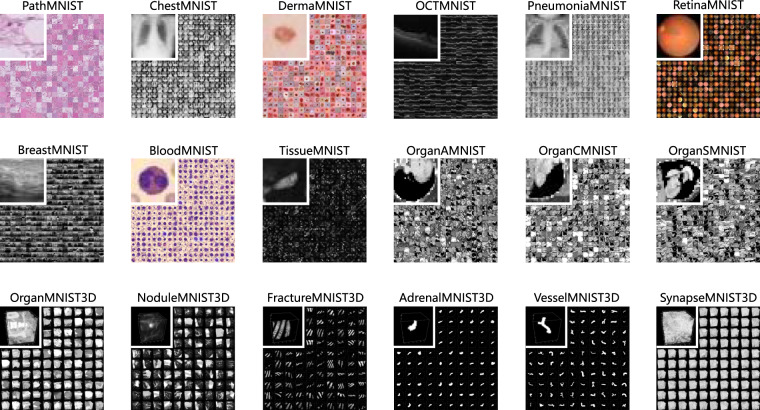
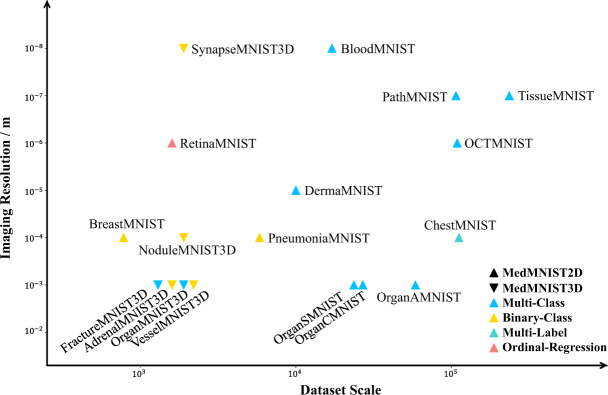
We introduce MedMNIST v2 , a large-scale MNIST-like dataset collection of standardized biomedical images, including 12 datasets for 2D and 6 datasets for 3D. All images are pre-processed into a small size of 28 × 28 (2D) or 28 × 28 × 28 (3D) with the corresponding classification labels so that no background knowledge is required for users. Covering primary data modalities in biomedical images, MedMNIST v2 is designed to perform classification on lightweight 2D and 3D images with various dataset scales (from 100 to 100,000) and diverse tasks (binary/multi-class, ordinal regression, and multi-label). The resulting dataset, consisting of 708,069 2D images and 9,998 3D images in total, could support numerous research/educational purposes in biomedical image analysis, computer vision, and machine learning. We benchmark several baseline methods on MedMNIST v2, including 2D/3D neural networks and open-source/commercial AutoML tools. The data and code are publicly available at https://medmnist.com/ .
Overview
AI snapshot
Written from the paper’s full text.
TL;DR
MedMNIST v2 is a standardized MNIST-like benchmark of 12 2D datasets (708,069 images) and 6 3D datasets (9,998 images) for biomedical image classification at 28×28 or 28×28×28. It benchmarks ResNets and AutoML tools, finding ResNets competitive and 3D/ACS convolutions generally better than 2.5D on 3D datasets.
Key findings
- MedMNIST v2 contains 12 2D datasets totaling 708,069 images and 6 3D datasets totaling 9,998 images, all preprocessed to 28×28 (2D) or 28×28×28 (3D), covering binary/multi-class, ordinal regression, and multi-label tasks.
- On MedMNIST2D, Google AutoML Vision achieved the highest average AUC (0.927), close to ResNet-18 (224) (0.925) and ResNet-50 (224) (0.923); ResNets had higher average ACC (0.821 for ResNet-18/50 at 224) than Google AutoML Vision (0.809). auto-sklearn was lowest (average AUC 0.878, ACC 0.722).
- On MedMNIST3D, ResNet-50 + 3D convolution achieved the best average AUC (0.863) and ACC (0.780); ResNet-18 + 3D was 0.849/0.767, auto-sklearn 0.815/0.765, and AutoKeras 0.763/0.737. 2.5D models were inferior to 3D and ACS models.
- Under the same ResNet backbone, 224 resolution generally outperformed 28 on 2D; at 28, ResNet-18 often outperformed ResNet-50. For 3D, 3D and ACS models were comparable, and ResNet-50 with 3D convolution surpassed ResNet-18.
Methods
- Dataset construction: 12 2D and 6 3D datasets from source datasets, preprocessed to MNIST-like sizes via cubic spline interpolation; official splits used where available, otherwise 9:1 train-validation from training or 7:1:2 patient-level random split; labels from source datasets, sometimes simplified.
- Benchmark: ResNet-18/50 with early stopping for 2D (28 or 224 input) and ResNet-18/50 with 2.5D/3D/ACS convolutions for 3D; auto-sklearn, AutoKeras, and Google AutoML Vision (2D only); training used cross-entropy, Adam, batch size 128 for 2D and 32 for 3D, 100 epochs, and learning-rate decay.
- Evaluation: AUC and ACC per dataset and average over MedMNIST2D/MedMNIST3D; each benchmark was repeated at least 3 times.
Limitations
- Stated: the dataset is NOT intended for clinical use; substantially reducing resolution may yield images insufficient to represent and capture different disease pathologies.
- Stated: labels could be simplified (merged or deleted classes) if classification on small images is too difficult.
- Evident from the text: the benchmark focuses on the machine-learning part rather than end-to-end systems; 3D datasets are much smaller (9,998 total) than 2D datasets (708,069), and AdrenalMNIST3D source CT scans are not provided due to patient privacy.
Model-written summary. Check it against the paper before relying on it.
Integrity signals
Registry
Cites
Statistics
Figures
Verification
Claims the paper makes
27 No basis given · 16 Own result · 7 Own interpretation · 6 Supported · 4 Own method · 3 Partly supported · 3 Sources not found · 3 No full text of the sources · 1 Supported so far · 1 Couldn’t confirm · accuracy not yet measured
The sources with a verdict support this claim; the rest weren’t checked yet, have no full text we could read, or their verdicts aren’t rated yet.
In the paper
“The BloodMNIST is based on a dataset26,27 of individual normal cells, captured from individuals without infection, hematologic or oncologic disease and free of any pharmacologic treatment at the moment of blood collection. It contains a total of 17,092 images and is organized into 8 classes.”
§ MedMNIST v2 - A large-scale lightweight benchmark for 2D and 3D biomedical image classification > Methods > Details for MedMNIST2D
What the sources say
- Supportedcites [26] Acevedo, A. et al. A dataset of microscopic peripheral blood cell images for development of automatic recognition systems. Data in Brief 30, 105474, https://doi.org/10.1016/j.dib.2020.105474 (2020). source
The Abstract states that the dataset contains 17,092 images of individual normal cells, organized into eight groups, and describes the donors’ health and treatment criteria. The Data section confirms the image count, eight groups, and pixel dimensions of the images. This paper documents the source dataset identified in the citing sentence. (LLM, conf=0.92)
- Not checked — no full text of the sourcecites [27] Acevedo, A. et al. A dataset for microscopic peripheral blood cell images for development of automatic recognition systems. Mendeley Data https://doi.org/10.17632/snkd93bnjr.1 (2020). source
plainn = 17,092- Asserted: passes — The authors put it forward as true.
- Checkable: passes — It can be checked against evidence.
- Load-bearing: unclear — It is unclear whether the paper’s conclusions depend on it.
- Based: passes — The paper gives a reason why it holds.
- Supported
The paper states this without a source or data behind it here, so there is nothing to check it against. The quote shows it is in the paper.
In the paper
“Furthermore, we provide standard train-validation-test splits for all datasets in MedMNIST v2, therefore algorithms could be easily compared.”
§ MedMNIST v2 - A large-scale lightweight benchmark for 2D and 3D biomedical image classification > Background & Summary
plain- Asserted: passes — The authors put it forward as true.
- Checkable: passes — It can be checked against evidence.
- Load-bearing: passes — The paper’s conclusions depend on it.
- Based: passes — The paper gives a reason why it holds.
The paper states this without a source or data behind it here, so there is nothing to check it against. The quote shows it is in the paper.
In the paper
“All images are pre-processed into a small size of 28 × 28 (2D) or 28 × 28 × 28 (3D) with the corresponding classification labels so that no background knowledge is required for users.”
- Also stated in: § Design principles · plain
“All images are pre-processed into a MNIST-like format, i.e., 28 × 28 (2D) or 28 × 28 × 28 (3D), with cubic spline interpolation operation for image resizing.”
§ MedMNIST v2 - A large-scale lightweight benchmark for 2D and 3D biomedical image classification > Abstract
plain- Asserted: passes — The authors put it forward as true.
- Checkable: passes — It can be checked against evidence.
- Load-bearing: passes — The paper’s conclusions depend on it.
- Based: passes — The paper gives a reason why it holds.
- Rests on an assumption: Resizing biomedical images to 28 × 28 (2D) or 28 × 28 × 28 (3D) preserves sufficient information for meaningful classification.
- Also stated in: § Design principles · plain
The paper states this without a source or data behind it here, so there is nothing to check it against. The quote shows it is in the paper.
In the paper
“Covering primary data modalities in biomedical images, MedMNIST v2 is designed to perform classification on lightweight 2D and 3D images with various dataset scales (from 100 to 100,000) and diverse tasks (binary/multi-class, ordinal regression, and multi-label).”
§ MedMNIST v2 - A large-scale lightweight benchmark for 2D and 3D biomedical image classification > Abstract
plain- Asserted: passes — The authors put it forward as true.
- Checkable: passes — It can be checked against evidence.
- Load-bearing: passes — The paper’s conclusions depend on it.
- Based: passes — The paper gives a reason why it holds.
The paper states this without a source or data behind it here, so there is nothing to check it against. The quote shows it is in the paper.
In the paper
“Considering the popularity of 3D imaging in biomedical area, we carefully develop 6 3D datasets following the same design principle as 2D ones.”
§ MedMNIST v2 - A large-scale lightweight benchmark for 2D and 3D biomedical image classification > Background & Summary
plain- Asserted: passes — The authors put it forward as true.
- Checkable: passes — It can be checked against evidence.
- Load-bearing: passes — The paper’s conclusions depend on it.
- Based: passes — The paper gives a reason why it holds.
The paper states this without a source or data behind it here, so there is nothing to check it against. The quote shows it is in the paper.
In the paper
“As MedMNIST v1 is more medical-oriented, we additionally provide 2 2D bioimage datasets.”
§ MedMNIST v2 - A large-scale lightweight benchmark for 2D and 3D biomedical image classification > Background & Summary
plain- Asserted: passes — The authors put it forward as true.
- Checkable: passes — It can be checked against evidence.
- Load-bearing: unclear — It is unclear whether the paper’s conclusions depend on it.
- Based: passes — The paper gives a reason why it holds.
In the paper
“As an MNIST-like8 dataset collection to perform classification tasks on small images, it primarily focuses on the machine learning part rather than the end-to-end system.”
§ MedMNIST v2 - A large-scale lightweight benchmark for 2D and 3D biomedical image classification > Background & Summary
What the sources say
- Not matchedcites [8] LeCun, Y., Cortes, C. & Burges, C. Mnist handwritten digit database. http://yann.lecun.com/exdb/mnist/ (2010).
Couldn’t be matched to a paper in Crossref, so it can’t be checked.
plain- Asserted: passes — The authors put it forward as true.
- Checkable: passes — It can be checked against evidence.
- Load-bearing: unclear — It is unclear whether the paper’s conclusions depend on it.
- Based: passes — The paper gives a reason why it holds.
- Not matched
A result the paper reports from its own data — it cites no other source for it, so there is none to check. The quote shows it is in the paper.
In the paper
“The resulting dataset, consisting of 708,069 2D images and 9,998 3D images in total, could support numerous research/educational purposes in biomedical image analysis, computer vision, and machine learning.”
§ MedMNIST v2 - A large-scale lightweight benchmark for 2D and 3D biomedical image classification > Abstract
plain- Asserted: passes — The authors put it forward as true.
- Checkable: passes — It can be checked against evidence.
- Load-bearing: passes — The paper’s conclusions depend on it.
- Based: passes — The paper gives a reason why it holds.
A result the paper reports from its own data — it cites no other source for it, so there is none to check. The quote shows it is in the paper.
In the paper
“2.5D models have poorer performance compared with 3D and ACS models”
§ MedMNIST v2 - A large-scale lightweight benchmark for 2D and 3D biomedical image classification > Technical Validation > Benchmark on each dataset
plain- Asserted: passes — The authors put it forward as true.
- Checkable: passes — It can be checked against evidence.
- Load-bearing: unclear — It is unclear whether the paper’s conclusions depend on it.
- Based: passes — The paper gives a reason why it holds.
A result the paper reports from its own data — it cites no other source for it, so there is none to check. The quote shows it is in the paper.
In the paper
“Auto-sklearn is superior to ResNet-18 + 2.5D and ResNet-50 + 2.5D in general”
§ MedMNIST v2 - A large-scale lightweight benchmark for 2D and 3D biomedical image classification > Technical Validation > Benchmark on each dataset
plaindirect- Asserted: passes — The authors put it forward as true.
- Checkable: passes — It can be checked against evidence.
- Load-bearing: unclear — It is unclear whether the paper’s conclusions depend on it.
- Based: passes — The paper gives a reason why it holds.
- It may state two separate claims as one. 31
- Probably not a substantial claim. 17
Every source the paper cites for this claim was checked and supports it.
In the paper
“MedMNIST v2 is extended from our preliminary version, MedMNIST v19, with 10 2D datasets for medical image classification.”
§ MedMNIST v2 - A large-scale lightweight benchmark for 2D and 3D biomedical image classification > Background & Summary
What the sources say
- Supportedcites [9] Yang, J., Shi, R. & Ni, B. Medmnist classification decathlon: A lightweight automl benchmark for medical image analysis. In International Symposium on Biomedical Imaging, 191–195 (2021). source
The Introduction (p. 1) presents MedMNIST as a collection of 10 datasets for classification on 28 × 28 images, and the Dataset section (p. 2) describes those images as 2D. The citation identifies the preliminary MedMNIST collection; this earlier paper need not describe the later v2 extension. (LLM, conf=0.88)
plaindirect- Asserted: passes — The authors put it forward as true.
- Checkable: passes — It can be checked against evidence.
- Load-bearing: unclear — It is unclear whether the paper’s conclusions depend on it.
- Based: passes — The paper gives a reason why it holds.
It may state two separate claims as one.
- Supported
Every source the paper cites for this claim was checked and supports it.
In the paper
“Each subset is saved in NumPy39 npz format, named as <data> mnist.npz for MedMNIST2D and <data> mnist3d.npz for MedMNIST3D, and is comprised of 6 keys (“train_images”, “train_labels”, “val_images”, “val_labels”, “test_images”, “test_labels”).”
§ MedMNIST v2 - A large-scale lightweight benchmark for 2D and 3D biomedical image classification > Data Records
What the sources say
- Supportedcites [39] Harris, C. R. et al. Array programming with numpy. Nature 585, 357–362 (2020). source
The citation is attached to “NumPy,” identifying the software rather than sourcing the MedMNIST file names or six keys. The Main section describes NumPy as an open-source library providing a multidimensional Python array object, which supports that identification. (LLM, conf=0.91)
plain- Asserted: passes — The authors put it forward as true.
- Checkable: passes — It can be checked against evidence.
- Load-bearing: fails — The paper’s conclusions may not depend on it.
- Based: passes — The paper gives a reason why it holds.
Probably not a substantial claim. The paper’s conclusions may not depend on it. It may state two separate claims as one.
- Supported
Every source the paper cites for this claim was checked and supports it.
In the paper
“The VesselMNIST3D is based on an open-access 3D intracranial aneurysm dataset, IntrA34, containing 103 3D models (meshes) of entire brain vessels collected by reconstructing MRA images. 1,694 healthy vessel segments and 215 aneurysm segments are generated automatically from the complete models.”
§ MedMNIST v2 - A large-scale lightweight benchmark for 2D and 3D biomedical image classification > Methods > Details for MedMNIST3D
What the sources say
- Supportedcites [34] Yang, X., Xia, D., Kin, T. & Igarashi, T. Intra: 3d intracranial aneurysm dataset for deep learning. In Conference on Computer Vision and Pattern Recognition (2020). source
Section 3.1 (Data) identifies IntrA as a dataset of 103 complete 3D brain-vessel models reconstructed from MRA images. It also reports 1,694 healthy vessel segments and 215 aneurysm segments generated automatically from those models. (LLM, conf=0.94)
plain- Asserted: passes — The authors put it forward as true.
- Checkable: passes — It can be checked against evidence.
- Load-bearing: unclear — It is unclear whether the paper’s conclusions depend on it.
- Based: passes — The paper gives a reason why it holds.
It may state two separate claims as one.
- Supported
The cited sources support only part of this claim — read each source’s verdict below.
In the paper
“The SynapseMNIST3D is a new 3D volume dataset to classify whether a synapse is excitatory or inhibitory. It uses a 3D image volume of an adult rat acquired by a multi-beam scanning electron microscope.”
§ MedMNIST v2 - A large-scale lightweight benchmark for 2D and 3D biomedical image classification > Methods > Details for MedMNIST3D
What the sources say
- Partly supportedcites [37] Wei, D. et al. Mitoem dataset: Large-scale 3d mitochondria instance segmentation from em images. In Conference on Medical Image Computing and Computer Assisted Intervention, 66–76 (Springer, 2020). sourceExperimental — accuracy not yet measured
The Dataset Acquisition section (page unavailable) says the adult-rat tissue used for MitoEM-R was imaged with a multi-beam scanning electron microscope. But the Introduction identifies MitoEM as a 3D mitochondria instance-segmentation dataset; our copy does not identify SynapseMNIST3D or describe excitatory-versus-inhibitory synapse classification. (LLM, conf=0.88)
plainSingle case- Asserted: passes — The authors put it forward as true.
- Checkable: passes — It can be checked against evidence.
- Load-bearing: passes — The paper’s conclusions depend on it.
- Based: passes — The paper gives a reason why it holds.
It may state two separate claims as one.
- Partly supported
The cited sources support only part of this claim — read each source’s verdict below.
In the paper
“We use the BBBC05128, available from the Broad Bioimage Benchmark Collection29. The dataset contains 236,386 human kidney cortex cells, segmented from 3 reference tissue specimens and organized into 8 categories.”
§ MedMNIST v2 - A large-scale lightweight benchmark for 2D and 3D biomedical image classification > Methods > Details for MedMNIST2D
What the sources say
- Partly supportedcites [28] Woloshuk, A. et al. In situ classification of cell types in human kidney tissue using 3d nuclear staining. Cytometry Part A (2020). sourceExperimental — accuracy not yet measured
The Data organization section describes approximately 230,000 nuclei from three reference tissue specimens, and the Results describe eight classification categories and derived 2D datasets. The copy does not give the exact count of 236,386 or identify the dataset as TissueMNIST or BBBC051; it says the dataset would be made available through an online repository such as the Broad Bioimage Benchmark Collection. (LLM, conf=0.86)
- Supportedcites [29] Ljosa, V., Sokolnicki, K. L. & Carpenter, A. E. Annotated high-throughput microscopy image sets for validation. Nature methods 9, 637–637 (2012). source
Citation 29 is attached to the Broad Bioimage Benchmark Collection, not to the BBBC051 dataset details. The paper describes the BBBC as a publicly available collection of microscopy image sets and gives its access URL. The dataset-specific figures in the citing sentence are not attributed to this citation. (LLM, conf=0.93)
plainn = 3- Asserted: passes — The authors put it forward as true.
- Checkable: passes — It can be checked against evidence.
- Load-bearing: unclear — It is unclear whether the paper’s conclusions depend on it.
- Based: passes — The paper gives a reason why it holds.
It may state two separate claims as one.
- Partly supported
The cited sources support only part of this claim — read each source’s verdict below.
In the paper
“The DermaMNIST is based on the HAM1000019–21, a large collection of multi-source dermatoscopic images of common pigmented skin lesions. The dataset consists of 10,015 dermatoscopic images categorized as 7 different diseases, formulized as a multi-class classification task.”
§ MedMNIST v2 - A large-scale lightweight benchmark for 2D and 3D biomedical image classification > Methods > Details for MedMNIST2D
What the sources say
- Partly supportedcites [19] Tschandl, P., Rosendahl, C. & Kittler, H. The ham10000 dataset, a large collection of multi-source dermatoscopic images of common pigmented skin lesions. Scientific data 5, 180161 (2018). sourceExperimental — accuracy not yet measured
The Abstract reports 10,015 dermatoscopic images, and Methods (“Unifying pathologic diagnoses”) says HAM10000 has seven diagnostic classes intended as a benchmark for classification. The paper does not identify DermaMNIST or establish that DermaMNIST is based on HAM10000, so it supports the underlying dataset description but not that relationship. (LLM, conf=0.84)
- Not checked — no full text of the sourcecites [20] Tschandl, P. The HAM10000 dataset, a large collection of multi-source dermatoscopic images of common pigmented skin lesions. Harvard Dataverse https://doi.org/10.7910/DVN/DBW86T (2018). source
- Partly supportedcites [21] Codella, N. et al. Skin lesion analysis toward melanoma detection 2018: A challenge hosted by the international skin imaging collaboration (isic). Preprint at https://arxiv.org/abs/1902.03368v2 (2019). sourceExperimental — accuracy not yet measured
Section 2.3 (p. 4) reports 10,015 dermoscopic training images with seven classification labels and cites the HAM10000 paper, identified in the References (p. 8). It does not identify DermaMNIST, establish that DermaMNIST is based on HAM10000, or describe it as a 2D dataset; the 10,015 figure is stated for the challenge’s training set. (LLM, conf=0.88)
plain- Asserted: passes — The authors put it forward as true.
- Checkable: passes — It can be checked against evidence.
- Load-bearing: unclear — It is unclear whether the paper’s conclusions depend on it.
- Based: passes — The paper gives a reason why it holds.
It may state two separate claims as one.
- Partly supported
Every source the paper cites for this claim was checked and supports it.
In the paper
“The data files of MedMNIST v2 dataset can be accessed at Zenodo38. It contains 12 pre-processed 2D datasets (MedMNIST2D) and 6 pre-processed 3D datasets (MedMNIST3D).”
§ MedMNIST v2 - A large-scale lightweight benchmark for 2D and 3D biomedical image classification > Data Records
What the sources say
- Supportedcites [38] Yang, J. et al. Medmnist v2: A large-scale lightweight benchmark for 2d and 3d biomedical image classification. Zenodo https://doi.org/10.5281/zenodo.5208230 (2021). source
The Abstract states that MedMNIST v2 includes 12 2D and 6 3D datasets, with all images pre-processed. The Zenodo record’s Files section lists the downloadable dataset files, supporting the access claim. (LLM, conf=0.95)
plain- Asserted: passes — The authors put it forward as true.
- Checkable: passes — It can be checked against evidence.
- Load-bearing: unclear — It is unclear whether the paper’s conclusions depend on it.
- Based: passes — The paper gives a reason why it holds.
It may state two separate claims as one.
- Supported
Every source the paper cites for this claim was checked and supports it.
In the paper
“The BreastMNIST is based on a dataset25 of 780 breast ultrasound images. It is categorized into 3 classes: normal, benign, and malignant. As we use low-resolution images, we simplify the task into binary classification by combining normal and benign as positive and classifying them against malignant as negative.”
§ MedMNIST v2 - A large-scale lightweight benchmark for 2D and 3D biomedical image classification > Methods > Details for MedMNIST2D
What the sources say
- Supportedcites [25] Al-Dhabyani, W., Gomaa, M., Khaled, H. & Fahmy, A. Dataset of breast ultrasound images. Data in Brief 28, 104863, https://doi.org/10.1016/j.dib.2019.104863 (2020). source
The Data section reports 780 breast ultrasound images categorized as normal, benign, and malignant, supporting the dataset description for which this source is cited. The binary grouping is described as the citing authors’ own simplification, not as a feature attributed to this source. (LLM, conf=0.91)
plain- Asserted: passes — The authors put it forward as true.
- Checkable: passes — It can be checked against evidence.
- Load-bearing: fails — The paper’s conclusions may not depend on it.
- Based: passes — The paper gives a reason why it holds.
Probably not a substantial claim. The paper’s conclusions may not depend on it. It may state two separate claims as one.
- Supported
The cited sources that could be checked couldn’t confirm or dispute this claim.
In the paper
“The source of the OrganMNIST3D is the same as that of the Organ{A,C,S}MNIST. Instead of 2D images, we directly use the 3D bounding boxes and process the images into 28 × 28 × 28 to perform multi-class classification of 11 body organs.”
§ MedMNIST v2 - A large-scale lightweight benchmark for 2D and 3D biomedical image classification > Methods > Details for MedMNIST3D
What the sources say
- Could not verifycites [30] Bilic, P. et al. The liver tumor segmentation benchmark (lits). Medical Image Analysis 84,102680 (2023). sourceExperimental — accuracy not yet measured
The Methods > Dataset passage describes LiTS as a collection of abdominal CT scans, but does not identify it as the source of OrganMNIST3D or Organ{A,C,S}MNIST. Searches for those dataset names and for 3D bounding boxes, 28 × 28 × 28 images, and classification of 11 organs found no supporting passage in our copy. (LLM, conf=0.75)
- Not checked — no full text of the sourcecites [31] Xu, X. et al. Efficient multiple organ localization in ct image using 3d region proposal network. IEEE Transactions on Medical Imaging 38, 1885–1898 (2019). source
plain- Asserted: passes — The authors put it forward as true.
- Checkable: passes — It can be checked against evidence.
- Load-bearing: unclear — It is unclear whether the paper’s conclusions depend on it.
- Based: passes — The paper gives a reason why it holds.
It may state two separate claims as one.
- Could not verify
Every source the paper cites for this claim was checked and supports it.
In the paper
“The NoduleMNIST3D is based on the LIDC-IDRI32, a large public lung nodule dataset, containing images from thoracic CT scans. The dataset is designed for both lung nodule segmentation and 5-level malignancy classification task. To perform binary classification, we categorize cases with malignancy level 1/2 into negative class and 4/5 into positive class, ignoring the cases with malignancy level 3.”
§ MedMNIST v2 - A large-scale lightweight benchmark for 2D and 3D biomedical image classification > Methods > Details for MedMNIST3D
What the sources say
- Supportedcites [32] Armato, S. G. III et al. The lung image database consortium (lidc) and image database resource initiative (idri): A completed reference database of lung nodules on ct scans. Medical Physics 38, 915–931, https://doi.org/10.1118/1.3528204 (2011). source
The citation is attached to the identification of LIDC-IDRI as a large, public dataset of lung nodules from thoracic CT scans. The paper reports 1018 thoracic CT scans (II.A), describes its nodule annotations (Results), and says the database is publicly available (II.E). The later binary-classification rule is presented as the citing authors’ own procedure, not as a finding attributed to this source. (LLM, conf=0.91)
plain- Asserted: passes — The authors put it forward as true.
- Checkable: passes — It can be checked against evidence.
- Load-bearing: unclear — It is unclear whether the paper’s conclusions depend on it.
- Based: passes — The paper gives a reason why it holds.
It may state two separate claims as one.
- Supported
The paper states this without a source or data behind it here, so there is nothing to check it against. The quote shows it is in the paper.
In the paper
“The MedMNIST v2 dataset consists of 12 2D and 6 3D standardized datasets from carefully selected sources covering primary data modalities (e.g., X-ray, OCT, ultrasound, CT, electron microscope), diverse classification tasks (binary/multi-class, ordinal regression, and multi-label) and dataset scales (from 100 to 100,000).”
§ MedMNIST v2 - A large-scale lightweight benchmark for 2D and 3D biomedical image classification > Methods > Design principles
plain- Asserted: passes — The authors put it forward as true.
- Checkable: passes — It can be checked against evidence.
- Load-bearing: passes — The paper’s conclusions depend on it.
- Based: passes — The paper gives a reason why it holds.
It may state two separate claims as one.
The paper states this without a source or data behind it here, so there is nothing to check it against. The quote shows it is in the paper.
In the paper
“The MedMNIST uses the classification labels from the source datasets directly in most cases, but the labels could be simplified (merged or deleted classes) if the classification tasks on the small images are too difficult.”
§ MedMNIST v2 - A large-scale lightweight benchmark for 2D and 3D biomedical image classification > Methods > Design principles
hedgedconditional- Asserted: passes — The authors put it forward as true.
- Checkable: passes — It can be checked against evidence.
- Load-bearing: fails — The paper’s conclusions may not depend on it.
- Based: passes — The paper gives a reason why it holds.
Probably not a substantial claim. The paper’s conclusions may not depend on it. It may state two separate claims as one.
- Rests on an assumption: The classification labels from the source datasets are accurate and suitable for the benchmark tasks.
A result the paper reports from its own data — it cites no other source for it, so there is none to check. The quote shows it is in the paper.
In the paper
“We introduce MedMNIST v2, a large-scale MNIST-like dataset collection of standardized biomedical images, including 12 datasets for 2D and 6 datasets for 3D.”
- Also stated in: § Background & Summary · plain
“MedMNIST v2 is a large-scale benchmark for 2D and 3D biomedical image classification, covering 12 2D datasets with 708,069 images and 6 3D datasets with 9,998 images.”
§ MedMNIST v2 - A large-scale lightweight benchmark for 2D and 3D biomedical image classification > Abstract
plain- Asserted: passes — The authors put it forward as true.
- Checkable: passes — It can be checked against evidence.
- Load-bearing: passes — The paper’s conclusions depend on it.
- Based: passes — The paper gives a reason why it holds.
It may state two separate claims as one.
- Also stated in: § Background & Summary · plain
The paper states this without a source or data behind it here, so there is nothing to check it against. The quote shows it is in the paper.
In the paper
“All source datasets are either associated with the Creative Commons (CC) Licenses or developed by us, which allows us to develop derivative datasets based on them.”
§ MedMNIST v2 - A large-scale lightweight benchmark for 2D and 3D biomedical image classification > Methods > Design principles
plaindirect- Asserted: passes — The authors put it forward as true.
- Checkable: passes — It can be checked against evidence.
- Load-bearing: passes — The paper’s conclusions depend on it.
- Based: passes — The paper gives a reason why it holds.
It may state two separate claims as one.
The paper states this without a source or data behind it here, so there is nothing to check it against. The quote shows it is in the paper.
In the paper
“Covering primary data modalities in biomedical images, MedMNIST v2 is designed to perform classification on lightweight 2D and 3D images with various dataset scales (from 100 to 100,000) and diverse tasks (binary/multi-class, ordinal regression, and multi-label).”
§ MedMNIST v2 - A large-scale lightweight benchmark for 2D and 3D biomedical image classification > Abstract
plain- Asserted: passes — The authors put it forward as true.
- Checkable: passes — It can be checked against evidence.
- Load-bearing: passes — The paper’s conclusions depend on it.
- Based: passes — The paper gives a reason why it holds.
It may state two separate claims as one.
The paper states this without a source or data behind it here, so there is nothing to check it against. The quote shows it is in the paper.
In the paper
“It is designed to be:Diverse: It covers diverse data modalities, dataset scales (from 100 to 100,000), and tasks (binary/multi-class, multi-label, and ordinal regression).”
§ MedMNIST v2 - A large-scale lightweight benchmark for 2D and 3D biomedical image classification > Background & Summary
plain- Asserted: passes — The authors put it forward as true.
- Checkable: passes — It can be checked against evidence.
- Load-bearing: passes — The paper’s conclusions depend on it.
- Based: passes — The paper gives a reason why it holds.
It may state two separate claims as one.
The paper states this without a source or data behind it here, so there is nothing to check it against. The quote shows it is in the paper.
In the paper
“Standardized: Each sub-dataset is pre-processed into the same format (see details in Methods), which requires no background knowledge for users.”
§ MedMNIST v2 - A large-scale lightweight benchmark for 2D and 3D biomedical image classification > Background & Summary
plaindirect- Asserted: passes — The authors put it forward as true.
- Checkable: passes — It can be checked against evidence.
- Load-bearing: passes — The paper’s conclusions depend on it.
- Based: passes — The paper gives a reason why it holds.
It may state two separate claims as one.
The paper states this without a source or data behind it here, so there is nothing to check it against. The quote shows it is in the paper.
In the paper
“Some datasets are under CC-BY-NC license; we have contacted the authors and obtained the permission to re-distribute the datasets.”
§ MedMNIST v2 - A large-scale lightweight benchmark for 2D and 3D biomedical image classification > Methods > Design principles
plain- Asserted: passes — The authors put it forward as true.
- Checkable: passes — It can be checked against evidence.
- Load-bearing: unclear — It is unclear whether the paper’s conclusions depend on it.
- Based: passes — The paper gives a reason why it holds.
It may state two separate claims as one.
A result the paper reports from its own data — it cites no other source for it, so there is none to check. The quote shows it is in the paper.
In the paper
““{train,val,test}_labels”: an array containing ground-truth labels, with a shape of N × 1 for multi-class/binary-class/ordinal regression datasets, of N × L for multi-lable binary-class datasets. N denotes the number of samples in training/validation/test set and L denotes the number of task labels in the multi-label dataset (i.e., 14 for the ChestMNIST).”
§ MedMNIST v2 - A large-scale lightweight benchmark for 2D and 3D biomedical image classification > Data Records
plain- Asserted: passes — The authors put it forward as true.
- Checkable: passes — It can be checked against evidence.
- Load-bearing: fails — The paper’s conclusions may not depend on it.
- Based: passes — The paper gives a reason why it holds.
Probably not a substantial claim. The paper’s conclusions may not depend on it. It may state two separate claims as one.
A result the paper reports from its own data — it cites no other source for it, so there is none to check. The quote shows it is in the paper.
In the paper
““{train,val,test}_images”: an array containing images, with a shape of N × 28 × 28 for 2D gray-scale datasets, of N × 28 × 28 × 3 for 2D RGB datasets, of N × 28 × 28 × 28 for 3D datasets.”
§ MedMNIST v2 - A large-scale lightweight benchmark for 2D and 3D biomedical image classification > Data Records
plain- Asserted: passes — The authors put it forward as true.
- Checkable: passes — It can be checked against evidence.
- Load-bearing: fails — The paper’s conclusions may not depend on it.
- Based: passes — The paper gives a reason why it holds.
Probably not a substantial claim. The paper’s conclusions may not depend on it. It may state two separate claims as one.
In the paper
“The RetinaMNIST is based on the DeepDRiD24 challenge, which provides a dataset of 1,600 retina fundus images. The task is ordinal regression for 5-level grading of diabetic retinopathy severity.”
§ MedMNIST v2 - A large-scale lightweight benchmark for 2D and 3D biomedical image classification > Methods > Details for MedMNIST2D
What the sources say
- Not matchedcites [24] DeepDRiD. The 2nd diabetic retinopathy–grading and image quality estimation challenge. https://isbi.deepdr.org/data.html (2020).
Couldn’t be matched to a paper in Crossref, so it can’t be checked.
plain- Asserted: passes — The authors put it forward as true.
- Checkable: passes — It can be checked against evidence.
- Load-bearing: unclear — It is unclear whether the paper’s conclusions depend on it.
- Based: passes — The paper gives a reason why it holds.
It may state two separate claims as one.
- Not matched
The paper states this without a source or data behind it here, so there is nothing to check it against. The quote shows it is in the paper.
In the paper
“The data type of the dataset is uint8.”
§ MedMNIST v2 - A large-scale lightweight benchmark for 2D and 3D biomedical image classification > Data Records
plain- Asserted: passes — The authors put it forward as true.
- Checkable: passes — It can be checked against evidence.
- Load-bearing: fails — The paper’s conclusions may not depend on it.
- Based: passes — The paper gives a reason why it holds.
Probably not a substantial claim. The paper’s conclusions may not depend on it.
A result the paper reports from its own data — it cites no other source for it, so there is none to check. The quote shows it is in the paper.
In the paper
“For 2D datasets, Google AutoML Vision is well-performing in general, however it could not always win, even compared with the baseline ResNet-18 and ResNet-50.”
§ MedMNIST v2 - A large-scale lightweight benchmark for 2D and 3D biomedical image classification > Technical Validation > Benchmark on each dataset
hedged- Asserted: passes — The authors put it forward as true.
- Checkable: passes — It can be checked against evidence.
- Load-bearing: unclear — It is unclear whether the paper’s conclusions depend on it.
- Based: passes — The paper gives a reason why it holds.
It may state two separate claims as one.
A claim is checked only against the cited paper’s full text, never its abstract, and none is available for its sources.
In the paper
“The OCTMNIST is based on a prior dataset22,23 of 109,309 valid optical coherence tomography (OCT) images for retinal diseases. The dataset is comprised of 4 diagnosis categories, leading to a multi-class classification task.”
§ MedMNIST v2 - A large-scale lightweight benchmark for 2D and 3D biomedical image classification > Methods > Details for MedMNIST2D
What the sources say
- Not checked — no full text of the sourcecites [22] Kermany, D. S. et al. Identifying medical diagnoses and treatable diseases by image-based deep learning. Cell 172, 1122–1131.e9, https://doi.org/10.1016/j.cell.2018.02.010 (2018). source
- Not checked — no full text of the sourcecites [23] Kermany, D. S., Zhang, K. & Goldbaum, M. Large dataset of labeled optical coherence tomography (oct) and chest x-ray images https://doi.org/10.17632/rscbjbr9sj.3 (2018). source
plaindirect- Asserted: passes — The authors put it forward as true.
- Checkable: passes — It can be checked against evidence.
- Load-bearing: unclear — It is unclear whether the paper’s conclusions depend on it.
- Based: passes — The paper gives a reason why it holds.
It may state two separate claims as one.
A result the paper reports from its own data — it cites no other source for it, so there is none to check. The quote shows it is in the paper.
In the paper
“For MedMNIST2D, Google AutoML Vision outperforms all the other methods in average AUC, however, it is very close to the performance of baseline ResNets.”
§ MedMNIST v2 - A large-scale lightweight benchmark for 2D and 3D biomedical image classification > Technical Validation > Benchmark on each dataset
plaincorrelational- Asserted: passes — The authors put it forward as true.
- Checkable: passes — It can be checked against evidence.
- Load-bearing: unclear — It is unclear whether the paper’s conclusions depend on it.
- Based: passes — The paper gives a reason why it holds.
It may state two separate claims as one.
The paper states this without a source or data behind it here, so there is nothing to check it against. The quote shows it is in the paper.
In the paper
“AutoKeras performs well on datasets with large scales, however relatively worse on datasets with small scale.”
§ MedMNIST v2 - A large-scale lightweight benchmark for 2D and 3D biomedical image classification > Technical Validation > Benchmark on each dataset
plaincorrelational- Asserted: passes — The authors put it forward as true.
- Checkable: passes — It can be checked against evidence.
- Load-bearing: unclear — It is unclear whether the paper’s conclusions depend on it.
- Based: passes — The paper gives a reason why it holds.
It may state two separate claims as one.
A claim is checked only against the cited paper’s full text, never its abstract, and none is available for its sources.
In the paper
“The PneumoniaMNIST is based on a prior dataset22,23 of 5,856 pediatric chest X-Ray images. The task is binary-class classification of pneumonia against normal.”
§ MedMNIST v2 - A large-scale lightweight benchmark for 2D and 3D biomedical image classification > Methods > Details for MedMNIST2D
What the sources say
- Not checked — no full text of the sourcecites [22] Kermany, D. S. et al. Identifying medical diagnoses and treatable diseases by image-based deep learning. Cell 172, 1122–1131.e9, https://doi.org/10.1016/j.cell.2018.02.010 (2018). source
- Not checked — no full text of the sourcecites [23] Kermany, D. S., Zhang, K. & Goldbaum, M. Large dataset of labeled optical coherence tomography (oct) and chest x-ray images https://doi.org/10.17632/rscbjbr9sj.3 (2018). source
plain- Asserted: passes — The authors put it forward as true.
- Checkable: passes — It can be checked against evidence.
- Load-bearing: unclear — It is unclear whether the paper’s conclusions depend on it.
- Based: passes — The paper gives a reason why it holds.
It may state two separate claims as one.
In the paper
“The ChestMNIST is based on the NIH-ChestXray14 dataset18, a dataset comprising 112,120 frontal-view X-Ray images of 30,805 unique patients with the text-mined 14 disease labels, which could be formulized as a multi-label binary-class classification task.”
§ MedMNIST v2 - A large-scale lightweight benchmark for 2D and 3D biomedical image classification > Methods > Details for MedMNIST2D
What the sources say
- Not checked — no full text of the sourcecites [18] Wang, X. et al. Chestx-ray8: Hospital-scale chest x-ray database and benchmarks on weakly-supervised classification and localization of common thorax diseases. In Conference on Computer Vision and Pattern Recognition, 3462–3471 (2017). source
hedgedn = 30,805- Asserted: passes — The authors put it forward as true.
- Checkable: passes — It can be checked against evidence.
- Load-bearing: unclear — It is unclear whether the paper’s conclusions depend on it.
- Based: passes — The paper gives a reason why it holds.
It may state two separate claims as one.
A result the paper reports from its own data — it cites no other source for it, so there is none to check. The quote shows it is in the paper.
In the paper
“Under the same ResNet backbone, 2.5D models are inferior to 3D and ACS models and perform worse than auto-sklearn and AutoKeras.”
§ MedMNIST v2 - A large-scale lightweight benchmark for 2D and 3D biomedical image classification > Technical Validation > Benchmark on each dataset
plain- Asserted: passes — The authors put it forward as true.
- Checkable: passes — It can be checked against evidence.
- Load-bearing: unclear — It is unclear whether the paper’s conclusions depend on it.
- Based: passes — The paper gives a reason why it holds.
It may state two separate claims as one.
The paper states this without a source or data behind it here, so there is nothing to check it against. The quote shows it is in the paper.
In the paper
“They are sliced before being resized into 1 × 28 × 28.”
§ MedMNIST v2 - A large-scale lightweight benchmark for 2D and 3D biomedical image classification > Technical Validation > Benchmark on each dataset
plain- Asserted: passes — The authors put it forward as true.
- Checkable: passes — It can be checked against evidence.
- Load-bearing: passes — The paper’s conclusions depend on it.
- Based: passes — The paper gives a reason why it holds.
Probably not a substantial claim.
The paper states this without a source or data behind it here, so there is nothing to check it against. The quote shows it is in the paper.
In the paper
“Since there is no severe class imbalance on our datasets”
§ MedMNIST v2 - A large-scale lightweight benchmark for 2D and 3D biomedical image classification > Technical Validation > Evaluation
plain- Asserted: passes — The authors put it forward as true.
- Checkable: passes — It can be checked against evidence.
- Load-bearing: passes — The paper’s conclusions depend on it.
- Based: fails — The paper may give no reason why it holds.
Probably not a substantial claim. The paper may give no reason why it holds.
The paper states this without a source or data behind it here, so there is nothing to check it against. The quote shows it is in the paper.
In the paper
“Organ{A,C,S}MNIST and OrganMNIST3D are generated from the same source dataset, and share the same task and the same data split.”
§ MedMNIST v2 - A large-scale lightweight benchmark for 2D and 3D biomedical image classification > Technical Validation > Benchmark on each dataset
plaincorrelational- Asserted: passes — The authors put it forward as true.
- Checkable: passes — It can be checked against evidence.
- Load-bearing: unclear — It is unclear whether the paper’s conclusions depend on it.
- Based: passes — The paper gives a reason why it holds.
It may state two separate claims as one.
The paper states this without a source or data behind it here, so there is nothing to check it against. The quote shows it is in the paper.
In the paper
“On the other hand, OrganMNIST3D is resized into 28 × 28 × 28 directly.”
§ MedMNIST v2 - A large-scale lightweight benchmark for 2D and 3D biomedical image classification > Technical Validation > Benchmark on each dataset
plain- Asserted: passes — The authors put it forward as true.
- Checkable: passes — It can be checked against evidence.
- Load-bearing: passes — The paper’s conclusions depend on it.
- Based: passes — The paper gives a reason why it holds.
Probably not a substantial claim.
The paper states this without a source or data behind it here, so there is nothing to check it against. The quote shows it is in the paper.
In the paper
“Organ{A,C,S}MNIST are sampled slices of 3D bounding boxes of 3D CT images in axial/coronal/sagittal views (planes), respectively.”
§ MedMNIST v2 - A large-scale lightweight benchmark for 2D and 3D biomedical image classification > Technical Validation > Benchmark on each dataset
plain- Asserted: passes — The authors put it forward as true.
- Checkable: passes — It can be checked against evidence.
- Load-bearing: passes — The paper’s conclusions depend on it.
- Based: passes — The paper gives a reason why it holds.
Probably not a substantial claim.
A result the paper reports from its own data — it cites no other source for it, so there is none to check. The quote shows it is in the paper.
In the paper
“The ResNets surpass auto-sklearn and AutoKeras, and outperform Google AutoML Vision in average ACC.”
§ MedMNIST v2 - A large-scale lightweight benchmark for 2D and 3D biomedical image classification > Technical Validation > Benchmark on each dataset
plaindirect- Asserted: passes — The authors put it forward as true.
- Checkable: passes — It can be checked against evidence.
- Load-bearing: passes — The paper’s conclusions depend on it.
- Based: passes — The paper gives a reason why it holds.
It may state two separate claims as one.
What the paper did — it cites no source for this, so there is none to check. The quote shows it is in the paper.
In the paper
“All benchmark experiments are repeated at least 3 times for more stable results than in MedMNIST v1.”
§ MedMNIST v2 - A large-scale lightweight benchmark for 2D and 3D biomedical image classification > Background & Summary
plaindirect- Asserted: passes — The authors put it forward as true.
- Checkable: passes — It can be checked against evidence.
- Load-bearing: fails — The paper’s conclusions may not depend on it.
- Based: passes — The paper gives a reason why it holds.
Probably not a substantial claim. The paper’s conclusions may not depend on it.
None of the sources cited for this claim could be matched to a paper in Crossref, so there is nothing to check it against.
In the paper
“It is as diverse as the VDD4 and MSD5 to fairly evaluate the generalizable performance of machine learning algorithms in different settings, but both 2D and 3D biomedical images are provided.”
§ MedMNIST v2 - A large-scale lightweight benchmark for 2D and 3D biomedical image classification > Background & Summary
What the sources say
- Not matchedcites VDD4
Couldn’t be matched to a paper in Crossref, so it can’t be checked.
- Not matchedcites MSD5
Couldn’t be matched to a paper in Crossref, so it can’t be checked.
plain- Asserted: passes — The authors put it forward as true.
- Checkable: passes — It can be checked against evidence.
- Load-bearing: passes — The paper’s conclusions depend on it.
- Based: passes — The paper gives a reason why it holds.
It may state two separate claims as one.
- Not matched
A conclusion the paper draws from its own results — it cites no other source for it, so there is none to check. The quote shows it is in the paper.
In the paper
“The resulting dataset, consisting of 708,069 2D images and 9,998 3D images in total, could support numerous research/educational purposes in biomedical image analysis, computer vision, and machine learning.”
§ MedMNIST v2 - A large-scale lightweight benchmark for 2D and 3D biomedical image classification > Abstract
hedged- Asserted: passes — The authors put it forward as true.
- Checkable: fails — It may be too vague to check against evidence.
- Load-bearing: passes — The paper’s conclusions depend on it.
- Based: passes — The paper gives a reason why it holds.
Probably not a substantial claim. It may be too vague to check against evidence.
- Rests on an assumption: Resizing biomedical images to 28 × 28 (2D) or 28 × 28 × 28 (3D) preserves sufficient information for meaningful classification.
What the paper did — it cites no source for this, so there is none to check. The quote shows it is in the paper.
In the paper
“For the dataset without an official split, we split the dataset randomly at the patient level with a ratio of 7:1:2 into training-validation-test.”
§ MedMNIST v2 - A large-scale lightweight benchmark for 2D and 3D biomedical image classification > Methods > Design principles
plain- Asserted: passes — The authors put it forward as true.
- Checkable: passes — It can be checked against evidence.
- Load-bearing: passes — The paper’s conclusions depend on it.
- Based: passes — The paper gives a reason why it holds.
Probably not a substantial claim.
- Rests on an assumption: Patient-level random splitting avoids data leakage for datasets without official splits.
A conclusion the paper draws from its own results — it cites no other source for it, so there is none to check. The quote shows it is in the paper.
In the paper
“The diverse dataset design could lead to diverse task difficulty, which is desirable as a biomedical image classification benchmark.”
§ MedMNIST v2 - A large-scale lightweight benchmark for 2D and 3D biomedical image classification > Methods > Design principles
hedgedconditional- Asserted: passes — The authors put it forward as true.
- Checkable: fails — It may be too vague to check against evidence.
- Load-bearing: passes — The paper’s conclusions depend on it.
- Based: passes — The paper gives a reason why it holds.
Probably not a substantial claim. It may be too vague to check against evidence.
What the paper did — it cites no source for this, so there is none to check. The quote shows it is in the paper.
In the paper
“We use the official data split from source dataset (if provided) to avoid data leakage.”
§ MedMNIST v2 - A large-scale lightweight benchmark for 2D and 3D biomedical image classification > Methods > Design principles
plaindirect- Asserted: passes — The authors put it forward as true.
- Checkable: passes — It can be checked against evidence.
- Load-bearing: passes — The paper’s conclusions depend on it.
- Based: passes — The paper gives a reason why it holds.
Probably not a substantial claim.
- Rests on an assumption: The official data splits from source datasets avoid data leakage.
A conclusion the paper draws from its own results — it cites no other source for it, so there is none to check. The quote shows it is in the paper.
In the paper
“ACC could also serve as a good metric”
§ MedMNIST v2 - A large-scale lightweight benchmark for 2D and 3D biomedical image classification > Technical Validation > Evaluation
hedged- Asserted: passes — The authors put it forward as true.
- Checkable: fails — It may be too vague to check against evidence.
- Load-bearing: fails — The paper’s conclusions may not depend on it.
- Based: passes — The paper gives a reason why it holds.
Probably not a substantial claim. It may be too vague to check against evidence. The paper’s conclusions may not depend on it.
What the paper did — it cites no source for this, so there is none to check. The quote shows it is in the paper.
In the paper
“We calculate the mean value of at least 3 trials for each method on each dataset.”
§ MedMNIST v2 - A large-scale lightweight benchmark for 2D and 3D biomedical image classification > Technical Validation > Benchmark on each dataset
plain- Asserted: passes — The authors put it forward as true.
- Checkable: passes — It can be checked against evidence.
- Load-bearing: passes — The paper’s conclusions depend on it.
- Based: passes — The paper gives a reason why it holds.
Probably not a substantial claim.
The paper relies on this without support.
The classification labels from the source datasets are accurate and suitable for the benchmark tasks.
“The MedMNIST uses the classification labels from the source datasets directly in most cases, but the labels could be simplified (merged or deleted classes) if the classification tasks on the small images are too difficult.”
The paper relies on this without support.
Resizing biomedical images to 28 × 28 (2D) or 28 × 28 × 28 (3D) preserves sufficient information for meaningful classification.
“All images are pre-processed into a MNIST-like format, i.e., 28 × 28 (2D) or 28 × 28 × 28 (3D), with cubic spline interpolation operation for image resizing.”
The paper relies on this without support.
The official data splits from source datasets avoid data leakage.
“We use the official data split from source dataset (if provided) to avoid data leakage.”
The paper relies on this without support.
Patient-level random splitting avoids data leakage for datasets without official splits.
“For the dataset without an official split, we split the dataset randomly at the patient level with a ratio of 7:1:2 into training-validation-test.”
The paper relies on this without support.
The selected 18 datasets are representative of primary data modalities and tasks in biomedical image analysis.
“The MedMNIST v2 dataset consists of 12 2D and 6 3D standardized datasets from carefully selected sources covering primary data modalities (e.g., X-ray, OCT, ultrasound, CT, electron microscope), diverse classification tasks (binary/multi-class, ordinal regression, and multi-label) and dataset scales (from 100 to 100,000).”
Citations
Cites
Deep Residual Learning for Image Recognition
He, K., Zhang, X., Ren, S., & Sun, J. (2016) · 2016 IEEE Conference on Computer Vision and Pattern Recognition (CVPR) · doi:10.1109/cvpr.2016.90 · Cited by 235,474
Adam: A Method for Stochastic Optimization
Kingma, D. P., & Ba, J. (2014) · arXiv · doi:10.48550/arxiv.1412.6980 · Cited by 98,946
Harris, C. R., Millman, K. J., van der Walt, S. J., Gommers, R., Virtanen, P., Cournapeau, D., Wieser, E., Taylor, J., Berg, S., Smith, N. J., et al. (2020) · Nature · doi:10.1038/s41586-020-2649-2 · Cited by 23,826
Advances in neural information processing systems 7
Cios, K. J., & Shields, M. E. (1997) · Neurocomputing · doi:10.1016/s0925-2312(97)90018-7 · Cited by 22,093
Harris, C., Millman, K., van der Walt, S., Gommers, R., Virtanen, P., Cournapeau, D., Wieser, E., Taylor, J., Berg, S., Smith, N., et al. (2020) · RePEc: Research Papers in Economics · Cited by 17,844
A survey on deep learning in medical image analysis
Litjens, G., Kooi, T., Bejnordi, B. E., Setio, A. A. A., Ciompi, F., Ghafoorian, M., van der Laak, J. A. W. M., van Ginneken, B., & Sánchez, C. I. (2017) · Medical Image Analysis · doi:10.1016/j.media.2017.07.005 · Cited by 15,332 · cited 7×
“AdrenalMNIST3D New Shape from Abdominal CT BC (2) 1,584 1,188/98/298”
BackgroundInfluentialnnU-Net: a self-configuring method for deep learning-based biomedical image segmentation
Isensee, F., Jaeger, P. F., Kohl, S. A. A., Petersen, J., & Maier-Hein, K. H. (2021) · Nature Methods · doi:10.1038/s41592-020-01008-z · Cited by 10,477 · cited 1×
“21 Dermatoscope MC (7) 10,015 7,007/1,003/2,005”
The use of the area under the ROC curve in the evaluation of machine learning algorithms
Bradley, A. P. (1997) · Pattern Recognition · doi:10.1016/s0031-3203(96)00142-2 · Cited by 7,217
Deep learning in medical image analysis
Shen, D., Wu, G., & Suk, H.-I. (2017) · Annual Review of Biomedical Engineering · doi:10.1146/annurev-bioeng-071516-044442 · Cited by 4,968
Identifying Medical Diagnoses and Treatable Diseases by Image-Based Deep Learning
Kermany, D. S., Goldbaum, M., Cai, W., Valentim, C. C. S., Liang, H., Baxter, S. L., McKeown, A., Yang, G., Wu, X., Yan, F., et al. (2018) · Cell · doi:10.1016/j.cell.2018.02.010 · Cited by 4,842
Research works printed but not linked: 1
- Pedregosa, F. et al. Scikit-learn: Machine learning in python. the Journal of machine Learning research 12, 2825–2830 (2011).
Cited by
Sorted by citations
Items 901–1,000 of 1,054
Secure and efficient federated learning using attribute-based homomorphic encryption
Obiri, I. A., Antwi‐Boasiako, E., Kuada, E., & Addobea, A. A. (2026) · Journal of Information Security and Applications · doi:10.1016/j.jisa.2026.104564
Towards Adaptive and Communication-Efficient Dynamic Federated Learning
Guo, S., Lv, J., Wang, Q., & Geng, X. (2026) · Machine Learning · doi:10.1007/s10994-026-07102-1
Granular-ball rough set for robust twin support vector classification in medical image detection
Gao, R., & Qi, K. (2026) · Applied Soft Computing · doi:10.1016/j.asoc.2026.115875
Brain-Inspired Fractional Convolution for Pathological Image Classification
Gu, L., Liu, Q., & Wang, G. (2026) · Lecture notes in computer science · doi:10.1007/978-981-95-9575-4_26
HASSL: Hierarchy-Aware Self-supervised Learning Framework for Single Cell Microscopy
Riel, J., Singh, V. M., Aryasomayajula, S. A., Chinbat, A., Leonhard, H., Ladenburger, M., Alexander, F., Choudhary, V., Laredo, F., Masserdotti, G., et al. (2026) · Lecture notes in computer science · doi:10.1007/978-3-032-36969-7_36
García-Hidalgo, C. (2026) · Journal of Imaging Informatics in Medicine · doi:10.1007/s10278-026-02107-7
Zatsarenko, R., Korobeinikov, D., Chuprov, S., & Reznik, L. (2026) · International Conference on Dependable Systems & Networks/Proceedings · doi:10.1109/dsn69566.2026.00055
“To study the improved learning efficiency, we perform an extensive evaluation of PID-MADE against competitor meth-ods on the four imaging datasets: FEMNIST [29], Pneumo-niaMNIST and BloodMNIST from MedMNISTv2 [30], and our own ITS.”
LLM-Defender: Leveraging Large Language Models for Data Poisoning Protection in Federated Learning
Zhou, X., Chen, G., Guo, Z., et al. (2026) · Lecture notes in computer science · doi:10.1007/978-981-92-2859-1_32
HGNet: Hypergraph-coordinated multi-scale spatial dependency-aware fusion for image classification
Zhou, X., Wang, N., Zhang, Y., & Jing, D. (2026) · Pattern Recognition · doi:10.1016/j.patcog.2026.114355
Geng, M., Chu, Y., Zhang, X., & Dong, J. (2026) · Lecture notes in computer science · doi:10.1007/978-981-92-2868-3_11
Photonic Tensor Processing Unit by Depthwise Separable Convolution
Pan, W., Chen, H., & Ji, C. (2026) · IEEE Photonics Technology Letters · doi:10.1109/lpt.2026.3713231
Contribution-Aware Coalition Federated Learning in Edge-Assisted Healthcare Monitoring Systems
Wu, H., Liu, Y., Zhang, W., et al. (2026) · International Conference on Communications · doi:10.1109/icc59461.2026.11586887
Adaptive Conformal Prediction for Reliable and Explainable Medical Image Classification
Octadion, O., Yudistira, N., & Muflikhah, L. (2026) · Lecture notes in computer science · doi:10.1007/978-981-92-2891-1_6
FedNLC: Personalized Federated Learning via Inverse-Norm Weighted Aggregation with Local Calibration
Cao, Y., Yan, Q., Lin, H., et al. (2026) · Lecture notes in computer science · doi:10.1007/978-981-92-3485-1_14
Steering Diffusion Models via Class-Contrastive Influence for Few-Shot Medical Classification
Kim, J., Esmaeili, E., & Qiu, Q. (2026) · Lecture notes in computer science · doi:10.1007/978-3-032-37517-9_27
Using Diffusion Models for Enhancing the Performance of Semi-supervised Image Classifiers
Orăşan, P.-D., Czibula, G., & Albu, A.-I. (2026) · Lecture notes in computer science · doi:10.1007/978-3-032-25029-2_23
Li, Z. Y., Mo, M., Du, C., & Wei, Z. (2026) · AI · doi:10.3390/ai7070264
CARE-FL: Fair collaborative learning for rare disease detection in decentralized healthcare
Khan, A. N., Rizwan, A., Ahmad, R., Khan, Q. W., Li, X., & kim, D. (2026) · Neurocomputing · doi:10.1016/j.neucom.2026.134539
Lan, X., Chen, W., Peng, Y., et al. (2026) · Lecture notes in computer science · doi:10.1007/978-981-92-3429-5_2
Li, X., Liu, Z., Wang, X., et al. (2026) · Lecture notes in computer science · doi:10.1007/978-981-92-3450-9_42
Self-citationGLEAM: Mitigating Barren Plateaus in Hybrid Quantum Machine Learning via Small-World Entanglement
Ding, Z., Xing, F., Xia, Y., & Zeng, P. (2026) · International Conference on Image Processing and Artificial Intelligence (ICIPAI) · doi:10.1109/icipai70034.2026.11605634
“• PneumoniaMNIST [42]: A dataset of pediatric chest X-ray images.”
Candar, A. E., & İni̇k, Ö. (2026) · International Symposium on AI-Driven Engineering Systems (ISADES) · doi:10.1109/isades69945.2026.11608095
“Both datasets are formulated as multi-class classification tasks with RGB images resized to 3 × 28 × 28 in MedMNIST v2 [7].”
InfluentialMISSC-DL: Deep Learning Approach for Medical Images Similarity Search and Classification
Abbassi, O., Kharmoum, N., Rhalem, W., et al. (2026) · Lecture notes in networks and systems · doi:10.1007/978-3-032-30563-3_38
Candar, A. E., & İni̇k, Ö. (2026) · doi:10.1109/isades69945.2026.11608178
“The standard split of 11,959 train / 1,712 validation / 3,421 test images was used [13].”
InfluentialAl-Fawa’reh, M., Kelly, L., Mašek, M., et al. (2026) · Lecture notes in computer science · doi:10.1007/978-3-032-31441-3_24
Paul, P. K., Ghosh, A., Chakraborty, D., & Das, D. (2026) · SSRN Electronic Journal · doi:10.2139/ssrn.7177158
Toward Autonomous Clinics: Human–Robot Collaboration in Clinical Care
Wu, X., Zhang, J., Xu, M., Chu, H. K., Chen, X., Zhong, P., Liu, B., He, M., & Shi, D. (2026) · MedComm · doi:10.1002/mco2.70885 · Cited by 1
“Good interaction design should prompt confirmation, slow or stop motion, trigger alerts, or transfer control back to clinicians when confidence falls, sensor data conflict, patient discomfort appears, or the task moves beyond its predefined boundary [ 62–64 ].”
Nguyen, M., Pham, T., Nguyen, L., Le, D., Pham, T. M., Pham, H. M., Nguyen, Q. D., Le, X. T., Huynh, A., Le, T. D., et al. (2026) · IEEE Access · doi:10.1109/access.2026.3717452
Boundary Sampling for Efficient Model Extraction
Chayim, D. J. B., Dor, M. B., Lenga, E., et al. (2026) · ACM Transactions on Intelligent Systems and Technology · doi:10.1145/3834856
GEANet: A Lightweight Stable Representation Network for Heterogeneous Federated Learning
Yu, L., & Gu, R. (2026) · International Conference on Artificial Intelligence, Big Data and Algorithms (CAIBDA) · doi:10.1109/caibda70336.2026.11621517
“[7] demonstrate that GEANet achieves favorable classification performance while maintaining relatively low parameter and computational costs.”
Zhou, R., Deng, W., Yu, W., et al. (2026) · Computer Methods and Programs in Biomedicine · doi:10.1016/j.cmpb.2026.109568
Panda, A., Pal, A. S., & Garain, U. (2025) · Indian Conference on Computer Vision, Graphics and Image Processing · doi:10.1145/3774521.3774601
Embedding-Consistent Contrastive Learning: A Robust Approach for Imbalanced Classification
Siamak, S., & Mansoori, E. G. (2025) · International Conference on Information and Knowledge Technology (IKT) · doi:10.1109/ikt69652.2025.11626677
“The experiments are conducted on the MedMNIST2D benchmark [20], a comprehensive collection of twelve medical image datasets designed to facilitate standardized evaluation across diverse imaging modalities, anatomical structures, and clinical tasks.”
Dharavath, S. B., & Mukkamala, H. S. (2025) · Indian Conference on Computer Vision, Graphics and Image Processing · doi:10.1145/3774521.3774600
H-QDCT: hierarchical quantum DCT for structural–textural feature fusion in medical imaging
Font-Aragonès, X., & Ballester, M. Á. G. (2026) · International Journal of Computer Assisted Radiology and Surgery · doi:10.1007/s11548-026-03764-3
DWT-Mamba: A Spatially-Aware State Space Model for Medical Image Classification
Dholey, M., Ahmed, R., Chatterjee, S., et al. (2025) · doi:10.1145/3774521.3774618
Kayaalp, K., & Onay, İ. (2026) · Engineering Perspective · doi:10.64808/engineeringperspective.1932616
PhD Forum: Learning Adaptive Adversarial Attacks for Medical AI via Reinforcement Learning
Fabiano, M. (2026) · doi:10.1109/smartcomp-companion70724.2026.00091
“Deep neural networks have achieved remarkable diagnostic accuracy in medical imaging, matching or exceeding expert clinicians in various tasks [1].”
Bioimage Synthesis and Detection: A Comparative Analysis of Generative Adversarial Networks
Sorgente, V., Verrillo, I., Biagiucci, D., et al. (2026) · Communications in computer and information science · doi:10.1007/978-3-032-34456-4_5
MUBA: Assuring medical image classifiers with Mix-Up Boundary Analysis
Poulett, W., Byfield, A., Wallace, B., Jose, A., Qayyum, A., Cohen, E. I., Ashraf, S. Q., Qadir, J., & Bilal, M. (2026) · Biomedical Signal Processing and Control · doi:10.1016/j.bspc.2026.111107
Latency-Optimal Adaptive Split Inference for Privacy-Preserving Cloud-Edge-End Collaboration
Li, Y., Zhang, P., & Au, M. H. (2026) · Lecture notes in computer science · doi:10.1007/978-981-92-5737-9_1
Data-Free Early Stopping for Federated Learning with Consensus of Local Task Vectors
Lee, Y., Lee, H., Jung, S., Luo, A., Gong, J., Cao, Y., & Kang, J. (2026) · IEEE International Conference on Distributed Computing Systems Workshops (ICDCSW) · doi:10.1109/icdcsw72724.2026.00012
“We compare the proposed framework with validation-based early stopping using validation loss or accuracy on three classification tasks: skin lesion, blood cell and colon pathology [22].”
MedLoRA: Low-Rank Few-Shot Adaptation of Vision-Language Models for Medical Images
Bai, B., Shih, T., & Miyata, K. (2026) · Communications in computer and information science · doi:10.1007/978-981-92-1546-1_26
Guo, Z., Zhu, J., Du, G., & Zhang, K. (2026) · ACM SIGKDD Conference on Knowledge Discovery and Data Mining (KDD) · doi:10.1145/3770855.3817728
Bilal, O., Li, Y., Asif, S., Zhao, M., & Li, X. (2026) · Journal of Bionic Engineering · doi:10.1007/s42235-026-00956-0
“The data utilized in this research originated from a publicly available Kaggle dataset provided by [29, 30].”
VisionDES: Robust and Explainable Dynamic Vision Ensemble
Juraev, F., Abuhamad, M., El–Sappagh, S., Woo, S. S., & Abuhmed, T. (2026) · ACM SIGKDD Conference on Knowledge Discovery and Data Mining (KDD) · doi:10.1145/3770855.3818121
Advancing Multimodal Fusion on Heterogeneous Medical Data with Hybrid Geometry Attention
Dhar, J., Pandey, M. K., Zaidi, N. A., Chen, C., Haghighat, M., Sohel, F. A., & Goyal, P. (2026) · ACM SIGKDD Conference on Knowledge Discovery and Data Mining (KDD) · doi:10.1145/3770855.3817885
Learning Faster without Deeper Networks: A*-Inspired Batch Selection for Efficient CNN Training
Shehu, A., Stastoli, E., & Çela, A. (2026) · International Conference on Control, Decision and Information Technologies (CoDIT) · doi:10.1109/codit70676.2026.11630921
“They follow the training protocol described in [4], which is publicly documented and identical across all twelve MedMNIST 2D tasks: 100 training epochs, cross-entropy loss (or binary cross-entropy for multi-label tasks), and Adam optimizer with the schedule reported by [4].”
InfluentialMIRROR: Multimodal Intelligent Radiology Reasoning and Observation ReporterPreprint
Nagarajan, V., & Venkatapathy, S. (2026) · SSRN Electronic Journal · doi:10.2139/ssrn.7245078
A lightweight dependency-based deep metric learning for medical image classification
Jun, J. S., Pu, W., Luo, Y., Feng, X., & Hu, D. (2026) · Biomedical Signal Processing and Control · doi:10.1016/j.bspc.2026.111210
CAViT - Channel-Aware Vision Transformer for Dynamic Feature Fusion
Safdar, A., & Saadeldin, M. (2026) · Communications in computer and information science · doi:10.1007/978-3-032-25809-0_17
General or Medical CLIP, Which One Shall We Choose?
Huang, H., Zanca, D., Eskofier, B. M., & Salin, E. (2026) · Lecture notes in computer science · doi:10.1007/978-3-032-35393-1_6
Pan, X., Wu, R., & Chen, J. (2026) · IEEE Access · doi:10.1109/access.2026.3717038
Purba, D. G. D., Aidha, D. F., Manurung, A. O., et al. (2026) · International Seminar on Intelligent Technology and Its Applications · doi:10.1109/isitia71267.2026.11642260
“The dataset used in this study is from the PneumoniaMNIST dataset, which is part of the MedMNIST collection and contains chest X-ray radiographic images in grayscale format [8], [9], [10].”
Wang, N., Zhang, Q., Zhang, H., et al. (2026) · Applied Soft Computing · doi:10.1016/j.asoc.2026.116214
AuxDenseFeatAlign: Auxiliary Dense Feature Alignment for Medical Incremental Learning
Roy, A., Bagwari, S., & Mazumder, P. (2026) · IEEE Guwahati Subsection Conference (GCON) · doi:10.1109/gcon69192.2026.11648884
“We evaluate our approach on four medical image datasets from the MedMNIST benchmark [26]: BloodMNIST [27] (microscopic, 8 classes), OrganAMNIST [28] (CT, 11 classes), PathMNIST [29] (pathology, 9 classes), and TissueMNIST [28] (microscopy, 8 classes).”
TCPA-MedMTL: A Task-Conditioned Prototype Adapter for Multi-Task Medical Image Classification
Lu, J., Liu, H., Li, W., et al. (2026) · International Conference on Computer Vision, Image and Deep Learning (CVIDL) · doi:10.1109/cvidl70130.2026.11637571
“MedMNIST v2 collects multiple standardized medical image classification datasets, consisting of 12 two-dimensional and 6 three-dimensional datasets[3], covering diverse medical imaging modalities and classification tasks, establishing a unified benchmark for lightweight medical image…”
InfluentialWang, Q., & Gui, X. (2026) · SSRN Electronic Journal · doi:10.2139/ssrn.7309963
Performance and Robustness of Self-Supervised Vision Transformers for Medical Few-Shot Learning
Cheng, R. (2026) · IEEE International Conference on Electronics, Energy Systems and Power Engineering (EESPE) · doi:10.1109/eespe68405.2026.11648606
“Our study selected DermaMNIST (from the MedMNIST v2 benchmark) as the experimental dataset [13].”
A Confidence-Guided Federated Learning Framework for Multi-Institution Medical Imaging
Allan, A., Ramesh, S., M, A. T., et al. (2026) · International Conference on Power, Control and Computing Technologies (ICPC2T) · doi:10.1109/icpc2t68221.2026.11646297
Adaptive resource-constrained neural networks for multi-class medical image classification
Kassif, Y., & Singer, G. (2026) · Engineering Applications of Artificial Intelligence · doi:10.1016/j.engappai.2026.115989
Semwal, R., Aier, I., & Varadwaj, P. K. (2026) · Intelligent Data Analysis · doi:10.1177/1088467x261474319
Entropy-Guided Resampling for Learning-Dynamics Improvement in Imbalanced Image ClassificationPreprint
Affonso, C. D. O., & Rossi, A. L. D. (2026) · SSRN Electronic Journal · doi:10.2139/ssrn.7328916
Multiple Kernel Subspace Continual Clustering with Fairness-awareness for Multimodal Medical Data
Li, M., Liang, W., Li, M., et al. (2026) · Pattern Recognition · doi:10.1016/j.patcog.2026.114628
He, F., Zhang, Q., & Tao, G. (2026) · Lecture notes in computer science · doi:10.1007/978-3-032-37654-1_32
Comparative Study of CNN, Hybrid, and Transformer Architectures in Medical Image Classification
Elkholy, D. A., Shehata, M. S., & Braun, J. W. (2026) · Journal of Imaging Informatics in Medicine · doi:10.1007/s10278-026-02154-0
Murugesan, K., & Vijayan, V. (2026) · PeerJ Computer Science · doi:10.7717/peerj-cs.3978
Coevolutionary Federated Learning with Differential Privacy
Gerry, P., Hemberg, E., Toutouh, J., et al. (2026) · Lecture notes in computer science · doi:10.1007/978-3-032-36229-2_29
Rethinking ViT Feature Aggregation for Medical Image Retrieval: Is [CLS] Always the Best Choice?
Hou, R., Chai, S., Teng, S., et al. (2026) · IEEE International Conference on Consumer Electronics - Taiwan (ICCE-Taiwan) · doi:10.1109/icce-taiwan71481.2026.11652618
“We evaluate on four representative MedMNIST [3] sub-sets: RetinaMNIST, OCTMNIST, PathMNIST, and Pneumoni-aMNIST, chosen to cover diverse imaging modalities (fundus, OCT, histopathology, and chest X-ray).”
A Chaos-Enhanced VAE-GAN for Semi-Blind and Imperceptible Medical Image Watermarking
Dinia, K., Kissi, C., & Boujiha, T. (2026) · International Conference on Circuit, Systems and Communication (ICCSC) · doi:10.1109/iccsc71566.2026.11650405
“5) Comparison with MedMNIST-ChestXRay: While MedMNIST-ChestXRay provides a standardized image set with 256 × 256 resolutions as a benchmark [8], the Paul Mooney dataset contains high-resolution clinical X-ray images that reflect real-world scenarios more accurately.”
Projection Clustering Support Vector Machine for semi-supervised learning
Liu, G., Lai, Z., Kong, H., & Xu, J. (2026) · Pattern Recognition · doi:10.1016/j.patcog.2026.114739
Hameed, S., Cui, X., Imran, N., Aurangzeb, K., & Abdul, W. (2026) · Journal of King Saud University - Computer and Information Sciences · doi:10.1007/s44443-026-01139-x
Towards Robust CLIP Adaptation for Medical Image Classification via Text Prototype Adaptation
Liu, Z., Kotta, A., Sanchez, S., et al. (2026) · IEEE/ACM Conference on Connected Health: Applications, Systems and Engineering Technologies · doi:10.1109/chase69719.2026.00079
“In our experiments, we evaluate the proposed method on three MedMNIST2D datasets, PathMNIST, DermaMNIST, and BloodMNIST [5] and report both clean accuracy and white-box PGD-10 robustness.”
Self-citationAutomating Research and Development of Dependable Federated Learning Systems
Korobeinikov, D., & Reznik, L. (2026) · IEEE/IFIP International Conference on Dependable Systems and Networks - Supplemental Volume (DSN-S) · doi:10.1109/dsn-s70715.2026.00063
Evolve While You Train: Online Data Augmentation for Medical Imaging
Morais, C., Santos, J. M., Vinhas, A., Machado, P., & Correia, J. (2026) · Lecture notes in computer science · doi:10.1007/978-3-032-36226-1_26
Hashmi, D. M. U., Hashmi, M. A., Ali, M., & Sarwar, R. (2026) · Journal of Imaging Informatics in Medicine · doi:10.1007/s10278-026-02270-x
Pan, W., Wang, X., Lv, C., Liu, R., & Ma, Z. (2026) · Pattern Recognition Letters · doi:10.1016/j.patrec.2026.08.033
Beyond Pseudo-Labels: Dual-Level Knowledge Distillation for Enhanced Deep Clustering
Alnefaie, R. M., Ismail, M. M. B., & Bchir, O. (2026) · Algorithms · doi:10.3390/a19090748
Virtual class learning for federated semi-supervised learning with open-set data
Zhang, W., Kong, X., Xie, J., et al. (2026) · Information Sciences · doi:10.1016/j.ins.2026.124113
Meng, X., Xu, G., Zhao, Z., Xu, X., & Jiang, J. (2026) · Information Processing & Management · doi:10.1016/j.ipm.2026.105134
Nieroda, M., Fenoglio, E., & Treleaven, P. C. (2026) · doi:10.2196/preprints.111355
Liang, H., Qian, C., Mulo, J., et al. (2026) · IEEE International Conference on Information Reuse and Integration for Data Science (IRI) · doi:10.1109/iri69576.2026.00039
“We evaluate WAET on BloodMNIST from the MedMNIST benchmark suite [4].”
Performance Evaluation of CNN Architectures for Multi-label Chest X-ray Classification on ChestMNIST
Sowbhagya, K., Surendiran, B., Mayudu, B. P., et al. (2026) · Lecture notes in networks and systems · doi:10.1007/978-3-032-29319-0_20
Wu, X., Yu, H., Lu, W., Sok, M., & Chuang, J. J. (2026) · International Conference on Computer Information Science and Application Technology (CISAT) · doi:10.1109/cisat71030.2026.11682109
“Data are PubMedQA [15] and PathMNIST [12] (CC BY 4.0); faithfulness uses a DeBERTa-v3 NLI model; seeds are fixed (42, 2026, 3407); code and manifests are released.”
InfluentialHazra, A., Majumdar, S., Mahmud, Z., Modak, G., & Das, N. (2026) · Lecture notes in networks and systems · doi:10.1007/978-3-032-27448-9_11
Uncertainty-Driven Training for Three-Dimensional Calibrated Lung Nodule Classification
Tripodi, G., Rosis, A. D., & Rezaeiravesh, S. (2026) · Lecture notes in computer science · doi:10.1007/978-3-032-38407-2_21
“To assess generalisation, we evaluate all methods on NoduleMNIST3D [27] in Table 3.”
InfluentialDYPAL: Dynamic Privacy-Aware Split Learning for distributed medical imaging in IoMT networks
Saha, R., Kumar, G., Markandey, V., et al. (2026) · ICT Express · doi:10.1016/j.icte.2026.09.005
PhenoLIP: Phenotype Guided Medical Vision–Language Pretraining
Liang, C., Wu, C., Zhao, W., Zhang, Y., Wang, Y., & Xie, W. (2026) · Lecture notes in computer science · doi:10.1007/978-3-032-37592-6_7
Non-Gradient Quaternion Training Matrix Modifications for Color-Image Distillation
Shahnewaz, T., Chowdhury, M. A., & Sirakov, N. (2026) · Electronics · doi:10.3390/electronics15184219
Khatri, H., Vineetha, K. R., & Resmi, K. R. (2026) · International Conference on Trends in Quantum Computing and Emerging Business Technologies (TQCEBT) · doi:10.1109/tqcebt67648.2026.11681888
pykarambola: Minkowski tensor morphometry of 3D structures
Khurana, Y., & Ishihara, K. (2026) · Bioinformatics Advances · doi:10.1093/bioadv/vbag273
TopoAgent: An Agentic Framework for Automated Topology Learning in Medical Imaging
Meng, G., Gu, P., Li, X., Shi, Y., Chambers, E. W., & Chen, D. Z. (2026) · Lecture notes in computer science · doi:10.1007/978-3-032-37032-7_17
Uncertainty-Aware Bayesian ConvNeXt for BreastMNIST Classification Under Limited Data Conditions
CHAIBI, I., Njah, H., Jamoussi, S., et al. (2026) · Communications in computer and information science · doi:10.1007/978-3-032-37933-7_38
Zhang, L., & Liu, T. (2026) · SSRN Electronic Journal · doi:10.2139/ssrn.7484711
Kaya, S. (2026) · International Conference on Machine Learning Technologies (ICMLT) · doi:10.1109/icmlt69916.2026.11688867
“The OCTMNIST dataset [9] from the MedMNIST collection was used in this study.”
Hu, S., Cai, L., He, H., Yang, S., Jia, H., & Wu, X. (2026) · Computer Methods in Biomechanics and Biomedical Engineering Imaging & Visualization · doi:10.1080/21681163.2026.2723012
Adaptive frequency-context-attention modeling for corruption-robust medical image classification
Lin, S., Lu, W., Rao, Y., Ye, X., Lu, N., Yan, E. S., Wei, W., Su, P., Rao, H., Jia, X., et al. (2026) · Pattern Recognition · doi:10.1016/j.patcog.2026.114921
PriLoRA: Prior-Conditioned Low-Rank Adapters for Medical Vision Models
Kazerouni, A., Karimijafarbigloo, S., Aghayari, A., Khorzoughi, A. G., Azad, R., Samek, W., Merhof, D., Brudno, M., & Taati, B. (2026) · Lecture notes in computer science · doi:10.1007/978-3-032-38059-3_42
Sangle, A. (2026) · SSRN Electronic Journal · doi:10.2139/ssrn.7471134
Heterogeneity‐Aware Federated Learning via Heterogeneity Identification and Adaptive Optimization
Pu, J., Fu, X., Liu, L., Peng, W., & Ding, J. (2026) · Expert Systems · doi:10.1111/exsy.70428
Metadata
- Authors
- Yang, J., Shi, R., Wei, D., Liu, Z., Zhao, L., Ke, B., Pfister, H., & Ni, B.
- Affiliations
- Shanghai Jiao Tong University (CN)
- Boston College (US)
- RWTH Aachen University (DE)
- Fudan University (CN)
- Harvard University (US)
- Corresponding author
- Ni, Bingbing
- Venue
- Scientific Data
- Published
- 2023-01-19
- Volume
- 10
- Issue
- 1
- Pages
- 41-41
- ISSN
- 2052-4463 (ISSN-L)
- PMC
- PMC9852451
- OpenAlex
- W4317436377
- Semantic Scholar
- a66606a0bb11a1d5a7a14ec09df8a3481121ad6c
- Cited by
- 1,043
- References
- 43
- Citations by year
- 2026: 355 · 2025: 373 · 2024: 203 · 2023: 101
- Type
- data paper
- Language
- en
- Open access
- gold
- doi.org
- Locations
- Scientific Data (publishedVersion, cc-by)
- PubMed (publishedVersion)
- PubMed Central (submittedVersion, cc-by-nc)
- DOAJ (DOAJ: Directory of Open Access Journals) (submittedVersion, cc-by-sa)
- Funders
- National Natural Science Foundation of China (U20B200011, 61976137)
- Shanghai Jiao Tong University (YG2021ZD18)
- Topics
- Physical Sciences › Computer Science › Computer Vision and Pattern Recognition › Advanced Neural Network Applications
- Physical Sciences › Computer Science › Artificial Intelligence › Domain Adaptation and Few-Shot Learning
- Life Sciences › Biochemistry, Genetics and Molecular Biology › Biophysics › Cell Image Analysis Techniques
- Keywords
- biomedical image classification, 3D medical images, benchmark dataset, ordinal regression, multi-label classification, automated machine learning, 3D neural networks
- MeSH terms
- Machine Learning, Image Processing, Computer-Assisted, Neural Networks, Computer, Benchmarking, Imaging, Three-Dimensional
About these checks
Registry, retraction, Cites and statistics results are computed, not judged, with one exception: a printed reference that no index lists is read once by a model before it counts as a citation error. Claims are extracted by a model and kept only when their quote appears verbatim in the text; each cited source is then checked, with a model’s help, for whether it says what the claim relies on. Those verdicts can be wrong — read the claim’s quote and the cited source before relying on one.
A language model drew the claims from the paper on 2026-10-21, under version 3 of the claim definition (model deepseek-v4.1-flash, prompt extract-v3).
A second model labelled each claim on 2026-10-21 (model jev-1.13-20260917, definition revision gold-guideline-v0.2).
Cited sources are checked with a language model’s help (gpt-6-sol).
Statistics and arithmetic are recomputed, not judged.
Confidence bands are shown only for fields calibrated on our annotated test set. None is calibrated yet, so no band is shown.
What counts as a claim ›How we measure confidence ›How we check this ›
Are you an author, or do you see a problem with this page? Request a review
