

The DOI matches its Crossref record; 45 of the 45 references it cites were found in a registry or an index; 13 of the 25 sources its claims cite were checked for support.
MedMNIST v2 - A large-scale lightweight benchmark for 2D and 3D biomedical image classification
Open accessAbstract
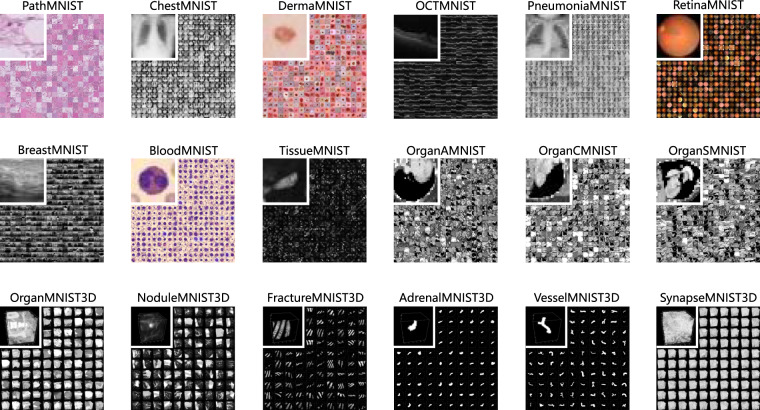
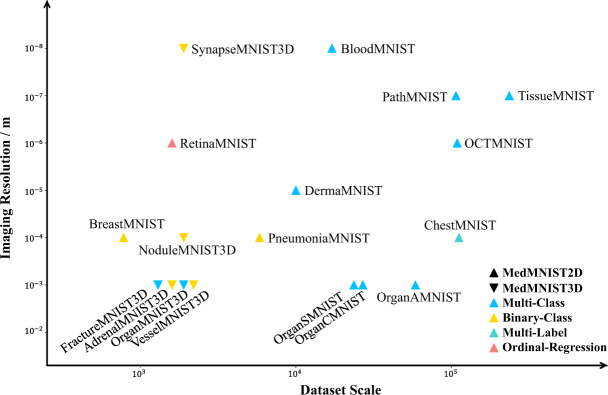
We introduce MedMNIST v2 , a large-scale MNIST-like dataset collection of standardized biomedical images, including 12 datasets for 2D and 6 datasets for 3D. All images are pre-processed into a small size of 28 × 28 (2D) or 28 × 28 × 28 (3D) with the corresponding classification labels so that no background knowledge is required for users. Covering primary data modalities in biomedical images, MedMNIST v2 is designed to perform classification on lightweight 2D and 3D images with various dataset scales (from 100 to 100,000) and diverse tasks (binary/multi-class, ordinal regression, and multi-label). The resulting dataset, consisting of 708,069 2D images and 9,998 3D images in total, could support numerous research/educational purposes in biomedical image analysis, computer vision, and machine learning. We benchmark several baseline methods on MedMNIST v2, including 2D/3D neural networks and open-source/commercial AutoML tools. The data and code are publicly available at https://medmnist.com/ .
Overview
AI snapshot
Written from the paper’s full text.
TL;DR
MedMNIST v2 is a standardized MNIST-like benchmark of 12 2D datasets (708,069 images) and 6 3D datasets (9,998 images) for biomedical image classification at 28×28 or 28×28×28. It benchmarks ResNets and AutoML tools, finding ResNets competitive and 3D/ACS convolutions generally better than 2.5D on 3D datasets.
Key findings
- MedMNIST v2 contains 12 2D datasets totaling 708,069 images and 6 3D datasets totaling 9,998 images, all preprocessed to 28×28 (2D) or 28×28×28 (3D), covering binary/multi-class, ordinal regression, and multi-label tasks.
- On MedMNIST2D, Google AutoML Vision achieved the highest average AUC (0.927), close to ResNet-18 (224) (0.925) and ResNet-50 (224) (0.923); ResNets had higher average ACC (0.821 for ResNet-18/50 at 224) than Google AutoML Vision (0.809). auto-sklearn was lowest (average AUC 0.878, ACC 0.722).
- On MedMNIST3D, ResNet-50 + 3D convolution achieved the best average AUC (0.863) and ACC (0.780); ResNet-18 + 3D was 0.849/0.767, auto-sklearn 0.815/0.765, and AutoKeras 0.763/0.737. 2.5D models were inferior to 3D and ACS models.
- Under the same ResNet backbone, 224 resolution generally outperformed 28 on 2D; at 28, ResNet-18 often outperformed ResNet-50. For 3D, 3D and ACS models were comparable, and ResNet-50 with 3D convolution surpassed ResNet-18.
Methods
- Dataset construction: 12 2D and 6 3D datasets from source datasets, preprocessed to MNIST-like sizes via cubic spline interpolation; official splits used where available, otherwise 9:1 train-validation from training or 7:1:2 patient-level random split; labels from source datasets, sometimes simplified.
- Benchmark: ResNet-18/50 with early stopping for 2D (28 or 224 input) and ResNet-18/50 with 2.5D/3D/ACS convolutions for 3D; auto-sklearn, AutoKeras, and Google AutoML Vision (2D only); training used cross-entropy, Adam, batch size 128 for 2D and 32 for 3D, 100 epochs, and learning-rate decay.
- Evaluation: AUC and ACC per dataset and average over MedMNIST2D/MedMNIST3D; each benchmark was repeated at least 3 times.
Limitations
- Stated: the dataset is NOT intended for clinical use; substantially reducing resolution may yield images insufficient to represent and capture different disease pathologies.
- Stated: labels could be simplified (merged or deleted classes) if classification on small images is too difficult.
- Evident from the text: the benchmark focuses on the machine-learning part rather than end-to-end systems; 3D datasets are much smaller (9,998 total) than 2D datasets (708,069), and AdrenalMNIST3D source CT scans are not provided due to patient privacy.
Model-written summary. Check it against the paper before relying on it.
Integrity signals
Registry
Cites
Statistics
Figures
Verification
Claims the paper makes
27 No basis given · 16 Own result · 7 Own interpretation · 6 Supported · 4 Own method · 3 Partly supported · 3 Sources not found · 3 No full text of the sources · 1 Supported so far · 1 Couldn’t confirm · accuracy not yet measured
The sources with a verdict support this claim; the rest weren’t checked yet, have no full text we could read, or their verdicts aren’t rated yet.
In the paper
“The BloodMNIST is based on a dataset26,27 of individual normal cells, captured from individuals without infection, hematologic or oncologic disease and free of any pharmacologic treatment at the moment of blood collection. It contains a total of 17,092 images and is organized into 8 classes.”
§ MedMNIST v2 - A large-scale lightweight benchmark for 2D and 3D biomedical image classification > Methods > Details for MedMNIST2D
What the sources say
- Supportedcites [26] Acevedo, A. et al. A dataset of microscopic peripheral blood cell images for development of automatic recognition systems. Data in Brief 30, 105474, https://doi.org/10.1016/j.dib.2020.105474 (2020). source
The Abstract states that the dataset contains 17,092 images of individual normal cells, organized into eight groups, and describes the donors’ health and treatment criteria. The Data section confirms the image count, eight groups, and pixel dimensions of the images. This paper documents the source dataset identified in the citing sentence. (LLM, conf=0.92)
- Not checked — no full text of the sourcecites [27] Acevedo, A. et al. A dataset for microscopic peripheral blood cell images for development of automatic recognition systems. Mendeley Data https://doi.org/10.17632/snkd93bnjr.1 (2020). source
plainn = 17,092- Asserted: passes — The authors put it forward as true.
- Checkable: passes — It can be checked against evidence.
- Load-bearing: unclear — It is unclear whether the paper’s conclusions depend on it.
- Based: passes — The paper gives a reason why it holds.
- Supported
The paper states this without a source or data behind it here, so there is nothing to check it against. The quote shows it is in the paper.
In the paper
“Furthermore, we provide standard train-validation-test splits for all datasets in MedMNIST v2, therefore algorithms could be easily compared.”
§ MedMNIST v2 - A large-scale lightweight benchmark for 2D and 3D biomedical image classification > Background & Summary
plain- Asserted: passes — The authors put it forward as true.
- Checkable: passes — It can be checked against evidence.
- Load-bearing: passes — The paper’s conclusions depend on it.
- Based: passes — The paper gives a reason why it holds.
The paper states this without a source or data behind it here, so there is nothing to check it against. The quote shows it is in the paper.
In the paper
“All images are pre-processed into a small size of 28 × 28 (2D) or 28 × 28 × 28 (3D) with the corresponding classification labels so that no background knowledge is required for users.”
- Also stated in: § Design principles · plain
“All images are pre-processed into a MNIST-like format, i.e., 28 × 28 (2D) or 28 × 28 × 28 (3D), with cubic spline interpolation operation for image resizing.”
§ MedMNIST v2 - A large-scale lightweight benchmark for 2D and 3D biomedical image classification > Abstract
plain- Asserted: passes — The authors put it forward as true.
- Checkable: passes — It can be checked against evidence.
- Load-bearing: passes — The paper’s conclusions depend on it.
- Based: passes — The paper gives a reason why it holds.
- Rests on an assumption: Resizing biomedical images to 28 × 28 (2D) or 28 × 28 × 28 (3D) preserves sufficient information for meaningful classification.
- Also stated in: § Design principles · plain
The paper states this without a source or data behind it here, so there is nothing to check it against. The quote shows it is in the paper.
In the paper
“Covering primary data modalities in biomedical images, MedMNIST v2 is designed to perform classification on lightweight 2D and 3D images with various dataset scales (from 100 to 100,000) and diverse tasks (binary/multi-class, ordinal regression, and multi-label).”
§ MedMNIST v2 - A large-scale lightweight benchmark for 2D and 3D biomedical image classification > Abstract
plain- Asserted: passes — The authors put it forward as true.
- Checkable: passes — It can be checked against evidence.
- Load-bearing: passes — The paper’s conclusions depend on it.
- Based: passes — The paper gives a reason why it holds.
The paper states this without a source or data behind it here, so there is nothing to check it against. The quote shows it is in the paper.
In the paper
“Considering the popularity of 3D imaging in biomedical area, we carefully develop 6 3D datasets following the same design principle as 2D ones.”
§ MedMNIST v2 - A large-scale lightweight benchmark for 2D and 3D biomedical image classification > Background & Summary
plain- Asserted: passes — The authors put it forward as true.
- Checkable: passes — It can be checked against evidence.
- Load-bearing: passes — The paper’s conclusions depend on it.
- Based: passes — The paper gives a reason why it holds.
The paper states this without a source or data behind it here, so there is nothing to check it against. The quote shows it is in the paper.
In the paper
“As MedMNIST v1 is more medical-oriented, we additionally provide 2 2D bioimage datasets.”
§ MedMNIST v2 - A large-scale lightweight benchmark for 2D and 3D biomedical image classification > Background & Summary
plain- Asserted: passes — The authors put it forward as true.
- Checkable: passes — It can be checked against evidence.
- Load-bearing: unclear — It is unclear whether the paper’s conclusions depend on it.
- Based: passes — The paper gives a reason why it holds.
In the paper
“As an MNIST-like8 dataset collection to perform classification tasks on small images, it primarily focuses on the machine learning part rather than the end-to-end system.”
§ MedMNIST v2 - A large-scale lightweight benchmark for 2D and 3D biomedical image classification > Background & Summary
What the sources say
- Not matchedcites [8] LeCun, Y., Cortes, C. & Burges, C. Mnist handwritten digit database. http://yann.lecun.com/exdb/mnist/ (2010).
Couldn’t be matched to a paper in Crossref, so it can’t be checked.
plain- Asserted: passes — The authors put it forward as true.
- Checkable: passes — It can be checked against evidence.
- Load-bearing: unclear — It is unclear whether the paper’s conclusions depend on it.
- Based: passes — The paper gives a reason why it holds.
- Not matched
A result the paper reports from its own data — it cites no other source for it, so there is none to check. The quote shows it is in the paper.
In the paper
“The resulting dataset, consisting of 708,069 2D images and 9,998 3D images in total, could support numerous research/educational purposes in biomedical image analysis, computer vision, and machine learning.”
§ MedMNIST v2 - A large-scale lightweight benchmark for 2D and 3D biomedical image classification > Abstract
plain- Asserted: passes — The authors put it forward as true.
- Checkable: passes — It can be checked against evidence.
- Load-bearing: passes — The paper’s conclusions depend on it.
- Based: passes — The paper gives a reason why it holds.
A result the paper reports from its own data — it cites no other source for it, so there is none to check. The quote shows it is in the paper.
In the paper
“2.5D models have poorer performance compared with 3D and ACS models”
§ MedMNIST v2 - A large-scale lightweight benchmark for 2D and 3D biomedical image classification > Technical Validation > Benchmark on each dataset
plain- Asserted: passes — The authors put it forward as true.
- Checkable: passes — It can be checked against evidence.
- Load-bearing: unclear — It is unclear whether the paper’s conclusions depend on it.
- Based: passes — The paper gives a reason why it holds.
A result the paper reports from its own data — it cites no other source for it, so there is none to check. The quote shows it is in the paper.
In the paper
“Auto-sklearn is superior to ResNet-18 + 2.5D and ResNet-50 + 2.5D in general”
§ MedMNIST v2 - A large-scale lightweight benchmark for 2D and 3D biomedical image classification > Technical Validation > Benchmark on each dataset
plaindirect- Asserted: passes — The authors put it forward as true.
- Checkable: passes — It can be checked against evidence.
- Load-bearing: unclear — It is unclear whether the paper’s conclusions depend on it.
- Based: passes — The paper gives a reason why it holds.
- It may state two separate claims as one. 31
- Probably not a substantial claim. 17
Every source the paper cites for this claim was checked and supports it.
In the paper
“MedMNIST v2 is extended from our preliminary version, MedMNIST v19, with 10 2D datasets for medical image classification.”
§ MedMNIST v2 - A large-scale lightweight benchmark for 2D and 3D biomedical image classification > Background & Summary
What the sources say
- Supportedcites [9] Yang, J., Shi, R. & Ni, B. Medmnist classification decathlon: A lightweight automl benchmark for medical image analysis. In International Symposium on Biomedical Imaging, 191–195 (2021). source
The Introduction (p. 1) presents MedMNIST as a collection of 10 datasets for classification on 28 × 28 images, and the Dataset section (p. 2) describes those images as 2D. The citation identifies the preliminary MedMNIST collection; this earlier paper need not describe the later v2 extension. (LLM, conf=0.88)
plaindirect- Asserted: passes — The authors put it forward as true.
- Checkable: passes — It can be checked against evidence.
- Load-bearing: unclear — It is unclear whether the paper’s conclusions depend on it.
- Based: passes — The paper gives a reason why it holds.
It may state two separate claims as one.
- Supported
Every source the paper cites for this claim was checked and supports it.
In the paper
“Each subset is saved in NumPy39 npz format, named as <data> mnist.npz for MedMNIST2D and <data> mnist3d.npz for MedMNIST3D, and is comprised of 6 keys (“train_images”, “train_labels”, “val_images”, “val_labels”, “test_images”, “test_labels”).”
§ MedMNIST v2 - A large-scale lightweight benchmark for 2D and 3D biomedical image classification > Data Records
What the sources say
- Supportedcites [39] Harris, C. R. et al. Array programming with numpy. Nature 585, 357–362 (2020). source
The citation is attached to “NumPy,” identifying the software rather than sourcing the MedMNIST file names or six keys. The Main section describes NumPy as an open-source library providing a multidimensional Python array object, which supports that identification. (LLM, conf=0.91)
plain- Asserted: passes — The authors put it forward as true.
- Checkable: passes — It can be checked against evidence.
- Load-bearing: fails — The paper’s conclusions may not depend on it.
- Based: passes — The paper gives a reason why it holds.
Probably not a substantial claim. The paper’s conclusions may not depend on it. It may state two separate claims as one.
- Supported
Every source the paper cites for this claim was checked and supports it.
In the paper
“The VesselMNIST3D is based on an open-access 3D intracranial aneurysm dataset, IntrA34, containing 103 3D models (meshes) of entire brain vessels collected by reconstructing MRA images. 1,694 healthy vessel segments and 215 aneurysm segments are generated automatically from the complete models.”
§ MedMNIST v2 - A large-scale lightweight benchmark for 2D and 3D biomedical image classification > Methods > Details for MedMNIST3D
What the sources say
- Supportedcites [34] Yang, X., Xia, D., Kin, T. & Igarashi, T. Intra: 3d intracranial aneurysm dataset for deep learning. In Conference on Computer Vision and Pattern Recognition (2020). source
Section 3.1 (Data) identifies IntrA as a dataset of 103 complete 3D brain-vessel models reconstructed from MRA images. It also reports 1,694 healthy vessel segments and 215 aneurysm segments generated automatically from those models. (LLM, conf=0.94)
plain- Asserted: passes — The authors put it forward as true.
- Checkable: passes — It can be checked against evidence.
- Load-bearing: unclear — It is unclear whether the paper’s conclusions depend on it.
- Based: passes — The paper gives a reason why it holds.
It may state two separate claims as one.
- Supported
The cited sources support only part of this claim — read each source’s verdict below.
In the paper
“The SynapseMNIST3D is a new 3D volume dataset to classify whether a synapse is excitatory or inhibitory. It uses a 3D image volume of an adult rat acquired by a multi-beam scanning electron microscope.”
§ MedMNIST v2 - A large-scale lightweight benchmark for 2D and 3D biomedical image classification > Methods > Details for MedMNIST3D
What the sources say
- Partly supportedcites [37] Wei, D. et al. Mitoem dataset: Large-scale 3d mitochondria instance segmentation from em images. In Conference on Medical Image Computing and Computer Assisted Intervention, 66–76 (Springer, 2020). sourceExperimental — accuracy not yet measured
The Dataset Acquisition section (page unavailable) says the adult-rat tissue used for MitoEM-R was imaged with a multi-beam scanning electron microscope. But the Introduction identifies MitoEM as a 3D mitochondria instance-segmentation dataset; our copy does not identify SynapseMNIST3D or describe excitatory-versus-inhibitory synapse classification. (LLM, conf=0.88)
plainSingle case- Asserted: passes — The authors put it forward as true.
- Checkable: passes — It can be checked against evidence.
- Load-bearing: passes — The paper’s conclusions depend on it.
- Based: passes — The paper gives a reason why it holds.
It may state two separate claims as one.
- Partly supported
The cited sources support only part of this claim — read each source’s verdict below.
In the paper
“We use the BBBC05128, available from the Broad Bioimage Benchmark Collection29. The dataset contains 236,386 human kidney cortex cells, segmented from 3 reference tissue specimens and organized into 8 categories.”
§ MedMNIST v2 - A large-scale lightweight benchmark for 2D and 3D biomedical image classification > Methods > Details for MedMNIST2D
What the sources say
- Partly supportedcites [28] Woloshuk, A. et al. In situ classification of cell types in human kidney tissue using 3d nuclear staining. Cytometry Part A (2020). sourceExperimental — accuracy not yet measured
The Data organization section describes approximately 230,000 nuclei from three reference tissue specimens, and the Results describe eight classification categories and derived 2D datasets. The copy does not give the exact count of 236,386 or identify the dataset as TissueMNIST or BBBC051; it says the dataset would be made available through an online repository such as the Broad Bioimage Benchmark Collection. (LLM, conf=0.86)
- Supportedcites [29] Ljosa, V., Sokolnicki, K. L. & Carpenter, A. E. Annotated high-throughput microscopy image sets for validation. Nature methods 9, 637–637 (2012). source
Citation 29 is attached to the Broad Bioimage Benchmark Collection, not to the BBBC051 dataset details. The paper describes the BBBC as a publicly available collection of microscopy image sets and gives its access URL. The dataset-specific figures in the citing sentence are not attributed to this citation. (LLM, conf=0.93)
plainn = 3- Asserted: passes — The authors put it forward as true.
- Checkable: passes — It can be checked against evidence.
- Load-bearing: unclear — It is unclear whether the paper’s conclusions depend on it.
- Based: passes — The paper gives a reason why it holds.
It may state two separate claims as one.
- Partly supported
The cited sources support only part of this claim — read each source’s verdict below.
In the paper
“The DermaMNIST is based on the HAM1000019–21, a large collection of multi-source dermatoscopic images of common pigmented skin lesions. The dataset consists of 10,015 dermatoscopic images categorized as 7 different diseases, formulized as a multi-class classification task.”
§ MedMNIST v2 - A large-scale lightweight benchmark for 2D and 3D biomedical image classification > Methods > Details for MedMNIST2D
What the sources say
- Partly supportedcites [19] Tschandl, P., Rosendahl, C. & Kittler, H. The ham10000 dataset, a large collection of multi-source dermatoscopic images of common pigmented skin lesions. Scientific data 5, 180161 (2018). sourceExperimental — accuracy not yet measured
The Abstract reports 10,015 dermatoscopic images, and Methods (“Unifying pathologic diagnoses”) says HAM10000 has seven diagnostic classes intended as a benchmark for classification. The paper does not identify DermaMNIST or establish that DermaMNIST is based on HAM10000, so it supports the underlying dataset description but not that relationship. (LLM, conf=0.84)
- Not checked — no full text of the sourcecites [20] Tschandl, P. The HAM10000 dataset, a large collection of multi-source dermatoscopic images of common pigmented skin lesions. Harvard Dataverse https://doi.org/10.7910/DVN/DBW86T (2018). source
- Partly supportedcites [21] Codella, N. et al. Skin lesion analysis toward melanoma detection 2018: A challenge hosted by the international skin imaging collaboration (isic). Preprint at https://arxiv.org/abs/1902.03368v2 (2019). sourceExperimental — accuracy not yet measured
Section 2.3 (p. 4) reports 10,015 dermoscopic training images with seven classification labels and cites the HAM10000 paper, identified in the References (p. 8). It does not identify DermaMNIST, establish that DermaMNIST is based on HAM10000, or describe it as a 2D dataset; the 10,015 figure is stated for the challenge’s training set. (LLM, conf=0.88)
plain- Asserted: passes — The authors put it forward as true.
- Checkable: passes — It can be checked against evidence.
- Load-bearing: unclear — It is unclear whether the paper’s conclusions depend on it.
- Based: passes — The paper gives a reason why it holds.
It may state two separate claims as one.
- Partly supported
Every source the paper cites for this claim was checked and supports it.
In the paper
“The data files of MedMNIST v2 dataset can be accessed at Zenodo38. It contains 12 pre-processed 2D datasets (MedMNIST2D) and 6 pre-processed 3D datasets (MedMNIST3D).”
§ MedMNIST v2 - A large-scale lightweight benchmark for 2D and 3D biomedical image classification > Data Records
What the sources say
- Supportedcites [38] Yang, J. et al. Medmnist v2: A large-scale lightweight benchmark for 2d and 3d biomedical image classification. Zenodo https://doi.org/10.5281/zenodo.5208230 (2021). source
The Abstract states that MedMNIST v2 includes 12 2D and 6 3D datasets, with all images pre-processed. The Zenodo record’s Files section lists the downloadable dataset files, supporting the access claim. (LLM, conf=0.95)
plain- Asserted: passes — The authors put it forward as true.
- Checkable: passes — It can be checked against evidence.
- Load-bearing: unclear — It is unclear whether the paper’s conclusions depend on it.
- Based: passes — The paper gives a reason why it holds.
It may state two separate claims as one.
- Supported
Every source the paper cites for this claim was checked and supports it.
In the paper
“The BreastMNIST is based on a dataset25 of 780 breast ultrasound images. It is categorized into 3 classes: normal, benign, and malignant. As we use low-resolution images, we simplify the task into binary classification by combining normal and benign as positive and classifying them against malignant as negative.”
§ MedMNIST v2 - A large-scale lightweight benchmark for 2D and 3D biomedical image classification > Methods > Details for MedMNIST2D
What the sources say
- Supportedcites [25] Al-Dhabyani, W., Gomaa, M., Khaled, H. & Fahmy, A. Dataset of breast ultrasound images. Data in Brief 28, 104863, https://doi.org/10.1016/j.dib.2019.104863 (2020). source
The Data section reports 780 breast ultrasound images categorized as normal, benign, and malignant, supporting the dataset description for which this source is cited. The binary grouping is described as the citing authors’ own simplification, not as a feature attributed to this source. (LLM, conf=0.91)
plain- Asserted: passes — The authors put it forward as true.
- Checkable: passes — It can be checked against evidence.
- Load-bearing: fails — The paper’s conclusions may not depend on it.
- Based: passes — The paper gives a reason why it holds.
Probably not a substantial claim. The paper’s conclusions may not depend on it. It may state two separate claims as one.
- Supported
The cited sources that could be checked couldn’t confirm or dispute this claim.
In the paper
“The source of the OrganMNIST3D is the same as that of the Organ{A,C,S}MNIST. Instead of 2D images, we directly use the 3D bounding boxes and process the images into 28 × 28 × 28 to perform multi-class classification of 11 body organs.”
§ MedMNIST v2 - A large-scale lightweight benchmark for 2D and 3D biomedical image classification > Methods > Details for MedMNIST3D
What the sources say
- Could not verifycites [30] Bilic, P. et al. The liver tumor segmentation benchmark (lits). Medical Image Analysis 84,102680 (2023). sourceExperimental — accuracy not yet measured
The Methods > Dataset passage describes LiTS as a collection of abdominal CT scans, but does not identify it as the source of OrganMNIST3D or Organ{A,C,S}MNIST. Searches for those dataset names and for 3D bounding boxes, 28 × 28 × 28 images, and classification of 11 organs found no supporting passage in our copy. (LLM, conf=0.75)
- Not checked — no full text of the sourcecites [31] Xu, X. et al. Efficient multiple organ localization in ct image using 3d region proposal network. IEEE Transactions on Medical Imaging 38, 1885–1898 (2019). source
plain- Asserted: passes — The authors put it forward as true.
- Checkable: passes — It can be checked against evidence.
- Load-bearing: unclear — It is unclear whether the paper’s conclusions depend on it.
- Based: passes — The paper gives a reason why it holds.
It may state two separate claims as one.
- Could not verify
Every source the paper cites for this claim was checked and supports it.
In the paper
“The NoduleMNIST3D is based on the LIDC-IDRI32, a large public lung nodule dataset, containing images from thoracic CT scans. The dataset is designed for both lung nodule segmentation and 5-level malignancy classification task. To perform binary classification, we categorize cases with malignancy level 1/2 into negative class and 4/5 into positive class, ignoring the cases with malignancy level 3.”
§ MedMNIST v2 - A large-scale lightweight benchmark for 2D and 3D biomedical image classification > Methods > Details for MedMNIST3D
What the sources say
- Supportedcites [32] Armato, S. G. III et al. The lung image database consortium (lidc) and image database resource initiative (idri): A completed reference database of lung nodules on ct scans. Medical Physics 38, 915–931, https://doi.org/10.1118/1.3528204 (2011). source
The citation is attached to the identification of LIDC-IDRI as a large, public dataset of lung nodules from thoracic CT scans. The paper reports 1018 thoracic CT scans (II.A), describes its nodule annotations (Results), and says the database is publicly available (II.E). The later binary-classification rule is presented as the citing authors’ own procedure, not as a finding attributed to this source. (LLM, conf=0.91)
plain- Asserted: passes — The authors put it forward as true.
- Checkable: passes — It can be checked against evidence.
- Load-bearing: unclear — It is unclear whether the paper’s conclusions depend on it.
- Based: passes — The paper gives a reason why it holds.
It may state two separate claims as one.
- Supported
The paper states this without a source or data behind it here, so there is nothing to check it against. The quote shows it is in the paper.
In the paper
“The MedMNIST v2 dataset consists of 12 2D and 6 3D standardized datasets from carefully selected sources covering primary data modalities (e.g., X-ray, OCT, ultrasound, CT, electron microscope), diverse classification tasks (binary/multi-class, ordinal regression, and multi-label) and dataset scales (from 100 to 100,000).”
§ MedMNIST v2 - A large-scale lightweight benchmark for 2D and 3D biomedical image classification > Methods > Design principles
plain- Asserted: passes — The authors put it forward as true.
- Checkable: passes — It can be checked against evidence.
- Load-bearing: passes — The paper’s conclusions depend on it.
- Based: passes — The paper gives a reason why it holds.
It may state two separate claims as one.
The paper states this without a source or data behind it here, so there is nothing to check it against. The quote shows it is in the paper.
In the paper
“The MedMNIST uses the classification labels from the source datasets directly in most cases, but the labels could be simplified (merged or deleted classes) if the classification tasks on the small images are too difficult.”
§ MedMNIST v2 - A large-scale lightweight benchmark for 2D and 3D biomedical image classification > Methods > Design principles
hedgedconditional- Asserted: passes — The authors put it forward as true.
- Checkable: passes — It can be checked against evidence.
- Load-bearing: fails — The paper’s conclusions may not depend on it.
- Based: passes — The paper gives a reason why it holds.
Probably not a substantial claim. The paper’s conclusions may not depend on it. It may state two separate claims as one.
- Rests on an assumption: The classification labels from the source datasets are accurate and suitable for the benchmark tasks.
A result the paper reports from its own data — it cites no other source for it, so there is none to check. The quote shows it is in the paper.
In the paper
“We introduce MedMNIST v2, a large-scale MNIST-like dataset collection of standardized biomedical images, including 12 datasets for 2D and 6 datasets for 3D.”
- Also stated in: § Background & Summary · plain
“MedMNIST v2 is a large-scale benchmark for 2D and 3D biomedical image classification, covering 12 2D datasets with 708,069 images and 6 3D datasets with 9,998 images.”
§ MedMNIST v2 - A large-scale lightweight benchmark for 2D and 3D biomedical image classification > Abstract
plain- Asserted: passes — The authors put it forward as true.
- Checkable: passes — It can be checked against evidence.
- Load-bearing: passes — The paper’s conclusions depend on it.
- Based: passes — The paper gives a reason why it holds.
It may state two separate claims as one.
- Also stated in: § Background & Summary · plain
The paper states this without a source or data behind it here, so there is nothing to check it against. The quote shows it is in the paper.
In the paper
“All source datasets are either associated with the Creative Commons (CC) Licenses or developed by us, which allows us to develop derivative datasets based on them.”
§ MedMNIST v2 - A large-scale lightweight benchmark for 2D and 3D biomedical image classification > Methods > Design principles
plaindirect- Asserted: passes — The authors put it forward as true.
- Checkable: passes — It can be checked against evidence.
- Load-bearing: passes — The paper’s conclusions depend on it.
- Based: passes — The paper gives a reason why it holds.
It may state two separate claims as one.
The paper states this without a source or data behind it here, so there is nothing to check it against. The quote shows it is in the paper.
In the paper
“Covering primary data modalities in biomedical images, MedMNIST v2 is designed to perform classification on lightweight 2D and 3D images with various dataset scales (from 100 to 100,000) and diverse tasks (binary/multi-class, ordinal regression, and multi-label).”
§ MedMNIST v2 - A large-scale lightweight benchmark for 2D and 3D biomedical image classification > Abstract
plain- Asserted: passes — The authors put it forward as true.
- Checkable: passes — It can be checked against evidence.
- Load-bearing: passes — The paper’s conclusions depend on it.
- Based: passes — The paper gives a reason why it holds.
It may state two separate claims as one.
The paper states this without a source or data behind it here, so there is nothing to check it against. The quote shows it is in the paper.
In the paper
“It is designed to be:Diverse: It covers diverse data modalities, dataset scales (from 100 to 100,000), and tasks (binary/multi-class, multi-label, and ordinal regression).”
§ MedMNIST v2 - A large-scale lightweight benchmark for 2D and 3D biomedical image classification > Background & Summary
plain- Asserted: passes — The authors put it forward as true.
- Checkable: passes — It can be checked against evidence.
- Load-bearing: passes — The paper’s conclusions depend on it.
- Based: passes — The paper gives a reason why it holds.
It may state two separate claims as one.
The paper states this without a source or data behind it here, so there is nothing to check it against. The quote shows it is in the paper.
In the paper
“Standardized: Each sub-dataset is pre-processed into the same format (see details in Methods), which requires no background knowledge for users.”
§ MedMNIST v2 - A large-scale lightweight benchmark for 2D and 3D biomedical image classification > Background & Summary
plaindirect- Asserted: passes — The authors put it forward as true.
- Checkable: passes — It can be checked against evidence.
- Load-bearing: passes — The paper’s conclusions depend on it.
- Based: passes — The paper gives a reason why it holds.
It may state two separate claims as one.
The paper states this without a source or data behind it here, so there is nothing to check it against. The quote shows it is in the paper.
In the paper
“Some datasets are under CC-BY-NC license; we have contacted the authors and obtained the permission to re-distribute the datasets.”
§ MedMNIST v2 - A large-scale lightweight benchmark for 2D and 3D biomedical image classification > Methods > Design principles
plain- Asserted: passes — The authors put it forward as true.
- Checkable: passes — It can be checked against evidence.
- Load-bearing: unclear — It is unclear whether the paper’s conclusions depend on it.
- Based: passes — The paper gives a reason why it holds.
It may state two separate claims as one.
A result the paper reports from its own data — it cites no other source for it, so there is none to check. The quote shows it is in the paper.
In the paper
““{train,val,test}_labels”: an array containing ground-truth labels, with a shape of N × 1 for multi-class/binary-class/ordinal regression datasets, of N × L for multi-lable binary-class datasets. N denotes the number of samples in training/validation/test set and L denotes the number of task labels in the multi-label dataset (i.e., 14 for the ChestMNIST).”
§ MedMNIST v2 - A large-scale lightweight benchmark for 2D and 3D biomedical image classification > Data Records
plain- Asserted: passes — The authors put it forward as true.
- Checkable: passes — It can be checked against evidence.
- Load-bearing: fails — The paper’s conclusions may not depend on it.
- Based: passes — The paper gives a reason why it holds.
Probably not a substantial claim. The paper’s conclusions may not depend on it. It may state two separate claims as one.
A result the paper reports from its own data — it cites no other source for it, so there is none to check. The quote shows it is in the paper.
In the paper
““{train,val,test}_images”: an array containing images, with a shape of N × 28 × 28 for 2D gray-scale datasets, of N × 28 × 28 × 3 for 2D RGB datasets, of N × 28 × 28 × 28 for 3D datasets.”
§ MedMNIST v2 - A large-scale lightweight benchmark for 2D and 3D biomedical image classification > Data Records
plain- Asserted: passes — The authors put it forward as true.
- Checkable: passes — It can be checked against evidence.
- Load-bearing: fails — The paper’s conclusions may not depend on it.
- Based: passes — The paper gives a reason why it holds.
Probably not a substantial claim. The paper’s conclusions may not depend on it. It may state two separate claims as one.
In the paper
“The RetinaMNIST is based on the DeepDRiD24 challenge, which provides a dataset of 1,600 retina fundus images. The task is ordinal regression for 5-level grading of diabetic retinopathy severity.”
§ MedMNIST v2 - A large-scale lightweight benchmark for 2D and 3D biomedical image classification > Methods > Details for MedMNIST2D
What the sources say
- Not matchedcites [24] DeepDRiD. The 2nd diabetic retinopathy–grading and image quality estimation challenge. https://isbi.deepdr.org/data.html (2020).
Couldn’t be matched to a paper in Crossref, so it can’t be checked.
plain- Asserted: passes — The authors put it forward as true.
- Checkable: passes — It can be checked against evidence.
- Load-bearing: unclear — It is unclear whether the paper’s conclusions depend on it.
- Based: passes — The paper gives a reason why it holds.
It may state two separate claims as one.
- Not matched
The paper states this without a source or data behind it here, so there is nothing to check it against. The quote shows it is in the paper.
In the paper
“The data type of the dataset is uint8.”
§ MedMNIST v2 - A large-scale lightweight benchmark for 2D and 3D biomedical image classification > Data Records
plain- Asserted: passes — The authors put it forward as true.
- Checkable: passes — It can be checked against evidence.
- Load-bearing: fails — The paper’s conclusions may not depend on it.
- Based: passes — The paper gives a reason why it holds.
Probably not a substantial claim. The paper’s conclusions may not depend on it.
A result the paper reports from its own data — it cites no other source for it, so there is none to check. The quote shows it is in the paper.
In the paper
“For 2D datasets, Google AutoML Vision is well-performing in general, however it could not always win, even compared with the baseline ResNet-18 and ResNet-50.”
§ MedMNIST v2 - A large-scale lightweight benchmark for 2D and 3D biomedical image classification > Technical Validation > Benchmark on each dataset
hedged- Asserted: passes — The authors put it forward as true.
- Checkable: passes — It can be checked against evidence.
- Load-bearing: unclear — It is unclear whether the paper’s conclusions depend on it.
- Based: passes — The paper gives a reason why it holds.
It may state two separate claims as one.
A claim is checked only against the cited paper’s full text, never its abstract, and none is available for its sources.
In the paper
“The OCTMNIST is based on a prior dataset22,23 of 109,309 valid optical coherence tomography (OCT) images for retinal diseases. The dataset is comprised of 4 diagnosis categories, leading to a multi-class classification task.”
§ MedMNIST v2 - A large-scale lightweight benchmark for 2D and 3D biomedical image classification > Methods > Details for MedMNIST2D
What the sources say
- Not checked — no full text of the sourcecites [22] Kermany, D. S. et al. Identifying medical diagnoses and treatable diseases by image-based deep learning. Cell 172, 1122–1131.e9, https://doi.org/10.1016/j.cell.2018.02.010 (2018). source
- Not checked — no full text of the sourcecites [23] Kermany, D. S., Zhang, K. & Goldbaum, M. Large dataset of labeled optical coherence tomography (oct) and chest x-ray images https://doi.org/10.17632/rscbjbr9sj.3 (2018). source
plaindirect- Asserted: passes — The authors put it forward as true.
- Checkable: passes — It can be checked against evidence.
- Load-bearing: unclear — It is unclear whether the paper’s conclusions depend on it.
- Based: passes — The paper gives a reason why it holds.
It may state two separate claims as one.
A result the paper reports from its own data — it cites no other source for it, so there is none to check. The quote shows it is in the paper.
In the paper
“For MedMNIST2D, Google AutoML Vision outperforms all the other methods in average AUC, however, it is very close to the performance of baseline ResNets.”
§ MedMNIST v2 - A large-scale lightweight benchmark for 2D and 3D biomedical image classification > Technical Validation > Benchmark on each dataset
plaincorrelational- Asserted: passes — The authors put it forward as true.
- Checkable: passes — It can be checked against evidence.
- Load-bearing: unclear — It is unclear whether the paper’s conclusions depend on it.
- Based: passes — The paper gives a reason why it holds.
It may state two separate claims as one.
The paper states this without a source or data behind it here, so there is nothing to check it against. The quote shows it is in the paper.
In the paper
“AutoKeras performs well on datasets with large scales, however relatively worse on datasets with small scale.”
§ MedMNIST v2 - A large-scale lightweight benchmark for 2D and 3D biomedical image classification > Technical Validation > Benchmark on each dataset
plaincorrelational- Asserted: passes — The authors put it forward as true.
- Checkable: passes — It can be checked against evidence.
- Load-bearing: unclear — It is unclear whether the paper’s conclusions depend on it.
- Based: passes — The paper gives a reason why it holds.
It may state two separate claims as one.
A claim is checked only against the cited paper’s full text, never its abstract, and none is available for its sources.
In the paper
“The PneumoniaMNIST is based on a prior dataset22,23 of 5,856 pediatric chest X-Ray images. The task is binary-class classification of pneumonia against normal.”
§ MedMNIST v2 - A large-scale lightweight benchmark for 2D and 3D biomedical image classification > Methods > Details for MedMNIST2D
What the sources say
- Not checked — no full text of the sourcecites [22] Kermany, D. S. et al. Identifying medical diagnoses and treatable diseases by image-based deep learning. Cell 172, 1122–1131.e9, https://doi.org/10.1016/j.cell.2018.02.010 (2018). source
- Not checked — no full text of the sourcecites [23] Kermany, D. S., Zhang, K. & Goldbaum, M. Large dataset of labeled optical coherence tomography (oct) and chest x-ray images https://doi.org/10.17632/rscbjbr9sj.3 (2018). source
plain- Asserted: passes — The authors put it forward as true.
- Checkable: passes — It can be checked against evidence.
- Load-bearing: unclear — It is unclear whether the paper’s conclusions depend on it.
- Based: passes — The paper gives a reason why it holds.
It may state two separate claims as one.
In the paper
“The ChestMNIST is based on the NIH-ChestXray14 dataset18, a dataset comprising 112,120 frontal-view X-Ray images of 30,805 unique patients with the text-mined 14 disease labels, which could be formulized as a multi-label binary-class classification task.”
§ MedMNIST v2 - A large-scale lightweight benchmark for 2D and 3D biomedical image classification > Methods > Details for MedMNIST2D
What the sources say
- Not checked — no full text of the sourcecites [18] Wang, X. et al. Chestx-ray8: Hospital-scale chest x-ray database and benchmarks on weakly-supervised classification and localization of common thorax diseases. In Conference on Computer Vision and Pattern Recognition, 3462–3471 (2017). source
hedgedn = 30,805- Asserted: passes — The authors put it forward as true.
- Checkable: passes — It can be checked against evidence.
- Load-bearing: unclear — It is unclear whether the paper’s conclusions depend on it.
- Based: passes — The paper gives a reason why it holds.
It may state two separate claims as one.
A result the paper reports from its own data — it cites no other source for it, so there is none to check. The quote shows it is in the paper.
In the paper
“Under the same ResNet backbone, 2.5D models are inferior to 3D and ACS models and perform worse than auto-sklearn and AutoKeras.”
§ MedMNIST v2 - A large-scale lightweight benchmark for 2D and 3D biomedical image classification > Technical Validation > Benchmark on each dataset
plain- Asserted: passes — The authors put it forward as true.
- Checkable: passes — It can be checked against evidence.
- Load-bearing: unclear — It is unclear whether the paper’s conclusions depend on it.
- Based: passes — The paper gives a reason why it holds.
It may state two separate claims as one.
The paper states this without a source or data behind it here, so there is nothing to check it against. The quote shows it is in the paper.
In the paper
“They are sliced before being resized into 1 × 28 × 28.”
§ MedMNIST v2 - A large-scale lightweight benchmark for 2D and 3D biomedical image classification > Technical Validation > Benchmark on each dataset
plain- Asserted: passes — The authors put it forward as true.
- Checkable: passes — It can be checked against evidence.
- Load-bearing: passes — The paper’s conclusions depend on it.
- Based: passes — The paper gives a reason why it holds.
Probably not a substantial claim.
The paper states this without a source or data behind it here, so there is nothing to check it against. The quote shows it is in the paper.
In the paper
“Since there is no severe class imbalance on our datasets”
§ MedMNIST v2 - A large-scale lightweight benchmark for 2D and 3D biomedical image classification > Technical Validation > Evaluation
plain- Asserted: passes — The authors put it forward as true.
- Checkable: passes — It can be checked against evidence.
- Load-bearing: passes — The paper’s conclusions depend on it.
- Based: fails — The paper may give no reason why it holds.
Probably not a substantial claim. The paper may give no reason why it holds.
The paper states this without a source or data behind it here, so there is nothing to check it against. The quote shows it is in the paper.
In the paper
“Organ{A,C,S}MNIST and OrganMNIST3D are generated from the same source dataset, and share the same task and the same data split.”
§ MedMNIST v2 - A large-scale lightweight benchmark for 2D and 3D biomedical image classification > Technical Validation > Benchmark on each dataset
plaincorrelational- Asserted: passes — The authors put it forward as true.
- Checkable: passes — It can be checked against evidence.
- Load-bearing: unclear — It is unclear whether the paper’s conclusions depend on it.
- Based: passes — The paper gives a reason why it holds.
It may state two separate claims as one.
The paper states this without a source or data behind it here, so there is nothing to check it against. The quote shows it is in the paper.
In the paper
“On the other hand, OrganMNIST3D is resized into 28 × 28 × 28 directly.”
§ MedMNIST v2 - A large-scale lightweight benchmark for 2D and 3D biomedical image classification > Technical Validation > Benchmark on each dataset
plain- Asserted: passes — The authors put it forward as true.
- Checkable: passes — It can be checked against evidence.
- Load-bearing: passes — The paper’s conclusions depend on it.
- Based: passes — The paper gives a reason why it holds.
Probably not a substantial claim.
The paper states this without a source or data behind it here, so there is nothing to check it against. The quote shows it is in the paper.
In the paper
“Organ{A,C,S}MNIST are sampled slices of 3D bounding boxes of 3D CT images in axial/coronal/sagittal views (planes), respectively.”
§ MedMNIST v2 - A large-scale lightweight benchmark for 2D and 3D biomedical image classification > Technical Validation > Benchmark on each dataset
plain- Asserted: passes — The authors put it forward as true.
- Checkable: passes — It can be checked against evidence.
- Load-bearing: passes — The paper’s conclusions depend on it.
- Based: passes — The paper gives a reason why it holds.
Probably not a substantial claim.
A result the paper reports from its own data — it cites no other source for it, so there is none to check. The quote shows it is in the paper.
In the paper
“The ResNets surpass auto-sklearn and AutoKeras, and outperform Google AutoML Vision in average ACC.”
§ MedMNIST v2 - A large-scale lightweight benchmark for 2D and 3D biomedical image classification > Technical Validation > Benchmark on each dataset
plaindirect- Asserted: passes — The authors put it forward as true.
- Checkable: passes — It can be checked against evidence.
- Load-bearing: passes — The paper’s conclusions depend on it.
- Based: passes — The paper gives a reason why it holds.
It may state two separate claims as one.
What the paper did — it cites no source for this, so there is none to check. The quote shows it is in the paper.
In the paper
“All benchmark experiments are repeated at least 3 times for more stable results than in MedMNIST v1.”
§ MedMNIST v2 - A large-scale lightweight benchmark for 2D and 3D biomedical image classification > Background & Summary
plaindirect- Asserted: passes — The authors put it forward as true.
- Checkable: passes — It can be checked against evidence.
- Load-bearing: fails — The paper’s conclusions may not depend on it.
- Based: passes — The paper gives a reason why it holds.
Probably not a substantial claim. The paper’s conclusions may not depend on it.
None of the sources cited for this claim could be matched to a paper in Crossref, so there is nothing to check it against.
In the paper
“It is as diverse as the VDD4 and MSD5 to fairly evaluate the generalizable performance of machine learning algorithms in different settings, but both 2D and 3D biomedical images are provided.”
§ MedMNIST v2 - A large-scale lightweight benchmark for 2D and 3D biomedical image classification > Background & Summary
What the sources say
- Not matchedcites VDD4
Couldn’t be matched to a paper in Crossref, so it can’t be checked.
- Not matchedcites MSD5
Couldn’t be matched to a paper in Crossref, so it can’t be checked.
plain- Asserted: passes — The authors put it forward as true.
- Checkable: passes — It can be checked against evidence.
- Load-bearing: passes — The paper’s conclusions depend on it.
- Based: passes — The paper gives a reason why it holds.
It may state two separate claims as one.
- Not matched
A conclusion the paper draws from its own results — it cites no other source for it, so there is none to check. The quote shows it is in the paper.
In the paper
“The resulting dataset, consisting of 708,069 2D images and 9,998 3D images in total, could support numerous research/educational purposes in biomedical image analysis, computer vision, and machine learning.”
§ MedMNIST v2 - A large-scale lightweight benchmark for 2D and 3D biomedical image classification > Abstract
hedged- Asserted: passes — The authors put it forward as true.
- Checkable: fails — It may be too vague to check against evidence.
- Load-bearing: passes — The paper’s conclusions depend on it.
- Based: passes — The paper gives a reason why it holds.
Probably not a substantial claim. It may be too vague to check against evidence.
- Rests on an assumption: Resizing biomedical images to 28 × 28 (2D) or 28 × 28 × 28 (3D) preserves sufficient information for meaningful classification.
What the paper did — it cites no source for this, so there is none to check. The quote shows it is in the paper.
In the paper
“For the dataset without an official split, we split the dataset randomly at the patient level with a ratio of 7:1:2 into training-validation-test.”
§ MedMNIST v2 - A large-scale lightweight benchmark for 2D and 3D biomedical image classification > Methods > Design principles
plain- Asserted: passes — The authors put it forward as true.
- Checkable: passes — It can be checked against evidence.
- Load-bearing: passes — The paper’s conclusions depend on it.
- Based: passes — The paper gives a reason why it holds.
Probably not a substantial claim.
- Rests on an assumption: Patient-level random splitting avoids data leakage for datasets without official splits.
A conclusion the paper draws from its own results — it cites no other source for it, so there is none to check. The quote shows it is in the paper.
In the paper
“The diverse dataset design could lead to diverse task difficulty, which is desirable as a biomedical image classification benchmark.”
§ MedMNIST v2 - A large-scale lightweight benchmark for 2D and 3D biomedical image classification > Methods > Design principles
hedgedconditional- Asserted: passes — The authors put it forward as true.
- Checkable: fails — It may be too vague to check against evidence.
- Load-bearing: passes — The paper’s conclusions depend on it.
- Based: passes — The paper gives a reason why it holds.
Probably not a substantial claim. It may be too vague to check against evidence.
What the paper did — it cites no source for this, so there is none to check. The quote shows it is in the paper.
In the paper
“We use the official data split from source dataset (if provided) to avoid data leakage.”
§ MedMNIST v2 - A large-scale lightweight benchmark for 2D and 3D biomedical image classification > Methods > Design principles
plaindirect- Asserted: passes — The authors put it forward as true.
- Checkable: passes — It can be checked against evidence.
- Load-bearing: passes — The paper’s conclusions depend on it.
- Based: passes — The paper gives a reason why it holds.
Probably not a substantial claim.
- Rests on an assumption: The official data splits from source datasets avoid data leakage.
A conclusion the paper draws from its own results — it cites no other source for it, so there is none to check. The quote shows it is in the paper.
In the paper
“ACC could also serve as a good metric”
§ MedMNIST v2 - A large-scale lightweight benchmark for 2D and 3D biomedical image classification > Technical Validation > Evaluation
hedged- Asserted: passes — The authors put it forward as true.
- Checkable: fails — It may be too vague to check against evidence.
- Load-bearing: fails — The paper’s conclusions may not depend on it.
- Based: passes — The paper gives a reason why it holds.
Probably not a substantial claim. It may be too vague to check against evidence. The paper’s conclusions may not depend on it.
What the paper did — it cites no source for this, so there is none to check. The quote shows it is in the paper.
In the paper
“We calculate the mean value of at least 3 trials for each method on each dataset.”
§ MedMNIST v2 - A large-scale lightweight benchmark for 2D and 3D biomedical image classification > Technical Validation > Benchmark on each dataset
plain- Asserted: passes — The authors put it forward as true.
- Checkable: passes — It can be checked against evidence.
- Load-bearing: passes — The paper’s conclusions depend on it.
- Based: passes — The paper gives a reason why it holds.
Probably not a substantial claim.
The paper relies on this without support.
The classification labels from the source datasets are accurate and suitable for the benchmark tasks.
“The MedMNIST uses the classification labels from the source datasets directly in most cases, but the labels could be simplified (merged or deleted classes) if the classification tasks on the small images are too difficult.”
The paper relies on this without support.
Resizing biomedical images to 28 × 28 (2D) or 28 × 28 × 28 (3D) preserves sufficient information for meaningful classification.
“All images are pre-processed into a MNIST-like format, i.e., 28 × 28 (2D) or 28 × 28 × 28 (3D), with cubic spline interpolation operation for image resizing.”
The paper relies on this without support.
The official data splits from source datasets avoid data leakage.
“We use the official data split from source dataset (if provided) to avoid data leakage.”
The paper relies on this without support.
Patient-level random splitting avoids data leakage for datasets without official splits.
“For the dataset without an official split, we split the dataset randomly at the patient level with a ratio of 7:1:2 into training-validation-test.”
The paper relies on this without support.
The selected 18 datasets are representative of primary data modalities and tasks in biomedical image analysis.
“The MedMNIST v2 dataset consists of 12 2D and 6 3D standardized datasets from carefully selected sources covering primary data modalities (e.g., X-ray, OCT, ultrasound, CT, electron microscope), diverse classification tasks (binary/multi-class, ordinal regression, and multi-label) and dataset scales (from 100 to 100,000).”
Citations
Cites
Deep Residual Learning for Image Recognition
He, K., Zhang, X., Ren, S., & Sun, J. (2016) · 2016 IEEE Conference on Computer Vision and Pattern Recognition (CVPR) · doi:10.1109/cvpr.2016.90 · Cited by 235,474
Adam: A Method for Stochastic Optimization
Kingma, D. P., & Ba, J. (2014) · arXiv · doi:10.48550/arxiv.1412.6980 · Cited by 98,946
Harris, C. R., Millman, K. J., van der Walt, S. J., Gommers, R., Virtanen, P., Cournapeau, D., Wieser, E., Taylor, J., Berg, S., Smith, N. J., et al. (2020) · Nature · doi:10.1038/s41586-020-2649-2 · Cited by 23,826
Advances in neural information processing systems 7
Cios, K. J., & Shields, M. E. (1997) · Neurocomputing · doi:10.1016/s0925-2312(97)90018-7 · Cited by 22,093
Harris, C., Millman, K., van der Walt, S., Gommers, R., Virtanen, P., Cournapeau, D., Wieser, E., Taylor, J., Berg, S., Smith, N., et al. (2020) · RePEc: Research Papers in Economics · Cited by 17,844
A survey on deep learning in medical image analysis
Litjens, G., Kooi, T., Bejnordi, B. E., Setio, A. A. A., Ciompi, F., Ghafoorian, M., van der Laak, J. A. W. M., van Ginneken, B., & Sánchez, C. I. (2017) · Medical Image Analysis · doi:10.1016/j.media.2017.07.005 · Cited by 15,332 · cited 7×
“AdrenalMNIST3D New Shape from Abdominal CT BC (2) 1,584 1,188/98/298”
BackgroundInfluentialnnU-Net: a self-configuring method for deep learning-based biomedical image segmentation
Isensee, F., Jaeger, P. F., Kohl, S. A. A., Petersen, J., & Maier-Hein, K. H. (2021) · Nature Methods · doi:10.1038/s41592-020-01008-z · Cited by 10,477 · cited 1×
“21 Dermatoscope MC (7) 10,015 7,007/1,003/2,005”
The use of the area under the ROC curve in the evaluation of machine learning algorithms
Bradley, A. P. (1997) · Pattern Recognition · doi:10.1016/s0031-3203(96)00142-2 · Cited by 7,217
Deep learning in medical image analysis
Shen, D., Wu, G., & Suk, H.-I. (2017) · Annual Review of Biomedical Engineering · doi:10.1146/annurev-bioeng-071516-044442 · Cited by 4,968
Identifying Medical Diagnoses and Treatable Diseases by Image-Based Deep Learning
Kermany, D. S., Goldbaum, M., Cai, W., Valentim, C. C. S., Liang, H., Baxter, S. L., McKeown, A., Yang, G., Wu, X., Yan, F., et al. (2018) · Cell · doi:10.1016/j.cell.2018.02.010 · Cited by 4,842
Research works printed but not linked: 1
- Pedregosa, F. et al. Scikit-learn: Machine learning in python. the Journal of machine Learning research 12, 2825–2830 (2011).
Cited by
Sorted by citations
Items 501–600 of 1,054
The Need for Benchmarks to Advance AI-Enabled Player Risk Detection in Gambling
Ghaharian, K., Dragičević, S., Percy, C., Nelson, S. E., Murch, W. S., Heirene, R. M., Simeon-Rose, K., & Schrans, T. (2026) · Journal of Gambling Studies · doi:10.1007/s10899-026-10483-6 · Cited by 2
“Similarly, the MedMNIST benchmark was created to advance biomedical image classification in healthcare (Yang et al., 2023).”
Population Historical Information-Driven Evolutionary Multitask Neural Architecture Search
Yu, K., Tang, H., Liang, J., et al. (2025) · IEEE Transactions on Neural Networks and Learning Systems · doi:10.1109/tnnls.2025.3637391 · Cited by 1
“The results of these methods can be found in the open-source MedMNIST v2 dataset [66].”
Hui, W., & Du, W. (2025) · IEEE Access · doi:10.1109/access.2025.3640234 · Cited by 1
Moreno-Tagle, J. C., Olveres, J., & Ramírez, B. E. (2025) · Neurocomputing · doi:10.1016/j.neucom.2025.132344 · Cited by 1
Li, Q., Jiang, Y., Zhong, R. Y., & Cao, X. (2025) · IEEE Transactions on Information Forensics and Security · doi:10.1109/tifs.2025.3609664 · Cited by 1
Chang, Y., Noh, Y., Lee, S.-W., et al. (2025) · Lecture notes in computer science · doi:10.1007/978-3-032-05185-1_10 · Cited by 1
High-Order Progressive Trajectory Matching for Medical Image Dataset Distillation
Dong, L., Bian, J., Hou, J., et al. (2025) · Lecture notes in computer science · doi:10.1007/978-3-032-05185-1_27 · Cited by 1
“We evaluate our method on two public medical datasets: PathMNIST [26] and COVID19-CXR [17].”
GradInvDiff: Stealing Medical Privacy in Federated Learning via Diffusion-Based Gradient Inversion
Wang, Z., Gan, D., Fang, W., Zhu, Y., & Liu, K. (2025) · Lecture notes in computer science · doi:10.1007/978-3-032-05185-1_26 · Cited by 2
Mitigating Data Exfiltration Attacks Through Layer-Wise Learning Rate Decay Fine-Tuning
Thellier, E., Li, H., Ayache, N., & Delingette, H. (2025) · Lecture notes in computer science · doi:10.1007/978-3-032-05663-4_8 · Cited by 2
“ChestMNIST [26,27] involves 14-label classification with 112,120 images of size 224 × 224 , also using ResNet18 .”
Out-of-Distribution Detection in Medical Imaging via Diffusion Trajectories
Abdi, L., Caetano, F., Valiuddin, M. M. A., Viviers, C. G. A., Joudeh, H., & van der Sommen, F. (2025) · Lecture notes in computer science · doi:10.1007/978-3-032-06593-3_9 · Cited by 1
Improving GNNs for Image Classification: Addressing Homophily Challenges
Singh, A. K., Eising, C., Denny, P. E., & van de Ven, P. W. J. (2025) · IEEE Open Journal of the Computer Society · doi:10.1109/ojcs.2025.3618309 · Cited by 1
Liu, J., Zhou, H.-Y., Huang, W., Yang, H., Song, D., Tan, T., Liang, Y., & Wang, S. (2025) · Lecture notes in computer science · doi:10.1007/978-3-032-07845-2_3 · Cited by 1
Dai, J., Hung, K., Chui, K. T., Ho, R., & Gu, J. (2025) · Communications in computer and information science · doi:10.1007/978-981-95-3736-5_15 · Cited by 1
QResNet: A Hybrid Quantum-Classical Network For Medical Image Classification
Bai, D., Li, Q., Li, D., et al. (2025) · International Conference on Cloud Computing, Big Data Application and Software Engineering (CBASE) · doi:10.1109/cbase67452.2025.11335444 · Cited by 1
“All experiments were conducted using the MedMNIST v2 benchmark [3], focusing on three medical imaging datasets that represent different anatomical planes: OrganMNIST-Axial, OrganMNIST-Coronal, and OrganMNIST-Sagittal.”
InfluentialPEER: Towards reliable and efficient inference via Patience-Based Early Exiting with Rejection
Zhan, Z., Zhou, S., & Zhang, R. (2026) · Journal of Biomedical Informatics · doi:10.1016/j.jbi.2026.104988 · Cited by 2
Chen, X., & Lai, S. (2026) · Frontiers in Medicine · doi:10.3389/fmed.2025.1632370 · Cited by 1
DC-GCE Loss: Robust Medical Image Classification Under Label Noise
Ke, C., Sun, Y., Xia, W., et al. (2025) · IEEE International Conference on Bioinformatics and Biomedicine (BIBM) · doi:10.1109/bibm66473.2025.11356850 · Cited by 1
“We further validate DC-GCE on two real-world biomedical microscopy benchmark datasets PathMNIST [5] and TissueMNIST [5].”
InfluentialEnhancing blood cell classification using an explainable transformers-based ensemble learning
Ziane, S., & Hazmoune, S. (2026) · Multimedia Tools and Applications · doi:10.1007/s11042-026-21332-4 · Cited by 1
Task-adaptive parameter optimization for medical image classification transfer learning
Du, X., Liu, Z., Xu, W., & Feng, Z. (2026) · Multimedia Systems · doi:10.1007/s00530-025-02132-6 · Cited by 1
“Among them, datasets with data volumes greater than 100k include NIH Chest X-rays (NT) [ 28] and TissueMnist (TE) [41 ].”
InfluentialSelf-citationFederated learning with dynamics-aware loss for label noise
Ouyang, C., Mao, J., Liu, Z., Zhu, D., Zhou, C., Hu, G., & Li, T. (2026) · Expert Systems with Applications · doi:10.1016/j.eswa.2026.131523 · Cited by 2
Self-citationFeng, L., & Chen, S. (2026) · Knowledge-Based Systems · doi:10.1016/j.knosys.2026.115524 · Cited by 1
Dong, L. W., Bi, Y., Xue, B., et al. (2026) · Genetic Programming and Evolvable Machines · doi:10.1007/s10710-026-09533-0 · Cited by 1
“They are BreastMNIST [ 39 ], BreKHis [ 40 ], BrainTumor [ 41 ], ChestX [ 42 ], BUSBRA [ 43 ], and LungCancer [ 44 ].”
C-WOE: Clustering for Out-of-Distribution Detection Learning With Wild Outlier Exposure
Lan, L., Hu, Z., Li, H., Liu, T., & Liu, X. (2026) · IEEE Transactions on Image Processing · doi:10.1109/tip.2026.3662593 · Cited by 2
MedCSS: a causal self-supervised approach for hierarchical feature consistency in 3D medical imaging
Han, J., Wang, F., Shen, X., & Cao, F. (2026) · Frontiers in Neuroscience · doi:10.3389/fnins.2026.1739716 · Cited by 2
Breast Cancer Detection with Topological Deep Learning
Nuwagira, B., Rodriguez, A., Li, Q. Y., & Coskunuzer, B. (2025) · IEEE International Conference on Computer Vision Workshops · doi:10.1109/iccvw69036.2025.00108 · Cited by 2
“In addition to these, to show the applicability of our Topo-DL models in different image formats, we employed three other datasets from the MedMNIST collection [78], namely RETINAMNIST (Fundus images), PneuMNIST (Chest X-ray) and BloodMNIST (Blood Cell) (see Table 8).”
Pillai, A., Azri, N. R., Pornphol, P., Sathasivam, S., & Inthanil, A. (2026) · Franklin Open · doi:10.1016/j.fraope.2026.100543 · Cited by 1
On the Two Facets to Conquer Wild Out-of-Distribution Detection
Hu, Z., Wang, Q., Liu, X., Lan, L., & Han, B. (2026) · IEEE Transactions on Pattern Analysis and Machine Intelligence · doi:10.1109/tpami.2026.3667806 · Cited by 1
Visualization methods for explainable medical imaging diagnosis: A survey
Yang, L., Liu, Y., He, L., & Hu, D. (2026) · Computer Science Review · doi:10.1016/j.cosrev.2026.100930 · Cited by 1
Ye, Y., Tian, Y.-C., Wang, L.-L., Xi, Z., Zhang, Y.-F., Zhou, T., Zhao, Z.-H., Zheng, Y.-F., Liang, X., & Jiang, H.-T. (2026) · Frontiers in Immunology · doi:10.3389/fimmu.2026.1770042 · Cited by 1
Guo, J., Chen, X., Li, B., & Hu, J. (2026) · Information Sciences · doi:10.1016/j.ins.2026.123337 · Cited by 1
Liu, H., Zheng, P., & Wang, X. (2026) · Frontiers in Neural Circuits · doi:10.3389/fncir.2026.1731513 · Cited by 2
“0 benchmark dataset (Bardozzo et al., 2025; Fiore et al., 2025; Yang et al., 2023).”
BioFuse: an embedding fusion framework for biomedical foundation models
Hossain, M. N., & Harris‐Birtill, D. (2026) · PLoS ONE · doi:10.1371/journal.pone.0320989 · Cited by 2
Federated Learning on Riemannian Manifolds with Differential Privacy
Huang, Z., Huang, W., Jawanpuria, P., & Mishra, B. (2026) · Machine Learning · doi:10.1007/s10994-026-07018-w · Cited by 10
Tong, R., Liu, J., Wang, T., et al. (2026) · International Conference on Artificial Intelligence, Computer, Data Sciences and Applications (ACDSA) · doi:10.1109/acdsa67686.2026.11467941 · Cited by 1
“To facilitate standardized and reproducible research in imaging, benchmark datasets like MedMNIST were introduced, offering a collection of pre-processed medical image datasets for classification tasks [1].”
Comparing frameworks for similarity-aware generalized entropy (sentropy)
Nguyen, P., Couch, J., Bansal, R., et al. (2026) · Physical review. E · doi:10.1103/n2s3-2g85 · Cited by 1
A three-dimensional multi-modal foundation model for optical coherence tomography
Liu, Z., Xu, H., Woicik, A., Shapiro, L. G., Blazes, M. S., Wu, Y., Steffen, V., Cukras, C. A., Lee, C. S., Zhang, M., et al. (2026) · Nature Biomedical Engineering · doi:10.1038/s41551-026-01662-2 · Cited by 3
Self-citationPacioni, E., Muller, C., de Vega, F. F., & Calvaresi, D. (2026) · Lecture notes in computer science · doi:10.1007/978-3-032-23607-4_31 · Cited by 1
Liang, Y., Ding, W., Xu, H., Wang, H., Shentu, G., Qiu, T., & Ma, H. (2026) · Physica Scripta · doi:10.1088/1402-4896/ae67b8 · Cited by 1
Neural architecture search for 3D biomedical image classification
Kuş, Z., Kıraz, B., Aydin, M., & Kıraz, A. (2026) · Multimedia Systems · doi:10.1007/s00530-026-02404-9 · Cited by 1
“The MedMNIST3D datasets used in our study are derived from real-world clinical imaging datasets, as referenced in the MedMNISTv2 benchmark paper [7], and encompass various imaging modalities.”
InfluentialA hybrid model for pathological image diagnosis assistance based on neural networks and cloud model
Wang, Y. R., Wu, F., Gu, L., & Zeng, M. (2026) · Pattern Recognition Letters · doi:10.1016/j.patrec.2026.04.031 · Cited by 1
MedMambaLite-v2: Shared Selective Scan for Efficient Edge Medical Mamba
Aalishah, R., Navardi, M., Mana, N. K., et al. (2026) · IEEE Transactions on Biomedical Circuits and Systems · doi:10.1109/tbcas.2026.3695051 · Cited by 1
Ghoshal, S., & Buckchash, H. (2026) · Applied Sciences · doi:10.3390/app16115252 · Cited by 1
A Review of Multimodal Image Feature Fusion Technology and Application
Cao, P., Zhao, Y., Duan, T., Li, L., Xian, C., & Li, S. (2026) · Applied Sciences · doi:10.3390/app16115290 · Cited by 1
Boukdir, A. (2026) · Journal of Imaging Informatics in Medicine · doi:10.1007/s10278-026-02006-x · Cited by 1
Adaptive feature unlearning for trustworthy medical imaging privacy
Han, Z., Wang, B., Wu, S., Zhou, J., Luo, G., Wei, B., & Gao, X. (2026) · Medical Image Analysis · doi:10.1016/j.media.2026.104151 · Cited by 1
Tiwari, A. K., & Bhandari, A. K. (2026) · Intelligence-Based Medicine · doi:10.1016/j.ibmed.2026.100404 · Cited by 2
Federated learning for medical image analysis: Methods, challenges, and future directions
Le, T. T., Tran, P.-N., Pham, N. T., Manavalan, B., Shen, L., Hong, C. S., & Dang, D. N. M. (2026) · Advanced Engineering Informatics · doi:10.1016/j.aei.2026.104976 · Cited by 1
Liu, L., Yen, G. G., & He, Z. (2026) · Information Sciences · doi:10.1016/j.ins.2026.123858 · Cited by 1
Efficient Uncertainty Quantification in Medical Imaging via Mamba State Space Models
Güneş, A. (2026) · Tomography · doi:10.3390/tomography12070096 · Cited by 1
“As documented by Yang et al. [25], the OrganMNIST validation images share CT volumes with the training set, while test images originate from entirely independent subjects.”
InfluentialDynamic learning rate adaptation via momentum-guided gradient discrepancy
Xiang, Q., Chai, W., Lei, L., Song, Y., & Li, C. J. (2026) · Expert Systems with Applications · doi:10.1016/j.eswa.2026.133676 · Cited by 1
Genetic Programming in Federated Aggregation: A Comparison of FedGP with State of the Art Methods
Pacioni, E., Muller, C., de Vega, F. F., & Calvaresi, D. (2026) · Lecture notes in computer science · doi:10.1007/978-3-032-25035-3_26 · Cited by 1
Federated learning for medical image classification based on prototype alignment
Wei, M., Xu, R., Zhang, Q., et al. (2026) · Multimedia Systems · doi:10.1007/s00530-026-02545-x · Cited by 1
“The medical image dataset used in this study is OCT - MNIST [ 33 ], which is derived from the MedMNIST v2 collection and primarily contains optical coherence tomography images of the retina.”
Effective and Robust Multimodal Medical Image Analysis
Dhar, J., Zaidi, N. A., & Haghighat, M. (2026) · ACM SIGKDD Conference on Knowledge Discovery and Data Mining (KDD) · doi:10.1145/3770854.3780331 · Cited by 1
Brännvall, R., Linge, H. M., & Östman, J. (2023) · Linköping electronic conference proceedings · doi:10.3384/ecp199006 · Cited by 1
Shaoyan, 盖. G., Yanyan, 黄. H., & Feipeng, 达. D. (2023) · Acta Optica Sinica · doi:10.3788/aos231054 · Cited by 1
Lin, B., Wang, J., Dou, Y., Zhang, Y., Yue, W., Yu, G., & Yin, J. (2023) · IEEE International Conference on Bioinformatics and Biomedicine (BIBM) · doi:10.1109/bibm58861.2023.10385560 · Cited by 1
Personalized Multi-task Federated Learning on Non-IID Medical Health Care Data
Feng, Y., Chang, X., & Zhao, J. (2023) · International Conference on Big Data Computing and Communications (BigCom) · doi:10.1109/bigcom61073.2023.00025 · Cited by 1
Poster Abstract: CNN-guardian: Secure Neural Network Inference Acceleration on Edge GPU
Xie, Q., Yang, H., Jiang, L., et al. (2023) · ACM Conference on Embedded Networked Sensor Systems (SenSys) · doi:10.1145/3625687.3628394 · Cited by 1
Self-citationBuildung Continuous Quantum-Classical Bayesian Neural Networks for a Classical Clinical Dataset
Sakhnenko, A., Sikora, J., & Lorenz, J. M. (2024) · doi:10.1145/3665870.3665872 · Cited by 2
Classification of rotation-invariant biomedical images using equivariant neural networks
Bernander, K. B., Sintorn, I., Strand, R., & Nyström, I. (2024) · Scientific Reports · doi:10.1038/s41598-024-65597-x · Cited by 2
Strategic Construction of Initial Datasets for Active Learning: Leveraging Self-Supervised Learning
Hwang, S., Heo, D., Choi, J., & Choi, J. (2026) · IEEE Access · doi:10.1109/access.2026.3695528 · Cited by 1
Pseudo-label Learning with Calibrated Confidence Using an Energy-based Model
Toba, M., Uchida, S., & Hayashi, H. (2024) · International Joint Conference on Neural Networks (IJCNN) · doi:10.1109/ijcnn60899.2024.10650805 · Cited by 1
Adversarial Robustness Certification for Bayesian Neural Networks
Wicker, M., Patanè, A., Laurenti, L., & Kwiatkowska, M. (2024) · Lecture notes in computer science · doi:10.1007/978-3-031-71162-6_1 · Cited by 5
Unbalanced few-shot classification based on ME-MAML framework
Liao, Z., Lv, Z., Sun, Q., et al. (2024) · Chinese Control Conference (CCC) · doi:10.23919/ccc63176.2024.10662587 · Cited by 1
CALICO: Confident Active Learning with Integrated Calibration
Querol, L. S., Nagahara, H., & Hayashi, H. (2024) · Lecture notes in computer science · doi:10.1007/978-3-031-72332-2_9 · Cited by 2
Anthony, H., & Kamnitsas, K. (2024) · Lecture notes in computer science · doi:10.1007/978-3-031-73158-7_15 · Cited by 1
SiFT: A Serial Framework with Textual Guidance for Federated Learning
Li, X., Zhang, W., Yu, Y., Zheng, W., Zhang, T., & Wang, R. (2024) · Lecture notes in computer science · doi:10.1007/978-3-031-72117-5_61 · Cited by 1
Chen, S., Hu, L., Ye, T., Lai, Z., Zhang, Q., Liu, K., Naseem, U., Sun, K., & Zhu, N. (2024) · ACM International Conference on Multimedia (ACM MM) · doi:10.1145/3664647.3680863 · Cited by 2
Reliable Medical Data Augmentation for Deep Learning: a Case Study on Breast Cancer Prediction
Adama, S., Diassana, F., Koné, I., et al. (2024) · International Conference on Intelligent Computing in Data Sciences (ICDS) · doi:10.1109/icds62089.2024.10756362 · Cited by 1
Towards More Robust Federated Learning with Medical Imaging Model Anomaly Detection
Korobeinikov, D., Chuprov, S., & Reznik, L. (2024) · IEEE Western New York Image and Signal Processing Workshop (WNYISPW) · doi:10.1109/wnyispw63690.2024.10786500 · Cited by 1
A Multi-view Clustering Ensemble via Graph Tensor Learning in Medicine Images
Chen, X., Dong, Z., Bi, J., et al. (2024) · IEEE International Conference on Medical Artificial Intelligence (MedAI) · doi:10.1109/medai62885.2024.00023 · Cited by 1
Improving Federated Learning Efficiency with PruneFL: A Healthcare Perspective
Shahid, A., Arshad, M., Azam, F., Anwar, M. W., & Shafi, I. (2024) · International Conference on Computing and Pattern Recognition (ICCPR) · doi:10.1145/3704323.3704327 · Cited by 1
Moser, P., Maletzky, A., & Giretzlehner, M. (2024) · IEEE International Conference on Quantum Computing and Engineering (QCE) · doi:10.1109/qce60285.2024.10372 · Cited by 1
MH-CLR: A Self-Supervised Learning Strategy Based on Hard Sample Mining and Masked Autoencoders
Yang, C., Li, C., & Guo, L. (2024) · IEEE International Conference on Anti-counterfeiting, Security, and Identification (ASID) · doi:10.1109/asid63618.2024.10839687 · Cited by 1
FedERA: Framework for Federated Learning with Diversified Edge Resource Allocation
Borthakur, A., Kasliwal, A., Manna, A., Dewan, D., & Sheet, D. (2024) · International Conference on Federated Learning Technologies and Applications (FLTA) · doi:10.1109/flta63145.2024.10840072 · Cited by 1
Unnecessary Budget Reduction in Federated Active Learning
Zhang, E., & Liu, Y. (2024) · IEEE International Conference on Tools with Artificial Intelligence (ICTAI) · doi:10.1109/ictai62512.2024.00127 · Cited by 1
DuoGNN: Topology-Aware Graph Neural Network with Homophily and Heterophily Interaction-Decoupling
Mancini, K., & Rekik, I. (2025) · Lecture notes in computer science · doi:10.1007/978-3-031-83243-7_12 · Cited by 1
Ding, H., Tao, Q., & Huang, N. (2025) · IEEE International Conference on Acoustics Speech and Signal Processing · doi:10.1109/icassp49660.2025.10888542 · Cited by 1
“Datasets: This paper uses BloodMNIST and Pneumoni-aMNIST from MedMNIST as experimental datasets [20], [21].”
COMPARISON OF QUANTUM DEEP LEARNING METHODS FOR IMAGE CLASSIFICATION
Katı, B. E., Küçüksille, E. U., & Sarıman, G. (2025) · Mühendislik Bilimleri ve Tasarım Dergisi · doi:10.21923/jesd.1553326 · Cited by 1
Image Superresolution in Single-Pixel Imaging with Generative Adversarial Networks
Валерьевич, Б. Д., Reutov, A. A., & Васильевич, С. Д. (2025) · Bulletin of the Lebedev Physics Institute · doi:10.3103/s1068335624601729 · Cited by 1
Benchmarking GAN-Based vs Classical Data Augmentation on Biomedical Images
Mantegna, M., Tronchin, L., Tortora, M., & Soda, P. (2025) · Lecture notes in computer science · doi:10.1007/978-3-031-87660-8_7 · Cited by 1
Differentially Private Active Learning: Balancing Effective Data Selection and Privacy
Schwethelm, K., Kaiser, J., Kuntzer, J., Yiğitsoy, M., Rückert, D., & Kaissis, G. A. (2025) · IEEE Conference on Secure and Trustworthy Machine Learning (SaTML) · doi:10.1109/satml64287.2025.00053 · Cited by 1
Li, J., & Wang, D. (2025) · Neurocomputing · doi:10.1016/j.neucom.2025.130584 · Cited by 1
Yang, J., Subbotin, A., & Zhukova, N. A. (2025) · IEEE International Conference on Soft Computing and Measurements (SCM) · doi:10.1109/scm66446.2025.11060099 · Cited by 1
“We evaluate the framework using the DermaMNIST dataset from MedMNIST v2 [8], which contains 10,015 dermatoscopic images across 7 skin lesion categories: actinic keratoses and intraepithelial carcinoma (akiec), basal cell carcinoma (bcc), benign keratosis-like lesions (bkl), dermatofibroma (df),…”
InfluentialSelf-citationMitigating open-set misclassification in a colorectal cancer detecting neural network
Mukherjee, O., & Erichson, N. B. (2025) · Journal of Emerging Investigators · doi:10.59720/23-345
Enhanced federated learning framework for handling heterogeneity in medical image data
Naganna, M., & Nayaka, G. R. (2025) · Progress in Artificial Intelligence · doi:10.1007/s13748-025-00384-x · Cited by 4
Histogram Layers for Neural “Engineered” Features
Peeples, J., Kharsa, S. A., Saleh, L., et al. (2025) · IEEE Transactions on Artificial Intelligence · doi:10.1109/tai.2025.3593445 · Cited by 1
MedNNS: Supernet-Based Medical Task-Adaptive Neural Network Search
Mecharbat, L. A., Almakky, I., Takáč, M., & Yaqub, M. K. (2025) · Lecture notes in computer science · doi:10.1007/978-3-032-04978-0_43 · Cited by 1
The persistent Laplacian of non-branching complexes
Botnan, M. B., & Dong, R. (2025) · Foundations of Data Science · doi:10.3934/fods.2025020 · Cited by 1
MambaMIC: An Efficient Baseline for Microscopic Image Classification with State Space Models
Zou, S., Zhang, Z., Zou, Y. S., et al. (2025) · IEEE International Conference on Multimedia and Expo (ICME) · doi:10.1109/icme59968.2025.11209808 · Cited by 1
Enabling verifiability in federated learning utilizing zero-knowledge proofs and blockchain
Tian, J. (2025) · International Conference on Artificial Intelligence, Automation and High Performance Computing (AIAHPC) · doi:10.1109/aiahpc66801.2025.11290017 · Cited by 1
Kadrić, N., Akagić, A., & Kapo, M. (2026) · World Congress on Medical Physics and Biomedical Engineering, September 7 - 12, 2009, Munich, Germany · doi:10.1007/978-3-032-06531-5_15 · Cited by 1
Janusko, T., Gonsior, J., & Thiele, M. (2023) · Communications in computer and information science · doi:10.1007/978-3-031-42941-5_29 · Cited by 1
Chu, X., & He, X. (2022) · doi:10.36227/techrxiv.19513780.v1 · Cited by 1
$\textit{sentropy}$: A Python Package for Revealing Hidden Differences in Complex DatasetsPreprint
Nguyen, P., Arora, R., Hill, E. D., Braun, J., Morgan, A., Quintana, L. M., Mazzoni, G., Lee, G. R., Arnaout, R., & Arnaout, R. (2023) · PubMed · doi:10.48550/arxiv.2401.00102 · Cited by 1
A Differentially Private Federated Learning Application in Privacy-Preserving Medical ImagingPreprint
FARES, M. H., & Sertbaş, A. (2024) · Research Square · doi:10.21203/rs.3.rs-3873379/v2 · Cited by 1
Training-free Design of Deep Networks as Ensembles of Clinical ExpertsPreprint
Wu, T., Wu, J., Zhang, Z., & Chen, W. (2024) · medRxiv · doi:10.1101/2024.03.17.24304438 · Cited by 1
MedSegBench: A Comprehensive Benchmark for Medical Image Segmentation in Diverse Data ModalitiesPreprint
Aydın, M., & Kuş, Z. (2024) · medRxiv · doi:10.1101/2024.08.26.24312619 · Cited by 1
From image classification to segmentation: a comprehensive empirical review
Ruksana, Jim, J. R., Hossain, M. A., et al. (2025) · Iran Journal of Computer Science · doi:10.1007/s42044-025-00242-y · Cited by 1
TAET: Two-Stage Adversarial Equalization Training on Long-Tailed DistributionsPreprint
Wang, Y.-H., Guo, J., Liu, A., et al. (2025) · Qeios · doi:10.32388/9z1lyw · Cited by 1
Self-citation
Metadata
- Authors
- Yang, J., Shi, R., Wei, D., Liu, Z., Zhao, L., Ke, B., Pfister, H., & Ni, B.
- Affiliations
- Shanghai Jiao Tong University (CN)
- Boston College (US)
- RWTH Aachen University (DE)
- Fudan University (CN)
- Harvard University (US)
- Corresponding author
- Ni, Bingbing
- Venue
- Scientific Data
- Published
- 2023-01-19
- Volume
- 10
- Issue
- 1
- Pages
- 41-41
- ISSN
- 2052-4463 (ISSN-L)
- PMC
- PMC9852451
- OpenAlex
- W4317436377
- Semantic Scholar
- a66606a0bb11a1d5a7a14ec09df8a3481121ad6c
- Cited by
- 1,043
- References
- 43
- Citations by year
- 2026: 355 · 2025: 373 · 2024: 203 · 2023: 101
- Type
- data paper
- Language
- en
- Open access
- gold
- doi.org
- Locations
- Scientific Data (publishedVersion, cc-by)
- PubMed (publishedVersion)
- PubMed Central (submittedVersion, cc-by-nc)
- DOAJ (DOAJ: Directory of Open Access Journals) (submittedVersion, cc-by-sa)
- Funders
- National Natural Science Foundation of China (U20B200011, 61976137)
- Shanghai Jiao Tong University (YG2021ZD18)
- Topics
- Physical Sciences › Computer Science › Computer Vision and Pattern Recognition › Advanced Neural Network Applications
- Physical Sciences › Computer Science › Artificial Intelligence › Domain Adaptation and Few-Shot Learning
- Life Sciences › Biochemistry, Genetics and Molecular Biology › Biophysics › Cell Image Analysis Techniques
- Keywords
- biomedical image classification, 3D medical images, benchmark dataset, ordinal regression, multi-label classification, automated machine learning, 3D neural networks
- MeSH terms
- Machine Learning, Image Processing, Computer-Assisted, Neural Networks, Computer, Benchmarking, Imaging, Three-Dimensional
About these checks
Registry, retraction, Cites and statistics results are computed, not judged, with one exception: a printed reference that no index lists is read once by a model before it counts as a citation error. Claims are extracted by a model and kept only when their quote appears verbatim in the text; each cited source is then checked, with a model’s help, for whether it says what the claim relies on. Those verdicts can be wrong — read the claim’s quote and the cited source before relying on one.
A language model drew the claims from the paper on 2026-10-21, under version 3 of the claim definition (model deepseek-v4.1-flash, prompt extract-v3).
A second model labelled each claim on 2026-10-21 (model jev-1.13-20260917, definition revision gold-guideline-v0.2).
Cited sources are checked with a language model’s help (gpt-6-sol).
Statistics and arithmetic are recomputed, not judged.
Confidence bands are shown only for fields calibrated on our annotated test set. None is calibrated yet, so no band is shown.
What counts as a claim ›How we measure confidence ›How we check this ›
Are you an author, or do you see a problem with this page? Request a review
