

The DOI matches its Crossref record; 68 of the 69 references it cites were found in a registry or an index.
Feeding type and development drive the ingestion of microplastics by freshwater invertebrates
Open accessAbstract
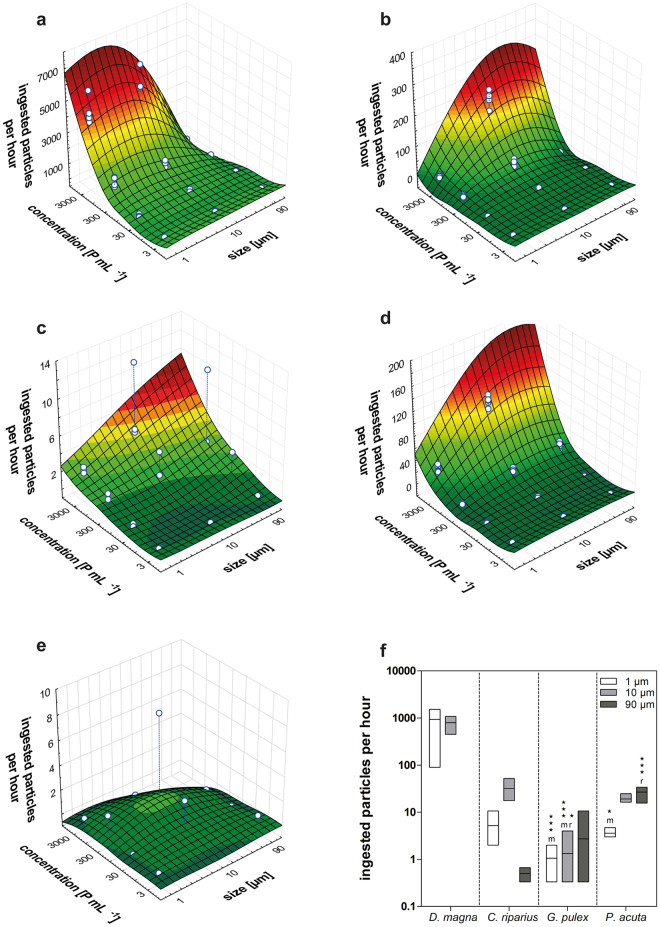
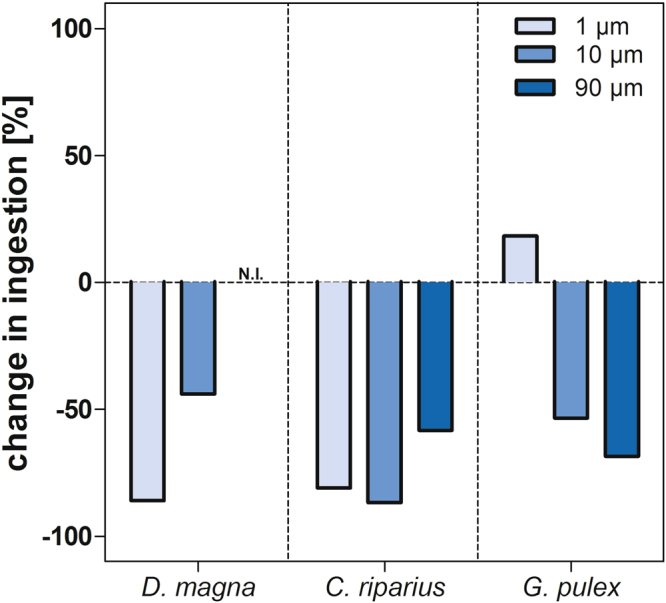
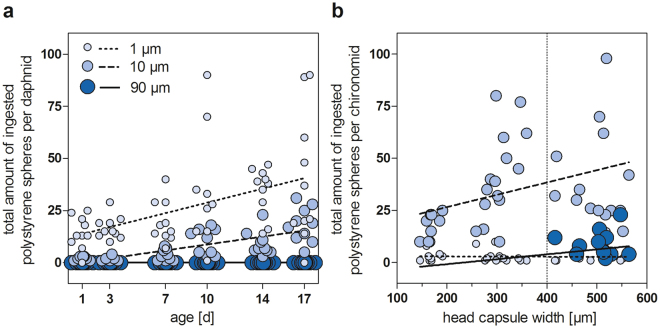
Abstract Microscopic plastic items (microplastics) are ubiquitously present in aquatic ecosystems. With decreasing size their availability and potential to accumulate throughout food webs increase. However, little is known on the uptake of microplastics by freshwater invertebrates. To address this, we exposed species with different feeding strategies to 1, 10 and 90 µm fluorescent polystyrene spheres (3–3 000 particles mL−1). Additionally, we investigated how developmental stages and a co-exposure to natural particles (e.g., food) modulate microplastic ingestion. All species ingested microplastics in a concentration-dependent manner with Daphnia magna consuming up to 6 180 particles h−1, followed by Chironomus riparius (226 particles h−1), Physella acuta (118 particles h−1), Gammarus pulex (10 particles h−1) and Lumbriculus variegatus (8 particles h−1). D. magna did not ingest 90 µm microplastics whereas the other species preferred larger microplastics over 1 µm in size. In C. riparius and D. magna, size preference depended on the life stage with larger specimens ingesting more and larger microplastics. The presence of natural particles generally reduced the microplastics uptake. Our results demonstrate that freshwater invertebrates have the capacity to ingest microplastics. However, the quantity of uptake depends on their feeding type and morphology as well as on the availability of microplastics.
Overview
The claims and statistics of this paper haven’t been checked yet.
Run the check — free, no account needed. It reads the open-access text and checks the sources it cites.
Integrity signals
Registry
Cites
Statistics
Figures
Verification
Claims the paper makes
The claims and statistics of this paper haven’t been checked yet.
Run the check — free, no account needed. It reads the open-access text and checks the sources it cites.
Claims other papers make about this one
Each is checked against this paper’s own text: does it say what the citing paper says it does?
The source backs part of the claim, not all of it — or backs it for a different population, condition or comparison.
In the citing paper
“Previous studies have indeed demonstrated that microplastics are taken up from sediments by freshwater species10−15 and that the capacity of freshwater invertebrates to ingest microplastics depends on their feeding type.15”
From Microplastic Effect Thresholds for Freshwater Benthic Macroinvertebrates (2018) · cites this paper as [15]
Experimental — accuracy not yet measuredThe source backs part of the claim, not all of it — or backs it for a different population, condition or comparison.
In the citing paper
“This is in accordance with previous studies showing that microplastic uptake by freshwater invertebrates is size- specific and feeding type dependent and that irregularly shaped microplastics need a significant longer clearance time in comparison to spherical microplastics.11,15”
From Microplastic Effect Thresholds for Freshwater Benthic Macroinvertebrates (2018) · cites this paper as [15]
Experimental — accuracy not yet measuredThe source backs part of the claim, not all of it — or backs it for a different population, condition or comparison.
In the citing paper
“Both laboratory experiments and in situ observations have confirmed that organisms of various trophic levels ingest or uptake microplastics, either directly or indirectly (Cole et al., 2013;Provencher et al., 2018;Scherer et al., 2017;Setälä et al., 2014).”
From No Effect of Realistic Concentrations of Polyester Microplastic Fibers on Freshwater Zooplankton Communities (2024) · cites this paper as Scherer et al., 2017
Experimental — accuracy not yet measuredThe cited source says what the claim attributes to it.
In the citing paper
“Such differences between study outcomes may relate to (a) differences in the exposure medium, as the presence of natural particles seems to reduce the ingestion of microplastics in freshwater invertebrates,15 and (b) to a higher bioavailability of particles in suspension as compared to particles mixed in the sediment as in the present bioassays.”
From Microplastic Effect Thresholds for Freshwater Benthic Macroinvertebrates (2018) · cites this paper as [15]
Self-check
Percentages, sums and reported differences re-computed from the paper’s own numbers.
The self-check needs the paper’s full text.
Citations
Cites
Lost at sea: where is all the plastic?
Thompson, R. C., Olsen, Y., Mitchell, R. P., Davis, A., Rowland, S. J., John, A. W. G., McGonigle, D., & Russell, A. E. (2004) · Science · doi:10.1126/science.1094559 · Cited by 7,765
Eerkes-Medrano, D., Thompson, R. C., & Aldridge, D. C. (2015) · Water Research · doi:10.1016/j.watres.2015.02.012 · Cited by 2,638
Lu, Y., Zhang, Y., Deng, Y., Jiang, W., Zhao, Y., Geng, J., Ding, L., & Ren, H. (2016) · Environmental Science & Technology · doi:10.1021/acs.est.6b00183 · Cited by 2,125
Microplastics in bivalves cultured for human consumption
Cauwenberghe, L. V., & Janssen, C. (2014) · Environmental Pollution · doi:10.1016/j.envpol.2014.06.010 · Cited by 2,105
von Moos, N., Burkhardt-Holm, P., & Köhler, A. (2012) · Environmental Science & Technology · doi:10.1021/es302332w · Cited by 1,697
Microplastics in freshwater ecosystems: what we know and what we need to know
Wagner, M., Scherer, C., Alvarez-Muñoz, D., Brennholt, N., Bourrain, X., Buchinger, S., Fries, E., Grosbois, C., Klasmeier, J., Marti, T., et al. (2014) · Environmental Sciences Europe · doi:10.1186/s12302-014-0012-7 · Cited by 1,543
Self-citationCole, M., Lindeque, P., Fileman, E., Halsband, C., & Galloway, T. S. (2015) · Environmental Science & Technology · doi:10.1021/es504525u · Cited by 1,308
Klein, S., Worch, E., & Knepper, T. P. (2015) · Environmental Science & Technology · doi:10.1021/acs.est.5b00492 · Cited by 1,181
Nanoplastic Affects Growth of S. obliquus and Reproduction of D. magna
Besseling, E., Wang, B., Lürling, M., & Koelmans, A. A. (2014) · Environmental Science & Technology · doi:10.1021/es503001d · Cited by 1,138
Characterisation of nanoplastics during the degradation of polystyrene
Lambert, S., & Wagner, M. (2016) · Chemosphere · doi:10.1016/j.chemosphere.2015.11.078 · Cited by 1,075
Self-citation
Cited by
Sorted by citations
Items 101–200 of 448
Mueller, M.-T., Fueser, H., Höss, S., & Traunspurger, W. (2020) · Ecological Indicators · doi:10.1016/j.ecolind.2020.106698 · Cited by 73
Wang, C., Hou, M., Shang, K., Wang, H., & Wang, J. (2022) · Molecules · doi:10.3390/molecules27030584 · Cited by 71
Song, J., Na, J., An, D., & Jung, J. (2021) · The Science of The Total Environment · doi:10.1016/j.scitotenv.2021.149638 · Cited by 70
Felice, B. D., Bacchetta, R., Santo, N., Tremolada, P., & Parolini, M. (2018) · Environmental Science and Pollution Research · doi:10.1007/s11356-018-3408-x · Cited by 69
Chagas, T. Q., Araújo, A. P. D. C., & Malafaia, G. (2020) · The Science of The Total Environment · doi:10.1016/j.scitotenv.2020.143231 · Cited by 69
RetractedThe Paleoecology of Microplastic Contamination
Bancone, C. E. P., Turner, S. D., do Sul, J. A. I., & Rose, N. L. (2020) · Frontiers in Environmental Science · doi:10.3389/fenvs.2020.574008 · Cited by 74
Gupta, D. K., Choudhary, D., Vishwakarma, A., Mudgal, M., Srivastava, A. K., & Singh, A. K. (2022) · International Journal of Environmental Science and Technology · doi:10.1007/s13762-022-04139-2 · Cited by 69
Can microplastics facilitate the emergence of infectious diseases?
Loiseau, C., & Sorci, G. (2022) · The Science of The Total Environment · doi:10.1016/j.scitotenv.2022.153694 · Cited by 69
Microplastics in Freshwater Sediments Impact the Role of a Main Bioturbator in Ecosystem Functioning
Wazne, M., Mermillod‐Blondin, F., Vallier, M., Hervant, F., Dumet, A., Nel, H., Kukkola, A. T., Krause, S., & Simon, L. (2023) · Environmental Science & Technology · doi:10.1021/acs.est.2c05662 · Cited by 68
Amariei, G., Rosal, R., Fernández-Piñas, F., & Koelmans, A. A. (2022) · Environmental Pollution · doi:10.1016/j.envpol.2021.118622 · Cited by 65
Ockenden, A., Tremblay, L. A., Dikareva, N., & Simon, K. S. (2021) · Science of The Total Environment · doi:10.1016/j.scitotenv.2021.148507 · Cited by 65
Shamskhany, A., & Karimpour, S. (2022) · Marine Pollution Bulletin · doi:10.1016/j.marpolbul.2022.114160 · Cited by 65
Prata, J. C., Silva, C. J. M., Serpa, D., Soares, A. M. V. M., Gravato, C., & Silva, A. L. P. (2022) · The Science of The Total Environment · doi:10.1016/j.scitotenv.2022.160426 · Cited by 65
Yıldız, D., Yalçın, G., Jovanović, B., Boukal, D. S., Vebrová, L., Riha, D., Stanković, J., Savić‐Zdravković, D., Metin, M., Akyürek, Y. N., et al. (2022) · The Science of The Total Environment · doi:10.1016/j.scitotenv.2022.155407 · Cited by 68
Rodrigues, C. C., Salla, R. F., & Rocha, T. L. (2022) · Journal of Hazardous Materials · doi:10.1016/j.jhazmat.2022.130382 · Cited by 65
Microplastic Pollution in the Surface Waters from Plain and Mountainous Lakes in Siberia, Russia
Malygina, N. S., Mitrofanova, E. Y., Kuryatnikova, N., Biryukov, R. Y., Zolotov, D. V., Pershin, D. K., & Черных, Д. В. (2021) · Water · doi:10.3390/w13162287 · Cited by 65
Khedre, A. M., Ramadan, S. A., Ashry, A., & Alaraby, M. (2024) · Chemosphere · doi:10.1016/j.chemosphere.2024.141557 · Cited by 61
Makhdoumi, P., Hossini, H., Nazmara, Z., Mansouri, K., & Pirsaheb, M. (2021) · Marine Pollution Bulletin · doi:10.1016/j.marpolbul.2021.112915 · Cited by 59
Soltanighias, T., Umar, A. Y., Abdullahi, M., Abdallah, M. A., & Orsini, L. (2024) · Environmental Pollution · doi:10.1016/j.envpol.2024.125133 · Cited by 64
Lievens, S., Vervoort, E., Bruno, D., der Donck, T. V., Tettamanti, G., Seo, J. W., Poma, G., Covaci, A., Smet, J. D., & Borght, M. V. D. (2023) · Scientific Reports · doi:10.1038/s41598-023-31176-9 · Cited by 58
Khosrovyan, A., & Kahru, A. (2019) · Chemosphere · doi:10.1016/j.chemosphere.2019.125487 · Cited by 58
Review on the ecotoxicological impacts of plastic pollution on the freshwater invertebrate Daphnia
Samadi, A., Kim, Y., Lee, S., Kim, Y. J., & Esterhuizen‐Londt, M. (2022) · Environmental Toxicology · doi:10.1002/tox.23623 · Cited by 60
Pizzichetti, A. R. P., Pablos, C., Álvarez-Fernández, C., Reynolds, K., Stanley, S., & Marugán, J. (2022) · Journal of environmental chemical engineering · doi:10.1016/j.jece.2023.109338 · Cited by 58
Yu, S.-P., Nakaoka, M., & Chan, B. K. K. (2020) · Environmental Pollution · doi:10.1016/j.envpol.2020.115865 · Cited by 57
Cyto–Genotoxic Effect Causing Potential of Polystyrene Micro-Plastics in Terrestrial Plants
Kaur, M., Xu, M., & Wang, L. (2022) · Nanomaterials · doi:10.3390/nano12122024 · Cited by 56
Modelling the transfer and accumulation of microplastics in a riverine freshwater food web
O’Connor, J., Lally, H., Koelmans, A. A., Mahon, A. M., O’Connor, I., Nash, R., O’Sullivan, J., Bruen, M., Heerey, L., & Murphy, S. (2022) · Environmental Advances · doi:10.1016/j.envadv.2022.100192 · Cited by 57
Luo, B., Li, J., Wang, M., Zhang, X., Mi, Y., Xiang, J., Gong, S., Zhou, Y., & Ma, T. (2022) · Journal of Hazardous Materials · doi:10.1016/j.jhazmat.2022.128800 · Cited by 54
Ingestion of microplastics by meiobenthic communities in small-scale microcosm experiments
Fueser, H., Mueller, M.-T., & Traunspurger, W. (2020) · The Science of The Total Environment · doi:10.1016/j.scitotenv.2020.141276 · Cited by 54
Winkler, A., Antonioli, D., Masseroni, A., Chiarcos, R., Laus, M., & Tremolada, P. (2022) · The Science of The Total Environment · doi:10.1016/j.scitotenv.2022.153638 · Cited by 56
Alfonso, M. B., Arias, A. H., & Píccolo, M. C. (2020) · Environmental Monitoring and Assessment · doi:10.1007/s10661-020-8080-1 · Cited by 53
The impacts of plastics on aquatic insects
Ribeiro-Brasil, D. R. G., Brasil, L. S., Veloso, G. K. O., de Matos, T. P., de Lima, E. S., & Dias‐Silva, K. (2021) · The Science of The Total Environment · doi:10.1016/j.scitotenv.2021.152436 · Cited by 52
Su, Q.-L., Wu, J., Tan, S.-W., Guo, X., Zou, D.-Z., & Kang, K. (2024) · PLoS ONE · doi:10.1371/journal.pone.0304686 · Cited by 52
Toxicity and biomarkers of micro-plastic in aquatic environment: a review
Suman, K. H., Haque, M. N., Uddin, M. J., Begum, M. S., & Sikder, M. H. (2020) · Biomarkers · doi:10.1080/1354750x.2020.1863470 · Cited by 53
Spatial distribution of microplastics in Chinese freshwater ecosystem and impacts on food webs
Bhutto, S. U. A., & You, X. (2021) · Environmental Pollution · doi:10.1016/j.envpol.2021.118494 · Cited by 52
Effects of polyester fibers and car tire particles on freshwater invertebrates
Schell, T., Martinez-Perez, S., Dafouz, R., Hurley, R., Vighi, M., & Rico, A. (2022) · Environmental Toxicology and Chemistry · doi:10.1002/etc.5337 · Cited by 50
The cause, fate and effect of microplastics in freshwater ecosystem: Ways to overcome the challenge
Raju, M., Gandhimathi, R., & Nidheesh, P. V. (2023) · Journal of Water Process Engineering · doi:10.1016/j.jwpe.2023.104199 · Cited by 51
Kadiene, E. U., Meng, P., Hwang, J., & Souissi, S. (2019) · Chemosphere · doi:10.1016/j.chemosphere.2019.05.220 · Cited by 49
Pan, C., Mintenig, S. M., Redondo‐Hasselerharm, P. E., Neijenhuis, P. H. M. W., Yu, K., Wang, Y., & Koelmans, A. A. (2021) · Environmental Science & Technology · doi:10.1021/acs.est.1c03119 · Cited by 55
Hu, L., Fu, J., Zheng, P., Dai, M., Zeng, G., & Pan, X. (2021) · Journal of Hazardous Materials · doi:10.1016/j.jhazmat.2021.127665 · Cited by 47
Varg, J. E., Kunce, W., Outomuro, D., Svanbäck, R., & Johansson, F. (2021) · Environmental Pollution · doi:10.1016/j.envpol.2021.117848 · Cited by 50
Electrokinetic-assisted filtration for fast and highly efficient removal of microplastics from water
Lee, M., Choi, W., & Lim, G. (2022) · Chemical Engineering Journal · doi:10.1016/j.cej.2022.139152 · Cited by 47
Transfer and effects of PET microfibers in Chironomus riparius
Setyorini, L., Michler‐Kozma, D., Sures, B., & Gabel, F. (2020) · The Science of The Total Environment · doi:10.1016/j.scitotenv.2020.143735 · Cited by 47
González-Saldías, F., Sabater, F., & Gomà, J. (2024) · The Science of The Total Environment · doi:10.1016/j.scitotenv.2024.173165 · Cited by 45
Khosrovyan, A., & Kahru, A. (2021) · Environmental Pollution · doi:10.1016/j.envpol.2021.117334 · Cited by 44
Zhang, J., Ma, C., Xia, X., Li, Y., Lin, X., Zhang, Y., & Yang, Z. (2023) · Environmental Science & Technology · doi:10.1021/acs.est.3c02144 · Cited by 43
What the fluff is this? - Gammarus pulex prefer food sources without plastic microfibers
Yardy, L. D., & Callaghan, A. (2020) · The Science of The Total Environment · doi:10.1016/j.scitotenv.2020.136815 · Cited by 44
Mateos-Cárdenas, A., Moroney, A. V. D. G., van Pelt, F. N. A. M., O’Halloran, J., & Jansen, M. A. K. (2022) · Food Webs · doi:10.1016/j.fooweb.2022.e00228 · Cited by 45
Assessing microplastic distribution within infaunal benthic communities in a coastal embayment
Pagter, E., Nash, R., Frias, J. P. G. L., & Kavanagh, F. (2021) · The Science of The Total Environment · doi:10.1016/j.scitotenv.2021.148278 · Cited by 43
Kaliszewicz, A., Winczek, M., Karaban, K., Kurzydłowski, D., Górska, M., Koselak, W., & Romanowski, J. (2020) · Waste Management & Research The Journal for a Sustainable Circular Economy · doi:10.1177/0734242x20938448 · Cited by 45
Lin, C.-T., Chiu, M., & Kuo, M. (2021) · Scientific Reports · doi:10.1038/s41598-020-79881-z · Cited by 44
Magester, S., Barcelona, A., Colomer, J., & Serra, T. (2021) · Ecotoxicology and Environmental Safety · doi:10.1016/j.ecoenv.2021.113001 · Cited by 46
Welden, N. A. C., & Lusher, A. (2020) · Elsevier eBooks · doi:10.1016/b978-0-12-817880-5.00009-8 · Cited by 44
Simakova, A. V., Varenitsina, A. A., Babkina, I. B., Andreeva, Y. V., Bagirov, R. T.-O., Yartsev, V. V., & Frank, Y. A. (2022) · Water · doi:10.3390/w14121852 · Cited by 41
Marchant, D. J., Martínez Rodríguez, A., Francelle, P., Jones, J. I., & Kratina, P. (2023) · Ecotoxicology and Environmental Safety · doi:10.1016/j.ecoenv.2023.114834 · Cited by 40
Mediated food and hydrodynamics on the ingestion of microplastics by Daphnia magna
Colomer, J., Müller, M. F., Barcelona, A., & Serra, T. (2019) · Environmental Pollution · doi:10.1016/j.envpol.2019.05.034 · Cited by 39
Wu, B., Yu, H., Lei, P., He, J., Yi, J., Wu, W., Wang, H., Yang, Q., Zeng, G., & Sun, D. (2025) · Ecotoxicology and Environmental Safety · doi:10.1016/j.ecoenv.2025.117883 · Cited by 39
D’Avignon, G., Hsu, S. S. H., Gregory‐Eaves, I., & Ricciardi, A. P. (2023) · The Science of The Total Environment · doi:10.1016/j.scitotenv.2023.165261 · Cited by 39
Heinrich, P., Hanslik, L., Kämmer, N., & Braunbeck, T. A. (2020) · Environmental Science and Pollution Research · doi:10.1007/s11356-020-08859-1 · Cited by 39
Yu, S.-P., & Chan, B. K. K. (2020) · Environmental Pollution · doi:10.1016/j.envpol.2020.115560 · Cited by 38
Drago, C., Pawlak, J., & Weithoff, G. (2020) · Frontiers in Environmental Science · doi:10.3389/fenvs.2020.574274 · Cited by 39
Tamayo-Belda, M., Venâncio, C., Fernández‐Piñas, F., Rosal, R., Lopes, I., & Oliveira, M. (2023) · The Science of The Total Environment · doi:10.1016/j.scitotenv.2023.163447 · Cited by 39
Sforzi, L., Camillo, A. T. D., Lorenzo, T. D., Galassi, D. M. P., Balestra, V., Piccini, L., Cabigliera, S. B., Ciattini, S., Laurati, M., Chelazzi, D., et al. (2024) · Sustainability · doi:10.3390/su16062532 · Cited by 37
Park, J. S., Yoo, J.-W., Lee, Y.-H., Park, C., & Lee, Y.-M. (2024) · Marine Pollution Bulletin · doi:10.1016/j.marpolbul.2024.116768 · Cited by 38
Capparelli, M. V., Gómez-Ponce, M. A., Borges-Ramírez, M. M., Osten, J. R., Celis-Hernández, O., Briceño-Vera, A. E., Ávila, E., & MOULATLET, G. M. (2022) · Marine Pollution Bulletin · doi:10.1016/j.marpolbul.2022.114088 · Cited by 37
Microplastic distribution among estuarine sedimentary habitats utilized by intertidal crabs
Vermeiren, P., Ikejima, K., Uchida, Y., & Muñoz, C. C. (2023) · The Science of The Total Environment · doi:10.1016/j.scitotenv.2023.161400 · Cited by 37
Biogeochemical cycling and ecological thresholds in a High Arctic lake (Svalbard)
Luoto, T. P., Rantala, M. V., Kivilä, E. H., Nevalainen, L., & Ojala, A. E. K. (2019) · Aquatic Sciences · doi:10.1007/s00027-019-0630-7 · Cited by 38
Hengstmann, E., & Fischer, E. K. (2020) · Environmental Research · doi:10.1016/j.envres.2020.109945 · Cited by 35
Kajian Kelimpahan Mikroplastik di Biota Perairan
Sandra, S. W., & Radityaningrum, A. D. (2021) · Jurnal Ilmu Lingkungan · doi:10.14710/jil.19.3.638-648 · Cited by 34
Tracking nanoplastics in freshwater microcosms and their impacts to aquatic organisms
Tamayo-Belda, M., Pérez-Olivares, A. V., Pulido‐Reyes, G., Martín-Betancor, K., González-Pleiter, M., Leganés, F., Mitrano, D. M., Rosal, R., & Fernández‐Piñas, F. (2022) · Journal of Hazardous Materials · doi:10.1016/j.jhazmat.2022.130625 · Cited by 37
Zhang, M., Jin, Y., Fan, C., Xu, Y., Li, J., Pan, W., Lou, Z., Chen, H., & Jin, B. (2024) · Environmental Pollution · doi:10.1016/j.envpol.2024.124426 · Cited by 33
Bioaccumulation of metals in calanoid copepods by oral intake
Kadiene, E. U., Ouddane, B., Hwang, J., & Souissi, S. (2019) · Scientific Reports · doi:10.1038/s41598-019-45987-2 · Cited by 32
İşinibilir, M., Svetlichny, L. S., Mykitchak, T., Türkeri, E. E., Eryalçın, K. M., Doğan, O., Kayadelen, G. C., Yüksel, E., & Kideys, A. E. (2020) · Frontiers in Marine Science · doi:10.3389/fmars.2020.603321 · Cited by 35
Stanković, J., Milošević, D., Jovanović, B., Savić‐Zdravković, D., Petrović, A. S., Raković, M., Stanković, N., & Piperac, M. S. (2021) · Environmental Toxicology and Chemistry · doi:10.1002/etc.5119 · Cited by 37
A review of current approaches for the study of microplastic contamination in crustaceans
Sorrentino, R., & Senna, A. R. (2020) · Environmental Reviews · doi:10.1139/er-2020-0024 · Cited by 33
Nikhil, V. G., Amritha, G. G., Ranjeet, K., & Varghese, G. K. (2024) · Environmental Pollution · doi:10.1016/j.envpol.2024.123350 · Cited by 30
Castro, G. B., Bernegossi, A. C., PINHEIRO, F. R., Felipe, M. C., & Corbi, J. J. (2020) · Water Air & Soil Pollution · doi:10.1007/s11270-020-04845-y · Cited by 31
Svetlichny, L. S., İşinibilir, M., Mykitchak, T., Eryalçın, K. M., Türkeri, E. E., Yüksel, E., & Kideys, A. E. (2021) · Regional Studies in Marine Science · doi:10.1016/j.rsma.2021.101650 · Cited by 32
Mackenzie, C. M., & Vladimirova, V. (2021) · Studies on Neotropical Fauna and Environment · doi:10.1080/01650521.2021.1895466 · Cited by 32
Romero-Blanco, A., Remón-Elola, A., & Alonso, Á. (2021) · Water Air & Soil Pollution · doi:10.1007/s11270-021-05379-7 · Cited by 31
Toxicity of Tire Rubber Microplastics to Freshwater Sediment Organisms
Navarro, V. C., Nuutinen, A., Sorvari, J., & Kukkonen, J. V. K. (2021) · Archives of Environmental Contamination and Toxicology · doi:10.1007/s00244-021-00905-4 · Cited by 30
Castro, G. B., Bernegossi, A. C., PINHEIRO, F. R., & Corbi, J. J. (2022) · Limnologica · doi:10.1016/j.limno.2022.125964 · Cited by 33
Khosrovyan, A., Doria, H. B., Kahru, A., & Pfenninger, M. (2022) · Chemosphere · doi:10.1016/j.chemosphere.2022.134452 · Cited by 30
Yardy, L. D., Al-Jaibachi, R., & Callaghan, A. (2022) · Elsevier eBooks · doi:10.1016/b978-0-12-822850-0.00017-x · Cited by 29
Silva, C. J. M., Machado, A. L., Campos, D., Soares, A., & Pestana, J. (2022) · Environmental Research · doi:10.1016/j.envres.2022.113641 · Cited by 24
Effects of environmentally relevant concentrations of microplastics on amphipods
Rani-Borges, B., Meitern, R., Teesalu, P., Raudna-Kristoffersen, M., Kreitsberg, R., Heinlaan, M., Tuvikene, A., & Ivask, A. (2022) · Chemosphere · doi:10.1016/j.chemosphere.2022.136599 · Cited by 30
de Ruijter, V. N., Hof, M., Kotorou, P., van Leeuwen, J., van den Heuvel-Greve, M. J., Roessink, I., & Koelmans, A. A. (2023) · Environmental Science & Technology · doi:10.1021/acs.est.3c06829 · Cited by 32
Khdre, A. M., Ramadan, S. A., Ashry, A., & Alaraby, M. (2023) · Water Air & Soil Pollution · doi:10.1007/s11270-023-06179-x · Cited by 28
Ritchie, M. W., Provencher, J. F., Allison, J. E., Muzzatti, M. J., & MacMillan, H. A. (2023) · Environmental Pollution · doi:10.1016/j.envpol.2023.123168 · Cited by 28
Bermúdez, R., Métian, M., Oberhänsli, F., Taylor, A., & Swarzenski, P. W. (2021) · Marine Environmental Research · doi:10.1016/j.marenvres.2021.105260 · Cited by 30
Mercury Bioaccumulation in Benthic Invertebrates: From Riverine Sediments to Higher Trophic Levels
Marziali, L., Roscioli, C., & Valsecchi, L. (2021) · Toxics · doi:10.3390/toxics9090197 · Cited by 28
Curtis, B. J., Niemuth, N. J., Bennett, E. A., Schmoldt, A., Mueller, O., Mohaimani, A. A., Laudadio, E. D., Shen, Y. J., White, J. C., Hamers, R. J., et al. (2022) · Nature Nanotechnology · doi:10.1038/s41565-022-01096-2 · Cited by 28
Du, Y., Zhao, J., Teng, J., Ren, J., Zheng, P., Zhu, X., Liu, Y., Sun, X., Yuan, S., & Wang, Q. (2022) · Marine Pollution Bulletin · doi:10.1016/j.marpolbul.2022.114341 · Cited by 28
Liang, J., Xiong, S., He, C., Song, Z., Yang, S. Y., Ma, D., Yan, W., Wang, H., Tahir, R., & Han, M. (2023) · Aquatic Toxicology · doi:10.1016/j.aquatox.2023.106774 · Cited by 28
Hanslik, L., Sommer, C., Huppertsberg, S., Dittmar, S., Knepper, T. P., & Braunbeck, T. A. (2020) · Comparative Biochemistry and Physiology Part C Toxicology & Pharmacology · doi:10.1016/j.cbpc.2020.108849 · Cited by 28
Lorenzo, T. D., Cabigliera, S. B., Martellini, T., Laurati, M., Chelazzi, D., Galassi, D. M. P., & Cincinelli, A. (2022) · Chemosphere · doi:10.1016/j.chemosphere.2022.136830 · Cited by 30
Kumari, N., Samantaray, B. P., Patel, A., & Kumar, R. (2023) · Water · doi:10.3390/w15050928 · Cited by 28
The effect of microplastics on Daphnia fitness – Systematic review and meta‐analysis
Funke, E., Webb, L. J., & Wolinska, J. (2024) · Freshwater Biology · doi:10.1111/fwb.14228 · Cited by 28
Microplastic pollution in riverine ecosystems: threats posed on macroinvertebrates
Nantege, D., Odong, R., Auta, H. S., Keke, U. N., Ndatimana, G., Assie, F. A. G. J., & Arimoro, F. O. (2023) · Environmental Science and Pollution Research · doi:10.1007/s11356-023-27839-9 · Cited by 28
Brehm, J., Ritschar, S., Laforsch, C., & Mair, M. M. (2023) · Journal of Hazardous Materials · doi:10.1016/j.jhazmat.2023.131839 · Cited by 26
Kim, D., Kim, S. A., Nam, S., Kwak, J. I., Kim, L., Lee, T.-Y., Kim, H., An, S., & An, Y. (2024) · Marine Pollution Bulletin · doi:10.1016/j.marpolbul.2024.116056 · Cited by 25
Metadata
- Authors
- Scherer, C., Brennholt, N., Reifferscheid, G., & Wagner, M.
- Affiliations
- Goethe University Frankfurt (DE)
- Federal Institute of Hydrology (DE)
- Corresponding author
- Scherer, Christian
- Venue
- Scientific Reports
- Published
- 2017-12-05
- Volume
- 7
- Issue
- 1
- Pages
- 17006-17006
- ISSN
- 2045-2322 (ISSN-L)
- PMC
- PMC5717137
- OpenAlex
- W2770802549
- Cited by
- 448
- References
- 69
- Citations by year
- 2026: 45 · 2025: 48 · 2024: 66 · 2023: 58 · 2022: 64 · 2021: 63 · 2020: 52 · 2019: 37 · 2018: 13 · 2017: 1
- FWCI
- 12.68
- Type
- journal article
- Language
- en
- Open access
- gold
- doi.org
- Locations
- Scientific Reports (publishedVersion, cc-by)
- Europe PMC (PubMed Central) (publishedVersion, cc-by)
- PubMed Central (publishedVersion, cc-by)
- PubMed (publishedVersion)
- BIBSYS Brage (BIBSYS (Norway)) (acceptedVersion, cc-by)
- DOAJ (DOAJ: Directory of Open Access Journals) (submittedVersion)
- NORA - Norwegian Open Research Archives (submittedVersion, cc-by)
- Publication Server of Goethe University Frankfurt am Main (Goethe University Frankfurt) (submittedVersion, cc-by)
- Funders
- Bundesministerium für Bildung und Forschung
- Topics
- Physical Sciences › Environmental Science › Pollution › Microplastics and Plastic Pollution
- Physical Sciences › Environmental Science › Health, Toxicology and Mutagenesis › Environmental Toxicology and Ecotoxicology
- Physical Sciences › Environmental Science › Pollution › Pharmaceutical and Antibiotic Environmental Impacts
- Keywords
- microplastics, microplastic ingestion, freshwater invertebrates, feeding type, developmental stages, Daphnia magna, Chironomus riparius, Physella acuta, Gammarus pulex, Lumbriculus variegatus, polystyrene microspheres
- MeSH terms
- Animals, Chironomidae, Daphnia, Eating, Fresh Water, Invertebrates, Plastics, Water Pollutants, Chemical, Ecosystem, Food Chain, Amphipoda
About these checks
Registry, retraction, Cites and statistics results are computed, not judged, with one exception: a printed reference that no index lists is read once by a model before it counts as a citation error. Claims are extracted by a model and kept only when their quote appears verbatim in the text; each cited source is then checked, with a model’s help, for whether it says what the claim relies on. Those verdicts can be wrong — read the claim’s quote and the cited source before relying on one.
Statistics and arithmetic are recomputed, not judged.
Confidence bands are shown only for fields calibrated on our annotated test set. None is calibrated yet, so no band is shown.
What counts as a claim ›How we measure confidence ›How we check this ›
Are you an author, or do you see a problem with this page? Request a review
