

The DOI matches its Crossref record; 68 of the 69 references it cites were found in a registry or an index.
Feeding type and development drive the ingestion of microplastics by freshwater invertebrates
Open accessAbstract
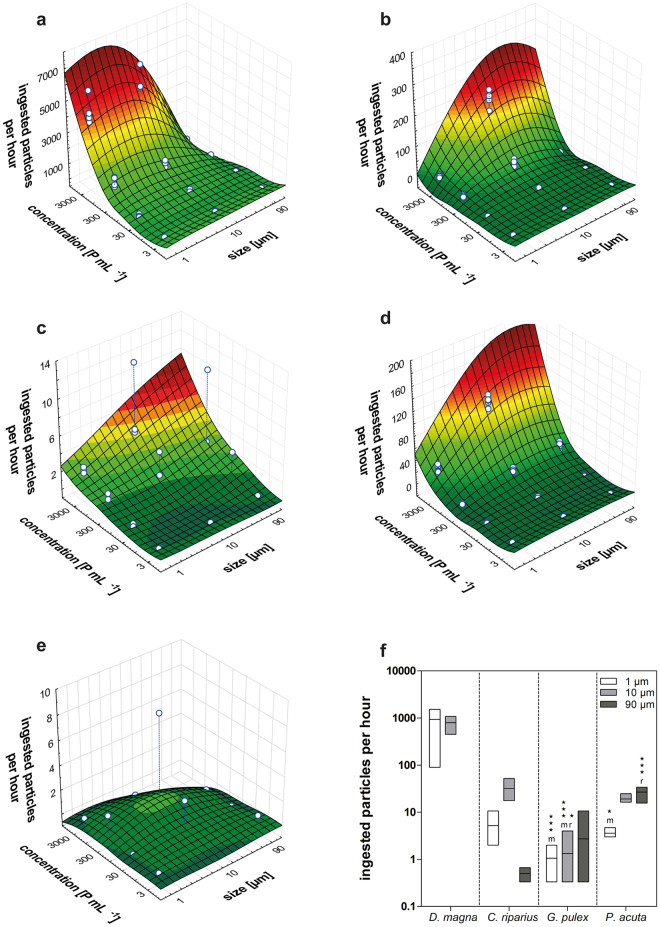
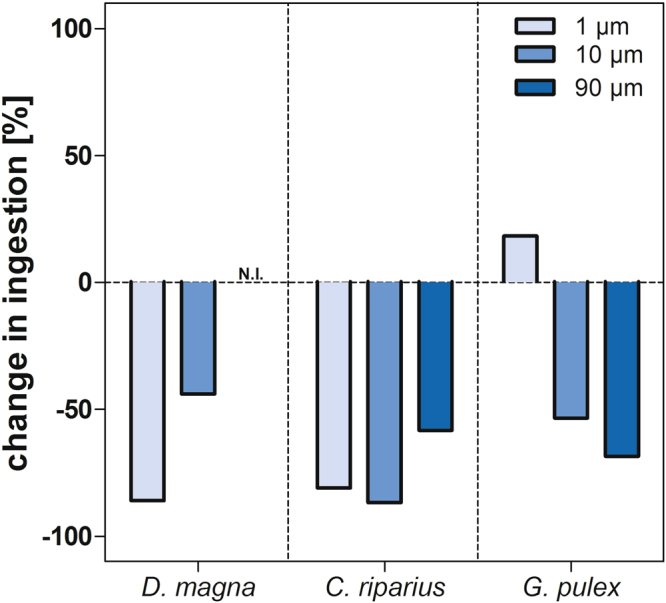
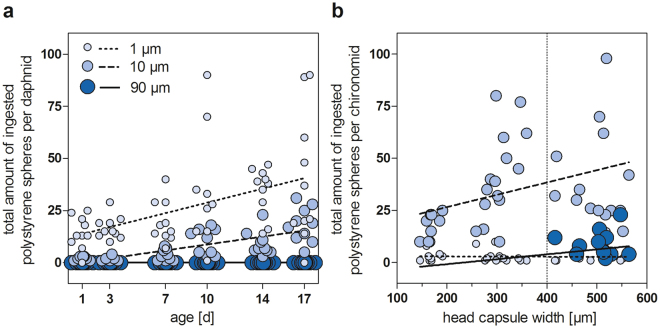
Abstract Microscopic plastic items (microplastics) are ubiquitously present in aquatic ecosystems. With decreasing size their availability and potential to accumulate throughout food webs increase. However, little is known on the uptake of microplastics by freshwater invertebrates. To address this, we exposed species with different feeding strategies to 1, 10 and 90 µm fluorescent polystyrene spheres (3–3 000 particles mL−1). Additionally, we investigated how developmental stages and a co-exposure to natural particles (e.g., food) modulate microplastic ingestion. All species ingested microplastics in a concentration-dependent manner with Daphnia magna consuming up to 6 180 particles h−1, followed by Chironomus riparius (226 particles h−1), Physella acuta (118 particles h−1), Gammarus pulex (10 particles h−1) and Lumbriculus variegatus (8 particles h−1). D. magna did not ingest 90 µm microplastics whereas the other species preferred larger microplastics over 1 µm in size. In C. riparius and D. magna, size preference depended on the life stage with larger specimens ingesting more and larger microplastics. The presence of natural particles generally reduced the microplastics uptake. Our results demonstrate that freshwater invertebrates have the capacity to ingest microplastics. However, the quantity of uptake depends on their feeding type and morphology as well as on the availability of microplastics.
Overview
The claims and statistics of this paper haven’t been checked yet.
Run the check — free, no account needed. It reads the open-access text and checks the sources it cites.
Integrity signals
Registry
Cites
Statistics
Figures
Verification
Claims the paper makes
The claims and statistics of this paper haven’t been checked yet.
Run the check — free, no account needed. It reads the open-access text and checks the sources it cites.
Claims other papers make about this one
Each is checked against this paper’s own text: does it say what the citing paper says it does?
The source backs part of the claim, not all of it — or backs it for a different population, condition or comparison.
In the citing paper
“Previous studies have indeed demonstrated that microplastics are taken up from sediments by freshwater species10−15 and that the capacity of freshwater invertebrates to ingest microplastics depends on their feeding type.15”
From Microplastic Effect Thresholds for Freshwater Benthic Macroinvertebrates (2018) · cites this paper as [15]
Experimental — accuracy not yet measuredThe source backs part of the claim, not all of it — or backs it for a different population, condition or comparison.
In the citing paper
“This is in accordance with previous studies showing that microplastic uptake by freshwater invertebrates is size- specific and feeding type dependent and that irregularly shaped microplastics need a significant longer clearance time in comparison to spherical microplastics.11,15”
From Microplastic Effect Thresholds for Freshwater Benthic Macroinvertebrates (2018) · cites this paper as [15]
Experimental — accuracy not yet measuredThe source backs part of the claim, not all of it — or backs it for a different population, condition or comparison.
In the citing paper
“Both laboratory experiments and in situ observations have confirmed that organisms of various trophic levels ingest or uptake microplastics, either directly or indirectly (Cole et al., 2013;Provencher et al., 2018;Scherer et al., 2017;Setälä et al., 2014).”
From No Effect of Realistic Concentrations of Polyester Microplastic Fibers on Freshwater Zooplankton Communities (2024) · cites this paper as Scherer et al., 2017
Experimental — accuracy not yet measuredThe cited source says what the claim attributes to it.
In the citing paper
“Such differences between study outcomes may relate to (a) differences in the exposure medium, as the presence of natural particles seems to reduce the ingestion of microplastics in freshwater invertebrates,15 and (b) to a higher bioavailability of particles in suspension as compared to particles mixed in the sediment as in the present bioassays.”
From Microplastic Effect Thresholds for Freshwater Benthic Macroinvertebrates (2018) · cites this paper as [15]
Self-check
Percentages, sums and reported differences re-computed from the paper’s own numbers.
The self-check needs the paper’s full text.
Citations
Cites
Lost at sea: where is all the plastic?
Thompson, R. C., Olsen, Y., Mitchell, R. P., Davis, A., Rowland, S. J., John, A. W. G., McGonigle, D., & Russell, A. E. (2004) · Science · doi:10.1126/science.1094559 · Cited by 7,765
Eerkes-Medrano, D., Thompson, R. C., & Aldridge, D. C. (2015) · Water Research · doi:10.1016/j.watres.2015.02.012 · Cited by 2,638
Lu, Y., Zhang, Y., Deng, Y., Jiang, W., Zhao, Y., Geng, J., Ding, L., & Ren, H. (2016) · Environmental Science & Technology · doi:10.1021/acs.est.6b00183 · Cited by 2,125
Microplastics in bivalves cultured for human consumption
Cauwenberghe, L. V., & Janssen, C. (2014) · Environmental Pollution · doi:10.1016/j.envpol.2014.06.010 · Cited by 2,105
von Moos, N., Burkhardt-Holm, P., & Köhler, A. (2012) · Environmental Science & Technology · doi:10.1021/es302332w · Cited by 1,697
Microplastics in freshwater ecosystems: what we know and what we need to know
Wagner, M., Scherer, C., Alvarez-Muñoz, D., Brennholt, N., Bourrain, X., Buchinger, S., Fries, E., Grosbois, C., Klasmeier, J., Marti, T., et al. (2014) · Environmental Sciences Europe · doi:10.1186/s12302-014-0012-7 · Cited by 1,543
Self-citationCole, M., Lindeque, P., Fileman, E., Halsband, C., & Galloway, T. S. (2015) · Environmental Science & Technology · doi:10.1021/es504525u · Cited by 1,308
Klein, S., Worch, E., & Knepper, T. P. (2015) · Environmental Science & Technology · doi:10.1021/acs.est.5b00492 · Cited by 1,181
Nanoplastic Affects Growth of S. obliquus and Reproduction of D. magna
Besseling, E., Wang, B., Lürling, M., & Koelmans, A. A. (2014) · Environmental Science & Technology · doi:10.1021/es503001d · Cited by 1,138
Characterisation of nanoplastics during the degradation of polystyrene
Lambert, S., & Wagner, M. (2016) · Chemosphere · doi:10.1016/j.chemosphere.2015.11.078 · Cited by 1,075
Self-citation
Cited by
Sorted by citations
Items 201–300 of 448
Langenfeld, D., Bucci, K., Veneruzzo, C., McNamee, R. A., Gao, G. H. Y., Rochman, C. M., Rennie, M. D., Hoffman, M. J., Orihel, D. M., Provencher, J. F., et al. (2024) · Environmental Science & Technology · doi:10.1021/acs.est.4c05327 · Cited by 27
Chiani, M. M., Rasta, M., Taleshi, M. S., & Elmi, F. (2024) · Marine Environmental Research · doi:10.1016/j.marenvres.2024.106863 · Cited by 25
Kuehr, S., Esser, D., & Schlechtriem, C. (2022) · Environmental Toxicology and Chemistry · doi:10.1002/etc.5315 · Cited by 27
Anthropogenically impacted lake catchments in Denmark reveal low microplastic pollution
Kallenbach, E., Friberg, N. R., Lusher, A., Jacobsen, D., & Hurley, R. R. (2022) · Environmental Science and Pollution Research · doi:10.1007/s11356-022-19001-8 · Cited by 25
Dosimetry on first clinical dark‐field chest radiography
Frank, M., Urban, T., Willer, K., Noichl, W., Marco, F. D., Schick, R. C., Gleich, B., Schegerer, A., Lechel, U., Meyer, P., et al. (2021) · Medical Physics · doi:10.1002/mp.15132 · Cited by 25
Wang, Z., Wang, Y., Qin, S., Yang, Z., & Sun, Y. (2023) · Environmental Pollution · doi:10.1016/j.envpol.2022.120657 · Cited by 24
Klein, K., Heß, S., Nungeß, S., Schulte‐Oehlmann, U., & Oehlmann, J. (2021) · Environmental Science and Pollution Research · doi:10.1007/s11356-021-15068-x · Cited by 24
The Potential Role of Membrane Technology in the Removal of Microplastics from Wastewater
Adewuyi, A., Campbell, A. J., & Adeyemi, O. G. (2021) · Journal of Applied Membrane Science & Technology · doi:10.11113/amst.v25n2.216 · Cited by 24
Grgić, I., Cetinić, K. A., Karačić, Z., Previšić, A., & Rožman, M. (2022) · The Science of The Total Environment · doi:10.1016/j.scitotenv.2022.160387 · Cited by 28
Acute bioaccumulation and chronic toxicity of olivine in the marine amphipod Gammarus locusta
Flipkens, G., Horoba, K., Bostyn, K., Geerts, L. J. J., Town, R. M., & Blust, R. (2023) · Aquatic Toxicology · doi:10.1016/j.aquatox.2023.106662 · Cited by 25
Bulannga, R. B., & Schmidt, Š. (2024) · Frontiers in Earth Science · doi:10.3389/feart.2024.1349865 · Cited by 24
Ockenden, Α., Mitrano, D. M., Kah, M., Tremblay, L. A., & Simon, K. S. (2024) · Nature Water · doi:10.1038/s44221-024-00334-2 · Cited by 22
Including impacts of microplastics in marine water and sediments in life cycle assessment
Saadi, N., Lavoie, J., Fantke, P., Redondo‐Hasselerharm, P. E., & Boulay, A. (2025) · Journal of Cleaner Production · doi:10.1016/j.jclepro.2025.146037 · Cited by 22
Evidence of micro and macroplastic toxicity along a stream detrital food-chain
Batista, D., Pradhan, A., Pascoal, C., & Cássio, F. (2022) · Journal of Hazardous Materials · doi:10.1016/j.jhazmat.2022.129064 · Cited by 21
Wang, X., Lo, H., Fu, Y., Wu, Z., Qin, D., Huang, X., Zhu, J., Cheung, S. G., & Kwan, K. Y. (2022) · Journal of Ocean University of China · doi:10.1007/s11802-022-5163-3 · Cited by 21
Parolini, M., Felice, B. D., Góis, A., Faria, M., Cordeiro, N., & Nogueira, N. (2022) · The Science of The Total Environment · doi:10.1016/j.scitotenv.2022.160497 · Cited by 21
Manríquez-Guzmán, D. L., Chaparro-Herrera, D. D. J., & Ramírez, P. (2023) · Food Webs · doi:10.1016/j.fooweb.2023.e00316 · Cited by 21
Microplastics from agricultural mulch films: Biodegradation and ecotoxicity in freshwater systems
Ferreira-Filipe, D. A., Paço, A., Pinho, B., Silva, R., Silva, S. A. M., Jesus, F. T., Pereira, J. L., Duarte, A. C., Rocha‐Santos, T., & Silva, A. L. P. (2023) · The Science of The Total Environment · doi:10.1016/j.scitotenv.2023.169287 · Cited by 21
Benhadji, N., Kurniawan, S. B., & Imron, M. F. (2024) · The Science of The Total Environment · doi:10.1016/j.scitotenv.2024.178057 · Cited by 20
Mülayim, A., Bat, L., Öztekin, A., Kecel‐Gunduz, S., Yücedağ, E., & Bıçak, B. (2022) · Water Air & Soil Pollution · doi:10.1007/s11270-022-05908-y · Cited by 21
Silva, S. A. M., Rodrigues, A. C. M., Rocha‐Santos, T., Silva, A. L. P., & Gravato, C. (2022) · International Journal of Environmental Research and Public Health · doi:10.3390/ijerph192315610 · Cited by 21
Hund‐Rinke, K., Broßell, D., Eilebrecht, S., Schlich, K., Schlinkert, R., Steska, T., Wolf, C., & Kühnel, D. (2022) · Environmental Sciences Europe · doi:10.1186/s12302-022-00695-z · Cited by 20
Bertoli, M., Renzi, M., Pastorino, P., Lesa, D., Mele, A., Anselmi, S., Barceló, ., Prearo, M., & Pizzul, E. (2023) · Ecological Indicators · doi:10.1016/j.ecolind.2023.109995 · Cited by 20
Song, X., Ding, J., Zhang, Y., Zhu, M., Peng, Y., Wang, Z., Pan, G., & Zou, H. (2024) · Journal of Hazardous Materials · doi:10.1016/j.jhazmat.2024.134047 · Cited by 20
Bour, A., Sandgaard, M. H., Syberg, K., Palmqvist, A., & Almroth, B. C. (2021) · Journal of Hazardous Materials · doi:10.1016/j.jhazmat.2021.125652 · Cited by 20
Silva, S. A. M., Prata, J. C., Dias‐Pereira, P., Rodrigues, A. C. M., Soares, A. M. V. M., Sarmento, R. A., Rocha‐Santos, T., Gravato, C., & Silva, A. L. P. (2023) · The Science of The Total Environment · doi:10.1016/j.scitotenv.2023.162556 · Cited by 19
Khedre, A. M., Ramadan, S. A., Ashry, A., & Alaraby, M. (2023) · Marine and Freshwater Research · doi:10.1071/mf22257 · Cited by 19
Ribeiro, F., Pavlaki, M. D., Loureiro, S., Sarmento, R. A., Soares, A. M. V. M., & Tourinho, P. S. (2023) · Toxics · doi:10.3390/toxics11060474 · Cited by 19
Bosshart, S., Erni-Cassola, G., & Burkhardt‐Holm, P. (2020) · Environmental Pollution · doi:10.1016/j.envpol.2020.115664 · Cited by 21
Чайка, В., Pikula, K., Вшивкова, Т. С., Zakharenko, A. M., Reva, G. V., Анатольевич, Д. К., Vardavas, A. I., Stivaktakis, P. D., Νikolouzakis, Τ. Κ., Stratidakis, A. K., et al. (2020) · Toxicology Reports · doi:10.1016/j.toxrep.2020.07.011 · Cited by 19
Procházková, P., Kalčíková, G., Maršálková, E., Brtnický, M., Gargošová, H. Z., & Kučerík, J. (2024) · Heliyon · doi:10.1016/j.heliyon.2024.e36302 · Cited by 18
“According to Scherer et al. [29], the probability of MPs ingestion by freshwater invertebrates depends on factors such as the properties and concentration of MPs. Daphnids are also preferred for these studies because of their global abundance in aquatic environments and their significant role in…”
BackgroundLeaf morphology affects microplastic entrapment efficiency in freshwater macrophytes
Tan, J. W. Q., Tong, R. J., Tang, Z., Lee, C. Z. D., Yong, C. L. X., & Todd, P. A. (2023) · Marine and Freshwater Research · doi:10.1071/mf22149 · Cited by 19
Kühnel, D., Steska, T., Schlich, K., Wolf, C., Wohlleben, W., & Hund‐Rinke, K. (2023) · Microplastics and Nanoplastics · doi:10.1186/s43591-023-00078-y · Cited by 21
Ecological risk assessment of microplastics in agricultural soils of Coimbatore region, India
Karthika, S., Sivasubramanian, K., Dhevagi, P., Krishnaraj, R. S., Chitra, N., Arunachalam, L., & Kamalam, D. G. (2024) · Natural Resources for Human Health · doi:10.53365/nrfhh/184013 · Cited by 18
Gallitelli, L., Cera, A., Scalici, M., Sodo, A., Gioacchino, M. D., Luzi, B., Hortas, F., Green, A. J., & Coccia, C. (2024) · The Science of The Total Environment · doi:10.1016/j.scitotenv.2024.176707 · Cited by 18
Im, H., Lee, J., Oh, J., Song, J., & Jeong, S. (2025) · Molecules · doi:10.3390/molecules30071608 · Cited by 18
The impacts of microplastics on zebrafish behavior depend on initial personality state
Jabri, N. A., Abed, R. M. M., Al-Habsi, A. A., Al-Ansari, A., & Barry, M. J. (2024) · Environmental Toxicology and Pharmacology · doi:10.1016/j.etap.2024.104561 · Cited by 19
Microplastics in subsurface water and zooplankton from eight lakes in British Columbia
Klasios, N., & Tseng, M. (2023) · Canadian Journal of Fisheries and Aquatic Sciences · doi:10.1139/cjfas-2022-0293 · Cited by 17
Zink, L., Shearer, A. Y., Wiseman, S. B., & Pyle, G. G. (2023) · Environmental Toxicology and Chemistry · doi:10.1002/etc.5628 · Cited by 17
Stanković, J., Milošević, D., Paunović, M., Jovanović, B., Popović, N., Tomović, J., Atanacković, A. D., Radulović, K., Lončarević, D. R., & Raković, M. (2024) · Water · doi:10.3390/w16070962 · Cited by 17
Ledet, J., Tan, C., Guan, X. H., Yong, C. L. X., Ying, L., & Todd, P. A. (2024) · Marine Environmental Research · doi:10.1016/j.marenvres.2024.106487 · Cited by 18
Gong, N., Wang, Z., Wang, X., & Shao, K. (2024) · Aquatic Toxicology · doi:10.1016/j.aquatox.2024.107165 · Cited by 18
Uptake and Transfer of Polyamide Microplastics in a Freshwater Mesocosm Study
Michler‐Kozma, D., Kruckenfellner, L., Heitkamp, A., Ebke, K. P., & Gabel, F. (2022) · Water · doi:10.3390/w14060887 · Cited by 17
Qi, H., Zeng, S., Wang, Y., & Dong, X. Z. (2022) · Journal of Environmental Management · doi:10.1016/j.jenvman.2022.114917 · Cited by 18
Klasios, N., Kim, J. O., & Tseng, M. (2024) · Environmental Toxicology and Chemistry · doi:10.1002/etc.5797 · Cited by 18
“Both laboratory experiments and in situ observations have con fi rmed that organisms of various trophic levels ingest or uptake microplastics, either directly or indirectly (Cole et al., 2013; Provencher et al., 2018; Scherer et al., 2017; Setälä et al., 2014).”
BackgroundAshry, A., & Naggar, Y. A. (2025) · Environmental Research · doi:10.1016/j.envres.2025.121945 · Cited by 16
Yu, J., Wang, S., Zhang, H.-Q., Song, X., Liu, L., Jiang, Y., Chen, R., Zhang, Q., Chen, Y.-Q., Zhou, H.-J., et al. (2024) · Environmental Pollution · doi:10.1016/j.envpol.2024.123308 · Cited by 17
Towards harmonized ecotoxicological effect assessment of micro- and nanoplastics in aquatic systems
Beggel, S., Kalis, E. J. J., & Geist, J. P. (2024) · Environmental Pollution · doi:10.1016/j.envpol.2024.125504 · Cited by 17
Kallenbach, E., Eriksen, T. E., Hurley, R. R., Jacobsen, D., Singdahl-Larsen, C., & Friberg, N. R. (2022) · Microplastics and Nanoplastics · doi:10.1186/s43591-022-00045-z · Cited by 16
İşinibilir, M., Eryalçın, K. M., & Kideys, A. E. (2022) · Microplastics · doi:10.3390/microplastics2010002 · Cited by 16
Microplastic label in microencapsulation field – Consequence of shell material selection
Woźniak-Budych, M., Staszak, K., Wieszczycka, K., Bajek, A., Staszak, M., Roszkowski, S., Giamberini, M., & Tylkowski, B. (2023) · Journal of Hazardous Materials · doi:10.1016/j.jhazmat.2023.133000 · Cited by 15
Khedre, A. M., Ramadan, S. A., Ashry, A., & Alaraby, M. (2023) · Environmental Science and Pollution Research · doi:10.1007/s11356-023-30855-4 · Cited by 15
A perspective on the impacts of microplastics on mosquito biology and their vectorial capacity
Jones, C. M., Hughes, G. L., Coleman, S., Fellows, R. J., & Quilliam, R. S. (2024) · Medical and Veterinary Entomology · doi:10.1111/mve.12710 · Cited by 17
da Silva, J. V. F., Lansac‐Tôha, F. M., Segóvia, B. T., Amadeo, F. E., Braghin, L. D. S. M., Velho, L. F. M., Sarmento, H., & Bonecker, C. C. (2022) · The Science of The Total Environment · doi:10.1016/j.scitotenv.2022.153045 · Cited by 16
Sui, Y., Wang, S., Mohsen, M., Zhang, L., Shen, M., Liu, Z., Nguyen, H., Zhang, S., Li, K., Lv, L., et al. (2022) · Journal of Ocean University of China · doi:10.1007/s11802-022-4937-y · Cited by 15
The Fluid Mechanics of Ocean Microplastics
DiBenedetto, M. H. (2025) · Annual Review of Fluid Mechanics · doi:10.1146/annurev-fluid-120423-012604 · Cited by 16
Nousheen, R., Rittschof, D., & Hashmi, I. (2021) · Environmental Toxicology and Pharmacology · doi:10.1016/j.etap.2022.103912 · Cited by 14
Lu, H., Kumar, A., Melvin, S., Ziajahromi, S., Neale, P., & Leusch, F. (2023) · Journal of Hazardous Materials · doi:10.1016/j.jhazmat.2023.132097 · Cited by 11
Sun, A., & Wang, W. (2024) · Environmental Science & Technology · doi:10.1021/acs.est.3c07869 · Cited by 14
Yang, Y.-K.-X., Ge, S.-J., Su, Q.-L., Chen, J., Wu, J., & Kang, K. (2024) · Veterinary Sciences · doi:10.3390/vetsci11100488 · Cited by 14
Lechner, A. (2020) · Springer eBooks · doi:10.1007/978-3-030-38945-1_8 · Cited by 14
Procházková, P., Kalčíková, G., Maršálková, E., Zlámalová Gargošová, H., & Kučerík, J. (2025) · Journal of Thermal Analysis and Calorimetry · doi:10.1007/s10973-024-12985-0 · Cited by 13
Hashim, S., Alam, M. J., Yang, Z., & Arakawa, H. (2024) · Regional Studies in Marine Science · doi:10.1016/j.rsma.2024.103384 · Cited by 13
Sebteoui, K., Milošević, D., Stanković, J., BARANOV, V. A., Jovanović, B., Krause, S., & Csabai, Z. (2024) · The Science of The Total Environment · doi:10.1016/j.scitotenv.2024.170844 · Cited by 13
Effects of food quantity on the ingestion and egestion of MPs with different colors by Daphnia magna
Lan, D., He, H., Song, X., & Ma, Y. (2024) · Aquatic Toxicology · doi:10.1016/j.aquatox.2024.106976 · Cited by 13
Stojanović, J., Savić‐Zdravković, D., Jovanović, B., Vitorović, J., Bašić, J., Stojanović, I. R., Popović, A. Ž., Duran, H., Kračun‐Kolarević, M., & Milošević, D. (2023) · The Science of The Total Environment · doi:10.1016/j.scitotenv.2023.166042 · Cited by 12
Bibliometric Insights into Microplastic Pollution in Freshwater Ecosystems
Yıldırım, G., Anindita, M., Pan, X. H., Rahman, S., Alim, M. A., Rehana, S., & Rahman, A. (2024) · Water · doi:10.3390/w16223237 · Cited by 13
Micro- and Macroplastics in Aquatic Ecosystems
Napper, I. E., & Thompson, R. C. (2018) · Elsevier eBooks · doi:10.1016/b978-0-12-409548-9.10600-1 · Cited by 12
Zink, L., Meslo, M., Wiseman, S. B., & Pyle, G. G. (2023) · Environmental Toxicology · doi:10.1002/tox.24096 · Cited by 11
Andrade, C., Sepúlveda, T., Pinto, B., Rivera, C. N., Aldea, C., & Urbina, M. A. (2025) · Environmental Science and Pollution Research · doi:10.1007/s11356-025-36144-6 · Cited by 12
Prata, J. C., Venâncio, C., da Costa, J. P., Lopes, I., Duarte, A. C., & Rocha‐Santos, T. (2021) · Marine Pollution Bulletin · doi:10.1016/j.marpolbul.2021.112615 · Cited by 11
Nałęcz‐Jawecki, G., Chojnacka, J., Wawryniuk, M., & Drobniewska, A. (2021) · Water · doi:10.3390/w13202857 · Cited by 14
Gilfedder, B. S., Elagami, H., Boos, J., Brehm, J., Schott, M., Witt, L., Laforsch, C., & Frei, S. (2023) · The Science of The Total Environment · doi:10.1016/j.scitotenv.2023.164293 · Cited by 11
Metabolic equilibrium and reproductive resilience: Freshwater gastropods under nanoplastics exposure
Wang, T., & Liu, W. (2023) · Chemosphere · doi:10.1016/j.chemosphere.2023.141017 · Cited by 11
Interactions between microplastics and Culex sp. larvae in wastewater
Khedre, A. M., Ramadan, S. A., Ashry, A., & Alaraby, M. (2024) · Water Environment Research · doi:10.1002/wer.11003 · Cited by 10
Samudra, D., Aunurohim, A., & Setiawan, E. (2024) · BIO Web of Conferences · doi:10.1051/bioconf/20249404019 · Cited by 11
Assessing the effectiveness of microplastic extraction methods on fishmeal with different properties
Way, C., Hudson, M. D., Williams, I. D., Langley, G. J., & Marsh, R. (2022) · Analytical Methods · doi:10.1039/d1ay02154k · Cited by 10
Collecting–Gathering Biophysics of the Blackworm Lumbriculus variegatus
Tuazon, H., Nguyen, C., Kaufman, E., Tiwari, I., Bermudez, J., Chudasama, D., Peleg, O., & Bhamla, M. S. (2023) · Integrative and Comparative Biology · doi:10.1093/icb/icad080 · Cited by 10
Ahmadi, P., Dichgans, F., Jagau, L., Schmidt, C., Aizinger, V., Gilfedder, B. S., & Fleckenstein, J. H. (2024) · The Science of The Total Environment · doi:10.1016/j.scitotenv.2024.170218 · Cited by 11
Fate and effects of microplastic particles in a periphyton-grazer system
Merbt, S. N., Kroll, A., Sgier, L., Tlili, A., Schirmer, K., & Behra, R. (2024) · Environmental Pollution · doi:10.1016/j.envpol.2024.123798 · Cited by 10
Can water mites’ parasitism influence the number of microplastics ingested by aquatic insects?
Khedre, A. M., Ramadan, S. A., Ashry, A., & Alaraby, M. (2024) · Applied Water Science · doi:10.1007/s13201-024-02192-5 · Cited by 9
Ants avoid food contaminated with micro- and nanoplastics
Hen, G. L., Masoni, A., Manuelli, M., Falsini, S., Corti, E., Balzani, P., Renault, D., Papini, A., & Santini, G. (2024) · Environmental Pollution · doi:10.1016/j.envpol.2024.124625 · Cited by 9
Ockenden, Α., Mitrano, D. M., Kah, M., Tremblay, L. A., & Simon, K. S. (2024) · Microplastics and Nanoplastics · doi:10.1186/s43591-024-00096-4 · Cited by 9
Pettersen, K. S., Sele, V., Araujo, P. W., Belghit, I., Benestad, S. L., Bernhoft, A., Booth, A. M., Eriksen, G. S., Farkas, J., Handå, A., et al. (2025) · Reviews in Aquaculture · doi:10.1111/raq.12996 · Cited by 9
Sapkale, D., Kurkute, P., Mistry, A., & Pandit, S. V. (2023) · Bulletin of Environmental Contamination and Toxicology · doi:10.1007/s00128-023-03813-6 · Cited by 9
Martínez-Pérez, S., Schell, T., Franco, D., Rosal, R., Redondo‐Hasselerharm, P. E., Martínez-Hernández, V., & Rico, A. (2024) · Aquatic Toxicology · doi:10.1016/j.aquatox.2024.107104 · Cited by 11
Davis, K. E., Beaty, F., & Sánchez, C. (2021) · Marine Policy · doi:10.1016/j.marpol.2021.104833 · Cited by 9
Footprint of the plastisphere on freshwater zooplankton
Balkić, A. G., Pfeiffer, T. Ž., Čmelar, K., Maronić, D. Š., Stević, F., Bek, N., Martinović, A., & Nikolašević, R. (2022) · Environmental Research · doi:10.1016/j.envres.2022.113563 · Cited by 9
Bilan, M. V., Lieshchova, M. A., & Brygadyrenko, V. V. (2022) · Biosystems Diversity · doi:10.15421/012243 · Cited by 9
Astel, A. M., & Piskuła, P. (2023) · Toxics · doi:10.3390/toxics11090779 · Cited by 8
Izlal, S., Arif, M. S., Rahman, S., & Rhidoy, M. O. I. (2025) · Environmental Monitoring and Assessment · doi:10.1007/s10661-025-14433-4 · Cited by 8
Do microplastics impair male dominance interactions in fish? A test of the vector hypothesis
Swank, A., Blevins, K., Bourne, A., & Ward, J. (2022) · Ecology and Evolution · doi:10.1002/ece3.8620 · Cited by 8
Microplastic Ingestion by a Benthic Amphipod in Different Feeding Modes
Hiki, K., & Nakajima, F. (2022) · Journal of Water and Environment Technology · doi:10.2965/jwet.22-057 · Cited by 8
The potential of Lecane rotifers in microplastics removal
Pajdak‐Stós, A., Fiałkowska, E., Hajdyła, F., & Fiałkowski, W. (2023) · The Science of The Total Environment · doi:10.1016/j.scitotenv.2023.165662 · Cited by 9
Spatial distribution of microplastic in sediment of the Citanduy River, West Java, Indonesia
Widigdo, B., Imran, Z., Taryono, T., Wulandari, D. Y., & Marliana, A. (2021) · IOP Conference Series Earth and Environmental Science · doi:10.1088/1755-1315/744/1/012098 · Cited by 8
Simantiris, N., Cladas, Y., Chochos, C. L., Gregoriou, V. G., Koutsikopoulos, C., Karapanagioti, H. K., Avlonitis, M., & Vardaki, M. Z. (2024) · Estuarine Coastal and Shelf Science · doi:10.1016/j.ecss.2024.108775 · Cited by 7
Dou, Q., Zhao, J., Zhai, W., Tang, J., & Zhang, J. (2024) · ChemistrySelect · doi:10.1002/slct.202401084 · Cited by 7
Mustafa, A. N., Khedre, A. M., & El-masry, S. M. (2025) · Chemosphere · doi:10.1016/j.chemosphere.2025.144295 · Cited by 7
Doria, H. B., Sohal, N., Feldmeyer, B., & Pfenninger, M. (2025) · Aquatic Toxicology · doi:10.1016/j.aquatox.2025.107386 · Cited by 6
Pace, G., Melfe, F., Rodrigues, C. M., Ribeiro, D., Lourenço, J., Carvalho, F., Ribeiro, C. A., Cássio, F., Pascoal, C., & Pradhan, A. (2025) · Hydrobiologia · doi:10.1007/s10750-025-05882-6 · Cited by 7
Metadata
- Authors
- Scherer, C., Brennholt, N., Reifferscheid, G., & Wagner, M.
- Affiliations
- Goethe University Frankfurt (DE)
- Federal Institute of Hydrology (DE)
- Corresponding author
- Scherer, Christian
- Venue
- Scientific Reports
- Published
- 2017-12-05
- Volume
- 7
- Issue
- 1
- Pages
- 17006-17006
- ISSN
- 2045-2322 (ISSN-L)
- PMC
- PMC5717137
- OpenAlex
- W2770802549
- Cited by
- 448
- References
- 69
- Citations by year
- 2026: 45 · 2025: 48 · 2024: 66 · 2023: 58 · 2022: 64 · 2021: 63 · 2020: 52 · 2019: 37 · 2018: 13 · 2017: 1
- FWCI
- 12.68
- Type
- journal article
- Language
- en
- Open access
- gold
- doi.org
- Locations
- Scientific Reports (publishedVersion, cc-by)
- Europe PMC (PubMed Central) (publishedVersion, cc-by)
- PubMed Central (publishedVersion, cc-by)
- PubMed (publishedVersion)
- BIBSYS Brage (BIBSYS (Norway)) (acceptedVersion, cc-by)
- DOAJ (DOAJ: Directory of Open Access Journals) (submittedVersion)
- NORA - Norwegian Open Research Archives (submittedVersion, cc-by)
- Publication Server of Goethe University Frankfurt am Main (Goethe University Frankfurt) (submittedVersion, cc-by)
- Funders
- Bundesministerium für Bildung und Forschung
- Topics
- Physical Sciences › Environmental Science › Pollution › Microplastics and Plastic Pollution
- Physical Sciences › Environmental Science › Health, Toxicology and Mutagenesis › Environmental Toxicology and Ecotoxicology
- Physical Sciences › Environmental Science › Pollution › Pharmaceutical and Antibiotic Environmental Impacts
- Keywords
- microplastics, microplastic ingestion, freshwater invertebrates, feeding type, developmental stages, Daphnia magna, Chironomus riparius, Physella acuta, Gammarus pulex, Lumbriculus variegatus, polystyrene microspheres
- MeSH terms
- Animals, Chironomidae, Daphnia, Eating, Fresh Water, Invertebrates, Plastics, Water Pollutants, Chemical, Ecosystem, Food Chain, Amphipoda
About these checks
Registry, retraction, Cites and statistics results are computed, not judged, with one exception: a printed reference that no index lists is read once by a model before it counts as a citation error. Claims are extracted by a model and kept only when their quote appears verbatim in the text; each cited source is then checked, with a model’s help, for whether it says what the claim relies on. Those verdicts can be wrong — read the claim’s quote and the cited source before relying on one.
Statistics and arithmetic are recomputed, not judged.
Confidence bands are shown only for fields calibrated on our annotated test set. None is calibrated yet, so no band is shown.
What counts as a claim ›How we measure confidence ›How we check this ›
Are you an author, or do you see a problem with this page? Request a review
