

The DOI matches its Crossref record; 48 of the 48 references it cites were found in a registry or an index.
Early human settlement of Sahul was not an accident
Open accessAbstract
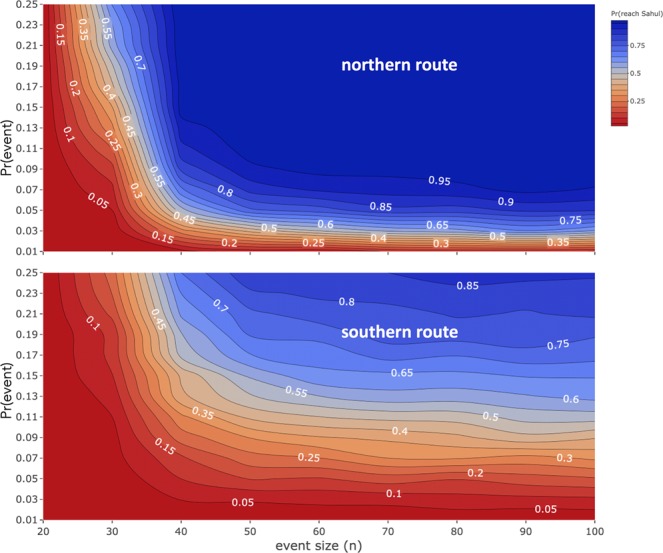
The first peopling of Sahul (Australia, New Guinea and the Aru Islands joined at lower sea levels) by anatomically modern humans required multiple maritime crossings through Wallacea, with at least one approaching 100 km. Whether these crossings were accidental or intentional is unknown. Using coastal-viewshed analysis and ocean drift modelling combined with population projections, we show that the probability of randomly reaching Sahul by any route is <5% until ≥40 adults are ‘washed off’ an island at least once every 20 years. We then demonstrate that choosing a time of departure and making minimal headway (0.5 knots) toward a destination greatly increases the likelihood of arrival. While drift modelling demonstrates the existence of ‘bottleneck’ crossings on all routes, arrival via New Guinea is more likely than via northwestern Australia. We conclude that anatomically modern humans had the capacity to plan and make open-sea voyages lasting several days by at least 50,000 years ago.
Overview
The claims and statistics of this paper haven’t been checked yet.
Run the check — free, no account needed. It reads the open-access text and checks the sources it cites.
Integrity signals
Registry
Cites
Statistics
Figures
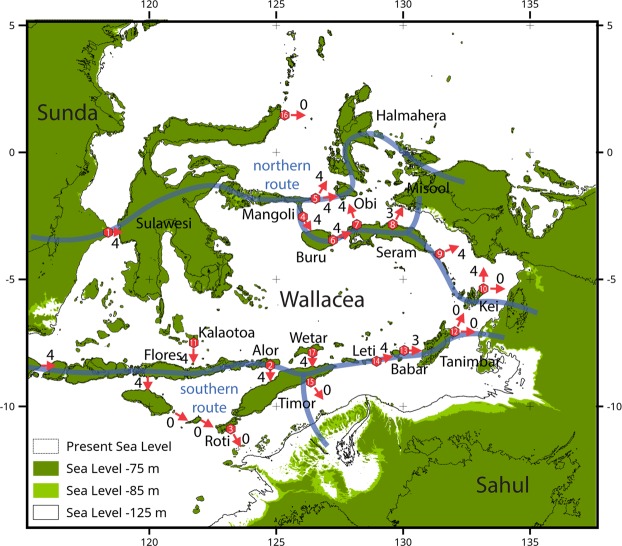
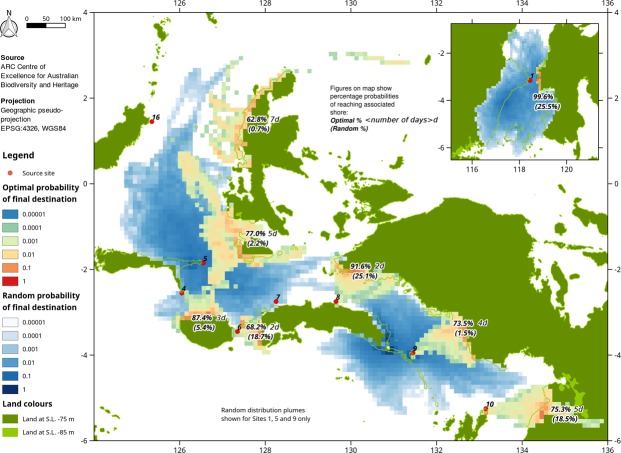
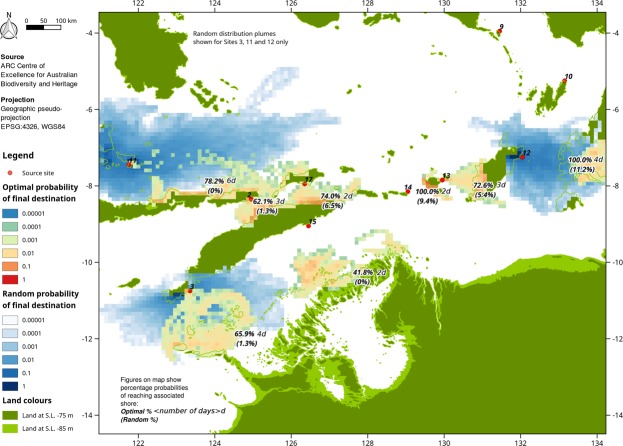
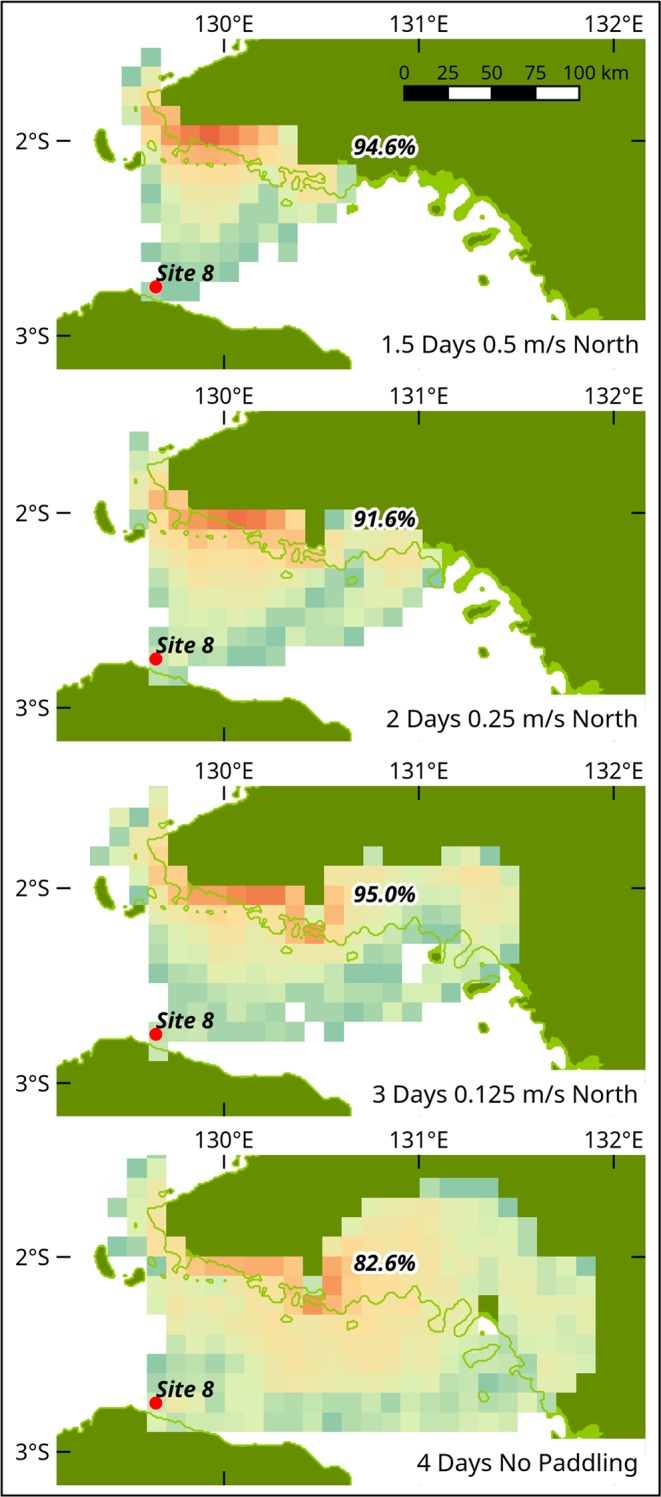
Verification
Claims the paper makes
The claims and statistics of this paper haven’t been checked yet.
Run the check — free, no account needed. It reads the open-access text and checks the sources it cites.
Claims other papers make about this one
Each is checked against this paper’s own text: does it say what the citing paper says it does?
The source backs part of the claim, not all of it — or backs it for a different population, condition or comparison.
In the citing paper
“Nonetheless, the current fossil and archaeological records, together mounting genetic evidence from across ISEA, point to the widespread presence of archaic hominins east of Wallace's Line 26 , and indicate that the first AMH populations to arrive in ISEA most likely encountered a variety of hominin populations, no matter which route they took to enter Sahul 4752 .”
From Widespread Denisovan ancestry in Island Southeast Asia but no evidence of substantial super-archaic hominin admixture (2021) · cites this paper as [52]
Experimental — accuracy not yet measuredThe source backs part of the claim, not all of it — or backs it for a different population, condition or comparison.
In the citing paper
“Our resulting network explicitly identifies vectors of connectivity among regions that have so far only been qualitatively inferred from linguistic 57,58 , genetic 59,60 , or archaeological 24,27,28 data (although see recent work by Pedro et al. 61 that suggested vectors of connectivity); our findings are complimentary to these studies.”
From Landscape rules predict optimal superhighways for the first peopling of sahul (2021) · cites this paper as [28]
Experimental — accuracy not yet measuredThe check wasn’t confident either way, so it gives no verdict — never disputed.
In the citing paper
“explaining how people likely traversed the large and diverse continent of Sahul once they arrived so far remains largely speculative 28 .”
From Landscape rules predict optimal superhighways for the first peopling of sahul (2021) · cites this paper as [28]
Experimental — accuracy not yet measured
Self-check
Percentages, sums and reported differences re-computed from the paper’s own numbers.
The self-check needs the paper’s full text.
Citations
Cites
Human occupation of northern Australia by 65,000 years ago
Clarkson, C., Jacobs, Z., Marwick, B., Fullagar, R., Wallis, L., Smith, M., Roberts, R. G., Hayes, E., Lowe, K., Carah, X., et al. (2017) · Nature · doi:10.1038/nature22968 · Cited by 1,185
Frankham, R., Bradshaw, C. J. A., & Brook, B. W. (2014) · Biological Conservation · doi:10.1016/j.biocon.2013.12.036 · Cited by 1,162
Self-citationLongevity Among Hunter‐ Gatherers: A Cross‐Cultural Examination
Gurven, M., & Kaplan, H. (2007) · Population and Development Review · doi:10.1111/j.1728-4457.2007.00171.x · Cited by 670
Direct estimates of the Indonesian Throughflow entering the Indian Ocean: 2004–2006
Janet Sprintall, A., Wijffels, S., Molcard, R., & Jaya, I. (2009) · Journal of Geophysical Research Atmospheres · doi:10.1029/2008jc005257 · Cited by 550
Growth rates and life histories in twenty‐two small‐scale societies
Walker, R. S., Gurven, M., Hill, K. R., Migliano, A. B., Chagnon, N. A., de Souza, R., Djurovic, G., HAMES, R. B., Hurtado, A. M., Kaplan, H. S., et al. (2006) · American Journal of Human Biology · doi:10.1002/ajhb.20510 · Cited by 436
Description of the Earth system model of intermediate complexity LOVECLIM version 1.2
Goosse, H., Brovkin, V. A., Fichefet, T., Haarsma, R., Huybrechts, P., Jongma, J. I., Mouchet, A., Selten, F., Barriat, P.-Y., Campin, J., et al. (2010) · Geoscientific model development · doi:10.5194/gmd-3-603-2010 · Cited by 386
Aboriginal mitogenomes reveal 50,000 years of regionalism in Australia
Tobler, R., Rohrlach, A. B., Soubrier, J., Bover, P. R., Llamas, B., Tuke, J., Bean, N. G., Abdullah-Highfold, A., Agius, S., O’Donoghue, A., et al. (2017) · Nature · doi:10.1038/nature21416 · Cited by 376
A Competing‐Risk Model for Animal Mortality
Siler, W. (1979) · Ecology · doi:10.2307/1936612 · Cited by 368
Rethinking the dispersal of Homo sapiens out of Africa
Groucutt, H. S., Petraglia, M. D., Bailey, G. N., Scerri, E. M. L., Parton, A., Clark‐Balzan, L., Jennings, R. P., Lewis, L., Blinkhorn, J., Drake, N., et al. (2015) · Evolutionary Anthropology Issues News and Reviews · doi:10.1002/evan.21455 · Cited by 334
Defining the ‘generalist specialist’ niche for Pleistocene Homo sapiens
Roberts, P., & Stewart, B. A. (2018) · Nature Human Behaviour · doi:10.1038/s41562-018-0394-4 · Cited by 300
Genetic and archaeological perspectives on the initial modern human colonization of southern Asia
Mellars, P., Gori, K. C., Carr, M., Soares, P. A., & Richards, M. B. (2013) · Proceedings of the National Academy of Sciences · doi:10.1073/pnas.1306043110 · Cited by 276
Human dispersal across diverse environments of Asia during the Upper Pleistocene
Boivin, N. L., Fuller, D. Q., Dennell, R., Allaby, R. G., & Petraglia, M. D. (2013) · Quaternary International · doi:10.1016/j.quaint.2013.01.008 · Cited by 241
When did Homo sapiens first reach Southeast Asia and Sahul?
O’Connell, J. F., Allen, J., Williams, M. A. J., Williams, A. N., Turney, C. S. M., Spooner, N. A., Kamminga, J., Brown, G., & Cooper, A. (2018) · Proceedings of the National Academy of Sciences · doi:10.1073/pnas.1808385115 · Cited by 236
(1977) · Cited by 221
Petraglia, M. D., Haslam, M., Fuller, D. Q., Boivin, N. L., & Clarkson, C. (2010) · Annals of Human Biology · doi:10.3109/03014461003639249 · Cited by 186
Early human occupation of a maritime desert, Barrow Island, North-West Australia
Veth, P., Ward, I. A. K., Manne, T., Ulm, S., Ditchfield, K., Dortch, J., Hook, F., Petchey, F., Hogg, A. G., Questiaux, D. G., et al. (2017) · Quaternary Science Reviews · doi:10.1016/j.quascirev.2017.05.002 · Cited by 186
Self-citationSymbolic behaviour and the peopling of the southern arc route to Australia
Balme, J., Davidson, I. M. T., McDonald, J., Stern, N., & Veth, P. (2008) · Quaternary International · doi:10.1016/j.quaint.2008.10.002 · Cited by 177
Least-cost pathway models indicate northern human dispersal from Sunda to Sahul
Kealy, S., Louys, J., & O'Connor, S. (2018) · Journal of Human Evolution · doi:10.1016/j.jhevol.2018.10.003 · Cited by 169
Self-citationProductivity, biodiversity, and pathogens influence the global hunter-gatherer population density
Tallavaara, M., Eronen, J. T., & Luoto, M. (2017) · Proceedings of the National Academy of Sciences · doi:10.1073/pnas.1715638115 · Cited by 163
Earliest hominin occupation of Sulawesi, Indonesia
van den Bergh, G. D., Li, B., Brumm, A., Grün, R., Yurnaldi, D., Moore, M. W., Kurniawan, I., Setiawan, R., Aziz, F., Roberts, R. G., et al. (2016) · Nature · doi:10.1038/nature16448 · Cited by 160
The frequency and severity of catastrophic die‐offs in vertebrates
Reed, D. H., O’Grady, J. J., Ballou, J. D., & Frankham, R. (2003) · Animal Conservation · doi:10.1017/s1367943003003147 · Cited by 133
Davidson, I. M. T., & Noble, W. G. (1992) · Archaeology in Oceania/Archæology & physical anthropology in Oceania · doi:10.1002/j.1834-4453.1992.tb00297.x · Cited by 124
Bird, M. I., Beaman, R. J., Condie, S. A., Cooper, A., Ulm, S., & Veth, P. (2018) · Quaternary Science Reviews · doi:10.1016/j.quascirev.2018.04.027 · Cited by 122
Self-citationAge and context of the oldest known hominin fossils from Flores
Brumm, A., van den Bergh, G. D., Storey, M., Kurniawan, I., Alloway, B. V., Setiawan, R., Setiyabudi, E., Grün, R., Moore, M. W., Yurnaldi, D., et al. (2016) · Nature · doi:10.1038/nature17663 · Cited by 111
Bulbeck, D. (2007) · Current Anthropology · doi:10.1086/512988 · Cited by 107
Sutikna, T., Tocheri, M. W., Faith, J. T., Jatmiko, J., Awe, R. D., Meijer, H. J. M., Saptomo, E. W., & Roberts, R. G. (2018) · Journal of Human Evolution · doi:10.1016/j.jhevol.2018.07.001 · Cited by 107
Hunter-gatherer energetics and fertility: A reassessment of the !Kung San
Bentley, G. R. (1985) · Human Ecology · doi:10.1007/bf01531090 · Cited by 103
The throughflow within Ombai Strait
Molcard, R., Fieux, M., & Syamsudin, F. (2001) · Deep Sea Research Part I Oceanographic Research Papers · doi:10.1016/s0967-0637(00)00084-4 · Cited by 103
Hawkins, S., O'Connor, S., Maloney, T. R., Litster, M., Kealy, S., Fenner, J. N., Aplin, K., Boulanger, C., Brockwell, S., Willan, R., et al. (2017) · Quaternary Science Reviews · doi:10.1016/j.quascirev.2017.07.008 · Cited by 96
Self-citationKealy, S., Louys, J., & O'Connor, S. (2017) · Archaeological Prospection · doi:10.1002/arp.1570 · Cited by 89
Self-citationAn early colonisation pathway into northwest Australia 70-60,000 years ago
Norman, K., Inglis, J., Clarkson, C., Faith, J. T., Shulmeister, J., & Harris, D. (2018) · Quaternary Science Reviews · doi:10.1016/j.quascirev.2017.11.023 · Cited by 87
Erlandson, J. M., & Braje, T. J. (2015) · Quaternary International · doi:10.1016/j.quaint.2015.03.046 · Cited by 83
Stone artifacts and hominins in island Southeast Asia: New insights from Flores, eastern Indonesia
Moore, M. W., & Brumm, A. (2006) · Journal of Human Evolution · doi:10.1016/j.jhevol.2006.08.002 · Cited by 82
van den Bergh, G. D., Awe, R. D., Morwood, M. J., Sutikna, T., Jatmiko, J., & Saptomo, E. W. (2007) · Quaternary International · doi:10.1016/j.quaint.2007.02.001 · Cited by 78
Pleistocene rainforests: barriers or attractive environments for early human foragers?
Roberts, P., & Petraglia, M. D. (2015) · World Archaeology · doi:10.1080/00438243.2015.1073119 · Cited by 75
Dennell, R., Louys, J., O’Regan, H. J., & Wilkinson, D. M. (2013) · Quaternary Science Reviews · doi:10.1016/j.quascirev.2013.06.031 · Cited by 72
O’Connor, S., Louys, J., Kealy, S., & Samper Carro, S. C. (2017) · Current Anthropology · doi:10.1086/694252 · Cited by 60
Self-citationMinimum founding populations for the first peopling of Sahul
Bradshaw, C. J. A., Ulm, S., Williams, A. N., Bird, M. I., Roberts, R. G., Jacobs, Z., Laviano, F., Weyrich, L. S., Friedrich, T., Norman, K., et al. (2019) · Nature Ecology & Evolution · doi:10.1038/s41559-019-0902-6 · Cited by 56
Self-citationLate Pleistocene Human Evolution in Eastern Asia
Bae, C. J. (2017) · Current Anthropology · doi:10.1086/694078 · Cited by 45
Direct dating of Pleistocene stegodon from Timor Island, East Nusa Tenggara
Louys, J., Price, G. J., & O’Connor, S. (2016) · PeerJ · doi:10.7717/peerj.1788 · Cited by 32
Self-citationEcological Contingency Accounts for Earliest Seagoing in the Western Pacific Ocean
Anderson, A. (2017) · The Journal of Island and Coastal Archaeology · doi:10.1080/15564894.2016.1277286 · Cited by 25
A Genomic View of the Pleistocene Population History of Asia
Sikora, M. (2017) · Current Anthropology · doi:10.1086/694422 · Cited by 24
Turvey, S. T., Crees, J. J., Hansford, J. P., Jeffree, T. E., Crumpton, N., Kurniawan, I., Setiyabudi, E., Guillerme, T., Paranggarimu, U., Dosseto, A., et al. (2017) · Proceedings of the Royal Society B Biological Sciences · doi:10.1098/rspb.2017.1278 · Cited by 23
Probability of Survival Decision Aid (PSDA)
Xu, X., Amin, M. S., & Santee, W. R. (2008) · doi:10.21236/ada478331 · Cited by 20
Allen, J., & O’Connell, J. F. (2008) · Islands of Inquiry: Colonisation, seafaring and the archaeology of maritime landscapes · doi:10.22459/ta29.06.2008.02 · Cited by 16
Cave use variability in central Maluku, eastern Indonesia
Latinis, D. K., & Stark, K. (2005) · Asian Perspectives · doi:10.1353/asi.2005.0009 · Cited by 14
The Discovery of the Hobbit: By Mike Morwood and Penny van Oosterzee Random House
David, B. (2007) · Archaeology in Oceania/Archæology & physical anthropology in Oceania · doi:10.1002/j.1834-4453.2007.tb00024.x · Cited by 2
Islands in between : prehistory of the northeastern Indonesian archipelago
Tanudirjo, D. A. (2001) · The Australian National University · doi:10.25911/5d78d809b0b81
Research works printed but not linked: 2
- O’Connell, J. F, Allen, J. & Hawkes, K. Pleistocene Sahul and the origins of seafaring. The Global Origins and Development of Seafaring, eds Anderson, A., Barrett, J. H., Boyle, K. V. (McDonald Institute of Archaeological Research, Cambridge), pp 57–68 (2010).
- Bellwood, P. et al. 35,000 years of prehistory in the northern Moluccas. In Bartstra, G. J. (ed.). Bird’s head approaches, Irian Jaya studies, a programme for interdisciplinary research. Modern Quaternary Research in Southeast Asia. 15, 233–275 (1998).
Cited by
Sorted by citations
Roberts, P., Louys, J., Zech, J., Shipton, C., Kealy, S., Carro, S. S., Hawkins, S., Boulanger, C., Marzo, S., Fiedler, B., et al. (2020) · Nature Communications · doi:10.1038/s41467-020-15969-4 · Cited by 111
Self-citationStochastic models support rapid peopling of Late Pleistocene Sahul
Bradshaw, C. J. A., Norman, K., Ulm, S., Williams, A. N., Clarkson, C., Chadœuf, J., Lin, S. C., Jacobs, Z., Roberts, R. G., Bird, M. I., et al. (2021) · Nature Communications · doi:10.1038/s41467-021-21551-3 · Cited by 58
Self-citationGenome of a middle Holocene hunter-gatherer from Wallacea
Carlhoff, S., Duli, A., Nägele, K., Nur, M., Skov, L., Sumantri, I., Oktaviana, A. A., Hakim, B., Burhan, B., Syahdar, F. A., et al. (2021) · Nature · doi:10.1038/s41586-021-03823-6 · Cited by 107
Papuan mitochondrial genomes and the settlement of Sahul
Pedro, N., Brucato, N., Fernandes, V., André, M., Saag, L., Pomat, W., Besse, C., Boland, A., Deleuze, J.-F., Clarkson, C., et al. (2020) · Journal of Human Genetics · doi:10.1038/s10038-020-0781-3 · Cited by 48
Forty-thousand years of maritime subsistence near a changing shoreline on Alor Island (Indonesia)
Kealy, S., O’Connor, S., Mahirta, M., Sari, D. M., Shipton, C., Langley, M. C., Boulanger, C., Kaharudin, H. A. F., Patridina, E. P. B. G. G., Algifary, M. A., et al. (2020) · Quaternary Science Reviews · doi:10.1016/j.quascirev.2020.106599 · Cited by 91
Self-citation
Metadata
- Authors
- Bird, M. I., Condie, S. A., O’Connor, S., O’Grady, D., Reepmeyer, C., Ulm, S., Zega, M., Saltré, F., & Bradshaw, C. J. A.
- Affiliations
- James Cook University (AU)
- CSIRO Oceans and Atmosphere (AU)
- Australian National University (AU)
- Flinders University (AU)
- Corresponding author
- Bird, Michael I.
- ORCID
- Venue
- Scientific Reports
- Published
- 2019-06-17
- Volume
- 9
- Issue
- 1
- Pages
- 8220-8220
- ISSN
- 2045-2322 (ISSN-L)
- PMC
- PMC6579762
- OpenAlex
- W2953120749
- Cited by
- 114
- References
- 48
- Citations by year
- 2026: 8 · 2025: 12 · 2024: 15 · 2023: 11 · 2022: 14 · 2021: 27 · 2020: 22 · 2019: 5
- FWCI
- 79.77
- Type
- journal article
- Language
- en
- Open access
- gold
- doi.org
- Locations
- Scientific Reports (publishedVersion, cc-by)
- PubMed Central (publishedVersion, cc-by)
- PubMed (publishedVersion)
- ResearchOnline - JCU (James Cook University) (submittedVersion)
- Adelaide Research & Scholarship (AR&S) (University of Adelaide) (submittedVersion, cc-by)
- DOAJ (DOAJ: Directory of Open Access Journals) (submittedVersion)
- ANU Open Research (Australian National University) (submittedVersion, cc-by)
- Funders
- Department of Education and Training | Australian Research Council (CE170100015, FL140100044, FT120100656)
- Topics
- Social Sciences › Anthropology › Pacific and Southeast Asian Studies
- Social Sciences › Arts and Humanities › Archeology (arts and humanities) › Maritime and Coastal Archaeology
- Social Sciences › Anthropology › Pleistocene-Era Hominins and Archaeology
- Keywords
- Wallacea, population projections, sea-level lowstand, anatomically modern humans, New Guinea, northwestern Australia, Aru Islands, human dispersal
- MeSH terms
- Archaeology, Australia, Humans, New Guinea, Oceans and Seas, Human Migration
About these checks
Registry, retraction, Cites and statistics results are computed, not judged, with one exception: a printed reference that no index lists is read once by a model before it counts as a citation error. Claims are extracted by a model and kept only when their quote appears verbatim in the text; each cited source is then checked, with a model’s help, for whether it says what the claim relies on. Those verdicts can be wrong — read the claim’s quote and the cited source before relying on one.
Statistics and arithmetic are recomputed, not judged.
Confidence bands are shown only for fields calibrated on our annotated test set. None is calibrated yet, so no band is shown.
What counts as a claim ›How we measure confidence ›How we check this ›
Are you an author, or do you see a problem with this page? Request a review
