

Prior physical synchrony enhances rapport and inter-brain synchronization during subsequent educational communication
Open accessPublished version of a preprint
The DOI matches its Crossref record; 102 of the 102 references it cites were found in a registry or an index.
Abstract
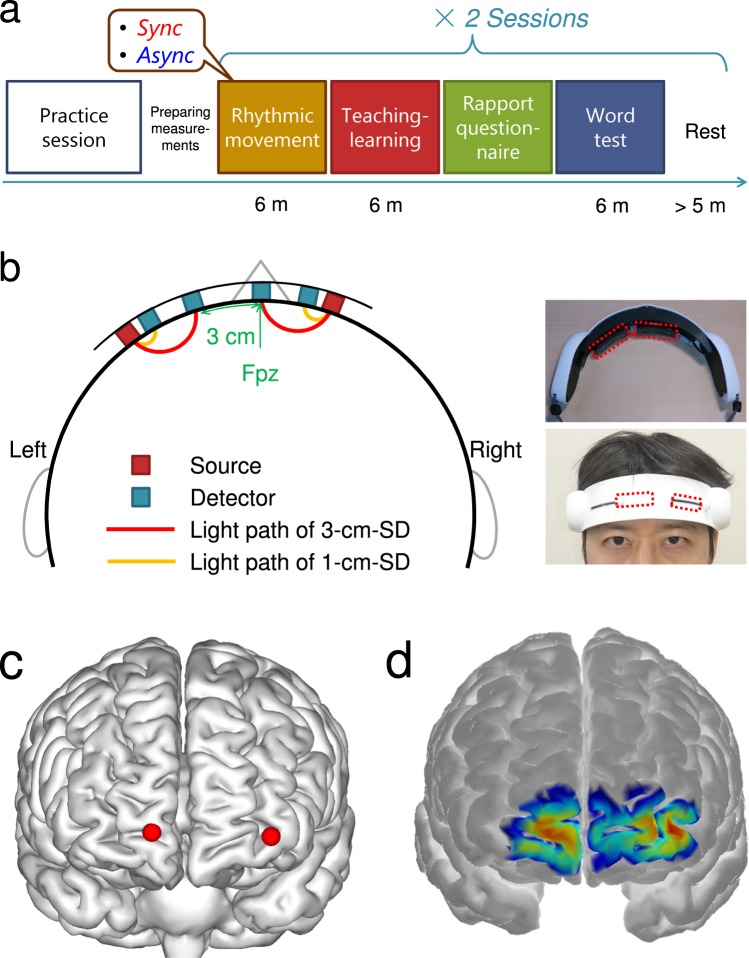
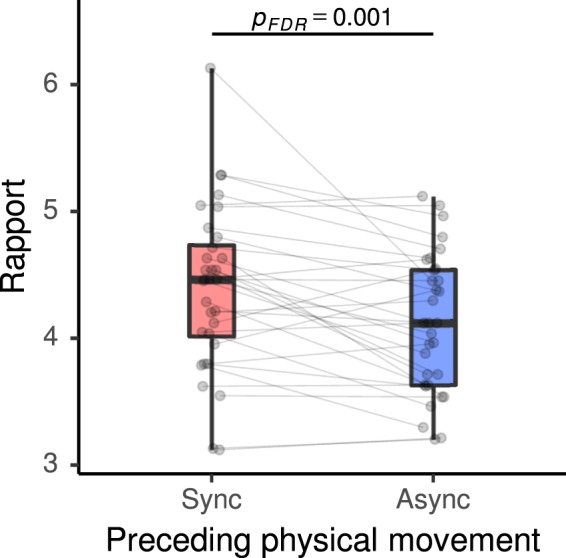
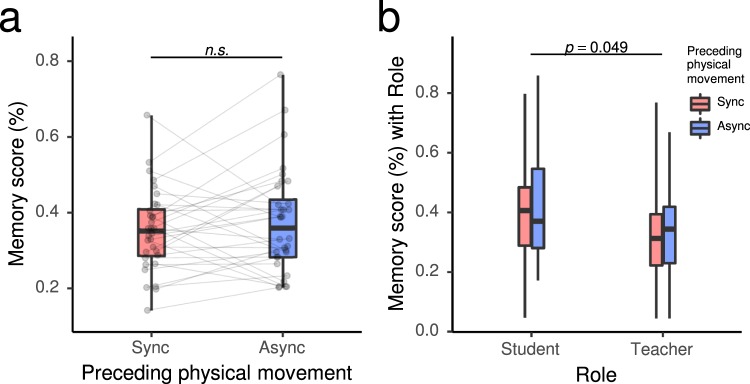
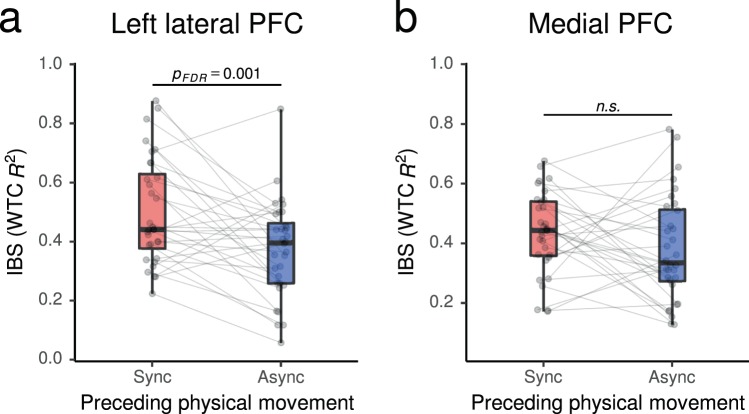
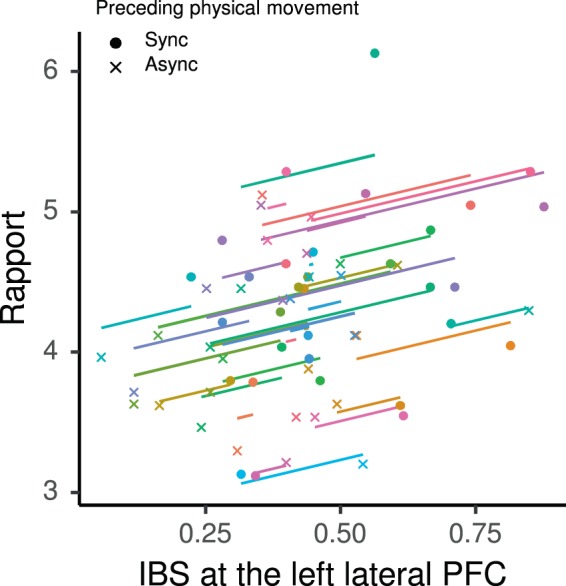
Physical synchrony has been suggested to have positive effects on not only concurrent but also subsequent communication, but the underlying neural processes are unclear. Using functional near-infrared spectroscopy (fNIRS) hyperscanning, we tested the effects of preceding physical synchrony on subsequent dyadic teaching-learning communication. Thirty-two pairs of participants performed two experimental sessions. In each session, they underwent a rhythmic arm movement block with synchronous or asynchronous conditions, and then taught/learned unknown words to/from each other according to a given scenario. Neural activities in their medial and left lateral prefrontal cortex (PFC) were measured and inter-brain synchronization (IBS) during the teaching-learning blocks was evaluated. Participants rated their subjective rapport during the teaching-learning blocks, and took a word memory test. The analyses revealed that (1) prior physical synchrony enhanced teacher-learner rapport; (2) prior physical synchrony also enhanced IBS in the lateral PFC; and (3) IBS changes correlated positively with rapport changes. Physical synchrony did however not affect word memory performance. These results suggest that IBS can be useful to measure the effects of social-bonding facilitation activities for educational communication.
Overview
The claims and statistics of this paper haven’t been checked yet.
Free: it reads the open-access text and checks the first 5 claims that cite a source we can check. Create a free account to check every claim.
Integrity signals
Registry
Cites
Statistics
Figures
Verification
Claims the paper makes
The claims and statistics of this paper haven’t been checked yet.
Free: it reads the open-access text and checks the first 5 claims that cite a source we can check. Create a free account to check every claim.
Self-check
Percentages, sums and reported differences re-computed from the paper’s own numbers.
The self-check needs the paper’s full text.
Citations
Cites
The assessment and analysis of handedness: The Edinburgh inventory
Oldfield, R. C. (1971) · Neuropsychologia · doi:10.1016/0028-3932(71)90067-4 · Cited by 35,900
A Practical Guide to Wavelet Analysis
Torrence, C., & Compo, G. P. (1998) · Bulletin of the American Meteorological Society · doi:10.1175/1520-0477(1998)079<0061:apgtwa>2.0.co;2 · Cited by 14,890
Lakens, D. (2013) · Frontiers in Psychology · doi:10.3389/fpsyg.2013.00863 · Cited by 10,303
Application of the cross wavelet transform and wavelet coherence to geophysical time series
Grinsted, A., Moore, J. C., & Jevrejeva, S. (2004) · Nonlinear Processes in Geophysics · doi:10.5194/npg-11-561-2004 · Cited by 6,285
BrainNet Viewer: A Network Visualization Tool for Human Brain Connectomics
Xia, M., Wang, J., & He, Y. (2013) · PLoS ONE · doi:10.1371/journal.pone.0068910 · Cited by 4,106
Meeting of minds: the medial frontal cortex and social cognition
Amodio, D. M., & Frith, C. D. (2006) · Nature Reviews Neuroscience · doi:10.1038/nrn1884 · Cited by 3,782
The chameleon effect: the perception–behavior link and social interaction
Chartrand, T. L., & Bargh, J. A. (1999) · Journal of Personality and Social Psychology · doi:10.1037/0022-3514.76.6.893 · Cited by 3,674
Ferrari, M., & Quaresima, V. (2012) · NeuroImage · doi:10.1016/j.neuroimage.2012.03.049 · Cited by 2,274
Bakdash, J. Z., & Marusich, L. R. (2017) · Frontiers in Psychology · doi:10.3389/fpsyg.2017.00456 · Cited by 2,018
On the adaptive control of the false discovery rate in multiple testing with independent statistics
Benjamini, Y., & Hochberg, Y. (2000) · Journal of Educational and Behavioral Statistics · doi:10.3102/10769986025001060 · Cited by 2,015
Scholkmann, F., Kleiser, S., Metz, A. J., Zimmermann, R., Mata Pavia, J., Wolf, U., & Wolf, M. (2014) · NeuroImage · doi:10.1016/j.neuroimage.2013.05.004 · Cited by 2,002
HomER: A review of time-series analysis methods for near-infrared spectroscopy of the brain
Huppert, T. J., Diamond, S. G., Franceschini, M. A., & Boas, D. A. (2009) · Applied Optics · doi:10.1364/ao.48.00d280 · Cited by 1,817
Social cognition and the brain: A meta-analysis
Van Overwalle, F. (2009) · Human Brain Mapping · doi:10.1002/hbm.20547 · Cited by 1,792
Wiltermuth, S. S., & Heath, C. (2009) · Psychological Science · doi:10.1111/j.1467-9280.2008.02253.x · Cited by 1,717
Toward a second-person neuroscience
Schilbach, L., Timmermans, B., Reddy, V., Costall, A., Bente, G., Schlicht, T., & Vogeley, K. (2013) · Behavioral and Brain Sciences · doi:10.1017/s0140525x12000660 · Cited by 1,510
It's All in the Timing: Interpersonal Synchrony Increases Affiliation
Hove, M. J., & Risen, J. L. (2009) · Social Cognition · doi:10.1521/soco.2009.27.6.949 · Cited by 1,334
Okamoto, M., Dan, H., Sakamoto, K., Takeo, K., Shimizu, K., Kohno, S., Oda, I., Isobe, S., Suzuki, T., Kohyama, K., et al. (2004) · NeuroImage · doi:10.1016/j.neuroimage.2003.08.026 · Cited by 1,320
Speaker-listener neural coupling underlies successful communication
Stephens, G. J., Silbert, L. J., & Hasson, U. (2010) · Proceedings of the National Academy of Sciences · doi:10.1073/pnas.1008662107 · Cited by 970
The nature of rapport and its nonverbal correlates
Tickle-Degnen, L., & Rosenthal, R. (1990) · Psychological Inquiry · doi:10.1207/s15327965pli0104_1 · Cited by 960
Non-invasive neuroimaging using near-infrared light
Strangman, G., Boas, D. A., & Sutton, J. P. (2002) · Biological Psychiatry · doi:10.1016/s0006-3223(02)01550-0 · Cited by 903
Brain-to-brain synchrony tracks real-world dynamic group interactions in the classroom
Dikker, S., Wan, L., Davidesco, I., Kaggen, L., Oostrik, M., McClintock, J., Rowland, J., Michalareas, G., Van Bavel, J. J., Ding, M., et al. (2017) · Current Biology · doi:10.1016/j.cub.2017.04.002 · Cited by 871
Cui, X., Bryant, D. M., & Reiss, A. L. (2012) · NeuroImage · doi:10.1016/j.neuroimage.2011.09.003 · Cited by 807
Anterior Prefrontal Function and the Limits of Human Decision-Making
Koechlin, E., & Hyafil, A. (2007) · Science · doi:10.1126/science.1142995 · Cited by 747
Functional Specialization within Rostral Prefrontal Cortex (Area 10): A Meta-analysis
Gilbert, S. J., Spengler, S., Simons, J. S., Steele, J. D., Lawrie, S. M., Frith, C. D., & Burgess, P. W. (2006) · Journal of Cognitive Neuroscience · doi:10.1162/jocn.2006.18.6.932 · Cited by 683
Synchrony and the social tuning of compassion.
Valdesolo, P., & DeSteno, D. (2011) · Emotion · doi:10.1037/a0021302 · Cited by 654
Virtual spatial registration of stand-alone fNIRS data to MNI space
Tsuzuki, D., Jurcak, V., Singh, A. K., Okamoto, M., Watanabe, E., & Dan, I. (2007) · NeuroImage · doi:10.1016/j.neuroimage.2006.10.043 · Cited by 630
Wavelet-based motion artifact removal for functional near-infrared spectroscopy
Molavi, B., & Dumont, G. A. (2012) · Physiological Measurement · doi:10.1088/0967-3334/33/2/259 · Cited by 623
Boas, D. A., Culver, J. P., Stott, J. J., & Dunn, A. K. (2002) · Optics Express · doi:10.1364/oe.10.000159 · Cited by 599
Motivation and cognitive control in the human prefrontal cortex
Kouneiher, F., Charron, S., & Koechlin, E. (2009) · Nature Neuroscience · doi:10.1038/nn.2321 · Cited by 590
Coordinated movement and rapport in teacher–student interactions
Bernieri, F. J. (1988) · Journal of Nonverbal Behavior · doi:10.1007/bf00986930 · Cited by 590
Performance Comparison of Several Published Tissue Near-Infrared Spectroscopy Algorithms
Matcher, S. J., Elwell, C. E., Cooper, C. E., Cope, M., & Delpy, D. T. (1995) · Analytical Biochemistry · doi:10.1006/abio.1995.1252 · Cited by 588
Social Connection Through Joint Action and Interpersonal Coordination
Marsh, K. L., Richardson, M. J., & Schmidt, R. C. (2009) · Topics in Cognitive Science · doi:10.1111/j.1756-8765.2009.01022.x · Cited by 583
Social neuroscience and hyperscanning techniques: past, present and future.
Babiloni, F., & Astolfi, L. (2014) · Neuroscience & Biobehavioral Reviews · doi:10.1016/j.neubiorev.2012.07.006 · Cited by 573
Brigadoi, S., Ceccherini, L., Cutini, S., Scarpa, F., Scatturin, P., Selb, J., Gagnon, L., Boas, D. A., & Cooper, R. J. (2014) · NeuroImage · doi:10.1016/j.neuroimage.2013.04.082 · Cited by 557
The rhythm of joint action: synchrony promotes cooperative ability.
Valdesolo, P., Ouyang, J., & DeSteno, D. (2010) · Journal of Experimental Social Psychology · doi:10.1016/j.jesp.2010.03.004 · Cited by 521
Neural Synchronization during Face-to-Face Communication
Jiang, J., Dai, B., Peng, D., Zhu, C., Liu, L., & Lu, C. (2012) · The Journal of Neuroscience · doi:10.1523/jneurosci.2926-12.2012 · Cited by 489
Neubert, F.-X., Mars, R. B., Thomas, A. G., Sallet, J., & Rushworth, M. F. S. (2014) · Neuron · doi:10.1016/j.neuron.2013.11.012 · Cited by 416
Anatomical guidance for functional near-infrared spectroscopy: AtlasViewer tutorial
Aasted, C. M., Yücel, M. A., Cooper, R. J., Dubb, J., Tsuzuki, D., Becerra, L., Petkov, M. P., Borsook, D., Dan, I., & Boas, D. A. (2015) · Neurophotonics · doi:10.1117/1.nph.2.2.020801 · Cited by 409
Brain-to-Brain Synchrony during Naturalistic Social Interactions
Kinreich, S., Djalovski, A., Kraus, L., Louzoun, Y., & Feldman, R. (2017) · Scientific Reports · doi:10.1038/s41598-017-17339-5 · Cited by 402
A review of effect sizes and their confidence intervals, Part I: The Cohen's d family
Goulet-Pelletier, J.-C., & Cousineau, D. (2018) · The Quantitative Methods for Psychology · doi:10.20982/tqmp.14.4.p242 · Cited by 398
Interpersonal body and neural synchronization as a marker of implicit social interaction
Yun, K., Watanabe, K., & Shimojo, S. (2012) · Scientific Reports · doi:10.1038/srep00959 · Cited by 379
Nonverbal synchrony and affect in dyadic interactions.
Tschacher, W., Rees, G. M., & Ramseyer, F. (2014) · Frontiers in Psychology · doi:10.3389/fpsyg.2014.01323 · Cited by 351
Leader emergence through interpersonal neural synchronization.
Jiang, J., Chen, C., Dai, B., Shi, G., Ding, G., Liu, L., & Lu, C. (2015) · Proceedings of the National Academy of Sciences · doi:10.1073/pnas.1422930112 · Cited by 341
Konvalinka, I., & Roepstorff, A. (2012) · Frontiers in Human Neuroscience · doi:10.3389/fnhum.2012.00215 · Cited by 324
Mapping the information flow from one brain to another during gestural communication
Schippers, M. B., Roebroeck, A., Renken, R., Nanetti, L., & Keysers, C. (2010) · Proceedings of the National Academy of Sciences · doi:10.1073/pnas.1001791107 · Cited by 323
Bevilacqua, D., Davidesco, I., Wan, L., Chaloner, K., Rowland, J., Ding, M., Poeppel, D., & Dikker, S. (2019) · Journal of Cognitive Neuroscience · doi:10.1162/jocn_a_01274 · Cited by 312
Dyad rapport and the accuracy of its judgment across situations: A lens model analysis.
Bernieri, F. J., Gillis, J. S. W., Davis, J. M., & Grahe, J. E. (1996) · Journal of Personality and Social Psychology · doi:10.1037//0022-3514.71.1.110 · Cited by 311
Cooperation in lovers: An fNIRS-based hyperscanning study
Pan, Y., Cheng, X., Zhang, Z., Li, X., & Hu, Y. (2017) · Human Brain Mapping · doi:10.1002/hbm.23421 · Cited by 307
Lakens, D., & Stel, M. (2011) · Social Cognition · doi:10.1521/soco.2011.29.1.1 · Cited by 304
Prosocial Consequences of Interpersonal Synchrony: A Meta-Analysis
Rennung, M., & Göritz, A. S. (2016) · Zeitschrift für Psychologie · doi:10.1027/2151-2604/a000252 · Cited by 295
Fukui, Y., Ajichi, Y., & Okada, E. (2003) · Applied Optics · doi:10.1364/ao.42.002881 · Cited by 286
Why Use Music in English Language Learning? A Survey of the Literature
Engh, D. (2013) · English Language Teaching · doi:10.5539/elt.v6n2p113 · Cited by 257
Cheng, X., Li, X., & Hu, Y. (2015) · Human Brain Mapping · doi:10.1002/hbm.22754 · Cited by 253
Cytoarchitecture, probability maps and functions of the human frontal pole
Bludau, S., Eickhoff, S. B., Mohlberg, H., Caspers, S., Laird, A. R., Fox, P. T., Schleicher, A., Zilles, K., & Amunts, K. (2014) · NeuroImage · doi:10.1016/j.neuroimage.2013.05.052 · Cited by 242
Hirsch, J., Zhang, X., Noah, J. A., & Ono, Y. (2017) · NeuroImage · doi:10.1016/j.neuroimage.2017.06.018 · Cited by 236
Nozawa, T., Sasaki, Y., Sakaki, K., Yokoyama, R., & Kawashima, R. (2016) · NeuroImage · doi:10.1016/j.neuroimage.2016.03.059 · Cited by 235
Self-citationGroup rapport: posture sharing as a nonverbal indicator
Lafrance, M., & Broadbent, M. (1976) · Group & Organization Studies · doi:10.1177/105960117600100307 · Cited by 222
Gagnon, L., Yücel, M. A., Dehaes, M., Cooper, R. J., Perdue, K. L., Selb, J., Huppert, T. J., Hoge, R. D., & Boas, D. A. (2012) · NeuroImage · doi:10.1016/j.neuroimage.2011.10.054 · Cited by 214
A case of hand waving: Action synchrony and person perception
Macrae, C. N., Duffy, O. K., Miles, L. K., & Lawrence, J. (2008) · Cognition · doi:10.1016/j.cognition.2008.07.007 · Cited by 211
Ramseyer, F., & Tschacher, W. (2014) · Frontiers in Psychology · doi:10.3389/fpsyg.2014.00979 · Cited by 210
Meta-Analyses of the Intra- and Interpersonal Outcomes of Interpersonal Coordination
Vicaria, I. M., & Dickens, L. (2016) · Journal of Nonverbal Behavior · doi:10.1007/s10919-016-0238-8 · Cited by 209
Between-brain connectivity during imitation measured by fNIRS
Holper, L., Scholkmann, F., & Wolf, M. (2012) · NeuroImage · doi:10.1016/j.neuroimage.2012.06.028 · Cited by 207
Flow of affective information between communicating brains
Anders, S., Heinzle, J., Weiskopf, N., Ethofer, T., & Haynes, J.-D. (2011) · NeuroImage · doi:10.1016/j.neuroimage.2010.07.004 · Cited by 206
Liu, N., Mok, C., Witt, E. E., Pradhan, A. H., Chen, J. E., & Reiss, A. L. (2016) · Frontiers in Human Neuroscience · doi:10.3389/fnhum.2016.00082 · Cited by 205
Tang, H., Mai, X., Wang, S., Zhu, C., Krueger, F., & Liu, C. (2016) · Social Cognitive and Affective Neuroscience · doi:10.1093/scan/nsv092 · Cited by 198
Bilek, E., Ruf, M., Schäfer, A., Akdeniz, C., Calhoun, V. D., Schmahl, C., Demanuele, C., Tost, H., Kirsch, P., & Meyer-Lindenberg, A. (2015) · Proceedings of the National Academy of Sciences · doi:10.1073/pnas.1421831112 · Cited by 186
Enhancement of teaching outcome through neural prediction of the students' knowledge state
Zheng, L., Chen, C., Liu, W., Long, Y., Zhao, H., Bai, X., Zhang, Z., Han, Z., Liu, L., Guo, T., et al. (2018) · Human Brain Mapping · doi:10.1002/hbm.24059 · Cited by 180
Measuring speaker–listener neural coupling with functional near infrared spectroscopy
Liu, Y., Piazza, E. A., Simony, E., Shewokis, P. A., Onaral, B., Hasson, U., & Ayaz, H. (2017) · Scientific Reports · doi:10.1038/srep43293 · Cited by 180
Saager, R. B., Telleri, N. L., & Berger, A. J. (2011) · NeuroImage · doi:10.1016/j.neuroimage.2011.01.043 · Cited by 176
Inter-brain synchrony in mother-child dyads during cooperation: An fNIRS hyperscanning study
Miller, J. G., Vrtička, P., Cui, X., Shrestha, S., Hosseini, S. M. H., Baker, J. M., & Reiss, A. L. (2019) · Neuropsychologia · doi:10.1016/j.neuropsychologia.2018.12.021 · Cited by 171
Katura, T., Tanaka, N., Obata, A. N., Sato, H. R., & Maki, A. (2006) · NeuroImage · doi:10.1016/j.neuroimage.2006.02.010 · Cited by 170
Scalp and skull influence on near infrared photon propagation in the Colin27 brain template
Strangman, G. E., Zhang, Q., & Li, Z. (2013) · NeuroImage · doi:10.1016/j.neuroimage.2013.04.090 · Cited by 168
Koike, T., Tanabe, H. C., Okazaki, S., Nakagawa, E., Sasaki, A. T., Shimada, K., Sugawara, S. K., Takahashi, H. K., Yoshihara, K., Bosch-Bayard, J., et al. (2016) · NeuroImage · doi:10.1016/j.neuroimage.2015.09.076 · Cited by 167
Inter-brain synchrony and cooperation context in interactive decision making
Hu, Y., Pan, Y., Shi, X., Cai, Q., Li, X., & Cheng, X. (2018) · Biological Psychology · doi:10.1016/j.biopsycho.2017.12.005 · Cited by 166
Osaka, N., Minamoto, T., Yaoi, K., Azuma, M., Shimada, Y. M., & Osaka, M. (2015) · Frontiers in Psychology · doi:10.3389/fpsyg.2015.01811 · Cited by 161
Synchronized movement experience enhances peer cooperation in preschool children
Rabinowitch, T.-C., & Meltzoff, A. N. (2017) · Journal of Experimental Child Psychology · doi:10.1016/j.jecp.2017.03.001 · Cited by 155
Brodmann area 10: Collating, integrating and high level processing of nociception and pain
Peng, K., Steele, S. C., Becerra, L., & Borsook, D. (2018) · Progress in Neurobiology · doi:10.1016/j.pneurobio.2017.11.004 · Cited by 155
Hemodynamics for Brain-Computer Interfaces
Matthews, F., Pearlmutter, B., Wards, T., Soraghan, C., & Markham, C. (2008) · IEEE Signal Processing Magazine · doi:10.1109/msp.2008.4408445 · Cited by 153
You are in sync with me: Neural correlates of interpersonal synchrony with a partner
Cacioppo, S., Zhou, H., Monteleone, G., Majka, E. A., Quinn, K. A., Ball, A. B., Norman, G. J., Semin, G. R., & Cacioppo, J. T. (2014) · Neuroscience · doi:10.1016/j.neuroscience.2014.07.051 · Cited by 150
Motion Artifact Removal for Functional Near Infrared Spectroscopy: A Comparison of Methods
Robertson, F. C., Douglas, T. S., & Meintjes, E. M. (2010) · IEEE Transactions on Biomedical Engineering · doi:10.1109/tbme.2009.2038667 · Cited by 148
Hyperscanning neuroimaging technique to reveal the “two-in-one” system in social interactions
Koike, T., Tanabe, H. C., & Sadato, N. (2015) · Neuroscience Research · doi:10.1016/j.neures.2014.11.006 · Cited by 145
Scholkmann, F., Holper, L., Wolf, U., & Wolf, M. (2013) · Frontiers in Human Neuroscience · doi:10.3389/fnhum.2013.00813 · Cited by 143
Holper, L., Goldin, A. P., Shalóm, D. E., Battro, A. M., Wolf, M., & Sigman, M. (2013) · International Journal of Educational Research · doi:10.1016/j.ijer.2013.02.002 · Cited by 133
Synchrony of brains and bodies during implicit interpersonal interaction
Hari, R., Himberg, T., Nummenmaa, L., Hämäläinen, M., & Parkkonen, L. T. (2013) · Trends in Cognitive Sciences · doi:10.1016/j.tics.2013.01.003 · Cited by 118
Gilbert, S. J., Gonen-Yaacovi, G., Benoit, R. G., Volle, E., & Burgess, P. W. (2010) · NeuroImage · doi:10.1016/j.neuroimage.2010.07.032 · Cited by 113
Scholkmann, F., Metz, A. J., & Wolf, M. (2014) · Physiological Measurement · doi:10.1088/0967-3334/35/4/717 · Cited by 103
Dommer, L., Jäger, N., Scholkmann, F., Wolf, M., & Holper, L. (2012) · Behavioural Brain Research · doi:10.1016/j.bbr.2012.06.024 · Cited by 102
Toronov, V. Y., WEBB, A. G., Choi, J. H., Wolf, M., Safonova, L. P., Wolf, U., & Gratton, E. (2001) · Optics Express · doi:10.1364/oe.9.000417 · Cited by 81
Connectivity-based parcellation of the human frontal polar cortex
Moayedi, M., Salomons, T. V., Dunlop, K., Downar, J. H., & Davis, K. D. (2014) · Brain Structure and Function · doi:10.1007/s00429-014-0809-6 · Cited by 70
Toward a neural basis for peer-interaction: what makes peer-learning tick?
Clark, I., & Dumas, G. (2015) · Frontiers in Psychology · doi:10.3389/fpsyg.2015.00028 · Cited by 67
Balconi, M., Pezard, L., Nandrino, J.-L., & Vanutelli, M. E. (2017) · PLOS ONE · doi:10.1371/journal.pone.0187652 · Cited by 66
Steady Beat Sound Facilitates both Coordinated Group Walking and Inter-Subject Neural Synchrony
Ikeda, S., Nozawa, T., Yokoyama, R., Miyazaki, A., Sasaki, Y., Sakaki, K., & Kawashima, R. (2017) · Frontiers in Human Neuroscience · doi:10.3389/fnhum.2017.00147 · Cited by 64
Self-citationTakeuchi, N., Mori, T., Suzukamo, Y., & Izumi, S.-I. (2017) · Frontiers in Psychology · doi:10.3389/fpsyg.2016.02052 · Cited by 57
Puccinelli, N. M., & Tickle‐Degnen, L. (2004) · Journal of Nonverbal Behavior · doi:10.1007/s10919-004-4157-8 · Cited by 51
Teaching as a Dynamic Phenomenon with Interpersonal Interactions
Watanabe, K. (2013) · Mind Brain and Education · doi:10.1111/mbe.12011 · Cited by 41
The Effects of Reciprocal Imitation on Teacher–Student Relationships and Student Learning Outcomes
Zhou, J. (2012) · Mind Brain and Education · doi:10.1111/j.1751-228x.2012.01140.x · Cited by 40
High frequency neurons determine effective connectivity in neuronal networks
Pariz, A., Esfahani, Z. G., Parsi, S. S., Valizadeh, A., Canals, S., & Mirasso, C. R. (2017) · NeuroImage · doi:10.1016/j.neuroimage.2017.11.014 · Cited by 37
The Role of Warming Up Activities in Adolescent Students' Involvement during the English Class
Velandia, R. (2008) · LA Referencia (Red Federada de Repositorios Institucionales de Publicaciones Científicas) · Cited by 27
Li, C., Weng, H., Zheng, J., Feng, Z.-H., Ou, J., & Liao, W. (2018) · Frontiers in Aging Neuroscience · doi:10.3389/fnagi.2018.00082 · Cited by 24
Synchronization as a Classroom Dynamic: A Practitioner's Perspective
Kent, A. (2013) · Mind Brain and Education · doi:10.1111/mbe.12002 · Cited by 22
Cheering Enhances Inter‐Brain Synchronization Between Sensorimotor Areas of Player and Observer
Koide, T., & Shimada, S. (2018) · Japanese Psychological Research · doi:10.1111/jpr.12202 · Cited by 10
Hemodynamics for brain-computer interfaces: optical correlates of control signals
Matthews, F., Pearlmutter, B. A., Ward, T. E., Soraghan, C. J., & Markham, C. H. (2008) · Maynooth University ePrints and eTheses Archive (Maynooth University) · Cited by 9
Cited by
Interactional synchrony: signals, mechanisms and benefits
Hoehl, S., Fairhurst, M., & Schirmer, A. (2021) · Social Cognitive and Affective Neuroscience · doi:10.1093/scan/nsaa024 · Cited by 231
“A recent study in adults showed that moving in synchrony with each other promoted self-reported rapport, though not learning per se, during a teacher–learner interaction (Nozawa et al., 2019).”
BackgroundInter-brain synchrony in teams predicts collective performance
Reinero, D. A., Dikker, S., & Van Bavel, J. J. (2021) · Social Cognitive and Affective Neuroscience · doi:10.1093/scan/nsaa135 · Cited by 169
A new science of emotion: implications for functional neurological disorder
Jungilligens, J., Paredes-Echeverri, S., Popkirov, S., Barrett, L. F., & Perez, D. L. (2022) · Brain · doi:10.1093/brain/awac204 · Cited by 164
Kelsen, B. A., Sumich, A., Kasabov, N., Liang, S. H. Y., & Wang, G. Y. (2022) · Neuroscience & Biobehavioral Reviews · doi:10.1016/j.neubiorev.2020.09.008 · Cited by 148
“The cortical regions activated and exhibiting IBS while sharing knowledge include frontal (Holper et al., 2013; Liu et al., 2019; Nozawa et al., 2019; Pan et al., 2018), temporal-parietal (Zheng et al.”
BackgroundDance on the Brain: Enhancing Intra- and Inter-Brain Synchrony
Basso, J. C., Satyal, M. K., & Rugh, R. (2021) · Frontiers in Human Neuroscience · doi:10.3389/fnhum.2020.584312 · Cited by 217
Metadata
- Authors
- Nozawa, T., Sakaki, K., Ikeda, S., Jeong, H., Yamazaki, S., Kawata, K. H. D. S., Kawata, N. Y. D. S., Sasaki, Y., Kulason, K., Hirano, K., Miyake, Y., & Kawashima, R.
- Affiliations
- Tokyo Institute of Technology (JP)
- Tohoku University (JP)
- Corresponding author
- Nozawa, Takayuki
- ORCID
- Venue
- Scientific Reports
- Published
- 2019-09-04
- Volume
- 9
- Issue
- 1
- Pages
- 12747-12747
- ISSN
- 2045-2322 (ISSN-L)
- PMC
- PMC6726616
- OpenAlex
- W2971781906
- Semantic Scholar
- aad770f22b874872cc2d6582f29537b8d84a271c
- Cited by
- 95
- References
- 102
- Citations by year
- 2026: 11 · 2025: 13 · 2024: 21 · 2023: 13 · 2022: 15 · 2021: 14 · 2020: 8
- FWCI
- 11.62
- Type
- journal article
- Language
- en
- Open access
- gold
- doi.org
- Licence
- cc-by
- creativecommons.org/licenses/by/4.0 (tdm)
- creativecommons.org/licenses/by/4.0 (vor)
- Locations
- Scientific Reports (publishedVersion, cc-by)
- bioRxiv (Cold Spring Harbor Laboratory) (acceptedVersion)
- PubMed Central (publishedVersion, cc-by)
- PubMed (publishedVersion)
- DOAJ (DOAJ: Directory of Open Access Journals) (submittedVersion)
- Funders
- MEXT | Japan Society for the Promotion of Science (JP26330171, JP15H01771, JP17H01753)
- MEXT | JST | Center of Innovation Program
- Topics
- Social Sciences › Psychology › Social Psychology › Action Observation and Synchronization
- Life Sciences › Neuroscience › Cognitive Neuroscience › Neural dynamics and brain function
- Life Sciences › Neuroscience › Cognitive Neuroscience › Neuroscience, Education and Cognitive Function
- Keywords
- inter-brain synchrony, educational communication, prefrontal cortex, word memory, social bonding, dyadic interaction
- MeSH terms
- Adult, Communication, Female, Humans, Interpersonal Relations, Learning, Male, Memory, Social Behavior, Prefrontal Cortex, Young Adult
About these checks
Registry, retraction, Cites and statistics results are computed, not judged, with one exception: a printed reference that no index lists is read once by a model before it counts as a citation error. Claims are extracted by a model and kept only when their quote appears verbatim in the text; each cited source is then checked, with a model’s help, for whether it says what the claim relies on. Those verdicts can be wrong — read the claim’s quote and the cited source before relying on one.
Statistics and arithmetic are recomputed, not judged.
Confidence bands are shown only for fields calibrated on our annotated test set. None is calibrated yet, so no band is shown.
What counts as a claim ›How we measure confidence ›How we check this ›
Are you an author, or do you see a problem with this page? Request a review
Data sources
Bibliographic data: Semantic Scholar, OpenAlex, Crossref.
Contains information from the Semantic Scholar Academic Graph Datasets, made available under the ODC Attribution License (ODC-BY 1.0).
Semantic Scholar’s data is described in: Kinney, R., et al. (2023). The Semantic Scholar Open Data Platform. arXiv:2301.10140.
