

The impact of multisensory integration and perceptual load in virtual reality settings on performance, workload and presence
Open accessThe DOI matches its Crossref record; 99 of the 99 references it cites were found in a registry or an index; 10 of the 67 sources its claims cite were checked for support.
Abstract
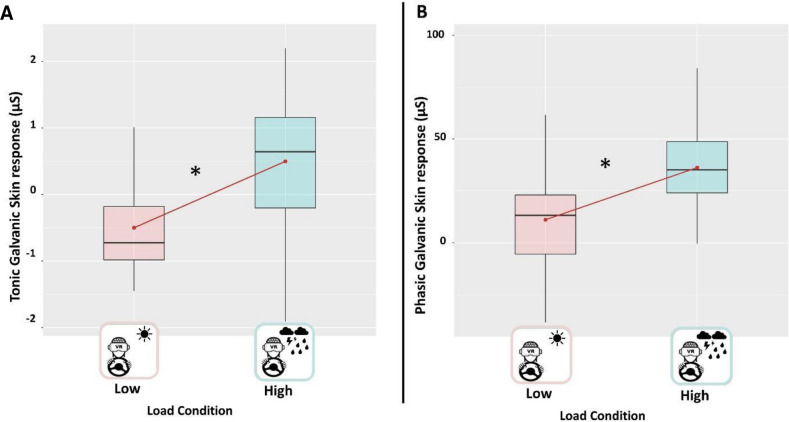
Real-world experience is typically multimodal. Evidence indicates that the facilitation in the detection of multisensory stimuli is modulated by the perceptual load, the amount of information involved in the processing of the stimuli. Here, we used a realistic virtual reality environment while concomitantly acquiring Electroencephalography (EEG) and Galvanic Skin Response (GSR) to investigate how multisensory signals impact target detection in two conditions, high and low perceptual load. Different multimodal stimuli (auditory and vibrotactile) were presented, alone or in combination with the visual target. Results showed that only in the high load condition, multisensory stimuli significantly improve performance, compared to visual stimulation alone. Multisensory stimulation also decreases the EEG-based workload. Instead, the perceived workload, according to the "NASA Task Load Index" questionnaire, was reduced only by the trimodal condition (i.e., visual, auditory, tactile). This trimodal stimulation was more effective in enhancing the sense of presence, that is the feeling of being in the virtual environment, compared to the bimodal or unimodal stimulation. Also, we show that in the high load task, the GSR components are higher compared to the low load condition. Finally, the multimodal stimulation (Visual-Audio-Tactile-VAT and Visual-Audio-VA) induced a significant decrease in latency, and a significant increase in the amplitude of the P300 potentials with respect to the unimodal (visual) and visual and tactile bimodal stimulation, suggesting a faster and more effective processing and detection of stimuli if auditory stimulation is included. Overall, these findings provide insights into the relationship between multisensory integration and human behavior and cognition.
Overview
CoChat Summary
## TL;DR
In an immersive VR target-detection task with 18 healthy male volunteers, multisensory cues improved performance only under high perceptual load, while also reducing EEG-based workload and increasing presence. P300 measures and skin conductance supported the view that higher multisensory integration and higher load changed stimulus processing, arousal, and user experience.
## Key findings
- In the performance LMM, perceptual load had a significant main effect: performance was lower in the high-load than the low-load condition (marginal R² = 0.53; conditional R² = 0.67).
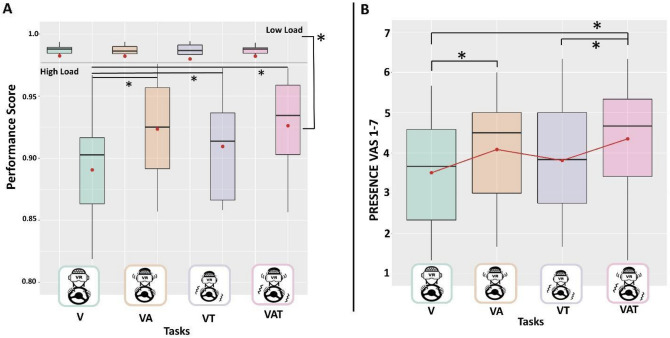
- There was a significant Condition × Task interaction for performance: in the high-load condition only, bimodal and trimodal stimulation improved performance versus visual-only, with VA p = 0.003, VAT p < 0.001, and VT p = 0.037.
- Sense of presence increased with multisensory integration and with load: VAT produced higher presence than V (p = 0.007) and VT (p = 0.026), VA was higher than V (p = 0.048), and high load increased presence by β = 0.559 (p = 0.0118).
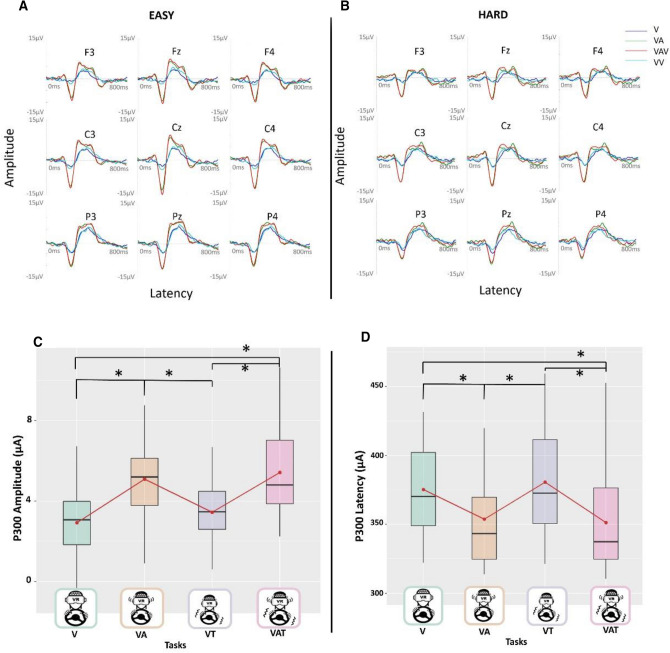
- EEG findings showed multisensory benefits in stimulus processing: P300 amplitude increased for VA and VAT versus V and VT (all p-values < 0.001 or < 0.01), while P300 latency increased for VA and VAT versus V and VT; high load also increased latency by β = 0.44.
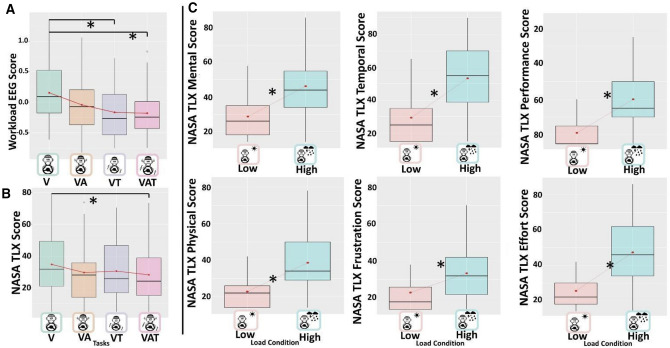
- Workload measures diverged by instrument: the EEG-based workload index decreased for VAT and VT versus V (β = 0.333, p = 0.002; β = 0.319, p = 0.006), while NASA-TLX showed a significant reduction only for VAT versus V (p = 0.025).
- Skin conductance increased under high load for both tonic and phasic components: tonic β = 0.995 (p = 0.004) and phasic β = 1.02 (p < 0.0001).
## Methods
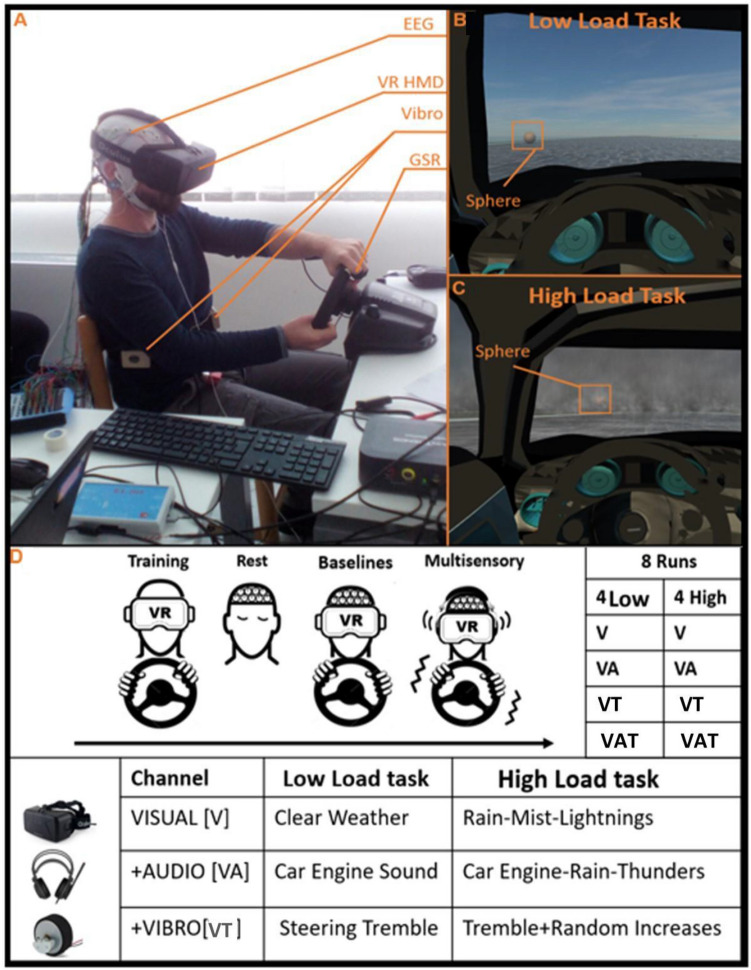
- The study used a counterbalanced VR experiment with a target-detection driving task under 2 perceptual-load conditions (low vs high) and 4 sensory tasks: V, VA, VT, and VAT.
- Participants were 18 healthy male volunteers, mean age 26.5 ± 3.2 years, with normal or corrected-to-normal vision.
- Outcomes included behavioral performance (#HitT and TimeD), subjective workload (NASA-TLX), presence questionnaire scores, EEG-derived workload (WEEG), P300 amplitude/latency, and GSR-based arousal measures; analysis used linear mixed-effects models with subject random effects and post hoc Tukey tests.
## Limitations
- The paper states that perceptual load may have intrinsically increased cognitive load, and that the design did not allow disentangling cognitive from perceptual load; further studies are needed.
- The sample included only 18 participants and only male volunteers, which the paper says was done to reduce variability due to putative gender effects.
- The text makes evident that the study used a highly controlled VR task, so generalization to other settings is uncertain; this is an inference from the experimental design, not a limitation explicitly stated in the paper.
Model-written summary. Check it against the paper before relying on it.
Integrity signals
Registry
Cites
Statistics
Figures
Verification
Claims the paper makes
5 Valid · 2 Not valid · 29 Not checked · 54 Own results and interpretations
The cited sources support only part of this claim — read each source’s verdict below.
In the paper
“This means that multisensory integration can enhance the ability to detect a target stimulus.”
§ The impact of multisensory integration and perceptual load in virtual reality settings on performance, workload and presence > Introduction
What the sources say
- Not checked — no full text of the sourcecites [12] Spence C Pavani F Driver J Crossmodal links between vision and touch in covert endogenous spatial attention J. Exp. Psychol. Hum. Percept. Perform. 2000 26 1298 1319 10.1037/0096-1523.26.4.1298 10946716 source
- Supportedcites [13] Ngo MK Spence C Auditory, tactile, and multisensory cues facilitate search for dynamic visual stimuli Atten. Percept. Psychophys. 2010 72 1654 1665 10.3758/APP.72.6.1654 20675808 source
The paper's own results carry the claim: the General Discussion states that the presence of auditory or vibrotactile cues gave 'a substantial facilitation of participants' visual search performance, as compared with the performance seen when no cue is present,' and, of the bimodal audiotactile (multisensory) condition, that 'overall performance was still significantly better than in the no-cue condition.' The same discussion frames the mechanism as multisensory integration — the cue and target becoming 'bound together and ... integrated into a single, coherent, multisensory event' that aids segregation of the target from distractors, 'which ultimately leads to its improved identification' — and cites Perrott et al. (1990) for reduced visual target detection latencies with auditory cues. One nuance worth noting: the paper found no additional benefit of the multisensory cue over unimodal cues, so the enhancement is relative to no cue rather than to single-modality cuing; the hedged claim ('can enhance') is nonetheless stated. (LLM, conf=0.84)
- Could not verifycites [14] Van der Burg E Olivers CN Bronkhorst AW Theeuwes J Pip and pop: nonspatial auditory signals improve spatial visual search J. Exp. Psychol. Hum. Percept. Perform. 2008 34 1053 1065 10.1037/0096-1523.34.5.1053 18823194 sourceExperimental — accuracy not yet measured
Our copy of van der Burg et al. (2008) holds only institutional-repository metadata: the four passages returned (section 'Abstract' and the unlabelled record header) consist of the title/author line, the RIS and BIBTEX citation strings, an 'Access to Document' resolver link and a 'Fingerprint' block — no abstract body, methods or results text. Four queries ('auditory signals improve visual search target detection', 'multisensory integration enhances detection of a target', 'whether irrelevant auditory signals speed up visual search', 'response time reaction time targets distractors display sound present absent') returned nothing beyond these same citation records, so no passage states that multisensory integration enhances target detection. The article title as recorded suggests the topic (nonspatial auditory signals improving spatial visual search) but is not evidence of the claim's content, so the claim cannot be checked against our copy. (LLM, conf=0.62)
- Partly supportedcites [15] Matusz PJ Eimer M Multisensory enhancement of attentional capture in visual search Psychon. Bull. Rev. 2011 18 904 909 10.3758/s13423-011-0131-8 21748418 sourceExperimental — accuracy not yet measured
Matusz & Eimer's own demonstration concerns attentional capture by task-irrelevant cues: the Abstract (p.1) and Discussion state that spatial-cuing effects were larger on tone-present than tone-absent trials, i.e. multisensory integration boosts salience and capture, not detection accuracy. Where improved target detection does appear in our copy it is credited to other work (Abstract: Van der Burg et al., 2008 - 'Target detection was substantially faster in tone-present blocks'; Vroomen & de Gelder, 2000 - 'freezing effect was associated with improved target detection performance'). Moreover, in their own experiments the Discussion reports that shorter target RTs on tone-present trials came with more frequent errors, attributed to tone-induced alerting and a speed-accuracy trade-off, so the specific claim of enhanced target-detection ability is not established by this paper. (LLM, conf=0.72)
plainstates a cause- Asserted: passes — The authors put it forward as true.
- Checkable: passes — It can be checked against evidence.
- Load-bearing: passes — The paper’s conclusions depend on it.
- Based: passes — The paper gives a reason why it holds.
The cited sources support only part of this claim — read each source’s verdict below.
In the paper
“The electrodermal response permits to assess the level of arousal: previous studies demonstrated its utility as an objective measure of anxiety under threatening situations or of body illusions29–31.”
§ The impact of multisensory integration and perceptual load in virtual reality settings on performance, workload and presence > Introduction
What the sources say
- Supportedcites [29] Petkova V Ehrsson H If I were you: perceptual illusion of body swapping PLoS ONE 2008 3 e3832 10.1371/journal.pone.0003832 19050755 PMC2585011 source
The Results section, under “Physiological evidence for owning a new body,” explicitly uses skin conductance response as an objective measure of anxiety during a threat. The Discussion links threat-evoked skin conductance responses to autonomic arousal and emotional reactions, supporting the claim that electrodermal response can assess arousal in this context. Page numbers are not provided in our copy. (LLM, conf=0.91)
- Not matchedcites [30] Gonzalez-Franco, M., Perez-Marcos, D., Spanlang, B. & Slater, M. in 2010 IEEE virtual reality conference (VR). 111–114 (IEEE).
We searched by its title and found no matching paper.
- Supportedcites [31] Slater M Spanlang B Sanchez-Vives MV Blanke O First person experience of body transfer in virtual reality PLoS ONE 2010 5 e10564 10.1371/journal.pone.0010564 20485681 PMC2868878 source
The Discussion states that skin conductance measures arousal, supporting the claim that electrodermal response can assess arousal. It distinguishes arousal from its emotional valence, which the measure does not identify. (LLM, conf=0.94)
boostedstates an association- Asserted: passes — The authors put it forward as true.
- Checkable: passes — It can be checked against evidence.
- Load-bearing: passes — The paper’s conclusions depend on it.
- Based: passes — The paper gives a reason why it holds.
- Supported
The cited sources support only part of this claim — read each source’s verdict below.
In the paper
“Through EEG measures, we extracted features (i) in the time domain (i.e., ERPs analysis, in particular P300 ERPs) and (ii) in the frequency domain (i.e., EEG frequency bands), both modulated the difficulty of the task variations32–34.”
§ The impact of multisensory integration and perceptual load in virtual reality settings on performance, workload and presence > Introduction
What the sources say
- Not checked — no full text of the sourcecites [32] Arico P A passive brain-computer interface application for the mental workload assessment on professional air traffic controllers during realistic air traffic control tasks Prog. Brain Res. 2016 228 295 328 10.1016/bs.pbr.2016.04.021 27590973 source
- Partly supportedcites [33] Di Flumeri G EEG-based mental workload neurometric to evaluate the impact of different traffic and road conditions in real driving settings Front. Hum. Neurosci. 2018 12 509 10.3389/fnhum.2018.00509 30618686 PMC6305466 sourceExperimental — accuracy not yet measured
Materials and Methods (The Data Collection; page not provided) describes theta and alpha frequency-band features, and Results (Experimental Design Validation; page not provided) reports that an EEG-band indicator increased significantly on the harder road segment. The cited paper does not report P300 ERP or other time-domain features being modulated by task difficulty. (LLM, conf=0.88)
- Not checked — no full text of the sourcecites [34] Aloise F Asynchronous gaze-independent event-related potential-based brain–computer interface Artif. Intell. Med. 2013 59 61 69 10.1016/j.artmed.2013.07.006 24080078 source
plainstates a cause- Asserted: passes — The authors put it forward as true.
- Checkable: passes — It can be checked against evidence.
- Load-bearing: passes — The paper’s conclusions depend on it.
- Based: passes — The paper gives a reason why it holds.
A result the paper reports from its own data — it cites no other source for it, so there is none to check. The quote shows it is in the paper.
In the paper
“Results showed that only in the high load condition, multisensory stimuli significantly improve performance, compared to visual stimulation alone.”
§ The impact of multisensory integration and perceptual load in virtual reality settings on performance, workload and presence > Abstract
plainstates a cause- Asserted: passes — The authors put it forward as true.
- Checkable: passes — It can be checked against evidence.
- Load-bearing: passes — The paper’s conclusions depend on it.
- Based: passes — The paper gives a reason why it holds.
A result the paper reports from its own data — it cites no other source for it, so there is none to check. The quote shows it is in the paper.
In the paper
“This trimodal stimulation was more effective in enhancing the sense of presence, that is the feeling of being in the virtual environment, compared to the bimodal or unimodal stimulation.”
§ The impact of multisensory integration and perceptual load in virtual reality settings on performance, workload and presence > Abstract
plainstates a cause- Asserted: passes — The authors put it forward as true.
- Checkable: passes — It can be checked against evidence.
- Load-bearing: passes — The paper’s conclusions depend on it.
- Based: passes — The paper gives a reason why it holds.
37 more claims
Create a free account to see all 90 claims and to verify the 6 references still open.
- It may state two separate claims as one. 30
- Probably not a substantial claim. 23
- The quote only partly states this claim. 1
Citations
Cites
Fitting Linear Mixed-Effects Models Using lme4
Bates, D., Mächler, M., Bolker, B., & Walker, S. (2015) · Journal of Statistical Software · doi:10.18637/jss.v067.i01 · Cited by 86,835
Delorme, A., & Makeig, S. (2004) · Journal of Neuroscience Methods · doi:10.1016/j.jneumeth.2003.10.009 · Cited by 24,371
Data Analysis Using Regression and Multilevel/Hierarchical Models
Gelman, A., & Hill, J. (2006) · doi:10.1017/cbo9780511790942 · Cited by 13,597
de Boor, C. (1978) · Applied Mathematical Sciences · doi:10.1007/978-1-4612-6333-3 · Cited by 11,944
Mixed-Effects Models in Sand S-PLUS
Pinheiro, J. C., & Bates, D. M. (2000) · Statistics and Computing · doi:10.1007/978-1-4419-0318-1 · Cited by 11,187
EEG alpha and theta oscillations reflect cognitive and memory performance: a review and analysis
Klimesch, W. (1999) · Brain Research Reviews · doi:10.1016/s0165-0173(98)00056-3 · Cited by 6,889
Zhang, J.-H., Chung, T. D. Y., & Oldenburg, K. R. (1999) · SLAS Discovery · doi:10.1177/108705719900400206 · Cited by 6,847
Bengio, Y., Louradour, J., Collobert, R., & Weston, J. (2009) · Proceedings of the 26th Annual International Conference on Machine Learning · doi:10.1145/1553374.1553380 · Cited by 5,366
Boucsein, W. (2012) · doi:10.1007/978-1-4614-1126-0 · Cited by 2,526
Population Marginal Means in the Linear Model: An Alternative to Least Squares Means
Searle, S. R., Speed, F. M., & Milliken, G. A. (1980) · The American Statistician · doi:10.1080/00031305.1980.10483031 · Cited by 2,215
Research works printed but not linked: 5
- Gonzalez-Franco, M., Perez-Marcos, D., Spanlang, B. & Slater, M. in 2010 IEEE virtual reality conference (VR). 111–114 (IEEE).
- Fox J Weisberg S An R Companion to Applied Regression (Third) 2019 Thousand Oaks CA Sage
- Lenth R Lenth MR Package ‘lsmeans’ Am. Stat. 2018 34 4 216 221
- Osaka, M. et al. in 2012 ICME International Conference on Complex Medical Engineering (CME). 717–721 (IEEE).
- Slater, M., Brogni, A. & Steed, A. in Presence 2003: The 6th Annual International Workshop on Presence. (Citeseer).
Cited by
Eadro: An End-to-End Troubleshooting Framework for Microservices on Multi-source Data
Lee, C., Yang, T., Chen, Z., Su, Y., & Lyu, M. R. (2023) · 2023 IEEE/ACM 45th International Conference on Software Engineering (ICSE) · doi:10.1109/icse48619.2023.00150 · Cited by 149
“Research in cross-modal learning [33], [34] and neuroscience [35], [36] suggests that intermediate fusion usually facilitates modeling, so we transform single-modal representations to a compact multi-modal representation via intermediate fusion.”
An Online Framework for Cognitive Load Assessment in Industrial Tasks
Lagomarsino, M., Lorenzini, M., Momi, E. D., & Ajoudani, A. (2022) · Robotics and Computer-Integrated Manufacturing · doi:10.1016/j.rcim.2022.102380 · Cited by 130
“Researchers use high-resolution EDA for indexing variations in sympathetic arousal associated with emotion, cognition, and attention [28, 29] and today represents one of the preferred metrics for stress [30].”
BackgroundMethodLagomarsino, M., Lorenzini, M., Balatti, P., Momi, E. D., & Ajoudani, A. (2022) · IEEE Transactions on Cognitive and Developmental Systems · doi:10.1109/tcds.2022.3182811 · Cited by 97
“As in [26], we computed the mean value of the SCL and the mean amplitude of the SCR peaks to investigate the stress induced by the entire task on participants.”
BackgroundMethodValidation of a Light EEG-Based Measure for Real-Time Stress Monitoring during Realistic Driving
Sciaraffa, N., Flumeri, G. D., Germano, D., Giorgi, A., Florio, A. D., Borghini, G., Vozzi, A., Ronca, V., Varga, R., van Gasteren, M., et al. (2022) · Brain Sciences · doi:10.3390/brainsci12030304 · Cited by 69
Self-citationVozzi, A., Ronca, V., Aricò, P., Borghini, G., Sciaraffa, N., Cherubino, P., Trettel, A., Babiloni, F., & Flumeri, G. D. (2021) · Sensors · doi:10.3390/s21186088 · Cited by 78
Self-citationEffect of lighting illuminance and colour temperature on mental workload in an office setting
Bao, J., Song, X., Li, Y., Bai, Y., & Zhou, Q. (2021) · Scientific Reports · doi:10.1038/s41598-021-94795-0 · Cited by 65
Studying the Effects of Congruence of Auditory and Visual Stimuli on Virtual Reality Experiences
Kim, H., & Lee, I.-K. (2022) · IEEE Transactions on Visualization and Computer Graphics · doi:10.1109/tvcg.2022.3150514 · Cited by 68
“Rich multisensory expressions can improve the sense of presence and performance of users [19,42,46].”
BackgroundChiossi, F., Turgut, Y., Welsch, R., & Mayer, S. (2023) · Proceedings of the ACM on Human-Computer Interaction · doi:10.1145/3604243 · Cited by 61
“Similarly, in a target detection task in immersive VR, an increased perceptual load elicited an increased mean SCL [83].”
BackgroundTangible Immersive Trauma Simulation: Is Mixed Reality the next level of medical skills training?
Uhl, J. C., Schrom-Feiertag, H., Regal, G., Gallhuber, K., & Tscheligi, M. (2023) · CHI Conference on Human Factors in Computing Systems · doi:10.1145/3544548.3581292 · Cited by 52
“Skin conductance in the context of VR experience has shown promise as a proxy for presence [37], with the assumption that higher physiological arousal in a VR environment signifies a higher involvement”
BackgroundWhy we Should Rethink Our Approach to Embodiment and Presence
Forster, P.-P., Karimpur, H., & Fiehler, K. (2022) · Frontiers in Virtual Reality · doi:10.3389/frvir.2022.838369 · Cited by 56
“In addition, multisensory integration might link attention and presence: it is known that attention can guide information selection for multisensory integration (Alsius et al., 2007) and presence can bene fi t from multisensory information (Marucci et al., 2021).”
BackgroundEEG-Based Index for Timely Detecting User’s Drowsiness Occurrence in Automotive Applications
Flumeri, G. D., Ronca, V., Giorgi, A., Vozzi, A., Aricò, P., Sciaraffa, N., Zeng, H., Dai, G., Kong, W., Babiloni, F., et al. (2022) · Frontiers in Human Neuroscience · doi:10.3389/fnhum.2022.866118 · Cited by 45
“In fact, neurophysiological measures are considered a powerful objective way to obtain reliable information about the driver’s psychophysiological state on the basis of its mind-body relations (Borghini et al., 2014; Di Flumeri et al., 2018, 2019b; Islam et al., 2020; Marucci et al., 2021).”
BackgroundSelf-citationWilson, E., Ibragimov, A., Proulx, M. J., Tetali, S. D., Butler, K. R. B., & Jain, E. (2024) · IEEE Transactions on Visualization and Computer Graphics · doi:10.1109/tvcg.2024.3372032 · Cited by 44
“…impose on other user-experience enhancing research focused on eye tracking in VR. Future work could explore concepts such as spatial perception [80], cybersickness [27,43], and multisensory perception [46] and the level of impact that eye tracking privacy mechanisms would have on these metrics.”
BackgroundA Systematic Review: The Role of Multisensory Feedback in Virtual Reality
Apostolou, K., & Liarokapis, F. (2022) · IEEE International Conference on Intelligent Reality (ICIR) · doi:10.1109/icir55739.2022.00024 · Cited by 45
“Moreover, increasing the fidelity of sensory components of the VR environment, instead of the overall VR set-up, can enhance user performance [17], [20], [22], [23] [24].”
BackgroundLi, G., Lin, S., & Tian, Y. (2024) · Journal of the Knowledge Economy · doi:10.1007/s13132-024-01782-7 · Cited by 34
RetractedGirondini, M., Stefanova, M., Pillan, M., & Gallace, A. (2023) · International Journal of Human-Computer Studies · doi:10.1016/j.ijhcs.2023.103106 · Cited by 26
The role of attention in immersion: The two–competitor model
Strauß, D. J., Francis, A. L., Vibell, J. F., & Corona–Strauss, F. I. (2024) · Brain Research Bulletin · doi:10.1016/j.brainresbull.2024.110923 · Cited by 28
Sound Improves Neuronal Encoding of Visual Stimuli in Mouse Primary Visual Cortex
Williams, A. M., Angeloni, C. F., & Geffen, M. N. (2023) · Journal of Neuroscience · doi:10.1523/jneurosci.2444-21.2023 · Cited by 34
Marcos-Antón, S., Jardón, A., Oña, E. D., Blázquez-Fernández, A., Rolando, L. M., & Cano‐de‐la‐Cuerda, R. (2023) · Journal of NeuroEngineering and Rehabilitation · doi:10.1186/s12984-023-01233-5 · Cited by 32
“This questionnaire has been widely used in aviation, nuclear engineering, medicine and VR applications to understand the perceived task load immediately after the task is performed through mental, emotional and physical dimensions [42, 43].”
MethodiVR-fNIRS: studying brain functions in a fully immersive virtual environment
Peng, K., Moussavi, Z., Karunakaran, K. D., Borsook, D., Lesage, F., & Nguyen, D. K. (2024) · Neurophotonics · doi:10.1117/1.nph.11.2.020601 · Cited by 35
“87,88 Past iVR-fNIRS studies have focused on assessing the interaction of cognitive control, visuospatial attention, working memory, and motor functions in scenarios such as distracted driving 57,61 and multitask walking 62 to explore the resource demand and brain performance during demanding tasks.”
BackgroundThreat Assessment in Police VR Training: Multi-Sensory Cues for Situation Awareness
Uhl, J. C., Murtinger, M., Zechner, O., & Tscheligi, M. (2022) · IEEE International Conference on Metrology for eXtended Reality, Artificial Intelligence and Neural Engineering (MetroXRAINE) · doi:10.1109/metroxraine54828.2022.9967692 · Cited by 26
“Marucci and collegues [15] demonstrate in a virtual driving simulation conducted in two conditions (low and high perceptual load) that multi-sensory information (visual, audio, tactile) can lead to a faster detection of a target.”
BackgroundDesign and evaluation of an adaptive virtual reality training system
Reyes, C. I. A., Wozniak, D., Ham, A., & Zahabi, M. (2023) · Virtual Reality · doi:10.1007/s10055-023-00827-7 · Cited by 30
“In addition, EDA is a useful method in detecting changes in work-load due to increased task demand (Charles and Nixon 2019; Marucci et al. 2021).”
MethodA Neuroergonomic Approach Fostered by Wearable EEG for the Multimodal Assessment of Drivers Trainees
Flumeri, G. D., Giorgi, A., Germano, D., Ronca, V., Vozzi, A., Borghini, G., Tamborra, L., Simonetti, I., Capotorto, R., Ferrara, S., et al. (2023) · Sensors · doi:10.3390/s23208389 · Cited by 25
Self-citationRibé-Viñes, J. M., Gutiérrez-Maldonado, J., Zabolipour, Z., & Ferrer-Garcia, M. (2023) · The Cognitive Behaviour Therapist · doi:10.1017/s1754470x23000119 · Cited by 19
“There are reasons to believe that such stimuli contribute to the sense of presence and immersion experienced in anxiety-eliciting virtual scenarios (Cooper et al ., 2018; Marquardt et al ., 2018; Marucci et al ., 2021; Mühlberger et al ., 2001, 2006; Rothbaum et al ., 2000).”
Investigating the Correlation Between Presence and Reaction Time in Mixed Reality
Chandio, Y., Bashir, N., Interrante, V. L., & Anwar, F. M. (2023) · IEEE Transactions on Visualization and Computer Graphics · doi:10.1109/tvcg.2023.3319563 · Cited by 27
“Matteo et al. show a negative correlation between performance and presence when the sense of presence is changed by varying the perceptual load [48].”
BackgroundNo pain, no gain? The effects of adding a pain stimulus in virtual training for police officers
Kleygrewe, L., Hutter, V., & Oudejans, R. R. D. (2023) · Ergonomics · doi:10.1080/00140139.2022.2157496 · Cited by 20
“Despite advancements in multisensory integration in virtual simulators (e.g. Marucci et al. 2021), there are theoretical and practical limitations that make it difficult to simulate sensory experiences in a virtual environment; for instance, the simulation of localised smells that only occur in a…”
BackgroundRanking Crossing Scenario Complexity for eHMIs Testing: A Virtual Reality Study
Fratini, E., Welsh, R., & Thomas, P. (2023) · Multimodal Technologies and Interaction · doi:10.3390/mti7020016 · Cited by 21
Kamat, A., Makled, B., Norfleet, J., Schwaitzberg, S. D., Intes, X., De, S., & Dutta, A. (2022) · npj Science of Learning · doi:10.1038/s41539-022-00138-7 · Cited by 23
Iacono, F. D., Guinti, L., Cecchetti, M., Giorgi, A., Rossi, D., Ronca, V., Vozzi, A., Capotorto, R., Babiloni, F., Aricò, P., et al. (2025) · Brain Sciences · doi:10.3390/brainsci15091001 · Cited by 25
“…directly from the driver and which offer a more objective, sensitive, and timely way to assess the internal state of the individual, and can therefore provide a solid scientific foundation for the development of monitoring techniques that are reliable, early-detecting, and customizable [12,13].”
Self-citationImmersive interfaces for clinical applications: current status and future perspective
Chenais, N. A. L., & Görgen, A. (2024) · Frontiers in Neurorobotics · doi:10.3389/fnbot.2024.1362444 · Cited by 26
Luque, F., Armada, V., Piovano, L., Barba, R. J., & Santamaría, A. (2024) · Electronics · doi:10.3390/electronics13081453 · Cited by 18
Cognitive Load Estimation Based on Pupillometry in Virtual Reality with Uncontrolled Scene Lighting
Eckert, M., Habets, E. A. P., & Rummukainen, O. (2021) · International Conference on Quality of Multimedia Experience (QoMEX) · doi:10.1109/qomex51781.2021.9465417 · Cited by 22
Hsu, L. (2021) · Journal of Hospitality Leisure Sport & Tourism Education · doi:10.1016/j.jhlste.2021.100342 · Cited by 24
Wenk, N., Jordi, M. V., Buetler, K. A., & Marchal–Crespo, L. (2022) · IEEE Transactions on Neural Systems and Rehabilitation Engineering · doi:10.1109/tnsre.2022.3147260 · Cited by 18
Multimodal interaction in virtual reality supported education: a systematic review
Hu, H., Liu, G., & Xie, T. (2024) · Interactive Learning Environments · doi:10.1080/10494820.2024.2342993 · Cited by 21
“Studies have shown that trimodal stimulation is more e ff ective than bimodal or monomodal stimulation in enhancing the sense of presence and work performance (Marucci et al., 2021).”
Valentine, C. (2023) · International Journal of Environmental Research and Public Health · doi:10.3390/ijerph20032735 · Cited by 17
“The occupant of physical spaces receives visual, auditory, somatosensory, vestibular, and olfactory sensory inputs [124].”
BackgroundThe Place of Virtual Reality in E-Retail: Viable Shopping Environment or Just a Game
Semerádová, T., & Weinlich, P. (2021) · Advances in electronic commerce (AEC) book series/Advances in electronic commerce series · doi:10.4018/978-1-7998-8294-7.ch005 · Cited by 13
Spomer, A. M., Conner, B. C., Schwartz, M. H., Lerner, Z. F., & Steele, K. M. (2023) · Journal of NeuroEngineering and Rehabilitation · doi:10.1186/s12984-023-01279-5 · Cited by 20
“This aligns with the theory of multi-sensory integration which states that providing information across disparate sensory path ways may induce a faster and more accurate response than unisensory stimuli and help prevent cognitive overload, particularly for complex tasks [14, 31–33].”
BackgroundMacias-Velasquez, S., Medellín-Castillo, H. I., & García-Barrientos, A. (2024) · International Journal of Human-Computer Studies · doi:10.1016/j.ijhcs.2024.103312 · Cited by 21
Ahmed, N., Wu, P., Huang, K., Jung, S., Rheem, H., Tan, G., Imani, M., & Islam, R. (2025) · Frontiers in Virtual Reality · doi:10.3389/frvir.2025.1589256 · Cited by 14
Mirzaeian, R., & Ghaderyan, P. (2023) · Journal of Applied Biomedicine · doi:10.1016/j.bbe.2023.01.001 · Cited by 12
Jiang, T., Fang, Y., Goh, J., & Hu, S. (2024) · Automation in Construction · doi:10.1016/j.autcon.2024.105580 · Cited by 17
A survey of wearable devices to capture human factors for human-robot collaboration
Sarvghadi, H., Reinhardt, A., & Semmelhack, E. A. (2025) · Pervasive and Mobile Computing · doi:10.1016/j.pmcj.2025.102048 · Cited by 15
Design of Proactive Interaction for In-Vehicle Robots Based on Transparency
Wang, J., Yue, T., Liu, Y., Wang, Y., Wang, C., Yan, F., & You, F. (2022) · Sensors · doi:10.3390/s22103875 · Cited by 17
Boustani, G. A., Weiß, L. J. K., Li, H., Meyer, S. M., Hiendlmeier, L., Rinklin, P., Menze, B. H., Hemmert, W., & Wolfrum, B. L. (2022) · Frontiers in Human Neuroscience · doi:10.3389/fnhum.2022.809293 · Cited by 14
“(Wang W. Y. et al., 2012; Marucci et al., 2021).”
BackgroundInfluentialDistinguishing Laparoscopic Surgery Experts from Novices Using EEG Topographic Features
Manabe, T., Rahul, F. N. U., Fu, Y., Intes, X., Schwaitzberg, S. D., De, S., Cavuoto, L. A., & Dutta, A. (2023) · Brain Sciences · doi:10.3390/brainsci13121706 · Cited by 12
“To evaluate brain correlates of FLS skills, it is proposed that the brain forms a cognitive-perceptual mental model [3,4] during the initial stages of the skill acquisition in a novel laparoscopy environment [5–8].”
BackgroundRibé-Viñes, J. M., Gutiérrez‐Maldonado, J., Zabolipour, Z., & Ferrer‐García, M. (2023) · Journal of Behavior Therapy and Experimental Psychiatry · doi:10.1016/j.jbtep.2023.101915 · Cited by 13
Chiossi, F., Ou, C., & Mayer, S. (2024) · International Conference on Advanced Visual Interfaces (AVI) · doi:10.1145/3656650.3656657 · Cited by 19
Beyond performance: the role of task demand, effort, and individual differences in ab initio pilots
Darvishi-Bayazi, M.-J., Law, A. J. J., Mejía-Romero, S., Jennings, S. A., Rish, I., & Faubert, J. (2023) · Scientific Reports · doi:10.1038/s41598-023-41427-4 · Cited by 13
“Examples include pupillometry, electrodermal activity (EDA), electrocardiography (ECG) 9 , electroencephalography (EEG) 10,11 , and functional near-infrared spectroscopy (fNIRS) 12 , which have been applied in laboratory 13 , virtual reality 11 , flight simulator 14 , and real flight environments…”
MethodThe Relationship between Immersion and Psychophysiological Indicators
Hébert-Lavoie, M., Ozell, B., & Doyon-Poulin, P. (2021) · PRESENCE Virtual and Augmented Reality · doi:10.1162/pres_a_00390 · Cited by 13
“A virtual environment simulating more relevant sensory modalities has been shown to increase presence (Marucci et al., 2021).”
BackgroundRonca, V., Ricci, A., Capotorto, R., Donato, L. D., Freda, D., Pirozzi, M., Palermo, E., Mattioli, L., Gironimo, G. D., Coccorese, D., et al. (2024) · Applied Sciences · doi:10.3390/app14188192 · Cited by 16
Self-citationMultiVibes: What if your VR Controller had 10 Times more Vibrotactile Actuators?
Richard, G., Pietrzak, T., Argelaguet, F., Lécuyer, A., & Casiez, G. (2023) · Proceedings - International Symposium on Mixed and Augmented Reality, ISMAR · doi:10.1109/ismar59233.2023.00085 · Cited by 15
“Haptic integration is a crucial aspect of immersive experiences in VR [4,27,36,47], as haptic feedback can improve performance [9], presence [15,26] and embodiment [16,44].”
Editorial: Advances in multimodal learning: pedagogies, technologies, and analytics
Luo, H. (2023) · Frontiers in Psychology · doi:10.3389/fpsyg.2023.1286092 · Cited by 31
The impact of virtual reality and distractors on attentional processes: insights from EEG
Pappalettera, C., Miraglia, F., Cacciotti, A., Nucci, L., Tufo, G., Rossini, P. M., & Vecchio, F. (2024) · Pflügers Archiv - European Journal of Physiology · doi:10.1007/s00424-024-03008-w · Cited by 8
“These findings confirmed that under low perceptual load, perceptual and attentional capacities are not saturated, leading to increased distractors and a failure in selective attention [27].”
Liem, D. G., Mawas, M., & Keast, R. (2023) · Food Research International · doi:10.1016/j.foodres.2023.112645 · Cited by 10
Hedges, J., Sazdov, R., & Johnston, A. (2023) · Immersive and 3D Audio: from Architecture to Automotive (I3DA) · doi:10.1109/i3da57090.2023.10289267 · Cited by 16
Wriessnegger, S. C., Autengruber, L.-M., Chacón, L. A. B., Pirker, J., & Safikhani, S. (2022) · IEEE International Conference on Metrology for eXtended Reality, Artificial Intelligence and Neural Engineering (MetroXRAINE) · doi:10.1109/metroxraine54828.2022.9967594 · Cited by 7
Cortical cellular encoding of thermotactile integration
Schnepel, P., Paricio-Montesinos, R., Ezquerra-Romano, I., Haggard, P., & Poulet, J. F. A. (2024) · Current Biology · doi:10.1016/j.cub.2024.03.018 · Cited by 8
Modulation of thermal perception by VR-based visual stimulation to the embodied virtual body
Takeo, Y., Hara, M., Otsuru, N., Taihei, T., Kawasoe, R., & Sugata, H. (2024) · Behavioural Brain Research · doi:10.1016/j.bbr.2024.115395 · Cited by 8
Painting++: Human–computer collaborative painting in VR with multisensory interaction
Li, Z., Chen, P., Zhang, H., Wu, Y., & Liu, X. (2025) · Design and Artificial Intelligence · doi:10.1016/j.daai.2025.100019 · Cited by 8
McEvoy, A., Kane, D. T., Hokey, E., Mangina, E., Higgins, S., & McAuliffe, F. M. (2024) · American Journal of Obstetrics & Gynecology MFM · doi:10.1016/j.ajogmf.2024.101429 · Cited by 6
Sadness is reduced by virtual hugging
Wang, X., Liu, Q., Li, X., Zheng, X., Hommel, B., & Ma, K. (2025) · Applied Psychology Health and Well-Being · doi:10.1111/aphw.70007 · Cited by 9
“Along the same lines, in VR studies, participants who were exposed to multi-modal stimuli reported a better presence in virtual environments (Marucci et al., 2021).”
Bonab, A. K., Camardella, C., Serra, F., Frisoli, A., Posteraro, F., & Leonardis, D. (2026) · Scientific Reports · doi:10.1038/s41598-026-35092-6 · Cited by 8
Rui, Z., & Gu, Z. (2023) · International Journal of Human-Computer Interaction · doi:10.1080/10447318.2023.2260983 · Cited by 5
“Multisensory integration is the process through which the brain combines information from multiple sensory sources, such as vision, audition, touch, and olfaction, into a coherent representation (Marucci et al., 2021).”
Evaluation of mental workload in haptic-enabled virtual assembly training operations
Macias-Velasquez, S., Medellín-Castillo, H. I., & García-Barrientos, A. (2024) · The International Journal of Advanced Manufacturing Technology · doi:10.1007/s00170-024-13691-9 · Cited by 7
“Moreover, it has been used in the evaluation of virtual environments, such as a virtual keyboard [42], a virtual scenario of a driving track [43], and an immersive virtual environment [44–46].”
Ghosh, P., Talwar, S., & Banerjee, A. (2024) · eNeuro · doi:10.1523/eneuro.0251-23.2024 · Cited by 6
“…and audiovisual MMN latencies than auditory MMN. Similarly, others have reported a signi fi cant early onset of P300 latency (Stefanics et al., 2005; Marucci et al., 2021) as well as increased amplitude (Fleming et al., 2020; Marucci et al., 2021) during multimodal stimulation…”
BackgroundInfluentialParanthaman, P. K., Graham, S., & Bajaj, N. (2024) · Electronics · doi:10.3390/electronics13112043 · Cited by 5
Sound improves neuronal encoding of visual stimuli in mouse primary visual cortexPreprint
Williams, A. M., Angeloni, C., & Geffen, M. (2021) · bioRxiv · doi:10.1101/2021.08.03.454738 · Cited by 12
EEG topographic features for assessing skill levels during laparoscopic surgical trainingPreprint
Manabe, T., Walia, P., Fu, Y., Intes, X., De, S., Schwaitzberg, S. D., Cavuoto, L. A., & Dutta, A. (2022) · Research Square · doi:10.21203/rs.3.rs-1934633/v1 · Cited by 6
Ghaderyan, P., & Mirzaeian, R. (2024) · Biomedical Signal Processing and Control · doi:10.1016/j.bspc.2024.106679 · Cited by 5
Wender, C. L. A., DeLuca, J., & Sandroff, B. M. (2022) · NeuroSci · doi:10.3390/neurosci3020015 · Cited by 4
Borghini, G., Ronca, V., Giorgi, A., Aricò, P., Flumeri, G. D., Capotorto, R., Rooseleer, F., Kirwan, B., Visscher, I. D., Goman, M. G., et al. (2024) · Brain Research Bulletin · doi:10.1016/j.brainresbull.2024.111020 · Cited by 6
“…Ronca, Di Flu-meri, et al., 2021; Ronca, Giorgi, et al., 2021; Ronca, Rossi, et al., 2020; Song et al., 2023; Ronca et al., 2021), virtual reality (Marucci et al., 2021; Reynal et al., 2019, 2020) and training (Borghini, Aric ` o, Di Flu-meri, Sciaraffa, et al., 2017; Borghini et al., 2016,…”
Self-citationAmputees but not healthy subjects optimally integrate non-spatially matched visuo-tactile stimuli
Aurucci, G. V., Preatoni, G., Risso, G., & Raspopović, S. (2024) · iScience · doi:10.1016/j.isci.2024.111685 · Cited by 4
“32 Marucci et al. 28 demonstrated the decrease of an EEG-based mental workload index indicating the facilitatory impact of multimodal stimuli over unimodal cues during the competition of Virtual-reality (VR) based tasks.”
Stress Embodied: Developing Multi-sensory Experiences for VR Police Training
Uhl, J. C., Regal, G., Gafert, M., Murtinger, M., & Tscheligi, M. (2023) · Lecture notes in computer science · doi:10.1007/978-3-031-42280-5_36 · Cited by 4
Kim, D., Ha, T., Hong, J.-S., et al. (2025) · IEEE Computer Graphics and Applications · doi:10.1109/mcg.2025.3555901 · Cited by 3
“13 Therefore, an economic system can effectively incentivize participation, encouraging user engagement in the metaverse.”
Toumaian, M., Covanis, P., Mantas, A., Karantinos, T., Kayas, S., Kentikeleni, A., Vatakis, A., Klein, C. A., & Smyrnis, N. (2024) · Psychiatry Research · doi:10.1016/j.psychres.2024.115727 · Cited by 4
Savalle, E., Pillette, L., Won, K., Argelaguet, F., Lécuyer, A., & Macé, M. J. ‐. (2024) · Journal of Neural Engineering · doi:10.1088/1741-2552/ad5cc2 · Cited by 7
“It has been used in VR to assess user experience factors, such as the level of agency over an avatar [13], application errors [14] or cognitive workload [15, 16].”
The role of different sensory stimuli in an at height simulation
Shah, D., & Lawson, G. (2025) · Applied Ergonomics · doi:10.1016/j.apergo.2025.104559 · Cited by 4
Pavel, M. I., Mahmud, M. R., Setu, J. N., Desai, K., & Quarles, J. P. (2025) · ACM Symposium on Virtual Reality Software and Technology (VRST) · doi:10.1145/3756884.3766053 · Cited by 8
“The mental and physical effort needed to process information plays a vital role in VR-based learning and training [55, 76].”
Exploring Magic Interactions for Collaboration in Virtual Reality Learning Factory
Hartleb, T., Kim, H., Zhao, R., Aqlan, F., & Yang, H. Y. (2024) · ASEE Annual Conference & Exposition · doi:10.18260/1-2--43621 · Cited by 7
“Studies have shown that multisensory integration boosts performance [15] and leads to faster, more efficient learning [16] [17].”
BackgroundWeinrich, M., Neto, O. P., Wang, Y., Abbott, R. F., Walsh, M., Diaz‐Artiles, A., & Kennedy, D. M. (2025) · Human Movement Science · doi:10.1016/j.humov.2025.103360 · Cited by 4
Sun, X., Chen, P., & Rau, P. P. (2022) · Multisensory Research · doi:10.1163/22134808-bja10075 · Cited by 3
Stepping into the Unknown: Immersive Spatial Hypertext
Eidloth, L., Atzenbeck, C., & Pfeiffer, T. (2024) · doi:10.1145/3679058.3688632 · Cited by 2
“Marucci et al. concluded from their study that complementing visual with auditory signals in a virtual environment has a beneficial effect on presence and the processing of stimuli [31].”
Measuring Bound Attention During Complex Liver Surgery Planning: Feasibility Study
Schneider, T., Cetin, T., Uppenkamp, S., Weyhe, D., Muender, T., Reinschluessel, A. V., Salzmann, D., & Uslar, V. (2024) · JMIR Formative Research · doi:10.2196/62740 · Cited by 2
“P300 potentials with respect to the unimodal (visual) and visual and tactile bimodal stimulation General population Marucci et al [28] • Multisensory stimuli significantly improved performance and reduced EEG-based workload only in high load conditions.”
Woods, A. T., Levstek, M., Moffatt, J. A., Lycett, M., Whittaker, L., & Dalton, P. (2025) · Multisensory Research · doi:10.1163/22134808-bja10141 · Cited by 2
The Impact of Sensory Levels on Presence and Cybersickness in Virtual Reality
Champury, H., & Ferdous, S. M. S. (2025) · ACM Symposium on Virtual Reality Software and Technology (VRST) · doi:10.1145/3756884.3766030 · Cited by 2
“Higher fidelity generally means a more convincing and compelling experience, resulting in a heightened sense of presence and more effective engagement with the virtual environment [31].”
Donggeun, K. I. M., & Jo, D. (2024) · Journal of the Korea Computer Graphics Society · doi:10.15701/kcgs.2024.30.3.125 · Cited by 2
The vivid tactile experience from vision and auditory: Clues from multisensory channel integration
Bicheng, W. A. N., Zheng, Y., Hongting, L., & Ma, S. (2022) · Advances in Psychological Science · doi:10.3724/sp.j.1042.2022.00580 · Cited by 1
Common Mechanism Underlying Multimodal Integration
Xu, H., Yaron, A., Shiramatsu, T. I., et al. (2023) · Biomedical Engineering International Conference · doi:10.1109/bmeicon60347.2023.10322007 · Cited by 1
“…multimodal integration using virtual reality, in the high perceptual load task, bimodal and trimodal stimulation were equally effective in significantly improving performance [10], revealing the potential of multimodal integration to be a safe and effective method of improving cognition abilities.”
MethodEnhancing Localization Performance with Extended Funneling Vibrotactile Feedback
Apostolou, K., Škola, F., & Liarokapis, F. (2023) · Multimodal Technologies and Interaction · doi:10.3390/mti7120114 · Cited by 1
Performing a Throw in Mixed Reality: A Validation Study
Porco, I. G., Rizza, M. F., Pica, A., Solinas, S. M. G., Picerno, P., & Croce, U. D. (2024) · IEEE Gaming, Entertainment, and Media Conference (GEM) · doi:10.1109/gem61861.2024.10585705 · Cited by 2
“As stated by [11], when virtual scenarios are accurate representations of real scenarios, the behavior of subjects exposed to the two scenarios is comparable.”
BackgroundArinta, R. T., Satwiko, P., Widjaja, R. R., & Kusrohmaniah, S. (2024) · Frontiers in Human Neuroscience · doi:10.3389/fnhum.2024.1419889 · Cited by 6
An, W., Zhang, N., Li, S., Yu, Y., Wu, J., & Yang, J. (2024) · Brain Sciences · doi:10.3390/brainsci14121258 · Cited by 2
Breaking the silence: Exploring the influence of auditory singularity on visual search
Yuan, M., Gao, M., Cui, X., Lu, S., & Tang, X. (2025) · Quarterly Journal of Experimental Psychology · doi:10.1177/17470218251322504 · Cited by 1
Scarpa, C., Vigier, T., Haese, G., & Callet, P. L. (2025) · IEEE Transactions on Visualization and Computer Graphics · doi:10.1109/tvcg.2025.3549158 · Cited by 1
“Marucci et al. [20] investigated the impact of auditory and vibrotactile stimuli on participants’ performance when presented alongside visual targets.”
Bayro, A., Ghasemi, Y., Dai, T., & Jeong, H. (2025) · Computers in Human Behavior Reports · doi:10.1016/j.chbr.2025.100691 · Cited by 4
The Impact of Adding Multisensory Stimulation to a Fear of Heights Virtual Reality Experience
Ribé-Viñes, J. M., Gutiérrez‐Maldonado, J., Zabolipour, Z., Aguilar‐Gil, M., & Ferrer‐García, M. (2025) · Clinical Psychology & Psychotherapy · doi:10.1002/cpp.70107 · Cited by 2
Qomariyah, U., Neina, Q. A., Baehaqie, I., & Sumartini, S. A. (2025) · Ankara Üniversitesi Eğitim Bilimleri Fakültesi Özel Eğitim Dergisi · doi:10.21565/ozelegitimdergisi.1579551 · Cited by 5
Chen, H., Liu, J., Li, Z., Pan, Y., Tao, H., Wu, H., Wang, Y., & Yang, C. (2025) · Expert Systems with Applications · doi:10.1016/j.eswa.2025.129805 · Cited by 11
Tirrell, E. M., Kalantaryardebily, N., Hocker, J., Bowles, C. T., Parcetich, K. M., & Gurari, N. (2025) · Behavioural Brain Research · doi:10.1016/j.bbr.2025.115841 · Cited by 1
Pina, J., Bernal-Berdun, E., Martin, D., Malpica, S., Real, C., Barquero, A., Julián, P. A., Lázaro, J. M., Martín-Yebra, A., Masiá, B., et al. (2025) · Proceedings - International Symposium on Mixed and Augmented Reality, ISMAR · doi:10.1109/ismar67309.2025.00054 · Cited by 5
“We focus on electrocardiogram (ECG) and electrodermal (EDA) signals, which are known to be affected by high-level cognitive processes like changes in cognitive load [1, 39].”
Metadata
- Authors
- Marucci, M., Di Flumeri, G., Borghini, G., Sciaraffa, N., Scandola, M., Pavone, E. F., Babiloni, F., Betti, V., & Aricò, P.
- Affiliations
- Sapienza University of Rome (IT)
- Fondazione Santa Lucia (IT)
- University of Verona (IT)
- Corresponding author
- Marucci, Matteo
- ORCID
- Venue
- Scientific Reports
- Published
- 2021-03-01
- Volume
- 11
- Issue
- 1
- Pages
- 4831-4831
- ISSN
- 2045-2322 (ISSN-L)
- PMC
- PMC7921449
- OpenAlex
- W3135027244
- Cited by
- 170
- References
- 99
- Citations by year
- 2026: 35 · 2025: 38 · 2024: 39 · 2023: 30 · 2022: 20 · 2021: 8
- FWCI
- 23.44
- Type
- journal article
- Language
- en
- Open access
- gold
- doi.org
- Licence
- cc-by
- creativecommons.org/licenses/by/4.0 (tdm)
- creativecommons.org/licenses/by/4.0 (vor)
- Locations
- Scientific Reports (publishedVersion, cc-by)
- PubMed Central (publishedVersion, cc-by)
- PubMed (publishedVersion)
- DOAJ (DOAJ: Directory of Open Access Journals) (submittedVersion, cc-by-sa)
- IRIS Research product catalog (Sapienza University of Rome) (submittedVersion, cc-by)
- Funders
- European Commission (699379)
- H2020 European Research Council (759651)
- Topics
- Social Sciences › Psychology › Experimental and Cognitive Psychology › Multisensory perception and integration
- Physical Sciences › Computer Science › Human-Computer Interaction › Virtual Reality Applications and Impacts
- Life Sciences › Neuroscience › Cognitive Neuroscience › Tactile and Sensory Interactions
- Keywords
- multisensory integration, perceptual load, virtual reality, target detection, workload, presence, P300, skin conductance, auditory stimulation, vibrotactile stimulation, multimodal stimuli, NASA-TLX
About these checks
Registry, retraction, Cites and statistics results are computed, not judged, with one exception: a printed reference that no index lists is read once by a model before it counts as a citation error. Claims are extracted by a model and kept only when their quote appears verbatim in the text; each cited source is then checked, with a model’s help, for whether it says what the claim relies on. Those verdicts can be wrong — read the claim’s quote and the cited source before relying on one.
The claim verdicts this report counts are experimental: their accuracy is not yet measured.
A language model drew the claims from the paper on 2026-10-10, under version 3 of the claim definition (model deepseek-v4.1-flash, prompt extract-v3).
A second model labelled each claim on 2026-10-10 (model jev-1.13-20260917, definition revision gold-guideline-v0.2).
Cited sources are checked with a language model’s help (qwen3.8-omni-flash and gpt-6-sol).
Statistics and arithmetic are recomputed, not judged.
Confidence bands are shown only for fields calibrated on our annotated test set. None is calibrated yet, so no band is shown.
What counts as a claim ›How we measure confidence ›How we check this ›
Are you an author, or do you see a problem with this page? Request a review
Data sources
Bibliographic data: Semantic Scholar, OpenAlex, Crossref.
Contains information from the Semantic Scholar Academic Graph Datasets, made available under the ODC Attribution License (ODC-BY 1.0).
Semantic Scholar’s data is described in: Kinney, R., et al. (2023). The Semantic Scholar Open Data Platform. arXiv:2301.10140.
