

The impact of multisensory integration and perceptual load in virtual reality settings on performance, workload and presence
Open accessThe DOI matches its Crossref record; 99 of the 99 references it cites were found in a registry or an index; 10 of the 67 sources its claims cite were checked for support.
Abstract
Real-world experience is typically multimodal. Evidence indicates that the facilitation in the detection of multisensory stimuli is modulated by the perceptual load, the amount of information involved in the processing of the stimuli. Here, we used a realistic virtual reality environment while concomitantly acquiring Electroencephalography (EEG) and Galvanic Skin Response (GSR) to investigate how multisensory signals impact target detection in two conditions, high and low perceptual load. Different multimodal stimuli (auditory and vibrotactile) were presented, alone or in combination with the visual target. Results showed that only in the high load condition, multisensory stimuli significantly improve performance, compared to visual stimulation alone. Multisensory stimulation also decreases the EEG-based workload. Instead, the perceived workload, according to the "NASA Task Load Index" questionnaire, was reduced only by the trimodal condition (i.e., visual, auditory, tactile). This trimodal stimulation was more effective in enhancing the sense of presence, that is the feeling of being in the virtual environment, compared to the bimodal or unimodal stimulation. Also, we show that in the high load task, the GSR components are higher compared to the low load condition. Finally, the multimodal stimulation (Visual-Audio-Tactile-VAT and Visual-Audio-VA) induced a significant decrease in latency, and a significant increase in the amplitude of the P300 potentials with respect to the unimodal (visual) and visual and tactile bimodal stimulation, suggesting a faster and more effective processing and detection of stimuli if auditory stimulation is included. Overall, these findings provide insights into the relationship between multisensory integration and human behavior and cognition.
Overview
CoChat Summary
## TL;DR
In an immersive VR target-detection task with 18 healthy male volunteers, multisensory cues improved performance only under high perceptual load, while also reducing EEG-based workload and increasing presence. P300 measures and skin conductance supported the view that higher multisensory integration and higher load changed stimulus processing, arousal, and user experience.
## Key findings
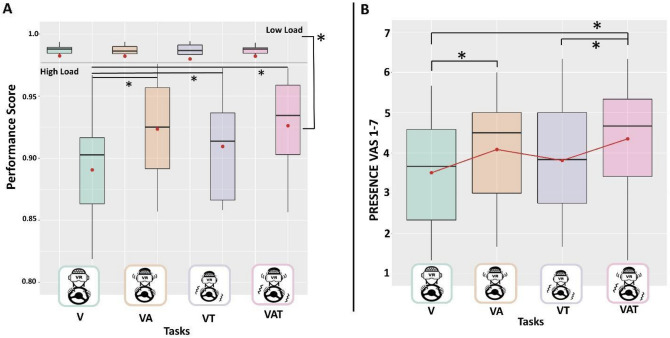
- In the performance LMM, perceptual load had a significant main effect: performance was lower in the high-load than the low-load condition (marginal R² = 0.53; conditional R² = 0.67).
- There was a significant Condition × Task interaction for performance: in the high-load condition only, bimodal and trimodal stimulation improved performance versus visual-only, with VA p = 0.003, VAT p < 0.001, and VT p = 0.037.
- Sense of presence increased with multisensory integration and with load: VAT produced higher presence than V (p = 0.007) and VT (p = 0.026), VA was higher than V (p = 0.048), and high load increased presence by β = 0.559 (p = 0.0118).
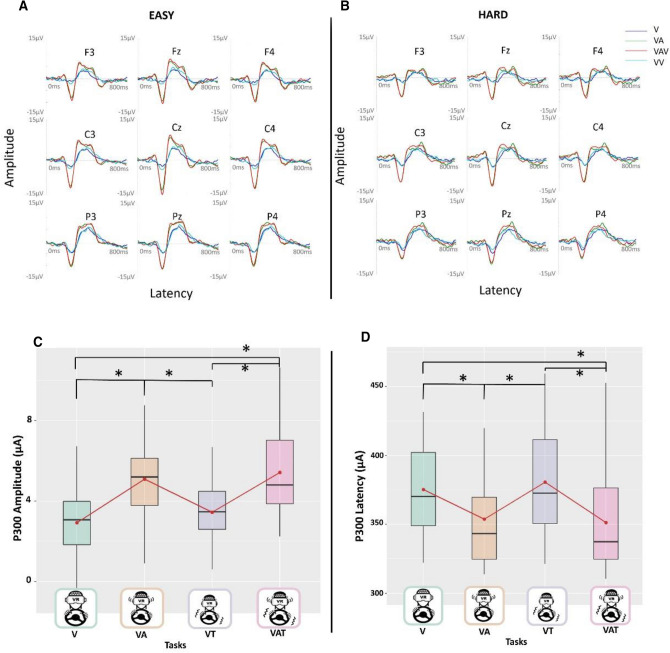
- EEG findings showed multisensory benefits in stimulus processing: P300 amplitude increased for VA and VAT versus V and VT (all p-values < 0.001 or < 0.01), while P300 latency increased for VA and VAT versus V and VT; high load also increased latency by β = 0.44.
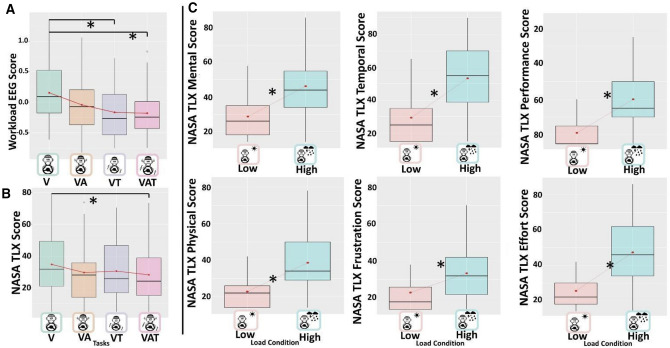
- Workload measures diverged by instrument: the EEG-based workload index decreased for VAT and VT versus V (β = 0.333, p = 0.002; β = 0.319, p = 0.006), while NASA-TLX showed a significant reduction only for VAT versus V (p = 0.025).
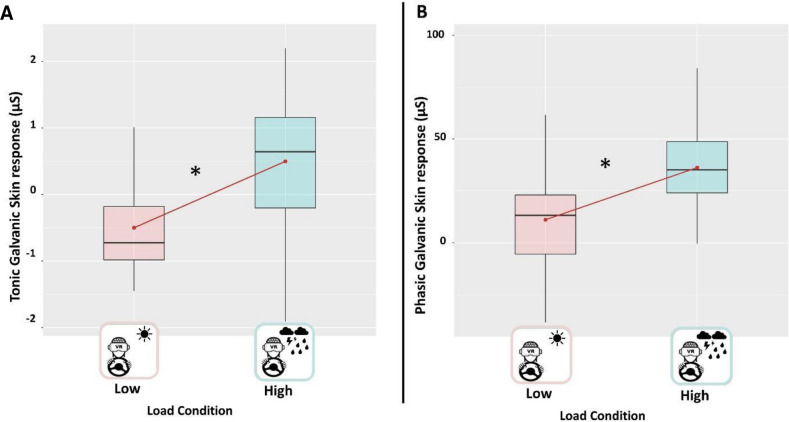
- Skin conductance increased under high load for both tonic and phasic components: tonic β = 0.995 (p = 0.004) and phasic β = 1.02 (p < 0.0001).
## Methods
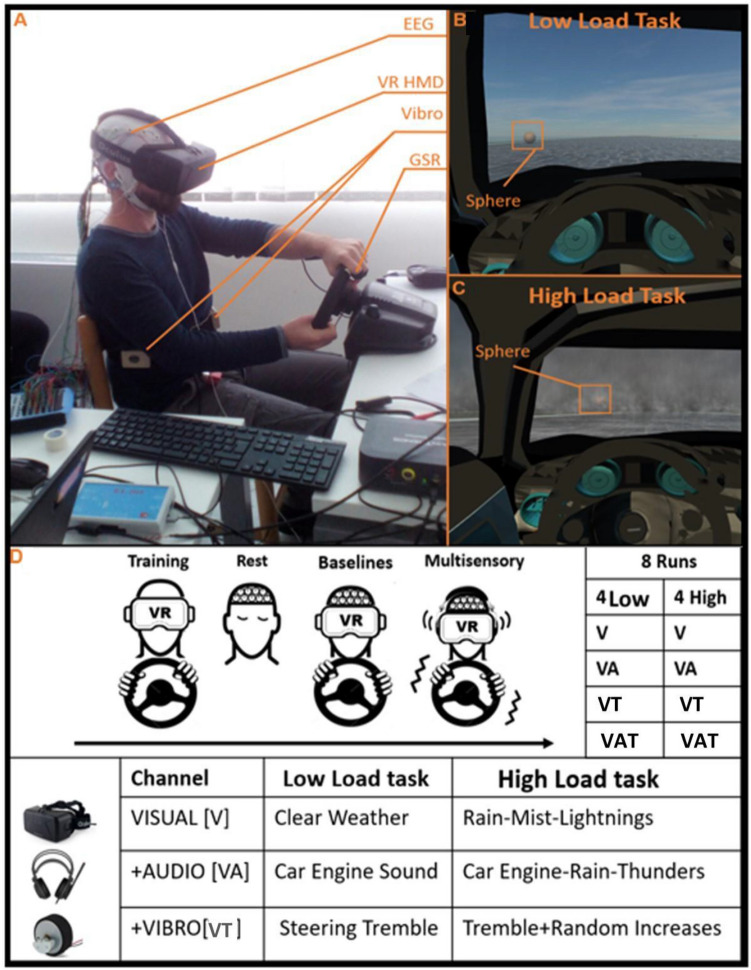
- The study used a counterbalanced VR experiment with a target-detection driving task under 2 perceptual-load conditions (low vs high) and 4 sensory tasks: V, VA, VT, and VAT.
- Participants were 18 healthy male volunteers, mean age 26.5 ± 3.2 years, with normal or corrected-to-normal vision.
- Outcomes included behavioral performance (#HitT and TimeD), subjective workload (NASA-TLX), presence questionnaire scores, EEG-derived workload (WEEG), P300 amplitude/latency, and GSR-based arousal measures; analysis used linear mixed-effects models with subject random effects and post hoc Tukey tests.
## Limitations
- The paper states that perceptual load may have intrinsically increased cognitive load, and that the design did not allow disentangling cognitive from perceptual load; further studies are needed.
- The sample included only 18 participants and only male volunteers, which the paper says was done to reduce variability due to putative gender effects.
- The text makes evident that the study used a highly controlled VR task, so generalization to other settings is uncertain; this is an inference from the experimental design, not a limitation explicitly stated in the paper.
Model-written summary. Check it against the paper before relying on it.
Integrity signals
Registry
Cites
Statistics
Figures
Verification
Claims the paper makes
5 Valid · 2 Not valid · 29 Not checked · 54 Own results and interpretations
The cited sources support only part of this claim — read each source’s verdict below.
In the paper
“This means that multisensory integration can enhance the ability to detect a target stimulus.”
§ The impact of multisensory integration and perceptual load in virtual reality settings on performance, workload and presence > Introduction
What the sources say
- Not checked — no full text of the sourcecites [12] Spence C Pavani F Driver J Crossmodal links between vision and touch in covert endogenous spatial attention J. Exp. Psychol. Hum. Percept. Perform. 2000 26 1298 1319 10.1037/0096-1523.26.4.1298 10946716 source
- Supportedcites [13] Ngo MK Spence C Auditory, tactile, and multisensory cues facilitate search for dynamic visual stimuli Atten. Percept. Psychophys. 2010 72 1654 1665 10.3758/APP.72.6.1654 20675808 source
The paper's own results carry the claim: the General Discussion states that the presence of auditory or vibrotactile cues gave 'a substantial facilitation of participants' visual search performance, as compared with the performance seen when no cue is present,' and, of the bimodal audiotactile (multisensory) condition, that 'overall performance was still significantly better than in the no-cue condition.' The same discussion frames the mechanism as multisensory integration — the cue and target becoming 'bound together and ... integrated into a single, coherent, multisensory event' that aids segregation of the target from distractors, 'which ultimately leads to its improved identification' — and cites Perrott et al. (1990) for reduced visual target detection latencies with auditory cues. One nuance worth noting: the paper found no additional benefit of the multisensory cue over unimodal cues, so the enhancement is relative to no cue rather than to single-modality cuing; the hedged claim ('can enhance') is nonetheless stated. (LLM, conf=0.84)
- Could not verifycites [14] Van der Burg E Olivers CN Bronkhorst AW Theeuwes J Pip and pop: nonspatial auditory signals improve spatial visual search J. Exp. Psychol. Hum. Percept. Perform. 2008 34 1053 1065 10.1037/0096-1523.34.5.1053 18823194 sourceExperimental — accuracy not yet measured
Our copy of van der Burg et al. (2008) holds only institutional-repository metadata: the four passages returned (section 'Abstract' and the unlabelled record header) consist of the title/author line, the RIS and BIBTEX citation strings, an 'Access to Document' resolver link and a 'Fingerprint' block — no abstract body, methods or results text. Four queries ('auditory signals improve visual search target detection', 'multisensory integration enhances detection of a target', 'whether irrelevant auditory signals speed up visual search', 'response time reaction time targets distractors display sound present absent') returned nothing beyond these same citation records, so no passage states that multisensory integration enhances target detection. The article title as recorded suggests the topic (nonspatial auditory signals improving spatial visual search) but is not evidence of the claim's content, so the claim cannot be checked against our copy. (LLM, conf=0.62)
- Partly supportedcites [15] Matusz PJ Eimer M Multisensory enhancement of attentional capture in visual search Psychon. Bull. Rev. 2011 18 904 909 10.3758/s13423-011-0131-8 21748418 sourceExperimental — accuracy not yet measured
Matusz & Eimer's own demonstration concerns attentional capture by task-irrelevant cues: the Abstract (p.1) and Discussion state that spatial-cuing effects were larger on tone-present than tone-absent trials, i.e. multisensory integration boosts salience and capture, not detection accuracy. Where improved target detection does appear in our copy it is credited to other work (Abstract: Van der Burg et al., 2008 - 'Target detection was substantially faster in tone-present blocks'; Vroomen & de Gelder, 2000 - 'freezing effect was associated with improved target detection performance'). Moreover, in their own experiments the Discussion reports that shorter target RTs on tone-present trials came with more frequent errors, attributed to tone-induced alerting and a speed-accuracy trade-off, so the specific claim of enhanced target-detection ability is not established by this paper. (LLM, conf=0.72)
plainstates a cause- Asserted: passes — The authors put it forward as true.
- Checkable: passes — It can be checked against evidence.
- Load-bearing: passes — The paper’s conclusions depend on it.
- Based: passes — The paper gives a reason why it holds.
The cited sources support only part of this claim — read each source’s verdict below.
In the paper
“The electrodermal response permits to assess the level of arousal: previous studies demonstrated its utility as an objective measure of anxiety under threatening situations or of body illusions29–31.”
§ The impact of multisensory integration and perceptual load in virtual reality settings on performance, workload and presence > Introduction
What the sources say
- Supportedcites [29] Petkova V Ehrsson H If I were you: perceptual illusion of body swapping PLoS ONE 2008 3 e3832 10.1371/journal.pone.0003832 19050755 PMC2585011 source
The Results section, under “Physiological evidence for owning a new body,” explicitly uses skin conductance response as an objective measure of anxiety during a threat. The Discussion links threat-evoked skin conductance responses to autonomic arousal and emotional reactions, supporting the claim that electrodermal response can assess arousal in this context. Page numbers are not provided in our copy. (LLM, conf=0.91)
- Not matchedcites [30] Gonzalez-Franco, M., Perez-Marcos, D., Spanlang, B. & Slater, M. in 2010 IEEE virtual reality conference (VR). 111–114 (IEEE).
We searched by its title and found no matching paper.
- Supportedcites [31] Slater M Spanlang B Sanchez-Vives MV Blanke O First person experience of body transfer in virtual reality PLoS ONE 2010 5 e10564 10.1371/journal.pone.0010564 20485681 PMC2868878 source
The Discussion states that skin conductance measures arousal, supporting the claim that electrodermal response can assess arousal. It distinguishes arousal from its emotional valence, which the measure does not identify. (LLM, conf=0.94)
boostedstates an association- Asserted: passes — The authors put it forward as true.
- Checkable: passes — It can be checked against evidence.
- Load-bearing: passes — The paper’s conclusions depend on it.
- Based: passes — The paper gives a reason why it holds.
- Supported
The cited sources support only part of this claim — read each source’s verdict below.
In the paper
“Through EEG measures, we extracted features (i) in the time domain (i.e., ERPs analysis, in particular P300 ERPs) and (ii) in the frequency domain (i.e., EEG frequency bands), both modulated the difficulty of the task variations32–34.”
§ The impact of multisensory integration and perceptual load in virtual reality settings on performance, workload and presence > Introduction
What the sources say
- Not checked — no full text of the sourcecites [32] Arico P A passive brain-computer interface application for the mental workload assessment on professional air traffic controllers during realistic air traffic control tasks Prog. Brain Res. 2016 228 295 328 10.1016/bs.pbr.2016.04.021 27590973 source
- Partly supportedcites [33] Di Flumeri G EEG-based mental workload neurometric to evaluate the impact of different traffic and road conditions in real driving settings Front. Hum. Neurosci. 2018 12 509 10.3389/fnhum.2018.00509 30618686 PMC6305466 sourceExperimental — accuracy not yet measured
Materials and Methods (The Data Collection; page not provided) describes theta and alpha frequency-band features, and Results (Experimental Design Validation; page not provided) reports that an EEG-band indicator increased significantly on the harder road segment. The cited paper does not report P300 ERP or other time-domain features being modulated by task difficulty. (LLM, conf=0.88)
- Not checked — no full text of the sourcecites [34] Aloise F Asynchronous gaze-independent event-related potential-based brain–computer interface Artif. Intell. Med. 2013 59 61 69 10.1016/j.artmed.2013.07.006 24080078 source
plainstates a cause- Asserted: passes — The authors put it forward as true.
- Checkable: passes — It can be checked against evidence.
- Load-bearing: passes — The paper’s conclusions depend on it.
- Based: passes — The paper gives a reason why it holds.
A result the paper reports from its own data — it cites no other source for it, so there is none to check. The quote shows it is in the paper.
In the paper
“Results showed that only in the high load condition, multisensory stimuli significantly improve performance, compared to visual stimulation alone.”
§ The impact of multisensory integration and perceptual load in virtual reality settings on performance, workload and presence > Abstract
plainstates a cause- Asserted: passes — The authors put it forward as true.
- Checkable: passes — It can be checked against evidence.
- Load-bearing: passes — The paper’s conclusions depend on it.
- Based: passes — The paper gives a reason why it holds.
A result the paper reports from its own data — it cites no other source for it, so there is none to check. The quote shows it is in the paper.
In the paper
“This trimodal stimulation was more effective in enhancing the sense of presence, that is the feeling of being in the virtual environment, compared to the bimodal or unimodal stimulation.”
§ The impact of multisensory integration and perceptual load in virtual reality settings on performance, workload and presence > Abstract
plainstates a cause- Asserted: passes — The authors put it forward as true.
- Checkable: passes — It can be checked against evidence.
- Load-bearing: passes — The paper’s conclusions depend on it.
- Based: passes — The paper gives a reason why it holds.
37 more claims
Create a free account to see all 90 claims and to verify the 5 references still open.
- It may state two separate claims as one. 30
- Probably not a substantial claim. 23
- The quote only partly states this claim. 1
Citations
Cites
Fitting Linear Mixed-Effects Models Using lme4
Bates, D., Mächler, M., Bolker, B., & Walker, S. (2015) · Journal of Statistical Software · doi:10.18637/jss.v067.i01 · Cited by 86,835
Delorme, A., & Makeig, S. (2004) · Journal of Neuroscience Methods · doi:10.1016/j.jneumeth.2003.10.009 · Cited by 24,371
Data Analysis Using Regression and Multilevel/Hierarchical Models
Gelman, A., & Hill, J. (2006) · doi:10.1017/cbo9780511790942 · Cited by 13,597
de Boor, C. (1978) · Applied Mathematical Sciences · doi:10.1007/978-1-4612-6333-3 · Cited by 11,944
Mixed-Effects Models in Sand S-PLUS
Pinheiro, J. C., & Bates, D. M. (2000) · Statistics and Computing · doi:10.1007/978-1-4419-0318-1 · Cited by 11,187
EEG alpha and theta oscillations reflect cognitive and memory performance: a review and analysis
Klimesch, W. (1999) · Brain Research Reviews · doi:10.1016/s0165-0173(98)00056-3 · Cited by 6,889
Zhang, J.-H., Chung, T. D. Y., & Oldenburg, K. R. (1999) · SLAS Discovery · doi:10.1177/108705719900400206 · Cited by 6,847
Bengio, Y., Louradour, J., Collobert, R., & Weston, J. (2009) · Proceedings of the 26th Annual International Conference on Machine Learning · doi:10.1145/1553374.1553380 · Cited by 5,366
Boucsein, W. (2012) · doi:10.1007/978-1-4614-1126-0 · Cited by 2,526
Population Marginal Means in the Linear Model: An Alternative to Least Squares Means
Searle, S. R., Speed, F. M., & Milliken, G. A. (1980) · The American Statistician · doi:10.1080/00031305.1980.10483031 · Cited by 2,215
Picton, T. W., Bentin, S., Berg, P., Donchin, E., Hillyard, S. A., Johnson, R., Miller, G. A., Ritter, W., Ruchkin, D. S., Rugg, M. D., et al. (2000) · Psychophysiology · doi:10.1111/1469-8986.3720127 · Cited by 2,157
The role of involvement in attention and comprehension processes
Celsi, R. L., & Olson, J. C. (1988) · Journal of Consumer Research · doi:10.1086/209158 · Cited by 2,070
From presence to consciousness through virtual reality.
Sanchez-Vives, M. V., & Slater, M. (2005) · Nature reviews. Neuroscience · doi:10.1038/nrn1651 · Cited by 1,831
Load Theory of Selective Attention and Cognitive Control
Lavie, N., Hirst, A., de Fockert, J. W., & Viding, E. (2004) · Journal of Experimental Psychology: General · doi:10.1037/0096-3445.133.3.339 · Cited by 1,812
How Immersive Is Enough? A Meta-Analysis of the Effect of Immersive Technology on User Presence
Cummings, J. J., & Bailenson, J. N. (2016) · Media Psychology · doi:10.1080/15213269.2015.1015740 · Cited by 1,749
MuMIn : multi-model inference, R package version 0.12.0
Bartoń, K. A. (2009) · Medical Entomology and Zoology · Cited by 1,686
Cognitive and biological determinants of P300: an integrative review
Polich, J., & Kok, A. (1995) · Biological Psychology · doi:10.1016/0301-0511(95)05130-9 · Cited by 1,613
Jurcak, V., Tsuzuki, D., & Dan, I. (2007) · NeuroImage · doi:10.1016/j.neuroimage.2006.09.024 · Cited by 1,489
Musings on Telepresence and Virtual Presence
Sheridan, T. B. (1992) · Presence: Teleoperators and Virtual Environments · doi:10.1162/pres.1992.1.1.120 · Cited by 1,344
Borghini, G., Astolfi, L., Vecchiato, G., Mattia, D., & Babiloni, F. (2014) · Neuroscience & Biobehavioral Reviews · doi:10.1016/j.neubiorev.2012.10.003 · Cited by 1,331
Self-citationBlascovich, J., Loomis, J., Beall, A. C., Swinth, K. R., Hoyt, C. L., & Bailenson, J. N. (2002) · Psychological Inquiry · doi:10.1207/s15327965pli1302_01 · Cited by 1,280
First person experience of body transfer in virtual reality
Slater, M., Spanlang, B., Sanchez-Vives, M. V., & Blanke, O. (2010) · PLoS ONE · doi:10.1371/journal.pone.0010564 · Cited by 1,090
Review: Electrodermal Responses: What Happens in the Brain
Critchley, H. D. (2002) · The Neuroscientist · doi:10.1177/107385840200800209 · Cited by 997
Johnson, R. (1986) · Psychophysiology · doi:10.1111/j.1469-8986.1986.tb00649.x · Cited by 960
If I were you: Perceptual illusion of body swapping
Petkova, V. I., & Ehrsson, H. H. (2008) · PLoS ONE · doi:10.1371/journal.pone.0003832 · Cited by 953
Measuring Presence: A Response to the Witmer and Singer Presence Questionnaire
Slater, M. (1999) · Presence: Teleoperators and Virtual Environments · doi:10.1162/105474699566477 · Cited by 855
Interactions Among Converging Sensory Inputs in the Superior Colliculus
Meredith, M. A., & Stein, B. E. (1983) · Science · doi:10.1126/science.6867718 · Cited by 841
The Factor Structure of the Presence Questionnaire
Witmer, B. G., Jerome, C. J., & Singer, M. J. (2005) · Presence: Teleoperators and Virtual Environments · doi:10.1162/105474605323384654 · Cited by 770
Keil, A., Debener, S., Gratton, G., Junghöfer, M., Kappenman, E. S., Luck, S. J., Luu, P., Miller, G. A., & Yee, C. M. (2014) · Psychophysiology · doi:10.1111/psyp.12147 · Cited by 699
On the Dependence of P300 Latency on Stimulus Evaluation Processes
Magliero, A., Bashore, T. R., Coles, M. G. H., & Donchin, E. (1984) · Psychophysiology · doi:10.1111/j.1469-8986.1984.tb00201.x · Cited by 614
Reliability of cortical activity during natural stimulation
Hasson, U., Malach, R., & Heeger, D. J. (2010) · Trends in Cognitive Sciences · doi:10.1016/j.tics.2009.10.011 · Cited by 609
Decomposition of skin conductance data by means of nonnegative deconvolution
Benedek, M., & Kaernbach, C. (2010) · Psychophysiology · doi:10.1111/j.1469-8986.2009.00972.x · Cited by 587
Dinh, H. Q., Walker, N., Hodges, L. F., Song, C., & Kobayashi, A. (2003) · Proceedings IEEE Virtual Reality (Cat. No. 99CB36316) · doi:10.1109/vr.1999.756955 · Cited by 566
Pip and pop: Nonspatial auditory signals improve spatial visual search.
Van der Burg, E., Olivers, C. N. L., Bronkhorst, A. W., & Theeuwes, J. (2008) · Journal of Experimental Psychology: Human Perception and Performance · doi:10.1037/0096-1523.34.5.1053 · Cited by 485
Linear Mixed-Effects Models: Basic Concepts and Examples
(2000) · Statistics and Computing · doi:10.1007/978-1-4419-0318-1_1 · Cited by 474
Fabiani, M., Gratton, G., Karis, D., & Donchin, E. (1987) · Digital Commons - University of South Florida (University of South Florida) · Cited by 458
Talsma, D., Doty, T. J., & Woldorff, M. G. (2006) · Cerebral Cortex · doi:10.1093/cercor/bhk016 · Cited by 434
Extending the Linear Model with R
Faraway, J. J. (2005) · Chapman & Hall/CRC eBooks · doi:10.1201/b15416 · Cited by 432
Enhancement of Perceived Visual Intensity by Auditory Stimuli: A Psychophysical Analysis
Stein, B. E., London, N., Wilkinson, L. K., & Price, D. D. (1996) · Journal of Cognitive Neuroscience · doi:10.1162/jocn.1996.8.6.497 · Cited by 404
Noise effects on human performance: A meta-analytic synthesis.
Szalma, J. L., & Hancock, P. A. (2011) · Psychological Bulletin · doi:10.1037/a0023987 · Cited by 398
Stein, B. E., Meredith, M. A., Huneycutt, W. S., & McDade, L. (1989) · Journal of Cognitive Neuroscience · doi:10.1162/jocn.1989.1.1.12 · Cited by 394
Development of multisensory integration from the perspective of the individual neuron
Stein, B. E., Stanford, T. R., & Rowland, B. A. (2014) · Nature Reviews Neuroscience · doi:10.1038/nrn3742 · Cited by 392
Young Psychophysiologist Award Address, 1980: P300 Latency: A New Metric of Information Processing
Duncan‐Johnson, C. C. (1981) · Psychophysiology · doi:10.1111/j.1469-8986.1981.tb03020.x · Cited by 371
The Effects of Age on Human Event‐Related Potentials
Picton, T. W., Stuss, D. T., Champagne, S. C., & Nelson, R. F. (1984) · Psychophysiology · doi:10.1111/j.1469-8986.1984.tb02941.x · Cited by 361
A unifying information-theoretic framework for independent component analysis
Lee, T.-W., Girolami, M., Bell, A. J., & Sejnowski, T. J. (2000) · Computers & Mathematics with Applications · doi:10.1016/s0898-1221(00)00101-2 · Cited by 355
The effects of age on human event-related potentials
Picton (1984) · Medical Entomology and Zoology · Cited by 334
Presence within Virtual Environments as a Function of Visual Display Parameters
Hendrix, C., & Barfield, W. (1996) · Presence: Teleoperators and Virtual Environments · doi:10.1162/pres.1996.5.3.274 · Cited by 331
Käthner, I., Wriessnegger, S. C., Müller-Putz, G. R., Kübler, A., & Halder, S. (2014) · Biological Psychology · doi:10.1016/j.biopsycho.2014.07.014 · Cited by 328
The Role of Perceptual Load in Processing Distractor Faces
Lavie, N., Ro, T., & Russell, C. (2003) · Psychological Science · doi:10.1111/1467-9280.03453 · Cited by 313
A natural approach to studying vision
Felsen, G., & Dan, Y. (2005) · Nature Neuroscience · doi:10.1038/nn1608 · Cited by 285
Crossmodal links between vision and touch in covert endogenous spatial attention.
Spence, C., Pavani, F., & Driver, J. (2000) · Journal of Experimental Psychology: Human Perception and Performance · doi:10.1037/0096-1523.26.4.1298 · Cited by 282
Grandy, T. H., Werkle‐Bergner, M., Chicherio, C., Schmiedek, F., Lövdén, M., & Lindenberger, U. (2013) · Psychophysiology · doi:10.1111/psyp.12043 · Cited by 276
Doppelmayr, M., Klimesch, W., Pachinger, T., & Ripper, B. (1998) · Biological Cybernetics · doi:10.1007/s004220050457 · Cited by 265
Aricò, P., Borghini, G., Di Flumeri, G., Colosimo, A., Bonelli, S., Golfetti, A., Pozzi, S., Imbert, J.-P., Granger, G., Benhacene, R., et al. (2016) · Frontiers in Human Neuroscience · doi:10.3389/fnhum.2016.00539 · Cited by 249
Self-citationVisual perceptual load induces inattentional deafness
Macdonald, J. S. P., & Lavie, N. (2011) · Attention, Perception, & Psychophysics · doi:10.3758/s13414-011-0144-4 · Cited by 248
Multisensory In-Car Warning Signals for Collision Avoidance
Ho, C., Reed, N., & Spence, C. (2007) · Human Factors: The Journal of the Human Factors and Ergonomics Society · doi:10.1518/001872007x249965 · Cited by 235
Stelmach, G. E., & Vroom, J. P. (1980) · Elsevier eBooks · Cited by 231
Are We Ready for Real-world Neuroscience?
Matusz, P. J., Dikker, S., Huth, A. G., & Perrodin, C. (2019) · Journal of Cognitive Neuroscience · doi:10.1162/jocn_e_01276 · Cited by 225
Cooper, N., Milella, F., Pinto, C., Cant, I., White, M., & Meyer, G. (2018) · PLOS ONE · doi:10.1371/journal.pone.0191846 · Cited by 201
Voicu, I., Ménigot, S., Kouamé, D., & Girault, J.-M. (2014) · Computational and Mathematical Methods in Medicine · doi:10.1155/2014/784862 · Cited by 187
Tactile enhancement of auditory detection and perceived loudness
Gillmeister, H., & Eimer, M. (2007) · Brain Research · doi:10.1016/j.brainres.2007.03.041 · Cited by 177
Multisensory cues capture spatial attention regardless of perceptual load.
Santangelo, V., & Spence, C. (2007) · Journal of Experimental Psychology: Human Perception and Performance · doi:10.1037/0096-1523.33.6.1311 · Cited by 170
Di Flumeri, G., Borghini, G., Aricò, P., Sciaraffa, N., Lanzi, P., Pozzi, S., Vignali, V., Lantieri, C., Bichicchi, A., Simone, A., et al. (2018) · Frontiers in Human Neuroscience · doi:10.3389/fnhum.2018.00509 · Cited by 168
Self-citationHuman auditory and somatosensory event-related potentials: effects of response condition and age
Barrett, G., Neshige, R., & Shibasaki, H. (1987) · Electroencephalography and Clinical Neurophysiology · doi:10.1016/0013-4694(87)90210-0 · Cited by 164
Vecchiato, G., Maglione, A. G., Cherubino, P., Wasikowska, B., Wawrzyniak, A., Latuszynska, A., Latuszynska, M., Nermend, K., Graziani, I., Leucci, M. R., et al. (2014) · Computational and Mathematical Methods in Medicine · doi:10.1155/2014/912981 · Cited by 164 · cited 1×
“Mental workload is also known to suppress EEG alpha rhythm and to increase theta rhythm during the information encoding and retrieval 66 .”
BackgroundSelf-citationMueller, A. S., & Trick, L. M. (2012) · Accident Analysis & Prevention · doi:10.1016/j.aap.2012.03.003 · Cited by 162
(1998) · CERN Document Server (European Organization for Nuclear Research) · Cited by 149
The emotional side of cognitive distraction: Implications for road safety
Chan, M., & Singhal, A. (2013) · Accident Analysis & Prevention · doi:10.1016/j.aap.2012.04.004 · Cited by 145
Aricò, P., Borghini, G., Di Flumeri, G., Colosimo, A., Pozzi, S., & Babiloni, F. (2016) · Progress in Brain Research · doi:10.1016/bs.pbr.2016.04.021 · Cited by 145
Self-citationWorking memory training: Improving intelligence – Changing brain activity
Jaušovec, N., & Jaušovec, K. (2012) · Brain and Cognition · doi:10.1016/j.bandc.2012.02.007 · Cited by 142
Superadditive BOLD activation in superior temporal sulcus with threshold non-speech objects
Stevenson, R. A., Geoghegan, M. L., & James, T. W. (2006) · Experimental Brain Research · doi:10.1007/s00221-006-0770-6 · Cited by 122
Capturing spatial attention with multisensory cues: A review
Spence, C. J., & Santangelo, V. (2009) · Hearing Research · doi:10.1016/j.heares.2009.04.015 · Cited by 117
Unni, A., Ihme, K. A., Jipp, M., & Rieger, J. W. (2017) · Frontiers in Human Neuroscience · doi:10.3389/fnhum.2017.00167 · Cited by 116
P300 Development from Auditory Stimuli
Polich, J. (1986) · Psychophysiology · doi:10.1111/j.1469-8986.1986.tb00677.x · Cited by 109
The nature of the galvanic skin response.
McCleary, R. A. (1950) · Psychological Bulletin · doi:10.1037/h0059810 · Cited by 100
Body visual discontinuity affects feeling of ownership and skin conductance responses
Tieri, G., Tidoni, E., Pavone, E. F., & Aglioti, S. M. (2015) · Scientific Reports · doi:10.1038/srep17139 · Cited by 100
Self-citationAuditory, tactile, and multisensory cues facilitate search for dynamic visual stimuli
Ngo, M. K., & Spence, C. (2010) · Attention, Perception, & Psychophysics · doi:10.3758/app.72.6.1654 · Cited by 94
Mental and physical effort affect vigilance differently
Smit, A. S., Eling, P. A. T. M., Hopman, M. T., & Coenen, A. M. L. (2005) · International Journal of Psychophysiology · doi:10.1016/j.ijpsycho.2005.02.001 · Cited by 92
Multisensory warning signals: when spatial correspondence matters
Ho, C., Santangelo, V., & Spence, C. (2009) · Experimental Brain Research · doi:10.1007/s00221-009-1778-5 · Cited by 89
Aricò, P., Aloise, F., Schettini, F., Salinari, S., Mattia, D., & Cincotti, F. (2014) · Journal of Neural Engineering · doi:10.1088/1741-2560/11/3/035008 · Cited by 87
The Spatial Disorientation Problem in the United States Air Force
Gillingham, K. K. (1992) · Journal of Vestibular Research · doi:10.3233/ves-1992-2404 · Cited by 79 · cited 1×
“Moreover, the lack of acoustical signals could even account for spatial disorientation 91,92 .”
BackgroundMultisensory enhancement of attentional capture in visual search
Matusz, P. J., & Eimer, M. (2011) · Psychonomic Bulletin & Review · doi:10.3758/s13423-011-0131-8 · Cited by 78
Wiederhold, B. K., Jang, D. P., Kaneda, M., Lurie, Y., Kim, I. Y., & Kim, S. I. (2003) · Cited by 78
Theta and Alpha Oscillations in Attentional Interaction during Distracted Driving
Wang, Y., Jung, T., & Lin, C. (2018) · Frontiers in Behavioral Neuroscience · doi:10.3389/fnbeh.2018.00003 · Cited by 77
Relative Unisensory Strength and Timing Predict Their Multisensory Product
Miller, R. L., Pluta, S. R., Stein, B. E., & Rowland, B. A. (2015) · Journal of Neuroscience · doi:10.1523/jneurosci.4771-14.2015 · Cited by 62
Multisensory enhancement of attention depends on whether you are already paying attention
Lunn, J., Sjoblom, A., Ward, J., Soto-Faraco, S., & Forster, S. (2019) · Cognition · doi:10.1016/j.cognition.2019.02.008 · Cited by 62
(1998) · PubMed · Cited by 59
Perceptual Load Induces Inattentional Blindness in Drivers
Murphy, G., & Greene, C. M. (2016) · Applied Cognitive Psychology · doi:10.1002/acp.3216 · Cited by 58
P300 from auditory and somatosensory stimuli: probability and inter-stimulus interval
Polich, J., Brock, T., & Geisler, M. W. (1991) · International Journal of Psychophysiology · doi:10.1016/0167-8760(91)90015-p · Cited by 55
Visual illusion of tool use recalibrates tactile perception
Miller, L. E., Longo, M. R., & Saygın, A. P. (2017) · Cognition · doi:10.1016/j.cognition.2017.01.022 · Cited by 47
Mental workload estimations in unilateral deafened children
Cartocci, G., Maglione, A. G., Vecchiato, G., Flumeri, G. D., Colosimo, A., Scorpecci, A., Marsella, P., Giannantonio, S., Malerba, P., Borghini, G., et al. (2015) · Annual International Conference of the IEEE Engineering in Medicine and Biology Society (EMBC) · doi:10.1109/embc.2015.7318693 · Cited by 44
Self-citationAsynchronous gaze-independent event-related potential-based brain–computer interface
Aloise, F., Aricò, P., Schettini, F., Salinari, S., Mattia, D., & Cincotti, F. (2013) · Artificial Intelligence in Medicine · doi:10.1016/j.artmed.2013.07.006 · Cited by 43
Self-citationHow Neurophysiological Measures Can be Used to Enhance the Evaluation of Remote Tower Solutions
Aricò, P., Reynal, M., Flumeri, G. D., Borghini, G., Sciaraffa, N., Imbert, J.-P., Hurter, C., Terenzi, M., Ferreira, A., Pozzi, S., et al. (2019) · Frontiers in Human Neuroscience · doi:10.3389/fnhum.2019.00303 · Cited by 43
Self-citationBorghini, G., Aricò, P., Flumeri, G. D., Sciaraffa, N., & Babiloni, F. (2019) · Sensors · doi:10.3390/s19030704 · Cited by 35
Self-citationDeconstructing multisensory enhancement in detection
Pannunzi, M., Pérez-Bellido, A., Pereda-Baños, A., López‐Moliner, J., Deco, G., & Soto‐Faraco, S. (2014) · Journal of Neurophysiology · doi:10.1152/jn.00341.2014 · Cited by 26
EEG-Based Mental Workload Assessment During Real Driving
Di Flumeri, G., Borghini, G., Aricò, P., Sciaraffa, N., Lanzi, P., Pozzi, S., Vignali, V., Lantieri, C., Bichicchi, A., Simone, A., et al. (2019) · Neuroergonomics · doi:10.1016/b978-0-12-811926-6.00020-8 · Cited by 23
Self-citationde Tommaso, M., Betti, V., Bocci, T., Bolognini, N., Russo, F. D., Fattapposta, F., Ferri, R., Invitto, S., Koch, G., Miniussi, C., et al. (2020) · Neurological Sciences · doi:10.1007/s10072-020-04527-x · Cited by 20
Self-citationExtending the Linear Model with R (Texts in Statistical Science)
Faraway, J. J. (2005) · Chapman & Hall/CRC eBooks · Cited by 16
Relationship of Galvanic Skin Response to Task Difficulty, Personality Traits, and Motivation
Lakie, W. L. (1967) · Research Quarterly. American Association for Health, Physical Education and Recreation · doi:10.1080/10671188.1967.10614803 · Cited by 4
Research works printed but not linked: 5
- Gonzalez-Franco, M., Perez-Marcos, D., Spanlang, B. & Slater, M. in 2010 IEEE virtual reality conference (VR). 111–114 (IEEE).
- Fox J Weisberg S An R Companion to Applied Regression (Third) 2019 Thousand Oaks CA Sage
- Lenth R Lenth MR Package ‘lsmeans’ Am. Stat. 2018 34 4 216 221
- Osaka, M. et al. in 2012 ICME International Conference on Complex Medical Engineering (CME). 717–721 (IEEE).
- Slater, M., Brogni, A. & Steed, A. in Presence 2003: The 6th Annual International Workshop on Presence. (Citeseer).
Cited by
Eadro: An End-to-End Troubleshooting Framework for Microservices on Multi-source Data
Lee, C., Yang, T., Chen, Z., Su, Y., & Lyu, M. R. (2023) · 2023 IEEE/ACM 45th International Conference on Software Engineering (ICSE) · doi:10.1109/icse48619.2023.00150 · Cited by 149
“Research in cross-modal learning [33], [34] and neuroscience [35], [36] suggests that intermediate fusion usually facilitates modeling, so we transform single-modal representations to a compact multi-modal representation via intermediate fusion.”
An Online Framework for Cognitive Load Assessment in Industrial Tasks
Lagomarsino, M., Lorenzini, M., Momi, E. D., & Ajoudani, A. (2022) · Robotics and Computer-Integrated Manufacturing · doi:10.1016/j.rcim.2022.102380 · Cited by 130
“Researchers use high-resolution EDA for indexing variations in sympathetic arousal associated with emotion, cognition, and attention [28, 29] and today represents one of the preferred metrics for stress [30].”
BackgroundMethodLagomarsino, M., Lorenzini, M., Balatti, P., Momi, E. D., & Ajoudani, A. (2022) · IEEE Transactions on Cognitive and Developmental Systems · doi:10.1109/tcds.2022.3182811 · Cited by 97
“As in [26], we computed the mean value of the SCL and the mean amplitude of the SCR peaks to investigate the stress induced by the entire task on participants.”
BackgroundMethodValidation of a Light EEG-Based Measure for Real-Time Stress Monitoring during Realistic Driving
Sciaraffa, N., Flumeri, G. D., Germano, D., Giorgi, A., Florio, A. D., Borghini, G., Vozzi, A., Ronca, V., Varga, R., van Gasteren, M., et al. (2022) · Brain Sciences · doi:10.3390/brainsci12030304 · Cited by 69
Self-citationVozzi, A., Ronca, V., Aricò, P., Borghini, G., Sciaraffa, N., Cherubino, P., Trettel, A., Babiloni, F., & Flumeri, G. D. (2021) · Sensors · doi:10.3390/s21186088 · Cited by 78
Self-citation
Metadata
- Authors
- Marucci, M., Di Flumeri, G., Borghini, G., Sciaraffa, N., Scandola, M., Pavone, E. F., Babiloni, F., Betti, V., & Aricò, P.
- Affiliations
- Sapienza University of Rome (IT)
- Fondazione Santa Lucia (IT)
- University of Verona (IT)
- Corresponding author
- Marucci, Matteo
- ORCID
- Venue
- Scientific Reports
- Published
- 2021-03-01
- Volume
- 11
- Issue
- 1
- Pages
- 4831-4831
- ISSN
- 2045-2322 (ISSN-L)
- PMC
- PMC7921449
- OpenAlex
- W3135027244
- Cited by
- 170
- References
- 99
- Citations by year
- 2026: 35 · 2025: 38 · 2024: 39 · 2023: 30 · 2022: 20 · 2021: 8
- FWCI
- 23.44
- Type
- journal article
- Language
- en
- Open access
- gold
- doi.org
- Licence
- cc-by
- creativecommons.org/licenses/by/4.0 (tdm)
- creativecommons.org/licenses/by/4.0 (vor)
- Locations
- Scientific Reports (publishedVersion, cc-by)
- PubMed Central (publishedVersion, cc-by)
- PubMed (publishedVersion)
- DOAJ (DOAJ: Directory of Open Access Journals) (submittedVersion, cc-by-sa)
- IRIS Research product catalog (Sapienza University of Rome) (submittedVersion, cc-by)
- Funders
- European Commission (699379)
- H2020 European Research Council (759651)
- Topics
- Social Sciences › Psychology › Experimental and Cognitive Psychology › Multisensory perception and integration
- Physical Sciences › Computer Science › Human-Computer Interaction › Virtual Reality Applications and Impacts
- Life Sciences › Neuroscience › Cognitive Neuroscience › Tactile and Sensory Interactions
- Keywords
- multisensory integration, perceptual load, virtual reality, target detection, workload, presence, P300, skin conductance, auditory stimulation, vibrotactile stimulation, multimodal stimuli, NASA-TLX
About these checks
Registry, retraction, Cites and statistics results are computed, not judged, with one exception: a printed reference that no index lists is read once by a model before it counts as a citation error. Claims are extracted by a model and kept only when their quote appears verbatim in the text; each cited source is then checked, with a model’s help, for whether it says what the claim relies on. Those verdicts can be wrong — read the claim’s quote and the cited source before relying on one.
The claim verdicts this report counts are experimental: their accuracy is not yet measured.
A language model drew the claims from the paper on 2026-10-10, under version 3 of the claim definition (model deepseek-v4.1-flash, prompt extract-v3).
A second model labelled each claim on 2026-10-10 (model jev-1.13-20260917, definition revision gold-guideline-v0.2).
Cited sources are checked with a language model’s help (qwen3.8-omni-flash and gpt-6-sol).
Statistics and arithmetic are recomputed, not judged.
Confidence bands are shown only for fields calibrated on our annotated test set. None is calibrated yet, so no band is shown.
What counts as a claim ›How we measure confidence ›How we check this ›
Are you an author, or do you see a problem with this page? Request a review
Data sources
Bibliographic data: Semantic Scholar, OpenAlex, Crossref.
Contains information from the Semantic Scholar Academic Graph Datasets, made available under the ODC Attribution License (ODC-BY 1.0).
Semantic Scholar’s data is described in: Kinney, R., et al. (2023). The Semantic Scholar Open Data Platform. arXiv:2301.10140.
