

A pragmatic randomized waitlist-controlled effectiveness and cost-effectiveness trial of digital interventions for depression and anxiety
Open accessThe DOI matches its Crossref record; 39 of the 41 references it cites were found in a registry or an index.
Abstract
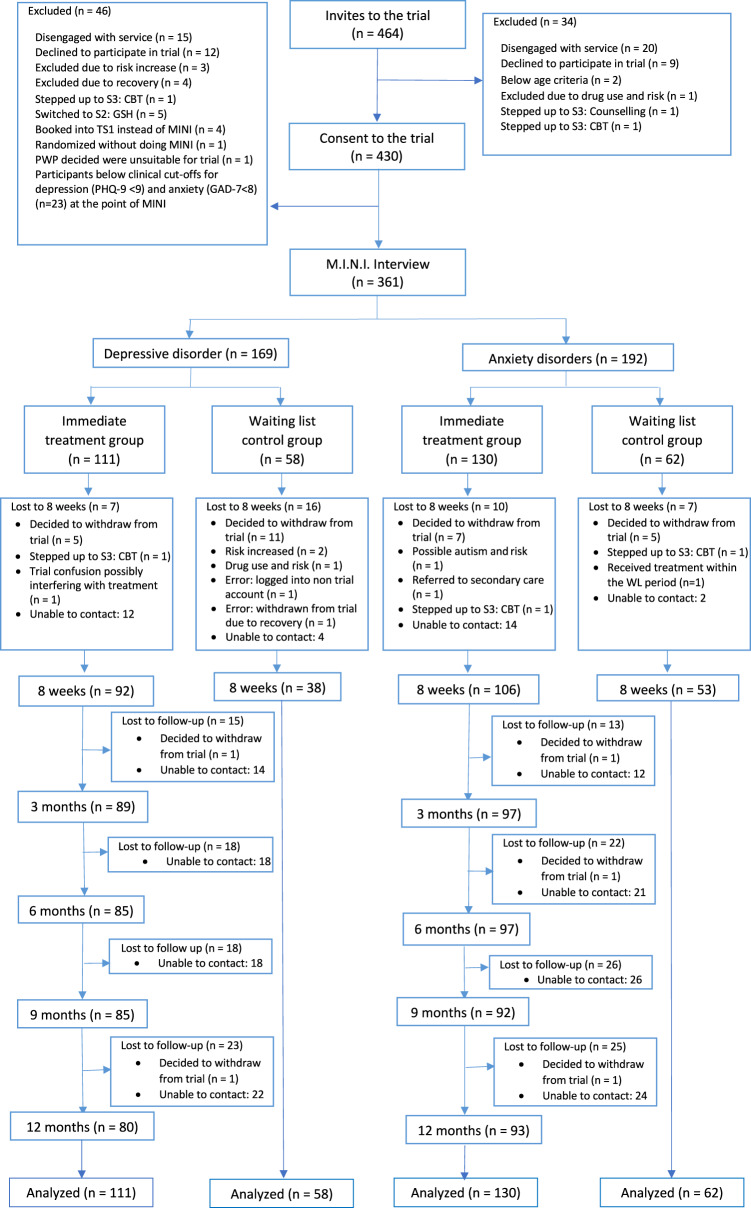
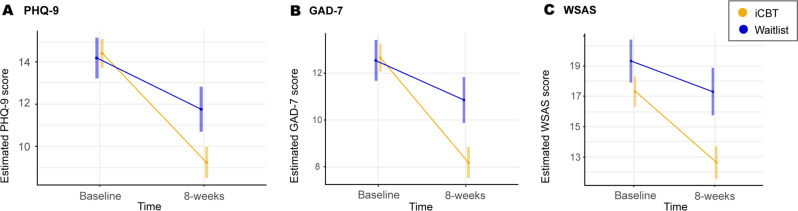
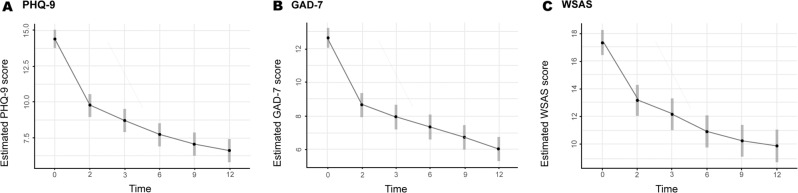
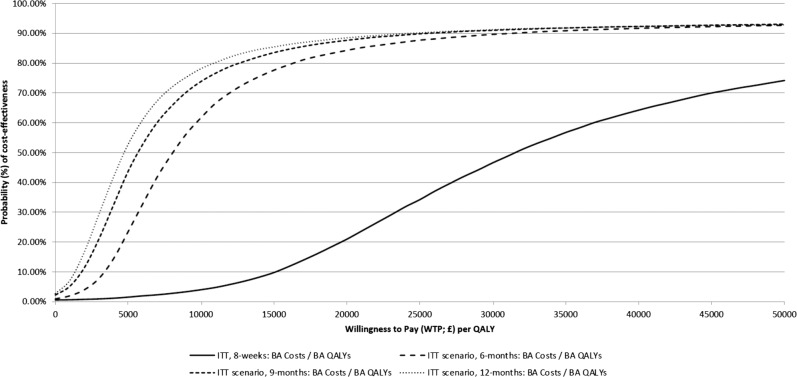
Utilization of internet-delivered cognitive behavioural therapy (iCBT) for treating depression and anxiety disorders in stepped-care models, such as the UK’s Improving Access to Psychological Therapies (IAPT), is a potential solution for addressing the treatment gap in mental health. We investigated the effectiveness and cost-effectiveness of iCBT when fully integrated within IAPT stepped-care settings. We conducted an 8-week pragmatic randomized controlled trial with a 2:1 (iCBT intervention: waiting-list) allocation, for participants referred to an IAPT Step 2 service with depression and anxiety symptoms (Trial registration: ISRCTN91967124). The primary outcomes measures were PHQ-9 (depressive symptoms) and GAD-7 (anxiety symptoms) and WSAS (functional impairment) as a secondary outcome. The cost-effectiveness analysis was based on EQ-5D-5L (preference-based health status) to elicit the quality-adjust life year (QALY) and a modified-Client Service Receipt Inventory (care resource-use). Diagnostic interviews were administered at baseline and 3 months. Three-hundred and sixty-one participants were randomized (iCBT, 241; waiting-list, 120). Intention-to-treat analyses showed significant interaction effects for the PHQ-9 ( b = −2.75, 95% CI −4.00, −1.50) and GAD-7 ( b = −2.79, 95% CI −4.00, −1.58) in favour of iCBT at 8-week and further improvements observed up to 12-months. Over 8-weeks the probability of cost-effectiveness was 46.6% if decision makers are willing to pay £30,000 per QALY, increasing to 91.2% when the control-arm’s outcomes and costs were extrapolated over 12-months. Results indicate that iCBT for depression and anxiety is effective and potentially cost-effective in the long-term within IAPT. Upscaling the use of iCBT as part of stepped care could help to enhance IAPT outcomes. The pragmatic trial design supports the ecological validity of the findings.
Overview
The claims and statistics of this paper haven’t been checked yet.
Free: it reads the open-access text and checks the first 5 claims that cite a source we can check. Create a free account to check every claim.
Integrity signals
Registry
Cites
Statistics
Figures
Verification
Claims the paper makes
The claims and statistics of this paper haven’t been checked yet.
Free: it reads the open-access text and checks the first 5 claims that cite a source we can check. Create a free account to check every claim.
Claims other papers make about this one
Each is checked against this paper’s own text: does it say what the citing paper says it does?
The source backs part of the claim, not all of it — or backs it for a different population, condition or comparison.
In the citing paper
“Although DMHTs have begun to be integrated into health care systems in Europe and Australia (16–20), they have not been well integrated into the U.S. health care system.”
From Banbury forum consensus statement on the path forward for digital mental health treatment (2021) · cites this paper as [20]
Experimental — accuracy not yet measuredThe cited source says what the claim attributes to it.
In the citing paper
“Emerging evidence supports the cost-effectiveness of guided DMHTs (20, 41).”
From Banbury forum consensus statement on the path forward for digital mental health treatment (2021) · cites this paper as [20]
The cited source says what the claim attributes to it.
In the citing paper
“In a recent randomised waitlist-controlled effectiveness and cost-effectiveness trial of digital interventions, it was found that 8-week iCBT for depression and anxiety is not only effective but also potentially cost-effective in the long-term within the improving access to psychological therapies programme (IAPT) in the UK”
Self-check
Percentages, sums and reported differences re-computed from the paper’s own numbers.
The self-check needs the paper’s full text.
Citations
Cites
The PHQ-9: Validity of a brief depression severity measure
Kroenke, K., Spitzer, R. L., & Williams, J. B. W. (2001) · Journal of General Internal Medicine · doi:10.1046/j.1525-1497.2001.016009606.x · Cited by 44,910
A Brief Measure for Assessing Generalized Anxiety Disorder: The GAD-7
Spitzer, R. L., Kroenke, K., Williams, J. B. W., & Löwe, B. (2006) · Archives of Internal Medicine · doi:10.1001/archinte.166.10.1092 · Cited by 31,765
(1998) · The Journal of Clinical Psychiatry · Cited by 19,139
(1998) · PubMed · Cited by 10,216
Development and preliminary testing of the new five-level version of EQ-5D (EQ-5D-5L)
Herdman, M., Gudex, C., Lloyd, A., Janssen, M., Kind, P., Parkin, D., Bonsel, G., & Badia, X. (2011) · Quality of Life Research · doi:10.1007/s11136-011-9903-x · Cited by 9,795
The Work and Social Adjustment Scale: a simple measure of impairment in functioning
Mundt, J. C., Marks, I. M., Shear, M. K., & Greist, J. M. (2002) · British Journal of Psychiatry · doi:10.1192/bjp.180.5.461 · Cited by 2,515
Scaling-up treatment of depression and anxiety: a global return on investment analysis
Chisholm, D., Sweeny, K., Sheehan, P., Rasmussen, B., Smit, F., Cuijpers, P., & Saxena, S. (2016) · The Lancet Psychiatry · doi:10.1016/s2215-0366(16)30024-4 · Cited by 1,451
Computer-based psychological treatments for depression: A systematic review and meta-analysis
Richards, D., & Richardson, T. (2012) · Clinical Psychology Review · doi:10.1016/j.cpr.2012.02.004 · Cited by 1,442
Self-citationExplanatory and Pragmatic Attitudes in Therapeutical Trials
Schwartz, D., & Lellouch, J. (2009) · Journal of Clinical Epidemiology · doi:10.1016/j.jclinepi.2009.01.012 · Cited by 1,252
Undertreatment of people with major depressive disorder in 21 countries
Thornicroft, G., Chatterji, S., Evans-Lacko, S., Gruber, M., Sampson, N., Aguilar-Gaxiola, S., Al-Hamzawi, A., Alonso, J., Andrade, L., Borges, G., et al. (2017) · British Journal of Psychiatry · doi:10.1192/bjp.bp.116.188078 · Cited by 1,121
Bower, P., & Gilbody, S. (2005) · British Journal of Psychiatry · doi:10.1192/bjp.186.1.11 · Cited by 1,084
Andrews, G., Basu, A., Cuijpers, P., Craske, M. G., McEvoy, P., English, C. L., & Newby, J. M. (2018) · Journal of Anxiety Disorders · doi:10.1016/j.janxdis.2018.01.001 · Cited by 922
Feingold, A. (2009) · Psychological Methods · doi:10.1037/a0014699 · Cited by 851
Alonso, J., Liu, Z., Evans-Lacko, S., Sadikova, E., Sampson, N., Chatterji, S., Abdulmalik, J., Aguilar-Gaxiola, S., Al-Hamzawi, A., Andrade, L. H., et al. (2018) · Depression and Anxiety · doi:10.1002/da.22711 · Cited by 716
Realizing the Mass Public Benefit of Evidence-Based Psychological Therapies: The IAPT Program
Clark, D. M. (2018) · Annual Review of Clinical Psychology · doi:10.1146/annurev-clinpsy-050817-084833 · Cited by 492
Gilbody, S., Littlewood, E., Hewitt, C., Brierley, G., Tharmanathan, P., Araya, R., Barkham, M., Bower, P., Cooper, C., Gask, L., et al. (2015) · BMJ · doi:10.1136/bmj.h5627 · Cited by 409
Self-citationEvans-Lacko, S., & Knapp, M. (2016) · Social Psychiatry and Psychiatric Epidemiology · doi:10.1007/s00127-016-1278-4 · Cited by 390
ICBT in routine care: A descriptive analysis of successful clinics in five countries
Titov, N., Dear, B., Nielssen, O., Staples, L., Hadjistavropoulos, H., Nugent, M., Adlam, K., Nordgreen, T., Bruvik, K. H., Hovland, A., et al. (2018) · Internet Interventions · doi:10.1016/j.invent.2018.07.006 · Cited by 353
Sieverink, F., Kelders, S. M., & van Gemert-Pijnen, J. E. (2017) · Journal of Medical Internet Research · doi:10.2196/jmir.8578 · Cited by 331
A comparison of multiple imputation methods for missing data in longitudinal studies
Huque, M. H., Carlin, J. B., Simpson, J. A., & Lee, K. J. (2018) · BMC Medical Research Methodology · doi:10.1186/s12874-018-0615-6 · Cited by 320
Clark, D. M., Canvin, L., Green, J., Layard, R., Pilling, S., & Janecka, M. (2018) · The Lancet · doi:10.1016/s0140-6736(17)32133-5 · Cited by 294
Dear, B. F., Staples, L. G., Terides, M. D., Karin, E., Zou, J., Johnston, L., Gandy, M., Fogliati, V. J., Wootton, B. M., McEvoy, P. M., et al. (2015) · Journal of Anxiety Disorders · doi:10.1016/j.janxdis.2015.09.003 · Cited by 230
Computer-Assisted Cognitive-Behavior Therapy for Depression: A Systematic Review and Meta-Analysis
Wright, J. H., Owen, J. J., Richards, D., Eells, T. D., Richardson, T., Brown, G. K., Barrett, M., Rasku, M. A., Polser, G., & Thase, M. E. (2019) · The Journal of Clinical Psychiatry · doi:10.4088/jcp.18r12188 · Cited by 200
Self-citationPaganini, S., Teigelkötter, W., Buntrock, C., & Baumeister, H. (2018) · Journal of Affective Disorders · doi:10.1016/j.jad.2017.07.018 · Cited by 144
An Educational Review of the Statistical Issues in Analysing Utility Data for Cost-Utility Analysis
Hunter, R. M., Baio, G., Butt, T., Morris, S., Round, J. A., & Freemantle, N. (2015) · PharmacoEconomics · doi:10.1007/s40273-014-0247-6 · Cited by 123
Multiple Imputation of Multilevel Missing Data: An Introduction to the R Package pan
Grund, S., Lüdtke, O., & Robitzsch, A. (2016) · Sage Open · doi:10.1177/2158244016668220 · Cited by 120
Rollman, B. L., Herbeck Belnap, B., Abebe, K. Z., Spring, M. B., Rotondi, A. J., Rothenberger, S. D., & Karp, J. F. (2018) · JAMA Psychiatry · doi:10.1001/jamapsychiatry.2017.3379 · Cited by 118
Gilbody, S., Brabyn, S., Lovell, K., Kessler, D., Devlin, T., Smith, L., Araya, R., Barkham, M., Bower, P., Cooper, C., et al. (2017) · British Journal of Psychiatry · doi:10.1192/bjp.bp.116.192435 · Cited by 116
Self-citationRichards, D., Timulak, L., O'Brien, E., Hayes, C., Vigano, N., Sharry, J., & Doherty, G. (2015) · Behaviour Research and Therapy · doi:10.1016/j.brat.2015.10.005 · Cited by 109
Self-citationMassoudi, B., Holvast, F., Bockting, C. L. H., Burger, H., & Blanker, M. H. (2019) · Journal of Affective Disorders · doi:10.1016/j.jad.2018.11.050 · Cited by 101
The use of waitlists as control conditions in anxiety disorders research
Patterson, B., Boyle, M. H., Kivlenieks, M., & Van Ameringen, M. (2016) · Journal of Psychiatric Research · doi:10.1016/j.jpsychires.2016.08.015 · Cited by 94
Enrique, A., Palacios, J. E., Ryan, H., & Richards, D. (2019) · Journal of Medical Internet Research · doi:10.2196/12775 · Cited by 81
Self-citationMultiple imputation of multilevel missing data: An introduction to the R package pan
Grund, S., Lüdtke, O., & Robitzsch, A. (2016) · arXiv (Cornell University) · doi:10.25656/01:12692 · Cited by 67
An Educational Review About Using Cost Data for the Purpose of Cost-Effectiveness Analysis
Franklin, M., Lomas, J., Walker, S., & Young, T. (2019) · PharmacoEconomics · doi:10.1007/s40273-019-00771-y · Cited by 58
Self-citationRichards, D., Duffy, D., Blackburn, B., Earley, C., Enrique, A., Palacios, J., Franklin, M., Clarke, G., Sollesse, S., Connell, S., et al. (2018) · BMC Psychiatry · doi:10.1186/s12888-018-1639-5 · Cited by 52
Self-citationIAPT is probably not cost-effective
McCrone, P. (2013) · British Journal of Psychiatry · doi:10.1192/bjp.202.5.383 · Cited by 12
Richards, D., Timulak, L., O'Brien, E., Hayes, C., Vigano, N., Sharry, J., & Gavin, D. (2015) · Iproceedings · doi:10.2196/iproc.4679 · Cited by 12
Self-citationThe English Improving Access to Psychological Therapies (IAPT) Program
Clark, D. M. (2015) · Oxford Clinical Psychology · doi:10.1093/med:psych/9780195389050.003.0004 · Cited by 12
Richardson, T. H., & Richards, D. (2012) · ePrints Soton (University of Southampton) · Cited by 8
Self-citation
Research works printed but not linked: 2
- Layard, R. & Clark, D. Thrive: The Power of Evidence-based Psychological Therapies (Penguin, UK, 2014).
- National Institute for Health and Care Excellence. Guide to the methods of technology appraisal. Process and methods. National Institute for Health and Care Excellence (2013). 27905712
Cited by
Digital interventions for the treatment of depression: a meta-analytic review
Moshe, I., Terhorst, Y., Philippi, P., Domhardt, M., Cuijpers, P., Cristea, I., Pulkki-Råback, L., Baumeister, H., & Sander, L. B. (2021) · Psychological Bulletin · doi:10.1037/bul0000334 · Cited by 390
Thieme, A., Hanratty, M., Lyons, M., Palacios, J., Marques, R. F., Morrison, C., & Doherty, G. (2023) · ACM Transactions on Computer-Human Interaction · doi:10.1145/3564752 · Cited by 171
Self-citationBanbury forum consensus statement on the path forward for digital mental health treatment
Mohr, D. C., Azocar, F., Bertagnolli, A., Choudhury, T., Chrisp, P., Frank, R., Harbin, H., Histon, T., Kaysen, D., Nebeker, C., et al. (2021) · Psychiatric Services · doi:10.1176/appi.ps.202000561 · Cited by 115
“Emerging evidence supports the costeffectiveness of guidedDMHTs (20, 41).”
Self-citationEffectiveness of a digital therapeutic as adjunct to treatment with medication in pediatric ADHD
Kollins, S. H., Childress, A. C., Heusser, A. C., & Lutz, J. G. (2021) · npj Digital Medicine · doi:10.1038/s41746-021-00429-0 · Cited by 125
Six, S. G., Byrne, K. A., Tibbett, T. P., & Pericot-Valverde, I. (2021) · JMIR Mental Health · doi:10.2196/32199 · Cited by 95
“The following data were extracted from each article: first author, year of publication, participants’ characteristics (ie, gender and age), population, and study length (Multimedia Appendix 3), as well as app name, app classification (ie, mobile or internet), presence of gamification elements, type of gamification ele…”
MethodResult
Metadata
- Authors
- Richards, D., Enrique, A., Eilert, N., Franklin, M., Palacios, J., Duffy, D., Earley, C., Chapman, J., Jell, G., Sollesse, S., & Timulak, L.
- Affiliations
- Trinity College Dublin (IE)
- University of Sheffield (GB)
- Berkshire Healthcare NHS Foundation Trust (GB)
- Corresponding author
- Richards, Derek
- ORCID
- Venue
- npj Digital Medicine
- Published
- 2020-06-15
- Volume
- 3
- Issue
- 1
- Pages
- 85-85
- ISSN
- 2398-6352 (ISSN-L)
- PMC
- PMC7295750
- OpenAlex
- W3035328635
- Cited by
- 154
- References
- 41
- Citations by year
- 2026: 20 · 2025: 26 · 2024: 20 · 2023: 31 · 2022: 33 · 2021: 17 · 2020: 7
- FWCI
- 19.88
- Type
- journal article
- Language
- en
- Update notices
- correction (2020-06-30)
- Open access
- gold
- doi.org
- Licence
- cc-by
- creativecommons.org/licenses/by/4.0 (tdm)
- creativecommons.org/licenses/by/4.0 (vor)
- Locations
- npj Digital Medicine (publishedVersion, cc-by)
- PubMed Central (publishedVersion, cc-by)
- PubMed (publishedVersion)
- White Rose Research Online (University of Leeds, The University of Sheffield, University of York) (acceptedVersion)
- Arrow@dit (Dublin Institute of Technology) (submittedVersion, cc-by-nc-sa)
- DOAJ (DOAJ: Directory of Open Access Journals) (submittedVersion, cc-by-sa)
- Trinity's Access to Research Output (TARA) (Trinity College Dublin) (submittedVersion, cc-by)
- Lenus, The Irish Health Repository (Dr Steevens Hospital Library) (submittedVersion)
- Funders
- SilverCloud Health
- Berkshire Healthcare NHS Foundation Trust
- Topics
- Social Sciences › Psychology › Applied Psychology › Digital Mental Health Interventions
- Social Sciences › Psychology › Experimental and Cognitive Psychology › Anxiety, Depression, Psychometrics, Treatment, Cognitive Processes
- Health Sciences › Medicine › Psychiatry and Mental health › Mental Health Treatment and Access
- Keywords
- internet-based cognitive behavioral therapy, depression, anxiety, Improving Access to Psychological Therapies, cost-effectiveness, digital mental health interventions, quality-adjusted life years, functional disability, waitlist control
About these checks
Registry, retraction, Cites and statistics results are computed, not judged, with one exception: a printed reference that no index lists is read once by a model before it counts as a citation error. Claims are extracted by a model and kept only when their quote appears verbatim in the text; each cited source is then checked, with a model’s help, for whether it says what the claim relies on. Those verdicts can be wrong — read the claim’s quote and the cited source before relying on one.
Statistics and arithmetic are recomputed, not judged.
Confidence bands are shown only for fields calibrated on our annotated test set. None is calibrated yet, so no band is shown.
What counts as a claim ›How we measure confidence ›How we check this ›
Are you an author, or do you see a problem with this page? Request a review
Data sources
Bibliographic data: Semantic Scholar, OpenAlex, Crossref.
Contains information from the Semantic Scholar Academic Graph Datasets, made available under the ODC Attribution License (ODC-BY 1.0).
Semantic Scholar’s data is described in: Kinney, R., et al. (2023). The Semantic Scholar Open Data Platform. arXiv:2301.10140.
