

Brain insulin action on peripheral insulin sensitivity in women depends on menstrual cycle phase
Open accessThe DOI matches its Crossref record; 47 of the 49 references it cites were found in a registry or an index; 13 of the 76 sources its claims cite were checked for support.
Abstract
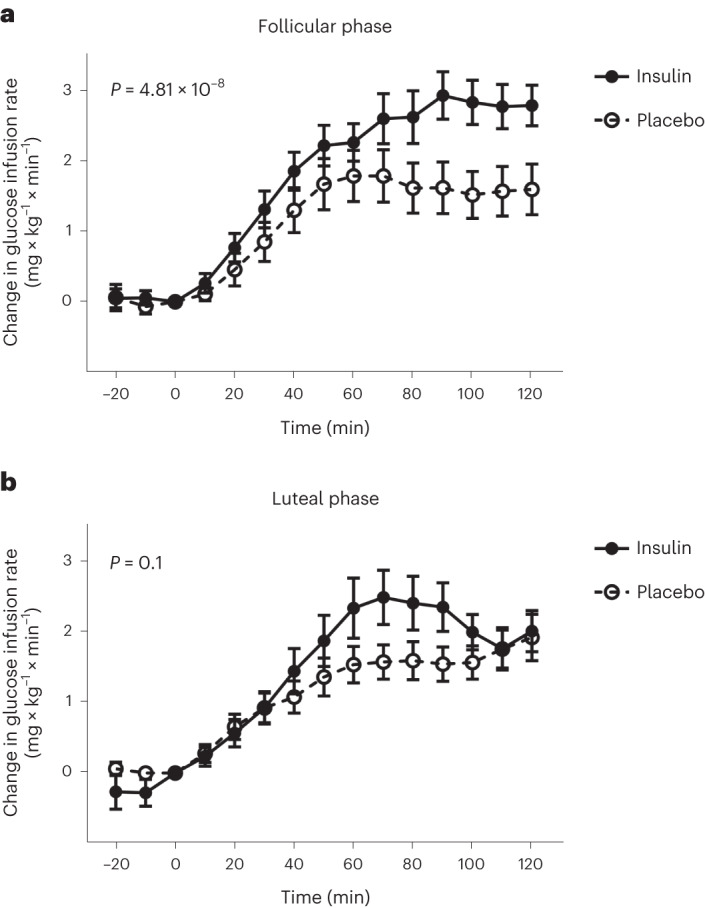
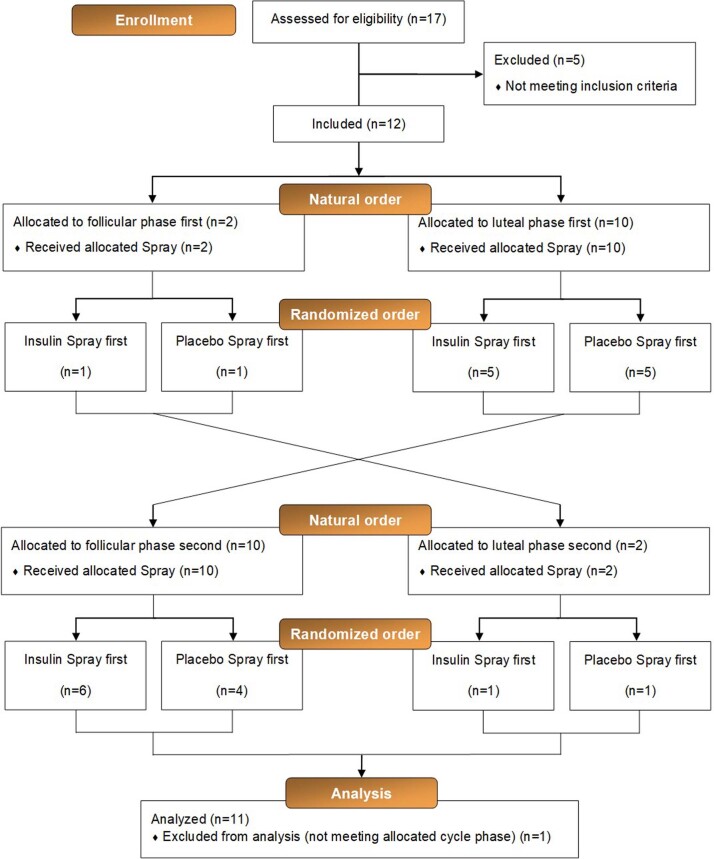
Insulin action in the human brain modulates eating behaviour, whole-body metabolism and body fat distribution 1,2 . In particular, brain insulin action increases whole-body insulin sensitivity, but these studies were mainly performed in lean men 3,4 . Here we investigate metabolic and hypothalamic effects of brain insulin action in women with a focus on the impact of menstrual cycle ( ClinicalTrials.gov registration: NCT03929419 ). Eleven women underwent four hyperinsulinemic–euglycemic clamps, two in the follicular phase and two in the luteal phase. Brain insulin action was introduced using nasal insulin spray 5–7 and compared to placebo spray in a fourfold crossover design with change in glucose infusion rate as the primary endpoint. Here we show that during the follicular phase, more glucose has to be infused after administration of nasal insulin than after administration of placebo. This remains significant after adjustment for blood glucose and insulin. During the luteal phase, no significant influence of brain insulin action on glucose infusion rate is detected after adjustment for blood glucose and insulin (secondary endpoint). In 15 other women, hypothalamic insulin sensitivity was assessed in a within-subject design by functional magnetic resonance imaging with intranasal insulin administration 8 . Hypothalamus responsivity is influenced by insulin in the follicular phase but not the luteal phase. Our study therefore highlights that brain insulin action improves peripheral insulin sensitivity also in women but only during the follicular phase. Thus, brain insulin resistance could contribute to whole-body insulin resistance in the luteal phase of the menstrual cycle.
Overview
CoChat Summary
TL;DR
In healthy naturally cycling women, intranasal insulin improved peripheral insulin sensitivity during the follicular phase but not the luteal phase. A separate fMRI study found hypothalamic cerebral blood flow responses to insulin in the follicular phase only, although the phase-by-spray interaction was not significant.
Key findings
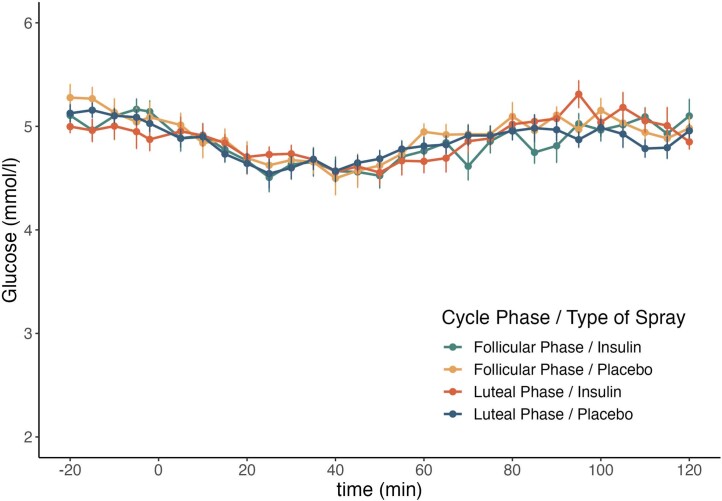
- In 11 women, spray-induced changes in glucose infusion rate differed by cycle phase (t₁,₀₇₅ = 2.85, P = 0.004; adjusted for glucose and insulin: t₄₆₄ = 2.53, P = 0.01). During the follicular phase, glucose infusion rate increased more after nasal insulin than placebo (t₅₂₅ = −6.83, P < 0.0001; adjusted t₂₃₀ = −5.66, P < 0.0001). During the luteal phase, the unadjusted difference (t₅₅₀ = −2.83, P = 0.005) was no longer significant after adjustment (t₂₃₄ = −1.69, adjusted P = 0.09).
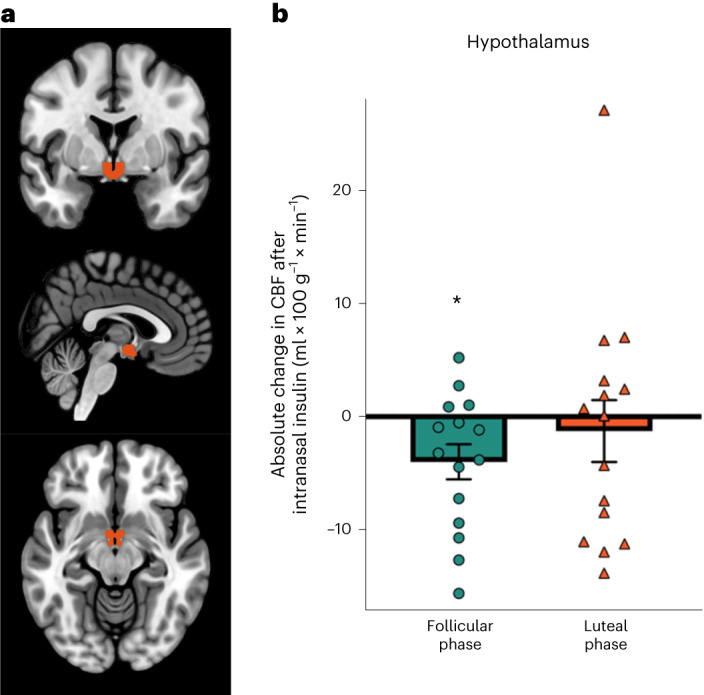
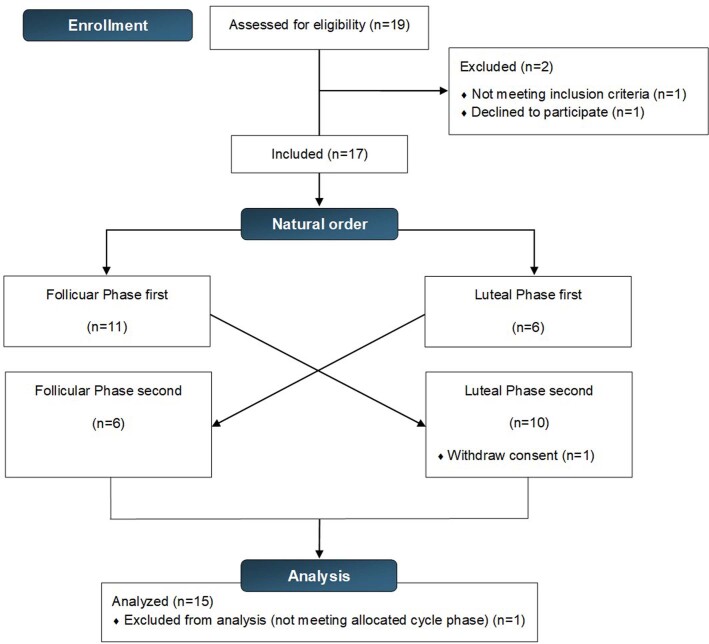
- In 15 women, insulin significantly decreased hypothalamic cerebral blood flow in the follicular phase (t₁₄ = −2.57, P = 0.02) but not the luteal phase (t₁₄ = −0.467, P = 0.648); the cycle phase × spray interaction was not significant (P = 0.5).
- The estradiol:progesterone ratio interacted with spray and time on glucose infusion rate (t₂₁₀ = −2.89, P = 0.004), suggesting a high ratio, as in the follicular phase, is linked to a stronger intranasal insulin effect. Testosterone also showed an interaction (t₁,₀₇₅ = 3.7, P = 0.0002), but calculated free testosterone did not (t₁,₀₇₅ = 0.37, P = 0.7).
Methods
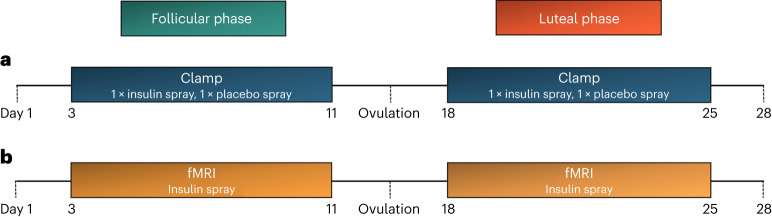
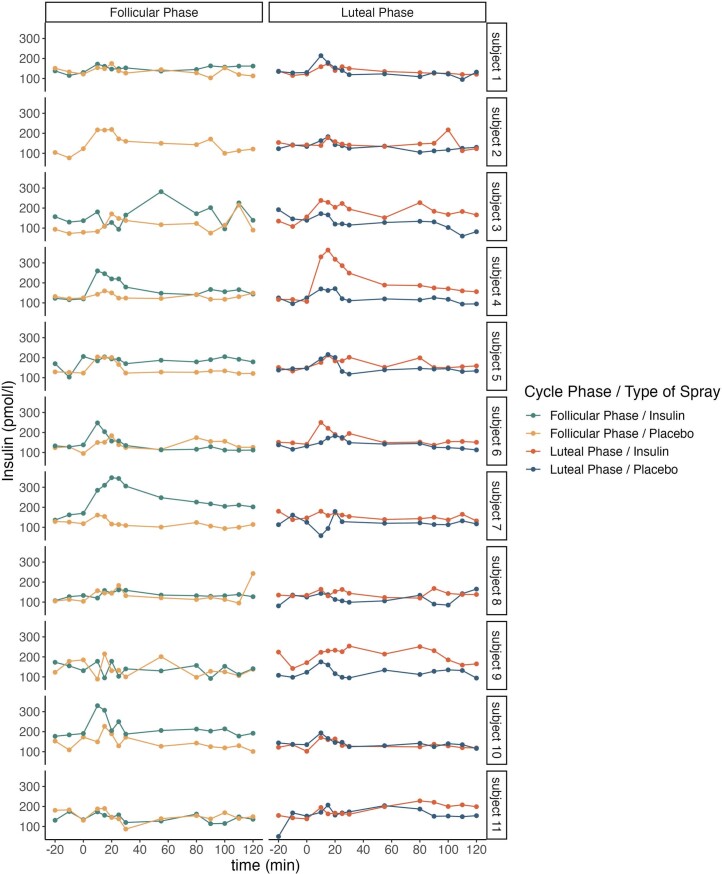
- Two study populations: 11 healthy naturally cycling women underwent four hyperinsulinemic–euglycemic clamps, two in the follicular and two in the luteal phase, in a single-blind crossover design with nasal insulin (160 U) versus placebo plus an intravenous insulin bolus to mimic spillover; primary endpoint was change in glucose infusion rate.
- 15 women underwent one fMRI session per cycle phase in a within-subject design; hypothalamic cerebral blood flow was measured with pulsed arterial spin labelling before and 30 min after 160 U nasal insulin, without a placebo control.
- Dynamic outcomes were modelled with linear mixed models testing time × spray × phase interactions, with adjustment for plasma glucose and insulin where indicated; hypothalamic CBF was compared by two-sided paired t-tests.
Limitations
- Stated by the paper: limited participant numbers, no women taking oral contraceptives, small differences with large confidence intervals, and need for replication; nasal insulin is not the physiological route; unstable d-[6,6-²H₂]-glucose tracer enrichment prevented separating endogenous glucose production from glucose disappearance; clamp experiments were single-blind, with investigators aware of condition; the fMRI experiment lacked placebo administration.
- Stated by the paper: the limited sample size may explain why differences in hypothalamic insulin response did not reach statistical significance, while significant spray × cycle phase interactions were detected in the clamp experiments.
- Evident from the text: the fMRI study found phase-specific hypothalamic effects but no significant cycle phase × spray interaction (P = 0.5), so the neuroimaging result is suggestive rather than confirmatory.
Model-written summary. Check it against the paper before relying on it.
Integrity signals
Registry
Cites
Statistics
Figures
Verification
Claims the paper makes
12 Valid · 1 Not valid · 35 Not checked · 94 Own results and interpretations
The cited sources support only part of this claim — read each source’s verdict below.
In the paper
“This could also be involved in worse glycemic control in the luteal phase in women with type I diabetes40.”
§ Brain insulin action on peripheral insulin sensitivity in women depends on menstrual cycle phase > Functional magnetic resonance imaging study
What the sources say
- Partly supportedcites [40] Tatulashvili, S. et al. Ambulatory glucose profile according to different phases of the menstrual cycle in women living with type 1 diabetes. J. Clin. Endocrinol. Metab. 107, 2793–2800 (2022). 35869507 sourceExperimental — accuracy not yet measured
The Pathophysiology section says luteal-phase glycemic changes in women with type 1 diabetes may be linked to reduced insulin sensitivity, and the Conclusion reports worse time in range in the late luteal phase. The paper does not identify brain insulin resistance as the mechanism; that brain-specific part of the claim is unsupported. (LLM, conf=0.87)
hedgedstates a possible cause- Asserted: passes — The authors put it forward as true.
- Checkable: passes — It can be checked against evidence.
- Load-bearing: passes — The paper’s conclusions depend on it.
- Based: passes — The paper gives a reason why it holds.
- Partly supported
The cited sources that could be checked couldn’t confirm or dispute this claim.
In the paper
“However, in our previous placebo-controlled assessments6,8,39 (see Supplementary Material 2 for more details), the placebo nasal spray did not impact hypothalamic blood flow.”
§ Brain insulin action on peripheral insulin sensitivity in women depends on menstrual cycle phase > Functional magnetic resonance imaging study
What the sources say
- Not checked — no full text of the sourcecites [6] Kullmann S Dose-dependent effects of intranasal insulin on resting-state brain activity J. Clin. Endocrinol. Metab. 2018 103 253 262 10.1210/jc.2017-01976 29095982 source
- Not checked — no full text of the sourcecites [8] Kullmann S Selective insulin resistance in homeostatic and cognitive control brain areas in overweight and obese adults Diabetes Care 2015 38 1044 1050 10.2337/dc14-2319 25795413 source
- Could not verifycites [39] Wagner, L. et al. Brain insulin responsiveness is linked to age and peripheral insulin sensitivity. Diabetes Obes. Metab. 25, 2171–2180 (2023). 37046367 sourceExperimental — accuracy not yet measured
Our copy of Wagner et al. (2023) documents a placebo-controlled cross-over assessment with hypothalamus among the ROIs (Methods 2.2, 2.2.1, 2.2.3: 'Brain insulin action was defined as the regional CBF change in response to intranasal insulin compared with placebo'), but it never reports the effect of the placebo (vehicle) spray itself on hypothalamic blood flow. The Results (3.2) and Discussion only state that insulin action in the hypothalamus showed no significant association with peripheral insulin sensitivity or age, which is a different point. Searched: 'placebo nasal spray did not affect hypothalamic cerebral blood flow', 'hypothalamus CBF intranasal insulin response', 'placebo spray had no effect on cerebral blood flow results', 'hypothalamic insulin responsivity'; no passage addresses the null placebo effect, and none contradicts it. (LLM, conf=0.65)
plain- Asserted: passes — The authors put it forward as true.
- Checkable: passes — It can be checked against evidence.
- Load-bearing: unclear — It is unclear whether the paper’s conclusions depend on it.
- Based: passes — The paper gives a reason why it holds.
Every source the paper cites for this claim was checked and supports it.
In the paper
“Insulin crosses the blood–brain barrier9”
§ Brain insulin action on peripheral insulin sensitivity in women depends on menstrual cycle phase > Main
What the sources say
- Supportedcites [9] Rhea, E. M. & Banks, W. A. A historical perspective on the interactions of insulin at the blood–brain barrier. J. Neuroendocrinol. 33, e12929 (2021). PMC8052275 33433042 source
In “Insulin binding at the BBB: The 1980’s” (page not provided), the paper reports insulin transport across the blood–brain barrier in developing rabbits and says the debate over whether insulin crosses it was resolved. (LLM, conf=0.93)
plainstates a cause- Asserted: passes — The authors put it forward as true.
- Checkable: passes — It can be checked against evidence.
- Load-bearing: passes — The paper’s conclusions depend on it.
- Based: passes — The paper gives a reason why it holds.
- Supported
The sources with a verdict support this claim; the rest weren’t checked yet, have no full text we could read, or their verdicts aren’t rated yet.
In the paper
“Of note, experimental studies suggest considerable sex differences in brain insulin sensitivity.”
§ Brain insulin action on peripheral insulin sensitivity in women depends on menstrual cycle phase > Main
What the sources say
- Not checked — no full text of the sourcecites [23] Clegg DJ Riedy CA Smith KAB Benoit SC Woods SC Differential sensitivity to central leptin and insulin in male and female rats Diabetes 2003 52 682 687 10.2337/diabetes.52.3.682 12606509 source
- Not checked — no full text of the sourcecites [24] Benedict C Kern W Schultes B Born J Hallschmid M Differential sensitivity of men and women to anorexigenic and memory-improving effects of intranasal insulin J. Clin. Endocrinol. Metab. 2008 93 1339 1344 10.1210/jc.2007-2606 18230654 source
- Supportedcites [26] Hallschmid M Intranasal insulin reduces body fat in men but not in women Diabetes 2004 53 3024 3029 10.2337/diabetes.53.11.3024 15504987 source
The Discussion reports that intranasal insulin reduced body weight and adiposity in men but not women, and describes this as a fundamental difference in central insulin sensitivity. It specifies that the observed sex difference concerned insulin’s effects on body-weight regulation. (LLM, conf=0.94)
hedgedstates an association- Asserted: passes — The authors put it forward as true.
- Checkable: passes — It can be checked against evidence.
- Load-bearing: unclear — It is unclear whether the paper’s conclusions depend on it.
- Based: passes — The paper gives a reason why it holds.
The cited sources support only part of this claim — read each source’s verdict below.
In the paper
“In line with experimental evidence from animals30, previous correlational findings from humans indicate a crucial role of insulin action in the hypothalamus for the modulation of whole-body glucose metabolism3,4.”
§ Brain insulin action on peripheral insulin sensitivity in women depends on menstrual cycle phase > Functional magnetic resonance imaging study
What the sources say
- Partly supportedcites [30] Ruud J Steculorum SM Brüning JC Neuronal control of peripheral insulin sensitivity and glucose metabolism Nat. Commun. 2017 8 15259 10.1038/ncomms15259 28469281 PMC5418592 sourceExperimental — accuracy not yet measured
The section ‘Of mice and men: IR signalling in the human brain’ reports that improved whole-body insulin sensitivity after intranasal insulin correlated with increased hypothalamic activity in humans. It describes a hypothalamic mechanism as possible, however, and says the studies do not definitively establish a physiological role for endogenous insulin in the human brain. The claim’s ‘crucial role’ is stronger than that human evidence supports. (LLM, conf=0.83)
- Not checked — no full text of the sourcecites [3] Heni M Hypothalamic and striatal insulin action suppresses endogenous glucose production and may stimulate glucose uptake during hyperinsulinemia in lean but not in overweight men Diabetes 2017 66 1797 1806 10.2337/db16-1380 28174292 source
- Not checked — no full text of the sourcecites [4] Heni M Central insulin administration improves whole-body insulin sensitivity via hypothalamus and parasympathetic outputs in men Diabetes 2014 63 4083 4088 10.2337/db14-0477 25028522 source
hedgedstates a cause- Asserted: passes — The authors put it forward as true.
- Checkable: passes — It can be checked against evidence.
- Load-bearing: passes — The paper’s conclusions depend on it.
- Based: passes — The paper gives a reason why it holds.
- Partly supported
69 more claims
Create a free account to see all 142 claims and to verify the 2 references still open.
- Probably not a substantial claim. 50
- It may state two separate claims as one. 32
Citations
Cites
Fitting Linear Mixed-Effects Models Using lme4
Bates, D., Mächler, M., Bolker, B., & Walker, S. (2015) · Journal of Statistical Software · doi:10.18637/jss.v067.i01 · Cited by 86,835
lmerTest Package: Tests in Linear Mixed Effects Models
Kuznetsova, A., Brockhoff, P. B., & Christensen, R. H. B. (2017) · Journal of Statistical Software · doi:10.18637/jss.v082.i13 · Cited by 24,346
A Critical Evaluation of Simple Methods for the Estimation of Free Testosterone in Serum
Vermeulen, A., Verdonck, L., & Kaufman, J. M. (1999) · The Journal of Clinical Endocrinology & Metabolism · doi:10.1210/jcem.84.10.6079 · Cited by 3,824
Role of Brain Insulin Receptor in Control of Body Weight and Reproduction
Brüning, J. C., Gautam, D., Burks, D. J., Gillette, J., Schubert, M., Orban, P. C., Klein, R., Krone, W., Müller-Wieland, D., & Kahn, C. R. (2000) · Science · doi:10.1126/science.289.5487.2122 · Cited by 2,235
Brain insulin resistance in type 2 diabetes and Alzheimer disease: concepts and conundrums
Arnold, S. E., Arvanitakis, Z., Macauley-Rambach, S. L., Koenig, A. M., Wang, H.-Y., Ahima, R. S., Craft, S., Gandy, S., Buettner, C., Stoeckel, L. E., et al. (2018) · Nature Reviews Neurology · doi:10.1038/nrneurol.2017.185 · Cited by 1,597
Sniffing neuropeptides: A transnasal approach to the human brain
Born, J., Lange, T., Kern, W., McGregor, G. P., Bickel, U., & Fehm, H. L. (2002) · Nature Neuroscience · doi:10.1038/nn0602-849 · Cited by 1,356
Differential Sensitivity to Central Leptin and Insulin in Male and Female Rats
Clegg, D. J., Riedy, C. A., Smith, K. A. B., Benoit, S. C., & Woods, S. C. (2003) · Diabetes · doi:10.2337/diabetes.52.3.682 · Cited by 332
Benedict, C., Kern, W., Schultes, B., Born, J., & Hallschmid, M. (2008) · The Journal of Clinical Endocrinology & Metabolism · doi:10.1210/jc.2007-2606 · Cited by 296
Intranasal Insulin Reduces Body Fat in Men but not in Women
Hallschmid, M., Benedict, C., Schultes, B., Fehm, H.-L., Born, J., & Kern, W. (2004) · Diabetes · doi:10.2337/diabetes.53.11.3024 · Cited by 281
Impaired insulin action in the human brain: causes and metabolic consequences
Heni, M., Kullmann, S., Preissl, H., Fritsche, A., & Häring, H.-U. (2015) · Nature Reviews Endocrinology · doi:10.1038/nrendo.2015.173 · Cited by 245
Self-citation
Cited by
Diabetes mellitus—Progress and opportunities in the evolving epidemic
Abel, E. D., Gloyn, A. L., Evans-Molina, C., Joseph, J. J., Misra, S., Pajvani, U. B., Simcox, J., Susztak, K., & Drucker, D. J. (2024) · Cell · doi:10.1016/j.cell.2024.06.029 · Cited by 292
The insulin resistant brain: impact on whole-body metabolism and body fat distribution
Heni, M. (2024) · Diabetologia · doi:10.1007/s00125-024-06104-9 · Cited by 90
“Hence, combining fMRI with nasal administration of insulin to assess insulin responses in regional cerebral blood flow in these areas could be a reliable and robust approach [31, 47] for quantifying brain insulin sensitivity in future trials.”
Self-citationNiering, M., Wolf-Belala, N., Seifert, J., Tovar, O., Coldewey, J., Kuranda, J., & Muehlbauer, T. (2024) · Sports · doi:10.3390/sports12010031 · Cited by 82
“For athletes with type 1 diabetes, it is particularly relevant to understand that insulin sensitivity is lower during the luteal phase compared to the follicular phase of the menstrual cycle [44].”
BackgroundLiver-specific actions of GH and IGF1 that protect against MASLD
Kineman, R. D., del Río-Moreno, M., & Waxman, D. J. (2024) · Nature Reviews Endocrinology · doi:10.1038/s41574-024-01037-0 · Cited by 54
“Oestrogen protects against MASLD by both direct and indirect actions, which includes promoting insulin sensitivity 53,54 .”
Metaflammation’s Role in Systemic Dysfunction in Obesity: A Comprehensive Review
Crasan, I.-M., Tanase, M., Delia, C., Pîrcălăbioru, G. G., Cîmpean, A., & Ionica, E. (2025) · International Journal of Molecular Sciences · doi:10.3390/ijms262110445 · Cited by 47
A short-term, high-caloric diet has prolonged effects on brain insulin action in men
Kullmann, S., Wagner, L., Hauffe, R., Kühnel, A., Sandforth, L., Veit, R., Dannecker, C., Machann, J., Fritsche, A., Stefan, N., et al. (2025) · Nature Metabolism · doi:10.1038/s42255-025-01226-9 · Cited by 35
“Sex-specific findings of insulin action on appetite, metabolism and memory have been reported 3 , which depend in part on the menstrual cycle 10 .”
Self-citationChakravartti, S. P., Jann, K., Veit, R., Liu, H., Yunker, A. G., ANGELO, B. C., Monterosso, J. R., Xiang, A. H., Kullmann, S., & Page, K. A. (2025) · Nature Metabolism · doi:10.1038/s42255-025-01227-8 · Cited by 29
“Recent reports have highlighted the importance of insulin sensitivity in the hypothalamic regulation of appetite and eating behaviour 39,40 .”
Self-citationExpanding the understanding of insulin resistance in brain and periphery
Chen, W., Kullmann, S., & Rhea, E. M. (2025) · Trends in Endocrinology and Metabolism · doi:10.1016/j.tem.2025.04.010 · Cited by 27
Self-citationMonroy, G., Picón-César, M. J., García-Alemán, J., Tinahones, F. J., & Martínez-Montoro, J. I. (2025) · Diabetes Technology & Therapeutics · doi:10.1089/dia.2024.0522 · Cited by 17
“19 The performance of AHCL systems across the menstrual cycle in women with T1D remains poorly explored.”
Schieren, A., Koch, S., Pecht, T., & Simon, M. (2024) · Experimental and Clinical Endocrinology & Diabetes · doi:10.1055/a-2273-5602 · Cited by 28
The autonomic nervous system in the regulation of glucose and lipid metabolism
Wangler, S., Jarczok, M. N., Ennis, M., Herhaus, B., Wagner, R., Sehgal, R., & Heni, M. (2026) · Nature Reviews Endocrinology · doi:10.1038/s41574-025-01221-w · Cited by 21
Self-citationGlycaemic fluctuations across the menstrual cycle: possible effect of the brain
Hummel, J., Kullmann, S., Wagner, R. J., & Heni, M. (2023) · The Lancet Diabetes & Endocrinology · doi:10.1016/s2213-8587(23)00286-3 · Cited by 11
Self-citationNeurotransmitter Alterations in Prediabetes and Type 2 Diabetes Mellitus: A Narrative Review
Ahrițculesei, R.-V., Boldeanu, L., Dijmărescu, A. L., Assani, M.-Z., Boldeanu, M. V., Siloşi, I., & Vere, C. C. (2025) · International Journal of Molecular Sciences · doi:10.3390/ijms26167847 · Cited by 12
“Yet, few studies stratify by sex, limiting the development of tailored interventions [153,154].”
Kördel, M., Meier, M., Kühnel, A., & Kroemer, N. B. (2025) · Neurobiology of Stress · doi:10.1016/j.ynstr.2025.100764 · Cited by 15
Kaduk, K., Kaeber, M., Kühnel, A., Torrado, M. B., Grahlow, M., Derntl, B., & Kroemer, N. B. (2025) · EBioMedicine · doi:10.1016/j.ebiom.2025.106035 · Cited by 14
“Future studies specifically addressing changes in insulin sensitivity across the menstrual cycle 113,114 could provide additional insights.”
Natalucci, V., Spinello, G., Moro, T., Pavei, G., Boccia, G., Torre, A. L., & Bonato, M. (2026) · Nutrients · doi:10.3390/nu18071144 · Cited by 7
“Such alterations may contribute to glycemic variability and appetite-related changes observed in some women during the luteal phase [82].”
Metabolic tuning during the menstrual cycle
Kroemer, N. B. (2023) · Nature Metabolism · doi:10.1038/s42255-023-00867-y · Cited by 4
Zhao, S., Veit, R., Semeia, L., Hummel, J., Sandforth, L., Fritsche, A., Birkenfeld, A. L., Heni, M., Preissl, H. T., & Kullmann, S. (2024) · The Journal of Clinical Endocrinology & Metabolism · doi:10.1210/clinem/dgae833 · Cited by 4
Self-citationEster-Nacke, T., Veit, R., Thomanek, J., Book, M. L., Tamble, L., Beermann, M., Löffler, D., Salvador, R., Ruffini, G., Heni, M., et al. (2025) · Brain stimulation · doi:10.1016/j.brs.2025.04.013 · Cited by 5
Self-citationZaitoon, H., Khalil, H., Cohen‐Sela, E., Eyal, O., Interator, H., Oren, A., Laurian, I., Dorfman, A., Chorna, E., Lebenthal, Y., et al. (2025) · Diabetes/Metabolism Research and Reviews · doi:10.1002/dmrr.70047 · Cited by 3
“In the more advanced stages of puberty, when ovulation occurs, progesterone may also impact insulin sensitivity, often leading to increased insulin resistance during the luteal phase [34, 35].”
Dole, A., Sims, S. T., Gan, H., Gill, N., & Beaven, C. M. (2024) · International Journal of Sports Physiology and Performance · doi:10.1123/ijspp.2024-0068 · Cited by 4
Circulating epigenetic signatures classifying brain insulin resistance in humans
Kullmann, S., Singh, A., Sehgal, R., Eichelmann, F., Sandforth, L., Wilms, B., Jähnert, M., Peter, A., Meyhöfer, S., Walther, D., et al. (2025) · Science Translational Medicine · doi:10.1126/scitranslmed.adv7834 · Cited by 4
Self-citationLatva‐Rasku, A., Laurila, S., Karjalainen, T., Klén, R., Löyttyniemi, E., Eskola, O., Nummenmaa, L., Heni, M., & Nuutila, P. (2025) · American Journal of Physiology-Endocrinology and Metabolism · doi:10.1152/ajpendo.00061.2025 · Cited by 4
Self-citationHummel, J. R., Zhao, S., Sobotta, S., Veit, R., Sandforth, L., Birkenfeld, A. L., Fritsche, A., Wagner, R., Peter, A., Preissl, H., et al. (2026) · Communications Biology · doi:10.1038/s42003-025-09341-9 · Cited by 4
Self-citationExploring the effects of an insulin challenge on neuroimaging outcomes: A scoping review
Stogios, N., Wu, S., Hahn, M., Emami, Z., Navagnanavel, J., Korann, V., Prasannakumar, A., Remington, G. J., Graff‐Guerrero, A., & Agarwal, S. M. (2025) · Frontiers in Neuroendocrinology · doi:10.1016/j.yfrne.2025.101187 · Cited by 3
Derkach, K. V., Zorina, I. I., & Shpakov, A. O. (2024) · Российский физиологический журнал им И М Сеченова · doi:10.31857/s0869813924040067 · Cited by 1
An Overview of the Impact of the Menstrual Cycle on Nutrient Metabolism: An Integrative Perspective
García-Montero, C., Castro-Martinez, P. D., Boaru, D. L., Ortega, M. A., & Fraile‐Μartinez, O. (2026) · Nutrients · doi:10.3390/nu18071063 · Cited by 4
Gastaldelli, A., Choi, E., Conde‐Knape, K., Göransson, O., Krook, A., Lehtonen, S. H., Roden, M., Schrauwen, P., Sparks, L. M., & Heni, M. (2026) · Diabetologia · doi:10.1007/s00125-026-06853-9 · Cited by 2
Self-citationStarling, S. (2023) · Nature Reviews Endocrinology · doi:10.1038/s41574-023-00915-3 · Cited by 1
Ramírez Mazo, C., Gómez-Echavarría, L., Lema-Pérez, L., & Röblitz, S. (2026) · Journal of Theoretical Biology · doi:10.1016/j.jtbi.2026.112518
Zerebraler Glukosestoffwechsel: Insulinsensitivität ist abhängig vom Menstruationszyklus
Eckert, N. (2023) · Deutsches Ärzteblatt · doi:10.3238/persdia.2023.11.03.02
Derkach, K. V., Zorina, I. I., & Shpakov, A. O. (2024) · Journal of Evolutionary Biochemistry and Physiology · doi:10.1134/s0022093024020327
“However, it is worth noting that INI effi(cid:2) cacy in normalizing metabolic indices and insulin sensitivity is largely determined by the nature of met(cid:2) abolic disorders, IR severity, and sex-dependent fea(cid:2) tures [33–35].”
miR214 regulates sex determination through gsdf in zebrafishPreprint
Wittkopp, N., Domingues, A. M. D. J., & Ketting, R. F. (2024) · bioRxiv (Cold Spring Harbor Laboratory) · doi:10.1101/2024.05.01.592007 · Cited by 1
Das Gehirn als zentrale Schaltstelle des Stoffwechsels
Hummel, J., & Heni, M. (2024) · Die Diabetologie · doi:10.1007/s11428-024-01200-1
Self-citationHeni, M., Wangler, S., & Hummel, J. (2024) · Diabetologie und Stoffwechsel · doi:10.1055/a-2352-0542
Self-citationEster-Nacke, T., Veit, R., Thomanek, J., Book, M. L., Tamble, L., Beermann, M., Löffler, D., Salvador, R., Ruffini, G., Heni, M., et al. (2024) · medRxiv · doi:10.1101/2024.12.11.24318873
Self-citationRamírez-Mazo, C., Gómez-Echavarría, L. M., Lema-Pérez, L., & Röblitz, S. (2025) · SSRN Electronic Journal · doi:10.2139/ssrn.5172938
MTGlu: A Multi-scale Time-Frequency Approach for Personalized Glucose Prediction in Type 1 Diabetes
Fu, L., Li, Y., Sun, X., Bao, Z., Wen, Y., & Zhang, Y. (2025) · Lecture notes in computer science · doi:10.1007/978-981-96-8173-0_36
Nijssen, K. M. R., Adam, T. C., Mensink, R. P., & Joris, P. J. (2026) · Metabolism · doi:10.1016/j.metabol.2026.156672
Röblitz, S. (2026) · Journal of Molecular Endocrinology · doi:10.1530/jme-25-0211
Wangler, S., Sørensen, P., Kass, K., Jensen, N. J., Vestergaard, M. B., Hummel, J., Völk, R., Antvorskov, J. C., Pociot, F., Rungby, J., et al. (2026) · Diabetic Medicine · doi:10.1111/dme.70415
Self-citationUnhealthy fat distribution as a sex-specific predictor of declining hippocampus insulin sensitivity
Sandforth, L., Veit, R., Machann, J., Dannecker, C., Miller, G., Jiménez‐Muñoz, M., Peter, A., von Schwartzenberg, R. J., Fritsche, A., Heni, M., et al. (2026) · Diabetologia · doi:10.1007/s00125-026-06787-2
Self-citationMaksyutynska, K., Stogios, N., Korann, V., Hamel, L., Korczak, D. J., Goldstein, B. I., Remington, G. J., Sanches, M., Hahn, M., Graff‐Guerrero, A., et al. (2026) · Neuropsychopharmacology · doi:10.1038/s41386-026-02498-9
Hossmann, S., FRIEDMAN, M., Lizoain, A., Caduff, M., Braunack-Mayer, V., Burlando, L., Lal, R., Cengiz, E., Braune, K., Tan, S., et al. (2026) · Diabetes Care · doi:10.2337/dc26-0692 · Cited by 3
Type 2 diabetes prevention across the life course
Wang, Y., Sargent, J. L., Mathieu, C., Arreola, E. V., Perreault, L., Loos, R. J. F., Lim, L., Sandforth, L., Hanson, R. L., Kullmann, S., et al. (2026) · Nature Medicine · doi:10.1038/s41591-026-04550-z · Cited by 1
“Furthermore, emerging research indicates that brain insulin action and peripheral insulin sensitivity fluctuate across the menstrual cycle, with insulin sensitivity being higher in the follicular phase 109,110 .”
Self-citationStruckmeyer, N., Landsberg, S., Biester, T., Dolle, R. M., Frerking, A.-K., Kapitzke, K., Knottnerus-Meyer, N., Niemeyer, M., Toenne, R., Berge, T. V. D., et al. (2026) · Journal of Pediatric Endocrinology and Metabolism · doi:10.1515/jpem-2026-0309
“In addition to hormonal in fl uences, behavioral factors such as variations in carbohydrate intake or appetite across the menstrual cycle could theoretically contribute to changes in glycemic control [20].”
Luo, P., Zeng, J., Wu, Y., Chen, Y., Gong, G., Huang, Q., & Luo, X. (2026) · BMJ Open · doi:10.1136/bmjopen-2026-122401
“Furthermore, this protocol will be updated in the registration database of the Chinese Clinical Trial Registry following any revision.”
Metadata
- Authors
- Hummel, J., Benkendorff, C., Fritsche, L., Prystupa, K., Vosseler, A., Gancheva, S., Trenkamp, S., Birkenfeld, A. L., Preissl, H., Roden, M., Häring, H.-U., Fritsche, A., Peter, A., Wagner, R., Kullmann, S., & Heni, M.
- Affiliations
- Universität Ulm (DE)
- University of Tübingen (DE)
- Helmholtz Munich (DE)
- Deutsches Diabetes-Zentrum e.V. (DE)
- German Center for Diabetes Research (DE)
- Düsseldorf University Hospital (DE)
- Corresponding author
- Heni, Martin
- ORCID
- Venue
- Nature Metabolism
- Published
- 2023-09-21
- Volume
- 5
- Issue
- 9
- Pages
- 1475-1482
- ISSN
- 2522-5812 (ISSN-L)
- PMC
- PMC10513929
- OpenAlex
- W4386917918
- Semantic Scholar
- 4f7b75520965211c6e28782f6f57c943649874ce
- Cited by
- 48
- References
- 49
- Citations by year
- 2026: 16 · 2025: 15 · 2024: 13 · 2023: 4
- FWCI
- 7.14
- Type
- journal article
- Language
- en
- Open access
- hybrid
- doi.org
- Licence
- cc-by
- creativecommons.org/licenses/by/4.0 (tdm)
- creativecommons.org/licenses/by/4.0 (vor)
- Locations
- Nature Metabolism (publishedVersion, cc-by)
- PubMed Central (publishedVersion, cc-by)
- PubMed (publishedVersion)
- PuSH - Publication Server of Helmholtz Zentrum München (submittedVersion, cc-by)
- Universitätsbibliothek Tübingen
- Funders
- German Federal Ministry of Education and Research (BMBF) to the German Center for Diabetes Research
- Topics
- Life Sciences › Neuroscience › Endocrine and Autonomic Systems › Regulation of Appetite and Obesity
- Health Sciences › Medicine › Endocrinology, Diabetes and Metabolism › Adipokines, Inflammation, and Metabolic Diseases
- Health Sciences › Medicine › Reproductive Medicine › Hypothalamic control of reproductive hormones
- Keywords
- peripheral insulin sensitivity, menstrual cycle, follicular phase, luteal phase, intranasal insulin, hyperinsulinemic-euglycemic clamp, glucose infusion rate, hypothalamus, women, insulin resistance
- MeSH terms
- Blood Glucose, Brain, Female, Glucose, Humans, Insulin, Insulin Resistance, Male, Menstrual Cycle
About these checks
Registry, retraction, Cites and statistics results are computed, not judged, with one exception: a printed reference that no index lists is read once by a model before it counts as a citation error. Claims are extracted by a model and kept only when their quote appears verbatim in the text; each cited source is then checked, with a model’s help, for whether it says what the claim relies on. Those verdicts can be wrong — read the claim’s quote and the cited source before relying on one.
The claim verdicts this report counts are experimental: their accuracy is not yet measured.
A language model drew the claims from the paper on 2026-10-10, under version 3 of the claim definition (model deepseek-v4.1-flash, prompt extract-v3).
A second model labelled each claim on 2026-10-10 (model jev-1.13-20260917, definition revision gold-guideline-v0.2).
Cited sources are checked with a language model’s help (gpt-6-sol and qwen3.8-omni-flash).
Statistics and arithmetic are recomputed, not judged.
Confidence bands are shown only for fields calibrated on our annotated test set. None is calibrated yet, so no band is shown.
What counts as a claim ›How we measure confidence ›How we check this ›
Are you an author, or do you see a problem with this page? Request a review
Data sources
Bibliographic data: Semantic Scholar, OpenAlex, Crossref.
Contains information from the Semantic Scholar Academic Graph Datasets, made available under the ODC Attribution License (ODC-BY 1.0).
Semantic Scholar’s data is described in: Kinney, R., et al. (2023). The Semantic Scholar Open Data Platform. arXiv:2301.10140.
