

The DOI matches its Crossref record; 59 of the 59 references it cites were found in a registry or an index.
Electronic Conduction in Ti/Poly-TiO2/Ti Structures
Open accessAbstract
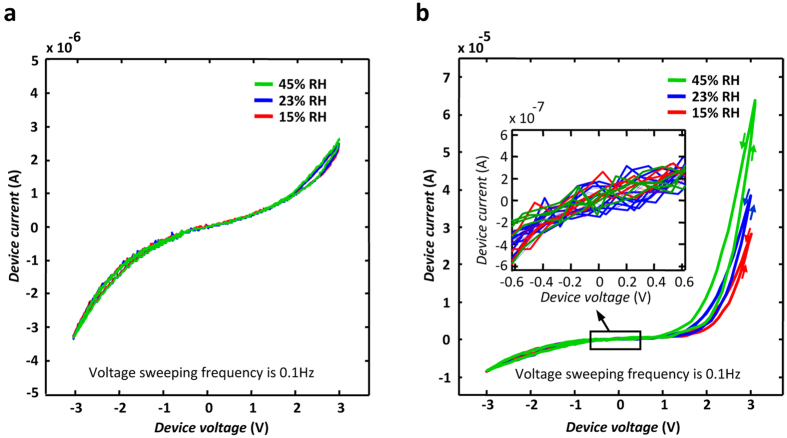
Recent intensive investigations on metal/metal oxide/metal structures have targeted nanometric single grain oxides at high electric fields. Similar research on thicker polycrystalline oxide layers can bridge the results to the prior literature on varistors and may uncover novel ionic/electronic features originating from the conduction mechanisms involving grain boundaries. Here, we investigate electronic conduction in Ti/poly-TiO 2−x/Ti structures with different oxygen vacancy distributions and describe the observed features based on the motion and rearrangement of the ionized oxygen vacancies (IOVs) on the grain facets rather than the grain interiors. Containing no interface energy barrier, Ti/poly-TiO 2/Ti devices demonstrate high resistance ohmic conduction at biasing fields below 5 × 10 6 V.m−1; higher fields drive the samples to a distinctly nonlinear and hysteretic low resistance status. The observed threshold is two orders of magnitude smaller than the typical resistance switching fields reported for the nanosized single grain memristors. This is consistent with the smaller activation energies reported for the IOV motion on the rutile facets than its interior. The presented model describes the observed dependence of the threshold field on the relative humidity of the surrounding air based on the lower activation energies reported for the hydroxyl-assisted IOV motion on the rutile facets.
Overview
The claims and statistics of this paper haven’t been checked yet.
Free: it reads the open-access text and checks the first 5 claims that cite a source we can check. Create a free account to check every claim.
Integrity signals
Registry
Cites
Statistics
Figures




Verification
Claims the paper makes
The claims and statistics of this paper haven’t been checked yet.
Free: it reads the open-access text and checks the first 5 claims that cite a source we can check. Create a free account to check every claim.
Claims other papers make about this one
Each is checked against this paper’s own text: does it say what the citing paper says it does?
The source backs part of the claim, not all of it — or backs it for a different population, condition or comparison.
In the citing paper
“This is because H2O molecules, used during the anodizing process, significantly reduce the activation energy19.”
From Experimental demonstration of highly reliable dynamic memristor for artificial neuron and neuromorphic computing (2022) · cites this paper as [19]
Experimental — accuracy not yet measuredThe cited source says what the claim attributes to it.
In the citing paper
“The calculated activation energy (EA) is about 0.21 eV, which is similar to the activation energy of the ionized oxygen vacancy in polycrystalline H2O-rich TiO219.”
From Experimental demonstration of highly reliable dynamic memristor for artificial neuron and neuromorphic computing (2022) · cites this paper as [19]
Self-check
Percentages, sums and reported differences re-computed from the paper’s own numbers.
The self-check needs the paper’s full text.
Citations
Cites
Physics of Semiconductor Devices
Sze, S. M., & Ng, K. K. (2006) · doi:10.1002/0470068329 · Cited by 14,627
Physics of Semiconductor Devices
(2002) · Kluwer Academic Publishers eBooks · doi:10.1007/b117561 · Cited by 13,963
Strukov, D. B., Snider, G. S., Stewart, D. R., & Williams, R. S. (2008) · Nature · doi:10.1038/nature06932 · Cited by 11,828
Redox‐Based Resistive Switching Memories – Nanoionic Mechanisms, Prospects, and Challenges
Waser, R., Dittmann, R., Staikov, G., & Szot, K. (2009) · Advanced Materials · doi:10.1002/adma.200900375 · Cited by 5,080
Nanoionics-based resistive switching memories
Waser, R., & Aono, M. (2007) · Nature Materials · doi:10.1038/nmat2023 · Cited by 4,923
Memristive switching mechanism for metal/oxide/metal nanodevices
Yang, J. J., Pickett, M. D., Li, X., Ohlberg, D. A. A., Stewart, D. R., & Williams, R. S. (2008) · Nature Nanotechnology · doi:10.1038/nnano.2008.160 · Cited by 2,987 · cited 1×
“The high field features of all samples are basically attributed to the motion and filament formation by the IOVs, which reportedly causes the resistance switching in rutile nanocrystals 5,6 .”
Resistive switching in transition metal oxides
Sawa, A. (2008) · Materials Today · doi:10.1016/s1369-7021(08)70119-6 · Cited by 2,948
Atomic structure of conducting nanofilaments in TiO2 resistive switching memory
Kwon, D.-H., Kim, K. M., Jang, J. H., Jeon, J. M., Lee, M. H., Kim, G. H., Li, X.-S., Park, G.-S., Lee, B., Han, S., et al. (2010) · Nature Nanotechnology · doi:10.1038/nnano.2009.456 · Cited by 2,092
‘Memristive’ switches enable ‘stateful’ logic operations via material implication
Borghetti, J., Snider, G. S., Kuekes, P. J., Yang, J. J., Stewart, D. R., & Williams, R. S. (2010) · Nature · doi:10.1038/nature08940 · Cited by 1,929
Switching the electrical resistance of individual dislocations in single-crystalline SrTiO3
Szot, K., Speier, W., Bihlmayer, G., & Waser, R. (2006) · Nature Materials · doi:10.1038/nmat1614 · Cited by 1,651
Resistance switching memories are memristors
Chua, L. (2011) · Applied Physics A · doi:10.1007/s00339-011-6264-9 · Cited by 1,434
The mechanism of electroforming of metal oxide memristive switches
Joshua Yang, J., Miao, F., Pickett, M. D., Ohlberg, D. A. A., Stewart, D. R., Lau, C. N., & Williams, R. S. (2009) · Nanotechnology · doi:10.1088/0957-4484/20/21/215201 · Cited by 860
Wendt, S., Schaub, R., Matthiesen, J., Vestergaard, E. K., Wahlström, E., Rasmussen, M. D., Thostrup, P., Molina, L. M., Lægsgaard, E., Stensgaard, I., et al. (2005) · Surface Science · doi:10.1016/j.susc.2005.08.041 · Cited by 600
Surface defects of TiO2(110): A combined XPS, XAES AND ELS study
Göpel, W., Anderson, J. A., Frankel, D., Jaehnig, M., Phillips, K., Schäfer, J. A., & Rocker, G. (1984) · Surface Science · doi:10.1016/0039-6028(84)90054-2 · Cited by 590
Role of Oxygen Vacancies in Cr‐Doped SrTiO3 for Resistance‐Change Memory
Janousch, M., Meijer, G. I., Staub, U., Delley, B., Karg, S. F., & Andreasson, B. P. (2007) · Advanced Materials · doi:10.1002/adma.200602915 · Cited by 530
Exponential ionic drift: fast switching and low volatility of thin-film memristors
Strukov, D. B., & Williams, R. S. (2009) · Applied Physics A · doi:10.1007/s00339-008-4975-3 · Cited by 494
Oxygen-Mediated Diffusion of Oxygen Vacancies on the TiO 2 (110) Surface
Schaub, R., Wahlström, E., Rønnau, A., Lægsgaard, E., Stensgaard, I., & Besenbacher, F. (2003) · Science · doi:10.1126/science.1078962 · Cited by 466
The physics of metal oxide varistors
Levinson, L. M., & Philipp, H. R. (1975) · Journal of Applied Physics · doi:10.1063/1.321701 · Cited by 429
Guan, X., Yu, S., & Wong, H.-S. P. (2012) · IEEE Transactions on Electron Devices · doi:10.1109/ted.2012.2184545 · Cited by 355 · cited 1×
“Assuming electron hopping between IOVs to be the foremost conduction mechanism 54 , the observed reduction in Δ E a is consistent with the IOV motion for filament formation.”
Identification of a determining parameter for resistive switching of TiO2 thin films
Rohde, C., Choi, B. J., Jeong, D. S., Choi, S., Zhao, J.-S., & Hwang, C. S. (2005) · Applied Physics Letters · doi:10.1063/1.1968416 · Cited by 333
Coexistence of Bipolar and Unipolar Resistive Switching Behaviors in a Pt∕TiO[sub 2]∕Pt Stack
Jeong, D. S., Schroeder, H., & Waser, R. (2007) · Electrochemical and Solid-State Letters · doi:10.1149/1.2742989 · Cited by 320
Localized Metallic Conductivity and Self-Healing during Thermal Reduction ofSrTiO3
Szot, K., Speier, W., Carius, R., Zastrow, U., & Beyer, W. (2002) · Physical Review Letters · doi:10.1103/physrevlett.88.075508 · Cited by 297
Jeong, D. S., Schroeder, H., Breuer, U., & Waser, R. (2008) · Journal of Applied Physics · doi:10.1063/1.3043879 · Cited by 289
Switching Kinetic of VCM‐Based Memristor: Evolution and Positioning of Nanofilament
Chen, J., Huang, C., Chiu, C., Huang, Y., & Wu, W. (2015) · Advanced Materials · doi:10.1002/adma.201502758 · Cited by 233
Lee, M., Kim, S. I., Lee, C. B., Yin, H., Ahn, S., Kang, B. S., Kim, K. H., Park, J. C., Kim, C. J., Song, I., et al. (2009) · Advanced Functional Materials · doi:10.1002/adfm.200801032 · Cited by 217
Ting, C.-C., Chen, S.-Y., & Liu, D.-M. (2000) · Journal of Applied Physics · doi:10.1063/1.1309039 · Cited by 214
Bipolar resistive switching in polycrystalline TiO2 films
Tsunoda, K., Fukuzumi, Y., Jameson, J. R., Wang, Z., Griffin, P. B., & Nishi, Y. (2007) · Applied Physics Letters · doi:10.1063/1.2712777 · Cited by 213
Quantitative theory of the oxygen vacancy and carrier self-trapping in bulk TiO2
Deák, P., Aradi, B., & Frauenheim, T. (2012) · Physical Review B · doi:10.1103/physrevb.86.195206 · Cited by 200
Electron Transfer-Induced Dynamics of Oxygen Molecules on the TiO 2 (110) Surface
Wahlström, E., Vestergaard, E. K., Schaub, R., Rønnau, A., Vestergaard, M., Lægsgaard, E., Stensgaard, I., & Besenbacher, F. (2004) · Science · doi:10.1126/science.1093425 · Cited by 189
Interface‐Engineered Amorphous TiO2‐Based Resistive Memory Devices
Jeong, H. Y., Lee, J. Y., & Choi, S. (2010) · Advanced Functional Materials · doi:10.1002/adfm.201001254 · Cited by 185
Metal/TiO2 interfaces for memristive switches
Yang, J. J., Strachan, J. P., Miao, F., Zhang, M.-X., Pickett, M. D., Yi, W., Ohlberg, D. A. A., Medeiros-Ribeiro, G., & Williams, R. S. (2011) · Applied Physics A · doi:10.1007/s00339-011-6265-8 · Cited by 162
Hu, C., McDaniel, M. D., Posadas, A. B., Demkov, A. A., Ekerdt, J. G., & Yu, E. T. (2014) · Nano Letters · doi:10.1021/nl501249q · Cited by 146
Bae, Y. C., Lee, A. R., Lee, J. B., Koo, J. H., Kwon, K. C., Park, J. G., Im, H. S., & Hong, J. P. (2011) · Advanced Functional Materials · doi:10.1002/adfm.201102362 · Cited by 140
The Missing Memristor has Not been Found
Vongehr, S., & Meng, X. (2015) · Scientific Reports · doi:10.1038/srep11657 · Cited by 131
Fabrication and humidity sensing properties of nanostructured TiO2–SnO2 thin films
Tai, W., & Oh, J.-H. (2002) · Sensors and Actuators B Chemical · doi:10.1016/s0925-4005(02)00074-6 · Cited by 125
Diffusion mechanisms of native point defects in rutile TiO2 :Ab initiototal-energy calculations
Iddir, H. H., Öğüt, S., Zapol, P., & Browning, N. D. (2007) · Physical Review B · doi:10.1103/physrevb.75.073203 · Cited by 123
Fabrication of TiO2 thin film memristor device using electrohydrodynamic inkjet printing
Duraisamy, N., Nauman, M. M., Kim, H.-C., Jo, J., & Choi, K. H. (2012) · Thin Solid Films · doi:10.1016/j.tsf.2012.03.003 · Cited by 117
Formation and Diffusion of Water Dimers on Rutile TiO2(110)
Matthiesen, J., Hansen, J. Ø., Wendt, S., Lira, E., Schaub, R., Lægsgaard, E., Besenbacher, F., & Hammer, B. (2009) · Physical Review Letters · doi:10.1103/physrevlett.102.226101 · Cited by 101
Grain junction properties of ZnO varistors
Einzinger, R. (1979) · Applications of Surface Science · doi:10.1016/0378-5963(79)90008-4 · Cited by 91
Atomic View of Filament Growth in Electrochemical Memristive Elements
Lv, H., Xu, X., Sun, P., Liu, H., Luo, Q., Liu, Q., Banerjee, W., Sun, H., Long, S., Li, L., et al. (2015) · Scientific Reports · doi:10.1038/srep13311 · Cited by 90
The energy barrier at noble metal/TiO2 junctions
Hossein‐Babaei, F., Lajvardi, M. M., & Alaei-Sheini, N. (2015) · Applied Physics Letters · doi:10.1063/1.4913667 · Cited by 85
Self-citationPreferential growth of thin rutile TiO2 films upon thermal oxidation of sputtered Ti films
Ting, C., Chen, S., & Liu, D. (2002) · Thin Solid Films · doi:10.1016/s0040-6090(01)01675-3 · Cited by 82
Hng, H. H., & Knowles, K. M. (2000) · Journal of the American Ceramic Society · doi:10.1111/j.1151-2916.2000.tb01576.x · Cited by 80
Hysteretic bipolar resistive switching characteristics in TiO2/TiO2−x multilayer homojunctions
Do, Y. H., Kwak, J. S., Bae, Y. C., Jung, K., Im, H., & Hong, J. P. (2009) · Applied Physics Letters · doi:10.1063/1.3224179 · Cited by 73
16 Boolean logics in three steps with two anti-serially connected memristors
Zhou, Y., Li, Y., Xu, L., Zhong, S., Sun, H., & Miao, X. (2015) · Applied Physics Letters · doi:10.1063/1.4922344 · Cited by 64
Large area Ag–TiO2 UV radiation sensor fabricated on a thermally oxidized titanium chip
Hossein‐Babaei, F., Lajvardi, M. M., & Boroumand, F. A. (2011) · Sensors and Actuators A Physical · doi:10.1016/j.sna.2011.10.028 · Cited by 55
Self-citationDensity functional theory study of TiO 2 /Ag interfaces and their role in memristor devices
Prada, S., Rosa, M., Giordano, L., Valentin, C. D., & Pacchioni, G. (2011) · Physical Review B · doi:10.1103/physrevb.83.245314 · Cited by 54
Hossein‐Babaei, F., & Rahbarpour, S. (2011) · Solid-State Electronics · doi:10.1016/j.sse.2010.12.007 · Cited by 49
Self-citationHossein‐Babaei, F., & Rahbarpour, S. (2011) · Sensors and Actuators B Chemical · doi:10.1016/j.snb.2011.07.029 · Cited by 47
Self-citationOxygen vacancy filament formation in TiO2: A kinetic Monte Carlo study
Li, D., Li, M., Zahid, F., Wang, J., & Hong, G. (2012) · Journal of Applied Physics · doi:10.1063/1.4757584 · Cited by 47
Wang, G., Long, S., Yu, Z., Zhang, M., Ye, T., Li, Y., Xu, D., Lv, H., Liu, Q., Wang, M., et al. (2015) · Applied Physics Letters · doi:10.1063/1.4907604 · Cited by 46
Hysteresis switching loops in Ag-manganite memristive interfaces
Ghenzi, N., Sánchez, M. J., Gomez-Marlasca, F., Lévy, P., & Rozenberg, M. J. (2010) · Journal of Applied Physics · doi:10.1063/1.3372617 · Cited by 36
Zhang, F., Gan, X., Li, X., Wu, L., Gao, X., Zheng, R., He, Y. J., Liu, X., & Yang, R. (2011) · Electrochemical and Solid-State Letters · doi:10.1149/1.3617442 · Cited by 31
Selective formation of Ohmic junctions and Schottky barriers with electrodeposited ZnO
Chatman, S. M., Ryan, B. J., & Poduska, K. M. (2008) · Applied Physics Letters · doi:10.1063/1.2828702 · Cited by 28
Grain Boundary Phenomena in ZnO Varistors
Einzinger, R. (1981) · MRS Proceedings · doi:10.1557/proc-5-343 · Cited by 28
Rogala, M., Bihlmayer, G., Speier, W., Klusek, Z., Rodenbücher, C., & Szot, K. (2015) · Advanced Functional Materials · doi:10.1002/adfm.201500855 · Cited by 27
Ion transport in solids under conditions which include large electric fields
Dignam, M. J. (1968) · Journal of Physics and Chemistry of Solids · doi:10.1016/0022-3697(68)90069-3 · Cited by 25
Electronic properties of thin cuprous oxide sheet prepared by infrared light irradiation
Suehiro, T., Sasaki, T. A., & Hiratate, Y. (2001) · Thin Solid Films · doi:10.1016/s0040-6090(00)01604-7 · Cited by 23
Features of titanium oxide memristor fabrication by pulsed laser deposition
Maslova, N., Hrapovickaya, Y., Sokolov, I. S., Grishchenko, Y., Мамичев, Д. А., & Занавескин, М. Л. (2014) · Physica status solidi. C, Conferences and critical reviews/Physica status solidi. C, Current topics in solid state physics · doi:10.1002/pssc.201400110 · Cited by 3
Research works printed but not linked: 2
- Schaub, R. et al. Oxygen-mediated diffusion of oxygen vacancies on the TiO2(110) surface. Science 299, 377–379 (2003).
- Wahlström, E. et al. Electron transfer-induced dynamics of oxygen molecules on the TiO2(110) surface. Science 303, 511–513 (2004).
Cited by
Park, S.-O., Jeong, H., Park, J., Bae, J., & Choi, S. (2022) · Nature Communications · doi:10.1038/s41467-022-30539-6 · Cited by 331
“19, 20.”
BackgroundInfluentialMemristive TiO2: Synthesis, Technologies, and Applications
Illarionov, G. A., Morozova, S. M., Chrishtop, V. V., Einarsrud, M., & Morozov, M. I. (2020) · Frontiers in Chemistry · doi:10.3389/fchem.2020.00724 · Cited by 94
Mohammad-Yousefi, S., Rahbarpour, S., & Ghafoorifard, H. (2019) · Materials Chemistry and Physics · doi:10.1016/j.matchemphys.2019.02.010 · Cited by 53
Electronic properties of Ag-doped ZnO: DFT hybrid functional study
Masoumi, S., Nadimi, E., & Hossein‐Babaei, F. (2018) · Physical Chemistry Chemical Physics · doi:10.1039/c8cp01578c · Cited by 42
Self-citationMasoumi, S., Shokrani, M., Aghili, S., & Hossein‐Babaei, F. (2019) · Sensors and Actuators B Chemical · doi:10.1016/j.snb.2019.05.063 · Cited by 39
Self-citation
Metadata
- Authors
- Hossein-Babaei, F., & Alaei-Sheini, N.
- Affiliations
- K. N. Toosi University of Technology (IR)
- ORCID
- Alaei-Sheini, Navid
- Venue
- Scientific Reports
- Published
- 2016-07-12
- Volume
- 6
- Issue
- 1
- Pages
- 29624-29624
- ISSN
- 2045-2322 (ISSN-L)
- PMC
- PMC4940738
- OpenAlex
- W2461224744
- Cited by
- 47
- References
- 59
- Citations by year
- 2025: 4 · 2024: 4 · 2023: 1 · 2022: 2 · 2021: 1 · 2020: 5 · 2019: 11 · 2018: 6 · 2017: 13
- FWCI
- 4.61
- Type
- journal article
- Language
- en
- Open access
- gold
- doi.org
- Licence
- cc-by
- creativecommons.org/licenses/by/4.0 (tdm)
- creativecommons.org/licenses/by/4.0 (vor)
- Locations
- Scientific Reports (publishedVersion, cc-by)
- Europe PMC (PubMed Central) (publishedVersion, cc-by)
- PubMed Central (publishedVersion, cc-by)
- PubMed (publishedVersion)
- Topics
- Physical Sciences › Engineering › Electrical and Electronic Engineering › Advanced Memory and Neural Computing
- Physical Sciences › Materials Science › Materials Chemistry › Dielectric properties of ceramics
- Physical Sciences › Engineering › Electrical and Electronic Engineering › Semiconductor materials and devices
- Keywords
- electronic conduction, oxygen vacancies, rutile, nonlinear conduction, hysteresis, threshold field, activation energy, relative humidity, varistors, memristors
About these checks
Registry, retraction, Cites and statistics results are computed, not judged, with one exception: a printed reference that no index lists is read once by a model before it counts as a citation error. Claims are extracted by a model and kept only when their quote appears verbatim in the text; each cited source is then checked, with a model’s help, for whether it says what the claim relies on. Those verdicts can be wrong — read the claim’s quote and the cited source before relying on one.
Statistics and arithmetic are recomputed, not judged.
Confidence bands are shown only for fields calibrated on our annotated test set. None is calibrated yet, so no band is shown.
What counts as a claim ›How we measure confidence ›How we check this ›
Are you an author, or do you see a problem with this page? Request a review
Data sources
Bibliographic data: Semantic Scholar, OpenAlex, Crossref.
Contains information from the Semantic Scholar Academic Graph Datasets, made available under the ODC Attribution License (ODC-BY 1.0).
Semantic Scholar’s data is described in: Kinney, R., et al. (2023). The Semantic Scholar Open Data Platform. arXiv:2301.10140.
