

Prevalence and Predictors of Persistent Speech Sound Disorder at Eight Years Old: Findings From a Population Cohort Study
Open accessThe DOI matches its Crossref record; 97 of the 97 references it cites were found in a registry or an index.
Abstract
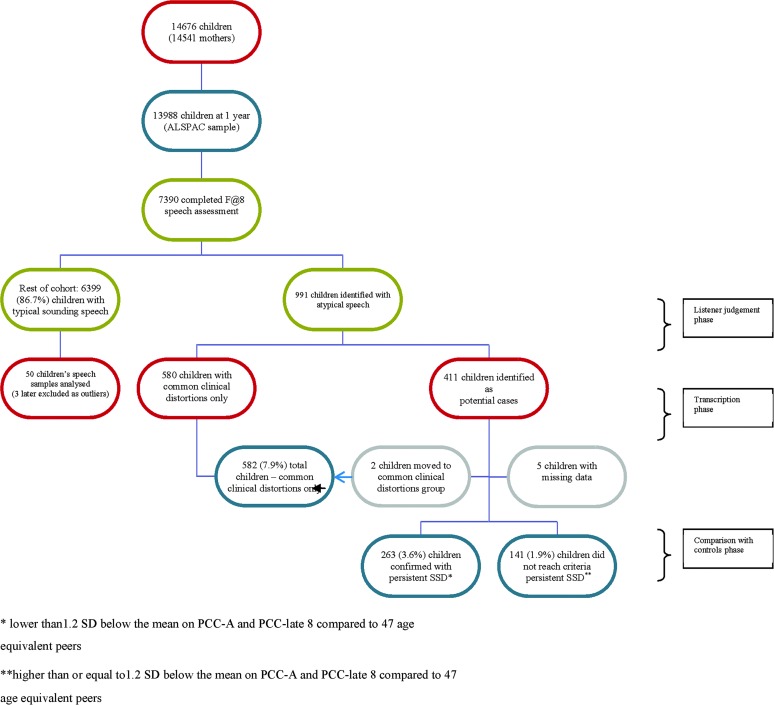
Purpose: The purpose of this study was to determine prevalence and predictors of persistent speech sound disorder (SSD) in children aged 8 years after disregarding children presenting solely with common clinical distortions (i.e., residual errors). Method: Data from the Avon Longitudinal Study of Parents and Children (Boyd et al., 2012) were used. Children were classified as having persistent SSD on the basis of percentage of consonants correct measures from connected speech samples. Multivariable logistic regression analyses were performed to identify predictors. Results: The estimated prevalence of persistent SSD was 3.6%. Children with persistent SSD were more likely to be boys and from families who were not homeowners. Early childhood predictors identified as important were weak sucking at 4 weeks, not often combining words at 24 months, limited use of word morphology at 38 months, and being unintelligible to strangers at age 38 months. School-age predictors identified as important were maternal report of difficulty pronouncing certain sounds and hearing impairment at age 7 years, tympanostomy tube insertion at any age up to 8 years, and a history of suspected coordination problems. The contribution of these findings to our understanding of risk factors for persistent SSD and the nature of the condition is considered. Conclusion: Variables identified as predictive of persistent SSD suggest that factors across motor, cognitive, and linguistic processes may place a child at risk. Supplemental Material: https://doi.org/10.23641/asha.14963811
Overview
The claims and statistics of this paper haven’t been checked yet.
Free: it reads the open-access text and checks the first 5 claims that cite a source we can check. Create a free account to check every claim.
Integrity signals
Registry
Cites
Statistics
Figures
Verification
Claims the paper makes
The claims and statistics of this paper haven’t been checked yet.
Free: it reads the open-access text and checks the first 5 claims that cite a source we can check. Create a free account to check every claim.
Claims other papers make about this one
Each is checked against this paper’s own text: does it say what the citing paper says it does?
The source backs part of the claim, not all of it — or backs it for a different population, condition or comparison.
In the citing paper
“Studies demonstrate that boys are more likely to be diagnosed with SSDs compared to girls, with a meaningful male-to-female ratio of approximately 2:1 . 19”
From Artificial intelligence (AI)-driven technologies for managing pediatric speech and language therapy: A scoping review (2025) · cites this paper as [19]
Experimental — accuracy not yet measured
Self-check
Percentages, sums and reported differences re-computed from the paper’s own numbers.
The self-check needs the paper’s full text.
Citations
Cites
Boyd, A., Golding, J., Macleod, J., Lawlor, D. A., Fraser, A., Henderson, J., Molloy, L., Ness, A., Ring, S., & Davey Smith, G. (2013) · International Journal of Epidemiology · doi:10.1093/ije/dys064 · Cited by 2,996 · cited 1×
“A description of the cohort profile is available (Boyd et al., 2012).”
Bishop, D. V. M., & Adams, C. (1990) · Journal of Child Psychology and Psychiatry · doi:10.1111/j.1469-7610.1990.tb00844.x · Cited by 1,064 · cited 1×
“Moreover, the relationship between (Bishop & Adams, 1990; Broomfield & Dodd, 2004; Lewis et al., 2006; Raitano, Pennington, Tunick, Boada, & Shriberg, 2004; Shriberg et al., 1999).”
Certain Language Skills in Children: Their Development and Interrelationships
TEMPLIN, M. C. (1957) · University of Minnesota Press eBooks · doi:10.5749/j.ctttv2st · Cited by 899 · cited 2×
“espite variation in the rate of speech development, most children who are native speakers of English master accurate production of all vowels and by age 8 years (Dodd, Hulm, Hua, & Crosbie, 2003; James, 2001; Smit, 1993a, 1993b; Templin, 1957).”
The children's test of nonword repetition: A test of phonological working memory
Gathercole, S. E., Willis, C. S., Baddeley, A. D., & Emslie, H. (1994) · Memory · doi:10.1080/09658219408258940 · Cited by 897
Language-Impaired 4-Year-Olds: Distinguishing Transient from Persistent Impairment
Bishop, D. V. M., & Edmundson, A. (1987) · Journal of Speech and Hearing Disorders · doi:10.1044/jshd.5202.156 · Cited by 659 · cited 1×
“…has been positively associated with SSD (Eadie et al., 2015; Highman, Hennessey, Sherwood, & Laitao, 2008) and with speech and language impairment (Bishop & Edmundson, 1987; Dale, Price, Bishop, & Plomin, 2003; Glogowska, Roulstone, Peters, & Enderby, 2006; Rescorla, 2002; Rice, Taylor, &…”
The Percentage of Consonants Correct (PCC) Metric: Extensions and Reliability Data
Shriberg, L. D., Austin, D., Lewis, B. A., McSweeny, J. L., & Wilson, D. L. (1997) · Journal of Speech, Language, and Hearing Research · doi:10.1044/jslhr.4004.708 · Cited by 647 · cited 3×
“Means and standard deviations for the percentage consonants correct (PCC) late eight (/s, z, ʃ , ʒ , θ , ð, ɹ , l/; PCC late 8) and PCC adjusted (PCC-A) measures (Shriberg, Austin, Lewis, McSweeny, & Wilson, 1997a) were calculated for the 50 control children.”
Prevalence of Speech Delay in 6-Year-Old Children and Comorbidity With Language Impairment
Shriberg, L. D., Tomblin, J. B., & McSweeny, J. L. (1999) · Journal of Speech, Language, and Hearing Research · doi:10.1044/jslhr.4206.1461 · Cited by 582 · cited 11×
“Moreover, the relationship between (Bishop & Adams, 1990; Broomfield & Dodd, 2004; Lewis et al., 2006; Raitano, Pennington, Tunick, Boada, & Shriberg, 2004; Shriberg et al., 1999).”
InfluentialChildren's Speech and Literacy Difficulties: A Psycholinguistic Framework
Stackhouse, J., & Wells, B. (1997) · Whurr eBooks · Cited by 540
Hill, E. L. (2001) · International Journal of Language & Communication Disorders · doi:10.1080/13682820010019874 · Cited by 527 · cited 2×
“This is consistent with reports in the literature of links between general coordination problems and speech impairment (Gaines & Missiuna, 2007; Gibbon, 2002; Hill, 2001; Hill & Bishop, 1998; Robinson, 1991; Visscher et al., 2007, 2010; Webster et al., 2005).”
The Auditory Analysis Test: An Initial Report
Rosner, J., & Simon, D. P. (1971) · Journal of Learning Disabilities · doi:10.1177/002221947100400706 · Cited by 464
Research works printed but not linked: 9
- Fenson L., Dale P., Reznick J., Thal D., Bates E., Hartung J., … Reilly J. (1993). The MacArthur Communicative Development Inventories: User's guide and technical manual. San Diego, CA: Singular Publishing.
- Long S. H., Fey M. E., & Channell R. W. (2006). Computerized Profiling (MS-DOS Version 9.7.0). Cleveland, OH: Case Western Reserve University.
- Northstone K., Bonnell S., Horwood J., Bell C., Sadler S., Carmichael A., & the Focus@8 study team. (2006). Avon longitudinal study of parents and children: Focus at 8 built files documentation (No. v3a). Bristol, UK: ALSPAC.
- Northstone K., Bonnell S., Sadler S., Carmichael A., & the Focus@7 study team. (2005). Avon longitudinal study of parents and children: Focus @7 built files (No. version 3c). Bristol, UK: ALSPAC.
- Roulstone S., Law J., Rush R., Clegg J., & Peters T. J. (2011). Investigating the role of language in children's early educational outcomes (Research report DFE-RR134). London, United Kingdom: Department for Education.
- Rust J., Golombok S., & Trickey G. (1993). WORD: Wechsler Objective Reading Dimensions Manual. Sidcup, UK: The Psychological Corporation.
- Rust J. (1996). Wechsler Objective Language Dimensions Manual. London, United Kingdom: The Psychological Corporation.
- Tuomi S., & Ivanoff P. (1977). Incidence of speech and hearing disorders among kindergarten and grade 1 children. Special Education in Canada, 51, 5– 8.
- Wechsler D., Golombok S., & Rust J. (1992). Wechsler Intelligence Scale for Children–Third UK Edition manual. Sidcup, UK: The Psychological Corporation.
Cited by
Items 101–200 of 229
Carl, M., Rudyk, E., Shapira, Y., Rusiewicz, H. L., & Icht, M. (2024) · Journal of Speech, Language, and Hearing Research · doi:10.1044/2024_jslhr-24-00009 · Cited by 9
Literacy-Based Intervention for Children With Speech Sound Disorders: A Review of the Literature
Cabbage, K. L., & Algeo-Nichols, D. (2024) · Perspectives of the ASHA Special Interest Groups · doi:10.1044/2024_persp-24-00025 · Cited by 5
Importance of copy number variants in childhood apraxia of speech and other speech sound disorders
Chan, E. R., Benchek, P. H., Miller, G. J., Brustoski, K., Schaffer, A. E., Truitt, B. J., Tag, J., Freebairn, L. A., Lewis, B. A., Stein, C. M., et al. (2024) · Communications Biology · doi:10.1038/s42003-024-06968-y · Cited by 7
Toledo, N. Z., & de Ávila, C. R. B. (2021) · Revista de Logopedia Foniatría y Audiología · doi:10.1016/j.rlfa.2020.07.002 · Cited by 5
Phonological variations in typically-developing Italian-speaking children aged 3;0-4;11
Fox-Boyer, A. V., Lavaggi, S., & Fricke, S. (2021) · Clinical Linguistics & Phonetics · doi:10.1080/02699206.2021.1945686 · Cited by 6
“Prevalence estimates of SSD in children and adolescents range from 2 to 24% as a result of inconsistent terminologies and classifications as well as differences in the age groups studied (Black et al., 2015; Flipsen, 2015; Wren et al., 2016).”
BackgroundOutcome measures for children with speech sound disorder: an umbrella review protocol
Harding, S. A., Burr, S., Cleland, J., Stringer, H., & Wren, Y. E. (2023) · BMJ Open · doi:10.1136/bmjopen-2022-068945 · Cited by 7
Self-citationMeta Analysis Study of Interpersonal Communication and Speech Delay in Early Childhood
Sujaya, D. J., & Yudiarso, A. (2023) · Journal of Family Sciences · doi:10.29244/jfs.v8i1.44122 · Cited by 7
Capelli, E., Dondena, C., Lorusso, M. L., Mascheretti, S., Pozzoli, R., Salandi, A., Molteni, M., Riva, V., & Cantiani, C. (2024) · Journal of Speech Language and Hearing Research · doi:10.1044/2024_jslhr-23-00815 · Cited by 7
Benway, N. R., Preston, J. L., Hitchcock, E. R., Salekin, A., Sharma, H., & McAllister, T. (2022) · Interspeech (USB) · doi:10.21437/interspeech.2022-10785 · Cited by 12
“The imbalance between males and females in the corpus reflects the increased prevalence of RSSD observed among males [17].”
BackgroundUtepbayeva, A., Zhiyenbayeva, N., Assylbekova, L., & Tapalova, O. (2022) · World Journal on Educational Technology Current Issues · doi:10.18844/wjet.v14i6.7616 · Cited by 5
Benway, N. R., & Preston, J. L. (2023) · Interspeech (USB) · doi:10.21437/interspeech.2023-1882 · Cited by 6
“The imbalance between sexes is expected in Phase II trials, given the higher speech disorder prevalence in males [20].”
BackgroundDigital Tools to Support Children’s Speech and Language Skill
Wren, Y. E., McCormack, J., Masso, S., McLeod, S. L., Baker, E., & Crowe, K. M. (2018) · International perspectives on early childhood education and development · doi:10.1007/978-981-10-6484-5_15 · Cited by 5
Self-citationNilsson, C., Nyberg, J., & Strömbergsson, S. (2021) · Child Language Teaching and Therapy · doi:10.1177/0265659021995538 · Cited by 5
“Speech sound disorders (SSD) are represented in around 4% of children in the ages of 6 to 8 (Shriberg et al., 1999; Wren et al., 2016), and indicate speech production difficulties of specific speech sounds, or groups of speech sounds, as well as/or difficulties in motor planning and sequencing of speech sounds (Bowen,…”
BackgroundWren, Y. E. (2015) · Perspectives on School-Based Issues · doi:10.1044/sbi16.2.25 · Cited by 5
Self-citationDadgar, M., Ennis, C., Mokgosi, K., & Ross, R. (2025) · DIGITAL HEALTH · doi:10.1177/20552076251376533 · Cited by 4
Development of the Digital Speech Assessment Instrument
Uberti, L. B., Keske‐Soares, M., & Pagliarin, K. C. (2024) · American Journal of Speech-Language Pathology · doi:10.1044/2024_ajslp-23-00155 · Cited by 4
Ali, S. A., El‐Setouhy, M., Albasheer, O., Alqassim, A. Y., Muaddi, M. A., Jareebi, M. A., Mkeen, A. M., Alattas, K. K., Alshareef, G. M. A., Koko, R. F. I., et al. (2025) · Medicine · doi:10.1097/md.0000000000043817 · Cited by 7
“[11] Language delay impacts comprehension and the ability to connect words to create meaning, whereas speech delay refers to difficulties producing sounds necessary for verbal communication.”
InfluentialPrevalence of Speech and Language Delay in Early School-Aged Children
Lee, E. K., & Choi, S. H. (2024) · Clinical Archives of Communication Disorders · doi:10.21849/cacd.2024.01452 · Cited by 4
McAllister, T., Preston, J. L., Benway, N. R., Hill, J., Lara, M. P., Leece, M. C., Liang, W., & Hitchcock, E. R. (2025) · Journal of Speech Language and Hearing Research · doi:10.1044/2025_jslhr-24-00909 · Cited by 4
Barrozo, T. F., Silva, L. A. F., Matas, C. G., & Wertzner, H. F. (2025) · Revista CEFAC · doi:10.1590/1982-0216/20252740425 · Cited by 3
Acoustic voice and spectrographic measures in children with the phonological process of devoicing
Simões-Zenari, M., Batista, G. K. S., Pagan-Neves, L. D. O., Nemr, K., & Wertzner, H. F. (2022) · International Journal of Pediatric Otorhinolaryngology · doi:10.1016/j.ijporl.2022.111137 · Cited by 3
Herbst, B. M., Beiting, M., Schultheiss, M., Benway, N. R., & Preston, J. L. (2024) · Language Speech and Hearing Services in Schools · doi:10.1044/2024_lshss-24-00043 · Cited by 3
Munson, B., Wruck, C., Benway, N. R., & Preston, J. L. (2024) · International Journal of Language & Communication Disorders · doi:10.1111/1460-6984.13122 · Cited by 4
Semantic analysis of words for the Virtual Tool for Speech Assessment
Uberti, L. B., Keske‐Soares, M., & Pagliarin, K. C. (2023) · Revista CEFAC · doi:10.1590/1982-0216/20232556523 · Cited by 3
“In the age group of 2 to 7, in 38 productions, the children used gestures combined with onomatopoeia, mainly for conceptualizing animals.”
BackgroundInfluentialChewing efficiency in children with motor speech disorders
Björelius, H., Tsilingaridis, G., Johansson, F., Trang, J., Grigoriadis, A., Thorman, R., & Terband, H. (2025) · European Archives of Paediatric Dentistry · doi:10.1007/s40368-025-01095-6 · Cited by 2
“This observation supports the notion that persistent speech sound disorders (including motor speech disorders) beyond the age of 7 may be linked to missed developmental milestones, such as delayed sucking, gross motor delays, and speech development difficulties (Wren et al. 2016).”
Autism Spectrum Disorder at Home and in School
Bone, M., & Leppert, M. L. O. (2024) · Pediatric Clinics of North America · doi:10.1016/j.pcl.2024.01.008 · Cited by 3
Facial Movements Extracted from Video for the Kinematic Classification of Speech
Palmer, R., Ward, R., Helmholz, P., Strauss, G. R., Davey, P. C., Hennessey, N. W., Orton, L., & Namasivayam, A. K. (2024) · Sensors · doi:10.3390/s24227235 · Cited by 5
Rodgers, L., Botting, N., Stringer, H., Abdo, N., Amer-El-Khedoud, M., Baker, E., Franks, S., Harford, D., Salimi-Tabar, P., Temple, L., et al. (2025) · PLoS ONE · doi:10.1371/journal.pone.0326072 · Cited by 2
“A co-occurring profile of DLD and SSD features in the pre-school years is associated with negative long term outcomes relating to literacy [8] and persisting communication needs [9,10], with subsequent implications for emotional well-being [1,11] and quality of life [2].”
Petinou, K. (2025) · International Journal of Speech-Language Pathology · doi:10.1080/17549507.2025.2524387 · Cited by 2
“…to range from 3% to 16% with figures reaching 40% in the presence of concomitant communication impairments such as development language disorder (DLD) and autism spectrum disorders (ASD) (Broomfield & Dodd, 2004; Eadie et al., 2015; Petinou, 2021; Shriberg et al., 1999; Wren et al., 2016).”
Aakko, I., Kauramäki, J., Cleland, J., Lee, A., Vainio, M., & Saalasti, S. (2022) · Clinical Linguistics & Phonetics · doi:10.1080/02699206.2022.2118079 · Cited by 2
“Speech sound errors may significantly impede speech intelligibility and are among the most common reasons for seeking speech and language therapy (Wren et al., 2016).”
BackgroundSonik, R. A., Parish, S. L., Akobirshoev, I., Son, E., & Rosenthal, E. (2017) · Language Speech and Hearing Services in Schools · doi:10.1044/2017_lshss-16-0072 · Cited by 3
Ultrasound Tongue Imaging for Diarization and Alignment of Child Speech Therapy Sessions
Ribeiro, M. S., Eshky, A., Richmond, K., & Renals, S. J. (2019) · Interspeech (USB) · doi:10.21437/interspeech.2019-2612 · Cited by 2
Children with Speech Sound Disorders
Rvachew, S. (2021) · Wiley eBooks · doi:10.1002/9781119606987.ch15 · Cited by 4
Hall-Mills, S. S. (2022) · ISU Red - Research and eData (Illinois State University) · doi:10.30707/tlcsd6.1.1649037808.661764 · Cited by 1
Interpretation of Misarticulated Words by Children With and Without Speech Sound Disorders
Krueger, B. I., Beers, H., & Frankenberry, J. (2023) · Journal of Speech Language and Hearing Research · doi:10.1044/2022_jslhr-22-00474 · Cited by 1
Hesketh, E., White, P., Simkiss, D., & Roulstone, S. (2023) · International Journal of Language & Communication Disorders · doi:10.1111/1460-6984.12877 · Cited by 5
Self-citationChoo, A. L., King, C. J., & Barger, B. D. (2024) · Remedial and Special Education · doi:10.1177/07419325241274574 · Cited by 1
“It is worth mentioning that the prevalence of neurodevelopmental disorders, including those that affect speech and language, is higher in boys compared with girls (e.g., Choo et al., 2022; Lindsay & Strand, 2016; Wren et al., 2016).”
Appezzato, M. M., & de Ávila, C. R. B. (2024) · CoDAS · doi:10.1590/2317-1782/20242024034en · Cited by 1
“The current basis of evidence suggests that the presence of speech sound changes increases the propensity to undertake more significant efforts to acquire literacy skills (13-15) .”
Effect of hearing training on hearing and speech skills in children with speech sound disorders
Valim, C. D., Keske‐Soares, M., & Biaggio, E. P. V. (2025) · CoDAS · doi:10.1590/2317-1782/e20240008en · Cited by 1
“It should be noted that cases aged over nine years were classified as having Persistent SSD (31) , either PD or MSD.”
The Effectiveness of a Training Program for Reducing Speech Disorders Among Kindergarten Children
Suleiman, N. S., & Shukri, B. T. (2025) · Jurnal Psikiatri Surabaya · doi:10.20473/jps.v14i1.71592 · Cited by 1
Investigation of Rapid Naming and Language Skills in Children With Speech Sound Disorders
Barmak, E., Çağlar, N. A., & Söylemez, D. (2025) · International Journal of Language & Communication Disorders · doi:10.1111/1460-6984.70044 · Cited by 1
Bazzocchi, N. B. M., & Washington, K. N. (2025) · BMJ Open · doi:10.1136/bmjopen-2025-106152 · Cited by 1
Let's Be Friends: Peer Perceptions of Disordered Speech in Preschool and Early School-Aged Children
Henry, M., & Bent, T. (2025) · American Journal of Speech-Language Pathology · doi:10.1044/2025_ajslp-25-00093 · Cited by 1
Cairney, M. V., Kevill, S., & Cleland, J. (2026) · International Journal of Language & Communication Disorders · doi:10.1111/1460-6984.70187 · Cited by 1
“It affects approximately 3.4%–3.8% of school aged children, suggesting that around one child in a classroom of 30 will require clinical support (Eadie et al. 2015 ; Shriberg et al. 1999 ; Wren et al. 2016 ).”
InfluentialBjörelius, H., Terband, H., Johansson, F., Tsilingaridis, G., & Tükel, Ş. (2026) · Folia Phoniatrica et Logopaedica · doi:10.1159/000551061 · Cited by 1
Harding, S. A., Burr, S., Cleland, J., Stringer, H., & Wren, Y. E. (2026) · Child Language Teaching and Therapy · doi:10.1177/02656590261444674 · Cited by 2
“If an SSD persists through childhood, it can have a detrimental impact on a child ’ s learning, education, well-being and social integration, and future work and life chances (Anthony et al., 2011; Felsenfeld et al., 1994; Speech and Language UK, 2022; Wren et al., 2016, 2023).”
Self-citationLee, S. A. S., & Glasser, C. (2026) · Journal of Speech Language and Hearing Research · doi:10.1044/2026_jslhr-25-00850 · Cited by 1
van Zelst, A. L., & Earle, F. S. (2026) · Clinical Linguistics & Phonetics · doi:10.1080/02699206.2026.2713447 · Cited by 1
Aldila, R. R. F., & Erlich, W. A. D. (2024) · The International Journal of Medical Science and Health Research · doi:10.70070/hpaavy19 · Cited by 1
Kilili-Lesta, M., Giannakou, K., & Voniati, L. (2025) · Journal of Communication Disorders · doi:10.1016/j.jcomdis.2025.106542 · Cited by 1
Stoev, S., Rasheva-Yordanova, K., Kostadinova, I. S., Dimitrov, G., & Dimitrova, R. (2025) · International Convention on Information and Communication Technology, Electronics and Microelectronics · doi:10.1109/mipro65660.2025.11131786 · Cited by 1
Pauls, L. J. (2018) · Scholarship@Western (Western University) · Cited by 1
[Current status of initial diagnosis of speech sound disorder in a child healthcare clinic].
Chen, W.-C., Xiong, L.-M., Gao, L., & Cheng, Q. (2020) · PubMed Central · doi:10.7499/j.issn.1008-8830.1911106 · Cited by 1
Word-Final Phoneme Segmentation Using Cross-Correlation
Mahmut, E. E., Nicola, S., & Stoicu-Tivadar, V. (2020) · Studies in health technology and informatics · doi:10.3233/shti200709 · Cited by 1
“persistent SSDs (Speech Sound Disorders) among preschoolers and elementary schoolers [3] in conjunction with the key role played by early diagnosis and subsequent treatment in the therapeutic outcome reinforce the need for an automated”
BackgroundKonuşma Geriliğindeki Etiyolojik Nedenlerin Çocuk Nörolojisi Perspektifinden İncelenmesi
İnce, H., Say, G. N., Başaran, A., Akoğlu, S. Ç., Bekaroğlu, A., & Taşdemir, H. A. (2021) · Turkish Journal of Pediatric Disease · doi:10.12956/tchd.927493 · Cited by 1
Pagolu, K. R. (2021) · Biomedical Journal of Scientific & Technical Research · doi:10.26717/bjstr.2021.38.006221 · Cited by 1
“Overall, these results are slightly higher when compared to the prevalence in developed countries as reported by Wren [21].”
ResultRios, N. V. D. F., Fernandes, L. D. C., de Andrade, C. L. O., Santiago, A. C. T., & Alves, C. (2021) · CoDAS · doi:10.1590/2317-1782/20212020340 · Cited by 1
“This is considered the most prevalent communication disorder in the child population(1,2).”
BackgroundPagolu, K. R., & Tamanam, R. R. (2022) · Clinical Epidemiology and Global Health · doi:10.1016/j.cegh.2022.101062 · Cited by 2
“22 The present study reveals that the trend of admission of neuromotor impairment cases was being consistent with a large number up to 2019 and then diminished.”
Outgrowing Speech Sound Disorders
Westby, C. E. (2022) · Word of Mouth · doi:10.1177/10483950221101453a · Cited by 1
Moll, D., Edwards, L., Kelly, G., Hamilton, C., & Price, H. (2022) · International Journal of Therapy and Rehabilitation · doi:10.12968/ijtr.2021.0113 · Cited by 1
Lowry, G., Silva, E. R., Matthews, J., Shoji, A., Turvey, T. A., Blakey, G. H., Zajac, D. J., Mielke, J., & Jacox, L. A. (2025) · Orthodontics and Craniofacial Research · doi:10.1111/ocr.12926 · Cited by 1
Protracted phonological development in Granada Spanish : a case study
Klassen, J. (2017) · cIRcle (University of British Columbia) · doi:10.14288/1.0344008 · Cited by 3
Pernon, M. (2022) · theses.fr (ABES) · doi:10.70675/08d91228z7779z49bdzb02ez0c2da976142a · Cited by 1
Boyce, J. O. (2019) · Minerva Access (University of Melbourne)
Psychological understanding of the impact of health interventions in relation to chronic conditions
Harding, S. A. (2026) · e-space (Manchester Metropolitan University) · doi:10.83056/mmu.32477637
Évaluation des aptitudes phonologiques chez un adolescent avec déficience intellectuelle légère
Boilley, C. (2020) · HAL · Cited by 1
Prestation på nonordsrepetition hos barn med kvarstående talstörning efter 6 års ålder
Sigvant, J., & Rane, M. (2021) · Gothenburg University Publications Electronic Archive (Gothenburg University)
Johnston, B. (2021) · UC Research Repository (University of Canterbury) · doi:10.26021/11135
Sugden, E., & Cleland, J. (2020) · OSF Preprints (OSF Preprints) · doi:10.31219/osf.io/9rqmb
Neurological Evaluation of Children Followed Up For Speech Retardation
Özdemir, F. M. A., & Çelik, H. (2023) · Genel Tıp Dergisi · doi:10.54005/geneltip.1211492
Análise semântica de palavras do Instrumento Virtual de Avaliação da Fala
Uberti, L. B., Keske‐Soares, M., & Pagliarin, K. C. (2023) · Revista CEFAC · doi:10.1590/1982-0216/20232556523s
Under the Surface: Rhoticity and Relevance in the Song “Surface Pressure” From Disney's Encanto
Lockenvitz, S., & Brooks, A. (2023) · Perspectives of the ASHA Special Interest Groups · doi:10.1044/2023_persp-23-00087
Şen, S., & Yeşilyurt, M. (2024) · Dil Konuşma ve Yutma Araştırmaları Dergisi · doi:10.58563/dkyad-2024.71.3
Appezzato, M. M., & de Ávila, C. R. B. (2024) · CoDAS · doi:10.1590/2317-1782/20242024034pt
Leppert, M. L. O. (2024) · Elsevier eBooks · doi:10.1016/b978-0-12-824060-1.00029-8
Interferencija i razvoj artikulacije na maternjem i stranom jeziku kod dece predškolskog uzrasta
Janjić, J., Milošević, N., & Čolić, G. (2024) · Inovacije u nastavi · doi:10.5937/inovacije2403075j
CHILDHOOD SPEECH IMPAIRMENT AND DEMENTIA RISKS AMONG US OLDER ADULTS
Wang, H., Xu, S., & Pei, Y. (2024) · International Journal of Language & Communication Disorders · doi:10.1093/geroni/igae098.4140
La dislalia funcional: rutinas musicales para su intervención en Educación Infantil
Izquierdo, M. L., & Palomo, M. E. R. (2024) · Creativity and Educational Innovation Review · doi:10.7203/creativity.8.28528
Valim, C. D., Keske‐Soares, M., & Biaggio, E. P. V. (2025) · CoDAS · doi:10.1590/2317-1782/e20240008pt · Cited by 3
Deka, C., & Shrivastava, A. (2025) · Lecture notes in computer science · doi:10.1007/978-3-031-88881-6_17
Bron, A. E., Scheper, A., Groen, M. A., & Verhoeven, L. T. W. (2025) · International Journal of Language & Communication Disorders · doi:10.1111/1460-6984.70059
“An early history of OME may result in poor intelligibility and, for instance, more backing of consonants (Shriberg et al., 2003; Wren et al., 2016) but not all children with a history of early OME are at risk for poor speech or language problems (Paradise et al., 2000).”
Beiting, M., Viswanathan, N., Caballero, N. F., Hitchcock, E. R., McAllister, T., & Preston, J. L. (2025) · Journal of Communication Disorders · doi:10.1016/j.jcomdis.2025.106583
“This pattern is common in speech disorders research given the higher prevalence of SSD in males (Wren et al., 2016).”
The influence of age, listener sex, and speaker sex on the McGurk effect
Jenson, D., Thornton, D. M., & VanDam, M. (2025) · Perception · doi:10.1177/03010066251386575
“…disorders including autism spectrum disorder (Loomes et al., 2017), stuttering (Yairi & Ambrose, 2013), childhood apraxia of speech (Chilosi et al., 2015), speech sound disorders (Wren et al., 2016), dyslexia (Quinn & Wagner, 2015), and developmental language disorder (Chilosi et al., 2023).”
Bernard, R. (2023) · UCL Discovery (University College London)
Baxter, R. (2023) · UCL Discovery (University College London)
Biomarkers of Familial Speech Sound Disorders: Genes, Perception, and Motor Control
(2020) · Arizona State University Library Digital Repository (Arizona State University) · Cited by 1
Warnier, M. (2022) · ORBi (University of Liège) · Cited by 3
Navajo Children With and Without Speech Sound Disorders
Henderson, D. E., & Sosa, A. (2025) · Journal of Speech Language and Hearing Research · doi:10.1044/2025_jslhr-25-00021
Daza, L. F. O., Andrada, V. G., Rodríguez-Grande, E.-I., & Fernández, P. V. (2026) · Revista de Investigación en Logopedia · doi:10.5209/rlog.102578 · Cited by 1
Development of a virtual instrument for speech assessment
Uberti, L. B. (2023) · LA Referencia (Red Federada de Repositorios Institucionales de Publicaciones Científicas)
Early Detection of Apraxia of Speech in Children using MATLAB
Dargar, A., Babu, N. G., Sumanth, S. S. S., & Kumar, K. S. D. (2025) · International Conference on Evolutionary Computing and Mobile Sustainable Networks (ICECMSN) · doi:10.1109/icecmsn68058.2025.11382894
“This can cause biased learning where the model becomes better at recognizing normal speech [16],[17].”
Kanorau ā-roro: Neurodevelopmental conditions in children and young people in Aotearoa
Tustin, K., Adams, J., Bowden, N., McAnally, H. M., Wicken, A., Taylor, B. J., & Turnbull, F. (2025) · Otago University Research Archive (University of Otago) · doi:10.82348/our-archive.00031
Atypical Phonological Errors: A Guide for Speech-Language Pathologists
Roepke, E., & Brosseau‐Lapré, F. (2026) · Language Speech and Hearing Services in Schools · doi:10.1044/2025_lshss-25-00101
Rofaeel, M. (2025) · TSpace (University of Toronto)
Linna, N. (2025) · Tampere University Institutional Repository (Tampere University)
Articulation Function Changes in Children With Cleft Lip and Palate: A One-Year Follow-Up Study
Zhang, W., Shen, X., Li, C., Chen, R., & Du, X. (2026) · Journal of Craniofacial Surgery · doi:10.1097/scs.0000000000012637
Xu, Q., Peng, N., Li, X., Wang, L., Duan, H., Xu, C., Wang, X., Zhou, B., Wang, J., & Wang, L. (2026) · Behavioral Sciences · doi:10.3390/bs16040540
“This finding further supports the view proposed by Preston et al. (J. L. Preston et al., 2013) and Wren et al. (Wren et al., 2016) that speech sound problems in school-age children are a continuation of those present during the preschool period.”
Ruiz, J. R. V. (2025) · LA Referencia (Red Federada de Repositorios Institucionales de Publicaciones Científicas)
Mogren, Å., Rane, M., Sigvant, J., & Carlsson, E. (2026) · Logopedics Phoniatrics Vocology · doi:10.1080/14015439.2026.2671824
Spencer, S., Kaur-Bola, K., Reeves, L., Best, W., Stringer, H., & Pennington, L. (2026) · International Journal of Language & Communication Disorders · doi:10.1111/1460-6984.70266
Metadata
- Authors
- Wren, Y., Miller, L. L., Peters, T. J., Emond, A., & Roulstone, S.
- Affiliations
- North Bristol NHS Trust (GB)
- University of Bristol (GB)
- University of the West of England (GB)
- Corresponding author
- Wren, Yvonne
- Venue
- Journal of Speech, Language, and Hearing Research
- Published
- 2016-08
- Volume
- 59
- Issue
- 4
- Pages
- 647-673
- ISSN
- 1092-4388 (ISSN-L)
- 1558-9102
- PMC
- PMC5280061
- OpenAlex
- W2471412687
- Semantic Scholar
- e1b37ac7141ddb98e37ca66ab7db9116acede5c9
- Cited by
- 198
- References
- 96
- Citations by year
- 2026: 26 · 2025: 26 · 2024: 26 · 2023: 24 · 2022: 26 · 2021: 23 · 2020: 14 · 2019: 14 · 2018: 7 · 2017: 10
- FWCI
- 24.12
- Type
- journal article
- Language
- en
- Open access
- hybrid
- doi.org
- Locations
- Journal of Speech Language and Hearing Research (publishedVersion, cc-by)
- PubMed Central (publishedVersion, cc-by)
- PubMed (publishedVersion)
- Explore Bristol Research (publishedVersion, cc-by)
- Bristol Research (University of Bristol) (publishedVersion, cc-by)
- UWE Research Repository (UWE Bristol) (submittedVersion, cc-by)
- Funders
- Wellcome Trust (102215/2/13/2), 102215)
- University of Bristol (102215/2/13/2)
- North Bristol NHS Trust
- Medical Research Council (102215, 102215/2/13/2, MC_PC_15018, G0501804 ID 76829)
- Topics
- Social Sciences › Psychology › Developmental and Educational Psychology › Language Development and Disorders
- Health Sciences › Health Professions › Speech and Hearing › Voice and Speech Disorders
- Social Sciences › Psychology › Experimental and Cognitive Psychology › Phonetics and Phonology Research
- Keywords
- speech sound disorders, prevalence, risk factors, children, early childhood predictors, word morphology, sucking, hearing loss, tympanostomy tubes, coordination problems, connected speech, Avon Longitudinal Study of Parents and Children
- MeSH terms
- Child, Female, Humans, Longitudinal Studies, Male, Prognosis, Prospective Studies, Risk Factors, Sex Factors, Socioeconomic Factors, Prevalence, Multivariate Analysis, Logistic Models, Speech Sound Disorder
About these checks
Registry, retraction, Cites and statistics results are computed, not judged, with one exception: a printed reference that no index lists is read once by a model before it counts as a citation error. Claims are extracted by a model and kept only when their quote appears verbatim in the text; each cited source is then checked, with a model’s help, for whether it says what the claim relies on. Those verdicts can be wrong — read the claim’s quote and the cited source before relying on one.
Statistics and arithmetic are recomputed, not judged.
Confidence bands are shown only for fields calibrated on our annotated test set. None is calibrated yet, so no band is shown.
What counts as a claim ›How we measure confidence ›How we check this ›
Are you an author, or do you see a problem with this page? Request a review
Data sources
Bibliographic data: Semantic Scholar, OpenAlex, Crossref.
Contains information from the Semantic Scholar Academic Graph Datasets, made available under the ODC Attribution License (ODC-BY 1.0).
Semantic Scholar’s data is described in: Kinney, R., et al. (2023). The Semantic Scholar Open Data Platform. arXiv:2301.10140.
