

Prevalence and Predictors of Persistent Speech Sound Disorder at Eight Years Old: Findings From a Population Cohort Study
Open accessThe DOI matches its Crossref record; 97 of the 97 references it cites were found in a registry or an index.
Abstract
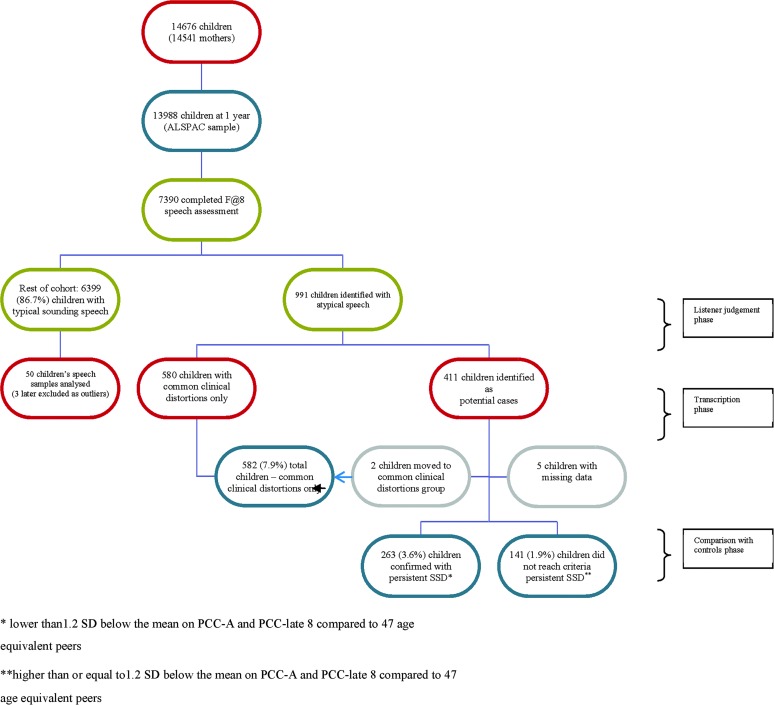
Purpose: The purpose of this study was to determine prevalence and predictors of persistent speech sound disorder (SSD) in children aged 8 years after disregarding children presenting solely with common clinical distortions (i.e., residual errors). Method: Data from the Avon Longitudinal Study of Parents and Children (Boyd et al., 2012) were used. Children were classified as having persistent SSD on the basis of percentage of consonants correct measures from connected speech samples. Multivariable logistic regression analyses were performed to identify predictors. Results: The estimated prevalence of persistent SSD was 3.6%. Children with persistent SSD were more likely to be boys and from families who were not homeowners. Early childhood predictors identified as important were weak sucking at 4 weeks, not often combining words at 24 months, limited use of word morphology at 38 months, and being unintelligible to strangers at age 38 months. School-age predictors identified as important were maternal report of difficulty pronouncing certain sounds and hearing impairment at age 7 years, tympanostomy tube insertion at any age up to 8 years, and a history of suspected coordination problems. The contribution of these findings to our understanding of risk factors for persistent SSD and the nature of the condition is considered. Conclusion: Variables identified as predictive of persistent SSD suggest that factors across motor, cognitive, and linguistic processes may place a child at risk. Supplemental Material: https://doi.org/10.23641/asha.14963811
Overview
The claims and statistics of this paper haven’t been checked yet.
Free: it reads the open-access text and checks the first 5 claims that cite a source we can check. Create a free account to check every claim.
Integrity signals
Registry
Cites
Statistics
Figures
Verification
Claims the paper makes
The claims and statistics of this paper haven’t been checked yet.
Free: it reads the open-access text and checks the first 5 claims that cite a source we can check. Create a free account to check every claim.
Claims other papers make about this one
Each is checked against this paper’s own text: does it say what the citing paper says it does?
The source backs part of the claim, not all of it — or backs it for a different population, condition or comparison.
In the citing paper
“Studies demonstrate that boys are more likely to be diagnosed with SSDs compared to girls, with a meaningful male-to-female ratio of approximately 2:1 . 19”
From Artificial intelligence (AI)-driven technologies for managing pediatric speech and language therapy: A scoping review (2025) · cites this paper as [19]
Experimental — accuracy not yet measured
Self-check
Percentages, sums and reported differences re-computed from the paper’s own numbers.
The self-check needs the paper’s full text.
Citations
Cites
Boyd, A., Golding, J., Macleod, J., Lawlor, D. A., Fraser, A., Henderson, J., Molloy, L., Ness, A., Ring, S., & Davey Smith, G. (2013) · International Journal of Epidemiology · doi:10.1093/ije/dys064 · Cited by 2,996 · cited 1×
“A description of the cohort profile is available (Boyd et al., 2012).”
Bishop, D. V. M., & Adams, C. (1990) · Journal of Child Psychology and Psychiatry · doi:10.1111/j.1469-7610.1990.tb00844.x · Cited by 1,064 · cited 1×
“Moreover, the relationship between (Bishop & Adams, 1990; Broomfield & Dodd, 2004; Lewis et al., 2006; Raitano, Pennington, Tunick, Boada, & Shriberg, 2004; Shriberg et al., 1999).”
Certain Language Skills in Children: Their Development and Interrelationships
TEMPLIN, M. C. (1957) · University of Minnesota Press eBooks · doi:10.5749/j.ctttv2st · Cited by 899 · cited 2×
“espite variation in the rate of speech development, most children who are native speakers of English master accurate production of all vowels and by age 8 years (Dodd, Hulm, Hua, & Crosbie, 2003; James, 2001; Smit, 1993a, 1993b; Templin, 1957).”
The children's test of nonword repetition: A test of phonological working memory
Gathercole, S. E., Willis, C. S., Baddeley, A. D., & Emslie, H. (1994) · Memory · doi:10.1080/09658219408258940 · Cited by 897
Language-Impaired 4-Year-Olds: Distinguishing Transient from Persistent Impairment
Bishop, D. V. M., & Edmundson, A. (1987) · Journal of Speech and Hearing Disorders · doi:10.1044/jshd.5202.156 · Cited by 659 · cited 1×
“…has been positively associated with SSD (Eadie et al., 2015; Highman, Hennessey, Sherwood, & Laitao, 2008) and with speech and language impairment (Bishop & Edmundson, 1987; Dale, Price, Bishop, & Plomin, 2003; Glogowska, Roulstone, Peters, & Enderby, 2006; Rescorla, 2002; Rice, Taylor, &…”
The Percentage of Consonants Correct (PCC) Metric: Extensions and Reliability Data
Shriberg, L. D., Austin, D., Lewis, B. A., McSweeny, J. L., & Wilson, D. L. (1997) · Journal of Speech, Language, and Hearing Research · doi:10.1044/jslhr.4004.708 · Cited by 647 · cited 3×
“Means and standard deviations for the percentage consonants correct (PCC) late eight (/s, z, ʃ , ʒ , θ , ð, ɹ , l/; PCC late 8) and PCC adjusted (PCC-A) measures (Shriberg, Austin, Lewis, McSweeny, & Wilson, 1997a) were calculated for the 50 control children.”
Prevalence of Speech Delay in 6-Year-Old Children and Comorbidity With Language Impairment
Shriberg, L. D., Tomblin, J. B., & McSweeny, J. L. (1999) · Journal of Speech, Language, and Hearing Research · doi:10.1044/jslhr.4206.1461 · Cited by 582 · cited 11×
“Moreover, the relationship between (Bishop & Adams, 1990; Broomfield & Dodd, 2004; Lewis et al., 2006; Raitano, Pennington, Tunick, Boada, & Shriberg, 2004; Shriberg et al., 1999).”
InfluentialChildren's Speech and Literacy Difficulties: A Psycholinguistic Framework
Stackhouse, J., & Wells, B. (1997) · Whurr eBooks · Cited by 540
Hill, E. L. (2001) · International Journal of Language & Communication Disorders · doi:10.1080/13682820010019874 · Cited by 527 · cited 2×
“This is consistent with reports in the literature of links between general coordination problems and speech impairment (Gaines & Missiuna, 2007; Gibbon, 2002; Hill, 2001; Hill & Bishop, 1998; Robinson, 1991; Visscher et al., 2007, 2010; Webster et al., 2005).”
The Auditory Analysis Test: An Initial Report
Rosner, J., & Simon, D. P. (1971) · Journal of Learning Disabilities · doi:10.1177/002221947100400706 · Cited by 464
Research works printed but not linked: 9
- Fenson L., Dale P., Reznick J., Thal D., Bates E., Hartung J., … Reilly J. (1993). The MacArthur Communicative Development Inventories: User's guide and technical manual. San Diego, CA: Singular Publishing.
- Long S. H., Fey M. E., & Channell R. W. (2006). Computerized Profiling (MS-DOS Version 9.7.0). Cleveland, OH: Case Western Reserve University.
- Northstone K., Bonnell S., Horwood J., Bell C., Sadler S., Carmichael A., & the Focus@8 study team. (2006). Avon longitudinal study of parents and children: Focus at 8 built files documentation (No. v3a). Bristol, UK: ALSPAC.
- Northstone K., Bonnell S., Sadler S., Carmichael A., & the Focus@7 study team. (2005). Avon longitudinal study of parents and children: Focus @7 built files (No. version 3c). Bristol, UK: ALSPAC.
- Roulstone S., Law J., Rush R., Clegg J., & Peters T. J. (2011). Investigating the role of language in children's early educational outcomes (Research report DFE-RR134). London, United Kingdom: Department for Education.
- Rust J., Golombok S., & Trickey G. (1993). WORD: Wechsler Objective Reading Dimensions Manual. Sidcup, UK: The Psychological Corporation.
- Rust J. (1996). Wechsler Objective Language Dimensions Manual. London, United Kingdom: The Psychological Corporation.
- Tuomi S., & Ivanoff P. (1977). Incidence of speech and hearing disorders among kindergarten and grade 1 children. Special Education in Canada, 51, 5– 8.
- Wechsler D., Golombok S., & Rust J. (1992). Wechsler Intelligence Scale for Children–Third UK Edition manual. Sidcup, UK: The Psychological Corporation.
Cited by
Items 201–229 of 229
English (English) speech development
Mayr, R., Knight, R., Bates, S., Wren, Y. E., & Howard, S. (2026) · Oxford University Press eBooks · doi:10.1093/9780191964909.003.0020
Self-citationPrinciples of Intervention for Children with Speech, Language, and Communication Impairments
Hrastelj, L., Burr, S., & Wren, Y. E. (2026) · Springer eBooks · doi:10.1007/978-3-032-26192-2_11
Self-citationWren, Y. E., Burr, S., Cleland, J., Stringer, H., & Harding, S. A. (2026) · Language Speech and Hearing Services in Schools · doi:10.1044/2026_lshss-25-00202
Self-citationAni, S. A. (2026) · Enlighten: Theses (The University of Glasgow) · doi:10.5525/gla.thesis.86062
Lin, Y.-S., Tseng, S.-C., & Jang, J. R. (2026) · IEEE Access · doi:10.1109/access.2026.3707593
“A community-cohort study reported an SSD prevalence of 3.4% among 4-year-old children, and a separate population-based study estimated that persistent SSD affects 3.6% of children at 8 years of age [1], [2].”
InfluentialAliaga, M. L. T. (2024) · LA Referencia (Red Federada de Repositorios Institucionales de Publicaciones Científicas)
Hall, A. J., Gregory, S., Iles‐Caven, Y., Northstone, K., & Golding, J. (2026) · Wellcome Open Research · doi:10.12688/wellcomeopenres.26995.1
“Publications examining the relationship between hearing loss and speech and language include Bornstein et al., 2018; Carding et al., 2006; Wren et al., 2016.”
Somadasa, C., Balasooriya, P., Chandrasoma, H., Dilhara, T., Gunathilake, P., & Thelijjagoda, S. (2026) · IEEE International Conference on Automatic Control and Intelligent Systems (I2CACIS) · doi:10.1109/i2cacis69435.2026.11600096
Concepts and Approaches for Gamified Speech Therapy Applications in the Slovak Language
Kováč, J., Ondáš, S., Staš, J., Pleva, M., & Kiktová, E. (2026) · Electronics · doi:10.3390/electronics15143165
Acoustic measures of speech sound production in multilingual children: A scoping review protocol
Wang, S., & Washington, K. N. (2026) · PLoS ONE · doi:10.1371/journal.pone.0361605
“…first identified in this period; prevalence estimates for speech delay are highest in the early years, with a median of 7.8% at age 5 falling to 2.3% by age 7 [22]; and persistent SSD still affects an estimated 3.6% of children at 8 years, underscoring the stakes of early identification [23].”
InfluentialA Rapid Review to Reconsider the Concept of Accuracy in Speech Sound Production
MacLeod, A. A. N., & Glaspey, A. M. (2026) · Journal of Monolingual and Bilingual Speech · doi:10.3138/jmbs-2024-0018
Narrative performance and working memory performance in Saudi children with speech sound disorder
Aljadaan, A. F. (2026) · Applied Neuropsychology Child · doi:10.1080/21622965.2026.2719661
Piron, L., MacLeod, A. A. N., & Maillart, C. (2026) · Journal of Speech Language and Hearing Research · doi:10.1044/2026_jslhr-25-00609 · Cited by 1
Alharbi, A., Binhotan, M. S., Alqassim, A. Y., Muaddi, M. A., Alhosaini, A., Arafat, M. S., Aldhabib, A., Sumaily, I. A., & Aljerian, N. (2026) · Healthcare · doi:10.3390/healthcare14172675
“Crude population-based referral rates of females exceeded males overall, except for speech disorders where male predominance aligns with higher developmental speech delay prevalence in males [37,38].”
Papastefanou, T., & Petinou, K. (2026) · Clinical Linguistics & Phonetics · doi:10.1080/02699206.2026.2713444
Liang, C.-C., & Torng, P.-C. (2026) · Journal of Speech Language and Hearing Research · doi:10.1044/2026_jslhr-25-01044
Shijo, V., Das, A., Bo, W., Hou, S., Guo, L.-Y., Xia, J., & Xu, W. (2026) · IEEE/ACM Conference on Connected Health: Applications, Systems and Engineering Technologies · doi:10.1109/chase69719.2026.00047
“Speech sound disorders (SSD) affect 5–8% of children [1], and clinical assessment relies on perceptual judgment by speech-language pathologists (SLPs), which is subjective and cannot capture articulatory detail beyond what can be heard.”
Speech Science: Anatomy, Physiology, and Acoustics
Chanda, S., & Kumar, V. (2026) · Springer eBooks · doi:10.1007/978-981-92-1475-4_1
Ameli, N., Ravesh, M. N., Dalmazo, L. M. T., Pollock, K., DeSantis, D., Lagravère, M. O., & Lai, H. (2026) · Journal of Applied Oral Science · doi:10.1590/1678-7765-2026-0078 · Cited by 1
Titterington, J., Rudd, S., Stringer, H., Pagnamenta, E., Robinson, T., & Harding, S. A. (2026) · International Journal of Language & Communication Disorders · doi:10.1111/1460-6984.70339
Early life factors documented in electronic health records predict recurrent acute otitis media
Hurst, J. H., Zhao, C., Raynor, E. M., Lee, J. W., Gitomer, S. A., Woods, C. W., Kelly, M. S., Smith, M. J., & Goldstein, B. A. (2026) · PLoS ONE · doi:10.1371/journal.pone.0345434
“Further, rAOM is accompanied by middle ear effusion, which can impair hearing, potentially resulting in language delays and auditory processing disorders that have lifelong impacts [11–14].”
Swaroop, D., Thenkanidiyoor, V., Dileep, A. D., & Muralikrishna, H. (2026) · Lecture notes in computer science · doi:10.1007/978-3-032-37867-5_29
Attachment and anxiety in primary school children with speech and language disorders
Peklaj, A. (2026) · Repository of the University of Ljubljana (University of Ljubljana)
AXBOROT-KOMMUNIKATSIYA TEXNOLOGIYALARINING NUTQ NUQSONLARINI KORREKSIYALASHDAGI SAMARADORLIGI
Isakulovna, M. U., Farxodovna, D. M., Egamova, N. B., & Egamova, F. J. (2026) · Modern education and development
Ethno Literacy-Based Early Childhood Articulation Intervention through Unplugged Coding Maze Media
Sakinatina, N., Fathurohman, I., & Rondli, W. S. (2026) · EDUKASIA Jurnal Pendidikan dan Pembelajaran · doi:10.62775/edukasia.v7i1.2128
Nobre, I. D. S., TELES, D. O., da Silva, K., & Zuanetti, P. A. (2026) · Revista CEFAC · doi:10.1590/1982-0216/20262864326s
Nobre, I. D. S., TELES, D. O., da Silva, K., & Zuanetti, P. A. (2026) · Revista CEFAC · doi:10.1590/1982-0216/20262864326
Thomas, P., & Barman, A. (2026) · Communication Disorders Quarterly · doi:10.1177/15257401261501942
Metadata
- Authors
- Wren, Y., Miller, L. L., Peters, T. J., Emond, A., & Roulstone, S.
- Affiliations
- North Bristol NHS Trust (GB)
- University of Bristol (GB)
- University of the West of England (GB)
- Corresponding author
- Wren, Yvonne
- Venue
- Journal of Speech, Language, and Hearing Research
- Published
- 2016-08
- Volume
- 59
- Issue
- 4
- Pages
- 647-673
- ISSN
- 1092-4388 (ISSN-L)
- 1558-9102
- PMC
- PMC5280061
- OpenAlex
- W2471412687
- Semantic Scholar
- e1b37ac7141ddb98e37ca66ab7db9116acede5c9
- Cited by
- 198
- References
- 96
- Citations by year
- 2026: 26 · 2025: 26 · 2024: 26 · 2023: 24 · 2022: 26 · 2021: 23 · 2020: 14 · 2019: 14 · 2018: 7 · 2017: 10
- FWCI
- 24.12
- Type
- journal article
- Language
- en
- Open access
- hybrid
- doi.org
- Locations
- Journal of Speech Language and Hearing Research (publishedVersion, cc-by)
- PubMed Central (publishedVersion, cc-by)
- PubMed (publishedVersion)
- Explore Bristol Research (publishedVersion, cc-by)
- Bristol Research (University of Bristol) (publishedVersion, cc-by)
- UWE Research Repository (UWE Bristol) (submittedVersion, cc-by)
- Funders
- Wellcome Trust (102215/2/13/2), 102215)
- University of Bristol (102215/2/13/2)
- North Bristol NHS Trust
- Medical Research Council (102215, 102215/2/13/2, MC_PC_15018, G0501804 ID 76829)
- Topics
- Social Sciences › Psychology › Developmental and Educational Psychology › Language Development and Disorders
- Health Sciences › Health Professions › Speech and Hearing › Voice and Speech Disorders
- Social Sciences › Psychology › Experimental and Cognitive Psychology › Phonetics and Phonology Research
- Keywords
- speech sound disorders, prevalence, risk factors, children, early childhood predictors, word morphology, sucking, hearing loss, tympanostomy tubes, coordination problems, connected speech, Avon Longitudinal Study of Parents and Children
- MeSH terms
- Child, Female, Humans, Longitudinal Studies, Male, Prognosis, Prospective Studies, Risk Factors, Sex Factors, Socioeconomic Factors, Prevalence, Multivariate Analysis, Logistic Models, Speech Sound Disorder
About these checks
Registry, retraction, Cites and statistics results are computed, not judged, with one exception: a printed reference that no index lists is read once by a model before it counts as a citation error. Claims are extracted by a model and kept only when their quote appears verbatim in the text; each cited source is then checked, with a model’s help, for whether it says what the claim relies on. Those verdicts can be wrong — read the claim’s quote and the cited source before relying on one.
Statistics and arithmetic are recomputed, not judged.
Confidence bands are shown only for fields calibrated on our annotated test set. None is calibrated yet, so no band is shown.
What counts as a claim ›How we measure confidence ›How we check this ›
Are you an author, or do you see a problem with this page? Request a review
Data sources
Bibliographic data: Semantic Scholar, OpenAlex, Crossref.
Contains information from the Semantic Scholar Academic Graph Datasets, made available under the ODC Attribution License (ODC-BY 1.0).
Semantic Scholar’s data is described in: Kinney, R., et al. (2023). The Semantic Scholar Open Data Platform. arXiv:2301.10140.
