

Innovation, organizational capabilities, and the born-global firm
Open accessThe DOI matches its Crossref record; 106 of the 106 references it cites were found in a registry or an index; none of the 100 sources its claims cite is checked for support yet.
Overview
CoChat Summary
## TL;DR
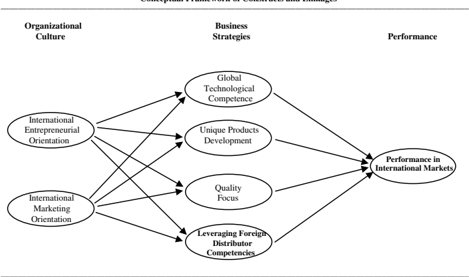
This study argues that born-global firms succeed because early internationalization is supported by an innovative culture and a distinctive set of organizational capabilities. Using qualitative case studies followed by a survey of 203 usable responses, the authors find that several capability links are significant and that these capabilities are associated with performance in international markets.
## Key findings
- The survey analysis found that international entrepreneurial orientation significantly predicted global technological competence with a standardized coefficient of 0.28; the link from international marketing orientation to global technological competence was not significant.
- Unique products development was significantly predicted by both international entrepreneurial orientation (0.19) and international marketing orientation (0.24).
- Quality focus was significantly predicted by both international entrepreneurial orientation (0.23) and international marketing orientation (0.35).
- Leveraging foreign distributor competences was significantly predicted by international marketing orientation (0.26) but not by international entrepreneurial orientation; these strategy variables were also significant drivers of performance in international markets: global technological competence (0.21), unique products development (0.14), quality focus (0.30), and leveraging foreign distributor competences (0.18).
## Methods
- The paper uses a two-phase design: first qualitative interviews/case studies to develop constructs and hypotheses, then a cross-industry field survey to test them.
- The qualitative phase included 33 professionals: 24 senior managers at early internationalizing firms, 6 scholars, and 3 international trade experts; the firms were mostly founded after 1985, sold half or more of their sales abroad, and had entered foreign markets within 3 years of founding.
- The survey was mailed to a random sample of 900 manufacturing firms in the United States founded in 1980 or later and exporting at least 25% of total production; 203 usable surveys were returned (about 23% response rate). The main analysis used LISREL8 path analysis, with exploratory factor analysis and confirmatory factor analysis for scale purification and validity checks.
## Limitations
- The paper states that “little empirical work” had been attempted on born globals and that there had been “almost no empirical research” on the factors driving their superior international performance.
- The study itself is focused on U.S. manufacturing firms that were selected using a 25% export threshold, so the evidence is tied to that sample and entry-mode context; this is evident from the text.
- The paper notes that the survey results are based on self-reported measures from responding firms; this is evident from the questionnaire-based design, though the paper does not frame it explicitly as a limitation.
Model-written summary. Check it against the paper before relying on it.
Integrity signals
Registry
Cites
Statistics
Figures
Verification
Claims the paper makes
0 Valid · 0 Not valid · 53 Not checked · 112 Own results and interpretations
A result the paper reports from its own data — it cites no other source for it, so there is none to check. The quote shows it is in the paper.
In the paper
“Despite the scarce resources typical of young firms, our findings reveal that born-global firms leverage a distinctive mix of orientations and strategies that allow them to succeed in diverse international markets.”
plainstates a cause- Asserted: passes — The authors put it forward as true.
- Checkable: passes — It can be checked against evidence.
- Load-bearing: passes — The paper’s conclusions depend on it.
- Based: passes — The paper gives a reason why it holds.
- Rests on an assumption not shown here.
A result the paper reports from its own data — it cites no other source for it, so there is none to check. The quote shows it is in the paper.
In the paper
“The critical role of marketing prowess overseas was also strongly emphasized by virtually all interviewees in the case studies.”
boosted- Asserted: passes — The authors put it forward as true.
- Checkable: passes — It can be checked against evidence.
- Load-bearing: unclear — It is unclear whether the paper’s conclusions depend on it.
- Based: passes — The paper gives a reason why it holds.
A result the paper states — it cites no source for it, so there is none to check. The quote shows it is in the paper.
In the paper
“Most interviewed firms exhibited strong technological capabilities in their respective product or industry categories.”
plain- Asserted: passes — The authors put it forward as true.
- Checkable: passes — It can be checked against evidence.
- Load-bearing: unclear — It is unclear whether the paper’s conclusions depend on it.
- Based: passes — The paper gives a reason why it holds.
A result the paper reports from its own data — it cites no other source for it, so there is none to check. The quote shows it is in the paper.
In the paper
“In general, the qualitative phase of the study revealed that born globals are likely to be formed by entrepreneurs who pursue foreign ventures with a strong marketing orientation.”
hedgedstates an association- Asserted: passes — The authors put it forward as true.
- Checkable: passes — It can be checked against evidence.
- Load-bearing: passes — The paper’s conclusions depend on it.
- Based: passes — The paper gives a reason why it holds.
A result the paper states — it cites no source for it, so there is none to check. The quote shows it is in the paper.
In the paper
“In contrast, born globals leverage a collection of fundamental intangible knowledge-based capabilities in the cultivation of foreign markets early in their evolution.”
plainstates a cause- Asserted: passes — The authors put it forward as true.
- Checkable: passes — It can be checked against evidence.
- Load-bearing: passes — The paper’s conclusions depend on it.
- Based: unclear — It is unclear why the paper says it holds.
- Rests on an assumption not shown here.
84 more claims
Create a free account to see all 165 claims and to verify the 3 references still open.
- It may state two separate claims as one. 33
- Probably not a substantial claim. 54
Citations
Cites
Evaluating Structural Equation Models with Unobservable Variables and Measurement Error
Fornell, C., & Larcker, D. F. (1981) · Journal of Marketing Research · doi:10.2307/3151312 · Cited by 109,314 · cited 2×
“Composite reliability was calculated using the procedures outlined by Fornell and Larcker (1981).”
MethodInfluentialEvaluating structural equation models with unobservable variables and measurement error
Fornell, C., & Larcker, D. F. (1981) · Journal of Marketing Research · doi:10.1177/002224378101800104 · Cited by 109,190
Firm Resources and Sustained Competitive Advantage
Barney, J. (1991) · Journal of Management · doi:10.1177/014920639101700108 · Cited by 48,334
(1994) · Journal of the American Dietetic Association · doi:10.1016/0002-8223(94)92216-0 · Cited by 45,910
Firm resources and sustained competitive advantage
Barney, J. B. (2004) · Advances in Strategic Management · doi:10.1016/s0742-3322(00)17018-4 · Cited by 38,152
Absorptive Capacity: A New Perspective on Learning and Innovation
Cohen, W. M., & Levinthal, D. A. (1990) · Administrative Science Quarterly · doi:10.2307/2393553 · Cited by 35,728
A resource‐based view of the firm
Wernerfelt, B. (1984) · Strategic Management Journal · doi:10.1002/smj.4250050207 · Cited by 25,635
The Theory of Economic Development
Schumpeter, J., & Backhaus, U. (2006) · The European Heritage in Economics and the Social Sciences · doi:10.1007/0-306-48082-4_3 · Cited by 22,506
An Evolutionary Theory of Economic Change.
Loasby, B. J., Nelson, R. R., & Winter, S. G. (1983) · The Economic Journal · doi:10.2307/2232409 · Cited by 21,366
A Dynamic Theory of Organizational Knowledge Creation
Nonaka, I. (1994) · Organization Science · doi:10.1287/orsc.5.1.14 · Cited by 17,809
Research works printed but not linked: 5
- Nikkei Sangyoo Shimbun (1995) Benchaa Shin Sedai (New Generation Ventures) , Nihon Keizai Shimbun: Tokyo.
- Nunnally, J.C. (1978) Psychometric Theory
- Porter, M.E. (1980) Competitive Strategy , The Free Press: New York.
- Rennie, M. (1993) 'Born global', McKinsey Quarterly (4): 45-52. Rosson, P. and Ford, I.D. (1982) 'Manufacturer-overseas distributor relations and export performance', Journal of International Business Studies 13 (2): 57-72.
- Schumpeter, J. (1939) Business Cycles , Vol. 1 McGraw-Hill: New York.
Cited by
Items 2,601–2,700 of 3,020
Brathwaite, J. (2018) · International Journal of Business and Economic Development · doi:10.24052/ijbed/v06nu02/art-06
“…challenging traditional INT theory, the Network Approach (Sharma and Bloomstermo, 2003; Nordman and Melen, 2008), explains INT of born global firms (Knight and Cavusgil 2004; Weerawardena et al, 2007), and is relevant for EE firms, which despite facing advantageous elements in BC, can be…”
BackgroundThe emergence of born global firms : a least-developed country perspective
Ahmed, F. U. (2016) · Arrow@dit (Dublin Institute of Technology)
Organization of Multinational Operations
Fatehi, K., & Choi, J. (2018) · Springer texts in business and economics · doi:10.1007/978-3-319-96622-9_8
Exports and Female Entrepreneurs: Foreign Influence and Domestic SME Exports
Thompson, P., & Zang, W. (2018) · Advances in business strategy and competitive advantage book series · doi:10.4018/978-1-5225-7479-8.ch009
Outward foreign direct investment and firm internationalisation from Sub Saharan Africa
Fasanya, D. O. (2018) · Lancaster EPrints (Lancaster University) · doi:10.17635/lancaster/thesis/412
“For such firms, Oviatt and McDougall (1994) use a paradigm called new international ventures (NIV) and contend that low-cost technology, advances in transportation, and moderate capital can empower an entrepreneur to set up and conduct international operations swiftly, without necessarily going through the traditional…”
BackgroundInfluentialSolano, L. V. L. (2018) · eDiss (Georg-August-Universität Göttingen) · doi:10.53846/goediss-7178
Joensuu‐Salo, S., Sorama, K., & Kettunen, S. (2018) · Edward Elgar Publishing eBooks · doi:10.4337/9781788972307.00013
The influence of new marketing approaches on the export performance of Spanish firms
González-Ferriz, F. (2018) · Tesis Doctorals en Xarxa (Consorci de Serveis Universitaris de Catalunya) · doi:10.6035/14102.2018.568406 · Cited by 3
Crowdsourcing as a modern management technology in conditions of new industrialization
Bakalenko, A., & Dolzhenko, R. A. (2019) · Proceedings of the 2nd International Scientific conference on New Industrialization: Global, national, regional dimension (SICNI 2018) · doi:10.2991/sicni-18.2019.60
“of outputs in multiple countries” [3] or companies that have made “at least one international sale to any new market within”
BackgroundAnderson, A. (2018) · Sheffield Hallam University · doi:10.7190/shu-thesis-00154 · Cited by 1
“As global communications developed and international markets became more accessible, scholars witnessed the rise of the early internationalising firm - the 'born global' (Rennie 1993); the international new venture (INV) (Oviatt and Mcdougall 1994); or the global start-up (Knight and Cavusgil 2004).”
BackgroundLee, S.-S. (2018) · Asia-Pacific Journal of Business Venturing and Entrepreneurship · doi:10.16972/apjbve.13.1.201802.131
Serendipitous Network Internationalization
Polónia, D. F., & Miranda, A. M. (2019) · Advances in business strategy and competitive advantage book series · doi:10.4018/978-1-5225-8906-8.ch014
Maps Ranking Countries as Innovators in Information and Communication Technologies, and Creativity
Brunn, S. D., & Gilbreath, R. (2019) · Springer eBooks · doi:10.1007/978-3-319-73400-2_195-1
Tracing the Path of International Business Research
Muralidharan, E. K., & Tiwari, S. (2022) · Advances in business strategy and competitive advantage book series · doi:10.4018/978-1-6684-3749-0.ch004 · Cited by 1
The Historical Review on Internationalization Process of LG Electronics based on the Uppsala Model
송기홍, 조혜진, & 정재호 (2017) · The Review of Business History · doi:10.22629/kabh.2017.32.4.001
Wymiary internacjonalizacji branży w badaniach jej efektywności
Mroczek‐Dąbrowska, K. (2018)
Entrepreneurial Orientation of Family Business: A Case Study From Turkey
Faiz, E., & Uludağ, G. (2019) · Advances in business strategy and competitive advantage book series · doi:10.4018/978-1-5225-8479-7.ch005 · Cited by 1
Li, M. H. (2014) · Econstor (Econstor)
Estado da produção científica internacional em Born Globals
Berchin, I. I., da Silva, A., Martignago, G., et al. (2017) · Revista Brasileira de Administração Científica · doi:10.6008/spc2179-684x.2017.003.0007
Does International Diversity Increase Innovation Performance of New Ventures from Emerging Markets?
Wang, Y., Zhu, M., Liu, W., et al. (2019) · Academy of Management Proceedings · doi:10.5465/ambpp.2019.11414abstract
“According to knowledge-based view, foreign countries are important sources of knowledge for innovation (Grant, 1996; Knight & Cavusgil, 2004; Kogut & Zander, 1994), the important but under-explored question is: Whether new venture from emerging countries can take advantage of knowledge from their…”
BackgroundConclusion: The 2020 Enterprise
Abbott, P. Y., Zheng, Y., & Du, R. (2014) · SpringerBriefs in digital spaces · doi:10.1007/978-3-319-14421-4_6
Innovative aspects in production companies
Wojtaszek, H. (2017) · World Scientific News
Firmy usługowe born global z perspektywy polskich liderów globalnych
Pluta-Olearnik, M. (2017) · Marketing i Rynek
An Explorative Study on Innovation and Knowledge Sharing of Prezi
김소형, & 최향미 (2017) · Journal of Product Research · doi:10.36345/kacst.2017.35.5.002
Fernandes, C. M. (2019) · Revista Gestão em Análise · doi:10.12662/2359-618xregea.v8i3.p148-165.2019
YENİ TİP İŞLETMELER: GLOBAL DOĞAN İŞLETMELERİN OLUŞUM NEDENLERİ VE ÖZELLİKLERİ
Ural, T., & Küçükaslan, A. (2008) · Öneri Dergisi · doi:10.14783/maruoneri.680617
de Sousa, R. C. F., da Costa, P. R., & Bittencourt, V. D. S. (2019) · Revista de Administração Contabilidade e Economia da Fundace · doi:10.13059/racef.v10i3.575
Antecedents and outcomes of export-oriented entrepreneurship
Pernía, J. L. G. (2012) · Dialnet (Universidad de la Rioja)
An Empirical Analysis of Trade Support System and Export Performance in Korean SMEs
Byoung-Goo, K. I. M. (2020) · International Convergence Management Association · doi:10.20482/jemm.2020.8.1.36 · Cited by 1
Le développement international des entreprises nées globales : l’importance du réseau social
Estay, C., & Akhter, M. (2019) · Management & Sciences Sociales · doi:10.3917/mss.027.0048
Exporting, technological collaboration, and SME growth: an empirical analysis
Capelleras, J., Rialp, A., & Criado, J. R. (2020) · Edward Elgar Publishing eBooks · doi:10.4337/9781786430960.00007
A Conceptual Framework of Internationalization of Family Business Groups: Turkey Context
KAYACI, A., & Ataay, A. (2020) · Eskişehir Osmangazi Üniversitesi İktisadi ve İdari Bilimler Dergisi · doi:10.17153/oguiibf.526489 · Cited by 1
Internationalisation in Family Businesses. The Case of Mamagra
Cristiano, E. (2020) · Contributions to management science · doi:10.1007/978-3-030-47741-7_11 · Cited by 1
Early Internationalizing Firms' Capabilities
Shuijing, J. (2020) · doi:10.3990/1.9789036550604
Bia Brazil: Activewear Made in Brazil to the World
Kotabe, M. “., Nunes, M. P., & Steinbruch, F. K. (2020) · Revista de Administração Contemporânea · doi:10.1590/1982-7849rac2021190357.en
Gil-Barragán, J. M., & Aguilera-Castillo, A. (2020) · Advances in finance, accounting, and economics book series · doi:10.4018/978-1-7998-4459-4.ch020
Cabrera, A. M. G., Soto, M. G. G., & Cuéllar-Molina, D. (2020) · Advances in business strategy and competitive advantage book series · doi:10.4018/978-1-7998-4387-0.ch002
Barragán, J. M. G. (2020) · RiuNet (Universitat Politècnica de València) · doi:10.4995/thesis/10251/152489
Bellagamba, A. (2020) · International Journal of Economic Behavior · doi:10.14276/2285-0430.2388
“…(defined “born global” for the first time in a McKensey study) are able to sell their products in international markets immediately after their birth and to realize a significant share of turnover in foreign markets in a short period of time following their constitution (Knight and Cavusgil, 2004).”
BackgroundInfluentialMarketing Capabilities of Early Internationalising Firms
Mitić, S., & Rakita, B. (2020) · Management Journal of Sustainable Business and Management Solutions in Emerging Economies · doi:10.7595/management.fon.2020.0019
“Entrepreneurial marketing (Mort, Weerawardena & Liesch, 2012; Kocak and Abimbola, 2009), international marketing (Knight & Cavusgil, 2004) and strategic marketing perspectives (Gabrielsson, Gabrielsson & Seppälä, 2012) are some of the different standpoints evident in the literature.”
BackgroundInfluentialFACTORS INFLUENCING THE INTERNATIONALIZATION PROCESS OF BRAZILIAN BORN GLOBAL COMPANIES
de Souza, I. R., & Gianezini, M. (2020) · International Journal of Research -GRANTHAALAYAH · doi:10.29121/granthaalayah.v8.i12.2020.2694
“Moreover, the most recognized works of the theory of internationalization are the works of the Uppsala School (Johanson and Vahlne, 1977; 1990), the Cavusgil Innovation Model (1980), in addition to subsequent developments such as Networks, International Entrepreneurship and BGs (Knight and Cavusgil, 2004).”
BackgroundInfluentialInternational New Ventures: Do They Really Matter?
Ebeigbe, I. J., & Rose, E. L. (2020) · Oxford University Press eBooks · doi:10.1093/oxfordhb/9780198868378.013.9
Nessel, K. (2014) · RePEc: Research Papers in Economics
Born Globals (BGs): Who Are They?Preprint
Guili, H. E. (2018) · SSRN Electronic Journal · doi:10.2139/ssrn.3179042
Fernández, R. C. (2018) · Review of Global Management · doi:10.19083/rgm.v3i2.777
“The work of Knight and Cavusgil (2004) is quite interesting as far as a culture forged from internal capabilities of the firm is concerned, which may be combined with accumulated knowledge as well, to engender new methods and new products.”
BackgroundContextualising Entrepreneurial Activity: A Paradigm Shift in European Countries
Brás, G. R. (2021) · Advances in business strategy and competitive advantage book series · doi:10.4018/978-1-7998-6776-0.ch001
Determinanty konkurencyjności przedsiębiorstw wcześnie umiędzynarodowionych
Jarosiński, M. (2020) · Wydawnictwo Uniwersytetu Łódzkiego eBooks · doi:10.18778/8220-335-6.33
Seeking Opportunities: Challenges Faced by a Small “Born Global” Company
Inês, A., Hespanha, M., Pires, P., Almeida, A., & Moreira, A. C. (2021) · Advances in business strategy and competitive advantage book series · doi:10.4018/978-1-7998-4303-0.ch005
The Business Model of Chinese Manufacturing Born Global Companies
Rundquist, J., Norr, C., Shen, Y.-L., et al. (2012)
Vasquez, J. C. S., & Serna, A. G. Z. (2020) · Universidad San Ignacio de Loyola · doi:10.20511/usil.thesis/10934
Kato-Cruz, É. M., Salusse, M. A. Y., Presrlak, M. I., et al. (2021) · Revista Gestão em Análise · doi:10.12662/2359-618xregea.v10i1.p106-122.2021
Critically Exploring the Development of a Conceptual Framework for Building Innovative Brands
You, X., & Hands, D. (2016) · Proceedings of DRS · doi:10.21606/drs.2016.350
Dual role of absorptive capacity for exploitative and exploratory learning
Radickovic, B. (2019) · Own your potential (DEAKIN)
Adam, R. P., Zahara, Z., Suardi, S., & Idris, I. (2021) · International Journal of Financial Research · doi:10.5430/ijfr.v12n4p179 · Cited by 1
“…strategy notice that marketing innovation as a resource key that can be used by small and medium-sized producers to manage their environment, perform and even survive in difficult economic circumstances (Grewal & Tansuhaj, 2001; Knight & Cavusgil, 2004; Lin, et al., 2010); Ungerman, et al., 2018).”
BackgroundUnderstanding Born Global Firms in Turkey: A Literature Review
Tanrıkulu, C. (2021) · Eurasian studies in business and economics · doi:10.1007/978-3-030-71869-5_17
People Manager Mindset Perceptional Influence On Culture At A Large Technology Company
Patterson, R. B. (2021) · DUNE - DigitalUNE (University of New England)
Wierzbiński, B. (2019) · Cited by 1
Veilleux, S., Haskell, N. A., & Béliveau, D. (2021) · Revue internationale P M E Économie et gestion de la petite et moyenne entreprise · doi:10.7202/1076458ar
Internationalization, Company Value Creation, and European Funds
Teixeira, N., Costa, T. G., Lisboa, I. M. C., et al. (2021) · Advances in business strategy and competitive advantage book series · doi:10.4018/978-1-7998-6926-9.ch009
Borderless Firms e a Configuração Global do Empreendimento: Estudo de Caso
da Fonseca, L. N. M., & da Rocha, Â. (2021) · Revista da Micro e Pequena Empresa · doi:10.6034/rmpe.v15i1.1460
Social Media as an Aid to Export and Early Stage Internationalization: A Literature Review
Ingram, D. P. (2021) · Springer eBooks · doi:10.1007/978-3-658-33642-4_4
The 3/2 Country Market Evaluation Model: Inclusive Emerging Market Paradigm
Fulton, D., Fulton, R., & Garsombke, T. W. (2021) · Journal of International Business Research and Marketing · doi:10.18775/jibrm.1849-8558.2015.65.3002
Chairunnisa, J. C., Sulung, L. A. K., & Ririh, K. R. (2021) · STI Policy and Management Journal · doi:10.14203/stipm.2021.299
“Advantage such as technology advances, global networking, and innovation (Knight & Cavusgil, 2004) are needed to maximize the utilization of capital investment.”
BackgroundLiu, Z. (2020) · Journal of Management and Humanity Research · doi:10.22457/jmhr.v03a05105
He, H. (2020) · Journal of Management and Humanity Research · doi:10.22457/jmhr.v02a05205
Combining local and international embeddedness in a rural context
Jørgensen, E. J. B. (2021) · Routledge eBooks · doi:10.4324/9781003034001-18
Imiru, G. A. (2021) · International Journal of Business Administration · doi:10.5430/ijba.v12n5p47
“The need to analyse competitors' offerings is facilitated by the uniqueness of information, inimitable information helps maintain earnings, and immobility reduces the risk of knowledge being spread to rival enterprises (Knight and Cavusgil, 2004).”
BackgroundAdebayo, T. S., & Salaudeen, J. (2021) · Advanced International Journal of Business Entrepreneurship and SMEs · doi:10.35631/aijbes.39020
Internationalisation of microenterprises: systematic literature review
Virkkala, P., Saarela, M., & Lehtinen, U. (2021) · International Journal of Management and Enterprise Development · doi:10.1504/ijmed.2021.10042075 · Cited by 12
“Born-global firms can be defined as the newly founded company that immediately starts seeking superior international business performance from the application of knowledge-based resources to the sales of outputs in several countries (Knight and Cavusgil, 2004).”
BackgroundKyriakou, M., & Tsogas, M. H. (2021) · Springer eBooks · doi:10.1007/978-3-030-73219-6_13
Wachstumschcancen für KMU auf internationalen Märkten
Rohlfing, F. (2021) · Springer eBooks · doi:10.1007/978-3-658-34700-0_10
Luong, A. (2021) · Nottingham Trent University's Institutional Repository (Nottingham Trent Repository) · Cited by 1
Berbegal‐Mirabent, J., Parellada, F. S., & Aguirre, I. D. P. (2011) · Hispana · Cited by 6
On Technology and Internationalisation: An Empirical Study of Norwegian International SMEs
Bakke, M. U., & Hjørnevik, E. A. (2014) · NORA - Norwegian Open Research Archives
Knowledge source preferences as determinants of strategic entrepreneurial orientationPreprint
Radošević, S., Yoruk, E., & Woodward, R. S. (2010) · RePEc: Research Papers in Economics
Kong, Y., Wang, X., Wu, Z., Li, Y., Fu, X., & Xie, F. (2023) · Foods · doi:10.3390/foods12244505 · Cited by 25
South African multinational enterprises : motivators and predictors of headquarter location
Hughes, J. M. (2010) · UpSpace Institutional Repository (University of Pretoria) · Cited by 1
Runfola, A., Milanesi, M., & Guercini, S. (2021) · Palgrave advances in luxury · doi:10.1007/978-3-030-88755-1_1
Internationalization and Business Models of Luxury Fashion SMEs: Some Emerging Issues
Runfola, A., Milanesi, M., & Guercini, S. (2021) · Palgrave advances in luxury · doi:10.1007/978-3-030-88755-1_7
The Internationalization of Born Globals Business Schools: A Conceptual Framework
Ghani, N. A., Teo, P.-C., & Mahadi, N. B. (2021) · International Conference on Data Analytics for Business and Industry (ICDABI) · doi:10.1109/icdabi53623.2021.9655823
Ramlee, A. A. (2021) · Advances in business strategy and competitive advantage book series · doi:10.4018/978-1-7998-9071-3.ch004
Development and expansion of born global firms in Serbia
Rakita, B., & Mitić, S. (2021) · Marketing · doi:10.5937/mkng2102095r
Are Networks a Gateway to European Funding? Considerations from a Systematic Literature Review
Kulaga, B., & Cardinali, S. (2022) · Open Journal of Business and Management · doi:10.4236/ojbm.2022.101017
Barré, G. (2016) · CNRS Éditions eBooks · doi:10.4000/books.editionscnrs.45442
Chowdhury, M. U. (2022) · doi:10.32920/18863885 · Cited by 1
Dominguez, N. (2018) · Wiley eBooks · doi:10.1002/9781119453413.biblio
(2017) · Emerald Group Publishing Limited eBooks · doi:10.1108/978-1-78714-577-120171011 · Cited by 1
Entrepreneurship in International Context
Redien‐Collot, R., Laviolette, É. M., & Bonnafous‐Boucher, M. (2020) · Springer eBooks · doi:10.1007/978-1-4614-6616-1_224-3
Nationalism and Patriotism in International Business
Windsor, D. (2020) · IGI Global eBooks · doi:10.4018/978-1-7998-2448-0.ch083
Exploring international entrepreneurship and opportunity creation in emerging markets
Astuti, N. C. (2022) · Queensland University of Technology · doi:10.5204/thesis.eprints.227808 · Cited by 1
Marketing Strategy: A Global Discipline
Schlegelmilch, B. B. (2022) · Management for professionals · doi:10.1007/978-3-030-90665-8_1
Chew, T. C., & Idris, S. (2022) · International Journal of Human Resource Studies · doi:10.5296/ijhrs.v12i2.19454
Metadata
- Authors
- Knight, G. A., & Cavusgil, S. T.
- Affiliations
- Florida State University (US)
- Corresponding author
- Knight, Gary A
- ORCID
- Knight, Gary A
- Venue
- Journal of International Business Studies
- Published
- 2004-01-08
- Volume
- 35
- Issue
- 2
- Pages
- 124-141
- ISSN
- 0047-2506 (ISSN-L)
- 1478-6990
- OpenAlex
- W2127709152
- Semantic Scholar
- d24960b5342d0dd3b86be002ab18a80e7b6fb5c9
- Cited by
- 3,013
- References
- 102
- Citations by year
- 2026: 121 · 2025: 123 · 2024: 157 · 2023: 154 · 2022: 182 · 2021: 196 · 2020: 189 · 2019: 180 · 2018: 199 · 2017: 172 · 2016: 188 · 2015: 187 · 2014: 178 · 2013: 167 · 2012: 129
- FWCI
- 137.12
- Type
- journal article
- Language
- en
- Update notices
- correction (2004-07-16)
- Open access
- bronze
- doi.org
- Licence
- www.springer.com/tdm (tdm)
- Locations
- Journal of International Business Studies (publishedVersion)
- RePEc: Research Papers in Economics (submittedVersion)
- Funders
- Michigan State University
- College of Engineering, Michigan State University
- Topics
- Social Sciences › Business, Management and Accounting › Strategy and Management › International Business and FDI
- Social Sciences › Business, Management and Accounting › Strategy and Management › Innovation and Knowledge Management
- Social Sciences › Communication › International Student and Expatriate Challenges
- Keywords
- born global firms, early internationalization, organizational capabilities, innovation, innovation culture, international business strategy, international success, young firms, internationalization of firms
About these checks
Registry, retraction, Cites and statistics results are computed, not judged, with one exception: a printed reference that no index lists is read once by a model before it counts as a citation error. Claims are extracted by a model and kept only when their quote appears verbatim in the text; each cited source is then checked, with a model’s help, for whether it says what the claim relies on. Those verdicts can be wrong — read the claim’s quote and the cited source before relying on one.
A language model drew the claims from the paper on 2026-10-10, under version 3 of the claim definition (model deepseek-v4.1-flash, prompt extract-v3).
A second model labelled each claim on 2026-10-10 (model jev-1.13-20260917, definition revision gold-guideline-v0.2).
Statistics and arithmetic are recomputed, not judged.
Confidence bands are shown only for fields calibrated on our annotated test set. None is calibrated yet, so no band is shown.
What counts as a claim ›How we measure confidence ›How we check this ›
Are you an author, or do you see a problem with this page? Request a review
Data sources
Bibliographic data: Semantic Scholar, OpenAlex, Crossref.
Contains information from the Semantic Scholar Academic Graph Datasets, made available under the ODC Attribution License (ODC-BY 1.0).
Semantic Scholar’s data is described in: Kinney, R., et al. (2023). The Semantic Scholar Open Data Platform. arXiv:2301.10140.
