

Innovation, organizational capabilities, and the born-global firm
Open accessThe DOI matches its Crossref record; 106 of the 106 references it cites were found in a registry or an index; none of the 100 sources its claims cite is checked for support yet.
Overview
CoChat Summary
## TL;DR
This study argues that born-global firms succeed because early internationalization is supported by an innovative culture and a distinctive set of organizational capabilities. Using qualitative case studies followed by a survey of 203 usable responses, the authors find that several capability links are significant and that these capabilities are associated with performance in international markets.
## Key findings
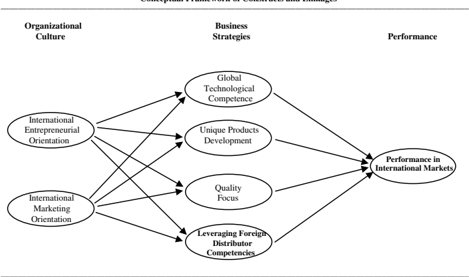
- The survey analysis found that international entrepreneurial orientation significantly predicted global technological competence with a standardized coefficient of 0.28; the link from international marketing orientation to global technological competence was not significant.
- Unique products development was significantly predicted by both international entrepreneurial orientation (0.19) and international marketing orientation (0.24).
- Quality focus was significantly predicted by both international entrepreneurial orientation (0.23) and international marketing orientation (0.35).
- Leveraging foreign distributor competences was significantly predicted by international marketing orientation (0.26) but not by international entrepreneurial orientation; these strategy variables were also significant drivers of performance in international markets: global technological competence (0.21), unique products development (0.14), quality focus (0.30), and leveraging foreign distributor competences (0.18).
## Methods
- The paper uses a two-phase design: first qualitative interviews/case studies to develop constructs and hypotheses, then a cross-industry field survey to test them.
- The qualitative phase included 33 professionals: 24 senior managers at early internationalizing firms, 6 scholars, and 3 international trade experts; the firms were mostly founded after 1985, sold half or more of their sales abroad, and had entered foreign markets within 3 years of founding.
- The survey was mailed to a random sample of 900 manufacturing firms in the United States founded in 1980 or later and exporting at least 25% of total production; 203 usable surveys were returned (about 23% response rate). The main analysis used LISREL8 path analysis, with exploratory factor analysis and confirmatory factor analysis for scale purification and validity checks.
## Limitations
- The paper states that “little empirical work” had been attempted on born globals and that there had been “almost no empirical research” on the factors driving their superior international performance.
- The study itself is focused on U.S. manufacturing firms that were selected using a 25% export threshold, so the evidence is tied to that sample and entry-mode context; this is evident from the text.
- The paper notes that the survey results are based on self-reported measures from responding firms; this is evident from the questionnaire-based design, though the paper does not frame it explicitly as a limitation.
Model-written summary. Check it against the paper before relying on it.
Integrity signals
Registry
Cites
Statistics
Figures
Verification
Claims the paper makes
0 Valid · 0 Not valid · 53 Not checked · 112 Own results and interpretations
A result the paper reports from its own data — it cites no other source for it, so there is none to check. The quote shows it is in the paper.
In the paper
“Despite the scarce resources typical of young firms, our findings reveal that born-global firms leverage a distinctive mix of orientations and strategies that allow them to succeed in diverse international markets.”
plainstates a cause- Asserted: passes — The authors put it forward as true.
- Checkable: passes — It can be checked against evidence.
- Load-bearing: passes — The paper’s conclusions depend on it.
- Based: passes — The paper gives a reason why it holds.
- Rests on an assumption not shown here.
A result the paper reports from its own data — it cites no other source for it, so there is none to check. The quote shows it is in the paper.
In the paper
“The critical role of marketing prowess overseas was also strongly emphasized by virtually all interviewees in the case studies.”
boosted- Asserted: passes — The authors put it forward as true.
- Checkable: passes — It can be checked against evidence.
- Load-bearing: unclear — It is unclear whether the paper’s conclusions depend on it.
- Based: passes — The paper gives a reason why it holds.
A result the paper states — it cites no source for it, so there is none to check. The quote shows it is in the paper.
In the paper
“Most interviewed firms exhibited strong technological capabilities in their respective product or industry categories.”
plain- Asserted: passes — The authors put it forward as true.
- Checkable: passes — It can be checked against evidence.
- Load-bearing: unclear — It is unclear whether the paper’s conclusions depend on it.
- Based: passes — The paper gives a reason why it holds.
A result the paper reports from its own data — it cites no other source for it, so there is none to check. The quote shows it is in the paper.
In the paper
“In general, the qualitative phase of the study revealed that born globals are likely to be formed by entrepreneurs who pursue foreign ventures with a strong marketing orientation.”
hedgedstates an association- Asserted: passes — The authors put it forward as true.
- Checkable: passes — It can be checked against evidence.
- Load-bearing: passes — The paper’s conclusions depend on it.
- Based: passes — The paper gives a reason why it holds.
A result the paper states — it cites no source for it, so there is none to check. The quote shows it is in the paper.
In the paper
“In contrast, born globals leverage a collection of fundamental intangible knowledge-based capabilities in the cultivation of foreign markets early in their evolution.”
plainstates a cause- Asserted: passes — The authors put it forward as true.
- Checkable: passes — It can be checked against evidence.
- Load-bearing: passes — The paper’s conclusions depend on it.
- Based: unclear — It is unclear why the paper says it holds.
- Rests on an assumption not shown here.
84 more claims
Create a free account to see all 165 claims and to verify the 3 references still open.
- It may state two separate claims as one. 33
- Probably not a substantial claim. 54
Citations
Cites
Evaluating Structural Equation Models with Unobservable Variables and Measurement Error
Fornell, C., & Larcker, D. F. (1981) · Journal of Marketing Research · doi:10.2307/3151312 · Cited by 109,314 · cited 2×
“Composite reliability was calculated using the procedures outlined by Fornell and Larcker (1981).”
MethodInfluentialEvaluating structural equation models with unobservable variables and measurement error
Fornell, C., & Larcker, D. F. (1981) · Journal of Marketing Research · doi:10.1177/002224378101800104 · Cited by 109,190
Firm Resources and Sustained Competitive Advantage
Barney, J. (1991) · Journal of Management · doi:10.1177/014920639101700108 · Cited by 48,334
(1994) · Journal of the American Dietetic Association · doi:10.1016/0002-8223(94)92216-0 · Cited by 45,910
Firm resources and sustained competitive advantage
Barney, J. B. (2004) · Advances in Strategic Management · doi:10.1016/s0742-3322(00)17018-4 · Cited by 38,152
Absorptive Capacity: A New Perspective on Learning and Innovation
Cohen, W. M., & Levinthal, D. A. (1990) · Administrative Science Quarterly · doi:10.2307/2393553 · Cited by 35,728
A resource‐based view of the firm
Wernerfelt, B. (1984) · Strategic Management Journal · doi:10.1002/smj.4250050207 · Cited by 25,635
The Theory of Economic Development
Schumpeter, J., & Backhaus, U. (2006) · The European Heritage in Economics and the Social Sciences · doi:10.1007/0-306-48082-4_3 · Cited by 22,506
An Evolutionary Theory of Economic Change.
Loasby, B. J., Nelson, R. R., & Winter, S. G. (1983) · The Economic Journal · doi:10.2307/2232409 · Cited by 21,366
A Dynamic Theory of Organizational Knowledge Creation
Nonaka, I. (1994) · Organization Science · doi:10.1287/orsc.5.1.14 · Cited by 17,809
Research works printed but not linked: 5
- Nikkei Sangyoo Shimbun (1995) Benchaa Shin Sedai (New Generation Ventures) , Nihon Keizai Shimbun: Tokyo.
- Nunnally, J.C. (1978) Psychometric Theory
- Porter, M.E. (1980) Competitive Strategy , The Free Press: New York.
- Rennie, M. (1993) 'Born global', McKinsey Quarterly (4): 45-52. Rosson, P. and Ford, I.D. (1982) 'Manufacturer-overseas distributor relations and export performance', Journal of International Business Studies 13 (2): 57-72.
- Schumpeter, J. (1939) Business Cycles , Vol. 1 McGraw-Hill: New York.
Cited by
Items 2,401–2,500 of 3,020
Entry Modes for Finnish Firms into the Zambian Renewable Energy Industry
Moono, M. (2014) · Doria (University of Helsinki)
Eloff, J. I. (2012) · UpSpace Institutional Repository (University of Pretoria)
Proces przyspieszonej internacjonalizacji : fenomen firm born global
Blanke-Ławniczak, K. (2008) · Zeszyty Naukowe Politechniki Poznańskiej. Organizacja i Zarządzanie
Prashantham, S. (2008) · SSRN Electronic Journal · doi:10.2139/ssrn.1309551
Bekamp, B. (2013) · Utrecht University Repository (Utrecht University)
Laurell, H. (2015) · DiVA - Jönköping University · Cited by 2
Notice of Retraction: An analytical framework for the internationalization of EIFs
Wang, Z., & Lin, Y. (2010) · IEEE International Conference on Computer Science and Information Technology · doi:10.1109/iccsit.2010.5563741
Born Global – Internationalisierung und Entrepreneurship
Neubauer, H. (2011) · Physica-Verlag eBooks · doi:10.1007/978-3-7908-2728-6_5 · Cited by 1
Servais, P., & Decker, A. (2014) · University of Southern Denmark Research Portal (University of Southern Denmark)
Orientação empreendedora no contexto internacional: um estudo de caso da Vinícola Panceri
Tonial, G., & Rosseto, C. R. (2020) · PROA-UA · doi:10.34624/rtd.v4i21/22.12277
Born Globals: Darstellung und kritische Würdigung
Trippel, A. (2015) · RePEc: Research Papers in Economics
Key drivers of overseas expansion of service franchise chains
Graciá, V. B., & Fernández, J. C. (2012) · ABACUS. Repositorio de Producción Científica (Universidad Europea)
Collaborative Product Development by Born Globals: Analyzing the Technology Alliance Capability.
Altshuler, L., & Elg, U. (2010) · Lund University Publications (Lund University)
An investigation of foreign exchange risk management by exporting small and medium sized enterprises
Dang, V. H. (2015) · Open Access Victoria University of Wellington | Te Herenga Waka (Figshare) · doi:10.26686/wgtn.17012750 · Cited by 1
Emergenz organisationaler Fähigkeiten
Kupke, S., & Lattemann, C. (2009) · Zeitschrift für Management · doi:10.1007/s12354-009-0105-1 · Cited by 2
de Alcântara, J. N., Calegário, C. L. L., Carneiro, J. M. T., & Buchbinder, F. (2015) · DOAJ (DOAJ: Directory of Open Access Journals) · doi:10.21714/1984-6975faces2015v14n3art2414
Halal International New Ventures (INVs) as a special case of SMEs internationalization
Osman, M. H. M., Roudini, A., & Heidarzadagan, A. (2014)
Eminefendic, T., & Gevorgyan, V. (2013) · Gothenburg University Publications Electronic Archive (Gothenburg University) · Cited by 1
Born Again Globals and the Reconfiguration of Resources in the Internationalization Process
Servais, P., & Decker, A. (2014) · University of Southern Denmark Research Portal (University of Southern Denmark)
Uwarunkowania powstania przedsiębiorstw od początku globalnych (born global)
Przybylska, K. (2012) · Krakow Review of Economics and Management/Zeszyty Naukowe Uniwersytetu Ekonomicznego w Krakowie
Local country attributes and the emergence of high tech clusters
Malul, M., & Shoham, A. (2014) · International Economics and Economic Policy · doi:10.1007/s10368-014-0294-7
International entrepreneurship and knowledge acquisition in Chinese international firms
Yang, H. R., Ding, D. Z., & Liu, Z. (2010) · International Journal of Business and Emerging Markets · doi:10.1504/ijbem.2010.035664
“International entrepreneurship is the extension of the conceptual domain to international operations (Knight and Cavusgil, 2004; Zhou, 2007).”
BackgroundInternationalisation of film production: a historical review of movie making in Taiwan and Hong Kong
Yang, Y. K. (2014) · International Journal of Business and Globalisation · doi:10.1504/ijbg.2014.065430
“Entrepreneurial managers can mobilise the resources needed to launch operations across countries in the firm’s initial stage; in other words, those firms are born into an international or even global market (Knight and Cavusgil, 2004; Moen and Servais, 2002; Oviatt and McDougall, 1997).”
BackgroundLimits of I-models Principles Application on Czech SMEs' Internationalization Process
Kubíčková, L. (2014) · Acta Universitatis Agriculturae et Silviculturae Mendelianae Brunensis · doi:10.11118/actaun201462040667
Wang, S. (2013) · Open Access Victoria University of Wellington | Te Herenga Waka (Figshare) · doi:10.26686/wgtn.17006017 · Cited by 1
Haaff, D. N. D., & Nicholas, D. (2012)
Guo, X. (2011) · KTH Publication Database DiVA (KTH Royal Institute of Technology)
Zilli, J. C., Elias, M. J., Watanabe, M., et al. (2014) · Revista E-Tech Tecnologias para Competitividade Industrial · doi:10.18624/e-tech.v7i1.429
SME’s and the Problems of Development: An Innovative Costa Rican Approach
Thach, S. V., Lafuente, E., Fan, C., & Garcia, A. R. (2011) · Journal of Marketing Development and Competitiveness
Nairn, H. (2009) · The Sydney eScholarship Repository (The University of Sydney)
Carrick, J. (2012) · Enlighten: Theses (The University of Glasgow) · Cited by 1
An Adaptive Method For Face Recognition Based Filters and Selection of Features
Cho, B.-M., Kim, G.-H., & Rhee, P.-K. (2009) · The Journal of the Korea Contents Association · doi:10.5392/jkca.2009.9.6.001
Growth of the International New Venture (INV)
Sisay, T. (2013)
Chaves, F. Q., & Barber, J. P. (2013) · TEC Empresarial · doi:10.18845/te.v7i1.1331
Tartu Ülikooli spin-off ettevõtete rahvusvahelistumine Positium LBS OÜ ja TBD-Biodiscovery OÜ näitel
Lüüs, S. (2012) · DSpace repository (University of Tartu)
Performance Measurement and Antecedents of Early Internationalizing Firms: A Systematic Assessment
Rättich, G., Clark, K., & Hartmann, E. (2011) · Gabler eBooks · doi:10.1007/978-3-8349-6900-2_3
“…previously assumed that EIFs are typical for the high-tech sector, some studies have identified EIF phenomenon in other areas, like medical solutions, textile printing, woodwork or various types of manufacturing (see e.g. Knight & Cavusgil, 2004; Mostafa, Wheeler & Jones, 2006; Han & Celly, 2008).”
BackgroundMethodInfluentialEnhancing International Performance of Exporting Firms through E-Business Integration
Ekemen, M. A., & Bayram, P. (2014) · Business and Economic Research · doi:10.5296/ber.v4i1.5273
“The questionnaire was designed as undisguised -respondents were informed about the purpose of the study - and structured - the same questions are administered to every respondent, and developed by using five-point Likert scales to minimize response time and effort (Knight & Cavusgil, 2004).”
MethodThe Role of Export-Driven New Ventures in Economic Growth: A Cross-Country AnalysisPreprint
Hessels, J., & van Stel, A. J. (2007) · RePEc: Research Papers in Economics
Liu, C., Tian, L., & Jing, Y. (2014) · The Anthropologist · doi:10.1080/09720073.2014.11891483
“Born internationals are defined as independently operating small and medium-sized firms with export sales that represent at least 20% of their total sales within 3 years of inception (Knight and Cavusgil 2004).”
BackgroundANALYZING INTERNATIONALIZATION, TECHNOLOGICAL DEVELOPMENT AND SUSTAINABLE FIRM GROWTH
(2013) · Issues in Information Systems · doi:10.48009/1_iis_2013_21-26
“Recently, internationalization scholars have acknowledged that entrepreneur firms internationalize at their early stages and follow a more radical and large-scale approach [11].”
UK public policy and open innovation
Levy, C. S., & Reid, B. (2011)
Technology and the Export Behavior of Small, Locally- owned Firms: New Insight
Williams, D. A. (2018) · Journal for the Advancement of Developing Economies · doi:10.13014/k27w69dk
“The gradualist view has come under heavy scrutiny given the rise of born global and international new ventures firms (Knight & Cavusgil, 2004; Oviatt & McDougall, 1994).”
BackgroundBlesa, A., Meliá, M. R., & Monferrer, D. (2009)
BRANDING IN THE INTERNATIONAL BUSINESS OPPORTUNITY DEVELOPMENT
Berle, M. (2014)
Corso di Laurea magistrale in Economia degli Scambi Internazionali
Pattarello, S., & Accademico, A. (2012)
Technology and Precocious Internationalization in Brazilian Industry Author's Information:
Silva, A., Francischini, N., & García, R. (2010)
USE OF INTERNATIONAL TRADE FAIRS FOR THE INTERNATIONALISATION OF SMEs
Measson, N. (2011)
Campos, T. M., Lima, E., Júnior, V. U., et al. (2011) · Dialnet (Universidad de la Rioja)
Born Global: a debate on organizational forms and
Ruzza, E., & Accademico, A. (2014)
Filosofiche, S. (2014)
Teollisuusyrityksen muuntautuminen kansainväliseen palveluliiketoimintaan
Nurminen, T. (2015) · Tampere University Institutional Repository (Tampere University)
The global strategy of high-tech startups-case studies of cambridge region
Taji, N. (2013) · doi:10.1109/itmc.2013.7352705
“Clear product positioning makes it possible for these born-global firms to grow rapidly Knight and Cavusgil, 1996, 2004; Madsen and Servais, 1997].”
BackgroundTwo Essays on the Degree of Globalization of a Firm: Measurement, Antecedents, and Consequences
Marshall, V. B. (2012) · DigitalCommons - Kennesaw State University (Kennesaw State University)
Firm level factors and Internatioal performance of Companies listed on the Securities Exchange
Musuva, M. A. M. (2013) · University of Nairobi Research Archive (University of Nairobi) · Cited by 2
Essays on the entrepreneurship-growth nexus: an aggregate analysis
Mthanti, T. (2014)
Does the intensity in R&D generate start-up's growth?Preprint
Herrero, F. V., & Pernía, J. L. G. (2010) · RePEc: Research Papers in Economics
A Adoção do E-Commerce e a Velocidade de Internacionalização das Empresas
Azevedo, A. R. M. (2015) · Portuguese National Funding Agency for Science, Research and Technology (RCAAP Project by FCT) · doi:10.34626/46rs-2n12
Co-entrepreneurs in high-tech Born globals
Dominguinhos, P., & Simões, V. C. (2007) · Portuguese National Funding Agency for Science, Research and Technology (RCAAP Project by FCT)
Costa, M. D. P. B. (2013) · Portuguese National Funding Agency for Science, Research and Technology (RCAAP Project by FCT) · Cited by 5
International Business Competence Framework: Internationalized Small and Medium Enterprises (SMEs)
Ibrahim, Z., Abdullah, F., & Ismail, A. (2015) · Springer eBooks · doi:10.1007/978-981-10-0036-2_13
“International innovativeness is an important dimension as it positively influences the performance of internationalized SMEs [9, 43].”
BackgroundInfluentialFreiling, J., & Schmidt, M. K. (2012) · SSRN Electronic Journal · doi:10.2139/ssrn.2179596
Innovation champions in internationalisation approaches of SME first exporters
Rees, M., & Edwards, R. (2011) · Swinburne figshare (Swinburne University of Technology) · doi:10.25916/sut.26284678
Kimando, L. N. (2016) · Cited by 1
Portillo, C., & Andrés, M. (2015) · Aaltodoc (Aalto University)
Mannebach, T. (2014) · Portuguese National Funding Agency for Science, Research and Technology (RCAAP Project by FCT)
Ekspordi ja innovatsiooni seosed Eesti töötleva tööstuse ettevõtetes
Kljain, A. (2014) · DSpace repository (University of Tartu)
INTERNACIONALIZAÇÃO DE EMPRESAS EXPORTADORAS: ASPECTOS MOTIVACIONAIS E O PAPEL DO EMPREENDEDOR
Galdino, C. B., & da Costa, L. D. F. L. G. (2015) · Holos · doi:10.15628/holos.2015.2263
IT-yrityksen etabloituminen Keski-Eurooppaan
Aho, O. (2014) · Doria (University of Helsinki)
김선조, & Lee, S.-B. (2012) · The e-Business Studies · doi:10.15719/geba.13.4.201211.195
김민숙, & Bang, H.-Y. (2014) · The Journal of International Trade & Commerce · doi:10.16980/jitc.10.5.201410.247
주혜영, & Du, H. (2014) · The Journal of International Trade & Commerce · doi:10.16980/jitc.10.3.201406.87
Strategic Approach to Internationalization Paths of Korean Animation Companies
Pichurina, V., & 박상일 (2013) · The Journal of International Trade & Commerce · doi:10.16980/jitc.9.5.201310.255
Suh, C.-J., & 남현정 (2014) · Journal of Korea Service Management Society · doi:10.15706/jksms.2014.15.2.005
조연성 (2012) · Journal of Korea Service Management Society · doi:10.15706/jksms.2012.13.1.007
Sectoral Differences in Determinants of Export IntensityPreprint
Bhaird, C. M. A., & Curran, D. (2016) · SSRN Electronic Journal · doi:10.2139/ssrn.2761081
Choi, J. (2012) · 전략경영연구 · doi:10.17786/jsm.2012.15.1.002 · Cited by 1
INTERNACIONALIZAÇÃO DE EMPRESAS EXPORTADORAS: ASPECTOS MOTIVACIONAIS E ESTRATÉGICOS
Galdino, C. B., & Costa, L. F. L. G. (2015) · Redalyc (Universidad Autónoma del Estado de México)
Rodrigues, F. P. (2015) · Digital Library of Theses and Dissertations (Universidade de São Paulo) · doi:10.11606/d.18.2015.tde-16122015-105642
Martins, I., Rialp, A., & Vaillant, Y. (2012) · SSRN Electronic Journal · doi:10.2139/ssrn.2161996
Creating Global Product and Service Offerings
Schlegelmilch, B. B. (2016) · Management for professionals · doi:10.1007/978-3-319-26279-6_5
de Alcântara, J. N., Lelis, C., Calegario, L., & Thomé, K. M. (2014)
Carlos, E. D. E. D. S., & Rodrigues, F. P. (2015)
Zhang, M., Kwon, J.-S., & Gao, Q. (2016) · International Journal of Social Ecology and Sustainable Development · doi:10.4018/ijsesd.2016040104
INTERNATIONAL MANAGEMENT RESEARCH: QUO VADIS?
Reiche, B. S., & Pudelko, M. (2015)
Jekanyika, M., Oly, N., & Jie, F. (2016) · SSRN Electronic Journal
Gossas, E., & Fandrey, R. (2016) · KTH Publication Database DiVA (KTH Royal Institute of Technology)
Metadata
- Authors
- Knight, G. A., & Cavusgil, S. T.
- Affiliations
- Florida State University (US)
- Corresponding author
- Knight, Gary A
- ORCID
- Knight, Gary A
- Venue
- Journal of International Business Studies
- Published
- 2004-01-08
- Volume
- 35
- Issue
- 2
- Pages
- 124-141
- ISSN
- 0047-2506 (ISSN-L)
- 1478-6990
- OpenAlex
- W2127709152
- Semantic Scholar
- d24960b5342d0dd3b86be002ab18a80e7b6fb5c9
- Cited by
- 3,013
- References
- 102
- Citations by year
- 2026: 121 · 2025: 123 · 2024: 157 · 2023: 154 · 2022: 182 · 2021: 196 · 2020: 189 · 2019: 180 · 2018: 199 · 2017: 172 · 2016: 188 · 2015: 187 · 2014: 178 · 2013: 167 · 2012: 129
- FWCI
- 137.12
- Type
- journal article
- Language
- en
- Update notices
- correction (2004-07-16)
- Open access
- bronze
- doi.org
- Licence
- www.springer.com/tdm (tdm)
- Locations
- Journal of International Business Studies (publishedVersion)
- RePEc: Research Papers in Economics (submittedVersion)
- Funders
- Michigan State University
- College of Engineering, Michigan State University
- Topics
- Social Sciences › Business, Management and Accounting › Strategy and Management › International Business and FDI
- Social Sciences › Business, Management and Accounting › Strategy and Management › Innovation and Knowledge Management
- Social Sciences › Communication › International Student and Expatriate Challenges
- Keywords
- born global firms, early internationalization, organizational capabilities, innovation, innovation culture, international business strategy, international success, young firms, internationalization of firms
About these checks
Registry, retraction, Cites and statistics results are computed, not judged, with one exception: a printed reference that no index lists is read once by a model before it counts as a citation error. Claims are extracted by a model and kept only when their quote appears verbatim in the text; each cited source is then checked, with a model’s help, for whether it says what the claim relies on. Those verdicts can be wrong — read the claim’s quote and the cited source before relying on one.
A language model drew the claims from the paper on 2026-10-10, under version 3 of the claim definition (model deepseek-v4.1-flash, prompt extract-v3).
A second model labelled each claim on 2026-10-10 (model jev-1.13-20260917, definition revision gold-guideline-v0.2).
Statistics and arithmetic are recomputed, not judged.
Confidence bands are shown only for fields calibrated on our annotated test set. None is calibrated yet, so no band is shown.
What counts as a claim ›How we measure confidence ›How we check this ›
Are you an author, or do you see a problem with this page? Request a review
Data sources
Bibliographic data: Semantic Scholar, OpenAlex, Crossref.
Contains information from the Semantic Scholar Academic Graph Datasets, made available under the ODC Attribution License (ODC-BY 1.0).
Semantic Scholar’s data is described in: Kinney, R., et al. (2023). The Semantic Scholar Open Data Platform. arXiv:2301.10140.
