

Innovation, organizational capabilities, and the born-global firm
Open accessThe DOI matches its Crossref record; 106 of the 106 references it cites were found in a registry or an index; none of the 100 sources its claims cite is checked for support yet.
Overview
CoChat Summary
## TL;DR
This study argues that born-global firms succeed because early internationalization is supported by an innovative culture and a distinctive set of organizational capabilities. Using qualitative case studies followed by a survey of 203 usable responses, the authors find that several capability links are significant and that these capabilities are associated with performance in international markets.
## Key findings
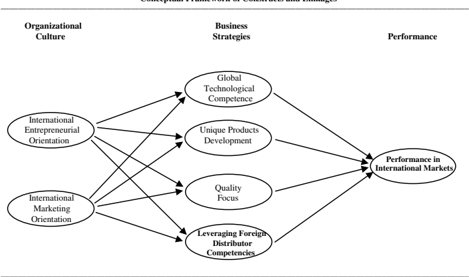
- The survey analysis found that international entrepreneurial orientation significantly predicted global technological competence with a standardized coefficient of 0.28; the link from international marketing orientation to global technological competence was not significant.
- Unique products development was significantly predicted by both international entrepreneurial orientation (0.19) and international marketing orientation (0.24).
- Quality focus was significantly predicted by both international entrepreneurial orientation (0.23) and international marketing orientation (0.35).
- Leveraging foreign distributor competences was significantly predicted by international marketing orientation (0.26) but not by international entrepreneurial orientation; these strategy variables were also significant drivers of performance in international markets: global technological competence (0.21), unique products development (0.14), quality focus (0.30), and leveraging foreign distributor competences (0.18).
## Methods
- The paper uses a two-phase design: first qualitative interviews/case studies to develop constructs and hypotheses, then a cross-industry field survey to test them.
- The qualitative phase included 33 professionals: 24 senior managers at early internationalizing firms, 6 scholars, and 3 international trade experts; the firms were mostly founded after 1985, sold half or more of their sales abroad, and had entered foreign markets within 3 years of founding.
- The survey was mailed to a random sample of 900 manufacturing firms in the United States founded in 1980 or later and exporting at least 25% of total production; 203 usable surveys were returned (about 23% response rate). The main analysis used LISREL8 path analysis, with exploratory factor analysis and confirmatory factor analysis for scale purification and validity checks.
## Limitations
- The paper states that “little empirical work” had been attempted on born globals and that there had been “almost no empirical research” on the factors driving their superior international performance.
- The study itself is focused on U.S. manufacturing firms that were selected using a 25% export threshold, so the evidence is tied to that sample and entry-mode context; this is evident from the text.
- The paper notes that the survey results are based on self-reported measures from responding firms; this is evident from the questionnaire-based design, though the paper does not frame it explicitly as a limitation.
Model-written summary. Check it against the paper before relying on it.
Integrity signals
Registry
Cites
Statistics
Figures
Verification
Claims the paper makes
0 Valid · 0 Not valid · 53 Not checked · 112 Own results and interpretations
A result the paper reports from its own data — it cites no other source for it, so there is none to check. The quote shows it is in the paper.
In the paper
“Despite the scarce resources typical of young firms, our findings reveal that born-global firms leverage a distinctive mix of orientations and strategies that allow them to succeed in diverse international markets.”
plainstates a cause- Asserted: passes — The authors put it forward as true.
- Checkable: passes — It can be checked against evidence.
- Load-bearing: passes — The paper’s conclusions depend on it.
- Based: passes — The paper gives a reason why it holds.
- Rests on an assumption not shown here.
A result the paper reports from its own data — it cites no other source for it, so there is none to check. The quote shows it is in the paper.
In the paper
“The critical role of marketing prowess overseas was also strongly emphasized by virtually all interviewees in the case studies.”
boosted- Asserted: passes — The authors put it forward as true.
- Checkable: passes — It can be checked against evidence.
- Load-bearing: unclear — It is unclear whether the paper’s conclusions depend on it.
- Based: passes — The paper gives a reason why it holds.
A result the paper states — it cites no source for it, so there is none to check. The quote shows it is in the paper.
In the paper
“Most interviewed firms exhibited strong technological capabilities in their respective product or industry categories.”
plain- Asserted: passes — The authors put it forward as true.
- Checkable: passes — It can be checked against evidence.
- Load-bearing: unclear — It is unclear whether the paper’s conclusions depend on it.
- Based: passes — The paper gives a reason why it holds.
A result the paper reports from its own data — it cites no other source for it, so there is none to check. The quote shows it is in the paper.
In the paper
“In general, the qualitative phase of the study revealed that born globals are likely to be formed by entrepreneurs who pursue foreign ventures with a strong marketing orientation.”
hedgedstates an association- Asserted: passes — The authors put it forward as true.
- Checkable: passes — It can be checked against evidence.
- Load-bearing: passes — The paper’s conclusions depend on it.
- Based: passes — The paper gives a reason why it holds.
A result the paper states — it cites no source for it, so there is none to check. The quote shows it is in the paper.
In the paper
“In contrast, born globals leverage a collection of fundamental intangible knowledge-based capabilities in the cultivation of foreign markets early in their evolution.”
plainstates a cause- Asserted: passes — The authors put it forward as true.
- Checkable: passes — It can be checked against evidence.
- Load-bearing: passes — The paper’s conclusions depend on it.
- Based: unclear — It is unclear why the paper says it holds.
- Rests on an assumption not shown here.
84 more claims
Create a free account to see all 165 claims and to verify the 3 references still open.
- It may state two separate claims as one. 33
- Probably not a substantial claim. 54
Citations
Cites
Evaluating Structural Equation Models with Unobservable Variables and Measurement Error
Fornell, C., & Larcker, D. F. (1981) · Journal of Marketing Research · doi:10.2307/3151312 · Cited by 109,314 · cited 2×
“Composite reliability was calculated using the procedures outlined by Fornell and Larcker (1981).”
MethodInfluentialEvaluating structural equation models with unobservable variables and measurement error
Fornell, C., & Larcker, D. F. (1981) · Journal of Marketing Research · doi:10.1177/002224378101800104 · Cited by 109,190
Firm Resources and Sustained Competitive Advantage
Barney, J. (1991) · Journal of Management · doi:10.1177/014920639101700108 · Cited by 48,334
(1994) · Journal of the American Dietetic Association · doi:10.1016/0002-8223(94)92216-0 · Cited by 45,910
Firm resources and sustained competitive advantage
Barney, J. B. (2004) · Advances in Strategic Management · doi:10.1016/s0742-3322(00)17018-4 · Cited by 38,152
Absorptive Capacity: A New Perspective on Learning and Innovation
Cohen, W. M., & Levinthal, D. A. (1990) · Administrative Science Quarterly · doi:10.2307/2393553 · Cited by 35,728
A resource‐based view of the firm
Wernerfelt, B. (1984) · Strategic Management Journal · doi:10.1002/smj.4250050207 · Cited by 25,635
The Theory of Economic Development
Schumpeter, J., & Backhaus, U. (2006) · The European Heritage in Economics and the Social Sciences · doi:10.1007/0-306-48082-4_3 · Cited by 22,506
An Evolutionary Theory of Economic Change.
Loasby, B. J., Nelson, R. R., & Winter, S. G. (1983) · The Economic Journal · doi:10.2307/2232409 · Cited by 21,366
A Dynamic Theory of Organizational Knowledge Creation
Nonaka, I. (1994) · Organization Science · doi:10.1287/orsc.5.1.14 · Cited by 17,809
Research works printed but not linked: 5
- Nikkei Sangyoo Shimbun (1995) Benchaa Shin Sedai (New Generation Ventures) , Nihon Keizai Shimbun: Tokyo.
- Nunnally, J.C. (1978) Psychometric Theory
- Porter, M.E. (1980) Competitive Strategy , The Free Press: New York.
- Rennie, M. (1993) 'Born global', McKinsey Quarterly (4): 45-52. Rosson, P. and Ford, I.D. (1982) 'Manufacturer-overseas distributor relations and export performance', Journal of International Business Studies 13 (2): 57-72.
- Schumpeter, J. (1939) Business Cycles , Vol. 1 McGraw-Hill: New York.
Cited by
Items 2,301–2,400 of 3,020
Relaciones de redes, perspectiva de internacionalización para la pyme Gastro Innova
Montenegro-Arcila, M. M. (2021) · Ploutos · doi:10.21158/23227230.v10.n0.2020.2841 · Cited by 1
Capacidades Organizacionales en las Empresas de Manufacturas de Cuenca – Ecuador
Mejía-Matute, S. R., Pinos-Luzuriaga, L. G., Proaño-Rivera, W. B., & Galarza, E. G. (2021) · INNOVA Research Journal · doi:10.33890/innova.v6.n2.2021.1667 · Cited by 2
Widening International Entrepreneurship Research
Blesa, A., & Meliá, M. R. (2020) · MDPI eBooks · doi:10.3390/books978-3-03928-281-4 · Cited by 1
Análise da capacidade competitiva das micro e pequenas empresas brasileiras com vista a exportação
Ferreira, C. P. S., Cavalcanti, A. M., & da Silva, A. M. (2021) · Exacta · doi:10.5585/exactaep.2021.17813 · Cited by 1
Qadir, S. A., Olcay, G. A., & Kunday, Ö. (2021) · International Journal of Innovation and Technology Management · doi:10.1142/s0219877021500255 · Cited by 1
YALÇIN, A., & Çetin, B. (2021) · Journal of Business Research - Turk · doi:10.20491/isarder.2021.1280 · Cited by 1
Effect of Organizational Capability on Firms Growth: Implications on SMEs in Anambra State, Nigeria
Anugwu, C. C., Nwosu, C. K., & Okoli, I. E. (2021) · European Journal of Business Management and Research · doi:10.24018/ejbmr.2021.6.5.1050 · Cited by 1
“[16] Knight, G.A., & Cavusgil, S.T. Innovation, organizational capabilities, and the born-global firm.”
BackgroundEntrepreneurial Internationalization in an Increasingly Digitized and Networked World Economy
(2021) · Edward Elgar Publishing eBooks · doi:10.4337/9781788976817 · Cited by 1
Introduction and Problem Statement
Schühly, A. M. (2022) · MIR series in international business · doi:10.1007/978-3-030-86660-0_1 · Cited by 1
Discovering the Nexus between Market Orientation and Open Innovation: A Grounded Theory Approach
Şakar, G. D., Çetin, Ç. K., & Saatçıoğlu, Ö. Y. (2015) · IGI Global eBooks · doi:10.4018/978-1-4666-8468-3.ch060 · Cited by 2
Creating Global Product and Service Offerings
Schlegelmilch, B. B. (2022) · Management for professionals · doi:10.1007/978-3-030-90665-8_7 · Cited by 1
INTERNASIONALISASI KHAZANAH KESULTANAN DAN KERATON MELALUI BAHAN BACAAN BAHASA INGGRIS
Ikhsanudin, I., & Barella, Y. (2022) · Jurnal Pendidikan Sosiologi dan Humaniora · doi:10.26418/j-psh.v13i1.46238 · Cited by 1
SOCIAL GLOBALISATION IN THE CONTEXT OF INTERNATIONAL ENTREPRENEURSHIP
(2017) · Asia Pacific Journal of Advanced Business and Social Studies · doi:10.25275/apjabssv3i2bus14 · Cited by 1
The Roles of International Entrepreneurship and Organizational Innovation in SMEs
Kasemsap, K. (2016) · IGI Global eBooks · doi:10.4018/978-1-4666-9814-7.ch062 · Cited by 1
Les Grands Auteurs en Entrepreneuriat et PME
Servantie, V. (2015) · EMS Editions eBooks · doi:10.3917/ems.torre.2015.01.0409 · Cited by 1
Forms of growth: How SMEs combine forms of growth to achieve high growth
Navarro, J. L. B., Bueno, J. C. C., & Barringer, B. R. (2011) · Journal of Management & Organization · doi:10.5172/jmo.2012.81 · Cited by 1
Market innovations driving competitive advantage in MSMEs: An extensive literature review
Rathod, H. S., Dixit, T., Huda, M., & Maseleno, A. (2022) · International Journal of Health Sciences · doi:10.53730/ijhs.v6ns3.7449 · Cited by 18
Internationalisierung von Dienstleistungen
Haller, S., & Wissing, C. (2022) · Springer eBooks · doi:10.1007/978-3-658-36810-4_9 · Cited by 1
Wpływ kryzysu na funkcjonowanie przedsiębiorstw i przemiany układów przestrzennych
Zioło, Z., & Kilar, W. (2023) · Studies of the Industrial Geography Commission of the Polish Geographical Society · doi:10.24917/20801653.371 · Cited by 1
The Influence of Internationalization on Credit Ratings: an Analysis of Brazilian Companies
Prates, R. C., & da Fonseca, M. W. (2023) · Revista de Ciências da Administração · doi:10.5007/2175-8077.2023.e70312
The effects of innovation on export of the small and medium-sized enterprises: The case of Viet Nam
Le, D. N., & Thành, P. T. (2022) · Science & Technology Development Journal - Economics - Law and Management · doi:10.32508/stdjelm.v6i2.974 · Cited by 1
Classification of Born-Global Firms: The Case of Japanese High-Tech Startups
Otomo, S., Ishida, S., & Yang-Yoshihara, M. (2023) · Management for professionals · doi:10.1007/978-3-031-43188-3_9 · Cited by 1
Industry Factors Influencing International New Ventures' Internationalisation Processes
Evers, N., Kuivalainen, O., & Andersson, S. (2015) · Palgrave Macmillan UK eBooks · doi:10.1057/9781137473110_13 · Cited by 1
Toward International Entrepreneurial Orientation and Networking of Born Global Firms
Sekliuckienė, J. (2015) · Contributions to management science · doi:10.1007/978-3-319-18185-1_10 · Cited by 1
De, C. L., & Mazza, S. (2013) · Americanae (AECID Library) · Cited by 2
Galimberti, M. F. (2009) · Americanae (AECID Library) · Cited by 1
Ding, Q. (2011) · Research Commons (University of Waikato) · Cited by 3
Gelan, D. T., & Wedajo, G. (2013) · SSRN Electronic Journal · doi:10.2139/ssrn.2261488 · Cited by 1
Palmero, A. J. (2010) · Repositorio Institucional de la Universidad de Burgos (University of Burgos) · doi:10.36443/10259/143 · Cited by 2
Internationalisierung von jungen High-Tech KMU
Nolting, M. (2010) · Gabler eBooks · doi:10.1007/978-3-8349-8657-3_5 · Cited by 1
Innovation in Emerging Market Micro, Small and Medium Enterprises: Barriers and Access to Resources
Ramnath, G. (2012) · doi:10.13021/mars/8298 · Cited by 1
Networking capability development in new venture internationalisation: a theory building approach
Warner, K. S. R. (2014) · Enlighten: Theses (The University of Glasgow) · Cited by 2
Oh, C.-H., Cho, Y.-R., & Kim, W.-J. (2009) · The Journal of the Korea Contents Association · doi:10.5392/jkca.2009.9.6.153 · Cited by 1
Can Australia Compete Internationally? The Old Question Revisited in the Light of New Evidence
Lewis, G., & Zalan, T. (2005) · Asia Pacific Business Review · doi:10.1080/13602380500068516 · Cited by 2
“A recent study provides further evidence on the relationship between capabilities of ‘born global’ firms targeting global niche markets and superior financial performance in international markets (Knight & Cavusgil, 2004).”
BackgroundYang, H. (2010) · IEEE International Conference on Industrial Engineering and Engineering Management (IEEM) · doi:10.1109/ieem.2010.5674541 · Cited by 1
Networking Capability And 'Born Global' Exporters
Mort, G. S., Weerawardena, J., & Meng, A. C. (2005) · Cited by 1
Kahiya, E. T. (2012) · Lincoln University Research Archive (Lincoln University) · Cited by 1
The Role of Inter-personal Networks in SME Internationalisation
Eberhard, M. (2013) · e-publications@bond (Bond University) · Cited by 6
Yavuz, R. I. (2011) · SSRN Electronic Journal · doi:10.2139/ssrn.1950752 · Cited by 1
GOING GLOBAL: SUCCESS FACTORS FOR PENETRATING EMERGING MARKETS
Knab, E. F. (2008) · ProQuest Demo Repository · Cited by 3
Problemistic Search and International EntrepreneurshipPreprint
Holmquist, C., & Wennberg, K. (2008) · SSRN Electronic Journal · Cited by 1
The effect of internet technology in the exporter-distributor relationship
Knight, G., & Kuhlmeier, D. B. (2005) · DigiNole (Florida State University) · Cited by 1
Self-citationBruneel, J. (2009) · Ghent University Academic Bibliography (Ghent University) · Cited by 1
Nothing New under the Sun? How Firms Can Benefit from New Product Imitation
Shu, C. (2012) · Figshare · Cited by 1
The Internationalization of Academic Spin-Offs: Evidence from ItalyPreprint
Bolzani, D., Fini, R., & Grimaldi, R. (2015) · SSRN Electronic Journal · doi:10.2139/ssrn.2671330 · Cited by 1
Foreign Market Entry Mode Choice of Small and Medium-Sized Enterprises
Laufs, K. (2015) · Univ. Duesseldorf: Duesseldorfer Dokumenten- und Publikationsserver · Cited by 1
Batas, S. (2015) · ERA · Cited by 1
Global sales channel strategies of technology intensive startups
Jokinen, K. (2012) · Aaltodoc (Aalto University) · Cited by 2
Gruber-Mücke, T. (2013) · SSRN Electronic Journal · doi:10.2139/ssrn.2232076 · Cited by 1
Miller, T. L. (2009) · OakTrust (Texas A&M University Libraries) · Cited by 3
Gustas, T., & Blixt, C. (2016) · DiVA (Digitala Vetenskapliga Arkivet)
Yamamoto, S., & Kan, V. (2018) · Institutional Repositories DataBase (IRDB) · doi:10.13140/rg.2.2.22424.16645 · Cited by 2
Australian infant formula exports to China: factors for success
Marano, S. (2018) · RMIT Research Repository (RMIT University Library) · doi:10.25439/rmt.27581769 · Cited by 1
Vendruscolo, L. T. (2019) · doi:10.11606/d.96.2019.tde-21082019-155040 · Cited by 1
Features of Born-Global Processing Plants under the Global Economy
Zhao, H. G., Lo, V. H. Y., & Sculli, D. (2005) · Journal of international technology and information management · doi:10.58729/1941-6679.1157 · Cited by 1
Niche marketing strategy and export performance in SMEs
Assadinia, S. (2014) · White Rose eTheses Online (University of Leeds, The University of Sheffield, University of York) · Cited by 4
Small, Young, and Exporters: New Evidence on the Determinants of Firm GrowthPreprint
Grazzi, M. (2016) · SSRN Electronic Journal · doi:10.2139/ssrn.2791464 · Cited by 1
Borders of Network Effects and Early Internationalization as a Latecomer StrategyPreprint
Park, S., & Chang, S. (2021) · SSRN Electronic Journal · doi:10.2139/ssrn.3878726 · Cited by 1
The Consequences of Intrapreneurship in Exporting Firms: A Structural-model ApproachPreprint
Brás, G. R., & Preto, M. T. (2021) · SSRN Electronic Journal · doi:10.2139/ssrn.3892885 · Cited by 3
Strategic responses to disruption by established SMEs in a declining industry
Thomas, G. H. (2021) · Queensland University of Technology · doi:10.5204/thesis.eprints.212900 · Cited by 1
The internationalization process of entrepreneurial SMEs in high technology niche market segments
Cruz-Carreon, G. (2007) · QUT Business School · Cited by 1
Knight, G. (2010) · Wiley International Encyclopedia of Marketing · doi:10.1002/9781444316568.wiem06052 · Cited by 1
Self-citationForouharfar, A. (2022) · Springer eBooks · doi:10.1007/978-3-030-66252-3_3893 · Cited by 1
Piqueras, S., & Rialp, A. (2023) · SSRN Electronic Journal · doi:10.2139/ssrn.4478768 · Cited by 2
Alarcón‐del‐Amo, M., Rialp, A., Criado, J. R., et al. (2023) · SSRN Electronic Journal · doi:10.2139/ssrn.4579229 · Cited by 1
Analysis of the Competitiveness of Hungarian Companies from the Perspective of Internationalisation
Szanyi-Gyenes, X. (2024) · CUB Ph.D. Dissertations (Corvinus University of Budapest) · doi:10.14267/phd.2024012 · Cited by 1
Internationalization of Small- and Medium-Sized Enterprises (SMEs)
Anggadwita, G., & Indarti, N. (2024) · Elsevier eBooks · doi:10.1016/b978-0-443-13701-3.00321-2 · Cited by 1
Fraccastoro, S., Vanninen, H., & Gabrielsson, M. (2024) · SSRN Electronic Journal · doi:10.2139/ssrn.4891460 · Cited by 1
The Mid-Sized Market Trap in Entrepreneurial ScalingPreprint
Wright, N. L., & Saiedi, E. (2024) · SSRN Electronic Journal · doi:10.2139/ssrn.5078041 · Cited by 2
Xin, M., & Mendonça, A. D. S. (2025) · Research Square · doi:10.21203/rs.3.rs-5645142/v1 · Cited by 1
Entrepreneurial Dynamics of Internationalising Ventures: The Opportunity-Value Creation Nexus
Peiris, I. K. (2014) · Research Commons (University of Waikato) · Cited by 2
Bettini, F. A. (2009) · AMS Dottorato Institutional Doctoral Theses Repository (University of Bologna) · doi:10.6092/unibo/amsdottorato/1520 · Cited by 1
Errotabehere, M. (2018) · theses.fr (ABES) · doi:10.70675/d0fa6dd4zc239z4db7z9e0bz53842853b6cf · Cited by 2
Mohamed, F., & Zaouaoui, S. K. (2026) · Journal of global entrepreneurship research · doi:10.1007/s40497-026-00525-z · Cited by 3
Basic Concepts of Global Operations Strategy
Gong, Y. Y. (2013) · Springer texts in business and economics · doi:10.1007/978-3-642-36708-3_1
Das Lernverhalten früh internationalisierender Unternehmen: Ein konzeptioneller Analyserahmen
Schwens, C., & Kabst, R. (2009) · Gabler eBooks · doi:10.1007/978-3-8349-8431-9_5
Tao, M. (2014) · Gothenburg University Publications Electronic Archive (Gothenburg University)
Digital Inequality on Global Online Knowledge Exchange Platforms
Yu, Y., Lang, K. R., & Gross, S. T. (2013) · Lecture notes in business information processing · doi:10.1007/978-3-642-39808-7_13
“In international business studies, firms which have targeted international markets since their foundation, are called born global firms [13].”
BackgroundSME Internationalisation: Studies of Resource as Antecedents and Performance Outcomes
Cao, Q. (2014) · doi:10.25560/24919
“…companies are resource constrained and may have had limited opportunities to accumulate resources prior to their internationalisation (Knight & Cavusgil, 2004), the survival and growth of SME during and after internationalisation rests on their ability to mobilise existing resources…”
BackgroundESTRUCTURAS ORGANIZATIVAS EN EMPRESAS DE INTERNACIONALIZACIÓN ACELERADA: EVIDENCIA EMPÍRICA
Chaves, F. Q., & Barber, J. P. (1969) · Revista Nacional de Administración · doi:10.22458/rna.v2i2.374
Aziende Born Global e loro determinanti
Scattolin, S. (2012)
Managing the Global Product Portfolio
Keegan, W. J., & Brill, E. A. (2010) · Wiley International Encyclopedia of Marketing · doi:10.1002/9781444316568.wiem06019
Puri, M. (2012) · SSRN Electronic Journal · doi:10.2139/ssrn.2052975
Yang, J. (2012) · Illinois Digital Environment for Access to Learning and Scholarship (University of Illinois at Urbana-Champaign)
Distance-Related Barriers and the Internationalization of Finnish MNEs
Lundan, S. M. (2015) · Palgrave Macmillan UK eBooks · doi:10.1057/9781137467690_5
“We think this is an interesting finding, and links to another discussion on so-called ‘born global’ firms (Gabrielsson & Kirpalani, 2004; Knight & Cavusgil, 2004).”
BackgroundJohansen, D. (2011) · Cited by 1
INTERNACIONALIZACIÓN EN LAS BODEGAS FAMILIARES: UNA APLICACIÓN EMPÍRICA EN EL SECTOR DE LA RIOJA
Ortiz, R. F., Lombardo, G. F., & Menorca, M. L. G. (1969) · Revista Nacional de Administración · doi:10.22458/rna.v1i1.281 · Cited by 1
Contextualization of Evolving Patterns in the Internationalization of Small Firms
Ya, Z. (2015) · Linköping studies in science and technology. Dissertations · doi:10.3384/diss.diva-121247
Debrulle, J. (2013) · SSRN Electronic Journal · doi:10.2139/ssrn.2285805
“Apart from the consumption of internal knowledge bases, international activities such as export also require specific knowledge that new ventures do not yet possess and may find difficult to identify, acquire, assimilate and exploit (Knight and Cavusgil, 2004; Presutti et al., 2007).”
InfluentialBeall, A. J. (n.d.) · ProQuest Demo Repository
Orientación emprendedora de las cooperativas agroalimentarias con actividad exportadora
Hernández‐Perlines, F. (2014) · Redalyc (Universidad Autónoma del Estado de México) · Cited by 1
Internet Sales as a New Mode of InternationalizationPreprint
Tiago, M. T. B., Couto, J. P. A., Tiago, F., & Vieira, J. A. C. (2010) · SSRN Electronic Journal · doi:10.2139/ssrn.1016061
“The works of Kuan and Chau (2001) Nevertheless, this line of approach adds elements to the research, such as the importance of concrete internal resources (Knight & Cavusgil, 2004; Madsen & Servais, 1997) and the usefulness of networks (Johanson & Vahlne, 2003).”
BackgroundKnowledge Augmentation and Growth in International SMEs
Davidsson, P., & Naldi, L. (2008)
The positive effect of inward and outward capability on new product development performance
Chang, C., Chen, Y., & Lee, Y.-I. (2014)
Firm-level factors associated with export performance
Kahiya, E. T., Dean, D., & Heyl, J. E. (2010) · Lincoln University Research Archive (Lincoln University)
Shan, J., & JOLLY, D. R. (2013) · Canadian Journal of Administrative Sciences / Revue Canadienne des Sciences de l Administration · doi:10.1002/cjas.1260
Tabares, S., Anzo, E., & Estrada, L. M. (2014) · Estudios Gerenciales
Coopérer avec des partenaires localisés dans les PECO : Rupture ou continuité ?
Angué, K., & Mayrhofer, U. (2010) · HAL (Le Centre pour la Communication Scientifique Directe)
Metadata
- Authors
- Knight, G. A., & Cavusgil, S. T.
- Affiliations
- Florida State University (US)
- Corresponding author
- Knight, Gary A
- ORCID
- Knight, Gary A
- Venue
- Journal of International Business Studies
- Published
- 2004-01-08
- Volume
- 35
- Issue
- 2
- Pages
- 124-141
- ISSN
- 0047-2506 (ISSN-L)
- 1478-6990
- OpenAlex
- W2127709152
- Semantic Scholar
- d24960b5342d0dd3b86be002ab18a80e7b6fb5c9
- Cited by
- 3,013
- References
- 102
- Citations by year
- 2026: 121 · 2025: 123 · 2024: 157 · 2023: 154 · 2022: 182 · 2021: 196 · 2020: 189 · 2019: 180 · 2018: 199 · 2017: 172 · 2016: 188 · 2015: 187 · 2014: 178 · 2013: 167 · 2012: 129
- FWCI
- 137.12
- Type
- journal article
- Language
- en
- Update notices
- correction (2004-07-16)
- Open access
- bronze
- doi.org
- Licence
- www.springer.com/tdm (tdm)
- Locations
- Journal of International Business Studies (publishedVersion)
- RePEc: Research Papers in Economics (submittedVersion)
- Funders
- Michigan State University
- College of Engineering, Michigan State University
- Topics
- Social Sciences › Business, Management and Accounting › Strategy and Management › International Business and FDI
- Social Sciences › Business, Management and Accounting › Strategy and Management › Innovation and Knowledge Management
- Social Sciences › Communication › International Student and Expatriate Challenges
- Keywords
- born global firms, early internationalization, organizational capabilities, innovation, innovation culture, international business strategy, international success, young firms, internationalization of firms
About these checks
Registry, retraction, Cites and statistics results are computed, not judged, with one exception: a printed reference that no index lists is read once by a model before it counts as a citation error. Claims are extracted by a model and kept only when their quote appears verbatim in the text; each cited source is then checked, with a model’s help, for whether it says what the claim relies on. Those verdicts can be wrong — read the claim’s quote and the cited source before relying on one.
A language model drew the claims from the paper on 2026-10-10, under version 3 of the claim definition (model deepseek-v4.1-flash, prompt extract-v3).
A second model labelled each claim on 2026-10-10 (model jev-1.13-20260917, definition revision gold-guideline-v0.2).
Statistics and arithmetic are recomputed, not judged.
Confidence bands are shown only for fields calibrated on our annotated test set. None is calibrated yet, so no band is shown.
What counts as a claim ›How we measure confidence ›How we check this ›
Are you an author, or do you see a problem with this page? Request a review
Data sources
Bibliographic data: Semantic Scholar, OpenAlex, Crossref.
Contains information from the Semantic Scholar Academic Graph Datasets, made available under the ODC Attribution License (ODC-BY 1.0).
Semantic Scholar’s data is described in: Kinney, R., et al. (2023). The Semantic Scholar Open Data Platform. arXiv:2301.10140.
