

Innovation, organizational capabilities, and the born-global firm
Open accessThe DOI matches its Crossref record; 106 of the 106 references it cites were found in a registry or an index; none of the 100 sources its claims cite is checked for support yet.
Overview
CoChat Summary
## TL;DR
This study argues that born-global firms succeed because early internationalization is supported by an innovative culture and a distinctive set of organizational capabilities. Using qualitative case studies followed by a survey of 203 usable responses, the authors find that several capability links are significant and that these capabilities are associated with performance in international markets.
## Key findings
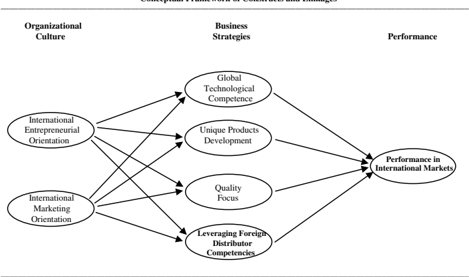
- The survey analysis found that international entrepreneurial orientation significantly predicted global technological competence with a standardized coefficient of 0.28; the link from international marketing orientation to global technological competence was not significant.
- Unique products development was significantly predicted by both international entrepreneurial orientation (0.19) and international marketing orientation (0.24).
- Quality focus was significantly predicted by both international entrepreneurial orientation (0.23) and international marketing orientation (0.35).
- Leveraging foreign distributor competences was significantly predicted by international marketing orientation (0.26) but not by international entrepreneurial orientation; these strategy variables were also significant drivers of performance in international markets: global technological competence (0.21), unique products development (0.14), quality focus (0.30), and leveraging foreign distributor competences (0.18).
## Methods
- The paper uses a two-phase design: first qualitative interviews/case studies to develop constructs and hypotheses, then a cross-industry field survey to test them.
- The qualitative phase included 33 professionals: 24 senior managers at early internationalizing firms, 6 scholars, and 3 international trade experts; the firms were mostly founded after 1985, sold half or more of their sales abroad, and had entered foreign markets within 3 years of founding.
- The survey was mailed to a random sample of 900 manufacturing firms in the United States founded in 1980 or later and exporting at least 25% of total production; 203 usable surveys were returned (about 23% response rate). The main analysis used LISREL8 path analysis, with exploratory factor analysis and confirmatory factor analysis for scale purification and validity checks.
## Limitations
- The paper states that “little empirical work” had been attempted on born globals and that there had been “almost no empirical research” on the factors driving their superior international performance.
- The study itself is focused on U.S. manufacturing firms that were selected using a 25% export threshold, so the evidence is tied to that sample and entry-mode context; this is evident from the text.
- The paper notes that the survey results are based on self-reported measures from responding firms; this is evident from the questionnaire-based design, though the paper does not frame it explicitly as a limitation.
Model-written summary. Check it against the paper before relying on it.
Integrity signals
Registry
Cites
Statistics
Figures
Verification
Claims the paper makes
0 Valid · 0 Not valid · 53 Not checked · 112 Own results and interpretations
A result the paper reports from its own data — it cites no other source for it, so there is none to check. The quote shows it is in the paper.
In the paper
“Despite the scarce resources typical of young firms, our findings reveal that born-global firms leverage a distinctive mix of orientations and strategies that allow them to succeed in diverse international markets.”
plainstates a cause- Asserted: passes — The authors put it forward as true.
- Checkable: passes — It can be checked against evidence.
- Load-bearing: passes — The paper’s conclusions depend on it.
- Based: passes — The paper gives a reason why it holds.
- Rests on an assumption not shown here.
A result the paper reports from its own data — it cites no other source for it, so there is none to check. The quote shows it is in the paper.
In the paper
“The critical role of marketing prowess overseas was also strongly emphasized by virtually all interviewees in the case studies.”
boosted- Asserted: passes — The authors put it forward as true.
- Checkable: passes — It can be checked against evidence.
- Load-bearing: unclear — It is unclear whether the paper’s conclusions depend on it.
- Based: passes — The paper gives a reason why it holds.
A result the paper states — it cites no source for it, so there is none to check. The quote shows it is in the paper.
In the paper
“Most interviewed firms exhibited strong technological capabilities in their respective product or industry categories.”
plain- Asserted: passes — The authors put it forward as true.
- Checkable: passes — It can be checked against evidence.
- Load-bearing: unclear — It is unclear whether the paper’s conclusions depend on it.
- Based: passes — The paper gives a reason why it holds.
A result the paper reports from its own data — it cites no other source for it, so there is none to check. The quote shows it is in the paper.
In the paper
“In general, the qualitative phase of the study revealed that born globals are likely to be formed by entrepreneurs who pursue foreign ventures with a strong marketing orientation.”
hedgedstates an association- Asserted: passes — The authors put it forward as true.
- Checkable: passes — It can be checked against evidence.
- Load-bearing: passes — The paper’s conclusions depend on it.
- Based: passes — The paper gives a reason why it holds.
A result the paper states — it cites no source for it, so there is none to check. The quote shows it is in the paper.
In the paper
“In contrast, born globals leverage a collection of fundamental intangible knowledge-based capabilities in the cultivation of foreign markets early in their evolution.”
plainstates a cause- Asserted: passes — The authors put it forward as true.
- Checkable: passes — It can be checked against evidence.
- Load-bearing: passes — The paper’s conclusions depend on it.
- Based: unclear — It is unclear why the paper says it holds.
- Rests on an assumption not shown here.
84 more claims
Create a free account to see all 165 claims and to verify the 3 references still open.
- It may state two separate claims as one. 33
- Probably not a substantial claim. 54
Citations
Cites
Evaluating Structural Equation Models with Unobservable Variables and Measurement Error
Fornell, C., & Larcker, D. F. (1981) · Journal of Marketing Research · doi:10.2307/3151312 · Cited by 109,314 · cited 2×
“Composite reliability was calculated using the procedures outlined by Fornell and Larcker (1981).”
MethodInfluentialEvaluating structural equation models with unobservable variables and measurement error
Fornell, C., & Larcker, D. F. (1981) · Journal of Marketing Research · doi:10.1177/002224378101800104 · Cited by 109,190
Firm Resources and Sustained Competitive Advantage
Barney, J. (1991) · Journal of Management · doi:10.1177/014920639101700108 · Cited by 48,334
(1994) · Journal of the American Dietetic Association · doi:10.1016/0002-8223(94)92216-0 · Cited by 45,910
Firm resources and sustained competitive advantage
Barney, J. B. (2004) · Advances in Strategic Management · doi:10.1016/s0742-3322(00)17018-4 · Cited by 38,152
Absorptive Capacity: A New Perspective on Learning and Innovation
Cohen, W. M., & Levinthal, D. A. (1990) · Administrative Science Quarterly · doi:10.2307/2393553 · Cited by 35,728
A resource‐based view of the firm
Wernerfelt, B. (1984) · Strategic Management Journal · doi:10.1002/smj.4250050207 · Cited by 25,635
The Theory of Economic Development
Schumpeter, J., & Backhaus, U. (2006) · The European Heritage in Economics and the Social Sciences · doi:10.1007/0-306-48082-4_3 · Cited by 22,506
An Evolutionary Theory of Economic Change.
Loasby, B. J., Nelson, R. R., & Winter, S. G. (1983) · The Economic Journal · doi:10.2307/2232409 · Cited by 21,366
A Dynamic Theory of Organizational Knowledge Creation
Nonaka, I. (1994) · Organization Science · doi:10.1287/orsc.5.1.14 · Cited by 17,809
Research works printed but not linked: 5
- Nikkei Sangyoo Shimbun (1995) Benchaa Shin Sedai (New Generation Ventures) , Nihon Keizai Shimbun: Tokyo.
- Nunnally, J.C. (1978) Psychometric Theory
- Porter, M.E. (1980) Competitive Strategy , The Free Press: New York.
- Rennie, M. (1993) 'Born global', McKinsey Quarterly (4): 45-52. Rosson, P. and Ford, I.D. (1982) 'Manufacturer-overseas distributor relations and export performance', Journal of International Business Studies 13 (2): 57-72.
- Schumpeter, J. (1939) Business Cycles , Vol. 1 McGraw-Hill: New York.
Cited by
Items 3,001–3,020 of 3,020
Fu, Y., Li, H., & Cao, G. (2026) · Journal of Small Business & Entrepreneurship · doi:10.1080/08276331.2026.2730760
Hojnik, B. B. (2026) · Systems · doi:10.3390/systems14101193 · Cited by 1
Varma, S., Nayyar, R., & SHWETA, S. (2026) · SSRN Electronic Journal · doi:10.2139/ssrn.7506836
Entrepreneurial bricolage in the branding efforts of international new ventures
Appiah, E. K. (2026) · Industrial Marketing Management · doi:10.1016/j.indmarman.2026.09.004 · Cited by 2
Cœurderoy, R., & Murray, G. (2014) · Palgrave Macmillan UK eBooks · doi:10.1057/9781137472311_8 · Cited by 15
Khan, H., Knight, G., & Khan, Z. (2026) · International Business Review · doi:10.1016/j.ibusrev.2026.102664
Self-citationMarmor, M., Lukason, O., & Vissak, T. (2026) · management revue · doi:10.31083/mrev43137
Liu, G., Liu, W., & Ko, W. W. (2026) · R and D Management · doi:10.1111/radm.70061
Hossain, K., Alam, M. N., Abdullah, A. S. C., Balwi, M. A. W. F. M., & Lubis, A. (2026) · RAUSP Management Journal · doi:10.1108/rausp-03-2024-0066
Buccieri, D., Russell, L. T. M., & Javalgi, R. G. (2026) · Journal of Global Marketing · doi:10.1080/08911762.2026.2742486
Swoboda, B. S., Jäger, M., & Olejnik, E. (2010) · Gabler eBooks · doi:10.1007/978-3-8349-6104-4_6
Małe i średnie przedsiębiorstwa typu born global - studium literatury przedmiotu
Blanke-Ławniczak, K. (2012) · Zeszyty Naukowe Uniwersytetu Szczecińskiego. Ekonomiczne Problemy Usług
The Internationalization of Knowledge-Based Small and Medium-Sized Enterprises from Syria
Kasem, L., & Ibeh, K. (2010) · Palgrave Macmillan UK eBooks · doi:10.1057/9780230278028_15
Talay, C. (2013) · Repository@Hull (Worktribe) (University of Hull)
Iberian multinationals driving the crisis recovery
Fernández‐Olmos, M., Asín, J. F., Sánchez‐Sellero, P., Alesón, M. L. R., & Oricain, N. D. (2014)
Internationalisation process & upgrading prospects of Indian garment manufacturers
Patel, S. A. (2011) · ERA
Rodríguez-Martínez, J. (2005) · OpenGrey (Institut de l'Information Scientifique et Technique) · doi:10.13140/rg.2.2.20829.77281
de la Torre, J. R. (2014) · Journal of Globalization Competitiveness and Governability · doi:10.3232/gcg.2008.v2.n2.04 · Cited by 1
Science parks as innovative development catalyzers for SMEs
Palamara, G. (2005) · Deutscher Universitätsverlag eBooks · doi:10.1007/978-3-322-82153-9_4
Metadata
- Authors
- Knight, G. A., & Cavusgil, S. T.
- Affiliations
- Florida State University (US)
- Corresponding author
- Knight, Gary A
- ORCID
- Knight, Gary A
- Venue
- Journal of International Business Studies
- Published
- 2004-01-08
- Volume
- 35
- Issue
- 2
- Pages
- 124-141
- ISSN
- 0047-2506 (ISSN-L)
- 1478-6990
- OpenAlex
- W2127709152
- Semantic Scholar
- d24960b5342d0dd3b86be002ab18a80e7b6fb5c9
- Cited by
- 3,013
- References
- 102
- Citations by year
- 2026: 121 · 2025: 123 · 2024: 157 · 2023: 154 · 2022: 182 · 2021: 196 · 2020: 189 · 2019: 180 · 2018: 199 · 2017: 172 · 2016: 188 · 2015: 187 · 2014: 178 · 2013: 167 · 2012: 129
- FWCI
- 137.12
- Type
- journal article
- Language
- en
- Update notices
- correction (2004-07-16)
- Open access
- bronze
- doi.org
- Licence
- www.springer.com/tdm (tdm)
- Locations
- Journal of International Business Studies (publishedVersion)
- RePEc: Research Papers in Economics (submittedVersion)
- Funders
- Michigan State University
- College of Engineering, Michigan State University
- Topics
- Social Sciences › Business, Management and Accounting › Strategy and Management › International Business and FDI
- Social Sciences › Business, Management and Accounting › Strategy and Management › Innovation and Knowledge Management
- Social Sciences › Communication › International Student and Expatriate Challenges
- Keywords
- born global firms, early internationalization, organizational capabilities, innovation, innovation culture, international business strategy, international success, young firms, internationalization of firms
About these checks
Registry, retraction, Cites and statistics results are computed, not judged, with one exception: a printed reference that no index lists is read once by a model before it counts as a citation error. Claims are extracted by a model and kept only when their quote appears verbatim in the text; each cited source is then checked, with a model’s help, for whether it says what the claim relies on. Those verdicts can be wrong — read the claim’s quote and the cited source before relying on one.
A language model drew the claims from the paper on 2026-10-10, under version 3 of the claim definition (model deepseek-v4.1-flash, prompt extract-v3).
A second model labelled each claim on 2026-10-10 (model jev-1.13-20260917, definition revision gold-guideline-v0.2).
Statistics and arithmetic are recomputed, not judged.
Confidence bands are shown only for fields calibrated on our annotated test set. None is calibrated yet, so no band is shown.
What counts as a claim ›How we measure confidence ›How we check this ›
Are you an author, or do you see a problem with this page? Request a review
Data sources
Bibliographic data: Semantic Scholar, OpenAlex, Crossref.
Contains information from the Semantic Scholar Academic Graph Datasets, made available under the ODC Attribution License (ODC-BY 1.0).
Semantic Scholar’s data is described in: Kinney, R., et al. (2023). The Semantic Scholar Open Data Platform. arXiv:2301.10140.
