

Innovation, organizational capabilities, and the born-global firm
Open accessThe DOI matches its Crossref record; 106 of the 106 references it cites were found in a registry or an index; none of the 100 sources its claims cite is checked for support yet.
Overview
CoChat Summary
## TL;DR
This study argues that born-global firms succeed because early internationalization is supported by an innovative culture and a distinctive set of organizational capabilities. Using qualitative case studies followed by a survey of 203 usable responses, the authors find that several capability links are significant and that these capabilities are associated with performance in international markets.
## Key findings
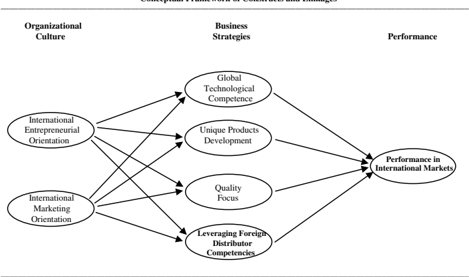
- The survey analysis found that international entrepreneurial orientation significantly predicted global technological competence with a standardized coefficient of 0.28; the link from international marketing orientation to global technological competence was not significant.
- Unique products development was significantly predicted by both international entrepreneurial orientation (0.19) and international marketing orientation (0.24).
- Quality focus was significantly predicted by both international entrepreneurial orientation (0.23) and international marketing orientation (0.35).
- Leveraging foreign distributor competences was significantly predicted by international marketing orientation (0.26) but not by international entrepreneurial orientation; these strategy variables were also significant drivers of performance in international markets: global technological competence (0.21), unique products development (0.14), quality focus (0.30), and leveraging foreign distributor competences (0.18).
## Methods
- The paper uses a two-phase design: first qualitative interviews/case studies to develop constructs and hypotheses, then a cross-industry field survey to test them.
- The qualitative phase included 33 professionals: 24 senior managers at early internationalizing firms, 6 scholars, and 3 international trade experts; the firms were mostly founded after 1985, sold half or more of their sales abroad, and had entered foreign markets within 3 years of founding.
- The survey was mailed to a random sample of 900 manufacturing firms in the United States founded in 1980 or later and exporting at least 25% of total production; 203 usable surveys were returned (about 23% response rate). The main analysis used LISREL8 path analysis, with exploratory factor analysis and confirmatory factor analysis for scale purification and validity checks.
## Limitations
- The paper states that “little empirical work” had been attempted on born globals and that there had been “almost no empirical research” on the factors driving their superior international performance.
- The study itself is focused on U.S. manufacturing firms that were selected using a 25% export threshold, so the evidence is tied to that sample and entry-mode context; this is evident from the text.
- The paper notes that the survey results are based on self-reported measures from responding firms; this is evident from the questionnaire-based design, though the paper does not frame it explicitly as a limitation.
Model-written summary. Check it against the paper before relying on it.
Integrity signals
Registry
Cites
Statistics
Figures
Verification
Claims the paper makes
0 Valid · 0 Not valid · 53 Not checked · 112 Own results and interpretations
A result the paper reports from its own data — it cites no other source for it, so there is none to check. The quote shows it is in the paper.
In the paper
“Despite the scarce resources typical of young firms, our findings reveal that born-global firms leverage a distinctive mix of orientations and strategies that allow them to succeed in diverse international markets.”
plainstates a cause- Asserted: passes — The authors put it forward as true.
- Checkable: passes — It can be checked against evidence.
- Load-bearing: passes — The paper’s conclusions depend on it.
- Based: passes — The paper gives a reason why it holds.
- Rests on an assumption not shown here.
A result the paper reports from its own data — it cites no other source for it, so there is none to check. The quote shows it is in the paper.
In the paper
“The critical role of marketing prowess overseas was also strongly emphasized by virtually all interviewees in the case studies.”
boosted- Asserted: passes — The authors put it forward as true.
- Checkable: passes — It can be checked against evidence.
- Load-bearing: unclear — It is unclear whether the paper’s conclusions depend on it.
- Based: passes — The paper gives a reason why it holds.
A result the paper states — it cites no source for it, so there is none to check. The quote shows it is in the paper.
In the paper
“Most interviewed firms exhibited strong technological capabilities in their respective product or industry categories.”
plain- Asserted: passes — The authors put it forward as true.
- Checkable: passes — It can be checked against evidence.
- Load-bearing: unclear — It is unclear whether the paper’s conclusions depend on it.
- Based: passes — The paper gives a reason why it holds.
A result the paper reports from its own data — it cites no other source for it, so there is none to check. The quote shows it is in the paper.
In the paper
“In general, the qualitative phase of the study revealed that born globals are likely to be formed by entrepreneurs who pursue foreign ventures with a strong marketing orientation.”
hedgedstates an association- Asserted: passes — The authors put it forward as true.
- Checkable: passes — It can be checked against evidence.
- Load-bearing: passes — The paper’s conclusions depend on it.
- Based: passes — The paper gives a reason why it holds.
A result the paper states — it cites no source for it, so there is none to check. The quote shows it is in the paper.
In the paper
“In contrast, born globals leverage a collection of fundamental intangible knowledge-based capabilities in the cultivation of foreign markets early in their evolution.”
plainstates a cause- Asserted: passes — The authors put it forward as true.
- Checkable: passes — It can be checked against evidence.
- Load-bearing: passes — The paper’s conclusions depend on it.
- Based: unclear — It is unclear why the paper says it holds.
- Rests on an assumption not shown here.
84 more claims
Create a free account to see all 165 claims and to verify the 3 references still open.
- It may state two separate claims as one. 33
- Probably not a substantial claim. 54
Citations
Cites
Evaluating Structural Equation Models with Unobservable Variables and Measurement Error
Fornell, C., & Larcker, D. F. (1981) · Journal of Marketing Research · doi:10.2307/3151312 · Cited by 109,314 · cited 2×
“Composite reliability was calculated using the procedures outlined by Fornell and Larcker (1981).”
MethodInfluentialEvaluating structural equation models with unobservable variables and measurement error
Fornell, C., & Larcker, D. F. (1981) · Journal of Marketing Research · doi:10.1177/002224378101800104 · Cited by 109,190
Firm Resources and Sustained Competitive Advantage
Barney, J. (1991) · Journal of Management · doi:10.1177/014920639101700108 · Cited by 48,334
(1994) · Journal of the American Dietetic Association · doi:10.1016/0002-8223(94)92216-0 · Cited by 45,910
Firm resources and sustained competitive advantage
Barney, J. B. (2004) · Advances in Strategic Management · doi:10.1016/s0742-3322(00)17018-4 · Cited by 38,152
Absorptive Capacity: A New Perspective on Learning and Innovation
Cohen, W. M., & Levinthal, D. A. (1990) · Administrative Science Quarterly · doi:10.2307/2393553 · Cited by 35,728
A resource‐based view of the firm
Wernerfelt, B. (1984) · Strategic Management Journal · doi:10.1002/smj.4250050207 · Cited by 25,635
The Theory of Economic Development
Schumpeter, J., & Backhaus, U. (2006) · The European Heritage in Economics and the Social Sciences · doi:10.1007/0-306-48082-4_3 · Cited by 22,506
An Evolutionary Theory of Economic Change.
Loasby, B. J., Nelson, R. R., & Winter, S. G. (1983) · The Economic Journal · doi:10.2307/2232409 · Cited by 21,366
A Dynamic Theory of Organizational Knowledge Creation
Nonaka, I. (1994) · Organization Science · doi:10.1287/orsc.5.1.14 · Cited by 17,809
Research works printed but not linked: 5
- Nikkei Sangyoo Shimbun (1995) Benchaa Shin Sedai (New Generation Ventures) , Nihon Keizai Shimbun: Tokyo.
- Nunnally, J.C. (1978) Psychometric Theory
- Porter, M.E. (1980) Competitive Strategy , The Free Press: New York.
- Rennie, M. (1993) 'Born global', McKinsey Quarterly (4): 45-52. Rosson, P. and Ford, I.D. (1982) 'Manufacturer-overseas distributor relations and export performance', Journal of International Business Studies 13 (2): 57-72.
- Schumpeter, J. (1939) Business Cycles , Vol. 1 McGraw-Hill: New York.
Cited by
International Entrepreneurship research (1989–2009): A domain ontology and thematic analysis
Jones, M. V., Coviello, N., & Tang, Y. K. (2011) · Journal of Business Venturing · doi:10.1016/j.jbusvent.2011.04.001 · Cited by 1,241
Internationalization and the performance of born-global SMEs: the mediating role of social networks
Zhou, L., Wu, W.-P., & Luo, X. (2007) · Journal of International Business Studies · doi:10.1057/palgrave.jibs.8400282 · Cited by 1,139
“It is interesting because recent theoretical development in the international entrepreneurship literature emphasizes how and why the dynamics of internationalization of born globals lead to superior performance (Etemad and Wright, 2003; Knight and Cavusgil, 2004; Oviatt and McDougall, 2005).”
BackgroundInfluentialPaul, J., & Rosado-Serrano, A. (2019) · International Marketing Review · doi:10.1108/imr-10-2018-0280 · Cited by 1,130
Internationalisation: conceptualising an entrepreneurial process of behaviour in time
Jones, M. V., & Coviello, N. E. (2005) · Journal of International Business Studies · doi:10.1057/palgrave.jibs.8400138 · Cited by 1,085
“the international expansion of the firm, this reflects innovation (Andersen, 1993; Knight and Cavusgil, 2004).”
BackgroundThe network dynamics of international new ventures
Coviello, N. E. (2006) · Journal of International Business Studies · doi:10.1057/palgrave.jibs.8400219 · Cited by 1,010
Cavusgil, S. T., & Knight, G. (2015) · Journal of International Business Studies · doi:10.1057/jibs.2014.62 · Cited by 977
“They were characterized as “young, entrepreneurial start-ups that initiate international business (typically exporting) soon after their inception” (Knight & Cavusgil, 2004).”
BackgroundInfluentialSelf-citationExporting challenges of SMEs: A review and future research agenda
Paul, J., Parthasarathy, S., & Gupta, P. (2017) · Journal of World Business · doi:10.1016/j.jwb.2017.01.003 · Cited by 951
Weerawardena, J., Mort, G. S., Liesch, P. W., & Knight, G. (2007) · Journal of World Business · doi:10.1016/j.jwb.2007.04.004 · Cited by 881
“In addition, the literature suggests that born global early internationalization is facilitated by innovation within the firm (Knight & Cavusgil, 2004; Madsen & Servais, 1997; Rennie, 1993).”
BackgroundSelf-citationWhat is really different about emerging market multinationals?
Ramamurti, R. (2012) · Global Strategy Journal · doi:10.1002/gsj.1025 · Cited by 790
Covin, J. G., & Miller, D. (2014) · Entrepreneurship Theory and Practice · doi:10.1111/etap.12027 · Cited by 775
The Network Dynamics of International New Ventures
Coviello, N. E. (2018) · JIBS Special Collections · doi:10.1007/978-3-319-74228-1_6 · Cited by 769
Keupp, M. M., & Gassmann, O. (2009) · Journal of Management · doi:10.1177/0149206308330558 · Cited by 707
“…elements such as strategic management, access to resources, knowledge and information, firm capabilities, and innovatory advantages, all of which enable entrepreneurial firms to internationalize their business in an entrepreneurial manner over time (Gassmann & Keupp, 2007; Knight & Cavusgil, 2004).”
BackgroundThe elephant in the room of dynamic capabilities: Bringing two diverging conversations together
Peteraf, M., Di Stefano, G., & Verona, G. (2013) · Strategic Management Journal · doi:10.1002/smj.2078 · Cited by 702
What Drives New Ventures to Internationalize from Emerging to Developed Economies?
Yamakawa, Y., Peng, M. W., & Deeds, D. L. (2008) · Entrepreneurship Theory and Practice · doi:10.1111/j.1540-6520.2007.00216.x · Cited by 684
Impact of ownership on the international involvement of SMEs
Fernández, Z., & Nieto, M. J. (2006) · Journal of International Business Studies · doi:10.1057/palgrave.jibs.8400196 · Cited by 623
“It also underlines the importance of concrete resources such as knowledge intensity and international entrepreneurial orientation (Madsen and Servais, 1997; Autio et al., 2000; Knight and Cavusgil, 2004).”
BackgroundInternationalization: From incremental to born global
Knight, G. A., & Liesch, P. W. (2016) · Journal of World Business · doi:10.1016/j.jwb.2015.08.011 · Cited by 613
Self-citationBuilding capabilities for international operations through networks: a study of Indian firms
Elango, B., & Pattnaik, C. (2007) · Journal of International Business Studies · doi:10.1057/palgrave.jibs.8400280 · Cited by 602
International entrepreneurship research in emerging economies: A critical review and research agenda
Kiss, A. N., Danis, W. M., & Cavusgil, S. T. (2012) · Journal of Business Venturing · doi:10.1016/j.jbusvent.2011.09.004 · Cited by 583
Self-citationEntrepreneurial Orientation, Dynamic Capabilities and International Performance
Jantunen, A., Puumalainen, K., Saarenketo, S., & Kyläheiko, K. (2005) · Journal of International Entrepreneurship · doi:10.1007/s10843-005-1133-2 · Cited by 580
Filatotchev, I., Liu, X., Buck, T., & Wright, M. (2009) · Journal of International Business Studies · doi:10.1057/jibs.2008.105 · Cited by 568
“A number of studies have analyzed the factors that drive the internationalization of smaller firms (Gabrielsson and Kirpalani, 2004; Knight and Cavusgil, 2004), but our understanding of this recent phenomenon remains limited.”
BackgroundInfluentialSullivan Mort, G., & Weerawardena, J. (2006) · International Marketing Review · doi:10.1108/02651330610703445 · Cited by 561
“There has recently been some advance in understanding at the broad level, with born global internationalisation attributed to developing organisational capability ( Knight and Cavusgil, 2004”
BackgroundExploring the complementarity between innovation and export for SMEs’ growth
Golovko, E., & Valentini, G. (2011) · Journal of International Business Studies · doi:10.1057/jibs.2011.2 · Cited by 572
Freeman, S., Edwards, R., & Schroder, B. (2006) · Journal of International Marketing · doi:10.1509/jimk.14.3.33 · Cited by 556
“Styles Problems and Possibilities Associated with Relationships and Network Development 38 Susan Freeman, Ron Edwards, and Bill Schroder and Ambler (2003) examine the particular problems related to relationship development facing firms in cross-border settings, including more explicit reconciliation of the interests o…”
BackgroundInfluentialDi Stefano, G., Peteraf, M., & Verona, G. (2010) · Industrial and Corporate Change · doi:10.1093/icc/dtq027 · Cited by 557
Douglas, E. J., Shepherd, D. A., & Prentice, C. (2020) · Journal of Business Venturing · doi:10.1016/j.jbusvent.2019.105970 · Cited by 539
Firms’ degree of born-globalness, international entrepreneurial orientation and export performance
Kuivalainen, O., Sundqvist, S., & Servais, P. (2007) · Journal of World Business · doi:10.1016/j.jwb.2007.04.010 · Cited by 533
“The emergence of firms variously referred to as bornglobals , international new ventures or global start-ups has been the focus of increasing interest over the last decade (Knight & Cavusgil, 1996, 2004; Madsen & Servais, 1997; Moen, 2002; Oviatt & McDougall, 1994; Rennie, 1993).”
BackgroundMusteen, M., Francis, J., & Datta, D. K. (2010) · Journal of World Business · doi:10.1016/j.jwb.2009.12.003 · Cited by 525
On open innovation, platforms, and entrepreneurship
Nambisan, S., Siegel, D., & Kenney, M. (2018) · Strategic Entrepreneurship Journal · doi:10.1002/sej.1300 · Cited by 519
The international entrepreneurial dynamics of accelerated internationalisation
Mathews, J. A., & Zander, I. (2007) · Journal of International Business Studies · doi:10.1057/palgrave.jibs.8400271 · Cited by 502
An assessment of the measurement of performance in international business research
Hult, G. T. M., Ketchen, D. J., Griffith, D. A., Chabowski, B. R., Hamman, M. K., Dykes, B. J., Pollitte, W. A., & Cavusgil, S. T. (2008) · Journal of International Business Studies · doi:10.1057/palgrave.jibs.8400398 · Cited by 487
Self-citationDoh, J. P. (2005) · Journal of Management Studies · doi:10.1111/j.1467-6486.2005.00515.x · Cited by 447
“Indeed, some have argued that many firms are now ‘born global’ (Knight and Cavusgil, 2004) and that the notion of sequential internationalization – whether on a country, industry, or firm scale – is outmoded and anachronistic.”
BackgroundInternational business competence and the contemporary firm
Knight, G. A., & Kim, D. (2009) · Journal of International Business Studies · doi:10.1057/palgrave.jibs.8400397 · Cited by 440
Self-citationBringing history (back) into international business
Jones, G., & Khanna, T. (2006) · Journal of International Business Studies · doi:10.1057/palgrave.jibs.8400198 · Cited by 420
The internationalization of entrepreneurship
Oviatt, B. M., & McDougall, P. P. (2005) · Journal of International Business Studies · doi:10.1057/palgrave.jibs.8400119 · Cited by 419
“, Knight and Cavusgil, 2004), and the vocabulary continues to proliferate. For example, Doz et al. (2001) call these firms 'metanational upstarts'.”
BackgroundPlatforms without borders? The international strategies of digital platform firms
Stallkamp, M., & Schotter, A. P. J. (2021) · Global Strategy Journal · doi:10.1002/gsj.1336 · Cited by 420
Loane, S., & Bell, J. (2006) · International Marketing Review · doi:10.1108/02651330610703409 · Cited by 402
Freeman, S., & Cavusgil, S. T. (2007) · Journal of International Marketing · doi:10.1509/jimk.15.4.1 · Cited by 397
“Factors identified as underpinning successful internationalizing SMEs include the characteristics of top management (Bloodgood, Sapienza, and Almeida 1996; Etemad 2004), international networks (Oviatt and McDougall 2005), and knowledge and culture (Knight and Cavusgil 2004).”
BackgroundInfluentialSelf-citationJavalgi, R. (. G., & Todd, P. R. (2011) · Journal of Business Research · doi:10.1016/j.jbusres.2010.11.024 · Cited by 377
“, 2007), “born-global” firms (Knight and Cavusgil, 2004), and small to medium-sized firms (Crick and Jones, 2000).”
BackgroundGassmann, O., & Keupp, M. M. (2007) · Journal of World Business · doi:10.1016/j.jwb.2007.04.006 · Cited by 380
“Although authors have employed perspectives as different as organisational learning (Zahra, Ireland, & Hitt, 2000) and evolutionary economics (Knight & Cavusgil, 2004), we neither completely understand which capabilities enable SMEs to be internationally active at all, nor do we know the elements…”
BackgroundThe effects of entrepreneurial proclivity and foreign market knowledge on early internationalization
Zhou, L. (2007) · Journal of World Business · doi:10.1016/j.jwb.2007.04.009 · Cited by 378
“From the work of Knight and Cavusgil (2004), entrepreneurial culture is manifested in the context of born-global internationalization.”
BackgroundMartin, S. L., & Javalgi, R. (. G. (2016) · Journal of Business Research · doi:10.1016/j.jbusres.2015.10.149 · Cited by 374
Explaining the internationalization of ibusiness firms
Brouthers, K. D., Geisser, K. D., & Rothlauf, F. (2016) · Journal of International Business Studies · doi:10.1057/jibs.2015.20 · Cited by 366
“More recently social network theory has been examined as the basis or, more speci fi cally, the means by which fi rms internationalize (Johanson & Vahlne, 2009; Knight & Cavusgil, 2004; Oviatt & McDougall, 1995).”
BackgroundDai, L., Maksimov, V., Gilbert, B. A., & Fernhaber, S. A. (2014) · Journal of Business Venturing · doi:10.1016/j.jbusvent.2013.07.004 · Cited by 358
“In order to establish and maintain their presence in multiple foreign markets, firms must proactively identify opportunities in each successive market (Knight and Cavusgil, 2004).”
BackgroundProksch, D., Rosin, A. F., Stubner, S., & Pinkwart, A. (2024) · Journal of Small Business Management · doi:10.1080/00472778.2021.1883036 · Cited by 349
“This allows for identification of processes that can be digitally improved or enhanced (Iivari et al., 2016; Knight & Cavusgil, 2004).”
BackgroundMethodThe determinants of export performance: a review of the literature 2006-2014
Chen, J., Sousa, C. M. P., & He, X. (2016) · International Marketing Review · doi:10.1108/imr-10-2015-0212 · Cited by 350
“Thus, as firm capabilities are a main source of the firm’s performance advantage and central to the firm’s continued survival (see Knight and Cavusgil, 2004, Yalcinkaya et al., 2007), future studies are encouraged to pay adequate attention to these factors Management Characteristics.”
BackgroundChouaibi, S., Chouaibi, J., & Rossi, M. (2022) · EuroMed Journal of Business · doi:10.1108/emjb-09-2020-0101 · Cited by 347
De Clercq, D., Sapienza, H. J., Yavuz, R. I., & Zhou, L. (2012) · Journal of Business Venturing · doi:10.1016/j.jbusvent.2011.09.003 · Cited by 349
Zhou, L., Barnes, B. R., & Lu, Y. (2010) · Journal of International Business Studies · doi:10.1057/jibs.2009.87 · Cited by 343
Trade promotion and SME export performance
Wilkinson, T., & Brouthers, L. E. (2006) · International Business Review · doi:10.1016/j.ibusrev.2006.03.001 · Cited by 344
Re-thinking research on born globals
Coviello, N. (2015) · Journal of International Business Studies · doi:10.1057/jibs.2014.59 · Cited by 339
“In Knight and Cavusgil (2004), traditional measures are employed.”
BackgroundMethodInfluentialSolano Acosta, A., Herrero Crespo, Á., & Collado Agudo, J. (2018) · International Business Review · doi:10.1016/j.ibusrev.2018.04.004 · Cited by 337
Lisboa, A., Skarmeas, D., & Lages, C. (2011) · Industrial Marketing Management · doi:10.1016/j.indmarman.2011.10.013 · Cited by 337
Internationalization of Australian Family Businesses: A Managerial Capabilities Perspective
Graves, C., & Thomas, J. (2006) · Family Business Review · doi:10.1111/j.1741-6248.2006.00066.x · Cited by 436
“Knight and Cavusgil (2004) found that resource-derived capabilities drive the international expansion of born global firms.”
BackgroundThe Sharing Economy Globalization Phenomenon: A Research Agenda
Parente, R. C., Geleilate, J.-M. G., & Rong, K. (2018) · Journal of International Management · doi:10.1016/j.intman.2017.10.001 · Cited by 331
“…lenses drawing from transaction costs theory, such as the ownership, location, internalization (OLI) paradigm, the sequential notion of internationalization, and other “resource-based” perspectives (Bartlett and Ghoshal, 2002; Dunning, 2003; Johanson and Vahlne, 1977; Knight and Cavusgil, 2004).”
BackgroundLopez, L. E., Kundu, S. K., & Ciravegna, L. (2009) · Journal of International Business Studies · doi:10.1057/jibs.2008.69 · Cited by 327
Relationship Capabilities, Quality, and Innovation as Determinants of Export Performance
Lages, L. F., Silva, G., & Styles, C. (2009) · Journal of International Marketing · doi:10.1509/jimk.17.4.47 · Cited by 318
“Capabilities have been a central theme of international marketing research (Knight and Cavusgil 2004; Yalcinkaya, Calantone, and Griffith 2007; Zou, Fang, and Zhao 2003).”
BackgroundHome country supportiveness/unfavorableness and outward foreign direct investment from China
Gaur, A. S., Ma, X., & Ding, Z. (2018) · Journal of International Business Studies · doi:10.1057/s41267-017-0136-2 · Cited by 311
“We controlled for technological capability by asking respondents, on a seven-point Likert measurement scale, whether technological capability influenced their firm’s OFDI decisions (Knight & Cavusgil, 2004).”
MethodThe Accidental Internationalists: A Theory of Born Globals
Hennart, J. (2014) · Entrepreneurship Theory and Practice · doi:10.1111/etap.12076 · Cited by 313
“Welch and Luostarinen (1988), Rennie (1993), Oviatt and McDougall (1994), and Knight and Cavusgil (2004) have observed that some firms internationalize very early in their life.”
BackgroundA bibliometric analysis of born global firms
Dzikowski, P. (2018) · Journal of Business Research · doi:10.1016/j.jbusres.2017.12.054 · Cited by 313
“…most relevant definitions is the term ‘Born Global’ to mean business organizations which, either from or near their founding, seek sustainable international business performance from the application of knowledge-based resources to the sale of outputs in multiple countries (Knight & Cavusgil, 2004).”
BackgroundInfluentialInternationalization strategy, firm resources and the survival of SMEs in the export market
Sui, S., & Baum, M. (2014) · Journal of International Business Studies · doi:10.1057/jibs.2014.11 · Cited by 309
“Early internationalizing firms might have been found to be more innovative than other firms (Knight & Cavusgil, 2004) because those early internationalizers who were not innovative and productive enough did not survive and therefore could not be observed in cross-sectional studies.”
BackgroundThe Organizational Drivetrain: A Road To Integration of Dynamic Capabilities Research
Di Stefano, G., Peteraf, M., & Verona, G. (2014) · Academy of Management Perspectives · doi:10.5465/amp.2013.0100 · Cited by 307
“…Wade and Hulland (2004) 292 Todorova and Durisin (2007) 132 Subramaniam and Youndt (2005) 286 Zhu (2004) 129 Danneels (2002) 266 Madhok (2002) 127 Knight and Cavusgil (2004) 260 Jarzabkowski (2004) 117 Helfat (1997) 251 Kale and Singh (2007) 115 Aragon-Correa and Sharma (2003) 236 Lubatkin,…”
Mainela, T., Puhakka, V., & Servais, P. (2014) · International Journal of Management Reviews · doi:10.1111/ijmr.12011 · Cited by 304
Five decades of research on export barriers: Review and future directions
Kahiya, E. T. (2018) · International Business Review · doi:10.1016/j.ibusrev.2018.04.008 · Cited by 296
Innovation capacity, international experience and export performance of SMEs in Brazil
Oura, M. M., Zilber, S. N., & Lopes, E. L. (2016) · International Business Review · doi:10.1016/j.ibusrev.2015.12.002 · Cited by 298
How do country regulations and business environment impact foreign direct investment (FDI) inflows?
Contractor, F. J., Dangol, R., Nuruzzaman, N., & Raghunath, S. (2020) · International Business Review · doi:10.1016/j.ibusrev.2019.101640 · Cited by 294
A Taxonomy of Born-global Firms
Knight, G., & Cavusgil, S. T. (2005) · Management International Review · Cited by 450
Self-citationInternational new ventures: revisiting the influences behind the ‘born-global’ firm
Fan, T., & Phan, P. (2007) · Journal of International Business Studies · doi:10.1057/palgrave.jibs.8400308 · Cited by 290
“…Madsen and Servais, 1997; Harveston et al., 2000; Shrader et al., 2000), whereas others suggest that the fast-paced learning of these resource-constrained, technology-oriented firms allows them the early internationalization opportunity (e.g., Zahra and George, 2002; Knight and Cavusgil, 2004).”
BackgroundPergelova, A., Manolova, T., Simeonova-Ganeva, R., & Yordanova, D. (2019) · Journal of Small Business Management · doi:10.1111/jsbm.12494 · Cited by 288
“We focus on international market intelligence as a mediating mechanism for three reasons. first, market knowledge offers a solid foundation for internationalization (e.g., Knight and Cavusgil 2004; lamb and liesch 2002; mejri and umemoto 2010; Peng 2001).”
BackgroundLaufs, K., & Schwens, C. (2014) · International Business Review · doi:10.1016/j.ibusrev.2014.03.006 · Cited by 285
Corporate Social Responsibility, Product Differentiation Strategy and Export Performance
Boehe, D. M., & Barin Cruz, L. (2010) · Journal of Business Ethics · doi:10.1007/s10551-010-0613-z · Cited by 283
“Although both indicators have been newly developed for this research in order to be in line with respondents’ characteristics and language, they have been inspired by previous studies, for instance (Murray, Kotabe & Zhou 2005 and Knight & Cavusgil 2004).”
ResultPost–Entry Speed of International New Ventures
Prashantham, S., & Young, S. (2011) · Entrepreneurship Theory and Practice · doi:10.1111/j.1540-6520.2009.00360.x · Cited by 281
Performance of Global New Product Development Programs: A Resource‐Based View
Kleinschmidt, E. J., De Brentani, U., & Salomo, S. (2007) · Journal of Product Innovation Management · doi:10.1111/j.1540-5885.2007.00261.x · Cited by 278
“001) (Knight and Cavusgil, 2004; Teece, Pisano, and Shuen, 1997).”
BackgroundMethodInfluentialKarami, M., & Tang, J. (2019) · International Small Business Journal: Researching Entrepreneurship · doi:10.1177/0266242618807275 · Cited by 277
“, 2011), which is certainly an entrepreneurial act (Knight and Cavusgil, 2004).”
BackgroundInfluentialStrategic orientations of born globals—Do they really matter?
Jantunen, A., Nummela, N., Puumalainen, K., & Saarenketo, S. (2008) · Journal of World Business · doi:10.1016/j.jwb.2007.11.015 · Cited by 277
Bruneel, J., Yli‐Renko, H., & Clarysse, B. (2010) · Strategic Entrepreneurship Journal · doi:10.1002/sej.89 · Cited by 275
“Yet, many start-ups manage to expand into foreign markets, often exhibiting a pattern of early internationalization (Knight and Cavusgil, 2004; Yamakawa, Peng, and Deeds, 2008) that does not match the step-by-step process that the Uppsala stage model would predict.”
BackgroundResultExperience, age and exporting performance in UK SMEs
Love, J. H., Roper, S., & Zhou, Y. (2016) · International Business Review · doi:10.1016/j.ibusrev.2015.10.001 · Cited by 274
“…literature on the internationalisation of small and medium-sized enterprises (SMEs) involves a contrast between the process or stages approach, originated by Johanson and Vahlne (1977), and the international new ventures or ‘born global’ approach (Knight & Cavusgil, 2004; Oviatt & McDougall, 1994).”
BackgroundOrganizational innovation outcomes in SMEs: Effects of age, size, and sector
Laforet, S. (2013) · Journal of World Business · doi:10.1016/j.jwb.2012.09.005 · Cited by 270
Rapid FDI expansion and firm performance
Chang, S.-J., & Rhee, J. H. (2011) · Journal of International Business Studies · doi:10.1057/jibs.2011.30 · Cited by 269
Marketing innovation: A consequence of competitiveness
Gupta, S., Malhotra, N. K., Czinkota, M., & Foroudi, P. (2016) · Journal of Business Research · doi:10.1016/j.jbusres.2016.02.042 · Cited by 270
“Unanimously the study describes innovation as a tool that enablesmanagers to efficiently use their resources for developing a competitive advantage (Hunt & Morgan, 1995; Knight & Cavusgil, 2004).”
BackgroundKrammer, S. M. S., Strange, R., & Lashitew, A. (2018) · International Business Review · doi:10.1016/j.ibusrev.2017.07.003 · Cited by 270
“Furthermore, business education of employees will result into tailored management, operational and marketing strategies which account for idiosyncrasies of foreign markets (Samiee &Walters, 2000) and increase the effectiveness of export operations (Knight & Cavusgil, 2004).”
BackgroundAutio, E., George, G., & Alexy, O. (2011) · Entrepreneurship Theory and Practice · doi:10.1111/j.1540-6520.2010.00421.x · Cited by 268
“…of entrepreneurship research—that of international entrepreneurship—has induced renewed interest in the role of organizational capabilities on firm performance (Autio, Sapienza, & Almeida, 2000; Bingham, 2009; Keupp & Gassmann, 2009; Knight & Cavusgil, 2004; Sapienza, Autio, George, & Zahra, 2006).”
Gerschewski, S., Rose, E. L., & Lindsay, V. J. (2015) · Journal of World Business · doi:10.1016/j.jwb.2014.09.001 · Cited by 268
“These results are consistent with previous findings identifying quality as a key competitive advantage (Rennie, 1993), and the importance of a focus on quality for engendering superior international performance (Knight & Cavusgil, 2004; Larimo, 2006) among BGs.”
BackgroundMethodResultInfluentialBuccieri, D., Javalgi, R. G., & Cavusgil, E. (2020) · International Business Review · doi:10.1016/j.ibusrev.2019.101639 · Cited by 269
The resource dynamics of international new venture networks
Coviello, N. E., & Cox, M. P. (2007) · Journal of International Entrepreneurship · doi:10.1007/s10843-007-0004-4 · Cited by 264
“Increasingly, the RBV has also been used to inform research in international entrepreneurship, with Knight and Cavusgil (2004) arguing that the RBV helps explain how unique organizational capabilities are developed and leveraged by the internationalizing new venture.”
BackgroundGenc, E., Dayan, M., & Genc, O. F. (2019) · Industrial Marketing Management · doi:10.1016/j.indmarman.2019.01.008 · Cited by 262
Market selection for international expansion: Assessing opportunities in emerging markets
Sakarya, S., Eckman, M., & Hyllegard, K. H. (2007) · International Marketing Review · doi:10.1108/02651330710741820 · Cited by 254
“The existence of born global firms suggests a new challenge to traditional theories of internationalization ( Knight and Cavusgil, 1996, 2004”
BackgroundBorn globals and international business: Evolution of a field of research
Zander, I., McDougall-Covin, P., & L Rose, E. (2015) · Journal of International Business Studies · doi:10.1057/jibs.2014.60 · Cited by 254
“As suggested above, the Knight and Cavusgil (2004) paper was instrumental in broadening the conversation in IB research, from large, resource-rich, well-established multinationals to also include young, asset-constrained firms that are evolving and expanding internationally very rapidly.”
BackgroundInfluentialInternational entrepreneurship, born globals and the theory of effectuation
Andersson, S. (2011) · Journal of Small Business and Enterprise Development · doi:10.1108/14626001111155745 · Cited by 254
Chen, Y.-S., Chang, C.-H., & Lin, Y.-H. (2014) · Sustainability · doi:10.3390/su6117787 · Cited by 248
“Successful innovation needs the integration between external knowledge and internal capability which can provide important ideas [44,54].”
BackgroundGanotakis, P., & Love, J. H. (2012) · Journal of International Business Studies · doi:10.1057/jibs.2012.16 · Cited by 246
“A related strand has been especially concerned with the ability of relatively young firms to become international without the lengthy period of developing suitable experience implied by the process model (Oviatt and McDougall 1995; Knight and Cavusgil 2004).”
BackgroundA model of rapid knowledge development: The smaller born-global firm
Freeman, S., Hutchings, K., Lazaris, M., & Zyngier, S. (2010) · International Business Review · doi:10.1016/j.ibusrev.2009.09.004 · Cited by 245
Fernández-Mesa, A., & Alegre, J. (2015) · International Business Review · doi:10.1016/j.ibusrev.2014.07.004 · Cited by 246
“This entrepreneurship role in a firm’s decision to engage in exporting activities has been reported in research on new ventures (e.g., Yiu, Lau, & Bruton, 2007), SMEs (e.g., Javalgi & Todd, 2011) and born-global firms (e.g., Knight & Cavusgil, 2004).”
BackgroundKey Factors for Successful Export Performance for Small Firms
Brouthers, L. E., Nakos, G., Hadjimarcou, J., & Brouthers, K. D. (2009) · Journal of International Marketing · doi:10.1509/jimk.17.3.21 · Cited by 243
“Similar to Knight and Cavusgil (2004), our results provide some evidence for the notion that recent trends in globalization and improvements in telecommunication technology may have diminished the importance of gradual internationalization and the IP model.”
ResultCulture and innovation: The moderating effect of cultural values on corporate entrepreneurship
Turró, A., Urbano, D., & Peris-Ortiz, M. (2014) · Technological Forecasting and Social Change · doi:10.1016/j.techfore.2013.10.004 · Cited by 241
International entrepreneurship in internet-enabled markets
Reuber, A. R., & Fischer, E. (2011) · Journal of Business Venturing · doi:10.1016/j.jbusvent.2011.05.002 · Cited by 241
“…of the speed of initial foreign market entry after startup, the speed with which geographic scope is increased, and the speed with which foreign revenues increase (Oviatt and McDougall, 2005a) and the number of foreign domain websites a fi rm has (Kotha et al., 2001; Rothaermel et al., 2006).”
BackgroundLearning by exporting: Lessons from high-technology SMEs
Love, J. H., & Ganotakis, P. (2013) · International Business Review · doi:10.1016/j.ibusrev.2012.01.006 · Cited by 239
“In addition, although there are numerous studies of early-internationalization or ‘born-global firms (e.g. Autio et al 2000; Knight and Cavusgil 2004), there is little systematic evidence specifically on learning by exporting among high-tech SMEs.”
BackgroundReturnee entrepreneurs and firm performance in Chinese high-technology industries
Dai, O., & Liu, X. (2009) · International Business Review · doi:10.1016/j.ibusrev.2009.03.004 · Cited by 238
Aspelund, A., Koed Madsen, T., & Moen, Ø. (2007) · European Journal of Marketing · doi:10.1108/03090560710821242 · Cited by 237
“For these reasons INVs are often set up to pursue specific market niches (Bloodgood et al., 1996; Keeble et al., 1998; Knight et al., 2004; Knight and Cavusgil, 2004; Moen, 2002) where competition from global players is less intense, but opportunities for profits are significant.”
BackgroundDonbesuur, F., Ampong, G. O. A., Owusu-Yirenkyi, D., & Chu, I. (2020) · Technological Forecasting and Social Change · doi:10.1016/j.techfore.2020.120252 · Cited by 235
International entrepreneurship: leveraging internal and external knowledge sources
Fernhaber, S. A., Mcdougall‐Covin, P. P., & Shepherd, D. A. (2009) · Strategic Entrepreneurship Journal · doi:10.1002/sej.76 · Cited by 232
“Although fi rms have traditionally leveraged tangible resources in foreign markets, the intangible resources represent a more sustainable source of competitive advantage due to the diffi culties competitors face in replicating them (Kotha, Rindova, and Rothaermel, 2001; Knight and Cavusgil, 2004).”
Metadata
- Authors
- Knight, G. A., & Cavusgil, S. T.
- Affiliations
- Florida State University (US)
- Corresponding author
- Knight, Gary A
- ORCID
- Knight, Gary A
- Venue
- Journal of International Business Studies
- Published
- 2004-01-08
- Volume
- 35
- Issue
- 2
- Pages
- 124-141
- ISSN
- 0047-2506 (ISSN-L)
- 1478-6990
- OpenAlex
- W2127709152
- Semantic Scholar
- d24960b5342d0dd3b86be002ab18a80e7b6fb5c9
- Cited by
- 3,013
- References
- 102
- Citations by year
- 2026: 121 · 2025: 123 · 2024: 157 · 2023: 154 · 2022: 182 · 2021: 196 · 2020: 189 · 2019: 180 · 2018: 199 · 2017: 172 · 2016: 188 · 2015: 187 · 2014: 178 · 2013: 167 · 2012: 129
- FWCI
- 137.12
- Type
- journal article
- Language
- en
- Update notices
- correction (2004-07-16)
- Open access
- bronze
- doi.org
- Licence
- www.springer.com/tdm (tdm)
- Locations
- Journal of International Business Studies (publishedVersion)
- RePEc: Research Papers in Economics (submittedVersion)
- Funders
- Michigan State University
- College of Engineering, Michigan State University
- Topics
- Social Sciences › Business, Management and Accounting › Strategy and Management › International Business and FDI
- Social Sciences › Business, Management and Accounting › Strategy and Management › Innovation and Knowledge Management
- Social Sciences › Communication › International Student and Expatriate Challenges
- Keywords
- born global firms, early internationalization, organizational capabilities, innovation, innovation culture, international business strategy, international success, young firms, internationalization of firms
About these checks
Registry, retraction, Cites and statistics results are computed, not judged, with one exception: a printed reference that no index lists is read once by a model before it counts as a citation error. Claims are extracted by a model and kept only when their quote appears verbatim in the text; each cited source is then checked, with a model’s help, for whether it says what the claim relies on. Those verdicts can be wrong — read the claim’s quote and the cited source before relying on one.
A language model drew the claims from the paper on 2026-10-10, under version 3 of the claim definition (model deepseek-v4.1-flash, prompt extract-v3).
A second model labelled each claim on 2026-10-10 (model jev-1.13-20260917, definition revision gold-guideline-v0.2).
Statistics and arithmetic are recomputed, not judged.
Confidence bands are shown only for fields calibrated on our annotated test set. None is calibrated yet, so no band is shown.
What counts as a claim ›How we measure confidence ›How we check this ›
Are you an author, or do you see a problem with this page? Request a review
Data sources
Bibliographic data: Semantic Scholar, OpenAlex, Crossref.
Contains information from the Semantic Scholar Academic Graph Datasets, made available under the ODC Attribution License (ODC-BY 1.0).
Semantic Scholar’s data is described in: Kinney, R., et al. (2023). The Semantic Scholar Open Data Platform. arXiv:2301.10140.
