

Innovation, organizational capabilities, and the born-global firm
Open accessThe DOI matches its Crossref record; 106 of the 106 references it cites were found in a registry or an index; none of the 100 sources its claims cite is checked for support yet.
Overview
CoChat Summary
## TL;DR
This study argues that born-global firms succeed because early internationalization is supported by an innovative culture and a distinctive set of organizational capabilities. Using qualitative case studies followed by a survey of 203 usable responses, the authors find that several capability links are significant and that these capabilities are associated with performance in international markets.
## Key findings
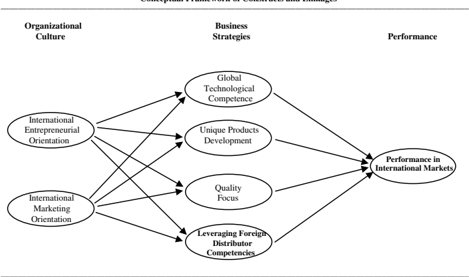
- The survey analysis found that international entrepreneurial orientation significantly predicted global technological competence with a standardized coefficient of 0.28; the link from international marketing orientation to global technological competence was not significant.
- Unique products development was significantly predicted by both international entrepreneurial orientation (0.19) and international marketing orientation (0.24).
- Quality focus was significantly predicted by both international entrepreneurial orientation (0.23) and international marketing orientation (0.35).
- Leveraging foreign distributor competences was significantly predicted by international marketing orientation (0.26) but not by international entrepreneurial orientation; these strategy variables were also significant drivers of performance in international markets: global technological competence (0.21), unique products development (0.14), quality focus (0.30), and leveraging foreign distributor competences (0.18).
## Methods
- The paper uses a two-phase design: first qualitative interviews/case studies to develop constructs and hypotheses, then a cross-industry field survey to test them.
- The qualitative phase included 33 professionals: 24 senior managers at early internationalizing firms, 6 scholars, and 3 international trade experts; the firms were mostly founded after 1985, sold half or more of their sales abroad, and had entered foreign markets within 3 years of founding.
- The survey was mailed to a random sample of 900 manufacturing firms in the United States founded in 1980 or later and exporting at least 25% of total production; 203 usable surveys were returned (about 23% response rate). The main analysis used LISREL8 path analysis, with exploratory factor analysis and confirmatory factor analysis for scale purification and validity checks.
## Limitations
- The paper states that “little empirical work” had been attempted on born globals and that there had been “almost no empirical research” on the factors driving their superior international performance.
- The study itself is focused on U.S. manufacturing firms that were selected using a 25% export threshold, so the evidence is tied to that sample and entry-mode context; this is evident from the text.
- The paper notes that the survey results are based on self-reported measures from responding firms; this is evident from the questionnaire-based design, though the paper does not frame it explicitly as a limitation.
Model-written summary. Check it against the paper before relying on it.
Integrity signals
Registry
Cites
Statistics
Figures
Verification
Claims the paper makes
0 Valid · 0 Not valid · 53 Not checked · 112 Own results and interpretations
A result the paper reports from its own data — it cites no other source for it, so there is none to check. The quote shows it is in the paper.
In the paper
“Despite the scarce resources typical of young firms, our findings reveal that born-global firms leverage a distinctive mix of orientations and strategies that allow them to succeed in diverse international markets.”
plainstates a cause- Asserted: passes — The authors put it forward as true.
- Checkable: passes — It can be checked against evidence.
- Load-bearing: passes — The paper’s conclusions depend on it.
- Based: passes — The paper gives a reason why it holds.
- Rests on an assumption not shown here.
A result the paper reports from its own data — it cites no other source for it, so there is none to check. The quote shows it is in the paper.
In the paper
“The critical role of marketing prowess overseas was also strongly emphasized by virtually all interviewees in the case studies.”
boosted- Asserted: passes — The authors put it forward as true.
- Checkable: passes — It can be checked against evidence.
- Load-bearing: unclear — It is unclear whether the paper’s conclusions depend on it.
- Based: passes — The paper gives a reason why it holds.
A result the paper states — it cites no source for it, so there is none to check. The quote shows it is in the paper.
In the paper
“Most interviewed firms exhibited strong technological capabilities in their respective product or industry categories.”
plain- Asserted: passes — The authors put it forward as true.
- Checkable: passes — It can be checked against evidence.
- Load-bearing: unclear — It is unclear whether the paper’s conclusions depend on it.
- Based: passes — The paper gives a reason why it holds.
A result the paper reports from its own data — it cites no other source for it, so there is none to check. The quote shows it is in the paper.
In the paper
“In general, the qualitative phase of the study revealed that born globals are likely to be formed by entrepreneurs who pursue foreign ventures with a strong marketing orientation.”
hedgedstates an association- Asserted: passes — The authors put it forward as true.
- Checkable: passes — It can be checked against evidence.
- Load-bearing: passes — The paper’s conclusions depend on it.
- Based: passes — The paper gives a reason why it holds.
A result the paper states — it cites no source for it, so there is none to check. The quote shows it is in the paper.
In the paper
“In contrast, born globals leverage a collection of fundamental intangible knowledge-based capabilities in the cultivation of foreign markets early in their evolution.”
plainstates a cause- Asserted: passes — The authors put it forward as true.
- Checkable: passes — It can be checked against evidence.
- Load-bearing: passes — The paper’s conclusions depend on it.
- Based: unclear — It is unclear why the paper says it holds.
- Rests on an assumption not shown here.
84 more claims
Create a free account to see all 165 claims and to verify the 3 references still open.
- It may state two separate claims as one. 33
- Probably not a substantial claim. 54
Citations
Cites
Evaluating Structural Equation Models with Unobservable Variables and Measurement Error
Fornell, C., & Larcker, D. F. (1981) · Journal of Marketing Research · doi:10.2307/3151312 · Cited by 109,314 · cited 2×
“Composite reliability was calculated using the procedures outlined by Fornell and Larcker (1981).”
MethodInfluentialEvaluating structural equation models with unobservable variables and measurement error
Fornell, C., & Larcker, D. F. (1981) · Journal of Marketing Research · doi:10.1177/002224378101800104 · Cited by 109,190
Firm Resources and Sustained Competitive Advantage
Barney, J. (1991) · Journal of Management · doi:10.1177/014920639101700108 · Cited by 48,334
(1994) · Journal of the American Dietetic Association · doi:10.1016/0002-8223(94)92216-0 · Cited by 45,910
Firm resources and sustained competitive advantage
Barney, J. B. (2004) · Advances in Strategic Management · doi:10.1016/s0742-3322(00)17018-4 · Cited by 38,152
Absorptive Capacity: A New Perspective on Learning and Innovation
Cohen, W. M., & Levinthal, D. A. (1990) · Administrative Science Quarterly · doi:10.2307/2393553 · Cited by 35,728
A resource‐based view of the firm
Wernerfelt, B. (1984) · Strategic Management Journal · doi:10.1002/smj.4250050207 · Cited by 25,635
The Theory of Economic Development
Schumpeter, J., & Backhaus, U. (2006) · The European Heritage in Economics and the Social Sciences · doi:10.1007/0-306-48082-4_3 · Cited by 22,506
An Evolutionary Theory of Economic Change.
Loasby, B. J., Nelson, R. R., & Winter, S. G. (1983) · The Economic Journal · doi:10.2307/2232409 · Cited by 21,366
A Dynamic Theory of Organizational Knowledge Creation
Nonaka, I. (1994) · Organization Science · doi:10.1287/orsc.5.1.14 · Cited by 17,809
Research works printed but not linked: 5
- Nikkei Sangyoo Shimbun (1995) Benchaa Shin Sedai (New Generation Ventures) , Nihon Keizai Shimbun: Tokyo.
- Nunnally, J.C. (1978) Psychometric Theory
- Porter, M.E. (1980) Competitive Strategy , The Free Press: New York.
- Rennie, M. (1993) 'Born global', McKinsey Quarterly (4): 45-52. Rosson, P. and Ford, I.D. (1982) 'Manufacturer-overseas distributor relations and export performance', Journal of International Business Studies 13 (2): 57-72.
- Schumpeter, J. (1939) Business Cycles , Vol. 1 McGraw-Hill: New York.
Cited by
Items 2,101–2,200 of 3,020
Entrepreneurial finance models for born-global SMEs in Nigeria
Nwankwo, T. (2023) · Sheffield Hallam University · doi:10.7190/shu-thesis-00546 · Cited by 3
Disentangling innovation in international entrepreneurship
Jafari‐Sadeghi, V., Sukumar, A., Radu-Lefebvre, M., et al. (2025) · The International Journal of Entrepreneurship and Innovation · doi:10.1177/14657503251347454 · Cited by 2
“As Knight and Cavusgil (2004) emphasize, innovation capabilities enable resource-constrained fi rms to develop unique offerings and processes that facilitate international expansion despite their relative newness and size limitations.”
What Lies Beneath the Internationalization of Firms in a Regional Innovation System?
Sedita, S. R., Belussi, F., & Fiscato, G. (2011) · Advances in international management · doi:10.1108/s1571-5027(2011)0000024019 · Cited by 3
How to compete? The development of business and functional-level strategies
Venzin, M. (2009) · Oxford University Press eBooks · doi:10.1093/acprof:oso/9780199535200.003.0009 · Cited by 1
de Oliveira, M. C. S. F., Hahn, I. S., dos Santos, M. B., et al. (2017) · Revista de Administração da UFSM · doi:10.5902/1983465924750 · Cited by 1
Expansion and internationalization of business companies in Brazil: theoretical/methodological cont
Costa, A. J. D., Saes, A. M., & Gonçalves, C. (2018) · Journal of Evolutionary Studies in Business-JESB · doi:10.1344/jesb2018.2.j045 · Cited by 1
The determinants of firms’ global diversification decisions
Hurwitz, C., Chou, W.-H., Chang, C., & Prakash, A. J. (2019) · Applied Economics · doi:10.1080/00036846.2019.1566690 · Cited by 1
“Themaximum time lag between the year the firm goes public and the subsequent globalization decision is three years, consistent with Knight and Cavusgil (2004) rapid internationalization theory.”
BackgroundFinancial strategy and the process of the internationalization of enterprises
Różański, J., & Bogołębska, J. (2020) · Financial Sciences · doi:10.15611/fins.2020.4.04 · Cited by 1
“…(Vissak & Francioni, 2013); the possibility of rapid internationalization – the concept of born global – (Baronchelli & Cassia, 2010; 2008; Knight & Cavusgil, 2004); • creating models of international business networks (Johanson & Vahlne, 2009); examining the relationship between…”
Designing a Digital Marketing Strategy for Start-Up Luxury Brands: The Case of Vidda Royalle
Rosenbaum, G. O., Carneiro, M. I. C., Gomes, C. M. N., & Marques, L. A. (2022) · Advances in e-business research series · doi:10.4018/978-1-7998-9008-9.ch021 · Cited by 1
The Degree of Internationalization and the Use of Social Media in Marketing Communication
Bartosik‐Purgat, M., & Jankowska, B. (2021) · IGI Global eBooks · doi:10.4018/978-1-7998-9155-0.ch039 · Cited by 1
Jathol, B. A., & Favre-Bonté, V. (2022) · Management international · doi:10.7202/1089022ar · Cited by 1
“Born-global firms are defined as “ business organizations that, from or near their founding, seek superior international business performance from the application of knowledge-based resources to the sale of outputs in multiple countries” (Knight & Cavusgil, 2004, p. 124).”
BackgroundInfluentialDuan, C. (2023) · Journal of Business Ecosystems · doi:10.4018/jbe.322774 · Cited by 3
“(Knight & Cavusgil, 2004) Ethnic (minority) entrepreneurship and entrepreneurs Defined as “entrepreneurs that migrate from one country to another, concurrently maintaining business-related linkages with their former country of origin and currently adopted countries and communities.””
(2023) · Quality - Access to Success · doi:10.47750/qas/24.195.11 · Cited by 1
Milhailova, I. (2023) · Emprendimiento y Negocios Internacionales · doi:10.20420/eni.2023.639 · Cited by 1
Zasobowe uwarunkowania zdolności internacjonalizacyjnej przedsiębiorstw. Wiedza. Relacje. Kultura
Szymura-Tyc, M., Sulimowska-Formowicz, M., & Babińska, D. (2023) · doi:10.22367/uekat.9788378758730 · Cited by 1
Zalan, T., Polyzos, E., & Toufaily, É. (2026) · Long Range Planning · doi:10.1016/j.lrp.2026.102647 · Cited by 2
Pallás-Rocafull, A., Villar, C., & Barber, J. P. (2024) · Springer eBooks · doi:10.1007/978-3-031-45659-6_6 · Cited by 1
Evolutionary Development of Born Globals Literature During the Period of 2002–2020
Baskıcı, Ç., Ercil, Y., & Gökmen, Y. (2024) · Journal of the Knowledge Economy · doi:10.1007/s13132-024-01926-9 · Cited by 1
“…in the triggering of the growth of national economies (Puthusserry et al., 2020) and their successes in international markets despite their limited financial, human, and material resources (Knight & Cavusgil, 2004) have nourished the interest of researchers in these firms (Cavusgil & Knight, 2009).”
Influentialdos Santos, A. F., da Costa, P. R., Arantes, C. N., Pires, A. D. C., & Cirani, C. B. S. (2024) · REGEPE Entrepreneurship and Small Business Journal · doi:10.14211/regepe.esbj.e2407 · Cited by 7
International entrepreneurship: Insights from Laos, Cambodia, and Vietnam
TAFE SA – Business & Arts, A., & Sorensen, B. (2024) · Asian Journal of Business Research · doi:10.14707/ajbr.240164 · Cited by 3
What SMEs Should Be Supported to Increase the Number of Exporting SMEs?
Vladimirov, Z. D. (2024) · Eurasian studies in business and economics · doi:10.1007/978-3-031-51212-4_12 · Cited by 1
Nave, E., Ferreira, J. J., & Veiga, P. M. (2024) · Journal of International Entrepreneurship · doi:10.1007/s10843-024-00361-w · Cited by 4
“Networking relationships are the core activity enabling the overcome of financial and human resources restrictions while simultaneously facilitating entrance into external markets towards the export performance (Acosta et al. 2018; Faroque et al. 2017; Knight and Cavusgil 2004).”
InfluentialPlanned Internationalization Level and Founder Attitudes Towards Venture Strategy
MacDonald, J., Mattingly, E. S., & Kushev, T. N. (2024) · Journal of Small Business Strategy · doi:10.53703/001c.117665 · Cited by 1
Burciu, A., Kicsi, R., & Danileț, A. M. (2024) · Contributions to management science · doi:10.1007/978-3-031-60343-3_6 · Cited by 1
The role of innovation strategies in balancing growth and profit: evidence from Colombian firms
Parga, M. A. R., Rialp, A., & Zuluaga, J. C. (2024) · Innovation and Development · doi:10.1080/2157930x.2024.2413260 · Cited by 1
“…of knowledge sources facilitates and increases the search for and acquisition of information which will be transformed into knowledge that will help EMFs grow and internationalize faster and earlier through the development of both radical and incremental innovations (Knight and Cavusgil 2004).”
Hwang, S.-J., & Choi, J. (2024) · Emerald Group Publishing Limited eBooks · doi:10.1108/s1571-038620240000034020 · Cited by 2
Indarwati, T. A., Andjarwati, A. L., Dhenabayu, R., & Sanaji (2024) · International Conference on Decision Aid Sciences and Applications (DASA) · doi:10.1109/dasa63652.2024.10836519 · Cited by 4
Pre-founding, Creation, and Early Internationalization
Romanello, R., & Chiarvesio, M. (2024) · International series in advanced management studies · doi:10.1007/978-3-031-80128-0_4 · Cited by 1
Ego, P., & Pidun, U. (2025) · Management International Review · doi:10.1007/s11575-024-00566-0 · Cited by 3
“By focusing on the entry mode choice, our study also contrasts with related literature on ‘born globals’ (Knight & Cavusgil, 2004 ) or international new ventures (INVs) (Zahra, 2005) that explore rapid internationalization of startups, often right after inception.”
Elia, S., & Grilli, L. (2025) · Industry and Innovation · doi:10.1080/13662716.2025.2482046 · Cited by 1
“…i.e. the ambition to exploit opportunities across national borders from inception, is widely recognised as an increasingly important phenomenon by international entrepreneurship literature (Knight and Cavusgil 2004; Oviatt and McDougall 1994; Rumyantseva and Welch 2023; Zucchella 2021).”
The Emergence and Growth of International Business Thought as an Evolutionary Process
Zhang, F., & Li, Y. (2025) · Springer eBooks · doi:10.1007/978-3-031-86133-8_2 · Cited by 2
Platzek, F., Schmitz, A., & Hagen, A. (2025) · Business & Society · doi:10.1177/00076503251343359 · Cited by 4
“Nurtured by the resources-based view (Barney, 1991) and debates around organizational capabilities (Knight & Cavusgil, 2004), information asymmetries (Bergh et al., 2019; Nayyar, 1990), and market entry timing (Lilien & Yoon, 1990), the concept of the first-mover advantage evolved (Kerin et al.,…”
Ngo, Q. D., & LE, H. M. (2025) · Journal of Developmental Entrepreneurship · doi:10.1142/s1084946725500098 · Cited by 2
Heo, A.-J., & Kim, Y. (2025) · Review of International Business and Strategy · doi:10.1108/ribs-11-2024-0138 · Cited by 2
Dark triad personality traits and born global internationalization
Nooshabadi, J. E., Mockaitis, A. I., & Chugh, R. (2025) · Journal of International Management · doi:10.1016/j.intman.2025.101309 · Cited by 1
Contemporary transitions in the international activities of startups and their policy implications
Zahra, S. A., & Hashai, N. (2025) · Journal of International Business Policy · doi:10.1057/s42214-025-00226-6 · Cited by 7
“Hence, this research documented how digital technologies facilitated agile and cost-effective interna-tionalization, enabling startups to compete internationally with larger, established Multinational Corporations (Knight & Cavusgil, 2004).”
Hoai, T. T., Adomako, S., Nguyen, N. P., & Ahsan, M. (2025) · Thunderbird International Business Review · doi:10.1002/tie.70066 · Cited by 3
The Next Catch : spotting surging entrepreneurial ecosystems
Belfanti, F., Riva, M., & Alberti, F. G. (2025) · European Planning Studies · doi:10.1080/09654313.2025.2597248 · Cited by 3
Dung, L. T., Minh, T. Q., & Binh, N. T. (2025) · Asia Pacific Business Review · doi:10.1080/13602381.2025.2600474 · Cited by 1
Location choice in global patent litigation: Does the landscape matter?
An, C. B., Wang, S., & Zhao, M. (2025) · Strategic Management Journal · doi:10.1002/smj.70037 · Cited by 3
Dubois, E., Zhang, H., Garbuio, M., & Vazquez-Hernandez, C. (2025) · European Management Journal · doi:10.1016/j.emj.2025.12.006 · Cited by 3
An, L., Kang, S., & Lee, W. J. (2026) · Sustainability · doi:10.3390/su18010421 · Cited by 2
Stay or go? Exogenous shocks and small and medium‐sized enterprises ' export market portfolios
Meschi, M., Majocchi, A., & Mayrhofer, U. (2026) · Global Strategy Journal · doi:10.1002/gsj.70006 · Cited by 16
Marmor, M., Lukason, O., & Vissak, T. (2026) · Cogent Business & Management · doi:10.1080/23311975.2026.2616849 · Cited by 1
Improvisation in internationalization decision-making: The critical role of entrepreneurs in SMEs
Gabrielsson, P., Galkina, T., Chabowski, B. R., & Gabrielsson, M. (2026) · Journal of World Business · doi:10.1016/j.jwb.2026.101721 · Cited by 1
Shi, L. H., & Danis, W. M. (2026) · Journal of World Business · doi:10.1016/j.jwb.2026.101723 · Cited by 2
Guven, A. A. (2026) · IGI Global eBooks · doi:10.4018/979-8-3373-6466-7.ch003 · Cited by 1
Cherchem, N., Clark, D. R., & Wales, W. J. (2026) · Journal of World Business · doi:10.1016/j.jwb.2026.101726 · Cited by 6
Jalali, H. S. (2026) · Central European Management Journal · doi:10.1108/cemj-09-2025-0269 · Cited by 1
Kahveci, E., Toprak, B., & Zaim, S. (2026) · Administrative Sciences · doi:10.3390/admsci16030143 · Cited by 3
“Similarly, born-global firms demonstrate that strong innovation capabilities and knowledge assets can compensate for limited financial and human resources in international markets (Knight & Cavusgil, 2004).”
Vu, K.-C., He, X., & Lengler, J. (2026) · International Business Review · doi:10.1016/j.ibusrev.2026.102587 · Cited by 1
Anggadwita, G., Ramadani, V., & Tjahjono, H. K. (2026) · Review of International Business and Strategy · doi:10.1108/ribs-12-2025-0171 · Cited by 7
Ghouse, S. M., Vita, G. D., Jones, P. K., & Arslan, A. (2026) · Journal of Small Business and Enterprise Development · doi:10.1108/jsbed-02-2026-0186 · Cited by 2
Sriboonlue, O., & Sriboonlue, U. (2026) · Cogent Business & Management · doi:10.1080/23311975.2026.2656052 · Cited by 1
International business strategy and the bifurcated world of ‘Sunset’ industries
Verbeke, A. C., & Simoes, S. (2026) · Long Range Planning · doi:10.1016/j.lrp.2026.102639 · Cited by 5
Chen, W., Zeng, Z., & 余康妮 (2026) · Management International Review · doi:10.1007/s11575-026-00625-8 · Cited by 1
The anatomy of SME international resilience: empirical evidence from an emerging market
Ribeiro, D. R. P., Barbosa, A. P. F. P. L., & Nakano, D. (2026) · Review of International Business and Strategy · doi:10.1108/ribs-04-2025-0053 · Cited by 2
Çakır, F. S., Adıgüzel, Z., & Salamzadeh, Y. (2026) · foresight · doi:10.1108/fs-09-2025-0196 · Cited by 1
Liu, H., Du, Y., Xu, Y., & Niu, S. (2026) · Sustainability · doi:10.3390/su18125967 · Cited by 3
Going Global Early: Liabilities of Foreignness and Early Internationalizing Firms
Bals, L., Berry, H., Hartmann, E., & Rättich, G. (2011) · Gabler eBooks · doi:10.1007/978-3-8349-6900-2_2 · Cited by 2
Resource Acquisition in High-Tech Start-up Global Strategies
Taji, N. (2014) · Technology, innovation, entrepreneurship and competitive strategy · doi:10.1108/s1479-067x20140000014008 · Cited by 1
Firm-‐level entrepreneurship and the internationalization of small and medium-‐sized enterprises
Hosseini, M. (2013) · Linköping University Electronic Press eBooks · doi:10.3384/lic.diva-98274 · Cited by 2
Wczesna internacjonalizacja polskich firm typu born global
Seroka‐Stolka, O. (2013) · Zeszyty Naukowe Wyższej Szkoły Humanitas Zarządzanie · Cited by 1
A LONGITUDINAL STUDY ON THE IMPACT OF CROSS-BORDER VENTURE CAPITAL ON PORTFOLIO COMPANY GROWTH
Paeleman, I., Devigne, D., & Vanacker, T. R. (2010) · Cited by 1
Strategie zarządzania wiedzą w organizacjach typu born global
Prystupa-Rządca, K. (2013) · e-mentor · Cited by 1
Savić, M., Đorđević, P., Nikolić, Đ., et al. (2012) · Istrazivanja i projektovanja za privredu · doi:10.5937/jaes10-2522 · Cited by 1
Samsung Electronics: From ‘National Champion’ to ‘Global Leader’
Park, S.-C., Alvstam, C. G., Dolles, H., et al. (2014) · Palgrave Macmillan UK eBooks · doi:10.1057/9781137312211_9 · Cited by 1
A skills approach to growth of university spin-off firms: Export as an example
van GEENHUIZEN, M., Ye, Q., & Au-Yong-Oloviera, M. (2014) · Research Repository (Delft University of Technology) · Cited by 2
SABMiller: The Internationalisation of a Brewing Giant
Nel, R. (2015) · Cited by 1
R&D-related Capabilities of Technology Born Globals
Altshuler, L. (2011) · Cited by 1
Introduction: Research on FDI and MNEs in a Changing World
Hashai, N., & Ramamurti, R. (2011) · Research in global strategic management · doi:10.1108/s1064-4857(2011)0000015007 · Cited by 1
International new ventures’ use of networks to target globally released mobile applications
Ahola, N. (2014) · Cited by 1
Early Rapidly Internationalizing Small Firms from South Africa
Masango, S. G., & Marinova, S. T. (2013) · Palgrave Macmillan eBooks · doi:10.1057/9781137369413_7 · Cited by 1
AN OVERVIEW OF 10 YEARS OF QUALITATIVE METHODS AT JOURNAL OF INTERNATIONAL BUSINESS STUDIES
de Vasconcellos, S. L., Garrido, I. L., Monticelli, J. M., de Souza, Y. S., & Calixto, C. V. (2013) · Administração Ensino e Pesquisa · doi:10.13058/raep.2013.v14n2.65 · Cited by 1
Rungi, M., & Ida, A. (2015) · doi:10.1109/ieem.2015.7385908 · Cited by 1
VALUE CREATION THROUGH BUSINESS MODEL IN
Laaksolahti, M., & Saarenketo, P. S. (2012) · Doria (University of Helsinki) · Cited by 1
ESTRATÉGIAS DE INOVAÇÃO DAS STARTUPS GLOBAL BORNS: um estudo comparativos com empresas incubadas
da Costa, L. D. F. L. G., Ribeiro, C. M. F. A., da Silva, J. D. L., et al. (2015) · EmpíricaBR - Revista Brasileira de Gestão Negócio e Tecnologia da Informação · doi:10.15628/empiricabr.2015.3326 · Cited by 1
A Critical Review of Theoretical Perspectives on Emerging Economy Multinationals
Ayden, Y. (2016) · European journal of economic and political studies · Cited by 3
Marketing: A Global Discipline
Schlegelmilch, B. (2016) · Management for professionals · doi:10.1007/978-3-319-26279-6_1 · Cited by 1
양희순, & 정민지 (2015) · Asia-Pacific Journal of Business Venturing and Entrepreneurship · doi:10.16972/apjbve.10.2.201504.121 · Cited by 1
Torkkeli, L., Puumalainen, K., Saarenketo, S., & Kuivalainen, O. (2011) · Progress in international business research · doi:10.1108/s1745-8862(2011)0000006008 · Cited by 1
The characteristics of financial services
Venzin, M. (2009) · Oxford University Press eBooks · doi:10.1093/acprof:oso/9780199535200.003.0002 · Cited by 1
Martins, I. (2013) · TDX (Tesis Doctorals en Xarxa) · Cited by 2
Personal and Firm Drivers of Export Entrepreneurship
García, A. N., Arenas-Gaitán, J., & Cataluña, F. J. R. (2015) · Advances in business strategy and competitive advantage book series · doi:10.4018/978-1-4666-8348-8.ch023 · Cited by 1
International Entrepreneurship at the Foreign Market Level: Towards a Network Perspective
Melén, S., Nordman, E. R., Tolstoy, D., & Sharma, D. D. (2011) · Advances in international management · doi:10.1108/s1571-5027(2011)0000024021 · Cited by 1
The legitimation strategies of internationalizing Flemish SMEs and their subsidiaries
Voisey, C. J., Onkelinx, J., Sleuwaegen, L. E., & Buysse, R. (2010) · Cited by 1
Internationalisation and innovation: the case of Victorian SME first exporters
Rees, M. (2011) · Swinburne figshare (Swinburne University of Technology) · doi:10.25916/sut.26276665 · Cited by 1
Lithuanian Exporters in the Financial Crisis
Jensen, C. B. F., & Rastenienė, A. (2016) · Ekonomika · doi:10.15388/ekon.2016.2.10128 · Cited by 1
“…has focused on managerial factors in marketing studies (see e.g. Aaby and Slater, 1989, Cavusgil, 1984, Katsikeas, Leonidou and Morgan, 2000, Knight and Cavusgil, 2004) or firm-level productivity in economics (see e.g. Hallward-Driemeier, Iarossi and Sokoloff, 2002, Wagner, 2007, Kasahar…”
BackgroundExploring Technological Capabilities Relative to Cash Holdings and Firm Internationalization
남현정, & Leem, B. (2015) · The Journal of International Trade & Commerce · doi:10.16980/jitc.11.2.201504.449 · Cited by 1
Internationalization of High-Tech Enterprises
Daszkiewicz, N. (2015) · Problemy Zarządzania - Management Issues · doi:10.7172/1644-9584.56.4 · Cited by 1
Saeedi, M. R. (2016) · Linköping studies in science and technology. Dissertations · doi:10.3384/diss.diva-133305 · Cited by 1
“Differentiation across national borders could be strongly realized through launching novel and unique products that meet the particular specifications and needs of BPs, and this product advantage results in more loyalty from customers (Knight and Cavusgil, 2004).”
BackgroundResultInfluentialLe dodici fonti della capacità innovativa tra letteratura accademica e pratica manageriale
Bortoluzzi, G., & Maqbool, S. (2017) · ECONOMIA E SOCIETÀ REGIONALE · doi:10.3280/es2016-003004 · Cited by 2
Kim, J. Y., 박강민, & Lew, Y. K. (2016) · 전략경영연구 · doi:10.17786/jsm.2016.19.3.003 · Cited by 1
ANÁLISE REFLEXIVA DO PROCESSO DE INTERNACIONALIZAÇÃO DAS EMPRESAS DE NEGÓCIOS DIGITAIS
Feld, M., & Schreiber, D. (2016) · Revista Gestão e Desenvolvimento · doi:10.25112/rgd.v13i2.516 · Cited by 1
Three Essays on Foreign Entrepreneurs
Kulchina, E. (2013) · AIB Insights · doi:10.46697/001c.16948 · Cited by 1
Under-Investments in Innovative SMEs: The Effect of Entrepreneurial Cognitive Bias
Bar‐El, R., Gavious, I., Kaufmann, D., & Schwartz, D. (2017) · Emerald Group Publishing Limited eBooks · doi:10.1108/978-1-78714-827-720171012 · Cited by 2
Teixeira, N. M., Pardal, P. N., & Rafael, B. (2017) · Advances in business strategy and competitive advantage book series · doi:10.4018/978-1-5225-3525-6.ch017 · Cited by 1
The Internationalization Processes of SMEs
Pauluzzo, R., & Shen, B. (2018) · International series in advanced management studies · doi:10.1007/978-3-319-77881-5_2 · Cited by 4
Buccieri, D. (2018) · EngagedScholarship @ Cleveland State University (Cleveland State University) · Cited by 1
Metadata
- Authors
- Knight, G. A., & Cavusgil, S. T.
- Affiliations
- Florida State University (US)
- Corresponding author
- Knight, Gary A
- ORCID
- Knight, Gary A
- Venue
- Journal of International Business Studies
- Published
- 2004-01-08
- Volume
- 35
- Issue
- 2
- Pages
- 124-141
- ISSN
- 0047-2506 (ISSN-L)
- 1478-6990
- OpenAlex
- W2127709152
- Semantic Scholar
- d24960b5342d0dd3b86be002ab18a80e7b6fb5c9
- Cited by
- 3,013
- References
- 102
- Citations by year
- 2026: 121 · 2025: 123 · 2024: 157 · 2023: 154 · 2022: 182 · 2021: 196 · 2020: 189 · 2019: 180 · 2018: 199 · 2017: 172 · 2016: 188 · 2015: 187 · 2014: 178 · 2013: 167 · 2012: 129
- FWCI
- 137.12
- Type
- journal article
- Language
- en
- Update notices
- correction (2004-07-16)
- Open access
- bronze
- doi.org
- Licence
- www.springer.com/tdm (tdm)
- Locations
- Journal of International Business Studies (publishedVersion)
- RePEc: Research Papers in Economics (submittedVersion)
- Funders
- Michigan State University
- College of Engineering, Michigan State University
- Topics
- Social Sciences › Business, Management and Accounting › Strategy and Management › International Business and FDI
- Social Sciences › Business, Management and Accounting › Strategy and Management › Innovation and Knowledge Management
- Social Sciences › Communication › International Student and Expatriate Challenges
- Keywords
- born global firms, early internationalization, organizational capabilities, innovation, innovation culture, international business strategy, international success, young firms, internationalization of firms
About these checks
Registry, retraction, Cites and statistics results are computed, not judged, with one exception: a printed reference that no index lists is read once by a model before it counts as a citation error. Claims are extracted by a model and kept only when their quote appears verbatim in the text; each cited source is then checked, with a model’s help, for whether it says what the claim relies on. Those verdicts can be wrong — read the claim’s quote and the cited source before relying on one.
A language model drew the claims from the paper on 2026-10-10, under version 3 of the claim definition (model deepseek-v4.1-flash, prompt extract-v3).
A second model labelled each claim on 2026-10-10 (model jev-1.13-20260917, definition revision gold-guideline-v0.2).
Statistics and arithmetic are recomputed, not judged.
Confidence bands are shown only for fields calibrated on our annotated test set. None is calibrated yet, so no band is shown.
What counts as a claim ›How we measure confidence ›How we check this ›
Are you an author, or do you see a problem with this page? Request a review
Data sources
Bibliographic data: Semantic Scholar, OpenAlex, Crossref.
Contains information from the Semantic Scholar Academic Graph Datasets, made available under the ODC Attribution License (ODC-BY 1.0).
Semantic Scholar’s data is described in: Kinney, R., et al. (2023). The Semantic Scholar Open Data Platform. arXiv:2301.10140.
