

Innovation, organizational capabilities, and the born-global firm
Open accessThe DOI matches its Crossref record; 106 of the 106 references it cites were found in a registry or an index; none of the 100 sources its claims cite is checked for support yet.
Overview
CoChat Summary
## TL;DR
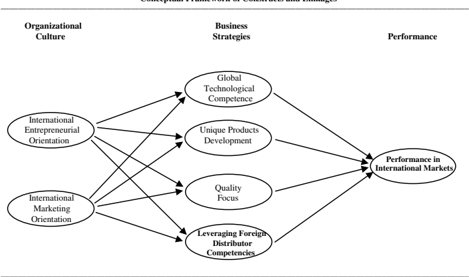
This study argues that born-global firms succeed because early internationalization is supported by an innovative culture and a distinctive set of organizational capabilities. Using qualitative case studies followed by a survey of 203 usable responses, the authors find that several capability links are significant and that these capabilities are associated with performance in international markets.
## Key findings
- The survey analysis found that international entrepreneurial orientation significantly predicted global technological competence with a standardized coefficient of 0.28; the link from international marketing orientation to global technological competence was not significant.
- Unique products development was significantly predicted by both international entrepreneurial orientation (0.19) and international marketing orientation (0.24).
- Quality focus was significantly predicted by both international entrepreneurial orientation (0.23) and international marketing orientation (0.35).
- Leveraging foreign distributor competences was significantly predicted by international marketing orientation (0.26) but not by international entrepreneurial orientation; these strategy variables were also significant drivers of performance in international markets: global technological competence (0.21), unique products development (0.14), quality focus (0.30), and leveraging foreign distributor competences (0.18).
## Methods
- The paper uses a two-phase design: first qualitative interviews/case studies to develop constructs and hypotheses, then a cross-industry field survey to test them.
- The qualitative phase included 33 professionals: 24 senior managers at early internationalizing firms, 6 scholars, and 3 international trade experts; the firms were mostly founded after 1985, sold half or more of their sales abroad, and had entered foreign markets within 3 years of founding.
- The survey was mailed to a random sample of 900 manufacturing firms in the United States founded in 1980 or later and exporting at least 25% of total production; 203 usable surveys were returned (about 23% response rate). The main analysis used LISREL8 path analysis, with exploratory factor analysis and confirmatory factor analysis for scale purification and validity checks.
## Limitations
- The paper states that “little empirical work” had been attempted on born globals and that there had been “almost no empirical research” on the factors driving their superior international performance.
- The study itself is focused on U.S. manufacturing firms that were selected using a 25% export threshold, so the evidence is tied to that sample and entry-mode context; this is evident from the text.
- The paper notes that the survey results are based on self-reported measures from responding firms; this is evident from the questionnaire-based design, though the paper does not frame it explicitly as a limitation.
Model-written summary. Check it against the paper before relying on it.
Integrity signals
Registry
Cites
Statistics
Figures
Verification
Claims the paper makes
0 Valid · 0 Not valid · 53 Not checked · 112 Own results and interpretations
A result the paper reports from its own data — it cites no other source for it, so there is none to check. The quote shows it is in the paper.
In the paper
“Despite the scarce resources typical of young firms, our findings reveal that born-global firms leverage a distinctive mix of orientations and strategies that allow them to succeed in diverse international markets.”
plainstates a cause- Asserted: passes — The authors put it forward as true.
- Checkable: passes — It can be checked against evidence.
- Load-bearing: passes — The paper’s conclusions depend on it.
- Based: passes — The paper gives a reason why it holds.
- Rests on an assumption not shown here.
A result the paper reports from its own data — it cites no other source for it, so there is none to check. The quote shows it is in the paper.
In the paper
“The critical role of marketing prowess overseas was also strongly emphasized by virtually all interviewees in the case studies.”
boosted- Asserted: passes — The authors put it forward as true.
- Checkable: passes — It can be checked against evidence.
- Load-bearing: unclear — It is unclear whether the paper’s conclusions depend on it.
- Based: passes — The paper gives a reason why it holds.
A result the paper states — it cites no source for it, so there is none to check. The quote shows it is in the paper.
In the paper
“Most interviewed firms exhibited strong technological capabilities in their respective product or industry categories.”
plain- Asserted: passes — The authors put it forward as true.
- Checkable: passes — It can be checked against evidence.
- Load-bearing: unclear — It is unclear whether the paper’s conclusions depend on it.
- Based: passes — The paper gives a reason why it holds.
A result the paper reports from its own data — it cites no other source for it, so there is none to check. The quote shows it is in the paper.
In the paper
“In general, the qualitative phase of the study revealed that born globals are likely to be formed by entrepreneurs who pursue foreign ventures with a strong marketing orientation.”
hedgedstates an association- Asserted: passes — The authors put it forward as true.
- Checkable: passes — It can be checked against evidence.
- Load-bearing: passes — The paper’s conclusions depend on it.
- Based: passes — The paper gives a reason why it holds.
A result the paper states — it cites no source for it, so there is none to check. The quote shows it is in the paper.
In the paper
“In contrast, born globals leverage a collection of fundamental intangible knowledge-based capabilities in the cultivation of foreign markets early in their evolution.”
plainstates a cause- Asserted: passes — The authors put it forward as true.
- Checkable: passes — It can be checked against evidence.
- Load-bearing: passes — The paper’s conclusions depend on it.
- Based: unclear — It is unclear why the paper says it holds.
- Rests on an assumption not shown here.
84 more claims
Create a free account to see all 165 claims and to verify the 3 references still open.
- It may state two separate claims as one. 33
- Probably not a substantial claim. 54
Citations
Cites
Evaluating Structural Equation Models with Unobservable Variables and Measurement Error
Fornell, C., & Larcker, D. F. (1981) · Journal of Marketing Research · doi:10.2307/3151312 · Cited by 109,314 · cited 2×
“Composite reliability was calculated using the procedures outlined by Fornell and Larcker (1981).”
MethodInfluentialEvaluating structural equation models with unobservable variables and measurement error
Fornell, C., & Larcker, D. F. (1981) · Journal of Marketing Research · doi:10.1177/002224378101800104 · Cited by 109,190
Firm Resources and Sustained Competitive Advantage
Barney, J. (1991) · Journal of Management · doi:10.1177/014920639101700108 · Cited by 48,334
(1994) · Journal of the American Dietetic Association · doi:10.1016/0002-8223(94)92216-0 · Cited by 45,910
Firm resources and sustained competitive advantage
Barney, J. B. (2004) · Advances in Strategic Management · doi:10.1016/s0742-3322(00)17018-4 · Cited by 38,152
Absorptive Capacity: A New Perspective on Learning and Innovation
Cohen, W. M., & Levinthal, D. A. (1990) · Administrative Science Quarterly · doi:10.2307/2393553 · Cited by 35,728
A resource‐based view of the firm
Wernerfelt, B. (1984) · Strategic Management Journal · doi:10.1002/smj.4250050207 · Cited by 25,635
The Theory of Economic Development
Schumpeter, J., & Backhaus, U. (2006) · The European Heritage in Economics and the Social Sciences · doi:10.1007/0-306-48082-4_3 · Cited by 22,506
An Evolutionary Theory of Economic Change.
Loasby, B. J., Nelson, R. R., & Winter, S. G. (1983) · The Economic Journal · doi:10.2307/2232409 · Cited by 21,366
A Dynamic Theory of Organizational Knowledge Creation
Nonaka, I. (1994) · Organization Science · doi:10.1287/orsc.5.1.14 · Cited by 17,809
Research works printed but not linked: 5
- Nikkei Sangyoo Shimbun (1995) Benchaa Shin Sedai (New Generation Ventures) , Nihon Keizai Shimbun: Tokyo.
- Nunnally, J.C. (1978) Psychometric Theory
- Porter, M.E. (1980) Competitive Strategy , The Free Press: New York.
- Rennie, M. (1993) 'Born global', McKinsey Quarterly (4): 45-52. Rosson, P. and Ford, I.D. (1982) 'Manufacturer-overseas distributor relations and export performance', Journal of International Business Studies 13 (2): 57-72.
- Schumpeter, J. (1939) Business Cycles , Vol. 1 McGraw-Hill: New York.
Cited by
Items 2,901–3,000 of 3,020
Wang, Y., Li, W. H., & Liu, W. (2026) · Journal of International Management · doi:10.1016/j.intman.2026.101327
International SMEs and sustainability in the manufacturing industry
Kabbara, D., Salhab, R., & Torres, M. M. (2026) · Critical Perspectives on International Business · doi:10.1108/cpoib-02-2025-0038 · Cited by 2
TanTai, B., Isa, R. M., Senik, Z. C., & Muhamad, N. S. (2026) · SAGE Open · doi:10.1177/21582440251411759
“The five case firms in this study, based on the definition proposed by Knight and Cavusgil (2004), are all BGs that began expanding into global markets within 3 years of their establishment, with international business accounting for more than 25% of their revenue.”
InfluentialThe Impact of Local Services Development on the Export Performance of Chinese Manufacturing Firms
Zhang, Y., Roelfsema, H., Findlay, C., & Liu, C. (2026) · Open Economies Review · doi:10.1007/s11079-026-09855-7
KÜRESEL DOĞAN AİLE İŞLETMELERİNDE ERKEN ULUSLARARASILAŞMANIN TETİKLEYİCİLERİ: BYL TEKSTİL ÖRNEĞİ
Berber, Ş., & Can, E. (2026) · Yönetim Bilimleri Dergisi · doi:10.35408/comuybd.1653413
Jabeen, M., Ishaq, K., & Jabeen, B. (2026) · NUST Business Review · doi:10.37435/nbr.v7i2.130
“According to the Born Global theory, Born Global firms were the firms that internationalized rapidly and early after their inception (McDougal & Oviatt, 1994; Knight & Cavusgil, 2004).”
Factors Impacting Entrepreneurial Orientation and International Performance of Born Global Companies
Veselova, A. S., & Sikachev, A. (2026) · Journal of East-West Business · doi:10.1080/10669868.2026.2620112 · Cited by 1
“Unlike well-established multinational corporations, BGCs often operate with limited financial, human, and technological resources (Baker & Nelson, 2005; Knight & Cavusgil, 2004).”
InfluentialThe impact of distance on social capital in high-tech born global companies
Presutti, M., Fratocchi, L., & Majocchi, A. (2026) · Journal of Small Business Management · doi:10.1080/00472778.2025.2607508
“To identify the BGs to be sampled, we applied the following three criteria proposed by Taylor and Jack (2012) and Knight and Cavusgil (1996, 2004): (a) International expansion implemented no later than the third year after the firm’s establishment.”
Brewing identity: How craft beer firms navigate identity work in international growthPreprint
Jasovska, P. (2026) · SSRN Electronic Journal · doi:10.2139/ssrn.6142678
Entwicklung globaler Produkt- und Serviceangebote
Schlegelmilch, B. B. (2026) · Springer eBooks · doi:10.1007/978-3-032-13252-9_7
Marketingstrategie: Eine globale Disziplin
Schlegelmilch, B. B. (2026) · Springer eBooks · doi:10.1007/978-3-032-13252-9_1
Roque, A. F. (2026) · SSRN Electronic Journal · doi:10.2139/ssrn.6172549
Alves, S. L. (2026) · SSRN Electronic Journal · doi:10.2139/ssrn.6184697
Born Globals in Indian Manufacturing: Post-Entry Export PerformancePreprint
Goldar, B., & Banga, K. (2025) · SSRN Electronic Journal · doi:10.2139/ssrn.5343320
Cross-border marketing in tourist SMEs in the Alentejo-Algarve-Andalusia Euroregion
Gil‐Cordero, E., Maldonado-López, B., & Chaves, P. L. (2026) · Cities · doi:10.1016/j.cities.2026.106912 · Cited by 2
Kamineni, R., & Rammal, H. G. (2026) · AIB Insights · doi:10.46697/001c.157783
Decossa, J. J. (2026) · Revue internationale des sciences de l organisation · doi:10.3917/riso.020.0022
Hye-Jin, P. A. R. K., & Ji-Ung, K. I. M. (2026) · Journal of Fisheries and Marine Sciences Education · doi:10.13000/jfmse.2026.2.38.1.149
Value chains, knowledge isolation, and performance in internationalizing SMEs
Gabrielsson, M., Seppälä, T., Gabrielsson, P., Rose, E. L., & Chetty, S. (2026) · Industrial Marketing Management · doi:10.1016/j.indmarman.2026.02.018 · Cited by 1
“We employed a widely used operationalization to distinguish between the two strategies for internationalization, categorizing firms that have reached the 25% threshold for foreign sales within three years of foundation as EIFs and others as TIFs (e.g., Knight & Cavusgil, 2004).”
Technological complexity and global capabilities in SMEs. A survey in an Italian industrial region
Cattaruzzo, S., Corò, G., & Borsato, R. (2026) · Industry and Innovation · doi:10.1080/13662716.2026.2637174 · Cited by 1
Alves, S. L., & Figueira, A. R. (2026) · SSRN Electronic Journal · doi:10.2139/ssrn.6390775
Inês, A., Ferreira, J. M. A., Zhang, Z., et al. (2026) · Research in International Business and Finance · doi:10.1016/j.ribaf.2026.103368
Managerial decision-making: entry modes in global markets
Sharma, V. M., & Klein, A. (2026) · Management Decision · doi:10.1108/md-02-2025-0535
Dimitrieff, G., & Masse, C. (2026) · International Journal of Music Business Research · doi:10.2478/ijmbr-2026-0003
“Independent labels, in contrast, resemble born global (BG) firms, which internationalise early by leveraging flexible business strategies, international networks and digital distribution (Chen et al. 2021; Knight & Cavusgil 2004).”
Desempenho de empresas de base tecnológica com internacionalização acelerada
Amorim, B. P., Ramos, A. S. M., & Pereira, F. A. D. M. (2026) · Revista Ibero-Americana de Estratégia · doi:10.5585/2026.27714
Macedo, D., & Crespo, N. F. (2026) · Emerald Group Publishing Limited eBooks · doi:10.1108/s1745-88622026000020b010
The Moderating Effect of Family Firm on SME Innovativeness and Internationalization
Theodoraki, C., Audretsch, D. B., & Pastelakos, E. (2023) · Revue de l’Entrepreneuriat · doi:10.3917/e.entre.pr.0046
Smith, C. (2021) · Revue de l’Entrepreneuriat · doi:10.3917/e.entre1.pr.0026 · Cited by 2
Origin and role of social networks : a Comparative study of Born Global Firms of France and Pakistan
Akhter, M. (2013) · theses.fr (ABES) · doi:10.70675/f64d8f9czc705z475az8ddbz1ca6712aef2e · Cited by 2
“HOLLENSTEIN, H. Determinants of International Activities: Are SMEs Different?”
InfluentialKrieweth, C., Kruse, S., Short, J. C., Schrameier, L. R. M., & Brettel, M. (2026) · Entrepreneurship Theory and Practice · doi:10.1177/10422587261415935 · Cited by 1
Catanzaro, A. (2014) · theses.fr (ABES) · doi:10.70675/ebc5fef7z3d08z4ad9z953cz75bc388fa763 · Cited by 3
Makrini, H. E. (2014) · theses.fr (ABES) · doi:10.70675/835225f9z02fez4415z82f8zb2e0e0964d35
Network development in international organizations : the case of ONLYLYON
Valdemarin, S. (2019) · theses.fr (ABES) · doi:10.70675/8c248fb9zfb69z451cz82d7z8231aef43cdb
Milano-Mayan, E. (2019) · theses.fr (ABES) · doi:10.70675/b886d057z75c7z49b2z9401zdbcb30159b65 · Cited by 1
lnternationalization and Digitalization of micro-, small- and medium-sized enterprises
Hervé, A. (2021) · theses.fr (ABES) · doi:10.70675/88470627zabf0z486fz8af1zf368df493511 · Cited by 1
Jouannaux, E. (2022) · theses.fr (ABES) · doi:10.70675/eed67ed2z7c15z499dz88edz145e14550887
Lefebvre, F. (2021) · theses.fr (ABES) · doi:10.70675/77c2db7az5789z4db2zba36z8149c65cfbb2 · Cited by 1
Three essays on the contribution of market learning ambidexterity in export success of SMEs
Unal, N. N. (2024) · theses.fr (ABES) · doi:10.70675/2d2efee7z53e1z49d8z888czd3852d5ce8bf
Internationalisierung – Expansion von Dienstleistungen steuern
Haller, S., & Wissing, C. (2026) · Springer eBooks · doi:10.1007/978-3-658-50218-8_9
Economic impact of Baltic region startups ecosystems
Kleponė, D. (2026) · doi:10.20334/2026-017-m · Cited by 1
International Marketing Practices and Strategies in the Dynamics of Brand Management
Tavares, S. B., Ribau, C. P., & Sousa, B. B. (2026) · IGI Global eBooks · doi:10.4018/979-8-3373-8162-6.ch006
Macedo, D., & Crespo, N. F. (2026) · SSRN Electronic Journal · doi:10.2139/ssrn.6574192
Internationalization and data capabilities: An institutional void perspective
BHATTACHARYA, B., Goyal, L., Mukherjee, R., & Majumdar, A. (2026) · Journal of International Management · doi:10.1016/j.intman.2026.101371 · Cited by 1
Appiah, E. K. (2026) · International Marketing Review · doi:10.1108/imr-02-2025-0051 · Cited by 1
Mahmood, S. M. F. (2026) · SSRN Electronic Journal · doi:10.2139/ssrn.6414918
Ismail, M. D., Samsudin, Z., Mavondo, F., & Ahmad, S. Z. (2026) · International Journal of Conflict Management · doi:10.1108/ijcma-08-2025-0288 · Cited by 1
Critical drivers of founders for intention to internationalize: an empirical study
Kumar, A., & Terzidis, O. (2026) · Journal of global entrepreneurship research · doi:10.1007/s40497-026-00518-y
Entrepreneurship and Startup Ecosystems: Drivers of Innovation, Growth and Economic ResiliencePreprint
Riahi, L. (2026) · SSRN Electronic Journal · doi:10.2139/ssrn.6664539
Strazdas, R., Černevičiūtė, J., & Banelienė, R. (2026) · Creativity Studies · doi:10.3846/cs.2026.25105
A Pragmatist View of Small Firms’ Foreign Market Entry
Alinasab, J., & Hunt, R. A. (2026) · Public Organization Review · doi:10.1007/s11115-026-01015-2
The impact of internationalization and innovation on productivity across MEDA firmsPreprint
Scalamonti, F. (2026) · SSRN Electronic Journal · doi:10.2139/ssrn.6680978
Technological Innovation in International Business: The Role of Organizational Culture
Deirmentzoglou, G. A., Agoraki, K. K., Anastasopoulou, E. E., et al. (2026) · Lecture notes in networks and systems · doi:10.1007/978-3-032-00264-8_47
Syed Ali Nawaid, A. L. A. M., & Adekunle, O. E. (2026) · European Business Review · doi:10.1108/ebr-11-2025-0432 · Cited by 1
Liu, R. R., Bai, W., Johanson, M., & Zhou, L. (2026) · Management International Review · doi:10.1007/s11575-026-00618-7 · Cited by 1
“…firms expand abroad soon after inception—has been extensively examined over the past two decades, yiel ding rich insights into the drivers, processes, and performance implications of rapid global expansion (Autio et al., 2000; Knight & Cavusgil, 2004; Oviatt & McDougall, 1994).”
InfluentialAlkhalailah, A. M., Gómez, E. G., & Sorroche‐del‐Rey, Y. (2026) · International Journal of Energy Sector Management · doi:10.1108/ijesm-10-2025-0013
Micro-enterprises going global: Networks and institutional support in Poland
Belniak, M. (2026) · Ruch Prawniczy Ekonomiczny i Socjologiczny · doi:10.14746/rpeis.2026.88.1.14
“Classic born-global research by Knight and Cavusgil (2004) and a subsequent meta-analysis by Cavusgil and Knight (2015) demonstrate that cloud adoption compresses the time-to-export from six years to fewer than two years.”
Min, H., Yang, G. H., Yan, C., Mei, F., XuePeng, D., & Wenda, C. (2026) · BMC Health Services Research · doi:10.1186/s12913-026-14735-4
“Key frameworks include Evolutionary Economic Theory [118], the Uppsala Internationalization Model [119] and International New Venture (INV) Theory [120], Evolutionary Game theory [121], and Stackelberg Game Model [122].”
Relationship Marketing and International Networks
Carvalho, H. M., & Santos, V. (2026) · IGI Global eBooks · doi:10.4018/979-8-3373-9988-1.ch005
АНАЛІЗ КОНКУРЕНТОСПРОМОЖНОСТІ ПІДПРИЄМСТВ В УМОВАХ ТРАНСКОРДОННОГО СПІВРОБІТНИЦТВА
Ткачук, Н. В. (2025) · Таврійський науковий вісник Серія Економіка · doi:10.32782/2708-0366/2025.26.17
Marketing Drivers and Barriers for Rapid Internationalisation
Liow, M. L. S. (2026) · IGI Global eBooks · doi:10.4018/979-8-3373-9988-1.ch003
The art of the successful dance: The investigation of AI adoption on firm performance
Xu, M., Zhang, W., Gupta, S., & Huang, J. (2026) · Journal of Strategy & Innovation · doi:10.1016/j.jsinno.2026.200576
Ho, M. H.-W., Chiang, L. L., Shenkar, O., Yang, P. S.-F., Huang, M.-H., & Chung, H. F. L. (2026) · Journal of World Business · doi:10.1016/j.jwb.2026.101757 · Cited by 1
Makhmadshoev, D., Ibeh, K., Demirbağ, M., & Saiyed, A. A. (2026) · International Marketing Review · doi:10.1108/imr-11-2024-0445 · Cited by 1
Wang, X., Lan, S., Zhang, X., et al. (2026) · SSRN Electronic Journal · doi:10.2139/ssrn.6966659
Yülek, M. Â., Candan, S. K., & Candan, H. E. (2026) · SSRN Electronic Journal · doi:10.2139/ssrn.6968603
Epistemología del mercadeo y los negocios internacionales
Cardona, M. M., Marulanda, C. C., & Martínez, E. D. (2026) · doi:10.52811/uao.9789586192309
Market diversity and cultural product performance: Evidence from the global movie industry
Kutlubay, O. C., Yayla, S., Kim, D., Çiçek, M., & Jean, R. “. (2026) · International Business Review · doi:10.1016/j.ibusrev.2026.102628
Scaling through friction: Learning, trust, and institutional alignment in global AgTech
Fernández-Vidal, J. (2026) · Agricultural Systems · doi:10.1016/j.agsy.2026.104878 · Cited by 2
Оцінка та кластеризація країн ЄС за пріоритетністю експорту української харчової продукції
Kruhlova, O., Velychko, K., Тімченко, О., et al. (2026) · Agricultural and Resource Economics International Scientific E-Journal · doi:10.51599/are.2026.12.02.05
Amornpinyo, S., Jankanakittikul, T., Bounthalath, L., Saengpakdeejit, R., & Saengnil, D. (2026) · SSRN Electronic Journal · doi:10.2139/ssrn.7036182 · Cited by 1
Ribeiro, D. R. P., Barbosa, A. P. F. P. L., Zomer, T. T. D. S., & Nakano, D. (2026) · Journal of Small Business Strategy · doi:10.53703/001c.163471 · Cited by 1
Hikmet, T., & Hurd, F. (2026) · Small Enterprise Research · doi:10.1080/13215906.2026.2692084
Coelho, A., Cancela, B. L., & Neves, M. E. D. (2026) · European Business Review · doi:10.1108/ebr-01-2026-0010
Digital Innovation and Transnational Network Activation
Bhattarai, N. (2026) · Palgrave studies in entrepreneurship and society. · doi:10.1007/978-3-032-21733-2_5
Zapata-Muñoz, A. F., & Zapata-Sánchez, C. E. (2026) · SSRN Electronic Journal · doi:10.2139/ssrn.7151806
Early Internationalizing Firms Long-term Growth: Insights From a Longitudinal Study
Breuillot, A., Favre-Bonté, V., & Meuric, P.-L. (2026) · Management International Review · doi:10.1007/s11575-026-00638-3
Exchange Rate Regimes and Startup Investment Depth: The Creative Destruction ProcessPreprint
Chiboub, I., & Sadok, H. (2026) · SSRN Electronic Journal · doi:10.2139/ssrn.7064458
Toikka, A. (2026) · Critical Perspectives on International Business · doi:10.1108/cpoib-11-2024-0141
Pan, Y., Peng, H., Luo, F., et al. (2026) · The International Journal of Entrepreneurship and Innovation · doi:10.1177/14657503261472794
Affordable Luxury from the Global South: Monastery’s Path to Internationalization
Gómez-Trujillo, A. M., Buriticá, D. C., Bunzl, B. A., Bonilla-Calle, D., & BEDOYA, J. C. M. (2026) · Latin American Business Review · doi:10.1080/10978526.2026.2714256
Jegede, O., & Adeyeye, D. (2026) · African Journal of Science Technology Innovation and Development · doi:10.1080/20421338.2026.2693765
Firm’s characteristics in international trade in services: the case of Estonia
Kerner, R. (2026) · Business and management · doi:10.3846/bm.2026.2390
Anggadwita, G., Rammal, H. G., & Zhu, Y. (2026) · Journal of Asia Business Studies · doi:10.1108/jabs-11-2025-0687 · Cited by 1
Zhang, M., & Hartley, J. L. (2026) · Journal of Chinese Economic and Business Studies · doi:10.1080/14765284.2026.2719196
Sidrat, S., & Boujelbene, Y. (2026) · IntechOpen eBooks · doi:10.5772/intechopen.1014113
Shi, L., Yang, M., & Han, C. (2026) · Sustainability · doi:10.3390/su18178797
When digital reach Pays Off: capability bundles and differential export paths in software firms
Choi, H., & Park, M. J. (2026) · Journal of Business Research · doi:10.1016/j.jbusres.2026.116510
Zhang, X., Wang, G., & Chen, M. (2026) · Research Square · doi:10.21203/rs.3.rs-10299974/v1
Cheng, L. (2026) · Journal of East European Management Studies · doi:10.31083/jeems45478
Erfanikia, A., Hajikarimi, B., Nazari, A., & Beshkooh, M. (2026) · SN Business & Economics · doi:10.1007/s43546-026-01399-9
“Prior research describes international orientation as directing managerial attention toward foreign opportunities and supporting learning and sustained international engagement (Knight and Cavusgil 2004 ; Escandón-Barbosa et al. 2019 ).”
InfluentialWathen, P., Ojala, A., & Karami, M. (2026) · Scandinavian Journal of Management · doi:10.1016/j.scaman.2026.101481
Dadzie, S. A., & Owusu, R. A. (2026) · SSRN Electronic Journal · doi:10.2139/ssrn.7454961
Metadata
- Authors
- Knight, G. A., & Cavusgil, S. T.
- Affiliations
- Florida State University (US)
- Corresponding author
- Knight, Gary A
- ORCID
- Knight, Gary A
- Venue
- Journal of International Business Studies
- Published
- 2004-01-08
- Volume
- 35
- Issue
- 2
- Pages
- 124-141
- ISSN
- 0047-2506 (ISSN-L)
- 1478-6990
- OpenAlex
- W2127709152
- Semantic Scholar
- d24960b5342d0dd3b86be002ab18a80e7b6fb5c9
- Cited by
- 3,013
- References
- 102
- Citations by year
- 2026: 121 · 2025: 123 · 2024: 157 · 2023: 154 · 2022: 182 · 2021: 196 · 2020: 189 · 2019: 180 · 2018: 199 · 2017: 172 · 2016: 188 · 2015: 187 · 2014: 178 · 2013: 167 · 2012: 129
- FWCI
- 137.12
- Type
- journal article
- Language
- en
- Update notices
- correction (2004-07-16)
- Open access
- bronze
- doi.org
- Licence
- www.springer.com/tdm (tdm)
- Locations
- Journal of International Business Studies (publishedVersion)
- RePEc: Research Papers in Economics (submittedVersion)
- Funders
- Michigan State University
- College of Engineering, Michigan State University
- Topics
- Social Sciences › Business, Management and Accounting › Strategy and Management › International Business and FDI
- Social Sciences › Business, Management and Accounting › Strategy and Management › Innovation and Knowledge Management
- Social Sciences › Communication › International Student and Expatriate Challenges
- Keywords
- born global firms, early internationalization, organizational capabilities, innovation, innovation culture, international business strategy, international success, young firms, internationalization of firms
About these checks
Registry, retraction, Cites and statistics results are computed, not judged, with one exception: a printed reference that no index lists is read once by a model before it counts as a citation error. Claims are extracted by a model and kept only when their quote appears verbatim in the text; each cited source is then checked, with a model’s help, for whether it says what the claim relies on. Those verdicts can be wrong — read the claim’s quote and the cited source before relying on one.
A language model drew the claims from the paper on 2026-10-10, under version 3 of the claim definition (model deepseek-v4.1-flash, prompt extract-v3).
A second model labelled each claim on 2026-10-10 (model jev-1.13-20260917, definition revision gold-guideline-v0.2).
Statistics and arithmetic are recomputed, not judged.
Confidence bands are shown only for fields calibrated on our annotated test set. None is calibrated yet, so no band is shown.
What counts as a claim ›How we measure confidence ›How we check this ›
Are you an author, or do you see a problem with this page? Request a review
Data sources
Bibliographic data: Semantic Scholar, OpenAlex, Crossref.
Contains information from the Semantic Scholar Academic Graph Datasets, made available under the ODC Attribution License (ODC-BY 1.0).
Semantic Scholar’s data is described in: Kinney, R., et al. (2023). The Semantic Scholar Open Data Platform. arXiv:2301.10140.
