

Proterozoic ocean redox and biogeochemical stasis
Open accessThe DOI matches its Crossref record; 54 of the 54 references it cites were found in a registry or an index.
Abstract
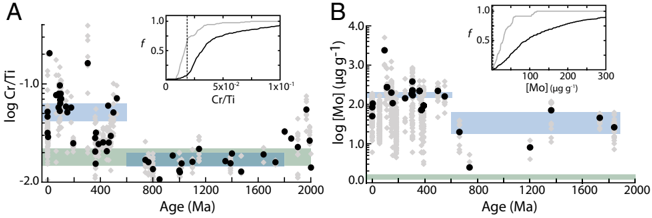
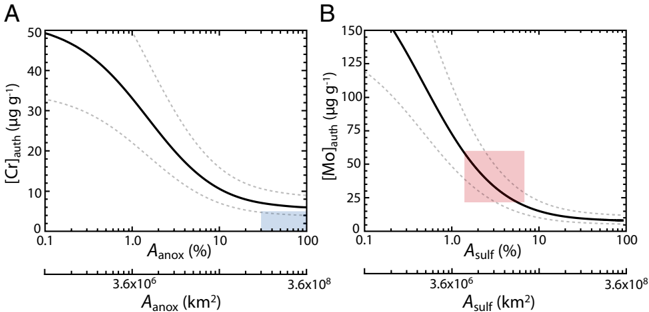
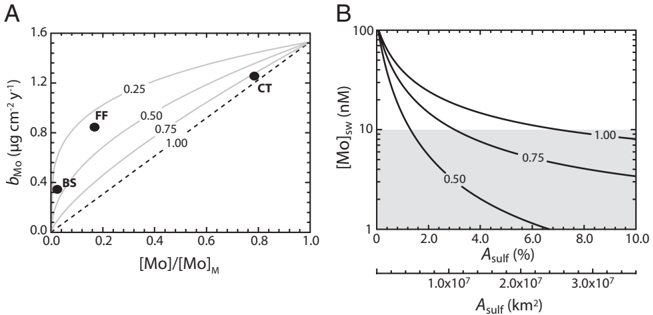
The partial pressure of oxygen in Earth’s atmosphere has increased dramatically through time, and this increase is thought to have occurred in two rapid steps at both ends of the Proterozoic Eon (∼2.5–0.543 Ga). However, the trajectory and mechanisms of Earth’s oxygenation are still poorly constrained, and little is known regarding attendant changes in ocean ventilation and seafloor redox. We have a particularly poor understanding of ocean chemistry during the mid-Proterozoic (∼1.8–0.8 Ga). Given the coupling between redox-sensitive trace element cycles and planktonic productivity, various models for mid-Proterozoic ocean chemistry imply different effects on the biogeochemical cycling of major and trace nutrients, with potential ecological constraints on emerging eukaryotic life. Here, we exploit the differing redox behavior of molybdenum and chromium to provide constraints on seafloor redox evolution by coupling a large database of sedimentary metal enrichments to a mass balance model that includes spatially variant metal burial rates. We find that the metal enrichment record implies a Proterozoic deep ocean characterized by pervasive anoxia relative to the Phanerozoic (at least ∼30–40% of modern seafloor area) but a relatively small extent of euxinic (anoxic and sulfidic) seafloor (less than ∼1–10% of modern seafloor area). Our model suggests that the oceanic Mo reservoir is extremely sensitive to perturbations in the extent of sulfidic seafloor and that the record of Mo and chromium enrichments through time is consistent with the possibility of a Mo–N colimited marine biosphere during many periods of Earth’s history.
Overview
The claims and statistics of this paper haven’t been checked yet.
Free: it reads the open-access text and checks the first 5 claims that cite a source we can check. Create a free account to check every claim.
Integrity signals
Registry
Cites
Statistics
Figures
Verification
Claims the paper makes
The claims and statistics of this paper haven’t been checked yet.
Free: it reads the open-access text and checks the first 5 claims that cite a source we can check. Create a free account to check every claim.
Claims other papers make about this one
Each is checked against this paper’s own text: does it say what the citing paper says it does?
The source backs part of the claim, not all of it — or backs it for a different population, condition or comparison.
In the citing paper
“The pervasiveness of benthic anoxia in shallow settings may also have been exacerbated by nutrient limitation of biological oxygen production in the surface ocean during much of Proterozoic time (refs. 27 and 28, Supporting Information ).”
From Earth's oxygen cycle and the evolution of animal life (2016) · cites this paper as [27]
Experimental — accuracy not yet measuredThe source backs part of the claim, not all of it — or backs it for a different population, condition or comparison.
In the citing paper
“but these fluxes are small compared to the riverine flux (i.e., ~0.60% and ~0.02% of the riverine flux respectively, Reinhard et al., 2013)”
From The chromium isotope composition of reducing and oxic marine sediments (2016) · cites this paper as Reinhard et al., 2013
Experimental — accuracy not yet measuredThe source backs part of the claim, not all of it — or backs it for a different population, condition or comparison.
In the citing paper
“The sharp rise of oxygen levels, featured by great oxidation events (GOEs) during the Proterzoic, are also recorded by the highly increasing access of trace metals like Mo and U in the ocean4, 5.”
From Heterogenous oceanic redox conditions through the Ediacaran-Cambrian boundary limited the metazoan zonation (2017) · cites this paper as [4]
Experimental — accuracy not yet measuredThe source backs part of the claim, not all of it — or backs it for a different population, condition or comparison.
In the citing paper
“Although limited in extent, euxinia then was likely two orders of magnitude more extensive than in today's oceans where it blankets much less than 1% of the seafloor (Reinhard et al., 2013).”
From Oxygenation, Life, and the Planetary System during Earth's Middle History: An Overview (2021) · cites this paper as Reinhard et al., 2013
Experimental — accuracy not yet measuredThe source backs part of the claim, not all of it — or backs it for a different population, condition or comparison.
In the citing paper
“The contrasting behaviors of molybdenum, chromium, uranium, and rhenium in organic-rich marginal sedimentary rocks deposited throughout the mid-Proterozoic qualitatively indicate widespread marine anoxia (Partin et al. 2013, Reinhard et al. 2013, Scott et al. 2008, Sheen et al. 2018)”
From The History of Ocean Oxygenation (2022) · cites this paper as Reinhard et al. 2013
Experimental — accuracy not yet measured
5 more claims about this paper
Create a free account to see every claim other papers make about this one.
Self-check
Percentages, sums and reported differences re-computed from the paper’s own numbers.
The self-check needs the paper’s full text.
Citations
Cites
Composition of the Continental Crust
Rudnick, R. L., & Gao, S. (2014) · Treatise on Geochemistry · doi:10.1016/b978-0-08-095975-7.00301-6 · Cited by 5,691
The geochemical evolution of the continental crust
Taylor, S. R., & McLennan, S. M. (1995) · Reviews of Geophysics · doi:10.1029/95rg00262 · Cited by 4,643 · cited 1×
“Proterozoic enrichments range from less than 10 to greater than 100 ppm, compared with concentrations on the order of ∼1–2 ppm in average upper crust (16).”
BackgroundComposition of the Continental Crust
Rudnick, R. L., & Gao, S. (2003) · Treatise on Geochemistry · doi:10.1016/b0-08-043751-6/03016-4 · Cited by 3,413
Relationships between the trace element composition of sedimentary rocks and upper continental crust
McLennan, S. M. (2001) · Geochemistry, Geophysics, Geosystems · doi:10.1029/2000gc000109 · Cited by 2,457
Condie, K. C. (1993) · Chemical Geology · doi:10.1016/0009-2541(93)90140-e · Cited by 2,366
Glacial‐interglacial CO2 change: The Iron Hypothesis
Martin, J. H. (1990) · Paleoceanography · doi:10.1029/pa005i001p00001 · Cited by 2,021 · cited 2×
“75 × 10 μg·cm·y, estimated by compiling Mo burial rates in oxic settings (22) and by combining Mn burial rates in oxic pelagic sediments (23) with a characteristic Mo/Mn ratio of 2 × 10 (24).”
BackgroundThe Chemical Evolution of the Atmosphere and Oceans
Holland, H. D. (1984) · doi:10.1515/9780691220239 · Cited by 1,836
Trace-element behavior and redox facies in core shales of Upper Pennsylvanian Kansas-type cyclothems
Algeo, T. J., & Maynard, J. B. (2004) · Chemical Geology · doi:10.1016/j.chemgeo.2003.12.009 · Cited by 1,694 · cited 1×
“From a mechanistic perspective, this approach builds from clear evidence that the burial in sediments of many redox sensitive metals in anoxic settings scales strongly with carbon flux to the sediments (18, 41, 42).”
BackgroundDating the rise of atmospheric oxygen
Bekker, A., Holland, H. D., Wang, P.-L., Rumble, D., Stein, H. J., Hannah, J. L., Coetzee, L. L., & Beukes, N. J. (2004) · Nature · doi:10.1038/nature02260 · Cited by 1,435 · cited 2×
“4 Ga (14), the concentration of many redox-sensitive elements in the ocean has been primarily controlled by marine redox conditions.”
BackgroundSelf-citationA new model for Proterozoic ocean chemistry
Canfield, D. E. (1998) · Nature · doi:10.1038/24839 · Cited by 1,243 · cited 1×
“For example, given that deep-sea anoxia during the mid-Proterozoic was most likely caused by gas-exchange constraints expressed in deep-water formation regions (81), rather than local reductant (i.”
Background
Research works printed but not linked: 1
- 52. Partin C, et al. (2012) Fluctuations in Precambrian atmospheric and oceanic oxygen levels: A new Precambrian paradigm emerging? Mineralogical Magazine 76(6):2207.
Cited by
Items 401–500 of 527
Phototrophic Microorganisms: The Basis of the Marine Food Web
Hess, W. R., Garczarek, L., Pfreundt, U., & Partensky, F. (2016) · Springer eBooks · doi:10.1007/978-3-319-33000-6_3 · Cited by 9
Chakraborty, P. P., Mukhopadhyay, J., Paul, P. K., Banerjee, D. M., & Bera, M. K. (2020) · Episodes · doi:10.18814/epiiugs/2020/020011 · Cited by 6
“…the most intriguing time slot and is debated period in the Earth history principally because of i) first appearance of eukaryotes, though in low diversity (Blumenberg et al., 2012; Reinhard et al., 2013) and ii) claim of very low oxygen concentration in shallow seawaters (Tang et al., 2016).”
BackgroundKendall, B., Andersen, M. B., & Owens, J. D. (2021) · Geophysical monograph · doi:10.1002/9781119507444.ch13 · Cited by 8
“Hence, seawater Mo concentrations and residence times will be lower in ancient oceans with a greater extent of euxinic seafloor than today (Reinhard et al., 2013).”
BackgroundInfluentialWang, W., Chrastný, V., Hettler, J., Kistler, A., Yadav, A. K., Šebek, O., Kumar, N., & Kraemer, S. M. (2026) · Communications Earth & Environment · doi:10.1038/s43247-025-03071-w · Cited by 6
“Chromium (Cr) is a redox-sensitive element of broad environmental relevance 1 – 3 .”
Evolutionary stasis during the Mesoproterozoic Columbia-Rodinia supercontinent transition
Lu, G., Wang, W., Ernst, R. E., Bilali, H. E., Spencer, C. J., Xu, Y., & Bekker, A. (2023) · Precambrian Research · doi:10.1016/j.precamres.2023.107057 · Cited by 5
Self-citationSignificance of pH and iron-sulfur chemistry for molybdenum sequestration under sulfidic conditions
Phillips, R., Singerling, S. A., Leng, W., & Xu, J. (2023) · Chemical Geology · doi:10.1016/j.chemgeo.2023.121702 · Cited by 5
Grettenberger, C. L., & Sumner, D. Y. (2024) · Geobiology · doi:10.1111/gbi.12622 · Cited by 6
“…ecosystems may have been a nutrient, such as nitrogen (Fennel, Follows, and Falkowski 2005), molybdenum–nitrogen colimitation (Anbar and Knoll 2002; Reinhard et al. 2013), or phosphorus (Bjerrum and Canfield 2002; Reinhard et al. 2016; Laakso and Schrag 2018) but this limitation is disputed…”
Reexamination and reidentification of ocean oxygenation event in the wake of the Marinoan glaciation
Li, R., Zhou, X., Guo, C., Huang, T., Wang, Z., Huang, K., Peng, P., Wang, X., Du, T., Xue, D., et al. (2025) · Earth and Planetary Science Letters · doi:10.1016/j.epsl.2025.119312 · Cited by 6
Ji, C., Mansour, A., Chen, Y., Wu, Z., & Wagreich, M. (2025) · Minerals · doi:10.3390/min15050440 · Cited by 5
The Early Earth as an Analogue for Exoplanetary Biogeochemistry
Stüeken, E. E., Olson, S. L., Moore, E. K., & Foley, B. J. (2024) · Reviews in Mineralogy and Geochemistry · doi:10.2138/rmg.2024.90.14 · Cited by 5
Earth: Atmospheric Evolution of a Habitable Planet
Olson, S. L., Schwieterman, E. W., Reinhard, C. T., & Lyons, T. W. (2018) · Springer eBooks · doi:10.1007/978-3-319-30648-3_189-1 · Cited by 11
Self-citationPartensky, F., Hess, W. R., & Garczarek, L. (2022) · The microbiomes of humans, animals, plants, and the environment · doi:10.1007/978-3-030-90383-1_3 · Cited by 6
Paoletti, M. M., & Fournier, G. P. (2022) · PLoS ONE · doi:10.1371/journal.pone.0275539 · Cited by 6
“This implies sulfur bacteria were a substantial part of aquatic microbial ecologies by this time, consistent with the presence of a stratified ocean with widespread euxinic conditions [7].”
BackgroundEvolution of Earth's Atmosphere
Large, R. R. (2019) · Elsevier eBooks · doi:10.1016/b978-0-12-409548-9.11853-6 · Cited by 5
Mysteries of metallome evolution: Integrating insights from the Earth and life sciences
Rico, K. I., Garcia, A. K., Saito, M. A., Kaçar, B., & Anbar, A. D. (2024) · Elsevier eBooks · doi:10.1016/b978-0-323-99762-1.00143-1 · Cited by 3
Controls on uranium isotope fractionation in the late Paleoproterozoic ocean
Kunert, A., Poulton, S. W., Canfield, D. E., Fralick, P. W., Gilleaudeau, G. J., & Kendall, B. (2025) · Earth and Planetary Science Letters · doi:10.1016/j.epsl.2025.119498 · Cited by 4
Biological use of molybdenum and tungsten stems back to 3.4 billion years ago
Klos, A. S., Sobol, M. S., Boden, J. S., Stüeken, E. E., Anderson, R. E., Konhauser, K. O., & Kaçar, B. (2026) · Nature Communications · doi:10.1038/s41467-026-72133-0 · Cited by 8
Self-citationFossil evidence provides new insights into the origin of the Mesoproterozoic ministromatolites
Wang, T., Feng, Q., & Huang, Y. (2021) · Precambrian Research · doi:10.1016/j.precamres.2021.106426 · Cited by 5
Liu, C., Xu, L., Ma, H., Liu, S., Liu, P., Wang, X., & Li, S. (2024) · Journal of Geophysical Research Solid Earth · doi:10.1029/2023jb027140 · Cited by 7
“…results show that marine alteration tends to transfer Cr from peridotites into seawater, with an average global Cr flux of 3.5·10 8 mol/yr (Figure 8a), which is comparable to estimated riverine fluxes on the orderof10 8 –10 9 mol/yr(Pöppelmeier et al., 2021; Qin &Wang, 2017; Reinhard et al., 2013).”
BackgroundResultInfluentialCheng, J., Huang, Y., Wang, S., Li, M., & Yan, W. (2019) · Continental Shelf Research · doi:10.1016/j.csr.2019.103978 · Cited by 4
Barrote, V. R., Tessalina, S. G., McNaughton, N. J., Evans, N. J., Hollis, S. P., & McDonald, B. J. (2020) · Mineralium Deposita · doi:10.1007/s00126-020-00986-6 · Cited by 4
Yang, T., Wang, X., Xu, D., Shi, X., & Peng, Y. (2022) · Journal of Earth Science · doi:10.1007/s12583-020-1085-4 · Cited by 4
“There is increasing consensus that the global oceans of the Mesoproterozoic were characterized by pervasive anoxic conditions (Reinhard et al., 2017, 2013; Lyons et al., 2014; Sahoo et al., 2012; Planavsky et al., 2011; Poulton and Canfield, 2011; Scott et al., 2008).”
BackgroundBrookfield, M. E., Stebbins, A. G., Williams, J. C., & Hannigan, R. E. (2022) · The Depositional Record · doi:10.1002/dep2.187 · Cited by 4
“…ratios F I G U R E 1 3 Plot of Ursula Creek Th/Sc against Zr/Sc a baseline detrital and organic input value is needed to resolve enrichments beyond a background value (Tribovillard et al., 2006), which is usually taken as an accepted crustal average (Cole et al., 2017; Reinhard et al., 2013).”
BackgroundRESEARCH FOCUS: Cracking the Neoproterozoic atmosphere?
Jones, D. S. J. (2016) · Geology · doi:10.1130/focus082016.1 · Cited by 5
Hao, Y., Liu, H., Chen, Q., Sun, W., & Huang, J. (2023) · Journal of Asian Earth Sciences · doi:10.1016/j.jseaes.2023.105670 · Cited by 4
Yu, X., Fang, Z., He, X., Yi, L., Deng, C., Yan, W., & Qin, L. (2023) · Palaeogeography Palaeoclimatology Palaeoecology · doi:10.1016/j.palaeo.2023.111729 · Cited by 6
How Bacteria are Affected by Toxic Metal Release
Frankel, M. L., Booth, S. C., & Turner, R. J. (2016) · Wiley eBooks · doi:10.1002/9781119009115.ch11 · Cited by 5
Sugiyama, I., & Halevy, I. (2025) · Geochimica et Cosmochimica Acta · doi:10.1016/j.gca.2025.03.018 · Cited by 4
Ai, Y., Zhu, G., Li, T., Zhang, Z., Zhang, Y., Duan, P., Liu, J., Zhao, K., & Li, X. (2023) · The Science of The Total Environment · doi:10.1016/j.scitotenv.2023.169277 · Cited by 3
Otero, X. L., Ramírez-Pérez, A. M., Abernathy, M. J., Ying, S. C., Queiroz, H. M., Ferreira, T. O., Huerta-Díaz, M. Á., & de Blas, E. (2024) · Marine Geology · doi:10.1016/j.margeo.2024.107250 · Cited by 3
“In fact, its presence in sediments is used as a proxy of oxic paleoredox conditions (Poulton and Canfield, 2011; Johnson et al., 2013; Reinhard et al., 2013).”
Cascading oxygen loss shoreward in the oceans: Insights from the Cambrian SPICE event
Sørensen, A. L., & Dahl, T. W. (2024) · One Earth · doi:10.1016/j.oneear.2024.05.011 · Cited by 3
Venugopal, A., Tripathy, G. R., Goswami, V., Khan, T., & Ackerman, L. (2025) · Geochimica et Cosmochimica Acta · doi:10.1016/j.gca.2025.09.013 · Cited by 3
Ansari, A. H., Singh, V. K., Шарма, М., & Kumar, K. (2021) · Terra Nova · doi:10.1111/ter.12564 · Cited by 4
“However, these suggested transient rises in the Mesoproterozoic atmospheric oxygen are not reflected in the traditional RSTE (Cr, Mo and U) records probably due to a synchronous increase in their drawdown in the deep marine euxinic environment (Reinhard et al., 2013).”
Background梁, 超., 籍, 士., 操, 应., Liu, K., 吴, 靖., & 郝, 芳. (2024) · SCIENTIA SINICA Terrae · doi:10.1360/n072022-0291 · Cited by 3
Fru, E. C., Bankole, O. M., Chraiki, I., Youbi, N., Millet, M., Rouxel, O. J., Albani, A. E., & Bouougri, E. H. (2021) · Chemical Geology · doi:10.1016/j.chemgeo.2021.120404 · Cited by 3
Andronikov, A. V., Novák, M., Krám, P., Šebek, O., Andronikova, I. E., Štěpánová, M., Vitkova, H., Antalova, E., & Komárek, A. (2021) · Hydrological Processes · doi:10.1002/hyp.14434 · Cited by 5
“tope composition of the Earth's mantle and crust, rivers and oceans (Bonnand et al., 2013; Brugmann et al., 2019; Frei et al., 2009; Qin & Wang, 2017; Reinhard et al., 2013; Shen et al., 2015).”
BackgroundIron and phosphorus cycling under ferruginous conditions
Thompson, J. A. (2018) · White Rose eTheses Online (University of Leeds, The University of Sheffield, University of York) · Cited by 4
Chappaz, A., Glass, J. B., & Lyons, T. W. (2016) · Encyclopedia of earth sciences series/Encyclopedia of earth sciences · doi:10.1007/978-3-319-39193-9_256-1 · Cited by 5
Self-citationLi, T., Zhu, G., Zhang, Y., & Chen, Z. (2025) · Earth Science-Journal of China University of Geosciences · doi:10.3799/dqkx.2023.202 · Cited by 2
Hao, Y., Wu, S., Deng, J., Li, C., Sun, W., & Huang, J. (2025) · Chemical Geology · doi:10.1016/j.chemgeo.2025.123085 · Cited by 2
氧化还原敏感元素在海相沉积物中富集的其他控制因素——海平面波动
彭, 俊. (2022) · SCIENTIA SINICA Terrae · doi:10.1360/n072021-0327 · Cited by 2
Redox Conditions of the Late Ediacaran Ocean on the Southern Margin of the North China Craton
Yang, J., Jin, W., Wang, G.-D., Wan, L., & Zeng, Z. (2023) · Minerals · doi:10.3390/min13091124 · Cited by 2
“It has been regarded as a consequence of widespread reducing sinks [50,56] or the small size of the corresponding oceanic trace metal reservoirs [57,58].”
BackgroundMukhopadhyay, J., Gutzmer, J., Hein, J. R., & Beukes, N. J. (2024) · South African Journal of Geology · doi:10.25131/sajg.127.0009 · Cited by 2
Wang, W., Chen, J., Feng, X., Ge, X., Yinguo, Z., Liang, J., & Xu, L. (2025) · Minerals · doi:10.3390/min15030204 · Cited by 3
CHUPRYNA, A., Aubineau, J., Bankole, O. M., Fru, E. C., Konhauser, K. O., Nesterovskyi, V. A., Martyshyn, A., Soldatenko, Y., Becker-Kerber, B., Sansjofre, P., et al. (2025) · Comptes Rendus Géoscience · doi:10.5802/crgeos.296 · Cited by 2
Self-citationOxygenation of the Proterozoic Earth's surface: An evolving story
Kendall, B., & Ostrander, C. M. (2024) · Elsevier eBooks · doi:10.1016/b978-0-323-99762-1.00058-9 · Cited by 6
Balancing Redox Budgets: Mechanisms for Prolonging Anoxia During Major Carbon Burial Events
Newby, S. M., Young, S. A., Them, T. R., Gill, B. C., & Owens, J. D. (2025) · American Journal of Science · doi:10.2475/001c.143665 · Cited by 2
Self-citationChromium Distribution in Water and Sediments in the Mobile River and Bay, Alabama
Roseburrough, R., & Wang, X. (2019) · Gulf and Caribbean Research · doi:10.18785/gcr.3001.13 · Cited by 3
“…pore water dissolved Cr concentrations, previous studies reported that porewater typically has less dissolved Cr than the overlying seawater (e.g., Ciceri et al. 1992), which is consistent with the conventional view that marine sediments are a net sink of Cr from seawater (Reinhard et al. 2013).”
BackgroundOcean redox evolution past and present
Hardisty, D. S., & Lau, K. (2024) · Elsevier eBooks · doi:10.1016/b978-0-323-99762-1.00033-4 · Cited by 6
Lu, X., Kendall, B., Li, C., Stein, H. J., Hannah, J. L., Gordon, G. W., & Ebbestad, J. O. R. (2015) · UWSpace (University of Waterloo) · Cited by 2
Grettenberger, C. L., Sumner, D. Y., Wall, K., Brown, C. T., Eisen, J. A., Mackey, T., Hawes, I., & Jungblut, A. D. (2018) · bioRxiv (Cold Spring Harbor Laboratory) · doi:10.1101/334458 · Cited by 2
“This Great 48 Oxygenation Event (GOE) permanently changed Earth’s surface geochemistry, fundamentally 49 reshaped the cycling of key elements [5] and altered the evolutionary path of life by allowing 50 widespread oxygen respiration [6].”
BackgroundYang, S. (2019) · UWSpace (University of Waterloo) · Cited by 2
Chappaz, A., Glass, J. B., & Lyons, T. W. (2018) · Encyclopedia of earth sciences series/Encyclopedia of earth sciences · doi:10.1007/978-3-319-39312-4_256 · Cited by 7
Self-citationdos Santos, R. F., Sansjofre, P., Nogueira, A. C. R., Hohl, S. V., Bom, M. H. H., Brito, A. D. S., Callefo, F., & Lalonde, S. V. (2024) · Palaeogeography Palaeoclimatology Palaeoecology · doi:10.1016/j.palaeo.2024.112600 · Cited by 3
Self-citationCohen, A. B., Klepac‐Ceraj, V., Butler, K., Weber, F., Garber, A. I., Christensen, L. N., Yagudaeva, M., Cram, J. A., McCormick, M. L., & Taylor, G. T. (2025) · Limnology and Oceanography · doi:10.1002/lno.70096 · Cited by 1
“The margins of the mid-Proterozoic Ocean had sulfur-rich waters (Reinhard et al. 2013), which had a photic zone spanning oxic through sul fi dic zones, resulting in dense populations of prokaryote autotrophs that were tolerant of different dissolved oxygen concentrations, and all of which lacked…”
Fang, Z., He, X., Yu, X., Li, D., Zhang, X., Shen, Y., & Qin, L. (2025) · Chemical Geology · doi:10.1016/j.chemgeo.2025.122938 · Cited by 2
Subarkah, D., Blades, M., Collins, A. S., Farkaš, J., & Virgo, G. M. (2025) · Australian Journal of Earth Sciences · doi:10.1080/08120099.2025.2559364 · Cited by 2
“…estimates of oxygen levels across the full extent of the sea floor and suggests that oceans were largely anoxic at depth with a thin oxic layer at the surface (Banerjee et al ., 2022; Lyons et al ., 2009; Planavsky et al ., 2011; Reinhard et al ., 2013; Scott et al ., 2008; Wang et al ., 2022).”
Iron formations: unique archives to reconstruct the Precambrian Earth
Smith, A. J. B., & Viehmann, S. (2025) · Elsevier eBooks · doi:10.1016/b978-0-323-95547-8.00023-9 · Cited by 3
Choudhuri, A., Plummer, P. S., Ghnahalla, M., Albani, A. E., Sarkar, S., Bouougri, E. H., Reisberg, L. C., Kumar, A., & Bose, T. (2025) · Australian Journal of Earth Sciences · doi:10.1080/08120099.2025.2586733 · Cited by 1
“Molybdenum, for example, requires intensely anoxic conditions and the presence of free H 2 S for precipitation (Algeo & Tribovillard, 2009; Piper & Calvert, 2009; Reinhard et al. , 2013; Tribovillard et al ., 2006; Wang et al ., 2021).”
Wallace, M. W., Reed, C., Hood, A. V. S., Turchyn, A. V., Cawood, N., & Lechte, M. A. (2026) · Precambrian Research · doi:10.1016/j.precamres.2026.108031 · Cited by 1
Revisiting the Bio-Inorganic Bridge 25 Years Later
Robbins, L. J., Mughal, S., Mahmoudi, N., Mills, D. B., Rucker, H. R., Stüeken, E. E., Anbar, A. D., Knoll, A. H., Kaçar, B., & Konhauser, K. O. (2026) · Annual Review of Earth and Planetary Sciences · doi:10.1146/annurev-earth-040523-125151 · Cited by 3
Self-citationSugiyama, I., & Halevy, I. (2026) · Chemical Geology · doi:10.1016/j.chemgeo.2026.123357 · Cited by 2
From manganese mineral evolution history to atmospheric oxygen reconstruction
Li, Y., Zhuang, Z., Xu, X., Yin, R., Li, Y., Wang, Y., Li, C., Lai, Y., Zhang, Y., Ye, H., et al. (2026) · National Science Review · doi:10.1093/nsr/nwag230 · Cited by 1
“Additionally, fragmented reconstructions of p O 2 by these modeling approaches often yield disagreed results due to the different sensitivities of those proxies to changes in O 2 fugacity [7 –12 ].”
Xu, B., Zheng, D., Li, Q., Ren, S., Sun, F., Fu, J., Wang, X., & Yang, W. (2026) · Palaeogeography Palaeoclimatology Palaeoecology · doi:10.1016/j.palaeo.2026.114043 · Cited by 1
Chen, X., Romaniello, S. J., Zhao, M., McCormick, M. L., Zheng, W., Sherry, A., Kendall, B., & Anbar, A. D. (2026) · Earth and Planetary Science Letters · doi:10.1016/j.epsl.2026.120284 · Cited by 1
Hao, J., Zhang, Z., Li, J., Mondal, J. A., Yu-ke, Z. H. U., Xing, L. I., Hao-tian, G. U. O., Cui, X., Guo, J., Ya-fang, S. O. N. G., et al. (2025) · Bulletin of Mineralogy Petrology and Geochemistry · doi:10.3724/j.issn.1007-2802.20240141 · Cited by 1
Wang, J.-Y., Jin, Z., Cheng, H. L., Hua, K.-B., & Ran, H.-X. (2025) · Journal of Palaeogeography · doi:10.1016/j.jop.2024.11.005 · Cited by 1
Fitoussi, C., Pili, E., Yobregat, E., Touboul, M., & Gardin, C. (2025) · Earth and Planetary Science Letters · doi:10.1016/j.epsl.2025.119459 · Cited by 2
A Multi-Basin Comparison of Paleoredox Conditions During the Mid-Silurian Mulde/Lundgreni Event
Maaleki-Moghadam, M., Lindskog, A., Noble, P. J., Kaljo, D., Hints, O., Goodin, J., Owens, J. D., & Young, S. A. (2025) · Global and Planetary Change · doi:10.1016/j.gloplacha.2025.105085 · Cited by 1
Gfatter, C., Owens, J. D., & Martínez-Colón, M. (2025) · Journal of Micropalaeontology · doi:10.5194/jm-44-381-2025 · Cited by 2
Chromium isotope fractionation in the redox-stratified Chesapeake Bay
Mallick, D., Wang, X. L., Miletto, M., Krause, J. W., Ohnemus, D. C., Planavsky, N. J., Luther, G. W., Lyons, T. W., & Tebo, B. M. (2025) · Applied Geochemistry · doi:10.1016/j.apgeochem.2025.106671 · Cited by 2
Self-citationCooling-induced intensification of ocean anoxia in the mid-Paleozoic
Wang, Y., Wignall, P. B., Mills, B. J. W., Dickson, A. J., Loydell, D. K., Xiong, Y., Xu, Z., Peakall, J., & Poulton, S. W. (2026) · Science Advances · doi:10.1126/sciadv.aec8573 · Cited by 2
“We used an updated dynamic mass balance model ( 44 ) for U and Mo cycling in the global ocean (see parameters in table S6), where the integrated input and output fluxes control the seawater inventory and isotopic composition of both elements The [M] sw and δ M sw parameters denote the seawater…”
The evolution of the Earth’s surface iron cycle
Scholz, F., Döetterl, S., & Hardisty, D. S. (2026) · Proceedings of the National Academy of Sciences · doi:10.1073/pnas.2608784123 · Cited by 1
“3), despite widespread independent evidence for anoxic depositional conditions in contemporaneous oceans (54, 57, 60).”
Seawater Redox Conditions in the Late Paleoproterozoic: Insight from the North China Craton
Ma, Q., Zhou, Y., Zerkle, A. L., & Cao, M. (2024) · ACS Earth and Space Chemistry · doi:10.1021/acsearthspacechem.4c00061 · Cited by 1
Li, Q., Zheng, D., & Sun, F. (2025) · Scientific Reports · doi:10.1038/s41598-025-13303-w · Cited by 2
“This process may have been driven by a combination of sea-level rise and reduced basin restriction, enhancing connectivity with the open ocean 53 .”
The chitin raft hypothesis for the colonization of the open ocean by cyanobacteria
Braakman, R. (2025) · Philosophical Transactions of the Royal Society B Biological Sciences · doi:10.1098/rstb.2024.0086 · Cited by 1
“Euxinic conditions were likely limited to relatively productive coastal waters, but models suggest that such environments could potentially still have acted as an effective global sink of molybdenum due to large-scale ocean circulation processes [23].”
Redox-Controlled Ammonium Storage and Overturn in Ediacaran Oceans
Hallmann, C., Grosjean, E., Shapiro, N. D., Kashiyama, Y., Chikaraishi, Y., Fike, D. A., Ohkouchi, N., & Summons, R. E. (2021) · Frontiers in Earth Science · doi:10.3389/feart.2021.706144 · Cited by 2
“, 2014), a limited spatial extent of pervasive euxinia (Reinhard et al., 2013) and a slow oxygenation that continued into the early Paleozoic (Sperling, 2015) warrant revisiting these hypotheses.”
BackgroundPrecambrian evolution of the nitrogen cycle
Johnson, B., & Stüeken, E. E. (2023) · Elsevier eBooks · doi:10.1016/b978-0-323-99762-1.00026-7 · Cited by 3
Johnson, C. M. (2018) · Encyclopedia of earth sciences series/Encyclopedia of earth sciences · doi:10.1007/978-3-319-39312-4_58 · Cited by 1
“This was once thought to record a shift to euxinic ocean conditions, where high sulfide contents would suppress Fe(II) transport (Canfield 1998), but it is now generally accepted that pervasive oceanic anoxia characterized the Mesoproterozoic, but with restricted euxinic environments (Reinhard et al. 2013), and so it…”
BackgroundNgombi-Pemba, L.-P. (2014) · theses.fr (ABES) · doi:10.70675/8ab8264ez6af4z4945z9cc0z1481e3f28942 · Cited by 6
Danzelle, J. (2019) · theses.fr (ABES) · doi:10.70675/d4f527a8ze98dz4c91z911ezff8d242d27fd · Cited by 4
“Or, les temps de résidence de l’Os (10-50 kyr) et du Cr (9-40 kyr; Reinhard et al., 2013) étant similaires, il est difficile sur la seule base de conditions océanographiques d’expliquer le décalage temporel, d’environ 120-150 kyr, déterminé sur la base des contraintes chronostratigraphiques à…”
BackgroundWang, J. (2016) · UWSpace (University of Waterloo) · Cited by 2
Carlson, H. K., Price, M. N., Callaghan, M., Aaring, A., Chakraborty, R., Liu, H., Arkin, A. P., & Deutschbauer, A. M. (2018) · bioRxiv (Cold Spring Harbor Laboratory) · doi:10.1101/388306
Gilleaudeau, G. J., Sahoo, S., Ostrander, C. M., Owens, J. D., Poulton, S. W., Lyons, T. W., & Anbar, A. D. (2019) · Abstracts with programs - Geological Society of America · doi:10.1130/abs/2019am-339003
Self-citationThomson, D. (2014) · Carleton University's Institutional Repository (MacOdrum Library, Carleton University) · doi:10.22215/etd/2014-10232
THE REACTOR WEIGHT OPTIMIZATION PARAMETRIC CODE-WOP
Fish, R. W., & Killen, R. E. (1965) · OSTI OAI (U.S. Department of Energy Office of Scientific and Technical Information)
Bauer, K. W., & al., E. (2021) · doi:10.1130/geol.s.15078945
Robbins, L. J., Mänd, K., Planavsky, N. J., Alessi, D. S., & Konhauser, K. O. (2019) · Encyclopedia of Astrobiology · doi:10.1007/978-3-642-27833-4_5422-1 · Cited by 4
Self-citationArmstrong, J., Parnell, J., Bullock, L. A., Perez, M., Boyce, A. J., & Feldmann, J. (2018) · Terra Nova · doi:10.1111/ter.2018.30.issue-3
Johnson, C. M. (2017) · Encyclopedia of earth sciences series/Encyclopedia of earth sciences · doi:10.1007/978-3-319-39193-9_58-1
Morford, J. L. (2018) · Elsevier eBooks · doi:10.1016/b978-0-12-409548-9.10963-7
Robbins, L. J., Mänd, K., Planavsky, N. J., Alessi, D. S., & Konhauser, K. O. (2023) · Encyclopedia of Astrobiology · doi:10.1007/978-3-662-65093-6_5422
Self-citationLi, S., Wang, X., & Hu, M. (2023) · Geoenergy Science and Engineering · doi:10.1016/j.geoen.2023.212216
Li, J., Yin, L., Zhang, J., Yao, H., Lin, Z., Zhao, P., Long, X., & Xu, Y. (2023) · Research Square · doi:10.21203/rs.3.rs-3263404/v1
Ofori, K. (2023) · IntechOpen eBooks · doi:10.5772/intechopen.1003662 · Cited by 1
Redox Geochemistry of the Late Cambrian SPICE Event in Durness Group, UKPreprint
Feng, K., Wood, R. A., & Bowyer, F. T. (2024) · EarthArXiv (California Digital Library) · doi:10.31223/x51395
A protracted Mesoproterozoic carbon cycle perturbation in response to volcanism at ∼ 1.39 Ga
Lyu, Y., Wang, X., Wang, H., Ma, S., Ye, Y., Yuan, C., Zhang, P., & Zhang, S. (2024) · Palaeogeography Palaeoclimatology Palaeoecology · doi:10.1016/j.palaeo.2024.112355
Imbalances: Sources of All Change
Knoflacher, M. (2024) · Springer eBooks · doi:10.1007/978-3-662-69423-7_8
Ghnahalla, M., Rouxel, O. J., Fru, E. C., Bankole, O. M., Sabar, M. S., Elmola, A. A., Chraiki, I., Abdelfadel, F., Fontaine, C., Trentesaux, A., et al. (2024) · Gondwana Research · doi:10.1016/j.gr.2024.08.012
Duan, R., He, R., Ju, P., Yang, H., Yang, F., Wang, Q., Yao, M., Yao, J., Huang, K., & Zhao, G. (2025) · Precambrian Research · doi:10.1016/j.precamres.2025.107709
Metadata
- Authors
- Reinhard, C. T., Planavsky, N. J., Robbins, L. J., Partin, C. A., Gill, B. C., Lalonde, S. V., Bekker, A., Konhauser, K. O., & Lyons, T. W.
- Affiliations
- University of California, Riverside (US)
- University of Alberta (CA)
- University of Manitoba (CA)
- Virginia Tech (US)
- Université de Bretagne Occidentale (FR)
- ORCID
- Venue
- Proceedings of the National Academy of Sciences
- Publisher
- National Academy of Sciences
- Published
- 2013-03-20
- Volume
- 110
- Issue
- 14
- Pages
- 5357-5362
- ISSN
- 0027-8424 (ISSN-L)
- 1091-6490
- PMC
- PMC3619314
- OpenAlex
- W2062900030
- Cited by
- 532
- References
- 54
- Citations by year
- 2026: 23 · 2025: 43 · 2024: 35 · 2023: 38 · 2022: 41 · 2021: 55 · 2020: 51 · 2019: 46 · 2018: 52 · 2017: 40 · 2016: 39 · 2015: 37 · 2014: 21 · 2013: 9
- FWCI
- 24.03
- Type
- journal article
- Language
- en
- Open access
- green
- europepmc.org
- Locations
- Proceedings of the National Academy of Sciences (publishedVersion)
- Europe PMC (PubMed Central) (publishedVersion)
- PubMed Central (publishedVersion)
- PubMed (publishedVersion)
- VTechWorks (Virginia Tech) (submittedVersion, cc-by-nc-nd)
- CaltechAUTHORS (California Institute of Technology) (submittedVersion)
- HAL (submittedVersion, other-oa)
- Funders
- National Science Foundation
- National Aeronautics and Space Administration
- Topics
- Physical Sciences › Earth and Planetary Sciences › Paleontology › Paleontology and Stratigraphy of Fossils
- Physical Sciences › Earth and Planetary Sciences › Geochemistry and Petrology › Geochemistry and Elemental Analysis
- Physical Sciences › Environmental Science › Global and Planetary Change › Earth Systems and Cosmic Evolution
- Keywords
- atmospheric oxygenation, euxinia, molybdenum, chromium, trace metal enrichment, mass balance model, ocean ventilation, marine biosphere, eukaryotic evolution
- MeSH terms
- Atmosphere, Computer Simulation, Metals, Models, Theoretical, Oceanography, Oceans and Seas, Oxidation-Reduction, Oxygen, Plankton, Geologic Sediments, History, Ancient
About these checks
Registry, retraction, Cites and statistics results are computed, not judged, with one exception: a printed reference that no index lists is read once by a model before it counts as a citation error. Claims are extracted by a model and kept only when their quote appears verbatim in the text; each cited source is then checked, with a model’s help, for whether it says what the claim relies on. Those verdicts can be wrong — read the claim’s quote and the cited source before relying on one.
Statistics and arithmetic are recomputed, not judged.
Confidence bands are shown only for fields calibrated on our annotated test set. None is calibrated yet, so no band is shown.
What counts as a claim ›How we measure confidence ›How we check this ›
Are you an author, or do you see a problem with this page? Request a review
Data sources
Bibliographic data: Semantic Scholar, OpenAlex, Crossref.
Contains information from the Semantic Scholar Academic Graph Datasets, made available under the ODC Attribution License (ODC-BY 1.0).
Semantic Scholar’s data is described in: Kinney, R., et al. (2023). The Semantic Scholar Open Data Platform. arXiv:2301.10140.
