

Proterozoic ocean redox and biogeochemical stasis
Open accessThe DOI matches its Crossref record; 54 of the 54 references it cites were found in a registry or an index.
Abstract
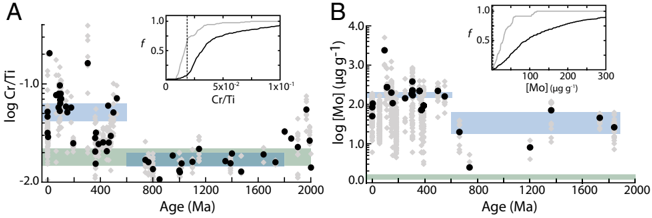
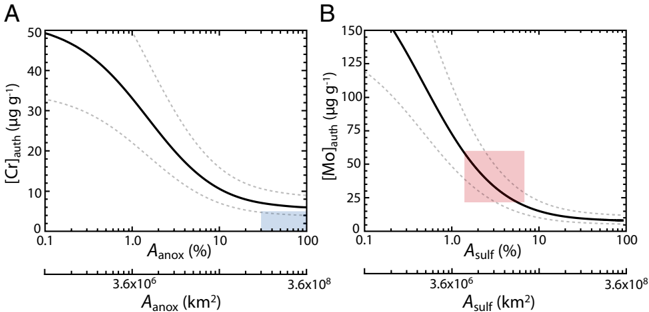
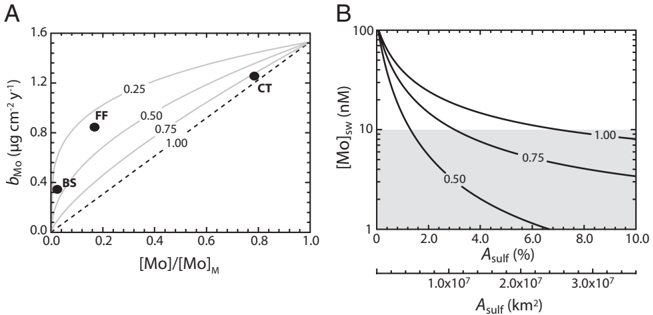
The partial pressure of oxygen in Earth’s atmosphere has increased dramatically through time, and this increase is thought to have occurred in two rapid steps at both ends of the Proterozoic Eon (∼2.5–0.543 Ga). However, the trajectory and mechanisms of Earth’s oxygenation are still poorly constrained, and little is known regarding attendant changes in ocean ventilation and seafloor redox. We have a particularly poor understanding of ocean chemistry during the mid-Proterozoic (∼1.8–0.8 Ga). Given the coupling between redox-sensitive trace element cycles and planktonic productivity, various models for mid-Proterozoic ocean chemistry imply different effects on the biogeochemical cycling of major and trace nutrients, with potential ecological constraints on emerging eukaryotic life. Here, we exploit the differing redox behavior of molybdenum and chromium to provide constraints on seafloor redox evolution by coupling a large database of sedimentary metal enrichments to a mass balance model that includes spatially variant metal burial rates. We find that the metal enrichment record implies a Proterozoic deep ocean characterized by pervasive anoxia relative to the Phanerozoic (at least ∼30–40% of modern seafloor area) but a relatively small extent of euxinic (anoxic and sulfidic) seafloor (less than ∼1–10% of modern seafloor area). Our model suggests that the oceanic Mo reservoir is extremely sensitive to perturbations in the extent of sulfidic seafloor and that the record of Mo and chromium enrichments through time is consistent with the possibility of a Mo–N colimited marine biosphere during many periods of Earth’s history.
Overview
The claims and statistics of this paper haven’t been checked yet.
Free: it reads the open-access text and checks the first 5 claims that cite a source we can check. Create a free account to check every claim.
Integrity signals
Registry
Cites
Statistics
Figures
Verification
Claims the paper makes
The claims and statistics of this paper haven’t been checked yet.
Free: it reads the open-access text and checks the first 5 claims that cite a source we can check. Create a free account to check every claim.
Claims other papers make about this one
Each is checked against this paper’s own text: does it say what the citing paper says it does?
The source backs part of the claim, not all of it — or backs it for a different population, condition or comparison.
In the citing paper
“The pervasiveness of benthic anoxia in shallow settings may also have been exacerbated by nutrient limitation of biological oxygen production in the surface ocean during much of Proterozoic time (refs. 27 and 28, Supporting Information ).”
From Earth's oxygen cycle and the evolution of animal life (2016) · cites this paper as [27]
Experimental — accuracy not yet measuredThe source backs part of the claim, not all of it — or backs it for a different population, condition or comparison.
In the citing paper
“but these fluxes are small compared to the riverine flux (i.e., ~0.60% and ~0.02% of the riverine flux respectively, Reinhard et al., 2013)”
From The chromium isotope composition of reducing and oxic marine sediments (2016) · cites this paper as Reinhard et al., 2013
Experimental — accuracy not yet measuredThe source backs part of the claim, not all of it — or backs it for a different population, condition or comparison.
In the citing paper
“The sharp rise of oxygen levels, featured by great oxidation events (GOEs) during the Proterzoic, are also recorded by the highly increasing access of trace metals like Mo and U in the ocean4, 5.”
From Heterogenous oceanic redox conditions through the Ediacaran-Cambrian boundary limited the metazoan zonation (2017) · cites this paper as [4]
Experimental — accuracy not yet measuredThe source backs part of the claim, not all of it — or backs it for a different population, condition or comparison.
In the citing paper
“Although limited in extent, euxinia then was likely two orders of magnitude more extensive than in today's oceans where it blankets much less than 1% of the seafloor (Reinhard et al., 2013).”
From Oxygenation, Life, and the Planetary System during Earth's Middle History: An Overview (2021) · cites this paper as Reinhard et al., 2013
Experimental — accuracy not yet measuredThe source backs part of the claim, not all of it — or backs it for a different population, condition or comparison.
In the citing paper
“The contrasting behaviors of molybdenum, chromium, uranium, and rhenium in organic-rich marginal sedimentary rocks deposited throughout the mid-Proterozoic qualitatively indicate widespread marine anoxia (Partin et al. 2013, Reinhard et al. 2013, Scott et al. 2008, Sheen et al. 2018)”
From The History of Ocean Oxygenation (2022) · cites this paper as Reinhard et al. 2013
Experimental — accuracy not yet measured
5 more claims about this paper
Create a free account to see every claim other papers make about this one.
Self-check
Percentages, sums and reported differences re-computed from the paper’s own numbers.
The self-check needs the paper’s full text.
Citations
Cites
Composition of the Continental Crust
Rudnick, R. L., & Gao, S. (2014) · Treatise on Geochemistry · doi:10.1016/b978-0-08-095975-7.00301-6 · Cited by 5,691
The geochemical evolution of the continental crust
Taylor, S. R., & McLennan, S. M. (1995) · Reviews of Geophysics · doi:10.1029/95rg00262 · Cited by 4,643 · cited 1×
“Proterozoic enrichments range from less than 10 to greater than 100 ppm, compared with concentrations on the order of ∼1–2 ppm in average upper crust (16).”
BackgroundComposition of the Continental Crust
Rudnick, R. L., & Gao, S. (2003) · Treatise on Geochemistry · doi:10.1016/b0-08-043751-6/03016-4 · Cited by 3,413
Relationships between the trace element composition of sedimentary rocks and upper continental crust
McLennan, S. M. (2001) · Geochemistry, Geophysics, Geosystems · doi:10.1029/2000gc000109 · Cited by 2,457
Condie, K. C. (1993) · Chemical Geology · doi:10.1016/0009-2541(93)90140-e · Cited by 2,366
Glacial‐interglacial CO2 change: The Iron Hypothesis
Martin, J. H. (1990) · Paleoceanography · doi:10.1029/pa005i001p00001 · Cited by 2,021 · cited 2×
“75 × 10 μg·cm·y, estimated by compiling Mo burial rates in oxic settings (22) and by combining Mn burial rates in oxic pelagic sediments (23) with a characteristic Mo/Mn ratio of 2 × 10 (24).”
BackgroundThe Chemical Evolution of the Atmosphere and Oceans
Holland, H. D. (1984) · doi:10.1515/9780691220239 · Cited by 1,836
Trace-element behavior and redox facies in core shales of Upper Pennsylvanian Kansas-type cyclothems
Algeo, T. J., & Maynard, J. B. (2004) · Chemical Geology · doi:10.1016/j.chemgeo.2003.12.009 · Cited by 1,694 · cited 1×
“From a mechanistic perspective, this approach builds from clear evidence that the burial in sediments of many redox sensitive metals in anoxic settings scales strongly with carbon flux to the sediments (18, 41, 42).”
BackgroundDating the rise of atmospheric oxygen
Bekker, A., Holland, H. D., Wang, P.-L., Rumble, D., Stein, H. J., Hannah, J. L., Coetzee, L. L., & Beukes, N. J. (2004) · Nature · doi:10.1038/nature02260 · Cited by 1,435 · cited 2×
“4 Ga (14), the concentration of many redox-sensitive elements in the ocean has been primarily controlled by marine redox conditions.”
BackgroundSelf-citationA new model for Proterozoic ocean chemistry
Canfield, D. E. (1998) · Nature · doi:10.1038/24839 · Cited by 1,243 · cited 1×
“For example, given that deep-sea anoxia during the mid-Proterozoic was most likely caused by gas-exchange constraints expressed in deep-water formation regions (81), rather than local reductant (i.”
Background
Research works printed but not linked: 1
- 52. Partin C, et al. (2012) Fluctuations in Precambrian atmospheric and oceanic oxygen levels: A new Precambrian paradigm emerging? Mineralogical Magazine 76(6):2207.
Cited by
Items 501–527 of 527
Banerjee, A., Patel, A., Lahiri, S., Majumder, P., Banerjee, A., & Dasgupta, S. (2025) · Precambrian Research · doi:10.1016/j.precamres.2025.107735 · Cited by 1
Ponomar, V., & Gavryliv, L. (2025) · Earth-Science Reviews · doi:10.1016/j.earscirev.2025.105206
Ma, Q., Zhou, Y., Stüeken, E. E., & Cao, M. (2025) · iScience · doi:10.1016/j.isci.2025.113047
Cabral, E. D. S., Amaral, W. D. S., dos Santos, F. H., Braga, A. A. D. J., Modesto, V. O., & Mesquita, M. J. (2025) · Journal of the Geological Society · doi:10.1144/jgs2024-281
Significant decline in oxygen levels following the Great Oxidation Event
Liu, Y., Shi, X., Sun, L., Xu, L., Xie, B., Meng, L., She, Z., Zhou, L., Wang, X., & Tang, D. (2025) · Geological Society of America Bulletin · doi:10.1130/b38354.1 · Cited by 1
Evolving weathering processes during the Archean Eon
Hao, J., Knoll, A. H., Cui, X., Song, Y., Jing, Z., & Huang, F. (2025) · Elsevier eBooks · doi:10.1016/b978-0-323-95547-8.00025-2
Robbins, L. J., Mänd, K., Li, Z., & Konhauser, K. O. (2025) · Elsevier eBooks · doi:10.1016/b978-0-323-95547-8.00027-6
Self-citationShi, C., Zhang, J., Ding, X., Liu, Y., & Liu, P. (2025) · Palaeogeography Palaeoclimatology Palaeoecology · doi:10.1016/j.palaeo.2025.113474 · Cited by 1
Chen, X., Zhang, X., Li, D., Li, M., Cui, Y., & Shen, Y. (2025) · SSRN Electronic Journal · doi:10.2139/ssrn.5967827
Huang, T., & Shen, B. (2026) · National Science Open · doi:10.1360/nso/20250075 · Cited by 1
Fernandes, H. A., Boggiani, P. C., Frederiksen, J. A., Pescarini, T., Cardoso-Lucas, V., Paula-Santos, G., Elias, E., Babinski, M., Leme, J. D. M., Rose, C. V., et al. (2026) · Gondwana Research · doi:10.1016/j.gr.2026.01.006 · Cited by 1
Processus microbiens de formation des gisements sédimentaires de phosphates actuels
Lamelo, S. R. (2017) · theses.fr (ABES) · doi:10.70675/a9876c9az24efz44c4z8d84z5b2d662e2f18 · Cited by 1
Chimie des océans au Paléoprotérozoïque
Thibon, F. (2019) · theses.fr (ABES) · doi:10.70675/b46ca998z0032z4822za964z77924518955c
Aubineau, J. (2019) · theses.fr (ABES) · doi:10.70675/5aab44dcz6310z42beza3d0zc3672a46b0c5 · Cited by 1
“We cannot completely rule out the possibility of Mo limitation in the FB2 Member, since low Mo contents have been predicted for Proterozoic oceans (Reinhard et al., 2013b).”
BackgroundPandey, A. K., Chakraborty, P. P., Nakada, R., Kano, A., & Shiraishi, F. (2026) · Sedimentary Geology · doi:10.1016/j.sedgeo.2026.107091
Ghnahalla, M. (2022) · theses.fr (ABES) · doi:10.70675/964c7659z75d5z4eb8zaf6cza025b04596a4 · Cited by 1
Calassou, E., Triantafyllou, A., Bosch, D., Bruguier, O., Kabouri, J. E., Berger, J., Ponte, C. D., Debret, B. P. R., Margirier, A., Fellah, C., et al. (2026) · Gondwana Research · doi:10.1016/j.gr.2026.03.013
Shi, X., Cai, H., Tang, W., Wei, E., Zhao, M., & Zhao, Y. Q. (2026) · BMC Chemistry · doi:10.1186/s13065-026-01802-4
“Localized oxidative microenvironments during the late Archean to early Proterozoic likely enabled partial oxidation of Cu(I) to Cu(II), providing transient copper bio-availability before the global Great Oxidation Event [6, 7].”
Stable uranium isotope geochemistry and its application in tracing Earth’s oxygenation history
Wang, X., Chen, Z., & Lin, C. (2026) · Bulletin of Mineralogy Petrology and Geochemistry · doi:10.3724/j.issn.1007-2802.20260093
Oligotrophic Areas of Late Precambrian Sedimentation in the East of the East European Platform
Maslov, A. V. (2026) · Stratigraphy and Geological Correlation · doi:10.1134/s0869593826700012
Copper and zinc isotopes reveal redox-driven nutrient cycles in the Mesoproterozoic ocean
Song, K., Li, D., Yuan, C., Liu, Y., Qu, Y., & Liu, S. (2026) · Palaeogeography Palaeoclimatology Palaeoecology · doi:10.1016/j.palaeo.2026.114042
Wang, P., Miao, M., Jiang, K., Bai, Z., Zhang, Y., Borjigin, T., Liu, Y., Xu, Q., Cao, J., Zhao, H., et al. (2026) · Minerals · doi:10.3390/min16080769
Sun, M., Archer, C., Scholz, F., Sweere, T., & Vance, D. (2026) · Science Advances · doi:10.1126/sciadv.aeg0341
Yang, Y., Hao, Q., Wen, J., Zhao, W., & Zhang, C. (2026) · PLoS ONE · doi:10.1371/journal.pone.0356723
“However, recent research has shown that sulfidation of less than 10% of seafloor area is sufficient to remove Mo from seawater, and that the oceans were more likely characterized by iron-rich seawater [9,35].”
Xie, W., Ma, G., Zhang, H., 孙立吉, Yue, F., Qin, Y., Lu, Y., Huang, Y., Zeng, P., & Ma, X. (2026) · Applied Sciences · doi:10.3390/app16178590
“Relative to the modern ocean, Precambrian seawater likely contained smaller dissolved Mo and U inventories, lower sulfate concentrations, different elemental residence times, and more restricted exchange between marginal basins and the open ocean [47,48].”
Newby, S. M., Owens, J. D., Young, S. A., & Hammer, Ø. (2026) · Geobiology · doi:10.1111/gbi.70062 · Cited by 1
“Previous work has shown that, though local enrichments of these trace metals is common under anoxic conditions (Algeo and Maynard 2004; Lyons et al. 2009), they ultimately depend on a globally large reservoir of these elements in seawater (Owens et al. 2016; Reinhard et al. 2013).”
Coupled Mo and U isotopes constrain oceanic ventilation during the early Ediacaran
Cheng, M., Chen, X., Wang, H., Zhang, Z., Cao, M., Algeo, T. J., & Li, C. (2026) · Global and Planetary Change · doi:10.1016/j.gloplacha.2026.105745
Metadata
- Authors
- Reinhard, C. T., Planavsky, N. J., Robbins, L. J., Partin, C. A., Gill, B. C., Lalonde, S. V., Bekker, A., Konhauser, K. O., & Lyons, T. W.
- Affiliations
- University of California, Riverside (US)
- University of Alberta (CA)
- University of Manitoba (CA)
- Virginia Tech (US)
- Université de Bretagne Occidentale (FR)
- ORCID
- Venue
- Proceedings of the National Academy of Sciences
- Publisher
- National Academy of Sciences
- Published
- 2013-03-20
- Volume
- 110
- Issue
- 14
- Pages
- 5357-5362
- ISSN
- 0027-8424 (ISSN-L)
- 1091-6490
- PMC
- PMC3619314
- OpenAlex
- W2062900030
- Cited by
- 532
- References
- 54
- Citations by year
- 2026: 23 · 2025: 43 · 2024: 35 · 2023: 38 · 2022: 41 · 2021: 55 · 2020: 51 · 2019: 46 · 2018: 52 · 2017: 40 · 2016: 39 · 2015: 37 · 2014: 21 · 2013: 9
- FWCI
- 24.03
- Type
- journal article
- Language
- en
- Open access
- green
- europepmc.org
- Locations
- Proceedings of the National Academy of Sciences (publishedVersion)
- Europe PMC (PubMed Central) (publishedVersion)
- PubMed Central (publishedVersion)
- PubMed (publishedVersion)
- VTechWorks (Virginia Tech) (submittedVersion, cc-by-nc-nd)
- CaltechAUTHORS (California Institute of Technology) (submittedVersion)
- HAL (submittedVersion, other-oa)
- Funders
- National Science Foundation
- National Aeronautics and Space Administration
- Topics
- Physical Sciences › Earth and Planetary Sciences › Paleontology › Paleontology and Stratigraphy of Fossils
- Physical Sciences › Earth and Planetary Sciences › Geochemistry and Petrology › Geochemistry and Elemental Analysis
- Physical Sciences › Environmental Science › Global and Planetary Change › Earth Systems and Cosmic Evolution
- Keywords
- atmospheric oxygenation, euxinia, molybdenum, chromium, trace metal enrichment, mass balance model, ocean ventilation, marine biosphere, eukaryotic evolution
- MeSH terms
- Atmosphere, Computer Simulation, Metals, Models, Theoretical, Oceanography, Oceans and Seas, Oxidation-Reduction, Oxygen, Plankton, Geologic Sediments, History, Ancient
About these checks
Registry, retraction, Cites and statistics results are computed, not judged, with one exception: a printed reference that no index lists is read once by a model before it counts as a citation error. Claims are extracted by a model and kept only when their quote appears verbatim in the text; each cited source is then checked, with a model’s help, for whether it says what the claim relies on. Those verdicts can be wrong — read the claim’s quote and the cited source before relying on one.
Statistics and arithmetic are recomputed, not judged.
Confidence bands are shown only for fields calibrated on our annotated test set. None is calibrated yet, so no band is shown.
What counts as a claim ›How we measure confidence ›How we check this ›
Are you an author, or do you see a problem with this page? Request a review
Data sources
Bibliographic data: Semantic Scholar, OpenAlex, Crossref.
Contains information from the Semantic Scholar Academic Graph Datasets, made available under the ODC Attribution License (ODC-BY 1.0).
Semantic Scholar’s data is described in: Kinney, R., et al. (2023). The Semantic Scholar Open Data Platform. arXiv:2301.10140.
