

Proterozoic ocean redox and biogeochemical stasis
Open accessThe DOI matches its Crossref record; 54 of the 54 references it cites were found in a registry or an index.
Abstract
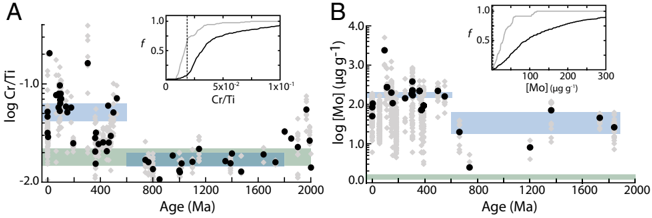
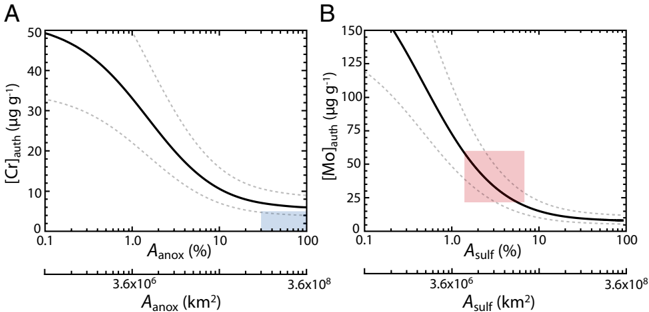
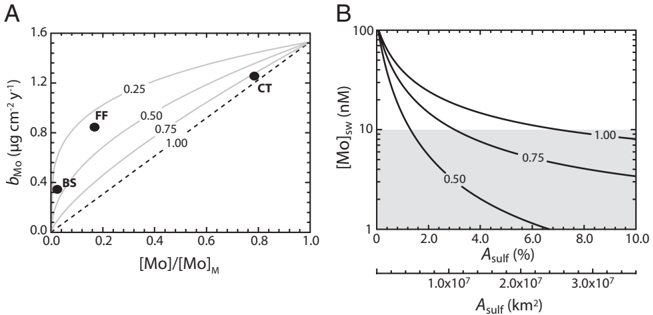
The partial pressure of oxygen in Earth’s atmosphere has increased dramatically through time, and this increase is thought to have occurred in two rapid steps at both ends of the Proterozoic Eon (∼2.5–0.543 Ga). However, the trajectory and mechanisms of Earth’s oxygenation are still poorly constrained, and little is known regarding attendant changes in ocean ventilation and seafloor redox. We have a particularly poor understanding of ocean chemistry during the mid-Proterozoic (∼1.8–0.8 Ga). Given the coupling between redox-sensitive trace element cycles and planktonic productivity, various models for mid-Proterozoic ocean chemistry imply different effects on the biogeochemical cycling of major and trace nutrients, with potential ecological constraints on emerging eukaryotic life. Here, we exploit the differing redox behavior of molybdenum and chromium to provide constraints on seafloor redox evolution by coupling a large database of sedimentary metal enrichments to a mass balance model that includes spatially variant metal burial rates. We find that the metal enrichment record implies a Proterozoic deep ocean characterized by pervasive anoxia relative to the Phanerozoic (at least ∼30–40% of modern seafloor area) but a relatively small extent of euxinic (anoxic and sulfidic) seafloor (less than ∼1–10% of modern seafloor area). Our model suggests that the oceanic Mo reservoir is extremely sensitive to perturbations in the extent of sulfidic seafloor and that the record of Mo and chromium enrichments through time is consistent with the possibility of a Mo–N colimited marine biosphere during many periods of Earth’s history.
Overview
The claims and statistics of this paper haven’t been checked yet.
Free: it reads the open-access text and checks the first 5 claims that cite a source we can check. Create a free account to check every claim.
Integrity signals
Registry
Cites
Statistics
Figures
Verification
Claims the paper makes
The claims and statistics of this paper haven’t been checked yet.
Free: it reads the open-access text and checks the first 5 claims that cite a source we can check. Create a free account to check every claim.
Claims other papers make about this one
Each is checked against this paper’s own text: does it say what the citing paper says it does?
The source backs part of the claim, not all of it — or backs it for a different population, condition or comparison.
In the citing paper
“The pervasiveness of benthic anoxia in shallow settings may also have been exacerbated by nutrient limitation of biological oxygen production in the surface ocean during much of Proterozoic time (refs. 27 and 28, Supporting Information ).”
From Earth's oxygen cycle and the evolution of animal life (2016) · cites this paper as [27]
Experimental — accuracy not yet measuredThe source backs part of the claim, not all of it — or backs it for a different population, condition or comparison.
In the citing paper
“but these fluxes are small compared to the riverine flux (i.e., ~0.60% and ~0.02% of the riverine flux respectively, Reinhard et al., 2013)”
From The chromium isotope composition of reducing and oxic marine sediments (2016) · cites this paper as Reinhard et al., 2013
Experimental — accuracy not yet measuredThe source backs part of the claim, not all of it — or backs it for a different population, condition or comparison.
In the citing paper
“The sharp rise of oxygen levels, featured by great oxidation events (GOEs) during the Proterzoic, are also recorded by the highly increasing access of trace metals like Mo and U in the ocean4, 5.”
From Heterogenous oceanic redox conditions through the Ediacaran-Cambrian boundary limited the metazoan zonation (2017) · cites this paper as [4]
Experimental — accuracy not yet measuredThe source backs part of the claim, not all of it — or backs it for a different population, condition or comparison.
In the citing paper
“Although limited in extent, euxinia then was likely two orders of magnitude more extensive than in today's oceans where it blankets much less than 1% of the seafloor (Reinhard et al., 2013).”
From Oxygenation, Life, and the Planetary System during Earth's Middle History: An Overview (2021) · cites this paper as Reinhard et al., 2013
Experimental — accuracy not yet measuredThe source backs part of the claim, not all of it — or backs it for a different population, condition or comparison.
In the citing paper
“The contrasting behaviors of molybdenum, chromium, uranium, and rhenium in organic-rich marginal sedimentary rocks deposited throughout the mid-Proterozoic qualitatively indicate widespread marine anoxia (Partin et al. 2013, Reinhard et al. 2013, Scott et al. 2008, Sheen et al. 2018)”
From The History of Ocean Oxygenation (2022) · cites this paper as Reinhard et al. 2013
Experimental — accuracy not yet measured
5 more claims about this paper
Create a free account to see every claim other papers make about this one.
Self-check
Percentages, sums and reported differences re-computed from the paper’s own numbers.
The self-check needs the paper’s full text.
Citations
Cites
Composition of the Continental Crust
Rudnick, R. L., & Gao, S. (2014) · Treatise on Geochemistry · doi:10.1016/b978-0-08-095975-7.00301-6 · Cited by 5,691
The geochemical evolution of the continental crust
Taylor, S. R., & McLennan, S. M. (1995) · Reviews of Geophysics · doi:10.1029/95rg00262 · Cited by 4,643 · cited 1×
“Proterozoic enrichments range from less than 10 to greater than 100 ppm, compared with concentrations on the order of ∼1–2 ppm in average upper crust (16).”
BackgroundComposition of the Continental Crust
Rudnick, R. L., & Gao, S. (2003) · Treatise on Geochemistry · doi:10.1016/b0-08-043751-6/03016-4 · Cited by 3,413
Relationships between the trace element composition of sedimentary rocks and upper continental crust
McLennan, S. M. (2001) · Geochemistry, Geophysics, Geosystems · doi:10.1029/2000gc000109 · Cited by 2,457
Condie, K. C. (1993) · Chemical Geology · doi:10.1016/0009-2541(93)90140-e · Cited by 2,366
Glacial‐interglacial CO2 change: The Iron Hypothesis
Martin, J. H. (1990) · Paleoceanography · doi:10.1029/pa005i001p00001 · Cited by 2,021 · cited 2×
“75 × 10 μg·cm·y, estimated by compiling Mo burial rates in oxic settings (22) and by combining Mn burial rates in oxic pelagic sediments (23) with a characteristic Mo/Mn ratio of 2 × 10 (24).”
BackgroundThe Chemical Evolution of the Atmosphere and Oceans
Holland, H. D. (1984) · doi:10.1515/9780691220239 · Cited by 1,836
Trace-element behavior and redox facies in core shales of Upper Pennsylvanian Kansas-type cyclothems
Algeo, T. J., & Maynard, J. B. (2004) · Chemical Geology · doi:10.1016/j.chemgeo.2003.12.009 · Cited by 1,694 · cited 1×
“From a mechanistic perspective, this approach builds from clear evidence that the burial in sediments of many redox sensitive metals in anoxic settings scales strongly with carbon flux to the sediments (18, 41, 42).”
BackgroundDating the rise of atmospheric oxygen
Bekker, A., Holland, H. D., Wang, P.-L., Rumble, D., Stein, H. J., Hannah, J. L., Coetzee, L. L., & Beukes, N. J. (2004) · Nature · doi:10.1038/nature02260 · Cited by 1,435 · cited 2×
“4 Ga (14), the concentration of many redox-sensitive elements in the ocean has been primarily controlled by marine redox conditions.”
BackgroundSelf-citationA new model for Proterozoic ocean chemistry
Canfield, D. E. (1998) · Nature · doi:10.1038/24839 · Cited by 1,243 · cited 1×
“For example, given that deep-sea anoxia during the mid-Proterozoic was most likely caused by gas-exchange constraints expressed in deep-water formation regions (81), rather than local reductant (i.”
Background
Research works printed but not linked: 1
- 52. Partin C, et al. (2012) Fluctuations in Precambrian atmospheric and oceanic oxygen levels: A new Precambrian paradigm emerging? Mineralogical Magazine 76(6):2207.
Cited by
The rise of oxygen in Earth's early ocean and atmosphere
Lyons, T. W., Reinhard, C. T., & Planavsky, N. J. (2014) · Nature · doi:10.1038/nature13068 · Cited by 2,810
Self-citationLow Mid-Proterozoic atmospheric oxygen levels and the delayed rise of animals
Planavsky, N. J., Reinhard, C. T., Wang, X., Thomson, D., McGoldrick, P., Rainbird, R. H., Johnson, T., Fischer, W. W., & Lyons, T. W. (2014) · Science · doi:10.1126/science.1258410 · Cited by 763
Self-citationEvolution of the global phosphorus cycle
Reinhard, C. T., Planavsky, N. J., Gill, B. C., Ozaki, K., Robbins, L. J., Lyons, T. W., Fischer, W. W., Wang, C., Cole, D. B., & Konhauser, K. O. (2017) · Nature · doi:10.1038/nature20772 · Cited by 649
Self-citationStatistical analysis of iron geochemical data suggests limited late Proterozoic oxygenation
Sperling, E. A., Wolock, C. J., Morgan, A. S., Gill, B. C., Kunzmann, M., Halverson, G. P., Macdonald, F. A., Knoll, A. H., & Johnston, D. T. (2015) · Nature · doi:10.1038/nature14589 · Cited by 637
Self-citationTrace element content of sedimentary pyrite as a new proxy for deep-time ocean–atmosphere evolution
Large, R. R., Halpin, J. A., Danyushevsky, L. V., Maslennikov, V. V., Bull, S. W., Long, J. A., Gregory, D. D., Lounejeva, E., Lyons, T. W., Sack, P. J., et al. (2014) · Earth and Planetary Science Letters · doi:10.1016/j.epsl.2013.12.020 · Cited by 545
“The Cr data shows a very similar trend to that recently published for organic-rich shales using whole-rock analytical techniques (Reinhard et al., 2013).”
BackgroundMethodSelf-citationIron formations: A global record of Neoarchaean to Palaeoproterozoic environmental history
Konhauser, K. O., Planavsky, N. J., Hardisty, D. S., Robbins, L. J., Warchola, T. J., Haugaard, R., Lalonde, S. V., Partin, C. A., Oonk, P. B. H., Tsikos, H., et al. (2017) · Earth-Science Reviews · doi:10.1016/j.earscirev.2017.06.012 · Cited by 537
Self-citationTrace Element Content of Sedimentary Pyrite in Black Shales
Gregory, D. D., Large, R. R., Halpin, J. A., Baturina, E. L., Lyons, T. W., Wu, S., Danyushevsky, L., Sack, P. J., Chappaz, A., Maslennikov, V. V., et al. (2015) · Economic Geology · doi:10.2113/econgeo.110.6.1389 · Cited by 502
“Chromium has been used as an indicator of anoxic conditions, as it is readily reduced and buried under these conditions (Reinhard et al., 2013).”
BackgroundSelf-citationThe evolution of Earth's biogeochemical nitrogen cycle
Stüeken, E. E., Kipp, M. A., Koehler, M. C., & Buick, R. (2016) · Earth-Science Reviews · doi:10.1016/j.earscirev.2016.07.007 · Cited by 439
“…3.0 Gyr, possibly sourced from mild oxidative weathering or hydrothermal inputs (McManus et al., 2002; Planavsky et al., 2014a), dissolved Mo concentrations in the Precambrian ocean may have been as low as 1–10 nM compared to 100 nM today (Anbar, 2008; Reinhard et al., 2013b; Scott et al., 2008).”
InfluentialCo-evolution of eukaryotes and ocean oxygenation in the Neoproterozoic era
Lenton, T. M., Boyle, R. A., Poulton, S. W., Shields-Zhou, G. A., & Butterfield, N. J. (2014) · Nature Geoscience · doi:10.1038/ngeo2108 · Cited by 424
Rise to modern levels of ocean oxygenation coincided with the Cambrian radiation of animals
Chen, X., Ling, H.-F., Vance, D., Shields-Zhou, G. A., Zhu, M., Poulton, S. W., Och, L. M., Jiang, S.-Y., Li, D., Cremonese, L., et al. (2015) · Nature Communications · doi:10.1038/ncomms8142 · Cited by 413
Oceanic oxygenation events in the anoxic Ediacaran ocean
Sahoo, S. K., Planavsky, N. J., Jiang, G., Kendall, B., Owens, J. D., Wang, X., Shi, X., Anbar, A. D., & Lyons, T. W. (2016) · Geobiology · doi:10.1111/gbi.12182 · Cited by 352
Self-citationTHE STABLE ISOTOPE GEOCHEMISTRY OF MOLYBDENUM
Kendall, B., Dahl, T. W., & Anbar, A. D. (2017) · Reviews in Mineralogy and Geochemistry · doi:10.2138/rmg.2017.82.16 · Cited by 333
“…dissolved in river waters and leaving primarily in association with authigenic Fe–Mn oxides and anoxic sediments underlying oxic or anoxic waters, where hydrogen sulfide is present (Crusius et al. 1996; Morford and Emerson 1999; Scott et al. 2008; Scott and Lyons 2012; Reinhard et al. 2013a).”
BackgroundResultInfluentialEarth's oxygen cycle and the evolution of animal life
Reinhard, C. T., Planavsky, N. J., Olson, S. L., Lyons, T. W., & Erwin, D. H. (2016) · Proceedings of the National Academy of Sciences · doi:10.1073/pnas.1521544113 · Cited by 287
Self-citationKendall, B., Komiya, T., Lyons, T. W., Bates, S. M., Gordon, G. W., Romaniello, S. J., Jiang, G., Creaser, R. A., Xiao, S., McFadden, K., et al. (2015) · Geochimica et Cosmochimica Acta · doi:10.1016/j.gca.2015.02.025 · Cited by 286
Self-citationPerspectives on Proterozoic surface ocean redox from iodine contents in ancient and recent carbonate
Hardisty, D. S., Lu, Z., Bekker, A., Diamond, C. W., Gill, B. C., Jiang, G., Kah, L. C., Knoll, A. H., Loyd, S. J., Osburn, M. R., et al. (2017) · Earth and Planetary Science Letters · doi:10.1016/j.epsl.2017.01.032 · Cited by 257
Self-citationStepwise oxygenation of the Paleozoic atmosphere
Krause, A. J., Mills, B. J. W., Zhang, S., Planavsky, N. J., Lenton, T. M., & Poulton, S. W. (2018) · Nature Communications · doi:10.1038/s41467-018-06383-y · Cited by 255
Self-citationLittle, S. H., Vance, D., Lyons, T. W., & McManus, J. (2015) · American Journal of Science · doi:10.2475/02.2015.01 · Cited by 247
Self-citationTrace elements at the intersection of marine biological and geochemical evolution
Robbins, L. J., Lalonde, S. V., Planavsky, N. J., Partin, C. A., Reinhard, C. T., Kendall, B., Scott, C., Hardisty, D. S., Gill, B. C., Alessi, D. S., et al. (2016) · Earth-Science Reviews · doi:10.1016/j.earscirev.2016.10.013 · Cited by 227
Self-citationAder, M., Thomazo, C., Sansjofre, P., Busigny, V., Papineau, D., Laffont, R., Cartigny, P., & Halverson, G. P. (2016) · Chemical Geology · doi:10.1016/j.chemgeo.2016.02.010 · Cited by 217
“GOE stands for the Great Oxidation Event.”
BackgroundInfluentialNitrogen isotope fractionation by alternative nitrogenases and past ocean anoxia
Zhang, X., Sigman, D. M., Morel, F. M. M., & Kraepiel, A. M. L. (2014) · Proceedings of the National Academy of Sciences · doi:10.1073/pnas.1402976111 · Cited by 215
“Due to the near-absence of atmospheric oxygen in the Archean Eon, the mobilization of Mo and V by chemical weathering would have been slow, rendering the Archean ocean poor in Mo and V (17, 27).”
BackgroundInfluentialOxygenation, Life, and the Planetary System during Earth's Middle History: An Overview
Lyons, T. W., Diamond, C. W., Planavsky, N. J., Reinhard, C. T., & Li, C. (2021) · Astrobiology · doi:10.1089/ast.2020.2418 · Cited by 211
“…al., 2018); (C) iodine concentrations from shallow marine carbonates (Hardisty et al., 2017; Lu et al., 2018); (D) molybdenum (Scott et al., 2008; Reinhard et al., 2013) and (E) uranium concentrations (Partin et al., 2013) from marine shales deposited under euxinic and anoxic conditions,…”
BackgroundSelf-citationLife: the first two billion years
Knoll, A. H., Bergmann, K. D., & Strauss, J. V. (2016) · Philosophical Transactions of the Royal Society B: Biological Sciences · doi:10.1098/rstb.2015.0493 · Cited by 207
Triple oxygen isotope evidence for limited mid-Proterozoic primary productivity
Crockford, P. W., Hayles, J. A., Bao, H., Planavsky, N. J., Bekker, A., Fralick, P. W., Halverson, G. P., Bui, T. H., Peng, Y., & Wing, B. A. (2018) · Nature · doi:10.1038/s41586-018-0349-y · Cited by 196
Self-citationCadmium adsorption to clay-microbe aggregates: Implications for marine heavy metals cycling
Zhou, Q., Liu, Y., Li, T., Zhao, H., Alessi, D. S., Liu, W., & Konhauser, K. O. (2020) · Geochimica et Cosmochimica Acta · doi:10.1016/j.gca.2020.09.002 · Cited by 187
Self-citationHighly fractionated chromium isotopes in Mesoproterozoic-aged shales and atmospheric oxygen
Canfield, D. E., Zhang, S., Frank, A. B., Wang, X., Wang, H., Su, J., Ye, Y., & Frei, R. (2018) · Nature Communications · doi:10.1038/s41467-018-05263-9 · Cited by 184
Extensive marine anoxia during the terminal Ediacaran Period
Zhang, F., Xiao, S., Kendall, B., Romaniello, S. J., Cui, H., Meyer, M., Gilleaudeau, G. J., Kaufman, A. J., & Anbar, A. D. (2018) · Science Advances · doi:10.1126/sciadv.aan8983 · Cited by 180
Ader, M., Sansjofre, P., Halverson, G. P., Busigny, V., Trindade, R. I. F., Kunzmann, M., & Nogueira, A. C. R. (2014) · Earth and Planetary Science Letters · doi:10.1016/j.epsl.2014.03.042 · Cited by 180
Disequilibrium biosignatures over Earth history and implications for detecting exoplanet life
Krissansen-Totton, J., Olson, S., & Catling, D. C. (2018) · Science Advances · doi:10.1126/sciadv.aao5747 · Cited by 177
“However, <1 to 10% of the Precambrian seafloor was euxinic (91), which implies <1% euxinia by volume because euxinic continental slopes are much shallower than the deep ocean.”
BackgroundOwens, J. D., Gill, B. C., Jenkyns, H. C., Bates, S. M., Severmann, S., Kuypers, M. M. M., Woodfine, R. G., & Lyons, T. W. (2013) · Proceedings of the National Academy of Sciences · doi:10.1073/pnas.1305304110 · Cited by 170
Self-citationAsael, D., Tissot, F. L. H., Reinhard, C. T., Rouxel, O., Dauphas, N., Lyons, T. W., Ponzevera, E., Liorzou, C., & Chéron, S. (2013) · Chemical Geology · doi:10.1016/j.chemgeo.2013.08.003 · Cited by 168
Self-citationDaines, S. J., Mills, B. J. W., & Lenton, T. M. (2017) · Nature Communications · doi:10.1038/ncomms14379 · Cited by 166
Claypool continued: Extending the isotopic record of sedimentary sulfate
Crockford, P. W., Kunzmann, M., Bekker, A., Hayles, J., Bao, H., Halverson, G. P., Peng, Y., Bui, T. H., Cox, G. M., Gibson, T. M., et al. (2019) · Chemical Geology · doi:10.1016/j.chemgeo.2019.02.030 · Cited by 162
Self-citationThe Ecological Physiology of Earth's Second Oxygen Revolution
Sperling, E. A., Knoll, A. H., & Girguis, P. R. (2015) · Annual Review of Ecology, Evolution, and Systematics · doi:10.1146/annurev-ecolsys-110512-135808 · Cited by 165
“Although Mo isotopes and abundance in anoxic shales suggest that Neoproterozoic oceans were probably more sulfidic than modern oceans (Dahl et al. 2010, 2011; Reinhard et al. 2013), modeling of the percentage of seafloor bathed by euxinic waters indicates that this was a minor phenomenon globally, affecting only ∼1–5%…”
BackgroundInfluentialMetabolic evolution and the self-organization of ecosystems
Braakman, R., Follows, M. J., & Chisholm, S. W. (2017) · Proceedings of the National Academy of Sciences · doi:10.1073/pnas.1619573114 · Cited by 166
“It was argued this general redox structure persisted because of N/Mo limitation (138, 139), with Mo scavenged by H2S even with only limited global euxinia (137), and P limitation due to its scavenging by abundant Fe (140).”
BackgroundExtremely low oxygen concentration in mid-Proterozoic shallow seawaters
Tang, D., Shi, X., Wang, X., & Jiang, G. (2016) · Precambrian Research · doi:10.1016/j.precamres.2016.02.005 · Cited by 160
“…T F e s 1 v s ( 1 t a C a W t t P C u h l e o a ( 2 m w low metamorphism of rocks warrants that REE + Y signatures may 46 D. Tang et al. / Precambria einhard et al., 2013; Smith and Harper, 2013; Luo et al., 2014; lanavsky et al., 2014; Gilleaudeau and Kah, 2015), although some ave argued that…”
BackgroundCyanobacterial evolution during the Precambrian
Schirrmeister, B. E., Sanchez-Baracaldo, P., & Wacey, D. (2016) · International Journal of Astrobiology · doi:10.1017/s1473550415000579 · Cited by 156
Nitrogen and sulfur assimilation in plants and algae
Giordano, M., & Raven, J. A. (2014) · Aquatic Botany · doi:10.1016/j.aquabot.2014.06.012 · Cited by 175
Redox heterogeneity of subsurface waters in the Mesoproterozoic ocean
Sperling, E. A., Rooney, A. D., Hays, L., Sergeev, V. N., Vorob'eva, N. G., Sergeeva, N. D., Selby, D., Johnston, D. T., & Knoll, A. H. (2014) · Geobiology · doi:10.1111/gbi.12091 · Cited by 149
“Further, due to widespread reducing sinks, trace metal enrichments in anoxic sediments in the Proterozoic are generally muted (Reinhard et al., 2013), potentially limiting their usefulness as local water-column redox proxies during this time (Scott and Lyons, 2012).”
BackgroundInfluentialCauses and consequences of mid-Proterozoic anoxia: CAUSES OF MID-PROTEROZOIC ANOXIA
Derry, L. A. (2015) · Geophysical Research Letters · doi:10.1002/2015gl065333 · Cited by 147
“…the notion that major perturbations during the GOE such as the Lomagundi carbon burial event resulted in an “oxygen overshoot” that was followed by a prolonged period of lower O2 from around 1.8 to 0.8Ga [Bekker and Holland, 2012; Lyons et al., 2014; Partin et al., 2013; Reinhard et al., 2013].”
BackgroundInfluentialCole, D. B., Zhang, S., & Planavsky, N. J. (2017) · Geochimica et Cosmochimica Acta · doi:10.1016/j.gca.2017.08.004 · Cited by 155
Self-citationCycles of nutrient trace elements in the Phanerozoic ocean
Large, R. R., Halpin, J. A., Lounejeva, E., Danyushevsky, L. V., Maslennikov, V. V., Gregory, D., Sack, P. J., Haines, P. W., Long, J. A., Makoundi, C., et al. (2015) · Gondwana Research · doi:10.1016/j.gr.2015.06.004 · Cited by 145
Scheiderich, K., Amini, M., Holmden, C., & Francois, R. (2015) · Earth and Planetary Science Letters · doi:10.1016/j.epsl.2015.04.030 · Cited by 145
A Neoproterozoic Transition in the Marine Nitrogen Cycle
Sánchez-Baracaldo, P., Ridgwell, A., & Raven, J. A. (2014) · Current Biology · doi:10.1016/j.cub.2014.01.041 · Cited by 145
“As these elements became more abundant during the Cryogenian [7, 8], both nitrogen-fixing cyanobacteria and planktonic picocyanobacteria diversified.”
BackgroundInfluentialJavaux, E. J., & Knoll, A. H. (2017) · Journal of Paleontology · doi:10.1017/jpa.2016.124 · Cited by 143
“Primary production by eukaryotes might well have been limited by fi xed nitrogen availability (Anbar and Knoll, 2002; Reinhard et al., 2013), especially in oxic waters above sul fi dic water masses (Boyle et al., 2013).”
On the co‐evolution of surface oxygen levels and animals
Cole, D. B., Mills, D. B., Erwin, D. H., Sperling, E. A., Porter, S. M., Reinhard, C. T., & Planavsky, N. J. (2020) · Geobiology · doi:10.1111/gbi.12382 · Cited by 141
“…geochemical proxies has been used to argue for first-order shift in both nutrient cycling and surface redox conditions at ca. 800 Ma (Cole et al., 2016; Isson et al., 2018; Liu et al., 2016; Lu et al., 2017; Partin et al., 2013; Planavsky et al., 2014; Reinhard et al., 2013; Reinhard et al., 2017).”
BackgroundMethodSelf-citationManganese and iron geochemistry in sediments underlying the redox-stratified Fayetteville Green Lake
Herndon, E. M., Havig, J. R., Singer, D. M., McCormick, M. L., & Kump, L. R. (2018) · Geochimica et Cosmochimica Acta · doi:10.1016/j.gca.2018.04.013 · Cited by 149
Llorens‐Marès, T., Yooseph, S., Goll, J. B., Hoffman, J., Vila‐Costa, M., Borrego, C., Dupont, C. L., & Casamayor, E. O. (2015) · The ISME Journal · doi:10.1038/ismej.2014.254 · Cited by 153
“4 billion years ago, with a ferruginous ocean (Anbar, 2008; Reinhard et al., 2013).”
BackgroundInfluentialReinhard, C. T., Planavsky, N. J., Wang, X., Fischer, W. W., Johnson, T. M., & Lyons, T. W. (2014) · Earth and Planetary Science Letters · doi:10.1016/j.epsl.2014.09.024 · Cited by 134
Self-citationCobalt and marine redox evolution
Swanner, E. D., Planavsky, N. J., Lalonde, S. V., Robbins, L. J., Bekker, A., Rouxel, O. J., Saito, M. A., Kappler, A., Mojzsis, S. J., & Konhauser, K. O. (2014) · Earth and Planetary Science Letters · doi:10.1016/j.epsl.2014.01.001 · Cited by 127
Self-citationUranium in iron formations and the rise of atmospheric oxygen
Partin, C. A., Lalonde, S. V., Planavsky, N. J., Bekker, A., Rouxel, O. J., Lyons, T. W., & Konhauser, K. O. (2013) · Chemical Geology · doi:10.1016/j.chemgeo.2013.09.005 · Cited by 134
“Though the absolute level of atmospheric oxygen reached is unknown (Kump, 2008), it is plausible that high O2 levels (N10% PAL) were attained in the Paleoproterozoic (cf. Bekker and Holland, 2012; Partin et al., 2013).”
BackgroundInfluentialSelf-citationReconciling proxy records and models of Earth's oxygenation during the Neoproterozoic and Palaeozoic
Tostevin, R., & Mills, B. J. W. (2020) · Interface Focus · doi:10.1098/rsfs.2019.0137 · Cited by 120
“Modelling efforts suggest that relatively limited seafloor euxinia (1–10%) and more extensive seafloor anoxia (greater than 30–40%) are needed to crash the global Mo and Cr reservoirs, respectively [47].”
BackgroundBasin redox and primary productivity within the Mesoproterozoic Roper Seaway
Cox, G. M., Jarrett, A., Edwards, D., Crockford, P. W., Halverson, G. P., Collins, A. S., Poirier, A., & Li, Z.-X. (2016) · Chemical Geology · doi:10.1016/j.chemgeo.2016.06.025 · Cited by 124
Thallium-isotopic compositions of euxinic sediments as a proxy for global manganese-oxide burial
Owens, J. D., Nielsen, S. G., Horner, T. J., Ostrander, C. M., & Peterson, L. C. (2017) · Geochimica et Cosmochimica Acta · doi:10.1016/j.gca.2017.06.041 · Cited by 127
The onset of widespread marine red beds and the evolution of ferruginous oceans
Song, H., Jiang, G., Poulton, S. W., Wignall, P. B., Tong, J., Song, H., An, Z., Chu, D., Tian, L., She, Z., et al. (2017) · Nature Communications · doi:10.1038/s41467-017-00502-x · Cited by 130
Sperling, E. A., & Stockey, R. G. (2018) · Integrative and Comparative Biology · doi:10.1093/icb/icy088 · Cited by 122
Atmosphere oxygen cycling through the Proterozoic and Phanerozoic
Large, R. R., Mukherjee, I., Gregory, D., Steadman, J., Corkrey, R., & Danyushevsky, L. V. (2019) · Mineralium Deposita · doi:10.1007/s00126-019-00873-9 · Cited by 122
A molybdenum-isotope perspective on Phanerozoic deoxygenation events
Dickson, A. J. (2017) · Nature Geoscience · doi:10.1038/ngeo3028 · Cited by 130
Large, R. R., Mukherjee, I., Gregory, D. D., Steadman, J. A., Масленников, В. В., & Meffre, S. (2017) · Economic Geology · doi:10.2113/econgeo.112.2.423 · Cited by 137
Uranium isotopes in marine carbonates as a global ocean paleoredox proxy: A critical review
Zhang, F., Lenton, T. M., del Rey, Á., Romaniello, S. J., Chen, X., Planavsky, N. J., Clarkson, M. O., Dahl, T. W., Lau, K. V., Wang, W., et al. (2020) · Geochimica et Cosmochimica Acta · doi:10.1016/j.gca.2020.05.011 · Cited by 117
Self-citationHorner, T. J., Little, S., Conway, T. M., Farmer, J. R., Hertzberg, J. E., Lough, A., McKay, J. L., Tessin, A. C., Galer, S. J. G., Jaccard, S. L., et al. (2021) · Global Biogeochemical Cycles · doi:10.1029/2020gb006814 · Cited by 124
Holmden, C., Jacobson, A. D., Sageman, B. B., & Hurtgen, M. T. (2016) · Geochimica et Cosmochimica Acta · doi:10.1016/j.gca.2016.04.039 · Cited by 121
The Geologic History of Seawater
Lowenstein, T. K., Kendall, B., & Anbar, A. D. (2013) · Elsevier eBooks · doi:10.1016/b978-0-08-095975-7.00621-5 · Cited by 127
Qin, L., & Wang, X. (2017) · Reviews in Mineralogy and Geochemistry · doi:10.2138/rmg.2017.82.10 · Cited by 128
“…(reviewed later in this chapter), which are largely dependent on the extent of spatial expansion of reducing conditions; for example, an expansion in reducing conditions tends to push seawater to lower Cr inventory and higher 53Cr/52Cr ratios (e.g., Reinhard et al. 2013a, 2014; Wang et al. 2016a).”
BackgroundInfluentialOwens, J. D., Reinhard, C. T., Rohrssen, M., Love, G. D., & Lyons, T. W. (2016) · Earth and Planetary Science Letters · doi:10.1016/j.epsl.2016.05.046 · Cited by 115
Self-citationHuang, K.-J., Shen, B., Lang, X.-G., Tang, W.-B., Peng, Y., Ke, S., Kaufman, A. J., Ma, H.-R., & Li, F.-B. (2015) · Geochimica et Cosmochimica Acta · doi:10.1016/j.gca.2015.05.002 · Cited by 104
The chromium isotope composition of reducing and oxic marine sediments
Gueguen, B., Reinhard, C. T., Algeo, T. J., Peterson, L. C., Nielsen, S. G., Wang, X., Rowe, H., & Planavsky, N. J. (2016) · Geochimica et Cosmochimica Acta · doi:10.1016/j.gca.2016.04.004 · Cited by 106
Self-citationSpence, G. H., Le Heron, D. P., & Fairchild, I. J. (2016) · Sedimentology · doi:10.1111/sed.12261 · Cited by 104
“The Mesoproterozoic ocean is now thought to be a patchwork of environments, only 1 to 10% being sulphidic (Reinhard et al., 2013); these are characterized by low abundances of elements such as molybdenum, which are readily sequestered into pyritic sediments.”
BackgroundAlbut, G., Babechuk, M. G., Kleinhanns, I. C., Benger, M., Beukes, N. J., Steinhilber, B., Smith, A. J. B., Kruger, S. J., & Schoenberg, R. (2018) · Geochimica et Cosmochimica Acta · doi:10.1016/j.gca.2018.02.034 · Cited by 103
Wang, X., Planavsky, N. J., Reinhard, C. T., Zou, H., Ague, J. J., Wu, Y., Gill, B. C., Schwarzenbach, E. M., & Peucker-Ehrenbrink, B. (2016) · Chemical Geology · doi:10.1016/j.chemgeo.2016.01.003 · Cited by 102
“Although this process may not be very important on a global scale in the modern oceans (e.g., Reinhard et al., 2013), it may affect local water masses and sediments, given that large Cr isotope variations have been reported for Cr-rich hydrothermal minerals (Schoenberg et al., 2008; Farkas et al.,…”
BackgroundSelf-citationThe Role of Microbial Electron Transfer in the Coevolution of the Biosphere and Geosphere
Jelen, B. I., Giovannelli, D., & Falkowski, P. G. (2016) · Annual Review of Microbiology · doi:10.1146/annurev-micro-102215-095521 · Cited by 112
Ediacaran Marine Redox Heterogeneity and Early Animal Ecosystems
Li, C., Planavsky, N. J., Shi, W., Zhang, Z., Zhou, C., Cheng, M., Tarhan, L. G., Luo, G., & Xie, S. (2015) · Scientific Reports · doi:10.1038/srep17097 · Cited by 100
Self-citationEvidence for episodic oxygenation in a weakly redox-buffered deep mid-Proterozoic ocean
Planavsky, N. J., Slack, J. F., Cannon, W. F., O’Connell, B., Isson, T. T., Asael, D., Jackson, J. C., Hardisty, D. S., Lyons, T. W., & Bekker, A. (2018) · Chemical Geology · doi:10.1016/j.chemgeo.2018.03.028 · Cited by 112
Self-citationThe biogeochemistry of ferruginous lakes and past ferruginous oceans
Swanner, E. D., Lambrecht, N., Wittkop, C. A., Harding, C., Katsev, S., Torgeson, J. M., & Poulton, S. W. (2020) · Earth-Science Reviews · doi:10.1016/j.earscirev.2020.103430 · Cited by 108
Sheen, A. I., Kendall, B., Reinhard, C. T., Creaser, R. A., Lyons, T. W., Bekker, A., Poulton, S. W., & Anbar, A. D. (2018) · Geochimica et Cosmochimica Acta · doi:10.1016/j.gca.2018.01.036 · Cited by 98
Self-citationPhotoferrotrophy: Remains of an Ancient Photosynthesis in Modern Environments
Camacho, A., Walter, X. A., Picazo, A., & Zopfi, J. (2017) · Frontiers in Microbiology · doi:10.3389/fmicb.2017.00323 · Cited by 111
“…by: Trinity L. Hamilton, University of Cincinnati, USA Reviewed by: Elizabeth Swanner, Iowa State University, USA Marc Llirós Dupré, Université Catholique de Louvain, Belgium *Correspondence: Antonio Camacho antonio.camacho@uv.es Specialty section: This article was submitted to”
BackgroundUranium isotope evidence for limited euxinia in mid-Proterozoic oceans
Gilleaudeau, G. J., Romaniello, S. J., Luo, G., Kaufman, A. J., Zhang, F., Klaebe, R. M., Kah, L. C., Azmy, K., Bartley, J. K., Zheng, W., et al. (2019) · Earth and Planetary Science Letters · doi:10.1016/j.epsl.2019.06.012 · Cited by 96
Carbonates before skeletons: A database approach
Cantine, M. D., Knoll, A. H., & Bergmann, K. (2019) · Earth-Science Reviews · doi:10.1016/j.earscirev.2019.103065 · Cited by 102
Persistent global marine euxinia in the early Silurian
Stockey, R. G., Cole, D. B., Planavsky, N. J., Loydell, D. K., Frýda, J., & Sperling, E. A. (2020) · Nature Communications · doi:10.1038/s41467-020-15400-y · Cited by 92
Self-citationFalse Negatives for Remote Life Detection on Ocean-Bearing Planets: Lessons from the Early Earth
Reinhard, C. T., Olson, S. L., Schwieterman, E. W., & Lyons, T. W. (2017) · Astrobiology · doi:10.1089/ast.2016.1598 · Cited by 93
“…exchange of O2 relative to high local rates of biological production in the surface waters can result in large regions of the surface ocean that are strongly out of equilibrium with atmospheric pO2, by as much as a factor of *10 4 (Kasting, 1991; Olson et al., 2013; Reinhard et al., 2013a, 2016).”
BackgroundSelf-citationA theory of atmospheric oxygen
Laakso, T. A., & Schrag, D. P. (2017) · Geobiology · doi:10.1111/gbi.12230 · Cited by 93
Atmospheric oxygenation driven by unsteady growth of the continental sedimentary reservoir
Husson, J. M., & Peters, S. E. (2016) · Earth and Planetary Science Letters · doi:10.1016/j.epsl.2016.12.012 · Cited by 99
“Nevertheless, a proxy-based history has emerged in which pO2 was stable but low throughout the Proterozoic (∼2300–∼635 Ma), with an anoxic deep ocean (Reinhard et al., 2013; Scott et al., 2008).”
BackgroundTransient deep-water oxygenation in the early Cambrian Nanhua Basin, South China
Cheng, M., Li, C., Zhou, L., Feng, L., Algeo, T. J., Zhang, F., Romaniello, S. J., Jin, C., Ling, H., & Jiang, S. (2017) · Geochimica et Cosmochimica Acta · doi:10.1016/j.gca.2017.04.032 · Cited by 96
Chen, S.-C., Sun, G.-X., Rosen, B. P., Zhang, S.-Y., Deng, Y., Zhu, B.-K., Rensing, C., & Zhu, Y.-G. (2017) · Scientific Reports · doi:10.1038/s41598-017-08313-2 · Cited by 91
Molybdenum speciation and burial pathway in weakly sulfidic environments: Insights from XAFS
Wagner, M., Chappaz, A., & Lyons, T. W. (2017) · Geochimica et Cosmochimica Acta · doi:10.1016/j.gca.2017.02.018 · Cited by 97
Self-citationSperling, E. A., Carbone, C., Strauss, J. V., Johnston, D. T., Narbonne, G. M., & Macdonald, F. A. (2016) · Geological Society of America Bulletin · doi:10.1130/b31329.1 · Cited by 92
“First, during most of the Proterozoic, trace-metal enrichments in anoxic shales (as deduced from independent iron redox proxies) were low, which has been interpreted as a result of widespread reducing sinks (Reinhard et al., 2013).”
BackgroundThe History of Ocean Oxygenation
Reinhard, C. T., & Planavsky, N. J. (2022) · Annual Review of Marine Science · doi:10.1146/annurev-marine-031721-104005 · Cited by 91
“…marginal sedimentary rocks deposited throughout the mid-Proterozoic qualitatively indicate widespread marine anoxia (Partin et al. 2013, Reinhard et al. 2013, Scott et al. 2008, Sheen et al. 2018) and, when coupled tomass balancemodeling of oceanic trace element inventories, suggest…”
BackgroundSelf-citationParsons, C., Stüeken, E. E., Rosen, C. J., Mateos, K., & Anderson, R. E. (2021) · Geobiology · doi:10.1111/gbi.12419 · Cited by 91
Primary Productivity Was Limited by Electron Donors Prior to the Advent of Oxygenic Photosynthesis
Ward, L. M., Rasmussen, B., & Fischer, W. W. (2019) · Journal of Geophysical Research: Biogeosciences · doi:10.1029/2018jg004679 · Cited by 91
“…that atmospheric oxygen concentrations and/or net productivity remained intermediate throughout the Proterozoic Eon (e.g., Crockford et al., 2018; Reinhard et al., 2013), perhaps maintained at a low-oxygen steady state by feedbacks related to modulation of phosphate availability due to…”
BackgroundGilleaudeau, G. J., & Kah, L. C. (2014) · Precambrian Research · doi:10.1016/j.precamres.2014.11.030 · Cited by 99
Tracing Earth’s O2 evolution using Zn/Fe ratios in marine carbonates
Liu, X.-M., Kah, L. C., Knoll, A. H., Cui, H., Kaufman, A. J., Shahar, A., & Hazen, R. M. (2016) · Geochemical Perspectives Letters · doi:10.7185/geochemlet.1603 · Cited by 91
Paulukat, C., Døssing, L. N., Mondal, S. K., Voegelin, A. R., & Frei, R. (2015) · Applied Geochemistry · doi:10.1016/j.apgeochem.2015.04.016 · Cited by 88
Koehler, M. C., Stüeken, E. E., Kipp, M. A., Buick, R., & Knoll, A. H. (2017) · Geochimica et Cosmochimica Acta · doi:10.1016/j.gca.2016.10.050 · Cited by 90
The selective pressures on the microbial community in a metal-contaminated aquifer
Carlson, H. K., Price, M. N., Callaghan, M., Aaring, A., Chakraborty, R., Liu, H., Kuehl, J. V., Arkin, A. P., & Deutschbauer, A. M. (2018) · The ISME Journal · doi:10.1038/s41396-018-0328-1 · Cited by 94
“For example, dissolution of clay minerals releases Mn2+, Al3+, and other transition metals [18, 19], while dissolution of carbonate minerals releases alkali earth metal cations such as Ca and Mg [18].”
Li, C., Planavsky, N. J., Love, G. D., Reinhard, C. T., Hardisty, D. S., Feng, L., Bates, S. M., Huang, J., Zhang, Q., Chu, X., et al. (2014) · Geochimica et Cosmochimica Acta · doi:10.1016/j.gca.2014.12.005 · Cited by 99
“Therefore, this work supports the argument that the size of the marine Mo reservoir can be used to gauge the extent of euxinic conditions specifically—rather than anoxic conditions more generally (see Reinhard et al., 2013).”
BackgroundSelf-citationA Cenozoic seawater redox record derived from 238U/235U in ferromanganese crusts
Wang, X., Planavsky, N. J., Reinhard, C. T., Hein, J. R., & Johnson, T. M. (2016) · American Journal of Science · doi:10.2475/01.2016.02 · Cited by 86
Self-citationWei, G., Wei, W., Wang, D., Li, T., Yang, X., Shields, G., Zhang, F., Li, G., Chen, T., Yang, T., et al. (2020) · Earth and Planetary Science Letters · doi:10.1016/j.epsl.2020.116244 · Cited by 89
A long-term record of early to mid-Paleozoic marine redox change
Sperling, E. A., Melchin, M. J., Fraser, T., Stockey, R. G., Farrell, U. C., Bhajan, L., Brunoir, T. N., Cole, D. B., Gill, B. C., Lenz, A., et al. (2021) · Science Advances · doi:10.1126/sciadv.abf4382 · Cited by 85
“6 of 12 pronounced” euxinia, sulfidic waters still likely covered a relatively small portion of the global seafloor (concentrated in productive outer shelf and upper slope settings or shallow epeiric seas) (40).”
Self-citationChromium isotope systematics in the Connecticut River
Wu, W., Wang, X., Reinhard, C. T., & Planavsky, N. J. (2017) · Chemical Geology · doi:10.1016/j.chemgeo.2017.03.009 · Cited by 94
“While rivers are known to contribute a major source of Cr to oceans (e.g. Jeandel and Minster, 1987; Reinhard et al., 2013; McClain and Maher, 2016), δ53Cr values of river waters, as well as Cr systematics under different climate regimes remain poorly constrained (e.g. Farkaš et al., 2013; Berger…”
BackgroundInfluentialSelf-citationYang, S., Kendall, B., Lu, X., Zhang, F., & Zheng, W. (2017) · Precambrian Research · doi:10.1016/j.precamres.2017.06.016 · Cited by 84
“If a first-order relationship exists between each sink’s burial flux and the global 486 seawater U concentration (Partin et al., 2013; Reinhard et al., 2013), then: 487 Fi =ki Ai [U] (VI) 488 where Ai is the areal extent of seafloor for each U sink; [U] is the seawater U 489 concentration, and ki…”
BackgroundInfluentialWhat the ~1.4 Ga Xiamaling Formation can and cannot tell us about the mid‐Proterozoic ocean
Diamond, C. W., Planavsky, N. J., Wang, C., & Lyons, T. W. (2018) · Geobiology · doi:10.1111/gbi.12282 · Cited by 84
Self-citation
Metadata
- Authors
- Reinhard, C. T., Planavsky, N. J., Robbins, L. J., Partin, C. A., Gill, B. C., Lalonde, S. V., Bekker, A., Konhauser, K. O., & Lyons, T. W.
- Affiliations
- University of California, Riverside (US)
- University of Alberta (CA)
- University of Manitoba (CA)
- Virginia Tech (US)
- Université de Bretagne Occidentale (FR)
- ORCID
- Venue
- Proceedings of the National Academy of Sciences
- Publisher
- National Academy of Sciences
- Published
- 2013-03-20
- Volume
- 110
- Issue
- 14
- Pages
- 5357-5362
- ISSN
- 0027-8424 (ISSN-L)
- 1091-6490
- PMC
- PMC3619314
- OpenAlex
- W2062900030
- Cited by
- 532
- References
- 54
- Citations by year
- 2026: 23 · 2025: 43 · 2024: 35 · 2023: 38 · 2022: 41 · 2021: 55 · 2020: 51 · 2019: 46 · 2018: 52 · 2017: 40 · 2016: 39 · 2015: 37 · 2014: 21 · 2013: 9
- FWCI
- 24.03
- Type
- journal article
- Language
- en
- Open access
- green
- europepmc.org
- Locations
- Proceedings of the National Academy of Sciences (publishedVersion)
- Europe PMC (PubMed Central) (publishedVersion)
- PubMed Central (publishedVersion)
- PubMed (publishedVersion)
- VTechWorks (Virginia Tech) (submittedVersion, cc-by-nc-nd)
- CaltechAUTHORS (California Institute of Technology) (submittedVersion)
- HAL (submittedVersion, other-oa)
- Funders
- National Science Foundation
- National Aeronautics and Space Administration
- Topics
- Physical Sciences › Earth and Planetary Sciences › Paleontology › Paleontology and Stratigraphy of Fossils
- Physical Sciences › Earth and Planetary Sciences › Geochemistry and Petrology › Geochemistry and Elemental Analysis
- Physical Sciences › Environmental Science › Global and Planetary Change › Earth Systems and Cosmic Evolution
- Keywords
- atmospheric oxygenation, euxinia, molybdenum, chromium, trace metal enrichment, mass balance model, ocean ventilation, marine biosphere, eukaryotic evolution
- MeSH terms
- Atmosphere, Computer Simulation, Metals, Models, Theoretical, Oceanography, Oceans and Seas, Oxidation-Reduction, Oxygen, Plankton, Geologic Sediments, History, Ancient
About these checks
Registry, retraction, Cites and statistics results are computed, not judged, with one exception: a printed reference that no index lists is read once by a model before it counts as a citation error. Claims are extracted by a model and kept only when their quote appears verbatim in the text; each cited source is then checked, with a model’s help, for whether it says what the claim relies on. Those verdicts can be wrong — read the claim’s quote and the cited source before relying on one.
Statistics and arithmetic are recomputed, not judged.
Confidence bands are shown only for fields calibrated on our annotated test set. None is calibrated yet, so no band is shown.
What counts as a claim ›How we measure confidence ›How we check this ›
Are you an author, or do you see a problem with this page? Request a review
Data sources
Bibliographic data: Semantic Scholar, OpenAlex, Crossref.
Contains information from the Semantic Scholar Academic Graph Datasets, made available under the ODC Attribution License (ODC-BY 1.0).
Semantic Scholar’s data is described in: Kinney, R., et al. (2023). The Semantic Scholar Open Data Platform. arXiv:2301.10140.
