

The dorsal anterior cingulate cortex is selective for pain: Results from large-scale reverse inference
Open accessThe DOI matches its Crossref record; 59 of the 59 references it cites were found in a registry or an index; none of the 19 sources its claims cite is checked for support yet.
Abstract
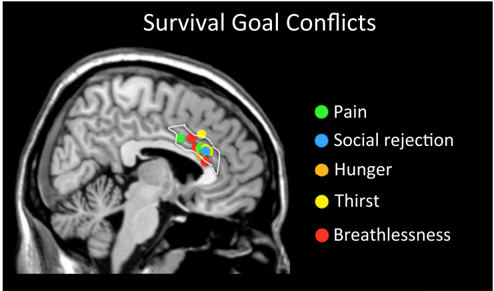
Dorsal anterior cingulate cortex (dACC) activation is commonly observed in studies of pain, executive control, conflict monitoring, and salience processing, making it difficult to interpret the dACC's specific psychological function. Using Neurosynth, an automated brainmapping database [of over 10,000 functional MRI (fMRI) studies], we performed quantitative reverse inference analyses to explore the best general psychological account of the dACC function P(Ψ process|dACC activity). Results clearly indicated that the best psychological description of dACC function was related to pain processing--not executive, conflict, or salience processing. We conclude by considering that physical pain may be an instance of a broader class of survival-relevant goals monitored by the dACC, in contrast to more arbitrary temporary goals, which may be monitored by the supplementary motor area.
Overview
CoChat Summary
TL;DR
Using Neurosynth, the paper performs large-scale forward and reverse inference analyses to ask what psychological process is most selectively associated with dorsal anterior cingulate cortex (dACC) activity. It concludes that dACC activity is best and selectively linked to pain, whereas executive, conflict, and salience terms show forward inference but not reliable reverse inference to dACC.
Key findings
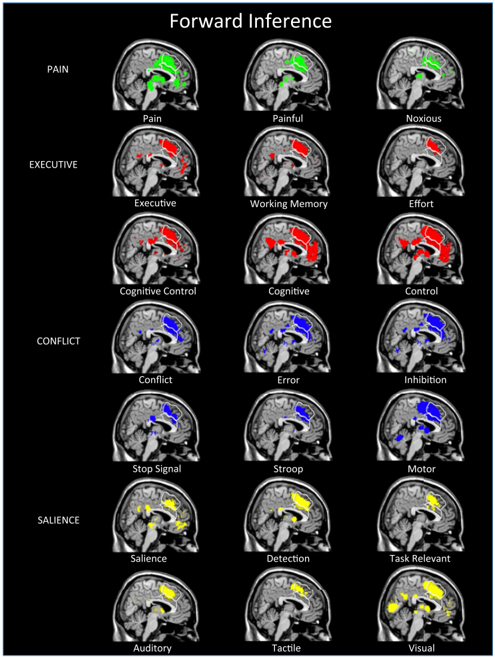
- Forward inference reproduced prior findings: pain, executive, conflict, and salience terms all produced at least some reliable dACC activity, though many effects were dACC-adjacent in SMA/pre-SMA.
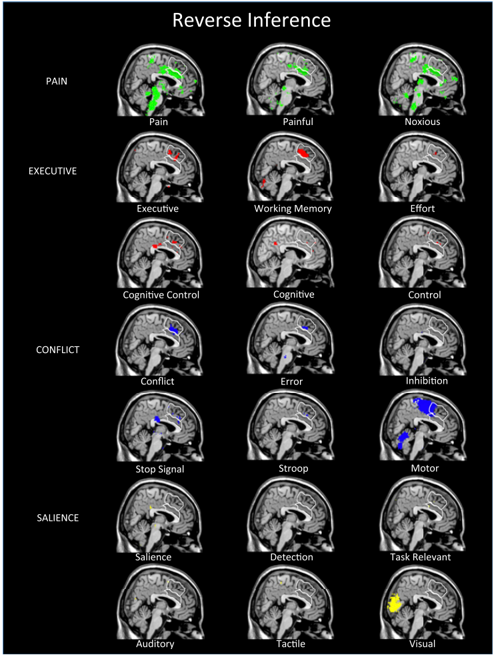
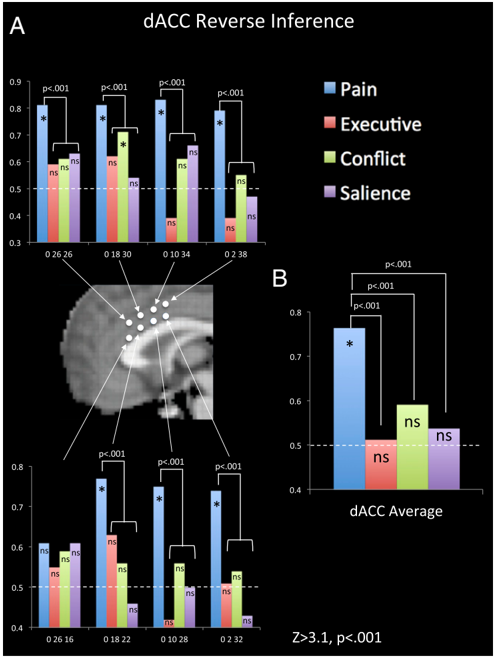
- Reverse inference showed that only pain-related terms (“pain,” “painful,” “noxious”) had broad coverage across dACC; dACC activity could be attributed to pain in seven of eight foci, to conflict in one of eight foci, and to neither executive nor salience at any of the eight foci.
- The maximum pain Z-score in dACC (11.98 at coordinates 0, 20, 28) was significantly higher than the maximum Z-score anywhere in the brain for “executive” (6.67), “conflict” (5.46), and “salience” (6.09) (P < 0.001).
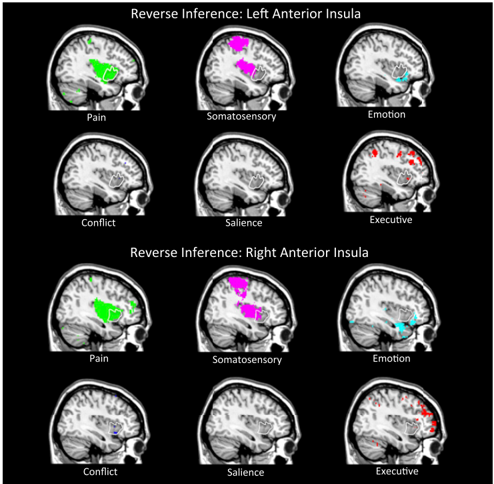
- Across all Neurosynth terms, “pain” was the top term for six of eight dACC locations; at one other location it was second after “clinically,” and at the last location the top term was “chronic pain.” The paper also reports that the anterior insula reverse inference maps were selective for pain.
Methods
- Neurosynth was used to conduct forward and reverse inference analyses on 10,903 neuroimaging studies available as of June 2015; no new data were collected.
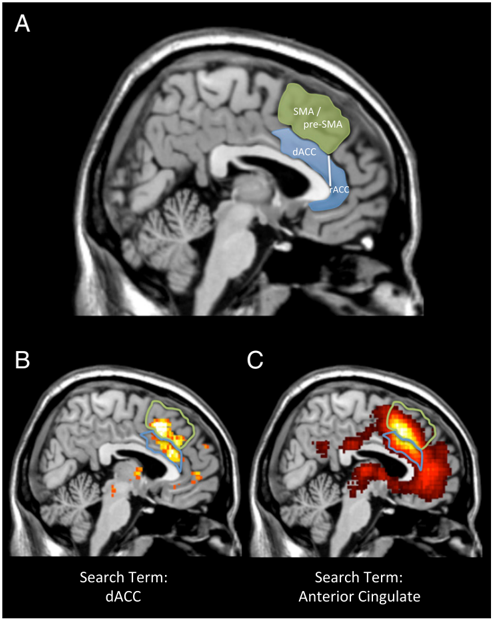
- The paper first located the dACC by forward inference for the term “dACC,” then ran forward inference maps for pain, executive control, conflict processing, and salience terms, and then ran reverse inference maps for the same terms.
- Quantitative reverse inference compared Z-scores and posterior probabilities across eight equally spaced midline dACC foci for “pain” (410 studies), “executive” (531), “conflict” (246), and “salience” (222), using a threshold of Z > 3.1, P < 0.001; statistical analyses were carried out on Z-scores.
Limitations
- The paper states that Neurosynth is automated and does not perform content analyses of term usage, treats activations and deactivations alike, is affected by confirmation biases in reporting, and uses linguistic terms rather than task trial types or specific psychological states.
- The paper addresses possible base-rate and term-specificity concerns, arguing that frequency is controlled by setting the Bayesian prior for every term to 0.50 and that both loosely and tightly defined non-pain constructs failed to produce dACC reverse inference effects.
- The paper notes individual variability in neuroanatomy, especially an additional paracingulate sulcus that can extend dACC dorsally, which Neurosynth does not take into account; it argues this would still leave evidence of a dorso-ventral gradient distinguishing pain from some non-pain effects.
Model-written summary. Check it against the paper before relying on it.
Integrity signals
Registry
Cites
Statistics
Figures
Verification
Claims the paper makes
0 Valid · 2 Not valid · 15 Not checked · 65 Own results and interpretations
A result the paper reports from its own data — it cites no other source for it, so there is none to check. The quote shows it is in the paper.
In the paper
“Despite the fact that there are several hundred psychological terms in the Neurosynth database,”
§ The dorsal anterior cingulate cortex is selective for pain: Results from large-scale reverse inference > Step 3: Reverse Inference in the dACC
plainstates an association- Asserted: passes — The authors put it forward as true.
- Checkable: passes — It can be checked against evidence.
- Load-bearing: passes — The paper’s conclusions depend on it.
- Based: passes — The paper gives a reason why it holds.
A result the paper reports from its own data — it cites no other source for it, so there is none to check. The quote shows it is in the paper.
In the paper
“Specifically, the forward inference maps for”
§ The dorsal anterior cingulate cortex is selective for pain: Results from large-scale reverse inference > Step 2: Forward Inference in the dACC
plain- Asserted: passes — The authors put it forward as true.
- Checkable: passes — It can be checked against evidence.
- Load-bearing: passes — The paper’s conclusions depend on it.
- Based: passes — The paper gives a reason why it holds.
A result the paper reports from its own data — it cites no other source for it, so there is none to check. The quote shows it is in the paper.
In the paper
“What was striking in this dACC analysis is that the neuroimaging literature may have mislabeled the location of the dACC in many studies, and this mislabeling may have played a part in the current misunderstanding regarding dACC functionality.”
§ The dorsal anterior cingulate cortex is selective for pain: Results from large-scale reverse inference > Step 1: Locating the dACC
hedgedstates a possible cause- Asserted: passes — The authors put it forward as true.
- Checkable: passes — It can be checked against evidence.
- Load-bearing: passes — The paper’s conclusions depend on it.
- Based: passes — The paper gives a reason why it holds.
A result the paper reports from its own data — it cites no other source for it, so there is none to check. The quote shows it is in the paper.
In the paper
“The same is true if the term”
§ The dorsal anterior cingulate cortex is selective for pain: Results from large-scale reverse inference > Step 1: Locating the dACC
plain- Asserted: passes — The authors put it forward as true.
- Checkable: passes — It can be checked against evidence.
- Load-bearing: passes — The paper’s conclusions depend on it.
- Based: passes — The paper gives a reason why it holds.
A result the paper reports from its own data — it cites no other source for it, so there is none to check. The quote shows it is in the paper.
In the paper
“Only within the dACC did we find this distortion.”
§ The dorsal anterior cingulate cortex is selective for pain: Results from large-scale reverse inference > Step 1: Locating the dACC
plain- Asserted: passes — The authors put it forward as true.
- Checkable: passes — It can be checked against evidence.
- Load-bearing: passes — The paper’s conclusions depend on it.
- Based: passes — The paper gives a reason why it holds.
47 more claims
Create a free account to see all 82 claims and every source verdict.
- Probably not a substantial claim. 17
- It may state two separate claims as one. 17
- The quote only partly states this claim. 1
Claims other papers make about this one
Each is checked against this paper’s own text: does it say what the citing paper says it does?
The source backs part of the claim, not all of it — or backs it for a different population, condition or comparison.
In the citing paper
“Relatedly, the dACC may relate to survival goals, making it sensitive to social rejection, a central component of social anxiety disorder (Lieberman & Eisenberger, 2015).”
From Changes in functional connectivity with cognitive behavioral therapy for social anxiety disorder predict outcomes at follow-up (2020) · cites this paper as Lieberman & Eisenberger, 2015
Experimental — accuracy not yet measuredThe cited source says what the claim attributes to it.
In the citing paper
“Changes in amygdala-dACC connectivity through treatment may reflect less coupling between threat-detection (Phelps & LeDoux, 2005) and social distress (Lieberman & Eisenberger, 2015) regions respectively during implicit emotion regulation, which in turn relate to superior outcomes at follow-up.”
From Changes in functional connectivity with cognitive behavioral therapy for social anxiety disorder predict outcomes at follow-up (2020) · cites this paper as Lieberman & Eisenberger, 2015
The cited source says what the claim attributes to it.
In the citing paper
“Historically, the ACC has been associated with a multitude of psychological functions; however, a reverse-inference meta-analysis indicated that the dACC specifically is related to pain and distress-related emotions rather than conflict, salience, or executive processes (Jahn, Nee, Alexander, & Brown, 2016; Lieberman & Eisenberger, 2015).”
From Changes in functional connectivity with cognitive behavioral therapy for social anxiety disorder predict outcomes at follow-up (2020) · cites this paper as Lieberman & Eisenberger, 2015
Statistics recomputed
Every reported test result, recomputed from its test statistic and degrees of freedom. A result shows as not adding up only once an independent check has confirmed it.
- Consistentz > 3.1reported p < .001 · recomputed p = .002
“Z > 3.1, p < .001”
Self-check
Percentages, sums and reported differences re-computed from the paper’s own numbers.
Self-check results appear here once an independent check has confirmed them.
Citations
Cites
The need to belong: Desire for interpersonal attachments as a fundamental human motivation.
Baumeister, R. F., & Leary, M. R. (1995) · Psychological Bulletin · doi:10.1037//0033-2909.117.3.497 · Cited by 23,245 · cited 1×
“We have argued that social rejection represents a threat to the survival-relevant goal of social connection (32, 33).”
BackgroundSocial Relationships and Mortality Risk: A Meta-analytic Review
Holt-Lunstad, J., Smith, T. B., & Layton, J. B. (2010) · PLoS Medicine · doi:10.1371/journal.pmed.1000316 · Cited by 7,272 · cited 1×
“We have argued that social rejection represents a threat to the survival-relevant goal of social connection (32, 33).”
BackgroundCognitive and emotional influences in anterior cingulate cortex
Bush, G., Luu, P., & Posner, M. I. (2000) · Trends in Cognitive Sciences · doi:10.1016/s1364-6613(00)01483-2 · Cited by 6,259 · cited 2×
“001) was at the coordinates (8, 24, 24) in the dACC in a region for which the strongest term in the Neurosynth reverse inference map is “pain.”
BackgroundSaliency, switching, attention and control: a network model of insula function
Menon, V., & Uddin, L. Q. (2010) · Brain Structure and Function · doi:10.1007/s00429-010-0262-0 · Cited by 5,592
Meta-Analytic Procedures for Social Research
Rosenthal, R. (1991) · doi:10.4135/9781412984997 · Cited by 4,635
Meta-Analytic Procedures for Social Research.
Metcalfe, A., & Rosenthal, R. (1994) · The Statistician · doi:10.2307/2348600 · Cited by 4,249
Large-scale automated synthesis of human functional neuroimaging data.
Yarkoni, T., Poldrack, R. A., Nichols, T. E., Van Essen, D. C., & Wager, T. D. (2011) · Nature Methods · doi:10.1038/nmeth.1635 · Cited by 3,686 · cited 4×
“Prior work has noted the close alignment between anatomically defined and Neurosynth-derived boundaries (13).”
BackgroundMethodInfluentialConflict monitoring and anterior cingulate cortex: an update
Botvinick, M. M., Cohen, J. D., & Carter, C. S. (2004) · Trends in Cognitive Sciences · doi:10.1016/j.tics.2004.10.003 · Cited by 3,623
Emotional processing in anterior cingulate and medial prefrontal cortex
Etkin, A., Egner, T., & Kalisch, R. (2011) · Trends in Cognitive Sciences · doi:10.1016/j.tics.2010.11.004 · Cited by 3,059
Pain Affect Encoded in Human Anterior Cingulate But Not Somatosensory Cortex
Rainville, P., Duncan, G. H., Price, D. D., Carrier, B., & Bushnell, M. C. (1997) · Science · doi:10.1126/science.277.5328.968 · Cited by 2,687 · cited 1×
“Sensory Aspects of Pain in dACC If “pain” is the term most closely associated with dACC activity, what does this finding suggest about the dACC’s function? Is it a dedicated physical pain module? One prominent account of dACC suggests that it is involved in the affective, but not the sensory, aspect of pain processing…”
Background
Cited by
Machine learning for neuroimaging with scikit-learn
Abraham, A., Pedregosa, F., Eickenberg, M., Gervais, P., Mueller, A., Kossaifi, J., Gramfort, A., Thirion, B., & Varoquaux, G. (2014) · Frontiers in Neuroinformatics · doi:10.3389/fninf.2014.00014 · Cited by 2,384
Mammalian empathy: behavioural manifestations and neural basis
de Waal, F. B. M., & Preston, S. D. (2017) · Nature Reviews Neuroscience · doi:10.1038/nrn.2017.72 · Cited by 957
Emotion and the prefrontal cortex: an integrative review
Dixon, M. L., Thiruchselvam, R., Todd, R., & Christoff, K. (2017) · Psychological Bulletin · doi:10.1037/bul0000096 · Cited by 745
“…rewards (Behrens et al., 2008; de la Vega et al., 2016; Eisenberger et al., 2011; Etkin et al., 2011; Hayden & Platt, 2010; Hutchison et al., 1999; Lieberman & Eisenberger, 2015; Livneh & Paz, 2012; Milad et al., 2007; Mobbs et al., 2009; Mobbs et al., 2010; Phelps, Delgado, Nearing, & LeDoux,…”
Schurz, M., Radua, J., Tholen, M. G., Maliske, L., Margulies, D. S., Mars, R. B., Sallet, J., & Kanske, P. (2021) · Psychological Bulletin · doi:10.1037/bul0000303 · Cited by 619
“…(e.g., Buckner & Carroll, 2007; Corbetta, Patel, & Shulman, 2008; Heyes, 2018; Heyes & Frith, 2014) and empathy (e.g., Barrett, Lindquist, & Gendron, 2007; Lindquist, Satpute, & Gendron, 2015; Wager et al., 2016; but see Lieberman, Burns, Torre,& Eisenberger, 2016; Lieberman & Eisenberger, 2015).”
Media use and brain development during adolescence
Crone, E. A., & Konijn, E. A. (2018) · Nature Communications · doi:10.1038/s41467-018-03126-x · Cited by 464
Ploner, M., Sorg, C., & Gross, J. (2017) · Trends in Cognitive Sciences · doi:10.1016/j.tics.2016.12.001 · Cited by 434
Herding Brains: A Core Neural Mechanism for Social Alignment
Shamay-Tsoory, S. G., Saporta, N., Marton-Alper, I. Z., & Gvirts, H. Z. (2019) · Trends in Cognitive Sciences · doi:10.1016/j.tics.2019.01.002 · Cited by 289
Large-Scale Meta-Analysis of Human Medial Frontal Cortex Reveals Tripartite Functional Organization
de la Vega, A., Chang, L. J., Banich, M. T., Wager, T. D., & Yarkoni, T. (2016) · The Journal of Neuroscience · doi:10.1523/jneurosci.4402-15.2016 · Cited by 288
“These results suggest a complex many-to-many mapping between brain regions and cognitive processes, in contrast to recent claims of functional selectivity in MFC (Lieberman and Eisenberger, 2015; compare Wager et al., 2016).”
The search for pain biomarkers in the human brain
Mouraux, A., & Iannetti, G. D. (2018) · Brain · doi:10.1093/brain/awy281 · Cited by 272
Kragel, P. A., Kano, M., Van Oudenhove, L., Ly, H. G., Dupont, P., Rubio, A., Delon-Martin, C., Bonaz, B. L., Manuck, S. B., Gianaros, P. J., et al. (2018) · Nature Neuroscience · doi:10.1038/s41593-017-0051-7 · Cited by 272
The neural and computational systems of social learning
Olsson, A., Knapska, E., & Lindström, B. (2020) · Nature Reviews Neuroscience · doi:10.1038/s41583-020-0276-4 · Cited by 272
Somatic and vicarious pain are represented by dissociable multivariate brain patterns
Krishnan, A., Woo, C.-W., Chang, L. J., Ruzic, L., Gu, X., López-Solà, M., Jackson, P. L., Pujol, J., Fan, J., & Wager, T. D. (2016) · eLife · doi:10.7554/elife.15166 · Cited by 234
“It is possible that activity in portions of the dACC is preferentially related to pain on average; for example, Lieberman and Eisenberger, 2015 used Neurosynth.org to identify a statistical association between studies using the term ’pain’ and activation of the dACC.”
MethodHow to Characterize the Function of a Brain Region
Genon, S., Reid, A., Langner, R., Amunts, K., & Eickhoff, S. B. (2018) · Trends in Cognitive Sciences · doi:10.1016/j.tics.2018.01.010 · Cited by 220
“This difficulty has been illustrated recently by a vigorous debate over the functional specialization of the anterior cingulate cortex (ACC), based on conflicting conclusions derived by two groups of authors [79-81].”
BackgroundLi, J., Duan, X., Cui, Q., Chen, H., & Liao, W. (2019) · Psychological Medicine · doi:10.1017/s0033291718001502 · Cited by 208
“The dACC plays an important role in executive function (Bush et al., 2000; Rogers et al., 2004; Frodl et al., 2010; Lieberman and Eisenberger, 2015) in MDD with SI.”
BackgroundGratton, C., Sun, H., & Petersen, S. E. (2018) · Psychophysiology · doi:10.1111/psyp.13032 · Cited by 191
“…network, which has been tied to various operations ranging from homeostatic regulation, pain, tracking uncertainty, and tonic alertness to task control (Dosenbach, et al., 2006; Lieberman & Eisenberger, 2015; Neta, Schlaggar, & Petersen, 2014; Sadaghiani & D’Esposito, 2015; Seeley, et al., 2012).”
BackgroundWager, T. D., Atlas, L. Y., Botvinick, M. M., Chang, L. J., Coghill, R. C., Davis, K. D., Iannetti, G. D., Poldrack, R. A., Shackman, A. J., & Yarkoni, T. (2016) · Proceedings of the National Academy of Sciences · doi:10.1073/pnas.1600282113 · Cited by 162
The brain’s action-mode network
Dosenbach, N. U. F., Raichle, M. E., & Gordon, E. M. (2025) · Nature Reviews Neuroscience · doi:10.1038/s41583-024-00895-x · Cited by 162
“…operculum) and other regions of the CON, wherein many different types of signals overlap, including executive control 7,12,13,66,165 , action initiation 7,14,31 , arousal 8,9,92 , motor control 34 , cognitive conflict 32 , error 16 and pain monitoring 15,130 (but not salience 22,65 ; see Box 1).”
Neocortical circuits in pain and pain relief
Tan, L. L., & Kuner, R. (2021) · Nature reviews. Neuroscience · doi:10.1038/s41583-021-00468-2 · Cited by 180
Reinhard, M. A., Dewald‐Kaufmann, J., Wüstenberg, T., Musil, R., Barton, B. B., Jobst, A., & Padberg, F. (2019) · European Archives of Psychiatry and Clinical Neuroscience · doi:10.1007/s00406-019-01074-1 · Cited by 171
Jauniaux, J., Khatibi, A., Rainville, P., & Jackson, P. L. (2019) · Social Cognitive and Affective Neuroscience · doi:10.1093/scan/nsz055 · Cited by 161
The Role of the Anterior Cingulate Cortex in Prediction Error and Signaling Surprise
Alexander, W. H., & Brown, J. W. (2017) · Topics in Cognitive Science · doi:10.1111/tops.12307 · Cited by 164
“…operating modes subserved by ACC, the emphasis on interpreting cingulate activity in terms of, on one hand, signaling aversive events such as pain (Lieberman & Eisenberger, 2015; Wager et al., 2016), error, and behavioral conflict or, on the other hand, appetitive events such as reward prediction…”
Sachs, M., Kaplan, J., Der Sarkissian, A., & Habibi, A. (2017) · PLOS ONE · doi:10.1371/journal.pone.0187254 · Cited by 135
Emotional contagion and prosocial behavior in rodents
Keysers, C., Knapska, E., Moita, M. A. P., & Gazzola, V. (2022) · Trends in Cognitive Sciences · doi:10.1016/j.tics.2022.05.005 · Cited by 136
“particular emotion [159] is problematic because a brain region is rarely activated by only one mental state [160].”
Galhardoni, R., da Silva, V. A., García-Larrea, L., Dale, C. S., Baptista, A. F., Barbosa, L. M., Menezes, L. M. B., de Siqueira, S. R. D. T., Valério, F., Rosí, J., et al. (2019) · Neurology · doi:10.1212/wnl.0000000000007396 · Cited by 146
“In this model, the ACC would also be hyperactive in neuropathic pain and would be an important hub in the integration of the affective-emotional components of neuropathic pain.(16) Here, we have tested the hypothesis that deep TMS of the disinhibited/overactive posterior insula or the ACC by high-frequency stimulation…”
BackgroundMarsh, A. A. (2018) · Current Opinion in Behavioral Sciences · doi:10.1016/j.cobeha.2017.12.016 · Cited by 124
“Although it has been suggested that activity in this region encodes pain specifically [14], other theoretical models argue instead that it is primarily involved in allocating control [15] or in threat appraisal [16], such that neither subjective nor empathic pain can be accurately described as localized to this region…”
BackgroundFallon, N. B., Roberts, C. A., & Stančák, A. (2020) · Social Cognitive and Affective Neuroscience · doi:10.1093/scan/nsaa090 · Cited by 143
“For example, debate around functional specificity and complexity for pain (and associated) processing in anterior cingulate region is well documented (Lieberman and Eisenberger, 2015; Wager et al., 2016).”
BackgroundAhn, S., Prim, J., Alexander, M. L., McCulloch, K. L., & Frӧhlich, F. (2018) · Journal of Pain · doi:10.1016/j.jpain.2018.09.004 · Cited by 131
“These brain regions play a fundamental role in the processing of pain.(32,51,57) Several electroencephalography (EEG) and magnetoencephalography (MEG) studies have shown that patients with chronic pain exhibit abnormal neuronal oscillations.”
Leung, A., Shirvalkar, P. R., Chen, R. E., Kuluva, J. E., Vaninetti, M., Bermudes, R. A., Poree, L. R., Wassermann, E. M., Kopell, B. H., & Levy, R. M. (2020) · Neuromodulation Technology at the Neural Interface · doi:10.1111/ner.13094 · Cited by 132
“Further, dysregulation in other areas of the limbic system have been implicated in both conditions (99).”
Wu, H., Luo, Y., & Feng, C. (2016) · Neuroscience & Biobehavioral Reviews · doi:10.1016/j.neubiorev.2016.08.038 · Cited by 131
Social exclusion reliably engages the default network: A meta-analysis of Cyberball
Mwilambwe-Tshilobo, L., & Spreng, R. N. (2020) · NeuroImage · doi:10.1016/j.neuroimage.2020.117666 · Cited by 130
Zhang, B., Jung, M., Tu, Y., Gollub, R. L., Lang, C., Ortiz, A., Park, J., Wilson, G., Gerber, J. A., Mawla, I., et al. (2019) · British Journal of Anaesthesia · doi:10.1016/j.bja.2019.02.021 · Cited by 118
van der Meulen, M., van IJzendoorn, M. H., & Crone, E. A. (2016) · PLoS ONE · doi:10.1371/journal.pone.0159045 · Cited by 116
“For dACC, a template based on a large scale reverse-inference analysis on social pain was used [32].”
MethodOrbitofrontal cortex mediates pain inhibition by monetary reward
Becker, S., Gandhi, W., Pomares, F. B., Wager, T. D., & Schweinhardt, P. (2017) · Social Cognitive and Affective Neuroscience · doi:10.1093/scan/nsw173 · Cited by 105
“The interpretation that the adACC reflects the conflict induced by simultaneously present pain and reward is supported by a recent meta-analysis suggesting that this part of the ACC monitors survival-relevant goal conflicts including nociceptive processes (Lieberman and Eisenberger, 2015).”
ResultTu, Y., Ortiz, A., Gollub, R. L., Cao, J., Gerber, J. A., Lang, C., Park, J., Wilson, G., Shen, W., Chan, S., et al. (2019) · NeuroImage Clinical · doi:10.1016/j.nicl.2019.101885 · Cited by 102
The neuroscience of goals and behavior change.
Berkman, E. T. (2018) · Consulting psychology journal · doi:10.1037/cpb0000094 · Cited by 117
“The experience of social rejection invokes similar brain networks as physical pain (Lieberman & Eisenberger, 2015).”
BackgroundOhashi, K., Anderson, C. M., Bolger, E. A., Khan, A., McGreenery, C. E., & Teicher, M. H. (2019) · Biological Psychiatry · doi:10.1016/j.biopsych.2018.10.016 · Cited by 88
Bryce, N. V., Flournoy, J. C., Moreira, J. F. G., Rosen, M. L., Sambook, K. A., Mair, P., & McLaughlin, K. A. (2021) · NeuroImage · doi:10.1016/j.neuroimage.2021.118487 · Cited by 99
Dalgleish, T., Walsh, N. D., Mobbs, D., Schweizer, S., van Harmelen, A.-L., Dunn, B., Dunn, V., Goodyer, I., & Stretton, J. (2017) · Scientific Reports · doi:10.1038/srep42010 · Cited by 82
Better the devil you know than the devil you don't: Neural processing of risk and ambiguity
Wu, S., Sun, S., Camilleri, J. A., Eickhoff, S. B., & Yu, R. (2021) · NeuroImage · doi:10.1016/j.neuroimage.2021.118109 · Cited by 82
Closed-Loop Deep Brain Stimulation for Refractory Chronic Pain
Shirvalkar, P. R., Veuthey, T. L., Dawes, H. E., & Chang, E. F. (2018) · Frontiers in Computational Neuroscience · doi:10.3389/fncom.2018.00018 · Cited by 89
“The role of the rostral ACC in the affective dimension of pain is also corroborated by a recent large meta-analysis of over 10,000 functional MRI datasets (Lieberman and Eisenberger, 2015) and animal studies that support the role of the medial ACC in transition from acute to chronic pain which has a larger affective c…”
BackgroundResultThome, J., Terpou, B. A., McKinnon, M. C., & Lanius, R. A. (2020) · Depression and Anxiety · doi:10.1002/da.22977 · Cited by 76
“The dorsal anterior cingulate is associated with negatively valenced emotion processing, in particular the regulation of visceral sensations (Lieberman & Eisenber- ger, 2015; Rainville, 2002).”
BackgroundYanes, J. A., Riedel, M. C., Ray, K. L., Kirkland, A. E., Bird, R. T., Boeving, E. R., Reid, M. A., Gonzalez, R., Robinson, J. L., Laird, A. R., et al. (2018) · Journal of Psychopharmacology · doi:10.1177/0269881117744995 · Cited by 76
“Indeed, these structures have demonstrated involvement in distinct aspects of pain processing (Freund et al., 2009; Jahn et al., 2016; Lieberman and Eisenberger, 2015).”
The anatomy of the human frontal lobe
Catani, M. (2019) · Handbook of clinical neurology · doi:10.1016/b978-0-12-804281-6.00006-9 · Cited by 96
Distinct Regions within Medial Prefrontal Cortex Process Pain and Cognition
Jahn, A., Nee, D. E., Alexander, W. H., & Brown, J. W. (2016) · The Journal of Neuroscience · doi:10.1523/jneurosci.2180-16.2016 · Cited by 75
“We found a double dissociation within the mPFC between the cognitive processes of PE and conflict located more dorsally and pain represented more ventrally, consistent with the metaanalysis results reported by Lieberman and Eisenberger (2015).”
BackgroundMethodResultInfluentialFunctional annotation of human cognitive states using deep graph convolution
Zhang, Y., Tetrel, L., Thirion, B., & Bellec, P. (2021) · NeuroImage · doi:10.1016/j.neuroimage.2021.117847 · Cited by 84
Effects of cannabinoid administration for pain: A meta-analysis and meta-regression.
Yanes, J. A., McKinnell, Z. E., Reid, M. A., Busler, J. N., Michel, J. S., Pangelinan, M. M., Sutherland, M. T., Younger, J., González, R., & Robinson, J. L. (2019) · Experimental and Clinical Psychopharmacology · doi:10.1037/pha0000281 · Cited by 84
“…in higherorder pain processing, such as conditioned place avoidance (Johansen, Fields, & Manning, 2001; LaGraize, Labuda, Rutledge, Jackson, & Fuchs, 2004), perceived threat from noxious stimulation (Foltz & White Jr, 1962), and monitoring survival-relevant goals (Lieberman & Eisenberger, 2015).”
BackgroundThe tenacious brain: How the anterior mid-cingulate contributes to achieving goals
Touroutoglou, A., Andreano, J. M., Dickerson, B. C., & Barrett, L. F. (2019) · Cortex · doi:10.1016/j.cortex.2019.09.011 · Cited by 77
Spatial Patterns of Brain Activity Preferentially Reflecting Transient Pain and Stimulus Intensity
Liang, M., Su, Q., Mouraux, A., & Iannetti, G. D. (2019) · Cerebral Cortex · doi:10.1093/cercor/bhz026 · Cited by 79
A social affective neuroscience lens on placebo analgesia
Atlas, L. Y. (2021) · Trends in Cognitive Sciences · doi:10.1016/j.tics.2021.07.016 · Cited by 64
“In fact, the brain regions that make up the so-called 'pain matrix', and that show the strongest evidence of pain-related responses during neuroimaging, include the insula, dorsal anterior cingulate cortex (dACC), and thalamus [97,98], as depicted in Figure 2, leading to a wide debate on whether activation of these re…”
Strohman, A., Payne, B., In, A., Stebbins, K., & Legon, W. (2024) · Journal of Neuroscience · doi:10.1523/jneurosci.1011-23.2023 · Cited by 76
Event-based control of autonomic and emotional states by the anterior cingulate cortex
Seamans, J. K., & Floresco, S. (2021) · Neuroscience & Biobehavioral Reviews · doi:10.1016/j.neubiorev.2021.12.026 · Cited by 67
The Biology of Pain: Through the Rheumatology Lens
Sunzini, F., Schrepf, A., Clauw, D. J., & Basu, N. (2023) · Arthritis & Rheumatology · doi:10.1002/art.42429 · Cited by 83
Interaction between social pain and physical pain
Zhang, M., Zhang, Y., & Kong, Y. (2019) · Brain Science Advances · doi:10.26599/bsa.2019.9050023 · Cited by 72
“The dACC, as an important area selective for pain using neurosynth [49], may be activated during individual experiences of social exclusion [50–52].”
BackgroundBalsters, J. H., Mantini, D., Apps, M. A. J., Eickhoff, S. B., & Wenderoth, N. (2016) · NeuroImage: Clinical · doi:10.1016/j.nicl.2016.03.016 · Cited by 50
“Unfortunately, meta-analytic approaches lack information about individual anatomical variation, so it is not possible to confirm whether our initial mask was overly generous and includes sections of preSMA, or whether Lieberman and Eisenberger (2015) have been too conservative and ignored Area 32′.”
BackgroundResultInfluentialShared Neural Representations of Cognitive Conflict and Negative Affect in the Medial Frontal Cortex
Vermeylen, L., Wisniewski, D., González‐García, C., Hoofs, V., Notebaert, W., & Braem, S. (2020) · Journal of Neuroscience · doi:10.1523/jneurosci.1744-20.2020 · Cited by 62
“T his conjecture also relates to a broader debate on the functional organization of the MFC in regard to the psychological domains of cognitive control, negative affect and pain (Inzlicht et al., 2015; Lieberman & Eisenberger, 2015; Shackman et al., 2011).”
InfluentialFish and microchips: on fish pain and multiple realization
Michel, M. (2019) · Philosophical Studies · doi:10.1007/s11098-018-1133-4 · Cited by 51
Brown, J. W., & Alexander, W. H. (2017) · Journal of Cognitive Neuroscience · doi:10.1162/jocn_a_01140 · Cited by 49
Botvinik‐Nezer, R., Petre, B., Čeko, M., Lindquist, M. A., Friedman, N. P., & Wager, T. D. (2024) · Nature Communications · doi:10.1038/s41467-024-50103-8 · Cited by 54
Functional connectivity of music-induced analgesia in fibromyalgia
Pando‐Naude, V., Barrios, F. A., Alcauter, S., Pasaye, E. H., Vase, L., Brattico, E., Vuust, P., & Garza‐Villarreal, E. A. (2019) · Scientific Reports · doi:10.1038/s41598-019-51990-4 · Cited by 57
The push of social pain: Does rejection’s sting motivate subsequent social reconnection?
Chester, D. S., DeWall, C. N., & Pond, R. S. (2016) · Cognitive Affective & Behavioral Neuroscience · doi:10.3758/s13415-016-0412-9 · Cited by 75
“However, meta-analytic and other neuroimaging evidence establishes that the dACC is reliably associated with rejection and pain and not with other processes such as conflictmonitoring or salience (Eisenberger, 2015; Kawamoto et al., 2012; Lieberman & Eisenberger, 2015; Rotge et al., 2015).”
The human cingulum: From the limbic tract to the connectionist paradigm
Maldonado, I. L., de Matos, V. P., Cuesta, T. A. C., Herbet, G., & Destrieux, C. (2020) · Neuropsychologia · doi:10.1016/j.neuropsychologia.2020.107487 · Cited by 53
Obeying orders reduces vicarious brain activation towards victims’ pain
Caspar, É. A., Ioumpa, K., Keysers, C., & Gazzola, V. (2020) · NeuroImage · doi:10.1016/j.neuroimage.2020.117251 · Cited by 55
Moloney, R. D., Sajjad, J., Foley, T., Felice, V. D., Dinan, T. G., Cryan, J. F., & O’Mahony, S. M. (2016) · Biology of Sex Differences · doi:10.1186/s13293-016-0086-6 · Cited by 52
“In the present study, we aimed to assess whether maternal separation and the estrous cycle alter visceral sensitivity and if changes in phenotype were associated with changes in excitatory amino acid transport via glial uptake in the lumbosacral spinal cord and the anterior cingulate cortex (ACC), two critical regions…”
Parallel cortical-brainstem pathways to attentional analgesia
Oliva, V., Gregory, R., Davies, W.-E., Harrison, L., Moran, R., Pickering, A. E., & Brooks, J. C. W. (2020) · NeuroImage · doi:10.1016/j.neuroimage.2020.117548 · Cited by 52
Rokita, K., Holleran, L., Dauvermann, M. R., Mothersill, D., Holland, J. F., Costello, L., Kane, R., McKernan, D. P., Morris, D. W., Kelly, J. P., et al. (2020) · Social Cognitive and Affective Neuroscience · doi:10.1093/scan/nsaa160 · Cited by 48
“The ACC region is in fact often implicated in physical and social pain research as disruption in ACC activity has been consistently demonstrated while experiencing physical as well as ‘social pain’, such as rejection, exclusion, humiliation or grief, based on previous studies and meta-analyses (Eisenberger et al., 200…”
ResultYih, J., Beam, D. E., Fox, K. C. R., & Parvizi, J. (2019) · Social Cognitive and Affective Neuroscience · doi:10.1093/scan/nsz015 · Cited by 43
“Beyond the clear importance of subcortical structures such as the amygdala, nucleus accumbens and various brainstem nuclei, affective neuroscience has implicated a diverse range of cortical regions in affective processing, especially the anterior portion of the cingulate cortex (ACC), the orbitofrontal cortex (OFC) an…”
BackgroundSeo, J., Pace-Schott, E. F., Milad, M. R., Song, H., & Germain, A. (2020) · Biological Psychiatry Cognitive Neuroscience and Neuroimaging · doi:10.1016/j.bpsc.2020.09.013 · Cited by 56
Cingulate Cortex: Anatomy, Structural and Functional Connectivity
Oane, I., Barborică, A., & Mîndruță, I. (2023) · Journal of Clinical Neurophysiology · doi:10.1097/wnp.0000000000000970 · Cited by 45
Patael, S. Z., Farris, E. A., Black, J. M., Hancock, R., Gabrieli, J. D. E., Cutting, L. E., & Hoeft, F. (2018) · PLoS ONE · doi:10.1371/journal.pone.0198791 · Cited by 44
“Thus, it is commonly used to decide among competing theories of human behavior [38, 39].”
BackgroundPitfalls in Organizational Neuroscience: A Critical Review and Suggestions for Future Research
Jack, A. I., Rochford, K. C., Friedman, J. P., Passarelli, A. M., & Boyatzis, R. E. (2017) · Organizational Research Methods · doi:10.1177/1094428117708857 · Cited by 51
The emerging neuroscience of social punishment: Meta-analytic evidence
Bellucci, G., Camilleri, J. A., Iyengar, V., Eickhoff, S. B., & Krüeger, F. (2020) · Neuroscience & Biobehavioral Reviews · doi:10.1016/j.neubiorev.2020.04.011 · Cited by 44
“The MCC might monitor the contextual situation and urge to take action, representing negative emotions associated with the transgression (Hoffstaedter et al., 2014; Lieberman and Eisenberger, 2015).”
BackgroundAcetaminophen attenuates error evaluation in cortex
Randles, D., Kam, J. W. Y., Heine, S. J., Inzlicht, M., & Handy, T. C. (2016) · Social Cognitive and Affective Neuroscience · doi:10.1093/scan/nsw023 · Cited by 42
Brain regions preferentially responding to transient and iso-intense painful or tactile stimuli
Su, Q., Qin, W., Yang, Q. Q., Yu, C., Qian, T., Mouraux, A., Iannetti, G. D., & Liang, M. (2019) · NeuroImage · doi:10.1016/j.neuroimage.2019.01.039 · Cited by 38
“Within this network, the brain areas with a response most clearly related to perceived stimulus intensity were the primary sensorimotor cortex, the secondary somatosensory cortex, the supplementary motor area, the ACC, the insula, the visual cortex and part of the cerebellum (Fig.”
BackgroundInfluentialFeeling Hurt: Revisiting the Relationship Between Social and Physical Pain
Ferris, L. J., Jetten, J., Hornsey, M. J., & Bastian, B. B. (2019) · Review of General Psychology · doi:10.1177/1089268019857936 · Cited by 50
Propelled: How Boredom, Frustration, and Anticipation Lead Us to the Good Life
Elpidorou, A. (2020) · doi:10.1093/oso/9780190912963.001.0001 · Cited by 57
From Architecture to Evolution: Multisensory Evidence of Decentralized Emotion
Kryklywy, J. H., Ehlers, M. R., Anderson, A. K., & Todd, R. M. (2020) · Trends in Cognitive Sciences · doi:10.1016/j.tics.2020.08.002 · Cited by 31
Quadir, S. G., Tanino, S. M., Rohl, C. D., Sahn, J. J., Yao, E. J., Cruz, L. R., Cottone, P., Martin, S. F., & Sabino, V. (2020) · Neuropharmacology · doi:10.1016/j.neuropharm.2020.108409 · Cited by 33
“In particular, σ2R/ TMEM97 is highly expressed in the anterior cingulate cortex (ACC), one of the cortical areas most frequently linked to the emotional reaction to pain and whose hyperexcitability results in pain-induced aversion (Bouchard and Quirion, 1997; Lieberman and Eisenberger, 2015; Meda et al., 2019; Moisset…”
BackgroundSmith, D. M., Perez, D. C., Porter, A., Dworetsky, A., & Gratton, C. (2021) · Current Opinion in Behavioral Sciences · doi:10.1016/j.cobeha.2020.12.004 · Cited by 31
Frumkin, M. R., Robinaugh, D. J., LeBlanc, N. J., Ahmad, Z. N., Bui, É., Nock, M. K., Simon, N. M., & McNally, R. J. (2020) · Journal of Clinical Psychology · doi:10.1002/jclp.23024 · Cited by 40
“…Mischel, Smith, & Wager, 2011), including the dorsal anterior cingulate cortex and anterior insula (for a critical discussion of the literature on social and physical pain, see Lieberman, Burns, Torre, & Eisenberger, 2016; Lieberman & Eisenberger, 2015; Wager et al., 2016; Woo et al., 2014).”
BackgroundModality-specific effects of aversive expectancy in the anterior insula and medial prefrontal cortex
Sharvit, G., Corradi‐Dell’Acqua, C., & Vuilleumier, P. O. (2018) · Pain · doi:10.1097/j.pain.0000000000001237 · Cited by 37
The brain’s cingulo-opercular action-mode networkPreprint
Dosenbach, N. U. F., Raichle, M. E., & Gordon, E. M. (2024) · doi:10.31234/osf.io/2vt79 · Cited by 32
On the relationship between the social brain, social connectedness, and wellbeing
Kim, M. J., & Sul, S. (2023) · Frontiers in Psychiatry · doi:10.3389/fpsyt.2023.1112438 · Cited by 43
“It is noteworthy that this is in contrast to the social exclusion literature, where the relationships between social exclusion, neural representation of pain, and dACC function are disagreed upon (59, 60).”
ResultNeta, M., Nelson, S. M., & Petersen, S. E. (2016) · Cerebral Cortex · doi:10.1093/cercor/bhw053 · Cited by 35
Hartmann, H., Rütgen, M., Riva, F., & Lamm, C. (2020) · NeuroImage · doi:10.1016/j.neuroimage.2020.117397 · Cited by 31
Cheng, T. W., Vijayakumar, N., Flournoy, J. C., Op de Macks, Z., Peake, S. J., Flannery, J. E., Mobasser, A., Alberti, S. L., Fisher, P. A., & Pfeifer, J. H. (2020) · Cognitive, Affective, & Behavioral Neuroscience · doi:10.3758/s13415-020-00772-x · Cited by 29
“…various ACC subregions for processing the affective distress of social exclusion (including but not limited to Eisenberger et al. 2003; Somerville et al. 2006; Kawamoto et al. 2012; Bolling et al., 2011; Woo et al. 2014; Eisenberger et al. 2015; Lieberman and Eisenberger, 2015; Rotge et al., 2015).”
BackgroundAsymmetric coding of reward prediction errors in human insula and dorsomedial prefrontal cortex
Hoy, C. W., Quiroga‐Martinez, D. R., Sandoval, E., King‐Stephens, D., Laxer, K. D., Weber, P. B., Lin, J. J., & Knight, R. T. (2023) · Nature Communications · doi:10.1038/s41467-023-44248-1 · Cited by 46
“A second family suggests dMPFC is specialized for pro-cessingnegativeRPEstocoordinateresponsestothreatsandpain 20 – 22 .”
Distinct neural networks subserve placebo analgesia and nocebo hyperalgesia
Fu, J., Wu, S., Liu, C., Camilleri, J. A., Eickhoff, S. B., & Yu, R. (2021) · NeuroImage · doi:10.1016/j.neuroimage.2021.117833 · Cited by 35
Wu, R., Wang, F., Yang, P., & Chen, L. M. (2017) · NeuroImage · doi:10.1016/j.neuroimage.2017.04.067 · Cited by 29
“ACC is linked to the affective processing of pain, and also likely serves as an important relay station in descending inhibitory control of pain (Bingel et al., 2006; Lieberman and Eisenberger, 2015; Qu et al., 2011; Rainville et al., 1997; Rance et al., 2014; Russo and Sheth, 2015).”
Motivation in the Service of Allostasis: The Role of Anterior Mid-Cingulate Cortex
Touroutoglou, A., Andreano, J. M., Adebayo, M., Lyons, S., & Barrett, L. F. (2019) · Advances in Motivation Science · doi:10.1016/bs.adms.2018.09.002 · Cited by 25
“Additionally, substantial research indicates that the aMCC is engaged by various other interoceptive experiences, notably the experience of pain (Derbyshire et al., 2004; Lieberman and Eisenberger, 2015; Lindquist et al., 2012; Shackman et al., 2011; Vogt, 2005; Yarkoni et al., 2011).”
BackgroundResultReward function as an outcome predictor in youth with mood and anxiety symptoms
Liu, Q., Ely, B. A., Schwartz, J. J., Alonso, C. M., Stern, E. R., & Gabbay, V. (2020) · Journal of Affective Disorders · doi:10.1016/j.jad.2020.09.074 · Cited by 30
“, 1999), as well as pain processing (Jahn et al., 2016; Lieberman and Eisenberger, 2015).”
BackgroundKong, Z., Zhu, X., Chang, S., Bao, Y., Ma, Y., Yu, W., Zhu, R., Sun, Q., Sun, W., Deng, J., et al. (2022) · BMC Psychiatry · doi:10.1186/s12888-022-04488-9 · Cited by 35
Chan, H., Boksem, M. A. S., Venkatraman, V., Dietvorst, R. C., Scholz, C., Vo, K. D., Falk, E. B., & Smidts, A. (2023) · Journal of Marketing Research · doi:10.1177/00222437231194319 · Cited by 37
“…using it to infer mental states based on whole-brain activity has seen wide-ranging application, from identifying the neural signature of pain (Lieberman and Eisenberger 2015) to informing the psychological mechanism of gain-loss framing (Li et al. 2022) to interpreting genetic in fl uences on…”
Pain-preferential thalamocortical neural dynamics across species
Tu, Y., Li, Z., Zhang, L., Zhang, H., Bi, Y., Yue, L., & Hu, L. (2023) · Nature Human Behaviour · doi:10.1038/s41562-023-01714-6 · Cited by 32
“Notably, our results that pain-preferential activity could be identified in the MD-relayed medial pain pathway (between the MD and dACC/insula) also agree with previous human fMRI studies showing that the opercula-insular and cingulate cortices play a crucial role in pain processing 26,27 .”
Cingulate-centered large-scale networks: Normal functions, aging, and neurodegenerative disease
Touroutoglou, A., & Dickerson, B. C. (2019) · Handbook of clinical neurology · doi:10.1016/b978-0-444-64196-0.00008-x · Cited by 24
Silvestrini, N., Chen, J.-I., Piché, M., Roy, M., Vachon‐Presseau, É., Woo, C.-W., Wager, T. D., & Rainville, P. (2020) · NeuroImage · doi:10.1016/j.neuroimage.2020.116898 · Cited by 29
Finding specificity in structural brain alterations through Bayesian reverse inference
Cauda, F., Nani, A., Liloia, D., Manuello, J., Premi, E., Duca, S., Fox, P. T., & Costa, T. (2020) · Human Brain Mapping · doi:10.1002/hbm.25105 · Cited by 26
“Difficulties in making a reverse inference correctly have been discussed in the debate raised after the publication of Lieberman and Eisenberger (2015) (Gelman, 2017; Lieberman, 2015; Poldrack, 2013; ShackmanLab, 2015; Wager et al., 2016; Yarkoni, 2015a, 2015b), who claimed that activity of the…”
BackgroundMethodBACON: A tool for reverse inference in brain activation and alteration
Costa, T., Manuello, J., Ferraro, M., Liloia, D., Nani, A., Fox, P. T., Lancaster, J. L., & Cauda, F. (2021) · Human Brain Mapping · doi:10.1002/hbm.25452 · Cited by 24
Neural encoding of perceived patch value during competitive and hazardous virtual foraging
Silston, B., Wise, T., Qi, S., Sui, X., Dayan, P., & Mobbs, D. (2021) · Nature Communications · doi:10.1038/s41467-021-25816-9 · Cited by 25
Decreased ALFF and Functional Connectivity of the Thalamus in Vestibular Migraine Patients
Zhe, X., Tang, M., Ai, K., Lei, X., Zhang, X., & Jin, C. (2023) · Brain Sciences · doi:10.3390/brainsci13020183 · Cited by 27
Network targets for therapeutic brain stimulation: towards personalized therapy for pain
Motzkin, J., Kanungo, I., D'Esposito, M., & Shirvalkar, P. (2023) · Frontiers in Pain Research · doi:10.3389/fpain.2023.1156108 · Cited by 24
“Thus, simple structure-to-function mapping is fraught with potential biases in interpretation, which challenge links between specific regional dysfunction and processing domains commonly disrupted in chronic pain (89, 90).”
Background
Metadata
- Authors
- Lieberman, M. D., & Eisenberger, N. I.
- Affiliations
- University of California, Los Angeles (US)
- Venue
- Proceedings of the National Academy of Sciences
- Publisher
- National Academy of Sciences
- Published
- 2015-11-18
- Volume
- 112
- Issue
- 49
- Pages
- 15250-15255
- ISSN
- 0027-8424 (ISSN-L)
- 1091-6490
- PMC
- PMC4679028
- OpenAlex
- W2179752489
- Semantic Scholar
- 530c34f5ef0286fe9f0423083895d6bcd1aae322
- Cited by
- 274
- References
- 56
- Citations by year
- 2026: 12 · 2025: 17 · 2024: 16 · 2023: 21 · 2022: 20 · 2021: 26 · 2020: 50 · 2019: 36 · 2018: 36 · 2017: 19 · 2016: 20
- FWCI
- 9.85
- Type
- journal article
- Language
- en
- Open access
- hybrid
- doi.org
- Licence
- cc-by
- Locations
- Proceedings of the National Academy of Sciences (publishedVersion, cc-by)
- Europe PMC (PubMed Central) (publishedVersion)
- PubMed Central (publishedVersion)
- PubMed (publishedVersion)
- eScholarship (California Digital Library) (submittedVersion, cc-by-nc-nd)
- Topics
- Life Sciences › Neuroscience › Cognitive Neuroscience › Neural and Behavioral Psychology Studies
- Health Sciences › Medicine › Physiology (medical) › Pain Mechanisms and Treatments
- Life Sciences › Neuroscience › Cognitive Neuroscience › Pain Management and Placebo Effect
- Keywords
- dorsal anterior cingulate cortex, pain processing, reverse inference, Neurosynth, executive function, conflict monitoring, salience processing, goal tracking, supplementary motor area
- MeSH terms
- Gyrus Cinguli, Humans, Magnetic Resonance Imaging, Pain
About these checks
Registry, retraction, Cites and statistics results are computed, not judged, with one exception: a printed reference that no index lists is read once by a model before it counts as a citation error. Claims are extracted by a model and kept only when their quote appears verbatim in the text; each cited source is then checked, with a model’s help, for whether it says what the claim relies on. Those verdicts can be wrong — read the claim’s quote and the cited source before relying on one.
A language model drew the claims from the paper on 2026-10-18, under version 3 of the claim definition (model deepseek-v4.1-flash, prompt extract-v3).
A second model labelled each claim on 2026-10-18 (model jev-1.13-20260917, definition revision gold-guideline-v0.2).
Statistics and arithmetic are recomputed, not judged.
Confidence bands are shown only for fields calibrated on our annotated test set. None is calibrated yet, so no band is shown.
What counts as a claim ›How we measure confidence ›How we check this ›
Are you an author, or do you see a problem with this page? Request a review
Data sources
Bibliographic data: Semantic Scholar, OpenAlex, Crossref.
Contains information from the Semantic Scholar Academic Graph Datasets, made available under the ODC Attribution License (ODC-BY 1.0).
Semantic Scholar’s data is described in: Kinney, R., et al. (2023). The Semantic Scholar Open Data Platform. arXiv:2301.10140.
