

High sensitivity and interindividual variability in the response of the human circadian system to evening light
Open accessThe DOI matches its Crossref record; 50 of the 50 references it cites were found in a registry or an index.
Abstract
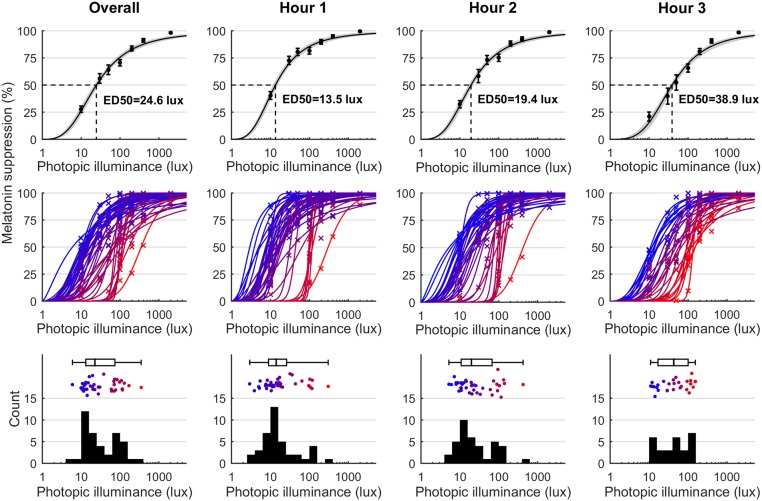
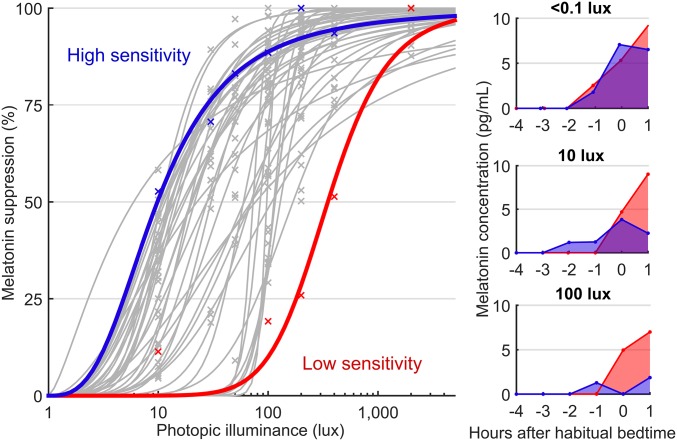
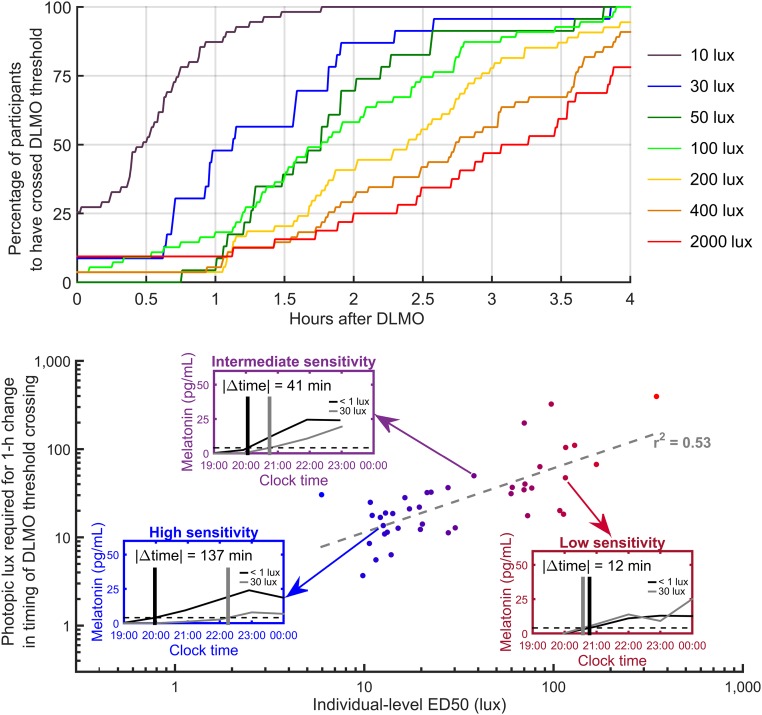
Significance: Electric lighting has fundamentally altered how the human circadian clock synchronizes to the day/night cycle. Exposure to light after dusk is pervasive in the modern world. We examined group-level sensitivity of the circadian system to evening light and the degree to which sensitivity varies between individuals. We found that, on average, humans are highly sensitive to evening light. Specifically, 50% suppression of melatonin occurred at <30 lux, which is comparable to or lower than typical indoor lighting used at night, as well as light produced by electronic devices. Significantly, there was a >50-fold difference in sensitivity to evening light across individuals. Interindividual differences in light sensitivity may explain differential vulnerability to circadian disruption and subsequent impact on human health.
Overview
The claims and statistics of this paper haven’t been checked yet.
Free: it reads the open-access text and checks the first 5 claims that cite a source we can check. Create a free account to check every claim.
Integrity signals
Registry
Cites
Statistics
Figures
Verification
Claims the paper makes
The claims and statistics of this paper haven’t been checked yet.
Free: it reads the open-access text and checks the first 5 claims that cite a source we can check. Create a free account to check every claim.
Claims other papers make about this one
Each is checked against this paper’s own text: does it say what the citing paper says it does?
The source backs part of the claim, not all of it — or backs it for a different population, condition or comparison.
In the citing paper
“There is, in fact, growing evidence showing that humans are, on average, highly sensitive to lower illuminance levels than previously thought (dependent on their prior light exposure history, and individually variable) and that a 50% suppression of melatonin can occur even at <30 lux. 16”
From Sustained remission from perinatal depression after bright light therapy: A pilot randomised, placebo‐controlled trial (2022) · cites this paper as [16]
Experimental — accuracy not yet measured
Self-check
Percentages, sums and reported differences re-computed from the paper’s own numbers.
The self-check needs the paper’s full text.
Citations
Cites
Stability, precision, and near-24-hour period of the human circadian pacemaker
Czeisler, C. A., Duffy, J. F., Shanahan, T. L., Brown, E. N., Mitchell, J. F., Rimmer, D. W., Ronda, J. M., Silva, E. J., Allan, J. S., Emens, J. S., et al. (1999) · Science · doi:10.1126/science.284.5423.2177 · Cited by 1,705 · cited 1×
“6% (4), showing that the human circadian period distribution was in fact similar to that seen in nonhuman animals studied in dark conditions.”
BackgroundChang, A.-M., Aeschbach, D., Duffy, J. F., & Czeisler, C. A. (2015) · Proceedings of the National Academy of Sciences · doi:10.1073/pnas.1418490112 · Cited by 1,430 · cited 1×
“Exposure to electric light after sunset in this range is extremely common in industrialized countries (9, 12–14), and the increasing use of light-emitting devices is a further source of evening light that is potentially disruptive to the circadian system (15, 16).”
BackgroundMeasuring and using light in the melanopsin age
Lucas, R. J., Peirson, S. N., Berson, D. M., Brown, T. M., Cooper, H. M., Czeisler, C. A., Figueiro, M. G., Gamlin, P. D., Lockley, S. W., O’Hagan, J. B., et al. (2014) · Trends in Neurosciences · doi:10.1016/j.tins.2013.10.004 · Cited by 1,278 · cited 1×
“blue light) on the circadian pacemaker (47).”
Self-citationHattar, S., Lucas, R. J., Mrosovsky, N., Thompson, S., Douglas, R. H., Hankins, M. W., Lem, J., Biel, M., Hofmann, F., Foster, R. G., et al. (2003) · Nature · doi:10.1038/nature01761 · Cited by 1,245 · cited 1×
“(5), it is important to note that the circadian system receives light via a complex pathway involving contributions frommultiple photoreceptors (45, 46).”
BackgroundZeitzer, J. M., Dijk, D., Kronauer, R. E., Brown, E. N., & Czeisler, C. A. (2000) · The Journal of Physiology · doi:10.1111/j.1469-7793.2000.00695.x · Cited by 1,175
Entrainment of the Human Circadian Clock to the Natural Light-Dark Cycle
Wright, K. P., McHill, A. W., Birks, B. R., Griffin, B. R., Rusterholz, T., & Chinoy, E. D. (2013) · Current Biology · doi:10.1016/j.cub.2013.06.039 · Cited by 783 · cited 1×
“The interindividual differences we observed in light sensitivity may underlie interindividual differences in sleep and circadian timing that are known to arise with access to electric light (8, 25, 26), in addition to previously identified physiological factors, including intrinsic period of the circadian clock and sl…”
BackgroundCajochen, C., Frey, S., Anders, D., Späti, J., Bues, M., Pross, A., Mager, R., Wirz-Justice, A., & Stefani, O. (2011) · Journal of Applied Physiology · doi:10.1152/japplphysiol.00165.2011 · Cited by 730 · cited 1×
“Exposure to electric light after sunset in this range is extremely common in industrialized countries (9, 12–14), and the increasing use of light-emitting devices is a further source of evening light that is potentially disruptive to the circadian system (15, 16).”
BackgroundMolecular Dissection of Two Distinct Actions of Melatonin on the Suprachiasmatic Circadian Clock
Liu, C., Weaver, D. R., Jin, X., Shearman, L. P., Pieschl, R. L., Gribkoff, V. K., & Reppert, S. M. (1997) · Neuron · doi:10.1016/s0896-6273(00)80350-5 · Cited by 723 · cited 1×
“These findings indicate that the rise of melatonin, an important signal for the initiation of sleep that inhibits electrical activity of SCN neurons (44), is extremely sensitive to suppression by eveninglight exposure.”
BackgroundCajochen, C., Zeitzer, J. M., Czeisler, C. A., & Dijk, D.-J. (2000) · Behavioural Brain Research · doi:10.1016/s0166-4328(00)00236-9 · Cited by 653 · cited 1×
“A related avenue of future work would be to examine whether individual differences in melatonin suppression predict individual differences in other outcomes that are known to follow similar dose–response curves at the group-average level, such as the effect of light on alertness (48).”
BackgroundWever, R. A. (1979) · Topics in Environmental Physiology and Medicine · doi:10.1007/978-1-4612-6142-1 · Cited by 608
Cited by
Items 401–450 of 450
Fitzpatrick, N. K., Chachay, V., Sandra, C., Briskey, D. R., Jackman, S. R., Shore, A., & Bowtell, J. L. (2024) · Figshare · doi:10.6084/m9.figshare.26668008
Fitzpatrick, N. K., Chachay, V., Sandra, C., Briskey, D. R., Jackman, S. R., Shore, A., & Bowtell, J. L. (2024) · Figshare · doi:10.6084/m9.figshare.26668014
Fitzpatrick, N. K., Chachay, V., Capra, S. M., Briskey, D. R., Jackman, S. R., Shore, A., & Bowtell, J. L. (2024) · Figshare · doi:10.6084/m9.figshare.26668011
Fitzpatrick, N. K., Chachay, V., Sandra, C., Briskey, D. R., Jackman, S. R., Shore, A., & Bowtell, J. L. (2024) · Figshare · doi:10.6084/m9.figshare.26668017
Rice, A. (2023) · ResearchWorks at the University of Washington (University of Washington)
Lighting and daylighting in livestock buildings for dairy cows - Circadian lighting and energy use
Nordin, K. A., & Zaw, P. W. (2024) · Lund University Publications Student Papers (Lund University)
Coirolo del Río, N. C. (2021) · LA Referencia (Red Federada de Repositorios Institucionales de Publicaciones Científicas) · Cited by 2
Ritmos circadianos humanos desafiados por las condiciones ambientales de la Antártida
Castillo, J. (2023) · LA Referencia (Red Federada de Repositorios Institucionales de Publicaciones Científicas)
眼内水晶体の光透過率や瞳孔径の年齢差と光の非視覚および視覚的作用の関係性
江藤, 太. (2021) · Institutional Repositories DataBase (IRDB)
Zhou, Y. (2025) · arXiv (Cornell University) · doi:10.48550/arxiv.2512.06181
“Exploring sequence models (LSTMs, Transformers) to exploit temporal dependencies beyond hour-level features, implementing uncertainty quantification (Bayesian neural networks) to flag ambiguous samples, and developing personalisation via meta-learning for rapid individual adaptation [23].”
Auswirkungen von veränderten Aktivitätszeiten, modernen Leuchtmitteln und Lichtverschmutzung
Krop-Benesch, A. (2025) · Springer eBooks · doi:10.1007/978-3-662-71727-1_10
Nogueira, M. G., Umemura, G. S., Vallim, J. R. D. S., Lopes, L. D. C., D’Almeida, V., & Forner‐Cordero, A. (2026) · Chronobiology International · doi:10.1080/07420528.2025.2606255 · Cited by 1
“Values below the threshold of 30 were reported to be sufficient to sensitize the circadian rhythm (Phillips et al. 2019), while values above 100 were not suitable for measuring the consistency of light incidence (Hand 2023).”
Bjerrum, L. B., Sørensen, L., Nordhus, I. H., Osnes, B., Bjorvatn, B., Kambestad, O. B., Hansen, M. E., Visted, E., & Flo, E. (2026) · Chronobiology International · doi:10.1080/07420528.2026.2617640 · Cited by 1
“Finally, studies indicate that there are large inter-individual differences in light sensitivity (Phillips et al. 2019), including sex differences that can affect alertness (Chellappa et al. 2017; Fazlali et al. 2025b), and a systematic review pointed out that neuroimaging studies show sex…”
Family History and Solar Insolation in Bipolar I Disorder
Bauer, M., Glenn, T., Achtyes, E. D., Alda, M., Ağaoğlu, E., Altınbaş, K., Andreassen, O. A., Angelopoulos, E. K., Ardau, R., Aydin, M., et al. (2026) · Acta Psychiatrica Scandinavica · doi:10.1111/acps.70075
Obesity mediates the association of outdoor artificial light at night with type 2 diabetes mellitus
Liu, X., Ding, Z., Yuchi, Y., Li, R., Liao, W., Dong, X., Huo, W., Hou, J., Lin, H., Liu, X., et al. (2026) · iScience · doi:10.1016/j.isci.2026.115036 · Cited by 2
Modern lights on neuropathology of Alzheimer’s disease
Mure, L. S. (2026) · SLEEP · doi:10.1093/sleep/zsag080 · Cited by 1
Li, J., Wang, T., Wang, Y., Shao, R., & Hao, L. (2026) · Interdisciplinary Nursing Research · doi:10.1097/nr9.0000000000000120
Martinelli, J. (2022) · theses.fr (ABES) · doi:10.70675/5488e904z57a3z4fd6z83d2z795ca0557b09
Circadian Disruption Shift Work and Breast Cancer Risk
Subramanian, H., & Kairaitis, K. (2026) · Sleep Medicine Clinics · doi:10.1016/j.jsmc.2026.02.009
Montanari, A., Wang, L. M., Birenboim, A., & Chaix, B. (2026) · JMIR mhealth and uhealth · doi:10.2196/75898
“The primary predictors were artificial light exposure (measured as minutes of exposure above 30 lux [ie, dim light], a physiologically relevant threshold used in previous protocols [47]) and smartphone use (in minutes) in the 2 hours before bedtime.”
Effects of light on brain-state dynamics and energy landscape
Zhang, R. W., & Volkow, N. D. (2026) · Network Neuroscience · doi:10.1162/netn.a.586
“…to investigate how individual differences in light sensitivity, which vary by more than 50-fold in healthy individuals as well as altered sensory processing of light, affect brain-state dynamics and control energy under varying light conditions (Phillips et al., 2019; Ríos Llamas et al., 2026).”
Barreira, J., Costa, J. A., Brito, J., Cardoso, V., & Reis, C. P. (2026) · Journal of Sleep Research · doi:10.1111/jsr.70349
Thurairajah, U. (2026) · International journal of research and scientific innovation · doi:10.51244/ijrsi.2026.1304000143
Wong, A., Yin, L., Lee, C. W., Park, A., & Choi, Y. (2026) · medRxiv · doi:10.64898/2026.05.31.26354481
Liu, H., & Xin, Y. (2026) · Frontiers in Nutrition · doi:10.3389/fnut.2026.1833858
“A controlled study reported that exposure to 30 lux resulted in more than 50% melatonin suppression at the group level, with individual variability reaching beyond 50% even under dim reading light (10 lux) (30).”
Li, S. X., Long, Q., Huang, D., & Mao, Y. (2026) · Frontiers in Psychiatry · doi:10.3389/fpsyt.2026.1835178
Eto, T., & Higuchi, S. (2026) · Journal of Japan Society of Kansei Engineering · doi:10.5057/kansei.24.2_59
Gogate, S., Nanaware, S. S., & Padma, K. (2026) · Indian Journal of Medical Specialities · doi:10.4103/injms.injms_8_26
Light exposure and sleep architecture in real-world settings
Akgun, S. G., Gemici, B., Roddis, C., Bickerstaff, L., Baño‐Otálora, B., Milosavljevic, N., Brown, T. M., Lucas, R. J., & Didikoğlu, A. (2026) · npj Biological Timing and Sleep · doi:10.1038/s44323-026-00087-z · Cited by 1
“Real-world studies also face the challenge of substantial interindividual variability in light sensitivity, which may obscure subtle effects 61 .”
Seah, M.-Y., Mohamed, A., Lau, W. J., Lim, J. M.-Y., Liang, S.-N., & Kalavally, V. (2026) · IEEE Transactions on Instrumentation and Measurement · doi:10.1109/tim.2026.3712970
“Myland et al. [14] used convolutional neural networks (CNNs) for low-light conditions but excluded data below 25 lx due to low signal-to-noise ratio, limiting applicability in real-world environments where such light levels are common and biologically relevant [25].”
Zhang, S., Liu, Y., Tan, J., Si, W., Liu, H. F., Huang, Y., Li, Y., & Xiao, J. (2026) · Frontiers in Psychiatry · doi:10.3389/fpsyt.2026.1884632
“Individual light sensitivity varies markedly, indicating that future light interventions should not rely solely on fi xed parameters (20, 21).”
Thurairajah, U. (2026) · International Journal of Research and Innovation in Applied Science · doi:10.51584/ijrias.2026.11070006
Schwartz, C. S., Granger, S. W., Aldrich, B. M., Stothard, E. R., & THOMAS, R. J. (2026) · medRxiv · doi:10.64898/2026.08.03.26359048
Traitements chronobiologiques dans les troubles du rythme circadien
Kilic-Huck, Ü., Saadi, S., & Bourgin, P. (2025) · Elsevier eBooks · doi:10.1016/b978-2-294-78711-9.00043-8
Effects of Morning and Evening Narrowband Blue Light and Myopic Defocus on Axial Length in Humans
Thakur, S., Khudkhudia, H., Sankaridurg, P. R., & Verkicharla, P. K. (2026) · Current Eye Research · doi:10.1080/02713683.2026.2709886
Vicente-Martínez, J., Bonmatí‐Carrión, M., López-Parra, A. M., Madrid, J. A., Pagán, P., & Rol, M. A. (2026) · Journal of Pineal Research · doi:10.1111/jpi.70181
“…given their close functional and anatomical association [25], and although individuals show > 50‐fold variability in light‐ induced melatonin suppression [26], no study had yet examined the effect of melanopsin variants on melatonin suppression and melatonin secretion under dim light conditions.”
Gaidica, M., & Rosengart, M. R. (2026) · medRxiv · doi:10.64898/2026.08.26.26361398
Blue-Light Filters in Eye Care: A State-of-the-Art Review
Abass, R., Fathy, A., & Abass, A. (2026) · Medical Sciences · doi:10.3390/medsci14050530
Sharma, D., Yang, H.-W., Huang, X.-Q., Chen, T.-H., Tsai, P.-C., Lee, S.-Y., Lee, K.-H., Yeh, P., & Jou, J. (2026) · Optoelectronics · doi:10.3390/optoelectronics1010004
Boumpalou, E., Papageorgiou, A., Damianos, G., Sergentanis, T. Ν., & Τσίτσικα, Ά. (2026) · Journal of Personalized Medicine · doi:10.3390/jpm16100500
“In addition, substantial interindividual differences exist in sensitivity to evening light and in the magnitude of melatonin suppression [38].”
Gubin, D. G., Danilenko, K. V., Stefani, O., Kolomeichuk, S., Markov, A., Petrov, I., Voronin, K., Mezhakova, M. S., Borisenkov, M. F., Shigabaeva, A., et al. (2026) · Biology · doi:10.3390/biology15201881
Wong, A., Lee, C., Park, A., Yin, L., & Choi, Y. (2026) · Sleep Health · doi:10.1016/j.sleh.2026.08.017
Evening light exposure and sleep phase shifts in adolescence and childhood: Literature review
Leś, K., Kronenberg, M., & Męcik-Kronenberg, T. (2026) · Annales Academiae Medicae Silesiensis · doi:10.18794/aams/241404
Pilechiha, P., Stefani, O., Schweiker, M., de Kort, Y. A. W., Smolders, K. C. H. J., & Harmsen, J. (2026) · medRxiv · doi:10.64898/2026.10.06.26364836
Moen, L. V., Holme, A. N., Nilsen, K. B., Sallinen, M., Matre, D., & Haugen, F. (2026) · Occupational and Environmental Medicine · doi:10.1136/oemed-2026-111002
Ming-Yi, S., Lim, J. M.-Y., Liang, S.-N., Kumari, Y., & Kalavally, V. (2026) · Research Square · doi:10.21203/rs.3.rs-10233757/v1
Circadian rhythms in health and disease
Liu, X., Du, X., Qi, S., Yuan, L., Liu, L., Zhang, K., Wang, L., Zhang, W., Liu, Q., Wu, M., et al. (2026) · Molecular Biomedicine · doi:10.1186/s43556-026-00646-7
Latitude, cities and health: What do we know and need to do about daylight?
Amorim, C. N. D., Hobday, R. A., Sokol, N., Dervishaj, A., Volf, C., Kenny, P., Foster, R. G., & Norton, B. (2026) · City and Environment Interactions · doi:10.1016/j.cacint.2026.100519
Metadata
- Authors
- Phillips, A. J. K., Vidafar, P., Burns, A. C., McGlashan, E. M., Anderson, C., Rajaratnam, S. M. W., Lockley, S. W., & Cain, S. W.
- Affiliations
- Monash University (AU)
- Corresponding author
- Cain, Sean W.
- ORCID
- Venue
- Proceedings of the National Academy of Sciences
- Publisher
- National Academy of Sciences
- Published
- 2019-05-28
- Volume
- 116
- Issue
- 24
- Pages
- 12019-12024
- ISSN
- 0027-8424 (ISSN-L)
- 1091-6490
- PMC
- PMC6575863
- OpenAlex
- W2946852268
- Cited by
- 430
- References
- 50
- Citations by year
- 2026: 53 · 2025: 54 · 2024: 60 · 2023: 54 · 2022: 76 · 2021: 64 · 2020: 51 · 2019: 17
- FWCI
- 28.72
- Type
- journal article
- Language
- en
- Open access
- hybrid
- doi.org
- Licence
- Locations
- Proceedings of the National Academy of Sciences (publishedVersion, cc-by-nc-nd)
- Europe PMC (PubMed Central) (publishedVersion, cc-by-nc-nd)
- PubMed Central (publishedVersion, cc-by-nc-nd)
- PubMed (publishedVersion)
- Monash University Research Portal (Monash University) (submittedVersion, other-oa)
- Surrey Research Insight Open Access (The University of Surrey) (submittedVersion)
- Funders
- Department of Health | National Health and Medical Research Council (1064231)
- Topics
- Life Sciences › Neuroscience › Endocrine and Autonomic Systems › Circadian rhythm and melatonin
- Physical Sciences › Environmental Science › Global and Planetary Change › Impact of Light on Environment and Health
- Social Sciences › Psychology › Experimental and Cognitive Psychology › Sleep and Work-Related Fatigue
- Keywords
- circadian system, evening light, melatonin suppression, interindividual variability, photosensitivity, circadian rhythm disruption, electric lighting, indoor lighting
- MeSH terms
- Adult, Circadian Rhythm, Female, Humans, Individuality, Light, Lighting, Male, Melatonin, Young Adult, Circadian Clocks
About these checks
Registry, retraction, Cites and statistics results are computed, not judged, with one exception: a printed reference that no index lists is read once by a model before it counts as a citation error. Claims are extracted by a model and kept only when their quote appears verbatim in the text; each cited source is then checked, with a model’s help, for whether it says what the claim relies on. Those verdicts can be wrong — read the claim’s quote and the cited source before relying on one.
Statistics and arithmetic are recomputed, not judged.
Confidence bands are shown only for fields calibrated on our annotated test set. None is calibrated yet, so no band is shown.
What counts as a claim ›How we measure confidence ›How we check this ›
Are you an author, or do you see a problem with this page? Request a review
Data sources
Bibliographic data: Semantic Scholar, OpenAlex, Crossref.
Contains information from the Semantic Scholar Academic Graph Datasets, made available under the ODC Attribution License (ODC-BY 1.0).
Semantic Scholar’s data is described in: Kinney, R., et al. (2023). The Semantic Scholar Open Data Platform. arXiv:2301.10140.
