

Gender imbalance in medical imaging datasets produces biased classifiers for computer-aided diagnosis
Open accessThe DOI matches its Crossref record; 36 of the 36 references it cites were found in a registry or an index.
Abstract
Artificial intelligence (AI) systems for computer-aided diagnosis and image-based screening are being adopted worldwide by medical institutions. In such a context, generating fair and unbiased classifiers becomes of paramount importance. The research community of medical image computing is making great efforts in developing more accurate algorithms to assist medical doctors in the difficult task of disease diagnosis. However, little attention is paid to the way databases are collected and how this may influence the performance of AI systems. Our study sheds light on the importance of gender balance in medical imaging datasets used to train AI systems for computer-assisted diagnosis. We provide empirical evidence supported by a large-scale study, based on three deep neural network architectures and two well-known publicly available X-ray image datasets used to diagnose various thoracic diseases under different gender imbalance conditions. We found a consistent decrease in performance for underrepresented genders when a minimum balance is not fulfilled. This raises the alarm for national agencies in charge of regulating and approving computer-assisted diagnosis systems, which should include explicit gender balance and diversity recommendations. We also establish an open problem for the academic medical image computing community which needs to be addressed by novel algorithms endowed with robustness to gender imbalance.
Overview
The claims and statistics of this paper haven’t been checked yet.
Free: it reads the open-access text and checks the first 5 claims that cite a source we can check. Create a free account to check every claim.
Integrity signals
Registry
Cites
Statistics
Figures
Verification
Claims the paper makes
The claims and statistics of this paper haven’t been checked yet.
Free: it reads the open-access text and checks the first 5 claims that cite a source we can check. Create a free account to check every claim.
Claims other papers make about this one
Each is checked against this paper’s own text: does it say what the citing paper says it does?
The source backs part of the claim, not all of it — or backs it for a different population, condition or comparison.
In the citing paper
“The choice of these subgroups is motivated by the clear history, in both traditional medicine and AI algorithms, of bias for subgroups on these axes 6,8,10,11 .”
From Underdiagnosis bias of artificial intelligence algorithms applied to chest radiographs in under-served patient populations (2021) · cites this paper as [6]
Experimental — accuracy not yet measuredThe source backs part of the claim, not all of it — or backs it for a different population, condition or comparison.
In the citing paper
“For example, if a dataset predominantly consists of images from a particular racial or ethnic group, the AI model trained on this dataset may exhibit reduced accuracy when applied to individuals from other groups.”
From Bias in artificial intelligence for medical imaging: fundamentals, detection, avoidance, mitigation, challenges, ethics, and prospects (2024) · cites this paper as [24]
Experimental — accuracy not yet measuredIn the citing paper
“Similar issues arise with gender, age, and socio-economic status, where AI systems may perform better for the demographic groups that are overrepresented in the training data (Figure 4).24”
From Bias in artificial intelligence for medical imaging: fundamentals, detection, avoidance, mitigation, challenges, ethics, and prospects (2024) · cites this paper as [24]
Self-check
Percentages, sums and reported differences re-computed from the paper’s own numbers.
The self-check needs the paper’s full text.
Citations
Cites
Deep Residual Learning for Image Recognition
He, K., Zhang, X., Ren, S., & Sun, J. (2016) · 2016 IEEE Conference on Computer Vision and Pattern Recognition (CVPR) · doi:10.1109/cvpr.2016.90 · Cited by 235,474 · cited 2×
“Additionally, we evaluated two other CNN architectures, the ResNet (33) and the Inception-v3 (34), confirming that our observations generalize for different neural models.”
MethodLeCun, Y., Bengio, Y., & Hinton, G. (2015) · Nature · doi:10.1038/nature14539 · Cited by 84,126
ImageNet: A large-scale hierarchical image database
Deng, J., Dong, W., Socher, R., Li, L.-J., Li, K., & Fei-Fei, L. (2009) · 2009 IEEE Conference on Computer Vision and Pattern Recognition · doi:10.1109/cvpr.2009.5206848 · Cited by 65,333 · cited 1×
“A model pretrained on ImageNet (32) was used to initialize the network weights.”
MethodDensely Connected Convolutional Networks
Huang, G., Liu, Z., Van Der Maaten, L., & Weinberger, K. Q. (2017) · 2017 IEEE Conference on Computer Vision and Pattern Recognition (CVPR) · doi:10.1109/cvpr.2017.243 · Cited by 48,566
Rethinking the Inception Architecture for Computer Vision
Szegedy, C., Vanhoucke, V., Ioffe, S., Shlens, J., & Wojna, Z. (2016) · 2016 IEEE Conference on Computer Vision and Pattern Recognition (CVPR) · doi:10.1109/cvpr.2016.308 · Cited by 32,138
An introduction to ROC analysis
Fawcett, T. (2006) · Pattern Recognition Letters · doi:10.1016/j.patrec.2005.10.010 · Cited by 21,879 · cited 4×
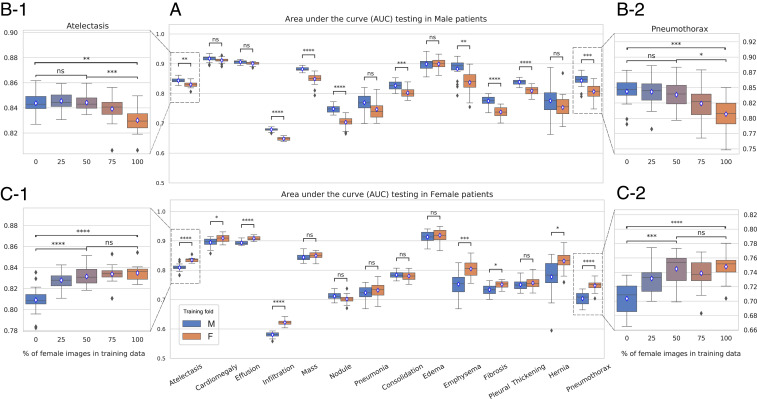
“( B and C ) AUC achieved for two exemplar diseases under a gradient of gender imbalance ratios, from 0% of female images in training data to 100%, with increments of 25%.”
MethodInfluentialProceedings of IEEE Conference on Computer Vision and Pattern Recognition
(1993) · doi:10.1109/cvpr.1993 · Cited by 17,667
A survey on deep learning in medical image analysis
Litjens, G., Kooi, T., Bejnordi, B. E., Setio, A. A. A., Ciompi, F., Ghafoorian, M., van der Laak, J. A. W. M., van Ginneken, B., & Sánchez, C. I. (2017) · Medical Image Analysis · doi:10.1016/j.media.2017.07.005 · Cited by 15,332 · cited 1×
“AI systems cannot only augment the information provided by such images with useful annotations (1, 2), but they are also starting to take autonomous decisions by performing computer-aided diagnosis (CAD) (3, 4).”
BackgroundDermatologist-level classification of skin cancer with deep neural networks
Esteva, A., Kuprel, B., Novoa, R. A., Ko, J., Swetter, S. M., Blau, H. M., & Thrun, S. (2017) · Nature · doi:10.1038/nature21056 · Cited by 14,362 · cited 9×
“Given a frontal X-ray image, the CAD system predicts the presence or absence of the 14 thoracic diseases.”
BackgroundInfluentialWang, X., Peng, Y., Lu, L., Lu, Z., Bagheri, M., & Summers, R. M. (2017) · 2017 IEEE Conference on Computer Vision and Pattern Recognition (CVPR) · doi:10.1109/cvpr.2017.369 · Cited by 4,616 · cited 4×
“We use the NIH Chest-XRay14 dataset (16, 19), which includes 112,120 chest X-ray images from 30,805 patients, labeled with 14 common thorax diseases (including hernia, pneumonia, fibrosis, emphysema, edema, cardiomegaly, pleural thickening, consolidation, mass, pneumothorax, nodule, atelectasis, effusion, and infiltra…”
MethodInfluential
Cited by
Items 601–700 of 898
Altamirano, S., Portegies, T. C., & Ghebreab, S. (2026) · Proceedings of IASEAI Conference · doi:10.1609/iaseai.v2i1.43011 · Cited by 1
Walston, S. L., Takita, H., Mitsuyama, Y., Sato, J., & Ueda, D. (2026) · European Radiology · doi:10.1007/s00330-026-12652-y · Cited by 1
“This method is based on the hypothesis that differences in subgroup performance fi ndings between studies can re fl ect training data gaps in commercial models [45].”
Taddese, A. A., & Tam, B. T. (2026) · Obesity Reviews · doi:10.1111/obr.70187 · Cited by 1
Ghenciulescu, N., Reinders, M. J. T., & Mahfouz, A. E. (2026) · Biochemistry and Biophysics Reports · doi:10.1016/j.bbrep.2026.102692 · Cited by 1
“Similar examples of sex bias amplification have been described for other larger-level classifiers in the medical field [43–45].”
Qamar, S., Al-Aloye, H. B. H. B. M., & Alam, F. (2026) · Bioengineering · doi:10.20944/preprints202607.1301.v1 · Cited by 1
Towards the practical use of AI: a tool for scalable colorectal cancer screening
Wong, E. Y. T., Plumb, A., & Shiu, K. (2026) · Annals of Oncology · doi:10.1016/j.annonc.2026.06.017 · Cited by 1
Integrating AI Into Emergency Radiology: Promises, Pitfalls, and Practical Approaches
Miller, Z. D., King, W. E., Cross, N. M., Singh, S., Linnau, K. F., Medverd, J. R., Sahani, D., & Mastrodicasa, D. (2026) · Seminars in Roentgenology · doi:10.1016/j.ro.2026.151009 · Cited by 1
Zhou, Y., Yu, B., Chang, R., Ding, Y., Wang, Y., & Han, M. (2026) · Frontiers in Immunology · doi:10.3389/fimmu.2026.1792331 · Cited by 1
Blixt, F. F., & Bjällmark, A. (2026) · Cardiovascular Ultrasound · doi:10.1186/s12947-026-00380-8 · Cited by 1
“Several studies examining radiographical images identified ethnicity and sex-related biases in AI models [9, 10], including the ability to predict sex from X-ray images, which can contribute to the development of biased models [11].”
Sun, X., Zou, X., Wu, Y., Zhang, S., & Wang, G. (2026) · Pattern Recognition · doi:10.1016/j.patcog.2026.114701 · Cited by 1
Toma, M., & YUSUPOV, D. (2026) · Bioengineering · doi:10.3390/bioengineering13091034 · Cited by 1
da Costa, G. C., Rodriguez, J. G. V., da Costa, G. F. D. O., & do Nascimento, E. A. (2026) · Journal of Electrocardiology · doi:10.1016/j.jelectrocard.2026.154458 · Cited by 1
Atehortúa, A., Estrada, U. M. L.-T., & Petrone, P. (2026) · International Journal of Medical Informatics · doi:10.1016/j.ijmedinf.2026.106731 · Cited by 1
Baianonie, H., & Alahdab, F. (2026) · Health Policy and Technology · doi:10.1016/j.hlpt.2026.101321 · Cited by 1
Beyond Regulatory Approval: Lifecycle Assurance for Clinical Artificial Intelligence
Shujaat, S. (2026) · Journal of Medical Systems · doi:10.1007/s10916-026-02466-2 · Cited by 1
“Models using utilization or cost proxies may underestimate risk in disadvantaged populations [28], while imaging algorithms may show reduced performance in underrepresented groups [ 35 ].”
Nieto, N., Larrazabal, A. J., Peterson, V., Milone, D. H., & Ferrante, E. (2021) · GigaScience · doi:10.1093/gigascience/giab086 · Cited by 1
Self-citationEscalas, E., Echeveste, R., Peterson, V., & Ferrante, E. (2020) · El Servicio de Difusión de la Creación Intelectual (National University of La Plata) · Cited by 1
Self-citationBenefits of Life Skill Based Education for Neurodiverse Adults: An Integrative Review and Analysis
Ravichandren, N., & O'Connor, A. N. (2021) · World Journal of Educational Research · doi:10.22158/wjer.v8n4p21 · Cited by 1
Modern Challenges in Machine Learning and Artificial Intelligence
Iliev, A. I. (2021) · Digital Presentation and Preservation of Cultural and Scientific Heritage · doi:10.55630/dipp.2021.11.2 · Cited by 1
“Others also lead to biased classifiers from imbalanced data in medical images (Larrazabal, Nieto, Peterson, Milone, & Ferrante, 2020).”
BackgroundIntroducing students to out-of-distribution detection with deep neural networks
Šuch, O., Fabricius, R., & Tarábek, P. (2022) · International Conference on Emerging eLearning Technologies and Applications (ICETA) · doi:10.1109/iceta57911.2022.9974603 · Cited by 1
“Similar care needs to be taken when it comes to gender-imbalanced medical datasets [20].”
BackgroundRealization of Halcon Image Segmentation Algorithm in Machine Vision for Complex Scenarios
Ke, L. (2023) · International Conference on Artificial Intelligence and Smart Energy (ICAIS) · doi:10.1109/icais56108.2023.10073925 · Cited by 1
“…computer vision and pattern recognition, and are used in a variety of image fields, such as GIS and hydrological image processing [7, 8], medical image analysis and intelligent computer-aided diagnosis [9], real-time traffic monitoring image platforms [10], and agricultural data fields [11], etc.”
BackgroundKumar, R., Panda, S., Anil, M., Anshul, G., & Pancholi, A. (2023) · Communications in computer and information science · doi:10.1007/978-3-031-43140-1_2 · Cited by 1
Artificial Intelligence: Development and Applications in Neurosurgery
Shah, R., Reese, V. C., Oselkin, M., & Stawicki, S. P. (2023) · Artificial intelligence · doi:10.5772/intechopen.113034 · Cited by 1
Where Are Biases? Adversarial Debiasing with Spurious Feature Visualization
Chen, C., Ching, P., Huang, P., & Hu, M. (2024) · Lecture notes in computer science · doi:10.1007/978-3-031-53305-1_1 · Cited by 1
Impact of Gender and Chest X-Ray View Imbalance in Pneumonia Classification Using Deep Learning
Farhat, H. J., Sakr, G. E., & Kilany, R. (2024) · Lecture notes in networks and systems · doi:10.1007/978-3-031-47724-9_7 · Cited by 1
The Journal Geological Society of India: Its Journey to 100th Volume, Challenges and Way Forward
Bhat, G. M. (2024) · Journal of the Geological Society of India · doi:10.17491/jgsi/2024/173815 · Cited by 1
Caughlin, K., Martinez, R. C., Tortorelli, G. P., Higgins, K. E., Faram, R., Jo, J. A., & Busso, C. (2024) · Annual International Conference of the IEEE Engineering in Medicine and Biology Society (EMBC) · doi:10.1109/embc53108.2024.10781827 · Cited by 1
“For example, Larrazabal et al. [5]showed that gender imbalance in x-ray training data sets can negatively impact model performance.”
King, A. P., & Lee, T. (2025) · Elsevier eBooks · doi:10.1016/b978-0-44-323761-4.00022-5 · Cited by 1
Advances in AI-Enhanced Biomedical Imaging for Cancer Immunology
Yim, W. W., Wee, F. Y. T., Ho, Z. Y., Feng, X., Zhang, M., Lee, S., Zlobec, I., Yeong, J. P.-S., & Lau, M. C. (2024) · World Scientific Annual Review of Cancer Immunology · doi:10.1142/s2972389224300044 · Cited by 1
A Delphi Study on the Conceptualization and Item Generation of AI Health Ethics Literacy
Lee, H., & Eom, J. (2025) · Journal of Digital Contents Society · doi:10.9728/dcs.2025.26.4.1091 · Cited by 1
Mozumder, A. Q., Ghosh, D., Raihan, M., Islam, A., Paul, R., & Bishnu, K. K. (2025) · International Journal of Science and Research Archive · doi:10.30574/ijsra.2025.17.1.2840 · Cited by 1
Lin, M., Xiao, Y., Hou, B., Wanyan, T., Sharma, M. M., Wang, Z., Wang, F., Tassel, S. H. V., & Peng, Y. (2023) · arXiv (Cornell University) · doi:10.48550/arxiv.2301.11315 · Cited by 1
Pham, H., Nguyen, H. Q., Nguyen, H. T., Le, L. T., & Lam, K. (2023) · arXiv (Cornell University) · doi:10.48550/arxiv.2304.01220 · Cited by 1
“The actual impact of AI systems on the diagnostic performance of radiologists in clinical practice remains unclear [12, 1, 11].”
BackgroundJones, Y., Deligianni, F., Dalton, J., Pellicori, P., & Cleland, J. G. F. (2023) · arXiv (Cornell University) · doi:10.48550/arxiv.2308.16067 · Cited by 1
“Interpretability highlights the importance of input features and helps identify model biases inherent in healthcare datasets [14], [15], [16], [17].”
BackgroundHislop, M. (2023) · Research Square · doi:10.21203/rs.3.rs-3249460/v1 · Cited by 1
Gulamali, F. F., Sawant, A. S., Liharska, L. E., Horowitz, C. R., Chan, L., Kovatch, P., Hofer, I. S., Singh, K., Richardson, L. D., Mensah, E., et al. (2023) · medRxiv · doi:10.1101/2023.11.06.23298164 · Cited by 1
Cao, J. J. (2024) · Deep Blue (University of Michigan) · doi:10.7302/23059 · Cited by 1
Persistence barcodes: A novel approach to reducing bias in radiological analysis
Singh, Y., Farrelly, C., Hathaway, Q. A., & Carlsson, G. (2024) · Oncotarget · doi:10.18632/oncotarget.28667 · Cited by 1
Exploring and mitigating analytical variability in fMRI results using representation learning
Germani, É. (2024) · theses.fr (ABES) · doi:10.70675/db89c27fz099cz492fz9785zd2f9c74ed664 · Cited by 1
Fair Diagnosis: Leveraging Causal Modeling to Mitigate Medical BiasPreprint
Tian, B., He, Y., Liu, M., Dai, Y., Wang, Z., He, S., Sun, G., Shen, Z., Ye, W., Wu, Y., et al. (2024) · Qeios · doi:10.32388/nx9jhl · Cited by 1
Human Retinotopic Mapping: from Empirical to Computational Models of RetinotopyPreprint
Ribeiro, F. L., Benson, N. C., & Puckett, A. M. (2025) · PsyArXiv (OSF Preprints) · doi:10.31234/osf.io/7eu9m_v2 · Cited by 1
The Strategic Imperative for Healthcare Organizations to Build Proprietary Foundation ModelsPreprint
Tiwari, N. (2025) · arXiv (Cornell University) · doi:10.48550/arxiv.2506.11412 · Cited by 1
Ridwan, R. (2025) · arXiv (Cornell University) · doi:10.48550/arxiv.2507.18647 · Cited by 1
BM-CL: Bias Mitigation through the lens of Continual LearningPreprint
Mansilla, L., Echeveste, R., González, C., Milone, D. H., & Ferrante, E. (2025) · arXiv (Cornell University) · doi:10.48550/arxiv.2509.01730 · Cited by 2
“In the last decade, a plethora of studies have demonstrated that machine learning systems can exhibit biases against specific demographic groups, often defined by protected attributes such as gender, age, or race [1], [4], [13], [14].”
Self-citationAlgorithms Trained on Normal Chest X-rays Can Predict Health Insurance TypesPreprint
Chen, C.-Y., Abulibdeh, R., Asgari, A., Ordóñez, S. A. C., Celi, L. A., Goode, D., Hamidi, H., Seyyed-Kalantari, L., McCague, N., Sounack, T., et al. (2025) · arXiv (Cornell University) · doi:10.48550/arxiv.2511.11030 · Cited by 1
“Larrazabal et al. (2020); Kumar et al. (2025).”
OxEnsemble: Fair Ensembles for Low-Data ClassificationPreprint
Rystrøm, J. H., Fu, Z., & Russell, C. (2025) · arXiv (Cornell University) · doi:10.48550/arxiv.2512.09665 · Cited by 1
“Deriving minimums: Under H 0 , the standard error of the difference between the minimum recall proportions in the validation and test set is: The one-sided z statistic fixing Requiring a significance level of α (i.e., z ≥ z 1 − α ) yields the minimal observable validation recall: For k = 0 .”
InfluentialUncovering Bias in Personal InformaticsPreprint
Yfantidou, S., Sermpezis, P., Vakali, A. I., & Baeza-Yates, R. (2023) · Zenodo (CERN European Organization for Nuclear Research) · doi:10.5281/zenodo.8113035 · Cited by 1
Fair, Robust, and Calibrated Deep Learning with Heavy-Tailed Subgroups
Hampton, L. M. (2023) · DSpace@MIT (Massachusetts Institute of Technology) · Cited by 1
Herencia del sesgo: influencia de los sesgos de la Inteligencia Artificial en las decisiones humanas
Vicente Holgado, L. (2024) · Basque Digital Memory (Vital Foundation) · Cited by 1
Bounos, I., Groisman, P., Sued, M., & Tabak, E. G. (2025) · arXiv (Cornell University) · doi:10.48550/arxiv.2512.20914 · Cited by 1
“Motivational examples abound in the context of medical diagnosis and more general health care settings, where it is commonly observed that algorithms fail to generalize well when applied to populations other than the ones they were originally trained on Larrazabal et al. (2020).”
Hybrid Vision Transformer_GAN Attribute Neutralizer for Mitigating Bias in Chest X_Ray DiagnosisPreprint
Solomon, J., Alsahag, A. M. M., & Ziabari, S. S. M. (2026) · arXiv (Cornell University) · doi:10.48550/arxiv.2601.15490 · Cited by 1
Farquhar, H. L. (2026) · medRxiv · doi:10.64898/2026.01.20.26344495 · Cited by 1
A Survey of Next-Generation AI and Its Evolving LandscapePreprint
Khan, A., Amjad, H., Amjad, H., Amjad, H., Hameed, R., Bilal, M. A., Fazal, D. S., Rehman, A., Chohan, S. N., & Munib, S. (2026) · doi:10.36227/techrxiv.175329122.29020847/v3 · Cited by 1
Di, Y., & Cai, N. (2026) · medRxiv · doi:10.64898/2026.02.15.26346336 · Cited by 1
Federated Measurement of Demographic Disparities from Quantile Sketches
Charpentier, A., Machado, A. F., Côté, O., & Hu, F. (2026) · Transactions on machine learning research · doi:10.48550/arxiv.2602.18870 · Cited by 1
“Similar issues arise in imaging: under-served subgroups may be systematically underdiagnosed, eluding single-silo audits (Seyyed-Kalantari et al., 2021; Larrazabal et al., 2020; Chen et al., 2021).”
Avci, M. Y., Achara, A., King, A., & Cardoso, M. J. (2026) · arXiv (Cornell University) · doi:10.48550/arxiv.2603.04113 · Cited by 1
“…and prognosis, growing evidence suggests that these models can exploit unintended correlations in imaging data, leading to performance disparities across demographic groups and allowing attributes such as race to remain identifiable even when unrelated to the clinical task [23,15,26,20,8].”
Pakzad, A. (n.d.) · Summit (Simon Fraser University) · Cited by 1
WHBench: Evaluating Frontier LLMs with Expert-in-the-Loop Validation on Women's Health TopicsPreprint
Maurya, S., Govindgari, S., Kumar, G., & Akhara, A. I. (2026) · arXiv (Cornell University) · doi:10.48550/arxiv.2604.00024 · Cited by 1
Active and Incremental Deep learning with class imbalanced data
Aggarwal, U. (2022) · theses.fr (ABES) · doi:10.70675/e6d51380zef20z4bd7z85eez594673d44967 · Cited by 1
Elangovan, K., & Ting, D. S. W. (2026) · arXiv (Cornell University) · doi:10.48550/arxiv.2604.08502 · Cited by 2
“Validation against radiologist-annotated ground-truth is necessary to confirm that consistent explanations are also clinically faithful [51].”
Pham, H.-H., Nguyen, H. S., Cao, D. P. M., Nguyen, T.-H., Xu, M., Le, T.-N., Bağcı, U., & Pham, H. (2026) · arXiv (Cornell University) · doi:10.48550/arxiv.2607.07717 · Cited by 1
“Fairness methods such as equal opportunity [4] and GroupDRO [11] typically aggregate over groups, while medical-imaging fairness studies have documented demographic and EHR-derived bias in clinical prediction pipelines [3, 7, 12].”
Cao, D. P. M., Pham, H. D., & Pham, H. (2026) · arXiv (Cornell University) · doi:10.48550/arxiv.2608.03342 · Cited by 1
“Fairness in medical AI is commonly studied through demographic disparities in sex, race, and healthcare access [9,5,13].”
Auditing for Diversity using Representative ExamplesPreprint
Keswani, V., & Celis, L. E. (2021) · arXiv (Cornell University) · doi:10.48550/arxiv.2107.07393
Stark, D., & Ritter, K. (2021) · Springer eBooks · doi:10.1007/978-3-030-58080-3_244-1
WITHDRAWN: Integrating Sex, Gender, and Intersectional Analysis into Bioengineering
Schiebinger, L. L. (2021) · Current Opinion in Biomedical Engineering · doi:10.1016/j.cobme.2021.100347
RetractedCaramanica, L., Maxwell, S. R., & Curry, S. (2000) · PubMed
Anwendungen der künstlichen Intelligenz in der Abdominalbildgebung
Ziegelmayer, S., & Braren, R. (2021) · Gastroenterologie up2date · doi:10.1055/a-1355-0636
“wird die diagnostische Genauigkeit von Algorithmen bei der Klassifizierung vonThoraxröntgenbildern erheblich von der Geschlechterverteilung in den Datensätzen beeinflusst [19].”
BackgroundStark, D., & Ritter, K. (2022) · Springer eBooks · doi:10.1007/978-3-030-64573-1_244
Librarians as Partners in Biomedical Data Science: Opportunities and Challenges
Federer, L. (2022) · Advances in library and information science (ALIS) book series · doi:10.4018/978-1-7998-9702-6.ch004
Implications of sex-specific differences on clinical studies of human health
Piñero, J., Quevenco, F., Furlong, L. I., & Güney, E. (2022) · Elsevier eBooks · doi:10.1016/b978-0-12-821392-6.00011-x
Alternative for Indoor Occupancy Estimation Based on Image Processing on an Embedded System
Carvajal, D. A. C., Rondón, C. V. N., Delgado, B. M., Casadiego, S. A. C., & Ibarra, D. G. (2022) · Ingeniería y Desarrollo · doi:10.14482/inde.40.01.620.427
Multi-task Learning Dataset for the Development of Remote Patient Monitoring System
Khlil, F., Naouali, S., Raddadi, A., Salem, S. B., Gharsallah, H., & Romdhani, C. (2022) · Lecture notes in computer science · doi:10.1007/978-3-031-16014-1_43
Analysis of Data Sequence Mining and Electronic Imaging Systems
Fu, H. (2022) · International Conference on I-SMAC (IoT in Social, Mobile, Analytics and Cloud) (I-SMAC) · doi:10.1109/i-smac55078.2022.9987400
“In the lemma 3, the initial matrix is presented [23-25].”
BackgroundEinsatz künstlicher Intelligenz in der Medizin – Chancen und Herausforderungen
Nguyen, D. T., Ritz, H., & Kammer, F. (2022) · Anwendungen und Konzepte der Wirtschaftsinformatik · doi:10.26034/lu.akwi.2022.3363
AI in eye care; an introduction to how neural networks work
Pead, E. (2020) · Optician · doi:10.12968/opti.2020.11.8402
Alvarez, L., de Moura, J., Ramos, L., Novo, J., & Ortega, M. (2023) · Kalpa publications in computing · doi:10.29007/v25g
The Ethics of AI and Robotics in Public Health: An East Asian Perspective
Wheeler, B. (2023) · Springer eBooks · doi:10.1007/978-3-030-96778-9_35-1
Avoiding Machine Learning Becoming Pseudoscience in Biomedical Research
Susanty, M., Puspasari, I., Fitriah, N., Mahayana, D., Rajab, T. L. E., Zakaria, H., Setiawan, A. W., & Hertadi, R. (2023) · Jurnal Informatika · doi:10.31294/inf.v10i1.12787
“…status, race, ethnic background, religion, gender, disability, or sexual orientation and amplifies inequities in health systems (Chen et al., 2008; Larrazabal et al., 2020; Ledford, 2019; Lyratzopoulos et al., 2013; Madabhushi & Lee, 2016; Maya Dusenbery, 2018; Meghani et al., 2012; Panch,…”
(2023) · Nature Computational Science · doi:10.1038/s43588-023-00499-y
Data Management and Regulations for International Business
Fornés, G., & Altamira, M. (2023) · Springer eBooks · doi:10.1007/978-3-031-33111-4_6
Inspecting Model Fairness in Ultrasound Segmentation TasksPreprint
Xu, Z., Tang, F., Quan, Q., Ding, J., Ning, C., & Zhou, S. (2023) · arXiv (Cornell University) · doi:10.48550/arxiv.2312.02501
“For instance, Larrazaba et al. [4] observed substantial performance variations among three DL models when applied to distinct gender groups (male and female) in a chest X-ray diagnosis task.”
BackgroundMethodThe Significance of Machine Learning in Healthcare Data ManagementPreprint
Aligbe, A. (2023) · OSF Preprints (OSF Preprints) · doi:10.31219/osf.io/sz9a7
Srour, F. J., & Balaghi, A. (2024) · SSRN Electronic Journal · doi:10.2139/ssrn.4676406
Non-specialist Versus Neural Network: An Example of Gender Classification from Abdominal CT Data
Prettner, S., & Ivanovska, T. (2024) · Informatik aktuell · doi:10.1007/978-3-658-44037-4_69
Achararit, P., Bongkaew, H., Chobpenthai, T., & Nonthasaen, P. (2024) · SSRN Electronic Journal · doi:10.2139/ssrn.4768104
Clustering with fairness, privacy, and predictions
Nguyen, T. (2024) · Digital Repository Service (Northeastern University) · doi:10.17760/d20653002
Achararit, P., Bongkaew, H., Chobpenthai, T., & Nonthasaen, P. (2024) · SSRN Electronic Journal · doi:10.2139/ssrn.4831886
Towards an Unbiased Classification of Chest X-ray Images Using a RL Powered ACGAN Framework
Beaini, M. E., & Awad, M. (2024) · IFIP advances in information and communication technology · doi:10.1007/978-3-031-63211-2_19
Remote illness detection faces a trust barrier
Smarr, B. L. (2024) · The Lancet Digital Health · doi:10.1016/s2589-7500(24)00145-6
CLIAS, Esteban, S., CLIAS, Pace, R. A., CLIAS, Pennini, V. A., CLIAS, Santoro, A., CLIAS, Rubinstein, A. L., et al. (2024) · The Global Health Network eBooks · doi:10.48060/tghn.134
Computer Models Assist Innovative Design of Graphic Arts
Xu, J., & Zhu, Q. (2024) · International Journal of High Speed Electronics and Systems · doi:10.1142/s0129156425400166
Challenges and Opportunities for the Healthcare
Jain, P., Behl, R., Saxena, A., & Bathla, R. (2024) · BENTHAM SCIENCE PUBLISHERS eBooks · doi:10.2174/9789815305128124010012
Justiça em Modelos de Apoio a Processos de Tomada de Decisão com Uso de Aprendizado Federado
do Carmo, Ê. P., Traina, A. J. M., & Traina, C. (2024) · Simpósio Brasileiro de Bancos de Dados (SBBD) · doi:10.5753/sbbd.2024.243139
Visualizing radiological data bias through persistence images
Singh, Y., Farrelly, C., Hathaway, Q. A., & Carlsson, G. (2024) · Oncotarget · doi:10.18632/oncotarget.28670
Legal and Ethical Aspects of AI in Radiology
Custers, B. H. M., & Fosch‐Villaronga, E. (2024) · Imaging informatics for healthcare professionals · doi:10.1007/978-3-031-68942-0_6
A cautionary tale on the cost-effectiveness of collaborative AI in real-world medical applications
Cremonesi, F., Lucia, I., Goh, V., Ourselin, S., Antonelli, M., & Lorenzi, M. (2026) · Scientific Reports · doi:10.1038/s41598-026-70599-y
Geschlechtersensible Medizin und künstliche Intelligenz – vom „Normmann“ bis zur Gleichberechtigung
Groß, C., Thun, S., Vorisek, C. N., & Poyraz, R. A. (2024) · SDG - Forschung, Konzepte, Lösungsansätze zur Nachhaltigkeit · doi:10.1007/978-3-658-44852-3_5
Towards Fair DeepNet: Evaluating Gender Bias in Deep Learning Networks
(2025) · International journal of intelligent engineering and systems · doi:10.22266/ijies2025.0630.14
de Barros, B. M., Rodrigues, D. D., Oliveira, G. B., & Recamonde‐Mendoza, M. (2025) · doi:10.5753/sbc.16731.5.4
Dietrich, M. (2025) · Zeitschrift für Gemeinwirtschaft und Gemeinwohl · doi:10.5771/2701-4193-2025-2-107
Metadata
- Authors
- Larrazabal, A. J., Nieto, N., Peterson, V., Milone, D. H., & Ferrante, E.
- Affiliations
- Consejo Nacional de Investigaciones Científicas y Técnicas (AR)
- Corresponding author
- Ferrante, Enzo
- Venue
- Proceedings of the National Academy of Sciences
- Publisher
- National Academy of Sciences
- Published
- 2020-05-26
- Volume
- 117
- Issue
- 23
- Pages
- 12592-12594
- ISSN
- 0027-8424 (ISSN-L)
- 1091-6490
- PMC
- PMC7293650
- OpenAlex
- W3030030520
- Cited by
- 685
- References
- 36
- Citations by year
- 2026: 117 · 2025: 149 · 2024: 125 · 2023: 110 · 2022: 101 · 2021: 71 · 2020: 10
- FWCI
- 21.48
- Type
- journal article
- Language
- en
- Open access
- hybrid
- doi.org
- Licence
- Locations
- Proceedings of the National Academy of Sciences (publishedVersion, cc-by)
- PubMed Central (publishedVersion, cc-by)
- PubMed (publishedVersion)
- LA Referencia (Red Federada de Repositorios Institucionales de Publicaciones Científicas) (submittedVersion, cc-by-nc-sa)
- Funders
- AXA Research Fund (2017-AXA-PDOC1-097)
- MINCyT | Agencia Nacional de Promoción Científica y Tecnológica (PICT 2017-4596, PICT-2018-03907, PICT 2014-2627, PICT-2018-3384)
- Universidad Nacional del Litoral (CAID-PIC-50220140100084L, 2016-082)
- Topics
- Health Sciences › Medicine › Health Informatics › Artificial Intelligence in Healthcare and Education
- Physical Sciences › Computer Science › Artificial Intelligence › Ethics and Social Impacts of AI
- Health Sciences › Medicine › Public Health, Environmental and Occupational Health › Sex and Gender in Healthcare
- Keywords
- gender imbalance, medical imaging datasets, algorithmic fairness, computer-aided diagnosis, X-ray images, thoracic disease diagnosis, deep neural network, underrepresented groups, dataset collection
- MeSH terms
- Deep Learning, Female, Humans, Male, Radiographic Image Interpretation, Computer-Assisted, Reference Standards, Sex Factors, Radiography, Thoracic, Bias, Datasets as Topic
About these checks
Registry, retraction, Cites and statistics results are computed, not judged, with one exception: a printed reference that no index lists is read once by a model before it counts as a citation error. Claims are extracted by a model and kept only when their quote appears verbatim in the text; each cited source is then checked, with a model’s help, for whether it says what the claim relies on. Those verdicts can be wrong — read the claim’s quote and the cited source before relying on one.
Statistics and arithmetic are recomputed, not judged.
Confidence bands are shown only for fields calibrated on our annotated test set. None is calibrated yet, so no band is shown.
What counts as a claim ›How we measure confidence ›How we check this ›
Are you an author, or do you see a problem with this page? Request a review
Data sources
Bibliographic data: Semantic Scholar, OpenAlex, Crossref.
Contains information from the Semantic Scholar Academic Graph Datasets, made available under the ODC Attribution License (ODC-BY 1.0).
Semantic Scholar’s data is described in: Kinney, R., et al. (2023). The Semantic Scholar Open Data Platform. arXiv:2301.10140.
