

Human heuristics for AI-generated language are flawed
Open accessThe DOI matches its Crossref record; 55 of the 55 references it cites were found in a registry or an index.
Abstract
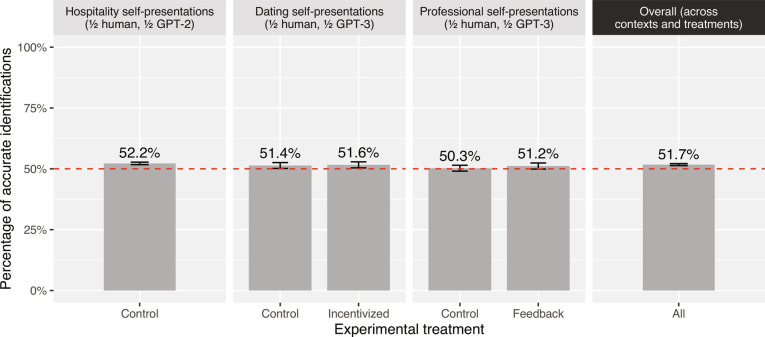
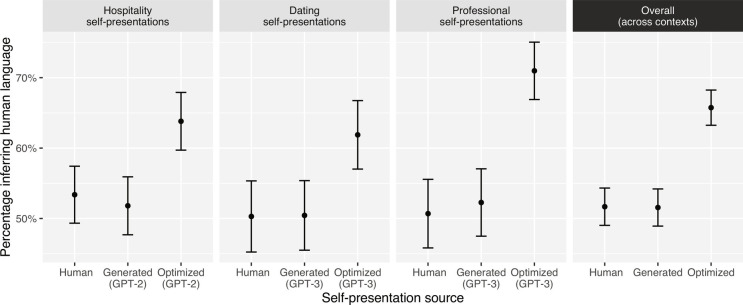
Human communication is increasingly intermixed with language generated by AI. Across chat, email, and social media, AI systems suggest words, complete sentences, or produce entire conversations. AI-generated language is often not identified as such but presented as language written by humans, raising concerns about novel forms of deception and manipulation. Here, we study how humans discern whether verbal self-presentations, one of the most personal and consequential forms of language, were generated by AI. In six experiments, participants (N = 4,600) were unable to detect self-presentations generated by state-of-the-art AI language models in professional, hospitality, and dating contexts. A computational analysis of language features shows that human judgments of AI-generated language are hindered by intuitive but flawed heuristics such as associating first-person pronouns, use of contractions, or family topics with human-written language. We experimentally demonstrate that these heuristics make human judgment of AI-generated language predictable and manipulable, allowing AI systems to produce text perceived as “more human than human.” We discuss solutions, such as AI accents, to reduce the deceptive potential of language generated by AI, limiting the subversion of human intuition.
Overview
The claims and statistics of this paper haven’t been checked yet.
Free: it reads the open-access text and checks the first 5 claims that cite a source we can check. Create a free account to check every claim.
Integrity signals
Registry
Cites
Statistics
Figures
Verification
Claims the paper makes
The claims and statistics of this paper haven’t been checked yet.
Free: it reads the open-access text and checks the first 5 claims that cite a source we can check. Create a free account to check every claim.
Claims other papers make about this one
Each is checked against this paper’s own text: does it say what the citing paper says it does?
The source backs part of the claim, not all of it — or backs it for a different population, condition or comparison.
In the citing paper
“Studies have shown that humans are largely ineffective at discerning AI created from human created content, and thus easily deceived (60).”
From The benefits and dangers of anthropomorphic conversational agents (2025) · cites this paper as [60]
Experimental — accuracy not yet measuredThe source backs part of the claim, not all of it — or backs it for a different population, condition or comparison.
In the citing paper
“Recent studies demonstrate that models like the GPT series are capable of producing news articles indistinguishable from human-generated ones (Kreps et al., 2022;Jakesch et al., 2023)”
From Anatomy of an AI-powered malicious social botnet (2024) · cites this paper as Jakesch et al., 2023
Experimental — accuracy not yet measuredThe source backs part of the claim, not all of it — or backs it for a different population, condition or comparison.
In the citing paper
“First, LLMs beat traditional text generation methods in producing human-like text (Jakesch et al., 2023;Guo et al., 2023;Clark et al., 2021).”
From Anatomy of an AI-powered malicious social botnet (2024) · cites this paper as Jakesch et al., 2023
Experimental — accuracy not yet measuredThe cited source says what the claim attributes to it.
In the citing paper
“We note that recent research has found that people could not reliably distinguish whether a piece of content is generated by people or the latest LLMs [33].”
From 'It was 80% me, 20% AI': Seeking Authenticity in Co-Writing with Large Language Models (2025) · cites this paper as [33]
The cited source says what the claim attributes to it.
In the citing paper
“it can also create realistic disinformation (e.g., fake news, propaganda) that is hard to detect by humans (Kreps et al. 2022; Jakesch et al. 2023)”
From Generative AI (2024) · cites this paper as Jakesch et al. 2023
6 more claims about this paper
Create a free account to see every claim other papers make about this one.
Self-check
Percentages, sums and reported differences re-computed from the paper’s own numbers.
The self-check needs the paper’s full text.
Citations
Cites
Vaswani, A., Shazeer, N., Parmar, N., Uszkoreit, J., Jones, L., Gomez, A. N., Kaiser, L., & Polosukhin, I. (2017) · arXiv · doi:10.48550/arxiv.1706.03762 · Cited by 120,404 · cited 1×
“We trained multiple customized versions of state-of-the-art AI language models (1, 2, 4) to generate self-presentations in three social contexts where trust in a self-presentation is important for decision-making: professional (e.g., job applications) (22), romantic (e.g., online dating) (12), and…”
MethodExploiting Generative AI to Scale up Intelligent Tutoring Systems
Jakubův, J., Chvalovský, K., Goertzel, Z., Kaliszyk, C., Olšák, M., Piotrowski, B., Schulz, S., Suda, M., & Urban, J. (2023) · DROPS (Schloss Dagstuhl – Leibniz Center for Informatics) · doi:10.4230/lipics.itp.2023.19 · Cited by 76,658
Language Models are Few-Shot Learners
Brown, T. B., Mann, B., Ryder, N., Subbiah, M., Kaplan, J., Dhariwal, P., Neelakantan, A., Shyam, P., Sastry, G., Askell, A., et al. (2020) · arXiv · doi:10.48550/arxiv.2005.14165 · Cited by 23,372 · cited 2×
“AI-generated language enables novel interactions that reduce human effort but can facilitate novel forms of plagiarism, manipulation, and deception (1, 3–8) when people mistake AI-generated language for language created by humans.”
BackgroundMethodKaugeranna, R., Kaugeranna, E., & Aion, (. S. 4. 6. (2023) · DROPS (Schloss Dagstuhl – Leibniz Center for Informatics) · doi:10.4230/lipics.giscience.2023.43 · Cited by 13,690
VADER: a parsimonious rule-based model for sentiment analysis of social media text
Hutto, C., & Gilbert, E. (2014) · Proceedings of the International AAAI Conference on Web and Social Media · doi:10.1609/icwsm.v8i1.14550 · Cited by 6,087 · cited 1×
“We computationally created a range of language features present in the self-presentations, including measurements for personality, sentiment, and perspective (28, 29).”
The Psychological Meaning of Words: LIWC and Computerized Text Analysis Methods
Tausczik, Y. R., & Pennebaker, J. W. (2010) · Journal of Language and Social Psychology · doi:10.1177/0261927x09351676 · Cited by 5,774 · cited 2×
“We developed an initial set of language features motivated by participants’ explanations of their judgments, to which we added various statistical metrics and commonly analyzed psychological language features such as LIWC (21).”
MethodProlific.ac—A subject pool for online experiments
Palan, S., & Schitter, C. (2018) · Journal of Behavioral and Experimental Finance · doi:10.1016/j.jbef.2017.12.004 · Cited by 3,450 · cited 2×
“Participants from Prolific had a median age of 37 y, 67% had a college degree, and 27% were at least somewhat familiar with computer programming.”
MethodThielke, S. M. (2004) · Psychiatric Services · doi:10.1176/appi.ps.55.9.1071 · Cited by 3,052
On the Opportunities and Risks of Foundation Models
Bommasani, R., Hudson, D. A., Adeli, E., Altman, R., Arora, S., von Arx, S., Bernstein, M. S., Bohg, J., Bosselut, A., Brunskill, E., et al. (2021) · arXiv · doi:10.48550/arxiv.2108.07258 · Cited by 2,676 · cited 1×
“We trained multiple customized versions of state-of-the-art AI language models (1, 2, 4) to generate self-presentations in three social contexts where trust in a self-presentation is important for decision-making: professional (e.g., job applications) (22), romantic (e.g., online dating) (12), and…”
MethodGPT-3: Its Nature, Scope, Limits, and Consequences
Floridi, L., & Chiriatti, M. (2020) · Minds and Machines · doi:10.1007/s11023-020-09548-1 · Cited by 2,519 · cited 1×
“In addition, human-like AI-generated self-presentations complicate questions about personhood and blur the line between human and machine intelligence (6, 15).”
Background
Research works printed but not linked: 4
- B. Buchanan, A. Lohn, M. Musser, K. Sedova, Truth, lies, and automation. Cent. Secur. Emerg. Technol. 1, 2 (2021).
- A. Radford, Language models are unsupervised multitask learners. OpenAI Blog 1, 9 (2019).
- A. Nelson, S. Friedler, F. Fields-Meyer, Blueprint for an AI bill of rights: A vision for protecting our civil rights in the algorithmic age. White House Office of Science and Technology Policy (2022). (18 October 2022).
- J. Williams, Should AI always identify itself? It’s more complicated than you might think. Electronic Frontier Foundation (2018). (18 October 2022).
Cited by
Items 201–300 of 610
Goodman, M. A., Lee, A., Schreck, Z., & Hollman, J. H. (2025) · Journal of Physical Therapy Education · doi:10.1097/jte.0000000000000396 · Cited by 9
Computational Sociolinguistics: An Emerging Multidisciplinary Research Area
Perez‐de‐Arriluzea‐Madariaga, A. (2025) · International Journal of Applied Linguistics · doi:10.1111/ijal.12696 · Cited by 10
A polycrisis threat model for AI
Bales, A. (2025) · AI & Society · doi:10.1007/s00146-025-02371-1 · Cited by 9
“…have grown more sophisticated, the text generated in this way has become more persuasive, and it’s now roughly as persuasive as human-generated text (Jakesch et al. 2023; Spitale et al. 2023; Costello et al. 2024; Durmus et al. 2024; Rogiers et al. 2024; Williams et al. 2024; Bai et al.,…”
Fool Me, Fool Me: User Attitudes Toward LLM Falsehoods
Nirman, D. B.-O., Weizman, A., & Azaria, A. (2025) · IEEE Access · doi:10.1109/access.2025.3632748 · Cited by 9
“Although it is widely assumed that users prefer accurate and truthful information, to the best of our knowledge, no prior work has explicitly tested this assumption in the context of LLMs.”
Köbis, N., Lorenz-Spreen, P., Ajaj, T., Bonnefon, J., Hertwig, R., & Rahwan, I. (2023) · arXiv (Cornell University) · doi:10.48550/arxiv.2306.04484 · Cited by 9
“AI is increasingly mediating communication between humans (Hancock et al., 2020; Jakesch et al., 2023; Purcell et al., 2023), and people have increasing control over the way they appear to others, as illustrated by the prevalence of beauty or youth-enhancing filters on platforms like Instagram or…”
Cognitive phantoms in large language models through the lens of latent variables
Peereboom, S., Schwabe, I., & Kleinberg, B. (2025) · Computers in Human Behavior: Artificial Humans · doi:10.1016/j.chbah.2025.100161 · Cited by 8
“For example, there is evidence that LLMs have generated text that was perceived as human more often than comparable human-written text [2] and that they are capable of advanced reasoning tactics and negotiation, ranking among the highest-level players in a strategy game with human players [3].”
BackgroundReducing political polarization through conversations with artificial intelligence
Hruschka, T. M. J., & Appel, M. (2026) · Journal of Computer-Mediated Communication · doi:10.1093/jcmc/zmag003 · Cited by 9
Ahmetoglu, Y., Constantinides, M., & Cox, A. L. (2026) · Annual Symposium on Human-Computer Interaction for Work (CHIWORK) · doi:10.1145/3808045.3808056 · Cited by 8
Introducing AI to an online petition platform changed outputs but not outcomes
Corpus, I., Gilbert, E., Koenecke, A., & Naaman, M. (2026) · Nature Human Behaviour · doi:10.1038/s41562-026-02580-8 · Cited by 8
Self-citationThe knowledge of ethical AI decision-making: A behavioral economics perspective
Bužinskienė, R., Miceikienė, A., Hernández-Tamurejo, Á., & Saura, J. R. (2026) · Journal of Innovation & Knowledge · doi:10.1016/j.jik.2026.100967 · Cited by 7
Designing with Generative AI: Symbiosis, Authorship, and the Evolving Image
Abdipour, M. (2026) · She ji · doi:10.1016/j.sheji.2026.02.004 · Cited by 7
LLM or Human? Perceptions of Trust and Quality in Research Summaries
Akpinar, N.-J., Avula, S., Lee, C., Dang, B., Razat, K., & Murdock, V. (2026) · CHI Conference on Human Factors in Computing Systems · doi:10.1145/3772318.3793386 · Cited by 8
“Moving to the perceived level of LLM involvement, our results show that participants’ beliefs about authorship shaped their evaluations even when inaccurate (RQ3), which is in line with prior oberveations from the literature [3, 13, 24].”
InfluentialIs Undisclosed LLM Use Morally Wrong?
Sahebi, S., & Montefiore, T. (2026) · Philosophy & Technology · doi:10.1007/s13347-026-01094-5 · Cited by 7
“…that self-presentations, such as online profiles, generated by LLMs such as ChatGPT are not detected by people in contexts including online dating (Jakesch et al., 2023b), meaning that there is a very real chance that someone will be deceived by another’s undisclosed use of the tool in at least…”
Human cognition and AI-generated texts: ethics in educational settings
Doenyas, C. (2024) · Humanities and Social Sciences Communications · doi:10.1057/s41599-024-04002-4 · Cited by 7
“Interestingly, university graduates performed 1% worse than those with no university degree, and self-reported technical knowledge did not correlate with more accurate ratings (Jakesch et al., 2023).”
InfluentialRagab, M., Ashary, E. B., Kateb, F., Hakeem, A., Mosli, R., Albogami, N., & Nooh, S. A. (2025) · Alexandria Engineering Journal · doi:10.1016/j.aej.2025.04.071 · Cited by 7
Walkthrough of Anthropomorphic Features in AI Assistant ToolsPreprint
Maeda, T. (2025) · arXiv (Cornell University) · doi:10.48550/arxiv.2502.16345 · Cited by 9
“Indeed, small grammatical or tonal cues can lead users to misinterpret Manuscript submitted to ACM AI-generated responses as human-written content [35].”
Jones, C. R., & Bergen, B. K. (2024) · arXiv · doi:10.48550/arxiv.2412.17128 · Cited by 7
“Spitale et al. (2023) found that participants were no better than chance at determining whether misinformation tweets were authored by people or GPT-3, in line with other related work (Hacken-burg et al., 2023; Jakesch et al., 2023b).”
Multi-Loss Fusion: Angular and Contrastive Integration for Machine-Generated Text Detection
Zahid, I., Chang, Y. S., Madusanka, T., Sun, Y., & Batista-Navarro, R. (2024) · Findings of the Association for Computational Linguistics: EMNLP (Findings of EMNLP) · doi:10.18653/v1/2024.findings-emnlp.421 · Cited by 6
“Previous work high-lighted that disambiguating between human and LLM-generated texts is increasingly difficult (Pu and Demberg, 2023; Jakesch et al., 2023; Cox, 2005).”
Rinderknecht, E., Engelmann, S. U., Saberi, V., Kirschner, C., Kravchuk, A. P., Schmelzer, A., Breyer, J., Goßler, C., Mayr, R., Gilfrich, C. P., et al. (2025) · Journal of Medical Internet Research · doi:10.2196/76598 · Cited by 6
Robots with hearts: How in-store AI’s task types impact brand attitude and ethicality
Bhoumik, K., Fang, L., & Igarashi, R. (2025) · Journal of Business Research · doi:10.1016/j.jbusres.2025.115923 · Cited by 8
The obligation to restrict AI in student writing
Taylor, M. R. (2026) · Journal of Philosophy of Education · doi:10.1093/jopedu/qhaf097 · Cited by 6
Yang, L., Xin, T., Yu, Y., & Wu, Y. (2026) · Journal of Intelligence · doi:10.3390/jintelligence14020027 · Cited by 6
“Comparative studies of human and AI-generated narratives find that AI texts reliably receive higher scores for local and global coherence (Jakesch et al., 2023).”
Playing the Imitation Game: How Perceived Generated Content Shapes Player Experience
Bazzaz, M., & Cooper, S. (2026) · CHI Conference on Human Factors in Computing Systems · doi:10.1145/3772318.3790473 · Cited by 7
Hwang, A. H., Wong, S. P., Chen, B., He, J., & Do, H. J. (2026) · CHI Conference on Human Factors in Computing Systems · doi:10.1145/3772318.3791920 · Cited by 6
Грона, Н. В., & Семеног, О. М. (2026) · Dialogica · doi:10.5709/dialogica-02.01.2026-06 · Cited by 6
van den Berg, K., Bedner, B., Zheng, M., Grote, P., & Shema, A. (2026) · Al-Qarawiyyin Jurnal Ilmu Ushuluddin · doi:10.64691/dh6rwb84 · Cited by 6
“Artificial intelligence treats text as a linguistic corpus that can be analyzed through statistical patterns, lacking intrinsic normative awareness (Jakesch, Hancock, & Naaman, 2023).”
Fan, M., & Chang, P. (2026) · Behavioral Sciences · doi:10.3390/bs16091671 · Cited by 6
“…of use, and there is converging reason to expect this: people’s intuitive heuristics for judging AI-generated language are systematically wrong (Jakesch et al., 2023), and students working with a model on authentic tasks calibrate their confidence to its output rather than to its correctness…”
Arifin, G. Y. (2024) · American Journal of Scholarly Research and Innovation · doi:10.63125/4m5fjb12 · Cited by 15
AI-Powered Promises: The Influence of ChatGPT on Trust and Trustworthiness
Greevink, I., Offerman, T., & Romagnoli, G. (2023) · Journal of Economic Behavior & Organization · doi:10.1016/j.jebo.2026.107538 · Cited by 6
Deciphering Conversational Networks: Stance Detection via Hypergraphs and LLMs
Vinco, D. D., Antelmi, A., Spagnuolo, C., & Aiello, L. M. (2024) · ACM Web Science Conference (WebSci) · doi:10.1145/3630744.3658418 · Cited by 6
A Linguistic Comparison between Human- and AI- Generated Texts in Lebanon
Fenianos, C. F., & Abdallah, M. (2024) · doi:10.60149/tmsy9941 · Cited by 6
Consistency Matters: Explore LLMs Consistency From a Black-Box PerspectivePreprint
Zhao, F., Jin, G., Huang, J., Zhao, R., & Tan, F. (2024) · arXiv (Cornell University) · doi:10.48550/arxiv.2402.17411 · Cited by 6
“Large Language Models (LLM) revolutionize the field of Natural Language Processing (NLP) by elevating text generation capabilities to incredible levels (Jakesch et al., 2023; Sadasivan et al., 2023).”
BackgroundAI, Expert or Peer? Provider Biases and Feedback Uptake Among Pre-Service Teachers
Jacobsen, L. J., Mertens, U., Jansen, T., & Weber, K. E. (2025) · arXiv · doi:10.48550/arxiv.2507.16013
The human-authorship halo: attribution bias in literary style evaluation by humans and AIPreprint
Haverals, W., & Martin, M. J. (2025) · arXiv (Cornell University) · doi:10.48550/arxiv.2510.08831 · Cited by 6
BUST: Benchmark for the evaluation of detectors of LLM-Generated Text
Cornelius, J., Lithgow-Serrano, O., Mitrovic, S., Dolamic, L., & Rinaldi, F. (2024) · Proceedings of the 2024 Conference of the North American Chapter of the Association for Computational Linguistics: Human Language Technologies (Volume 1: Long Papers) · doi:10.18653/v1/2024.naacl-long.444 · Cited by 5
“Several studies show that most adults cannot distinguish between the two (Clark et al., 2021; Jakesch et al., 2023).”
BackgroundKuo, J.-Y., & Wang, T.-H. (2025) · AI & Society · doi:10.1007/s00146-025-02390-y · Cited by 5
The more you think you know: AI experience, literacy, heuristics, and perceived AI authorship
Liu, S., Chu, H., Yuan, S., Sun, Y., & Men, L. R. (2025) · AI & Society · doi:10.1007/s00146-025-02643-w · Cited by 5
Instrumental Bot Identities and the Politics of Online Discourse
Letourneau, A. M. (2025) · Social Media + Society · doi:10.1177/20563051251378233 · Cited by 5
“The increasing access to generative AI has significant implications for reducing programmer limitations due to a lack of cultural familiarity (Jakesch et al., 2023).”
Huang, P. Y., Deng, J., Yang, Y., & Williams, S. (2025) · Proceedings of the ACM on Human-Computer Interaction · doi:10.1145/3757589 · Cited by 5
“For example, one study found that Google Smart Reply systems shape users’ linguistic behavior [37], while another demonstrated that opinionated AI outputs can steer user expression and beliefs [40].”
ArchiveGPT: A human-centered evaluation of using a vision language model for image cataloguing
Abele, L., Anders, G., Aydın, T., Buder, J., Fischer, H., Kimmel, D., & Huff, M. (2026) · Humanities and Social Sciences Communications · doi:10.1057/s41599-026-08367-6 · Cited by 5
“…behaviour equivalent to, or indistinguishable from, that of a human, has been a benchmark for measuring the performance of arti fi cial intelligence systems in generating human-like texts (e.g., Jakesch et al., 2023; Köbis and Mossink, 2021) and images (e.g., Nightingale and Farid, 2022).”
AI labeling reduces the perceived accuracy of online content but has limited broader effects
Wang, C., Sturgis, P., & de Kadt, D. (2026) · Telematics and Informatics · doi:10.1016/j.tele.2026.102416 · Cited by 6
Pramanik, S., & Husin, M. H. (2025) · International Journal of Advanced Computer Science and Applications · doi:10.14569/ijacsa.2025.0161226 · Cited by 5
“The Critical AI Analysis Assignment, central to RAPA's assessment design, explicitly asks students to critique AI-generated answers by identifying logical gaps [47], unsupported claims, biases, and limitations.”
Georgiou, G. P. (2026) · AI in Education · doi:10.3390/aieduc2010002 · Cited by 5
“…lexical diversity, syntactic complexity, the use of emotional or subjective language, perceived coherence, redundancy, and even subtle inconsistencies or noticeable signs may impact human assessment (Doru et al., 2025; Georgiou, 2025; Herbold et al., 2023; Jakesch et al., 2023; Jones et al., 2025).”
InfluentialChen, P., Guan, H., & Jeong, E. J. (2026) · Behavioral Sciences · doi:10.3390/bs16050720 · Cited by 5
“Jakesch et al. (2023) found that people cannot reliably distinguish AI-generated from human-written text, removing a potential cognitive barrier to accommodation; Shumailov et al. (2024) showed that recursive AI-to-AI training produces model collapse, suggesting that human-to-AI accommodation and…”
AI Literacy and Deepfake Detection Competence in Peruvian Higher Education
Rodriguez-Saavedra, M. O., Galindo, I. C., Ascuña, L. M. C., Gonzales, A. V. M., Cuarite, J. L. C., & Cabe, R. B. A. (2026) · European Journal of Educational Research · doi:10.12973/eu-jer.15.3.1009 · Cited by 5
Wack, M., & Prochaska, S. (2026) · Social Media + Society · doi:10.1177/20563051261462092 · Cited by 5
“Other researchers have sought to understand how audiences interpret AI-generated content, including work on AI-generated text (Altay & Gilardi, 2024; Jakesch et al., 2023; Longoni et al., 2022; Toff & Simon, 2023) and AI-generated video (Hameleers et al., 2022; Vaccari & Chadwick, 2020).”
Misinformation, Paradox, and Nudge: Combating Misinformation Through Nudging
Shin, D. (2024) · Springer eBooks · doi:10.1007/978-3-031-52569-8_7 · Cited by 5
Ignat, O., Lakshmy, G. G., & Mihalcea, R. F. (2025) · Workshop on Cross-Cultural Considerations in NLP (C3NLP) · doi:10.18653/v1/2025.c3nlp-1.4 · Cited by 5
To Feel is to be Human? The Empirical Study of Reader Response to Original and AI-Generated Texts
Marushchak, N. (2025) · Dialogica · doi:10.5709/dialogica-01.01.2025-04 · Cited by 5
Vukov, J. M., Joseph, T. L., Lebkuecher, G., Ramirez, M., & Burns, M. B. (2023) · The American Journal of Bioethics · doi:10.1080/15265161.2023.2250284 · Cited by 5
Name Heuristic Bias: How Can the Names of Accommodations Influence Individual Judgments?
Xue, K., Li, H., & Gao, L.-F. (2025) · Journal of Travel Research · doi:10.1177/00472875251323512 · Cited by 5
“In an experiment involving AI-generated texts featuring first-person language and family topics, participants tended to believe that these texts were authored by humans due to their language styles (Jakesch et al., 2023).”
Gameiro, H. D. S. (2024) · Springer eBooks · doi:10.1007/978-3-031-54827-7_22 · Cited by 5
Social Media Influence OperationsPreprint
Meier, R. (2023) · arXiv (Cornell University) · doi:10.48550/arxiv.2309.03670 · Cited by 5
Balog, K., Palowitch, J., Ikica, B., Radlinski, F., Alvari, H., & Manshadi, M. (2024) · arXiv (Cornell University) · doi:10.48550/arxiv.2408.08379 · Cited by 5
“Second, recent studies indicate that humans have difficulty reliably distinguishing between real and AI-generated text [7, 15].”
BackgroundDigital Literacy Interventions Can Boost Humans in Discerning DeepfakesPreprint
Geissler, D., Robertson, C. E., & Feuerriegel, S. (2025) · SSRN Electronic Journal · doi:10.2139/ssrn.5368742 · Cited by 6
Web-Browsing LLMs Can Access Social Media Profiles and Infer User DemographicsPreprint
Alizadeh, M., Gilardi, F., Samei, Z., & Mosleh, M. (2025) · arXiv (Cornell University) · doi:10.48550/arxiv.2507.12372 · Cited by 5
“Ethical concerns extend to informed consent: participants should be aware when exposed to AI-generated content, particularly if it might include harmful or misleading language [18].”
On Google's SynthID-Text LLM Watermarking System: Theoretical Analysis and Empirical ValidationPreprint
Omidi, R., Dong, Y., & Wang, B.-H. (2026) · arXiv.org · doi:10.48550/arxiv.2603.03410 · Cited by 3
“Robustness: Like many existing LLM watermarking methods, SynthID-Text exhibits moderate performance degradation under adversarial scenarios such as paraphrasing attacks [21, 16].”
Accepted with Minor Revisions: Value of AI-Assisted Scientific Writing
Hazra, S., Lee, D., Majumder, B. P., & Kumar, S. (2026) · ACM International Conference on Intelligent User Interfaces (IUI) · doi:10.1145/3742413.3789140 · Cited by 4
LLMTrace: A Corpus for Classification and Fine-Grained Localization of AI-Written Text
Tolstykh, I., Tsybina, A., Yakubson, S., & Kuprashevich, M. (2026) · Findings of the Association for Computational Linguistics: EMNLP (Findings of EMNLP) · doi:10.18653/2026.findings-emnlp.1951 · Cited by 4
Facilitating Asynchronous Idea Generation and Selection with Chatbots
Shin, J., Khatri, A., Hedderich, M. A., Lucero, A., & Oulasvirta, A. (2024) · Australian Conference on Human-Computer Interaction (OzCHI) · doi:10.1145/3726986.3726994 · Cited by 4
Khedr, N. A., & Abbas, N. F. (2026) · Arab World English Journal · doi:10.24093/awej/ai3.6 · Cited by 5
“Jakesch et al. (2023) carried out six extensive trials with 4,600 participants.”
Silver, B., Williams‐Ceci, S., & Naaman, M. (2025) · CHI Conference Extended Abstracts on Human Factors in Computing Systems (CHI EA) · doi:10.1145/3706599.3720008 · Cited by 4
“AI in the form of Large Language Models (LLMs) has become remarkably advanced in automating human-like language [16], and can be prompted to execute consistent rule-based responses to different types of content [20].”
Self-citationTrust or distrust? AIGC trustworthiness and an extended analysis within nomology framework
Li, M., Du, R., Ai, S., Hunt, R. A., & Xie, J. (2025) · Data Science and Management · doi:10.1016/j.dsm.2025.09.005 · Cited by 4
R.U.Psycho? A Framework for Robust Unified Psychometric Testing of Language Models
Schelb, J., Borin, O., García, D., & Spitz, A. (2026) · Language Resources and Evaluation Conference (LREC) · doi:10.63317/4d7ofew6usug · Cited by 4
“…with LLM-generated content (Veselovsky et al., 2023) and the difficulty one faces in detecting such contamination (Sadasivan et al., 2023; Jakesch et al., 2023), one * These authors contributed equally might argue that establishing a baseline of LLM traits is simply a necessity for…”
“My AI must have been broken”: How AI Stands to Reshape Human Communication
Naaman, M. (2022) · ACM Conference on Recommender Systems (RecSys) · doi:10.1145/3523227.3555724 · Cited by 4
“Given the impact of AI-MC on interpersonal evaluations, the talk will also cover our recent research examining the (mostly false) heuristics humans use when evaluating whether text was written by AI [5].”
BackgroundSelf-citationGenerative Künstliche Intelligenz: Mögliche Auswirkungen auf die psychologische Forschung
Buder, J., Lindner, M. A., Oestermeier, U., Huff, M., Gerjets, P. H., Utz, S., & Creß, U. (2024) · Psychologische Rundschau · doi:10.1026/0033-3042/a000699 · Cited by 4
Machine Learning in Sociology: Current and Future Applications
Garip, F., & Macy, M. W. (2023) · Oxford University Press eBooks · doi:10.1093/oxfordhb/9780197653609.013.11 · Cited by 5
Cross-cultural Inspiration Detection and Analysis in Real and LLM-generated Social Media DataPreprint
Ignat, O., Lakshmy, G. G., & Mihalcea, R. F. (2024) · arXiv (Cornell University) · doi:10.48550/arxiv.2404.12933 · Cited by 4
Zhu, J., & Molnár, A. (2025) · PsyArXiv (OSF Preprints) · doi:10.31234/osf.io/j8zgv_v1 · Cited by 4
On Controlled Change: Generative AI's Impact on Professional Authority in JournalismPreprint
Dodds, T., Yeung, W. N., Mellado, C., & de‐Lima‐Santos, M. (2025) · arXiv (Cornell University) · doi:10.48550/arxiv.2510.19792 · Cited by 5
“Generative AI can produce human-like texts that are “more human than human” (Jakesch et al., 2023), with linguistic features such as first-person pronouns and the use of contractions.”
Yan, L., Jin, Y., Zhao, L., Martínez‐Maldonado, R., Li, X., Guan, X., Guo, W., Han, X., & Gašević, D. (2025) · arXiv (Cornell University) · doi:10.48550/arxiv.2512.08933 · Cited by 4
“However, whereas traditional scaffolds operate through explicit prompts, undercover AI participation subtly reshaped reasoning through dialogue moves that emulated peer behaviour (Park et al., 2023; Jakesch et al., 2023).”
Understanding the Effects of RLHF on the Quality and Detectability of LLM-Generated TextsPreprint
Xu, B., & Zubiaga, A. (2025) · arXiv (Cornell University) · doi:10.48550/arxiv.2503.17965 · Cited by 4
“In these tasks, LLMs demonstrate a text generation ability comparable to, and that can often be perceived as, text written by humans (Jakesch, Hancock and Naaman, 2023).”
Zhang, W., Zavalniuk, I., Bohatko, V., Кухар, Н., & Pavlyuk, O. (2025) · Metaverse Basic and Applied Research · doi:10.56294/mr2025161 · Cited by 3
Can Artificial Intelligence Write Like Borges? An Evaluation Protocol for Spanish Microfiction
Manzanarez, G. A., Arana, N. D. L. C., Flores, J. G., Medina, Y. D. J. G., Monroy, R., & Pernelle, N. (2025) · Applied Sciences · doi:10.3390/app15126802 · Cited by 3
Hazim, L. R., & Ata, O. (2025) · The International Arab Journal of Information Technology · doi:10.34028/iajit/22/6/2 · Cited by 3
An Expert in the Loop Strategy for Generating Synthetic Learning Engagement Datasets
Obionwu, C. V., Bedi, S. S., Bhagavathi, A. V., Walia, D. S., & Turowski, K. (2025) · SN Computer Science · doi:10.1007/s42979-025-04457-5 · Cited by 3
Collaborative Evaluation of Deepfake Text with Deliberation-Enhancing Dialogue Systems
Lee, J., Zhu, X., Karadzhov, G., Stafford, T., Vlachos, A., & Lee, D. (2026) · Proceedings of the International AAAI Conference on Web and Social Media · doi:10.1609/icwsm.v20i1.42701 · Cited by 3
Pietrzak, Z., Mączka, K., & Niemiec, M. (2025) · Electronics · doi:10.3390/electronics14244971 · Cited by 3
“This is reflected in research by Jakesch et al. [42], which demonstrates that people rely on flawed heuristics and frequently judge AI text as “more human than human,” helping to explain our elevated false negatives.”
Culture, emotions, and power dynamics in AI email communication
Polupanova, M., Constantinides, M., & Quercia, D. (2026) · International Journal of Human-Computer Studies · doi:10.1016/j.ijhcs.2026.103770 · Cited by 3
Yao, G., & Liu, Z. (2026) · Journal of English for Academic Purposes · doi:10.1016/j.jeap.2026.101640 · Cited by 3
AL-Rawas, M., Qader, O. A. J. A., Lin, G. S. S., Beh, Y. H., Sabarudin, M. A., Ang, Y., Low, J. F., Abdullah, J. Y., & Noorani, T. Y. (2026) · Scientific Reports · doi:10.1038/s41598-026-42555-3 · Cited by 3
“The six criteria scores were computed and then divided by 18 to obtain either one of the four distinct ratings: 1 for excellent quality, 0.9 to 0.7 for good quality, 0.6 to 0.4 for average quality, and 0.1 to 0.3 for poor quality.”
InfluentialCan Humans Tell? A Dual-Axis Study of Human Perception of LLM-Generated News
Loth, A., Kappes, M., & Pahl, M. (2026) · ACM Web Science Conference (WebSci) · doi:10.1145/3795513.3807431 · Cited by 3
“On the human side, controlled experiments consistently show that participants perform near chance when distinguishing machine-generated from human-written text [3, 5].”
CaseMaster: Designing and Evaluating a Probe for Oral Case Presentation Training with LLM Assistance
Ouyang, Y., Xu, Y., Jiang, C., Jin, Y., Jiang, H., & Li, Q. (2026) · CHI Conference on Human Factors in Computing Systems · doi:10.1145/3772318.3790304 · Cited by 3
Why we believe chatbots: trust calibration as a design problem
Jaidka, K., & Cai, M. (2026) · Frontiers in Psychology · doi:10.3389/fpsyg.2026.1935527 · Cited by 4
“…such as its repeated formulaic expressions, phrases, and epithets (Kobak et al., 2025), as more or less trustworthy than text ostensibly written by humans; what is established is that readers cannot reliably tell the two apart, relying on intuitive but flawed heuristics (Jakesch et al., 2023).”
Lee-Geiller, S. (2026) · Journal of Elections Public Opinion and Parties · doi:10.1080/17457289.2026.2734815 · Cited by 3
Who’s Asking? Simulating Role-Based Questions for Conversational AI Evaluation
Kaur, N., Ayad, H., Jung, H., Mittal, S., Choudhury, M. D., & Mitra, T. (2026) · Findings of the Association for Computational Linguistics: ACL (Findings of ACL) · doi:10.18653/v1/2026.findings-acl.1769 · Cited by 3
“Because judgments of human-likeness are inherently subjective and prior work shows that humans are not always reliable judges of AI-generated text (Jakesch et al., 2023), we further familiarized annotators with examples of both human-and AI-written text and required free-text rationales for their…”
Generative Ai as (Un)Welcome Agents in Medical Crowdfunding: The Trust Dilemma and Moral HazardPreprint
Arnold, C., Xu, L. Z., Saffarizadeh, K., & Madiraju, P. (2024) · SSRN Electronic Journal · doi:10.2139/ssrn.4725206 · Cited by 3
Blended Bots: Infiltration through Identity Deception on Social MediaPreprint
Phillips, S. C., Ng, L. H. X., & Carley, K. M. (2024) · arXiv (Cornell University) · doi:10.48550/arxiv.2406.05246 · Cited by 3
“It has been well-established that humans are not very good at distinguishing between human and bot users (Kenny et al. 2024) or AI-and human-generated (brief) written self-presentations (Jakesch, Hancock, and Naaman 2023).”
BackgroundChu, H., Men, L. R., Liu, S., Yuan, S., & Sun, Y. (2024) · arXiv (Cornell University) · doi:10.48550/arxiv.2412.18647 · Cited by 3
Detecting Synthetic, Doubting Authentic: AI Attribution Bias for Political ImageryPreprint
Yan, H. Y., Moore, R. C., Tu, F., & Hancock, J. T. (2025) · OSF Preprints (OSF Preprints) · doi:10.31219/osf.io/w6bzx_v1 · Cited by 3
Self-citationAI-Generated Messages Can Be Used to Persuade Humans on Policy IssuesPreprint
Bai, H., Voelkel, J. G., Muldowney, S., Eichstaedt, J. C., & Willer, R. (2025) · OSF Preprints (OSF Preprints) · doi:10.31219/osf.io/stakv_v6 · Cited by 3
The Social Blindspot in Human-AI Collaboration: How Undetected AI Personas Reshape Team DynamicsPreprint
Yan, L., Han, X., Zhang, Y., Greiff, S., Molenaar, I., Martínez‐Maldonado, R., Fan, Y., Zhao, L., Li, X., Jin, Y., et al. (2025) · arXiv (Cornell University) · doi:10.48550/arxiv.2512.18234 · Cited by 3
Human attribution of empathic behaviour to AI systemsPreprint
Festor, J., Snels, I., & Kleinberg, B. (2026) · arXiv (Cornell University) · doi:10.48550/arxiv.2602.17293 · Cited by 3
“All texts were judged by a separate sample of participants on a 5-point Scale ranging from “1 = definitely AI-generated” to "5 = definitely human-written" (Jakesch et al., 2023).”
Ren, K., Raghavan, M., & Garg, N. (2026) · arXiv · doi:10.48550/arxiv.2606.25152 · Cited by 3
“Jakesch et al. (2023) show that people rely on inaccurate heuristics when identifying AI-generated text, which can be exploited; i.e., LLMs can be prompted to generate text that is judged as more human-like than actual human writing.”
Lee, W.-C., Lee, J.-S., & Suh, J. (2026) · Applied Sciences · doi:10.3390/app16062816 · Cited by 2
de Araújo, A. F. M. (2025) · AI and Ethics · doi:10.1007/s43681-025-00737-1 · Cited by 2
“Perpetuating the simulated memory (with greater accu - racy or authenticity over time by optimising data curation, toxicity filters, etc.) [ 33–35 ] as terminally ill patients’ fam - ily legacy could become a smart and organic property/chal - lenge of chatbots’ semantic corpus — like self-taught…”
Evaluating AI-Generated Satire against Human-Written Content: A Comparative Analysis
Dobre, A.-S., & Gross, E.-C. (2025) · Bulletin of the Transilvania University of Braşov Series VII Social Sciences • Law · doi:10.31926/but.ssl.2025.18.67.1.17 · Cited by 2
The Ouroboros effect and heterodox domains
Vukov, J. M., Lebkuecher, G., Joseph, T. L., Martinez, E. M., Ramirez, M., & Burns, M. B. (2025) · Ethics and Information Technology · doi:10.1007/s10676-025-09850-5 · Cited by 2
“Worryingly, as the authors note, the current inability to reliably identify synthetic (AI-produced) data online may mean that such MAD results are impossible to avoid—at least with current technology (Alemohammad et al., 2023 pp. 15–16; see also Jakesch et al., 2023 ; Sadasivan et al., 2023 ).”
Ningsih, T. W. R., Lestari, I., & Saptono, D. (2025) · Prosiding Konferensi Linguistik Tahunan Atma Jaya (KOLITA) · doi:10.25170/kolita.v23i23.7181 · Cited by 2
Effects of Personality- and Opinion-Alignment in Human-AI Interaction
Eder, M., Lechner, C. M., & Jakesch, M. (2026) · ACM Conference on Fairness, Accountability, and Transparency (FAccT) · doi:10.1145/3805689.3812350 · Cited by 3
Self-citation
Metadata
- Authors
- Jakesch, M., Hancock, J. T., & Naaman, M.
- Affiliations
- Cornell University (US)
- Stanford University (US)
- Corresponding author
- Jakesch, Maurice
- Venue
- Proceedings of the National Academy of Sciences
- Publisher
- National Academy of Sciences
- Published
- 2023-03-07
- Volume
- 120
- Issue
- 11
- Pages
- e2208839120-e2208839120
- ISSN
- 0027-8424 (ISSN-L)
- 1091-6490
- PMC
- PMC10089155
- OpenAlex
- W4323347737
- Cited by
- 342
- References
- 46
- Citations by year
- 2026: 138 · 2025: 102 · 2024: 69 · 2023: 32
- FWCI
- 32.10
- Type
- journal article
- Language
- en
- Open access
- hybrid
- doi.org
- Licence
- Locations
- Proceedings of the National Academy of Sciences (publishedVersion, cc-by-nc-nd)
- PubMed Central (publishedVersion, cc-by-nc-nd)
- PubMed (publishedVersion)
- arXiv (Cornell University) (submittedVersion)
- arXiv (Cornell University)
- Funders
- National Science Foundation (1901151/1901329)
- Topics
- Physical Sciences › Computer Science › Artificial Intelligence › Authorship Attribution and Profiling
- Physical Sciences › Computer Science › Artificial Intelligence › Ethics and Social Impacts of AI
- Social Sciences › Sociology and Political Science › Misinformation and Its Impacts
- Keywords
- AI-generated text detection, heuristics, intuitive judgment, AI language models, manipulation, first-person pronouns, contractions, human-AI interaction
- MeSH terms
- Heuristics, Artificial Intelligence, Choline O-Acetyltransferase, Communication, Humans, Language
About these checks
Registry, retraction, Cites and statistics results are computed, not judged, with one exception: a printed reference that no index lists is read once by a model before it counts as a citation error. Claims are extracted by a model and kept only when their quote appears verbatim in the text; each cited source is then checked, with a model’s help, for whether it says what the claim relies on. Those verdicts can be wrong — read the claim’s quote and the cited source before relying on one.
Statistics and arithmetic are recomputed, not judged.
Confidence bands are shown only for fields calibrated on our annotated test set. None is calibrated yet, so no band is shown.
What counts as a claim ›How we measure confidence ›How we check this ›
Are you an author, or do you see a problem with this page? Request a review
Data sources
Bibliographic data: Semantic Scholar, OpenAlex, Crossref.
Contains information from the Semantic Scholar Academic Graph Datasets, made available under the ODC Attribution License (ODC-BY 1.0).
Semantic Scholar’s data is described in: Kinney, R., et al. (2023). The Semantic Scholar Open Data Platform. arXiv:2301.10140.
