

Human heuristics for AI-generated language are flawed
Open accessThe DOI matches its Crossref record; 55 of the 55 references it cites were found in a registry or an index.
Abstract
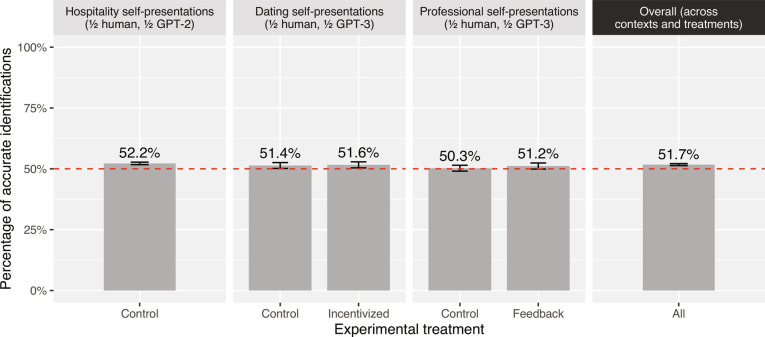
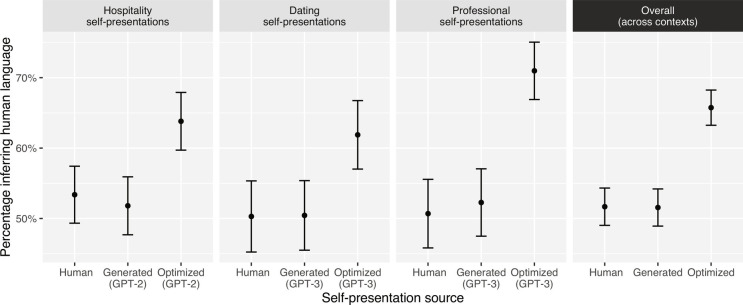
Human communication is increasingly intermixed with language generated by AI. Across chat, email, and social media, AI systems suggest words, complete sentences, or produce entire conversations. AI-generated language is often not identified as such but presented as language written by humans, raising concerns about novel forms of deception and manipulation. Here, we study how humans discern whether verbal self-presentations, one of the most personal and consequential forms of language, were generated by AI. In six experiments, participants (N = 4,600) were unable to detect self-presentations generated by state-of-the-art AI language models in professional, hospitality, and dating contexts. A computational analysis of language features shows that human judgments of AI-generated language are hindered by intuitive but flawed heuristics such as associating first-person pronouns, use of contractions, or family topics with human-written language. We experimentally demonstrate that these heuristics make human judgment of AI-generated language predictable and manipulable, allowing AI systems to produce text perceived as “more human than human.” We discuss solutions, such as AI accents, to reduce the deceptive potential of language generated by AI, limiting the subversion of human intuition.
Overview
The claims and statistics of this paper haven’t been checked yet.
Free: it reads the open-access text and checks the first 5 claims that cite a source we can check. Create a free account to check every claim.
Integrity signals
Registry
Cites
Statistics
Figures
Verification
Claims the paper makes
The claims and statistics of this paper haven’t been checked yet.
Free: it reads the open-access text and checks the first 5 claims that cite a source we can check. Create a free account to check every claim.
Claims other papers make about this one
Each is checked against this paper’s own text: does it say what the citing paper says it does?
The source backs part of the claim, not all of it — or backs it for a different population, condition or comparison.
In the citing paper
“Studies have shown that humans are largely ineffective at discerning AI created from human created content, and thus easily deceived (60).”
From The benefits and dangers of anthropomorphic conversational agents (2025) · cites this paper as [60]
Experimental — accuracy not yet measuredThe source backs part of the claim, not all of it — or backs it for a different population, condition or comparison.
In the citing paper
“Recent studies demonstrate that models like the GPT series are capable of producing news articles indistinguishable from human-generated ones (Kreps et al., 2022;Jakesch et al., 2023)”
From Anatomy of an AI-powered malicious social botnet (2024) · cites this paper as Jakesch et al., 2023
Experimental — accuracy not yet measuredThe source backs part of the claim, not all of it — or backs it for a different population, condition or comparison.
In the citing paper
“First, LLMs beat traditional text generation methods in producing human-like text (Jakesch et al., 2023;Guo et al., 2023;Clark et al., 2021).”
From Anatomy of an AI-powered malicious social botnet (2024) · cites this paper as Jakesch et al., 2023
Experimental — accuracy not yet measuredThe cited source says what the claim attributes to it.
In the citing paper
“We note that recent research has found that people could not reliably distinguish whether a piece of content is generated by people or the latest LLMs [33].”
From 'It was 80% me, 20% AI': Seeking Authenticity in Co-Writing with Large Language Models (2025) · cites this paper as [33]
The cited source says what the claim attributes to it.
In the citing paper
“it can also create realistic disinformation (e.g., fake news, propaganda) that is hard to detect by humans (Kreps et al. 2022; Jakesch et al. 2023)”
From Generative AI (2024) · cites this paper as Jakesch et al. 2023
6 more claims about this paper
Create a free account to see every claim other papers make about this one.
Self-check
Percentages, sums and reported differences re-computed from the paper’s own numbers.
The self-check needs the paper’s full text.
Citations
Cites
Vaswani, A., Shazeer, N., Parmar, N., Uszkoreit, J., Jones, L., Gomez, A. N., Kaiser, L., & Polosukhin, I. (2017) · arXiv · doi:10.48550/arxiv.1706.03762 · Cited by 120,404 · cited 1×
“We trained multiple customized versions of state-of-the-art AI language models (1, 2, 4) to generate self-presentations in three social contexts where trust in a self-presentation is important for decision-making: professional (e.g., job applications) (22), romantic (e.g., online dating) (12), and…”
MethodExploiting Generative AI to Scale up Intelligent Tutoring Systems
Jakubův, J., Chvalovský, K., Goertzel, Z., Kaliszyk, C., Olšák, M., Piotrowski, B., Schulz, S., Suda, M., & Urban, J. (2023) · DROPS (Schloss Dagstuhl – Leibniz Center for Informatics) · doi:10.4230/lipics.itp.2023.19 · Cited by 76,658
Language Models are Few-Shot Learners
Brown, T. B., Mann, B., Ryder, N., Subbiah, M., Kaplan, J., Dhariwal, P., Neelakantan, A., Shyam, P., Sastry, G., Askell, A., et al. (2020) · arXiv · doi:10.48550/arxiv.2005.14165 · Cited by 23,372 · cited 2×
“AI-generated language enables novel interactions that reduce human effort but can facilitate novel forms of plagiarism, manipulation, and deception (1, 3–8) when people mistake AI-generated language for language created by humans.”
BackgroundMethodKaugeranna, R., Kaugeranna, E., & Aion, (. S. 4. 6. (2023) · DROPS (Schloss Dagstuhl – Leibniz Center for Informatics) · doi:10.4230/lipics.giscience.2023.43 · Cited by 13,690
VADER: a parsimonious rule-based model for sentiment analysis of social media text
Hutto, C., & Gilbert, E. (2014) · Proceedings of the International AAAI Conference on Web and Social Media · doi:10.1609/icwsm.v8i1.14550 · Cited by 6,087 · cited 1×
“We computationally created a range of language features present in the self-presentations, including measurements for personality, sentiment, and perspective (28, 29).”
The Psychological Meaning of Words: LIWC and Computerized Text Analysis Methods
Tausczik, Y. R., & Pennebaker, J. W. (2010) · Journal of Language and Social Psychology · doi:10.1177/0261927x09351676 · Cited by 5,774 · cited 2×
“We developed an initial set of language features motivated by participants’ explanations of their judgments, to which we added various statistical metrics and commonly analyzed psychological language features such as LIWC (21).”
MethodProlific.ac—A subject pool for online experiments
Palan, S., & Schitter, C. (2018) · Journal of Behavioral and Experimental Finance · doi:10.1016/j.jbef.2017.12.004 · Cited by 3,450 · cited 2×
“Participants from Prolific had a median age of 37 y, 67% had a college degree, and 27% were at least somewhat familiar with computer programming.”
MethodThielke, S. M. (2004) · Psychiatric Services · doi:10.1176/appi.ps.55.9.1071 · Cited by 3,052
On the Opportunities and Risks of Foundation Models
Bommasani, R., Hudson, D. A., Adeli, E., Altman, R., Arora, S., von Arx, S., Bernstein, M. S., Bohg, J., Bosselut, A., Brunskill, E., et al. (2021) · arXiv · doi:10.48550/arxiv.2108.07258 · Cited by 2,676 · cited 1×
“We trained multiple customized versions of state-of-the-art AI language models (1, 2, 4) to generate self-presentations in three social contexts where trust in a self-presentation is important for decision-making: professional (e.g., job applications) (22), romantic (e.g., online dating) (12), and…”
MethodGPT-3: Its Nature, Scope, Limits, and Consequences
Floridi, L., & Chiriatti, M. (2020) · Minds and Machines · doi:10.1007/s11023-020-09548-1 · Cited by 2,519 · cited 1×
“In addition, human-like AI-generated self-presentations complicate questions about personhood and blur the line between human and machine intelligence (6, 15).”
Background
Research works printed but not linked: 4
- B. Buchanan, A. Lohn, M. Musser, K. Sedova, Truth, lies, and automation. Cent. Secur. Emerg. Technol. 1, 2 (2021).
- A. Radford, Language models are unsupervised multitask learners. OpenAI Blog 1, 9 (2019).
- A. Nelson, S. Friedler, F. Fields-Meyer, Blueprint for an AI bill of rights: A vision for protecting our civil rights in the algorithmic age. White House Office of Science and Technology Policy (2022). (18 October 2022).
- J. Williams, Should AI always identify itself? It’s more complicated than you might think. Electronic Frontier Foundation (2018). (18 October 2022).
Cited by
Items 501–600 of 610
Huang, Y., Chen, C., & Gong, Z. (2026) · International Journal of Information Management · doi:10.1016/j.ijinfomgt.2026.103113
AI helps until you say it does
Niu, X., Wang, Y., Cao, Q., & Li, J. (2026) · Scandinavian Journal of Economics · doi:10.1111/sjoe.70044
A moral Turing test: How belief and source shape detection of and agreement with LLM judgments
Garcia, B., Qian, C., & Palminteri, S. (2026) · PLoS ONE · doi:10.1371/journal.pone.0353391
““Humanized” LLMs have sometimes been judged as more human-like than actual human-generated responses [14].”
InfluentialKaushik, P. K., Sahoo, A. K., & Bisht, R. K. (2026) · Lecture notes in networks and systems · doi:10.1007/978-3-032-31526-7_6
Aksu, M., & Kuş, O. (2026) · Göç Araştırmaları Dergisi · doi:10.70972/gad.1908409
LLMs Can Amplify Emotion While Preserving Analytic Style in AI-mediated Communication
Mazzone, S. B., Harlan, J., Islam, K. M. S., Xu, L. Z., & Ow, T. T. (2026) · ACM Transactions on Social Computing · doi:10.1145/3839336
“…AI ( GenAI ), especially large language models ( LLMs ), are increasingly involved in how communication is initiated, managed, and consumed across everyday sectors such as journalism, healthcare, and social media, as well as high-stakes arenas including politics, law, and warfare [ 2 , 58 , 59 ].”
When Old Is Not Gold: The Interactive Effect of Brand Age and AI Disclosure on Ad-Clicking Interest
Zhang, H., Chung, M.-J., & Martirosyan, Y. (2026) · Journal of Interactive Advertising · doi:10.1080/15252019.2026.2707403
Flow-by-Flow:Content-Judgment Bypass for Governing AI Output in High-Loss DomainsPreprint
Naito, H. (2026) · arXiv · doi:10.48550/arxiv.2608.07474
PAUSE: A Privacy-preserving Self-reflection Tool for AI-associated Cognitive OffloadingPreprint
Alam, M. U. (2026) · SSRN Electronic Journal · doi:10.2139/ssrn.7270039
The reciprocity gap: How autonomous AI agent networks challenge platform ecosystem design
Pérez, C., & Sokolova, K. (2026) · Information Processing & Management · doi:10.1016/j.ipm.2026.105084
Fhitrah, K. M. E., Abdillah, M., Sugianto, A., Akbar, M. I., Kurniawan, N. A., & Pratama, F. F. (2026) · Jurnal Edukasi · doi:10.60132/edu.v4i3.802
di Padova, M., Guerriero, M. A., Ruberto, M., Moscatelli, F., Mancini, N., Monda, M., Messina, G., Polito, R., & Colecchia, F. P. (2026) · Communications in computer and information science · doi:10.1007/978-3-032-31853-4_12
Alluri, N., Gottumukkala, P. S. V., & Indukuri, H. (2026) · AI · doi:10.3390/ai7080319
ChatGPT Use and Abuse: A 3 Year Look at Undergraduate Perceptions and Usage in the Classroom
Ehrlich, A. C., Groves, C. L., Tacke, L. J., Flees, J., Rogers, M. P., & Hillberg, H. (2026) · Education Sciences · doi:10.3390/educsci16081341
“ChatGPT has demonstrated a capability to produce academic works that are often exceedingly difficult for educators to discern from human-generated works (Scarfe et al., 2024), even across varied contexts (Jakesch et al., 2023).”
The impact of generative AI on news believability: A mind perception perspective
Liu, Y., Zeng, J., Liu, S., & 卢, 晗. (2026) · Information & Management · doi:10.1016/j.im.2026.104418
Huang, L. (2026) · SSRN Electronic Journal · doi:10.2139/ssrn.7346483
BEYOND FAIRNESS METRICS: HUMAN EXPERIENCES AND DIFFERENTIAL OUTCOMES IN AI-MEDIATED WORK SETTINGS
Kadoma, K. (2026) · eCommons (Cornell University) · doi:10.7298/4h41-w092
He, M., Jiang, W., Shaheen, M., Xie, H., Sun, M., Rathore, R. S., & Gu, W. (2026) · Expert Systems · doi:10.1111/exsy.70403
Fute, A. Z., Amihere, A., & Kangwa, D. (2026) · Open Learning The Journal of Open Distance and e-Learning · doi:10.1080/02680513.2026.2722975
Mohebirad, A. H., Khalili, M., & Moradi, R. (2026) · SSRN Electronic Journal · doi:10.2139/ssrn.7360000
Sun, Y., & Wang, Y. (2026) · International Journal of Human-Computer Interaction · doi:10.1080/10447318.2026.2719117
Teaching What the Machine Told Us: Critical Agency and Epistemic Trust in the Algorithmic Classroom
Genç, L. G., & Uygun, E. (2026) · Advances in computational intelligence and robotics book series · doi:10.4018/979-8-2600-1232-1.ch014
AI and Machine Learning in Broadcast Media
Gupta, B. P., Gayratovich, E. N., Meylikulov, S., Akishova, S., Tursunova, S., Ashirova, A. I., & Lolakhon, K. (2026) · Advances in computational intelligence and robotics book series · doi:10.4018/979-8-3373-9260-8.ch001
Tran, T. P. D., & Nguyen, T. T. V. (2026) · International Conference on Education and Training Technologies (ICETT) · doi:10.1109/icett70124.2026.11666258
“AI systems have emergent and ostensibly autonomous behaviors that generate specific affective responses that include anthro-pomorphization, trust calibration challenges, and AI-specific anxiety distinct from general computer anxiety [15].”
Guo, S., Wang, K., Liu, X., & Feng, X. (2026) · Journal of Retailing and Consumer Services · doi:10.1016/j.jretconser.2026.105073
غانم, أ. (2026) · مجلة جامعة فلسطين التقنية للأبحاث · doi:10.53671/pturj.v14i02.805
S.Ajithkumar, V.Ramesh, Renukadevi, S., Deepan, S., Dhanasekar, S. D., & Kathir, S. S. (2026) · International Conference on Intelligent and Sustainable Electronics & Computing Technologies (INSECT) · doi:10.1109/insect68872.2026.11663863
Decision substitution and the reorganisation of judgement in AI-mediated society
Ibitoye, A., Ajenifuja, O. F., Kareem, R. S. A., Adeyemo, D. D., & Famutimi, R. F. (2026) · AI & Society · doi:10.1007/s00146-026-03349-3
Perry, A., & Cameron, C. D. (2026) · Cambridge University Press eBooks · doi:10.1017/9781009639057.002
Models Match or Surpass Objective Human Performance on Various Tasks
Goldstein, A., & Stanovsky, G. (2026) · Cambridge University Press eBooks · doi:10.1017/9781009639057.006
Jiang, Y., Dale, R., & Lu, H. (2026) · SSRN Electronic Journal · doi:10.2139/ssrn.7411385
Beyond "Made with AI": Visualizing Provenance Density to Mitigate the Transparency Penalty
Zhang, Q., Huang, Y., Lee, J., Starner, T., & Rekimoto, J. (2026) · IJCAI/ECAI · doi:10.24963/ijcai.2026/857
“However, AI-generated self-presentations can be difficult to distinguish from human-written ones [Jakesch et al. , 2023], and AI literacy does not reliably translate into consistent fact-checking behavior [Rheu and Cho, 2025].”
L'IA générative dans le parcours d'achat : opportunités et résistances des consommateurs
BENCHERRADA, C., & Mili, S. (2026) · African Scientific Journal · doi:10.5281/zenodo.22672252
The impact of GenAI on the future of requirements engineering
Breaux, T. D., & Singhal, A. (2026) · Requirements Engineering · doi:10.1007/s00766-026-00477-6
“Moreover, human evaluators applying an evaluation rubric to score factuality tend to employ a fluency heuristic by rating fluent text as higher quality regardless of factual content [33, 80].”
Koteczki, R., & Balassa, B. E. (2026) · Administrative Sciences · doi:10.3390/admsci16090436 · Cited by 1
“This is consistent with previous research showing that people often rely on imperfect heuristics when trying to identify AI-generated language (Jakesch et al., 2023), and that the ability to distinguish AI-generated from human-written texts may depend on individual differences, digital experience,…”
Rolwes, P. J., Valle, S., & Martín‐Raugh, M. P. (2026) · Personality and Individual Differences · doi:10.1016/j.paid.2026.114067
Copilot in the wings: When do employees reveal the use of AI?
Messer, U., & Leischnig, A. (2026) · Computers in Human Behavior Reports · doi:10.1016/j.chbr.2026.101315
Manhede, T., Fartachuk, Y., Martinez, S. A., Langer, A., & Chein, J. M. (2026) · AI & Society · doi:10.1007/s00146-026-03373-3
Zhu, S., & Yakub, N. A. B. (2026) · International journal of research and scientific innovation · doi:10.51244/ijrsi.2026.1308000169
PeerPen: AI-Assisted Writing for Online Mental Health Peer SupportPreprint
Kim, J., Gong, S., Ajit, M., Shimgekar, S. R., Yuan, Y., Yoo, D. W., Chandrasekharan, E., & Saha, K. (2026) · arXiv (Cornell University) · doi:10.48550/arxiv.2609.14886
“Perceived AI authorship shapes trust in a communicator [28, 32], even as people distinguish AI-generated from human-written language unreliably [33].”
Li, C. (2026) · International Journal of Mobile Human Computer Interaction · doi:10.4018/ijmhci.422111
an, L. B., Hoang, P. N., Nguyen, G., & Huynh, H. (2026) · Education + Training · doi:10.1108/et-06-2025-0427
Generative AI and a Sceptical Challenge to Digital Testimony
Church, I. M. (2026) · Analysis · doi:10.1093/analys/anag074
Preventing Model Collapse: A Fisher-Rao Perspective on the Dynamics of Training with Synthetic DataPreprint
Marchi, M., Silvestre, J. P., Gharesifard, B., & Paulo Tabuada, B. (2026) · arXiv (Cornell University)
Hossain, M. J., Jahan, U. N., & Shammo, S. S. (2026) · arXiv (Cornell University) · doi:10.48550/arxiv.2609.19151
Cao, Z., Lee, J., & Chen, Z. (2026) · Research Square · doi:10.21203/rs.3.rs-10223681/v1
Liu, L., & Hu, B. (2026) · Journal of Broadcasting & Electronic Media · doi:10.1080/08838151.2026.2735592
AI agents in human social decision-making: A framework from social inference to social action
Yin, Y., Yu, G., Pan, J., & Zhu, L. (2026) · Cognitive Science Research · doi:10.1016/j.csres.2026.09.001
La Nueva Taxonomía del Aprendizaje con Inteligencia Artificial
Guevara, D. P. S., Romo, M. S. S., Michuy, A. B. C., & Pereira, W. I. S. (2026) · doi:10.63415/saga.2026.132
"Is This Book AI-Generated?" How Authorship Suspicion Manifests in Marketplace ReviewsPreprint
Dibia, V. C. (2026) · arXiv (Cornell University) · doi:10.48550/arxiv.2609.33950
“Detectionaccuracysitsat 50–52%forAI-generatedself-presentations across six experiments with 4,600 participants [14], essentially coin-flip performance.”
CrisisFake: Benchmark Validity of AI-Generated Text Detection for Disaster Social SensingPreprint
Zhou, X., & Zhan, Z. (2026) · arXiv (Cornell University) · doi:10.48550/arxiv.2609.35821
“Human judgments of AI authorship are themselves unreliable, and post hoc detectors can be evaded through paraphrasing or manipulation [56,57].”
Saddhono, K., Stanislaus, S., Mahdi, U., Zahra, S. F., Idris, I. I. N., & Fahmi, R. (2026) · IGI Global eBooks · doi:10.4018/979-8-2600-1383-0.ch006
Presumption of generation: neural network paranoia and the crisis of trust in political content
Сергеевич, С. Н. (2026) · THE KAZAN SOCIALLY-HUMANITARIAN BULLETIN · doi:10.26907/2079-5912.2026.3.111-121
Estimating the Percentage Growth of AI Content Across Categories of the Web
Antonio, O., Kurniawan, K. M., Tjan, J., Qomariyah, N. N., & Bahana, R. (2026) · International Conference on ICT for Smart Society (ICISS) · doi:10.1109/iciss71466.2026.11715500
“Jakesch, Hancock, and Naaman, in their study Human Heuristics for AI-Generated Language Are Flawed [2], warned that humans are often unable to reliably distinguish AI-generated text from authentic writing.”
Orchestration and Agency in Multi-Agent Systems: Preserving Human Capability in Agentic Automation
Varone, A., Bolici, F., & Crowston, K. (2026) · Archivio Istituzionale della Ricerca - Università degli Studi di Cassino
Tekoälyn generoiman sisällön tunnistaminen käyttäjän näkökulmasta
Koskela, P. (2026) · Jyväskylä University Digital Archive (University of Jyväskylä)
Salam, A., Ubaidillah, A., & Saputri, H. (2026) · Journal of Educational Innovation and Transformation Global
How AI-Generated Language Shapes User Trust in Social Media? A Systematic Review
Riski, H., Pascawati, J., & Suaib, S. (2026) · ELS Journal on Interdisciplinary Studies in Humanities · doi:10.34050/845qtm76
“This finding is consistent with previous research showing that AI-generated language can closely resemble human communication, making the distinction between human-and AI-generated messages increasingly difficult for users (Jakesch et al., 2023).”
Technical–ethical–governance circuit–breaker framework for safe and sustainable AI governance
Yang, C.-C., Lai, Y.-T., Shia, B.-C., Selvamani, M. J. P., Lo, C.-Y., Chen, M. Y., & Liu, Y.-S. (2026) · Sustainable Futures · doi:10.1016/j.sftr.2026.102193
When the Commons Appropriates a Large Language Model: How WikiVault Reshaped Korean WikipediaPreprint
Song, I., Hwang, S., Yoo, T., & Ribeiro, M. H. (2026) · arXiv (Cornell University) · doi:10.48550/arxiv.2610.07660
“The appearance of fluency and coherence in the text further renders traditional signals of quality (structure, grammatical fluency, apparent sourcing) essentially moot [17, 41, 78].”
When Human Writing Looks Artificial: Perceived AI-Likeness as a Property of Text
Litvinova, T. A., & Dekhnich, O. V. (2026) · RESEARCH RESULT Theoretical and Applied Linguistics · doi:10.18413/2313-8912-2026-12-3-0-1
Haque, M. N. (2025) · Research journal in business and economics. · doi:10.61424/rjbe.v3i4.1082
“They sometimes make erroneous judgments and their evaluations can be influenced by expectations related to fluency, authorship, and communicative style (Jakesch et al., 2023).”
User Perceptions and Labor Market Outcomes of AI-Generated ResumesPreprint
White, E. (2026) · Research Square · doi:10.21203/rs.3.rs-11272368/v1
Shim, H., & Kim, E. (2026) · International Journal of Human-Computer Interaction · doi:10.1080/10447318.2026.2739761
Zaitsu, W., Jin, M., Ishihara, S., Tsuge, S., & Inaba, M. (2026) · Frontiers in Artificial Intelligence · doi:10.3389/frai.2026.1918939
Nguyen, H., Freeman, G., & Flathmann, C. (2026) · ACM Conference on Computer Supported Cooperative Work (CSCW) · doi:10.1145/3785651.3831517
Rizzuto, F., & Mattarella, A. M. R. (2026) · Nova Science Publishers (Nova Science Publishers, Inc.)
Two errors in attributing intelligence and a Bayesian Turing testPreprint
Gilestro, G. F. (2026) · PhilSci-Archive (University of Pittsburgh)
LLMs on the Political Compass: Prompt-Conditioned Positioning and Directional Drift
Salem, R. B., Romeo, A. V., & Aïmeur, E. (2026) · Proceedings of the AAAI/ACM Conference on AI Ethics and Society · doi:10.1609/aies.v9i1.43148
“This issue is becoming increasingly concerning as humans struggle to distinguish AI-generated language from human-written text (Jakesch, Hancock, and Naaman 2022; Jones and Bergen 2025).”
Creative Destruction: Human-AI Competition in an Experimental MarketPreprint
Conlon, J. J., & Schwardmann, P. (2026) · SSRN Electronic Journal · doi:10.2139/ssrn.7603138
Adıgüzel, D. Ü. (2026) · Özgür Yayınları eBooks · doi:10.58830/ozgur.pub1533
Suat, O. K. A. Y. (2026) · Özgür Yayınları eBooks · doi:10.58830/ozgur.pub1533.c6201
Söderlund, M., & Mårtensson, M. (2026) · Journal of Consumer Behaviour · doi:10.1002/cb.70268
Thammanyutanun, P., & Khongaiad, P. (2023) · The Journal of Pacific Institute of Management Science (Humanities and Social Science)
Rethinking Lasswell's 5W Model of Communication in the Era of Generative AI
Sapkota, A. (2026) · International Research Journal of MMC · doi:10.3126/irjmmc.v7i4.101334
“Surface features are unreliable indicators of authorship (Jakesch et al., 2023).”
Authorship Impersonation by Large Language Models: Mimicry, Textual Reuse, and Model-Specific StylePreprint
Gupta, H., & Ishihara, S. (2026) · SSRN Electronic Journal · doi:10.2139/ssrn.7624976
Yeh, J.-Y., Wu, K.-C., & Huang, Y.-X. (2026) · Journal of the Association for Information Systems
Public discourse on machine-generated Turkish: Standard language ideology and linguistic authority
Basbug, F. (2026) · Dil ve Edebiyat Araştırmaları/Journal of Language and Literature Studies · doi:10.30767/diledeara.2025244
ClockMark: Adaptive and Host-Dependent Watermarking for Large Language ModelsPreprint
Qiu, Y.-P., Fang, H., & Chang, E.-C. (2026) · arXiv (Cornell University) · doi:10.48550/arxiv.2610.27079
“Texts generated by large language models (LLMs) are increasingly difficult to distinguish from human-written content (Jakesch et al., 2023; Porter and Machery, 2024).”
Hojnik, N. (2026) · University of Maribor digital library (University of Maribor)
Expectations, Perceptions, and Performance in Human–LLM Interaction
Morabito, R. (2026) · Brock University Digital Repository (Brock University)
The Impact of AI-Driven Information Technology on Social Media Communication and Consumer Trust
Rahman, M. H., Afsar, T. B., & Alam, M. S. (2026) · doi:10.63125/2jq2bx46
Chitra, B., & Shanmugapriya, S. (2026) · Asian Journal of Management and Commerce · doi:10.22271/27084515.2026.v7.i10c.1530
Comparative evaluation of ChatGPT and google gemini in creative content generation
Gnanapriya, S., Anandan, K., & Sengaliappan, M. (2026) · E-Learning and Digital Media · doi:10.1177/20427530261498358
Towne, B. P. (2026) · Discover Artificial Intelligence · doi:10.1007/s44163-026-02604-2
“Jakesch et al. [11] showed that readers’ judgements of AI-generated self-presentations can be shaped by unreliable textual heuristics.”
Beyond pass or fail: an information-processing account of the Turing TestPreprint
Zhao, Q., Pansardi, O., Strachan, J. W. A., Scaliti, E., Manzi, G., Borghini, G., Manzi, F., Rufo, A., de Vignemont, F., Graziano, M. S. A., et al. (2026) · arXiv (Cornell University) · doi:10.48550/arxiv.2610.32868
“A second possibility is a failure of readout 8, 9, 10 : the relevant source information is present but not effectively extracted or used by the human interrogator 12 .”
The Impact of Personalized AI Response Suggestions on Content Creators' Direct MessagingPreprint
Kang, E. J., Chen, J., Geathers, J., & Fussell, S. R. (2026) · arXiv (Cornell University) · doi:10.48550/arxiv.2610.34770
“To achieve this, the underlying system may maintain a consistent persona while adapting its communication style, levels of disclosure, and relational framing to the affordances and economic logics of the platforms used by creators.”
You Never Can Tell: A Survey of Preferences on LLM-Generated Counterspeech in an Austrian Context
Pachinger, P., & Muti, A. (2026) · Workshop on Online Abuse and Harms (WOAH) · doi:10.18653/2026.woah-1.39
Ameh, S. S., Patience, N. O., Wogu, J. O., & Agahiu, A. M. (2026) · Howard Journal of Communications · doi:10.1080/10646175.2026.2756409
Beauty Is Human: When People Love AI-Generated Art, They Think a Human Made ItPreprint
Chen, Z., Zhu, D., & Zheng, L. N. (2026) · arXiv (Cornell University) · doi:10.48550/arxiv.2610.38113
“Jakesch et al. [6] showed that people judge AI-written self-presentations by intuitive but flawed heuristics, such as treating first-person pronouns or mentions of family as signs of a human writer, and that these heuristics make human judgment predictable enough to exploit.”
Beyond Deepfakes: Commercial AI Misinformation and Market Information Integrity
Xie, Q., Lim, W. M., Muralidharan, S., Phua, J., & Manrai, A. K. (2026) · Journal of Global Marketing · doi:10.1080/08911762.2026.2754678
Clear Human Web: Where a Person Vouches for Every ClientPreprint
Porcelli, L. (2026) · arXiv (Cornell University) · doi:10.48550/arxiv.2611.06286
GLOBA, A., & GASNAŞ, A. (2026) · PLURAL History Culture Society · doi:10.37710/plural.v14i1_6
Perceived Trust and Transparency in AI-Altered vs. Human-Written LinkedIn PostsPreprint
Joos, T. C., Bouleimen, A., Hannák, A., & Pagan, N. (2026) · arXiv (Cornell University) · doi:10.48550/arxiv.2611.06660
Presumption of guilt? AI chatbots and the role of affirmation vivas in assessing academic integrity
Armstrong, L., & Karyotis, G. (2026) · AI and Ethics · doi:10.1007/s43681-026-01505-5
AI companions, human concerns: a pragmatic perspective
Ekbia, H. R., Khan, S. O., AbuMusab, S., Chen, Y., Rheu, M., Rodwell, E. A., Schiff, D. S., Shackelford, S., & Yost, J. R. (2026) · AI and Ethics · doi:10.1007/s43681-026-01506-4
Beyond source: The effects of AI’s multiple roles in persuasion
Nyilasy, G. (2026) · Current Opinion in Psychology · doi:10.1016/j.copsyc.2026.102497
Metadata
- Authors
- Jakesch, M., Hancock, J. T., & Naaman, M.
- Affiliations
- Cornell University (US)
- Stanford University (US)
- Corresponding author
- Jakesch, Maurice
- Venue
- Proceedings of the National Academy of Sciences
- Publisher
- National Academy of Sciences
- Published
- 2023-03-07
- Volume
- 120
- Issue
- 11
- Pages
- e2208839120-e2208839120
- ISSN
- 0027-8424 (ISSN-L)
- 1091-6490
- PMC
- PMC10089155
- OpenAlex
- W4323347737
- Cited by
- 342
- References
- 46
- Citations by year
- 2026: 138 · 2025: 102 · 2024: 69 · 2023: 32
- FWCI
- 32.10
- Type
- journal article
- Language
- en
- Open access
- hybrid
- doi.org
- Licence
- Locations
- Proceedings of the National Academy of Sciences (publishedVersion, cc-by-nc-nd)
- PubMed Central (publishedVersion, cc-by-nc-nd)
- PubMed (publishedVersion)
- arXiv (Cornell University) (submittedVersion)
- arXiv (Cornell University)
- Funders
- National Science Foundation (1901151/1901329)
- Topics
- Physical Sciences › Computer Science › Artificial Intelligence › Authorship Attribution and Profiling
- Physical Sciences › Computer Science › Artificial Intelligence › Ethics and Social Impacts of AI
- Social Sciences › Sociology and Political Science › Misinformation and Its Impacts
- Keywords
- AI-generated text detection, heuristics, intuitive judgment, AI language models, manipulation, first-person pronouns, contractions, human-AI interaction
- MeSH terms
- Heuristics, Artificial Intelligence, Choline O-Acetyltransferase, Communication, Humans, Language
About these checks
Registry, retraction, Cites and statistics results are computed, not judged, with one exception: a printed reference that no index lists is read once by a model before it counts as a citation error. Claims are extracted by a model and kept only when their quote appears verbatim in the text; each cited source is then checked, with a model’s help, for whether it says what the claim relies on. Those verdicts can be wrong — read the claim’s quote and the cited source before relying on one.
Statistics and arithmetic are recomputed, not judged.
Confidence bands are shown only for fields calibrated on our annotated test set. None is calibrated yet, so no band is shown.
What counts as a claim ›How we measure confidence ›How we check this ›
Are you an author, or do you see a problem with this page? Request a review
Data sources
Bibliographic data: Semantic Scholar, OpenAlex, Crossref.
Contains information from the Semantic Scholar Academic Graph Datasets, made available under the ODC Attribution License (ODC-BY 1.0).
Semantic Scholar’s data is described in: Kinney, R., et al. (2023). The Semantic Scholar Open Data Platform. arXiv:2301.10140.
