

Human heuristics for AI-generated language are flawed
Open accessThe DOI matches its Crossref record; 55 of the 55 references it cites were found in a registry or an index.
Abstract
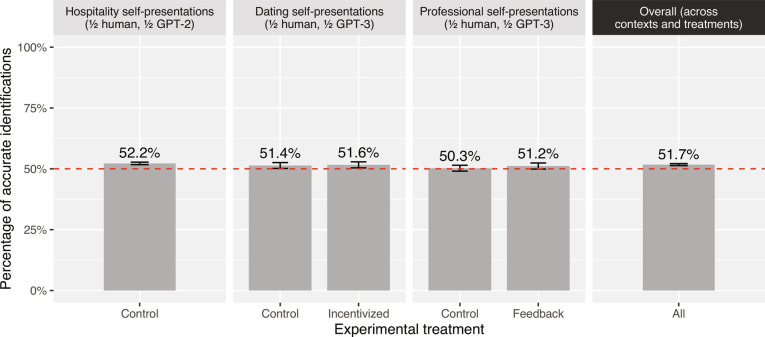
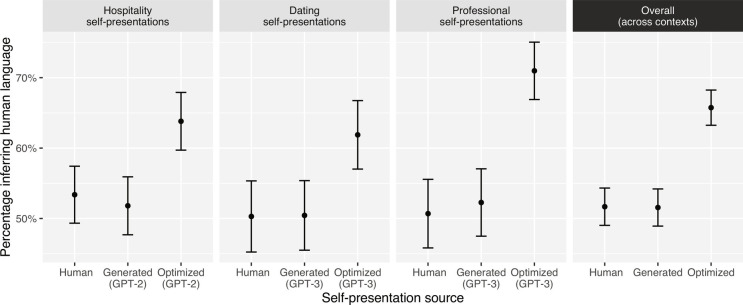
Human communication is increasingly intermixed with language generated by AI. Across chat, email, and social media, AI systems suggest words, complete sentences, or produce entire conversations. AI-generated language is often not identified as such but presented as language written by humans, raising concerns about novel forms of deception and manipulation. Here, we study how humans discern whether verbal self-presentations, one of the most personal and consequential forms of language, were generated by AI. In six experiments, participants (N = 4,600) were unable to detect self-presentations generated by state-of-the-art AI language models in professional, hospitality, and dating contexts. A computational analysis of language features shows that human judgments of AI-generated language are hindered by intuitive but flawed heuristics such as associating first-person pronouns, use of contractions, or family topics with human-written language. We experimentally demonstrate that these heuristics make human judgment of AI-generated language predictable and manipulable, allowing AI systems to produce text perceived as “more human than human.” We discuss solutions, such as AI accents, to reduce the deceptive potential of language generated by AI, limiting the subversion of human intuition.
Overview
The claims and statistics of this paper haven’t been checked yet.
Free: it reads the open-access text and checks the first 5 claims that cite a source we can check. Create a free account to check every claim.
Integrity signals
Registry
Cites
Statistics
Figures
Verification
Claims the paper makes
The claims and statistics of this paper haven’t been checked yet.
Free: it reads the open-access text and checks the first 5 claims that cite a source we can check. Create a free account to check every claim.
Claims other papers make about this one
Each is checked against this paper’s own text: does it say what the citing paper says it does?
The source backs part of the claim, not all of it — or backs it for a different population, condition or comparison.
In the citing paper
“Studies have shown that humans are largely ineffective at discerning AI created from human created content, and thus easily deceived (60).”
From The benefits and dangers of anthropomorphic conversational agents (2025) · cites this paper as [60]
Experimental — accuracy not yet measuredThe source backs part of the claim, not all of it — or backs it for a different population, condition or comparison.
In the citing paper
“Recent studies demonstrate that models like the GPT series are capable of producing news articles indistinguishable from human-generated ones (Kreps et al., 2022;Jakesch et al., 2023)”
From Anatomy of an AI-powered malicious social botnet (2024) · cites this paper as Jakesch et al., 2023
Experimental — accuracy not yet measuredThe source backs part of the claim, not all of it — or backs it for a different population, condition or comparison.
In the citing paper
“First, LLMs beat traditional text generation methods in producing human-like text (Jakesch et al., 2023;Guo et al., 2023;Clark et al., 2021).”
From Anatomy of an AI-powered malicious social botnet (2024) · cites this paper as Jakesch et al., 2023
Experimental — accuracy not yet measuredThe cited source says what the claim attributes to it.
In the citing paper
“We note that recent research has found that people could not reliably distinguish whether a piece of content is generated by people or the latest LLMs [33].”
From 'It was 80% me, 20% AI': Seeking Authenticity in Co-Writing with Large Language Models (2025) · cites this paper as [33]
The cited source says what the claim attributes to it.
In the citing paper
“it can also create realistic disinformation (e.g., fake news, propaganda) that is hard to detect by humans (Kreps et al. 2022; Jakesch et al. 2023)”
From Generative AI (2024) · cites this paper as Jakesch et al. 2023
6 more claims about this paper
Create a free account to see every claim other papers make about this one.
Self-check
Percentages, sums and reported differences re-computed from the paper’s own numbers.
The self-check needs the paper’s full text.
Citations
Cites
Vaswani, A., Shazeer, N., Parmar, N., Uszkoreit, J., Jones, L., Gomez, A. N., Kaiser, L., & Polosukhin, I. (2017) · arXiv · doi:10.48550/arxiv.1706.03762 · Cited by 120,404 · cited 1×
“We trained multiple customized versions of state-of-the-art AI language models (1, 2, 4) to generate self-presentations in three social contexts where trust in a self-presentation is important for decision-making: professional (e.g., job applications) (22), romantic (e.g., online dating) (12), and…”
MethodExploiting Generative AI to Scale up Intelligent Tutoring Systems
Jakubův, J., Chvalovský, K., Goertzel, Z., Kaliszyk, C., Olšák, M., Piotrowski, B., Schulz, S., Suda, M., & Urban, J. (2023) · DROPS (Schloss Dagstuhl – Leibniz Center for Informatics) · doi:10.4230/lipics.itp.2023.19 · Cited by 76,658
Language Models are Few-Shot Learners
Brown, T. B., Mann, B., Ryder, N., Subbiah, M., Kaplan, J., Dhariwal, P., Neelakantan, A., Shyam, P., Sastry, G., Askell, A., et al. (2020) · arXiv · doi:10.48550/arxiv.2005.14165 · Cited by 23,372 · cited 2×
“AI-generated language enables novel interactions that reduce human effort but can facilitate novel forms of plagiarism, manipulation, and deception (1, 3–8) when people mistake AI-generated language for language created by humans.”
BackgroundMethodKaugeranna, R., Kaugeranna, E., & Aion, (. S. 4. 6. (2023) · DROPS (Schloss Dagstuhl – Leibniz Center for Informatics) · doi:10.4230/lipics.giscience.2023.43 · Cited by 13,690
VADER: a parsimonious rule-based model for sentiment analysis of social media text
Hutto, C., & Gilbert, E. (2014) · Proceedings of the International AAAI Conference on Web and Social Media · doi:10.1609/icwsm.v8i1.14550 · Cited by 6,087 · cited 1×
“We computationally created a range of language features present in the self-presentations, including measurements for personality, sentiment, and perspective (28, 29).”
The Psychological Meaning of Words: LIWC and Computerized Text Analysis Methods
Tausczik, Y. R., & Pennebaker, J. W. (2010) · Journal of Language and Social Psychology · doi:10.1177/0261927x09351676 · Cited by 5,774 · cited 2×
“We developed an initial set of language features motivated by participants’ explanations of their judgments, to which we added various statistical metrics and commonly analyzed psychological language features such as LIWC (21).”
MethodProlific.ac—A subject pool for online experiments
Palan, S., & Schitter, C. (2018) · Journal of Behavioral and Experimental Finance · doi:10.1016/j.jbef.2017.12.004 · Cited by 3,450 · cited 2×
“Participants from Prolific had a median age of 37 y, 67% had a college degree, and 27% were at least somewhat familiar with computer programming.”
MethodThielke, S. M. (2004) · Psychiatric Services · doi:10.1176/appi.ps.55.9.1071 · Cited by 3,052
On the Opportunities and Risks of Foundation Models
Bommasani, R., Hudson, D. A., Adeli, E., Altman, R., Arora, S., von Arx, S., Bernstein, M. S., Bohg, J., Bosselut, A., Brunskill, E., et al. (2021) · arXiv · doi:10.48550/arxiv.2108.07258 · Cited by 2,676 · cited 1×
“We trained multiple customized versions of state-of-the-art AI language models (1, 2, 4) to generate self-presentations in three social contexts where trust in a self-presentation is important for decision-making: professional (e.g., job applications) (22), romantic (e.g., online dating) (12), and…”
MethodGPT-3: Its Nature, Scope, Limits, and Consequences
Floridi, L., & Chiriatti, M. (2020) · Minds and Machines · doi:10.1007/s11023-020-09548-1 · Cited by 2,519 · cited 1×
“In addition, human-like AI-generated self-presentations complicate questions about personhood and blur the line between human and machine intelligence (6, 15).”
Background
Research works printed but not linked: 4
- B. Buchanan, A. Lohn, M. Musser, K. Sedova, Truth, lies, and automation. Cent. Secur. Emerg. Technol. 1, 2 (2021).
- A. Radford, Language models are unsupervised multitask learners. OpenAI Blog 1, 9 (2019).
- A. Nelson, S. Friedler, F. Fields-Meyer, Blueprint for an AI bill of rights: A vision for protecting our civil rights in the algorithmic age. White House Office of Science and Technology Policy (2022). (18 October 2022).
- J. Williams, Should AI always identify itself? It’s more complicated than you might think. Electronic Frontier Foundation (2018). (18 October 2022).
Cited by
Items 401–500 of 610
IT-Sicherheit im arbeits- und organisationspsychologischen Spannungsfeld
Menges, U. (2025) · Dokumentenrepositorium der RUB (Ruhr University Bochum) · doi:10.13154/294-11990
The role of AI in complex problem-solving and implications for human-centric AI
Lee, A. (2024) · eCommons (Cornell University) · doi:10.7298/hb70-r792
The computational bridge: Interfacing theory and data in cognitive science
Kallens, P. C. (2023) · eCommons (Cornell University) · doi:10.7298/99q7-5006
Messingschlager, T. V. (2025) · Online Publication Service of Würzburg University (Würzburg University) · doi:10.25972/opus-40391
Huynh, L., Cyriax, N., George, J., Zoltick, S., & Yusaf, Z. (2025) · arXiv (Cornell University) · doi:10.48550/arxiv.2505.02879
“This replicates, inside a courtship genre, the flawed-heuristics finding of (44) and the quality-humanness inversion documented for poetry (63).”
The Impact of OpenAI on the Work Environment located in Finland
Laiho, J., & Varttila, K. (2023) · Theseus (Ammattikorkeakoulujen)
La Publicidad y su Influencia en la Intención de Compra
Vásquez Torres, R. M., Iñiguez Carchi, Y. S., Avila Rivas, V. A., & Aguilar-Gálvez, W. (2025) · Dialnet (Universidad de la Rioja)
Who shares misinformation in the post-truth world?Preprint
Chein, J. M., Martinez, S., & Bishop, O. (2025) · SSRN Electronic Journal · doi:10.2139/ssrn.5534564
Large language models in academic writing
Yeh, E. A., Levy, M., Hawkes, C. H., Lechner‐Scott, J., & Giovannoni, G. (2025) · Multiple Sclerosis and Related Disorders · doi:10.1016/j.msard.2025.106945
Thammastitkul, A. (2025) · Journal of Information Science · doi:10.1177/01655515251397636
Bring Wisdom into AI Education (Before it’s Too Late)
Williams‐Ceci, S., & Williams, W. M. (2026) · Roeper Review · doi:10.1080/02783193.2025.2593014
“(This type of AI application is realistic, since research has shown that LLMs can generate strikingly realistic text about people for online communities; Jakesch, Hancock, et al., 2023; Stokel-Walker & Van Noorden, 2023).”
Computer Mediated Creative Writing (CMCW): A Process-Oriented Framework for Human–AI CollaborationPreprint
Bugiolacchi, M. (2026) · SSRN Electronic Journal · doi:10.2139/ssrn.6052219
Dev, N., & Joy, S. (2026) · International Journal of Human-Computer Interaction · doi:10.1080/10447318.2026.2615218
“In some instances, the outputs of these AI systems are virtually indistinguishable from human-written texts, highlighting the extraordinary progress in natural language generation and its potential to redefine creative expression (Clark et al., 2021; Elgammal et al., 2017; Jakesch et al., 2023).”
Machine Learning-Based Detection of AI-Generated Text via Stylistic and Statistical Feature Modeling
Schäfer, K., & Steinebach, M. (2025) · IEEE International Conference on Trust, Security and Privacy in Computing and Communications (TrustCom) · doi:10.1109/trustcom66490.2025.00134
Computational Analysis for Philosophical Education: A Case Study in AI Ethics
Cline, A., Ball, B., Freeborn, D., Helliwell, A. C., & Loi-Heng, K. (2025) · Edukacja Filozoficzna · doi:10.14394/edufil.2025.0003
Can LLMs Shape Online Discourse? Evidence from a Viral AI Generated NarrativePreprint
Harvin, S. (2026) · SSRN Electronic Journal · doi:10.2139/ssrn.6173243
Putting critical online reasoning in perspective: contributions and challenges
Alexander, P. A. (2026) · Zeitschrift für Erziehungswissenschaft · doi:10.1007/s11618-026-01389-5
Fang, Y., & Zhou, T. (2026) · Information & Management · doi:10.1016/j.im.2026.104322
Ariel, N., & Riesenfeld, D. (2026) · Oxford University Press eBooks · doi:10.1093/9780197809563.003.0002
Stating the Obvious: An Introduction to Clichés
Ariel, N., & Riesenfeld, D. (2026) · Oxford University Press eBooks · doi:10.1093/9780197809563.003.0001
How We Learned to Stop Worrying and Start Exploring Clichés: A Dialogical Afterword
Ariel, N., & Riesenfeld, D. (2026) · Oxford University Press eBooks · doi:10.1093/9780197809563.003.0007
Ariel, N., & Riesenfeld, D. (2026) · Oxford University Press eBooks · doi:10.1093/9780197809563.003.0005
Clichés Between Convention and Event
Ariel, N., & Riesenfeld, D. (2026) · Oxford University Press eBooks · doi:10.1093/9780197809563.003.0004
Ariel, N., & Riesenfeld, D. (2026) · Oxford University Press eBooks · doi:10.1093/9780197809563.003.0003
Clichés and Artificial Intelligence
Ariel, N., & Riesenfeld, D. (2026) · Oxford University Press eBooks · doi:10.1093/9780197809563.003.0006
BEYOND DETECTION: A HUMAN-CENTERED APPROACH TO INTEGRITY IN THE AGE OF GENAI
Segreti, D., Tassis, A., & Jang, E. E. (2026) · International Multidisciplinary Research Journal · doi:10.47722/imrj.2001.67
Zhang, X., Li, H., & Bao, S. (2026) · Preprints.org · doi:10.20944/preprints202603.0898.v1
Zhang, X., Li, H., & Bao, S. (2026) · Research Square · doi:10.21203/rs.3.rs-9077074/v1 · Cited by 1
Grangeret, N. (2026) · EdArXiv (OSF Preprints) · doi:10.35542/osf.io/wuqa3_v1
Tekoälydisinformaatio ja tekoälylukutaito : yliopisto-opiskelijoiden huoli ja itsearvioidut kyvyt
Leppälampi, S. (2026) · LUTPub (LUT University)
Дисертація «Поетика Е. А. По: лінгвостилістичні особливості та наративна перспектива»
Марущак, Н. А. (2026) · Borys Grinchenko Kyiv University Institutional repository (Borys Grinchenko Kyiv University)
Camaioni, D. (2026) · AMS Degree Thesis (University of Bologna)
Yang, Y., Li, J., Liang, W., Peng, Y., Zou, Y., Yan, Z., Lyu, X., & Wang, Y. (2026) · International Journal of Human-Computer Interaction · doi:10.1080/10447318.2026.2647127
Guerouaou, N. (2024) · theses.fr (ABES) · doi:10.70675/87b35442z0b50z49c7z9534z71e7c0ef59f7
Breaking the Illusion of Identity in LLM ToolingPreprint
Miller, M. (2026) · arXiv (Cornell University) · doi:10.48550/arxiv.2604.07398
“First-person pronouns constitute sub-jectivity [1] and function as a heuristic for human-written text [16, 33, 34].”
Think Twice: Improving Privacy Awareness with Tailored LLM-Powered Interventions
Pias, S. B. H., Page, C. N., Chen, C., Amon, M. J., & Kapadia, A. C. (2026) · CHI Conference on Human Factors in Computing Systems · doi:10.1145/3772318.3791583 · Cited by 1
“However, the distinction in semantic richness and human-like qualities between text produced by large language models and human-generated text has been steadily diminishing in recent years [75].”
Amornbunchornvej, C. (n.d.) · PhilPapers (PhilPapers Foundation)
Watermarks Beyond English: Towards a Multilingual Evaluation of Watermarks in Large Language ModelsPreprint
Zhang, S., Chen, Y., Han, J., Cheng, B., & Jiang, H. (2026) · SSRN Electronic Journal · doi:10.2139/ssrn.6595775
Provoking Generative AI Futures: Merging Theory and Praxis
Luttrell, R. M., & Bowman, N. D. (2026) · Routledge eBooks · doi:10.4324/9781003487623
Most people do not realize when a personal message they receive was written by AI, study finds
Molnár, A. (2026) · The Conversation · doi:10.64628/aai.xt4jtmchj
Huang, L. (2026) · SSRN Electronic Journal · doi:10.2139/ssrn.6623780
How AI Writing Assistance Distorts Perceptions of AI Users and Their OpinionsPreprint
Röttger, P., Hackenburg, K., Kirk, H. R., & Summerfield, C. (2026) · arXiv (Cornell University) · doi:10.48550/arxiv.2604.22503
Yu, S., Ma, S., & Niu, M. (2026) · Research Square · doi:10.21203/rs.3.rs-9109799/v1
The Impact of AI-Generated Text on Language Accuracy and Usage among ESL Learners
Ijaz, S., Danish, S., Fiaz, T. J., Abbas, N., & Raza, A. (2026) · The Critical Review of Social Sciences Studies · doi:10.59075/x5sfjk33
Aziz, A. A., Nor, R. N. H., Jusoh, Y. Y., Rahman, W. N. W. A., Aziz, K. A., Tajuddin, N. I. I., & Muhammad, R. (2026) · International Journal of Advanced Computer Science and Applications · doi:10.14569/ijacsa.2026.0170407
“In addition, the completeness of information may be hampered when generative reactions do not have contextual richness or local detail in the multilingual or high-complexity contexts [15], [16].”
LLM Output Detectability and Task Performance Can be Jointly OptimizedPreprint
Saito, K., Koike, R., Kaneko, M., & Okazaki, N. (2026) · arXiv.org · doi:10.48550/arxiv.2605.01350
Adams, I. T., Barter, M., McLean, K. D., Geary, I. A., Fabila, A. R., & McCrain, J. (2026) · CrimRxiv · doi:10.21428/cb6ab371.ee18b482
Berkati, N. R. A. (2026) · Jurnal Manajemen Pendidikan · doi:10.33751/jmp.v14i1.88
“…bahwa perceived authenticity lebih kuat pada konten yang diciptakan manusia dibandingkan dengan konten yang berlabel AI-generated , yang konsisten dengan penelitian (Jakesch et al., 2023) serta (Kirkby et al., 2023) yang menunjukkan bahwa AI disclosure cenderung menurunkan persepsi autentisitas.”
The End of Trust: How Agentic AI Breaks Security AssumptionsPreprint
Zafar, O., Nemecek, A., & Ayday, E. (2026) · arXiv (Cornell University) · doi:10.48550/arxiv.2605.16436
“Generated content is now grammatically fluent and contextually appropriate [57], can be individually tailored, and is delivered through channels targets already trust.”
From Role to Person: Trust Calibration Challenges in Twin AgentsPreprint
Andersson, H., & Elmqvist, N. (2026) · arXiv (Cornell University) · doi:10.48550/arxiv.2605.19838
“Furthermore, recent work on AI-generated language demonstrates that people cannot reliably detect it, with well-calibrated systems producing text perceived as more natural than human-written output [7].”
ChatGPT Got the Job? Hospitality Recruiters Weigh in on AI Use in Job Applications
Stoinea, A., & Meehan, J. (2026) · Advances in computational intelligence and robotics book series · doi:10.4018/979-8-3373-5112-4.ch005
Socially fluent AI decouples conversational signals from source identity in online interactionPreprint
Yan, L., Jin, Y., Han, X., & Gašević, D. (2026) · arXiv (Cornell University) · doi:10.48550/arxiv.2605.23426
READER: Reasoning-Enhanced AI-Generated Text DetectionPreprint
Su, P., Ye, K., Gong, S.-J., Xu, E.-H., Zhu, J.-B., Livieri, G., & Shi, C.-C. (2026) · arXiv.org · doi:10.48550/arxiv.2605.25281 · Cited by 1
“Large language models (LLMs) increasingly produce fluent text that is often indistinguishable from human writing (e.g., Jakesch et al., 2023; Jones et al., 2025).”
Essays on Artificial Intelligence and Human Behavior in the Marketplace
Zhou, P. (2026) · UA Campus Repository (The University of Arizona)
Matei, A. (2026) · Науковий вісник Ужгородського університету Серія Математика і інформатика · doi:10.24144/2616-7700.2026.49(2).230-237
Stahl, H., Koch, G., & Kranz, J. J. (2026) · AIS Electronic Library (AISeL)
Romero, B. A. C., Romero, W. G. C., Montoya, L. C. M., & Romero, L. M. C. (2026) · ASCE MAGAZINE · doi:10.70577/asce.v5i2.868
A Testbed for Evaluating Human and Robot Power Dynamics in Small Group Decision-Making
Dorsey, C., Smith, M., Crouse, N., Bradley, B., Brown, L., Baeza, R. I., Liao, W.-H., Berrette, M., Dingwall, K., Holman, D., et al. (2026) · Systems and Information Engineering Design Symposium · doi:10.1109/sieds69358.2026.11540305
“Experiments on AI group influence show that when multiple AI agents act as a coordinated bloc, they generate normative pressure that shifts human judgments, increases conformity, and may even trigger resistance once the AI “group” becomes too large or too forceful [14].”
Luo, J. (2026) · Journalism Studies · doi:10.1080/1461670x.2026.2680639
“…of mimicking human writing, and is increasingly faster, more creative, and more sophisticated in tasks such as reasoning and information search (Jakesch, Hancock, and Naaman 2023), it remains an open question whether the traditionally held positive and negative machine heuristics still hold.”
Rządeczka, M., Wodziński, M. C., Zacharski, K., & Moskalewicz, M. (2026) · arXiv (Cornell University) · doi:10.48550/arxiv.2606.03377
“(Jakesch et al., 2023; Porter and Machery, 2024) demonstrated that people rely on flawed heuristics when judging AI-generated text, with AI systems capable of producing content perceived as “more human than human”.”
AI-associated linguistic shifts in Swedish university theses: a corpus-level analysis, 2020–2025
Hintze, A. (2026) · Social Sciences & Humanities Open · doi:10.2139/ssrn.6906371
Luo, J. (2025) · RiuNet (Universitat Politècnica de València)
Distinguishing Human and AI-Generated Text: A BiLSTM-Based Deep Learning Approach
Sumaya, S. T., Arnob, H. I., Ahmed, A., Sultana, A., & Rifat, A. A. S. (2026) · IEEE International Conference on Quantum Photonics, Artificial Intelligence & Networking (QPAIN) · doi:10.1109/qpain69676.2026.11546461
“According to Jakesch et al. [6], most people can notice machine-generated text by using shallow features, rather than structural features.”
Chairunnissa, C., Fahada, N., Hanim, S., & Sinuraya, I. U. (2026) · Journal Of Education And Teaching Learning (JETL) · doi:10.51178/jetl.v8i2.3441
“The collected data were analyzed using the interactive qualitative analysis model of (Huberman & Miles, 2002), which includes data reduction, data display, and conclusion drawing.”
Bai, W., Yao, Z., & Xu, W. (2026) · AIS Electronic Library (AISeL)
The phantom candidate: A framework for combating AI-enabled identity deception in remote hiring
Patel, P. C. (2026) · Human Resource Management Review · doi:10.1016/j.hrmr.2026.101165
When Errors Cut Both Ways :Error Directionality and Trust Collapse in AI-Assisted Review Detection
SU, C. (2026) · AIS Electronic Library (AISeL)
Guo, T., Mao, M., Wu, Q., & Zhou, Q. (2026) · AIS Electronic Library (AISeL)
"Are you an AI?" Analyzing Client Suspicion of AI Use in Crisis CounselingPreprint
Shah, S., Swaminathan, A., Simhadri, M., López, I., Phadke, S., Verma, D., John, A., Zhao, L., Cai, F., Zhang, S., et al. (2026) · arXiv (Cornell University) · doi:10.48550/arxiv.2606.18261
“4 Yet perceptions lag behind performance: even though blinded reviewers judge AI-assisted messages as more human and empathetic than purely human ones 4,5 , people rate messages less favorably when they suspect AI was involved, 3 whether or not their suspicions are correct.”
AI-Assisted Textual Communication and Crowdfunding PerformancePreprint
Fedorova, V., Андреевич, П. П., & Zavertiaeva, M. A. (2026) · Research Square · doi:10.21203/rs.3.rs-9939956/v1
Third-Person Perceptions of Generative AI Detection and DeceptionPreprint
Hardy, B. W., Santos, G., LaMarre, H. L., Chein, J. M., Tallapragada, M., & Hutler, B. (2026) · SSRN Electronic Journal · doi:10.2139/ssrn.6966676
Morari, V. (2026) · International Journal for Educational Integrity · doi:10.1007/s40979-026-00227-9
How Far Did They Go? The Persuasive Tactics of Covert LLM Agents in a Discontinued Field Experiment
Jaidka, K., & Ahmed, S. (2026) · Language Resources and Evaluation Conference (LREC) · doi:10.63317/477ns4y77c92
“These dynamics motivate RQ1: How does the model target or adopt social identities to establish epistemic authority and influence argumentative uptake?”
Shahin, A., Masry, B., Hamzeh, R., Aljabali, A., & Hussain, N. (2026) · SSRN Electronic Journal · doi:10.2139/ssrn.7023071
Discourse Realization of Generics in Human and LLM-generated Texts
Fomsgaard, S. K., Pastor, M., Dias, G. H., & Oostdijk, N. H. J. (2026) · Proceedings of the conference - Association for Computational Linguistics. Meeting · doi:10.18653/v1/2026.acl-long.1521
“Previous research (Jiang et al., 2023) has noted that machine-generated text is hard to detect in general (Jakesch et al., 2023), across domains (Li et al., 2024), in adversarial contexts (Krishna et al., 2023), and in social media-like interactions (Radivojevic et al., 2024), with humans often…”
Κουτσουπιάς, Ν., & Nosios, M. (2026) · The 1st International Online Conference on Administrative Sciences (IOCAS 2026) · doi:10.3390/proceedings2026140005
“More recent work extends these perspectives to AI-mediated communication, where intelligent systems assist in generating or modifying messages, shaping both content and perceived intent [19].”
Fair Marking in the Generative AI Era: Introducing the Master’s Dissertation Marking Framework
Ada, M. B. (2026) · AI in Education · doi:10.3390/aieduc2030023
“Jakesch et al. (2023) found that people often fail to recognise AI-generated text, relying on flawed cues, such as first-person pronouns, contractions, or familiar topics, to judge whether writing is human.”
A Scoping Review on Consumer's Perception on AI Generated Content
Gondopratikto, D., & Granita, W. (2026) · International Conference on Industrial Engineering and Operations Management (IEOM) · doi:10.46254/ap07.20260419
Stojković, V. (2026) · Journal of AI-Driven Communication Engineering · doi:10.31875/2979-1081.2026.02.08
“Conversational systems can adapt tone, simulate empathic acknowledgment, maintain apparent conversational continuity and produce outputs that users may experience as socially meaningful (Shum et al ., 2018; Shanahan et al ., 2023; Jakesch et al ., 2023).”
Stojković, V. (2026) · Journal of AI-Driven Communication Engineering · doi:10.31875/2979-1081.2026.02.09
“Studies of AI-assisted communication indicate that awareness of AI co-authorship can reduce perceived authenticity, especially in close relationships and emotionally significant exchanges (Hancock et al ., 2020; Jakesch et al ., 2023).”
Stojković, V. (2026) · Journal of AI-Driven Communication Engineering · doi:10.31875/2979-1081.2026.02.07
Sankarlingam, S. (2026) · Journal of High School Science · doi:10.64336/001c.164666
Yu, Q., Webb, J., Hunte, R., & Arachchilage, C. D. P. (2026) · Smart innovation, systems and technologies · doi:10.1007/978-3-032-18849-6_17
Zhang, Y., Li, Y., & Ren, X. (2026) · Lecture notes in computer science · doi:10.1007/978-3-032-29900-0_11
On the Security of the RDHEI by Binary Symmetric Channel and Polar Code
Wang, X., He, H., Chen, F., & Yang, Y. (2026) · Lecture notes of the Institute for Computer Sciences, Social Informatics and Telecommunications Engineering · doi:10.1007/978-3-032-22545-0_32
Morabito, R., McDonald, T., Viswanath, C., Hwang, A. H., Gaube, S., Kabbara, J., & Emami, A. (2026) · Conference on Empirical Methods in Natural Language Processing (EMNLP) · doi:10.18653/2026.emnlp-main.394
Hong, C.-H., Liu, Y.-Z., & Chen, C. (2026) · Computers in Human Behavior Artificial Humans · doi:10.1016/j.chbah.2026.100350
Behind the promise: Hidden paradoxes of AI in sales and actionable solutions for organizations
Bizzi, L. (2026) · Business Horizons · doi:10.1016/j.bushor.2026.07.004
Playful AI in Professional Email: A Field Experiment on Tone and Recipient EngagementPreprint
Ben‐Zion, Z., & Lazebnik, T. (2026) · arXiv (Cornell University) · doi:10.48550/arxiv.2607.11749
“We did not collect recipient-side data on whether an email was perceived as AI-edited; whether recipients who detect AI involvement respond differently is an open, increasingly consequential question 22 .”
Linguistic Resistance to AI Writing Tools: A Review and Conceptual FrameworkPreprint
Isaev, S. (2026) · Research Square · doi:10.21203/rs.3.rs-10348445/v1
Abel, M., & Johnson, R. (2026) · Computers in Human Behavior Reports · doi:10.1016/j.chbr.2026.101427
Kim, H., & Kim, J. (2026) · Journal of Data Forensics Research · doi:10.12972/jdfr.2026.3.1.6
Liang, J., Li, Y., & Zhileng, X. (2026) · Frontiers in Psychology · doi:10.3389/fpsyg.2026.1834334
Selected Evidence, Omitted Information, and Belief Updating in Large Language Model Decision SupportPreprint
Deng, Z., & Yan, J. (2026) · SSRN Electronic Journal · doi:10.2139/ssrn.7066638
Réponse, à propos de : « IA et revue de formation en neurologie »
Vercueil, L. (2026) · Pratique Neurologique - FMC · doi:10.1016/j.praneu.2026.07.003
Villacura-Herrera, C., Zaal, F. T. J. M., & Cox, R. F. A. (2026) · Computers in Human Behavior Reports · doi:10.1016/j.chbr.2026.101221
When AI Talks Back: Behavioral Consequences of AI-Generated Social Interaction on PlatformsPreprint
Li, B., & Lin, Z. (2026) · SSRN Electronic Journal · doi:10.2139/ssrn.7041298
Too Simple or Too Complex? Using Linguistic Signatures for AI-Generated Text Detection
Schäfer, K., & Bassenge, M. (2026) · Lecture notes in computer science · doi:10.1007/978-3-032-31404-8_33
Metadata
- Authors
- Jakesch, M., Hancock, J. T., & Naaman, M.
- Affiliations
- Cornell University (US)
- Stanford University (US)
- Corresponding author
- Jakesch, Maurice
- Venue
- Proceedings of the National Academy of Sciences
- Publisher
- National Academy of Sciences
- Published
- 2023-03-07
- Volume
- 120
- Issue
- 11
- Pages
- e2208839120-e2208839120
- ISSN
- 0027-8424 (ISSN-L)
- 1091-6490
- PMC
- PMC10089155
- OpenAlex
- W4323347737
- Cited by
- 342
- References
- 46
- Citations by year
- 2026: 138 · 2025: 102 · 2024: 69 · 2023: 32
- FWCI
- 32.10
- Type
- journal article
- Language
- en
- Open access
- hybrid
- doi.org
- Licence
- Locations
- Proceedings of the National Academy of Sciences (publishedVersion, cc-by-nc-nd)
- PubMed Central (publishedVersion, cc-by-nc-nd)
- PubMed (publishedVersion)
- arXiv (Cornell University) (submittedVersion)
- arXiv (Cornell University)
- Funders
- National Science Foundation (1901151/1901329)
- Topics
- Physical Sciences › Computer Science › Artificial Intelligence › Authorship Attribution and Profiling
- Physical Sciences › Computer Science › Artificial Intelligence › Ethics and Social Impacts of AI
- Social Sciences › Sociology and Political Science › Misinformation and Its Impacts
- Keywords
- AI-generated text detection, heuristics, intuitive judgment, AI language models, manipulation, first-person pronouns, contractions, human-AI interaction
- MeSH terms
- Heuristics, Artificial Intelligence, Choline O-Acetyltransferase, Communication, Humans, Language
About these checks
Registry, retraction, Cites and statistics results are computed, not judged, with one exception: a printed reference that no index lists is read once by a model before it counts as a citation error. Claims are extracted by a model and kept only when their quote appears verbatim in the text; each cited source is then checked, with a model’s help, for whether it says what the claim relies on. Those verdicts can be wrong — read the claim’s quote and the cited source before relying on one.
Statistics and arithmetic are recomputed, not judged.
Confidence bands are shown only for fields calibrated on our annotated test set. None is calibrated yet, so no band is shown.
What counts as a claim ›How we measure confidence ›How we check this ›
Are you an author, or do you see a problem with this page? Request a review
Data sources
Bibliographic data: Semantic Scholar, OpenAlex, Crossref.
Contains information from the Semantic Scholar Academic Graph Datasets, made available under the ODC Attribution License (ODC-BY 1.0).
Semantic Scholar’s data is described in: Kinney, R., et al. (2023). The Semantic Scholar Open Data Platform. arXiv:2301.10140.
