

Human heuristics for AI-generated language are flawed
Open accessThe DOI matches its Crossref record; 55 of the 55 references it cites were found in a registry or an index.
Abstract
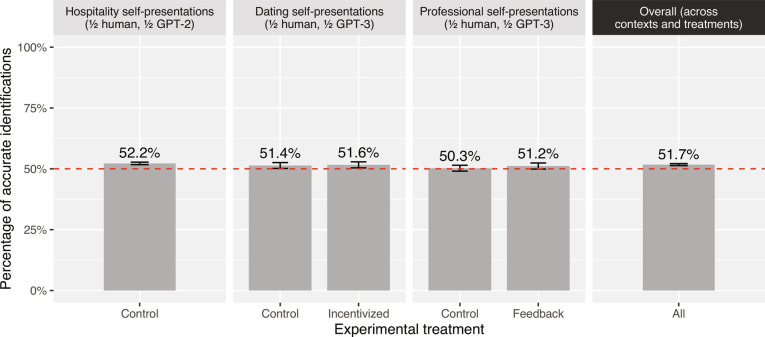
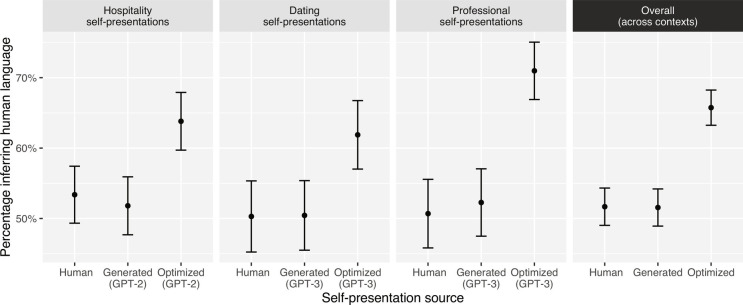
Human communication is increasingly intermixed with language generated by AI. Across chat, email, and social media, AI systems suggest words, complete sentences, or produce entire conversations. AI-generated language is often not identified as such but presented as language written by humans, raising concerns about novel forms of deception and manipulation. Here, we study how humans discern whether verbal self-presentations, one of the most personal and consequential forms of language, were generated by AI. In six experiments, participants (N = 4,600) were unable to detect self-presentations generated by state-of-the-art AI language models in professional, hospitality, and dating contexts. A computational analysis of language features shows that human judgments of AI-generated language are hindered by intuitive but flawed heuristics such as associating first-person pronouns, use of contractions, or family topics with human-written language. We experimentally demonstrate that these heuristics make human judgment of AI-generated language predictable and manipulable, allowing AI systems to produce text perceived as “more human than human.” We discuss solutions, such as AI accents, to reduce the deceptive potential of language generated by AI, limiting the subversion of human intuition.
Overview
The claims and statistics of this paper haven’t been checked yet.
Free: it reads the open-access text and checks the first 5 claims that cite a source we can check. Create a free account to check every claim.
Integrity signals
Registry
Cites
Statistics
Figures
Verification
Claims the paper makes
The claims and statistics of this paper haven’t been checked yet.
Free: it reads the open-access text and checks the first 5 claims that cite a source we can check. Create a free account to check every claim.
Claims other papers make about this one
Each is checked against this paper’s own text: does it say what the citing paper says it does?
The source backs part of the claim, not all of it — or backs it for a different population, condition or comparison.
In the citing paper
“Studies have shown that humans are largely ineffective at discerning AI created from human created content, and thus easily deceived (60).”
From The benefits and dangers of anthropomorphic conversational agents (2025) · cites this paper as [60]
Experimental — accuracy not yet measuredThe source backs part of the claim, not all of it — or backs it for a different population, condition or comparison.
In the citing paper
“Recent studies demonstrate that models like the GPT series are capable of producing news articles indistinguishable from human-generated ones (Kreps et al., 2022;Jakesch et al., 2023)”
From Anatomy of an AI-powered malicious social botnet (2024) · cites this paper as Jakesch et al., 2023
Experimental — accuracy not yet measuredThe source backs part of the claim, not all of it — or backs it for a different population, condition or comparison.
In the citing paper
“First, LLMs beat traditional text generation methods in producing human-like text (Jakesch et al., 2023;Guo et al., 2023;Clark et al., 2021).”
From Anatomy of an AI-powered malicious social botnet (2024) · cites this paper as Jakesch et al., 2023
Experimental — accuracy not yet measuredThe cited source says what the claim attributes to it.
In the citing paper
“We note that recent research has found that people could not reliably distinguish whether a piece of content is generated by people or the latest LLMs [33].”
From 'It was 80% me, 20% AI': Seeking Authenticity in Co-Writing with Large Language Models (2025) · cites this paper as [33]
The cited source says what the claim attributes to it.
In the citing paper
“it can also create realistic disinformation (e.g., fake news, propaganda) that is hard to detect by humans (Kreps et al. 2022; Jakesch et al. 2023)”
From Generative AI (2024) · cites this paper as Jakesch et al. 2023
6 more claims about this paper
Create a free account to see every claim other papers make about this one.
Self-check
Percentages, sums and reported differences re-computed from the paper’s own numbers.
The self-check needs the paper’s full text.
Citations
Cites
Vaswani, A., Shazeer, N., Parmar, N., Uszkoreit, J., Jones, L., Gomez, A. N., Kaiser, L., & Polosukhin, I. (2017) · arXiv · doi:10.48550/arxiv.1706.03762 · Cited by 120,404 · cited 1×
“We trained multiple customized versions of state-of-the-art AI language models (1, 2, 4) to generate self-presentations in three social contexts where trust in a self-presentation is important for decision-making: professional (e.g., job applications) (22), romantic (e.g., online dating) (12), and…”
MethodExploiting Generative AI to Scale up Intelligent Tutoring Systems
Jakubův, J., Chvalovský, K., Goertzel, Z., Kaliszyk, C., Olšák, M., Piotrowski, B., Schulz, S., Suda, M., & Urban, J. (2023) · DROPS (Schloss Dagstuhl – Leibniz Center for Informatics) · doi:10.4230/lipics.itp.2023.19 · Cited by 76,658
Language Models are Few-Shot Learners
Brown, T. B., Mann, B., Ryder, N., Subbiah, M., Kaplan, J., Dhariwal, P., Neelakantan, A., Shyam, P., Sastry, G., Askell, A., et al. (2020) · arXiv · doi:10.48550/arxiv.2005.14165 · Cited by 23,372 · cited 2×
“AI-generated language enables novel interactions that reduce human effort but can facilitate novel forms of plagiarism, manipulation, and deception (1, 3–8) when people mistake AI-generated language for language created by humans.”
BackgroundMethodKaugeranna, R., Kaugeranna, E., & Aion, (. S. 4. 6. (2023) · DROPS (Schloss Dagstuhl – Leibniz Center for Informatics) · doi:10.4230/lipics.giscience.2023.43 · Cited by 13,690
VADER: a parsimonious rule-based model for sentiment analysis of social media text
Hutto, C., & Gilbert, E. (2014) · Proceedings of the International AAAI Conference on Web and Social Media · doi:10.1609/icwsm.v8i1.14550 · Cited by 6,087 · cited 1×
“We computationally created a range of language features present in the self-presentations, including measurements for personality, sentiment, and perspective (28, 29).”
The Psychological Meaning of Words: LIWC and Computerized Text Analysis Methods
Tausczik, Y. R., & Pennebaker, J. W. (2010) · Journal of Language and Social Psychology · doi:10.1177/0261927x09351676 · Cited by 5,774 · cited 2×
“We developed an initial set of language features motivated by participants’ explanations of their judgments, to which we added various statistical metrics and commonly analyzed psychological language features such as LIWC (21).”
MethodProlific.ac—A subject pool for online experiments
Palan, S., & Schitter, C. (2018) · Journal of Behavioral and Experimental Finance · doi:10.1016/j.jbef.2017.12.004 · Cited by 3,450 · cited 2×
“Participants from Prolific had a median age of 37 y, 67% had a college degree, and 27% were at least somewhat familiar with computer programming.”
MethodThielke, S. M. (2004) · Psychiatric Services · doi:10.1176/appi.ps.55.9.1071 · Cited by 3,052
On the Opportunities and Risks of Foundation Models
Bommasani, R., Hudson, D. A., Adeli, E., Altman, R., Arora, S., von Arx, S., Bernstein, M. S., Bohg, J., Bosselut, A., Brunskill, E., et al. (2021) · arXiv · doi:10.48550/arxiv.2108.07258 · Cited by 2,676 · cited 1×
“We trained multiple customized versions of state-of-the-art AI language models (1, 2, 4) to generate self-presentations in three social contexts where trust in a self-presentation is important for decision-making: professional (e.g., job applications) (22), romantic (e.g., online dating) (12), and…”
MethodGPT-3: Its Nature, Scope, Limits, and Consequences
Floridi, L., & Chiriatti, M. (2020) · Minds and Machines · doi:10.1007/s11023-020-09548-1 · Cited by 2,519 · cited 1×
“In addition, human-like AI-generated self-presentations complicate questions about personhood and blur the line between human and machine intelligence (6, 15).”
Background
Research works printed but not linked: 4
- B. Buchanan, A. Lohn, M. Musser, K. Sedova, Truth, lies, and automation. Cent. Secur. Emerg. Technol. 1, 2 (2021).
- A. Radford, Language models are unsupervised multitask learners. OpenAI Blog 1, 9 (2019).
- A. Nelson, S. Friedler, F. Fields-Meyer, Blueprint for an AI bill of rights: A vision for protecting our civil rights in the algorithmic age. White House Office of Science and Technology Policy (2022). (18 October 2022).
- J. Williams, Should AI always identify itself? It’s more complicated than you might think. Electronic Frontier Foundation (2018). (18 October 2022).
Cited by
Items 101–200 of 610
Generative AI framework for sensory and consumer research
Motoki, K., Low, J. Y. Q., & Velasco, C. (2025) · Food Quality and Preference · doi:10.1016/j.foodqual.2025.105600 · Cited by 32
AI Writing Assistants Influence Topic Choice in Self-Presentation
Poddar, R., Sinha, R., Naaman, M., & Jakesch, M. (2023) · Extended Abstracts of the 2023 CHI Conference on Human Factors in Computing Systems · doi:10.1145/3544549.3585893 · Cited by 30
“With the recent generation of large transformerbased generative language models like GPT-3 [8], coherent humanlike language can be generated automatically at scale [24].”
BackgroundSelf-citationZiegelmayer, S., Marka, A. W., Lenhart, N. S., Nehls, N., Reischl, S., Harder, F., Sauter, A. P., Makowski, M., Graf, M. M., & Gawlitza, J. F. (2023) · Journal of Medical Internet Research · doi:10.2196/50865 · Cited by 30
“Evaluation metrics can only be as good as the human assessment, which is not free of bias and characterized by false heuristics [14].”
Contra generative AI detection in higher education assessmentsPreprint
Ardito, C. G. (2023) · arXiv · doi:10.48550/arxiv.2312.05241 · Cited by 33
“However, in the absence of unambiguous signs, studies show that humans are overconfident in their ability to detect AI-generated content [7], [28], [26] both in general and in specialised contexts [18].”
BackgroundNañola, E. L., Arroyo, R. L., Hermosura, N. J. T., Ragil, M., Sabanal, J. N. U., & Mendoza, H. (2025) · System · doi:10.1016/j.system.2025.103611 · Cited by 30
Calle, P., Shao, R., Liu, Y., Hébert, E. T., Kendzor, D. E., Neil, J. M., Businelle, M. S., & Pan, C. (2024) · CHI Conference on Human Factors in Computing Systems · doi:10.1145/3613904.3641965 · Cited by 28
Exploring Durham University Physics exams with Large Language ModelsPreprint
Yeadon, W., & Halliday, D. P. (2023) · arXiv (Cornell University) · doi:10.48550/arxiv.2306.15609 · Cited by 28
“While it has been established that humans struggle to reliably detect AI-generated text [18, 19, 20], certain detection technologies claim to counter this issue.”
BackgroundAI Could Have Written This: Birth of a Classist Slur in Knowledge Work
Sarkar, A. (2025) · CHI Conference Extended Abstracts on Human Factors in Computing Systems (CHI EA) · doi:10.1145/3706599.3716239 · Cited by 28
“…be prejudice because, in fact, humans are pretty poor at detecting AI-generated content, because we deploy flawed heuristics in attempting to do so [31], because we may in some cases even prefer AI-generated to human-generated content, and because we hypocritically reverse our judgement of an…”
Lima, G., Grgić-Hlača, N., & Redmiles, E. M. (2025) · CHI Conference on Human Factors in Computing Systems · doi:10.1145/3706598.3713338 · Cited by 27
Deciphering Deception: How Different Rhetoric of AI Language Impacts Users’ Sense of Truth in LLMs
Yoo, D., Kang, H., & Oh, C. (2024) · International Journal of Human-Computer Interaction · doi:10.1080/10447318.2024.2316370 · Cited by 28
“While humans can typically distinguish between human and AI texts with repeated exposure (Guo et al., 2023), certain topics such as first-person narratives about family and humanity blur this discernment, pointing to avenues for AI-led deception (Jakesch et al., 2023).”
The risks of risk-based AI regulation: taking liability seriouslyPreprint
Kretschmer, M., Kretschmer, T., Peukert, A., & Peukert, C. (2023) · SSRN Electronic Journal · doi:10.2139/ssrn.4622405 · Cited by 27
What makes children perceive or not perceive minds in generative AI?
Xu, Y., Thomas, T., Yu, C., & Pan, Z. (2025) · Computers in Human Behavior Artificial Humans · doi:10.1016/j.chbah.2025.100135 · Cited by 27
Raza, S., Shaban-Nejad, A., Dolatabadi, E., & Mamiya, H. (2024) · IEEE Access · doi:10.1109/access.2024.3509353 · Cited by 25
“Language and communication biases further demonstrate the difficulty in creating ML models that accurately understand and process language nuances and dialects [31], [42].”
The AI Memory Gap: Users Misremember What They Created With AI or Without
Zindulka, T., Goller, S., Fernandes, D., Welsch, R., & Buschek, D. (2026) · CHI Conference on Human Factors in Computing Systems · doi:10.1145/3772318.3791494 · Cited by 25
“In summary, using AI reduced people’s ability to remember sources and outcomes of the creative work.”
Palmer, A., & Spirling, A. (2023) · Political Science · doi:10.1080/00323187.2024.2335471 · Cited by 23
“First, there are ethical concerns with (re)training and instructing LLMs to psychologically manipulate humans, not least because humans may not be able to detect machine-generated language (Jakesch, Hancock, and Naaman 2023).”
BackgroundAI-disclosure and brand modernity: the role of “AI=novelty” lay belief
Xia, Q., He, X., & Gong, S. (2025) · Journal of Product & Brand Management · doi:10.1108/jpbm-11-2024-5575 · Cited by 26
When cutting edge meets silver tongue: Understanding the word-of-machine effect on travel decisions
Sun, D., Wong, I. A., Xiong, X., & Li, S. (2025) · Tourism Management · doi:10.1016/j.tourman.2025.105271 · Cited by 23
Jia, C., Riedl, M. J., & Woolley, S. (2023) · Journalism Studies · doi:10.1080/1461670x.2023.2289881 · Cited by 24
On the advantages of using AI-generated images of filler faces for creating fair lineups
Bell, R., Menne, N. M., Mayer, C., & Buchner, A. (2024) · Scientific Reports · doi:10.1038/s41598-024-63004-z · Cited by 24
“1.”
LLM-Aided Social Media Influence Operations
Meier, R. (2024) · Springer eBooks · doi:10.1007/978-3-031-54827-7_11 · Cited by 23
Meng, W., Harvey, J., Goulding, J., Carter, C. J., Lukinova, E., Smith, A., Frobisher, P., Forrest, M., & Nica‐Avram, G. (2025) · arXiv (Cornell University) · doi:10.48550/arxiv.2506.13313 · Cited by 23
“Jakesch et al. (2023) describe these cues as intuitive yet flawed heuristics, demonstrating that they make human judgment of AI-generated language predictable and manipulable, allowing AI systems to produce text perceived as ‘more human than human’.”
Atcheson, A., Khan, O., Siemann, B., Jain, A., & Karahalios, K. (2025) · Proceedings of the 2025 CHI Conference on Human Factors in Computing Systems · doi:10.1145/3706598.3714121 · Cited by 38
Ask Me Anything: Exploring Children’s Attitudes Toward an Age-tailored AI-powered Chatbot
Movahed, S. V., & Martin, F. (2025) · International Journal of Artificial Intelligence in Education · doi:10.1007/s40593-025-00523-4 · Cited by 24
“This construct is especially important when AI technologies, such as chatbots, are embedded in educational settings (Nelson et al., 2025) and everyday life (Jakesch et al., 2023).”
A new era for stress research: supporting user performance and experience in the digital age
Matthews, G., Cumings, R., Santos, E. P. D. L., Feng, I. Y., & Mouloua, S. A. (2024) · Ergonomics · doi:10.1080/00140139.2024.2425953 · Cited by 22
“…that users are only correctly identifying llM and ai-generated texts at or below chance values (Butavicius, taib, and han 2022; clark et al. 2021; Jakesch, hancock, and Naaman 2023; Partadiredja, serrano, and ljubenkov 2020). the intrinsic task difficulty is likely to raise workload,…”
AI in Disguise - How AI-Generated Ads' Visual Cues Shape Consumer Perception and PerformancePreprint
Exner, Y., Hartmann, J., Netzer, O., & Zhang, S. (2025) · SSRN Electronic Journal · doi:10.2139/ssrn.5096969 · Cited by 25
Sahebi, S., Formosa, P., & Bankins, S. (2026) · Computers in Human Behavior Artificial Humans · doi:10.1016/j.chbah.2026.100304 · Cited by 26
MetaSumPerceiver: Multimodal Multi-Document Evidence Summarization for Fact-Checking
Chen, T.-C., Tang, C.-W., & Thomas, C. (2024) · Proceedings of the conference - Association for Computational Linguistics. Meeting · doi:10.18653/v1/2024.acl-long.474 · Cited by 21
The Two Paradigms of LLM Detection: Authorship Attribution vs. Authorship Verification
Bevendorff, J., Wiegmann, M., Richter, E., Potthast, M., & Stein, B. (2025) · Findings of the Association for Computational Linguistics: ACL (Findings of ACL) · doi:10.18653/v1/2025.findings-acl.194 · Cited by 22
“As LLMs advanced, the basic heuristics applied by humans became inaccurate (Ippolito et al., 2020; Clark et al., 2021; Jakesch et al., 2023) so that LLM text can even be perceived more human-like than human text (Rathi et al., 2025).”
The Impact of AI-Generated Text on the InternetPreprint
Dolezal, J., Alam, S., Graham, M., & Boháček, M. (2026) · arXiv · doi:10.48550/arxiv.2604.26965 · Cited by 22
“As AI-generated text becomes ubiquitous and indistin-5 guishable from human writing (Chein et al., 2024; Jakesch et al., 2023; Porter and Machery, 2024), users may discount the credibility of all online information (operating on the principle of “reality apathy” or, when used maliciously, the…”
Wang, W., & Gong, H. (2025) · International Journal of Human-Computer Interaction · doi:10.1080/10447318.2024.2443247 · Cited by 20
“Existing studies on AIGC primarily focus on algorithmic dimensions, such as the potential of Large Language Models to amplify misin-formation (Jakesch et al., 2023; Weidinger et al., 2021), without delving into how individuals engage with and respond to AIGC during the spread of information on…”
Artificial Truth: Algorithmic Power, Epistemic Authority, and the Crisis of Democratic Knowledge
Palese, R. (2026) · Societies · doi:10.3390/soc16030102 · Cited by 22
Ferguson, S. A., Aoyagui, P. A., Rizvi, R., Kim, Y., & Kuzminykh, A. (2024) · Proceedings of the ACM on Human-Computer Interaction · doi:10.1145/3687056 · Cited by 21
Assessing AI-Generated vs. Human-Authored Spear Phishing SMS Attacks: An Empirical Study
Francia, J., Hansen, D. L., Schooley, B. L., Taylor, M., Murray, S., Cornelius, R., & Snow, G. L. (2026) · Journal of Cybersecurity and Privacy · doi:10.3390/jcp6040129 · Cited by 20
“This aligns with prior work showing that people often struggle to distinguish AI-generated from human-authored language [45,46].”
Contextualized counterspeech generated by Generative AI may backfirePreprint
Bär, D., Maarouf, A., & Feuerriegel, S. (2024) · arXiv (Cornell University) · doi:10.48550/arxiv.2411.14986 · Cited by 20
Markowitz, D. M. (2024) · Behavior Research Methods · doi:10.3758/s13428-024-02344-0 · Cited by 19
Algorithmic ethics in AI-enabled workplace systems for food delivery employees
Zhao, H., Yuan, B., Wen, M., & Zhang, T. (2025) · Service Industries Journal · doi:10.1080/02642069.2025.2538071 · Cited by 21
Zhao, S., Zhou, J., & Wang, T. (2025) · Journalism · doi:10.1177/14648849251381218 · Cited by 19
“Despite high self-con fi dence, readers routinely fail to distinguish AI from human articles, even when explicitly attempted to do so (Clerwall, 2014; Jakesch et al., 2023; W¨olker and Powell, 2021).”
From silicon to solutions: AI's impending impact on research and discovery
Markowitz, D. M., Boyd, R. L., & Blackburn, K. G. (2024) · Frontiers in Social Psychology · doi:10.3389/frsps.2024.1392128 · Cited by 19
Cava, L. L., Costa, D., & Tagarelli, A. (2024) · Frontiers in artificial intelligence and applications · doi:10.3233/faia240862 · Cited by 19
“These AI-powered systems are capable of generating human-like text, ranging from simple sentences to complex narratives, with remarkable fl uency and coherence [20].”
Poor Alignment and Steerability of Large Language Models: Evidence from College Admission EssaysPreprint
Lee, J., Alvero, A., Joachims, T., & Kizilcec, R. F. (2025) · arXiv (Cornell University) · doi:10.48550/arxiv.2503.20062 · Cited by 21
“Our findings are surprising considering recent work that suggests LLM-authored content is difficult to distinguish from human-authored content in other domains [17].”
Lee, S. Y., & Liu, W. (2025) · Telematics and Informatics · doi:10.1016/j.tele.2025.102308 · Cited by 22
Martin, A., & Jenkins, K. (2024) · Current Opinion in Psychology · doi:10.1016/j.copsyc.2024.101840 · Cited by 18
AI-generated fake review detection
Luo, J., Nan, G., Li, D., & Tan, Y. (2026) · Decision Support Systems · doi:10.1016/j.dss.2026.114628 · Cited by 19
Exploring the Impacts of ChatGPT on Future Scientific WorkPreprint
Irons, J. L., Mason, C., Cooper, P. S., Sidra, S., Reeson, A. F., & Paris, C. L. (2023) · SocArXiv (OSF Preprints) · doi:10.31235/osf.io/j2u9x · Cited by 18
Examining the Prevalence and Dynamics of AI-Generated Media in Art SubredditsPreprint
Matatov, H., Quéré, M. A. L., Amir, O., & Naaman, M. (2024) · arXiv (Cornell University) · doi:10.48550/arxiv.2410.07302 · Cited by 18
“Unfortunately, we know that suspicion of AI content is likely to lower trust online more broadly (Jakesch, Hancock, and Naaman 2023).”
Self-citationBenchmarking the Detection of LLMs-Generated Modern Chinese Poetry
Wang, S., Wu, J., Ye, F., Wong, D. F., Yao, J., & Chao, L. S. (2025) · Findings of the Association for Computational Linguistics: EMNLP (Findings of EMNLP) · doi:10.18653/v1/2025.findings-emnlp.507 · Cited by 17
Oliveira, M., Brands, J., Mashudi, J., Liefooghe, B., & Hortensius, R. (2024) · Cognitive Research Principles and Implications · doi:10.1186/s41235-024-00573-7 · Cited by 18
“In line with this idea, studies have shown how flawed heuristics based on intuition interfere with people’s ability to accurately judge the origin of verbal self-descrip-tions (i.e., human or AI-generated) (Jakesch et al., 2023).”
BackgroundResultInfluentialAlmeida, P., Teixeira, A., Velhinho, A., Raposo, R., Silva, T., & Pedro, L. F. M. G. (2024) · ACM International Conference on Interactive Media Experiences · doi:10.1145/3672406.3672419 · Cited by 17
“Less than a third of the participants were able to identify the texts generated by AI which may be considered a positive result of Polariscope’s engine to generate texts based on predefined content, confirming results in other studies on this issue [11] [12] [13] [14].”
Should AI Mimic People? Understanding AI-Supported Writing Technology Among Black Users
Basoah, J., Cunningham, J. L., Adams, E. E., Bose, A., Jain, A., Yadav, K., Yang, Z., Reinecke, K., & Rosner, D. K. (2025) · Proceedings of the ACM on Human-Computer Interaction · doi:10.1145/3757423 · Cited by 17
Zhu, J., & Molnár, A. (2026) · Computers in Human Behavior · doi:10.1016/j.chb.2026.108929 · Cited by 19
Artificial Intelligence and Machine Learning in Nanomedicine. What Do We Expect for 2030?
Longo, J. P. F., de Souza, P. E. N., & Morais, P. C. (2023) · Nanomedicine · doi:10.2217/nnm-2023-0084 · Cited by 17
International AI Safety Report
Bengio, Y., Mindermann, S., Privitera, D., Besiroglu, T., Bommasani, R., Casper, S., Choi, Y., Fox, P., Garfinkel, B., Goldfarb, D., et al. (2025) · arXiv · doi:10.48550/arxiv.2501.17805 · Cited by 16
Reactive Writers: How Co-Writing with AI Changes How We Engage with Ideas
Bhat, A., Quéré, M. A. L., Naaman, M., & Jakesch, M. (2026) · CHI Conference on Human Factors in Computing Systems · doi:10.1145/3772318.3791529 · Cited by 18
Self-citation“I understand your perspective”: LLM Persuasion through the Lens of Communicative Action Theory
Dönmez, E., & Faleńska, A. (2025) · Findings of the Association for Computational Linguistics: ACL (Findings of ACL) · doi:10.18653/v1/2025.findings-acl.793 · Cited by 16
“A key challenge is that humans often struggle to recognize AI-generated text due to cognitive shortcuts, such as associating first-person pronouns or family-related topics with human authorship (Jakesch et al., 2023).”
Imperfectly Human: The Humanizing Potential of (Corrected) Errors in Text-Based Communication
Netter, S. B., Zhao, X., Barasch, A., & Schroeder, J. (2023) · Journal of the Association for Consumer Research · doi:10.1086/728412 · Cited by 18
“For instance, when guessing whether content was generated by humans or AI, people tend to associate fi rst-person pronouns, spontaneous self-expression, and family topics with humans (Jakesch et al. 2023).”
BackgroundI Am Not Them: Fluid Identities and Persistent Out-group Bias in Large Language ModelsPreprint
Dong, W., Zhunis, A., Chin, H., Han, J., & Cha, M. (2024) · arXiv (Cornell University) · doi:10.48550/arxiv.2402.10436 · Cited by 16
“Bias measurement will become more important as people struggle to distinguish AI-generated text from human-generated ones, in which case human decisions can be more easily swayed by simple heuristics [14].”
BackgroundOn Controlled Change: Generative AI’s Impact on Professional Authority in Journalism
Dodds, T., Yeung, W. N., Mellado, C., & de‐Lima‐Santos, M. (2026) · Journalism Studies · doi:10.1080/1461670x.2026.2616634 · Cited by 15
“Generative AI can produce human-like texts that are “more human than human” (Jakesch et al., 2023), with linguistic features such as first-person pronouns and the use of contractions.”
Nowrozy, R. (2024) · Informatics · doi:10.3390/informatics11030045 · Cited by 18
Feldman, U., & Cherry, C. (2024) · ASEE Annual Conference & Exposition · doi:10.18260/1-2--47327 · Cited by 15
Wan, Y. N. (2024) · Informatics · doi:10.3390/informatics11030066 · Cited by 15
“Jakesch et al. [22] investigated how participants distinguished between human and AI-generated text based on the presence of first-person pronouns, contractions, and choice of family topic.”
BackgroundDesigning Effective Digital Literacy Interventions for Boosting Deepfake Discernment
Geissler, D., Robertson, C. E., & Feuerriegel, S. (2026) · CHI Conference on Human Factors in Computing Systems · doi:10.1145/3772318.3790428 · Cited by 16
Social Simulacra in the Wild: AI Agent Communities on MoltbookPreprint
Goyal, A., Pal, O., Sundaram, H., Chandrasekharan, E., & Saha, K. (2026) · arXiv (Cornell University) · doi:10.48550/arxiv.2603.16128 · Cited by 15
“AI-Generated Language and Homogenization: Prior research has found LLM-generated text to be much more formal, emotionally suppressed, and lacking in personal connection when compared to human writing (Köbis and Mossink, 2021; Jakesch et al., 2023; Saha et al., 2025).”
Generative AI and Perceptual Harms: Who's Suspected of using LLMs?
Kadoma, K., Metaxa, D., & Naaman, M. (2025) · Proceedings of the 2025 CHI Conference on Human Factors in Computing Systems · doi:10.1145/3706598.3713897 · Cited by 14
“Perceptual harms are likely to occur as AI-generated content continues to proliferate in various domains, given the fact that AI disclosure statements are not enforced, and that people cannot reliably identify AI-generated content [16, 38].”
InfluentialSelf-citationStańko-Kaczmarek, M., Dera, L., & Koscielska, H. (2024) · The Journal of Creative Behavior · doi:10.1002/jocb.1513 · Cited by 15
Helgeson, S. A., Johnson, P. W., Gopikrishnan, N., Koirala, T., Franco, P. M., Carter, R. E., Quicksall, Z., & Burger, C. D. (2025) · Mayo Clinic Proceedings · doi:10.1016/j.mayocp.2024.08.029 · Cited by 14
Innovations and Challenges in Digital Literacies
Jones, R. H. (2025) · Routledge eBooks · doi:10.4324/9780429328480 · Cited by 14
Social Misattributions in Conversations with Large Language Models
Ferrario, A., Termine, A., & Facchini, A. (2025) · Proceedings of the AAAI/ACM Conference on AI Ethics and Society · doi:10.1609/aies.v8i1.36600 · Cited by 14
AL-Rawas, M., Qader, O. A. J. A., Othman, N. H., Ismail, N. H., Mamat, R., Halim, M. S., Abdullah, J. Y., & Noorani, T. Y. (2025) · Scientific Reports · doi:10.1038/s41598-025-95387-y · Cited by 13
“Their extensive engagement with academic writing allows them to identify subtle inconsistencies and unnatural patterns characteristic of AI writing 30 .”
Fact or Fiction? Exploring Explanations to Identify Factual Confabulations in RAG-Based LLM Systems
Reinhard, P., Li, M. M., Fina, M., & Leimeister, J. M. (2025) · CHI Conference Extended Abstracts on Human Factors in Computing Systems (CHI EA) · doi:10.1145/3706599.3720249 · Cited by 13
“This aligns with studies examining human heuristics in distinguishing AI-generated text from human-written text [19].”
Cava, L. L., & Tagarelli, A. (2025) · Conference on Empirical Methods in Natural Language Processing (EMNLP) · doi:10.18653/v1/2025.emnlp-main.1354 · Cited by 13
MAiDE-up: Multilingual Deception Detection of GPT-generated Hotel ReviewsPreprint
Ignat, O., Xu, X., & Mihalcea, R. F. (2024) · arXiv (Cornell University) · doi:10.48550/arxiv.2404.12938 · Cited by 15
“There have been several efforts to study the differences be-tween AI and human-generated text (Sadasivan et al., 2023; Jakesch et al., 2023; Markowitz et al., 2024; Markowitz and Hancock, 2024) In the context of deception, Giorgi et al. (2023) and Markowitz and Hancock (2024) argue that…”
BackgroundThe AI Review Lottery: Widespread AI-Assisted Peer Reviews Boost Paper Scores and Acceptance Rates
Russo, G., Horta Ribeiro, M., Davidson, T. R., Veselovsky, V., & West, R. (2025) · Proceedings of the ACM on Human-Computer Interaction · doi:10.1145/3757667 · Cited by 12
“Unfortunately, disentangling the causal effect of AI-assisted reviews is challenging for at least the following reasons: Firstly, distinguishing between texts generated by LLMs and texts generated by humans is difficult for machine-learning models and humans alike [21, 40].”
Evaluating What Others Say: The Effect of Accuracy Assessment in Shaping Mental Models of AI Systems
Do, H. J., Brachman, M., Dugan, C., Pan, Q., Rai, P., Johnson, J. M., & Thawani, R. (2024) · Proceedings of the ACM on Human-Computer Interaction · doi:10.1145/3686912 · Cited by 12
Evaluation of Reliability Criteria for News Publishers with Large Language Models
Pratelli, M., Bianchi, J., Pinelli, F., & Petrocchi, M. (2025) · ACM Web Science Conference (WebSci) · doi:10.1145/3717867.3717924 · Cited by 12
“In recent years, Large Language Models (LLMs) have excelled at generating text that closely mimics human language [25].”
AI-generated text in academic writing: Balancing structural proficiency and intellectual autonomy
Rahman, G., Mudhsh, B. A., Almutairi, E. A. A., & Kouki, M. (2025) · International Journal of Innovative Research and Scientific Studies · doi:10.53894/ijirss.v8i4.7953 · Cited by 12
Hodzic, S., Stević, A., & Matthes, J. (2026) · Technology in Society · doi:10.1016/j.techsoc.2026.103331 · Cited by 12
Covington, N. V., & Vruwink, O. (2024) · International Journal of Artificial Intelligence in Education · doi:10.1007/s40593-024-00427-9 · Cited by 12
“That is, in our study 20% of essay responses were machine-generated in the rating task, whereas previous AI-identification studies included an equal balance of AI-versus human-authored responses (Clark et al., 2021; Jakesch et al., 2023).”
InfluentialCan AI-Attributed News Challenge Partisan News Selection? Evidence from a Conjoint Experiment
Zoizner, A., Matthes, J., Corbu, N., de Vreese, C. H., Esser, F., Koç-Michalska, K., Schemer, C., Theocharis, Y., & Zilinsky, J. (2025) · The International Journal of Press/Politics · doi:10.1177/19401612251342679 · Cited by 11
“…that AI-generated content tends to be more logical and less narrative-focused (Bai et al. 2023; Nah et al. 2024) and often emphasizes citizens’ ability to distinguish between human and machine-generated news content (Diel et al. 2024; Frank et al. 2024; Jakesch et al. 2023; Kreps et al. 2022).”
Transhumanism as Capitalist Continuity: Branded Bodies in the Age of Platform Sovereignty
Lockhart, E. N. S. (2025) · Humans · doi:10.3390/humans5030021 · Cited by 11
Decoding LLMs' verbal deception in online reviews
Huang, Y., Zhou, J., Dong, W., Li, W., Chi, M., Jiang, C., Wang, W., & Deng, S. (2025) · Decision Support Systems · doi:10.1016/j.dss.2025.114529 · Cited by 11
Pei, W., Wang, F., & Chua, Y. T. (2025) · Technology in Society · doi:10.1016/j.techsoc.2025.103089 · Cited by 11
Weidmann, B., & Xu, Y. (2025) · Journal of Intelligence · doi:10.3390/jintelligence13090116 · Cited by 11
Zheng, S. Y., & Becker, I. (2023) · European Symposium on Usable Security (EuroUSEC) · doi:10.1145/3617072.3617121 · Cited by 11
A Detailed Analysis of Article 50 of the EU's Artificial Intelligence ActPreprint
Gils, T. (2024) · SSRN Electronic Journal · doi:10.2139/ssrn.4865427 · Cited by 11
Ashktorab, Z., Desmond, M., Pan, Q., Johnson, J., Brachman, M., Dugan, C., Danilevsky, M., & Geyer, W. (2025) · Proceedings of the 4th Annual Symposium on Human-Computer Interaction for Work · doi:10.1145/3729176.3729179 · Cited by 10
MAiDE-up: Multilingual Deception Detection of AI-generated Hotel Reviews
Ignat, O., Xu, X., & Mihalcea, R. F. (2025) · Findings of the Association for Computational Linguistics: NAACL · doi:10.18653/v1/2025.findings-naacl.88 · Cited by 11
“There have been several efforts to study the differences be-tween AI and human-generated text (Sadasivan et al., 2023; Jakesch et al., 2023; Markowitz et al., 2024; Markowitz and Hancock, 2024) In the context of deception, Giorgi et al. (2023) and Markowitz and Hancock (2024) argue that…”
Hieronimus, B., Lopez-Aguirre, M.-L., Birringer, M., & Podszun, M. C. (2025) · Nutrition Research · doi:10.1016/j.nutres.2025.09.011 · Cited by 10
Authorship Attribution in Multilingual Machine-Generated Texts
Cava, L. L., Macko, D., Móro, R., Srba, I., & Tagarelli, A. (2026) · Proceedings of the conference - Association for Computational Linguistics. Meeting · doi:10.18653/v1/2026.acl-long.2091 · Cited by 10
Learning to detect AI texts and learning the limits
Milička, J., Marklová, A., Drobil, O., & Pospíšilová, E. (2025) · PLoS ONE · doi:10.1371/journal.pone.0333007 · Cited by 10
“[12] used both computational methods and humans to annotate texts based on certain language features, finding that while some of them are predictive of AI-content, some are not.”
Large language models show Dunning-Kruger-like effects in multilingual fact-checking
Qazi, I. A., Khan, Z., Ghani, A., Raza, A. A., Qazi, I. A., Sajjad, W., Ali, A., Javaid, A., Sohail, M. A., & Azeemi, A. H. (2026) · Scientific Reports · doi:10.1038/s41598-026-39046-w · Cited by 12
Dong, W., Zhunis, A., Jeong, D., Chin, H., Han, J., & Cha, M. (2024) · arXiv (Cornell University) · doi:10.48550/arxiv.2409.03843 · Cited by 10
“Humans often struggle to discern AI-generated content from human-created content, in which cases the judgments are frequently hindered by heuristics such as associating first-person pronouns and the use of contractions with authenticity [64].”
BackgroundShirvani, M. S., Liu, J., Chao, T., Martinez, S., Brandt, L., Kim, I.-J., & Yoon, D. (2025) · arXiv (Cornell University) · doi:10.14288/1.0448512 · Cited by 10
National Institute of Standards and Technology (US) (2024) · doi:10.6028/nist.ai.100-4 · Cited by 9
Chen, J., Zeng, W., & Mou, Y. (2025) · Technology in Society · doi:10.1016/j.techsoc.2025.103032 · Cited by 9
Gimmelberg, D., & Ludviga, I. (2025) · International Journal of Financial Studies · doi:10.3390/ijfs13040210 · Cited by 2
Arnold, C., Xu, L. Z., Saffarizadeh, K., & Madiraju, P. (2025) · Behaviour and Information Technology · doi:10.1080/0144929x.2025.2590099 · Cited by 9
“This supports findings from Jakesch, Hancock, and Naaman (2023), suggesting that lay human judges may struggle to detect GenAI-generated content.”
InfluentialThe chatbot's real self: On the archaeology of artificial personas
Handman, C. (2025) · Journal of Linguistic Anthropology · doi:10.1111/jola.70040 · Cited by 9
Jin, Y., Martínez‐Maldonado, R., Shi, W., Huang, S., Zheng, M., Han, X., Gašević, D., & Yan, L. (2026) · British Journal of Educational Technology · doi:10.1111/bjet.70067 · Cited by 10
An Information-Theoretic Approach for Detecting Edits in AI-Generated Text
Kashtan, I., & Kipnis, A. (2024) · Harvard Data Science Review · doi:10.1162/99608f92.5dbf3265 · Cited by 9
“Furthermore, edits are associated with relatively short pieces of “text atoms” like sentences whereas the signal discriminating a GLM from a human in a short text piece may be faint or not exist [ZHR + 19, KSK + 23, JHN23, Els23].”
Background
Metadata
- Authors
- Jakesch, M., Hancock, J. T., & Naaman, M.
- Affiliations
- Cornell University (US)
- Stanford University (US)
- Corresponding author
- Jakesch, Maurice
- Venue
- Proceedings of the National Academy of Sciences
- Publisher
- National Academy of Sciences
- Published
- 2023-03-07
- Volume
- 120
- Issue
- 11
- Pages
- e2208839120-e2208839120
- ISSN
- 0027-8424 (ISSN-L)
- 1091-6490
- PMC
- PMC10089155
- OpenAlex
- W4323347737
- Cited by
- 342
- References
- 46
- Citations by year
- 2026: 138 · 2025: 102 · 2024: 69 · 2023: 32
- FWCI
- 32.10
- Type
- journal article
- Language
- en
- Open access
- hybrid
- doi.org
- Licence
- Locations
- Proceedings of the National Academy of Sciences (publishedVersion, cc-by-nc-nd)
- PubMed Central (publishedVersion, cc-by-nc-nd)
- PubMed (publishedVersion)
- arXiv (Cornell University) (submittedVersion)
- arXiv (Cornell University)
- Funders
- National Science Foundation (1901151/1901329)
- Topics
- Physical Sciences › Computer Science › Artificial Intelligence › Authorship Attribution and Profiling
- Physical Sciences › Computer Science › Artificial Intelligence › Ethics and Social Impacts of AI
- Social Sciences › Sociology and Political Science › Misinformation and Its Impacts
- Keywords
- AI-generated text detection, heuristics, intuitive judgment, AI language models, manipulation, first-person pronouns, contractions, human-AI interaction
- MeSH terms
- Heuristics, Artificial Intelligence, Choline O-Acetyltransferase, Communication, Humans, Language
About these checks
Registry, retraction, Cites and statistics results are computed, not judged, with one exception: a printed reference that no index lists is read once by a model before it counts as a citation error. Claims are extracted by a model and kept only when their quote appears verbatim in the text; each cited source is then checked, with a model’s help, for whether it says what the claim relies on. Those verdicts can be wrong — read the claim’s quote and the cited source before relying on one.
Statistics and arithmetic are recomputed, not judged.
Confidence bands are shown only for fields calibrated on our annotated test set. None is calibrated yet, so no band is shown.
What counts as a claim ›How we measure confidence ›How we check this ›
Are you an author, or do you see a problem with this page? Request a review
Data sources
Bibliographic data: Semantic Scholar, OpenAlex, Crossref.
Contains information from the Semantic Scholar Academic Graph Datasets, made available under the ODC Attribution License (ODC-BY 1.0).
Semantic Scholar’s data is described in: Kinney, R., et al. (2023). The Semantic Scholar Open Data Platform. arXiv:2301.10140.
