

Human heuristics for AI-generated language are flawed
Open accessThe DOI matches its Crossref record; 55 of the 55 references it cites were found in a registry or an index.
Abstract
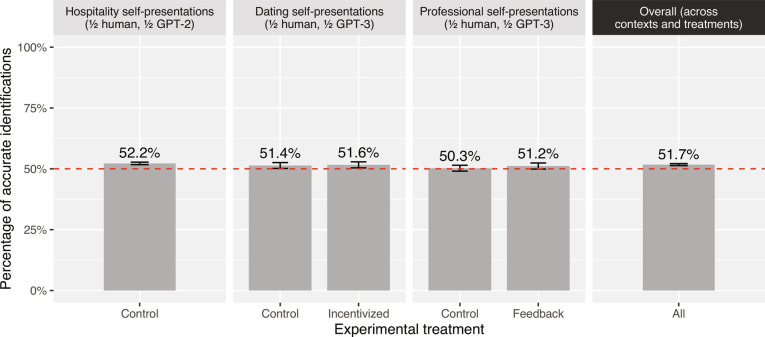
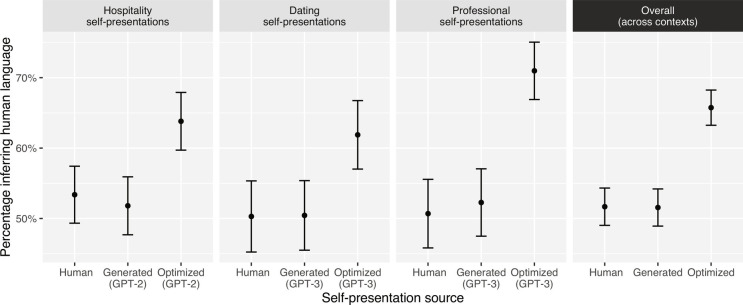
Human communication is increasingly intermixed with language generated by AI. Across chat, email, and social media, AI systems suggest words, complete sentences, or produce entire conversations. AI-generated language is often not identified as such but presented as language written by humans, raising concerns about novel forms of deception and manipulation. Here, we study how humans discern whether verbal self-presentations, one of the most personal and consequential forms of language, were generated by AI. In six experiments, participants (N = 4,600) were unable to detect self-presentations generated by state-of-the-art AI language models in professional, hospitality, and dating contexts. A computational analysis of language features shows that human judgments of AI-generated language are hindered by intuitive but flawed heuristics such as associating first-person pronouns, use of contractions, or family topics with human-written language. We experimentally demonstrate that these heuristics make human judgment of AI-generated language predictable and manipulable, allowing AI systems to produce text perceived as “more human than human.” We discuss solutions, such as AI accents, to reduce the deceptive potential of language generated by AI, limiting the subversion of human intuition.
Overview
The claims and statistics of this paper haven’t been checked yet.
Free: it reads the open-access text and checks the first 5 claims that cite a source we can check. Create a free account to check every claim.
Integrity signals
Registry
Cites
Statistics
Figures
Verification
Claims the paper makes
The claims and statistics of this paper haven’t been checked yet.
Free: it reads the open-access text and checks the first 5 claims that cite a source we can check. Create a free account to check every claim.
Claims other papers make about this one
Each is checked against this paper’s own text: does it say what the citing paper says it does?
The source backs part of the claim, not all of it — or backs it for a different population, condition or comparison.
In the citing paper
“Studies have shown that humans are largely ineffective at discerning AI created from human created content, and thus easily deceived (60).”
From The benefits and dangers of anthropomorphic conversational agents (2025) · cites this paper as [60]
Experimental — accuracy not yet measuredThe source backs part of the claim, not all of it — or backs it for a different population, condition or comparison.
In the citing paper
“Recent studies demonstrate that models like the GPT series are capable of producing news articles indistinguishable from human-generated ones (Kreps et al., 2022;Jakesch et al., 2023)”
From Anatomy of an AI-powered malicious social botnet (2024) · cites this paper as Jakesch et al., 2023
Experimental — accuracy not yet measuredThe source backs part of the claim, not all of it — or backs it for a different population, condition or comparison.
In the citing paper
“First, LLMs beat traditional text generation methods in producing human-like text (Jakesch et al., 2023;Guo et al., 2023;Clark et al., 2021).”
From Anatomy of an AI-powered malicious social botnet (2024) · cites this paper as Jakesch et al., 2023
Experimental — accuracy not yet measuredThe cited source says what the claim attributes to it.
In the citing paper
“We note that recent research has found that people could not reliably distinguish whether a piece of content is generated by people or the latest LLMs [33].”
From 'It was 80% me, 20% AI': Seeking Authenticity in Co-Writing with Large Language Models (2025) · cites this paper as [33]
The cited source says what the claim attributes to it.
In the citing paper
“it can also create realistic disinformation (e.g., fake news, propaganda) that is hard to detect by humans (Kreps et al. 2022; Jakesch et al. 2023)”
From Generative AI (2024) · cites this paper as Jakesch et al. 2023
6 more claims about this paper
Create a free account to see every claim other papers make about this one.
Self-check
Percentages, sums and reported differences re-computed from the paper’s own numbers.
The self-check needs the paper’s full text.
Citations
Cites
Vaswani, A., Shazeer, N., Parmar, N., Uszkoreit, J., Jones, L., Gomez, A. N., Kaiser, L., & Polosukhin, I. (2017) · arXiv · doi:10.48550/arxiv.1706.03762 · Cited by 120,404 · cited 1×
“We trained multiple customized versions of state-of-the-art AI language models (1, 2, 4) to generate self-presentations in three social contexts where trust in a self-presentation is important for decision-making: professional (e.g., job applications) (22), romantic (e.g., online dating) (12), and…”
MethodExploiting Generative AI to Scale up Intelligent Tutoring Systems
Jakubův, J., Chvalovský, K., Goertzel, Z., Kaliszyk, C., Olšák, M., Piotrowski, B., Schulz, S., Suda, M., & Urban, J. (2023) · DROPS (Schloss Dagstuhl – Leibniz Center for Informatics) · doi:10.4230/lipics.itp.2023.19 · Cited by 76,658
Language Models are Few-Shot Learners
Brown, T. B., Mann, B., Ryder, N., Subbiah, M., Kaplan, J., Dhariwal, P., Neelakantan, A., Shyam, P., Sastry, G., Askell, A., et al. (2020) · arXiv · doi:10.48550/arxiv.2005.14165 · Cited by 23,372 · cited 2×
“AI-generated language enables novel interactions that reduce human effort but can facilitate novel forms of plagiarism, manipulation, and deception (1, 3–8) when people mistake AI-generated language for language created by humans.”
BackgroundMethodKaugeranna, R., Kaugeranna, E., & Aion, (. S. 4. 6. (2023) · DROPS (Schloss Dagstuhl – Leibniz Center for Informatics) · doi:10.4230/lipics.giscience.2023.43 · Cited by 13,690
VADER: a parsimonious rule-based model for sentiment analysis of social media text
Hutto, C., & Gilbert, E. (2014) · Proceedings of the International AAAI Conference on Web and Social Media · doi:10.1609/icwsm.v8i1.14550 · Cited by 6,087 · cited 1×
“We computationally created a range of language features present in the self-presentations, including measurements for personality, sentiment, and perspective (28, 29).”
The Psychological Meaning of Words: LIWC and Computerized Text Analysis Methods
Tausczik, Y. R., & Pennebaker, J. W. (2010) · Journal of Language and Social Psychology · doi:10.1177/0261927x09351676 · Cited by 5,774 · cited 2×
“We developed an initial set of language features motivated by participants’ explanations of their judgments, to which we added various statistical metrics and commonly analyzed psychological language features such as LIWC (21).”
MethodProlific.ac—A subject pool for online experiments
Palan, S., & Schitter, C. (2018) · Journal of Behavioral and Experimental Finance · doi:10.1016/j.jbef.2017.12.004 · Cited by 3,450 · cited 2×
“Participants from Prolific had a median age of 37 y, 67% had a college degree, and 27% were at least somewhat familiar with computer programming.”
MethodThielke, S. M. (2004) · Psychiatric Services · doi:10.1176/appi.ps.55.9.1071 · Cited by 3,052
On the Opportunities and Risks of Foundation Models
Bommasani, R., Hudson, D. A., Adeli, E., Altman, R., Arora, S., von Arx, S., Bernstein, M. S., Bohg, J., Bosselut, A., Brunskill, E., et al. (2021) · arXiv · doi:10.48550/arxiv.2108.07258 · Cited by 2,676 · cited 1×
“We trained multiple customized versions of state-of-the-art AI language models (1, 2, 4) to generate self-presentations in three social contexts where trust in a self-presentation is important for decision-making: professional (e.g., job applications) (22), romantic (e.g., online dating) (12), and…”
MethodGPT-3: Its Nature, Scope, Limits, and Consequences
Floridi, L., & Chiriatti, M. (2020) · Minds and Machines · doi:10.1007/s11023-020-09548-1 · Cited by 2,519 · cited 1×
“In addition, human-like AI-generated self-presentations complicate questions about personhood and blur the line between human and machine intelligence (6, 15).”
Background
Research works printed but not linked: 4
- B. Buchanan, A. Lohn, M. Musser, K. Sedova, Truth, lies, and automation. Cent. Secur. Emerg. Technol. 1, 2 (2021).
- A. Radford, Language models are unsupervised multitask learners. OpenAI Blog 1, 9 (2019).
- A. Nelson, S. Friedler, F. Fields-Meyer, Blueprint for an AI bill of rights: A vision for protecting our civil rights in the algorithmic age. White House Office of Science and Technology Policy (2022). (18 October 2022).
- J. Williams, Should AI always identify itself? It’s more complicated than you might think. Electronic Frontier Foundation (2018). (18 October 2022).
Cited by
Items 301–400 of 610
Barcellos, L. I., & Albino, J. P. (2025) · Aracê. · doi:10.56238/arev7n12-164 · Cited by 2
Movahed, S. V. (2026) · ACM Technical Symposium on Computer Science Education (SIGCSE) · doi:10.1145/3770762.3772528 · Cited by 2
“Understanding how LLMs generate text is vital for youth AI literacy [23], as language has become the main way they interact with AI in daily life [10] and through learning-support chatbots [14, 18].”
Conversational signatures: structural patterns in human–AI interaction across models and platforms
Kraishan, O. (2026) · Interacting with Computers · doi:10.1093/iwc/iwag017 · Cited by 2
Beyond Accuracy: Experts See AI Fact-Checks as Accurate but Less Useful
Jia, C., Gondimalla, A., Zhang, A., Mullings, D. J., Boltz, A., & Lee, M. K. (2026) · CHI Conference on Human Factors in Computing Systems · doi:10.1145/3772318.3791625 · Cited by 3
Shao, A., & Scheufele, D. A. (2026) · Journal of Broadcasting & Electronic Media · doi:10.1080/08838151.2026.2669539 · Cited by 2
Large language models can detect verbal indicators of romantic attraction
Matz, S., Peters, H., Cerf, M., Grunenberg, E., Eastwick, P. W., Back, M. D., & Finkel, E. J. (2026) · Scientific Reports · doi:10.1038/s41598-026-52308-x · Cited by 2
Seeing the Poem: Image-Semantic Detection of AI-Generated Modern Chinese Poetry with MLLMs
Wang, S., Ye, F., Lyu, H., Gou, C., Wu, J., Yao, J., Xu, C., Luo, J., & Wong, D. F. (2026) · Findings of the Association for Computational Linguistics: EMNLP (Findings of EMNLP) · doi:10.18653/2026.findings-emnlp.586 · Cited by 2
Algorithmic Authority Bias in AI-Assisted Learning: An Integrative Cognitive Framework
Sony, S. D., & Mus, K. (2026) · International Educational Review · doi:10.58693/ier.415 · Cited by 2
“Other researchers (Jakesch et al., 2023) have shown that fluent, well-written AI text is often judged as more credible than human-written text even when the information is not more accurate.”
Ghasiya, P., & Sasahara, K. (2026) · International World Wide Web Conference (WWW) · doi:10.1145/3774905.3796489 · Cited by 2
Talking to Ourselves Through a Smart Mirror: Artificial Confidence in Human–AI Interaction
Hochman, G. (2026) · Systems · doi:10.3390/systems14060627 · Cited by 4
Lai, Z. C.-C. (2026) · Language Teaching Research · doi:10.1177/13621688261463373 · Cited by 2
Zhao, W., & Liu, J. (2026) · Frontiers in Psychology · doi:10.3389/fpsyg.2026.1879080 · Cited by 2
Decoding the AI’s Gaze: Unraveling ChatGPT’s Evaluation of Poetic Creativity
Fischer, N., Dischinger, E., & Gunser, V. E. (2024) · Communications in computer and information science · doi:10.1007/978-3-031-62110-9_19 · Cited by 2
Bachwani, S. (2024) · DergiPark · Cited by 2
As a Large Language Model: Ontological-Category Cue Effects on Agent and Message Evaluations
Banks, J. (2025) · Hawaii International Conference on System Sciences (HICSS) · doi:10.24251/hicss.2025.280 · Cited by 2
Umwandlung freitextlicher radiologischer Befundtexte in strukturierte Daten
Graf, M. M., Bressem, K. K., & Adams, L. C. (2025) · Die Radiologie · doi:10.1007/s00117-025-01422-4 · Cited by 2
Detection avoidance techniques for large language models
Schneider, S., Steuber, F., Schneider, J., & Rodosek, G. D. (2025) · Data & Policy · doi:10.1017/dap.2025.6 · Cited by 2
“The fact that machines can mimic these expressions and content was used by jakesch_human_2023 : In their experiment, participants could not distinguish between AI-generated and human-written self-presentations misled by the AI’s usage of first-person pronouns, contractions, or family topics.”
Evaluating Large Language Models on Twitter Based on Hashtag Dynamics and Scaling Properties
Su, S., Zhang, H., & Wang, Z. (2025) · Communications in computer and information science · doi:10.1007/978-981-96-5123-8_16 · Cited by 2
Semantic Ambiguity in AI-Generated Texts: Challenges in Human Interpretation
Sirait, T. E., & Damanik, B. A. R. (2025) · Indonesian Journal Of Education · doi:10.71417/ije.v2i1.710 · Cited by 2
Decoding AI-Generated Content Through Human Heuristics
Mitra, A., Mohanty, S., & Mishra, D. (2025) · Springer eBooks · doi:10.1007/978-3-031-77232-0_12 · Cited by 2
Semantic Shifts in Political Discourse: A Study of Language Manipulation
Meisuri, M., & Al-Haddad, H. (2025) · Journal of Humanities Research Sustainability · doi:10.70177/jhrs.v2i1.1924 · Cited by 2
Can Large Language Models Detect Verbal Indicators of Romantic Attraction?Preprint
Matz, S., Peters, H., Cerf, M., Grunenberg, E., Eastwick, P. W., Back, M. D., & Finkel, E. J. (2024) · arXiv (Cornell University) · doi:10.48550/arxiv.2407.10989 · Cited by 2
Ai Bias for Creative Writing: Subjective Assessment Versus Willingness to PayPreprint
Abel, M., & Johnson, R. (2025) · SSRN Electronic Journal · doi:10.2139/ssrn.5118633 · Cited by 2
“From professional and social media platforms [1, 2] to journalism [3, 4, 5] and poetry [6, 7, 8], Large Language Models (LLMs) are producing text that is increasingly indistinguishable from human writing.”
Palminteri, S., Garcia, B., & Qian, C. (2025) · PsyArXiv (OSF Preprints) · doi:10.31234/osf.io/ct6rx_v2 · Cited by 2
AI Bias for Creative Writing: Subjective Assessment Versus Willingness to PayPreprint
Abel, M., & Johnson, R. (2025) · SSRN Electronic Journal · doi:10.2139/ssrn.5406509 · Cited by 2
Experimental Evidence That AI-Managed Workers Tolerate Lower Pay Without Demotivation
Dong, M., Brinkmann, L. U. L., Sherif, O., Wang, S., Zhang, X., Bonnefon, J., & Rahwan, I. (2025) · Proceedings of the AAAI/ACM Conference on AI Ethics and Society · doi:10.1609/aies.v8i1.36590 · Cited by 2
Experimental Evidence That AI-Managed Workers Tolerate Lower Pay Without DemotivationPreprint
Dong, M., Brinkmann, L. U. L., Sherif, O., Wang, S., Zhang, X., Bonnefon, J., & Rahwan, I. (2025) · Toulouse Capitole Publications (University Toulouse 1 Capitole) · doi:10.48550/arxiv.2505.21752 · Cited by 2
“…studies and experiments rely on pretended AI evaluations, which elicit responses to the idea of AI rather than to actual machine behavior; and the idea of AI can be more aversive than its real-world experience (Dong, Bonnefon, and Rah-wan 2024; Jakesch, Hancock, and Naaman 2023; Tong et al. 2021).”
Large Language Model Use Impact Locus of ControlPreprint
Fu, J., Antone, B., Kadoma, K., & Jung, M. F. (2025) · arXiv (Cornell University) · doi:10.48550/arxiv.2505.11406 · Cited by 2
Seeking Human Security Consensus: A Unified Value Scale for Generative AI Value SafetyPreprint
He, Y., Li, B., Cao, Y., Xu, H., Chen, Q., Chen, S., & Ren, S. (2026) · arXiv (Cornell University) · doi:10.48550/arxiv.2601.09112 · Cited by 2
“• Deceptive Attribution: Misrepresenting the origin of AI-generated content as human-created, leading to academic dishonesty, plagiarism, or a lack of transparency regarding the nature of the interaction (Jakesch et al., 2023; Meng et al., 2025).”
Caffier, J., Stavrova, O., & Kleinberg, B. (2026) · arXiv (Cornell University) · doi:10.48550/arxiv.2604.03202 · Cited by 2
The Impact of Anthropomorphizing Large Language Models-based Chatbots: A Scoping ReviewPreprint
D’elia, Y., Caballa, N., Nguyen, C., Tong, X., Kadambi, A., & Aziz‐Zadeh, L. (2026) · Research Square · doi:10.21203/rs.3.rs-9224936/v1 · Cited by 2
Juzek, T. S. (2026) · arXiv · doi:10.48550/arxiv.2605.25358 · Cited by 2
Linguistic traces of stochastic empathy in language models
Kleinberg, B., Zegers, J., Festor, J., Vida, S., Präsent, J., Loconte, R., & Peereboom, S. (2024) · arXiv · doi:10.48550/arxiv.2410.01675 · Cited by 1
“That effect showed that texts written by humans ( M =3.46, SD =0.89) were rated as more human than those generated by an LLM ( M =2.75, SD =0.85), d =0.82 [0.65; 0.98], BF 10 >100, BF 01 <0.01, regardless of the task instructions.”
InfluentialAI-Powered Communication Frameworks in Industry: Analyzing Challenges, Opportunities and Impact.
Kumar, A. (2025) · Journal of Information Systems Engineering & Management · doi:10.52783/jisem.v10i23s.4558 · Cited by 1
Detection of LLM-powered bots using image classification
Paolo, E. D., Petrocchi, M., & Spognardi, A. (2025) · First Monday · doi:10.5210/fm.v30i5.13651 · Cited by 1
BEDAA: Bayesian Enhanced DeBERTa for Uncertainty-Aware Authorship Attribution
Zahid, I., Sun, Y., & Batista-Navarro, R. (2025) · Findings of the Association for Computational Linguistics: ACL (Findings of ACL) · doi:10.18653/v1/2025.findings-acl.924 · Cited by 1
AI's Struggle with Arabic: A Study on Pragmatic Failures in Contextual Communication
Alshraah, S. M., Aldaghri, A. A., & Oraif, I. (2025) · Forum for Linguistic Studies · doi:10.30564/fls.v7i11.9252 · Cited by 1
“Such pragmatic failures—instances where AI-generated language violates implicit social rules—undermine its utility in real-world applications, from customer service chatbots to educational tools, where nuanced communication is paramount [1,2] .”
Detecting AI-Generated Content: Challenges and Opportunities
de Melo, G. (2025) · Oxford University Press eBooks · doi:10.1093/oxfordhb/9780198940272.013.0008 · Cited by 1
Detecting Machine-Generated Text using Grammatical Features
Ngouanfouo, C., & Davoust, A. (2025) · IEEE International Conference on Tools with Artificial Intelligence (ICTAI) · doi:10.1109/ictai66417.2025.00123 · Cited by 1
Prospects for Artificial Intelligence in Journalism
Владимирович, К. А. (2025) · Virtual Communication and Social Networks · doi:10.21603/2782-4799-2025-4-4-366-372 · Cited by 1
ОБ ОБУЧЕНИИ СТУДЕНТОВ ИСПОЛЬЗОВАНИЮ ИСКУССТВЕННОГО ИНТЕЛЛЕКТА: ОТ СЛОВАРЯ ДО ПРАГМАТИКИ
Казанцева, Н. В. (2025) · Бизнес, образование, право · doi:10.25683/volbi.2025.73.1435 · Cited by 1
Who moved my text? Assessing whether ChatGPT can write better abstracts than humans
Albuquerque, F., & dos Santos, P. G. (2026) · Cogent Education · doi:10.1080/2331186x.2026.2616858 · Cited by 3
Clichés We Live By: From Modernity to AI
Ariel, N., & Riesenfeld, D. (2026) · doi:10.1093/9780197809563.001.0001 · Cited by 1
ReproHum #0927-03: DExpert Evaluation? Reproducing Human Judgements of the Fluency of Generated Text
Dinkar, T., Abercrombie, G., & Rieser, V. (2024) · Language Resources and Evaluation Conference (LREC) · doi:10.63317/2ncopi2t3wjs · Cited by 1
“For current state-of-the-art NLG systems, human evaluators cannot distinguish synthetic text from human written language when analysing the outputs of current systems, if relying on cues such as grammaticality (Jakesch et al., 2023).”
BackgroundProceedings of the Fourth Workshop on Human Evaluation of NLP Systems (HumEval) @ LREC-COLING 2024
(2024) · Language Resources and Evaluation Conference (LREC) · doi:10.63317/3jfrug2yvkgc · Cited by 1
HARARIA IJAZ, A. T. (2025) · TPM Testing, psychometrics, methodology in applied psychology · doi:10.5281/zenodo.19007060 · Cited by 1
Boer, J. W., & Spoelstra, H. (2026) · Education and Information Technologies · doi:10.1007/s10639-026-13939-9 · Cited by 2
“People tend to overestimate their skill in distinguishing student-written from GenAI-assisted texts (Jakesch et al., 2023).”
Characterizing AI Manipulation Risks in Brazilian YouTube Climate Discourse
Dong, W., Locatelli, M. S., Almeida, V., & Cha, M. (2026) · Proceedings of the AAAI Conference on Artificial Intelligence · doi:10.1609/aaai.v40i45.41180 · Cited by 1
Posavec, K. (2026) · International Journal of Instruction · doi:10.29333/iji.2026.19215a · Cited by 1
Understanding Human Heuristics in Context-Sensitive Image Captioning
Cognitive Science Society 2025, Dale, R., Jiang, Y., & Lu, H. (2025) · eScholarship (California Digital Library) · doi:10.48448/2wy3-fv92 · Cited by 1
Kim, H., Ham, J., & Eastin, M. S. (2026) · Journal of Interactive Advertising · doi:10.1080/15252019.2026.2652290 · Cited by 1
“Jakesch, Hancock, and Naaman (2023) suggest people tend to identify humans based on human-like cues, whereas AI is judged using machine heuristics, leading to expectations of mechanical behavior.”
ChatGPT’s ability to imitate writing styles: an analysis guided by forensic text comparison
Ishihara, S. (2026) · Digital Scholarship in the Humanities · doi:10.1093/llc/fqag079 · Cited by 1
How to help small human influencers face GenAI challenges: The role of non-AI disclosure
Guo, R., Wang, Y., Song, M., & Duan, Y. (2026) · Journal of Business Research · doi:10.1016/j.jbusres.2026.116355 · Cited by 1
What Influences Readers' and Writers' Perceived Necessity of AI Disclosure?
Fang, J., Wen, V. X., & Lee, M. (2026) · ACM Conference on Fairness, Accountability, and Transparency (FAccT) · doi:10.1145/3805689.3806724 · Cited by 1
“While this marks an exciting advancement of AI technologies, it makes it extremely challenging for readers to tell who created the content that they are reading [50].”
Mapping Emerging Climate Misinformation Playbooks in the Global South
Locatelli, M. S., Dong, W., Alzamora, P. L., Dutenhefner, P. R., Meira, W., Cha, M., & Almeida, V. A. F. (2026) · ACM Conference on Fairness, Accountability, and Transparency (FAccT) · doi:10.1145/3805689.3806492 · Cited by 1
Lee, H., Shin, J., Song, H., Ko, C., & Park, J. C. (2026) · Proceedings of the conference - Association for Computational Linguistics. Meeting · doi:10.18653/v1/2026.acl-long.1741 · Cited by 1
Zhang, W., Xie, R., & Hu, J. (2026) · Ethics & Behavior · doi:10.1080/10508422.2026.2696829 · Cited by 1
Sounds like AI? Consumer suspicion of AI authorship in mixed-source online reviews
Mao, M., Guo, T., Zhang, F., & Chen, S. (2026) · Internet Research · doi:10.1108/intr-07-2025-1039 · Cited by 1
Generative AI-assisted investor communication and stock price crash risk
Cao, R., & Zhang, Z. (2026) · Economics Letters · doi:10.1016/j.econlet.2026.113148 · Cited by 1
Jin, Y., Martinez‐Maldonado, R., Gašević, D., Han, X., & Yan, L. (2026) · Journal of Computer Assisted Learning · doi:10.1002/jcal.70310 · Cited by 1
“Finally, the work contributes to debates on human-likeness in AI-mediated learning (Jakesch et al., 2023), illustrating that undetected AI participation can reshape epistemic roles without altering outcomes.”
InfluentialLeveling the Playing Field? Generative AI and Entrepreneurial Storytelling
Taeuscher, K., & Lounsbury, M. D. (2026) · Entrepreneurship Theory and Practice · doi:10.1177/10422587261472523 · Cited by 1
Liu, D., Pan, L., Sabri, A. Q. M., & Fan, G. F. (2026) · ACM Transactions on Social Computing · doi:10.1145/3844666 · Cited by 1
Human-AI interaction: themes, applications, and challenges
Zhou, L., Li, Y., Zhang, Z., & Chen, X. (2026) · Data Science and Management · doi:10.1016/j.dsm.2026.100214 · Cited by 1
Invasion of ChatGPT and LLMs in Review and Writing Spaces: A Revolution or Radical
Hadap, A., & Khatri, V. (2024) · Springer eBooks · doi:10.1007/978-981-97-4060-4_16 · Cited by 1
Editor's Message: “AI”: No Guarantee of Accuracy or Integrity
(2023) · Journal of Geriatric Physical Therapy · doi:10.1519/jpt.0000000000000389 · Cited by 1
Do Large Language Models Understand Verbal Indicators of Romantic Attraction?Preprint
Matz, S., Peters, H., Eastwick, P. W., Cerf, M., & Finkel, E. J. (2024) · PsyArXiv (OSF Preprints) · doi:10.31234/osf.io/fqkgn · Cited by 1
The Career Interests of Large Language ModelsPreprint
Hua, M., Cheng, Y., & Zhu, H. (2024) · arXiv (Cornell University) · doi:10.48550/arxiv.2407.08564 · Cited by 1
“Studies have shown that human users are unable to distinguish between interactions with LLMs and real humans [7–9], even in sensitive, personal settings[10].”
BackgroundUsing Large Language Models to Generate Authentic Multi-agent Knowledge Work DatasetsPreprint
Heim, D., Jilek, C., Ulges, A., & Dengel, A. (2024) · arXiv (Cornell University) · doi:10.18420/inf2024_118 · Cited by 1
“Similar to previous publications [Cl21; Ja23; JHN23], we examined how authentic generated documents, in this case knowledge work documents, are perceived by human evaluators compared to real ones.”
BackgroundResultA General Method for Detecting Information Generated by Large Language ModelsPreprint
Mao, M., Wei, D., Fang, X., & Chau, M. (2025) · SSRN Electronic Journal · doi:10.2139/ssrn.5309665 · Cited by 1
AI is here – and everywhere: 3 AI researchers look to the challenges ahead in 2024
Susarla, A., Toyama, K., & Fiesler, C. L. (2024) · The Conversation · doi:10.64628/aai.jq9qjqhxr · Cited by 1
The AI Trust Paradox: Designing Interpretable and Reliable ChatbotsPreprint
Jaidka, K., & Cai, M. (2025) · SSRN Electronic Journal · doi:10.2139/ssrn.5632850 · Cited by 1
Perceived AI Use and Hiring Penalties: Experimental EvidencePreprint
Wang, S. Q., & Qiu, J. (2025) · SSRN Electronic Journal · doi:10.2139/ssrn.5675322 · Cited by 1
LLMartini: Seamless and Interactive Leveraging of Multiple LLMs through Comparison and CompositionPreprint
Shi, Y., Yang, J., Wang, Y., Yin, Y., Li, H., Gao, K., & Yu, C. (2025) · arXiv (Cornell University) · doi:10.48550/arxiv.2510.19252 · Cited by 1
“Empirical observations [30] and user studies (Section 3) indicate that this is not a niche activity.”
The Necessity of Imperfection:Reversing Model Collapse via Simulating Cognitive BoundednessPreprint
Jiang, Z. (2025) · arXiv (Cornell University) · doi:10.48550/arxiv.2512.01354 · Cited by 1
“This logic prioritizes fluency and convergence, thereby systematically excising traits inherent to human language, specifically those shaped by cognitive load, emotional oscillation, and heuristics and biases [14],[15].”
Harmful Hallucinations: Generative AI and ElectionsPreprint
McKay, S., Tenove, C., Gupta, N., Ibañez, J., Mathews, N., & Tworek, H. (2025) · SSRN Electronic Journal · doi:10.2139/ssrn.5440694 · Cited by 1
SimCT: A Simple Consistency Test Protocol in LLMs Development LifecyclePreprint
Zhao, F., Jin, G., Zhao, R., Huang, J., & Tan, F. (2024) · arXiv (Cornell University) · doi:10.48550/arxiv.2407.17150 · Cited by 1
“Large language models (LLMs) have revolutionized natural language processing (NLP) with their significantly improved text generation capabilities (Jakesch et al., 2023; Sadasivan et al., 2023; Lu et al., 2022; Zhang et al., 2024), promoting the rapid development of NLP.”
BackgroundShulman, Y., Kitkowska, A., & Warner, M. (2025) · arXiv (Cornell University) · doi:10.48550/arxiv.2604.19429 · Cited by 1
“Jakesch et al. [39] found that people’s inability to accurately discern AI-generated self-presentation authorship was partly due to flawed heuristics (e.g., grammar use) being used by evaluators.”
InfluentialOnline scam detection using human psychology: Towards usable cybersecurity
Zheng, S. Y. (2024) · UCL Discovery (University College London) · Cited by 1
UnWEIRDing LLM Entity RecommendationsPreprint
Kumar, A., & Mhatre, S. (2025) · arXiv (Cornell University) · doi:10.48550/arxiv.2511.18403 · Cited by 1
“Moreover, humans’ imperfect judgment of AI-generated text suggestions (Jakesch, Hancock, and Naaman 2023) can make it difficult for users to identify and overcome these biases.”
Ideal Attribution and Faithful Watermarks for Language ModelsPreprint
Song, M. J., & Shahabi, K. (2025) · arXiv (Cornell University) · doi:10.48550/arxiv.2512.07038 · Cited by 1
“What is clear, however, is that without provenance mechanisms in place, the shift is likely irreversible; once synthetic and human text are mixed without reliable markers of non-human origin, distinguishing between them may be nearly impossible [KM21; CASH+21; JHN23].”
Ramos, M. L. F. (2026) · PsyArXiv (OSF Preprints) · doi:10.31234/osf.io/j7wd5_v1 · Cited by 1
DSIPA: Detecting LLM-Generated Texts via Sentiment-Invariant Patterns Divergence AnalysisPreprint
Li, S., Wulianghai, A., Li, G., Lin, X., Mao, Q., Chen, Y., Wu, J., & Li, J. (2026) · arXiv · doi:10.48550/arxiv.2604.26328 · Cited by 1
“As LLMs evolve toward human-level stylistic fluency and coherence, the boundary between authentic and synthetic content becomes increasingly blurred [13], [14], creating significant risks for secure communication, online trust, and forensic auditing.”
LLM Agents Make Collective Belief Dynamics Programmable: Challenges and Research DirectionsPreprint
He, X., Shen, J., Mou, Y., Bossens, D. M., Chen, C., Tsang, I. W.-H., & Ong, Y. S. (2026) · arXiv (Cornell University) · doi:10.48550/arxiv.2605.19915 · Cited by 1
“These agents can engage in social media conversations, forum debates, and comment threads—often indistinguishably from human users [3, 4].”
Miklian, J., & Katsos, J. E. (2026) · arXiv (Cornell University) · doi:10.48550/arxiv.2606.12073 · Cited by 1
“Human heuristics for distinguishing AI from human writing are systematically miscalibrated (Jakesch et al. 2023), and the same heuristics drive the policing speech counted here.”
The Perplexity Trap: When Patent Law Makes Human Writing Look Like AIPreprint
Banerjee, A. (2026) · arXiv (Cornell University) · doi:10.48550/arxiv.2607.13044 · Cited by 1
“Lay readers’ heuristics for “sounding like AI” are themselves biased and unstable (Jakesch et al., 2023), while recent evidence suggests that habitual LLM-assisted writers can outperform generic automated classifiers in controlled discrimination tasks (Russell et al., 2025); together these…”
Greco, M., Shetty, A., Tagarelli, A., & Lau, J. (2026) · arXiv.org · doi:10.48550/arxiv.2609.02379 · Cited by 1
“Large language models (LLMs) can now generate high-quality text across multiple languages (Qin et al., 2024; Yue et al., 2025), achieving levels of fluency and coherence comparable to human-written content (Jakesch et al., 2023).”
LLM Detectors Still Fall Short of Real World: Case of LLM-Generated Short News-Like Posts
Gameiro, H. D. S., Kucharavy, A., & Dolamic, L. (2024) · arXiv · doi:10.48550/arxiv.2409.03291
“Unfortunately, humans do not distinguish well LLM-generated texts from human-written ones (Ippolito et al., 2020; Matz et al., 2024; Jakesch et al., 2022).”
BackgroundMisinformation, Paradox, and Heuristics: An Algorithmic Nudge to Counter Misinformation
Shin, D. (2024) · Springer eBooks · doi:10.1007/978-3-031-52569-8_4
Zhmai, A. (2024) · Artificial Intelligence · doi:10.15407/jai2024.04.060
Yuening, L., Ren, Y., & Chenhua, Z. (2025) · IEEE Access · doi:10.1109/access.2025.3553148
“These methods utilized large corpora of text and natural language processing (NLP) techniques to identify patterns in environmental health messaging and predict their impact on public attitudes [12].”
Synthetic Counteradaptation: A Principle of Human–AI Coevolution
Frisch, I., Kay, J., & Tomei, P. M. (2025) · doi:10.1162/anti.5czj
Can Generative AI Promote Democracy? Countering Polarization with Digital StorytellingPreprint
Wegemer, C. M., & Burke, J. (2025) · EdArXiv (OSF Preprints) · doi:10.35542/osf.io/cfrj8_v1
Metabioethics and ChatGPT-based posthumous memories at the service of palliative medicine
de Araújo, A. F. M. (2025) · Einstein (São Paulo) · doi:10.31744/einstein_journal/2025ce1590
From Blogs to Bots: Exploring the Impact of Ai Co-Authorship on Attitude FormationPreprint
Cho, K., & Shin, S. Y. (2025) · SSRN Electronic Journal · doi:10.2139/ssrn.5374607
Carmengen: um modelo de linguagem para geração de poemas
Possi, M. D. A. (2024) · doi:10.47328/ufvbbt.2025.528
Ensemble Approach for Detection of AI-Generated Text Using Machine Learning Models
Pardey, M. A., & Ghode, S. D. (2025) · Springer eBooks · doi:10.1007/978-3-031-92854-3_14
One Approach to Mathematical E-Learning Systems Content Generation
Bosov, A. V., & Ivanov, A. V. (2025) · Communications in computer and information science · doi:10.1007/978-3-032-04758-8_10
Facilitating Asynchronous Idea Generation and Selection with ChatbotsPreprint
Shin, J., Khatri, A., Hedderich, M. A., Lucero, A., & Oulasvirta, A. (2025) · arXiv (Cornell University) · doi:10.48550/arxiv.2503.03617
Can large language models complement tourism surveys?
Chen, Q., Kaza, V. S., Zinn, A. K., Portmann, M., & Dolničar, S. (2026) · Annals of Tourism Research · doi:10.31235/osf.io/beq6n_v1
Barcellos, L. I., & Albino, J. P. (2025) · Seven Editora eBooks · doi:10.56238/sevened2025.038-069
Metadata
- Authors
- Jakesch, M., Hancock, J. T., & Naaman, M.
- Affiliations
- Cornell University (US)
- Stanford University (US)
- Corresponding author
- Jakesch, Maurice
- Venue
- Proceedings of the National Academy of Sciences
- Publisher
- National Academy of Sciences
- Published
- 2023-03-07
- Volume
- 120
- Issue
- 11
- Pages
- e2208839120-e2208839120
- ISSN
- 0027-8424 (ISSN-L)
- 1091-6490
- PMC
- PMC10089155
- OpenAlex
- W4323347737
- Cited by
- 342
- References
- 46
- Citations by year
- 2026: 138 · 2025: 102 · 2024: 69 · 2023: 32
- FWCI
- 32.10
- Type
- journal article
- Language
- en
- Open access
- hybrid
- doi.org
- Licence
- Locations
- Proceedings of the National Academy of Sciences (publishedVersion, cc-by-nc-nd)
- PubMed Central (publishedVersion, cc-by-nc-nd)
- PubMed (publishedVersion)
- arXiv (Cornell University) (submittedVersion)
- arXiv (Cornell University)
- Funders
- National Science Foundation (1901151/1901329)
- Topics
- Physical Sciences › Computer Science › Artificial Intelligence › Authorship Attribution and Profiling
- Physical Sciences › Computer Science › Artificial Intelligence › Ethics and Social Impacts of AI
- Social Sciences › Sociology and Political Science › Misinformation and Its Impacts
- Keywords
- AI-generated text detection, heuristics, intuitive judgment, AI language models, manipulation, first-person pronouns, contractions, human-AI interaction
- MeSH terms
- Heuristics, Artificial Intelligence, Choline O-Acetyltransferase, Communication, Humans, Language
About these checks
Registry, retraction, Cites and statistics results are computed, not judged, with one exception: a printed reference that no index lists is read once by a model before it counts as a citation error. Claims are extracted by a model and kept only when their quote appears verbatim in the text; each cited source is then checked, with a model’s help, for whether it says what the claim relies on. Those verdicts can be wrong — read the claim’s quote and the cited source before relying on one.
Statistics and arithmetic are recomputed, not judged.
Confidence bands are shown only for fields calibrated on our annotated test set. None is calibrated yet, so no band is shown.
What counts as a claim ›How we measure confidence ›How we check this ›
Are you an author, or do you see a problem with this page? Request a review
Data sources
Bibliographic data: Semantic Scholar, OpenAlex, Crossref.
Contains information from the Semantic Scholar Academic Graph Datasets, made available under the ODC Attribution License (ODC-BY 1.0).
Semantic Scholar’s data is described in: Kinney, R., et al. (2023). The Semantic Scholar Open Data Platform. arXiv:2301.10140.
