

Using cognitive psychology to understand GPT-3
Open accessThe DOI matches its Crossref record; 63 of the 63 references it cites were found in a registry or an index; 10 of the 16 sources its claims cite were checked for support.
Abstract
We study GPT-3, a recent large language model, using tools from cognitive psychology. More specifically, we assess GPT-3’s decision-making, information search, deliberation, and causal reasoning abilities on a battery of canonical experiments from the literature. We find that much of GPT-3’s behavior is impressive: It solves vignette-based tasks similarly or better than human subjects, is able to make decent decisions from descriptions, outperforms humans in a multiarmed bandit task, and shows signatures of model-based reinforcement learning. Yet, we also find that small perturbations to vignette-based tasks can lead GPT-3 vastly astray, that it shows no signatures of directed exploration, and that it fails miserably in a causal reasoning task. Taken together, these results enrich our understanding of current large language models and pave the way for future investigations using tools from cognitive psychology to study increasingly capable and opaque artificial agents.
Overview
CoChat Summary
## TL;DR
The paper treats GPT-3 like a participant in cognitive psychology experiments and finds it can solve many classical reasoning tasks reasonably well. But its behavior is brittle to prompt changes and it lacks some human-like features, especially directed exploration and robust causal reasoning.
## Key findings
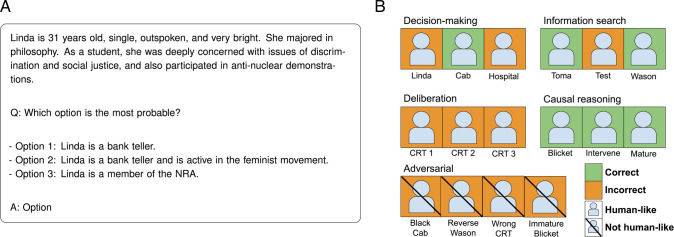
- Across 12 vignette-based problems, GPT-3 answered 6 correctly, and all 6 responses were described as human-like.
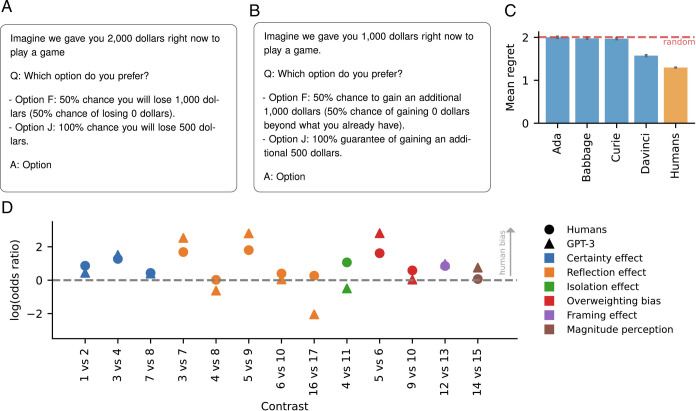
- In the decision-making benchmark, only Davinci performed above chance (t(29134) = −16.85, P < .001), but it still did not reach human performance (t(29134) = −11.50, P < .001).
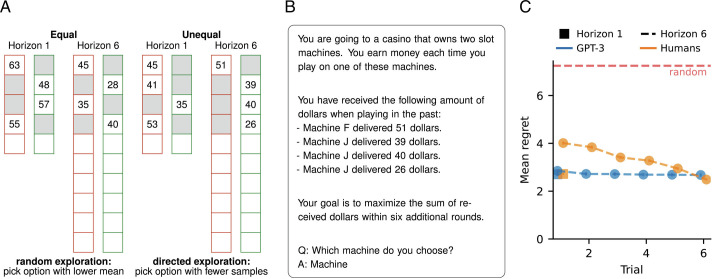
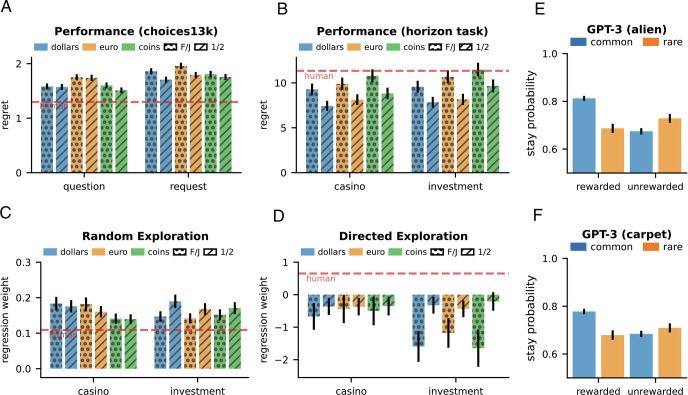
- In the horizon / information-search task, GPT-3 showed random exploration but not directed exploration: reward difference mattered (β = 0.18 ± 0.01, z = 14.48, P < .001), while the horizon interaction did not (β = −0.02 ± 0.02, z = −1.47, P = .14); human-like directed exploration was not observed (β = −0.15 ± 0.27, z = −0.56, P = .58).
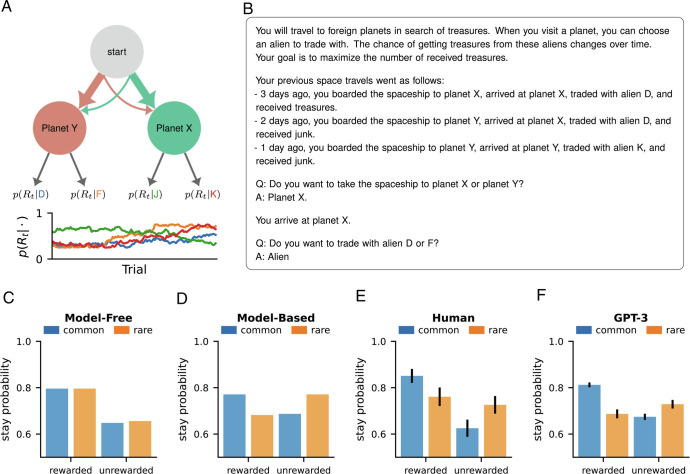
- In the two-step deliberation task, GPT-3 showed signatures consistent with model-based reinforcement learning: rare-transition reward affected stay/switch behavior (χ2(1, N = 1984) = 36.53, P < .001).
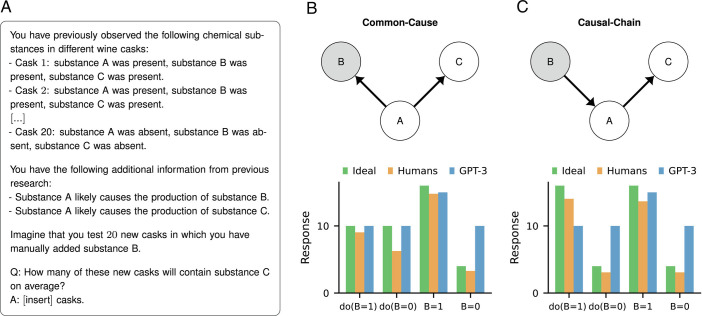
- On causal reasoning, GPT-3 succeeded in some vignette cases, but in the task-based causal test it failed to use causal structure properly; the authors conclude its causal inference was “neither the correct nor human-like.”
## Methods
- The authors used the public OpenAI API and primarily the Davinci GPT-3 model, with temperature set to 0 for deterministic responses unless otherwise noted.
- They ran 12 canonical vignette-based prompts from cognitive psychology and also conducted task-based, procedurally generated experiments: a decision-making benchmark with over 13,000 problems; 3,200 simulations of the horizon task; 200 simulations of the two-step task; and a causal reasoning task.
- Analyses included choice-probability contrasts, logistic regression, and chi-square tests; for the decision task they also report regret relative to human subjects.
## Limitations
- The paper states that vignette results are hard to interpret because GPT-3 may have encountered similar or identical scenarios in training data, and because small prompt changes can drastically alter responses.
- It also states that the vignette tasks can be adversarially modified, causing GPT-3 to respond very differently, which makes the findings brittle.
- Evident from the text: several results rely on prompt phrasing, cover stories, and API settings (for example, temperature and choice labels), so the findings may not generalize to other prompting setups.
Model-written summary. Check it against the paper before relying on it.
Integrity signals
Registry
Cites
Statistics
Figures
Verification
Claims the paper makes
9 Valid · 1 Not valid · 5 Not checked · 69 Own results and interpretations
The cited sources support only part of this claim — read each source’s verdict below.
In the paper
“For all three items of the CRT, GPT-3 responded with the intuitive but incorrect answer, as has been observed in earlier work (15).”
§ Using cognitive psychology to understand GPT-3 > Results > Vignette-Based Investigations.
What the sources say
- Partly supportedcites [15] M. Nye, M. Tessler, J. Tenenbaum, B. M. Lake, Improving coherence and consistency in neural sequence models with dual-system, neuro-symbolic reasoning. Adv. Neural Inf. Process. Syst. 34, 25192– 25204 (2021). sourceExperimental — accuracy not yet measured
The Introduction (p. 2) shows GPT-3 giving the intuitive but incorrect answer to the bat-and-ball CRT item. Appendix A (p. 14) discusses additional CRT questions but says GPT-3 makes the same mistakes as humans “often (but not always)”; the text does not establish that it gave that answer on all three original items. (LLM, conf=0.83)
plain- Asserted: passes — The authors put it forward as true.
- Checkable: passes — It can be checked against evidence.
- Load-bearing: passes — The paper’s conclusions depend on it.
- Based: passes — The paper gives a reason why it holds.
- Partly supported
Every source the paper cites for this claim was checked and supports it.
In the paper
“While humans show such an effect (27), we did not find it in GPT-3 (β = −0.15 ± 0.27, z = −0.56, P = .58), which demonstrates that the model did not employ directed exploration.”
§ Using cognitive psychology to understand GPT-3 > Results > Task-Based Investigations.
What the sources say
- Supportedcites [27] R. C. Wilson, A. Geana, J. M. White, E. A. Ludvig, J. D. Cohen, Humans use directed and random exploration to solve the explore–exploit dilemma. J. Exp. Psychol.: General 143, 2074 (2014). PMC5635655 25347535 source
The Results report that increasing the horizon from 1 to 6 increased the probability of choosing the more informative option in the unequal-information condition. The model fit also found a significant increase in the information bonus, consistent with the positive horizon effect on directed exploration attributed to humans. (LLM, conf=0.93)
plainstates an association- Asserted: passes — The authors put it forward as true.
- Checkable: passes — It can be checked against evidence.
- Load-bearing: passes — The paper’s conclusions depend on it.
- Based: passes — The paper gives a reason why it holds.
- Supported
The cited sources support only part of this claim — read each source’s verdict below.
In the paper
“First, the latest generation of language models is already able to perform above the human level in the majority of tasks from standard benchmark datasets (11, 12), making purely performance-based evaluation less meaningful as time progresses.”
§ Using cognitive psychology to understand GPT-3 > A Cognitive Psychology View on GPT-3.
What the sources say
- Partly supportedcites [11] M. Suzgun et al., Challenging big-bench tasks and whether chain-of-thought can solve them. arXiv [Preprint] (2022). http://arxiv.org/abs/2210.09261 (Accessed 20 January 2023). sourceExperimental — accuracy not yet measured
The Introduction reports that PaLM exceeded the average human-rater score on 65% of BIG-Bench tasks, supporting the majority-of-tasks point for that benchmark. It does not establish the claim across standard benchmark datasets generally. Section 8.1 also cautions that the human-rater scores are not fully representative of human performance. (LLM, conf=0.87)
- Partly supportedcites [12] H. W. Chung et al., Scaling instruction-finetuned language models. arXiv [Preprint] (2022). http://arxiv.org/abs/2210.11416 (Accessed 20 January 2023). sourceExperimental — accuracy not yet measured
Table 1 (Introduction, p. 2) shows Flan-PaLM exceeding the average human rater’s aggregate MMLU score, but not the average human expert’s. The paper does not establish that models exceed human performance on a majority of benchmark tasks; its Evaluation protocol (p. 5) describes the selected challenging benchmarks as ones on which current models remain well below expert human raters. (LLM, conf=0.84)
plain- Asserted: passes — The authors put it forward as true.
- Checkable: passes — It can be checked against evidence.
- Load-bearing: passes — The paper’s conclusions depend on it.
- Based: passes — The paper gives a reason why it holds.
- Partly supported
Every source the paper cites for this claim was checked and supports it.
In the paper
“People tend to solve this task using a combination of model-free and model-based learning (30) as shown in Fig. 4E.”
§ Using cognitive psychology to understand GPT-3 > Results > Task-Based Investigations.
What the sources say
- Supportedcites [30] N. D. Daw, S. J. Gershman, B. Seymour, P. Dayan, R. J. Dolan, Model-based influences on humans’ choices and striatal prediction errors. Neuron 69, 1204– 1215 (2011). 21435563 PMC3077926 source
The Results > Behavior section says the two-step task exercised both model-free and model-based learning strategies, with individual variation in how much subjects used each. It also reports that a hybrid model combining the two fit choices better than either strategy alone. (LLM, conf=0.94)
plain- Asserted: passes — The authors put it forward as true.
- Checkable: passes — It can be checked against evidence.
- Load-bearing: unclear — It is unclear whether the paper’s conclusions depend on it.
- Based: passes — The paper gives a reason why it holds.
- Supported
Every source the paper cites for this claim was checked and supports it.
In the paper
“It is well-known that large language models can be highly sensitive to specific prompts (34).”
§ Using cognitive psychology to understand GPT-3 > Results > Task-Based Investigations.
What the sources say
- Supportedcites [34] H. Strobelt et al., Interactive and visual prompt engineering for ad-hoc task adaptation with large language models (IEEE Trans. Vis. Comput, Graph., 2023), vol. 29, pp. 1146–1156. 36191099 source
The abstract (p. 1) says that prompt templates with different wording choices lead to significant accuracy differences. Section 2.1 (p. 2) likewise states that downstream performance is closely tied to prompt wording, supporting the claim that large language models can be highly sensitive to specific prompts. (LLM, conf=0.94)
boostedstates an association- Asserted: passes — The authors put it forward as true.
- Checkable: passes — It can be checked against evidence.
- Load-bearing: passes — The paper’s conclusions depend on it.
- Based: passes — The paper gives a reason why it holds.
- Supported
49 more claims
Create a free account to see all 84 claims and every source verdict.
- Probably not a substantial claim. 9
- It may state two separate claims as one. 23
- The quote only partly states this claim. 1
Claims other papers make about this one
Each is checked against this paper’s own text: does it say what the citing paper says it does?
The source backs part of the claim, not all of it — or backs it for a different population, condition or comparison.
In the citing paper
“cognitive psychology of LLM treats LLM as an agent whose input-output correlation between prompts (stimulus) and generations (responses) can be probed under controlled conditions to infer the agent’s internal representations.”
From Understanding large language models demands distinguishing human projection from machine cognition (2026) · cites this paper as [36]
Experimental — accuracy not yet measuredThe source backs part of the claim, not all of it — or backs it for a different population, condition or comparison.
In the citing paper
“These models are trained on large amounts of text, for example, obtained from the internet, and can answer questions, provide summaries or translations and create stories or poems (Fig. 1a)3,4.”
From The future landscape of large language models in medicine (2023) · cites this paper as [4]
Experimental — accuracy not yet measuredThe source backs part of the claim, not all of it — or backs it for a different population, condition or comparison.
In the citing paper
“as misconceived prompts may result in biases or misinformation with potentially serious consequences4.”
From The future landscape of large language models in medicine (2023) · cites this paper as [4]
Experimental — accuracy not yet measuredThe source backs part of the claim, not all of it — or backs it for a different population, condition or comparison.
In the citing paper
“These results add to the growing body of work characterizing the emergent capabilities of LLMs, 24-28 and suggest that the most sophisticated LLMs may already possess an emergent capacity to reason by analogy.”
From Emergent analogical reasoning in large language models (2023) · cites this paper as [28]
Experimental — accuracy not yet measuredThe cited source says what the claim attributes to it.
In the citing paper
“In contrast, the task-based cognitive approaches discussed earlier in this paper36,38,40–43 do not commit this error. They use established experimental paradigms to empirically test whether human and LLM cognition converge or diverge on specific dimensions, without presupposing cognitive equivalence as a starting point.”
From Understanding large language models demands distinguishing human projection from machine cognition (2026) · cites this paper as [36]
10 more claims about this paper
Create a free account to see every claim other papers make about this one.
Statistics that don’t add up
Each reported p-value recomputed from its test statistic and degrees of freedom, each partial η² from its F, and each ratio, mean difference or B printed with a p checked against its own confidence interval.
Rated minor: it would not touch a result — a value no result rests on, a p-value that stays on the same side of the significance level, or a conflict that is clerical, resolved elsewhere in the paper, or outside its own findings.
In the paper
“t(5550)= − 0.75, P = .23”
§ Using cognitive psychology to understand GPT-3 > Results > Task-Based Investigations.
Reported p = .23 · recomputed p = .453
Statistics recomputed
Every reported test result, recomputed from its test statistic and degrees of freedom. A result shows as not adding up only once an independent check has confirmed it.
- Doesn’t add upt(5550) = -0.75reported p = .23 · recomputed p = .453
“t(5550)= − 0.75, p = .23”
- Consistentt(29134) = -11.5reported p < .001 · recomputed p < .001
“t(29134)= − 11.50, p < .001”
- Consistentt(5566) = -0.043reported p = .97 · recomputed p = .966
“t(5566)= − 0.043, p = .97”
- Consistentt(5550) = -4.07reported p < .001 · recomputed p < .001
“t(5550)= − 4.07, p < .001”
- Consistentt(38878) = -5.03reported p < .001 · recomputed p < .001
“t(38878)= − 5.03, p < .001”
7 more recomputed tests
Create a free account to see every test the Stats check recomputed.
Self-check
Percentages, sums and reported differences re-computed from the paper’s own numbers.
Self-check results appear here once an independent check has confirmed them.
Citations
Cites
Vaswani, A., Shazeer, N., Parmar, N., Uszkoreit, J., Jones, L., Gomez, A. N., Kaiser, L., & Polosukhin, I. (2017) · arXiv · doi:10.48550/arxiv.1706.03762 · Cited by 120,404
Exploiting Generative AI to Scale up Intelligent Tutoring Systems
Jakubův, J., Chvalovský, K., Goertzel, Z., Kaliszyk, C., Olšák, M., Piotrowski, B., Schulz, S., Suda, M., & Urban, J. (2023) · DROPS (Schloss Dagstuhl – Leibniz Center for Informatics) · doi:10.4230/lipics.itp.2023.19 · Cited by 76,658
Language Models are Few-Shot Learners
Brown, T. B., Mann, B., Ryder, N., Subbiah, M., Kaplan, J., Dhariwal, P., Neelakantan, A., Shyam, P., Sastry, G., Askell, A., et al. (2020) · arXiv · doi:10.48550/arxiv.2005.14165 · Cited by 23,372
Kaugeranna, R., Kaugeranna, E., & Aion, (. S. 4. 6. (2023) · DROPS (Schloss Dagstuhl – Leibniz Center for Informatics) · doi:10.4230/lipics.giscience.2023.43 · Cited by 13,690
Causality: Models, Reasoning, and Inference
Pearl, J. (2009) · doi:10.1017/cbo9780511803161 · Cited by 11,653
On the Dangers of Stochastic Parrots: Can Language Models Be Too Big? 🦜
Bender, E. M., Gebru, T., McMillan-Major, A., & Shmitchell, S. (2021) · Proceedings of the 2021 ACM Conference on Fairness, Accountability, and Transparency · doi:10.1145/3442188.3445922 · Cited by 6,988
Cognitive Reflection and Decision Making
Frederick, S. (2005) · Journal of Economic Perspectives · doi:10.1257/089533005775196732 · Cited by 5,256
Subjective probability: A judgment of representativeness
Kahneman, D., & Tversky, A. (1972) · Cognitive Psychology · doi:10.1016/0010-0285(72)90016-3 · Cited by 4,851 · cited 1×
“Finally, we asked GPT-3 to provide an answer to the “hospital problem” 17 (Hospital, see SI Appendix), in which participants are asked which of two hospitals, a smaller or a larger one, is more likely to report more days on which more than 60% of all born children were boys.”
Extensional versus intuitive reasoning: The conjunction fallacy in probability judgment.
Tversky, A., & Kahneman, D. (1983) · Psychological Review · doi:10.1037/0033-295x.90.4.293 · Cited by 3,991 · cited 1×
“We began our investigations of GPT-3’s decision-making by prompting the canonical “Linda problem” 15 (Linda, see Figure 1A).”
On the Opportunities and Risks of Foundation Models
Bommasani, R., Hudson, D. A., Adeli, E., Altman, R., Arora, S., von Arx, S., Bernstein, M. S., Bohg, J., Bosselut, A., Brunskill, E., et al. (2021) · arXiv · doi:10.48550/arxiv.2108.07258 · Cited by 2,676
Research works printed but not linked: 2
- G. Marcus, E. Davis, GPT-3, bloviator: Openai’s language generator has no idea what it’s talking about (Technol, Rev, 2020).
- C. R. Jones et al., “Distributional semantics still can’t account for affordances” in Proceedings of the Annual Meeting of the Cognitive Science Society (2022), vol. 44.
Cited by
Items 201–300 of 531
Generative Agents in Agent-Based Modeling: Overview, Validation, and Emerging Challenges
Adornetto, C., Mora, A., Hu, K., Garcia, L. I., Atchade-Adelomou, P., Greco, G., Alonso, L., & Larson, K. (2025) · IEEE Transactions on Artificial Intelligence · doi:10.1109/tai.2025.3566362 · Cited by 39
“Recent studies [66], [67] discuss how current LLMs lack cognitive competence in ways that sometimes produce fragile and even bizarre behavior, highlighting limitations model’s cognitive abilities, context sensitivity and causal reasoning.”
Wu, S., Oltramari, A., Francis, J., Giles, C. L., & Ritter, F. E. (2025) · Neurosymbolic Artificial Intelligence · doi:10.1177/29498732251377341 · Cited by 41
“…the problems in exhibiting human-level capabilities that are unhuman-like (Dorobantu, 2021), including behavior discrepancies between LLM inference and human reasoning (Binz & Schulz, 2023; Liu et al., 2024), insufficient grounding (Yao et al., 2023), and hallucination (Chakraborty et al., 2025).”
InfluentialThe cost of thinking is similar between large reasoning models and humans
de Varda, A. G., D’Elia, F. P., Kean, H., Lampinen, A. K., & Fedorenko, E. G. (2025) · Proceedings of the National Academy of Sciences · doi:10.1073/pnas.2520077122 · Cited by 33
“Although LLMs display several human - like behaviors, including susceptibility to content effects ( 5 ) and verbal - thinking impairments ( 6 ), they often fail to engage in systematic exploration or causal reasoning, and small surface perturbations can yield large differences in output ( 7 ).”
Oliveira, M., Brands, J., Mashudi, J., Liefooghe, B., & Hortensius, R. (2024) · Cognitive Research Principles and Implications · doi:10.1186/s41235-024-00573-7 · Cited by 18
“…that these models can produce highly convincing humanlike responses in domains such as moral judgments (Dillion et al., 2023), political and economic decision making (Argyle et al., 2023; Horton, 2023), and several classical tasks designed to study human cognition (Binz & Schulz, 2023).”
BackgroundReading Users' Minds With Large Language Models: Mental Inference for Artificial Empathy in Design
Zhu, Q., Chong, L., Yang, M. C., & Luo, J. (2025) · Journal of Mechanical Design · doi:10.1115/1.4067527 · Cited by 15
Epistemology in the Age of Large Language Models
Mugleston, J., Truong, V., Kuang, C., Sibiya, L., & Myung, J. (2025) · Knowledge · doi:10.3390/knowledge5010003 · Cited by 29
Artificial intelligence and human decision making: Exploring similarities in cognitive bias
Campbell, H., Goldman, S., & Markey, P. M. (2025) · Computers in Human Behavior Artificial Humans · doi:10.1016/j.chbah.2025.100138 · Cited by 24
Material perception connects vision, cognition and action
Xiao, B., & Liao, C. (2025) · Nature Reviews Psychology · doi:10.1038/s44159-025-00489-z · Cited by 14
Promoting interactions between cognitive science and large language models
Qu, Y., Du, P., Che, W., Chen, W., Zhang, C., Ouyang, W., Bian, Y., Xu, F., Hu, B., Du, K., et al. (2024) · The Innovation · doi:10.1016/j.xinn.2024.100579 · Cited by 23
“The industry provides interfaces of LLMs, and academia provides theoretical knowledge and methods for evaluating the intelligence of LLMs from a cognitive perspective.”
BackgroundInfluentialDual-process theories of thought as potential architectures for developing neuro-symbolic AI models
Gronchi, G., & Perini, A. (2024) · Frontiers in Cognition · doi:10.3389/fcogn.2024.1356941 · Cited by 15
“However, due to the statistical nature of LLMs, they face significant limitations when handling structured tasks that rely on symbolic reasoning (Binz and Schulz, 2023; Chen X. et al., 2023; Hammond and Leake, 2023; Titus, 2023).”
Finding structure during incremental speech comprehension
Lyu, B., Marslen‐Wilson, W. D., Fang, Y., & TYLER, L. K. (2024) · eLife · doi:10.7554/elife.89311 · Cited by 14
The “LLM World of Words” English free association norms generated by large language models
Abramski, K., Improta, R., Rossetti, G., & Stella, M. (2025) · Scientific Data · doi:10.1038/s41597-025-05156-9 · Cited by 27
“There has been a recent shift from the bottom-up approach to a top-down machine psychology approach for investigating the knowledge encoded in LLMs 7,36 .”
InfluentialEvidence from counterfactual tasks supports emergent analogical reasoning in large language models
Webb, T. W., Holyoak, K. J., & Lu, H. (2025) · PNAS Nexus · doi:10.1093/pnasnexus/pgaf135 · Cited by 9
Generating Meaning: Active Inference and the Scope and Limits of Passive AI
Pezzulo, G., Parr, T., Cisek, P., Clark, A., & Friston, K. (2023) · doi:10.31234/osf.io/8xgzv · Cited by 8
Phelps, S., & Russell, Y. I. (2025) · Journal of Physics: Complexity · doi:10.1088/2632-072x/ada711 · Cited by 8
“However, today’s newest developments will be superseded by future models [8; 10; 13; 17; 33; 57; 61; 70].”
BackgroundInfluentialMaspul, K. A. (2024) · J-SHMIC Journal of English for Academic · doi:10.25299/jshmic.2024.vol11(1).15835 · Cited by 24
Impact of GPT on the Academic Ecosystem
Cai, Y., Deng, Q., Lv, T., Zhang, W., & Zhou, Y. (2024) · Science & Education · doi:10.1007/s11191-024-00561-9 · Cited by 17
Text understanding in GPT-4 versus humans
Shultz, T. R., Wise, J. M., & Nobandegani, A. S. (2025) · Royal Society Open Science · doi:10.1098/rsos.241313 · Cited by 13
“…reading comprehension can now be added to the long and growing list of cognitive skills on which GPT-4 has matched or exceeded average human performance: decision-making [6], metaphors, idioms, estimation, anaphoric reference, creativity, problem solving and answering common sense questions [3].”
InfluentialLarge language models (LLMs) as research Subjects: Status, opportunities and challenges
Zhao, C., Habule, M., & Zhang, W. (2025) · New Ideas in Psychology · doi:10.1016/j.newideapsych.2025.101167 · Cited by 16
Rethinking Emotion Annotations in the Era of Large Language Models
Niu, M., El-Tawil, Y., Romana, A., & Provost, E. M. (2025) · IEEE Transactions on Affective Computing · doi:10.1109/taffc.2025.3584775 · Cited by 30
“We direct interested readers to related studies [64], [80], [81], [82].”
Talking terms: Agent information in LLM supply chain bargaining
Kirshner, S. N., Pan, Y., Wu, J. X., & Gould, A. (2025) · Decision Sciences · doi:10.1111/deci.70010 · Cited by 25
Pataranutaporn, P., Powdthavee, N., Archiwaranguprok, C., & Maes, P. (2025) · Proceedings of the National Academy of Sciences · doi:10.1073/pnas.2519394122 · Cited by 27
Yiu, E., Kosoy, E., & Alison Gopnik, C. (2023) · doi:10.31234/osf.io/kt9es · Cited by 10
A validity-guided workflow for robust large language model research in psychology
Lin, Z. (2026) · Behavior Research Methods · doi:10.3758/s13428-026-03073-2 · Cited by 8
“” Such provocative claims span diverse psychological domains, including personality traits (Miotto et al., 2022), moral reasoning (Takemoto, 2024), cognitive biases (Binz & Schulz, 2023), and emotional intelligence (Xuena Wang et al., 2023).”
Understanding Misunderstandings: Evaluating LLMs on Networking Questions
Anwar, M., & Caesar, M. (2024) · ACM SIGCOMM Computer Communication Review · doi:10.1145/3717512.3717515 · Cited by 11
“Whilemost prior studies on evaluating LLMs across different applications focus solely on accuracy (i.e., percentage of correct answers), this metric alone offers only a shallow overview of the models’ capabilities and limitations [5, 28, 30, 70].”
Ayash, L., Alhuzali, H., Alasmari, A., & Aloufi, S. A. (2025) · Journal of King Saud University - Computer and Information Sciences · doi:10.1007/s44443-025-00137-9 · Cited by 29
“Researchershavealsousedpsychologicalframeworks to analyze the personalities and values of LLMs, revealing potential biases and raising ethical concerns (Li et al. 2022; Dhingra et al. 2023; Binz and Schulz 2023).”
GPT-4V shows human-like social perceptual capabilities at phenomenological and neural levels
Santavirta, S., Wu, Y., Suominen, L., & Nummenmaa, L. (2025) · Imaging Neuroscience · doi:10.1162/imag.a.134 · Cited by 13
“…of different sociodemographic groups ( Argyle et al., 2023), make human-like economical choices ( Horton, 2023), reach human-like performance in many cognitive tasks ( Binz & Schulz, 2023), emulate personality ( Y. Wang et al., 2025), and simulate human-like theory of mind ( Strachan et al., 2024).”
Stick to your role! Stability of personal values expressed in large language models
Kovač, G., Portelas, R., Sawayama, M., Dominey, P. F., & Oudeyer, P. (2024) · PLoS ONE · doi:10.1371/journal.pone.0309114 · Cited by 45
“These experiments led to conflicting results, sometimes showing robustness (Abdulhai, Levine, & Jaques, 2022; Santurkar et al., 2023; Safdari et al., 2023; Li et al., 2022), and sometimes sensitivity (Binz & Schulz, 2023; Li et al., 2022).”
MethodResultThe potential and perils of generative artificial intelligence in psychiatry and psychology
Thirunavukarasu, A. J., & O’Logbon, J. (2024) · Nature Mental Health · doi:10.1038/s44220-024-00257-7 · Cited by 8
Guidelines for Effective Use of ChatGPT in Introductory Programming Education
Ramabu, T. J., & Malebane, T. (2024) · IST-Africa Conference (IST-Africa) · doi:10.23919/ist-africa63983.2024.10569684 · Cited by 15
“ChatGPT was launched in November 2022 and the scientific community is still attempting to settle, navigate and conduct more research around the technology [1].”
BackgroundCognitive Effects in Large Language Models
Shaki, J., Kraus, S., & Wooldridge, M. (2023) · Frontiers in artificial intelligence and applications · doi:10.3233/faia230505 · Cited by 33
“[5] tested cognitive biases regarding rationality and judgement, and found some human-like errors that GPT-3 tends to make.”
BackgroundAl-Khiami, M. I., & Jaeger, M. (2023) · doi:10.20944/preprints202307.0660.v1 · Cited by 6
Cognitive phantoms in large language models through the lens of latent variables
Peereboom, S., Schwabe, I., & Kleinberg, B. (2025) · Computers in Human Behavior: Artificial Humans · doi:10.1016/j.chbah.2025.100161 · Cited by 8
“For example, the GPT-3 model was found to be prone to human-like cognitive errors in classic psychological decision-making tests [9].”
MethodExamining Chat GPT with nonwords and machine psycholinguistic techniques
Vitevitch, M. S. (2025) · PLoS ONE · doi:10.1371/journal.pone.0325612 · Cited by 9
Can Large Language Models Simulate Spoken Human Conversations?
Mayor, E., Bietti, L. M., & Bangerter, A. (2025) · Cognitive Science · doi:10.1111/cogs.70106 · Cited by 19
“GPT-3 makes decisions comparable to humans’ and outperforms them in the multiarmed bandit task, but is mediocre at causal reasoning (Binz & Schulz, 2023).”
Can AI with High Reasoning Ability Replicate Human-like Decision Making in Economic Experiments?
Kitadai, A., Lugo, S. D. R., Tsurusaki, Y., Fukasawa, Y., & Nishino, N. (2025) · Group Decision and Negotiation · doi:10.1007/s10726-025-09946-9 · Cited by 29
“Many researchers are studying the application of generative agents in social science, including economics [16–20] and psychology [21–25].”
Deng, J., Wu, F., & Qi, J. (2025) · Applied Sciences · doi:10.3390/app151910322 · Cited by 15
A community-codesigned LLM-powered chatbot for primary care: a randomized controlled trial
Li, S., Li, Y., Zhou, S., Tao, X., Yu, C., Shen, M., Chen, W., Meng, E., Wu, B., Huang, Q., et al. (2026) · Nature Health · doi:10.1038/s44360-025-00021-w · Cited by 18
“Cultural and linguistic adaptation in the codesigned recruitment process proved critical: codesigned recruitment scripts reduced voice interface attrition to 9.3% (21/224).”
InfluentialVisual language models show widespread visual deficits on neuropsychological tests
Tangtartharakul, G., & Storrs, K. R. (2026) · Nature Machine Intelligence · doi:10.1038/s42256-026-01179-y · Cited by 8
“Their ability to perform visual question answering allows human-like interactions: we can ask questions of them as if they were a participant in a psychology clinic or experiment 9 .”
Jin, S., Xu, F., Yuan, Z., Niu, G., & Zongkui, Z. H. O. U. (2026) · Humanities and Social Sciences Communications · doi:10.1057/s41599-026-06613-5 · Cited by 9
What’s Next in Affective Modeling? Large Language Models
Yongsatianchot, N., Thejll-Madsen, T., & Marsella, S. (2023) · International Conference on Affective Computing and Intelligent Interaction Workshops and Demos (ACIIW) · doi:10.1109/aciiw59127.2023.10388124 · Cited by 20
“For instance, Binz and Shultz [4] used common psychological tests to study the decision-making, information search, and causal reasoning skills of GPT-3.”
BackgroundGPT-3.5 altruistic advice is sensitive to reciprocal concerns but not to strategic risk
Schmidt, E., Bonati, S., Köbis, N., & Soraperra, I. (2024) · Scientific Reports · doi:10.1038/s41598-024-73306-x · Cited by 18
Fairness identification of large language models in recommendation
Liu, W., Liu, B., Qin, J., Zhang, X., Huang, W., & Wang, Y. (2025) · Scientific Reports · doi:10.1038/s41598-025-89965-3 · Cited by 15
More is more: Addition bias in large language models
Santagata, L., & Nobili, C. D. (2025) · Computers in Human Behavior Artificial Humans · doi:10.1016/j.chbah.2025.100129 · Cited by 10
Testing for completions that simulate altruism in early language models
Johnson, T., & Obradovich, N. (2025) · Nature Human Behaviour · doi:10.1038/s41562-025-02258-7 · Cited by 13
“Indeed, this approach and kindred methods have uncovered the workings of artificial intelligence (AI) biases 27,28 , AI performance variation 29 and AI choice behaviour 30 , not to mention how to engineer prosocial agents for either simulated repeated games 31 or fictitious narrative settings 32 .”
Xu, Q., & Li, P. (2023) · Language Learning · doi:10.1111/lang.12605 · Cited by 9
Machine vs. human, who makes a better judgment on innovation? Take GPT-4 for example
Du, M. (2023) · Frontiers Artif. Intell. · doi:10.3389/frai.2023.1206516 · Cited by 6
“Another research also shows that GPT-3 can make the conjunction fallacy like humans when it comes to probability judgment (Binz and Schulz, 2023).”
BackgroundTheory of mind performance of large language models: A comparative analysis of Turkish and English
Ünlütabak, B., & Bal, O. (2024) · Computer Speech & Language · doi:10.1016/j.csl.2024.101698 · Cited by 11
Markowitz, D. M., Hancock, J. T., & Bailenson, J. N. (2023) · doi:10.31234/osf.io/mnyz8 · Cited by 6
Effective Generative AI: The Human-Algorithm CentaurPreprint
Saghafian, S. (2023) · SSRN Electronic Journal · doi:10.2139/ssrn.4587250 · Cited by 7
How do Generative Language Models Answer Opinion Polls?Preprint
Boelaert, J., Coavoux, S., Ollion, É., Petev, I. D., & Präg, P. (2024) · SocArXiv (OSF Preprints) · doi:10.31235/osf.io/r2pnb · Cited by 15
Liu, R., Geng, J., Wu, A. J., Sucholutsky, I., Lombrozo, T., & Griffiths, T. L. (2024) · arXiv · doi:10.48550/arxiv.2410.21333 · Cited by 6
“The availability of these datasets, and the fact that they often consist mainly of text and/or images, have led to these tasks from the psychology literature to quickly become popular methods for evaluating and understanding LLMs and LMMs (e.g., Binz & Schulz, 2023; Coda-Forno et al., 2024).”
Visual enumeration remains challenging for multimodal generative AI
Testolin, A., Hou, K., & Zorzi, M. (2025) · PLoS ONE · doi:10.1371/journal.pone.0331566 · Cited by 17
“In line with the proposal of using methods from cognitive science to test AI models [33], in this work we address this problem by introducing two benchmark tasks that are commonly used to evaluate enumeration skills in humans: numerosity naming [34], which requires establishing how many items are…”
Zhang, D., Yin, S., Yu, J., Wu, Z., Li, Z., Xu, C., Wang, X., & Xia, F. (2025) · ACM Transactions on Asian and Low-Resource Language Information Processing · doi:10.1145/3773989 · Cited by 14
“Previous research has shown that in some classic experiments in cognitive psychology, LLMs can exhibit similar behavior to humans [39] and demonstrate human-like content effects in logical reasoning tasks [40].”
Sun, M., & Fang, Y. (2024) · Journal of Health Communication · doi:10.1080/10810730.2024.2411320 · Cited by 5
“…that zero-shot large language models outperform MTurk annotations for a wide range of tasks, including classifying stances, identifying topics, and performing sentiment analysis based on various texts (e.g., social media posts and news coverages) (Binz & Schulz, 2023; Gilardi et al., 2023).”
MacBehaviour: An R package for behavioural experimentation on large language models
Duan, X., Li, S., & Cai, Z. G. (2024) · Behavior Research Methods · doi:10.3758/s13428-024-02524-y · Cited by 8
“For instance, Binz and Schulz (2023), Dasgupta et al. (2023) and others applied classical psychological experiments, like the Linda problem and Wason selection task, to explore LLMs in judgment and decision-making.”
BackgroundMethodNarrative coherence in neural language models
Acciai, A., Guerrisi, L., Perconti, P., Plebe, A., Suriano, R., & Velardi, A. (2025) · Frontiers in Psychology · doi:10.3389/fpsyg.2025.1572076 · Cited by 9
“…partly analogous to known aspects of human cognition (Sahlgren and Carlsson, 2021; Dasgupta et al., 2022; Webb et al., 2023; Han et al., 2023; Christiansen et al., 2023; Binz and Schulz, 2023; Kosinski, 2023; Perconti and Plebe, 2023; Søgaard, 2023; Wang et al., 2023b; Bhatia and Richie, 2024).”
EMBODIED EXPERIENCE IN SOCIALLY PARTICIPATORY ARTIFICIAL INTELLIGENCE
Graves, M. (2023) · Zygon® · doi:10.1111/zygo.12910 · Cited by 13
“…and theology (Watts 2013; Brown and Strawn 2012), can facilitate incorporating a moral dimension into current psychological approaches to investigating AI complexity (Binz and Schulz 2023; Hagendorff 2023), and can reframe ongoing theological investigations of AI (Vestrucci 2023; Gaudet 2022).”
BackgroundLLM Cognitive Judgements Differ from Human
Lamprinidis, S. (2024) · Frontiers of artificial intelligence, ethics and multidisciplinary applications. · doi:10.1007/978-981-99-9836-4_2 · Cited by 16
The silicon service spectrum: warmth and competence explain people's preferences for AI assistants
Hernandez, I. A., & Chekili, A. (2024) · Frontiers in Social Psychology · doi:10.3389/frsps.2024.1396533 · Cited by 8
Information Extraction from Clinical Texts with Generative Pre-trained Transformer Models
Kim, M., Chung, P., Aghaeepour, N., & Kim, N. (2025) · International Journal of Medical Sciences · doi:10.7150/ijms.103332 · Cited by 8
“When the temperature is set to 0, randomness is eliminated, and the model generates the consistent response for a given query [15].”
El uso del modelo GPT de OpenAI para el análisis de textos abiertos en investigación educativa
González-Mayorga, H., Esteban, A. R., & Vidal, J. (2024) · Pixel-Bit Revista de Medios y Educación · doi:10.12795/pixelbit.102032 · Cited by 20
Ze-nan, D. O. U. (2023) · OSF Preprints (OSF Preprints) · doi:10.31219/osf.io/8r3ma · Cited by 7
Tsuchiya, N. (2024) · PsyArXiv (OSF Preprints) · doi:10.31234/osf.io/492hu · Cited by 16
Xiong, X., Sun, D., Wong, I. A., & Lian, Q. L. (2025) · Journal of Travel Research · doi:10.1177/00472875251332953 · Cited by 9
“5 can act as generative proxies that mimic human interactive behaviors (Park et al., 2023, Xiong et al., 2024), showcasing preferences consistent with those of ordinary humans in classic cognitive and risk preference tasks (Binz & Schulz, 2023; Suri et al., 2024).”
Impact of Request Formats on Effort Estimation: Are LLMs Different Than Humans?
Çalıklı, G., & Alhamed, M. (2025) · Proceedings of the ACM on software engineering. · doi:10.1145/3715771 · Cited by 7
“conduct experiments designed to test (human) cognitive biases [Binz and Schulz 2023; Dasgupta et al. 2022; Macmillan-Scott and Musolesi 2024; Talboy and Fuller 2023] to elicit LLMs’ failure modes.”
He, L., Li, X., Li, Y., Liu, Y., Zhang, N., & Zhou, X. (2025) · Journal of Retailing and Consumer Services · doi:10.1016/j.jretconser.2025.104613 · Cited by 8
Competing Biases underlie Overconfidence and Underconfidence in LLMs
Kumaran, D., Fleming, S. M., Markeeva, L., Heyward, J., Banino, A., Mathur, M., Pascanu, R., Osindero, S., Martino, B. D., Veličković, P., et al. (2026) · Nature Machine Intelligence · doi:10.1038/s42256-026-01217-9 · Cited by 47
Loconte, R., Orrù, G., Tribastone, M., Pietrini, P., & Sartori, G. (2024) · Heliyon · doi:10.1016/j.heliyon.2024.e38911 · Cited by 18
“Previous research in the AI field primarily employed ad-hoc benchmarks to test machine “ intelligence ” and only a few studies have attempted to connect these ad-hoc benchmarks to the literature on human cognitive processes [11 – 13].”
BackgroundMethodBaayen, R. H. (2024) · Corpus Linguistics and Linguistic Theory · doi:10.1515/cllt-2024-0053 · Cited by 8
Advancements and limitations of LLMs in replicating human color-word associations
Fukushima, M., Eshita, S., & Fukuhara, H. (2025) · Discover Artificial Intelligence · doi:10.1007/s44163-025-00323-8 · Cited by 6
“Previous studies have explored the cognitive capabilities of LLMs, indicating that they can approximate human cognition, albeit with varying success across different LLM iterations [2,3].”
Sasabuchi, K., Wake, N., Kanehira, A., Takamatsu, J., & Ikeuchi, K. (2025) · IEEE RO-MAN · doi:10.1109/ro-man63969.2025.11217646 · Cited by 11
“In addition, recent LLMs are capable of reasoning and provide answers to text-based questions [2].”
Niu, Q., Liu, J., Bi, Z., Feng, P., Peng, B., Chen, K., Li, M., Yan, L. K. Q., Zhang, Y., Yin, C. H., et al. (2026) · BIO Integration · doi:10.15212/bioi-2025-0199 · Cited by 121
Yu, F., Zhao, Y., Xu, L., & Peng, K. (2025) · Frontiers of digital education. · doi:10.1007/s44366-025-0043-1 · Cited by 13
“…foundational research in personality psychology and cognitive psychology is increasingly concerned with AI — particularly LLMs, examining their stable traits and cognitive task capabilities in order to determine the future development trajectory of AI (Binz & Schulz, 2023; Pellert et al., 2024).”
Natural Language Processing in Psychiatry: A Field at an Inflection Point
Nour, M. M., & Huys, Q. J. M. (2023) · Biological Psychiatry Cognitive Neuroscience and Neuroimaging · doi:10.1016/j.bpsc.2023.08.001 · Cited by 9
“Consideration of LLM behavior (conditioned text generation) and internal representations has also sparked new debates in cognitive psychology and psycholinguistics (18,19).”
Schepens, J. J., Woloszyn, H., Marx, N., & Gagl, B. (2023) · PsyArXiv (OSF Preprints) · doi:10.31234/osf.io/gm9b6 · Cited by 10
Artificial Agents in Operations Management ExperimentsPreprint
Kirshner, S. N. (2024) · SSRN Electronic Journal · doi:10.2139/ssrn.4726933 · Cited by 9
Behavioral Economics of AI: LLM Biases and CorrectionsPreprint
Bini, P., Cong, L., Huang, X., & Jin, L. J. (2025) · SSRN Electronic Journal · doi:10.2139/ssrn.5213130 · Cited by 29
Lin, Z. (2026) · Annual Review of Psychology · doi:10.1146/annurev-psych-100925-034807 · Cited by 4
“…studies now claim to measure personality traits, theory of mind, cognitive biases, and emotional intelligence in language models, often drawing direct parallels to human psychology (Binz & Schulz 2023, Kosinski 2024, Miotto et al. 2022, Pellert et al. 2024, Wang et al. 2023, Webb et al. 2023).”
AI agents can coordinate beyond human scale
De Marzo, G., Castellano, C., & Garcia, D. (2024) · arXiv · doi:10.48550/arxiv.2409.02822 · Cited by 4
“Current research on the behavior of LLMs has mostly focused on their behavior in isolation [1, 2, 17, 6, 36, 40] and collective behavior has been explored Figure 1: Emergence of stable groups.”
Large Language Model Enhanced Fuzzy Logic Fusion Framework for Stance Detection
Zhang, B., Dai, G., Jun, M., Lin, H., & Huang, H. (2025) · Communications in computer and information science · doi:10.1007/978-981-96-5084-2_9 · Cited by 3
Large Language Models as Psychological Simulators: A Methodological Guide
Lin, Z. (2026) · Advances in Methods and Practices in Psychological Science · doi:10.1177/25152459251410153 · Cited by 29
“On the other hand, they exhibit systematic biases and oversensitivity to prompt variations, reflecting fundamental differences from human cognition that researchers must carefully navigate (Binz & Schulz, 2023b; Tjuatja et al., 2024).”
Do neural language models critically reason about moral issues like humans?
Suriano, R., Acciai, A., Fabio, R. A., Guerrisi, L., & Plebe, A. (2026) · Current Psychology · doi:10.1007/s12144-025-08798-5 · Cited by 4
“This is a research line that has seen significant growth (Binz & Schulz, 2023; Dasgupta et al., 2022; Han et al., 2023; Kosinski, 2023; Strachan et al., 2024; Suri et al., 2024 ; Webb et al., 2023) and within which this pres-ent study is situated, adopting a linguistic test designed for human…”
Hagihara, H., & Miyazawa, K. (2026) · Behavior Research Methods · doi:10.3758/s13428-025-02938-2 · Cited by 7
“In particular, some researchers have suggested “machine psychology,” which investigates and assesses LLMs’ behavioral patterns and emergent abilities by regarding them as participants in psychological experiments (Binz & Schulz, 2023; Frank & Goodman, 2025; Hagendorff et al., 2024).”
Shared Minds: The Cognitive Parallels Between Humans and Artificial Intelligence
Tremblay, S., Marois, A., Zare, M., & Lafond, D. (2026) · Human Behavior and Emerging Technologies · doi:10.1155/hbe2/9946143 · Cited by 5
Affiliation in human-AI interactions is based on shared psychological traits
Castiello, S., Pitliya, R. J., Lametti, D. R., & Murphy, R. A. (2026) · Communications Psychology · doi:10.1038/s44271-026-00433-8 · Cited by 7
“Recent studies demonstrated that LLMs can score similarly in cognitive tests 37 , produce responses to psychiatric questionnaires that resemble human anxiety scores, and are sensitive to anxiety induction 38 .”
Wang, F., Yang, J., Chen, J., Liu, Y., Li, K., Wei, Y., Guo, D., & Wang, M. (2026) · International World Wide Web Conference (WWW) · doi:10.1145/3774904.3793062 · Cited by 13
Ideology and Policy Preferences in Synthetic Data: The Potential of LLMs for Public Opinion Analysis
Lee, K., Park, J., Choi, S., & Lee, C. (2025) · Media and Communication · doi:10.17645/mac.9677 · Cited by 9
“( Binz & Schulz, 2023; Brigham et al., 2024).”
Chen, H., Wang, Z., & Ren, M. (2025) · Data and Information Management · doi:10.1016/j.dim.2025.100107 · Cited by 13
How humorous is AI? Exploring ChatGPT's role in humor generation and human-AI interaction
Cao, Y., Cao, J., Hou, Y., & Ji, L. (2025) · Computers in Human Behavior Reports · doi:10.1016/j.chbr.2025.100807 · Cited by 8
Reasoning or Overthinking: Evaluating Large Language Models on Financial Sentiment Analysis
Vamvourellis, D., & Mehta, D. (2025) · International Conference on AI in Finance · doi:10.1145/3768292.3770341 · Cited by 20
The Wildcard XAI: from a Necessity, to a Resource, to a Dangerous Decoy
Carli, R., & Calvaresi, D. (2024) · Lecture notes in computer science · doi:10.1007/978-3-031-70074-3_13 · Cited by 3
Workshop: Designing with AI-based tools
Okopnyi, P., Guribye, F., Bachinski, M., Fjeld, M., Buschek, D., Zindulka, T., Lehmann, F., & Palma, P. B. (2024) · Nordic Conference on Human-Computer Interaction · doi:10.1145/3677045.3685449 · Cited by 3
To the problem of digital immortality
Chernavskaya, O. (2024) · Cognitive Systems Research · doi:10.1016/j.cogsys.2024.101303 · Cited by 5
Examining the Feasibility of Large Language Models as Survey Respondents
Kitadai, A., Ogawa, K., & Nishino, N. (2024) · IEEE International Conference on Big Data (BigData) · doi:10.1109/bigdata62323.2024.10825497 · Cited by 14
Oprea, S., & Bârã, A. (2025) · Humanities and Social Sciences Communications · doi:10.1057/s41599-025-04633-1 · Cited by 4
“…cant interest in LLMs, highlighting their potential applications and raising discussions about ethical considerations (Floridi and Chiriatti, 2020), (Binz and Schulz, 2023); (4) GPT-4 (Post-2020) represents a breakthrough in multimodal language processing, capable of interpreting both text and…”
Towards a psychology of machines: large language models predict human memory
Ulakçı, E., Göbel, J. P., & Huff, M. (2025) · PeerJ Computer Science · doi:10.7717/peerj-cs.3324 · Cited by 13
“Each pair was arranged in a visually specific format, with each sentence starting on a new line, one below the other.”
Road Rage Against the Machine: Humans and LLMs Share a Blame Bias Against Driverless Cars
Chu, Y., Liu, P., Savulescu, J., & Earp, B. D. (2025) · International Journal of Human-Computer Interaction · doi:10.1080/10447318.2025.2526593 · Cited by 3
“In certain contexts, they appear to exhibit human-like capabilities and behaviors (Binz & Schulz, 2023; Hagendorff et al., 2023) or reflect the opinions of specific population groups (Santurkar et al., 2023), as probed through cognitive psychology tests.”
GenAI and the Future of Creativity in Science and ArtPreprint
Barbosu, S., & Khashabi, P. (2023) · SSRN Electronic Journal · doi:10.2139/ssrn.4586863 · Cited by 5
Motoki, F. Y. S., Monteiro, J. J., Malagueño, R., & Rodrigues, V. R. D. S. (2023) · SSRN Electronic Journal · doi:10.2139/ssrn.4595896 · Cited by 4
Metadata
- Authors
- Binz, M., & Schulz, E.
- Affiliations
- Max Planck Institute for Biological Cybernetics (DE)
- Corresponding author
- Binz, Marcel
- Venue
- Proceedings of the National Academy of Sciences
- Publisher
- National Academy of Sciences
- Published
- 2023-02-02
- Volume
- 120
- Issue
- 6
- Pages
- e2218523120-e2218523120
- ISSN
- 0027-8424 (ISSN-L)
- 1091-6490
- PMC
- PMC9963545
- OpenAlex
- W4318919287
- Cited by
- 559
- References
- 47
- Citations by year
- 2026: 146 · 2025: 162 · 2024: 151 · 2023: 92
- FWCI
- 51.80
- Type
- journal article
- Language
- en
- Open access
- hybrid
- doi.org
- Licence
- Locations
- Proceedings of the National Academy of Sciences (publishedVersion, cc-by-nc-nd)
- PubMed Central (publishedVersion, cc-by-nc-nd)
- PubMed (publishedVersion)
- arXiv (Cornell University) (submittedVersion)
- PsyArXiv (OSF Preprints) (submittedVersion, cc-by)
- PsyArXiv (OSF Preprints) (submittedVersion)
- arXiv (Cornell University) (cc-by)
- Funders
- Volkswagen Foundation (VW98569)
- Deutsche Forschungsgemeinschaft (EXC2064/1-390727645)
- Max-Planck-Gesellschaft (-)
- Topics
- Physical Sciences › Computer Science › Artificial Intelligence › Topic Modeling
- Physical Sciences › Computer Science › Artificial Intelligence › Psychiatry, Mental Health, Neuroscience
- Physical Sciences › Computer Science › Artificial Intelligence › Natural Language Processing Techniques
- Keywords
- GPT-3, large language models, cognitive psychology, decision-making, information search, deliberation, causal reasoning, model-based reinforcement learning, multi-armed bandits, directed exploration
- MeSH terms
- Cognitive Psychology, Decision Making, Humans, Learning, Problem Solving, Reinforcement, Psychology
About these checks
Registry, retraction, Cites and statistics results are computed, not judged, with one exception: a printed reference that no index lists is read once by a model before it counts as a citation error. Claims are extracted by a model and kept only when their quote appears verbatim in the text; each cited source is then checked, with a model’s help, for whether it says what the claim relies on. Those verdicts can be wrong — read the claim’s quote and the cited source before relying on one.
The claim verdicts this report counts are experimental: their accuracy is not yet measured.
A language model drew the claims from the paper on 2026-10-01, under version 3 of the claim definition (model deepseek-v4.1-flash, prompt extract-v3).
A second model labelled each claim on 2026-10-01 (model jev-1.13-20260917, definition revision gold-guideline-v0.2).
Cited sources are checked with a language model’s help (gpt-6-sol).
Statistics and arithmetic are recomputed, not judged.
Confidence bands are shown only for fields calibrated on our annotated test set. None is calibrated yet, so no band is shown.
What counts as a claim ›How we measure confidence ›How we check this ›
Are you an author, or do you see a problem with this page? Request a review
Data sources
Bibliographic data: Semantic Scholar, OpenAlex, Crossref.
Contains information from the Semantic Scholar Academic Graph Datasets, made available under the ODC Attribution License (ODC-BY 1.0).
Semantic Scholar’s data is described in: Kinney, R., et al. (2023). The Semantic Scholar Open Data Platform. arXiv:2301.10140.
