

Using cognitive psychology to understand GPT-3
Open accessThe DOI matches its Crossref record; 63 of the 63 references it cites were found in a registry or an index; 10 of the 16 sources its claims cite were checked for support.
Abstract
We study GPT-3, a recent large language model, using tools from cognitive psychology. More specifically, we assess GPT-3’s decision-making, information search, deliberation, and causal reasoning abilities on a battery of canonical experiments from the literature. We find that much of GPT-3’s behavior is impressive: It solves vignette-based tasks similarly or better than human subjects, is able to make decent decisions from descriptions, outperforms humans in a multiarmed bandit task, and shows signatures of model-based reinforcement learning. Yet, we also find that small perturbations to vignette-based tasks can lead GPT-3 vastly astray, that it shows no signatures of directed exploration, and that it fails miserably in a causal reasoning task. Taken together, these results enrich our understanding of current large language models and pave the way for future investigations using tools from cognitive psychology to study increasingly capable and opaque artificial agents.
Overview
CoChat Summary
## TL;DR
The paper treats GPT-3 like a participant in cognitive psychology experiments and finds it can solve many classical reasoning tasks reasonably well. But its behavior is brittle to prompt changes and it lacks some human-like features, especially directed exploration and robust causal reasoning.
## Key findings
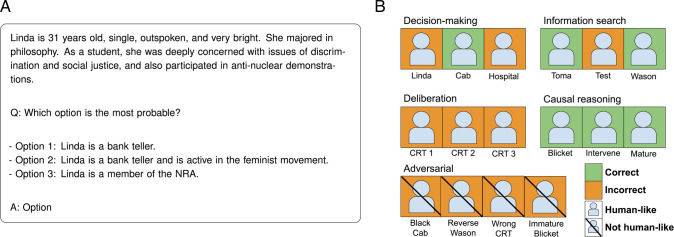
- Across 12 vignette-based problems, GPT-3 answered 6 correctly, and all 6 responses were described as human-like.
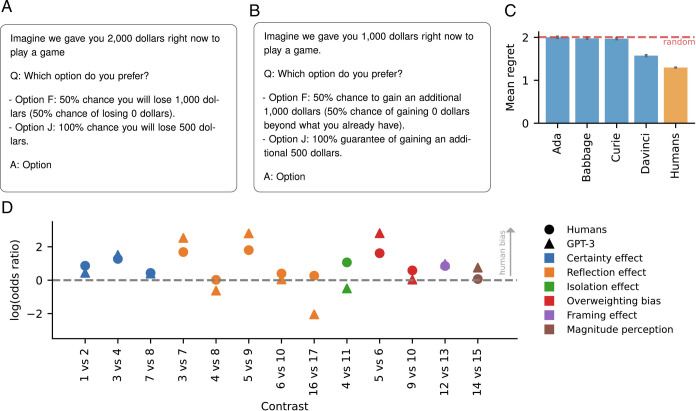
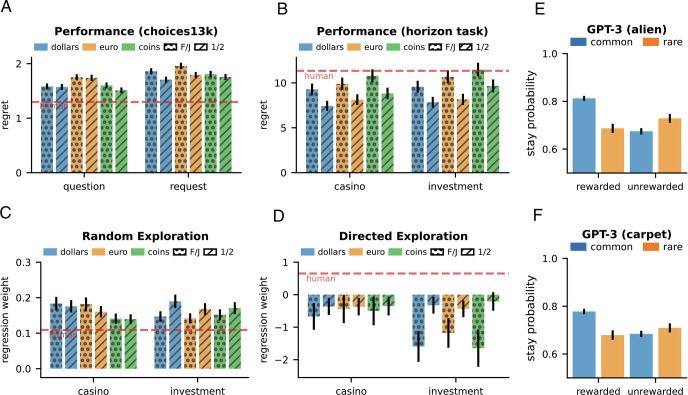
- In the decision-making benchmark, only Davinci performed above chance (t(29134) = −16.85, P < .001), but it still did not reach human performance (t(29134) = −11.50, P < .001).
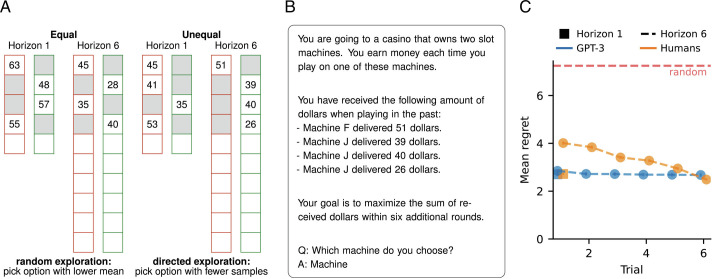
- In the horizon / information-search task, GPT-3 showed random exploration but not directed exploration: reward difference mattered (β = 0.18 ± 0.01, z = 14.48, P < .001), while the horizon interaction did not (β = −0.02 ± 0.02, z = −1.47, P = .14); human-like directed exploration was not observed (β = −0.15 ± 0.27, z = −0.56, P = .58).
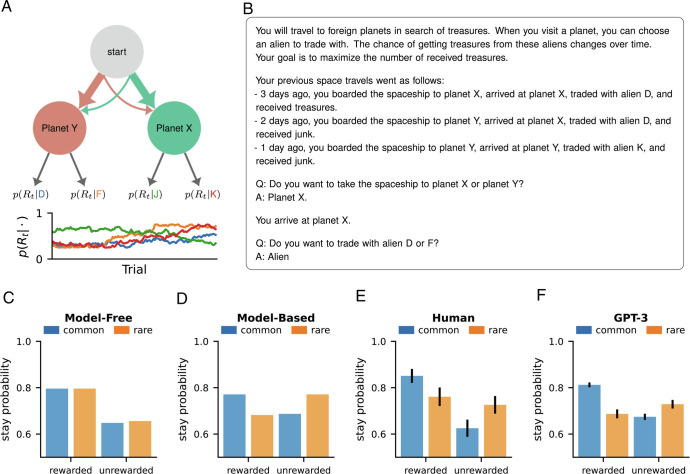
- In the two-step deliberation task, GPT-3 showed signatures consistent with model-based reinforcement learning: rare-transition reward affected stay/switch behavior (χ2(1, N = 1984) = 36.53, P < .001).
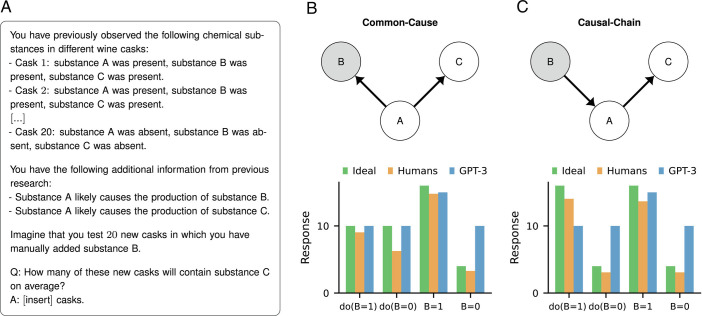
- On causal reasoning, GPT-3 succeeded in some vignette cases, but in the task-based causal test it failed to use causal structure properly; the authors conclude its causal inference was “neither the correct nor human-like.”
## Methods
- The authors used the public OpenAI API and primarily the Davinci GPT-3 model, with temperature set to 0 for deterministic responses unless otherwise noted.
- They ran 12 canonical vignette-based prompts from cognitive psychology and also conducted task-based, procedurally generated experiments: a decision-making benchmark with over 13,000 problems; 3,200 simulations of the horizon task; 200 simulations of the two-step task; and a causal reasoning task.
- Analyses included choice-probability contrasts, logistic regression, and chi-square tests; for the decision task they also report regret relative to human subjects.
## Limitations
- The paper states that vignette results are hard to interpret because GPT-3 may have encountered similar or identical scenarios in training data, and because small prompt changes can drastically alter responses.
- It also states that the vignette tasks can be adversarially modified, causing GPT-3 to respond very differently, which makes the findings brittle.
- Evident from the text: several results rely on prompt phrasing, cover stories, and API settings (for example, temperature and choice labels), so the findings may not generalize to other prompting setups.
Model-written summary. Check it against the paper before relying on it.
Integrity signals
Registry
Cites
Statistics
Figures
Verification
Claims the paper makes
9 Valid · 1 Not valid · 5 Not checked · 69 Own results and interpretations
The cited sources support only part of this claim — read each source’s verdict below.
In the paper
“For all three items of the CRT, GPT-3 responded with the intuitive but incorrect answer, as has been observed in earlier work (15).”
§ Using cognitive psychology to understand GPT-3 > Results > Vignette-Based Investigations.
What the sources say
- Partly supportedcites [15] M. Nye, M. Tessler, J. Tenenbaum, B. M. Lake, Improving coherence and consistency in neural sequence models with dual-system, neuro-symbolic reasoning. Adv. Neural Inf. Process. Syst. 34, 25192– 25204 (2021). sourceExperimental — accuracy not yet measured
The Introduction (p. 2) shows GPT-3 giving the intuitive but incorrect answer to the bat-and-ball CRT item. Appendix A (p. 14) discusses additional CRT questions but says GPT-3 makes the same mistakes as humans “often (but not always)”; the text does not establish that it gave that answer on all three original items. (LLM, conf=0.83)
plain- Asserted: passes — The authors put it forward as true.
- Checkable: passes — It can be checked against evidence.
- Load-bearing: passes — The paper’s conclusions depend on it.
- Based: passes — The paper gives a reason why it holds.
- Partly supported
Every source the paper cites for this claim was checked and supports it.
In the paper
“While humans show such an effect (27), we did not find it in GPT-3 (β = −0.15 ± 0.27, z = −0.56, P = .58), which demonstrates that the model did not employ directed exploration.”
§ Using cognitive psychology to understand GPT-3 > Results > Task-Based Investigations.
What the sources say
- Supportedcites [27] R. C. Wilson, A. Geana, J. M. White, E. A. Ludvig, J. D. Cohen, Humans use directed and random exploration to solve the explore–exploit dilemma. J. Exp. Psychol.: General 143, 2074 (2014). PMC5635655 25347535 source
The Results report that increasing the horizon from 1 to 6 increased the probability of choosing the more informative option in the unequal-information condition. The model fit also found a significant increase in the information bonus, consistent with the positive horizon effect on directed exploration attributed to humans. (LLM, conf=0.93)
plainstates an association- Asserted: passes — The authors put it forward as true.
- Checkable: passes — It can be checked against evidence.
- Load-bearing: passes — The paper’s conclusions depend on it.
- Based: passes — The paper gives a reason why it holds.
- Supported
The cited sources support only part of this claim — read each source’s verdict below.
In the paper
“First, the latest generation of language models is already able to perform above the human level in the majority of tasks from standard benchmark datasets (11, 12), making purely performance-based evaluation less meaningful as time progresses.”
§ Using cognitive psychology to understand GPT-3 > A Cognitive Psychology View on GPT-3.
What the sources say
- Partly supportedcites [11] M. Suzgun et al., Challenging big-bench tasks and whether chain-of-thought can solve them. arXiv [Preprint] (2022). http://arxiv.org/abs/2210.09261 (Accessed 20 January 2023). sourceExperimental — accuracy not yet measured
The Introduction reports that PaLM exceeded the average human-rater score on 65% of BIG-Bench tasks, supporting the majority-of-tasks point for that benchmark. It does not establish the claim across standard benchmark datasets generally. Section 8.1 also cautions that the human-rater scores are not fully representative of human performance. (LLM, conf=0.87)
- Partly supportedcites [12] H. W. Chung et al., Scaling instruction-finetuned language models. arXiv [Preprint] (2022). http://arxiv.org/abs/2210.11416 (Accessed 20 January 2023). sourceExperimental — accuracy not yet measured
Table 1 (Introduction, p. 2) shows Flan-PaLM exceeding the average human rater’s aggregate MMLU score, but not the average human expert’s. The paper does not establish that models exceed human performance on a majority of benchmark tasks; its Evaluation protocol (p. 5) describes the selected challenging benchmarks as ones on which current models remain well below expert human raters. (LLM, conf=0.84)
plain- Asserted: passes — The authors put it forward as true.
- Checkable: passes — It can be checked against evidence.
- Load-bearing: passes — The paper’s conclusions depend on it.
- Based: passes — The paper gives a reason why it holds.
- Partly supported
Every source the paper cites for this claim was checked and supports it.
In the paper
“People tend to solve this task using a combination of model-free and model-based learning (30) as shown in Fig. 4E.”
§ Using cognitive psychology to understand GPT-3 > Results > Task-Based Investigations.
What the sources say
- Supportedcites [30] N. D. Daw, S. J. Gershman, B. Seymour, P. Dayan, R. J. Dolan, Model-based influences on humans’ choices and striatal prediction errors. Neuron 69, 1204– 1215 (2011). 21435563 PMC3077926 source
The Results > Behavior section says the two-step task exercised both model-free and model-based learning strategies, with individual variation in how much subjects used each. It also reports that a hybrid model combining the two fit choices better than either strategy alone. (LLM, conf=0.94)
plain- Asserted: passes — The authors put it forward as true.
- Checkable: passes — It can be checked against evidence.
- Load-bearing: unclear — It is unclear whether the paper’s conclusions depend on it.
- Based: passes — The paper gives a reason why it holds.
- Supported
Every source the paper cites for this claim was checked and supports it.
In the paper
“It is well-known that large language models can be highly sensitive to specific prompts (34).”
§ Using cognitive psychology to understand GPT-3 > Results > Task-Based Investigations.
What the sources say
- Supportedcites [34] H. Strobelt et al., Interactive and visual prompt engineering for ad-hoc task adaptation with large language models (IEEE Trans. Vis. Comput, Graph., 2023), vol. 29, pp. 1146–1156. 36191099 source
The abstract (p. 1) says that prompt templates with different wording choices lead to significant accuracy differences. Section 2.1 (p. 2) likewise states that downstream performance is closely tied to prompt wording, supporting the claim that large language models can be highly sensitive to specific prompts. (LLM, conf=0.94)
boostedstates an association- Asserted: passes — The authors put it forward as true.
- Checkable: passes — It can be checked against evidence.
- Load-bearing: passes — The paper’s conclusions depend on it.
- Based: passes — The paper gives a reason why it holds.
- Supported
49 more claims
Create a free account to see all 84 claims and every source verdict.
- Probably not a substantial claim. 9
- It may state two separate claims as one. 23
- The quote only partly states this claim. 1
Claims other papers make about this one
Each is checked against this paper’s own text: does it say what the citing paper says it does?
The source backs part of the claim, not all of it — or backs it for a different population, condition or comparison.
In the citing paper
“cognitive psychology of LLM treats LLM as an agent whose input-output correlation between prompts (stimulus) and generations (responses) can be probed under controlled conditions to infer the agent’s internal representations.”
From Understanding large language models demands distinguishing human projection from machine cognition (2026) · cites this paper as [36]
Experimental — accuracy not yet measuredThe source backs part of the claim, not all of it — or backs it for a different population, condition or comparison.
In the citing paper
“These models are trained on large amounts of text, for example, obtained from the internet, and can answer questions, provide summaries or translations and create stories or poems (Fig. 1a)3,4.”
From The future landscape of large language models in medicine (2023) · cites this paper as [4]
Experimental — accuracy not yet measuredThe source backs part of the claim, not all of it — or backs it for a different population, condition or comparison.
In the citing paper
“as misconceived prompts may result in biases or misinformation with potentially serious consequences4.”
From The future landscape of large language models in medicine (2023) · cites this paper as [4]
Experimental — accuracy not yet measuredThe source backs part of the claim, not all of it — or backs it for a different population, condition or comparison.
In the citing paper
“These results add to the growing body of work characterizing the emergent capabilities of LLMs, 24-28 and suggest that the most sophisticated LLMs may already possess an emergent capacity to reason by analogy.”
From Emergent analogical reasoning in large language models (2023) · cites this paper as [28]
Experimental — accuracy not yet measuredThe cited source says what the claim attributes to it.
In the citing paper
“In contrast, the task-based cognitive approaches discussed earlier in this paper36,38,40–43 do not commit this error. They use established experimental paradigms to empirically test whether human and LLM cognition converge or diverge on specific dimensions, without presupposing cognitive equivalence as a starting point.”
From Understanding large language models demands distinguishing human projection from machine cognition (2026) · cites this paper as [36]
10 more claims about this paper
Create a free account to see every claim other papers make about this one.
Statistics that don’t add up
Each reported p-value recomputed from its test statistic and degrees of freedom, each partial η² from its F, and each ratio, mean difference or B printed with a p checked against its own confidence interval.
Rated minor: it would not touch a result — a value no result rests on, a p-value that stays on the same side of the significance level, or a conflict that is clerical, resolved elsewhere in the paper, or outside its own findings.
In the paper
“t(5550)= − 0.75, P = .23”
§ Using cognitive psychology to understand GPT-3 > Results > Task-Based Investigations.
Reported p = .23 · recomputed p = .453
Statistics recomputed
Every reported test result, recomputed from its test statistic and degrees of freedom. A result shows as not adding up only once an independent check has confirmed it.
- Doesn’t add upt(5550) = -0.75reported p = .23 · recomputed p = .453
“t(5550)= − 0.75, p = .23”
- Consistentt(29134) = -11.5reported p < .001 · recomputed p < .001
“t(29134)= − 11.50, p < .001”
- Consistentt(5566) = -0.043reported p = .97 · recomputed p = .966
“t(5566)= − 0.043, p = .97”
- Consistentt(5550) = -4.07reported p < .001 · recomputed p < .001
“t(5550)= − 4.07, p < .001”
- Consistentt(38878) = -5.03reported p < .001 · recomputed p < .001
“t(38878)= − 5.03, p < .001”
7 more recomputed tests
Create a free account to see every test the Stats check recomputed.
Self-check
Percentages, sums and reported differences re-computed from the paper’s own numbers.
Self-check results appear here once an independent check has confirmed them.
Citations
Cites
Vaswani, A., Shazeer, N., Parmar, N., Uszkoreit, J., Jones, L., Gomez, A. N., Kaiser, L., & Polosukhin, I. (2017) · arXiv · doi:10.48550/arxiv.1706.03762 · Cited by 120,404
Exploiting Generative AI to Scale up Intelligent Tutoring Systems
Jakubův, J., Chvalovský, K., Goertzel, Z., Kaliszyk, C., Olšák, M., Piotrowski, B., Schulz, S., Suda, M., & Urban, J. (2023) · DROPS (Schloss Dagstuhl – Leibniz Center for Informatics) · doi:10.4230/lipics.itp.2023.19 · Cited by 76,658
Language Models are Few-Shot Learners
Brown, T. B., Mann, B., Ryder, N., Subbiah, M., Kaplan, J., Dhariwal, P., Neelakantan, A., Shyam, P., Sastry, G., Askell, A., et al. (2020) · arXiv · doi:10.48550/arxiv.2005.14165 · Cited by 23,372
Kaugeranna, R., Kaugeranna, E., & Aion, (. S. 4. 6. (2023) · DROPS (Schloss Dagstuhl – Leibniz Center for Informatics) · doi:10.4230/lipics.giscience.2023.43 · Cited by 13,690
Causality: Models, Reasoning, and Inference
Pearl, J. (2009) · doi:10.1017/cbo9780511803161 · Cited by 11,653
On the Dangers of Stochastic Parrots: Can Language Models Be Too Big? 🦜
Bender, E. M., Gebru, T., McMillan-Major, A., & Shmitchell, S. (2021) · Proceedings of the 2021 ACM Conference on Fairness, Accountability, and Transparency · doi:10.1145/3442188.3445922 · Cited by 6,988
Cognitive Reflection and Decision Making
Frederick, S. (2005) · Journal of Economic Perspectives · doi:10.1257/089533005775196732 · Cited by 5,256
Subjective probability: A judgment of representativeness
Kahneman, D., & Tversky, A. (1972) · Cognitive Psychology · doi:10.1016/0010-0285(72)90016-3 · Cited by 4,851 · cited 1×
“Finally, we asked GPT-3 to provide an answer to the “hospital problem” 17 (Hospital, see SI Appendix), in which participants are asked which of two hospitals, a smaller or a larger one, is more likely to report more days on which more than 60% of all born children were boys.”
Extensional versus intuitive reasoning: The conjunction fallacy in probability judgment.
Tversky, A., & Kahneman, D. (1983) · Psychological Review · doi:10.1037/0033-295x.90.4.293 · Cited by 3,991 · cited 1×
“We began our investigations of GPT-3’s decision-making by prompting the canonical “Linda problem” 15 (Linda, see Figure 1A).”
On the Opportunities and Risks of Foundation Models
Bommasani, R., Hudson, D. A., Adeli, E., Altman, R., Arora, S., von Arx, S., Bernstein, M. S., Bohg, J., Bosselut, A., Brunskill, E., et al. (2021) · arXiv · doi:10.48550/arxiv.2108.07258 · Cited by 2,676
Research works printed but not linked: 2
- G. Marcus, E. Davis, GPT-3, bloviator: Openai’s language generator has no idea what it’s talking about (Technol, Rev, 2020).
- C. R. Jones et al., “Distributional semantics still can’t account for affordances” in Proceedings of the Annual Meeting of the Cognitive Science Society (2022), vol. 44.
Cited by
Items 301–400 of 531
Folk Economics in the Machine: LLMs and the Emergence of Mental AccountingPreprint
Leng, Y. (2024) · SSRN Electronic Journal · doi:10.2139/ssrn.4705130 · Cited by 11
Grammaticality Representation in ChatGPT as Compared to Linguists and LaypeoplePreprint
Qiu, Z., Duan, X., & Cai, Z. G. (2024) · PsyArXiv (OSF Preprints) · doi:10.31234/osf.io/r9zdh · Cited by 5
AI Knowledge and Reasoning: Emulating Expert Creativity in Scientific ResearchPreprint
Mukherjee, A., & Chang, H. H. (2024) · SSRN Electronic Journal · doi:10.2139/ssrn.4738442 · Cited by 13
Biases of Humans, of AI, and of Humans with AIPreprint
Chen, Y., Kirshner, S. N., Ovchinnikov, A. S., Andiappan, M., & Jenkin, T. A. (2024) · SSRN Electronic Journal · doi:10.2139/ssrn.4943377 · Cited by 7
Apidianaki, M., Fourtassi, A., & Padó, S. (2024) · Computational Linguistics · doi:10.1162/coli_e_00539 · Cited by 5
“…inspired by—the field of cognitive science, including eye tracking and brain imaging datasets, have been used to evaluate models’ behavior and to provide additional training signal (Ettinger 2020; Dunbar et al. 2017; Binz and Schulz 2023; Bingel, Barrett, and Søgaard 2016; Hollenstein et al. 2021).”
Machine marketing: rethinking the customer in the age of generative AI
Sarstedt, M., Adler, S. J., & Imschloss, M. (2026) · Journal of Marketing Analytics · doi:10.1057/s41270-026-00521-y · Cited by 3
Amplifying the Anomaly: How Humans Choose Unproven Options and Large Language Models Avoid Them
Brandt, A. (2024) · Creativity Research Journal · doi:10.1080/10400419.2024.2361217 · Cited by 6
“Indeed, studies indicate that LLMs can match or exceed human performance on evaluations of creativity such as the Torrance Test (Guzik et al., 2023) and other measures (Hubert et al., 2024).”
A thematic analysis of what Australians state would change their minds on climate change
Lee, A. S. G., Kirkland, K., Stanley, S. K., Robinson, A., Leviston, Z., & Walker, I. A. (2025) · Scientific Reports · doi:10.1038/s41598-025-96714-z · Cited by 4
“Overall, however, our findings support GPT’s effectiveness and efficiency in handling thematic coding for large amounts of text data and add to growing evidence demonstrating LMMs’ capacity to perform a variety of tasks at human or near-human levels 35,70–73 .”
Capturing Argument in Agent-Based Models
Assaad, L., Fuchs, R., Phillips, K., Schöppl, K., & Hahn, U. (2025) · Topoi · doi:10.1007/s11245-025-10215-2 · Cited by 3
“…of the LLM in question that are to do with its reasoning or inferential abilities [e.g., its ability to handle inductive and deductive arguments (Cheng et al. 2024) its capacity for causal reasoning (Binz and Schulz 2023) or its sensitivity to probabilistic coherence (Betz and Richardson 2023)].”
NMR-Challenge for LLMs: Evaluating Chemical Reasoning in Humans and AI
Sharlin, S., Agbere, F., Ishimwe, K., Osifová, Z., Socha, O., Dračínský, M., & Josephson, T. R. (2026) · Journal of Chemical Information and Modeling · doi:10.1021/acs.jcim.6c00481 · Cited by 13
Active use of latent tree-structured sentence representation in humans and large language models
Liu, W., Xiang, M., & Ding, N. (2025) · Nature Human Behaviour · doi:10.1038/s41562-025-02297-0 · Cited by 13
Can large language models exhibit cognitive and affective empathy as humans?
Yu, T., Pan, S., Fan, C., Luo, S., Jin, Y., & Zhao, B. (2025) · Computers in Human Behavior Artificial Humans · doi:10.1016/j.chbah.2025.100233 · Cited by 13
Chemke‐Dreyfus, A., Crimston, C. R., Selvanathan, H. P., & Jetten, J. (2025) · European Journal of Social Psychology · doi:10.1002/ejsp.70034 · Cited by 2
LLMs are not weird: Comparing AI and human financial decision-making
Erdem, O., & Ashok, R. P. (2025) · Journal of Behavioral and Experimental Economics · doi:10.1016/j.socec.2025.102505 · Cited by 8
Generic fitting models learn edge representations from prenatal retinal waves
Pandey, L., Wood, S. M. W., Cappell, B., & Wood, J. N. (2026) · Cognition · doi:10.1016/j.cognition.2025.106415 · Cited by 3
A large-scale evaluation of commonsense knowledge in humans and large language models
Nguyen, T. D., Watts, D. J., & Whiting, M. E. (2026) · PNAS Nexus · doi:10.1093/pnasnexus/pgag029 · Cited by 10
SUVA: A Probabilistic Framework for Auditing LLMs with an Application to Social Preferences
Leng, Y., & Yuan, Y. (2026) · Information Systems Research · doi:10.1287/isre.2024.0857 · Cited by 7
Integrating generative AI for comprehensive ELT material development
Aguş, F. S., & Mutlu, M. E. (2026) · Innovation in Language Learning and Teaching · doi:10.1080/17501229.2026.2641791 · Cited by 8
Schulte, N., & Kanbach, D. K. (2026) · Management Review Quarterly · doi:10.1007/s11301-026-00611-2 · Cited by 21
When Can AI Models Explain Learning? Validity Criteria for AI as Cognitive Models in Education
Wang, P., Viberg, O., Law, E. L.-C., & Greiff, S. (2026) · Educational Psychology Review · doi:10.1007/s10648-026-10202-y · Cited by 3
“…& Kaiser, 2019 ), reinforcement learning agents (Sutton & Barto, 1998 ), cognitive architectures, and large language models (Binz et al., 2025 ; Binz & Schulz, 2023 ), substantially expand the space of testable learning theories by enabling researchers to instantiate hypotheses about memory,…”
Like humans, language models demonstrate face-to-character biases
Lehr, S. A., Lothe, Y., & Banaji, M. R. (2026) · PNAS Nexus · doi:10.1093/pnasnexus/pgag247 · Cited by 3
“” On the other hand, LLMs have increasingly been shown to exhibit unexpected behaviors and abilities for which they were not explicitly trained (18, 23 – 26).”
Differences of Training Structures on Stimulus Class Formation in Computational Agents
Carrillo, A., & Betancort, M. (2023) · Multimodal Technologies and Interaction · doi:10.3390/mti7040039 · Cited by 3
Evaluation of ChatGPT Applicability to Learning Quantum Physics
Stefańska, A., Stefański, T. P., & Czubenko, M. (2023) · International Conference on Signal Processing and Communication Systems · doi:10.1109/icspcs58109.2023.10261132 · Cited by 5
Metric-Independent Mitigation of Unpredefined Bias in Machine Classification
Tang, Z., Lu, T., & Li, T. (2024) · Intelligent Computing · doi:10.34133/icomputing.0083 · Cited by 2
Machine Agencies: Large Language Models as a Case for a Sociology of Machines
Yolgörmez, C. (2024) · Oxford University Press eBooks · doi:10.1093/oxfordhb/9780197653609.013.30 · Cited by 2
Generative Künstliche Intelligenz: Mögliche Auswirkungen auf die psychologische Forschung
Buder, J., Lindner, M. A., Oestermeier, U., Huff, M., Gerjets, P. H., Utz, S., & Creß, U. (2024) · Psychologische Rundschau · doi:10.1026/0033-3042/a000699 · Cited by 4
Li, X., & Jiang, C. (2024) · doi:10.1145/3698383.3699622 · Cited by 2
“The intersection of cognitive neuroscience and large language models represents a compelling frontier in the study of human cognition and artificial intelligence [3, 8].”
ChatGPT and CLT: Investigating differences in multimodal processing
Cahalane, M. C., & Kirshner, S. N. (2024) · Journal of Economy and Technology · doi:10.1016/j.ject.2024.11.008 · Cited by 3
Grammaticality representation in ChatGPT as compared to linguists and laypeople
Qiu, Z., Duan, X., & Cai, Z. G. (2025) · Humanities and Social Sciences Communications · doi:10.1057/s41599-025-04907-8 · Cited by 5
“Pioneering work by Binz and Schulz (2023) subjected GPT-3 to a battery of psychological tests, originally crafted to understand facets of human thought processes, ranging from decision-making matrices to reasoning pathways.”
Turing Jest: Distributional Semantics and One‐Line Jokes
Trott, S., Walker, D. E., Taylor, S. M., & Coulson, S. (2025) · Cognitive Science · doi:10.1111/cogs.70066 · Cited by 4
“Notably, either a positive or a negative answer would contribute to “machine psychology,” a growing field that seeks to characterize the cognitive capacities of LLMs themselves (Binz & Schulz, 2023; Hagendorff, 2023).”
Estimating Belief Updates in AI-Driven Drone Controls for Urban Search and Rescue Operations
Sun, B., Wu, J., You, H., & Du, J. (2025) · Journal of Construction Engineering and Management · doi:10.1061/jcemd4.coeng-15747 · Cited by 2
Three scenarios of development: a predictive psychobiography of ChatGPT
Bálint, Á., Jenák, I., & Rab, V. (2025) · International Review of Psychiatry · doi:10.1080/09540261.2025.2529243 · Cited by 5
“As Binz and Schulz (2023, p. 9) predicted, for GPT-3, ‘actively interacting with the world will be crucial for matching the fill complexity of human cognition’.”
(Ir)rationality in AI: state of the art, research challenges and open questions
Macmillan-Scott, O., & Musolesi, M. (2025) · Artificial Intelligence Review · doi:10.1007/s10462-025-11341-4 · Cited by 16
“…of these biases (Barron & Leider 2010; Clotfelter & Cook 1993; Donovan & Epstein 1997; Nisbett & Borgida 1975; Tentori et al. 2004) (in recent years, similar experiments have been done with LLMs instead of humans (Binz & Schulz 2023; Hagendorff et al. 2023; Macmillan-Scott & Musolesi 2024)).”
InfluentialArtificial Intelligence Chatbots Mimic Human Collective BehaviourPreprint
He, J. K., Wallis, F. P. S., Gvirtz, A., & Rathje, S. (2023) · PsyArXiv (OSF Preprints) · doi:10.31234/osf.io/vf5ap · Cited by 2
The Mixed Subjects Design: Treating Large Language Models as Potentially Informative ObservationsPreprint
Broska, D., Howes, M., & van Loon, A. (2024) · SocArXiv (OSF Preprints) · doi:10.31235/osf.io/j3bnt · Cited by 4
Breaking Up with NVivo: AI Delivers Faster, Deeper, and Better Qualitative InsightsPreprint
Cameron, H. (2025) · SSRN Electronic Journal · doi:10.2139/ssrn.5180913 · Cited by 4
Large Language Models as Psychological Simulators: A Methodological GuidePreprint
Lin, Z. (2025) · doi:10.31234/osf.io/cxj7d_v1 · Cited by 2
POSQA: Probe the World Models of LLMs with Size Comparisons
Shu, C., Han, J., Liu, F., Shareghi, E., & Collier, N. (2023) · arXiv · doi:10.48550/arxiv.2310.13394 · Cited by 2
“…study on the boundary of the world understanding of LLMs. Similarly to other research on LLMs inspired by cognitive science and psychology (Binz and Schulz, 2022; Bisk et al., 2020a; Mahowald et al., 2023; Prystawski et al., 2022), we propose to audit the real-world understanding of LLM…”
BackgroundSynthetic Participants Generated by Large Language Models: A Systematic Literature Review
Kuric, E., Demcak, P., & Krajcovic, M. (2026) · doi:10.21203/rs.3.rs-9057643/v1 · Cited by 2
Balthasar, M. (2024) · i-com · doi:10.1515/icom-2024-0016 · Cited by 1
VedicFusion: Bridging Ancient Wisdom and Modern AI Through Natural Language Processing
Kasundra, C., Kariya, S., Dhaduk, M., Rupda, K., Vachhani, G., Jain, R., & Palaniappan, D. (2025) · International Conference on Intelligent Systems, Advanced Computing and Communication (ISACC) · doi:10.1109/isacc65211.2025.10969323 · Cited by 1
Relative Value Encoding in Large Language Models: A Multi-Task, Multi-Model Investigation
Hayes, W. M., Yax, N., & Palminteri, S. (2025) · Open Mind · doi:10.1162/opmi_a_00209 · Cited by 4
Neural language models as content analysis tools in psychology
Acciai, A., Guerrisi, L., Plebe, A., & Suriano, R. (2025) · Philosophical Psychology · doi:10.1080/09515089.2025.2508942 · Cited by 4
“…of these models, their linguistic mastery emerges (Wolfram, 2023, p. 71), and a research direction has been forming, known as machine psychology , which attempts to investigate the operation of the LLMs using the empirical methods of psychology (Binz & Schulz, 2023; Frank, 2023; Hagendorff, 2023).”
Zhou, Y., Wang, J., Yixin, D., Meng, X., & Gao, A. (2025) · Journal of Systems Science and Systems Engineering · doi:10.1007/s11518-025-5674-8 · Cited by 2
Cognitive Based Detection of Anomalous Sequences Using Bayesian Surprise
McGarry, K., & Nelson, D. (2025) · Expert Systems · doi:10.1111/exsy.70106 · Cited by 2
Xiong, Y., & Wu, S. (2025) · Acta Psychologica · doi:10.1016/j.actpsy.2025.105518 · Cited by 2
General interaction battery: Simple object navigation and affordances (GIBSONA)
Rutar, D., Markelius, A., Schellaert, W., Hernández‐Orallo, J., & Cheke, L. G. (2025) · Cognitive Systems Research · doi:10.1016/j.cogsys.2025.101411 · Cited by 2
ControlA: Agentic Workflow Control Mechanisms for Reliable Science
Gueroudji, A., Mallick, T., de Souza, R. P., da Silva, R. F., Ross, R. B., Dorier, M., Carns, P., Chard, K., & Foster, I. T. (2025) · IEEE International Conference on eScience · doi:10.1109/escience65000.2025.00086 · Cited by 6
“The evaluation focused on two key dimensions: correctness and human likeness [31].”
Salvatore, N., & Zhang, Q. (2025) · Communications Psychology · doi:10.1038/s44271-025-00322-6 · Cited by 2
“Weexpectthattheseq2seqmodelcansimilarlyaccountforthesetasks, giventhemappingwehavederivedbetweentheseq2seqmodelarchitecture andthecontextdriftingmechanisminCMR,andthe fl exibility in the seq2seq model to learn from the complex dynamics of context change.”
Shi, C., & Paracha, S. (2025) · Mental Health and Digital Technologies · doi:10.1108/mhdt-07-2025-0041 · Cited by 2
Challenging the Validity of Personality Tests for Large Language Models
Sühr, T., Dorner, F. E., Samadi, S., & Kelava, A. (2025) · ACM Conference on Equity and Access in Algorithms, Mechanisms, and Optimization (EAAMO) · doi:10.1145/3757887.3763016 · Cited by 61
“We used the personas from [43], for more details please consult Appendix E.”
Nonlinear transformation of probabilities by large language models
Hintze, A., Bisht, C., Schossau, J., & Hertwig, R. (2025) · Computers in Human Behavior: Artificial Humans · doi:10.1016/j.chbah.2025.100227 · Cited by 1
Toward LLM-enabled business process coherence checking based on multi-level process documentation
Schulte, M., Franzoi, S., Köhne, F., & Brocke, J. V. (2025) · Process Science · doi:10.1007/s44311-025-00024-6 · Cited by 4
“LLMs have advanced capabilities for processing and interpreting textual data, enabling them to make subjective decisions based on the context of the content provided (Binz and Schulz 2023; Mcintosh et al. 2024).”
Zhang, Z., Zeng, W., Tang, J., Wang, J., & Zhao, X. H. (2025) · ACM International Conference on Information and Knowledge Management (CIKM) · doi:10.1145/3746252.3761350 · Cited by 4
Du, J., Li, S., Chen, J., & Li, J. (2025) · Education and Information Technologies · doi:10.1007/s10639-025-13842-9 · Cited by 2
“…mental states and social behaviors to a considerable degree, enabling their participation in social surveys and experiments (Argyle et al., 2023 ; Binz & Schulz, 2023; Dillion et al., 2023; Hewitt et al., 2024; Huang et al., 2024 ; Imschloss et al., 2025; Li et al., 2025; Park et al., 2024a, b ,…”
Ma, J., Gong, L., Song, Y., Wang, G., Xia, J., Cheng, X., Liu, Y., Jia, B., & Chen, Y. (2025) · BMC Medical Informatics and Decision Making · doi:10.1186/s12911-025-03273-4 · Cited by 2
“Trained on diverse datasets, these models excel in tasks ranging from translation to summarization and question answering [1].”
Sensorimotor Regularities as Alignment between Humans and Large Language Models
Li, J., Hu, J., & Kristensson, P. O. (2026) · ACM Transactions on Computer-Human Interaction · doi:10.1145/3778353 · Cited by 1
The meaning of prompts: a semiotic approach to human–machine communication
Thellefsen, M., Dewi, A. N., & Sørensen, B. M. (2026) · Journal of Documentation · doi:10.1108/jd-03-2026-0140 · Cited by 6
Using Human Cumulative Prospect Theory to Understand Large Language Models Decision-Making
Zhang, G., Wu, J., Wang, P., & Tan, M. (2025) · IEEE Transactions on Computational Social Systems · doi:10.1109/tcss.2025.3636502 · Cited by 1
“Finally, existing studies [19], [21], [22] show that LLMs exhibit behavioral biases similar to humans.”
InfluentialDecision Making Obstacles and Strategic Performance of Indian MSMEs: A Stochastic Approach
Hussein, T. M., Ukaidi, C. U. A., Ateeq, A. A., Raman, V., & Ateeq, R. A. (2025) · Studies in systems, decision and control · doi:10.1007/978-3-031-91424-9_49 · Cited by 4
Cen, C., Zhang, Q., Xu, Z., Wen, F., Lin, Z., Liu, H., Xu, Y., Zou, Y., & Liang, Y. (2025) · doi:10.1145/3769698.3771223 · Cited by 2
“…of numerical optimization—that all decision factors can be quantified and compared through a unified numerical scale—does not hold in vehicular network safety decisions, because concepts such as “urgency,” “safety-criticality,” and “user importance” have heterogeneous semantic essence [1].”
Bilon, X. J. (2025) · Journal of Decision System · doi:10.1080/12460125.2025.2599912 · Cited by 3
“It also draws a parallel between interpreting opaque human cognition and the challenges of understanding black-box AI systems (Bilon, 2025; Binz & Schulz, 2023).”
Cognitive networks identify AI biases on societal issues in Large Language Models
Duro, E. S. D., Franchino, E., Improta, R., Veltri, G., & Stella, M. (2025) · EPJ Data Science · doi:10.1140/epjds/s13688-025-00600-7 · Cited by 9
Jang, M. (2026) · Information · doi:10.3390/info17020212 · Cited by 3
Health or taste? Investigating food decision-making patterns in humans and large language models
Lyu, M., & Huang, J. (2026) · Appetite · doi:10.1016/j.appet.2026.108512 · Cited by 1
Revisiting the role of linguistic knowledge in large language models through prompting
Sataer, Y., Gao, M., Shi, C., Li, B., & Gao, Z. (2026) · Knowledge-Based Systems · doi:10.1016/j.knosys.2026.115667 · Cited by 1
Divergent patterns of probabilistic reasoning in humans and GPT-5
Imannezhad, P., Pothos, E. M., & Wills, A. J. (2026) · Frontiers in Psychology · doi:10.3389/fpsyg.2026.1782184 · Cited by 9
Varianten und Risikoaspekte des psychologisch-therapeutischen KI-Einsatzes
Wanderwitz, M., & Weber, E. (2026) · Springer eBooks · doi:10.1007/978-3-662-72661-7_12 · Cited by 1
From Text to Insight: Leveraging Large Language Models for Performance Evaluation in Management
Li, N., Zhou, H., & Xu, M. (2026) · Personnel Psychology · doi:10.1111/peps.70020 · Cited by 4
“This built-in variance— arising from probabilistic token sampling rather than genuine differences in perspective—allows multiple LLM evaluation instances to capture different points in the model’s output distribution (Binz and Schulz 2023 ; Brown et al. 2020 ).”
Artificially intelligent opinion polling
Cerina, R., & Duch, R. M. (2026) · Royal Society Open Science · doi:10.1098/rsos.251150 · Cited by 2
McBride, R. (2026) · Strategy Science · doi:10.1287/stsc.2025.0439 · Cited by 6
Do large language model outputs exhibit algorithm aversion? A case study using GPT-3.5
Liu, Z., He, X., Xie, Y., & Zhou, R. (2026) · International Journal of Industrial Ergonomics · doi:10.1016/j.ergon.2026.103937 · Cited by 2
Metacognition of ChatGPT in confidence judgements
YOSHIZAWA, S., Onzo, A., Nozawa, S., Takano, T., Ishikawa, T., & Mogi, K. (2026) · Frontiers in Artificial Intelligence · doi:10.3389/frai.2026.1694192 · Cited by 2
“LLMs have been studied as a cognitive model (Frank, 2023; Binz and Schulz, 2023; Shiffrin and Mitchell, 2023) in comparison with humans.”
Mapping the landscape of AI-empowered psychology: a topic modeling-based bibliometric analysis
Jia, S., Zhang, Y., & Wang, F. (2026) · Artificial Intelligence Review · doi:10.1007/s10462-026-11543-4 · Cited by 3
“Cognitive psychologists apply classic cognitive experimental paradigms to LLMs to explore the source of their intelligent behavior (Binz and Schulz 2023 ).”
Califano, G., & Caracciolo, F. (2026) · Food Quality and Preference · doi:10.1016/j.foodqual.2026.105930 · Cited by 5
Hawkins, T., Cassenti, D. N., & Zaroukian, E. G. (2026) · Behavior Research Methods · doi:10.3758/s13428-026-02979-1 · Cited by 1
Proto-Interpretation: The Temporality of Large Language Model Inference
Rost, M. (2026) · ACM AI Letters · doi:10.1145/3789666 · Cited by 1
“Recent work conceptualizes LLMs in terms of latent-space inference and simulation of underlying causes [5] or as systems capable of weak world modeling [3, 6].”
Stoeber, T., Hammerschmidt, J., Lundervold, A., Kromidha, E., Kanbach, D. K., & Kraus, S. (2026) · Journal of Business Research · doi:10.1016/j.jbusres.2026.116227 · Cited by 5
Narrative–affect discrepancy as a regulated degree of freedom in 351,734 relationship narratives
Kim, R. S. (2026) · PLoS ONE · doi:10.1371/journal.pone.0348715 · Cited by 2
“Prior work has shown that alignment can reduce variance and extremity in model outputs [36,44], while studies applying cognitive and clinical benchmarks to language models have documented both surprising competencies and systematic limitations [45,46].”
Pinna, M., Galletta, S., Ash, E., & Elmer, T. (2026) · JMIR Formative Research · doi:10.2196/85427 · Cited by 2
“In particular, they have been explored in the context of cognitive behavioral therapy [22], highlighting their impressive language understanding and reasoning capabilities with potential applications in mental health care.”
Davinci the Dualist: The Mind–Body Divide in Large Language Models and in Human Learners
Berent, I., & Sansiveri, A. (2024) · Open Mind · doi:10.1162/opmi_a_00120 · Cited by 5
“Although Davinci ’ s performance remains imperfect (e.g., Binz & Schulz, 2023; Mitchell, 2023; Sap et al., 2022), it demonstrably approximates human learning in several domains (e.g., Dillion et al., 2023; Grossmann et al., 2023; but cf. Park et al., 2024); some have even credited it with general…”
BackgroundA Comparative Study on Artificial Intelligence and Courtroom Practices With India, UK, and USA
Sivasankar, S. (2024) · Advances in human resources management and organizational development book series · doi:10.4018/979-8-3693-0724-3.ch001 · Cited by 1
Beyond the Hype: Local Engagement with AI-Generated Tourism Content
Nugroho, V. T. A., Soelistiyowati, E., Permatasari, A. N., & Iban, C. (2024) · Jurnal Pariwisata Terapan · doi:10.22146/jpt.96617 · Cited by 1
“Binz & Schulz (2023), who do not share their optimism, critically evaluated the cognitive abilities of GPT-3 in their study.”
BackgroundRationality of Thought Improves Reasoning in Large Language Models
Gou, T., Zhang, B., Sun, Z., Wang, J., Liu, F., Wang, Y., & Wang, J. (2024) · Lecture notes in computer science · doi:10.1007/978-981-97-5501-1_26 · Cited by 6
On the Cultural Sensitivity of Large Language Models: GPT's Ability to Simulate Human Self-Concept
Luo, Y., Du, J. S., & Qiu, L. (2024) · International Conference on Behavioral, Economic, and Socio-Cultural Computing · doi:10.1109/besc64747.2024.10780488 · Cited by 3
“This growing body of research has revealed that LLMs reliably show linguistic, reasoning, and problem-solving capacities that are on par with, or superior to those of humans [4], [5], [6] through cognitive processes that closely mirror humans [7], [8], [9].”
Hou, C., Su, Y., Tian, Q., et al. (2025) · Lecture notes in electrical engineering · doi:10.1007/978-981-96-2046-3_31 · Cited by 1
Finding structure during incremental speech comprehensionPreprint
Lyu, B., Marslen‐Wilson, W. D., Fang, Y., & TYLER, L. K. (2023) · eLife · doi:10.7554/elife.89311.1 · Cited by 1
Large language models in the labyrinth: Possibility spaces and moral constraints
Poulsen, V. M., & DeDeo, S. (2023) · Possibility Studies & Society · doi:10.1177/27538699231206210 · Cited by 3
“In particular, given their ability to produce human-like text (Bail, 2023; Binz & Schulz, 2023; Dillion et al., 2023), they can serve as tools to rapidly map the geometry of possibilities available to an agent in a given context.”
BackgroundA Step-By-Step Method for Cultural Annotation by LLMsPreprint
Dubourg, E., Thouzeau, V., & Baumard, N. (2023) · doi:10.31219/osf.io/zuejp · Cited by 1
Niedermann, J., Sucholutsky, I., Marjieh, R., Çelen, E., Griffiths, T. L., Jacoby, N., & van Rijn, P. (2024) · PsyArXiv (OSF Preprints) · doi:10.31234/osf.io/3jvxw · Cited by 5
What Can Language Models Tell us About Human Cognition?Preprint
Connell, L., & Lynott, D. (2024) · doi:10.31234/osf.io/sy4h9 · Cited by 1
Verbal Reports as Data Revisited: Using Natural Language Models to Validate Cognitive ModelsPreprint
Mechera‐Ostrovsky, T., & Newell, B. R. (2024) · doi:10.31234/osf.io/eukqr · Cited by 1
Ciringione, L., Reigl, S., D'Onofrio, I., Poquet, O., Gabriel, F. C., & Stella, M. (2024) · doi:10.31234/osf.io/e5t7a · Cited by 1
A Comparison of Artificial Intelligence and Human Responses in Audit ExperimentsPreprint
MacKenzie, N. L., Moon, J., Rykowski, S., Swanquist, Q. T., & Whited, R. L. (2025) · SSRN Electronic Journal · doi:10.2139/ssrn.5036687 · Cited by 6
Quantifying Uncert-AI-nty: Testing the Accuracy of LLMs’ Confidence JudgmentsPreprint
Cash, T. N., Oppenheimer, D. M., Christie, S., & Devgan, M. (2025) · PsyArXiv (OSF Preprints) · doi:10.31234/osf.io/47df5_v3 · Cited by 1
Can AI hold up fists? The vertical-valence metaphor in Chat GPT-4Preprint
Sasaki, K., Yonemitsu, F., & Yamada, Y. (2025) · PsyArXiv (OSF Preprints) · doi:10.31234/osf.io/jtfxk_v1 · Cited by 1
AI Writing Assistants and Student Competence: A Linguistic AspectPreprint
Pryma, V., Pelivan, O. K., Цобенко, О. В., et al. (2025) · doi:10.31235/osf.io/sf27w_v1 · Cited by 1
General Social AgentsPreprint
Manning, B. S., & Horton, J. J. (2025) · SSRN Electronic Journal · doi:10.2139/ssrn.5521881 · Cited by 25
From Expectation to Evaluation: Expectation Cues Systematically Bias LLM and Human Judgment
Sun, Y., Dillion, D., Gray, K. J., Lyu, M., Zhang, Z., & Li, F. (2026) · CHI Conference on Human Factors in Computing Systems · doi:10.1145/3772318.3790492 · Cited by 2
Linguistic traces of stochastic empathy in language models
Kleinberg, B., Zegers, J., Festor, J., Vida, S., Präsent, J., Loconte, R., & Peereboom, S. (2024) · arXiv · doi:10.48550/arxiv.2410.01675 · Cited by 1
“Using that approach led to the discovery of racial prejudices in LLMs [21], proneness to cognitive biases [22], illusory truth effects in LLMs [23] and early efforts on testing a theory of mind in AI models [24,25].”
Metadata
- Authors
- Binz, M., & Schulz, E.
- Affiliations
- Max Planck Institute for Biological Cybernetics (DE)
- Corresponding author
- Binz, Marcel
- Venue
- Proceedings of the National Academy of Sciences
- Publisher
- National Academy of Sciences
- Published
- 2023-02-02
- Volume
- 120
- Issue
- 6
- Pages
- e2218523120-e2218523120
- ISSN
- 0027-8424 (ISSN-L)
- 1091-6490
- PMC
- PMC9963545
- OpenAlex
- W4318919287
- Cited by
- 559
- References
- 47
- Citations by year
- 2026: 146 · 2025: 162 · 2024: 151 · 2023: 92
- FWCI
- 51.80
- Type
- journal article
- Language
- en
- Open access
- hybrid
- doi.org
- Licence
- Locations
- Proceedings of the National Academy of Sciences (publishedVersion, cc-by-nc-nd)
- PubMed Central (publishedVersion, cc-by-nc-nd)
- PubMed (publishedVersion)
- arXiv (Cornell University) (submittedVersion)
- PsyArXiv (OSF Preprints) (submittedVersion, cc-by)
- PsyArXiv (OSF Preprints) (submittedVersion)
- arXiv (Cornell University) (cc-by)
- Funders
- Volkswagen Foundation (VW98569)
- Deutsche Forschungsgemeinschaft (EXC2064/1-390727645)
- Max-Planck-Gesellschaft (-)
- Topics
- Physical Sciences › Computer Science › Artificial Intelligence › Topic Modeling
- Physical Sciences › Computer Science › Artificial Intelligence › Psychiatry, Mental Health, Neuroscience
- Physical Sciences › Computer Science › Artificial Intelligence › Natural Language Processing Techniques
- Keywords
- GPT-3, large language models, cognitive psychology, decision-making, information search, deliberation, causal reasoning, model-based reinforcement learning, multi-armed bandits, directed exploration
- MeSH terms
- Cognitive Psychology, Decision Making, Humans, Learning, Problem Solving, Reinforcement, Psychology
About these checks
Registry, retraction, Cites and statistics results are computed, not judged, with one exception: a printed reference that no index lists is read once by a model before it counts as a citation error. Claims are extracted by a model and kept only when their quote appears verbatim in the text; each cited source is then checked, with a model’s help, for whether it says what the claim relies on. Those verdicts can be wrong — read the claim’s quote and the cited source before relying on one.
The claim verdicts this report counts are experimental: their accuracy is not yet measured.
A language model drew the claims from the paper on 2026-10-01, under version 3 of the claim definition (model deepseek-v4.1-flash, prompt extract-v3).
A second model labelled each claim on 2026-10-01 (model jev-1.13-20260917, definition revision gold-guideline-v0.2).
Cited sources are checked with a language model’s help (gpt-6-sol).
Statistics and arithmetic are recomputed, not judged.
Confidence bands are shown only for fields calibrated on our annotated test set. None is calibrated yet, so no band is shown.
What counts as a claim ›How we measure confidence ›How we check this ›
Are you an author, or do you see a problem with this page? Request a review
Data sources
Bibliographic data: Semantic Scholar, OpenAlex, Crossref.
Contains information from the Semantic Scholar Academic Graph Datasets, made available under the ODC Attribution License (ODC-BY 1.0).
Semantic Scholar’s data is described in: Kinney, R., et al. (2023). The Semantic Scholar Open Data Platform. arXiv:2301.10140.
