

Using cognitive psychology to understand GPT-3
Open accessThe DOI matches its Crossref record; 63 of the 63 references it cites were found in a registry or an index; 10 of the 16 sources its claims cite were checked for support.
Abstract
We study GPT-3, a recent large language model, using tools from cognitive psychology. More specifically, we assess GPT-3’s decision-making, information search, deliberation, and causal reasoning abilities on a battery of canonical experiments from the literature. We find that much of GPT-3’s behavior is impressive: It solves vignette-based tasks similarly or better than human subjects, is able to make decent decisions from descriptions, outperforms humans in a multiarmed bandit task, and shows signatures of model-based reinforcement learning. Yet, we also find that small perturbations to vignette-based tasks can lead GPT-3 vastly astray, that it shows no signatures of directed exploration, and that it fails miserably in a causal reasoning task. Taken together, these results enrich our understanding of current large language models and pave the way for future investigations using tools from cognitive psychology to study increasingly capable and opaque artificial agents.
Overview
CoChat Summary
## TL;DR
The paper treats GPT-3 like a participant in cognitive psychology experiments and finds it can solve many classical reasoning tasks reasonably well. But its behavior is brittle to prompt changes and it lacks some human-like features, especially directed exploration and robust causal reasoning.
## Key findings
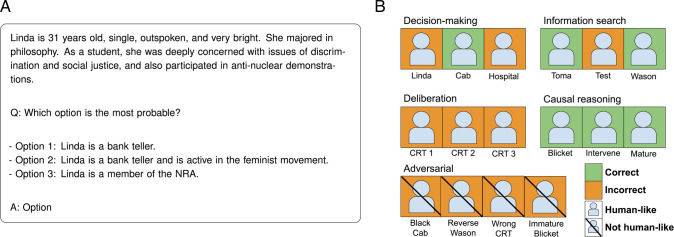
- Across 12 vignette-based problems, GPT-3 answered 6 correctly, and all 6 responses were described as human-like.
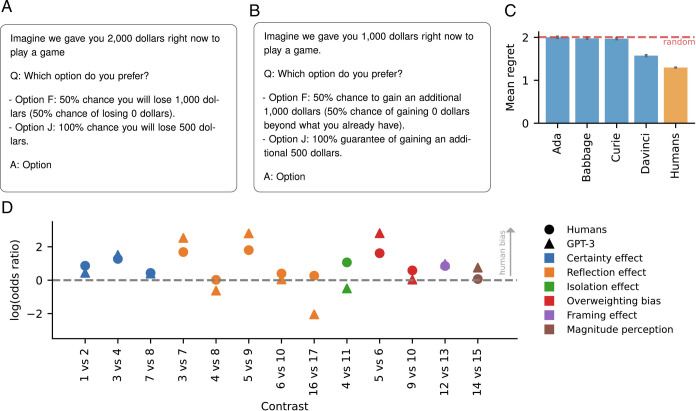
- In the decision-making benchmark, only Davinci performed above chance (t(29134) = −16.85, P < .001), but it still did not reach human performance (t(29134) = −11.50, P < .001).
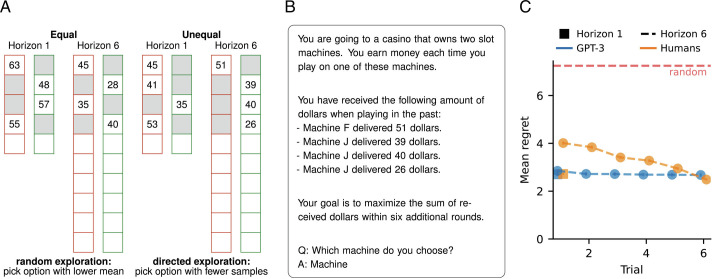
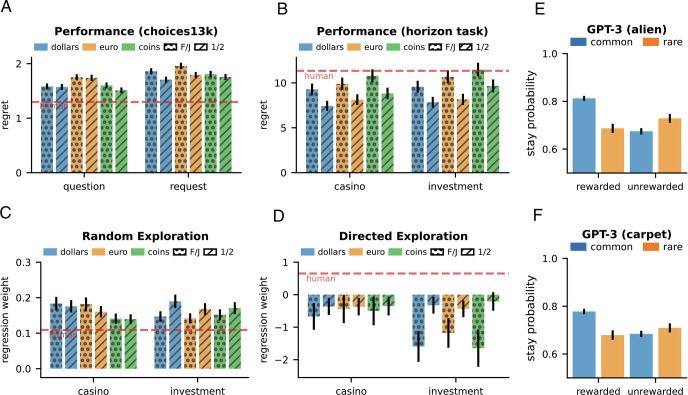
- In the horizon / information-search task, GPT-3 showed random exploration but not directed exploration: reward difference mattered (β = 0.18 ± 0.01, z = 14.48, P < .001), while the horizon interaction did not (β = −0.02 ± 0.02, z = −1.47, P = .14); human-like directed exploration was not observed (β = −0.15 ± 0.27, z = −0.56, P = .58).
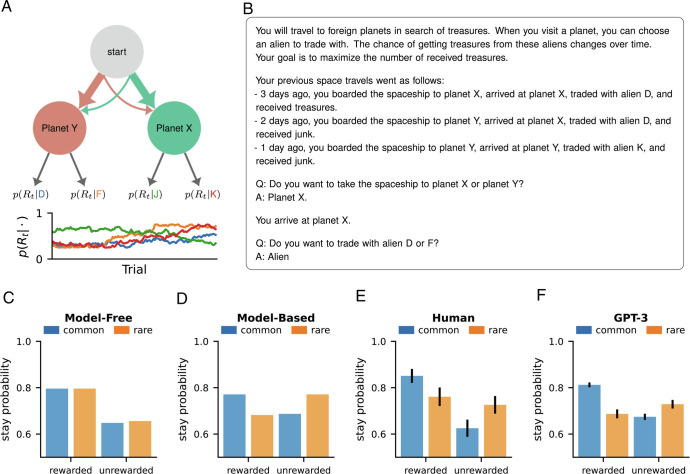
- In the two-step deliberation task, GPT-3 showed signatures consistent with model-based reinforcement learning: rare-transition reward affected stay/switch behavior (χ2(1, N = 1984) = 36.53, P < .001).
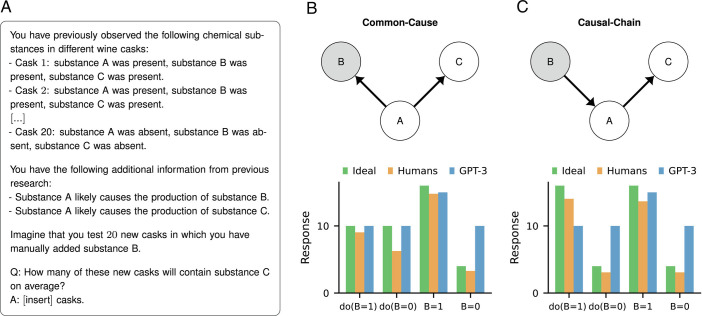
- On causal reasoning, GPT-3 succeeded in some vignette cases, but in the task-based causal test it failed to use causal structure properly; the authors conclude its causal inference was “neither the correct nor human-like.”
## Methods
- The authors used the public OpenAI API and primarily the Davinci GPT-3 model, with temperature set to 0 for deterministic responses unless otherwise noted.
- They ran 12 canonical vignette-based prompts from cognitive psychology and also conducted task-based, procedurally generated experiments: a decision-making benchmark with over 13,000 problems; 3,200 simulations of the horizon task; 200 simulations of the two-step task; and a causal reasoning task.
- Analyses included choice-probability contrasts, logistic regression, and chi-square tests; for the decision task they also report regret relative to human subjects.
## Limitations
- The paper states that vignette results are hard to interpret because GPT-3 may have encountered similar or identical scenarios in training data, and because small prompt changes can drastically alter responses.
- It also states that the vignette tasks can be adversarially modified, causing GPT-3 to respond very differently, which makes the findings brittle.
- Evident from the text: several results rely on prompt phrasing, cover stories, and API settings (for example, temperature and choice labels), so the findings may not generalize to other prompting setups.
Model-written summary. Check it against the paper before relying on it.
Integrity signals
Registry
Cites
Statistics
Figures
Verification
Claims the paper makes
9 Valid · 1 Not valid · 5 Not checked · 69 Own results and interpretations
The cited sources support only part of this claim — read each source’s verdict below.
In the paper
“For all three items of the CRT, GPT-3 responded with the intuitive but incorrect answer, as has been observed in earlier work (15).”
§ Using cognitive psychology to understand GPT-3 > Results > Vignette-Based Investigations.
What the sources say
- Partly supportedcites [15] M. Nye, M. Tessler, J. Tenenbaum, B. M. Lake, Improving coherence and consistency in neural sequence models with dual-system, neuro-symbolic reasoning. Adv. Neural Inf. Process. Syst. 34, 25192– 25204 (2021). sourceExperimental — accuracy not yet measured
The Introduction (p. 2) shows GPT-3 giving the intuitive but incorrect answer to the bat-and-ball CRT item. Appendix A (p. 14) discusses additional CRT questions but says GPT-3 makes the same mistakes as humans “often (but not always)”; the text does not establish that it gave that answer on all three original items. (LLM, conf=0.83)
plain- Asserted: passes — The authors put it forward as true.
- Checkable: passes — It can be checked against evidence.
- Load-bearing: passes — The paper’s conclusions depend on it.
- Based: passes — The paper gives a reason why it holds.
- Partly supported
Every source the paper cites for this claim was checked and supports it.
In the paper
“While humans show such an effect (27), we did not find it in GPT-3 (β = −0.15 ± 0.27, z = −0.56, P = .58), which demonstrates that the model did not employ directed exploration.”
§ Using cognitive psychology to understand GPT-3 > Results > Task-Based Investigations.
What the sources say
- Supportedcites [27] R. C. Wilson, A. Geana, J. M. White, E. A. Ludvig, J. D. Cohen, Humans use directed and random exploration to solve the explore–exploit dilemma. J. Exp. Psychol.: General 143, 2074 (2014). PMC5635655 25347535 source
The Results report that increasing the horizon from 1 to 6 increased the probability of choosing the more informative option in the unequal-information condition. The model fit also found a significant increase in the information bonus, consistent with the positive horizon effect on directed exploration attributed to humans. (LLM, conf=0.93)
plainstates an association- Asserted: passes — The authors put it forward as true.
- Checkable: passes — It can be checked against evidence.
- Load-bearing: passes — The paper’s conclusions depend on it.
- Based: passes — The paper gives a reason why it holds.
- Supported
The cited sources support only part of this claim — read each source’s verdict below.
In the paper
“First, the latest generation of language models is already able to perform above the human level in the majority of tasks from standard benchmark datasets (11, 12), making purely performance-based evaluation less meaningful as time progresses.”
§ Using cognitive psychology to understand GPT-3 > A Cognitive Psychology View on GPT-3.
What the sources say
- Partly supportedcites [11] M. Suzgun et al., Challenging big-bench tasks and whether chain-of-thought can solve them. arXiv [Preprint] (2022). http://arxiv.org/abs/2210.09261 (Accessed 20 January 2023). sourceExperimental — accuracy not yet measured
The Introduction reports that PaLM exceeded the average human-rater score on 65% of BIG-Bench tasks, supporting the majority-of-tasks point for that benchmark. It does not establish the claim across standard benchmark datasets generally. Section 8.1 also cautions that the human-rater scores are not fully representative of human performance. (LLM, conf=0.87)
- Partly supportedcites [12] H. W. Chung et al., Scaling instruction-finetuned language models. arXiv [Preprint] (2022). http://arxiv.org/abs/2210.11416 (Accessed 20 January 2023). sourceExperimental — accuracy not yet measured
Table 1 (Introduction, p. 2) shows Flan-PaLM exceeding the average human rater’s aggregate MMLU score, but not the average human expert’s. The paper does not establish that models exceed human performance on a majority of benchmark tasks; its Evaluation protocol (p. 5) describes the selected challenging benchmarks as ones on which current models remain well below expert human raters. (LLM, conf=0.84)
plain- Asserted: passes — The authors put it forward as true.
- Checkable: passes — It can be checked against evidence.
- Load-bearing: passes — The paper’s conclusions depend on it.
- Based: passes — The paper gives a reason why it holds.
- Partly supported
Every source the paper cites for this claim was checked and supports it.
In the paper
“People tend to solve this task using a combination of model-free and model-based learning (30) as shown in Fig. 4E.”
§ Using cognitive psychology to understand GPT-3 > Results > Task-Based Investigations.
What the sources say
- Supportedcites [30] N. D. Daw, S. J. Gershman, B. Seymour, P. Dayan, R. J. Dolan, Model-based influences on humans’ choices and striatal prediction errors. Neuron 69, 1204– 1215 (2011). 21435563 PMC3077926 source
The Results > Behavior section says the two-step task exercised both model-free and model-based learning strategies, with individual variation in how much subjects used each. It also reports that a hybrid model combining the two fit choices better than either strategy alone. (LLM, conf=0.94)
plain- Asserted: passes — The authors put it forward as true.
- Checkable: passes — It can be checked against evidence.
- Load-bearing: unclear — It is unclear whether the paper’s conclusions depend on it.
- Based: passes — The paper gives a reason why it holds.
- Supported
Every source the paper cites for this claim was checked and supports it.
In the paper
“It is well-known that large language models can be highly sensitive to specific prompts (34).”
§ Using cognitive psychology to understand GPT-3 > Results > Task-Based Investigations.
What the sources say
- Supportedcites [34] H. Strobelt et al., Interactive and visual prompt engineering for ad-hoc task adaptation with large language models (IEEE Trans. Vis. Comput, Graph., 2023), vol. 29, pp. 1146–1156. 36191099 source
The abstract (p. 1) says that prompt templates with different wording choices lead to significant accuracy differences. Section 2.1 (p. 2) likewise states that downstream performance is closely tied to prompt wording, supporting the claim that large language models can be highly sensitive to specific prompts. (LLM, conf=0.94)
boostedstates an association- Asserted: passes — The authors put it forward as true.
- Checkable: passes — It can be checked against evidence.
- Load-bearing: passes — The paper’s conclusions depend on it.
- Based: passes — The paper gives a reason why it holds.
- Supported
49 more claims
Create a free account to see all 84 claims and every source verdict.
- Probably not a substantial claim. 9
- It may state two separate claims as one. 23
- The quote only partly states this claim. 1
Claims other papers make about this one
Each is checked against this paper’s own text: does it say what the citing paper says it does?
The source backs part of the claim, not all of it — or backs it for a different population, condition or comparison.
In the citing paper
“cognitive psychology of LLM treats LLM as an agent whose input-output correlation between prompts (stimulus) and generations (responses) can be probed under controlled conditions to infer the agent’s internal representations.”
From Understanding large language models demands distinguishing human projection from machine cognition (2026) · cites this paper as [36]
Experimental — accuracy not yet measuredThe source backs part of the claim, not all of it — or backs it for a different population, condition or comparison.
In the citing paper
“These models are trained on large amounts of text, for example, obtained from the internet, and can answer questions, provide summaries or translations and create stories or poems (Fig. 1a)3,4.”
From The future landscape of large language models in medicine (2023) · cites this paper as [4]
Experimental — accuracy not yet measuredThe source backs part of the claim, not all of it — or backs it for a different population, condition or comparison.
In the citing paper
“as misconceived prompts may result in biases or misinformation with potentially serious consequences4.”
From The future landscape of large language models in medicine (2023) · cites this paper as [4]
Experimental — accuracy not yet measuredThe source backs part of the claim, not all of it — or backs it for a different population, condition or comparison.
In the citing paper
“These results add to the growing body of work characterizing the emergent capabilities of LLMs, 24-28 and suggest that the most sophisticated LLMs may already possess an emergent capacity to reason by analogy.”
From Emergent analogical reasoning in large language models (2023) · cites this paper as [28]
Experimental — accuracy not yet measuredThe cited source says what the claim attributes to it.
In the citing paper
“In contrast, the task-based cognitive approaches discussed earlier in this paper36,38,40–43 do not commit this error. They use established experimental paradigms to empirically test whether human and LLM cognition converge or diverge on specific dimensions, without presupposing cognitive equivalence as a starting point.”
From Understanding large language models demands distinguishing human projection from machine cognition (2026) · cites this paper as [36]
10 more claims about this paper
Create a free account to see every claim other papers make about this one.
Statistics that don’t add up
Each reported p-value recomputed from its test statistic and degrees of freedom, each partial η² from its F, and each ratio, mean difference or B printed with a p checked against its own confidence interval.
Rated minor: it would not touch a result — a value no result rests on, a p-value that stays on the same side of the significance level, or a conflict that is clerical, resolved elsewhere in the paper, or outside its own findings.
In the paper
“t(5550)= − 0.75, P = .23”
§ Using cognitive psychology to understand GPT-3 > Results > Task-Based Investigations.
Reported p = .23 · recomputed p = .453
Statistics recomputed
Every reported test result, recomputed from its test statistic and degrees of freedom. A result shows as not adding up only once an independent check has confirmed it.
- Doesn’t add upt(5550) = -0.75reported p = .23 · recomputed p = .453
“t(5550)= − 0.75, p = .23”
- Consistentt(29134) = -11.5reported p < .001 · recomputed p < .001
“t(29134)= − 11.50, p < .001”
- Consistentt(5566) = -0.043reported p = .97 · recomputed p = .966
“t(5566)= − 0.043, p = .97”
- Consistentt(5550) = -4.07reported p < .001 · recomputed p < .001
“t(5550)= − 4.07, p < .001”
- Consistentt(38878) = -5.03reported p < .001 · recomputed p < .001
“t(38878)= − 5.03, p < .001”
7 more recomputed tests
Create a free account to see every test the Stats check recomputed.
Self-check
Percentages, sums and reported differences re-computed from the paper’s own numbers.
Self-check results appear here once an independent check has confirmed them.
Citations
Cites
Vaswani, A., Shazeer, N., Parmar, N., Uszkoreit, J., Jones, L., Gomez, A. N., Kaiser, L., & Polosukhin, I. (2017) · arXiv · doi:10.48550/arxiv.1706.03762 · Cited by 120,404
Exploiting Generative AI to Scale up Intelligent Tutoring Systems
Jakubův, J., Chvalovský, K., Goertzel, Z., Kaliszyk, C., Olšák, M., Piotrowski, B., Schulz, S., Suda, M., & Urban, J. (2023) · DROPS (Schloss Dagstuhl – Leibniz Center for Informatics) · doi:10.4230/lipics.itp.2023.19 · Cited by 76,658
Language Models are Few-Shot Learners
Brown, T. B., Mann, B., Ryder, N., Subbiah, M., Kaplan, J., Dhariwal, P., Neelakantan, A., Shyam, P., Sastry, G., Askell, A., et al. (2020) · arXiv · doi:10.48550/arxiv.2005.14165 · Cited by 23,372
Kaugeranna, R., Kaugeranna, E., & Aion, (. S. 4. 6. (2023) · DROPS (Schloss Dagstuhl – Leibniz Center for Informatics) · doi:10.4230/lipics.giscience.2023.43 · Cited by 13,690
Causality: Models, Reasoning, and Inference
Pearl, J. (2009) · doi:10.1017/cbo9780511803161 · Cited by 11,653
On the Dangers of Stochastic Parrots: Can Language Models Be Too Big? 🦜
Bender, E. M., Gebru, T., McMillan-Major, A., & Shmitchell, S. (2021) · Proceedings of the 2021 ACM Conference on Fairness, Accountability, and Transparency · doi:10.1145/3442188.3445922 · Cited by 6,988
Cognitive Reflection and Decision Making
Frederick, S. (2005) · Journal of Economic Perspectives · doi:10.1257/089533005775196732 · Cited by 5,256
Subjective probability: A judgment of representativeness
Kahneman, D., & Tversky, A. (1972) · Cognitive Psychology · doi:10.1016/0010-0285(72)90016-3 · Cited by 4,851 · cited 1×
“Finally, we asked GPT-3 to provide an answer to the “hospital problem” 17 (Hospital, see SI Appendix), in which participants are asked which of two hospitals, a smaller or a larger one, is more likely to report more days on which more than 60% of all born children were boys.”
Extensional versus intuitive reasoning: The conjunction fallacy in probability judgment.
Tversky, A., & Kahneman, D. (1983) · Psychological Review · doi:10.1037/0033-295x.90.4.293 · Cited by 3,991 · cited 1×
“We began our investigations of GPT-3’s decision-making by prompting the canonical “Linda problem” 15 (Linda, see Figure 1A).”
On the Opportunities and Risks of Foundation Models
Bommasani, R., Hudson, D. A., Adeli, E., Altman, R., Arora, S., von Arx, S., Bernstein, M. S., Bohg, J., Bosselut, A., Brunskill, E., et al. (2021) · arXiv · doi:10.48550/arxiv.2108.07258 · Cited by 2,676
Research works printed but not linked: 2
- G. Marcus, E. Davis, GPT-3, bloviator: Openai’s language generator has no idea what it’s talking about (Technol, Rev, 2020).
- C. R. Jones et al., “Distributional semantics still can’t account for affordances” in Proceedings of the Annual Meeting of the Cognitive Science Society (2022), vol. 44.
Cited by
Items 101–200 of 531
Kawakita, G., Zeleznikow-Johnston, A., Tsuchiya, N., & Oizumi, M. (2024) · Scientific Reports · doi:10.1038/s41598-024-65604-1 · Cited by 64
“Large Language Models (LLMs) have demonstrated remarkable performance in a variety of cognitive tasks [1–3].”
BackgroundHuang, G. I., Wong, I. A., Zhang, C., & Liang, Q. (2025) · International Journal of Hospitality Management · doi:10.1016/j.ijhm.2025.104112 · Cited by 53
The homogenizing effect of large language models on human expression and thought
Sourati, Z., Ziabari, A. S., & Dehghani, M. (2026) · Trends in Cognitive Sciences · doi:10.1016/j.tics.2026.01.003 · Cited by 131
Danry, V., Pataranutaporn, P., Groh, M., & Epstein, Z. (2025) · Proceedings of the 2025 CHI Conference on Human Factors in Computing Systems · doi:10.1145/3706598.3713408 · Cited by 35
“In addition to generating false information, studies have also shown that LLMs fail miserably at abstract reasoning [5, 35, 44] and use causal knowledge accurately in simple reasoning tasks [5].”
Risk and prosocial behavioural cues elicit human-like response patterns from AI chatbots
Zhao, Y., Xu, L., Huang, Z., Peng, K., Seligman, M. E. P., Li, E., & Yu, F. (2024) · Scientific Reports · doi:10.1038/s41598-024-55949-y · Cited by 56
Why concepts are (probably) vectors
Piantadosi, S. T., Muller, D. C. Y., Rule, J., Kaushik, K., Gorenstein, M. I., Leib, E. R., & Sanford, E. M. (2024) · Trends in Cognitive Sciences · doi:10.1016/j.tics.2024.06.011 · Cited by 87
Cui, Z., Li, N., & Zhou, H. (2025) · Nature Computational Science · doi:10.1038/s43588-025-00840-7 · Cited by 125
Bodroža, B., Dinić, B. M., & Bojić, L. (2024) · Royal Society Open Science · doi:10.1098/rsos.240180 · Cited by 96
“Aside from the attention of the general public, there is interest in LLMs’ cognition, personality and other human-like characteristics (e.g. [3–6]) in order to be able to understand ts possible uses, misuses and limitations.”
BackgroundResultLoya, M., Sinha, D., & Futrell, R. (2023) · Findings of the Association for Computational Linguistics: EMNLP 2023 · doi:10.18653/v1/2023.findings-emnlp.241 · Cited by 33
“Binz and Schulz (2023) evaluated on decision-making, information search, deliberation, and causal reasoning in text-davinci-002 (Brown et al., 2020) by presenting it with prompts such as the one shown in Figure 1.”
BackgroundMethodResultInfluentialLampinen, A. (2024) · Computational Linguistics · doi:10.1162/coli_a_00525 · Cited by 32
“For example, a recent survey finding successes and failures of language models in cognitive tasks (Binz and Schulz, 2022) considered model evaluation without context, while comparing to prior human studies in extended experimental contexts.”
Lampinen, A. K. (2022) · arXiv · doi:10.48550/arxiv.2210.15303 · Cited by 32
AI emerges as the frontier in behavioral science
Meng, J. (2024) · Proceedings of the National Academy of Sciences · doi:10.1073/pnas.2401336121 · Cited by 57
“Other recent studies have also explored the degrees of rationality (2) and cognitive abilities of ChatGPT (3).”
BackgroundUnderstanding AI-Generated Experiments in Tourism: Replications Using GPT Simulations
Xiong, X., Wong, I. A., Huang, G. I., & Peng, Y. (2024) · Journal of Travel Research · doi:10.1177/00472875241275945 · Cited by 49
“Following the approach documented in the literature (Binz & Schulz, 2023; Miotto et al., 2022), we set the temperature to 0.6, which resulted in GPTs with a mean predicted age of 26.76 (Miotto et al., 2022), similar to that of Su, Pan, & Huang’s (2023), research that we aimed to replicate.”
InfluentialArtificial Intelligence-Based ChatGPT Responses for Patient Questions on Optic Disc Drusen
Potapenko, I. O., Malmqvist, L., Subhi, Y., & Hamann, S. (2023) · Ophthalmology and Therapy · doi:10.1007/s40123-023-00800-2 · Cited by 29
More or less than human? Evaluating the role of AI-as-participant in online qualitative research
Gibson, A. F., & Beattie, A. (2024) · Qualitative Research in Psychology · doi:10.1080/14780887.2024.2311427 · Cited by 53
“Cognitive psychologists have likewise claimed that Chat-GPT can perform heuristic-based assessments and human-esque problem solving, even better than humans (Binz and Schulz 2023).”
BackgroundLarge Language Model Displays Emergent Ability to Interpret Novel Literary Metaphors
Ichien, N., Stamenković, D., & Holyoak, K. J. (2024) · Metaphor and Symbol · doi:10.1080/10926488.2024.2380348 · Cited by 82
“…in language understanding (DiStefano et al., 2024; Köbis & Mossink, 2021; Mahowald et al., 2024; McClelland et al., 2020) and various forms of reasoning (Binz & Schulz, 2023; Chan et al., 2022; Dasgupta et al., 2022; Srivastava et al., 2022; Wei et al., 2022), including analogy (Webb et al., 2023).”
Generative AI lacks the human creativity to achieve scientific discovery from scratch
Ding, A. W., & Li, S. (2025) · Scientific Reports · doi:10.1038/s41598-025-93794-9 · Cited by 63
The cultural stereotype and cultural bias of ChatGPT
Yuan, H., Che, Z., Zhang, Y., Shao, L. H., Yuan, X., Huang, L., Hu, X., Peng, K., & Luo, S. (2025) · Journal of Pacific Rim Psychology · doi:10.1177/18344909251355673 · Cited by 38
“…of ChatGPT from algorithmic and data-centric perspectives, investigating whether ChatGPT can understand and process information akin to humans (Binz & Schulz, 2023; Coda-Forno et al., 2024; Huang et al., 2023; Mei et al., 2024), as well as the potential advantages and challenges associated…”
Exploring the Association Between Textual Parameters and Psychological and Cognitive Factors
Uludağ, K. (2024) · Psychology Research and Behavior Management · doi:10.2147/prbm.s460503 · Cited by 37
“15 Moreover, a previous study 16 evaluated GPT-3’s abilities in decision-making, information retrieval, contemplation, and causal reasoning through a series of experiments from previous literature.”
BackgroundUsing cognitive psychology to understand GPT-like models needs to extend beyond human biases
Stella, M., Hills, T. T., & Kenett, Y. N. (2023) · Proceedings of the National Academy of Sciences · doi:10.1073/pnas.2312911120 · Cited by 47
“However, the authors men - tioned that their results could occur not only because of simi - larities between the cognitive processes at work within LLMs and humans but also because LLMs may report human - made content, which “might have been part of its training set” [1, p.8].”
Human bias in AI models? Anchoring effects and mitigation strategies in large language models
Nguyen, J. K. (2024) · Journal of Behavioral and Experimental Finance · doi:10.1016/j.jbef.2024.100971 · Cited by 33
Karjus, A. (2025) · Humanities and Social Sciences Communications · doi:10.1057/s41599-025-04503-w · Cited by 32
“These issues have been and will be discussed elsewhere (Bender et al. 2021; Binz and Schulz 2023; Rooij et al. 2024; Feng et al. 2023; Hagendorff et al. 2024; Liesenfeld et al. 2023; Lund et al. 2023; Motoki et al. 2023; Novozhilova et al. 2024; Ollion et al. 2024; Tomlinson et al. 2024).”
Is GPT a Computational Model of Emotion?
Tak, A. N., & Gratch, J. S. (2023) · International Conference on Affective Computing and Intelligent Interaction and workshops · doi:10.1109/acii59096.2023.10388119 · Cited by 59
“Most recently, large-language models such as generative pre-trained trans-formers (GPT) have shown an impressive ability to model human cognition [21], raising the question as to whether these could serve as accurate computational models of human emotion.”
BackgroundMethodInfluentialAdvice from artificial intelligence: a review and practical implications
Baines, J. I., Dalal, R. S., Ponce, L. P., & Tsai, H.-C. (2024) · Frontiers in Psychology · doi:10.3389/fpsyg.2024.1390182 · Cited by 28
“…popularity and advancements of GPT-3, GPT-4, and other AI language models suggest that these developments are occurring at an extremely rapid pace (Floridi and Chiriatti, 2020) as scientists continue to acquire insights that support the improvement of future model versions (Binz and Schulz, 2023).”
BackgroundRecommendations to Create Programming Exercises to Overcome ChatGPT
Berrezueta-Guzman, J., & Krusche, S. (2023) · doi:10.35542/osf.io/expuq · Cited by 27
Is Ockham’s razor losing its edge? New perspectives on the principle of model parsimony
Dubova, M., Chandramouli, S., Gigerenzer, G., Grünwald, P., Holmes, W. R., Lombrozo, T., Marelli, M., Musslick, S., Nicenboim, B., Ross, L. N., et al. (2025) · Proceedings of the National Academy of Sciences · doi:10.1073/pnas.2401230121 · Cited by 70
Xu, Q., Peng, Y., Nastase, S. A., Chodorow, M. S., Wu, M., & Li, P. (2025) · Nature Human Behaviour · doi:10.1038/s41562-025-02203-8 · Cited by 112
“Despite these limited input modalities, these models exhibit remarkably human-like performance in various cognitive tasks 6,21–23 .”
The Rise of GPT-3: Implications for Natural Language Processing and Beyond
Imamguluyev, R. (2023) · International Journal of Research Publication and Reviews · doi:10.55248/gengpi.2023.4.33987 · Cited by 49
Recommendations to Create Programming Exercises to Overcome ChatGPT
Berrezueta-Guzman, J., & Krusche, S. (2023) · 2023 IEEE 35th International Conference on Software Engineering Education and Training (CSEE&T) · doi:10.1109/cseet58097.2023.00031 · Cited by 27
“The progression of LLMs underscores the escalating relevance of NLP in AI, striving for sophisticated human-machine interactions [19].”
BackgroundEvaluating Cognitive Maps and Planning in Large Language Models with CogEval
Momennejad, I., Hasanbeig, H., Frujeri, F. V., Sharma, H., Jojic, N., Palangi, H., Ness, R., & Larson, J. (2023) · Advances in Neural Information Processing Systems 36 · doi:10.52202/075280-3056 · Cited by 27
Human-like object concept representations emerge naturally in multimodal large language models
Du, C., Fu, K., Wen, B., Sun, Y., Peng, J., Wei, W., Gao, Y., Wang, S., Zhang, C., Li, J., et al. (2025) · Nature Machine Intelligence · doi:10.1038/s42256-025-01049-z · Cited by 83
“These results enrich the growing body of work characterizing the emergent characteristics of LLMs 37–43 , showcasing their potential to capture and reflect human-like conceptualizations of real-world objects.”
van Duijn, M., van Dijk, B., Kouwenhoven, T., de Valk, W., Spruit, M., & vanderPutten, P. (2023) · Proceedings of the 27th Conference on Computational Natural Language Learning (CoNLL) · doi:10.18653/v1/2023.conll-1.25 · Cited by 24
Colour/shape-taste correspondences across three languages in ChatGPT
Motoki, K., Spence, C. J., & Velasco, C. (2024) · Cognition · doi:10.1016/j.cognition.2024.105936 · Cited by 30
“Indeed, the field of psychology and behavioural sciences has started using ChatGPT to examine how it responds to questions that have often been posed in the psychological and behavioural sciences (Binz and Schulz, 2023; Yiting Chen et al., 2023).”
The high-dimensional psychological profile of ChatGPT
Zhang, Y., Shao, L. H., Yuan, X., Yuan, H., Che, Z., & Luo, S. (2025) · Science China Technological Sciences · doi:10.1007/s11431-025-2934-8 · Cited by 23
ROSE: A Universal Neural Grammar
Murphy, E. (2025) · Cognitive Neuroscience · doi:10.1080/17588928.2025.2523875 · Cited by 33
“Current evidence indicates that modern language models struggle with causal reasoning and directed exploration (Binz & Schulz, 2023), compositionality (Dentella et al., 2024; Lake & Murphy, 2023; Murphy et al., 2025), analogy and human-like abstractions (Mitchell, 2021), amongst other things (for…”
Shaping the Emerging Norms of Using Large Language Models in Social Computing Research
Shen, H., Li, T., Li, T. J.-J., Park, J. S., & Yang, D. (2023) · Computer Supported Cooperative Work and Social Computing · doi:10.1145/3584931.3606955 · Cited by 21
“LLMs capture the human behaviors that are represented in their training data [3, 14], and as such, these models can replicate these behaviors when prompted.”
BackgroundThe use of synthetic data in tourism
Viglia, G., Adler, S. J., Miltgen, C. L., & Sarstedt, M. (2024) · Annals of Tourism Research · doi:10.1016/j.annals.2024.103819 · Cited by 35
“These studies typically prompt a large language model with speci fi c tasks or paradigms relevant to the respective fi eld (e.g., vignette-based tasks) and compare the output with human responses (e.g., Binz & Schulz, 2023; Dillion et al., 2023; Hagendorff et al., 2023).”
ResultEvaluating the alignment of AI with human emotions
Lomas, D., van der Maden, W., Bandyopadhyay, S., Lion, G., Patel, N., Jain, G., Litowsky, Y., Xue, H., & Desmet, P. (2024) · Advanced Design Research · doi:10.1016/j.ijadr.2024.10.002 · Cited by 35
Beyond WEIRD: Can synthetic survey participants substitute for humans in global policy research?
Shrestha, P., Krpan, D., Koaik, F., Schnider, R., Sayess, D., & Binbaz, M. S. (2024) · Behavioral Science & Policy · doi:10.1177/23794607241311793 · Cited by 46
“…cognitive biases (such as the framing effect, where their responses changed on the basis of whether a choice was presented as a gain or a loss), 24 sensory judgments (such as distinguishing between similar and different colors), 25 and perceptions of object typicality (such as whether an apple…”
Signs of consciousness in AI: Can GPT-3 tell how smart it really is?
Bojić, L., Stojković, I., & Jolić Marjanović, Z. (2024) · Humanities and Social Sciences Communications · doi:10.1057/s41599-024-04154-3 · Cited by 19
“Regarding the GPT-3 ’ s potential, the algorithm is equipped to produce text that is similar to that of humans and can complete natural language processing tasks, including language translation and summarization (Binz and Schulz, 2022).”
What Can Language Models Tell Us About Human Cognition?
Connell, L., & Lynott, D. (2024) · Current Directions in Psychological Science · doi:10.1177/09637214241242746 · Cited by 38
“Indeed, so uncertain is the current understanding of the latest generation of trans-former models that recent work has begun to use cognitive tests to try to determine what is going on inside them (e.g., Binz & Schulz, 2023).”
BackgroundDo generative video models understand physical principles?
Motamed, S., Culp, L., Swersky, K., Jaini, P., & Geirhos, R. (2025) · arXiv · doi:10.48550/arxiv.2501.09038 · Cited by 19
Openly accessible LLMs can help us to understand human cognition
Frank, M. C. (2023) · Nature Human Behaviour · doi:10.1038/s41562-023-01732-4 · Cited by 18
Meduri, K., Gonaygunta, H., Nadella, G. S., Pawar, P. P., & Kumar, D. (2024) · IJARCCE · doi:10.17148/ijarcce.2024.13114 · Cited by 22
Integration of cognitive tasks into artificial general intelligence test for large models
Qu, Y., Wei, C., Du, P., Che, W., Zhang, C., Ouyang, W., Bian, Y., Xu, F., Hu, B., Du, K., et al. (2024) · iScience · doi:10.1016/j.isci.2024.109550 · Cited by 25
“Cognitive science-inspired AGI tests allow for the examination of the true level of intelligence in LLMs. Cognitive science and psychology have pioneered numerous classic cognitive tasks, which provide valuable insights into comprehending and evaluating the cognitive abilities of LLMs.”
BackgroundMethodInfluentialStylos, N., Okumus, F., & Onder, I. (2025) · Tourism Management · doi:10.1016/j.tourman.2025.105205 · Cited by 18
Bickley, S. J., Chan, H. F., Dao, B., Torgler, B., Tran, S., & Zimbatu, A. (2024) · Journal of Services Marketing · doi:10.1108/jsm-11-2023-0441 · Cited by 27
Jiang, Y., Ko-Wong, L., & Gutierrez, I. V. (2025) · Educational Researcher · doi:10.3102/0013189x251314821 · Cited by 29
“GPT-3 also demonstrates the ability to effectively tackle tasks commonly employed in psychology to evaluate human responses to real-world social situations, exhibiting performance equal to or surpassing that of human subjects (Binz & Schulz, 2023).”
Urrutia, F., & Araya, R. (2023) · Journal of Educational Computing Research · doi:10.1177/07356331231191174 · Cited by 32
Artificial intelligence chatbots mimic human collective behaviour
He, J. K., Wallis, F. P. S., Gvirtz, A., & Rathje, S. (2024) · British Journal of Psychology · doi:10.1111/bjop.12764 · Cited by 36
“human participants (Dillion et al., 2023), reflect human imperfections in abstract reasoning (Dasgupta et al., 2023) and respond similarly to emotion inductions (Aher et al., 2022; Binz & Schulz, 2023).”
Huang, G. I., Zhang, C., Torres, W. C. Z., Xiong, X., & Li, H. (2025) · Tourism Management · doi:10.1016/j.tourman.2025.105315 · Cited by 26
Bayesian Surprise Predicts Human Event Segmentation in Story ListeningPreprint
Kumar, M., Goldstein, A., Michelmann, S., Zacks, J. M., Hasson, U., & Norman, K. A. (2022) · doi:10.31234/osf.io/qd2ra · Cited by 15
A tutorial on open-source large language models for behavioral sciencePreprint
Hussain, Z., Binz, M., Mata, R., et al. (2023) · doi:10.31234/osf.io/f7stn · Cited by 16
Self-citationJacobs, O., Pazhoohi, F., & Kingstone, A. (2023) · doi:10.31234/osf.io/pn29d · Cited by 16
Niu, Q., Liu, J., Bi, Z., Feng, P., Peng, B., Chen, K., Li, M., Yan, L. K., Zhang, Y., Yin, C. H., et al. (2024) · arXiv · doi:10.48550/arxiv.2409.02387 · Cited by 16
Do generative video models understand physical principles?
Motamed, S., Culp, L., Swersky, K., Jaini, P., & Geirhos, R. (2026) · IEEE Winter Conference on Applications of Computer Vision · doi:10.1109/wacv61042.2026.00099 · Cited by 257
Johns, B. T. (2024) · Cognitive Science · doi:10.1111/cogs.13413 · Cited by 27
The Personality Dimensions GPT-3 Expresses During Human-Chatbot Interactions
Kovačević, N., Holz, C., Groß, M. H., & Wampfler, R. (2024) · Proceedings of the ACM on Interactive Mobile Wearable and Ubiquitous Technologies · doi:10.1145/3659626 · Cited by 27
“We also expected to observe a high level of instability given that previous studies already highlighted GPT-3’s limitations regarding consistency and factual reasoning [14, 35].”
Exploring the Impacts of ChatGPT on Future Scientific WorkPreprint
Irons, J. L., Mason, C., Cooper, P. S., Sidra, S., Reeson, A. F., & Paris, C. L. (2023) · SocArXiv (OSF Preprints) · doi:10.31235/osf.io/j2u9x · Cited by 18
Huang, G. I., Wong, I. A., Torres, W. C. Z., Davari, D., & Xie, H. (2024) · Tourism Management · doi:10.1016/j.tourman.2024.105075 · Cited by 16
The Mixed Subjects Design: Treating Large Language Models as Potentially Informative Observations
Broska, D., Howes, M., & van Loon, A. (2025) · Sociological Methods & Research · doi:10.1177/00491241251326865 · Cited by 64
Lehr, S. A., Saichandran, K. S., Harmon‐Jones, E., Vitali, N., & Banaji, M. R. (2025) · Proceedings of the National Academy of Sciences · doi:10.1073/pnas.2501823122 · Cited by 40
“Large language models (LLMs) have surprised their creators and the scientific community by exhibiting emergent abilities once thought to be uniquely human, such as humanlike cognition and reasoning ( 1 – 6 ), although the full extent of these accomplishments is debated ( 3 , 7 – 10 ).”
Six Fallacies in Substituting Large Language Models for Human Participants
Lin, Z. (2025) · Advances in Methods and Practices in Psychological Science · doi:10.1177/25152459251357566 · Cited by 66
“…LLMs in survey responses—RLHF-tuned models can be highly sensitive to changes such as typos (Tjuatja et al., 2024)—and in tasks such as reasoning (Binz & Schulz, 2023b; Dasgupta et al., 2022; Yax et al., 2024), decision-making (Binz & Schulz, 2023a; Suri et al., 2024), theory of mind (Strachan…”
InfluentialUsing large language models to facilitate academic work in the psychological sciences
Sohail, A., & Zhang, L. (2025) · Current Psychology · doi:10.1007/s12144-025-07438-2 · Cited by 25
“Certain LLMs also demonstrate zero-shot learn - ing (or generalization), the ability to infer on data that the model have never seen in training, by accurately simulating human responses towards previously unseen cognitive tasks (Binz & Schulz, 2023a).”
When cutting edge meets silver tongue: Understanding the word-of-machine effect on travel decisions
Sun, D., Wong, I. A., Xiong, X., & Li, S. (2025) · Tourism Management · doi:10.1016/j.tourman.2025.105271 · Cited by 23
Desdevises, J. (2025) · Frontiers in Psychology · doi:10.3389/fpsyg.2025.1628486 · Cited by 32
“While this approach aligns with recent practises in computational research (e.g., Chen et al., 2021; Binz and Schulz, 2023), it nonetheless limits the generalisability of findings.”
From humans to machines: Researching entrepreneurial AI agents built on large language models
Obschonka, M., & Fisch, C. O. (2025) · Journal of Business Venturing Insights · doi:10.1016/j.jbvi.2025.e00581 · Cited by 16
Dual-process theory and decision-making in large language models
Brady, O., Nulty, P., Zhang, L., Ward, T. E., & McGovern, D. P. (2025) · Nature Reviews Psychology · doi:10.1038/s44159-025-00506-1 · Cited by 33
“Slight variations in prompts can lead to vastly different interpretations and responses 16,22,49,72 , analogous to the way in which humans are influenced by the way instructions are framed 52 .”
InfluentialAn evaluation of estimative uncertainty in large language models
Tang, Z., Shen, K., & Kejriwal, M. (2026) · npj Complexity · doi:10.1038/s44260-026-00070-6 · Cited by 35
“Figure 2 displays the distribution of probability estimates for 17 WEPs provided by GPT-3.”
Signatures of the uncanny valley effect in an artificial neural network
Igaue, T., & Hayashi, R. (2023) · Computers in Human Behavior · doi:10.1016/j.chb.2023.107811 · Cited by 19
Das, K., Pattanaik, M., Basantia, S., Mishra, R., Das, D. M., Sahoo, K., & Paital, B. (2023) · Telematics and Informatics Reports · doi:10.1016/j.teler.2023.100065 · Cited by 24
CreativEval: Evaluating Creativity of LLM-Based Hardware Code Generation
DeLorenzo, M. C., Gohil, V., & Rajendran, J. (2024) · IEEE LLM Aided Design Workshop (LAD) · doi:10.1109/lad62341.2024.10691798 · Cited by 54
“Furthermore, recent works explore the intersection between cognitive science and LLMs [30]–[32], in which the creativity of LLMs are evaluated within the context of natural language, demonstrating near-human like performance in many Listing 1: Fluency/Originality prompt example cases [31].”
BackgroundAn appraisal-based chain-of-emotion architecture for affective language model game agents
Croissant, M., Frister, M., Schofield, G., & McCall, C. (2024) · PLOS ONE · doi:10.1371/journal.pone.0301033 · Cited by 15
“Each STEU item presents a situation (e.g. "Clara receives a gift.") and a question with five possible answers, one of which is right (e.g.”
BackgroundMethodResultInfluentialGPT models for text annotation: An empirical exploration in public policy research
Churchill, A., Pichika, S., Xu, C., & Liu, Y. (2025) · Policy Studies Journal · doi:10.1111/psj.70034 · Cited by 29
“This pattern aligns with findings from other studies showing that GPT models struggle with understanding high-context messages where subtler cues are present (Binz & Schulz, 2023; Hou et al., 2024; Lehr et al., 2024).”
Revealing emergent human-like conceptual representations from language prediction
Xu, N., Zhang, Q., Du, C., Luo, Q., Qiu, X., Huang, X., & Zhang, M. (2025) · Proceedings of the National Academy of Sciences · doi:10.1073/pnas.2512514122 · Cited by 36
On challenges of AI to cognitive security and safety
Huang, R., Zheng, X., Shang, Y., & Xue, X. (2023) · Security and Safety · doi:10.1051/sands/2023012 · Cited by 24
“…between the cognitive gains and the objective reality on the one hand, and motives of cognitive synergy for group collaboration and division of labor on the other hand, all lead to cognitive biases such as Bandwagon Effect, Groupthink, Stereotype, Belief Bias, False Memory, etc. [20–23].”
BackgroundSentiGEN: Synthetic Data Generator for Sentiment Analysis
Sundarreson, P., & Kumarapathirage, S. (2024) · Journal of Computing Theories and Applications · doi:10.62411/jcta.10480 · Cited by 18
“Meanwhile, its decoder produces text by leveraging these methods[41] – [43].”
MethodA step-by-step method for cultural annotation by LLMs
Dubourg, E., Thouzeau, V., & Baumard, N. (2024) · Frontiers in Artificial Intelligence · doi:10.3389/frai.2024.1365508 · Cited by 26
“In line with many other researchers, we believe that recent advancements in language models pre-trained on massive amounts of textual information have heralded a new era in the scientific study of culture (see Bail, 2023, for a review; see Binz and Schulz, 2023).”
Tuzsus, D., Brands, A. M. A., Pappas, I., & Peters, J. (2024) · Computational Brain & Behavior · doi:10.1007/s42113-024-00202-y · Cited by 12
“In UCB, uncertainty affects action value estimates additively (Schulz & Gershman, 2019), similar to the uncertainty bonus implementations used in in this as well as previous work (Chakroun et al., 2020; Daw et al., 2006; Speekenbrink & Konstantinidis, 2015; Wiehler et al., 2021).”
InfluentialGPT-4 Emulates Average-Human Emotional Cognition from a Third-Person Perspective
Tak, A. N., & Gratch, J. S. (2024) · International Conference on Affective Computing and Intelligent Interaction and workshops · doi:10.1109/acii63134.2024.00043 · Cited by 41
“These studies have probed the capabilities of models such as the GPT family of LLMs and others in tasks related to causal reasoning [1], emotional decision-making and appraisal theory [2], emotion classification [3]–[5], emotional intelligence [6], emotional dialogue understanding [7], generation…”
Does GPT-4 surpass human performance in linguistic pragmatics?
Bojić, L., Kovačević, P. S., & Čabarkapa, M. (2025) · Humanities and Social Sciences Communications · doi:10.1057/s41599-025-04912-x · Cited by 54
“For instance, they exhibit a sense of perception and expression, reasoning abilities, and spontaneity, leading to an increasingly complex imitation of human-like characteristics (Binz, Schulz (2023); Kosinski, 2023).”
On the Unexpected Abilities of Large Language Models
Nolfi, S. (2023) · Adaptive Behavior · doi:10.1177/10597123241256754 · Cited by 16
“However, it displays a qualitatively different behavior in decision from experience problems in which the decision-maker has to infer the probability of the alternative outcomes from multiple observations (Binz & Schulz, 2023a, 2023b).”
Digital Twin Studies for Reverse Engineering the Origins of Visual Intelligence
Wood, J. N., Pandey, L., & Wood, S. M. W. (2024) · Annual Review of Vision Science · doi:10.1146/annurev-vision-101322-103628 · Cited by 20
Quantifying uncert-AI-nty: Testing the accuracy of LLMs’ confidence judgments
Cash, T. N., Oppenheimer, D. M., Christie, S., & Devgan, M. (2025) · Memory & Cognition · doi:10.3758/s13421-025-01755-4 · Cited by 32
“Binz and Schulz (2023) found that GPT-3 performed as well or better than humans on a series of numeric reasoning tasks (e.g., the multi-armed bandit task), but that it routinely failed causal reasoning tasks.”
AI Surrogates and illusions of generalizability in cognitive science
Crockett, M. J., & Messeri, L. R. (2025) · Trends in Cognitive Sciences · doi:10.1016/j.tics.2025.09.012 · Cited by 36
Investigating Large Language Models’ Perception of Emotion Using Appraisal Theory
Yongsatianchot, N., Torshizi, P. G., & Marsella, S. (2023) · International Conference on Affective Computing and Intelligent Interaction Workshops and Demos (ACIIW) · doi:10.1109/aciiw59127.2023.10388194 · Cited by 40
“As these models can be sensitive to instruction [1], [22], [23], we investigate four different variations of prompting and asking the models.”
BackgroundMethodJacobs, O. L. E., Pazhoohi, F., & Kingstone, A. F. (2024) · Consciousness and Cognition · doi:10.1016/j.concog.2024.103733 · Cited by 16
“…rise of highly capable AI chatbots such as ChatGPT and other large language model (LLM) applications has spurred calls to use psychological tools to investigate how interactions with these systems influence a number of perceptions (Shiffrin & Mitchell, 2023; Kosinski, 2023; Binz & Schulz, 2023).”
BackgroundAI-induced hyper-learning in humans
Glickman, M., & Sharot, T. (2024) · Current Opinion in Psychology · doi:10.1016/j.copsyc.2024.101900 · Cited by 23
Contextualizing predictive minds
Butz, M. V., Mittenbühler, M., Schwöbel, S., Achimova, A., Gumbsch, C., Otte, S., & Kiebel, S. J. (2024) · Neuroscience & Biobehavioral Reviews · doi:10.1016/j.neubiorev.2024.105948 · Cited by 22
DeB3RTa: A Transformer-Based Model for the Portuguese Financial Domain
Pires, H. F., Paucar, V. L., & Carvalho, J. P. (2025) · Big Data and Cognitive Computing · doi:10.3390/bdcc9030051 · Cited by 16
“For instance, researchers have demonstrated that GPT-3 can solve complex reasoning problems and perform tasks from the perspective of cognitive psychology, highlighting its advanced text comprehension capabilities [8].”
Large language models and psychiatry
Orrù, G., Melis, G., & Sartori, G. (2025) · International Journal of Law and Psychiatry · doi:10.1016/j.ijlp.2025.102086 · Cited by 14
Using LLMs in sensory service research: initial insights and perspectives
Imschloss, M., Sarstedt, M., Adler, S. J., & Cheah, J. H. (2025) · The Service Industries Journal · doi:10.1080/02642069.2025.2479723 · Cited by 12
Logic Augmented Multi-Decision Fusion Framework for Stance Detection on Social Media
Zhang, B., Jun, M., Fu, X., & Dai, G. (2025) · Information Fusion · doi:10.1016/j.inffus.2025.103214 · Cited by 31
Large language models in textual analysis for gesture selection
Hensel, L. B., Yongsatianchot, N., Torshizi, P. G., Minucci, E., & Marsella, S. (2023) · INTERNATIONAL CONFERENCE ON MULTIMODAL INTERACTION · doi:10.1145/3577190.3614158 · Cited by 23
“For example, Binz and Schulz [9] studied GPT-3’s decision-making, information search, and causal reasoning using common cognitive psychological tests such as the conjunction and base-rate fallacies.”
Pragmatic Implicature Processing in ChatGPTPreprint
Qiu, Z., Duan, X., & Cai, Z. G. (2023) · PsyArXiv (OSF Preprints) · doi:10.31234/osf.io/qtbh9 · Cited by 21
Effective Generative AI: The Human-Algorithm CentaurPreprint
Saghafian, S. (2023) · SSRN Electronic Journal · doi:10.2139/ssrn.4594780 · Cited by 31
Large language models can predict the results of social science experiments
Ashokkumar, A., Hewitt, L., Ghezae, I., & Willer, R. (2026) · Nature · doi:10.1038/s41586-026-10742-x · Cited by 95
de Souza, B. C., Neto, A. S. D. A., & Roazzi, A. (2024) · Computers in Human Behavior Artificial Humans · doi:10.1016/j.chbah.2024.100042 · Cited by 21
ChatGPT’s Potential for Quantitative Content Analysis: Categorizing Actors in German News Articles
Hohenwalde, C. E., Leidecker-Sandmann, M., Promies, N., & Lehmkuhl, M. (2025) · Journal of Science Communication · doi:10.22323/2.24020201 · Cited by 12
Enhancing TRIZ through environment-based design methodology supported by a large language model
Mohammadi, A., & Zeng, Y. (2025) · Artificial intelligence for engineering design analysis and manufacturing · doi:10.1017/s0890060425000083 · Cited by 20
“Numerous efforts have been made to explore the capabilities of the LLMs for the advancement of conceptual design and innovation (Binz and Schulz, 2023; Dortheimer et al., 2024; Khanolkar et al., 2023; Zhu and Luo, 2023).”
Metadata
- Authors
- Binz, M., & Schulz, E.
- Affiliations
- Max Planck Institute for Biological Cybernetics (DE)
- Corresponding author
- Binz, Marcel
- Venue
- Proceedings of the National Academy of Sciences
- Publisher
- National Academy of Sciences
- Published
- 2023-02-02
- Volume
- 120
- Issue
- 6
- Pages
- e2218523120-e2218523120
- ISSN
- 0027-8424 (ISSN-L)
- 1091-6490
- PMC
- PMC9963545
- OpenAlex
- W4318919287
- Cited by
- 559
- References
- 47
- Citations by year
- 2026: 146 · 2025: 162 · 2024: 151 · 2023: 92
- FWCI
- 51.80
- Type
- journal article
- Language
- en
- Open access
- hybrid
- doi.org
- Licence
- Locations
- Proceedings of the National Academy of Sciences (publishedVersion, cc-by-nc-nd)
- PubMed Central (publishedVersion, cc-by-nc-nd)
- PubMed (publishedVersion)
- arXiv (Cornell University) (submittedVersion)
- PsyArXiv (OSF Preprints) (submittedVersion, cc-by)
- PsyArXiv (OSF Preprints) (submittedVersion)
- arXiv (Cornell University) (cc-by)
- Funders
- Volkswagen Foundation (VW98569)
- Deutsche Forschungsgemeinschaft (EXC2064/1-390727645)
- Max-Planck-Gesellschaft (-)
- Topics
- Physical Sciences › Computer Science › Artificial Intelligence › Topic Modeling
- Physical Sciences › Computer Science › Artificial Intelligence › Psychiatry, Mental Health, Neuroscience
- Physical Sciences › Computer Science › Artificial Intelligence › Natural Language Processing Techniques
- Keywords
- GPT-3, large language models, cognitive psychology, decision-making, information search, deliberation, causal reasoning, model-based reinforcement learning, multi-armed bandits, directed exploration
- MeSH terms
- Cognitive Psychology, Decision Making, Humans, Learning, Problem Solving, Reinforcement, Psychology
About these checks
Registry, retraction, Cites and statistics results are computed, not judged, with one exception: a printed reference that no index lists is read once by a model before it counts as a citation error. Claims are extracted by a model and kept only when their quote appears verbatim in the text; each cited source is then checked, with a model’s help, for whether it says what the claim relies on. Those verdicts can be wrong — read the claim’s quote and the cited source before relying on one.
The claim verdicts this report counts are experimental: their accuracy is not yet measured.
A language model drew the claims from the paper on 2026-10-01, under version 3 of the claim definition (model deepseek-v4.1-flash, prompt extract-v3).
A second model labelled each claim on 2026-10-01 (model jev-1.13-20260917, definition revision gold-guideline-v0.2).
Cited sources are checked with a language model’s help (gpt-6-sol).
Statistics and arithmetic are recomputed, not judged.
Confidence bands are shown only for fields calibrated on our annotated test set. None is calibrated yet, so no band is shown.
What counts as a claim ›How we measure confidence ›How we check this ›
Are you an author, or do you see a problem with this page? Request a review
Data sources
Bibliographic data: Semantic Scholar, OpenAlex, Crossref.
Contains information from the Semantic Scholar Academic Graph Datasets, made available under the ODC Attribution License (ODC-BY 1.0).
Semantic Scholar’s data is described in: Kinney, R., et al. (2023). The Semantic Scholar Open Data Platform. arXiv:2301.10140.
