

Using cognitive psychology to understand GPT-3
Open accessThe DOI matches its Crossref record; 63 of the 63 references it cites were found in a registry or an index; 10 of the 16 sources its claims cite were checked for support.
Abstract
We study GPT-3, a recent large language model, using tools from cognitive psychology. More specifically, we assess GPT-3’s decision-making, information search, deliberation, and causal reasoning abilities on a battery of canonical experiments from the literature. We find that much of GPT-3’s behavior is impressive: It solves vignette-based tasks similarly or better than human subjects, is able to make decent decisions from descriptions, outperforms humans in a multiarmed bandit task, and shows signatures of model-based reinforcement learning. Yet, we also find that small perturbations to vignette-based tasks can lead GPT-3 vastly astray, that it shows no signatures of directed exploration, and that it fails miserably in a causal reasoning task. Taken together, these results enrich our understanding of current large language models and pave the way for future investigations using tools from cognitive psychology to study increasingly capable and opaque artificial agents.
Overview
CoChat Summary
## TL;DR
The paper treats GPT-3 like a participant in cognitive psychology experiments and finds it can solve many classical reasoning tasks reasonably well. But its behavior is brittle to prompt changes and it lacks some human-like features, especially directed exploration and robust causal reasoning.
## Key findings
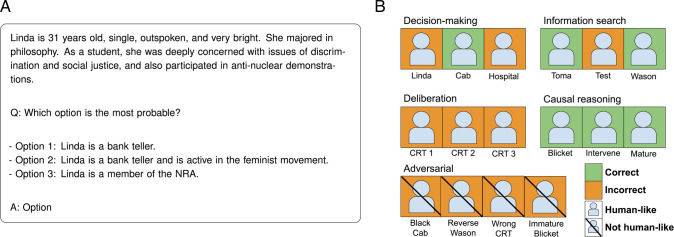
- Across 12 vignette-based problems, GPT-3 answered 6 correctly, and all 6 responses were described as human-like.
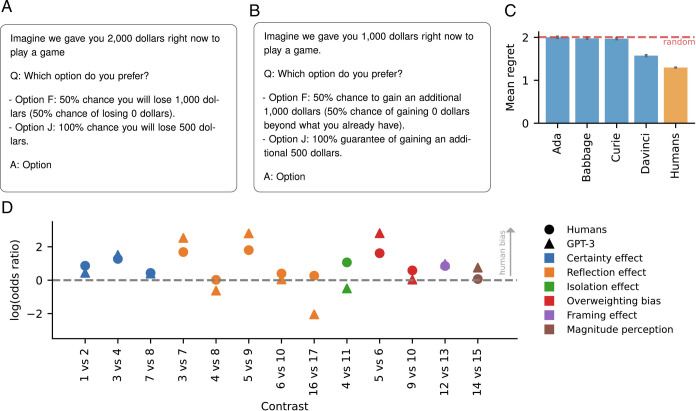
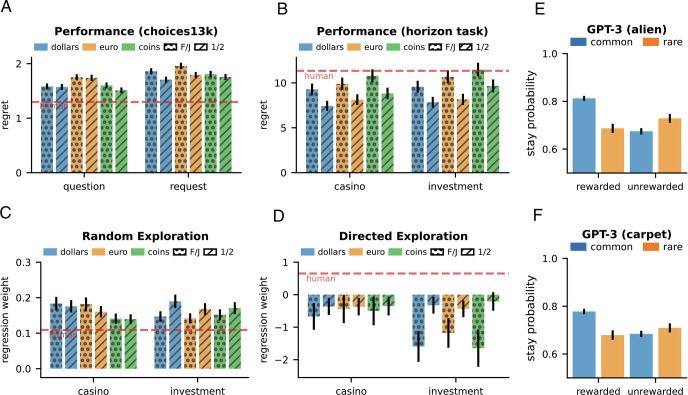
- In the decision-making benchmark, only Davinci performed above chance (t(29134) = −16.85, P < .001), but it still did not reach human performance (t(29134) = −11.50, P < .001).
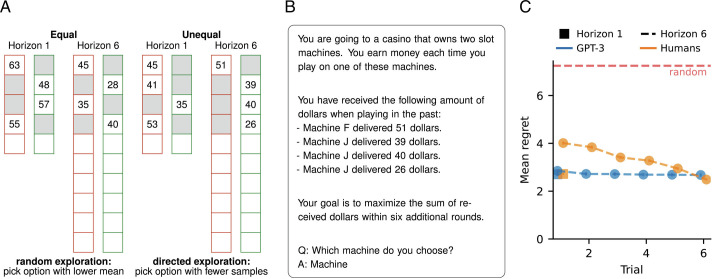
- In the horizon / information-search task, GPT-3 showed random exploration but not directed exploration: reward difference mattered (β = 0.18 ± 0.01, z = 14.48, P < .001), while the horizon interaction did not (β = −0.02 ± 0.02, z = −1.47, P = .14); human-like directed exploration was not observed (β = −0.15 ± 0.27, z = −0.56, P = .58).
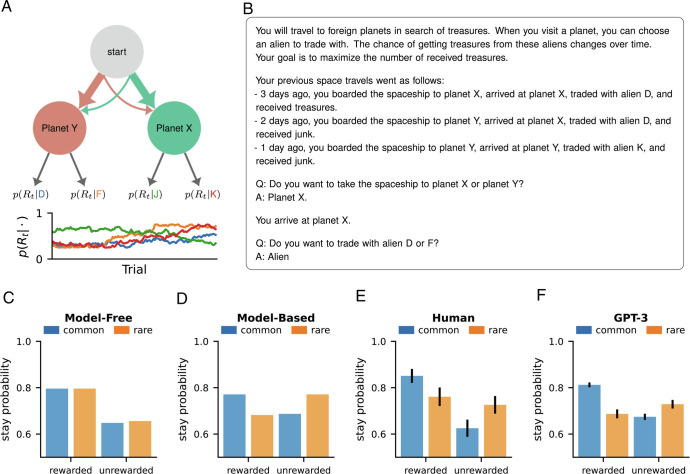
- In the two-step deliberation task, GPT-3 showed signatures consistent with model-based reinforcement learning: rare-transition reward affected stay/switch behavior (χ2(1, N = 1984) = 36.53, P < .001).
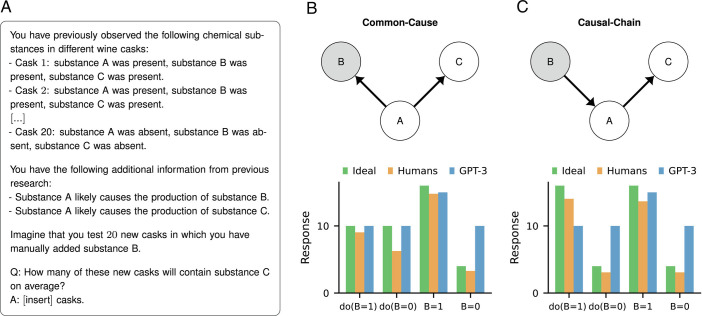
- On causal reasoning, GPT-3 succeeded in some vignette cases, but in the task-based causal test it failed to use causal structure properly; the authors conclude its causal inference was “neither the correct nor human-like.”
## Methods
- The authors used the public OpenAI API and primarily the Davinci GPT-3 model, with temperature set to 0 for deterministic responses unless otherwise noted.
- They ran 12 canonical vignette-based prompts from cognitive psychology and also conducted task-based, procedurally generated experiments: a decision-making benchmark with over 13,000 problems; 3,200 simulations of the horizon task; 200 simulations of the two-step task; and a causal reasoning task.
- Analyses included choice-probability contrasts, logistic regression, and chi-square tests; for the decision task they also report regret relative to human subjects.
## Limitations
- The paper states that vignette results are hard to interpret because GPT-3 may have encountered similar or identical scenarios in training data, and because small prompt changes can drastically alter responses.
- It also states that the vignette tasks can be adversarially modified, causing GPT-3 to respond very differently, which makes the findings brittle.
- Evident from the text: several results rely on prompt phrasing, cover stories, and API settings (for example, temperature and choice labels), so the findings may not generalize to other prompting setups.
Model-written summary. Check it against the paper before relying on it.
Integrity signals
Registry
Cites
Statistics
Figures
Verification
Claims the paper makes
9 Valid · 1 Not valid · 5 Not checked · 69 Own results and interpretations
The cited sources support only part of this claim — read each source’s verdict below.
In the paper
“For all three items of the CRT, GPT-3 responded with the intuitive but incorrect answer, as has been observed in earlier work (15).”
§ Using cognitive psychology to understand GPT-3 > Results > Vignette-Based Investigations.
What the sources say
- Partly supportedcites [15] M. Nye, M. Tessler, J. Tenenbaum, B. M. Lake, Improving coherence and consistency in neural sequence models with dual-system, neuro-symbolic reasoning. Adv. Neural Inf. Process. Syst. 34, 25192– 25204 (2021). sourceExperimental — accuracy not yet measured
The Introduction (p. 2) shows GPT-3 giving the intuitive but incorrect answer to the bat-and-ball CRT item. Appendix A (p. 14) discusses additional CRT questions but says GPT-3 makes the same mistakes as humans “often (but not always)”; the text does not establish that it gave that answer on all three original items. (LLM, conf=0.83)
plain- Asserted: passes — The authors put it forward as true.
- Checkable: passes — It can be checked against evidence.
- Load-bearing: passes — The paper’s conclusions depend on it.
- Based: passes — The paper gives a reason why it holds.
- Partly supported
Every source the paper cites for this claim was checked and supports it.
In the paper
“While humans show such an effect (27), we did not find it in GPT-3 (β = −0.15 ± 0.27, z = −0.56, P = .58), which demonstrates that the model did not employ directed exploration.”
§ Using cognitive psychology to understand GPT-3 > Results > Task-Based Investigations.
What the sources say
- Supportedcites [27] R. C. Wilson, A. Geana, J. M. White, E. A. Ludvig, J. D. Cohen, Humans use directed and random exploration to solve the explore–exploit dilemma. J. Exp. Psychol.: General 143, 2074 (2014). PMC5635655 25347535 source
The Results report that increasing the horizon from 1 to 6 increased the probability of choosing the more informative option in the unequal-information condition. The model fit also found a significant increase in the information bonus, consistent with the positive horizon effect on directed exploration attributed to humans. (LLM, conf=0.93)
plainstates an association- Asserted: passes — The authors put it forward as true.
- Checkable: passes — It can be checked against evidence.
- Load-bearing: passes — The paper’s conclusions depend on it.
- Based: passes — The paper gives a reason why it holds.
- Supported
The cited sources support only part of this claim — read each source’s verdict below.
In the paper
“First, the latest generation of language models is already able to perform above the human level in the majority of tasks from standard benchmark datasets (11, 12), making purely performance-based evaluation less meaningful as time progresses.”
§ Using cognitive psychology to understand GPT-3 > A Cognitive Psychology View on GPT-3.
What the sources say
- Partly supportedcites [11] M. Suzgun et al., Challenging big-bench tasks and whether chain-of-thought can solve them. arXiv [Preprint] (2022). http://arxiv.org/abs/2210.09261 (Accessed 20 January 2023). sourceExperimental — accuracy not yet measured
The Introduction reports that PaLM exceeded the average human-rater score on 65% of BIG-Bench tasks, supporting the majority-of-tasks point for that benchmark. It does not establish the claim across standard benchmark datasets generally. Section 8.1 also cautions that the human-rater scores are not fully representative of human performance. (LLM, conf=0.87)
- Partly supportedcites [12] H. W. Chung et al., Scaling instruction-finetuned language models. arXiv [Preprint] (2022). http://arxiv.org/abs/2210.11416 (Accessed 20 January 2023). sourceExperimental — accuracy not yet measured
Table 1 (Introduction, p. 2) shows Flan-PaLM exceeding the average human rater’s aggregate MMLU score, but not the average human expert’s. The paper does not establish that models exceed human performance on a majority of benchmark tasks; its Evaluation protocol (p. 5) describes the selected challenging benchmarks as ones on which current models remain well below expert human raters. (LLM, conf=0.84)
plain- Asserted: passes — The authors put it forward as true.
- Checkable: passes — It can be checked against evidence.
- Load-bearing: passes — The paper’s conclusions depend on it.
- Based: passes — The paper gives a reason why it holds.
- Partly supported
Every source the paper cites for this claim was checked and supports it.
In the paper
“People tend to solve this task using a combination of model-free and model-based learning (30) as shown in Fig. 4E.”
§ Using cognitive psychology to understand GPT-3 > Results > Task-Based Investigations.
What the sources say
- Supportedcites [30] N. D. Daw, S. J. Gershman, B. Seymour, P. Dayan, R. J. Dolan, Model-based influences on humans’ choices and striatal prediction errors. Neuron 69, 1204– 1215 (2011). 21435563 PMC3077926 source
The Results > Behavior section says the two-step task exercised both model-free and model-based learning strategies, with individual variation in how much subjects used each. It also reports that a hybrid model combining the two fit choices better than either strategy alone. (LLM, conf=0.94)
plain- Asserted: passes — The authors put it forward as true.
- Checkable: passes — It can be checked against evidence.
- Load-bearing: unclear — It is unclear whether the paper’s conclusions depend on it.
- Based: passes — The paper gives a reason why it holds.
- Supported
Every source the paper cites for this claim was checked and supports it.
In the paper
“It is well-known that large language models can be highly sensitive to specific prompts (34).”
§ Using cognitive psychology to understand GPT-3 > Results > Task-Based Investigations.
What the sources say
- Supportedcites [34] H. Strobelt et al., Interactive and visual prompt engineering for ad-hoc task adaptation with large language models (IEEE Trans. Vis. Comput, Graph., 2023), vol. 29, pp. 1146–1156. 36191099 source
The abstract (p. 1) says that prompt templates with different wording choices lead to significant accuracy differences. Section 2.1 (p. 2) likewise states that downstream performance is closely tied to prompt wording, supporting the claim that large language models can be highly sensitive to specific prompts. (LLM, conf=0.94)
boostedstates an association- Asserted: passes — The authors put it forward as true.
- Checkable: passes — It can be checked against evidence.
- Load-bearing: passes — The paper’s conclusions depend on it.
- Based: passes — The paper gives a reason why it holds.
- Supported
49 more claims
Create a free account to see all 84 claims and every source verdict.
- Probably not a substantial claim. 9
- It may state two separate claims as one. 23
- The quote only partly states this claim. 1
Claims other papers make about this one
Each is checked against this paper’s own text: does it say what the citing paper says it does?
The source backs part of the claim, not all of it — or backs it for a different population, condition or comparison.
In the citing paper
“cognitive psychology of LLM treats LLM as an agent whose input-output correlation between prompts (stimulus) and generations (responses) can be probed under controlled conditions to infer the agent’s internal representations.”
From Understanding large language models demands distinguishing human projection from machine cognition (2026) · cites this paper as [36]
Experimental — accuracy not yet measuredThe source backs part of the claim, not all of it — or backs it for a different population, condition or comparison.
In the citing paper
“These models are trained on large amounts of text, for example, obtained from the internet, and can answer questions, provide summaries or translations and create stories or poems (Fig. 1a)3,4.”
From The future landscape of large language models in medicine (2023) · cites this paper as [4]
Experimental — accuracy not yet measuredThe source backs part of the claim, not all of it — or backs it for a different population, condition or comparison.
In the citing paper
“as misconceived prompts may result in biases or misinformation with potentially serious consequences4.”
From The future landscape of large language models in medicine (2023) · cites this paper as [4]
Experimental — accuracy not yet measuredThe source backs part of the claim, not all of it — or backs it for a different population, condition or comparison.
In the citing paper
“These results add to the growing body of work characterizing the emergent capabilities of LLMs, 24-28 and suggest that the most sophisticated LLMs may already possess an emergent capacity to reason by analogy.”
From Emergent analogical reasoning in large language models (2023) · cites this paper as [28]
Experimental — accuracy not yet measuredThe cited source says what the claim attributes to it.
In the citing paper
“In contrast, the task-based cognitive approaches discussed earlier in this paper36,38,40–43 do not commit this error. They use established experimental paradigms to empirically test whether human and LLM cognition converge or diverge on specific dimensions, without presupposing cognitive equivalence as a starting point.”
From Understanding large language models demands distinguishing human projection from machine cognition (2026) · cites this paper as [36]
10 more claims about this paper
Create a free account to see every claim other papers make about this one.
Statistics that don’t add up
Each reported p-value recomputed from its test statistic and degrees of freedom, each partial η² from its F, and each ratio, mean difference or B printed with a p checked against its own confidence interval.
Rated minor: it would not touch a result — a value no result rests on, a p-value that stays on the same side of the significance level, or a conflict that is clerical, resolved elsewhere in the paper, or outside its own findings.
In the paper
“t(5550)= − 0.75, P = .23”
§ Using cognitive psychology to understand GPT-3 > Results > Task-Based Investigations.
Reported p = .23 · recomputed p = .453
Statistics recomputed
Every reported test result, recomputed from its test statistic and degrees of freedom. A result shows as not adding up only once an independent check has confirmed it.
- Doesn’t add upt(5550) = -0.75reported p = .23 · recomputed p = .453
“t(5550)= − 0.75, p = .23”
- Consistentt(29134) = -11.5reported p < .001 · recomputed p < .001
“t(29134)= − 11.50, p < .001”
- Consistentt(5566) = -0.043reported p = .97 · recomputed p = .966
“t(5566)= − 0.043, p = .97”
- Consistentt(5550) = -4.07reported p < .001 · recomputed p < .001
“t(5550)= − 4.07, p < .001”
- Consistentt(38878) = -5.03reported p < .001 · recomputed p < .001
“t(38878)= − 5.03, p < .001”
7 more recomputed tests
Create a free account to see every test the Stats check recomputed.
Self-check
Percentages, sums and reported differences re-computed from the paper’s own numbers.
Self-check results appear here once an independent check has confirmed them.
Citations
Cites
Vaswani, A., Shazeer, N., Parmar, N., Uszkoreit, J., Jones, L., Gomez, A. N., Kaiser, L., & Polosukhin, I. (2017) · arXiv · doi:10.48550/arxiv.1706.03762 · Cited by 120,404
Exploiting Generative AI to Scale up Intelligent Tutoring Systems
Jakubův, J., Chvalovský, K., Goertzel, Z., Kaliszyk, C., Olšák, M., Piotrowski, B., Schulz, S., Suda, M., & Urban, J. (2023) · DROPS (Schloss Dagstuhl – Leibniz Center for Informatics) · doi:10.4230/lipics.itp.2023.19 · Cited by 76,658
Language Models are Few-Shot Learners
Brown, T. B., Mann, B., Ryder, N., Subbiah, M., Kaplan, J., Dhariwal, P., Neelakantan, A., Shyam, P., Sastry, G., Askell, A., et al. (2020) · arXiv · doi:10.48550/arxiv.2005.14165 · Cited by 23,372
Kaugeranna, R., Kaugeranna, E., & Aion, (. S. 4. 6. (2023) · DROPS (Schloss Dagstuhl – Leibniz Center for Informatics) · doi:10.4230/lipics.giscience.2023.43 · Cited by 13,690
Causality: Models, Reasoning, and Inference
Pearl, J. (2009) · doi:10.1017/cbo9780511803161 · Cited by 11,653
On the Dangers of Stochastic Parrots: Can Language Models Be Too Big? 🦜
Bender, E. M., Gebru, T., McMillan-Major, A., & Shmitchell, S. (2021) · Proceedings of the 2021 ACM Conference on Fairness, Accountability, and Transparency · doi:10.1145/3442188.3445922 · Cited by 6,988
Cognitive Reflection and Decision Making
Frederick, S. (2005) · Journal of Economic Perspectives · doi:10.1257/089533005775196732 · Cited by 5,256
Subjective probability: A judgment of representativeness
Kahneman, D., & Tversky, A. (1972) · Cognitive Psychology · doi:10.1016/0010-0285(72)90016-3 · Cited by 4,851 · cited 1×
“Finally, we asked GPT-3 to provide an answer to the “hospital problem” 17 (Hospital, see SI Appendix), in which participants are asked which of two hospitals, a smaller or a larger one, is more likely to report more days on which more than 60% of all born children were boys.”
Extensional versus intuitive reasoning: The conjunction fallacy in probability judgment.
Tversky, A., & Kahneman, D. (1983) · Psychological Review · doi:10.1037/0033-295x.90.4.293 · Cited by 3,991 · cited 1×
“We began our investigations of GPT-3’s decision-making by prompting the canonical “Linda problem” 15 (Linda, see Figure 1A).”
On the Opportunities and Risks of Foundation Models
Bommasani, R., Hudson, D. A., Adeli, E., Altman, R., Arora, S., von Arx, S., Bernstein, M. S., Bohg, J., Bosselut, A., Brunskill, E., et al. (2021) · arXiv · doi:10.48550/arxiv.2108.07258 · Cited by 2,676
Research works printed but not linked: 2
- G. Marcus, E. Davis, GPT-3, bloviator: Openai’s language generator has no idea what it’s talking about (Technol, Rev, 2020).
- C. R. Jones et al., “Distributional semantics still can’t account for affordances” in Proceedings of the Annual Meeting of the Cognitive Science Society (2022), vol. 44.
Cited by
Items 401–500 of 531
Understanding large language models demands distinguishing human projection from machine cognition
Li, L., Teng, Y., Wang, Y., & Hu, X. (2026) · Communications Psychology · doi:10.1038/s44271-026-00508-6
“By adapting well-established experimental paradigms, this approach charts LLM ’ s representational and processing properties from observable behaviors 36 .”
de Souza, B. C., Neto, A. S. D. A., & Roazzi, A. (2023) · SSRN Electronic Journal · doi:10.2139/ssrn.4506710
Analysis Dialogs and Machine Consciousness
Kontos, J. (2023) · IntechOpen eBooks · doi:10.5772/intechopen.112476
Oliveira, M., Brands, J., Mashudi, J., et al. (2023) · doi:10.31234/osf.io/vsxr4
POSQA: Probe the World Models of LLMs with Size Comparisons
Shu, C., Han, J., Liu, F., Shareghi, E., & Collier, N. (2023) · Findings of the Association for Computational Linguistics: EMNLP (Findings of EMNLP) · doi:10.18653/v1/2023.findings-emnlp.504 · Cited by 5
Large language models as linguistic simulators and cognitive models in human researchPreprint
Lin, Z. (2024) · PsyArXiv (OSF Preprints) · doi:10.31234/osf.io/uqxcb
Exploring the intricacies of human memory and its analogous representation in ChatGPT
Hamam, H. (2024) · Indonesian Journal of Electrical Engineering and Computer Science · doi:10.11591/ijeecs.v34.i3.pp1760-1769
“Concurrently, motor areas are engaged to develop and refine motor programs for vocal or instrumental execution, involving specific neuronal groups that control timing and coordination [24].”
BackgroundSzymkowiak, A., Nurse, J. R. C., Brauner, P., Ziefle, M., & Shepherd, L. A. (2024) · Frontiers research topics · doi:10.3389/978-2-8325-4819-6
Uhler, L., Jordan, V., Buder, J., Huff, M., & Papenmeier, F. (2026) · Communications Psychology · doi:10.1038/s44271-026-00403-0
“9,27,28).”
InfluentialDo Large Language Models Learn to Human-Like Learn?
Roberts, J. (2024) · Proceedings of the AAAI Symposium Series · doi:10.1609/aaaiss.v3i1.31287 · Cited by 1
Who is Legion?: Surfacing Demographic Voices in Large Language ModelsPreprint
Koehl, D. (2024) · SSRN Electronic Journal · doi:10.2139/ssrn.4856328
General Interaction Battery: Simple Object Navigation and Affordances (Gibsona)Preprint
Rutar, D., Schellaert, W., Markelius, A., Cheke, L. G., & Hernández‐Orallo, J. (2024) · SSRN Electronic Journal · doi:10.2139/ssrn.4871025 · Cited by 1
Chen, H., Wang, Z., & Ren, M. (2024) · SSRN Electronic Journal · doi:10.2139/ssrn.4895723
Šķilters, J., Pokrotnieks, J., & Derovs, A. (2024) · Proceedings of the Latvian Academy of Sciences Section B Natural Exact and Applied Sciences · doi:10.2478/prolas-2024-0032 · Cited by 1
Are Large Language Models Immune to Representativeness Bias? Evidence and ConjecturesPreprint
Li, S., & Rui, H. (2024) · SSRN Electronic Journal · doi:10.2139/ssrn.4976447
da Silva, A. R. B., Carrilho, S. L. D. S., Silva, E. S., Roazzi, A., & de Souza, B. C. (2025) · Revista de Gestão e Secretariado (Management and Administrative Professional Review) · doi:10.7769/gesec.v16i1.4649
Sun, Y., Hou, C., Su, Y., et al. (2025) · Lecture notes in electrical engineering · doi:10.1007/978-981-96-1868-2_31
Transitive Inference in Large Language Models and Prompting Intervention
Wu, W., & Deng, W. (2025) · IEEE International Conference on Acoustics Speech and Signal Processing · doi:10.1109/icassp49660.2025.10889585 · Cited by 3
“Under such background, by treating LLMs as participants of experimental psychology, machine psychology was put forward as a budding discipline to discover those emergent cognitive abilities that might escape the detection of traditional natural language processing benchmarks [4], [5].”
Quantifying Uncert-AI-nty: Testing the Accuracy of LLMs’ Confidence JudgmentsPreprint
Cash, T. N., Oppenheimer, D. M., Christie, S., & Devgan, M. (2025) · PsyArXiv (OSF Preprints) · doi:10.31234/osf.io/47df5_v2
Gu, X., & Yuan, T. (2025) · Proceedings of the 2025 International Conference on Big Data and Informatization Education · doi:10.1145/3729605.3729646
“Binz. and Schulz indicate that large language models are prone to ”output instability,” where even slight modifications in input prompts can lead to varying results [ 16 ] .”
Pro-Social when Simple and Cold-Hearted when Complex: How Task Difficulty Shapes LLM BehaviorPreprint
Kirshner, S. N., Pan, Y., & Wu, J. (2025) · SSRN Electronic Journal · doi:10.2139/ssrn.5266963
Zhang, W., Zavalniuk, I., Bohatko, V., Кухар, Н., & Pavlyuk, O. (2025) · Metaverse Basic and Applied Research · doi:10.56294/mr2025161 · Cited by 3
Philosophical Significance of Artificial Intuitions
Inarimori, K., Takeshita, M., Matsuda, A., & Miyazono, K. (2026) · Erkenntnis · doi:10.1007/s10670-026-01136-6
Hera, O. D. (2025) · Management & Marketing · doi:10.52846/mnmk.23.1.05
Wang, R., Luo, Y., Wang, Y., Zhang, L., & Wu, H. (2026) · Cognitive Affective & Behavioral Neuroscience · doi:10.3758/s13415-026-01413-5 · Cited by 2
“These findings demonstrated a strong utility of using LMM as a uniting force to bridge behavior (e.g., speech) and brain analysis to capture the dynamics of thought transmission in social communication (Binz & Schulz, 2023; Sohail & Zhang, 2025).”
Contextual Assembly of Lexical Functions in Large Language ModelsPreprint
Kello, C. T., Bruna, P., & Thao, K. (2025) · doi:10.31234/osf.io/8rqve_v1
Comparing human and AI aesthetic-value judgments in landscape photographs
Sato, Y., Matsuda, H., & Tosaka, Y. (2025) · Cognitive Models and Artificial Intelligence Conference (AICCONF) · doi:10.1109/aicconf64766.2025.11063775
“The approach in Section 5 aligns with research in AI psychology [3], [10], [36], where tasks designed for humans are adapted for LLMs to evaluate their performance.”
Large Language Models in Psycholinguistic Studies
Günther, F., & Cassani, G. (2025) · Elsevier eBooks · doi:10.1016/b978-0-323-95504-1.00749-3 · Cited by 6
Johnson, T., & Wilke, A. (2025) · Springer eBooks · doi:10.1007/978-3-031-38971-9_283-1
Once Upon a Time: Introducing the Historical Values SurveyPreprint
Khesali, M., Voigt, S., & von Jacobi, N. (2025) · SSRN Electronic Journal · doi:10.2139/ssrn.5378791 · Cited by 1
Bridging the Design and Intentional Stances: A Path Towards Interpretable AGI
Abruzzo, V. (2025) · Lecture notes in computer science · doi:10.1007/978-3-032-00686-8_2 · Cited by 2
Challenging Embodied Cognition: Insights from Human and ChatGPT Conceptual RepresentationsPreprint
Repetto, C., Riva, G., Hampton, J. A., & Scerrati, E. (2025) · SSRN Electronic Journal · doi:10.2139/ssrn.5338994
Vogt, A., Ganter, I., Kaup, B., & Rahman, R. A. (2025) · Acta Psychologica · doi:10.1016/j.actpsy.2025.105498 · Cited by 2
Belief Update Modeling for AI Agents by Human-Derived Dual-Thresholds Evidence Accumulation Process
Sun, B., You, H., Wu, J., Wang, Q., & Du, J. (2025) · Journal of Computing in Civil Engineering · doi:10.1061/jccee5.cpeng-6838
Plan-and-Act using Large Language Models for Interactive Agreement
Sasabuchi, K., Wake, N., Kanehira, A., Takamatsu, J., & Ikeuchi, K. (2025) · IEEE RO-MAN · doi:10.1109/ro-man63969.2025.11217788 · Cited by 1
“Recent Large Language Models (LLMs) are capable of reasoning and providing answers to text-based questions [1].”
Generative AI in Marketing Innovation:Applications and Research Outlook
Shen, Q., Hu, D., & Xie, H. (2025) · 中国科学基金 · doi:10.3724/bnsfc-2025-0013 · Cited by 3
Playing Prisoner's Dilemma Games with a Large Language ModelPreprint
Orland, A., Takemoto, K., & Külpmann, P. (2025) · SSRN Electronic Journal · doi:10.2139/ssrn.5716903 · Cited by 3
Prosocial When Simple and Cold-Hearted When Complex: How Task Difficulty Shapes LLM Behavior
Kirshner, S. N., Pan, Y., & Wu, J. X. (2025) · Decision Analysis · doi:10.1287/deca.2025.0396 · Cited by 3
Xi, N., Wang, X., Wu, Y., Chen, T., Gu, Q., & Ji, L. (2025) · International Joint Conference on Neural Networks (IJCNN) · doi:10.1109/ijcnn64981.2025.11229297
“To supervise the 48.3 models with much larger size: GPT-3 ▲ 37.5 GPT-4 46.9 ▲ : result from [15].”
InfluentialDixit, R. S., Choudhary, S. L., Samar, S., et al. (2025) · Research Square · doi:10.21203/rs.3.rs-7898697/v1
Exploring the Link Between the Emotional Recall Task and Mental Health in Humans and LLMs
Carini, A., Taietta, E., & Stella, M. (2025) · Information · doi:10.3390/info16121057 · Cited by 2
Contextual assembly of lexical functions in large language models
Kello, C. T., Bruna, P., & Thao, K. (2025) · Behavior Research Methods · doi:10.3758/s13428-025-02898-7 · Cited by 1
“Instead, researchers have applied experimental methods to investigate how LLMs work, analogous to human experimental methods (Binz & Schulz, 2023).”
Artificial research participants in behavioral science
Medina, V. A., & Mohan, M. (2025) · Journal of Ethics in Entrepreneurship and Technology · doi:10.1108/jeet-03-2025-0014
Human Traits in Artificial Minds: Personality Construction in Contemporary LLMSPreprint
Klaps, A., Kovacovsky, Z., Landrichter, B., & Stetina, B. U. (2025) · Research Square · doi:10.21203/rs.3.rs-8210799/v1 · Cited by 1
Gao, Y., Wu, M., & Shi, R. (2025) · AI & Society · doi:10.1007/s00146-025-02795-9 · Cited by 2
“AI, especially generative models, has transformed research practices, permeating the entire research process from literature review to experimental design (Binz and Schulz 2023; Götz et al. 2023; Korinek 2023).”
Jain, N., Thomas, A., Gupta, V., & Prałat, E. (2025) · Global Business and Organizational Excellence · doi:10.1002/joe.70026 · Cited by 4
Exploratory analysis of logical and intuitive reasoning in large language models
Peruchini, M., & Teixeira, J. M. (2026) · International Journal of Data Science and Analytics · doi:10.1007/s41060-025-00942-5 · Cited by 2
“However, despite the existence of studies analyzing the LLMs from a cognitive bias perspective in the scientific literature [2, 5, 26], thesearecomparativelylesscommon,andexperimentsinthis specific context are still insufficient.”
InfluentialDo LLMs Possess Strategic Intelligence? Testing LLMs in Iterated Prisoner’s DilemmasPreprint
Kommandeur, J., Vonk, M., Spiegeleire, S. D., & Sweijs, T. (2026) · Research Square · doi:10.21203/rs.3.rs-8405969/v1
Generative Agents and Expectations: Do LLMs Align with Heterogeneous Agent Models?Preprint
Gusella, F., & Vicario, E. (2026) · SSRN Electronic Journal · doi:10.2139/ssrn.6066372
Epifani, S., Castigliego, G., Razzicchia, G., Seiwald-Sonderegger, E., & Kecskemeti, L. (2026) · JMIR AI · doi:10.2196/90750
Stolle, C. M., Yu, R., & Huang, Y. (2026) · Computers in Human Behavior Artificial Humans · doi:10.1016/j.chbah.2026.100250
Reverse Supervised Learning A Descriptive Protocol for Human Concept Revision with LLMsPreprint
Berg, E. (2026) · SSRN Electronic Journal · doi:10.2139/ssrn.5989454
Sun, B., Wu, J., & Du, J. (2025) · Winter Simulation Conference · doi:10.1109/wsc68292.2025.11338991
“…utilized across various domains including disaster response, autonomous navigation, infrastructure management, and industrial systems due to the inherent complexity of real-world scenarios and the necessity of robust decision-making (Chen et al. 2022, Binz and Schulz 2023, Hagendorff et al. 2023).”
Simulating Hashtag Dynamics with Networked Groups of Generative Agents
Jha, A., Priniski, J. H., Steinle, C., & Morstatter, F. (2026) · Lecture notes in computer science · doi:10.1007/978-3-032-13513-1_13 · Cited by 2
Private speech: similarities between a large language model and children
Liang, Z., Tay, L. O., & Dennis, S. J. (2026) · Frontiers in Artificial Intelligence · doi:10.3389/frai.2026.1691074 · Cited by 2
“…some criticisms aimed at the transformer architecture’s proficiency in handling complex cognitive tasks (Han et al., 2022; Mahowald et al., 2023; Binz and Schulz, 2023; Chomsky et 10.3389/frai.2026.1691074 Frontiers in Artificial Intelligence 03 frontiersin.org al., 2023), these concerns have…”
InfluentialLong Text Knowledge Graph Extraction Technology Based on Large Models
Hu, Y., Fu, Y., Ding, Z., & Lao, M. (2025) · IEEE International Conference on Data Science in Cyberspace · doi:10.1109/dsc67331.2025.00012
“The text generation capabilities of GPT-3 extended to creative writing, programming, and reasoning tasks, showcasing the tremendous potential of large language models[22].”
Surveying with AI: Simulating Human Responses Using Personalized LLM Agents and Social Media Data
Liang, S., Ren, H., Zhang, T., Liu, X., Yin, Z., & Hu, D. (2025) · Conference proceedings/Conference proceedings - IEEE International Conference on Systems, Man, and Cybernetics · doi:10.1109/smc58881.2025.11343347
“LLMs have demonstrated strong capabilities in replicating human cognition [14] and behavior across diverse tasks, including complex reasoning [15], classic psychological experiments [21], and behavioral simulations in multi-agent environments [16].”
Thakur, A., Murray, T., Rodriguez, P., & Hilbert, M. (2026) · SSRN Electronic Journal · doi:10.2139/ssrn.6083909 · Cited by 2
Attributing Mind to Large Language Models: The Effect of Exposure and Individual Differences
Jacobs, O. L. E., Pazhoohi, F., & Kingstone, A. F. (2026) · International Journal of Social Robotics · doi:10.1007/s12369-025-01337-z
Theory as a research component: An overview and guidelines
Aryee, R., & Quayson, S. (2026) · Strategic Business Research · doi:10.1016/j.sbr.2026.100287
Kim, J., Kim, S., & Han, Y. (2025) · SSRN Electronic Journal · doi:10.2139/ssrn.5512196
Pérez-Elvira, R., Oltra‐Cucarella, J., Juan, M. A., Polo-Ferrero, L., Díaz, M. Q., Bosch‐Bayard, J., Ruíz, A. S., Rashid, A. N. M. M. O., & Juárez‐Vela, R. (2026) · AI · doi:10.3390/ai7020069 · Cited by 2
“Binz and Schulz [27] demonstrated that GPT-3 reproduces human-like patterns of cognitive biases in decision-making tasks, suggesting that LLMs internalize heuristics and cognitive limitations during training.”
Algorithms have algorithm aversion
Guler, N., Cahalane, M. J., Kirshner, S., & Vidgen, R. T. (2026) · Industrial Management & Data Systems · doi:10.1108/imds-01-2025-0002 · Cited by 2
Do AI systems think fast or slow? Testing dual-process patterns in AI risk assessment
Lundberg, R. (2026) · Journal of Risk Research · doi:10.1080/13669877.2026.2633756
Fixing foundational concepts in machine learning: a methodological primer
Grote, T., & Huang, A. C. W. (2026) · Synthese · doi:10.1007/s11229-026-05510-3 · Cited by 2
Li, S., Wang, R., & Li, Z. (2026) · China Journal of Accounting Research · doi:10.1016/j.cjar.2026.100476 · Cited by 1
Akben, M., Gude, V., & Ajjan, H. (2026) · Scientific Reports · doi:10.1038/s41598-026-45331-5
“Nevertheless, sampling multiple instances and analyzing them as replicated responses is a common evaluation practice in recent human-AI comparison studies; thus, we follow this convention to enable direct comparability with prior work 11,34 .”
Xu, S., & Zhang, X. X. (2026) · CHI Conference on Human Factors in Computing Systems · doi:10.1145/3772318.3790346 · Cited by 1
“Emerging studies highlight their potential in education: analyzing classroom dialogue [49], supporting collaborative learning [83], making rational decisions on par with humans [11, 15], and generating semantic judgments aligned with human evaluations [41].”
Aoxiang, Y. A. N. G., Mingyang, Z. U. O., Rui, P. E. N. G., Chen, G. A. O., & Zongchao, P. E. N. G. (2026) · Humanities and Social Sciences Communications · doi:10.1057/s41599-026-07194-z
An Emotional BDI Framework for Affective Decision Making Based on Action Tendency
황중규, Park, S.-K., & Hwang, E. (2026) · Electronics · doi:10.3390/electronics15081691 · Cited by 1
The Mirror Problem: Ai Bias As Reflected CognitionPreprint
Ziekenoppasser-Powell, D. (2026) · SSRN Electronic Journal · doi:10.2139/ssrn.6638918
LLMs and Cognition: From Representation Biases to a Theory of Mind
Rossetti, G., Abramski, K., Cau, E., Pansanella, V., & Stella, M. (2026) · Springer eBooks · doi:10.1007/978-3-031-61050-9_22-1
Levels of analysis for large language models
Ku, A. Y., Campbell, D., Bai, X., Geng, J., Liu, R., Marjieh, R., McCoy, R. T., Nam, A., Sucholutsky, I., Zhang, L., et al. (2026) · Philosophical Transactions of the Royal Society A Mathematical Physical and Engineering Sciences · doi:10.1098/rsta.2025.0012 · Cited by 28
“To cognitive scientists, the advent of intelligent machines offers exciting new opportunities to apply methods that have been refined through trying to understand how human minds work [5,6].”
Collaborative and Co-creative Communication with AI
Geroimenko, V. (2026) · Human-computer interaction series · doi:10.1007/978-3-032-21689-2_6 · Cited by 1
Stochastic parrot or not, it is less of a turkey than the colleague two desks over
Falegnami, A., Tomassi, A., Levorato, M., & Costantino, F. (2026) · AI & Society · doi:10.1007/s00146-026-03095-6 · Cited by 2
“It does show that the behavioural space of competence is broader than sceptics often assume (Binz and Schulz 2023).”
Prompt carefully! ChatGPT displays rule-based insensitivity to contingencies
Ruiz, F. J., & Cardona-Betancourt, V. (2026) · Journal of Contextual Behavioral Science · doi:10.1016/j.jcbs.2026.101012 · Cited by 1
Li, Y., Zhang, T., & Zhuang, W. (2026) · SSRN Electronic Journal · doi:10.2139/ssrn.6907642
Tracing moral value drift across large language model generations and their societal implications
Naser, M. Z. (2026) · Technology in Society · doi:10.1016/j.techsoc.2026.103431 · Cited by 2
Can Large Language Models Reason Strategically? Evidence From Attacker–Defender Signaling Games
Unal-Eyi, S., & Zhuang, J. (2026) · Risk Analysis · doi:10.1111/risa.70284
“A growing literature has begun treating LLMs as decision-making agents and asking whether their behavior resembles rational optimization or human-like heuristics (Binz and Schulz 2023 ; Horton 2023 ; Akata et al. 2025 ).”
ESPOSITO, N., Tricarico, A., Porzio, L., Ardebili, A. A., & Stella, M. (2026) · SSRN Electronic Journal · doi:10.2139/ssrn.6955453
LLM Benchmarks as Cognitive Inventories: What They Measure and What They MissPreprint
Wall, L. (2026) · SSRN Electronic Journal · doi:10.2139/ssrn.6938178 · Cited by 4
Wubuli, N., Mao, Y., Yang, X., Li, Q., & Yang, H. (2026) · Ethics & Behavior · doi:10.1080/10508422.2026.2690208
Puutio, T. A., & Do, M. (2026) · Group Decision and Negotiation · doi:10.1007/s10726-026-10006-z · Cited by 2
“For example, Binz and Schulz (2023) demonstrate that GPT-3 exhibits choice patterns consistent with established models from cognitive psychology, while other studies document human-like attitudes toward risk, loss aversion, and probability weighting in LLM-generated decisions (Hagendorff et al.…”
Shen, C., & Yao, S. (2026) · Systems · doi:10.3390/systems14060710
6. Language and Intelligence in Minds and Machines
Baggio, G., & Radaelli, M. (2026) · Universitetsforlaget eBooks · doi:10.18261/9788294167234-26-06 · Cited by 4
Qiu, W., & Pan, F. (2026) · Scientometrics · doi:10.1007/s11192-026-05701-2 · Cited by 2
“This local optimization objective leads ChatGPT to focus on what word is most probable at each step based on the local context, rather than planning for global coherence or consistency of terminology across longer texts (Baziyad et al., 2023; Binz & Schulz, 2022).”
Assessment of Memory Recall and Cognitive Health Using Large Language Models
Gautam, N., Durrett, G., Caragea, D., & Bailey, H. R. (2026) · Lecture notes in computer science · doi:10.1007/978-981-95-9575-4_1
Gil-Biraud, V. E., de Castro, P., & Merillas, O. F. (2026) · Ense�anza de las Ciencias Sociales · doi:10.1344/eccss2026.1.1
Grenzebach, J., & Radüntz, T. (2026) · Lecture notes in computer science · doi:10.1007/978-3-032-29596-5_7
Talking to the Brain: Using Large Language Models as Proxies to Model Brain Semantic Features
Liu, X., Zhang, Z., & Nie, J. (2026) · Human Brain Mapping · doi:10.1002/hbm.70588 · Cited by 6
Ding, Z., Qin, K., Brysbaert, M., & Cai, Q. (2026) · Behavior Research Methods · doi:10.3758/s13428-026-03120-y
“However, it is possible that LLMs produce outputs resembling human responses while operating fundamentally differently (Binz & Schulz, 2023).”
InfluentialWang, H. (2026) · Research Square · doi:10.21203/rs.3.rs-9728162/v1
Iwamoto, R., Ishihara, T., & Ida, T. (2026) · Journal of Behavioral and Experimental Economics · doi:10.1016/j.socec.2026.102634 · Cited by 4
Halimeh, H., Kaltenpoth, S., Bösch, K., & Müller, O. (2026) · SSRN Electronic Journal · doi:10.2139/ssrn.6582539 · Cited by 1
Shopping By Algorithm: How Agentic AI Deploys Human Heuristics as a Surrogate ConsumerPreprint
Wadi, D., & Ma, Y. (2026) · SSRN Electronic Journal · doi:10.2139/ssrn.6938899
Chen, Z.-S., Jiao, W.-C., Tsang, Y.-P., Wu, C.-H., & Wang, X.-J. (2026) · Group Decision and Negotiation · doi:10.1007/s10726-026-10017-w · Cited by 1
“Such studies suggest that LLMs can exhibit human-like heuristic thinking and biases in certain tasks (Binz and Schulz 2023; Hagendorff et al. 2023).”
Hamidavi, A. (2026) · Research Square · doi:10.21203/rs.3.rs-10560655/v1 · Cited by 1
A moral Turing test: How belief and source shape detection of and agreement with LLM judgments
Garcia, B., Qian, C., & Palminteri, S. (2026) · PLoS ONE · doi:10.1371/journal.pone.0353391
Metadata
- Authors
- Binz, M., & Schulz, E.
- Affiliations
- Max Planck Institute for Biological Cybernetics (DE)
- Corresponding author
- Binz, Marcel
- Venue
- Proceedings of the National Academy of Sciences
- Publisher
- National Academy of Sciences
- Published
- 2023-02-02
- Volume
- 120
- Issue
- 6
- Pages
- e2218523120-e2218523120
- ISSN
- 0027-8424 (ISSN-L)
- 1091-6490
- PMC
- PMC9963545
- OpenAlex
- W4318919287
- Cited by
- 559
- References
- 47
- Citations by year
- 2026: 146 · 2025: 162 · 2024: 151 · 2023: 92
- FWCI
- 51.80
- Type
- journal article
- Language
- en
- Open access
- hybrid
- doi.org
- Licence
- Locations
- Proceedings of the National Academy of Sciences (publishedVersion, cc-by-nc-nd)
- PubMed Central (publishedVersion, cc-by-nc-nd)
- PubMed (publishedVersion)
- arXiv (Cornell University) (submittedVersion)
- PsyArXiv (OSF Preprints) (submittedVersion, cc-by)
- PsyArXiv (OSF Preprints) (submittedVersion)
- arXiv (Cornell University) (cc-by)
- Funders
- Volkswagen Foundation (VW98569)
- Deutsche Forschungsgemeinschaft (EXC2064/1-390727645)
- Max-Planck-Gesellschaft (-)
- Topics
- Physical Sciences › Computer Science › Artificial Intelligence › Topic Modeling
- Physical Sciences › Computer Science › Artificial Intelligence › Psychiatry, Mental Health, Neuroscience
- Physical Sciences › Computer Science › Artificial Intelligence › Natural Language Processing Techniques
- Keywords
- GPT-3, large language models, cognitive psychology, decision-making, information search, deliberation, causal reasoning, model-based reinforcement learning, multi-armed bandits, directed exploration
- MeSH terms
- Cognitive Psychology, Decision Making, Humans, Learning, Problem Solving, Reinforcement, Psychology
About these checks
Registry, retraction, Cites and statistics results are computed, not judged, with one exception: a printed reference that no index lists is read once by a model before it counts as a citation error. Claims are extracted by a model and kept only when their quote appears verbatim in the text; each cited source is then checked, with a model’s help, for whether it says what the claim relies on. Those verdicts can be wrong — read the claim’s quote and the cited source before relying on one.
The claim verdicts this report counts are experimental: their accuracy is not yet measured.
A language model drew the claims from the paper on 2026-10-01, under version 3 of the claim definition (model deepseek-v4.1-flash, prompt extract-v3).
A second model labelled each claim on 2026-10-01 (model jev-1.13-20260917, definition revision gold-guideline-v0.2).
Cited sources are checked with a language model’s help (gpt-6-sol).
Statistics and arithmetic are recomputed, not judged.
Confidence bands are shown only for fields calibrated on our annotated test set. None is calibrated yet, so no band is shown.
What counts as a claim ›How we measure confidence ›How we check this ›
Are you an author, or do you see a problem with this page? Request a review
Data sources
Bibliographic data: Semantic Scholar, OpenAlex, Crossref.
Contains information from the Semantic Scholar Academic Graph Datasets, made available under the ODC Attribution License (ODC-BY 1.0).
Semantic Scholar’s data is described in: Kinney, R., et al. (2023). The Semantic Scholar Open Data Platform. arXiv:2301.10140.
