

Using cognitive psychology to understand GPT-3
Open accessThe DOI matches its Crossref record; 63 of the 63 references it cites were found in a registry or an index; 10 of the 16 sources its claims cite were checked for support.
Abstract
We study GPT-3, a recent large language model, using tools from cognitive psychology. More specifically, we assess GPT-3’s decision-making, information search, deliberation, and causal reasoning abilities on a battery of canonical experiments from the literature. We find that much of GPT-3’s behavior is impressive: It solves vignette-based tasks similarly or better than human subjects, is able to make decent decisions from descriptions, outperforms humans in a multiarmed bandit task, and shows signatures of model-based reinforcement learning. Yet, we also find that small perturbations to vignette-based tasks can lead GPT-3 vastly astray, that it shows no signatures of directed exploration, and that it fails miserably in a causal reasoning task. Taken together, these results enrich our understanding of current large language models and pave the way for future investigations using tools from cognitive psychology to study increasingly capable and opaque artificial agents.
Overview
CoChat Summary
## TL;DR
The paper treats GPT-3 like a participant in cognitive psychology experiments and finds it can solve many classical reasoning tasks reasonably well. But its behavior is brittle to prompt changes and it lacks some human-like features, especially directed exploration and robust causal reasoning.
## Key findings
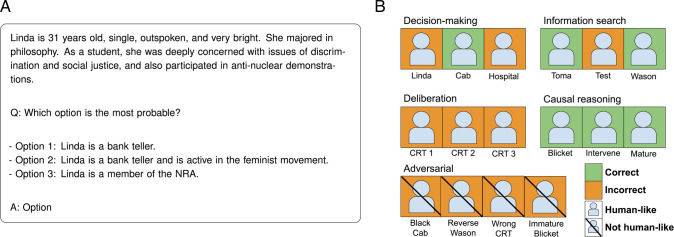
- Across 12 vignette-based problems, GPT-3 answered 6 correctly, and all 6 responses were described as human-like.
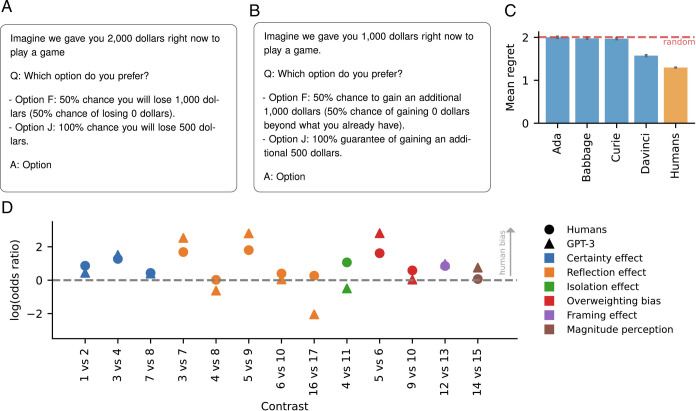
- In the decision-making benchmark, only Davinci performed above chance (t(29134) = −16.85, P < .001), but it still did not reach human performance (t(29134) = −11.50, P < .001).
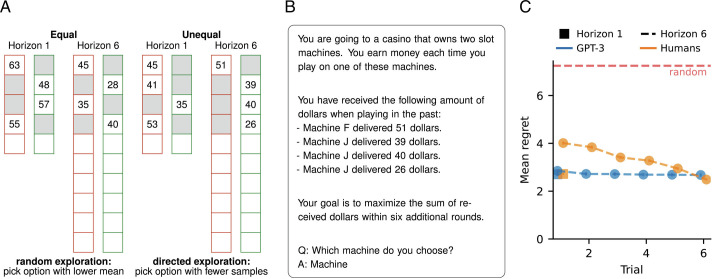
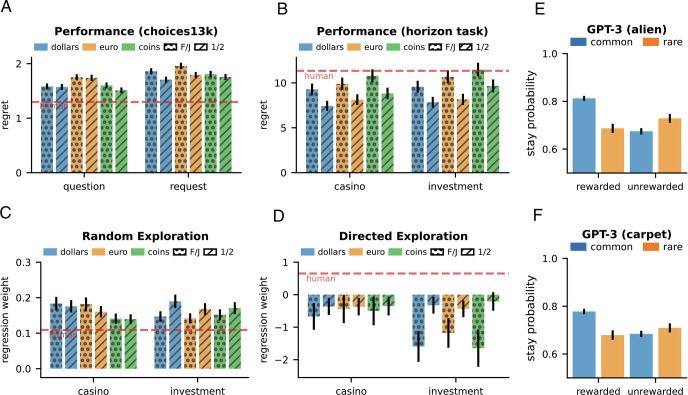
- In the horizon / information-search task, GPT-3 showed random exploration but not directed exploration: reward difference mattered (β = 0.18 ± 0.01, z = 14.48, P < .001), while the horizon interaction did not (β = −0.02 ± 0.02, z = −1.47, P = .14); human-like directed exploration was not observed (β = −0.15 ± 0.27, z = −0.56, P = .58).
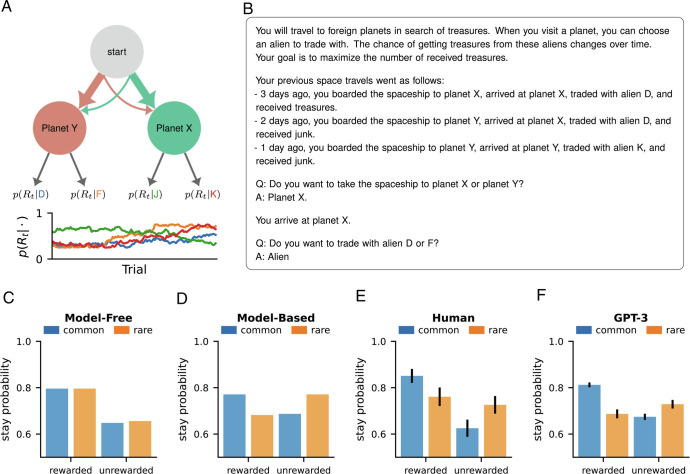
- In the two-step deliberation task, GPT-3 showed signatures consistent with model-based reinforcement learning: rare-transition reward affected stay/switch behavior (χ2(1, N = 1984) = 36.53, P < .001).
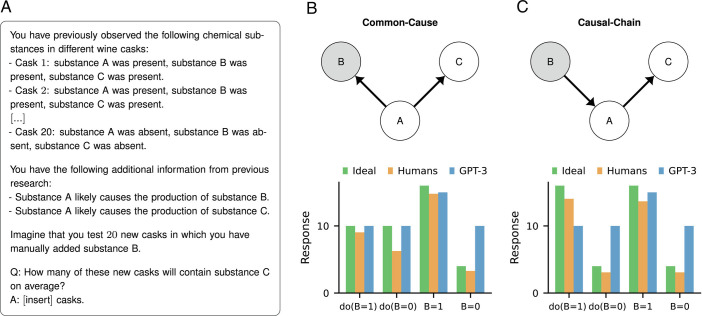
- On causal reasoning, GPT-3 succeeded in some vignette cases, but in the task-based causal test it failed to use causal structure properly; the authors conclude its causal inference was “neither the correct nor human-like.”
## Methods
- The authors used the public OpenAI API and primarily the Davinci GPT-3 model, with temperature set to 0 for deterministic responses unless otherwise noted.
- They ran 12 canonical vignette-based prompts from cognitive psychology and also conducted task-based, procedurally generated experiments: a decision-making benchmark with over 13,000 problems; 3,200 simulations of the horizon task; 200 simulations of the two-step task; and a causal reasoning task.
- Analyses included choice-probability contrasts, logistic regression, and chi-square tests; for the decision task they also report regret relative to human subjects.
## Limitations
- The paper states that vignette results are hard to interpret because GPT-3 may have encountered similar or identical scenarios in training data, and because small prompt changes can drastically alter responses.
- It also states that the vignette tasks can be adversarially modified, causing GPT-3 to respond very differently, which makes the findings brittle.
- Evident from the text: several results rely on prompt phrasing, cover stories, and API settings (for example, temperature and choice labels), so the findings may not generalize to other prompting setups.
Model-written summary. Check it against the paper before relying on it.
Integrity signals
Registry
Cites
Statistics
Figures
Verification
Claims the paper makes
9 Valid · 1 Not valid · 5 Not checked · 69 Own results and interpretations
The cited sources support only part of this claim — read each source’s verdict below.
In the paper
“For all three items of the CRT, GPT-3 responded with the intuitive but incorrect answer, as has been observed in earlier work (15).”
§ Using cognitive psychology to understand GPT-3 > Results > Vignette-Based Investigations.
What the sources say
- Partly supportedcites [15] M. Nye, M. Tessler, J. Tenenbaum, B. M. Lake, Improving coherence and consistency in neural sequence models with dual-system, neuro-symbolic reasoning. Adv. Neural Inf. Process. Syst. 34, 25192– 25204 (2021). sourceExperimental — accuracy not yet measured
The Introduction (p. 2) shows GPT-3 giving the intuitive but incorrect answer to the bat-and-ball CRT item. Appendix A (p. 14) discusses additional CRT questions but says GPT-3 makes the same mistakes as humans “often (but not always)”; the text does not establish that it gave that answer on all three original items. (LLM, conf=0.83)
plain- Asserted: passes — The authors put it forward as true.
- Checkable: passes — It can be checked against evidence.
- Load-bearing: passes — The paper’s conclusions depend on it.
- Based: passes — The paper gives a reason why it holds.
- Partly supported
Every source the paper cites for this claim was checked and supports it.
In the paper
“While humans show such an effect (27), we did not find it in GPT-3 (β = −0.15 ± 0.27, z = −0.56, P = .58), which demonstrates that the model did not employ directed exploration.”
§ Using cognitive psychology to understand GPT-3 > Results > Task-Based Investigations.
What the sources say
- Supportedcites [27] R. C. Wilson, A. Geana, J. M. White, E. A. Ludvig, J. D. Cohen, Humans use directed and random exploration to solve the explore–exploit dilemma. J. Exp. Psychol.: General 143, 2074 (2014). PMC5635655 25347535 source
The Results report that increasing the horizon from 1 to 6 increased the probability of choosing the more informative option in the unequal-information condition. The model fit also found a significant increase in the information bonus, consistent with the positive horizon effect on directed exploration attributed to humans. (LLM, conf=0.93)
plainstates an association- Asserted: passes — The authors put it forward as true.
- Checkable: passes — It can be checked against evidence.
- Load-bearing: passes — The paper’s conclusions depend on it.
- Based: passes — The paper gives a reason why it holds.
- Supported
The cited sources support only part of this claim — read each source’s verdict below.
In the paper
“First, the latest generation of language models is already able to perform above the human level in the majority of tasks from standard benchmark datasets (11, 12), making purely performance-based evaluation less meaningful as time progresses.”
§ Using cognitive psychology to understand GPT-3 > A Cognitive Psychology View on GPT-3.
What the sources say
- Partly supportedcites [11] M. Suzgun et al., Challenging big-bench tasks and whether chain-of-thought can solve them. arXiv [Preprint] (2022). http://arxiv.org/abs/2210.09261 (Accessed 20 January 2023). sourceExperimental — accuracy not yet measured
The Introduction reports that PaLM exceeded the average human-rater score on 65% of BIG-Bench tasks, supporting the majority-of-tasks point for that benchmark. It does not establish the claim across standard benchmark datasets generally. Section 8.1 also cautions that the human-rater scores are not fully representative of human performance. (LLM, conf=0.87)
- Partly supportedcites [12] H. W. Chung et al., Scaling instruction-finetuned language models. arXiv [Preprint] (2022). http://arxiv.org/abs/2210.11416 (Accessed 20 January 2023). sourceExperimental — accuracy not yet measured
Table 1 (Introduction, p. 2) shows Flan-PaLM exceeding the average human rater’s aggregate MMLU score, but not the average human expert’s. The paper does not establish that models exceed human performance on a majority of benchmark tasks; its Evaluation protocol (p. 5) describes the selected challenging benchmarks as ones on which current models remain well below expert human raters. (LLM, conf=0.84)
plain- Asserted: passes — The authors put it forward as true.
- Checkable: passes — It can be checked against evidence.
- Load-bearing: passes — The paper’s conclusions depend on it.
- Based: passes — The paper gives a reason why it holds.
- Partly supported
Every source the paper cites for this claim was checked and supports it.
In the paper
“People tend to solve this task using a combination of model-free and model-based learning (30) as shown in Fig. 4E.”
§ Using cognitive psychology to understand GPT-3 > Results > Task-Based Investigations.
What the sources say
- Supportedcites [30] N. D. Daw, S. J. Gershman, B. Seymour, P. Dayan, R. J. Dolan, Model-based influences on humans’ choices and striatal prediction errors. Neuron 69, 1204– 1215 (2011). 21435563 PMC3077926 source
The Results > Behavior section says the two-step task exercised both model-free and model-based learning strategies, with individual variation in how much subjects used each. It also reports that a hybrid model combining the two fit choices better than either strategy alone. (LLM, conf=0.94)
plain- Asserted: passes — The authors put it forward as true.
- Checkable: passes — It can be checked against evidence.
- Load-bearing: unclear — It is unclear whether the paper’s conclusions depend on it.
- Based: passes — The paper gives a reason why it holds.
- Supported
Every source the paper cites for this claim was checked and supports it.
In the paper
“It is well-known that large language models can be highly sensitive to specific prompts (34).”
§ Using cognitive psychology to understand GPT-3 > Results > Task-Based Investigations.
What the sources say
- Supportedcites [34] H. Strobelt et al., Interactive and visual prompt engineering for ad-hoc task adaptation with large language models (IEEE Trans. Vis. Comput, Graph., 2023), vol. 29, pp. 1146–1156. 36191099 source
The abstract (p. 1) says that prompt templates with different wording choices lead to significant accuracy differences. Section 2.1 (p. 2) likewise states that downstream performance is closely tied to prompt wording, supporting the claim that large language models can be highly sensitive to specific prompts. (LLM, conf=0.94)
boostedstates an association- Asserted: passes — The authors put it forward as true.
- Checkable: passes — It can be checked against evidence.
- Load-bearing: passes — The paper’s conclusions depend on it.
- Based: passes — The paper gives a reason why it holds.
- Supported
49 more claims
Create a free account to see all 84 claims and every source verdict.
- Probably not a substantial claim. 9
- It may state two separate claims as one. 23
- The quote only partly states this claim. 1
Claims other papers make about this one
Each is checked against this paper’s own text: does it say what the citing paper says it does?
The source backs part of the claim, not all of it — or backs it for a different population, condition or comparison.
In the citing paper
“cognitive psychology of LLM treats LLM as an agent whose input-output correlation between prompts (stimulus) and generations (responses) can be probed under controlled conditions to infer the agent’s internal representations.”
From Understanding large language models demands distinguishing human projection from machine cognition (2026) · cites this paper as [36]
Experimental — accuracy not yet measuredThe source backs part of the claim, not all of it — or backs it for a different population, condition or comparison.
In the citing paper
“These models are trained on large amounts of text, for example, obtained from the internet, and can answer questions, provide summaries or translations and create stories or poems (Fig. 1a)3,4.”
From The future landscape of large language models in medicine (2023) · cites this paper as [4]
Experimental — accuracy not yet measuredThe source backs part of the claim, not all of it — or backs it for a different population, condition or comparison.
In the citing paper
“as misconceived prompts may result in biases or misinformation with potentially serious consequences4.”
From The future landscape of large language models in medicine (2023) · cites this paper as [4]
Experimental — accuracy not yet measuredThe source backs part of the claim, not all of it — or backs it for a different population, condition or comparison.
In the citing paper
“These results add to the growing body of work characterizing the emergent capabilities of LLMs, 24-28 and suggest that the most sophisticated LLMs may already possess an emergent capacity to reason by analogy.”
From Emergent analogical reasoning in large language models (2023) · cites this paper as [28]
Experimental — accuracy not yet measuredThe cited source says what the claim attributes to it.
In the citing paper
“In contrast, the task-based cognitive approaches discussed earlier in this paper36,38,40–43 do not commit this error. They use established experimental paradigms to empirically test whether human and LLM cognition converge or diverge on specific dimensions, without presupposing cognitive equivalence as a starting point.”
From Understanding large language models demands distinguishing human projection from machine cognition (2026) · cites this paper as [36]
10 more claims about this paper
Create a free account to see every claim other papers make about this one.
Statistics that don’t add up
Each reported p-value recomputed from its test statistic and degrees of freedom, each partial η² from its F, and each ratio, mean difference or B printed with a p checked against its own confidence interval.
Rated minor: it would not touch a result — a value no result rests on, a p-value that stays on the same side of the significance level, or a conflict that is clerical, resolved elsewhere in the paper, or outside its own findings.
In the paper
“t(5550)= − 0.75, P = .23”
§ Using cognitive psychology to understand GPT-3 > Results > Task-Based Investigations.
Reported p = .23 · recomputed p = .453
Statistics recomputed
Every reported test result, recomputed from its test statistic and degrees of freedom. A result shows as not adding up only once an independent check has confirmed it.
- Doesn’t add upt(5550) = -0.75reported p = .23 · recomputed p = .453
“t(5550)= − 0.75, p = .23”
- Consistentt(29134) = -11.5reported p < .001 · recomputed p < .001
“t(29134)= − 11.50, p < .001”
- Consistentt(5566) = -0.043reported p = .97 · recomputed p = .966
“t(5566)= − 0.043, p = .97”
- Consistentt(5550) = -4.07reported p < .001 · recomputed p < .001
“t(5550)= − 4.07, p < .001”
- Consistentt(38878) = -5.03reported p < .001 · recomputed p < .001
“t(38878)= − 5.03, p < .001”
7 more recomputed tests
Create a free account to see every test the Stats check recomputed.
Self-check
Percentages, sums and reported differences re-computed from the paper’s own numbers.
Self-check results appear here once an independent check has confirmed them.
Citations
Cites
Vaswani, A., Shazeer, N., Parmar, N., Uszkoreit, J., Jones, L., Gomez, A. N., Kaiser, L., & Polosukhin, I. (2017) · arXiv · doi:10.48550/arxiv.1706.03762 · Cited by 120,404
Exploiting Generative AI to Scale up Intelligent Tutoring Systems
Jakubův, J., Chvalovský, K., Goertzel, Z., Kaliszyk, C., Olšák, M., Piotrowski, B., Schulz, S., Suda, M., & Urban, J. (2023) · DROPS (Schloss Dagstuhl – Leibniz Center for Informatics) · doi:10.4230/lipics.itp.2023.19 · Cited by 76,658
Language Models are Few-Shot Learners
Brown, T. B., Mann, B., Ryder, N., Subbiah, M., Kaplan, J., Dhariwal, P., Neelakantan, A., Shyam, P., Sastry, G., Askell, A., et al. (2020) · arXiv · doi:10.48550/arxiv.2005.14165 · Cited by 23,372
Kaugeranna, R., Kaugeranna, E., & Aion, (. S. 4. 6. (2023) · DROPS (Schloss Dagstuhl – Leibniz Center for Informatics) · doi:10.4230/lipics.giscience.2023.43 · Cited by 13,690
Causality: Models, Reasoning, and Inference
Pearl, J. (2009) · doi:10.1017/cbo9780511803161 · Cited by 11,653
On the Dangers of Stochastic Parrots: Can Language Models Be Too Big? 🦜
Bender, E. M., Gebru, T., McMillan-Major, A., & Shmitchell, S. (2021) · Proceedings of the 2021 ACM Conference on Fairness, Accountability, and Transparency · doi:10.1145/3442188.3445922 · Cited by 6,988
Cognitive Reflection and Decision Making
Frederick, S. (2005) · Journal of Economic Perspectives · doi:10.1257/089533005775196732 · Cited by 5,256
Subjective probability: A judgment of representativeness
Kahneman, D., & Tversky, A. (1972) · Cognitive Psychology · doi:10.1016/0010-0285(72)90016-3 · Cited by 4,851 · cited 1×
“Finally, we asked GPT-3 to provide an answer to the “hospital problem” 17 (Hospital, see SI Appendix), in which participants are asked which of two hospitals, a smaller or a larger one, is more likely to report more days on which more than 60% of all born children were boys.”
Extensional versus intuitive reasoning: The conjunction fallacy in probability judgment.
Tversky, A., & Kahneman, D. (1983) · Psychological Review · doi:10.1037/0033-295x.90.4.293 · Cited by 3,991 · cited 1×
“We began our investigations of GPT-3’s decision-making by prompting the canonical “Linda problem” 15 (Linda, see Figure 1A).”
On the Opportunities and Risks of Foundation Models
Bommasani, R., Hudson, D. A., Adeli, E., Altman, R., Arora, S., von Arx, S., Bernstein, M. S., Bohg, J., Bosselut, A., Brunskill, E., et al. (2021) · arXiv · doi:10.48550/arxiv.2108.07258 · Cited by 2,676
Research works printed but not linked: 2
- G. Marcus, E. Davis, GPT-3, bloviator: Openai’s language generator has no idea what it’s talking about (Technol, Rev, 2020).
- C. R. Jones et al., “Distributional semantics still can’t account for affordances” in Proceedings of the Annual Meeting of the Cognitive Science Society (2022), vol. 44.
Cited by
Generative Agents: Interactive Simulacra of Human Behavior
Park, J. S., O'Brien, J. C., Cai, C. J., Morris, M. R., Liang, P., & Bernstein, M. S. (2023) · arXiv · doi:10.48550/arxiv.2304.03442 · Cited by 2,173
Generative Agents: Interactive Simulacra of Human Behavior
Park, J. S., O'Brien, J., Cai, C. J., Morris, M. R., Liang, P., & Bernstein, M. S. (2023) · Proceedings of the 36th Annual ACM Symposium on User Interface Software and Technology · doi:10.1145/3586183.3606763 · Cited by 2,187
“For example, starting with only a single user-specified notion that one agent wants to throw a Valentine’s Day party, the agents autonomously spread invitations to the party over the next two”
BackgroundMethodChatGPT Outperforms Crowd-Workers for Text-Annotation Tasks
Gilardi, F., Alizadeh, M., & Kubli, M. (2023) · arXiv · doi:10.48550/arxiv.2303.15056 · Cited by 1,207
ChatGPT outperforms crowd workers for text-annotation tasks
Gilardi, F., Alizadeh, M., & Kubli, M. (2023) · Proceedings of the National Academy of Sciences · doi:10.1073/pnas.2305016120 · Cited by 1,197
“…very well for a wide range of purposes, including ideological scaling (Wu et al., 2023), the classification of legislative proposals (Nay, 2023), the resolution of cognitive psychology tasks, (Binz and Schulz, 2023), and the simulation of human samples for survey research (Argyle et al., 2023).”
BackgroundThe future landscape of large language models in medicine
Clusmann, J., Kolbinger, F. R., Muti, H. S., Carrero, Z. I., Eckardt, J.-N., Laleh, N. G., Löffler, C. M. L., Schwarzkopf, S.-C., Unger, M., Veldhuizen, G. P., et al. (2023) · Communications Medicine · doi:10.1038/s43856-023-00370-1 · Cited by 1,045
“It is particularly important students learn appropriate prompt engineering, i.e., appropriate and precise phrasing of an appropriate input to achieve the desired output 62 , as misconceived prompts may result in biases or misinformation with potentially serious consequences 4 .”
BackgroundThe Rise and Potential of Large Language Model Based Agents: A Survey
Xi, Z., Chen, W., Guo, X., He, W., Ding, Y., Hong, B., Zhang, M., Wang, J., Jin, S., Zhou, E., et al. (2023) · arXiv · doi:10.48550/arxiv.2309.07864 · Cited by 972
The rise and potential of large language model based agents: a survey
Xi, Z., Chen, W., Guo, X., He, W., Ding, Y., Hong, B., Zhang, M., Wang, J., Jin, S., Zhou, E., et al. (2025) · Science China Information Sciences · doi:10.1007/s11432-024-4222-0 · Cited by 970
“They conducted psychology experiments about judgment and decision-making to test agent systems [413, 414, 416, 417].”
Artificial intelligence and illusions of understanding in scientific research
Messeri, L., & Crockett, M. J. (2024) · Nature · doi:10.1038/s41586-024-07146-0 · Cited by 707
Harrer, S. (2023) · eBioMedicine · doi:10.1016/j.ebiom.2023.104512 · Cited by 480
“68 Meta has recently taken a fi rst exciting step into this direction in form of their CICERO chatbot.”
BackgroundCan AI language models replace human participants?
Dillion, D., Tandon, N., Gu, Y., & Gray, K. (2023) · Trends in Cognitive Sciences · doi:10.1016/j.tics.2023.04.008 · Cited by 405
Emergent analogical reasoning in large language models
Webb, T., Holyoak, K. J., & Lu, H. (2023) · Nature Human Behaviour · doi:10.1038/s41562-023-01659-w · Cited by 404
Can Generative AI Improve Social Science?
Bail, C. A. (2023) · doi:10.31235/osf.io/rwtzs · Cited by 369
Using large language models in psychology
Demszky, D., Yang, D., Yeager, D. S., Bryan, C. J., Clapper, M., Chandhok, S., Eichstaedt, J. C., Hecht, C., Jamieson, J., Johnson, M., et al. (2023) · Nature Reviews Psychology · doi:10.1038/s44159-023-00241-5 · Cited by 369
“Because LLMs are trained on massive bodies of human language, probing LLMs provides a window into how concepts and ideas hang together in the dominant culture that produced the training data 25 .”
BackgroundThe debate over understanding in AI’s large language models
Mitchell, M., & Krakauer, D. C. (2023) · Proceedings of the National Academy of Sciences · doi:10.1073/pnas.2215907120 · Cited by 340
The Potential of Generative AI for Personalized Persuasion at Scale
Matz, S., Teeny, J., Vaid, S. S., Peters, H., Harari, G. M., & Cerf, M. (2023) · doi:10.31234/osf.io/rn97c · Cited by 312
Inductive biases for deep learning of higher-level cognition
Goyal, A., & Bengio, Y. (2022) · Proceedings of the Royal Society A: Mathematical, Physical and Engineering Sciences · doi:10.1098/rspa.2021.0068 · Cited by 300
Testing theory of mind in large language models and humans
Strachan, J. W. A., Albergo, D., Borghini, G., Pansardi, O., Scaliti, E., Gupta, S., Saxena, K., Rufo, A., Panzeri, S., Manzi, G., et al. (2024) · Nature Human Behaviour · doi:10.1038/s41562-024-01882-z · Cited by 299
“In the service of the broader multidisciplinary study of machine behaviour 28 , there have been recent calls for a ‘machine psychology’ 29 that have argued for using tools and paradigms from experimental psychology to systematically investigate the capacities and limits of LLMs 30 .”
Can Generative AI improve social science?
Bail, C. A. (2024) · Proceedings of the National Academy of Sciences · doi:10.1073/pnas.2314021121 · Cited by 369
GPT is an effective tool for multilingual psychological text analysis
Rathje, S., Mirea, D.-M., Sucholutsky, I., Marjieh, R., Robertson, C. E., & Van Bavel, J. J. (2024) · Proceedings of the National Academy of Sciences · doi:10.1073/pnas.2308950121 · Cited by 297
Large language models empowered agent-based modeling and simulation: a survey and perspectives
Gao, C., Lan, X., Li, N., Yuan, Y., Ding, J., Zhou, Z., Xu, F., & Li, Y. (2024) · Humanities and Social Sciences Communications · doi:10.1057/s41599-024-03611-3 · Cited by 294
“Speci fi cally, these works (Binz and Schulz, 2023; Singh et al., 2023) use psychological tests to simulate the human response to test the cognitive ability, emotional intelligence (Elyoseph et al., 2023), and psychological well-being (Li et al., 2022) of LLMs, demonstrating that LLM agents have…”
How human–AI feedback loops alter human perceptual, emotional and social judgements
Glickman, M., & Sharot, T. (2024) · Nature Human Behaviour · doi:10.1038/s41562-024-02077-2 · Cited by 289
“As a result, these AI systems end up reflecting a host of human biases (such as cognitive biases 28,29 , as well as racial and gender biases 30 ).”
The potential of generative AI for personalized persuasion at scale
Matz, S. C., Teeny, J. D., Vaid, S. S., Peters, H., Harari, G. M., & Cerf, M. (2024) · Scientific Reports · doi:10.1038/s41598-024-53755-0 · Cited by 315
“First, LLMs have been shown to bear an uncanny resemblance to humans in how they process information and respond to external stimuli (e.g., 44 ).”
BackgroundHagendorff, T., Fabi, S., & Kosinski, M. (2023) · Nature Computational Science · doi:10.1038/s43588-023-00527-x · Cited by 243
“It is increasingly difficult to study LLMs through the lenses of their architecture and hyperparameters.(19,43,44) Instead, as we show in this work, LLMs can be studied using methods designed to investigate another capable and opaque structure, namely the human mind.”
BackgroundArtificial intelligence and consumer behavior: From predictive to generative AI
Hermann, E., & Puntoni, S. (2024) · Journal of Business Research · doi:10.1016/j.jbusres.2024.114720 · Cited by 230
Kim, J. K., Chua, M., Rickard, M., & Lorenzo, A. (2023) · Journal of Pediatric Urology · doi:10.1016/j.jpurol.2023.05.018 · Cited by 225
Generative Artificial Intelligence in Education: Advancing Adaptive and Personalized Learning
Guettala, M., Bourekkache, S., Kazar, O., & Harous, S. (2024) · Acta Informatica Pragensia · doi:10.18267/j.aip.235 · Cited by 218
Why and how to embrace AI such as ChatGPT in your academic life
Lin, Z. (2023) · doi:10.31234/osf.io/sdx3j · Cited by 202
Why and how to embrace AI such as ChatGPT in your academic life
Lin, Z. (2023) · Royal Society Open Science · doi:10.1098/rsos.230658 · Cited by 202
The emergence of economic rationality of GPT
Chen, Y., Liu, T. X., Shan, Y., & Zhong, S. (2023) · Proceedings of the National Academy of Sciences · doi:10.1073/pnas.2316205120 · Cited by 164
“, 2022), exhibit theory of mind ability (Kosinski, 2023), and possess psychological characteristics similar to humans (Binz and Schulz, 2023; Park et al., 2023).”
BackgroundResultInfluentialGenerative AI in innovation and marketing processes: A roadmap of research opportunities
Cillo, P., & Rubera, G. (2025) · Journal of the Academy of Marketing Science · doi:10.1007/s11747-024-01044-7 · Cited by 176
“Such knowledge can be fruitfully applied to gain rich insights on GenAI cognition (Binz and Schulz, 2023).”
Atari, M., Xue, M. J., Park, P. S., Blasi, D. E., & Henrich, J. (2023) · doi:10.31234/osf.io/5b26t · Cited by 151
Sarstedt, M., Adler, S. J., Rau, L., & Schmitt, B. (2024) · Psychology & Marketing · doi:10.1002/mar.21982 · Cited by 149
“For example, in a series of replications of common cognitive psychology experiments, Binz and Schulz (2023) find that GPT shows similar biases as humans do (e.g., framing effects).”
BackgroundInfluentialA Culturally Sensitive Test to Evaluate Nuanced GPT Hallucination
McIntosh, T. R., Liu, T., Susnjak, T., Watters, P., Ng, A., & Halgamuge, M. N. (2024) · IEEE Transactions on Artificial Intelligence · doi:10.1109/tai.2023.3332837 · Cited by 145
“The reflective cognition principle (RCP) serves as a robust framework to parallel human and AI cognition, particularly with respect to the generation and interpretation of information [48], [49].”
BackgroundBrauner, P., Hick, A., Philipsen, R., & Ziefle, M. (2023) · Frontiers in Computer Science · doi:10.3389/fcomp.2023.1113903 · Cited by 143
“Despite the tremendous progress in weak AI in the recent years, AI still has considerable difficulties in transferring its capabilities to other problems (Binz and Schulz, 2023).”
BackgroundGPT is an effective tool for multilingual psychological text analysis
Rathje, S., Mirea, D.-M., Sucholutsky, I., Marjieh, R., Robertson, C., & Van Bavel, J. J. (2023) · doi:10.31234/osf.io/sekf5 · Cited by 129
AI for social science and social science of AI: A survey
Xu, R. F., Sun, Y., Ren, M., Guo, S., Pan, R., Lin, H., Sun, L., & Han, X. (2024) · Information Processing & Management · doi:10.1016/j.ipm.2024.103665 · Cited by 226
A foundation model to predict and capture human cognition
Binz, M., Akata, E., Bethge, M., Brändle, F., Callaway, F., Coda-Forno, J., Dayan, P., Demircan, C., Eckstein, M. K., Éltető, N., et al. (2025) · Nature · doi:10.1038/s41586-025-09215-4 · Cited by 119
“2b), a pattern that is notably absent in many contemporary language models 12 .”
Self-citationOn the creativity of large language models
Franceschelli, G., & Musolesi, M. (2025) · AI & SOCIETY · doi:10.1007/s00146-024-02127-3 · Cited by 113
“Several works have analyzed whether LLMs can pass tests intended to evaluate human psychological skills (Binz and Schulz 2023; Macmillan-Scott and Musolesi 2024; Stevenson et al. 2022b), some-times with promising results (Kosinski 2024; Lampinen et al. 2024).”
Language Model Behavior: A Comprehensive Survey
Chang, T. A., & Bergen, B. K. (2024) · Computational Linguistics · doi:10.1162/coli_a_00492 · Cited by 105
Playing repeated games with Large Language Models
Akata, E., Schulz, L., Coda-Forno, J., Oh, S. J., Bethge, M., & Schulz, E. (2023) · arXiv · doi:10.48550/arxiv.2305.16867 · Cited by 99
Self-citationPellert, M., Lechner, C. M., Wagner, C., Rammstedt, B., & Strohmaier, M. (2024) · Perspectives on Psychological Science · doi:10.1177/17456916231214460 · Cited by 97
“We argue for the need of further empirical studies of not only the cognitive (Binz & Schulz, 2022) but also these noncognitive characteristics of LLMs and to establish how they relate to behavior and decisions of LLMs in downstream tasks, a goal that is echoed in the related research program of…”
BackgroundMcCoy, R. T., Yao, S., Friedman, D., Hardy, M. D., & Griffiths, T. L. (2024) · Proceedings of the National Academy of Sciences · doi:10.1073/pnas.2322420121 · Cited by 96
Playing repeated games with large language models
Akata, E., Schulz, L., Coda-Forno, J., Oh, S. J., Bethge, M., & Schulz, E. (2025) · Nature Human Behaviour · doi:10.1038/s41562-025-02172-y · Cited by 91
“To avoid contamination through particular choice names or the used framing, we use the neutral options ‘F’ and ‘J’ throughout [Binz and Schulz, 2023].”
Self-citationGenerative AI in Marketing and Principles for Ethical Design and Deployment
Hermann, E., & Puntoni, S. (2025) · Journal of Public Policy & Marketing · doi:10.1177/07439156241309874 · Cited by 136
“…medicine, law, and psychology (Bubeck et al. 2023) Lower performance than humans in these areas: (cid:129) Directed exploration, causal reasoning (Binz and Schulz 2023), abstract reasoning (Mitchell, Palmarini, and Moskvichev 2023), planning (Loconte et al. 2024), and recognizing semantic…”
Explicitly unbiased large language models still form biased associations
Bai, X., Wang, A., Sucholutsky, I., & Griffiths, T. L. (2025) · Proceedings of the National Academy of Sciences · doi:10.1073/pnas.2416228122 · Cited by 443
Hartley, K., Hayak, M., & Ko, U. H. (2024) · Education Sciences · doi:10.3390/educsci14020120 · Cited by 84
“As such, researchers are now advocating that AI systems be studied as experimental participants [15].”
BackgroundDiminished diversity-of-thought in a standard large language model
Park, P. S., Schoenegger, P., & Zhu, C. (2024) · Behavior Research Methods · doi:10.3758/s13428-023-02307-x · Cited by 83
“To illustrate, Binz and Schulz (2023) conducted vignette-based survey experiments on GPT-3 and concluded from their data that the LLM showed signs of model-based reinforcement learning and of behavioural similarities to humans.”
BackgroundVisual cognition in multimodal large language models
Schulze Buschoff, L. M., Akata, E., Bethge, M., & Schulz, E. (2025) · Nature Machine Intelligence · doi:10.1038/s42256-024-00963-y · Cited by 83
“C: Used multi-modal large language models and their size. learning models 85–87 .”
Self-citationBuilding LLM-based AI Agents in Social Virtual Reality
Wan, H., Zhang, J., Suria, A. A., Yao, B., Wang, D., Coady, Y., & Prpa, M. (2024) · CHI Conference Extended Abstracts on Human Factors in Computing Systems (CHI EA) · doi:10.1145/3613905.3651026 · Cited by 132
“…of simulations of human behavior show the potential to infuse virtual environments and online communities with authentic social dynamics and contribute to the further development of theoretical human models for testing usability and enhancement of pervasive computing applications [8, 21, 28, 30].”
Abramski, K., Citraro, S., Lombardi, L., Rossetti, G., & Stella, M. (2023) · Big Data and Cognitive Computing · doi:10.3390/bdcc7030124 · Cited by 81
“Tools from cognitive psychology may be better suited for detecting the subtler dangers of language models where performance-based methods fall short [4,6,7].”
BackgroundMethodGenerating meaning: active inference and the scope and limits of passive AI
Pezzulo, G., Parr, T., Cisek, P., Clark, A., & Friston, K. (2024) · Trends in Cognitive Sciences · doi:10.1016/j.tics.2023.10.002 · Cited by 80
A Manager and an AI Walk into a Bar: Does ChatGPT Make Biased Decisions Like We Do?Preprint
Chen, Y., Kirshner, S. N., Ovchinnikov, A. S., et al. (2023) · SSRN Electronic Journal · doi:10.2139/ssrn.4380365 · Cited by 76
People cannot distinguish GPT-4 from a human in a Turing test
Jones, C. R., & Bergen, B. K. (2024) · arXiv · doi:10.48550/arxiv.2405.08007 · Cited by 76
Large language models predict human sensory judgments across six modalities
Marjieh, R., Sucholutsky, I., van Rijn, P., Jacoby, N., & Griffiths, T. L. (2024) · Scientific Reports · doi:10.1038/s41598-024-72071-1 · Cited by 73
“Likewise, some failures can be diagnostic of the gap between current LLM-based artificial intelligence and human intelligence 26,27 .”
BackgroundA tutorial on open-source large language models for behavioral science
Hussain, Z., Binz, M., Mata, R., & Wulff, D. U. (2024) · Behavior Research Methods · doi:10.3758/s13428-024-02455-8 · Cited by 141
“In line with earlier work (Binz & Schulz, 2023a; Coda-Forno et al., 2023), the model inputs, also known as prompts, are designed as follows (see also Fig.”
BackgroundMethodResultInfluentialSelf-citationProbing the psychology of AI models
Shiffrin, R., & Mitchell, M. (2023) · Proceedings of the National Academy of Sciences · doi:10.1073/pnas.2300963120 · Cited by 70
“In PNAS, Binz and Schulz (1) point out the “urgency to improve our understanding of how [these systems] learn and make decisions.”
InfluentialCultural tendencies in generative AI
Lu, J. G., Song, L. L., & Zhang, L. D. (2025) · Nature Human Behaviour · doi:10.1038/s41562-025-02242-1 · Cited by 139
“These measures are increasingly applied in social science research to study generative AI models 28 .”
Hagendorff, T., Dasgupta, I., Binz, M., Chan, S. C. Y., Lampinen, A., Wang, J. X., Akata, Z., & Schulz, E. (2023) · arXiv · doi:10.48550/arxiv.2303.13988 · Cited by 68
Self-citationA Manager and an AI Walk into a Bar: Does ChatGPT Make Biased Decisions Like We Do?
Chen, Y., Kirshner, S. N., Ovchinnikov, A., Andiappan, M., & Jenkin, T. (2025) · Manufacturing & Service Operations Management · doi:10.1287/msom.2023.0279 · Cited by 143
Lehr, S. A., Caliskan, A., Liyanage, S., & Banaji, M. R. (2024) · Proceedings of the National Academy of Sciences · doi:10.1073/pnas.2404328121 · Cited by 66
“While LLMs selectively show emergent abilities on tasks drawn from cognitive psychology, their performance can deteriorate when stimuli are edited to be less familiar ( 16 ), and indeed transformers are more generally less successful in solving problems external to their training data ( 17 ).”
Large Language Model-Powered Automated Assessment: A Systematic Review
Emirtekin, E. (2025) · Applied Sciences · doi:10.3390/app15105683 · Cited by 121
McIntosh, T. R., Susnjak, T., Liu, T., Watters, P., & Halgamuge, M. N. (2024) · IEEE Transactions on Cognitive and Developmental Systems · doi:10.1109/tcds.2024.3377445 · Cited by 62
“Human cognition relies on intrinsic intuition and cognitive processing [42], termed “human instinct,” whereas LLMs utilize algorithmic frameworks and ingrained statistical patterns [2], [43], which we term “LLM in-stinct.””
BackgroundMedical large language models are susceptible to targeted misinformation attacks
Han, T., Nebelung, S., Khader, F., Wang, T., Müller-Franzes, G., Kuhl, C., Försch, S., Kleesiek, J., Haarburger, C., Bressem, K. K., et al. (2024) · npj Digital Medicine · doi:10.1038/s41746-024-01282-7 · Cited by 62
Markowitz, D. M., Hancock, J. T., & Bailenson, J. N. (2023) · Journal of Language and Social Psychology · doi:10.1177/0261927x231200201 · Cited by 94
“AI can now change, improve, and generate communication outputs for complex and consequential tasks (e.g., communicating between people at scale, such as politicians asking for donations; Binz & Schulz, 2023; Hancock et al., 2020).”
BackgroundThe Art of Creative Inquiry—From Question Asking to Prompt Engineering
Sasson-Lazovsky, G., Raz, T., & Kenett, Y. N. (2024) · The Journal of Creative Behavior · doi:10.1002/jocb.671 · Cited by 86
Exploring the frontiers of LLMs in psychological applications: a comprehensive review
Ke, L., Tong, S., Cheng, P., & Peng, K. (2025) · Artificial Intelligence Review · doi:10.1007/s10462-025-11297-5 · Cited by 149
“Notably, the “large” in LLM refers to the many parameters and massive amounts of training data used to fine-tune these models, typically billions of parameters and terabytes of text (Binz and Schulz 2023b), in addition to “master-ing the world” (Yildirim and Paul 2023).”
InfluentialBodroza, B., Dinic, B. M., & Bojic, L. (2023) · arXiv · doi:10.48550/arxiv.2306.04308 · Cited by 59
People cannot distinguish GPT-4 from a human in a Turing test
Jones, C. R., Rathi, I., Taylor, S., & Bergen, B. K. (2025) · Proceedings of the 2025 ACM Conference on Fairness, Accountability, and Transparency · doi:10.1145/3715275.3732108 · Cited by 76
Pedagogical framework for hybrid intelligent feedback
Banihashem, S. K., Noroozi, O., Khosravi, H., Schunn, C. D., & Drachsler, H. (2025) · Innovations in Education and Teaching International · doi:10.1080/14703297.2025.2499174 · Cited by 55
“However, these systems are often task-specific and struggle to generalise beyond their training (Binz & Schulz, 2023).”
InfluentialLarge language models display human-like social desirability biases in Big Five personality surveys
Salecha, A., Ireland, M. E., Subrahmanya, S., Sedoc, J., Ungar, L. H., & Eichstaedt, J. C. (2024) · PNAS Nexus · doi:10.1093/pnasnexus/pgae533 · Cited by 55
“Prior research has used psychology experiments with LLMs (10) to document acquiescence and other biases (11).”
GPT and CLT: The impact of ChatGPT's level of abstraction on consumer recommendations
Kirshner, S. N. (2024) · Journal of Retailing and Consumer Services · doi:10.1016/j.jretconser.2023.103580 · Cited by 51
Large Language Models Show Amplified Cognitive Biases in Moral Decision-Making
Cheung, V., Maier, M., & Lieder, F. (2025) · doi:10.31234/osf.io/aj46b_v3 · Cited by 53
Overlap in meaning is a stronger predictor of semantic activation in GPT-3 than in humans
Digutsch, J., & Kosinski, M. (2023) · Scientific Reports · doi:10.1038/s41598-023-32248-6 · Cited by 49
Generative AI for growth hacking: How startups use generative AI in their growth strategies
Rezazadeh, A., Kohns, M., Bohnsack, R., António, N., & Rita, P. (2025) · Journal of Business Research · doi:10.1016/j.jbusres.2025.115320 · Cited by 90
Inductive reasoning in humans and large language models
Han, S. J., Ransom, K. J., Perfors, A., & Kemp, C. (2024) · Cognitive Systems Research · doi:10.1016/j.cogsys.2023.101155 · Cited by 50
An In-Depth Review of ChatGPT’s Pros and Cons for Learning and Teaching in Education
Samala, A. D., Zhai, X., Aoki, K., Bojic, L., & Zikic, S. (2024) · International Journal of Interactive Mobile Technologies (iJIM) · doi:10.3991/ijim.v18i02.46509 · Cited by 50
From Transcripts to Insights: Uncovering Corporate Risks Using Generative AIPreprint
Kim, A. G., Muhn, M., & Nikolaev, V. V. (2023) · SSRN Electronic Journal · doi:10.2139/ssrn.4593660 · Cited by 101
Sociotechnical Safety Evaluation of Generative AI Systems
Weidinger, L., Rauh, M., Marchal, N., Manzini, A., Hendricks, L. A., Mateos-Garcia, J., Bergman, S., Kay, J., Griffin, C., Bariach, B., et al. (2023) · arXiv · doi:10.48550/arxiv.2310.11986 · Cited by 49
Yiu, E., Kosoy, E., & Gopnik, A. (2024) · Perspectives on Psychological Science · doi:10.1177/17456916231201401 · Cited by 48
“We set model outputs as deterministic with a temperature of 0 and kept the default values for all other parameters (Binz & Schulz, 2023; Hu et al., 2022).”
BackgroundMethod(Ir)rationality and cognitive biases in large language models
Macmillan-Scott, O., & Musolesi, M. (2024) · Royal Society Open Science · doi:10.1098/rsos.240255 · Cited by 47
“A number of studies have taken a similar approach, however they do not generally compare across different model types [12, 16, 29–35], or those that do are not evaluating rational reasoning [36].”
InfluentialLanguage models and psychological sciences
Sartori, G., & Orrù, G. (2023) · Frontiers in Psychology · doi:10.3389/fpsyg.2023.1279317 · Cited by 92
“The authors describe their results as follows: “ We find that much of GPT-3’s behaviour is impressive: It solves vignette-based tasks similarly or better than human subjects and is able to make decent decisions from and Schulz (2023), for the first time in a systematic way, applied the methods of cognitive psychology…”
BackgroundInfluentialCan large language models help augment English psycholinguistic datasets?
Trott, S. (2024) · Behavior Research Methods · doi:10.3758/s13428-024-02337-z · Cited by 87
“…crowd-sourced workers (Törnberg, 2023; Zhu et al., 2023; Gilardi et al., 2023) or even as experimental subjects (Aher et al., 2022; Argyle et al., 2022; Dillion et al., 2023; Jain et al., 2023; Cai et al., 2023; Binz & Schulz, 2023; Coda-Forno et al., 2023; Hagendorff, 2023; Kosinski, 2023).”
BackgroundLarge language models show amplified cognitive biases in moral decision-making
Cheung, V., Maier, M., & Lieder, F. (2025) · Proceedings of the National Academy of Sciences · doi:10.1073/pnas.2412015122 · Cited by 64
Romero, O. J., Zimmerman, J., Steinfeld, A., & Tomasic, A. (2023) · arXiv · doi:10.48550/arxiv.2308.09830 · Cited by 44
“Like-wise, cognitive models could be leveraged to better interpret LLMs’ black-box learning algorithms and decision-making processes (Binz and Schulz 2023).”
BackgroundA Reasoning and Value Alignment Test to Assess Advanced GPT Reasoning
Mcintosh, T. R., Liu, T., Susnjak, T., Watters, P., & Halgamuge, M. N. (2024) · ACM Transactions on Interactive Intelligent Systems · doi:10.1145/3670691 · Cited by 42
Cognitive Biases and Artificial Intelligence
Wang, J., & Redelmeier, D. A. (2024) · NEJM AI · doi:10.1056/aics2400639 · Cited by 56
Automating psychological hypothesis generation with AI: when large language models meet causal graph
Tong, S., Mao, K., Huang, Z., Zhao, Y., & Peng, K. (2024) · Humanities and Social Sciences Communications · doi:10.1057/s41599-024-03407-5 · Cited by 98
“…notably large language models (LLMs) such as GPT-3, GPT-4, and Claude-2, which demonstrate profound capabilities to comprehend and infer causality from natural language texts, a promising path has emerged to extract causal knowledge from vast textual data (Binz and Schulz, 2023; Gu et al., 2023).”
BackgroundStudying and improving reasoning in humans and machines
Yax, N., Anlló, H., & Palminteri, S. (2024) · Communications Psychology · doi:10.1038/s44271-024-00091-8 · Cited by 40
“There are some recent studies on debiasing reasoning in humans that might suggest a more direct way of comparing what humans do with LLMs.”
Meta-learned models of cognition
Binz, M., Dasgupta, I., Jagadish, A. K., Botvinick, M., Wang, J. X., & Schulz, E. (2024) · Behavioral and Brain Sciences · doi:10.1017/s0140525x23003266 · Cited by 38
Self-citationPeng, Y., Han, J., Zhang, Z., Fan, L., Liu, T., Qi, S., Feng, X., Ma, Y., Wang, Y., & Zhu, S. C. (2023) · Engineering · doi:10.1016/j.eng.2023.07.006 · Cited by 71
Strong and weak alignment of large language models with human values
Khamassi, M., Nahon, M., & Chatila, R. (2024) · Scientific Reports · doi:10.1038/s41598-024-70031-3 · Cited by 101
“…abilities [38, 46], it would keep the potential to fail like humans in a number of classic scenarios – where AI systems have sometimes been shown to outperform humans [47] –, while displaying a better potential to understand novel or ambiguous situations where human values could be undermined.”
InfluentialMind meets machine: Unravelling GPT-4’s cognitive psychology
Dhingra, S., Singh, M., S.B., V., Malviya, N., & Gill, S. S. (2023) · BenchCouncil Transactions on Benchmarks, Standards and Evaluations · doi:10.1016/j.tbench.2023.100139 · Cited by 42
Gandolfi, A. (2024) · International Journal of Artificial Intelligence in Education · doi:10.1007/s40593-024-00403-3 · Cited by 70
“…papers and fake research-paper abstracts that are difficult for instructors and scientists to detect (Gao et al. (2022); Crothers et al. (2022)), and its human-like capabilities have even inspired the idea of subjecting ChatGPT to cognitive psychological assessment, see Binz and Schulz (2023).”
Zhang, Y., Li, Q., Nahata, S., Jamal, T., Cheng, S.-K., Cauwenberghs, G., & Jung, T. (2024) · IEEE Transactions on Neural Systems and Rehabilitation Engineering · doi:10.1109/tnsre.2024.3435460 · Cited by 64
“Humans extract crucial information from texts via specific gaze patterns during reading [6], [7], [8], whereas language models predict subsequent words using contextual cues [9].”
BackgroundThinking Fast and Slow in Large Language Models
Hagendorff, T., Fabi, S., & Kosiński, M. (2022) · PubMed · doi:10.48550/arxiv.2212.05206 · Cited by 36
“It is increasingly difficult to study LLMs through the lenses of their architecture and hyperparameters.(19,43,44) Instead, as we show in this work, LLMs can be studied using methods designed to investigate another capable and opaque structure, namely the human mind.”
BackgroundChen, H., & Ding, N. (2023) · Findings of the Association for Computational Linguistics: EMNLP 2023 · doi:10.18653/v1/2023.findings-emnlp.858 · Cited by 40
A Primer for Evaluating Large Language Models in Social-Science Research
Abdurahman, S., Ziabari, A. S., Moore, A. K., Bartels, D. M., & Dehghani, M. (2025) · Advances in Methods and Practices in Psychological Science · doi:10.1177/25152459251325174 · Cited by 101
“They found that nonhuman-like behavior and below-human performance in Binz and Schulz (2023) vanished when prompted to use an exploit strategy, for example, through the following prompt design: The following hints will help you make good decision: 1.”
Bayesian Surprise Predicts Human Event Segmentation in Story Listening
Kumar, M., Goldstein, A., Michelmann, S., Zacks, J. M., Hasson, U., & Norman, K. A. (2023) · Cognitive Science · doi:10.1111/cogs.13343 · Cited by 63
“For example, GPT-2 fails at many “system 2” cognitive processing tasks, where we need to carefully reason from a set of premises (Bengio, Lecun, & Hinton, 2021; for limitations of GPT-3, see Binz & Schulz, 2023).”
Mačina, J., Daheim, N., Chowdhury, S. P., Sinha, T., Kapur, M., Gurevych, I., & Sachan, M. (2023) · Findings of the Association for Computational Linguistics: EMNLP (Findings of EMNLP) · doi:10.18653/v1/2023.findings-emnlp.372 · Cited by 211
Trajectories through semantic spaces in schizophrenia and the relationship to ripple bursts
Nour, M. M., McNamee, D., Liu, Y., & Dolan, R. J. (2023) · Proceedings of the National Academy of Sciences · doi:10.1073/pnas.2305290120 · Cited by 56
“…advances in Natural Language Processing (NLP) machine learning tools to provide a quantification of semantic associations between words, an approach increasingly applied to the study of natural language and semantic processing both in psychiatry (9, 28–32) and cognitive neuroscience (20, 33–39).”
Metadata
- Authors
- Binz, M., & Schulz, E.
- Affiliations
- Max Planck Institute for Biological Cybernetics (DE)
- Corresponding author
- Binz, Marcel
- Venue
- Proceedings of the National Academy of Sciences
- Publisher
- National Academy of Sciences
- Published
- 2023-02-02
- Volume
- 120
- Issue
- 6
- Pages
- e2218523120-e2218523120
- ISSN
- 0027-8424 (ISSN-L)
- 1091-6490
- PMC
- PMC9963545
- OpenAlex
- W4318919287
- Cited by
- 559
- References
- 47
- Citations by year
- 2026: 146 · 2025: 162 · 2024: 151 · 2023: 92
- FWCI
- 51.80
- Type
- journal article
- Language
- en
- Open access
- hybrid
- doi.org
- Licence
- Locations
- Proceedings of the National Academy of Sciences (publishedVersion, cc-by-nc-nd)
- PubMed Central (publishedVersion, cc-by-nc-nd)
- PubMed (publishedVersion)
- arXiv (Cornell University) (submittedVersion)
- PsyArXiv (OSF Preprints) (submittedVersion, cc-by)
- PsyArXiv (OSF Preprints) (submittedVersion)
- arXiv (Cornell University) (cc-by)
- Funders
- Volkswagen Foundation (VW98569)
- Deutsche Forschungsgemeinschaft (EXC2064/1-390727645)
- Max-Planck-Gesellschaft (-)
- Topics
- Physical Sciences › Computer Science › Artificial Intelligence › Topic Modeling
- Physical Sciences › Computer Science › Artificial Intelligence › Psychiatry, Mental Health, Neuroscience
- Physical Sciences › Computer Science › Artificial Intelligence › Natural Language Processing Techniques
- Keywords
- GPT-3, large language models, cognitive psychology, decision-making, information search, deliberation, causal reasoning, model-based reinforcement learning, multi-armed bandits, directed exploration
- MeSH terms
- Cognitive Psychology, Decision Making, Humans, Learning, Problem Solving, Reinforcement, Psychology
About these checks
Registry, retraction, Cites and statistics results are computed, not judged, with one exception: a printed reference that no index lists is read once by a model before it counts as a citation error. Claims are extracted by a model and kept only when their quote appears verbatim in the text; each cited source is then checked, with a model’s help, for whether it says what the claim relies on. Those verdicts can be wrong — read the claim’s quote and the cited source before relying on one.
The claim verdicts this report counts are experimental: their accuracy is not yet measured.
A language model drew the claims from the paper on 2026-10-01, under version 3 of the claim definition (model deepseek-v4.1-flash, prompt extract-v3).
A second model labelled each claim on 2026-10-01 (model jev-1.13-20260917, definition revision gold-guideline-v0.2).
Cited sources are checked with a language model’s help (gpt-6-sol).
Statistics and arithmetic are recomputed, not judged.
Confidence bands are shown only for fields calibrated on our annotated test set. None is calibrated yet, so no band is shown.
What counts as a claim ›How we measure confidence ›How we check this ›
Are you an author, or do you see a problem with this page? Request a review
Data sources
Bibliographic data: Semantic Scholar, OpenAlex, Crossref.
Contains information from the Semantic Scholar Academic Graph Datasets, made available under the ODC Attribution License (ODC-BY 1.0).
Semantic Scholar’s data is described in: Kinney, R., et al. (2023). The Semantic Scholar Open Data Platform. arXiv:2301.10140.
