

The DOI matches its Crossref record; 15 of the 15 references it cites were found in a registry or an index.
Descent, marriage, and residence practices of a 3,800-year-old pastoral community in Central Eurasia
Abstract
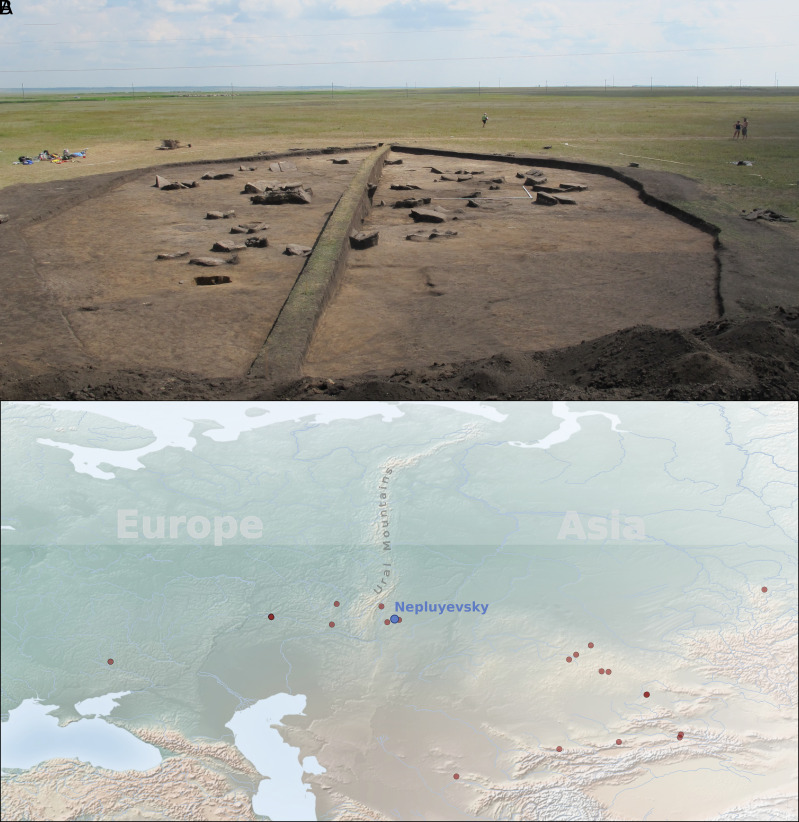
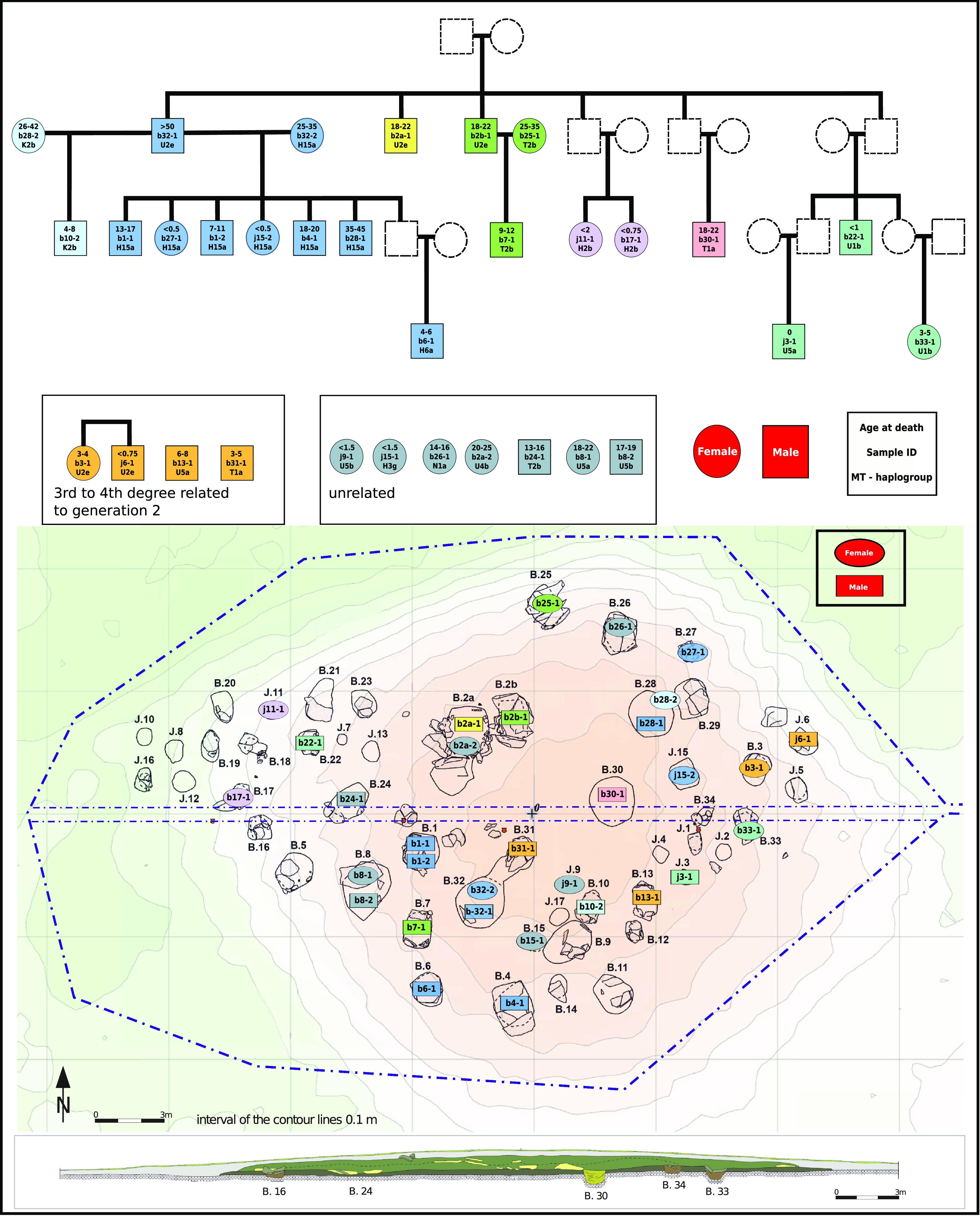
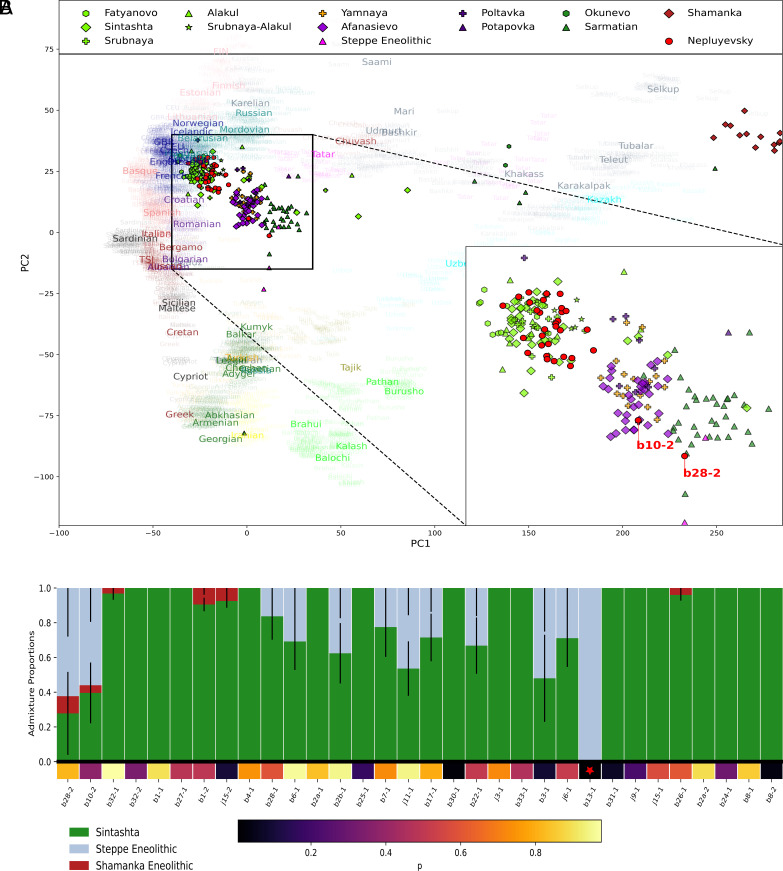
Our understanding of prehistoric societal organization at the family level is still limited. Here, we generated genome data from 32 individuals from an approximately 3,800-y-old burial mound attributed to the Bronze Age Srubnaya-Alakul cultural tradition at the site of Nepluyevsky, located in the Southern Ural region of Central Eurasia. We found that life expectancy was generally very low, with adult males living on average 8 y longer than females. A total of 35 first-degree, 40 second-degree, and 48 third-degree biological relationships connected 23 of the studied individuals, allowing us to propose a family tree spanning three generations with six brothers at its center. The oldest of these brothers had eight children with two women and the most children overall, whereas the other relationships were monogamous. Notably, related female children above the age of five were completely absent from the site, and adult females were more genetically diverse than males. These results suggest that biological relationships between male siblings played a structural role in society and that descent group membership was based on patrilineality. Women originated from a larger mating network and moved to join the men, with whom they were buried. Finally, the oldest brother likely held a higher social position, which was expressed in terms of fertility.
Overview
The claims and statistics of this paper haven’t been checked yet.
Run the check — free, no account needed. It reads the open-access text and checks the sources it cites.
Integrity signals
Registry
Cites
Statistics
Figures
Verification
Claims the paper makes
The claims and statistics of this paper haven’t been checked yet.
Run the check — free, no account needed. It reads the open-access text and checks the sources it cites.
Claims other papers make about this one
Each is checked against this paper’s own text: does it say what the citing paper says it does?
In the citing paper
“In addition, kinship analyses based on ancient DNA data from the Neolithic and Bronze Age (mostly Europe) showed low frequency of half-brothers and half-sisters67–71,73–77, with the exception of Hazleton North long cairn72.”
From Patrilineal segmentary systems provide a peaceful explanation for the post-Neolithic Y-chromosome bottleneck (2024) · cites this paper as [76]
In the citing paper
“Consistent with the hypothesis of a rapid spread of patrilocality after the Neolithic transition, ancient DNA studies show that male relatedness is often higher than female relatedness within archaeological sites from the Neolithic and the Bronze Age (mostly from Europe).”
From Patrilineal segmentary systems provide a peaceful explanation for the post-Neolithic Y-chromosome bottleneck (2024) · cites this paper as [76]
In the citing paper
“In particular, males tend to share more often the same haplogroup of the Y chromosome, whereas there is a greater diversity of haplogroups for mtDNA67–77.”
From Patrilineal segmentary systems provide a peaceful explanation for the post-Neolithic Y-chromosome bottleneck (2024) · cites this paper as [76]
Self-check
Percentages, sums and reported differences re-computed from the paper’s own numbers.
The self-check needs the paper’s full text.
Citations
Cites
The IntCal20 Northern Hemisphere Radiocarbon Age Calibration Curve (0–55 cal kBP)
Reimer, P. J., Austin, W. E. N., Bard, E., Bayliss, A., Blackwell, P. G., Bronk Ramsey, C., Butzin, M., Cheng, H., Edwards, R. L., Friedrich, M., et al. (2020) · Radiocarbon · doi:10.1017/rdc.2020.41 · Cited by 7,900
ANGSD: Analysis of Next Generation Sequencing Data
Korneliussen, T. S., Albrechtsen, A., & Nielsen, R. (2014) · BMC Bioinformatics · doi:10.1186/s12859-014-0356-4 · Cited by 2,982
Ancient Admixture in Human History
Patterson, N., Moorjani, P., Luo, Y., Mallick, S., Rohland, N., Zhan, Y., Genschoreck, T., Webster, T., & Reich, D. (2012) · Genetics · doi:10.1534/genetics.112.145037 · Cited by 2,848
Inference of human population history from individual whole-genome sequences
Li, H., & Durbin, R. (2011) · Nature · doi:10.1038/nature10231 · Cited by 2,590
Massive migration from the steppe was a source for Indo-European languages in Europe
Haak, W., Lazaridis, I., Patterson, N., Rohland, N., Mallick, S., Llamas, B., Brandt, G., Nordenfelt, S., Harney, E., Stewardson, K., et al. (2015) · Nature · doi:10.1038/nature14317 · Cited by 1,940
Self-citationPopulation genomics of Bronze Age Eurasia
Allentoft, M. E., Sikora, M., Sjögren, K.-G., Rasmussen, S., Rasmussen, M., Stenderup, J., Damgaard, P. B., Schroeder, H., Ahlström, T., Vinner, L., et al. (2015) · Nature · doi:10.1038/nature14507 · Cited by 1,550
Genome-wide patterns of selection in 230 ancient Eurasians
Mathieson, I., Lazaridis, I., Rohland, N., Mallick, S., Patterson, N., Roodenberg, S. A., Harney, E., Stewardson, K., Fernandes, D., Novak, M., et al. (2015) · Nature · doi:10.1038/nature16152 · Cited by 1,515
Self-citationAncient human genomes suggest three ancestral populations for present-day Europeans
Lazaridis, I., Patterson, N., Mittnik, A., Renaud, G., Mallick, S., Kirsanow, K., Sudmant, P. H., Schraiber, J. G., Castellano, S., Lipson, M., et al. (2014) · Nature · doi:10.1038/nature13673 · Cited by 1,357
Self-citationDouble indexing overcomes inaccuracies in multiplex sequencing on the Illumina platform
Kircher, M., Sawyer, S., & Meyer, M. (2012) · Nucleic Acids Research · doi:10.1093/nar/gkr771 · Cited by 1,106
A Revised Timescale for Human Evolution Based on Ancient Mitochondrial Genomes
Fu, Q., Mittnik, A., Johnson, P. L. F., Bos, K., Lari, M., Bollongino, R., Sun, C., Giemsch, L., Schmitz, R., Burger, J., et al. (2013) · Current Biology · doi:10.1016/j.cub.2013.02.044 · Cited by 709
Research works printed but not linked: 105
- J. J. Bachofen, Das Mutterrecht. Eine Untersuchung über die Gynaikokratie der alten Welt nach ihrer religiösen und rechtlichen Natur (Verlag von Krais und Hoffmann, 1861).
- 10.5962/bhl.title.50206 · DOI
- F. Engels, Der Ursprung der Familie, des Privateigenthums und des Staats: Im Anschluß an Lewis H. Morgans Forschungen (Schweizerische Genossenschaftsbuchdruckerei, 1884).
- J. Goody, The European Family: An Historico-Anthropological Essay (Blackwell Publishing Ltd., 2000).
- 10.1353/nlh.2017.0035 · DOI
- 10.1146/annurev-anthro-041320-021036 · DOI
- 10.2307/j.ctv209xn0x · DOI
- 10.1086/287716 · DOI
- 10.1086/287811 · DOI
- 10.1126/science.aao1807 · DOI · Paper page
- 10.1126/science.aax6219 · DOI · Paper page
- 10.1371/journal.pone.0241278 · DOI
- 10.1016/j.cub.2021.03.050 · DOI
- 10.1073/pnas.1820210116 · DOI · Paper page
- 10.1073/pnas.0807592105 · DOI
- 10.1007/s10963-022-09169-9 · DOI
- 10.1038/s41586-021-04241-4 · DOI · Paper page
- 10.1016/j.isci.2021.103352 · DOI
- 10.1093/molbev/msac108 · DOI
- 10.1038/sj.ejhg.5200322 · DOI
- F. Schilz “Molekulargenetische Verwandtschaftsanalysen am prähistorischen Skelettkollektiv der Lichtensteinhöhle ” Dissertation University Göttingen (2022). 10.53846/goediss-638 (11 February 2023). · DOI
- 10.1038/s41598-021-89090-x · DOI
- 10.1126/sciadv.abi6941 · DOI
- 10.1016/j.cub.2021.04.022 · DOI
- M. Frischalowski “Genetische Diversität in der Lichtensteinhöhle – Ableitungen zur Demographie und Interpretationen zu sozialen Strukturen sowie Bestattungssitten in einer bronzezeitlichen Bevölkerung ” University Göttingen (2022). 10.53846/goediss-9081 (11 February 2023). · DOI
- 10.1073/pnas.1719880115 · DOI
- 10.1038/s41467-018-06024-4 · DOI
- 10.1126/sciadv.aao1262 · DOI
- 10.1038/s41586-020-2378-6 · DOI · Paper page
- 10.1073/pnas.1818037116 · DOI · Paper page
- 10.1017/CBO9780511618451 · DOI
- 10.1073/pnas.1813608115 · DOI · Paper page
- 10.1126/science.aat7487 · DOI · Paper page
- 10.1126/sciadv.aat4457 · DOI
- 10.1038/s41586-018-0094-2 · DOI · Paper page
- 10.1126/science.aar7711 · DOI · Paper page
- 10.1017/ppr.2020.9 · DOI
- 10.1017/ppr.2019.4 · DOI
- E. Stolarczyk, Bronzezeitliche Siedlungen am Oberlauf des Karagajly-Ajat Flusses im südlichen Trans-Ural (Russische Förderation): Studien zu strukturellen Grundlagen in Raum und Zeit (Verlag Dr. Rudolf Habelt GmbH, 2019).
- ИП Aлaeвa “Bнyтpижилищныe кoнcтpyкции в пocтpoйкax эпoxи пoзднeй бpoнзы Южнoгo Зaypaлья” in Mapгyлaнoвcкиe чтeния–2009: Maтepиaлы мeждyнap. нayч. кoнф (институт археологии им. А.X. Маргулана 2009) pp. 4–8 [in Russian].
- ИП Aлaeвa, “Поселение бронзового века Малая Березовая-4” in Диалог культур Евразии в археологии Казахстана. Сборник научных статей, посвященных 90-летию со дня рождения выдающегося археолога К.А. Акишева (Издательство «Сарыарка», 2014), pp. 161–172 [in Russian].
- 10.1038/s41559-022-01701-6 · DOI
- 10.1002/oa.3017 · DOI
- 10.1007/s12520-018-0660-4 · DOI
- 10.1007/s00334-014-0506-7 · DOI
- A. V. Epimakhov “Settlements and cemeteries of the Bronze Age of the Urals: The potential for reconstructing early social dynamics” in Social Complexity in Prehistoric Eurasia: Monuments Metals and Mobility (Cambridge University Press 2009) pp. 74–90. · DOI
- 10.30759/1728-9718-2019-1(62)-28-37 · DOI
- R. J. McIntosh, Early urban clusters in China and Africa: The arbitration of social ambiguity. J. Field Archaeol. 18, 199 (1991). · DOI
- 10.1098/rspb.2003.2535 · DOI
- 10.20874/2071-0437-2020-50-3-11 · DOI
- 10.1016/j.jas.2013.07.004 · DOI · Paper page
- 10.1016/j.ajhg.2012.03.002 · DOI
- 10.1038/s41586-019-1251-y · DOI
- 10.1126/sciadv.abc4587 · DOI · Paper page
- 10.1038/s41467-021-25289-w · DOI
- 10.1186/s13059-023-02847-7 · DOI
- 10.1126/sciadv.abd6535 · DOI
- S. V. Sharapova, Report on Archaeological Excavation of the Neplyuevsky cemetery in Kartaly district of Chelyabinsk region in 2017 [in Russian] (Archive of the Institute of Archaeology RAS. Р-1, 2018).
- 10.1016/j.cell.2013.01.016 · DOI
- 10.1038/ncomms14615 · DOI · Paper page
- A. Barnard, A. Good, Research Practices in the Study of Kinship (Academic Press, 1984).
- C. Lévi-Strauss, Les structures élémentaires de la parenté (Presses Universitaires de France, 1949).
- 10.4054/DemRes.2008.18.5 · DOI
- 10.1073/pnas.1606800113 · DOI · Paper page
- 10.1525/aa.1980.82.1.02a00100 · DOI
- 10.1098/rstb.2009.0115 · DOI · Paper page
- N. Berseneva, E. Kupriyanova, “Children in the Bronze Age societies of the Southern Trans-Urals (Sintashta, Petrovka and Alakul’ cultures)” in Archaeologia Polona Vol. 51-52:2013-2014. Archaeology of Children and Childhood, P. Romanowicz, A. Rzeszotarska-Nowakiewicz, Eds. (Institute of Archaeology and Ethnology, Polish Academy of Sciences, 2016), pp. 5–20.
- V. V. Kufterin, A. I. Nechvaloda, “Paleoanthropology of the Nikolayevsky kurgan cemetery (based on materials from 2004-2006 excavations)” in Nikolayevsky Kurgans (“Elena”) on the Sterlya River in Bashkortostan [in Russian], R. Ismagil, Y. A. Morozov, M. S. Chaplygin, Eds. (Design Polygraph Service, 2009), pp. 175–210.
- V. V. Kufterin, “Anthropological materials from Yulaly-8 burrow burial ground (Bashkir Transurals)” in Historical and Cultural Processes in the South Urals in the Late Bronze Age: Modern Problems of Studying and Preserving the Cultural Heritage [in Russian], I. I. Bakhshiev, Ed. (Dialog, 2016), pp. 141–155.
- J. Loyer, V. V. Sharapova, Paleopathological study of the Bronze Age children’s burials (the Neplujevsky case study) [in Russian]. Ural Hist. J. 54, 103–112 (2017).
- 10.2307/2061861 · DOI
- M. Roser, H. Ritchie, B. Dadonaite, Child and Infant Mortality (Our World in Data, 2013).
- R. W. Lindstrom, “Anthropological characteristics of the population of the Bolshekaragansky cemetery, kurgan 25” in Arkaim Necropolis (on the Data of Kurgan 25 of the Bolshekaragansky Cemetery), D. G. Zdanovich, Ed. (Southern Ural book publisher, 2002), pp. 159–164.
- D. I. Razhev, A. V. Epimakhov, Phenomenon of multiplicity of children’s burials in burial grounds of the Bronze Age [in Russian]. Vestnik arkheologii, antropologii i etnografii 5, 107–113 (2005).
- 10.1002/ajhb.23129 · DOI
- 10.1186/s12963-021-00279-8 · DOI
- 10.1073/pnas.1706355114 · DOI · Paper page
- 10.1038/s41467-020-15560-x · DOI · Paper page
- W. H. R. Rivers, A genealogical method of collecting social and vital statistics. J. R. Anthropol. Inst. G. B. Irel. 30, 74–82 (1900).
- G. Ascádi, J. Nemeskéri, Paläodemographische Probleme am Beispiel des frühmittelalterlichen Gräberfeldes von Halimba-Cseres, Kom. Veszprem/Ungarn. Homo 8, 133–147 (1957).
- 10.1002/ajpa.22187 · DOI
- J.-P. Bocquet, C. Masset, Estimateurs en paléodémographie. L’Homme 17, 65–90 (1977).
- 10.1086/342429 · DOI
- 10.1002/ajpa.23365 · DOI
- 10.1016/j.jasrep.2018.03.012 · DOI
- 10.1017/RDC.2020.95 · DOI
- 10.1017/S0033822200033865 · DOI · Paper page
- 10.1098/rstb.2019.0723 · DOI
- 10.1002/(SICI)1096-8644(199804)105:4<539::AID-AJPA10>3.0.CO;2-1 · DOI
- D. E. MacHugh, C. J. Edwards, J. F. Bailey, D. R. Bancroft, D. G. Bradley, The extraction and analysis of ancient DNA from bone and teeth: A survey of current methodologies. Anc. Biomol. 3, 81–103 (2000).
- G. U. Neumann A. Andrades Valtuena J. A. Fellows Yates R. Stahl G. Brandt Tooth sampling from the inner pulp chamber for ancient DNA extraction v2 (2020) 10.17504/protocols.io.bqebmtan. · DOI
- F. Aron G. U. Neumann G. Brandt Half-UDG treated double-stranded ancient DNA library preparation for Illumina sequencing v1 (2020) 10.17504/protocols.io.bmh6k39e. · DOI
- J. A. Fellows Yates A-Z of ancient DNA protocols for shotgun Illumina next generation sequencing v2 (2021) 10.17504/protocols.io.bvt9n6r6. · DOI
- 10.1186/s13059-016-0918-z · DOI · Paper page
- 10.1093/bioinformatics/btu170 · DOI · Paper page
- 10.1093/bioinformatics/btp324 · DOI · Paper page
- 10.1093/bioinformatics/btv098 · DOI
- 10.1101/gr.107524.110 · DOI · Paper page
- V. Link ATLAS: Analysis tools for low-depth and ancient samples. bioRxiv [Preprint] (2017). https://doi.org/10.1101/105346 (Accessed 6 February 2022). · DOI · Paper page
- 10.1038/nature15393 · DOI · Paper page
- 10.1038/s41588-020-00756-0 · DOI
- 10.1093/nar/gkw233 · DOI
- 10.1016/j.fsigen.2019.04.001 · DOI
- 10.1016/j.ajhg.2015.04.018 · DOI
- H. Ringbauer Screening for identity by descent segments in human ancient DNA. bioRxiv [Preprint] (2023). https://doi.org/10.1101/2023.03.08.531671 (Accessed 15 May 2023). · DOI
Cited by
Guyon, L., Guez, J., Toupance, B., Heyer, E., & Chaix, R. (2024) · Nature Communications · doi:10.1038/s41467-024-47618-5 · Cited by 28
Metadata
- Authors
- Blöcher, J., Brami, M., Feinauer, I. S., Stolarczyk, E., Diekmann, Y., Vetterdietz, L., Karapetian, M., Winkelbach, L., Kokot, V., Vallini, L., Stobbe, A., Haak, W., Papageorgopoulou, C., Krause, R., Sharapova, S., & Burger, J.
- Venue
- Proceedings of the National Academy of Sciences
- Publisher
- National Academy of Sciences
- Published
- 2023-08-21
- Volume
- 120
- Issue
- 36
- ISSN
- 0027-8424
- 1091-6490
- PMC
- PMC10483636
- Cited by
- 42
- References
- 15
- Language
- en
- Funders
- Deutsche Forschungsgemeinschaft (466680522, BU 1403/14-1)
- EC | ERC | HORIZON EUROPE European Research Council (771234-PALEoRIDER)
- EC | European Research Council (788616)
About these checks
Registry, retraction, Cites and statistics results are computed, not judged, with one exception: a printed reference that no index lists is read once by a model before it counts as a citation error. Claims are extracted by a model and kept only when their quote appears verbatim in the text; each cited source is then checked, with a model’s help, for whether it says what the claim relies on. Those verdicts can be wrong — read the claim’s quote and the cited source before relying on one.
Statistics and arithmetic are recomputed, not judged.
Confidence bands are shown only for fields calibrated on our annotated test set. None is calibrated yet, so no band is shown.
What counts as a claim ›How we measure confidence ›How we check this ›
Are you an author, or do you see a problem with this page? Request a review
How to cite
Cite CoChat for the checks on this page, and the paper for its own findings.
- This page
- CoChat. (2026). Citation check: Descent, marriage, and residence practices of a 3,800-year-old pastoral community in Central Eurasia. https://app.cochat.ai/papers/10.1073/pnas.2303574120
- The paper
- Blöcher, J., Brami, M., Feinauer, I. S., Stolarczyk, E., Diekmann, Y., Vetterdietz, L., Karapetian, M., Winkelbach, L., Kokot, V., Vallini, L., Stobbe, A., Haak, W., Papageorgopoulou, C., Krause, R., Sharapova, S., & Burger, J. (2023). Descent, marriage, and residence practices of a 3,800-year-old pastoral community in Central Eurasia. Proceedings of the National Academy of Sciences. https://doi.org/10.1073/pnas.2303574120
