

The DOI matches its Crossref record; 99 of the 99 references it cites were found in a registry or an index; none of the 72 sources its claims cite is checked for support yet.
Distinguishing Moral Outrage and Empathetic Anger: Advancing the Triadic Appraisal Framework of Situational Crisis Communication Theory
Open accessAbstract
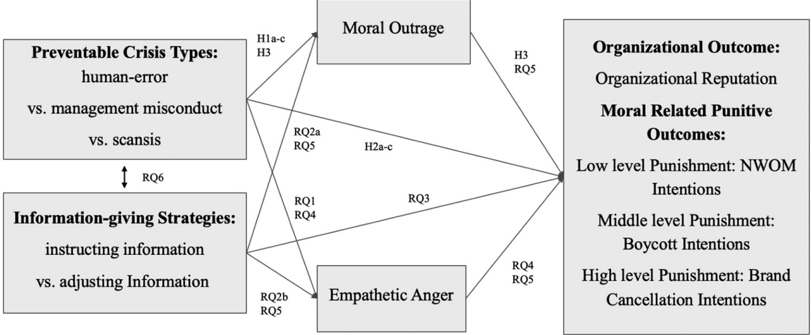
This study expands the triadic appraisal framework of situational crisis communication theory (SCCT) with a 3 (crisis type: human-error vs. management misconduct vs. scansis) × 2 (organizational information-giving strategy type: instructing vs. adjusting) between-subjects online experiment among U.S. adults (N = 482). Moral outrage and empathetic anger were found to be distinct forms of third-party anger, driven by different triggers. The adjusting strategy led to significantly lower organizational reputation damage than the instructing strategy in the management misconduct crisis, but not in the human error or scansis crisis. Punishment intentions were found to vary as a function of crisis type and organizational response strategy.
Overview
CoChat Summary
TL;DR
This 3×2 online experiment (N = 482 U.S. adults) extends SCCT’s triadic appraisal framework by distinguishing moral outrage from empathetic anger in preventable crises. It finds crisis type drives moral outrage and punitive outcomes, while adjusting information reduces reputation damage only in management misconduct, not human-error or scansis crises.
Key findings
- Moral outrage increased across preventable crisis types: human error M = 3.43, management misconduct M = 4.12, scansis M = 4.52; all planned comparisons were significant (e.g., scansis vs. human error mean diff = 1.09, p < .001).
- Empathetic anger was higher for management misconduct (M = 5.16) and scansis (M = 5.39) than human error (M = 4.76), but scansis vs. management misconduct was not significant (mean diff = .23, p = .21).
- Crisis type significantly affected organizational reputation, NWOM, boycott, and brand cancellation intentions (e.g., reputation F(2, 474) = 120.92, p < .001, η² = .34; boycott F(2, 474) = 61.52, p < .001, η² = .21).
- Adjusting strategy led to lower reputation damage than instructing only in management misconduct (M = 3.45 vs. 2.75, mean diff = .70, p < .001); no significant differences were found in human error (p = .06) or scansis (p = .42). Moral outrage and empathetic anger mediated crisis type–outcome relationships.
Methods
- 3 (crisis type: human-error vs. management misconduct vs. scansis) × 2 (information-giving strategy: instructing vs. adjusting) between-subjects online experiment among U.S. adults (N = 482; mean age 38.89, 54.6% male).
- Stimuli used food contamination and car accident news stories; no significant differences emerged between topics, so data were collapsed. Measures included moral outrage, empathetic anger, organizational reputation, NWOM, boycott, and brand cancellation intentions; covariates were crisis severity and involvement.
- Analysis used two-way MANCOVA/ANCOVAs with Bonferroni correction and mediation via PROCESS Model 4 with 5,000 bootstrap samples.
Limitations
- Stated: only two consumer product crises (food contamination and car incidents), only U.S. participants, and emotions were measured rather than manipulated.
- Evident from the text: outcomes are self-reported intentions rather than observed punishment behavior, and the single-time online experiment cannot establish causal ordering beyond the manipulated crisis and strategy conditions.
Model-written summary. Check it against the paper before relying on it.
Integrity signals
Registry
Cites
Statistics
Figures



Verification
Claims the paper makes
0 Valid · 11 Not valid · 58 Not checked · 118 Own results and interpretations
A result the paper reports from its own data — it cites no other source for it, so there is none to check. The quote shows it is in the paper.
In the paper
“Punishment intentions were found to vary as a function of crisis type and organizational response strategy.”
§ Distinguishing Moral Outrage and Empathetic Anger: Advancing the Triadic Appraisal Framework of Situational Crisis Communication Theory > Abstract
plainstates an associationn = 482- Asserted: passes — The authors put it forward as true.
- Checkable: passes — It can be checked against evidence.
- Load-bearing: passes — The paper’s conclusions depend on it.
- Based: passes — The paper gives a reason why it holds.
A result the paper reports from its own data — it cites no other source for it, so there is none to check. The quote shows it is in the paper.
In the paper
“| MO | 26.14* | <.001 | .10 | 0.07 | .79 | .00 | 1.49 | .23 | .006 |”
§ Distinguishing Moral Outrage and Empathetic Anger: Advancing the Triadic Appraisal Framework of Situational Crisis Communication Theory > Conclusion
plainstates a cause- Asserted: passes — The authors put it forward as true.
- Checkable: passes — It can be checked against evidence.
- Load-bearing: passes — The paper’s conclusions depend on it.
- Based: passes — The paper gives a reason why it holds.
A result the paper reports from its own data — it cites no other source for it, so there is none to check. The quote shows it is in the paper.
In the paper
“| SA vs. HE | MO | 1.09* | <.001 | 0.73 | 1.46 |”
§ Distinguishing Moral Outrage and Empathetic Anger: Advancing the Triadic Appraisal Framework of Situational Crisis Communication Theory > Conclusion
plain- Asserted: passes — The authors put it forward as true.
- Checkable: passes — It can be checked against evidence.
- Load-bearing: passes — The paper’s conclusions depend on it.
- Based: passes — The paper gives a reason why it holds.
A result the paper reports from its own data — it cites no other source for it, so there is none to check. The quote shows it is in the paper.
In the paper
“However, the difference between management misconduct (M = 5.16, SE = 0.09) and scansis (M = 5.39, SE = 0.09) was not statistically significant, Mean diff = .23,p = .21,CI [-0.07, 0.53], suggesting that the scansis crisis does not necessarily elicit a stronger empathetic anger response compared to management misconduct crisis (see Table 3).”
§ Distinguishing Moral Outrage and Empathetic Anger: Advancing the Triadic Appraisal Framework of Situational Crisis Communication Theory > Main effect of crisis type and information-giving strategy type
hedged- Asserted: passes — The authors put it forward as true.
- Checkable: passes — It can be checked against evidence.
- Load-bearing: passes — The paper’s conclusions depend on it.
- Based: passes — The paper gives a reason why it holds.
A result the paper reports from its own data — it cites no other source for it, so there is none to check. The quote shows it is in the paper.
In the paper
“| BC | 42.32* | <.001 | .15 | 0.80 | .37 | .002 | 0.24 | .79 | .001 |”
§ Distinguishing Moral Outrage and Empathetic Anger: Advancing the Triadic Appraisal Framework of Situational Crisis Communication Theory > Conclusion
plain- Asserted: passes — The authors put it forward as true.
- Checkable: passes — It can be checked against evidence.
- Load-bearing: unclear — It is unclear whether the paper’s conclusions depend on it.
- Based: passes — The paper gives a reason why it holds.
101 more claims
Create a free account to see all 187 claims and to verify the 44 references still open.
- It may state two separate claims as one. 44
- The quote only partly states this claim. 3
- Probably not a substantial claim. 63
Statistics recomputed
Every reported test result, recomputed from its test statistic and degrees of freedom. A result shows as not adding up only once an independent check has confirmed it.
- ConsistentF(2, 479) = 7.31reported p < .001 · recomputed p < .001
“F(2, 479) = 7.31, p < .001”
- ConsistentF(2, 479) = 210.72reported p < .001 · recomputed p < .001
“F(2, 479) = 210.72,p < .001”
- Consistentt(448.1) = 7.511reported p < .001 · recomputed p < .001
“t(448.1)= 7.511, p < .001”
- Consistentt(480) = -5.103reported p < .001 · recomputed p < .001
“t(480) = -5.103,p < .001”
- ConsistentF(12, 938) = 18.68reported p < .001 · recomputed p < .001
“F(12, 938) = 18.68, p < .001”
8 more recomputed tests
Create a free account to see every test the Stats check recomputed.
Self-check
Percentages, sums and reported differences re-computed from the paper’s own numbers.
Each contradiction between two passages listed here was confirmed by an independent check.
Rated major: it would touch a result — a value a result rests on, reported and recomputed p-values on opposite sides of the significance level, two passages that conflict with no sign which is right, or a cited work retracted before this paper was published.
In the paper
§ Distinguishing Moral Outrage and Empathetic Anger: Advancing the Triadic Appraisal Framework of Situational Crisis Communication Theory > Three different decoding positions of stakeholders
“We found no significant main effects of crisis strategy on emotions or organizational outcomes (RQ2 and RQ3).”
§ Distinguishing Moral Outrage and Empathetic Anger: Advancing the Triadic Appraisal Framework of Situational Crisis Communication Theory > Conclusion
“| OR | 120.92* | <.001 | .34 | 9.17* | .003 | .02 | 6.10* | .002 | .03 |”
Rated major: it would touch a result — a value a result rests on, reported and recomputed p-values on opposite sides of the significance level, two passages that conflict with no sign which is right, or a cited work retracted before this paper was published.
In the paper
§ Distinguishing Moral Outrage and Empathetic Anger: Advancing the Triadic Appraisal Framework of Situational Crisis Communication Theory > Conclusion
“the findings demonstrate how crisis type and information-giving strategies interact to shape emotions, reputational outcomes, and punitive intentions.”
§ Distinguishing Moral Outrage and Empathetic Anger: Advancing the Triadic Appraisal Framework of Situational Crisis Communication Theory > Interaction effects of crisis type and information-giving strategy type
“Further Bonferronicorrected two-way ANCOVAs showed no significant interaction effects for moral outrage, empathetic anger, NWOM intentions, boycott intentions, or brand cancellation intentions”
Rated minor: it would not touch a result — a value no result rests on, a p-value that stays on the same side of the significance level, or a conflict that is clerical, resolved elsewhere in the paper, or outside its own findings.
In the paper
§ Distinguishing Moral Outrage and Empathetic Anger: Advancing the Triadic Appraisal Framework of Situational Crisis Communication Theory > Manipulation checks
“the human-error condition (M = 5.66, SD = 1.11) was significantly higher than both the management misconduct condition (M = 6.04,SD = 1.08) and the scansis condition (M = 6.09,SD = 1.12).”
§ Distinguishing Moral Outrage and Empathetic Anger: Advancing the Triadic Appraisal Framework of Situational Crisis Communication Theory > Manipulation checks
“Since human-error crises yielded significantly lower responsibility perceptions than management misconduct and scansis crises”
Rated minor: it would not touch a result — a value no result rests on, a p-value that stays on the same side of the significance level, or a conflict that is clerical, resolved elsewhere in the paper, or outside its own findings.
In the paper
“Our final sample size was 482 with the average age of participants being 38.89 (SD = 11.98),ranging from 19 to 78.There were 263 males (54.6%) and 205 females (42.5%), 12 gender-diverse participants (2.9%), and 2 who preferred not to answer.”
§ Distinguishing Moral Outrage and Empathetic Anger: Advancing the Triadic Appraisal Framework of Situational Crisis Communication Theory > Participants
Reported 2.9 · recomputed 2.489627
Rated minor: it would not touch a result — a value no result rests on, a p-value that stays on the same side of the significance level, or a conflict that is clerical, resolved elsewhere in the paper, or outside its own findings.
In the paper
§ Distinguishing Moral Outrage and Empathetic Anger: Advancing the Triadic Appraisal Framework of Situational Crisis Communication Theory > Measures
“Empathetic anger was assessed with six items on a seven-point scale, adapted from Vitaglione and Barnett (2003) (α = .93).”
§ Distinguishing Moral Outrage and Empathetic Anger: Advancing the Triadic Appraisal Framework of Situational Crisis Communication Theory > Measures
“The empathetic anger scale (α = .96)included statements such as, "If I see that victims in this crisis are feeling mad because they were mistreated, then I feel mad too."”
Citations
Cites
Statistical power analyses using G∗Power 3.1: tests for correlation and regression analyses
Faul, F., Erdfelder, E., Buchner, A., & Lang, A.-G. (2009) · Behavior Research Methods · doi:10.3758/brm.41.4.1149 · Cited by 37,615
Lazarus, R. S. (1991) · doi:10.1093/oso/9780195069945.001.0001 · Cited by 12,691
An attributional theory of achievement motivation and emotion
Weiner, B. (1985) · Psychological Review · doi:10.1037/0033-295x.92.4.548 · Cited by 7,846
Moral Emotions and Moral Behavior
Tangney, J. P., Stuewig, J., & Mashek, D. J. (2007) · Annual Review of Psychology · doi:10.1146/annurev.psych.56.091103.070145 · Cited by 3,222
Coombs, W. T. (2007) · Corporate Reputation Review · doi:10.1057/palgrave.crr.1550049 · Cited by 2,790
Empathy and Moral Development: Implications for Caring and Justice
Hoffman, M. L. (2000) · Cambridge University Press eBooks · doi:10.1017/cbo9780511805851 · Cited by 2,788
The New Synthesis in Moral Psychology
Haidt, J. (2007) · Science · doi:10.1126/science.1137651 · Cited by 2,382
Cognition and motivation in emotion.
Lazarus, R. S. (1991) · American Psychologist · doi:10.1037/0003-066x.46.4.352 · Cited by 2,096
Graham, J., Haidt, J., Koleva, S., Motyl, M., Iyer, R., Wojcik, S. P., & Ditto, P. H. (2013) · Advances in Experimental Social Psychology · doi:10.1016/b978-0-12-407236-7.00002-4 · Cited by 1,716
Coombs, W. T., & Holladay, S. J. (2002) · Management Communication Quarterly · doi:10.1177/089331802237233 · Cited by 1,144
Kim, P. H., Ferrin, D. L., Cooper, C. D., & Dirks, K. T. (2004) · Journal of Applied Psychology · doi:10.1037/0021-9010.89.1.104 · Cited by 1,063
"Mood contagion": The automatic transfer of mood between persons.
Neumann, R., & Strack, F. (2000) · Journal of Personality and Social Psychology · doi:10.1037//0022-3514.79.2.211 · Cited by 808
Coombs, W. T. (1995) · Management Communication Quarterly · doi:10.1177/0893318995008004003 · Cited by 802
Coombs, W. T. (1998) · Journal of Public Relations Research · doi:10.1207/s1532754xjprr1003_02 · Cited by 661
Kim, P. H., Dirks, K. T., Cooper, C. D., & Ferrin, D. L. (2006) · Organizational Behavior and Human Decision Processes · doi:10.1016/j.obhdp.2005.07.002 · Cited by 557
VICTIMS AND SHAREHOLDERS: THE DILEMMAS OF PRESENTING CORPORATE POLICY DURING A CRISIS.
Marcus, A. A., & Goodman, R. S. (1991) · Academy of Management Journal · doi:10.2307/256443 · Cited by 499
Consumer response to corporate irresponsible behavior: Moral emotions and virtues
Grappi, S., Romani, S., & Bagozzi, R. P. (2013) · Journal of Business Research · doi:10.1016/j.jbusres.2013.02.002 · Cited by 487
The Protective Powers of Crisis Response Strategies: Managing Reputational Assets During a Crisis
Coombs, W. T. (2006) · Journal of Promotion Management · doi:10.1300/j057v12n03_13 · Cited by 418
Kim, H. J., & Cameron, G. T. (2011) · Communication Research · doi:10.1177/0093650210385813 · Cited by 414
Communicating through Crisis: A Strategy for Organizational Survival
Sturges, D. L. (1994) · Management Communication Quarterly · doi:10.1177/0893318994007003004 · Cited by 390
Anger at unfairness: is it moral outrage?
Batson, C. D., Kennedy, C. L., Nord, L., Stocks, E. L., Fleming, D. A., Marzette, C. M., Lishner, D. A., Hayes, R. E., Kolchinsky, L. M., & Zerger, T. (2007) · European Journal of Social Psychology · doi:10.1002/ejsp.434 · Cited by 373
Liu, B. F., Fraustino, J. D., & Jin, Y. (2016) · Communication Research · doi:10.1177/0093650214565917 · Cited by 297
Self-citationAn Exploratory Study of Stakeholder Emotions: Affect and Crises
Coombs, W. T., & Holladay, S. J. (2007) · Research on Emotion in Organizations · doi:10.1016/s1746-9791(05)01111-9 · Cited by 291
Timothy Coombs, W., & Holladay, S. J. (2007) · Journal of Communication Management · doi:10.1108/13632540710843913 · Cited by 290
Claeys, A.-S., Cauberghe, V., & Vyncke, P. (2010) · Public Relations Review · doi:10.1016/j.pubrev.2010.05.004 · Cited by 283
The revenge of the consumer! How brand moral violations lead to consumer anti-brand activism
Romani, S., Grappi, S., Zarantonello, L., & Bagozzi, R. P. (2015) · Journal of Brand Management · doi:10.1057/bm.2015.38 · Cited by 256
Choi, Y., & Lin, Y.-H. (2009) · Journal of Public Relations Research · doi:10.1080/10627260802557506 · Cited by 256
What makes crisis response strategies work? The impact of crisis involvement and message framing
Claeys, A.-S., & Cauberghe, V. (2014) · Journal of Business Research · doi:10.1016/j.jbusres.2012.10.005 · Cited by 245
Jin, Y., Pang, A., & Cameron, G. T. (2012) · Journal of Public Relations Research · doi:10.1080/1062726x.2012.676747 · Cited by 224
Self-citationYan, J. (2010) · Communication Research · doi:10.1177/0093650210368256 · Cited by 221
Consumer Boycott Behavior: An Exploratory Analysis of Twitter Feeds
Makarem, S. C., & Jae, H. (2015) · Journal of Consumer Affairs · doi:10.1111/joca.12080 · Cited by 206
Ma, L., & Zhan, M. (. (2016) · Journal of Public Relations Research · doi:10.1080/1062726x.2016.1166367 · Cited by 186
Beyond image repair: Suggestions for crisis communication theory development
Liu, B. F., & Fraustino, J. D. (2014) · Public Relations Review · doi:10.1016/j.pubrev.2014.04.004 · Cited by 154
My Anger Is Your Gain, My Contempt Your Loss: Explaining Consumer Responses to Corporate Wrongdoing
Romani, S., Grappi, S., & Bagozzi, R. P. (2013) · Psychology & Marketing · doi:10.1002/mar.20664 · Cited by 140
To support or to boycott: a public segmentation model in corporate social advocacy
Cheng, H., & Li, C. (2020) · Journal of Public Relations Research · doi:10.1080/1062726x.2020.1848841 · Cited by 137
Assessing a New Dimension of Empathy: Empathic Anger as a Predictor of Helping and Punishing Desires
Vitaglione, G. D., & Barnett, M. A. (2003) · Motivation and Emotion · doi:10.1023/a:1026231622102 · Cited by 135
The compatibility of corrective action in organizational crisis communication
Sellnow, T. L., Ulmer, R. R., & Snider, M. (1998) · Communication Quarterly · doi:10.1080/01463379809370084 · Cited by 127
Kim, S., & Sung, K. H. (2013) · Journal of Public Relations Research · doi:10.1080/1062726x.2013.795867 · Cited by 121
Pursuing moral outrage: Anger at torture
Batson, C. D., Chao, M. C., & Givens, J. M. (2008) · Journal of Experimental Social Psychology · doi:10.1016/j.jesp.2008.07.017 · Cited by 118
The place and role of (moral) anger in organizational behavior studies
Lindebaum, D., & Geddes, D. (2015) · Journal of Organizational Behavior · doi:10.1002/job.2065 · Cited by 115
Schoofs, L., Claeys, A., Waele, A. D., & Cauberghe, V. (2019) · Public Relations Review · doi:10.1016/j.pubrev.2019.101851 · Cited by 109
Coombs, W. T., & Tachkova, E. R. (2023) · Management Communication Quarterly · doi:10.1177/08933189221151177 · Cited by 102
Jin, Y., Fraustino, J. D., & Liu, B. F. (2016) · International Journal of Strategic Communication · doi:10.1080/1553118x.2016.1160401 · Cited by 101
Self-citationXie, C., & Bagozzi, R. P. (2019) · Psychology & Marketing · doi:10.1002/mar.21197 · Cited by 99
Crisis Communication Strategies in the Media Coverage of Chemical Accidents
Holladay, S. J. (2009) · Journal of Public Relations Research · doi:10.1080/10627260802557548 · Cited by 94
Hechler, S., & Kessler, T. (2018) · Journal of Experimental Social Psychology · doi:10.1016/j.jesp.2018.03.005 · Cited by 94
How Emotions Can Enhance Crisis Communication: Theorizing Around Moral Outrage
Coombs, W. T., & Tachkova, E. R. (2023) · Journal of Public Relations Research · doi:10.1080/1062726x.2023.2244615 · Cited by 94
Gummerum, M., van Dillen, L. F., van Dijk, E., & López‐Pérez, B. (2016) · Journal of Experimental Social Psychology · doi:10.1016/j.jesp.2016.04.004 · Cited by 91
Anger motivates costly punishment of unfair behavior
Seip, E. C., DIJK, W. W. V., & Rotteveel, M. (2014) · Motivation and Emotion · doi:10.1007/s11031-014-9395-4 · Cited by 90
The Value of Instructional Communication in Crisis Situations: Restoring Order to Chaos
Sellnow, T. L., Sellnow, D. D., Lane, D. R., & Littlefield, R. S. (2011) · Risk Analysis · doi:10.1111/j.1539-6924.2011.01634.x · Cited by 89
Scansis as a unique crisis type: theoretical and practical implications
Coombs, W. T., & Tachkova, E. R. (2018) · Journal of Communication Management · doi:10.1108/jcom-08-2018-0078 · Cited by 85
Debunking the myth of denial’s effectiveness in crisis communication: context matters
Coombs, W. T., Holladay, S. J., & Claeys, A. (2016) · Journal of Communication Management · doi:10.1108/jcom-06-2016-0042 · Cited by 84
Zhou, Z., & Ki, E.-J. (2018) · Public Relations Review · doi:10.1016/j.pubrev.2018.08.008 · Cited by 83
#CancelCulture: Examining definitions and motivations
Tandoc, E. C., Ru, B. T. H., Huei, G. L., Charlyn, N. M. Q., Chua, R. A., & Goh, Z. H. (2022) · New Media & Society · doi:10.1177/14614448221077977 · Cited by 82
Landmann, H., & Heß, U. (2016) · Cognition & Emotion · doi:10.1080/02699931.2016.1194258 · Cited by 78
Exploring effective crisis response strategies
Park, H. (2017) · Public Relations Review · doi:10.1016/j.pubrev.2016.12.001 · Cited by 78
Social Identification and Corporate Irresponsibility: A Model of Stakeholder Punitive Intentions
Antonetti, P., & Maklan, S. (2016) · British Journal of Management · doi:10.1111/1467-8551.12168 · Cited by 68
Batson, C. D. (2011) · Emotion Review · doi:10.1177/1754073911402380 · Cited by 61
Establishing Construct Continua in Construct Validation: The Process of Continuum Specification
Tay, L., & Jebb, A. T. (2018) · Advances in Methods and Practices in Psychological Science · doi:10.1177/2515245918775707 · Cited by 59
Ginther, M. R., Hartsough, L. E. S., & Marois, R. (2022) · Emotion · doi:10.1037/emo0000950 · Cited by 53
Shim, K., Cho, H., Kim, S., & Yeo, S. L. (2018) · Communication Research · doi:10.1177/0093650218793565 · Cited by 52
Zhao, X., Zhan, M., & Ma, L. (2020) · Public Relations Review · doi:10.1016/j.pubrev.2020.101944 · Cited by 52
Coombs, W. T., & Tachkova, E. R. (2022) · Public Relations Review · doi:10.1016/j.pubrev.2022.102234 · Cited by 52
Policing Work: Emotions and Violence in Institutional Work
Crawford, B., & Dacin, M. T. (2021) · Organization Studies · doi:10.1177/0170840620941614 · Cited by 49
Emotions in sexual morality: Testing the separate elicitors of anger and disgust
Giner-Sorolla, R., Bosson, J. K., Caswell, T. A., & Hettinger, V. E. (2012) · Cognition & Emotion · doi:10.1080/02699931.2011.645278 · Cited by 48
Six Years and Counting: Learning from Crisis Management at Bhopal
Sen, F., & Egelhoff, W. G. (1991) · Public Relations Review · doi:10.1016/0363-8111(91)90007-8 · Cited by 43
Manias-Muñoz, I., Jin, Y., & Reber, B. H. (2019) · Public Relations Review · doi:10.1016/j.pubrev.2019.101797 · Cited by 41
Self-citationBeyond attribution: Building new measures to explain the reputation threat posed by crisis
Page, T. G. (2018) · Public Relations Review · doi:10.1016/j.pubrev.2018.10.002 · Cited by 37
Page, T. G. (2020) · Public Relations Review · doi:10.1016/j.pubrev.2020.101952 · Cited by 37
Zhang, X., & Zhou, Z. (2020) · Public Relations Review · doi:10.1016/j.pubrev.2020.101979 · Cited by 37
I’M SO ANGRY I COULD HELP YOU: MORAL OUTRAGE AS A DRIVER OF VICTIM COMPENSATION
Thulin, E. W., & Bicchieri, C. (2016) · Social Philosophy and Policy · doi:10.1017/s0265052516000145 · Cited by 36
Crisis narrative and the paradox of erasure: Making room for dialectic tension in a cancel culture
Veil, S. R., & Waymer, D. (2021) · Public Relations Review · doi:10.1016/j.pubrev.2021.102046 · Cited by 36
Lim, J. S., & Shim, K. (2019) · American Behavioral Scientist · doi:10.1177/0002764219835241 · Cited by 34
Demsar, V., Ferraro, C., Nguyen, J., & Sands, S. (2023) · Journal of Macromarketing · doi:10.1177/02761467231168874 · Cited by 33
Coombs, W. T., Holladay, S. J., & White, K. L. (2020) · Routledge eBooks · doi:10.4324/9780429330650-16 · Cited by 32
5. Situational crisis communication theory: Influences, provenance, evolution, and prospects
Coombs, W. T. (2020) · De Gruyter eBooks · doi:10.1515/9783110554236-005 · Cited by 31
Schoofs, L., Hornung, S., & Glaser, J. (2022) · Acta Psychologica · doi:10.1016/j.actpsy.2022.103649 · Cited by 29
Crisis management: the psychological dimension
Doepel, D. (1991) · Industrial Crisis Quarterly · doi:10.1177/108602669100500301 · Cited by 26
Page, T. G. (2022) · Public Relations Review · doi:10.1016/j.pubrev.2022.102256 · Cited by 25
Hobbs, M. J., & O’Keefe, S. (2024) · Public Relations Review · doi:10.1016/j.pubrev.2023.102420 · Cited by 25
Kim, J., & Jin, Y. (2016) · Corporate Communications: An International Journal · doi:10.1108/ccij-10-2015-0064 · Cited by 24
Self-citationWhat Equivocality Teaches Us about Crisis Communication
Coombs, W. T. (2015) · Journal of Contingencies and Crisis Management · doi:10.1111/1468-5973.12088 · Cited by 23
Distinct affective responses to second- and third-party norm violations
Hartsough, L. E. S., Ginther, M. R., & Marois, R. (2020) · Acta Psychologica · doi:10.1016/j.actpsy.2020.103060 · Cited by 23
Stein, D. H., Schroeder, J., Hobson, N. M., Gino, F., & Norton, M. I. (2021) · Journal of Personality and Social Psychology · doi:10.1037/pspi0000352 · Cited by 23
Niu, R., Eng, N., Zhao, Y., & Jin, Y. (2025) · Journal of Contingencies and Crisis Management · doi:10.1111/1468-5973.70054 · Cited by 21
Self-citationComplex and Challenging Crises
Reber, B. H., Yarbrough, C. R., Nowak, G. J., & Jin, Y. (2020) · Routledge eBooks · doi:10.4324/9780429330650-2 · Cited by 20
Self-citationNdone, J., Warner, B. R., & Duffy, M. E. (2022) · International Journal of Strategic Communication · doi:10.1080/1553118x.2022.2085574 · Cited by 19
Niu, R., & Ma, X. (2023) · Public Relations Review · doi:10.1016/j.pubrev.2023.102372 · Cited by 19
Self-citationGao, S., & Yan, J. (2022) · Frontiers in Psychology · doi:10.3389/fpsyg.2022.884867 · Cited by 17
Voges, T. S., Jin, Y., Buckley, C., Eaddy, L. L., & Lu, X. (2024) · Public Relations Review · doi:10.1016/j.pubrev.2024.102424 · Cited by 17
Self-citationThe Twin Pillars of Crisis Communication: Protecting Safety and Building Healthy Relationships
Page, T. G., Liu, B. F., & Seate, A. A. (2025) · Journal of Public Relations Research · doi:10.1080/1062726x.2025.2513803 · Cited by 17
Charting Multiple Avenues for the Future of Crisis Communication Research
Coombs, T. (2025) · Journal of Public Relations Research · doi:10.1080/1062726x.2025.2513801 · Cited by 15
Ji, Y., & Kim, S. (2021) · Public Relations Review · doi:10.1016/j.pubrev.2021.102119 · Cited by 8
Tachkova, E. R., & Fediuk, T. A. (2025) · Journal of Contingencies and Crisis Management · doi:10.1111/1468-5973.70056 · Cited by 7
Ndone, J., Zheng, Q., Niu, R., Jin, Y., & Duffy, M. E. (2025) · Public Relations Review · doi:10.1016/j.pubrev.2025.102651 · Cited by 7
Self-citationZhou, Z., Zhang, X., & Ki, E. (2023) · Journal of Contingencies and Crisis Management · doi:10.1111/1468-5973.12482 · Cited by 5
A Primer for Crisis Communication Theory
Frandsen, F., Coombs, W. T., & Johansen, W. (2025) · Routledge eBooks · doi:10.4324/9781003469964 · Cited by 4
Yan, J., & van der Meer, T. G. L. A. (2025) · Wiley eBooks · doi:10.1002/9781394180844.ch14 · Cited by 3
Kim, S., & Chon, M. (2025) · Journal of Contingencies and Crisis Management · doi:10.1111/1468-5973.70066 · Cited by 3
Research works printed but not linked: 12
- Allred, K. G. (1999). Anger and retaliation: Toward an understanding of impassioned conflict in organizations. In R. J. Bies, R. J. Lewicki, & B. H. Sheppard (Eds.), Research on negotiation in organizations (Vol. 7, pp. 27–58). JAI Press.
- Coombs, W. T. (2019). Ongoing crisis communication: Planning, managing, and responding. SAGE Publications, Incorporated.
- Coombs, W. T., Holladay, S. J., & Tachkova, E. R. (2018). When a scandal and a crisis fuse: Exploring the communicative implication of scansis. In A. Haller, M. Hendrik, & M. Kraus (Eds.), Scandalogy: An interdisciplinary field (p. 181). Herbert von Harlem Verlag.
- Entman, R. M. (2012). Scandal and silence: Media responses to presidential misconduct. Polity.
- Haidt, J. (2003). The moral emotions. In R. J. Davidson, K. R. Scherer, & H. H. Goldsmith (Eds.), Handbook of affective sciences (pp. 852–870). Oxford University Press.
- Hall, S. (1980). Encoding/Decoding. In S. Hall, D. Hobson, A. Lowe, & P. Willis (Eds.), Culture, media, language: Working papers in cultural studies, 1972-79 (pp. 128–138). Hutchinson.
- Hayes, A. F. (2017). Introduction to mediation, moderation, and conditional process analysis: A regression-based approach. Guilford publications.
- Jorgensen, B. K. (1996). Components of consumer reaction to company-related mishaps: A structural equation model approach. In K. P. Corfman & J. G. Lynch Jr. (Eds.), Advances in consumer research (Vol. 23, pp. 346–351). Association for Consumer Research.
- Lazarus, R., & Folkman, S. (1984). Stress, appraisal, and coping. Springer.
- Richins, M. L. (1984). Word of mouth communication as negative information. In T. C. Kinnear (Ed.), Advances in consumer research (Vol. 11, pp. 697–702). Association for Consumer Research.
- Sellnow, T. L., & Seeger, M. W. (2021). Theorizing crisis communication. John Wiley & Sons.
- Stockmyer, J. (1996). Brands in crisis: Consumer help for deserving victims. In K. P. Corfman & J. G. Lynch Jr. (. (Eds.), Advances in consumer research (Vol. 23, pp. 429–435). Association for Consumer Research.
Cited by
Toward a Human-Centered Public Relations: Care, Solidarity, and Moral Relationality
Yang, S., Browning, N., & Krishna, A. (2026) · Journal of Public Relations Research · doi:10.1080/1062726x.2026.2702790
Perception Over Presence: The Role of Perceived Media Influence in Scandals
Chang, B. (2026) · Journal of Contingencies and Crisis Management · doi:10.1111/1468-5973.70226
Metadata
- Authors
- Niu, R., Eng, N., & Jin, Y.
- Affiliations
- University of Georgia (US)
- University of Waikato (NZ)
- Corresponding author
- Niu, Rongting
- Venue
- Journal of Public Relations Research
- Publisher
- Informa UK Limited
- Published
- 2026-05-04
- Volume
- 38
- Issue
- 4
- Pages
- 203-225
- ISSN
- 1062-726X (ISSN-L)
- 1532-754X
- OpenAlex
- W7160126698
- Cited by
- 2
- References
- 99
- Citations by year
- 2026: 2
- FWCI
- 11.51
- Type
- journal article
- Language
- en
- Open access
- hybrid
- doi.org
- Licence
- cc-by-nc
- creativecommons.org/licenses/by-nc/4.0/ (vor)
- doi.org/10.1080/policies-text-data-mining (tdm)
- Locations
- Journal of Public Relations Research (publishedVersion, cc-by-nc)
- Topics
- Social Sciences › Communication › Public Relations and Crisis Communication
- Social Sciences › Business, Management and Accounting › Strategy and Management › Corporate Identity and Reputation
- Social Sciences › Psychology › Social Psychology › Emotions and Moral Behavior
- Keywords
- moral outrage, Situational Crisis Communication Theory, crisis communication
About these checks
Registry, retraction, Cites and statistics results are computed, not judged, with one exception: a printed reference that no index lists is read once by a model before it counts as a citation error. Claims are extracted by a model and kept only when their quote appears verbatim in the text; each cited source is then checked, with a model’s help, for whether it says what the claim relies on. Those verdicts can be wrong — read the claim’s quote and the cited source before relying on one.
A language model drew the claims from the paper on 2026-11-14, under version 3 of the claim definition (model deepseek-v4.1-flash, prompt extract-v3).
A second model labelled each claim on 2026-11-14 (model jev-1.13-20260917, definition revision gold-guideline-v0.2).
Statistics and arithmetic are recomputed, not judged.
Confidence bands are shown only for fields calibrated on our annotated test set. None is calibrated yet, so no band is shown.
What counts as a claim ›How we measure confidence ›How we check this ›
Are you an author, or do you see a problem with this page? Request a review
Data sources
Bibliographic data: Semantic Scholar, OpenAlex, Crossref.
Contains information from the Semantic Scholar Academic Graph Datasets, made available under the ODC Attribution License (ODC-BY 1.0).
Semantic Scholar’s data is described in: Kinney, R., et al. (2023). The Semantic Scholar Open Data Platform. arXiv:2301.10140.
