

The Role of Perceived Surveillance and Privacy Cynicism in Effects of Multiple Synced Advertising Exposures on Brand Attitude
Open accessThe DOI matches its Crossref record; 42 of the 42 references it cites were found in a registry or an index; 9 of the 47 sources its claims cite were checked for support.
Abstract
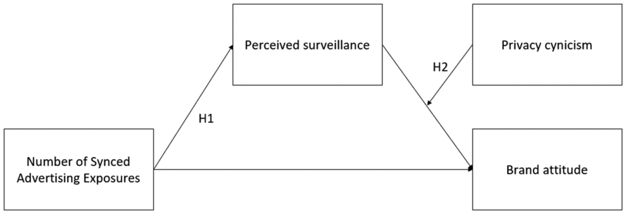
An online experiment (N = 527) showed the more that ads were synchronized, the higher the perceived surveillance, which led to less positive brand attitudes for participants with the lowest levels of privacy cynicism and positive brand attitudes only for participants with intermediate to high levels of privacy cynicism. The results advance theory on the direct effects, underlying mechanisms, and consumer-related factors that play a role in synced advertising effects.
Overview
CoChat Summary
TL;DR
This online experiment (N = 527) tested whether more synced advertising exposures increase perceived surveillance and, in turn, brand attitude, depending on privacy cynicism. More synchronized ads increased perceived surveillance, which reduced brand attitudes for the lowest privacy-cynicism participants but was associated with more positive brand attitudes for participants with intermediate to high privacy cynicism.
Key findings
- The higher the number of synced advertising exposures (0 to 3), the higher the perceived surveillance for all three brands: soap \(B = .19, SE = .06, 95% BCBCI [.07, .31]\); toothpaste \(B = .19, SE = .06, 95% BCBCI [.07, .31]\); kitchen detergent \(B = .18, SE = .06, 95% BCBCI [.06, .31]\).
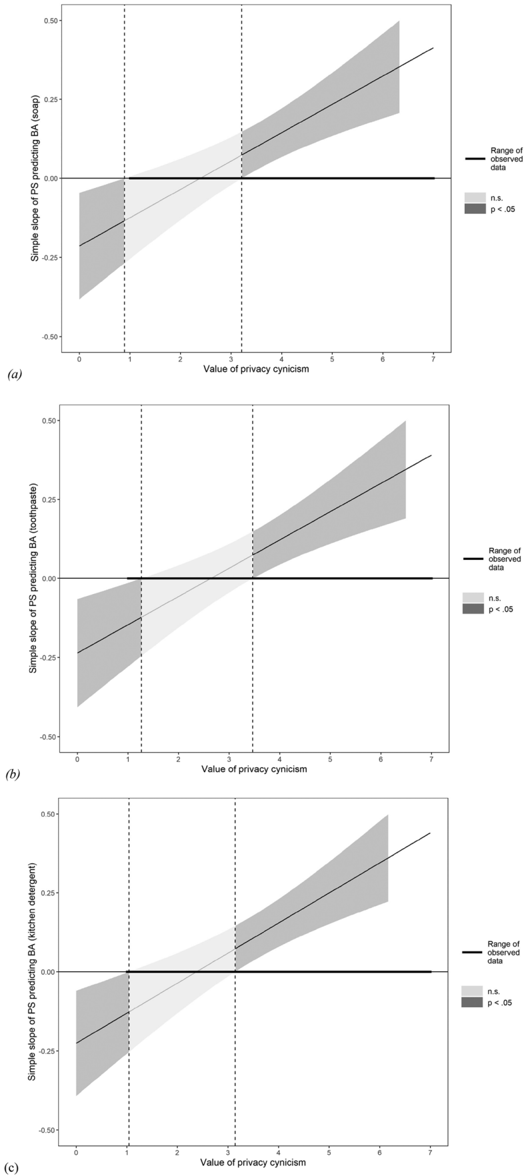
- For the lowest levels of privacy cynicism, perceived surveillance led to less positive brand attitude: soap \(\le 0.89\), toothpaste \(\le 1.27\), kitchen detergent \(\le 1.08\).
- For intermediate to high privacy cynicism, perceived surveillance was positively related to brand attitude: soap \(\ge 3.21\), toothpaste \(\ge 3.46\), kitchen detergent \(\ge 3.17\).
- There was no direct effect of multiple synced advertising exposures on brand attitude for any brand: soap \(B = -0.01, SE = .05, 95% BCBCI [-0.11, .10]\); toothpaste \(B = .00, SE = .05, 95% BCBCI [-0.10, .11]\); kitchen detergent \(B = .03, SE = .05, 95% BCBCI [-0.08, .13]\).
Methods
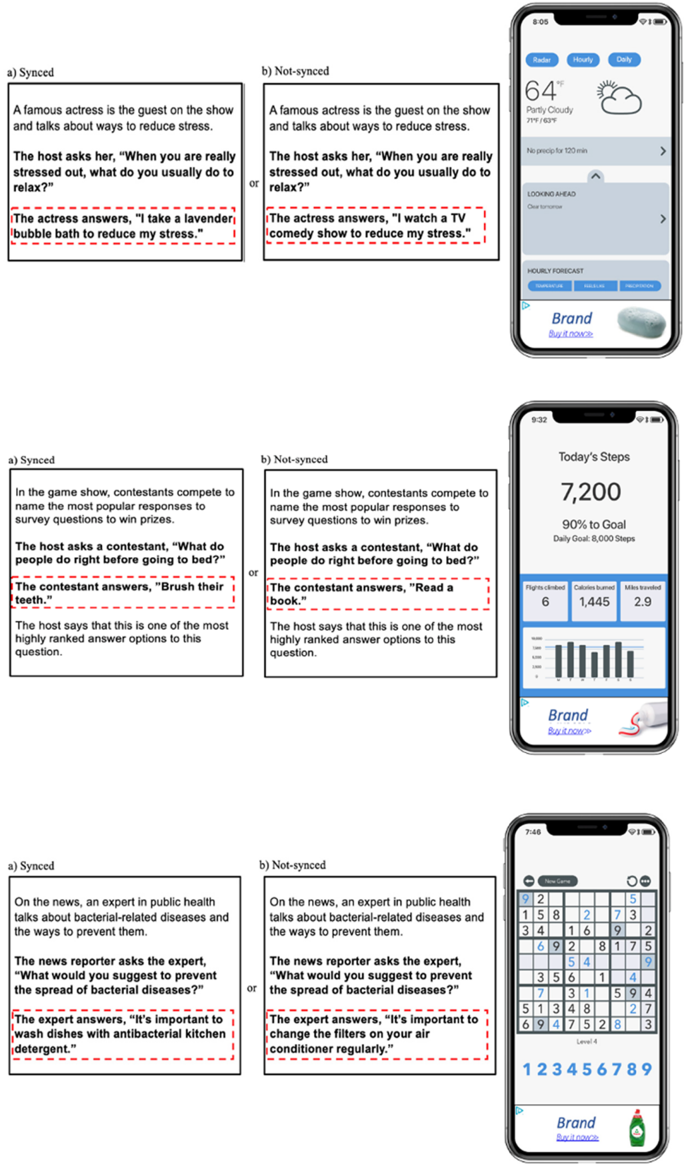
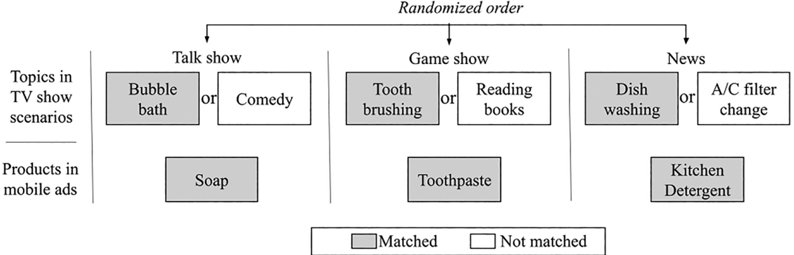
- Online experiment with synced advertising exposures manipulated as a between-subjects factor: participants saw three TV-show-and-mobile-ad scenarios with 0, 1, 2, or 3 synced matches, while the number of ad exposures was kept constant.
- Sample: U.S. adults aged 18+ recruited from Dynata; 560 completed, 33 excluded, leaving \(N = 527\) for analysis (\(M_{age} = 46.41\), \(SD_{age} = 17.04\), 48.8% female, 0.4% other).
- Analysis: PROCESS Model 14 with 5,000 bootstrap resamples; separate models for each of three brands, controlling for order of brand presentation; manipulation checks assessed perceived relevance, match, and personalization.
Limitations
- The paper states that the study used a scenario-based manipulation, so participants imagined synced advertising rather than encountering it in real life; the authors note responses may differ in real-life situations.
- The authors note the study used fictitious brands and one exposure per brand, which may help explain the absence of a direct effect on brand attitudes.
- Evident from the text: the experiment used only up to three synced exposures and three product categories, so the findings may not generalize to more exposures or repeated exposure to the same brand.
Model-written summary. Check it against the paper before relying on it.
Integrity signals
Registry
Cites
Statistics
Figures




Verification
Claims the paper makes
9 Valid · 0 Not valid · 22 Not checked · 32 Own results and interpretations
The sources with a verdict support this claim; the rest weren’t checked yet, have no full text we could read, or their verdicts aren’t rated yet.
In the paper
“Data-driven advertising and surveillance technologies can increase consumers' feelings of being monitored (i.e., perceived surveillance; Phelan, Lampe, and Resnick 2016;Segijn, Opree, and van Ooijen 2022).”
§ The Role of Perceived Surveillance and Privacy Cynicism in Effects of Multiple Synced Advertising Exposures on Brand Attitude > Abstract
What the sources say
- Not checked — no full text of the sourcecites Phelan, Lampe, and Resnick 2016 matched to “It's Creepy, But it Doesn't Bother Me” (2016) source
- Supportedcites Segijn, Opree, and van Ooijen 2022 matched to “The validation of the Perceived Surveillance Scale” (2022) source
The Introduction says data-collection practices can make people feel watched and that the increasing availability of online and offline data can enhance those feelings. This supports the claim about perceived surveillance in data-driven advertising. (LLM, conf=0.91)
plainstates a possible cause- Asserted: passes — The authors put it forward as true.
- Checkable: passes — It can be checked against evidence.
- Load-bearing: passes — The paper’s conclusions depend on it.
- Based: passes — The paper gives a reason why it holds.
The cited sources support only part of this claim — read each source’s verdict below.
In the paper
“Therefore, multiple synced advertising exposures might be needed for the consumer to classify the synced ad as a surveillance episode (Strycharz and Segijn 2022).”
§ The Role of Perceived Surveillance and Privacy Cynicism in Effects of Multiple Synced Advertising Exposures on Brand Attitude > Abstract
What the sources say
- Partly supportedcites Strycharz and Segijn 2022 matched to “The Future of Dataveillance in Advertising Theory and Practice” (2022) sourceExperimental — accuracy not yet measured
The Experience-Driven Surveillance Beliefs and Development and Activation of Surveillance Beliefs sections say that exposure to a personalized ad can make consumers aware of data collection and can activate surveillance beliefs. They do not say that multiple exposures to synced ads might be needed before a consumer regards an ad as a surveillance episode; the discussion of exposure frequency concerns clicking on ads, not recognizing surveillance. Page numbers are unavailable in our copy. (LLM, conf=0.84)
hedgedstates a possible cause- Asserted: passes — The authors put it forward as true.
- Checkable: passes — It can be checked against evidence.
- Load-bearing: passes — The paper’s conclusions depend on it.
- Based: passes — The paper gives a reason why it holds.
- Partly supported
Every source the paper cites for this claim was checked and supports it.
In the paper
“According to the DEAL framework, the level of perceived surveillance may be determined by people's knowledge or understanding about data collection and usage for persuasion, as that understanding impacts what the individual will classify as a surveillance episode.”
§ The Role of Perceived Surveillance and Privacy Cynicism in Effects of Multiple Synced Advertising Exposures on Brand Attitude > Dataveillance framework
What the sources say
- Supportedcites Strycharz and Segijn 2022 matched to “The Future of Dataveillance in Advertising Theory and Practice” (2022) source
The DEAL Framework section says surveillance beliefs are a condition for activating perceived surveillance: without them, consumers would not connect an ad to data collection. The Information-Driven Surveillance Beliefs section says information about data-collection practices can shape those beliefs, while noting that detailed understanding is not required. Together, these passages support the claim that understanding may affect what a person perceives as a surveillance episode. (LLM, conf=0.86)
hedgedstates a possible cause- Asserted: passes — The authors put it forward as true.
- Checkable: passes — It can be checked against evidence.
- Load-bearing: passes — The paper’s conclusions depend on it.
- Based: passes — The paper gives a reason why it holds.
- Supported
The cited sources support only part of this claim — read each source’s verdict below.
In the paper
“Following the DEAL framework, a surveillance episode increases perceived surveillance.”
§ The Role of Perceived Surveillance and Privacy Cynicism in Effects of Multiple Synced Advertising Exposures on Brand Attitude > Dataveillance framework
What the sources say
- Partly supportedcites Strycharz and Segijn 2022 matched to “The Future of Dataveillance in Advertising Theory and Practice” (2022) sourceExperimental — accuracy not yet measured
The DEAL framework section says a surveillance episode can activate surveillance beliefs, which can lead to perceived surveillance. It also says those beliefs must be present and activated; it does not claim that every surveillance episode increases perceived surveillance. (LLM, conf=0.86)
plainstates a cause- Asserted: passes — The authors put it forward as true.
- Checkable: passes — It can be checked against evidence.
- Load-bearing: passes — The paper’s conclusions depend on it.
- Based: passes — The paper gives a reason why it holds.
- Partly supported
The cited sources support only part of this claim — read each source’s verdict below.
In the paper
“In line with this notion, van Ooijen, Segijn, and Opree (2024) examined to what extent an individual's threat appraisal and coping appraisal of a surveillance episode predicted their privacy protection behaviors and found that privacy cynicism moderated these effects negatively.”
§ The Role of Perceived Surveillance and Privacy Cynicism in Effects of Multiple Synced Advertising Exposures on Brand Attitude > Perceived surveillance, brand attitudes, and privacy cynicism
What the sources say
- Partly supportedcites van Ooijen, Segijn, and Opree 2024 matched to “Privacy Cynicism and its Role in Privacy Decision-Making” (2024) sourceExperimental — accuracy not yet measured
The Interaction Effects section reports that privacy cynicism moderated the relationships of perceived vulnerability, disclosure benefits, response efficacy, and response costs with privacy protection behavior. But it did not significantly moderate the effects of perceived severity or self-efficacy, so the claim overgeneralizes the finding to threat and coping appraisal as a whole. No page number is available in our copy. (LLM, conf=0.90)
plainstates a cause- Asserted: passes — The authors put it forward as true.
- Checkable: passes — It can be checked against evidence.
- Load-bearing: unclear — It is unclear whether the paper’s conclusions depend on it.
- Based: passes — The paper gives a reason why it holds.
- Partly supported
26 more claims
Create a free account to see all 63 claims and to verify the 19 references still open.
- Probably not a substantial claim. 22
- It may state two separate claims as one. 13
- The quote only partly states this claim. 4
Statistics recomputed
Every reported test result, recomputed from its test statistic and degrees of freedom. A result shows as not adding up only once an independent check has confirmed it.
- ConsistentF(3, 521) = 0.167reported p = .919 · recomputed p = .919
“F (3, 521) = .167,p = .919”
- ConsistentF(1, 526) = 38.12reported p < .001 · recomputed p < .001
“F (1, 526) = 38.12,p < .001”
- ConsistentF(1, 526) = 54.76reported p < .001 · recomputed p < .001
“F (1, 526) = 54.76,p < .001”
- ConsistentF(1, 526) = 4.78reported p = .029 · recomputed p = .029
“F (1, 526) = 4.78, p = .029”
Self-check
Percentages, sums and reported differences re-computed from the paper’s own numbers.
Self-check results appear here once an independent check has confirmed them.
Citations
Cites
(2013) · Cited by 44,563
The Persuasion Knowledge Model: How People Cope with Persuasion Attempts
Friestad, M., & Wright, P. (1994) · Journal of Consumer Research · doi:10.1086/209380 · Cited by 3,811 · cited 3×
“Alternatively, consumers’ understanding of (personalized) advertising can also increase through consumers’ experiences with advertising (Friestad and Wright 1994; Strycharz and Segijn 2022).”
Awad, N. F., & Krishnan, M. S. (2006) · MIS Quarterly · doi:10.2307/25148715 · Cited by 1,252 · cited 1×
“Similar to other types of personalized advertising strategies, synced advertising has both benefits and costs for consumers (Segijn and van Ooijen 2021), known as the personalization paradox (Awad and Krishnan 2006).”
Aguirre, E., Mahr, D., Grewal, D., de Ruyter, K., & Wetzels, M. (2015) · Journal of Retailing · doi:10.1016/j.jretai.2014.09.005 · Cited by 868 · cited 1×
“Possibly, this discrepancy between consumer needs and their coping behaviors can be decreased by advertisers by increasing transparency about data usage, for instance, by means of disclosures (e.g., Aguirre et al. 2015).”
Measuring the Affective and Cognitive Properties of Attitudes: Conceptual and Methodological Issues
Crites, S. L., Fabrigar, L. R., & Petty, R. E. (1994) · Personality and Social Psychology Bulletin · doi:10.1177/0146167294206001 · Cited by 856 · cited 1×
“The items were Unpleasant/Pleasant , Bad/Good , Unappealing/Appealing , Not valuable/Valuable , Not interesting/Interesting , and Not useful/Useful (Chang and Thorson 2004; Crites, Fabrigar, and Petty 1994).”
Kalyanaraman, S., & Sundar, S. S. (2006) · Journal of Communication · doi:10.1111/j.1460-2466.2006.00006.x · Cited by 475 · cited 1×
“The manipulation check asked to what extent participants perceived the mobile ads as relevant ( M = 4.71, SD = 1.76), matched ( M = 4.87, SD = 1.73), or personalized (Kalyanaraman and Sundar 2006; Cronbach’s alpha = .89; M = 4.07, SD = 1.46) to the TV shows described in the media scenarios.”
InfluentialThe role of privacy fatigue in online privacy behavior
Choi, H., Park, J., & Jung, Y. (2018) · Computers in Human Behavior · doi:10.1016/j.chb.2017.12.001 · Cited by 427 · cited 1×
“Privacy cynicism was measured using three items taken from Choi, Park, and Jung (2018) on a 7-point Likert scale (1 = Totally disagree ; 7 = Totally agree ).”
Advertising Repetition: A Meta-Analysis on Effective Frequency in Advertising
Schmidt, S., & Eisend, M. (2015) · Journal of Advertising · doi:10.1080/00913367.2015.1018460 · Cited by 345 · cited 2×
“Thus, any differences found could be described to whether the TV show was synced to the mobile ad rather than to brand or ad exposure differences, (repetition) which could drive attitudinal advertising effects (Schmidt and Eisend 2015).”
TELEVISION AND WEB ADVERTISING SYNERGIES
Chang, Y., & Thorson, E. (2004) · Journal of Advertising · doi:10.1080/00913367.2004.10639161 · Cited by 306 · cited 1×
“The items were Unpleasant/Pleasant , Bad/Good , Unappealing/Appealing , Not valuable/Valuable , Not interesting/Interesting , and Not useful/Useful (Chang and Thorson 2004; Crites, Fabrigar, and Petty 1994).”
Smit, E. G., Van Noort, G., & Voorveld, H. A. M. (2014) · Computers in Human Behavior · doi:10.1016/j.chb.2013.11.008 · Cited by 238 · cited 2×
“Several studies examining knowledge of personalized communication have found this knowledge to be low for data collection techniques (Smit, Van Noort, and Voorveld 2014) and personalized message strategies, such as online behavioral advertising (McDonald and Cranor 2010; Nill and Aalberts 2014;…”
Privacy cynicism: A new approach to the privacy paradox
Hoffmann, C. P., Lutz, C., & Ranzini, G. (2016) · Cyberpsychology: Journal of Psychosocial Research on Cyberspace · doi:10.5817/cp2016-4-7 · Cited by 236 · cited 6×
“Hoffmann, Lutz, and Ranzini (2016) defined the concept of privacy cyn-icism as “an attitude of uncertainty, powerlessness, and mistrust toward the handling of personal data by digital platforms, rendering privacy protection subjectively futile.””
InfluentialPlanning and Conducting Experimental Advertising Research and Questionnaire Design
Geuens, M., & De Pelsmacker, P. (2017) · Journal of Advertising · doi:10.1080/00913367.2016.1225233 · Cited by 234 · cited 1×
“To rule out the potential effects of brand awareness or preexisting attitudes toward brands, we selected brands with which the study population were unfamiliar and had a neutral attitude toward (Geuens and De Pelsmacker 2017).”
"What Can I Really Do?" : Explaining the Privacy Paradox with Online Apathy
Hargittai, E., & Marwick, A. (2016) · University of Southern California · doi:10.5167/uzh-148157 · Cited by 202 · cited 1×
“…their perceptions of being watched (i.e., perceived surveillance) because they feel that they cannot prevent other parties from using their personal information (Acquisti, Friedman, and Telang 2006; Hargittai and Marwick 2016; Hoffmann, Lutz, and Ranzini 2016; van Ooijen, Segijn, and Opree 2024).”
van Ooijen, I., & Vrabec, H. U. (2019) · Journal of Consumer Policy · doi:10.1007/s10603-018-9399-7 · Cited by 180
Carden, S. W., Holtzman, N. S., & Strube, M. J. (2017) · Frontiers in Psychology · doi:10.3389/fpsyg.2017.01293 · Cited by 174 · cited 1×
“In addition, we used the Johnson–Neyman technique (Carden, Holtzman, and Strube 2017; Hayes 2013) to identify the regions of the moderator (privacy cynicism) where the relation between perceived surveillance and brand attitude is statistically significant and where it is not.”
Americans' attitudes about internet behavioral advertising practices
McDonald, A. M., & Cranor, L. F. (2010) · Proceedings of the 9th annual ACM workshop on Privacy in the electronic society · doi:10.1145/1866919.1866929 · Cited by 161 · cited 1×
“…low for data collection techniques (Smit, Van Noort, and Voorveld 2014) and personalized message strategies, such as online behavioral advertising (McDonald and Cranor 2010; Nill and Aalberts 2014; Smit, Van Noort, and Voorveld 2014) and synced advertising (Boerman and Segijn 2022; Segijn and van…”
Data capitalism and the user: An exploration of privacy cynicism in Germany
Lutz, C., Hoffmann, C. P., & Ranzini, G. (2020) · New Media & Society · doi:10.1177/1461444820912544 · Cited by 161 · cited 4×
“Privacy cynicism is a cognitive coping mechanism that allows individuals to overcome or ignore privacy concerns and rationalize their use of privacy-invasive online services (Hoffmann, Lutz, and Ranzini 2016; Lutz, Hoffmann, and Ranzini 2020; van Ooijen, Segijn, and Opree 2024).”
InfluentialBid optimizing and inventory scoring in targeted online advertising
Perlich, C., Dalessandro, B., Hook, R., Stitelman, O., Raeder, T., & Provost, F. (2012) · Proceedings of the 18th ACM SIGKDD international conference on Knowledge discovery and data mining · doi:10.1145/2339530.2339655 · Cited by 160 · cited 1×
“Advances in digital media technology have enabled digital marketers and advertisers to send ad messages personalized to consumers at the right time in the right place with the right frequency (Kim and Huh 2017; Perlich et al. 2012).”
It's Creepy, But it Doesn't Bother Me
Phelan, C., Lampe, C., & Resnick, P. (2016) · Proceedings of the 2016 CHI Conference on Human Factors in Computing Systems · doi:10.1145/2858036.2858381 · Cited by 106 · cited 2×
“Data-driven advertising and surveillance technologies can increase consumers’ feelings of being monitored (i.e., perceived surveillance; Phelan, Lampe, and Resnick 2016; Segijn, Opree, and van Ooijen 2022).”
Segijn, C. M., & van Ooijen, I. (2022) · Journal of Marketing Communications · doi:10.1080/13527266.2020.1857297 · Cited by 98 · cited 8×
“Similar to other types of personalized advertising strategies, synced advertising has both benefits and costs for consumers (Segijn and van Ooijen 2021), known as the personalization paradox (Awad and Krishnan 2006).”
InfluentialSelf-citationChallenges and Future Directions of Computational Advertising Measurement Systems
Yun, J. T., Segijn, C. M., Pearson, S., Malthouse, E. C., Konstan, J. A., & Shankar, V. (2020) · Journal of Advertising · doi:10.1080/00913367.2020.1795757 · Cited by 93 · cited 1×
“Moreover, by examining how consumers respond to ads depending on the number of synced advertisements, this study provides insights into the accuracy trade-off (Segijn 2019; Yun et al. 2020).”
Self-citationOnline behavioral advertising: An integrative review
Varnali, K. (2021) · Journal of Marketing Communications · doi:10.1080/13527266.2019.1630664 · Cited by 91 · cited 1×
“Companies collect data on consumers about their preferences and behaviors online, and these data are used as input to optimize communication by, for example, personalizing advertising in line with some-one’s preferences (Brinson, Eastin, and Bright 2019; Kim and Huh 2017; Varnali 2021).”
Kim, H., & Huh, J. (2017) · Journal of Current Issues & Research in Advertising · doi:10.1080/10641734.2016.1233157 · Cited by 86 · cited 2×
“Advances in digital media technology have enabled digital marketers and advertisers to send ad messages personalized to consumers at the right time in the right place with the right frequency (Kim and Huh 2017; Perlich et al. 2012).”
Privacy Cynicism and its Role in Privacy Decision-Making
van Ooijen, I., Segijn, C. M., & Opree, S. J. (2024) · Communication Research · doi:10.1177/00936502211060984 · Cited by 81 · cited 3×
“Privacy cynicism is a cognitive coping mechanism that allows individuals to overcome or ignore privacy concerns and rationalize their use of privacy-invasive online services (Hoffmann, Lutz, and Ranzini 2016; Lutz, Hoffmann, and Ranzini 2020; van Ooijen, Segijn, and Opree 2024).”
Self-citationAdvertising in a Media Multitasking Era: Considerations and Future Directions
Duff, B. R. L., & Segijn, C. M. (2019) · Journal of Advertising · doi:10.1080/00913367.2019.1585306 · Cited by 64 · cited 2×
“…simultaneously use multiple media, synced advertising is thought to be an effective digital marketing strategy to draw consumers’ attention to ads (Duff and Segijn 2019; Segijn, Voorveld, and Vakeel 2021) and is expected to show better ad effectiveness than nonsynced messages on memory (Hoeck and…”
Self-citationLegal and Ethical Challenges of Online Behavioral Targeting in Advertising
Nill, A., & Aalberts, R. J. (2014) · Journal of Current Issues & Research in Advertising · doi:10.1080/10641734.2014.899529 · Cited by 63 · cited 1×
“…collection techniques (Smit, Van Noort, and Voorveld 2014) and personalized message strategies, such as online behavioral advertising (McDonald and Cranor 2010; Nill and Aalberts 2014; Smit, Van Noort, and Voorveld 2014) and synced advertising (Boerman and Segijn 2022; Segijn and van Ooijen 2021).”
The Future of Dataveillance in Advertising Theory and Practice
Strycharz, J., & Segijn, C. M. (2022) · Journal of Advertising · doi:10.1080/00913367.2022.2109781 · Cited by 63 · cited 7×
“According to the DEAL framework, perceived surveillance could affect how consumers feel (e.g., attitudes) toward a surveillance episode (e.g., personalized ad) (Strycharz and Segijn 2022).”
InfluentialSelf-citationVoorveld, H. A. M., Meppelink, C. S., & Boerman, S. C. (2024) · International Journal of Advertising · doi:10.1080/02650487.2023.2264045 · Cited by 62 · cited 2×
“Because such personal characteristics were found to be more indicative of this group of consumers than demographics, practitioners may want to consider including such factors beyond the standard targeting variables (Voorveld, Meppelink, and Boerman 2023).”
Segijn, C. M., Voorveld, H. A. M., & Vakeel, K. A. (2021) · Journal of Advertising · doi:10.1080/00913367.2020.1870586 · Cited by 61 · cited 3×
“…media, synced advertising is thought to be an effective digital marketing strategy to draw consumers’ attention to ads (Duff and Segijn 2019; Segijn, Voorveld, and Vakeel 2021) and is expected to show better ad effectiveness than nonsynced messages on memory (Hoeck and Spann 2020) and brand…”
Self-citationFarman, L., Comello, M. L. (., & Edwards, J. R. (2020) · Journal of Broadcasting & Electronic Media · doi:10.1080/08838151.2020.1767292 · Cited by 48 · cited 4×
“…it may result in increased resistance to the advertising message and hence negatively affect the impact of advertisement for which personal data are being used (e.g., Farman, Comello, and Edwards 2020; Segijn and van Ooijen 2021; Segijn, Opree, and van Ooijen 2022; Sifaoui, Lee, and Segijn 2023).”
InfluentialThe perceived surveillance of conversations through smart devices
Frick, N. R. J., Wilms, K. L., Brachten, F., Hetjens, T., Stieglitz, S., & Ross, B. (2021) · Electronic Commerce Research and Applications · doi:10.1016/j.elerap.2021.101046 · Cited by 48 · cited 1×
“An example of this is when people worry that a device is listening to them when they receive relevant ads on social media related to previous offline conversations (Frick et al. 2021; Segijn, Strycharz, et al. 2024).”
The validation of the Perceived Surveillance Scale
Segijn, C. M., Opree, S. J., & Van Ooijen, I. (2022) · Cyberpsychology: Journal of Psychosocial Research on Cyberspace · doi:10.5817/cp2022-3-9 · Cited by 41
Self-citationBrinson, N. H., Eastin, M. S., & Bright, L. F. (2019) · Journal of Current Issues & Research in Advertising · doi:10.1080/10641734.2018.1503108 · Cited by 34 · cited 1×
“Companies collect data on consumers about their preferences and behaviors online, and these data are used as input to optimize communication by, for example, personalizing advertising in line with some-one’s preferences (Brinson, Eastin, and Bright 2019; Kim and Huh 2017; Varnali 2021).”
Segijn, C. M. (2019) · Annals of the International Communication Association · doi:10.1080/23808985.2019.1576020 · Cited by 27 · cited 5×
“Moreover, these technologies have enabled personalizing advertising across media in real time based on consumers’ offline media behavior, which is known as synced advertising (Segijn 2019).”
InfluentialSelf-citationAn Experimental Analysis of the Effectiveness of Multi-Screen Advertising
Hoeck, L., & Spann, M. (2020) · Journal of Interactive Marketing · doi:10.1016/j.intmar.2020.01.002 · Cited by 26 · cited 2×
“Some first studies into synced advertising effects found it could be an effective strategy in terms of increasing attention (Segijn, Voorveld, and Vakeel 2021) and memory (Hoeck and Spann 2020; Segijn, Kim, et al. 2024).”
Chatterjee, S., Malshe, A. V., & Heath, T. B. (2010) · Journal of Business Research · doi:10.1016/j.jbusres.2009.09.003 · Cited by 21 · cited 1×
“In all models, we controlled for the order (first, second, third) in which the brand was shown to the participant to control for spillover effects (e.g., Chatterjee, Malshe, and Heath 2010).”
A first step in unraveling synced advertising effectiveness
Segijn, C. M., & Voorveld, H. A. M. (2021) · International Journal of Advertising · doi:10.1080/02650487.2020.1778279 · Cited by 21 · cited 5×
“A first study into synced advertising and brand attitudes found an indication of a positive relationship compared to no exposure (Segijn and Voorveld 2021).”
InfluentialSelf-citationSegijn, C. M., Kim, E., Lee, G., Gansen, C., & Boerman, S. C. (2024) · International Journal of Research in Marketing · doi:10.1016/j.ijresmar.2023.07.001 · Cited by 21
Self-citationSegijn, C. M., Kim, E., Sifaoui, A., & Boerman, S. C. (2023) · Journal of Marketing Communications · doi:10.1080/13527266.2021.2020149 · Cited by 19
Self-citationAwareness and Perceived Appropriateness of Synced Advertising in Dutch Adults
Boerman, S. C., & Segijn, C. M. (2022) · Journal of Interactive Advertising · doi:10.1080/15252019.2022.2046216 · Cited by 17 · cited 3×
“…collection techniques (Smit, Van Noort, and Voorveld 2014) and personalized message strategies, such as online behavioral advertising (McDonald and Cranor 2010; Nill and Aalberts 2014; Smit, Van Noort, and Voorveld 2014) and synced advertising (Boerman and Segijn 2022; Segijn and van Ooijen 2021).”
Self-citationSifaoui, A., Lee, G., & Segijn, C. M. (2023) · European Advertising Academy · doi:10.1007/978-3-658-40429-1_10 · Cited by 10
Self-citation(2006)
Research works printed but not linked: 1
- 46. Wywy. 2015. "Wywy & Nissan: TV-Synced Online Campaigns [Video]. " YouTube. https://youtu.be/l8rrYCPQ-D Xu, H., S. Gupta, M. B. Rosson, and J. M. Carroll. 2012, December. "Measuring Mobile Users' Concerns for Information Privacy. " Thirty Third International Conference on Information Systems, Orlando, 1-16.
Cited by
Qadri, U. A., Moustafa, A. M. A., & Ghani, M. A. (2025) · Young Consumers Insight and Ideas for Responsible Marketers · doi:10.1108/yc-08-2024-2207 · Cited by 44
Price transparency in international retailing on digital platforms
Kim, K. K., Ryoo, Y., Zdravković, S., & Yoon, S. (2024) · International Marketing Review · doi:10.1108/imr-12-2023-0352 · Cited by 26
Triggering the Personalization Backfire Effect: The Moderating Role of Situational Privacy Concern
Kim, H., & Han, S. (2025) · Behavioral Sciences · doi:10.3390/bs15101323 · Cited by 23
“However, when situational cues have made privacy concerns salient, consumers’ focus will shift from convenience to threat, leading to a negative evaluation of intrusive messages (Lee et al., 2025; Li & Shi, 2025; Segijn et al., 2024).”
Sifaoui, A., & Segijn, C. M. (2024) · Journal of Current Issues & Research in Advertising · doi:10.1080/10641734.2024.2419602 · Cited by 9
“Previous research has found that these perceptions of surveillance can in turn lead to less positive attitudes (Segijn, Kim, and van Ooijen 2024).”
Self-citationSegijn, C. M., & Strycharz, J. (2025) · Journal of Interactive Advertising · doi:10.1080/15252019.2025.2546338 · Cited by 9
“For example, Segijn, Kim, and van Ooijen (2024) found that consumers with higher levels of privacy cynicism were susceptible to persuasive attempts and more vulnerable to exploitation.”
Self-citation
Metadata
- Authors
- Segijn, C. M., Kim, E., & van Ooijen, I.
- Affiliations
- University of Minnesota (US)
- Mount Royal University (CA)
- Behavioral Science Institute, Radboud University, Nijmegen, the Netherlands
- Venue
- Journal of Current Issues & Research in Advertising
- Publisher
- Informa UK Limited
- Published
- 2024-04-29
- Volume
- 45
- Issue
- 4
- Pages
- 506-522
- ISSN
- 1064-1734 (ISSN-L)
- 2164-7313
- OpenAlex
- W4396215917
- Cited by
- 16
- References
- 42
- Citations by year
- 2026: 8 · 2025: 6 · 2024: 2
- FWCI
- 11.52
- Type
- journal article
- Language
- en
- Open access
- hybrid
- doi.org
- Licence
- Locations
- Journal of Current Issues & Research in Advertising (publishedVersion, cc-by-nc-nd)
- Radboud Repository (Radboud University) (submittedVersion)
- Topics
- Social Sciences › Sociology and Political Science › Privacy, Security, and Data Protection
- Social Sciences › Business, Management and Accounting › Marketing › Marketing and Advertising Strategies
- Social Sciences › Business, Management and Accounting › Marketing › Digital Marketing and Social Media
- Keywords
- personalized advertising, perceived surveillance, privacy cynicism, brand attitude, consumer privacy protection, data privacy, advertising ethics
About these checks
Registry, retraction, Cites and statistics results are computed, not judged, with one exception: a printed reference that no index lists is read once by a model before it counts as a citation error. Claims are extracted by a model and kept only when their quote appears verbatim in the text; each cited source is then checked, with a model’s help, for whether it says what the claim relies on. Those verdicts can be wrong — read the claim’s quote and the cited source before relying on one.
The claim verdicts this report counts are experimental: their accuracy is not yet measured.
A language model drew the claims from the paper on 2026-10-10, under version 3 of the claim definition (model deepseek-v4.1-flash, prompt extract-v3).
A second model labelled each claim on 2026-10-10 (model jev-1.13-20260917, definition revision gold-guideline-v0.2).
Cited sources are checked with a language model’s help (gpt-6-sol).
Statistics and arithmetic are recomputed, not judged.
Confidence bands are shown only for fields calibrated on our annotated test set. None is calibrated yet, so no band is shown.
What counts as a claim ›How we measure confidence ›How we check this ›
Are you an author, or do you see a problem with this page? Request a review
Data sources
Bibliographic data: Semantic Scholar, OpenAlex, Crossref.
Contains information from the Semantic Scholar Academic Graph Datasets, made available under the ODC Attribution License (ODC-BY 1.0).
Semantic Scholar’s data is described in: Kinney, R., et al. (2023). The Semantic Scholar Open Data Platform. arXiv:2301.10140.
