

Insider/outsider dynamics: a reflexive thematic analysis of reflexivity/positionality in the ‘qualitative research in psychology’ journal
The DOI matches its Crossref record; 110 of the 110 references it cites were found in a registry or an index; 1 of the 34 sources its claims cite were checked for support.
Abstract
This study examines the concept of reflexivity/positionality using secondary data, specifically all articles published in the ‘Qualitative Research in Psychology’ journal up to and including 2023. A Reflexive Thematic Analysis was conducted on all reflexivity/positionality statements to investigate how they were used in the journal. Three main themes were developed: (a) background reflexivity, utilising previous literature; (b) self-identification, detailing the researchers’ identities; and (c) navigating insider-outsider dynamics, elaborating on their relationship with participants. engaged in these practices, researchers can foster a more nuanced and dynamic understanding of reflexivity in qualitative research, thereby enhancing the credibility and depth of their analyses.
Overview
CoChat Summary
TL;DR
This paper reviews reflexivity/positionality statements in *Qualitative Research in Psychology* articles published from 2004–2023 using reflexive thematic analysis. It finds that only 17 studies included a positionality reflection and that these statements clustered into three themes: background reflexivity, self-identification, and navigating insider-outsider dynamics.
Key findings
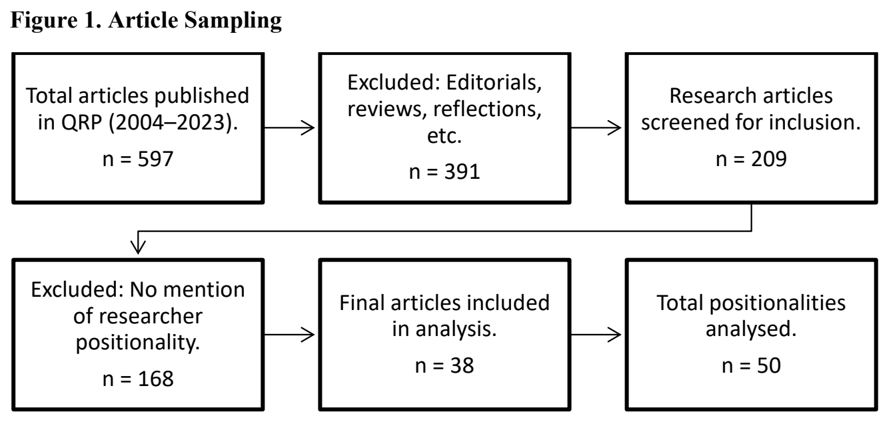
- Of 597 journal articles screened, 206 were research articles; 168 of those lacked a reflexivity/positionality statement and were excluded, leaving 38 suitable articles, with 50 positionality counts because some articles had multiple positionalities.
- Only 17 studies in the journal included a reflection on positionality.
- The analysis produced 3 themes: background reflexivity, self-identification, and navigating insider-outsider dynamics.
- The paper reports 7 insider reflections, 12 outsider reflections, 19 insider statements, and 12 outsider statements in the sample, and says outsider positionality was often framed negatively while insider positionality was described more favorably.
Methods
- Secondary-data qualitative study of all articles published in *Qualitative Research in Psychology* from 2004 to 2023, restricted to research articles; reflections, meta-analyses, reviews, and book reviews were excluded.
- The authors read abstracts and then full articles to identify reflexivity/positionality statements and whether authors identified as insiders/outsiders; quotes were extracted for analysis.
- They used Braun and Clarke’s six-stage Reflexive Thematic Analysis on the extracted positionality statements, with inductive coding and theme development.
Limitations
- The paper states that the sample size was small and that manual article selection could be subject to human error.
- The paper also notes that it did not know whether reflexivity statements were genuinely reflective or included because a reviewer suggested them.
- Evident from the text: the analysis was limited to one journal and to articles with explicit reflexivity/positionality statements, so it cannot capture positionality practices in articles that did not state them.
Model-written summary. Check it against the paper before relying on it.
Integrity signals
Registry
Cites
Statistics
Figures
Verification
Claims the paper makes
1 Valid · 2 Not valid · 45 Not checked · 68 Own results and interpretations
A result the paper reports from its own data — it cites no other source for it, so there is none to check. The quote shows it is in the paper.
In the paper
“Three main themes were developed: (a) background reflexivity, utilising previous literature; (b) self-identification, detailing the researchers' identities; and (c) navigating insider-outsider dynamics, elaborating on their relationship with participants.”
plain- Asserted: passes — The authors put it forward as true.
- Checkable: passes — It can be checked against evidence.
- Load-bearing: passes — The paper’s conclusions depend on it.
- Based: passes — The paper gives a reason why it holds.
A result the paper reports from its own data — it cites no other source for it, so there is none to check. The quote shows it is in the paper.
In the paper
“12 articles included a reflection as an outsider”
plain- Asserted: passes — The authors put it forward as true.
- Checkable: passes — It can be checked against evidence.
- Load-bearing: unclear — It is unclear whether the paper’s conclusions depend on it.
- Based: passes — The paper gives a reason why it holds.
None of the sources cited for this claim have been checked yet.
In the paper
“Moreover, in the context of using a specific approach to research, such as a psychosocial approach, researchers in this sample emphasised the importance of continually acknowledging their positionality throughout the investigation.”
plain- Asserted: passes — The authors put it forward as true.
- Checkable: passes — It can be checked against evidence.
- Load-bearing: unclear — It is unclear whether the paper’s conclusions depend on it.
- Based: passes — The paper gives a reason why it holds.
None of the sources cited for this claim have been checked yet.
In the paper
“Outsider investigators were also described as passionate and caring when they had personal connections with their population, which positioned them as close to , yet within a certain distance from, the participants.”
plainstates a cause- Asserted: passes — The authors put it forward as true.
- Checkable: passes — It can be checked against evidence.
- Load-bearing: unclear — It is unclear whether the paper’s conclusions depend on it.
- Based: passes — The paper gives a reason why it holds.
A result the paper reports from its own data — it cites no other source for it, so there is none to check. The quote shows it is in the paper.
In the paper
“Of the 597 articles published in the journal, only research articles were included in the study.”
- Also stated in: § Study design and procedure · plain
“A total of 206 articles were found suitable for this study.”
plain- Asserted: passes — The authors put it forward as true.
- Checkable: passes — It can be checked against evidence.
- Load-bearing: passes — The paper’s conclusions depend on it.
- Based: passes — The paper gives a reason why it holds.
- Also stated in: § Study design and procedure · plain
29 more claims
Create a free account to see all 116 claims and to verify the 8 references still open.
- It may state two separate claims as one. 46
- Probably not a substantial claim. 61
- The quote only partly states this claim. 1
Citations
Cites
(1980) · Cited by 22,286
Bourdieu, P. (1990) · doi:10.1515/9781503621749 · Cited by 17,271
(1986) · University of California Press eBooks · doi:10.1525/9780520946286 · Cited by 5,607
Thematic Analysis: A Practical Guide
Braun, V., & Clarke, V. (2022) · QMiP Bulletin · doi:10.53841/bpsqmip.2022.1.33.46 · Cited by 5,438
Introducing qualitative research in psychology : adventures in theory and method
Willig, C. (2001) · Cited by 4,275
Now I see it, now I don’t: researcher’s position and reflexivity in qualitative research
Berger, R. (2015) · Qualitative Research · doi:10.1177/1468794112468475 · Cited by 4,031 · cited 1×
“…existing studies support that expressing positionality transparently can enhance the credibility and authenticity of qualitative research by acknowledging potential ‘biases’ and framing the research within the investigator’s unique perspective (Berger 2013; Bucerius 2013; Chávez 2015).”
Identity and interaction: a sociocultural linguistic approach
Bucholtz, M., & Hall, K. (2005) · Discourse Studies · doi:10.1177/1461445605054407 · Cited by 3,797 · cited 1×
“Indeed, previous studies highlight the concept of authorisation in the context of identity, which refers to the processes by which identities are affirmed, shaped, or imposed through formal or informal structures invested with power and guided by specific ideologies (Bucholtz and Hall 2005).”
The chi-square test of independence
McHugh, M. L. (2013) · Biochemia Medica · doi:10.11613/bm.2013.018 · Cited by 2,828
Ponterotto, J. G. (2005) · Journal of Counseling Psychology · doi:10.1037/0022-0167.52.2.126 · Cited by 2,699
The Space Between: On Being an Insider-Outsider in Qualitative Research
Dwyer, S. C., & Buckle, J. L. (2009) · International Journal of Qualitative Methods · doi:10.1177/160940690900800105 · Cited by 2,681 · cited 2×
“Moreover, the notion of ‘the space between’ (Breen 2007; Dwyer and Buckle 2009) challenges the dichotomy between insider and outsider researchers.”
Anderson, L. (2006) · Journal of Contemporary Ethnography · doi:10.1177/0891241605280449 · Cited by 2,319
Pillow, W. (2003) · International Journal of Qualitative Studies in Education · doi:10.1080/0951839032000060635 · Cited by 2,093
Getting Personal: Reflexivity, Positionality, and Feminist Research∗
England, K. V. L. (1994) · The Professional Geographer · doi:10.1111/j.0033-0124.1994.00080.x · Cited by 2,075 · cited 2×
“Attempting to eliminate their life experiences or create an artificial distance between the researcher and the research process lacks sustainability (England 1994; Leavy 2020).”
Bracketing in Qualitative Research
Tufford, L., & Newman, P. (2012) · Qualitative Social Work · doi:10.1177/1473325010368316 · Cited by 1,601
Opening Pandora's Box: A Sociological Analysis of Scientists' Discourse.
Gieryn, T. F., Gilbert, G. N., & Mulkay, M. (1985) · Contemporary Sociology · doi:10.2307/2070471 · Cited by 1,580
Reflexive Accounts and Accounts of Reflexivity in Qualitative Data Analysis
Mauthner, N. S., & Doucet, A. (2003) · Sociology · doi:10.1177/00380385030373002 · Cited by 1,391 · cited 1×
“Conforming to previous literature, revealing the researcher’s positionality contributes to understanding how they interact with participants and how different positionalities, whether insider or out-sider, can enrich the research process (Mauthner and Doucet 2003).”
Darwin Holmes, A. G. (2020) · Shanlax International Journal of Education · doi:10.34293/education.v8i4.3232 · Cited by 1,341
Doing Qualitative Research Differently: Free Association, Narrative and the Interview Method
Hollway, W., & Jefferson, T. (2000) · Cited by 1,329
What is qualitative in qualitative research
Aspers, P., & Corte, U. (2019) · Qualitative Sociology · doi:10.1007/s11133-019-9413-7 · Cited by 1,280 · cited 1×
“In qualitative research, understanding positionality is crucial because the investigator is often actively involved in the data collection and has a close relationship with the participants (Aspers and Corte 2019).”
Burr, V. (2015) · Routledge eBooks · doi:10.4324/9781315715421 · Cited by 1,045
Positionality: Reflecting on the Research Process
Bourke, B. (2014) · The Qualitative Report · doi:10.46743/2160-3715/2014.1026 · Cited by 814
Methodological challenges in cross-language qualitative research: A research review
Squires, A. (2009) · International Journal of Nursing Studies · doi:10.1016/j.ijnurstu.2008.08.006 · Cited by 778
Ten Tips for Reflexive Bracketing
Ahern, K. J. (1999) · Qualitative Health Research · doi:10.1177/104973239900900309 · Cited by 583
Reflexivity: A Practical Guide for Researchers in Health and Social Sciences
(2003) · Wiley eBooks · doi:10.1002/9780470776094 · Cited by 554
Telling tales in sport and physical activity: a qualitative journey
(2003) · Choice Reviews Online · doi:10.5860/choice.40-5263 · Cited by 509
Performing Qualitative Cross-Cultural Research
Liamputtong, P. (2010) · Cambridge University Press eBooks · doi:10.1017/cbo9780511812705 · Cited by 490
Greene, M. (2014) · The Qualitative Report · doi:10.46743/2160-3715/2014.1106 · Cited by 471
Conceptualizing from the Inside: Advantages, Complications, and Demands on Insider Positionality
Chavez, C. (2015) · The Qualitative Report · doi:10.46743/2160-3715/2008.1589 · Cited by 465
Feminist Approaches to Social Science: Epistemological and Methodological Tenets
Campbell, R., & Wasco, S. M. (2000) · American Journal of Community Psychology · doi:10.1023/a:1005159716099 · Cited by 448
Jacobson, D., & Mustafa, N. (2019) · International Journal of Qualitative Methods · doi:10.1177/1609406919870075 · Cited by 436 · cited 1×
“The reflection may have also helped researchers clarify their stance, understand how their social identities influenced their research interests and methodologies, and make conscious decisions throughout the research process (Jacobson and Mustafa 2019).”
Qualitative methods in psychology: A research guide
Clements, A. (1995) · Journal of Psychosomatic Research · doi:10.1016/0022-3999(95)90051-9 · Cited by 418
Reflexivity in Qualitative Research: A Journey of Learning
Palaganas, E., Sanchez, M., Molintas, M. V., & Caricativo, R. (2017) · The Qualitative Report · doi:10.46743/2160-3715/2017.2552 · Cited by 384
The role of reflexivity in feminist psychology
Wilkinson, S. (1988) · Women's Studies International Forum · doi:10.1016/0277-5395(88)90024-6 · Cited by 322 · cited 1×
“While this study employs the concept of positionality to examine the insider-outsider dichotomy, it is essential to note that within feminist psychology, reflexivity has long served as the central framework for this discussion (Finlay and Gough 2003; Wilkinson 1988; Wilkinson and Kitzinger 1996).”
The Oxford Handbook of Qualitative Research
(2020) · Oxford University Press eBooks · doi:10.1093/oxfordhb/9780190847388.001.0001 · Cited by 315
(2007) · eSpace (Curtin University) · Cited by 253
Research Design for Social Work and the Human Services
Anastas, J. W. (2000) · Columbia University Press eBooks · doi:10.7312/anas11890 · Cited by 251
Hayfield, N., & Huxley, C. (2015) · Qualitative Research in Psychology · doi:10.1080/14780887.2014.918224 · Cited by 245
(1995) · PubMed · Cited by 240
Ethics guidelines for internet-mediated research
(2021) · British Psychological Society eBooks · doi:10.53841/bpsrep.2021.rep155 · Cited by 224
Ganga, D., & Scott, S. (2006) · Forum Qualitative Sozialforschung / Forum: Qualitative Social Research · doi:10.17169/fqs-7.3.134 · Cited by 220
D’Cruz, H., & Jones, M. (2004) · SAGE Publications Ltd eBooks · doi:10.4135/9780857024640 · Cited by 219
The Direction of Race of Interviewer Effects among African-Americans: Donning the Black Mask
Davis, D. W. (1997) · American Journal of Political Science · doi:10.2307/2111718 · Cited by 218
Reconsidering Reflexivity: Introducing the Case for Intellectual Entrepreneurship
Cutcliffe, J. R. (2003) · Qualitative Health Research · doi:10.1177/1049732302239416 · Cited by 214
Toward Active Reflexivity: Positionality and Practice in the Production of Knowledge
Soedirgo, J., & Glas, A. (2020) · PS: Political Science & Politics · doi:10.1017/s1049096519002233 · Cited by 211 · cited 1×
“A proactive approach to the implications of positionality aligns with feminist principles, emphasising the importance of being critically aware and actively engaged in research (England 1994; Soedirgo and Glas 2020).”
Representing Our Own Experience: Issues in “Insider” Research
Wilkinson, S., & Kitzinger, C. (2013) · Psychology of Women Quarterly · doi:10.1177/0361684313483111 · Cited by 193
Rolls, L., & Relf, M. (2006) · Mortality · doi:10.1080/13576270600774893 · Cited by 187 · cited 1×
“[…] At different stages in the research process we endeavoured to use memos (Cutcliffe 2003), separate interviews with outside sources to highlight preconceptions (Rolls and Relf 2006), and a reflexive journal (Ahern 1999) to support reflexivity.””
Holmes, A. G. D. (2020) · Shanlax International Journal of Education · doi:10.34293/education.v8i2.1477 · Cited by 185
Deconstructing insider–outsider researcher positionality
Bukamal, H. (2022) · British Journal of Special Education · doi:10.1111/1467-8578.12426 · Cited by 181
Positionality and reflexivity: negotiating insider-outsider positions within and across cultures
Yip, S. Y. (2024) · International Journal of Research & Method in Education · doi:10.1080/1743727x.2023.2266375 · Cited by 176
Ethical Dilemmas in Qualitative Research: A Critical Literature Review
Taquette, S. R., & Borges da Matta Souza, L. M. (2022) · International Journal of Qualitative Methods · doi:10.1177/16094069221078731 · Cited by 173
Becoming a “Trusted Outsider”: Gender, Ethnicity, and Inequality in Ethnographic Research
Bucerius, S. M. (2013) · Journal of Contemporary Ethnography · doi:10.1177/0891241613497747 · Cited by 170 · cited 3×
“…existing studies support that expressing positionality transparently can enhance the credibility and authenticity of qualitative research by acknowledging potential ‘biases’ and framing the research within the investigator’s unique perspective (Berger 2013; Bucerius 2013; Chávez 2015).”
Linking Ontology, Epistemology and Research Methodology
Al-Ababneh, M. M. (2020) · Science & philosophy · doi:10.23756/sp.v8i1.500 · Cited by 167
Qualitative Research: The Essential Guide to Theory and Practice
Savin-Baden, M., & Howell Major, C. (2023) · doi:10.4324/9781003377986 · Cited by 162
New Approaches to Qualitative Research
Wimpenny, K. (2010) · Routledge eBooks · doi:10.4324/9780203849873 · Cited by 160
(1996) · Medical Entomology and Zoology · Cited by 159
The double arrow: How qualitative social work researchers use reflexivity
Probst, B., & Berenson, L. (2014) · Qualitative Social Work · doi:10.1177/1473325013506248 · Cited by 157
The SAGE Handbook of Sociolinguistics
Wodak, R., Johnstone, B., & Kerswill, P. E. (2011) · SAGE Publications Ltd eBooks · doi:10.4135/9781446200957 · Cited by 143
Power, Positionality, and the Ethic of Care in Qualitative Research
Reich, J. A. (2021) · Qualitative Sociology · doi:10.1007/s11133-021-09500-4 · Cited by 133 · cited 1×
“We argue that, by reflecting on their positionality, researchers navigated the ethical issues, power dynamics, and interpersonal relationships that arose during the research process (Reich 2021).”
Ademolu, E. (2023) · Qualitative Research · doi:10.1177/14687941221149596 · Cited by 124
The conditionality of status: Experience-based reflections on the insider/outsider issue
O'Connor, P. (2004) · Australian Geographer · doi:10.1080/0004918042000249476 · Cited by 121
Archer, L. (2002) · Feminist Review · doi:10.1057/palgrave.fr.9400043 · Cited by 111
Fletcher, T. (2013) · Qualitative Research in Sport Exercise and Health · doi:10.1080/2159676x.2013.796487 · Cited by 101
Adamson, J., & Donovan, J. L. (2002) · Qualitative Health Research · doi:10.1177/10432302012006008 · Cited by 101
Adu-Ampong, E. A., & Adams, E. A. (2020) · Qualitative Inquiry · doi:10.1177/1077800419846532 · Cited by 97 · cited 1×
“…an insider or outsider to the population of study may play a role in framing the research questions, choosing the data collection methods, analysis, and interpretation of the results (Adu-Ampong and Adams 2019; Ganga and Scott 2006; Mellor et al. 2013; Underwood, Satterthwait, and Bartlett 2010).”
Kong, T. S. K., Mahoney, D., & Plummer, K. (2001) · Sage eBooks · doi:10.4135/9781412973588.n16 · Cited by 93
Underwood, M., Satterthwait, L. D., & Bartlett, H. P. (2010) · Qualitative Health Research · doi:10.1177/1049732310371102 · Cited by 71
Suwankhong, D., & Liamputtong, P. (2015) · International Journal of Qualitative Methods · doi:10.1177/1609406915621404 · Cited by 61
Researching stigma as an outsider: considerations for qualitative outsider research
Wigginton, B., & Setchell, J. (2016) · Qualitative Research in Psychology · doi:10.1080/14780887.2016.1183065 · Cited by 57
Emotions and reflexivity in feminised education action research
Burman, E. (2006) · Educational Action Research · doi:10.1080/09650790600847636 · Cited by 56
Class matters in the interview setting? Positionality, situatedness and class
Mellor, J., Ingram, N., Abrahams, J., & Beedell, P. (2014) · British Educational Research Journal · doi:10.1002/berj.3035 · Cited by 55
Of wine and whiteboards: Enacting feminist reflexivity in collaborative research
Linabary, J. R., Corple, D. J., & Cooky, C. (2021) · Qualitative Research · doi:10.1177/1468794120946988 · Cited by 54 · cited 1×
“…we argue that reflective practice can enhance the credibility and depth of research by embodying a feminist commitment to social justice and actively dismantling the often invisible barriers that can influence research outcomes (Linabary, Corple, and Cooky 2020; Wilkinson and Kitzinger 1996).”
Ozano, K., & Khatri, R. (2018) · Educational Action Research · doi:10.1080/09650792.2017.1331860 · Cited by 52
Making sense of violence: a study of narrative meaning
Shaw, R. L. (2004) · Qualitative Research in Psychology · doi:10.1191/1478088704qp009oa · Cited by 48 · cited 2×
“( Shaw 2004, outsider) Researchers often kept reflexive journals to avoid interpretations led by their assumptions.”
Ramdeo, J. (2023) · Educational Review · doi:10.1080/00131911.2023.2217358 · Cited by 44
King, N., Finlay, L., Ashworth, P., Smith, J. A., Langdridge, D., & Butt, T. (2008) · Qualitative Research in Psychology · doi:10.1080/14780880802070559 · Cited by 41
Holmes, J. (2013) · Qualitative Research in Psychology · doi:10.1080/14780887.2011.586451 · Cited by 41
The Effect of Rapport on Data Quality in Face-to-Face Interviews: Beneficial or Detrimental?
Horsfall, M., Eikelenboom, M., Draisma, S., & Smit, J. H. (2021) · International Journal of Environmental Research and Public Health · doi:10.3390/ijerph182010858 · Cited by 41 · cited 2×
“Previous studies tend to be balanced regarding the advantages and disadvantages of being an insider (Horsfall et al. 2021; Wilkinson and Kitzinger 2013) or an outsider (Hayfield and Huxley 2015; Premji et al. 2019).”
Rethinking researcher bias in health research
Buetow, S., & Zawaly, K. (2021) · Journal of Evaluation in Clinical Practice · doi:10.1111/jep.13622 · Cited by 36
Brannan, M. J. (2011) · International Journal of Work Organisation and Emotion · doi:10.1504/ijwoe.2011.045969 · Cited by 34
Tool for the Meaningful Consideration of Language Barriers in Qualitative Health Research
Premji, S., Kosny, A. A., Yanar, B., & Begum, M. (2019) · Qualitative Health Research · doi:10.1177/1049732319856303 · Cited by 34
Validity as Research Praxis: A Study of Self-Reflection and Engagement in Qualitative Inquiry
Dennis, B. (2018) · Qualitative Inquiry · doi:10.1177/1077800416686371 · Cited by 28 · cited 1×
“While the motivations behind including a positionality reflection are not definitively known, their presence shows a growing recognition of the researcher’s positionality in shaping the qualitative methods (Dennis 2017; Yoon and Uliassi 2022).”
Yoon, B., & Uliassi, C. (2022) · The Qualitative Report · doi:10.46743/2160-3715/2022.5074 · Cited by 27 · cited 1×
“While the motivations behind including a positionality reflection are not definitively known, their presence shows a growing recognition of the researcher’s positionality in shaping the qualitative methods (Dennis 2017; Yoon and Uliassi 2022).”
Running, Being, and Beijing—An Existential Exploration of a Runner Identity
Ronkainen, N. J., Harrison, M. E., & Ryba, T. V. (2014) · Qualitative Research in Psychology · doi:10.1080/14780887.2013.810796 · Cited by 26
Simmonds-Moore, C. A. (2016) · Qualitative Research in Psychology · doi:10.1080/14780887.2016.1205693 · Cited by 25
Kerr, R., & Sturm, D. (2019) · Qualitative Inquiry · doi:10.1177/1077800419838592 · Cited by 24
Kirn, A. N., Huff, J. L., Godwin, A., Ross, M. S., & Cass, C. A. P. (2019) · Qualitative Research in Psychology · doi:10.1080/14780887.2018.1563270 · Cited by 23
Making room for words: people who stutter on the Internet
Stoudt, B. G., & Ouellette, S. C. (2004) · Qualitative Research in Psychology · doi:10.1191/1478088704qp013oa · Cited by 22 · cited 1×
“(Stoudt and Ouellette 2004, outsider) Interestingly, in the following quote, the outsider positionality of a white researcher studying participants of different ethnicities became apparent from the language used to reflect on aspects of positionality.”
Athletes and Body Image: Interviews with Gay Sportsmen
Filiault, S. M., & Drummond, M. J. N. (2008) · Qualitative Research in Psychology · doi:10.1080/14780880802070575 · Cited by 19 · cited 3×
“(Filiault and Drummond 2008, insider) The choice to interview women exclusively was made for several reasons.”
InfluentialDiscourse and psychoanalysis: translating concepts into "fragmenting" methodology
Young, L. S., & Frosh, S. (2009) · Psychology in society · doi:10.17159//2309-8708/2009/n38a1 · Cited by 17
Build rapport and collect data: A teaching resource on the clinical interviewing intake
Pashak, T. J., & Heron, M. R. (2022) · Discover Psychology · doi:10.1007/s44202-022-00019-5 · Cited by 17 · cited 1×
“Additionally, when participants trust the investigator, rapport and rich data collection can be facilitated (Horsfall et al. 2021; Pashak and Heron 2022).”
Denning, S., Scriven, R., & Slatter, R. (2022) · Social & Cultural Geography · doi:10.1080/14649365.2020.1815826 · Cited by 16 · cited 1×
“Positionality is an essential tool for recognising the researcher’s role within the research process, highlighting the importance of reflexivity and self-awareness (Denning, Scriven, and Slatter 2020; Hardy 2021; Rose 2020).”
Walker, A. S., & Tobbell, J. (2015) · Qualitative Research in Psychology · doi:10.1080/14780887.2015.1054533 · Cited by 15 · cited 3×
“(Walker and Tobbell 2015, insider, outsider) This theme, therefore, represents a deliberate use of language to draw upon previous work about positionality.”
InfluentialRose, J. (2022) · Ethnography · doi:10.1177/1466138120913061 · Cited by 15 · cited 1×
“Positionality is an essential tool for recognising the researcher’s role within the research process, highlighting the importance of reflexivity and self-awareness (Denning, Scriven, and Slatter 2020; Hardy 2021; Rose 2020).”
Researcher positionality: the Liquid Inbetweener
Barnes, G.-J. (2023) · PRACTICE · doi:10.1080/25783858.2021.1968280 · Cited by 14 · cited 2×
“Therefore, following the guidelines outlined by the BPS (2017) and the BPS guide for Internet-mediated ethics (2021), the use of this publicly available data is not precluded, and it is unlikely to pose any harm to the researchers who originally published the articles from which the data was…”
Clifford, G., Craig, G., & McCourt, C. (2018) · Qualitative Research in Psychology · doi:10.1080/14780887.2018.1543048 · Cited by 11
Galdas, P. M., & Cheater, F. M. (2010) · Qualitative Research in Psychology · doi:10.1080/14780880802571168 · Cited by 10 · cited 2×
“(Sin 2004) (Galdas and Cheater 2010, outsider) However, other researchers’ referenced literature contributed to the insider-outsider debate by suggesting that a researcher can simultaneously be an insider and an outsider.”
(2017) · British Psychological Society eBooks · doi:10.53841/bpsrep.2017.inf115 · Cited by 10
Oakley, L., Fenge, L.-A., & Taylor, B. (2022) · Qualitative Research in Psychology · doi:10.1080/14780887.2020.1718813 · Cited by 9 · cited 2×
“(Probst and Berenson 2014) (Oakley, Fenge, and Taylor 2020, insider) The following quote represents a choice of background literature that portrays outsiders as strangers .”
Wiener, N. (1914) · The Journal of Philosophy Psychology and Scientific Methods · doi:10.2307/2012619 · Cited by 9
Communicating interviews: The experience of research with minority ethnic older people in Britain
Sin, C. H. (2004) · Quality in Ageing and Older Adults · doi:10.1108/14717794200400010 · Cited by 8
Allmark, N., Grogan, S., & Jeffries, M. (2017) · Qualitative Research in Psychology · doi:10.1080/14780887.2017.1393585 · Cited by 8
Embracing the emotional turn: responding to researchers’ emotions
Knight, V., & Zempi, I. (2020) · Emotions and Society · doi:10.1332/263169020x15925529968217 · Cited by 8
Towards a formulation of the fatherhood constellation: Representing absence
Berman, S., & Long, C. (2021) · Qualitative Research in Psychology · doi:10.1080/14780887.2021.1873473 · Cited by 7
Transformations in Māori Women's Identity: Some Things Change, Some Stay the Same
Houkamau, C. A. (2011) · Qualitative Research in Psychology · doi:10.1080/14780880903304501 · Cited by 6 · cited 3×
“(Houkamau 2011, insider) The following article explored researchers’ experiences working with sensitive topics and their different levels of experience in the field.”
Reyes, M. A. (2023) · Personal Relationships · doi:10.1111/pere.12516 · Cited by 6
Embodiment Research – Building Bridges to Evidence-Based Clinical Practice
Weineck, F., & Messner, M. (2018) · Springer eBooks · doi:10.1007/978-3-319-92889-0_9 · Cited by 5
Entering the ethnographic mind: A grounded theory of using ethnography in psychological research
Bartholomew, T. T., & Brown, J. R. (2022) · Qualitative Research in Psychology · doi:10.1080/14780887.2019.1604927 · Cited by 4
Locke, R. (2019) · The Clinical Teacher · doi:10.1111/tct.13027 · Cited by 4 · cited 1×
“Therefore, insider investigators leveraged their unique position and experience within a specific community or context to inform their research questions (Locke 2019).”
Dawson, N., & Bain, K. (2022) · Qualitative Research in Psychology · doi:10.1080/14780887.2021.1966559 · Cited by 4 · cited 3×
“( Pillow, p. 179) (Dawson and Bain 2021, outsider) Researchers from this sample, who were outsiders, contributed to the academic debate about conducting studies on different cultures by white researchers.”
InfluentialUsing Positionality and Theory in Historical Research: A Personal Journey
Hardy, D. M. (2021) · Journal of Cultural Research in Art Education · doi:10.2458/jcrae.4797 · Cited by 2 · cited 1×
“Positionality is an essential tool for recognising the researcher’s role within the research process, highlighting the importance of reflexivity and self-awareness (Denning, Scriven, and Slatter 2020; Hardy 2021; Rose 2020).”
Research works printed but not linked: 3
- Creswell, J. W. (2021). A concise introduction to mixed methods research . SAGE Publications.
- Creswell, J. W., & Clark, V. L. P. (2017). Designing and conducting mixed methods research . SAGE Publications.
- Young, J., S. M. Filiault, and M. J. N. Drummond 2007. “You know?” knowing and not knowing as insiders and outsiders: Reflections on qualitative interviews with men. 7th National Men’s Health Conference, Adelaide, SA, Australia, October 3–5 [Paper presentation.
Cited by
Doing Thematic Analysis in the Age of Generative AI: Practices, Ethics and Reflexivity
Xu, W. J. (2026) · International Journal of Qualitative Methods · doi:10.1177/16094069261425173 · Cited by 23
Chiu, P. (2025) · The British Journal of Social Work · doi:10.1093/bjsw/bcaf263 · Cited by 1
Gray, H., King, E., Neall, A. M., Parker, D., & Scotney, R. L. (2026) · Australian Veterinary Journal · doi:10.1111/avj.70077 · Cited by 1
“23,30 Our research team consists of fi ve members.”
Mayer, K. A., Yoder, C. M., & Garrigues, L. (2025) · Nurse Education Today · doi:10.1016/j.nedt.2025.106946
The Ecological Delivery Paradox in the Programmatic Advertising System Under Predictive Marketing
Kırcova, İ., Sağlam, M. H., & Enginkaya, E. (2025) · Systems · doi:10.3390/systems13121059 · Cited by 1
Metadata
- Authors
- Strunel, A.-M., & Cordoba, S.
- Affiliations
- London Metropolitan University (GB)
- Corresponding author
- Cordoba, Sebastian
- ORCID
- Cordoba, Sebastian
- Venue
- Qualitative Research in Psychology
- Publisher
- Informa UK Limited
- Published
- 2025-05-23
- Volume
- 22
- Issue
- 4
- Pages
- 887-917
- ISSN
- 1478-0887 (ISSN-L)
- 1478-0895
- OpenAlex
- W4410641083
- Semantic Scholar
- ea6b1020e2b28e017e445679355081f4d4941668
- Cited by
- 19
- References
- 101
- Citations by year
- 2026: 16 · 2025: 3
- FWCI
- 32.63
- Type
- journal article
- Language
- en
- Open access
- closed
- Locations
- Qualitative Research in Psychology (publishedVersion)
- London Met Repository (London Metropolitan University) (submittedVersion)
- Topics
- Social Sciences › Sociology and Political Science › Qualitative Research Methods and Ethics
- Social Sciences › Education › Qualitative Research Methods and Applications
- Social Sciences › Sociology and Political Science › Data Analysis and Archiving
- Keywords
- reflexivity, positionality, insider-outsider dynamics, researcher positionality, researcher-participant relationship, self-identification
About these checks
Registry, retraction, Cites and statistics results are computed, not judged, with one exception: a printed reference that no index lists is read once by a model before it counts as a citation error. Claims are extracted by a model and kept only when their quote appears verbatim in the text; each cited source is then checked, with a model’s help, for whether it says what the claim relies on. Those verdicts can be wrong — read the claim’s quote and the cited source before relying on one.
A language model drew the claims from the paper on 2026-10-10, under version 3 of the claim definition (model deepseek-v4.1-flash, prompt extract-v3).
A second model labelled each claim on 2026-10-10 (model jev-1.13-20260917, definition revision gold-guideline-v0.2).
Statistics and arithmetic are recomputed, not judged.
Confidence bands are shown only for fields calibrated on our annotated test set. None is calibrated yet, so no band is shown.
What counts as a claim ›How we measure confidence ›How we check this ›
Are you an author, or do you see a problem with this page? Request a review
Data sources
Bibliographic data: Semantic Scholar, OpenAlex, Crossref.
Contains information from the Semantic Scholar Academic Graph Datasets, made available under the ODC Attribution License (ODC-BY 1.0).
Semantic Scholar’s data is described in: Kinney, R., et al. (2023). The Semantic Scholar Open Data Platform. arXiv:2301.10140.
