

The RNA exosome: mechanisms of RNA surveillance, regulation, and disease
Open accessThe DOI matches its Crossref record; 207 of the 207 references it cites were found in a registry or an index; 3 of the 275 sources its claims cite were checked for support.
Abstract
The RNA exosome is a conserved multi-subunit ribonuclease complex with pivotal roles in RNA biogenesis, surveillance, and processing. It comprises a nine-subunit scaffold that associates with distinct ribonucleases in a cell compartment-specific manner, contributing to the processing and turnover of a broad spectrum of nuclear and cytoplasmic transcripts, including pervasively transcribed and short-lived RNAs, precursors, and abortive and aberrant transcripts. In this review, we examine how the RNA exosome engages a wide spectrum of RNAs via differential adaptor usage and intrinsic substrate features, such as transcript length and 3’ end structure. This also modulates the entry routes of the recruited transcripts. We highlight conserved principles and major differences between yeast and metazoans. We assimilate emerging evidence that suggests that the RNA exosome localization and activity are dynamically regulated in response to cellular context and external stimuli. Finally, drawing on findings from studies in S. cerevisiae, Drosophila, zebrafish, and mice, we discuss how perturbations in RNA surveillance can result in abnormalities in organismal development and homoeostasis. Together, these studies not only enhance our knowledge of the broader relevance of RNA quality control and metabolism but also provide mechanistic insights into pathomechanisms, particularly the tissue-specific vulnerabilities noted in RNA exosome-linked diseases.
Overview
CoChat Summary
TL;DR
This review synthesizes current understanding of the RNA exosome — a conserved nine-subunit ribonuclease complex — covering its architecture, adaptor-dependent substrate selection, nuclear and cytoplasmic entry routes, regulation by localization and post-translational modification, and its links to human disease. It argues that the exosome is an actively regulated modulator of gene expression rather than a passive disposal unit, and that tissue-specific vulnerabilities explain the disparate phenotypes of RNA exosomopathies.
Key findings
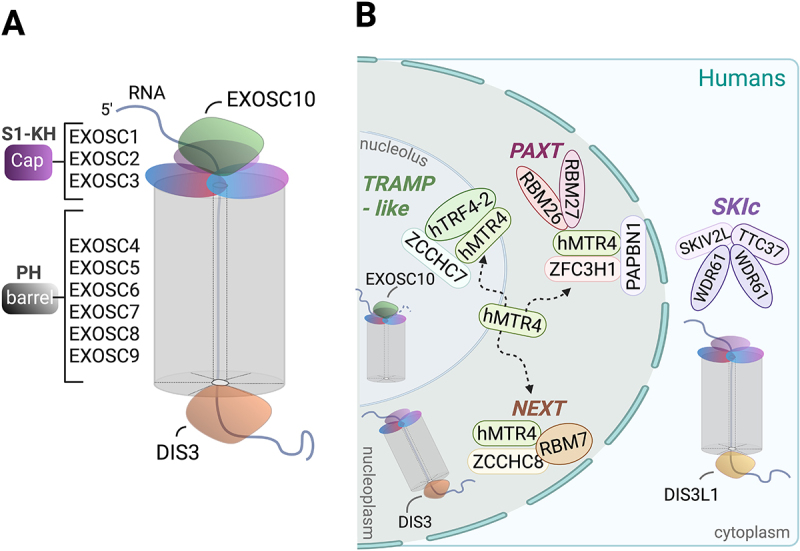
- The EXO9 core is a six-subunit PH-domain barrel (EXOSC4–EXOSC9) with an 8–10 Å central channel that accommodates a single RNA strand, capped by three S1-KH-domain subunits (EXOSC1–EXOSC3); it recruits EXOSC10, DIS3, or DIS3L1 in a mutually exclusive, compartment-specific manner (nucleolus, nucleoplasm, cytoplasm respectively).
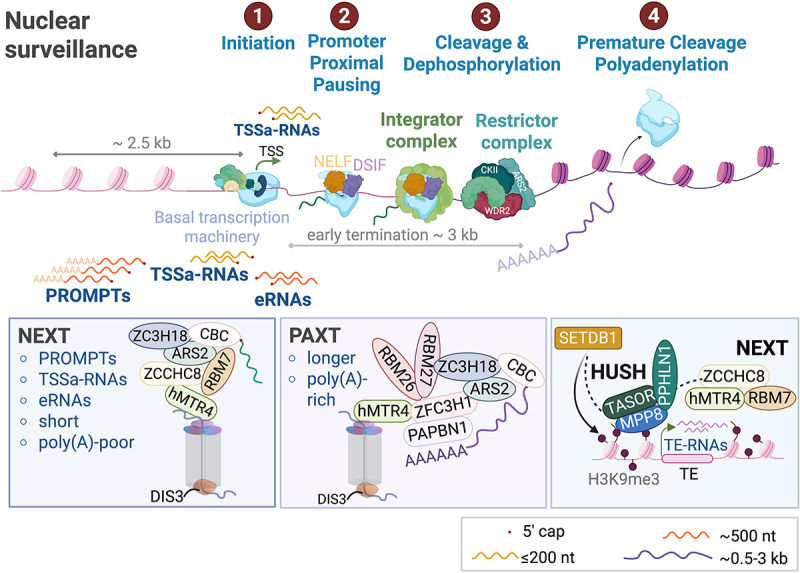
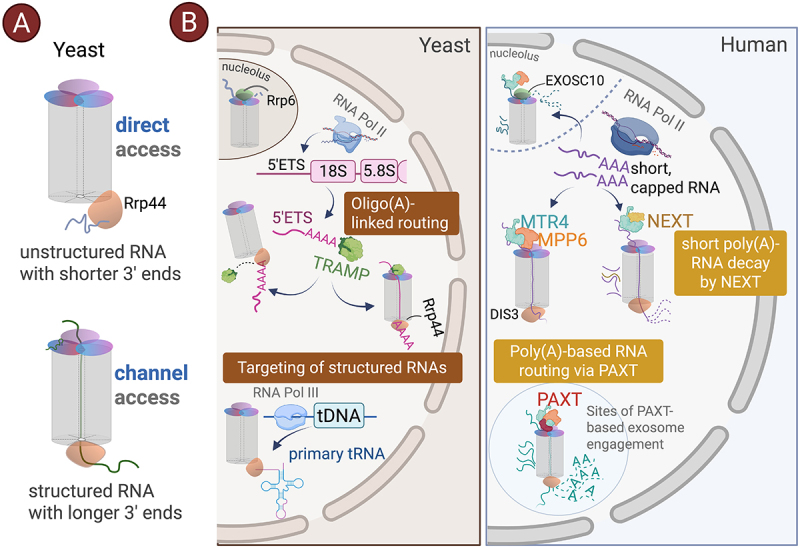
- Substrate routing depends on intrinsic RNA features and adaptor engagement: short, capped, poorly polyadenylated transcripts (e.g., TSSa-RNAs of ~20–200 nt, eRNAs of ~500 nt) are targeted by NEXT via CBC/ARS2, whereas longer, polyadenylated species (e.g., PROMPTs of ~450 nt) are preferentially degraded by PAXT; unstructured substrates with short 3′ extensions access Rrp44/DIS3 directly, while structured RNAs with longer 3′ tails are threaded through the EXO9 channel.
- Exosome activity is dynamically regulated: phosphorylation sites are reported on yCsl4, yRrp4, yRrp43, yMtr3, yRrp6 and ySki7, and PTM profiling of the purified S. pombe exosome revealed 39 modified sites; SUMOylation of EXOSC10 at K583 (via USP36) is required for nucleolar function, and hypoxia triggers its deSUMOylation and nucleolar-to-nucleoplasmic translocation.
- Exosome dysfunction causes monogenic disease with tissue-specific phenotypes — EXOSC1/3/8/9 variants cause PCH1 subtypes (PCH1F, PCH1B, PCH1C, PCH1D), EXOSC2 variants cause SHRF, EXOSC5 variants cause CABAC, ZCCHC8 variants cause pulmonary fibrosis/bone marrow failure, and SKIV2L/TTC37 variants cause trichohepatoenteric syndrome 2 and 1 — while DIS3 mutations are found in up to 18% of multiple myeloma cases.
Methods
- Narrative review; no primary experimental data are generated. The authors integrate structural, biochemical, transcriptomic, and genetic findings from the published literature.
- Evidence is drawn across model systems — S. cerevisiae, S. pombe, Drosophila melanogaster, Danio rerio, Mus musculus, and human cells — with a summary table (Table 1) mapping human exosome and cofactor subunits to their orthologs in mouse, zebrafish, Drosophila, and budding yeast alongside OMIM disease associations.
- Disease coverage is explicitly scoped to monogenic disorders and cancers.
Limitations
- Stated by the paper: key conceptual gaps remain, including how individual substrates are selectively routed to distinct exosome arms and cofactors (TRAMP, NEXT, PAXT, SKI) or via translation-dependent quality control; the authors call for high-resolution structural/biochemical work, CRISPR/Cas9 editing at defined target loci with nascent RNA sequencing and long-read profiling, and single-nucleus sequencing with patient-derived iPSCs and organoids to probe tissue-specific vulnerabilities.
- Stated by the paper: it is unclear whether the yeast TRAMP–Rrp6/Rrp47 interaction is conserved in humans, whether an analogous splicing-surveillance pathway to yeast Gbp2/Hrb1 operates in complex organisms, and whether Mpp6 coordinates Mtr4–exosome interaction in yeast as it does in metazoans; whether nuclear import of the exosome occurs as a pre-assembled complex, subcomplexes, or individual subunits is also not well understood.
- Evident from the text: as a review, all conclusions rest on previously published studies rather than new data, and the disease discussion is deliberately restricted to monogenic disorders and cancers, leaving other disease contexts and non-DIS3 cancer mechanisms largely unaddressed.
Model-written summary. Check it against the paper before relying on it.
Integrity signals
Registry
Cites
Statistics
Figures
Verification
Claims the paper makes
3 Valid · 1 Not valid · 173 Not checked · 38 Own results and interpretations
Every source the paper cites for this claim was checked and supports it.
In the paper
“In addition, to the TRAMP, human MTR4 is incorporated into distinct cofactor assemblies by binding different RNA-binding proteins.”
§ The RNA exosome: mechanisms of RNA surveillance, regulation, and disease > Architecture of the RNA exosome > Cofactors
What the sources say
- Supportedcites [34] Lingaraju M, Johnsen D, Schlundt A, et al. The MTR4 helicase recruits nuclear adaptors of the human RNA exosome using distinct arch-interacting motifs. Nat Commun. 2019; 10(1): 3393. doi: 10.1038/s41467-019-11339-x 31358741 PMC6662825 source
The Introduction (passages pp. Introduction, items 2 and 8) enumerates the distinct human MTR4 cofactor assemblies built by binding different RNA-binding adaptors: WDR74/NVL in ribosome biogenesis, the trimeric NEXT complex with ZCCHC8 and RBM7, the ZFC3H1–PABN1-linked decay route, and NRDE-2, alongside the yeast TRAMP (Trf4–Air2) comparison that the citing sentence's 'in addition to the TRAMP' framing rests on. The Abstract likewise states that MTR4 'associates with RNA-binding proteins that function as adaptors in different RNA processing and decay pathways' and that its arch domain recruits 'a repertoire of different RNA-binding proteins'. No qualifier in the claim is unmet. (LLM, conf=0.90)
plainstates a cause- Asserted: passes — The authors put it forward as true.
- Checkable: passes — It can be checked against evidence.
- Load-bearing: unclear — It is unclear whether the paper’s conclusions depend on it.
- Based: passes — The paper gives a reason why it holds.
- Supported
The sources with a verdict support this claim; the rest weren’t checked yet, have no full text we could read, or their verdicts aren’t rated yet.
In the paper
“High-resolution structural studies in budding yeast [41] and humans [42] have elucidated how conformational rearrangements of the Ski complex enable RNA substrate threading through the exosome to coordinate with ribosome-associated surveillance pathways.”
§ The RNA exosome: mechanisms of RNA surveillance, regulation, and disease > Architecture of the RNA exosome > Cofactors
What the sources say
- Supportedcites [41] Keidel A, Kögel A, Reichelt P, et al. Concerted structural rearrangements enable RNA channeling into the cytoplasmic Ski238-Ski7-exosome assembly. Mol Cell. 2023; 83(22): 4093– 105.e7. doi: 10.1016/j.molcel.2023.09.037 37879335 PMC10659929 source
Split into 2 atoms — 2 confirmed, 0 partially supported, 0 disputed, 0 misattributed, 0 unverifiable. Expand the claim to see per-atom verdicts.
- Not checked yetcites [42] Kögel A, Keidel A, Bonneau F, et al. The human SKI complex regulates channeling of ribosome-bound RNA to the exosome via an intrinsic gatekeeping mechanism. Mol Cell. 2022; 82(4): 756– 69. e8. doi: 10.1016/j.molcel.2022.01.009 35120588 PMC8860381 source
boostedstates a cause- Asserted: passes — The authors put it forward as true.
- Checkable: passes — It can be checked against evidence.
- Load-bearing: unclear — It is unclear whether the paper’s conclusions depend on it.
- Based: passes — The paper gives a reason why it holds.
- Supported
Every source the paper cites for this claim was checked and supports it.
In the paper
“Eukaryotic transcription is inherently pervasive, producing a wide spectrum of transcripts that extend beyond well-annotated protein-coding RNAs and ncRNAs with defined catalytic and regulatory roles [43].”
§ The RNA exosome: mechanisms of RNA surveillance, regulation, and disease > RNA exosome substrates, adaptors and entry-routes
What the sources say
- Supportedcites [43] Djebali S, Davis CA, Merkel A, et al. Landscape of transcription in human cells. Nature. 2012; 489(7414): 101– 108. doi: 10.1038/nature11233 22955620 PMC3684276 source
The Abstract (p. n/a) states the paper reports 'evidence that three quarters of the human genome is capable of being transcribed' plus 'observations about the range and levels of expression, localization, processing fates, regulatory regions and modifications of almost all currently annotated and thousands of previously unannotated RNAs', and the Introduction records that gene-rich and gene-poor regions 'were pervasively transcribed'. The 'Long RNA expression landscape > Detection of annotated and novel transcripts' section quantifies the extension beyond annotated elements (novel contigs covering 78% of intronic and 34% of intergenic nucleotides; 62.1%/74.7% genome coverage by processed/primary transcripts in the Abstract), and the Conclusion generalizes this as 'a consistent characteristic of annotated genomes'. The framing is built on 15 human cell lines, but the paper itself opens with 'Eukaryotic cells make many types of primary and processed RNAs' and generalizes the gene-definition consequence, so the broad background claim is treated as such in our copy. (LLM, conf=0.85)
plainstates a cause- Asserted: passes — The authors put it forward as true.
- Checkable: passes — It can be checked against evidence.
- Load-bearing: passes — The paper’s conclusions depend on it.
- Based: passes — The paper gives a reason why it holds.
- Supported
A statement the paper makes itself — it cites no source for it, so there is none to check. The quote shows it is in the paper.
In the paper
“The EXO9 central barrel is capped by a trimeric lid comprising yCsl4/EXOSC1, yRrp4/EXOSC2 and yRrp40/EXOSC3, which contributes to transcript engagement (Figure 1).”
§ The RNA exosome: mechanisms of RNA surveillance, regulation, and disease > Architecture of the RNA exosome > RNA exosome core and catalytic components
plainstates an association- Asserted: passes — The authors put it forward as true.
- Checkable: passes — It can be checked against evidence.
- Load-bearing: unclear — It is unclear whether the paper’s conclusions depend on it.
- Based: passes — The paper gives a reason why it holds.
None of the sources cited for this claim have been checked yet.
In the paper
“Initial studies resolved the structure of S. cerevisiae and human EXO9 comprising a donut-shaped central ring composed of six subunits containing RNase PH-like domains: yRrp41/EXOSC4, yRrp46/EXOSC5, yMtr3/EXOSC6, yRrp42/EXOSC7, yRrp43/EXOSC8, and yRrp45/EXOSC9, together forming a complex [8,9].”
§ The RNA exosome: mechanisms of RNA surveillance, regulation, and disease > Architecture of the RNA exosome > RNA exosome core and catalytic components
What the sources say
- Not checked yetcites [8] Liu Q, Greimann JC, Lima CD. Reconstitution, activities, and structure of the eukaryotic RNA exosome. Cell. 2006; 127(6): 1223– 1237. doi: 10.1016/j.cell.2006.10.037 17174896 source
- Not checked yetcites [9] Makino DL, Baumgärtner M, Conti E. Crystal structure of an RNA-bound 11-subunit eukaryotic exosome complex. Nature. 2013; 495(7439): 70– 75. doi: 10.1038/nature11870 23376952 source
plain- Asserted: passes — The authors put it forward as true.
- Checkable: passes — It can be checked against evidence.
- Load-bearing: unclear — It is unclear whether the paper’s conclusions depend on it.
- Based: passes — The paper gives a reason why it holds.
101 more claims
Create a free account to see all 215 claims and to verify the 272 references still open.
- It may state two separate claims as one. 102
- Probably not a substantial claim. 12
Self-check
Percentages, sums and reported differences re-computed from the paper’s own numbers.
Each contradiction between two passages listed here was confirmed by an independent check.
Rated minor: it would not touch a result — a value no result rests on, a p-value that stays on the same side of the significance level, or a conflict that is clerical, resolved elsewhere in the paper, or outside its own findings.
In the paper
§ The RNA exosome: mechanisms of RNA surveillance, regulation, and disease > RNA exosome associated human diseases > RNA exosome-linked monogenic diseases
“| DIS3L1 | cytoplasmic 3’-5’ exoribonuclease | Dis3l1 | dis3l1 | Dis3 | Rrp44 | Two unrelated families with primary ovarian insufficiency [2,3] | – |”
§ The RNA exosome: mechanisms of RNA surveillance, regulation, and disease > Model organisms in RNA exosome biology > Fruit fly
“Johnstone et al., proposed compound heterozygous mutations in DIS3 as the underlying genetic cause of primary ovarian insufficiency (POI) in two sisters [185]. In this study, dDis3 knockdown (KD) in Drosophila ovaries led to complete infertility. These findings were supported by a subsequent study reporting a biallelic missense mutation in DIS3 in an unrelated POI patient [186].”
Rated minor: it would not touch a result — a value no result rests on, a p-value that stays on the same side of the significance level, or a conflict that is clerical, resolved elsewhere in the paper, or outside its own findings.
In the paper
§ The RNA exosome: mechanisms of RNA surveillance, regulation, and disease > RNA exosome substrates, adaptors and entry-routes > Mechanistic basis of nuclear RNA targeting to the exosome
“PCPA-derived premature transcripts and many PROMPTs remain unspliced, which dissuades their efficient 3’ polyadenylation, thereby impairing their stability and stimulating exosome mediated RNA decay.”
§ The RNA exosome: mechanisms of RNA surveillance, regulation, and disease > RNA exosome substrates, adaptors and entry-routes > Nuclear exosome RNA targets
“In contrast, during PCPA U1 associates with cleavage and polyadenylation factors (CPAFs) to generate extensively polyadenylated RNAs, which are preferentially targeted to the exosome by PAXT and to a lesser extent by the NEXT complex [86].”
Citations
Cites
Landscape of transcription in human cells
Djebali, S., Davis, C. A., Merkel, A., Dobin, A., Lassmann, T., Mortazavi, A., Tanzer, A., Lagarde, J., Lin, W., Schlesinger, F., et al. (2012) · Nature · doi:10.1038/nature11233 · Cited by 5,187
Widespread transcription at neuronal activity-regulated enhancers
Kim, T.-K., Hemberg, M., Gray, J. M., Costa, A. M., Bear, D. M., Wu, J., Harmin, D. A., Laptewicz, M., Barbara-Haley, K., Kuersten, S., et al. (2010) · Nature · doi:10.1038/nature09033 · Cited by 2,450
Nascent RNA Sequencing Reveals Widespread Pausing and Divergent Initiation at Human Promoters
Core, L. J., Waterfall, J. J., & Lis, J. T. (2008) · Science · doi:10.1126/science.1162228 · Cited by 2,022
Initial genome sequencing and analysis of multiple myeloma
Chapman, M. A., Lawrence, M. S., Keats, J. J., Cibulskis, K., Sougnez, C., Schinzel, A. C., Harview, C. L., Brunet, J.-P., Ahmann, G. J., Adli, M., et al. (2011) · Nature · doi:10.1038/nature09837 · Cited by 1,433
Carrozza, M. J., Li, B., Florens, L., Suganuma, T., Swanson, S. K., Lee, K. K., Shia, W.-J., Anderson, S., Yates, J., Washburn, M. P., et al. (2005) · Cell · doi:10.1016/j.cell.2005.10.023 · Cited by 1,294
c-Myc Regulates Transcriptional Pause Release
Rahl, P. B., Lin, C. Y., Seila, A. C., Flynn, R. A., McCuine, S., Burge, C. B., Sharp, P. A., & Young, R. A. (2010) · Cell · doi:10.1016/j.cell.2010.03.030 · Cited by 1,279
The Structure of the Eukaryotic Ribosome at 3.0 Å Resolution
Ben-Shem, A., Garreau de Loubresse, N., Melnikov, S., Jenner, L., Yusupova, G., & Yusupov, M. (2011) · Science · doi:10.1126/science.1212642 · Cited by 1,134
Mitchell, P., Petfalski, E., Shevchenko, A., Mann, M., & Tollervey, D. (1997) · Cell · doi:10.1016/s0092-8674(00)80432-8 · Cited by 954
Divergent Transcription from Active Promoters
Seila, A. C., Calabrese, J. M., Levine, S. S., Yeo, G. W., Rahl, P. B., Flynn, R. A., Young, R. A., & Sharp, P. A. (2008) · Science · doi:10.1126/science.1162253 · Cited by 906
RNA Degradation by the Exosome Is Promoted by a Nuclear Polyadenylation Complex
LaCava, J., Houseley, J., Saveanu, C., Petfalski, E., Thompson, E., Jacquier, A., & Tollervey, D. (2005) · Cell · doi:10.1016/j.cell.2005.04.029 · Cited by 879
Wyers, F., Rougemaille, M., Badis, G., Rousselle, J.-C., Dufour, M.-E., Boulay, J., Régnault, B., Devaux, F., Namane, A., Séraphin, B., et al. (2005) · Cell · doi:10.1016/j.cell.2005.04.030 · Cited by 843
Quality and quantity control of gene expression by nonsense-mediated mRNA decay
Kurosaki, T., Popp, M. W., & Maquat, L. E. (2019) · Nature Reviews Molecular Cell Biology · doi:10.1038/s41580-019-0126-2 · Cited by 826
RNA Exosome Depletion Reveals Transcription Upstream of Active Human Promoters
Preker, P., Nielsen, J., Kammler, S., Lykke-Andersen, S., Christensen, M. S., Mapendano, C. K., Schierup, M. H., & Jensen, T. H. (2008) · Science · doi:10.1126/science.1164096 · Cited by 791
A large nucleolar U3 ribonucleoprotein required for 18S ribosomal RNA biogenesis
Dragon, F., Gallagher, J. E. G., Compagnone-Post, P. A., Mitchell, B. M., Porwancher, K. A., Wehner, K. A., Wormsley, S., Settlage, R. E., Shabanowitz, J., Osheim, Y., et al. (2002) · Nature · doi:10.1038/nature00769 · Cited by 688 · cited 1×
“During 18S rRNA maturation and small ribosomal subunit assembly, the small subunit processome (SSU) [100], a large ribonucleoprotein complex assembles co-transcriptionally on the pre-rRNA to catalyse endonucleolytic cleavages that release the 5’-ETS and ITS1, which are subsequently degraded.”
U1 snRNP protects pre-mRNAs from premature cleavage and polyadenylation
Kaida, D., Berg, M. G., Younis, I., Kasim, M., Singh, L. N., Wan, L., & Dreyfuss, G. (2010) · Nature · doi:10.1038/nature09479 · Cited by 638 · cited 1×
“%) in the intronic regions of human genes [82], PCPA is normally averted by U1 small nuclear ribonucleoprotein (U1 snRNP) binding to upstream canonical or cryptic splice donor sites [83,84], a process termed telescripting.”
Structures of the human and Drosophila 80S ribosome
Anger, A. M., Armache, J.-P., Berninghausen, O., Habeck, M., Subklewe, M., Wilson, D. N., & Beckmann, R. (2013) · Nature · doi:10.1038/nature12104 · Cited by 628
Functions of the exosome in rRNA, snoRNA and snRNA synthesis
Allmang, C. (1999) · The EMBO Journal · doi:10.1093/emboj/18.19.5399 · Cited by 618
Exosome-Mediated Recognition and Degradation of mRNAs Lacking a Termination Codon
van Hoof, A., Frischmeyer, P. A., Dietz, H. C., & Parker, R. (2002) · Science · doi:10.1126/science.1067272 · Cited by 591
Promoter-proximal pausing of RNA polymerase II: a nexus of gene regulation
Core, L., & Adelman, K. (2019) · Genes & Development · doi:10.1101/gad.325142.119 · Cited by 568
A New Yeast Poly(A) Polymerase Complex Involved in RNA Quality Control
Vaňáčová, Š., Wolf, J., Martin, G., Blank, D., Dettwiler, S., Friedlein, A., Langen, H., Keith, G., & Keller, W. (2005) · PLoS Biology · doi:10.1371/journal.pbio.0030189 · Cited by 567
Reconstitution, Activities, and Structure of the Eukaryotic RNA Exosome
Liu, Q., Greimann, J. C., & Lima, C. D. (2006) · Cell · doi:10.1016/j.cell.2006.10.037 · Cited by 543
Exoribonuclease superfamilies: structural analysis and phylogenetic distribution
Zuo, Y. (2001) · Nucleic Acids Research · doi:10.1093/nar/29.5.1017 · Cited by 512
Nuclear surveillance and degradation of hypomodified initiator tRNA Met in S. cerevisiae
Kadaba, S., Krueger, A., Trice, T., Krecic, A. M., Hinnebusch, A. G., & Anderson, J. (2004) · Genes & Development · doi:10.1101/gad.1183804 · Cited by 486
Identification of novel mutational drivers reveals oncogene dependencies in multiple myeloma
Walker, B. A., Mavrommatis, K., Wardell, C. P., Ashby, T. C., Bauer, M., Davies, F. E., Rosenthal, A., Wang, H., Qu, P., Hoering, A., et al. (2018) · Blood · doi:10.1182/blood-2018-03-840132 · Cited by 475
U1 snRNP Determines mRNA Length and Regulates Isoform Expression
Berg, M. G., Singh, L. N., Younis, I., Liu, Q., Pinto, A. M., Kaida, D., Zhang, Z., Cho, S., Sherrill-Mix, S., Wan, L., et al. (2012) · Cell · doi:10.1016/j.cell.2012.05.029 · Cited by 473
RNA Exosome-Regulated Long Non-Coding RNA Transcription Controls Super-Enhancer Activity
Pefanis, E., Wang, J., Rothschild, G., Lim, J., Kazadi, D., Sun, J., Federation, A., Chao, J., Elliott, O., Liu, Z.-P., et al. (2015) · Cell · doi:10.1016/j.cell.2015.04.034 · Cited by 464 · cited 2×
“…turnover and processing of a plethora of canonical noncoding RNAs (ncRNAs), such as snRNAs, snoRNAs and tRNAs, as well as, short-lived ncRNAs from intergenic regions [1–3] that are produced due to a widespread propensity for pervasive transcription by RNA Polymerase II (Pol II) [4] in the nucleus.”
Interaction profiling identifies the human nuclear exosome targeting complex
Lubas, M., Christensen, M. S., Kristiansen, M. S., Domanski, M., Falkenby, L. G., Lykke-Andersen, S., Andersen, J. S., Dziembowski, A., & Jensen, T. H. (2011) · Molecular Cell · doi:10.1016/j.molcel.2011.06.028 · Cited by 460
The yeast exosome and human PM-Scl are related complexes of 3' right-arrow 5' exonucleases
Allmang, C., Petfalski, E., Podtelejnikov, A., Mann, M., Tollervey, D., & Mitchell, P. (1999) · Genes & Development · doi:10.1101/gad.13.16.2148 · Cited by 448
Nechaev, S., Fargo, D. C., dos Santos, G., Liu, L., Gao, Y., & Adelman, K. (2010) · Science · doi:10.1126/science.1181421 · Cited by 424 · cited 1×
“Pol II pausing is spatiotemporally modulated [68] and generates short unstable RNA byproducts, such as TSSa-RNAs at many developmentally regulated genes [69,70].”
H3K4me3 regulates RNA polymerase II promoter-proximal pause-release
Wang, H., Fan, Z., Shliaha, P. V., Miele, M., Hendrickson, R. C., Jiang, X., & Helin, K. (2023) · Nature · doi:10.1038/s41586-023-05780-8 · Cited by 422 · cited 1×
“In addition, the trimethylation of histone H3 lysine 4 trimethylation (H3K4me3) regulates Pol II pause release and productive elongation [73].”
A single subunit, Dis3, is essentially responsible for yeast exosome core activity
Dziembowski, A., Lorentzen, E., Conti, E., & Séraphin, B. (2007) · Nature Structural & Molecular Biology · doi:10.1038/nsmb1184 · Cited by 420
Enhancer RNAs are an important regulatory layer of the epigenome
Sartorelli, V., & Lauberth, S. M. (2020) · Nature Structural & Molecular Biology · doi:10.1038/s41594-020-0446-0 · Cited by 366
Quality control of mRNA 3′-end processing is linked to the nuclear exosome
Hilleren, P., McCarthy, T., Rosbash, M., Parker, R., & Jensen, T. H. (2001) · Nature · doi:10.1038/35097110 · Cited by 364
Epigenetic silencing by the HUSH complex mediates position-effect variegation in human cells
Tchasovnikarova, I. A., Timms, R. T., Matheson, N. J., Wals, K., Antrobus, R., Göttgens, B., Dougan, G., Dawson, M. A., & Lehner, P. J. (2015) · Science · doi:10.1126/science.aaa7227 · Cited by 362
van Hoof, A., Lennertz, P., & Parker, R. (2000) · Molecular and Cellular Biology · doi:10.1128/mcb.20.2.441-452.2000 · Cited by 359
Tiny RNAs associated with transcription start sites in animals
Taft, R. J., Glazov, E. A., Cloonan, N., Simons, C., Stephen, S., Faulkner, G. J., Lassmann, T., Forrest, A. R. R., Grimmond, S. M., Schroder, K., et al. (2009) · Nature Genetics · doi:10.1038/ng.312 · Cited by 352
Endonucleolytic RNA cleavage by a eukaryotic exosome
Lebreton, A., Tomecki, R., Dziembowski, A., & Séraphin, B. (2008) · Nature · doi:10.1038/nature07480 · Cited by 335
Co-translational mRNA decay in Saccharomyces cerevisiae
Hu, W., Sweet, T. J., Chamnongpol, S., Baker, K. E., & Coller, J. (2009) · Nature · doi:10.1038/nature08265 · Cited by 334
de la Cruz, J. (1998) · The EMBO Journal · doi:10.1093/emboj/17.4.1128 · Cited by 321
Global Analysis of Protein Sumoylation in Saccharomyces cerevisiae
Wohlschlegel, J. A., Johnson, E. S., Reed, S. I., & Yates, J. R. (2004) · Journal of Biological Chemistry · doi:10.1074/jbc.m409203200 · Cited by 317
Ubiquitination of stalled ribosome triggers ribosome-associated quality control
Matsuo, Y., Ikeuchi, K., Saeki, Y., Iwasaki, S., Schmidt, C., Udagawa, T., Sato, F., Tsuchiya, H., Becker, T., Tanaka, K., et al. (2017) · Nature Communications · doi:10.1038/s41467-017-00188-1 · Cited by 317
Briggs, M. W., Burkard, K. T. D., & Butler, J. S. (1998) · Journal of Biological Chemistry · doi:10.1074/jbc.273.21.13255 · Cited by 310
Schaeffer, D., Tsanova, B., Barbas, A., Reis, F. P., Dastidar, E. G., Sanchez-Rotunno, M., Arraiano, C. M., & van Hoof, A. (2009) · Nature Structural & Molecular Biology · doi:10.1038/nsmb.1528 · Cited by 304
Identification of a Nuclear Exosome Decay Pathway for Processed Transcripts
Meola, N., Domanski, M., Karadoulama, E., Chen, Y., Gentil, C., Pultz, D., Vitting-Seerup, K., Lykke-Andersen, S., Andersen, J. S., Sandelin, A., et al. (2016) · Molecular Cell · doi:10.1016/j.molcel.2016.09.025 · Cited by 290 · cited 2×
“While NEXT targets short-lived RNA species, such as eRNAs, PROMPTs and others that are non-polyadenylated or poorly polyadenylated [63], PAXT preferentially degrades longer and highly polyadenylated RNA substrates [64] (Figure 2).”
Polyadenylation site–induced decay of upstream transcripts enforces promoter directionality
Ntini, E., Järvelin, A. I., Bornholdt, J., Chen, Y., Boyd, M., Jørgensen, M., Andersson, R., Hoof, I., Schein, A., Andersen, P. R., et al. (2013) · Nature Structural & Molecular Biology · doi:10.1038/nsmb.2640 · Cited by 286
Super-Enhancer-Mediated RNA Processing Revealed by Integrative MicroRNA Network Analysis
Suzuki, H. I., Young, R. A., & Sharp, P. A. (2017) · Cell · doi:10.1016/j.cell.2017.02.015 · Cited by 284 · cited 1×
“…ZCCHC8 subunits of NEXT bind to the Microprocessor complex, best known for microRNA (miRNA) processing, to form a variant of NEXT (vNEXT) complex that aids in primary miRNA maturation at super-enhancer [106], and this assembly has been reported to function in the decay of structured eRNAs [107].”
Translation affects mRNA stability in a codon-dependent manner in human cells
Wu, Q., Medina, S. G., Kushawah, G., DeVore, M. L., Castellano, L. A., Hand, J. M., Wright, M., & Bazzini, A. A. (2019) · eLife · doi:10.7554/elife.45396 · Cited by 283 · cited 1×
“Moreover, stretches of non-optimal codons can hamper ribosome translocation rates, increasing the rates of ribosome collisions, which in turn can trigger mRNA decay [130,131].”
The human core exosome interacts with differentially localized processive RNases: hDIS3 and hDIS3L
Tomecki, R., Kristiansen, M. S., Lykke‐Andersen, S., Chlebowski, A., Larsen, K. M., Szczesny, R. J., Drazkowska, K., Pastula, A., Andersen, J. S., Stepien, P. P., et al. (2010) · The EMBO Journal · doi:10.1038/emboj.2010.121 · Cited by 271
Termination of Cryptic Unstable Transcripts Is Directed by Yeast RNA-Binding Proteins Nrd1 and Nab3
Arigo, J. T., Eyler, D. E., Carroll, K. L., & Corden, J. L. (2006) · Molecular Cell · doi:10.1016/j.molcel.2006.07.024 · Cited by 262
Wan, J., Yourshaw, M., Mamsa, H., Rudnik-Schöneborn, S., Menezes, M. P., Hong, J. E., Leong, D. W., Senderek, J., Salman, M. S., Chitayat, D., et al. (2012) · Nature Genetics · doi:10.1038/ng.2254 · Cited by 257 · cited 2×
“These disorders are marked by underdevelopment of the cerebellum, global developmental delay, hypotonia and variable motor neuron involvement [157–160].”
The Yeast Exosome Functions as a Macromolecular Cage to Channel RNA Substrates for Degradation
Bonneau, F., Basquin, J., Ebert, J., Lorentzen, E., & Conti, E. (2009) · Cell · doi:10.1016/j.cell.2009.08.042 · Cited by 243
Crystal structure of an RNA-bound 11-subunit eukaryotic exosome complex
Makino, D. L., Baumgärtner, M., & Conti, E. (2013) · Nature · doi:10.1038/nature11870 · Cited by 238
Davis, C. A., & Ares, M. (2006) · Proceedings of the National Academy of Sciences · doi:10.1073/pnas.0507783103 · Cited by 232
Schneider, C., Leung, E., Brown, J., & Tollervey, D. (2009) · Nucleic Acids Research · doi:10.1093/nar/gkn1020 · Cited by 231
The human cap-binding complex is functionally connected to the nuclear RNA exosome
Andersen, P. R., Domanski, M., Kristiansen, M. S., Storvall, H., Ntini, E., Verheggen, C., Schein, A., Bunkenborg, J., Poser, I., Hallais, M., et al. (2013) · Nature Structural & Molecular Biology · doi:10.1038/nsmb.2703 · Cited by 229
An NMD Pathway in Yeast Involving Accelerated Deadenylation and Exosome-Mediated 3′→5′ Degradation
Mitchell, P., & Tollervey, D. (2003) · Molecular Cell · doi:10.1016/s1097-2765(03)00190-4 · Cited by 224
Ski7p G protein interacts with the exosome and the Ski complex for 3'-to-5' mRNA decay in yeast
Araki, Y. (2001) · The EMBO Journal · doi:10.1093/emboj/20.17.4684 · Cited by 222
Steurer, B., Janssens, R. C., Geverts, B., Geijer, M. E., Wienholz, F., Theil, A. F., Chang, J., Dealy, S., Pothof, J., van Cappellen, W. A., et al. (2018) · Proceedings of the National Academy of Sciences · doi:10.1073/pnas.1717920115 · Cited by 215
Zhang, Y., Chen, F., Chandrashekar, D. S., Varambally, S., & Creighton, C. J. (2022) · Nature Communications · doi:10.1038/s41467-022-30342-3 · Cited by 214
The Yeast Ski Complex: Crystal Structure and RNA Channeling to the Exosome Complex
Halbach, F., Reichelt, P., Rode, M., & Conti, E. (2013) · Cell · doi:10.1016/j.cell.2013.07.017 · Cited by 210 · cited 1×
“Under normal conditions, mRNA translation is not hindered as the Ski complex adopts a closed conformation, in which the RNA unwinding channel of the ySki2 helicase is blocked by a gatekeeping module comprising its N-terminal domain, ySki3 and two β - propeller subunits of ySki8 [42,134].”
Lubas, M., Andersen, P. R., Schein, A., Dziembowski, A., Kudla, G., & Jensen, T. H. (2015) · Cell Reports · doi:10.1016/j.celrep.2014.12.026 · Cited by 207
Widespread Inducible Transcription Downstream of Human Genes
Vilborg, A., Passarelli, M. C., Yario, T. A., Tycowski, K. T., & Steitz, J. A. (2015) · Molecular Cell · doi:10.1016/j.molcel.2015.06.016 · Cited by 206 · cited 1×
“…short-lived ncRNAs that are partially non-polyadenylated and arise due to constitutive readthrough transcription termed downstream of gene-containing transcripts (DoGs) [54], upstream of gene transcripts (UoG) [55], as well as transcripts initiated from cryptic promoters within gene bodies [55–57].”
Noncoding RNA transcription targets AID to divergently transcribed loci in B cells
Pefanis, E., Wang, J., Rothschild, G., Lim, J., Chao, J., Rabadan, R., Economides, A. N., & Basu, U. (2014) · Nature · doi:10.1038/nature13580 · Cited by 201 · cited 1×
“Exosc3 conditional depletion in mouse ESCs and B-cells also resulted in dramatic enrichment of eRNAs and lncRNAs, exacerbating R-loop-associated DNA double-stranded breaks [3,199], highlighting the essential role of RNA surveillance in maintaining genome stability.”
Transcriptome-wide Analysis of Exosome Targets
Schneider, C., Kudla, G., Wlotzka, W., Tuck, A., & Tollervey, D. (2012) · Molecular Cell · doi:10.1016/j.molcel.2012.08.013 · Cited by 195
The Exosome Is Recruited to RNA Substrates through Specific Adaptor Proteins
Thoms, M., Thomson, E., Baßler, J., Gnädig, M., Griesel, S., & Hurt, E. (2015) · Cell · doi:10.1016/j.cell.2015.07.060 · Cited by 195
Flynn, R. A., Almada, A. E., Zamudio, J. R., & Sharp, P. A. (2011) · Proceedings of the National Academy of Sciences · doi:10.1073/pnas.1106630108 · Cited by 189
KDM5B regulates embryonic stem cell self‐renewal and represses cryptic intragenic transcription
Xie, L., Pelz, C., Wang, W., Bashar, A., Varlamova, O., Shadle, S., & Impey, S. (2011) · The EMBO Journal · doi:10.1038/emboj.2011.91 · Cited by 180
Lorentzen, E., Basquin, J., Tomecki, R., Dziembowski, A., & Conti, E. (2008) · Molecular Cell · doi:10.1016/j.molcel.2008.02.018 · Cited by 179
The Integrator complex cleaves nascent mRNAs to attenuate transcription
Tatomer, D. C., Elrod, N. D., Liang, D., Xiao, M.-S., Jiang, J. Z., Jonathan, M., Huang, K.-L., Wagner, E. J., Cherry, S., & Wilusz, J. E. (2019) · Genes & Development · doi:10.1101/gad.330167.119 · Cited by 167 · cited 1×
“The Integrator complex, best known for its canonical role in 3’ end processing of snRNAs, associates with the C-terminal domain of Pol II at paused promoters to mediate premature transcription termination, thereby generating short, capped and poorly or non-polyadenylated transcripts [74–76].”
Heteromeric RNP Assembly at LINEs Controls Lineage-Specific RNA Processing
Attig, J., Agostini, F., Gooding, C., Chakrabarti, A. M., Singh, A., Haberman, N., Zagalak, J. A., Emmett, W., Smith, C. W. J., Luscombe, N. M., et al. (2018) · Cell · doi:10.1016/j.cell.2018.07.001 · Cited by 165
Integrator is a genome-wide attenuator of non-productive transcription
Lykke-Andersen, S., Žumer, K., Molska, E. Š., Rouvière, J. O., Wu, G., Demel, C., Schwalb, B., Schmid, M., Cramer, P., & Jensen, T. H. (2021) · Molecular Cell · doi:10.1016/j.molcel.2020.12.014 · Cited by 162
Weick, E.-M., Puno, M. R., Januszyk, K., Zinder, J. C., DiMattia, M. A., & Lima, C. D. (2018) · Cell · doi:10.1016/j.cell.2018.05.041 · Cited by 153 · cited 3×
“…whether this interaction is conserved; however, cryo-electron microscopy analysis of human nuclear exosomes bound to MTR4 have revealed that the helicase is docked at the EXO9 cap through direct contact with EXOSC2, with MPP6 bridging this interface by linking MTR4 to EXOSC1 and EXOSC3 [23,27].”
RNA degradation paths in a 12-subunit nuclear exosome complex
Makino, D. L., Schuch, B., Stegmann, E., Baumgärtner, M., Basquin, C., & Conti, E. (2015) · Nature · doi:10.1038/nature14865 · Cited by 152
Structure of an Rrp6–RNA exosome complex bound to poly(A) RNA
Wasmuth, E. V., Januszyk, K., & Lima, C. D. (2014) · Nature · doi:10.1038/nature13406 · Cited by 150
Boczonadi, V., Müller, J. S., Pyle, A., Munkley, J., Dor, T., Quartararo, J., Ferrero, I., Karcagi, V., Giunta, M., Polvikoski, T., et al. (2014) · Nature Communications · doi:10.1038/ncomms5287 · Cited by 149 · cited 1×
“…zebrafish models of mutations in other exosome subunits revealed similarly profound neurodevelopmental abnormalities, for example exosc8 morphants [159], exosc9 morphants and null crispants [158] exhibit severe cerebellar and hindbrain abnormalities, and motor-neuron dysfunction, paralleling the…”
Tomecki, R., Sikorski, P. J., & Zakrzewska‐Placzek, M. (2017) · FEBS Letters · doi:10.1002/1873-3468.12682 · Cited by 144
Dis3‐like 1: a novel exoribonuclease associated with the human exosome
Staals, R. H. J., Bronkhorst, A. W., Schilders, G., Slomovic, S., Schuster, G., Heck, A. J. R., Raijmakers, R., & Pruijn, G. J. (2010) · The EMBO Journal · doi:10.1038/emboj.2010.122 · Cited by 143
Ribosome states signal RNA quality control
D’Orazio, K. N., & Green, R. (2021) · Molecular Cell · doi:10.1016/j.molcel.2021.02.022 · Cited by 143
Ogami, K., Richard, P., Chen, Y., Hoque, M., Li, W., Moresco, J. J., Yates, J. R., Tian, B., & Manley, J. L. (2017) · Genes & Development · doi:10.1101/gad.302604.117 · Cited by 141
SCAF4 and SCAF8, mRNA Anti-Terminator Proteins
Gregersen, L. H., Mitter, R., Ugalde, A. P., Nojima, T., Proudfoot, N. J., Agami, R., Stewart, A., & Svejstrup, J. Q. (2019) · Cell · doi:10.1016/j.cell.2019.04.038 · Cited by 140 · cited 1×
“Early mRNA termination in human cells can also be prevented by U1 independent anti-termination mechanisms, which involve proteins such as SCAF4 and SCAF8, but there is currently no evidence for their interaction with the RNA exosome [87].”
Quality control of spliced mRNAs requires the shuttling SR proteins Gbp2 and Hrb1
Hackmann, A., Wu, H., Schneider, U.-M., Meyer, K., Jung, K., & Krebber, H. (2014) · Nature Communications · doi:10.1038/ncomms4123 · Cited by 132
Comparative analysis reveals genomic features of stress-induced transcriptional readthrough
Vilborg, A., Sabath, N., Wiesel, Y., Nathans, J., Levy-Adam, F., Yario, T. A., Steitz, J. A., & Shalgi, R. (2017) · Proceedings of the National Academy of Sciences · doi:10.1073/pnas.1711120114 · Cited by 131
Poised RNA Polymerase II Changes over Developmental Time and Prepares Genes for Future Expression
Gaertner, B., Johnston, J. J., Chen, K., Wallaschek, N., Paulson, A., Garruss, A. S., Gaudenz, K., Kumar, B. D., Krumlauf, R. K., & Zeitlinger, J. (2012) · Cell Reports · doi:10.1016/j.celrep.2012.11.024 · Cited by 129
The Human Nuclear Poly(A)-Binding Protein Promotes RNA Hyperadenylation and Decay
Bresson, S. M., & Conrad, N. K. (2013) · PLoS Genetics · doi:10.1371/journal.pgen.1003893 · Cited by 128
Mammalian RNA Decay Pathways Are Highly Specialized and Widely Linked to Translation
Tuck, A. C., Rankova, A., Arpat, A. B., Liechti, L. A., Hess, D., Iesmantavicius, V., Castelo-Szekely, V., Gatfield, D., & Bühler, M. (2020) · Molecular Cell · doi:10.1016/j.molcel.2020.01.007 · Cited by 127
Chiu, A. C., Suzuki, H. I., Wu, X., Mahat, D. B., Kriz, A. J., & Sharp, P. A. (2018) · Molecular Cell · doi:10.1016/j.molcel.2018.01.006 · Cited by 124
The cryo-EM structure of a ribosome–Ski2-Ski3-Ski8 helicase complex
Schmidt, C., Kowalinski, E., Shanmuganathan, V., Defenouillère, Q., Braunger, K., Heuer, A., Pech, M., Namane, A., Berninghausen, O., Fromont-Racine, M., et al. (2016) · Science · doi:10.1126/science.aaf7520 · Cited by 123
Stein, C. B., Field, A. R., Mimoso, C. A., Zhao, C., Huang, K.-L., Wagner, E. J., & Adelman, K. (2022) · Molecular Cell · doi:10.1016/j.molcel.2022.10.004 · Cited by 120
Nucleolar URB1 ensures 3′ ETS rRNA removal to prevent exosome surveillance
Shan, L., Xu, G., Yao, R.-W., Luan, P.-F., Huang, Y., Zhang, P.-H., Pan, Y.-H., Zhang, L., Gao, X., Li, Y., et al. (2023) · Nature · doi:10.1038/s41586-023-05767-5 · Cited by 120
Activities of human RRP6 and structure of the human RRP6 catalytic domain
Januszyk, K., Liu, Q., & Lima, C. D. (2011) · RNA · doi:10.1261/rna.2763111 · Cited by 120
So, B. R., Di, C., Cai, Z., Venters, C. C., Guo, J., Oh, J.-M., Arai, C., & Dreyfuss, G. (2019) · Molecular Cell · doi:10.1016/j.molcel.2019.08.007 · Cited by 115
The exosome‐binding factors Rrp6 and Rrp47 form a composite surface for recruiting the Mtr4 helicase
Schuch, B., Feigenbutz, M., Makino, D. L., Falk, S., Basquin, C., Mitchell, P., & Conti, E. (2014) · The EMBO Journal · doi:10.15252/embj.201488757 · Cited by 113
Lemay, J.-F., D'Amours, A., Lemieux, C., Lackner, D. H., St-Sauveur, V. G., Bähler, J., & Bachand, F. (2010) · Molecular Cell · doi:10.1016/j.molcel.2009.12.019 · Cited by 112 · cited 1×
“Work in fission yeast has shown that pab2, an ortholog of PABPN1, is involved in polyA trimming of pre-snoRNAs [115].”
Lemieux, C., Marguerat, S., Lafontaine, J., Barbezier, N., Bähler, J., & Bachand, F. (2011) · Molecular Cell · doi:10.1016/j.molcel.2011.06.035 · Cited by 112
Canonical Poly(A) Polymerase Activity Promotes the Decay of a Wide Variety of Mammalian Nuclear RNAs
Bresson, S. M., Hunter, O. V., Hunter, A. C., & Conrad, N. K. (2015) · PLOS Genetics · doi:10.1371/journal.pgen.1005610 · Cited by 107
Davidson, L., Francis, L., Cordiner, R. A., Eaton, J. D., Estell, C., Macias, S., Cáceres, J. F., & West, S. (2019) · Cell Reports · doi:10.1016/j.celrep.2019.02.012 · Cited by 100
Evidence for core exosome independent function of the nuclear exoribonuclease Rrp6p
Callahan, K. P., & Butler, J. S. (2008) · Nucleic Acids Research · doi:10.1093/nar/gkn743 · Cited by 98
Milligan, L., Decourty, L., Saveanu, C., Rappsilber, J., Ceulemans, H., Jacquier, A., & Tollervey, D. (2008) · Molecular and Cellular Biology · doi:10.1128/mcb.00463-08 · Cited by 95
Structure of a Cytoplasmic 11-Subunit RNA Exosome Complex
Kowalinski, E., Kögel, A., Ebert, J., Reichelt, P., Stegmann, E., Habermann, B., & Conti, E. (2016) · Molecular Cell · doi:10.1016/j.molcel.2016.05.028 · Cited by 95
Kong, K.-Y. E., Tang, H.-M. V., Pan, K., Huang, Z. P., Lee, T.-H. J., Hinnebusch, A. G., Jin, D., & Wong, C. (2013) · Nucleic Acids Research · doi:10.1093/nar/gkt888 · Cited by 94
Wang, S.-W., Stevenson, A. L., Kearsey, S. E., Watt, S., & Bähler, J. (2008) · Molecular and Cellular Biology · doi:10.1128/mcb.01531-07 · Cited by 93
Di Donato, N., Neuhann, T., Kahlert, A.-K., Klink, B., Hackmann, K., Neuhann, I., Novotna, B., Schallner, J., Krause, C., Glass, I. A., et al. (2016) · Journal of Medical Genetics · doi:10.1136/jmedgenet-2015-103511 · Cited by 92
Garland, W., Müller, I., Wu, M., Schmid, M., Imamura, K., Rib, L., Sandelin, A., Helin, K., & Jensen, T. H. (2022) · Molecular Cell · doi:10.1016/j.molcel.2022.03.004 · Cited by 91
Burns, D. T., Donkervoort, S., Müller, J. S., Knierim, E., Bharucha-Goebel, D., Faqeih, E. A., Bell, S. K., AlFaifi, A. Y., Monies, D., Millan, F., et al. (2018) · The American Journal of Human Genetics · doi:10.1016/j.ajhg.2018.03.011 · Cited by 88 · cited 2×
“…subunits revealed similarly profound neurodevelopmental abnormalities, for example exosc8 morphants [159], exosc9 morphants and null crispants [158] exhibit severe cerebellar and hindbrain abnormalities, and motor-neuron dysfunction, paralleling the clinical features of human patients with…”
Midtgaard, S. F., Assenholt, J., Jonstrup, A. T., Van, L. B., Jensen, T. H., & Brodersen, D. E. (2006) · Proceedings of the National Academy of Sciences · doi:10.1073/pnas.0604731103 · Cited by 88
Zinder, J. C., Wasmuth, E. V., & Lima, C. D. (2016) · Molecular Cell · doi:10.1016/j.molcel.2016.09.038 · Cited by 86
Stead, J. A., Costello, J. L., Livingstone, M. J., & Mitchell, P. (2007) · Nucleic Acids Research · doi:10.1093/nar/gkm614 · Cited by 83
The human ZC3H3 and RBM26/27 proteins are critical for PAXT-mediated nuclear RNA decay
Silla, T., Schmid, M., Dou, Y., Garland, W., Milek, M., Imami, K., Johnsen, D., Polak, P., Andersen, J. S., Selbach, M., et al. (2020) · Nucleic Acids Research · doi:10.1093/nar/gkz1238 · Cited by 81
Differential Distribution of Exosome Subunits at the Nuclear Lamina and in Cytoplasmic Foci
Graham, A. C., Kiss, D. L., & Andrulis, E. D. (2006) · Molecular Biology of the Cell · doi:10.1091/mbc.e05-08-0805 · Cited by 79
Synowsky, S. A., van Wijk, M., Raijmakers, R., & Heck, A. J. R. (2008) · Journal of Molecular Biology · doi:10.1016/j.jmb.2008.11.011 · Cited by 78
Bernstein, J., Patterson, D. N., Wilson, G. M., & Toth, E. A. (2008) · Journal of Biological Chemistry · doi:10.1074/jbc.m706677200 · Cited by 78
Single-molecule imaging reveals translation-dependent destabilization of mRNAs
Dave, P., Roth, G., Griesbach, E., Mateju, D., Hochstoeger, T., & Chao, J. A. (2023) · Molecular Cell · doi:10.1016/j.molcel.2023.01.013 · Cited by 75
The molecular spectrum and clinical impact of DIS 3 mutations in multiple myeloma
Weißbach, S., Langer, C., Puppe, B., Nedeva, T., Bach, E., Kull, M., Bargou, R., Einsele, H., Rosenwald, A., Knop, S., et al. (2015) · British Journal of Haematology · doi:10.1111/bjh.13256 · Cited by 69
Interaction between Ski7p and Upf1p is required for nonsense‐mediated 3′‐to‐5′ mRNA decay in yeast
Takahashi, S., Araki, Y., Sakuno, T., & Katada, T. (2003) · The EMBO Journal · doi:10.1093/emboj/cdg374 · Cited by 68
RNA channelling by the eukaryotic exosome
Malet, H., Topf, M., Clare, D. K., Ebert, J., Bonneau, F., Basquin, J., Drazkowska, K., Tomecki, R., Dziembowski, A., Conti, E., et al. (2010) · EMBO reports · doi:10.1038/embor.2010.164 · Cited by 68
Estell, C., Davidson, L., Eaton, J. D., Kimura, H., Gold, V. A. M., & West, S. (2023) · Molecular Cell · doi:10.1016/j.molcel.2023.05.029 · Cited by 68
ZC3H4 restricts non-coding transcription in human cells
Estell, C., Davidson, L., Steketee, P. C., Monier, A., & West, S. (2021) · eLife · doi:10.7554/elife.67305 · Cited by 66
Visualization of distinct substrate-recruitment pathways in the yeast exosome by EM
Liu, J.-J., Bratkowski, M. A., Liu, X., Niu, C.-Y., Ke, A., & Wang, H.-W. (2014) · Nature Structural & Molecular Biology · doi:10.1038/nsmb.2736 · Cited by 64
EXOSC10 sculpts the transcriptome during the growth-to-maturation transition in mouse oocytes
Wu, D., & Dean, J. (2020) · Nucleic Acids Research · doi:10.1093/nar/gkaa249 · Cited by 62
Extraction of mRNA from Stalled Ribosomes by the Ski Complex
Zinoviev, A., Ayupov, R. K., Abaeva, I. S., Hellen, C. U. T., & Pestova, T. V. (2020) · Molecular Cell · doi:10.1016/j.molcel.2020.01.011 · Cited by 59
Synowsky, S. A., van den Heuvel, R. H. H., Mohammed, S., Pim Pijnappel, W. W. M., & Heck, A. J. R. (2006) · Molecular & Cellular Proteomics · doi:10.1074/mcp.m600043-mcp200 · Cited by 58
The Rrp6 C-terminal domain binds RNA and activates the nuclear RNA exosome
Wasmuth, E. V., & Lima, C. D. (2017) · Nucleic Acids Research · doi:10.1093/nar/gkw1152 · Cited by 58
Caldas, P., Luz, M., Baseggio, S., Andrade, R., Sobral, D., & Grosso, A. R. (2024) · Communications Biology · doi:10.1038/s42003-024-05779-5 · Cited by 58
Structure of the Maturing 90S Pre-ribosome in Association with the RNA Exosome
Lau, B., Cheng, J., Flemming, D., La Venuta, G., Berninghausen, O., Beckmann, R., & Hurt, E. (2021) · Molecular Cell · doi:10.1016/j.molcel.2020.11.009 · Cited by 58
Kiss, D. L., & Andrulis, E. D. (2010) · RNA · doi:10.1261/rna.1906710 · Cited by 56
Rouvière, J. O., Salerno-Kochan, A., Lykke-Andersen, S., Garland, W., Dou, Y., Rathore, O., Molska, E. Š., Wu, G., Schmid, M., Bugai, A., et al. (2023) · Molecular Cell · doi:10.1016/j.molcel.2023.05.028 · Cited by 56
Lingaraju, M., Johnsen, D., Schlundt, A., Langer, L. M., Basquin, J., Sattler, M., Heick Jensen, T., Falk, S., & Conti, E. (2019) · Nature Communications · doi:10.1038/s41467-019-11339-x · Cited by 55 · cited 2×
“…that adaptor subunits, such as the zinc-finger proteins, ZCCHC8 and ZFC3H1 interact with MTR4 through unique ‘arch’ domain-interacting motifs and recruit it into the Nuclear Exosome Targeting (NEXT) and Poly(A) tail eXosome Targeting (PAXT) complexes located in the nucleoplasm [34] (Figure 1B).”
Gerlach, P., Garland, W., Lingaraju, M., Salerno-Kochan, A., Bonneau, F., Basquin, J., Jensen, T. H., & Conti, E. (2022) · Molecular Cell · doi:10.1016/j.molcel.2022.04.011 · Cited by 55 · cited 1×
“NEXT is a dimer of a heterotrimer containing hMTR4, RBM7, an RNA-binding protein and ZCCHC8 [33,35].”
Zimmer, J. T., Rosa-Mercado, N. A., Canzio, D., STEITZ, J. A., & Simon, M. D. (2021) · Molecular Cell · doi:10.1016/j.molcel.2021.08.019 · Cited by 55
Shape of promoter antisense RNAs regulates ligand-induced transcription activation
Yang, F., Tanasă, B., Micheletti, R., Ohgi, K. A., Aggarwal, A. K., & Rosenfeld, M. G. (2021) · Nature · doi:10.1038/s41586-021-03589-x · Cited by 53
The regulatory landscape of the yeast phosphoproteome
Leutert, M., Barente, A. S., Fukuda, N. K., Rodriguez-Mias, R. A., & Villén, J. (2023) · Nature Structural & Molecular Biology · doi:10.1038/s41594-023-01115-3 · Cited by 52
Kögel, A., Keidel, A., Bonneau, F., Schäfer, I. B., & Conti, E. (2022) · Molecular Cell · doi:10.1016/j.molcel.2022.01.009 · Cited by 51
Transcriptome-wide analysis of alternative routes for RNA substrates into the exosome complex
Delan-Forino, C., Schneider, C., & Tollervey, D. (2017) · PLOS Genetics · doi:10.1371/journal.pgen.1006699 · Cited by 50
A compendium of DIS3 mutations and associated transcriptional signatures in plasma cell dyscrasias
Lionetti, M., Barbieri, M., Todoerti, K., Agnelli, L., Fabris, S., Tonon, G., Segalla, S., Cifola, I., Pinatel, E., Tassone, P., et al. (2015) · Oncotarget · doi:10.18632/oncotarget.4674 · Cited by 49
Exome sequencing identifies germline variants in DIS3 in familial multiple myeloma
Pertesi, M., Vallée, M., Wei, X., Revuelta, M. V., Galia, P., Demangel, D., Oliver, J., Foll, M., Chen, S., Perrial, E., et al. (2019) · Leukemia · doi:10.1038/s41375-019-0452-6 · Cited by 48
A conserved CCCH-type zinc finger protein regulates mRNA nuclear adenylation and export
Hurt, J. A., Obar, R. A., Zhai, B., Farny, N. G., Gygi, S. P., & Silver, P. A. (2009) · Journal of Cell Biology · doi:10.1083/jcb.200811072 · Cited by 45
The Consensus 5' Splice Site Motif Inhibits mRNA Nuclear Export
Lee, E. S., Akef, A., Mahadevan, K., & Palazzo, A. F. (2015) · PLOS ONE · doi:10.1371/journal.pone.0122743 · Cited by 42
Altered RNA metabolism due to a homozygous RBM7 mutation in a patient with spinal motor neuropathy
Giunta, M., Edvardson, S., Xu, Y., Schuelke, M., Gomez-Duran, A., Boczonadi, V., Elpeleg, O., Müller, J. S., & Horvath, R. (2016) · Human Molecular Genetics · doi:10.1093/hmg/ddw149 · Cited by 42
Fasken, M. B., Losh, J. S., Leung, S. W., Brutus, S., Avin, B., Vaught, J. C., Potter-Birriel, J., Craig, T., Conn, G. L., Mills-Lujan, K., et al. (2017) · Genetics · doi:10.1534/genetics.116.195917 · Cited by 41 · cited 1×
“…monogenic RNA exosomopathies included validated and emerging candidate RNA exosome-disease associations by the introduction of patient-derived variants in EXOSC1 [175], EXOSC2 [176–178], EXOSC3 [177,179], EXOSC4 [178,180], EXOSC5 [177,181] and EXOSC9 [178] in their orthologous S. cerevisiae genes.”
Meers, M. P., Adelman, K., Duronio, R. J., Strahl, B. D., McKay, D. J., & Matera, A. G. (2018) · BMC Genomics · doi:10.1186/s12864-018-4510-7 · Cited by 41
Feigenbutz, M., Garland, W., Turner, M., & Mitchell, P. (2013) · PLoS ONE · doi:10.1371/journal.pone.0080752 · Cited by 41
Lee, E. S., Smith, H. W., Wolf, E. J., Guvenek, A., Wang, Y. E., Emili, A., Tian, B., & Palazzo, A. F. (2022) · RNA · doi:10.1261/rna.079104.122 · Cited by 40
A nuclear RNA degradation code for eukaryotic transcriptome surveillance
Soles, L. V., Liu, L., Zou, X., Yoon, Y., Li, S., Tian, L., Valdez, M. C., Yu, A. M., Yin, H. Z., Li, W., et al. (2024) · Molecular Cell · doi:10.1016/j.molcel.2025.03.010 · Cited by 39
Slavotinek, A., Misceo, D., Htun, S., Mathisen, L., Frengen, E., Foreman, M., Hurtig, J. E., Enyenihi, L., Sterrett, M. C., Leung, S. W., et al. (2020) · Human Molecular Genetics · doi:10.1093/hmg/ddaa108 · Cited by 38
Cooling-induced SUMOylation of EXOSC10 down-regulates ribosome biogenesis
Knight, J. R. P., Bastide, A., Peretti, D., Roobol, A., Roobol, J., Mallucci, G. R., Smales, C. M., & Willis, A. E. (2016) · RNA · doi:10.1261/rna.054411.115 · Cited by 37
Jamin, S. P., Petit, F. G., Kervarrec, C., Smagulova, F., Illner, D., Scherthan, H., & Primig, M. (2017) · Scientific Reports · doi:10.1038/s41598-017-14643-y · Cited by 37
Substrate specificity of the TRAMP nuclear surveillance complexes
Delan-Forino, C., Spanos, C., Rappsilber, J., & Tollervey, D. (2020) · Nature Communications · doi:10.1038/s41467-020-16965-4 · Cited by 36
Intergenic RNA mainly derives from nascent transcripts of known genes
Agostini, F., Zagalak, J. A., Attig, J., Ule, J., & Luscombe, N. M. (2021) · Genome biology · doi:10.1186/s13059-021-02350-x · Cited by 36
The RNA Exosome Channeling and Direct Access Conformations Have Distinct In Vivo Functions
Han, J., & van Hoof, A. (2016) · Cell Reports · doi:10.1016/j.celrep.2016.08.059 · Cited by 36
U1 snRNP Telescripting Roles in Transcription and Its Mechanism
Di, C., So, B. R., Cai, Z., Arai, C., Duan, J., & Dreyfuss, G. (2019) · Cold Spring Harbor Symposia on Quantitative Biology · doi:10.1101/sqb.2019.84.040451 · Cited by 35
DIS3 mutations in multiple myeloma impact the transcriptional signature and clinical outcome
Todoerti, K., Ronchetti, D., Favasuli, V., Maura, F., Morabito, F., Bolli, N., Taiana, E., & Neri, A. (2021) · Haematologica · doi:10.3324/haematol.2021.278342 · Cited by 34
RNA exosome drives early B cell development via noncoding RNA processing mechanisms
Laffleur, B., Batista, C. R., Zhang, W., Lim, J., Yang, B., Rossille, D., Wu, L., Estrella, J., Rothschild, G., Pefanis, E., et al. (2022) · Science Immunology · doi:10.1126/sciimmunol.abn2738 · Cited by 33
Bi‐allelic missense variant, p. Ser35Leu in EXOSC1 is associated with pontocerebellar hypoplasia
Somashekar, P. H., Kaur, P., Stephen, J., Guleria, V. S., Kadavigere, R., Girisha, K. M., Bielas, S., Upadhyai, P., & Shukla, A. (2021) · Clinical Genetics · doi:10.1111/cge.13928 · Cited by 32 · cited 1×
“These disorders are marked by underdevelopment of the cerebellum, global developmental delay, hypotonia and variable motor neuron involvement [157–160].”
Self-citationTaniue, K., Tanu, T., Shimoura, Y., Mitsutomi, S., Han, H., Kakisaka, R., Ono, Y., Tamamura, N., Takahashi, K., Wada, Y., et al. (2022) · International Journal of Molecular Sciences · doi:10.3390/ijms23010496 · Cited by 32
Zhang, E., Khanna, V., Dacheux, E., Namane, A., Doyen, A., Gomard, M., Turcotte, B., Jacquier, A., & Fromont‐Racine, M. (2019) · The EMBO Journal · doi:10.15252/embj.2018100640 · Cited by 32
Yang, X., Bayat, V., DiDonato, N., Zhao, Y., Zarnegar, B., Siprashvili, Z., Lopez-Pajares, V., Sun, T., Tao, S., Li, C., et al. (2020) · Human Molecular Genetics · doi:10.1093/hmg/ddz251 · Cited by 31
RNA exosome mutations in pontocerebellar hypoplasia alter ribosome biogenesis and p53 levels
Müller, J. S., Burns, D. T., Griffin, H., Wells, G. R., Zendah, R. A., Munro, B., Schneider, C., & Horvath, R. (2020) · Life Science Alliance · doi:10.26508/lsa.202000678 · Cited by 30
Chen, Y., Li, Y., Dai, R. S., Savage, J. C., Shinde, U., Klimek, J., David, L. L., Young, E. A., Hafner, M., Sears, R. C., et al. (2023) · Nucleic Acids Research · doi:10.1093/nar/gkad140 · Cited by 29
PAPγ associates with PAXT nuclear exosome to control the abundance of PROMPT ncRNAs
Contreras, X., Depierre, D., Akkawi, C., Srbic, M., Helsmoortel, M., Nogaret, M., LeHars, M., Salifou, K., Heurteau, A., Cuvier, O., et al. (2023) · Nature Communications · doi:10.1038/s41467-023-42620-9 · Cited by 29
Gritti, I., Basso, V., Rinchai, D., Corigliano, F., Pivetti, S., Gaviraghi, M., Rosano, D., Mazza, D., Barozzi, S., Roncador, M., et al. (2022) · The EMBO Journal · doi:10.15252/embj.2021108040 · Cited by 27
Stuparević, I., Novačić, A., Rahmouni, A. R., Fernandez, A., Lamb, N. J. C., & Primig, M. (2021) · Biological reviews/Biological reviews of the Cambridge Philosophical Society · doi:10.1111/brv.12693 · Cited by 26
Structural basis of mRNA decay by the human exosome–ribosome supercomplex
Kögel, A., Keidel, A., Loukeri, M.-J., Kuhn, C. C., Langer, L. M., Schäfer, I. B., & Conti, E. (2024) · Nature · doi:10.1038/s41586-024-08015-6 · Cited by 25 · cited 1×
“Thus, translation defects perceived via collision and stalling of ribosomes can simultaneously trigger parallel pathways for defective mRNA and polypeptide turnover [138].”
Morton, D. J., Jalloh, B., Kim, L., Kremsky, I., Nair, R. J., Nguyen, K. B., Rounds, J. C., Sterrett, M. C., Brown, B., Le, T., et al. (2020) · PLOS Genetics · doi:10.1371/journal.pgen.1008901 · Cited by 24 · cited 1×
“To model PCH1B, knockdown of dRrp40 , the Drosophila ortholog of EXOSC3 -associated with PCH1B was performed ubiquitously and in a tissue-specific manner, in the glia, neurons and muscle, which was lethal [189].”
Kobyłecki, K., Drążkowska, K., Kuliński, T. M., Dziembowski, A., & Tomecki, R. (2018) · RNA · doi:10.1261/rna.066589.118 · Cited by 24
Telekawa, C., Boisvert, F.-M., & Bachand, F. (2018) · Nucleic Acids Research · doi:10.1093/nar/gky915 · Cited by 22
Nuclear sorting of short RNA polymerase II transcripts
Garland, W., & Jensen, T. H. (2024) · Molecular Cell · doi:10.1016/j.molcel.2024.08.024 · Cited by 22
Caught in the act—visualizing ribonucleases during eukaryotic ribosome assembly
Schneider, C., & Bohnsack, K. E. (2023) · WIREs RNA · doi:10.1002/wrna.1766 · Cited by 21
Fasken, M. B., Leung, S. W., Cureton, L. A., Al-Awadi, M., Al-Kindy, A., van Hoof, A., Khoshnevis, S., Ghalei, H., Al-Maawali, A., & Corbett, A. H. (2024) · Journal of Biological Chemistry · doi:10.1016/j.jbc.2024.107571 · Cited by 20
EXOSC10/Rrp6 is essential for the eight-cell embryo/morula transition
Petit, F. G., Jamin, S. P., Kernanec, P.-Y., Becker, E., Halet, G., & Primig, M. (2022) · Developmental Biology · doi:10.1016/j.ydbio.2021.12.010 · Cited by 20
Mutations in the G-domain of Ski7 cause specific dysfunction in non-stop decay
Horikawa, W., Endo, K., WADA, M., & Ito, K. (2016) · Scientific Reports · doi:10.1038/srep29295 · Cited by 20
Graham, A. C., Davis, S. M., & Andrulis, E. D. (2009) · Traffic · doi:10.1111/j.1600-0854.2009.00888.x · Cited by 19
Tomecki, R., Drazkowska, K., Kobylecki, K., & Tudek, A. (2023) · WIREs RNA · doi:10.1002/wrna.1795 · Cited by 18
Keidel, A., Kögel, A., Reichelt, P., Kowalinski, E., Schäfer, I. B., & Conti, E. (2023) · Molecular Cell · doi:10.1016/j.molcel.2023.09.037 · Cited by 18
Zebrafish Ski7 tunes RNA levels during the oocyte-to-embryo transition
Cabrera-Quio, L. E., Schleiffer, A., Mechtler, K., & Pauli, A. (2021) · PLOS Genetics · doi:10.1371/journal.pgen.1009390 · Cited by 18
Lee, J., Lee, B., Lee, H., Kim, E. J. E., Kim, S. S., Kwon, H. C., Lee, H., Lee, G.-Y., Hong, W., Ham, S., et al. (2025) · Proceedings of the National Academy of Sciences · doi:10.1073/pnas.2505217122 · Cited by 17
Sequential verification of transcription by Integrator and Restrictor
Estell, C., Łazowski, K., Eaton, J. D., & West, S. (2025) · Molecular Cell · doi:10.1016/j.molcel.2025.09.025 · Cited by 16 · cited 1×
“Following pause release, Pol II enters an early ‘restriction’ zone, which constitutes a more global transcription checkpoint where the elongation of ncRNAs is curtailed by the Restrictor complex, composed of ZC3H4 with WD-repeat factor WDR82 [77–80].”
RNA exosome ribonuclease DIS3 degrades Pou6f1 to promote mouse pre-implantation cell differentiation
Wu, D., & Dean, J. (2023) · Cell Reports · doi:10.1016/j.celrep.2023.112047 · Cited by 16
Das, M., Zattas, D., Zinder, J. C., Wasmuth, E. V., Henri, J., & Lima, C. D. (2021) · Proceedings of the National Academy of Sciences · doi:10.1073/pnas.2024846118 · Cited by 16
Gonzales-Zubiate, F. A., Okuda, E. K., Da Cunha, J. P. C., & Oliveira, C. C. (2017) · Journal of Biological Chemistry · doi:10.1074/jbc.m116.772376 · Cited by 16
Demini, L., Kervarrec, C., Laetitia Guillot, D., Com, E., Lavigne, R., Kernanec, P.-Y., Primig, M., Pineau, C., Petit, F. G., & Jamin, S. P. (2023) · International Journal of Biological Sciences · doi:10.7150/ijbs.72889 · Cited by 15
Okuda, E. K., Gonzales-Zubiate, F. A., Gadal, O., & Oliveira, C. C. (2020) · Journal of Biological Chemistry · doi:10.1074/jbc.ra120.013589 · Cited by 15
N -6-methyladenosine (m6A) promotes the nuclear retention of mRNAs with intact 5′ splice site motifs
Lee, E. S., Smith, H. W., Wang, Y. E., Ihn, S. S., Scalize de Oliveira, L., Kejiou, N. S., Liang, Y. L., Nabeel-Shah, S., Jomphe, R. Y., Pu, S., et al. (2025) · Life Science Alliance · doi:10.26508/lsa.202403142 · Cited by 15
Damseh, N. S., Obeidat, A. N., Ahammed, K. S., Al‐Ashhab, M., Awad, M. A., & van Hoof, A. (2023) · American Journal of Medical Genetics Part A · doi:10.1002/ajmg.a.63198 · Cited by 14
Fujiwara, N., Shigemoto, M., Hirayama, M., Fujita, K.-I., Seno, S., Matsuda, H., Nagahama, M., & Masuda, S. (2022) · Nucleic Acids Research · doi:10.1093/nar/gkac559 · Cited by 13
Vlasenok, M., Margasyuk, S., & Pervouchine, D. D. (2023) · NAR Genomics and Bioinformatics · doi:10.1093/nargab/lqad051 · Cited by 13
Sterrett, M. C., Enyenihi, L., Leung, S. W., Hess, L., Strassler, S. E., Farchi, D., Lee, R. S., Withers, E. S., Kremsky, I., Baker, R. E., et al. (2021) · RNA · doi:10.1261/rna.078618.120 · Cited by 12
Sterrett, M. C., Cureton, L. A., Cohen, L. N., van Hoof, A., Khoshnevis, S., Fasken, M. B., Corbett, A. H., & Ghalei, H. (2025) · RNA · doi:10.1261/rna.080447.125 · Cited by 11
Hypoxia-driven deSUMOylation of EXOSC10 promotes adaptive changes in the transcriptome profile
Filippopoulou, C., Thomé, C. C., Perdikari, S., Ntini, E., Simos, G., Bohnsack, K. E., & Chachami, G. (2024) · Cellular and Molecular Life Sciences · doi:10.1007/s00018-023-05035-9 · Cited by 11
Johnstone, E. B., Gorsi, B., Coelho, E., Moore, B., Farr, A. M., Cooper, A. R., Mardis, E. R., Rajkovic, A., Chow, C. Y., Yandell, M. D., et al. (2023) · The Journal of Clinical Endocrinology & Metabolism · doi:10.1210/clinem/dgad126 · Cited by 11
Latini, C., Eichlinger, J., Fuchs, A.-L., Zhai, S.-N., Ho-Xuan, H., Lehmann, G., Glažar, P., Rajewsky, N., Bruckmann, A., Yang, L., et al. (2025) · Cell Reports · doi:10.1016/j.celrep.2025.115769 · Cited by 10 · cited 1×
“In vitro studies have identified a small pool of cytoplasmic DIS3 [19] that is capable of targeting circular RNAs (circRNAs) through its PIN endoribonuclease activity, unlike nuclear DIS3 or cytoplasmic DIS3L1 and independent of RNA exosome association [132].”
Exosome complex components 1 and 2 are vital for early mammalian development
Srinivasan, S., He, X., Mirza, S., & Mager, J. (2024) · Gene Expression Patterns · doi:10.1016/j.gep.2023.119346 · Cited by 10
RNA 3′end tailing safeguards cells against products of pervasive transcription termination
Wu, G., Rouvière, J. O., Schmid, M., & Heick Jensen, T. (2024) · Nature Communications · doi:10.1038/s41467-024-54834-6 · Cited by 8
A functional connection between the Microprocessor and a variant NEXT complex
Imamura, K., Garland, W., Schmid, M., Jakobsen, L., Sato, K., Rouvière, J. O., Jakobsen, K. P., Burlacu, E., Lopez, M. L., Lykke-Andersen, S., et al. (2024) · Molecular Cell · doi:10.1016/j.molcel.2024.10.015 · Cited by 8
Yatsuka, H., Hada, K., Shiraishi, H., Umeda, R., Morisaki, I., Urushibata, H., Shimizu, N., Sebastian, W. A., Hikida, T., Ishitani, T., et al. (2020) · Biochemical and Biophysical Research Communications · doi:10.1016/j.bbrc.2020.10.044 · Cited by 8
The RNA exosome maintains cellular RNA homeostasis by controlling transcript abundance in the brain
Higginson, L. A., Wang, X., He, K., Torstrick, M., Kim, M., Wijeratne, H. R. S., Runnebohm, A. M., Benayoun, B. A., MacLean, A., Chanfreau, G. F., et al. (2026) · Cell Reports · doi:10.1016/j.celrep.2025.116729 · Cited by 7 · cited 1×
“…in dRrp40 by single-nucleus RNA sequencing to reveal broad transcriptomic dysregulation, including that in rRNA processing in brain-enriched cell-populations, which correlated with attenuated survival, neurodegeneration and behavioural anomalies congruent with severity of the mutation [190].”
A UTP3-dependent nucleolar translocation pathway facilitates pre-rRNA 5′ETS processing
Bao, J., Su, B., Chen, Z., Sun, Z., Peng, J., & Zhao, S. (2024) · Nucleic Acids Research · doi:10.1093/nar/gkae631 · Cited by 7
DIS3 ribonuclease is essential for spermatogenesis and male fertility in mice
Wang, Z., Wu, D., Xu, X., Yu, G., Li, N., Wang, X., Li, J.-L., & Dean, J. (2024) · Development · doi:10.1242/dev.202579 · Cited by 7
Desterke, C., Griscelli, A. B., & Turhan, A. G. (2019) · Blood · doi:10.1182/blood-2019-123352 · Cited by 7
Defining the roles of the Integrator, NEXT, and nuclear exosome complexes in Drosophila oogenesis
Lee, Y., Biasini, A., Tipping, C., Hong, S. H., & Zamore, P. D. (2025) · Cell Reports · doi:10.1016/j.celrep.2025.116329 · Cited by 6
Functional characterization of human recessive DIS3 variants in premature ovarian insufficiency
Kline, B. L., Siddall, N. A., Wijaya, F., Stuart, C. J., Orlando, L., Bakhshalizadeh, S., Afkhami, F., Bell, K. M., Jaillard, S., Robevska, G., et al. (2025) · Biology of Reproduction · doi:10.1093/biolre/ioae148 · Cited by 6
Cited by
Fasken, M. B., Leung, S. W., Serafim, L. F., Yan, C., Intemann, M. L., Gable, D. L., Barañano, K. W., Ivanov, I., Ghalei, H., & Corbett, A. H. (2026) · doi:10.64898/2026.07.29.741578
Shruthi, D. J., Latha, K., Sharada Devi, J. N., Asha, K., & Kiran Kumar, H. B. (2026) · International Journal of Theoretical and Applied Sciences · doi:10.65041/ijtas.2026.18.2.4
Metadata
- Authors
- Upadhyai, P., Quadri, N., & Chandran, D.
- Affiliations
- Manipal Academy of Higher Education (IN)
- Corresponding author
- Upadhyai, Priyanka
- ORCID
- Upadhyai, Priyanka
- Venue
- RNA Biology
- Publisher
- Informa UK Limited
- Published
- 2026-06-11
- Volume
- 23
- Issue
- 1
- Pages
- 1-24
- ISSN
- 1547-6286 (ISSN-L)
- 1555-8584
- PMC
- PMC13271354
- OpenAlex
- W7164348784
- Cited by
- 2
- References
- 207
- Citations by year
- 2026: 2
- FWCI
- 0.87
- Type
- journal article
- Language
- en
- Open access
- gold
- doi.org
- Licence
- Locations
- RNA Biology (publishedVersion, cc-by)
- PubMed Central (publishedVersion, cc-by)
- PubMed (publishedVersion)
- DOAJ (DOAJ: Directory of Open Access Journals) (submittedVersion, cc-by-sa)
- Funders
- Anusandhan National Research Foundation (ANRF), Government of India (CRG/2022/000793)
- Topics
- Life Sciences › Biochemistry, Genetics and Molecular Biology › Molecular Biology › RNA Research and Splicing
- Life Sciences › Biochemistry, Genetics and Molecular Biology › Molecular Biology › RNA regulation and disease
- Life Sciences › Biochemistry, Genetics and Molecular Biology › Molecular Biology › Nuclear Structure and Function
- Keywords
- RNA exosome, RNA surveillance, RNA quality control, RNA processing, RNA turnover, transcript length, RNA biogenesis, aberrant transcripts, developmental abnormalities, homeostasis
- MeSH terms
- Animals, Gene Expression Regulation, Humans, RNA, RNA Stability, Exosomes, Exosome Multienzyme Ribonuclease Complex
About these checks
Registry, retraction, Cites and statistics results are computed, not judged, with one exception: a printed reference that no index lists is read once by a model before it counts as a citation error. Claims are extracted by a model and kept only when their quote appears verbatim in the text; each cited source is then checked, with a model’s help, for whether it says what the claim relies on. Those verdicts can be wrong — read the claim’s quote and the cited source before relying on one.
A language model drew the claims from the paper on 2026-11-22, under version 3 of the claim definition (model deepseek-v4.1-flash, prompt extract-v3).
A second model labelled each claim on 2026-11-22 (model jev-1.13-20260917, definition revision gold-guideline-v0.2).
Cited sources are checked with a language model’s help (qwen3.8-omni-flash).
Statistics and arithmetic are recomputed, not judged.
Confidence bands are shown only for fields calibrated on our annotated test set. None is calibrated yet, so no band is shown.
What counts as a claim ›How we measure confidence ›How we check this ›
Are you an author, or do you see a problem with this page? Request a review
Data sources
Bibliographic data: Semantic Scholar, OpenAlex, Crossref.
Contains information from the Semantic Scholar Academic Graph Datasets, made available under the ODC Attribution License (ODC-BY 1.0).
Semantic Scholar’s data is described in: Kinney, R., et al. (2023). The Semantic Scholar Open Data Platform. arXiv:2301.10140.
