

Pericentromeric repetitive ncRNA regulates chromatin interaction and inflammatory gene expression
Open accessThe DOI matches its Crossref record; 42 of the 42 references it cites were found in a registry or an index.
Abstract
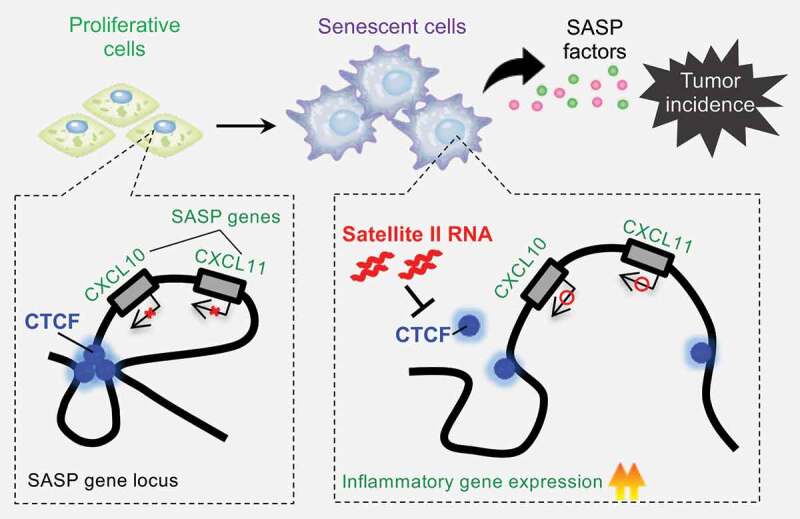
Cellular senescence provokes a dramatic alteration of chromatin organization and gene expression profile of proinflammatory factors, thereby contributing to various age-related pathologies via the senescence-associated secretory phenotype (SASP). Chromatin organization and global gene expression are maintained through the CCCTC-binding factor (CTCF). However, the molecular mechanism underlying CTCF regulation and its association with SASP gene expression remains to be fully elucidated. A recent study by our team showed that noncoding RNA (ncRNA) derived from normally silenced pericentromeric repetitive sequences directly impair the DNA binding of CTCF. This CTCF disturbance increases the accessibility of chromatin at the loci of SASP genes and caused the transcription of inflammatory factors. This mechanism may promote malignant transformation.
Overview
The claims and statistics of this paper haven’t been checked yet.
Free: it reads the open-access text and checks the first 5 claims that cite a source we can check. Create a free account to check every claim.
Integrity signals
Registry
Cites
Statistics
Figures
Verification
Claims the paper makes
The claims and statistics of this paper haven’t been checked yet.
Free: it reads the open-access text and checks the first 5 claims that cite a source we can check. Create a free account to check every claim.
Claims other papers make about this one
Each is checked against this paper’s own text: does it say what the citing paper says it does?
The source backs part of the claim, not all of it — or backs it for a different population, condition or comparison.
In the citing paper
“Increased chromatin accessibility of the pericentromeric hSATII loci in senescent fibroblasts as determined by formaldehyde-assisted isolation of regulatory element sequencing (23) and assay for transposase-accessible chromatin with sequencing (ATAC-seq) validated this distention (11, 21).”
From Chromatin conformational changes at human satellite II contribute to the senescence phenotype in the tumor microenvironment (2023) · cites this paper as [21]
Experimental — accuracy not yet measuredThe source backs part of the claim, not all of it — or backs it for a different population, condition or comparison.
In the citing paper
“Since previous studies have shown that elevated SASP in CAFs contributes to the development of cancers (11, 21, 41, 42), chromatin conformational changes at hSATII might promote the malignant transformation or cancer progression (Fig. 4E).”
From Chromatin conformational changes at human satellite II contribute to the senescence phenotype in the tumor microenvironment (2023) · cites this paper as [21]
Experimental — accuracy not yet measuredThe cited source says what the claim attributes to it.
In the citing paper
“Recent studies by our group and others have suggested that changes in the higher-order structure of chromatin contribute to the development of SASP or SASP-like inflammatory gene expression (11, 19–22).”
From Chromatin conformational changes at human satellite II contribute to the senescence phenotype in the tumor microenvironment (2023) · cites this paper as [21]
The cited source says what the claim attributes to it.
In the citing paper
“which can result in tumorigenic SASP-like inflammatory gene expression by altering chromosome interactions through the direct disruption of the binding of CCCTC-binding factor (CTCF) to DNA (11, 21).”
From Chromatin conformational changes at human satellite II contribute to the senescence phenotype in the tumor microenvironment (2023) · cites this paper as [21]
The cited source says what the claim attributes to it.
In the citing paper
“We previously found that the hSATII RNA was highly expressed in CAFs in tumor tissues (11, 21).”
From Chromatin conformational changes at human satellite II contribute to the senescence phenotype in the tumor microenvironment (2023) · cites this paper as [21]
Self-check
Percentages, sums and reported differences re-computed from the paper’s own numbers.
The self-check needs the paper’s full text.
Citations
Cites
The biology , function , and biomedical applications of exosomes
Kalluri, R., & LeBleu, V. S. (2020) · Science · doi:10.1126/science.aau6977 · Cited by 10,770
Cellular senescence: from physiology to pathology
Muñoz-Espín, D., & Serrano, M. (2014) · Nature Reviews Molecular Cell Biology · doi:10.1038/nrm3823 · Cited by 2,818 · cited 1×
“, aging, obesity, radiation, and chemotherapy [1].”
Senescence in Health and Disease
He, S., & Sharpless, N. E. (2017) · Cell · doi:10.1016/j.cell.2017.05.015 · Cited by 1,766
Senescence surveillance of pre-malignant hepatocytes limits liver cancer development
Kang, T.-W., Yevsa, T., Woller, N., Hoenicke, L., Wuestefeld, T., Dauch, D., Hohmeyer, A., Gereke, M., Rudalska, R., Potapova, A., et al. (2011) · Nature · doi:10.1038/nature10599 · Cited by 1,621 · cited 1×
“In addition, some SASP factors are also important for cancer prevention by immune cells at the early stages of cancer development [42], suggesting that it is a key to alter only harmful SASP factors involved in tumor incidence and/or progression to cure for human cancer.”
BackgroundCytoplasmic chromatin triggers inflammation in senescence and cancer
Dou, Z., Ghosh, K., Vizioli, M. G., Zhu, J., Sen, P., Wangensteen, K. J., Simithy, J., Lan, Y., Lin, Y., Zhou, Z., et al. (2017) · Nature · doi:10.1038/nature24050 · Cited by 1,335
Insulator dysfunction and oncogene activation in IDH mutant gliomas
Flavahan, W. A., Drier, Y., Liau, B. B., Gillespie, S. M., Venteicher, A. S., Stemmer-Rachamimov, A. O., Suvà, M. L., & Bernstein, B. E. (2016) · Nature · doi:10.1038/nature16490 · Cited by 1,288
L1 drives IFN in senescent cells and promotes age-associated inflammation
De Cecco, M., Ito, T., Petrashen, A. P., Elias, A. E., Skvir, N. J., Criscione, S. W., Caligiana, A., Brocculi, G., Adney, E. M., Boeke, J. D., et al. (2019) · Nature · doi:10.1038/s41586-018-0784-9 · Cited by 1,255
Innate immune sensing of cytosolic chromatin fragments through cGAS promotes senescence
Glück, S., Guey, B., Gulen, M. F., Wolter, K., Kang, T.-W., Schmacke, N. A., Bridgeman, A., Rehwinkel, J., Zender, L., & Ablasser, A. (2017) · Nature Cell Biology · doi:10.1038/ncb3586 · Cited by 1,196
Cohesin mediates transcriptional insulation by CCCTC-binding factor
Wendt, K. S., Yoshida, K., Itoh, T., Bando, M., Koch, B., Schirghuber, E., Tsutsumi, S., Nagae, G., Ishihara, K., Mishiro, T., et al. (2008) · Nature · doi:10.1038/nature06634 · Cited by 1,193 · cited 1×
“Remarkably, ChIPqPCR and electrophoretic mobility shift assay showed that hSATII ncRNA inhibited the DNAbinding capacity of CTCF to an imprinting control region, a representative CTCF binding site [29].”
BackgroundFunctional roles of enhancer RNAs for oestrogen-dependent transcriptional activation
Li, W., Notani, D., Ma, Q., Tanasa, B., Nunez, E., Chen, A. Y., Merkurjev, D., Zhang, J., Ohgi, K., Song, X., et al. (2013) · Nature · doi:10.1038/nature12210 · Cited by 1,049 · cited 1×
“reported that enhancer RNA transcripts up on 17β-estradiol (E2) could be functionally essential for the actions of E2-regulated gene enhancers, at least in part by contributing to the dynamic generation or stabilization of enhancer-promoter looping in human breast cancer cells [23,24].”
BackgroundActivation of proto-oncogenes by disruption of chromosome neighborhoods
Hnisz, D., Weintraub, A. S., Day, D. S., Valton, A.-L., Bak, R. O., Li, C. H., Goldmann, J., Lajoie, B. R., Fan, Z. P., Sigova, A. A., et al. (2016) · Science · doi:10.1126/science.aad9024 · Cited by 1,042
cGAS is essential for cellular senescence
Yang, H., Wang, H., Ren, J., Chen, Q., & Chen, Z. J. (2017) · Proceedings of the National Academy of Sciences · doi:10.1073/pnas.1705499114 · Cited by 1,009
Unmasking senescence: context-dependent effects of SASP in cancer
Faget, D. V., Ren, Q., & Stewart, S. A. (2019) · Nature Reviews Cancer · doi:10.1038/s41568-019-0156-2 · Cited by 863
How the ageing microenvironment influences tumour progression
Fane, M., & Weeraratna, A. T. (2020) · Nature Reviews Cancer · doi:10.1038/s41568-019-0222-9 · Cited by 849
Exosomes maintain cellular homeostasis by excreting harmful DNA from cells
Takahashi, A., Okada, R., Nagao, K., Kawamata, Y., Hanyu, A., Yoshimoto, S., Takasugi, M., Watanabe, S., Kanemaki, M. T., Obuse, C., et al. (2017) · Nature Communications · doi:10.1038/ncomms15287 · Cited by 761
Self-citationAberrant Overexpression of Satellite Repeats in Pancreatic and Other Epithelial Cancers
Ting, D. T., Lipson, D., Paul, S., Brannigan, B. W., Akhavanfard, S., Coffman, E. J., Contino, G., Deshpande, V., Iafrate, A. J., Letovsky, S., et al. (2011) · Science · doi:10.1126/science.1200801 · Cited by 540 · cited 1×
“Normally, the pericentromeric satellite RNA expression is extremely low in normal cells [15].”
BackgroundTakahashi, A., Ohtani, N., Yamakoshi, K., Iida, S.-I., Tahara, H., Nakayama, K., Nakayama, K. I., Ide, T., Saya, H., & Hara, E. (2006) · Nature Cell Biology · doi:10.1038/ncb1491 · Cited by 528 · cited 1×
“To unravel the biological effects of hSATII ncRNA expression, the authors overexpressed hSATII ncRNA in conditionally immortalized human fibroblasts [27].”
BackgroundSelf-citationDe Cecco, M., Criscione, S. W., Peckham, E. J., Hillenmeyer, S., Hamm, E. A., Manivannan, J., Peterson, A. L., Kreiling, J. A., Neretti, N., & Sedivy, J. M. (2013) · Aging Cell · doi:10.1111/acel.12047 · Cited by 459
From Ancient Pathways to Aging Cells—Connecting Metabolism and Cellular Senescence
Wiley, C. D., & Campisi, J. (2016) · Cell Metabolism · doi:10.1016/j.cmet.2016.05.010 · Cited by 440
Takasugi, M., Okada, R., Takahashi, A., Virya Chen, D., Watanabe, S., & Hara, E. (2017) · Nature Communications · doi:10.1038/ncomms15728 · Cited by 410
Self-citationSenescent cells harbour features of the cancer epigenome
Cruickshanks, H. A., McBryan, T., Nelson, D. M., VanderKraats, N. D., Shah, P. P., van Tuyn, J., Singh Rai, T., Brock, C., Donahue, G., Dunican, D. S., et al. (2013) · Nature Cell Biology · doi:10.1038/ncb2879 · Cited by 358
Takahashi, A., Loo, T. M., Okada, R., Kamachi, F., Watanabe, Y., Wakita, M., Watanabe, S., Kawamoto, S., Miyata, K., Barber, G. N., et al. (2018) · Nature Communications · doi:10.1038/s41467-018-03555-8 · Cited by 350
Self-citationCoppé, J.-P., Patil, C. K., Rodier, F., Sun, Y., Muñoz, D. P., Goldstein, J., Nelson, P. S., Desprez, P.-Y., & Campisi, J. (2008) · PLoS Biology · doi:10.1371/journal.pbio.0060301 · Cited by 302 · cited 1×
“The ectopic expression of hSATII ncRNA induced SASP-like inflammatory gene expression and altered the chromatin accessibility of the loci of SASP genes [28].”
BackgroundInjury-Induced Senescence Enables In Vivo Reprogramming in Skeletal Muscle
Chiche, A., Le Roux, I., von Joest, M., Sakai, H., Aguín, S. B., Cazin, C., Salam, R., Fiette, L., Alegria, O., Flamant, P., et al. (2017) · Cell Stem Cell · doi:10.1016/j.stem.2016.11.020 · Cited by 295
Ren, G., Jin, W., Cui, K., Rodrigez, J., Hu, G., Zhang, Z., Larson, D. R., & Zhao, K. (2017) · Molecular Cell · doi:10.1016/j.molcel.2017.08.026 · Cited by 256 · cited 1×
“Alternatively, some reports show that CTCF-mediated promoter–enhancer interaction is a critical regulator of gene expression [32].”
BackgroundAltered chromosomal topology drives oncogenic programs in SDH-deficient GISTs
Flavahan, W. A., Drier, Y., Johnstone, S. E., Hemming, M. L., Tarjan, D. R., Hegazi, E., Shareef, S. J., Javed, N. M., Raut, C. P., Eschle, B. K., et al. (2019) · Nature · doi:10.1038/s41586-019-1668-3 · Cited by 255
Loo, T. M., Miyata, K., Tanaka, Y., & Takahashi, A. (2020) · Cancer Science · doi:10.1111/cas.14266 · Cited by 232 · cited 1×
“However, blockage of all SASP factors in vivo could be toxicity because SASP factors play important roles in various physiological processes [7].”
BackgroundSelf-citationZirkel, A., Nikolic, M., Sofiadis, K., Mallm, J.-P., Brackley, C. A., Gothe, H., Drechsel, O., Becker, C., Altmüller, J., Josipovic, N., et al. (2018) · Molecular Cell · doi:10.1016/j.molcel.2018.03.030 · Cited by 226 · cited 2×
“showed that nuclear depletion of the high-mobility group B protein (HMGB2) provokes the alteration of CTCF distribution during cellular senescence [30].”
BackgroundPericentromeric satellite repeat expansions through RNA-derived DNA intermediates in cancer
Bersani, F., Lee, E., Kharchenko, P. V., Xu, A. W., Liu, M., Xega, K., MacKenzie, O. C., Brannigan, B. W., Wittner, B. S., Jung, H., et al. (2015) · Proceedings of the National Academy of Sciences · doi:10.1073/pnas.1518008112 · Cited by 181
Velazquez Camacho, O., Galan, C., Swist-Rosowska, K., Ching, R., Gamalinda, M., Karabiber, F., De La Rosa-Velazquez, I., Engist, B., Koschorz, B., Shukeir, N., et al. (2017) · eLife · doi:10.7554/elife.25293 · Cited by 181 · cited 2×
“Interestingly, Camacho et al. reported that murine pericentromeric satellite RNA in cis stabilizes heterochromatin retention of Suv39h [25].”
BackgroundReorganization of chromosome architecture in replicative cellular senescence
Criscione, S. W., De Cecco, M., Siranosian, B., Zhang, Y., Kreiling, J. A., Sedivy, J. M., & Neretti, N. (2016) · Science Advances · doi:10.1126/sciadv.1500882 · Cited by 164 · cited 2×
“reported that cellular senescence causes a dramatic alteration of chromatin organization [13]; however, how chromatin organization dramatically change in senescent cells is not ultimately understood.”
BackgroundEnhancer release and retargeting activates disease-susceptibility genes
Oh, S., Shao, J., Mitra, J., Xiong, F., D’Antonio, M., Wang, R., Garcia-Bassets, I., Ma, Q., Zhu, X., Lee, J.-H., et al. (2021) · Nature · doi:10.1038/s41586-021-03577-1 · Cited by 148 · cited 1×
“reported that enhancer RNA transcripts up on 17β-estradiol (E2) could be functionally essential for the actions of E2-regulated gene enhancers, at least in part by contributing to the dynamic generation or stabilization of enhancer-promoter looping in human breast cancer cells [23,24].”
BackgroundHitomi, K., Okada, R., Loo, T. M., Miyata, K., Nakamura, A., & Takahashi, A. (2020) · International Journal of Molecular Sciences · doi:10.3390/ijms21103720 · Cited by 76
Self-citationDistinguishing the immunostimulatory properties of noncoding RNAs expressed in cancer cells
Tanne, A., Muniz, L. R., Puzio-Kuter, A., Leonova, K. I., Gudkov, A. V., Ting, D. T., Monasson, R., Cocco, S., Levine, A. J., Bhardwaj, N., et al. (2015) · Proceedings of the National Academy of Sciences · doi:10.1073/pnas.1517584112 · Cited by 74
Miyata, K., Imai, Y., Hori, S., Nishio, M., Loo, T. M., Okada, R., Yang, L., Nakadai, T., Maruyama, R., Fujii, R., et al. (2021) · Proceedings of the National Academy of Sciences · doi:10.1073/pnas.2025647118 · Cited by 74 · cited 1×
“Here, it was disclosed that the functional impairment of CTCF by pericentromeric repetitive ncRNA results in an alteration of chromatin interaction, followed by the upregulation of SASP-like inflammatory genes accelerating malignant transformation [14].”
BackgroundSelf-citationMisawa, T., Tanaka, Y., Okada, R., & Takahashi, A. (2020) · Geriatrics & Gerontology International · doi:10.1111/ggi.13928 · Cited by 69
Self-citationTanaka, Y., & Takahashi, A. (2020) · The Journal of Biochemistry · doi:10.1093/jb/mvaa109 · Cited by 65
Self-citationA tumor-specific endogenous repetitive element is induced by herpesviruses
Nogalski, M. T., Solovyov, A., Kulkarni, A. S., Desai, N., Oberstein, A., Levine, A. J., Ting, D. T., Shenk, T., & Greenbaum, B. D. (2019) · Nature Communications · doi:10.1038/s41467-018-07944-x · Cited by 41
Aurora Kinase B Regulates Telomerase Activity via a Centromeric RNA in Stem Cells
Mallm, J., & Rippe, K. (2015) · Cell Reports · doi:10.1016/j.celrep.2015.05.015 · Cited by 38 · cited 1×
“reported that murine centromeric satellite RNA in trans regulates telomerase activity in embryonic stem cells [26].”
BackgroundDynamic regulation of CTCF stability and sub-nuclear localization in response to stress
Lehman, B. J., López-Díaz, F. J., Santisakultarm, T. P., Fang, L., Shokhirev, M. N., Diffenderfer, K. E., Manor, U., & Emerson, B. M. (2021) · PLoS Genetics · doi:10.1371/journal.pgen.1009277 · Cited by 33 · cited 1×
“reported that different stressors alter CTCF-RNA interaction [31].”
BackgroundNogalski, M. T., & Shenk, T. (2020) · Proceedings of the National Academy of Sciences · doi:10.1073/pnas.2017734117 · Cited by 25
Silent pericentromeric repeats speak out
Younger, S. T., & Rinn, J. L. (2015) · Proceedings of the National Academy of Sciences · doi:10.1073/pnas.1520341112 · Cited by 12
Cited by
Miyata, K., Zhou, X., Nishio, M., Hanyu, A., Chiba, M., Kawasaki, H., Osako, T., Takeuchi, K., Ohno, S., Ueno, T., et al. (2023) · Proceedings of the National Academy of Sciences · doi:10.1073/pnas.2305046120 · Cited by 14
Self-citationChromatin-Associated RNAs Regulate Gene Expression and Chromatin Structure
Xie, B., & Dean, A. (2025) · Non-Coding RNA · doi:10.3390/ncrna11050068 · Cited by 10
Oligodendroglioma: Advances in Molecular Mechanisms and Immunotherapeutic Strategies
Zhao, Y., Yu, Y., Chen, W., Zhang, X., Lv, J., & Zhao, H. (2025) · Biomedicines · doi:10.3390/biomedicines13051133 · Cited by 5
Non-coding RNAs (ncRNAs) as therapeutic targets and biomarkers in oligodendroglioma
Imran, M., Altamimi, A. S. A., Babu, M. A., Goyal, K., Kaur, I., Kumar, S., Sharma, N., Kumar, M. R., Alanazi, F. J., Alruwaili, A. N., et al. (2024) · Pathology - Research and Practice · doi:10.1016/j.prp.2024.155708 · Cited by 3
Li, M., Lin, Q., Chen, W., Chen, Y., Wang, Y., Fu, P., Zheng, Q., Wu, Z., Yang, D., Lin, T., et al. (2025) · Toxicological Sciences · doi:10.1093/toxsci/kfaf158
Metadata
- Authors
- Miyata, K., & Takahashi, A.
- Affiliations
- Japanese Foundation For Cancer Research (JP)
- Japan Agency for Medical Research and Development (JP)
- Corresponding author
- Takahashi, Akiko
- Venue
- Nucleus
- Publisher
- Informa UK Limited
- Published
- 2022-02-15
- Volume
- 13
- Issue
- 1
- Pages
- 74-78
- ISSN
- 1949-1034 (ISSN-L)
- 1949-1042
- PMC
- PMC8855862
- OpenAlex
- W4213376218
- Cited by
- 5
- References
- 42
- Citations by year
- 2025: 3 · 2024: 1 · 2023: 1
- Type
- journal article
- Language
- en
- Open access
- gold
- doi.org
- Locations
- Nucleus (publishedVersion, cc-by)
- PubMed Central (publishedVersion, cc-by)
- PubMed (publishedVersion)
- DOAJ (DOAJ: Directory of Open Access Journals) (submittedVersion, cc-by-sa)
- Funders
- Japan Agency of Medical Research and Development (19gm6110023h0001)
- Japan Science and Technology Agency-Moonshot R&D (JPMJPS2022)
- Japan Society for the Promotion of Science (20K16344)
- Topics
- Life Sciences › Biochemistry, Genetics and Molecular Biology › Molecular Biology › Genomics and Chromatin Dynamics
- Life Sciences › Biochemistry, Genetics and Molecular Biology › Cell Biology › Telomeres, Telomerase, and Senescence
- Life Sciences › Biochemistry, Genetics and Molecular Biology › Genetics › Chromosomal and Genetic Variations
- Keywords
- non-coding RNA, CTCF, cellular senescence, senescence-associated secretory phenotype, chromatin organization, chromatin accessibility, inflammatory gene expression, malignant transformation, age-related diseases
- MeSH terms
- CCCTC-Binding Factor, Senescence-Associated Secretory Phenotype, Chromatin, Gene Expression Regulation, Gene Expression, Cellular Senescence, RNA, Untranslated
About these checks
Registry, retraction, Cites and statistics results are computed, not judged, with one exception: a printed reference that no index lists is read once by a model before it counts as a citation error. Claims are extracted by a model and kept only when their quote appears verbatim in the text; each cited source is then checked, with a model’s help, for whether it says what the claim relies on. Those verdicts can be wrong — read the claim’s quote and the cited source before relying on one.
Statistics and arithmetic are recomputed, not judged.
Confidence bands are shown only for fields calibrated on our annotated test set. None is calibrated yet, so no band is shown.
What counts as a claim ›How we measure confidence ›How we check this ›
Are you an author, or do you see a problem with this page? Request a review
Data sources
Bibliographic data: Semantic Scholar, OpenAlex, Crossref.
Contains information from the Semantic Scholar Academic Graph Datasets, made available under the ODC Attribution License (ODC-BY 1.0).
Semantic Scholar’s data is described in: Kinney, R., et al. (2023). The Semantic Scholar Open Data Platform. arXiv:2301.10140.
