

Language control in bilinguals: The adaptive control hypothesis
Open accessThe DOI matches its Crossref record; 62 of the 62 references it cites were found in a registry or an index; none of the 36 sources its claims cite is checked for support yet.
Abstract
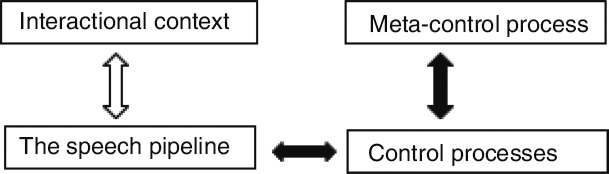
Speech comprehension and production are governed by control processes. We explore their nature and dynamics in bilingual speakers with a focus on speech production. Prior research indicates that individuals increase cognitive control in order to achieve a desired goal. In the adaptive control hypothesis we propose a stronger hypothesis: Language control processes themselves adapt to the recurrent demands placed on them by the interactional context. Adapting a control process means changing a parameter or parameters about the way it works (its neural capacity or efficiency) or the way it works in concert, or in cascade, with other control processes (e.g., its connectedness). We distinguish eight control processes (goal maintenance, conflict monitoring, interference suppression, salient cue detection, selective response inhibition, task disengagement, task engagement, opportunistic planning). We consider the demands on these processes imposed by three interactional contexts (single language, dual language, and dense code-switching). We predict adaptive changes in the neural regions and circuits associated with specific control processes. A dual-language context, for example, is predicted to lead to the adaptation of a circuit mediating a cascade of control processes that circumvents a control dilemma. Effective test of the adaptive control hypothesis requires behavioural and neuroimaging work that assesses language control in a range of tasks within the same individual.
Overview
CoChat Summary
TL;DR
The paper proposes the adaptive control hypothesis: bilingual language control processes themselves adapt to the recurrent demands of three interactional contexts—single-language, dual-language, and dense code-switching—by changing parameters such as neural capacity, efficiency, or coordination. It identifies eight control processes and predicts context-specific behavioural and neural adaptations, especially a dual-language adaptation that circumvents a control dilemma.
Key findings
- The paper distinguishes eight control processes: goal maintenance, conflict monitoring, interference suppression, salient cue detection, selective response inhibition, task disengagement, task engagement, and opportunistic planning.
- It contrasts three interactional contexts: single-language, dual-language, and dense code-switching. Table 1 indicates that single-language context increases demand on goal maintenance and interference control; dual-language context increases demand on goal maintenance, interference control, salient cue detection, selective response inhibition, task disengagement, and task engagement; dense code-switching increases demand on opportunistic planning.
- The hypothesis predicts that dual-language speakers adapt a cascade linking salient cue detection to selective response inhibition, task disengagement, and task engagement to circumvent the control dilemma in which suppression reduces flexibility to switch. Dense code-switching is predicted to adapt a left frontal–right cerebellar circuit for morphosyntactic integration, while single-language context is associated with left inferior regions for suppressing the nontarget language.
- No original quantitative results are reported; the paper is theoretical and offers illustrative behavioural and neuroimaging predictions.
Methods
- Theoretical/review paper with no participants or new empirical data; it proposes the adaptive control hypothesis and derives testable predictions.
- It synthesizes prior work on bilingual language control, cognitive control, neuroimaging, and neuropsychology, using three interactional contexts and eight control processes as an organizing framework.
- The main analysis is conceptual: a table of context-dependent demands and illustrative predictions for behavioural tasks (e.g., cued language switching, Stroop) and neural circuits; it calls for within-individual behavioural and neuroimaging tests across a range of tasks.
Limitations
- The authors state that their illustrative predictions may prove false and that there may be no systematic behavioural or neural differences as a function of interactional context.
- The authors acknowledge circular causation: interactional context may shape adaptive response, but individual differences in predispositions and genetic make-up constrain such effects; they assume individual variation in executive control and sociality is normally distributed.
- The text makes evident that the hypothesis is programmatic and untested in this paper; contexts are idealized, speakers may experience mixtures of contexts, and factors such as proficiency, sensitivity to interaction cost, neuropharmacology, and genetic variation may moderate predicted adaptations.
Model-written summary. Check it against the paper before relying on it.
Integrity signals
Registry
Cites
Statistics
Figures
Verification
Claims the paper makes
0 Valid · 0 Not valid · 30 Not checked · 57 Own results and interpretations
In the paper
“Strikingly, the use of more than one language appears to be a further important factor shaping individual performance on such tasks (e.g., Bialystok, Craik, Green, & Gollan, 2009, for a review).”
§ Language control in bilinguals: The adaptive control hypothesis > Abstract
What the sources say
- Not checked yetcites Bialystok, Craik, Green, & Gollan, 2009 matched to “Bilingual Minds” (2009) source
hedgedstates an association- Asserted: passes — The authors put it forward as true.
- Checkable: passes — It can be checked against evidence.
- Load-bearing: passes — The paper’s conclusions depend on it.
- Based: passes — The paper gives a reason why it holds.
A conclusion the paper draws from its own results — it cites no other source for it, so there is none to check. The quote shows it is in the paper.
In the paper
“In other words, any learning effects during the experiment should be observed earlier for speakers from an interactional context that is best suited to the experimental conditions.”
§ Language control in bilinguals: The adaptive control hypothesis > THE ADAPTIVE CONTROL HYPOTHESIS > Testing the adaptive control hypothesis
plainstates an association- Asserted: passes — The authors put it forward as true.
- Checkable: passes — It can be checked against evidence.
- Load-bearing: passes — The paper’s conclusions depend on it.
- Based: passes — The paper gives a reason why it holds.
In the paper
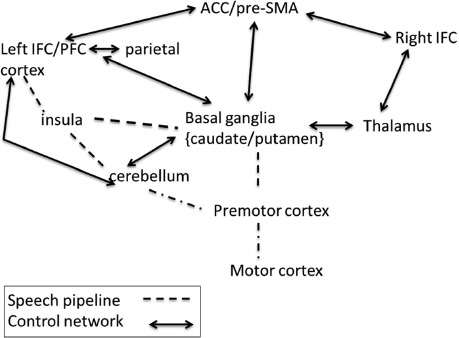
“acknowledged a role of the pre-SMA in initiating speech in language switching (see Luk et al., 2012, for further discussion).”
§ Language control in bilinguals: The adaptive control hypothesis > THE ADAPTIVE CONTROL HYPOTHESIS > Neuroimaging predictions
What the sources say
- Not checked yetcites Luk et al., 2012 matched to “Cognitive control for language switching in bilinguals: A quantitative meta-analysis of functional neuroimaging studies” (2012) source
plainstates an association- Asserted: passes — The authors put it forward as true.
- Checkable: passes — It can be checked against evidence.
- Load-bearing: unclear — It is unclear whether the paper’s conclusions depend on it.
- Based: passes — The paper gives a reason why it holds.
In the paper
“In Figure 2 we include a direct link between frontal cortex and the right cerebellum as a further circuit involved in language control (Fabbro, Moretti, & Bava, 2000).”
§ Language control in bilinguals: The adaptive control hypothesis > THE ADAPTIVE CONTROL HYPOTHESIS > Neuroimaging predictions
What the sources say
- Not checked yetcites Fabbro, Moretti, & Bava, 2000 matched to “Language impairments in patients with cerebellar lesions” (2000) source
plainstates an association- Asserted: passes — The authors put it forward as true.
- Checkable: passes — It can be checked against evidence.
- Load-bearing: passes — The paper’s conclusions depend on it.
- Based: passes — The paper gives a reason why it holds.
In the paper
“Reperfusion of the cerebellum reduces such symptoms (Marien, Engelborghs, Fabbro, & De Deyn, 2001).”
§ Language control in bilinguals: The adaptive control hypothesis > THE ADAPTIVE CONTROL HYPOTHESIS > Neuroimaging predictions
What the sources say
- Not checked yetcites Marien, Engelborghs, Fabbro, & De Deyn, 2001 matched to “The Lateralized Linguistic Cerebellum: A Review and a New Hypothesis” (2001) source
plainstates a cause- Asserted: passes — The authors put it forward as true.
- Checkable: passes — It can be checked against evidence.
- Load-bearing: unclear — It is unclear whether the paper’s conclusions depend on it.
- Based: passes — The paper gives a reason why it holds.
43 more claims
Create a free account to see all 87 claims and to verify the 30 references still open.
- Probably not a substantial claim. 23
- It may state two separate claims as one. 25
Claims other papers make about this one
Each is checked against this paper’s own text: does it say what the citing paper says it does?
In the citing paper
“Alternating between languages requires not only activation of words in the to-be-attended language but also inhibition of words in the language that should no longer be used (‘language control’; Green & Abutalebi, 2013).”
From Language proficiency drives listening-related fatigue in those who communicate in English as their second language (2026) · cites this paper as Green & Abutalebi, 2013
In the citing paper
“Previous work highlights the cognitive demands of switching between multiple languages within a conversation (Green & Abutalebi, 2013).”
From Language proficiency drives listening-related fatigue in those who communicate in English as their second language (2026) · cites this paper as Green & Abutalebi, 2013
Citations
Cites
Miyake, A., Friedman, N. P., Emerson, M. J., Witzki, A. H., Howerter, A., & Wager, T. D. (2000) · Cognitive Psychology · doi:10.1006/cogp.1999.0734 · Cited by 15,798
Clark, H. H. (1996) · doi:10.1017/cbo9780511620539 · Cited by 5,123
Conflict monitoring and anterior cingulate cortex: an update
Botvinick, M. M., Cohen, J. D., & Carter, C. S. (2004) · Trends in Cognitive Sciences · doi:10.1016/j.tics.2004.10.003 · Cited by 3,623
Anterior Cingulate Conflict Monitoring and Adjustments in Control
Kerns, J. G., Cohen, J. D., MacDonald, A. W., Cho, R. Y., Stenger, V. A., & Carter, C. S. (2004) · Science · doi:10.1126/science.1089910 · Cited by 2,891 · cited 4×
“In addition, there is a demand on frontal structures linked to conflict monitoring and interference suppression (e.g., Kerns et al., 2004) and to parietal regions (and frontal regions) associated with task changes.”
BackgroundInfluentialMental control of the bilingual lexico-semantic system
GREEN, D. W. (1998) · Bilingualism Language and Cognition · doi:10.1017/s1366728998000133 · Cited by 2,807
Self-citationUsing language: Communicative acts
Clark, H. H. (1996) · Cited by 2,721
Using language: Index of names
Clark, H. H. (1996) · Cited by 2,720
The variable nature of cognitive control: a dual mechanisms framework
Braver, T. S. (2012) · Trends in Cognitive Sciences · doi:10.1016/j.tics.2011.12.010 · Cited by 2,482 · cited 1×
“One way to recognise the interplay of these processes is to distinguish proactive control processes that establish a task goal from reactive control processes that limit interference with it (Braver, 2012).”
BackgroundInverted-U–Shaped Dopamine Actions on Human Working Memory and Cognitive Control
Cools, R., & D'Esposito, M. (2011) · Biological Psychiatry · doi:10.1016/j.biopsych.2011.03.028 · Cited by 1,673 · cited 2×
“Neuroimaging data also implicate distinct neural regions in task switching and interference control (e.g., Cools & D’Esposito, 2011).”
BackgroundBilingual language production: The neurocognition of language representation and control
Abutalebi, J., & Green, D. (2007) · Journal of Neurolinguistics · doi:10.1016/j.jneuroling.2006.10.003 · Cited by 1,302 · cited 2×
“In previous papers (e.g., Abutalebi & Green, 2007, 2008), we reviewed work showing that both cortical and subcortical structures are involved in language control and language switching (see Luk, Green, Abutalebi, & Grady, 2012, for a recent metaanalysis).”
BackgroundSelf-citation
Cited by
Items 1,901–2,000 of 2,166
Task-Specific Effects of Bilingualism on Proactive and Reactive Cognitive Control
Yahya, M., & BAL, S. Ş. (2026) · Quarterly Journal of Experimental Psychology · doi:10.1177/17470218261490486
Rachwał, K., Vecchio, C. D., & Schwieter, J. W. (2026) · Bilingualism Language and Cognition · doi:10.1017/s1366728926101886
Gaibor, M. F. M., Gómez, A. M. M., García, A. G. B., & Arellano, A. P. P. (2026) · doi:10.70577/xkq3qb94/acacfesa.editorial
Languages as Entities, Substances, and Containers: The Ontological Foundations of Language Myths
Jansen, S., del Moral, S. H., Barzen, J. S., Reimann, P., & Opolka, M. (2021) · Springer eBooks · doi:10.1007/978-3-030-87063-8_4
Schmid, M. S., Martín‐Gascón, B., Soto, C., & Solaimani, E. (2026) · Studies in Second Language Acquisition · doi:10.1017/s0272263126101806
A Review of Proactive Language Control
刘, 芳. (2020) · Modern Linguistics · doi:10.12677/ml.2020.83058
Voluntary and Mandatory Language Switching
Morina, E., & de Bruin, A. (2025) · Elsevier eBooks · doi:10.1016/b978-0-323-95504-1.00574-3
Peripheral Nerve Vasculitis, Immunology of
Sommer, C. (2025) · Elsevier eBooks · doi:10.1016/b978-0-323-95702-1.00363-8
Lei, U. M., Chan, K. L., & Lei, V. L. C. (2026) · Language and Cognition · doi:10.1017/langcog.2025.10056
New patterns of pathological language mixing in bilingual aphasia
Davis, C., Ajayi, D., Salas, C., Poindexter, K.-L., & Imaezue, G. C. (2026) · Aphasiology · doi:10.1080/02687038.2026.2642101
Bilingual language control and cognate processing: the role of proficiency, exposure, and attitudes
Rose, D., & Poarch, G. J. (2026) · Bilingualism Language and Cognition · doi:10.1017/s1366728926101205
Cury, L. D. S. (2023) · LA Referencia (Red Federada de Repositorios Institucionales de Publicaciones Científicas)
Grajales, A. I. L. (2026) · Tesis Doctorals en Xarxa (Consorci de Serveis Universitaris de Catalunya)
Vassiliu, C. (2023) · Apollo (University of Cambridge) · doi:10.17863/cam.108480
Loiseau, N. A. (2023) · Archive ouverte UNIGE (University of Geneva) · doi:10.13097/archive-ouverte/unige:168261
Prospective processing in bilinguals
López-Rojas, C. (2023) · Institutional Repository of the University of Granada (University of Granada)
Bilingual education and cognitive control: An educational neuroscience perspective
Fujitani, H. (2026) · Trends in Neuroscience and Education · doi:10.1016/j.tine.2026.100297
Reviews in Psychology of Language, volume II
Bova, A. (2026) · Frontiers research topics · doi:10.3389/978-2-8325-8374-6
Le bilinguisme dans la maladie d'Alzheimer, une réserve cognitive et inconsciente ?
Ware, C. (2023) · theses.fr (ABES) · doi:10.70675/07c86bf2z0ec1z4152zbff5zc09f13668af4
Carving New Spaces in the Study of Individual Multilingualism across the Lifespan
Ortega, L. (2021) · Routledge eBooks · doi:10.4324/9781003125815-16
Christofi, N.-M. (2025) · Lancaster EPrints (Lancaster University) · doi:10.17635/lancaster/thesis/2806
First-word acquisition in franco-lusophone bilinguals
Valente, D. (2024) · theses.fr (ABES) · doi:10.70675/12534aadz2c15z478cza783z01acba53fa96
Masullo, C. (2024) · Rovira & Virgili repository
Kulturwissenschaftliche Diversity Studies Grundzüge und Fallbeispiele
Höfer, H., & Nieberle, S. (n.d.) · doi:10.14361/9783839467350?locatt=mode:legacy
Kulturwissenschaftliche Diversity Studies: Grundzüge und Fallbeispiele
Höfer, H., & Nieberle, S. (2026) · Diversity in culture · doi:10.14361/9783839467350
Coulter, K. (2026) · Spectrum Research Repository (Concordia University)
Cognitive-communication Abilities in Bilinguals with a History of Mild Traumatic Brain Injury
(2020) · Arizona State University Library Digital Repository (Arizona State University)
Boggio-López, E. (2025) · Tesis Doctorals en Xarxa (Consorci de Serveis Universitaris de Catalunya)
Mauro, G. D. (n.d.) · Archivio Istituzionale della Ricerca - Università Vita-Salute San Raffaele
Pan, C. L. (2026) · Goldsmiths (University of London) · doi:10.25602/gold.00040428
The effects of task switching within and between languages on L2 reading comprehension
Tan, L. M. (2016) · Bilkent University Institutional Repository (Bilkent University)
The Linguistic and Cultural Aspects of Neuropsychological Assessment in People with Dementia
Çelik, S. (2023) · heiDOK (Heidelberg University) · doi:10.11588/heidok.00033722
Creating Appropriate Clinical Guidelines for The Bilingual Population with Acquired Brain Injuries
Pena, S. L. (2021) · Digital Commons - NLU (National Louis University)
Alfabetização baseada na ciência: manual do curso ABC
Nadalim, C. F. D. P., Alçada, I., Goucha, T., Martins, M., Alves, D., Pollo, T., Lopes, J. A., Costa, A., Aguiar, C., Mata, L., et al. (2021) · Portuguese National Funding Agency for Science, Research and Technology (RCAAP Project by FCT)
Demirkan, S., Wassermann, D., & Sagot, B. (2026) · bioRxiv (Cold Spring Harbor Laboratory) · doi:10.64898/2026.09.18.752561
Leung, K. I. (2026) · TSpace (University of Toronto)
Zax, A., & Gudiño, O. G. (2026) · Child Psychiatry & Human Development · doi:10.1007/s10578-026-02094-4
González Castro, S. (n.d.) · Jagiellonian University Repository (Jagiellonian University)
Neural and Behavioural Effects of Bilingualism on Selective Attention
Phelps, J. (2022) · Apollo (University of Cambridge) · doi:10.17863/cam.96584
Evaluating the role of acoustic cues in identifying the presence of a code-switch
Exton, E. L. (2024) · University Libraries (University of Maryland) · doi:10.13016/xplv-k8er
권영혜 (2016) · Seoul National University Open Repository (Seoul National University)
Spatial listening and semantic interference in a dual-language context
Allen-Rice, E. (2025) · White Rose eTheses Online (University of Leeds, The University of Sheffield, University of York)
Effects of multilingualism on brain structure, cognition and language processing
Yee, J. (2022) · Universiti Putra Malaysia Institutional Repository (Universiti Putra Malaysia)
(2023) · Oxford University Press eBooks · doi:10.1093/oso/9780192845818.002.0004
The material and the textual in documentation of Native American languages
Conathan, L. (2023) · Oxford University Press eBooks · doi:10.1093/oso/9780192845818.003.0018
(2023) · Oxford University Press eBooks · doi:10.1093/oso/9780192845818.002.0007
The fall and rise of vowel length in Bantu
Hyman, L. M. (2023) · Oxford University Press eBooks · doi:10.1093/oso/9780192845818.003.0001
Tone and morphological structure in a documentation-based grammar of Choguita Rarámuri
Caballero, G. (2023) · Oxford University Press eBooks · doi:10.1093/oso/9780192845818.003.0013
Recovering prosody from Karuk texts: Deciphering J. P. Harrington’s diacritics
Sandy, C. S. (2023) · Oxford University Press eBooks · doi:10.1093/oso/9780192845818.003.0015
Yu, A. C. L., To, C. K. S., & Yao, Y. (2023) · Oxford University Press eBooks · doi:10.1093/oso/9780192845818.003.0022
Paradigmatic heterogeneity and homogenization: Probing Paul’s principle
Cathcart, C. (2023) · Oxford University Press eBooks · doi:10.1093/oso/9780192845818.003.0023
The surface position of Hittite subordinating kuit
Melchert, H. C. (2023) · Oxford University Press eBooks · doi:10.1093/oso/9780192845818.003.0009
PIE *meh2- ‘grow, be fruitful’ and Proto-Basque *ma, *maha ‘fruit’: An apple by any other name…
Blevins, J. (2023) · Oxford University Press eBooks · doi:10.1093/oso/9780192845818.003.0010
Akan morphological ‘reversal’ in historical context
Paster, M. (2023) · Oxford University Press eBooks · doi:10.1093/oso/9780192845818.003.0004
Winter story themes in Meskwaki: Familiar creatures seen with new eyes
Thomason, L. (2023) · Oxford University Press eBooks · doi:10.1093/oso/9780192845818.003.0017
(2023) · Oxford University Press eBooks · doi:10.1093/oso/9780192845818.002.0009
(2023) · Oxford University Press eBooks · doi:10.1093/oso/9780192845818.002.0003
Sound symbolic words in Séliš-Ql’ispé
Thomason, S. G. (2023) · Oxford University Press eBooks · doi:10.1093/oso/9780192845818.003.0012
The value of family relations for revitalization
Mithun, M. (2023) · Oxford University Press eBooks · doi:10.1093/oso/9780192845818.003.0020
Stylistic differentiation in California Dene texts
Spence, J. (2023) · Oxford University Press eBooks · doi:10.1093/oso/9780192845818.003.0016
(2023) · Oxford University Press eBooks · doi:10.1093/oso/9780192845818.002.0008
Zeng, W. (2026) · Iowa Research Online (The University of Iowa) · doi:10.25820/etd.008009
Ramly, B. (2022) · Universiti Putra Malaysia Institutional Repository (Universiti Putra Malaysia)
Investigando funções executivas e experiência tradutória na literalidade em tradução
Freitag, P. H. (2019) · LA Referencia (Red Federada de Repositorios Institucionales de Publicaciones Científicas)
Bilingualism and social cognition in young adults
Wang, Y. (2024) · University of Birmingham Institutional Research Archive (University of Birmingham)
Exploring the relationship between bilingualism and cognitive flexibility
Morrison, C. (2025) · CBU Scholar
Bouayed, S. S. (2025) · theses.fr (ABES)
Structural and Functional MRI Insights into Bilingualism & Cognition in Aging
Richard, E. M. (2026) · Carleton University's Institutional Repository (MacOdrum Library, Carleton University) · doi:10.22215/etd/2026-17120
A multilingual guide to slowing aging
Rothman, J., & Gallo, F. (2025) · Nature Aging · doi:10.1038/s43587-025-01007-9
Language Choice, Mixed Inner Speech, and Code-Switching in Putonghua-Dialect Speakers
Qiao, R. (2026) · International Journal of Language and Literary Studies · doi:10.36892/ijlls.v8i5.2771
Mendoza, G. A. (2026) · eScholarship (California Digital Library)
Verhoeven, E., Oudgenoeg‐Paz, O., van Witteloostuijn, M., Blom, E., & Kuiper, R. M. (2026) · Child Development · doi:10.1093/chidev/aacag102
Behavioral and Neurophysiological Correlates of Auditory Attention in Monolinguals and Bilinguals
Bao, W. (2025) · TSpace (University of Toronto)
Andrade, G. S., Cristiano, L. B., Bosco, L. A. D., & de Toni, P. M. (2026) · International Journal of Bilingualism · doi:10.1177/13670069261436262
Kielellisen harjaantumisen vaikutus toiminnanohjauksen kuormittumiseen kielenvaihtotilanteissa
Lahdenranta, S. (2024) · UTUPub (University of Turku)
Chang, Q., Liu, X., Dang, Q., Chen, J., Lu, P., & Guo, T. (2026) · Cognitive Neurodynamics · doi:10.1007/s11571-026-10582-5
Tang, X., Hartsuiker, R., & Schiller, N. O. (2026) · CityUHK Scholars
Neuroanatomical differences in early bilingual and monolingual childrenPreprint
Coutinho, M. R., & Eden, G. F. (2026) · bioRxiv (Cold Spring Harbor Laboratory) · doi:10.64898/2026.05.08.722956
Kong-Johnson, N. (2026) · ScholarSpace (University of Hawaii at Manoa)
The Neurobiological Effects of Bilingualism: A Link to Neurodegenerative DiseasesPreprint
Hsieh, C. (2025) · doi:10.58445/rars.2291
Can structural priming answer the important questions about language?
Martin, A. E., Huettig, F., & Nieuwland, M. S. (2017) · Behavioral and Brain Sciences · doi:10.1017/s0140525x17000528
Kielenvaihtotehtävien ja toiminnanohjaustehtävien väliset siirtovaikutukset harjoitteluasetelmissa
Phan, T., & Lehtonen, K. (2025) · UTUPub (University of Turku)
L2 exposure intensity modulates the time course of verbal humor comprehension: An ERP study
Peng, F., Rong, Z., & Xie, M. (2026) · Bilingualism Language and Cognition · doi:10.1017/s1366728926101850
\nSpreading the Word. Cross-Linguistic Influence in the Bilingual Child’s Lexicon
Koutamanis, E. (2024) · Radboud Repository (Radboud University) · doi:10.48273/lot0665
Life Long Learning attraverso il bilinguismo
Kofler, D., & Videsott, G. (2016) · Libera Università di Bolzano · doi:10.19241/lll.v12i27.10
Le point sur l’avantage cognitif du bilinguisme : deux langues, deux mesures
Serres, F. A. D. (2019) · doi:10.71781/13535
Early Incidental Second Language Acquisition through Cartoons
Nisio, R. D. (2026) · Bloomsbury Publishing Plc eBooks · doi:10.5040/9781350513822
Videsott, G., & Rosa, P. A. D. (2023) · Open Journal of Modern Linguistics · doi:10.4236/ojml.2023.135043
Bimodal-Bilingual Advantage: Neural Patterns of ASL Interpreters During Narrative Encoding
Gioe, G. F. P. (2026) · CUNY Academic Works (City University of New York)
A meta-analysis of Stroop task studies on bilinguals’ emotional word processing
Elmetred, B. G., & Zhang, S. (2026) · Bilingualism Language and Cognition · doi:10.1017/s1366728926101795
A meta-analysis of gray matter volume differences between bilinguals and monolingualsPreprint
Danylkiv, A., & Krafnick, A. J. (2019) · PsyArXiv (OSF Preprints) · doi:10.31234/osf.io/bfhgz
Automatización y control cognitivo en las prácticas bilingüe y traductora
Togato, G. (2016) · Institutional Repository of the University of Granada (University of Granada)
The role of prediction during language processing
Tong, J. (2025) · RWTH Publications (RWTH Aachen) · doi:10.18154/rwth-2026-03672
Grossmann, J. A. (2024) · heiDOK (Heidelberg University) · doi:10.11588/heidok.00034270
The Impact of Multilingualism on Vocabulary Processing and Language Comprehension in Young Adults
Fatimah, A. F. (2025) · Journal of Psycho Linguistics
Exploring the connections between Pidgin and ʻōlelo Hawaiʻi
Kamigaki-Baron, M. (2026) · cIRcle (University of British Columbia)
Rohár, A., & Marton, K. (2021) · Magyar Pszichológiai Szemle · doi:10.1556/0016.2020.00036
Metadata
- Authors
- Green, D. W., & Abutalebi, J.
- Affiliations
- University College London (GB)
- Vita-Salute San Raffaele University (IT)
- Corresponding author
- Green, David W.
- Venue
- Journal of Cognitive Psychology
- Publisher
- Informa UK Limited
- Published
- 2013-05-24
- Volume
- 25
- Issue
- 5
- Pages
- 515-530
- ISSN
- 2044-5911 (ISSN-L)
- 2044-592X
- PMC
- PMC4095950
- OpenAlex
- W2128442137
- Cited by
- 2,163
- References
- 62
- Citations by year
- 2026: 264 · 2025: 271 · 2024: 222 · 2023: 211 · 2022: 197 · 2021: 160 · 2020: 154 · 2019: 254 · 2018: 164 · 2017: 90 · 2016: 82 · 2015: 61 · 2014: 27 · 2013: 3
- FWCI
- 21.17
- Type
- journal article
- Language
- en
- Open access
- hybrid
- doi.org
- Licence
- cc-by
- Locations
- Journal of Cognitive Psychology (publishedVersion, cc-by)
- PubMed Central (publishedVersion, cc-by)
- Europe PMC (PubMed Central) (publishedVersion, cc-by)
- PubMed (publishedVersion)
- UCL Discovery (University College London) (submittedVersion)
- Archivio Istituzionale della Ricerca - Università Vita-Salute San Raffaele (submittedVersion)
- Topics
- Life Sciences › Neuroscience › Cognitive Neuroscience › Neurobiology of Language and Bilingualism
- Social Sciences › Psychology › Developmental and Educational Psychology › Language Development and Disorders
- Life Sciences › Neuroscience › Cognitive Neuroscience › Neural and Behavioral Psychology Studies
- Keywords
- language control, bilingualism, cognitive control, speech production, code-switching, control processes, interference suppression, conflict monitoring, task disengagement, task engagement, goal maintenance, opportunistic planning, neural circuits
About these checks
Registry, retraction, Cites and statistics results are computed, not judged, with one exception: a printed reference that no index lists is read once by a model before it counts as a citation error. Claims are extracted by a model and kept only when their quote appears verbatim in the text; each cited source is then checked, with a model’s help, for whether it says what the claim relies on. Those verdicts can be wrong — read the claim’s quote and the cited source before relying on one.
A language model drew the claims from the paper on 2026-11-24, under version 3 of the claim definition (model deepseek-v4.1-flash, prompt extract-v3).
A second model labelled each claim on 2026-11-24 (model jev-1.13-20260917, definition revision gold-guideline-v0.2).
Statistics and arithmetic are recomputed, not judged.
Confidence bands are shown only for fields calibrated on our annotated test set. None is calibrated yet, so no band is shown.
What counts as a claim ›How we measure confidence ›How we check this ›
Are you an author, or do you see a problem with this page? Request a review
Data sources
Bibliographic data: Semantic Scholar, OpenAlex, Crossref.
Contains information from the Semantic Scholar Academic Graph Datasets, made available under the ODC Attribution License (ODC-BY 1.0).
Semantic Scholar’s data is described in: Kinney, R., et al. (2023). The Semantic Scholar Open Data Platform. arXiv:2301.10140.
