

Language control in bilinguals: The adaptive control hypothesis
Open accessThe DOI matches its Crossref record; 62 of the 62 references it cites were found in a registry or an index; none of the 36 sources its claims cite is checked for support yet.
Abstract
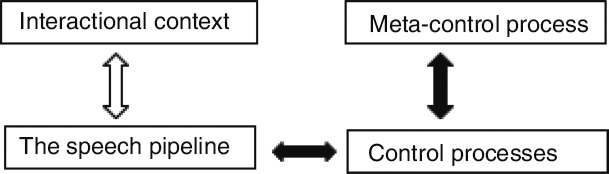
Speech comprehension and production are governed by control processes. We explore their nature and dynamics in bilingual speakers with a focus on speech production. Prior research indicates that individuals increase cognitive control in order to achieve a desired goal. In the adaptive control hypothesis we propose a stronger hypothesis: Language control processes themselves adapt to the recurrent demands placed on them by the interactional context. Adapting a control process means changing a parameter or parameters about the way it works (its neural capacity or efficiency) or the way it works in concert, or in cascade, with other control processes (e.g., its connectedness). We distinguish eight control processes (goal maintenance, conflict monitoring, interference suppression, salient cue detection, selective response inhibition, task disengagement, task engagement, opportunistic planning). We consider the demands on these processes imposed by three interactional contexts (single language, dual language, and dense code-switching). We predict adaptive changes in the neural regions and circuits associated with specific control processes. A dual-language context, for example, is predicted to lead to the adaptation of a circuit mediating a cascade of control processes that circumvents a control dilemma. Effective test of the adaptive control hypothesis requires behavioural and neuroimaging work that assesses language control in a range of tasks within the same individual.
Overview
CoChat Summary
TL;DR
The paper proposes the adaptive control hypothesis: bilingual language control processes themselves adapt to the recurrent demands of three interactional contexts—single-language, dual-language, and dense code-switching—by changing parameters such as neural capacity, efficiency, or coordination. It identifies eight control processes and predicts context-specific behavioural and neural adaptations, especially a dual-language adaptation that circumvents a control dilemma.
Key findings
- The paper distinguishes eight control processes: goal maintenance, conflict monitoring, interference suppression, salient cue detection, selective response inhibition, task disengagement, task engagement, and opportunistic planning.
- It contrasts three interactional contexts: single-language, dual-language, and dense code-switching. Table 1 indicates that single-language context increases demand on goal maintenance and interference control; dual-language context increases demand on goal maintenance, interference control, salient cue detection, selective response inhibition, task disengagement, and task engagement; dense code-switching increases demand on opportunistic planning.
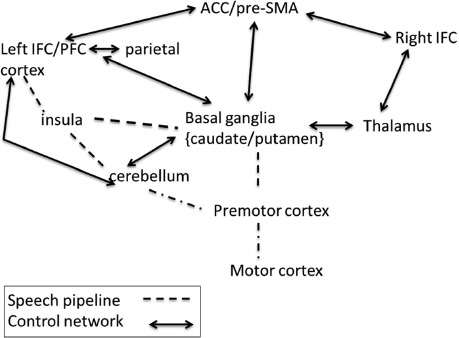
- The hypothesis predicts that dual-language speakers adapt a cascade linking salient cue detection to selective response inhibition, task disengagement, and task engagement to circumvent the control dilemma in which suppression reduces flexibility to switch. Dense code-switching is predicted to adapt a left frontal–right cerebellar circuit for morphosyntactic integration, while single-language context is associated with left inferior regions for suppressing the nontarget language.
- No original quantitative results are reported; the paper is theoretical and offers illustrative behavioural and neuroimaging predictions.
Methods
- Theoretical/review paper with no participants or new empirical data; it proposes the adaptive control hypothesis and derives testable predictions.
- It synthesizes prior work on bilingual language control, cognitive control, neuroimaging, and neuropsychology, using three interactional contexts and eight control processes as an organizing framework.
- The main analysis is conceptual: a table of context-dependent demands and illustrative predictions for behavioural tasks (e.g., cued language switching, Stroop) and neural circuits; it calls for within-individual behavioural and neuroimaging tests across a range of tasks.
Limitations
- The authors state that their illustrative predictions may prove false and that there may be no systematic behavioural or neural differences as a function of interactional context.
- The authors acknowledge circular causation: interactional context may shape adaptive response, but individual differences in predispositions and genetic make-up constrain such effects; they assume individual variation in executive control and sociality is normally distributed.
- The text makes evident that the hypothesis is programmatic and untested in this paper; contexts are idealized, speakers may experience mixtures of contexts, and factors such as proficiency, sensitivity to interaction cost, neuropharmacology, and genetic variation may moderate predicted adaptations.
Model-written summary. Check it against the paper before relying on it.
Integrity signals
Registry
Cites
Statistics
Figures
Verification
Claims the paper makes
0 Valid · 0 Not valid · 30 Not checked · 57 Own results and interpretations
In the paper
“Strikingly, the use of more than one language appears to be a further important factor shaping individual performance on such tasks (e.g., Bialystok, Craik, Green, & Gollan, 2009, for a review).”
§ Language control in bilinguals: The adaptive control hypothesis > Abstract
What the sources say
- Not checked yetcites Bialystok, Craik, Green, & Gollan, 2009 matched to “Bilingual Minds” (2009) source
hedgedstates an association- Asserted: passes — The authors put it forward as true.
- Checkable: passes — It can be checked against evidence.
- Load-bearing: passes — The paper’s conclusions depend on it.
- Based: passes — The paper gives a reason why it holds.
A conclusion the paper draws from its own results — it cites no other source for it, so there is none to check. The quote shows it is in the paper.
In the paper
“In other words, any learning effects during the experiment should be observed earlier for speakers from an interactional context that is best suited to the experimental conditions.”
§ Language control in bilinguals: The adaptive control hypothesis > THE ADAPTIVE CONTROL HYPOTHESIS > Testing the adaptive control hypothesis
plainstates an association- Asserted: passes — The authors put it forward as true.
- Checkable: passes — It can be checked against evidence.
- Load-bearing: passes — The paper’s conclusions depend on it.
- Based: passes — The paper gives a reason why it holds.
In the paper
“acknowledged a role of the pre-SMA in initiating speech in language switching (see Luk et al., 2012, for further discussion).”
§ Language control in bilinguals: The adaptive control hypothesis > THE ADAPTIVE CONTROL HYPOTHESIS > Neuroimaging predictions
What the sources say
- Not checked yetcites Luk et al., 2012 matched to “Cognitive control for language switching in bilinguals: A quantitative meta-analysis of functional neuroimaging studies” (2012) source
plainstates an association- Asserted: passes — The authors put it forward as true.
- Checkable: passes — It can be checked against evidence.
- Load-bearing: unclear — It is unclear whether the paper’s conclusions depend on it.
- Based: passes — The paper gives a reason why it holds.
In the paper
“In Figure 2 we include a direct link between frontal cortex and the right cerebellum as a further circuit involved in language control (Fabbro, Moretti, & Bava, 2000).”
§ Language control in bilinguals: The adaptive control hypothesis > THE ADAPTIVE CONTROL HYPOTHESIS > Neuroimaging predictions
What the sources say
- Not checked yetcites Fabbro, Moretti, & Bava, 2000 matched to “Language impairments in patients with cerebellar lesions” (2000) source
plainstates an association- Asserted: passes — The authors put it forward as true.
- Checkable: passes — It can be checked against evidence.
- Load-bearing: passes — The paper’s conclusions depend on it.
- Based: passes — The paper gives a reason why it holds.
In the paper
“Reperfusion of the cerebellum reduces such symptoms (Marien, Engelborghs, Fabbro, & De Deyn, 2001).”
§ Language control in bilinguals: The adaptive control hypothesis > THE ADAPTIVE CONTROL HYPOTHESIS > Neuroimaging predictions
What the sources say
- Not checked yetcites Marien, Engelborghs, Fabbro, & De Deyn, 2001 matched to “The Lateralized Linguistic Cerebellum: A Review and a New Hypothesis” (2001) source
plainstates a cause- Asserted: passes — The authors put it forward as true.
- Checkable: passes — It can be checked against evidence.
- Load-bearing: unclear — It is unclear whether the paper’s conclusions depend on it.
- Based: passes — The paper gives a reason why it holds.
43 more claims
Create a free account to see all 87 claims and to verify the 30 references still open.
- Probably not a substantial claim. 23
- It may state two separate claims as one. 25
Claims other papers make about this one
Each is checked against this paper’s own text: does it say what the citing paper says it does?
In the citing paper
“Alternating between languages requires not only activation of words in the to-be-attended language but also inhibition of words in the language that should no longer be used (‘language control’; Green & Abutalebi, 2013).”
From Language proficiency drives listening-related fatigue in those who communicate in English as their second language (2026) · cites this paper as Green & Abutalebi, 2013
In the citing paper
“Previous work highlights the cognitive demands of switching between multiple languages within a conversation (Green & Abutalebi, 2013).”
From Language proficiency drives listening-related fatigue in those who communicate in English as their second language (2026) · cites this paper as Green & Abutalebi, 2013
Citations
Cites
Miyake, A., Friedman, N. P., Emerson, M. J., Witzki, A. H., Howerter, A., & Wager, T. D. (2000) · Cognitive Psychology · doi:10.1006/cogp.1999.0734 · Cited by 15,798
Clark, H. H. (1996) · doi:10.1017/cbo9780511620539 · Cited by 5,123
Conflict monitoring and anterior cingulate cortex: an update
Botvinick, M. M., Cohen, J. D., & Carter, C. S. (2004) · Trends in Cognitive Sciences · doi:10.1016/j.tics.2004.10.003 · Cited by 3,623
Anterior Cingulate Conflict Monitoring and Adjustments in Control
Kerns, J. G., Cohen, J. D., MacDonald, A. W., Cho, R. Y., Stenger, V. A., & Carter, C. S. (2004) · Science · doi:10.1126/science.1089910 · Cited by 2,891 · cited 4×
“In addition, there is a demand on frontal structures linked to conflict monitoring and interference suppression (e.g., Kerns et al., 2004) and to parietal regions (and frontal regions) associated with task changes.”
BackgroundInfluentialMental control of the bilingual lexico-semantic system
GREEN, D. W. (1998) · Bilingualism Language and Cognition · doi:10.1017/s1366728998000133 · Cited by 2,807
Self-citationUsing language: Communicative acts
Clark, H. H. (1996) · Cited by 2,721
Using language: Index of names
Clark, H. H. (1996) · Cited by 2,720
The variable nature of cognitive control: a dual mechanisms framework
Braver, T. S. (2012) · Trends in Cognitive Sciences · doi:10.1016/j.tics.2011.12.010 · Cited by 2,482 · cited 1×
“One way to recognise the interplay of these processes is to distinguish proactive control processes that establish a task goal from reactive control processes that limit interference with it (Braver, 2012).”
BackgroundInverted-U–Shaped Dopamine Actions on Human Working Memory and Cognitive Control
Cools, R., & D'Esposito, M. (2011) · Biological Psychiatry · doi:10.1016/j.biopsych.2011.03.028 · Cited by 1,673 · cited 2×
“Neuroimaging data also implicate distinct neural regions in task switching and interference control (e.g., Cools & D’Esposito, 2011).”
BackgroundBilingual language production: The neurocognition of language representation and control
Abutalebi, J., & Green, D. (2007) · Journal of Neurolinguistics · doi:10.1016/j.jneuroling.2006.10.003 · Cited by 1,302 · cited 2×
“In previous papers (e.g., Abutalebi & Green, 2007, 2008), we reviewed work showing that both cortical and subcortical structures are involved in language control and language switching (see Luk, Green, Abutalebi, & Grady, 2012, for a recent metaanalysis).”
BackgroundSelf-citation
Cited by
Items 2,001–2,100 of 2,166
The multilingual brain: A critical review of cognitive advantages
Cockcroft, K. (2026) · South African Journal of Science · doi:10.17159/sajs.2026/23972
Language Use in Self-addressed Writing of Korean/English Bilinguals
KIM, J. (2025) · HARVEST (University of Saskatchewan)
Huang, X., & Zhang, P. (2025) · Language and Semiotic Studies · doi:10.1515/lass-2025-0069
Graham, B. (2024) · Open Research Exeter (University of Exeter)
Arbetsminnesprestationer hos tvåspråkiga och enspråkiga vuxna
Ritamäki, S. (2020) · Doria (University of Helsinki)
Speaking with an accent of the non-target language enhances language control in bilinguals
Ji, Y., Wang, Q., Zhao, H., Yan, G., & Wu, J. (2026) · Current Psychology · doi:10.1007/s12144-025-08806-8
García, C. M. (2026) · Porta Linguarum Revista Interuniversitaria de Didáctica de las Lenguas Extranjeras · doi:10.30827/portalin.vi45.32997
Segler-Heikkilä, L. (2026) · Theseus (Ammattikorkeakoulujen)
Coemans, S., Struys, E., Vandenborre, D., Wilssens, I., Engelborghs, S., Paquier, P., Tsapkini, K., & Keulen, S. (2021) · doi:10.3389/fnagi.2021.710818.s001
Canuto, C., Ciavattini, I., & Putta, P. A. D. (2025) · Institutional Research Information System University of Turin (University of Turin)
Cábez, M. B., & Galdi, P. (2020) · F1000Research · doi:10.5256/f1000research.25631.r63537
Višejezičnost i ovladavanje jezikom
Krevelj, S. L. (2025) · University of Zagreb Faculty of Humanities and Social Sciences eBooks · doi:10.17234/9789533792095
Bangalore, S. (2025) · CentAUR (University of Reading) · doi:10.48683/1926.00121716
Kétnyelvűség – Előny vagy sem? A Kétnyelvűség hatásai magyar-szerb bilingvisek körében
Jávor, R. (2020) · Pécsi Egyetemi Archívum (University of Pécs)
Global Language Control in Bilingual Language Processing
Seo, R. (2019) · ResearchWorks at the University of Washington (University of Washington)
Evaluating Theories of Bilingual Language Control Using Computational Models.
Lowry, M. D. (2019) · Digital Commons - University of South Florida (University of South Florida)
Slethei, I. (2020) · NVA (Nasjonalt vitenarkiv)
Laketa, A. (2021) · White Rose eTheses Online (University of Leeds, The University of Sheffield, University of York)
The role of executive control in bilingual language production and reading
Pivneva, I. (2015) · eScholarship@McGill (McGill) · doi:10.82308/47944
Wang, Y., Liu, K., Fang, Y., & Liu, X. (2026) · SSRN Electronic Journal · doi:10.2139/ssrn.6480944
Code-switching burstiness in bilingual speech
McGovern, K. A., Dussias, P. E., & Cacoullos, R. T. (2026) · Linguistic Approaches to Bilingualism · doi:10.1075/lab.25114.mcg
Peitz, K., Stumme, J., Jockwitz, C., Bittner, N., Caspers, S., & Heim, S. (2023) · doi:10.3389/fnagi.2023.1193283.s001
Hansen, L. (2019) · Institutional Repository of the University of Granada (University of Granada)
Nonreciprocal Language and Its Influence in Mother-child Relationships
Kuemerle-Pinillos, K. (2018) · ScholarWorks (Walden University)
Perceptual cues for Mandarin-Taiwanese code-switching
Hsiao, C.-H. (2021) · Indiana Magazine of History (Indiana University)
Explicit gender stereotyping in bilingualism
Mazzaggio, G. (2021) · RUNG
Effects of English exposure on Korean vowel production in Korean–English code-switched speech*
Yoon, D., & Oh, E. (2026) · Phonetics and Speech Sciences · doi:10.13064/ksss.2026.18.1.035
Moore, A. L. (2018) · Arrow@dit (Dublin Institute of Technology)
Walton, K. H. (2025) · TSpace (University of Toronto)
Семенова, М. Ю. (2026) · Филологический вестник · doi:10.66621/2949-4656-2026-5-4-269-277
Navarro, E. (2025) · PsyArXiv (OSF Preprints) · doi:10.31234/osf.io/ehdgm_v1
Bilingual language control : Evidence from Parkinson's disease
Cattaneo, G. (2017) · Repositori digital de la UPF (Universitat Pompeu Fabra)
Habig, A.-K. (2025) · Gutenberg Open Science · doi:10.25358/openscience-14204
Cognitive Differences Between Multilinguals and Monolinguals in Terms of Motor Skills
Zakaria, S. M. (2026) · BAU Health and Innovation · doi:10.14744/bauh.2025.22932
The effects of bilingualism on the treatment for dementia. A systematic review.
Pérez San Juan, O., & García, A. L. (2018) · RIULL (Universidad de La Laguna)
Grant, A. M., Kousaie, S., Coulter, K., Gilbert, A. C., Baum, S. R., Gracco, V., Titone, D., Klein, D., & Phillips, N. A. (2022) · doi:10.3389/fpsyg.2022.865857.s001
Lexical selection in Mandarin-English bilingual speakers
Lee, Y.-W., Casaponsa, A., & Rebuschat, P. (2025) · Lancaster EPrints (Lancaster University) · doi:10.17635/lancaster/thesis/2683
Andras, F., Ramos, M. Á., & Macizo, P. (2023) · doi:10.3389/fpsyg.2023.1173486.s001
Lexical and Syntactic Activation in Translation
Huertas, R., & Omar, J. (2020) · LA Referencia (Red Federada de Repositorios Institucionales de Publicaciones Científicas)
Zeng, W., Shea, C., Beckman, J., & Kutlu, E. (2024) · doi:10.3389/flang.2023.1302027.s001
Gädda, L., Derefalk, M., Husberg, H., Slama, S., Närhi, V., & Laine, M. (2019) · Jyväskylä University Digital Archive (University of Jyväskylä)
The road ahead: Ellen Bialystok’s lasting legacy
Anderson, J. A. E., & Grundy, J. G. (2023) · Studies in bilingualism · doi:10.1075/sibil.64.18and
León, N. E. R. D. (2024) · eScholarship (California Digital Library)
TEORETIČNI IN EKSPERIMENTALNI VIDIKI ŠTEVILČNOSTI IN KVANTIFIKACIJE V LIBANONSKI ARABŠČINI
Moussaoui, A. A. (2021) · RUNG
Investigating the impact of Bilingualism on Cognitive Abilities on Algerian students
Bensalah, M. A., & Medjahed, C. E. M. (2023) · Dépôt Institutionnel de lUniversité de Tlemcen
Vasilita, M. (2026) · CUNY Academic Works (City University of New York)
Каіісі, С. Р. (2026) · eKNUTSHIR
Çelik, İ. (2023) · OpenMETU (Middle East Technical University)
Irizarry, A. R. (2026) · eScholarship (California Digital Library)
Hu, H., & Wang, Z. (2026) · Journal of Linguistics & Cultural Studies · doi:10.70088/qmy8kn59
Supporting information 1 of Bilingual Language Control Flexibly Adapts to Cultural Context
Liu, C., Li, L., Jiao, L., & Wang, R. (2021) · doi:10.3389/fpsyg.2021.744289.s001
Investigation of Bilingual Language Processing Via Pupillometry
Pho, K. K. (2026) · YorkSpace (York University)
Masullo, C., Casado, A., & Leivada, E. (2024) · doi:10.1371/journal.pone.0298648.r004
The Corpus of English–Tagalog Code-switching: an integrative corpus of linguistic contact effects
Maria, A. S., & Enghels, R. (2026) · Scientific Data · doi:10.1038/s41597-026-08264-2
Wright, S. M., Antoniou, M., & Tyler, M. (2026) · Interspeech (USB) · doi:10.21437/interspeech.2026-3404
De effecten van tweetaligheid op cognitie
Woumans, E., & Duyck, W. (2015) · Ghent University Academic Bibliography (Ghent University)
Brogan, V. (2022) · CBU Scholar
Dutta, M., Anjum, J., & Khoroshenkikh, L. (2026) · Aphasiology · doi:10.1080/02687038.2026.2762074
de Bruin, A., Wang, J., Daryanani, R., & Coumel, M. (2025) · Memory & Cognition · doi:10.3758/s13421-025-01787-w
THE ROLE OF TASK DEMANDS, PROFICIENCY, AND ORTHOGRAPHY IN BILINGUAL LANGUAGE SWITCHING
Kim, S. (2025) · University Libraries (University of Maryland) · doi:10.13016/ksfv-tzzu
Cognitive Processes in Interpreting
Woumans, E. (2026) · Elsevier eBooks · doi:10.1016/b978-0-323-95504-1.01438-1
Lexical access in bilingual and multilingual speakers
Besch, L. (2025) · publish.UP (University of Potsdam) · doi:10.25932/publishup-68270
Cai, L., Xu, X., Fan, X., Ma, J., Fan, M., Wang, Q., Wu, Y., Pan, N., Yin, Z., & Li, X. (2021) · doi:10.3389/fnhum.2021.748919.s001
Wei, H. (2026) · Lecture Notes in Education Psychology and Public Media · doi:10.54254/2753-7048/2027.39091
Neural Mechanisms of Language Control in Bilinguals
Hsieh, M.-C. (2022) · Institutional Repositories DataBase (IRDB)
Mukhlis, M., Sobirov, B. B., & Kasanova, R. (. (2025) · Journal of Language, Literature, and Linguistic Research · doi:10.58218/jolr.v1i2.2097
Tran, T. T. P., & Nguyen, T. N. P. (2026) · Journal of Knowledge Learning and Science Technology · doi:10.60087/jklst.vol5.n2.001
Grossmann, J. A., Aschenbrenner, S., Teichmann, B., & Meyer, P. (2023) · doi:10.3389/fnagi.2023.1123185.s001
Psycholinguistic Analysis of Language Processing in Multilingual Societies
Rahman, H., & Yasin, G. (2026) · Physical Education Health and Social Sciences · doi:10.63163/jpehss.v4i1.1171
Torres, C., Xu, W., Li, Y., & Futrell, R. (2025) · Workshop on Cognitive Modeling and Computational Linguistics (CMCL) · doi:10.18653/v1/2025.cmcl-1.25
Cognitive Science Society 2025, Chen, X., Ge, H., Wu, R., & Zhang, C. (2025) · eScholarship (California Digital Library) · doi:10.48448/k9ad-vr88
A relevance-theoretic approach to interpreting ELF input
Andermatt, K. (2021) · Zürcher Hochschule für Angewandte Wissenschaften digital collection (Zurich University of Applied Sciences)
wang, Y., Yang, Q., & Wang, R. (2025) · OSF Preprints (OSF Preprints) · doi:10.31219/osf.io/3es9j_v1
Emotional influences on cognitive control: a missing factor in research on 'bilingual advantages'?
Niedbala, A. K. (2018) · Oxford University Research Archive (ORA) (University of Oxford) · doi:10.5287/ora-gwjqpwva7
L'interférence inter-linguistique chez les bilingues : étude de l'effet de la langue omise
Hendel, E. (2025) · ScriptoriUM
Nakamura, C., & Flynn, S. (2025) · Wiley eBooks · doi:10.1002/9781394312375.ch10
Repiso-Puigdelliura, G. (2023) · SSRN Electronic Journal · doi:10.2139/ssrn.4567002
Auditory processing and cognitive control in code-switching among bilingual individuals with aphasia
Julaha, A., & Ansari, S. (2025) · International Journal of Speech and Audiology · doi:10.22271/27103846.2025.v6.i2b.92
Language Control in Bilingual Processing
Sánchez, L. M., & Declerck, M. (2025) · Wiley eBooks · doi:10.1002/9781405198431.wbeal20376
Pathological language-switching/mixing and its relationship to domain-general cognitive control
Fyndanis, V., & Lehtonen, M. (2021) · Ktisis at Cyprus University of Technology (Cyprus University of Technology)
Awawdeh, A. (2025) · REAL-PhD (Hungarian Academy of Sciences) · doi:10.18136/pe.2025.929
Fuentes, N. A. V. (2026) · eScholarship (California Digital Library)
van den Berg, F., Brouwer, J., Tienkamp, T. B., Verhagen, J., & Keijzer, M. (2022) · doi:10.3389/fpsyg.2022.864763.s001
Marin-Marin, L., Costumero, V., Ávila, C., & Pliatsikas, C. (2022) · doi:10.3389/fpsyg.2022.886222.s001
Lexical access in bilingual spoken word production: effects of lexical interference
Assaneea, A. A. (2021) · University of Birmingham Institutional Research Archive (University of Birmingham)
Favilla, M., & Ferroni, L. (2018) · IRIS UNIMORE (University of Modena and Reggio Emilia)
SOCIO-CULTURAL FACTORS OF CODE-SWITCHING IN MODERN ENGLISH COMMUNICATION
Savchuk, I. I. (2026) · Вісник Житомирського державного університету імені Івана Франка Філологічні науки · doi:10.35433/philology.1(106).2026.206-215
How Do We Understand a Second Language? : Examining Sentence Processing Through Prosody
Nakamura, C. (2025) · IEICE ESS FUNDAMENTALS REVIEW · doi:10.1587/essfr.18.4_279
Ickx, J.-A. (2025) · Dépôt institutionnel de l'Université libre de Bruxelles (Université Libre de Bruxelles)
Ershaid, H., McLaughlin, D. J., & Lallier, M. (2025) · OSF Preprints (OSF Preprints) · doi:10.31219/osf.io/9jhd4
Effects of Bilingualism on Sustained Attention and Inhibition: A Bayesian Enquiry
Rana, M., & Verma, A. (2024) · eScholarship (California Digital Library)
Fridman, C., Meir, N., & Marian, V. (2026) · Applied Psycholinguistics · doi:10.1017/s0142716426100733
Sheehan, A. (2025) · CentAUR (University of Reading) · doi:10.48683/1926.00121914
PERSPECTIVES, J. J. O. P. R. (2026) · DergiPark · doi:10.5281/zenodo.21030714
Code-Switching, Cognitive Load, and Neural Fatigue in Multicultural Workspaces
Prasad, A., & Veena, N. (2026) · IGI Global eBooks · doi:10.4018/979-8-3373-9564-7.ch002
Kim, Y., Ye, Z., Leventhal, Z., Wang, W.-J., & Thiessen, E. D. (2023) · doi:10.3389/fpsyg.2022.923123.s003
Individual Differences in Bilingual Language Experience
Kałamała, P., Castro, S., & Wodniecka, Z. (2025) · Wiley eBooks · doi:10.1002/9781405198431.wbeal20287
Metadata
- Authors
- Green, D. W., & Abutalebi, J.
- Affiliations
- University College London (GB)
- Vita-Salute San Raffaele University (IT)
- Corresponding author
- Green, David W.
- Venue
- Journal of Cognitive Psychology
- Publisher
- Informa UK Limited
- Published
- 2013-05-24
- Volume
- 25
- Issue
- 5
- Pages
- 515-530
- ISSN
- 2044-5911 (ISSN-L)
- 2044-592X
- PMC
- PMC4095950
- OpenAlex
- W2128442137
- Cited by
- 2,163
- References
- 62
- Citations by year
- 2026: 264 · 2025: 271 · 2024: 222 · 2023: 211 · 2022: 197 · 2021: 160 · 2020: 154 · 2019: 254 · 2018: 164 · 2017: 90 · 2016: 82 · 2015: 61 · 2014: 27 · 2013: 3
- FWCI
- 21.17
- Type
- journal article
- Language
- en
- Open access
- hybrid
- doi.org
- Licence
- cc-by
- Locations
- Journal of Cognitive Psychology (publishedVersion, cc-by)
- PubMed Central (publishedVersion, cc-by)
- Europe PMC (PubMed Central) (publishedVersion, cc-by)
- PubMed (publishedVersion)
- UCL Discovery (University College London) (submittedVersion)
- Archivio Istituzionale della Ricerca - Università Vita-Salute San Raffaele (submittedVersion)
- Topics
- Life Sciences › Neuroscience › Cognitive Neuroscience › Neurobiology of Language and Bilingualism
- Social Sciences › Psychology › Developmental and Educational Psychology › Language Development and Disorders
- Life Sciences › Neuroscience › Cognitive Neuroscience › Neural and Behavioral Psychology Studies
- Keywords
- language control, bilingualism, cognitive control, speech production, code-switching, control processes, interference suppression, conflict monitoring, task disengagement, task engagement, goal maintenance, opportunistic planning, neural circuits
About these checks
Registry, retraction, Cites and statistics results are computed, not judged, with one exception: a printed reference that no index lists is read once by a model before it counts as a citation error. Claims are extracted by a model and kept only when their quote appears verbatim in the text; each cited source is then checked, with a model’s help, for whether it says what the claim relies on. Those verdicts can be wrong — read the claim’s quote and the cited source before relying on one.
A language model drew the claims from the paper on 2026-11-24, under version 3 of the claim definition (model deepseek-v4.1-flash, prompt extract-v3).
A second model labelled each claim on 2026-11-24 (model jev-1.13-20260917, definition revision gold-guideline-v0.2).
Statistics and arithmetic are recomputed, not judged.
Confidence bands are shown only for fields calibrated on our annotated test set. None is calibrated yet, so no band is shown.
What counts as a claim ›How we measure confidence ›How we check this ›
Are you an author, or do you see a problem with this page? Request a review
Data sources
Bibliographic data: Semantic Scholar, OpenAlex, Crossref.
Contains information from the Semantic Scholar Academic Graph Datasets, made available under the ODC Attribution License (ODC-BY 1.0).
Semantic Scholar’s data is described in: Kinney, R., et al. (2023). The Semantic Scholar Open Data Platform. arXiv:2301.10140.
