

Tumor-associated macrophages and response to 5-fluorouracil adjuvant therapy in stage III colorectal cancer
Open accessThe DOI matches its Crossref record; 51 of the 51 references it cites were found in a registry or an index.
Abstract
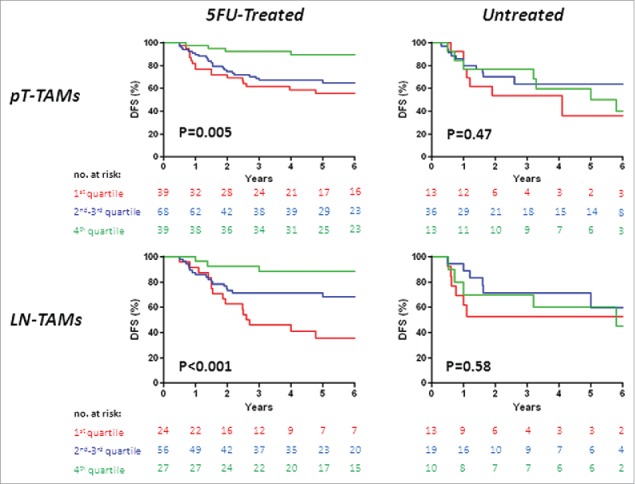
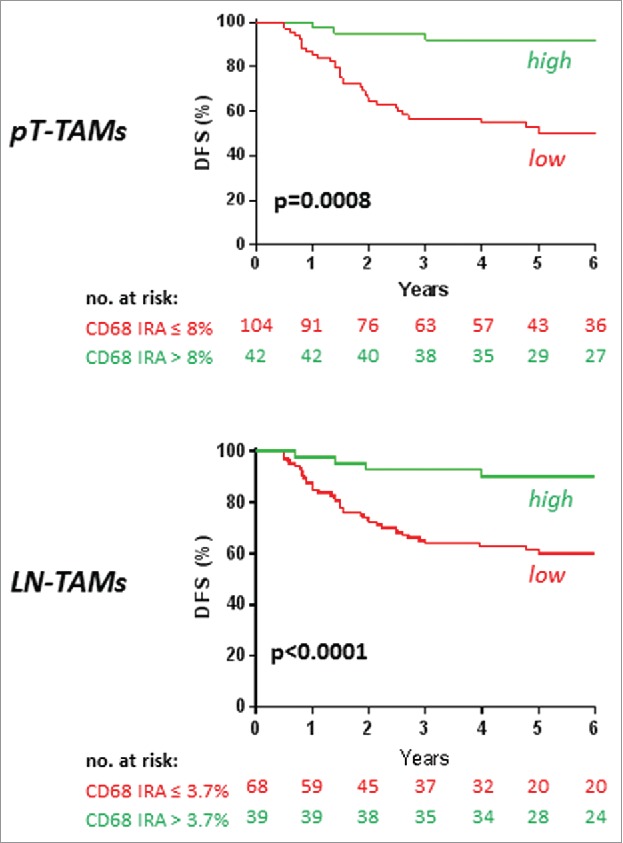
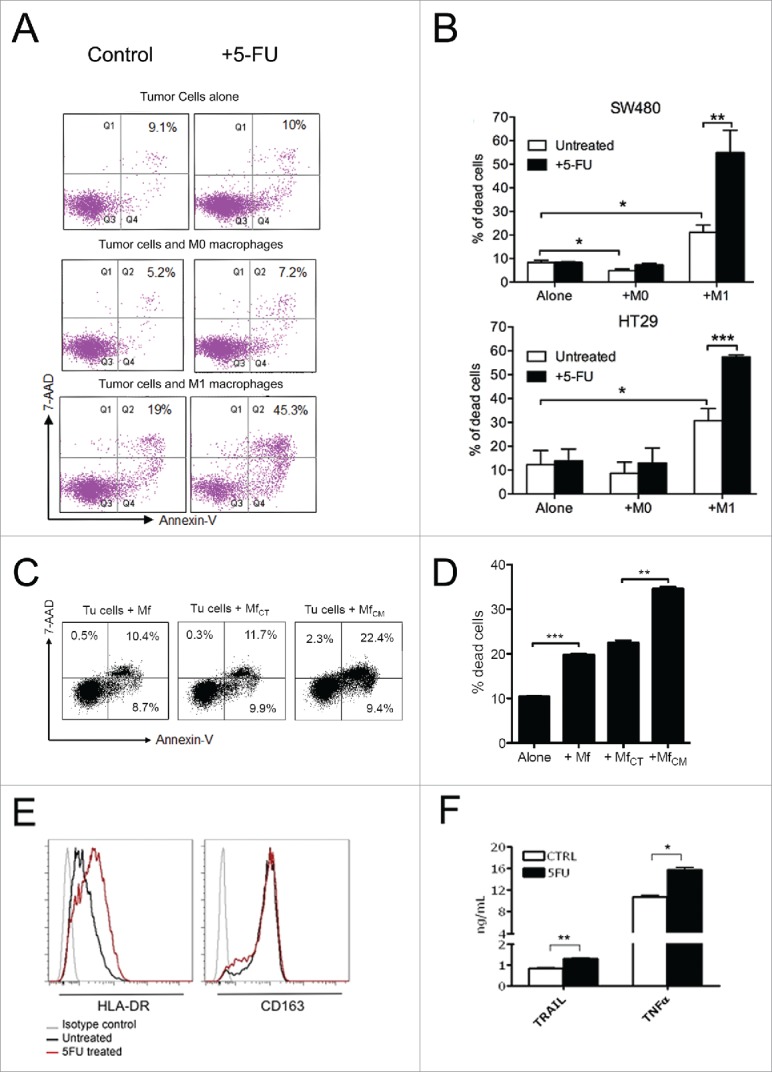
Tumor-associated macrophages (TAMs) play a role in tumor development and progression. We hypothesized that abundance of TAMs might modify efficacy of 5-fluorouracil chemotherapy in colorectal cancer. We measured the density of CD68+ TAMs at the invasive front of primary tumor of colorectal carcinoma (PT-TAMs; n = 208), at available matched metastatic lymph node (LN-TAMs; n = 149), and in an independent set of primary colorectal cancers (PT-TAMs, n = 111). The hazard ratios for disease-free survival were computed by Cox proportional-hazards model. In exploratory analysis, the interaction between TAMs and 5-fluorouracil adjuvant therapy was significant (PT-TAMs, p = 0.02; LN-TAMs, p = 0.005). High TAMs were independently associated with better disease-free survival only in 5-fluorouracil-treated patients (PT-TAMs, HR 0.23; 95%CI, 0.08–0.65; p = 0.005; LN-TAMs, HR 0.13; 95%CI, 0.04–0.43; p = 0.001). The independent predictive value of PT-TAMs was replicated in the external set (HR, 0.14; 95%CI 0.02–1.00; p = 0.05). In an in vitro experiment, 5-fluorouracil and macrophages showed a synergistic effect and increased colorectal cancer cell death. High densities of TAMs, particularly in metastatic lymph-nodes, identify stage III colorectal cancer patients benefitting from 5-fluorouracil adjuvant therapy.
Overview
The claims and statistics of this paper haven’t been checked yet.
Free: it reads the open-access text and checks the first 5 claims that cite a source we can check. Create a free account to check every claim.
Integrity signals
Registry
Cites
Statistics
Figures
Verification
Claims the paper makes
The claims and statistics of this paper haven’t been checked yet.
Free: it reads the open-access text and checks the first 5 claims that cite a source we can check. Create a free account to check every claim.
Claims other papers make about this one
Each is checked against this paper’s own text: does it say what the citing paper says it does?
The cited source says what the claim attributes to it.
In the citing paper
“However, high densities of TAMs have been shown to significantly benefit stage III CRC patients treated with 5-FU [327].”
From Drug Resistance in Colorectal Cancer: From Mechanism to Clinic (2022) · cites this paper as [327]
Self-check
Percentages, sums and reported differences re-computed from the paper’s own numbers.
The self-check needs the paper’s full text.
Citations
Cites
Mantovani, A., Allavena, P., Sica, A., & Balkwill, F. (2008) · Nature · doi:10.1038/nature07205 · Cited by 11,399
Self-citationType, Density, and Location of Immune Cells Within Human Colorectal Tumors Predict Clinical Outcome
Galon, J., Costes, A., Sanchez-Cabo, F., Kirilovsky, A., Mlecnik, B., Lagorce-Pagès, C., Tosolini, M., Camus, M., Berger, A., Wind, P., et al. (2006) · Science · doi:10.1126/science.1129139 · Cited by 6,516
Tumour-associated macrophages as treatment targets in oncology
Mantovani, A., Marchesi, F., Malesci, A., Laghi, L., & Allavena, P. (2017) · Nature Reviews Clinical Oncology · doi:10.1038/nrclinonc.2016.217 · Cited by 4,033 · cited 1×
“Preclinical studies have also depicted a complex dual role for TAMs in modulating the response to anticancer therapies.(28-30) In some cancers, selected chemotherapeutic agents enhance the anti-tumor activity of TAMs by eliciting adaptive responses able to determine immunogenic cell death,(31,32) by depleting immunosu…”
BackgroundSelf-citationOxaliplatin, Fluorouracil, and Leucovorin as Adjuvant Treatment for Colon Cancer
André, T., Boni, C., Mounedji-Boudiaf, L., Navarro, M., Tabernero, J., Hickish, T., Topham, C., Zaninelli, M., Clingan, P., Bridgewater, J., et al. (2004) · New England Journal of Medicine · doi:10.1056/nejmoa032709 · Cited by 3,689 · cited 1×
“ropyrimidines improve 5-year survival rates by 10–15%, an additional 4–6% being contributed by their combination with oxaliplatin.(1-3) Even among patients receiving adjuvant therapy, one third still progresses to metastatic disease,(4-6) a rate not improved by biologic agents.”
BackgroundImmunogenic Cell Death in Cancer Therapy
Kroemer, G., Galluzzi, L., Kepp, O., & Zitvogel, L. (2013) · Annual Review of Immunology · doi:10.1146/annurev-immunol-032712-100008 · Cited by 3,303
André, T., Boni, C., Navarro, M., Tabernero, J., Hickish, T., Topham, C., Bonetti, A., Clingan, P., Bridgewater, J., Rivera, F., et al. (2009) · Journal of Clinical Oncology · doi:10.1200/jco.2008.20.6771 · Cited by 2,277 · cited 1×
“ropyrimidines improve 5-year survival rates by 10–15%, an additional 4–6% being contributed by their combination with oxaliplatin.(1-3) Even among patients receiving adjuvant therapy, one third still progresses to metastatic disease,(4-6) a rate not improved by biologic agents.”
BackgroundEffector Memory T Cells, Early Metastasis, and Survival in Colorectal Cancer
Pagès, F., Berger, A., Camus, M., Sanchez-Cabo, F., Costes, A., Molidor, R., Mlecnik, B., Kirilovsky, A., Nilsson, M., Damotte, D., et al. (2005) · New England Journal of Medicine · doi:10.1056/nejmoa051424 · Cited by 2,135
The Intestinal Microbiota Modulates the Anticancer Immune Effects of Cyclophosphamide
Viaud, S., Saccheri, F., Mignot, G., Yamazaki, T., Daillère, R., Hannani, D., Enot, D. P., Pfirschke, C., Engblom, C., Pittet, M. J., et al. (2013) · Science · doi:10.1126/science.1240537 · Cited by 2,050
Immunological effects of conventional chemotherapy and targeted anticancer agents
Galluzzi, L., Buqué, A., Kepp, O., Zitvogel, L., & Kroemer, G. (2015) · Cancer Cell · doi:10.1016/j.ccell.2015.10.012 · Cited by 1,530
Towards the introduction of the ‘Immunoscore’ in the classification of malignant tumours
Galon, J., Mlecnik, B., Bindea, G., Angell, H. K., Berger, A., Lagorce, C., Lugli, A., Zlobec, I., Hartmann, A., Bifulco, C., et al. (2014) · The Journal of Pathology · doi:10.1002/path.4287 · Cited by 1,360 · cited 1×
“Also tumor-infiltrating lymphocytes (TILs), which effectively forecast the outcome of patients with early colorectal cancer, are unlikely to act as predictive factor in node-positive patients.(13-16) Under this respect, other key players of the tumor”
BackgroundSelf-citationCapecitabine as Adjuvant Treatment for Stage III Colon Cancer
Twelves, C., Wong, A., Nowacki, M. P., Abt, M., Burris, H., Carrato, A., Cassidy, J., Cervantes, A., Fagerberg, J., Georgoulias, V., et al. (2005) · New England Journal of Medicine · doi:10.1056/nejmoa043116 · Cited by 1,248 · cited 1×
“ropyrimidines improve 5-year survival rates by 10–15%, an additional 4–6% being contributed by their combination with oxaliplatin.(1-3) Even among patients receiving adjuvant therapy, one third still progresses to metastatic disease,(4-6) a rate not improved by biologic agents.”
BackgroundImmunogenic death of colon cancer cells treated with oxaliplatin
Tesniere, A., Schlemmer, F., Boige, V, Kepp, O., Martins, I., Ghiringhelli, F., Aymeric, L., Michaud, M., Apetoh, L., Barault, L., et al. (2010) · Oncogene · doi:10.1038/onc.2009.356 · Cited by 1,173 · cited 1×
“In a wider perspective, our data add to those pointing to the involvement of tumor targeting immune responses in determining the clinical efficacy of conventional chemotherapy regimens, besides their cytostatic and cytotoxic effects.(48,49) The pathways mediating the interaction of macrophages with 5-fluorouracil rema…”
BackgroundMacrophage Regulation of Tumor Responses to Anticancer Therapies
De Palma, M., & Lewis, C. E. (2013) · Cancer Cell · doi:10.1016/j.ccr.2013.02.013 · Cited by 1,079
Neutralizing Tumor-Promoting Chronic Inflammation: A Magic Bullet?
Coussens, L. M., Zitvogel, L., & Palucka, A. K. (2013) · Science · doi:10.1126/science.1232227 · Cited by 1,079
Zhang, Q.-W., Liu, L., Gong, C.-Y., Shi, H.-S., Zeng, Y.-H., Wang, X.-Z., Zhao, Y.-W., & Wei, Y.-Q. (2012) · PLoS ONE · doi:10.1371/journal.pone.0050946 · Cited by 1,039 · cited 2×
“In contrast to their association with poor prognosis in several tumors, high densities of TAMs favorably influence the postsurgical clinical outcome of colorectal cancer.(19-24) The present study clarifies that the association between high TAMs densities and better survival in patients with stage III colorectal cancer…”
BackgroundResultMlecnik, B., Tosolini, M., Kirilovsky, A., Berger, A., Bindea, G., Meatchi, T., Bruneval, P., Trajanoski, Z., Fridman, W.-H., Pagès, F., et al. (2011) · Journal of Clinical Oncology · doi:10.1200/jco.2010.30.5425 · Cited by 1,009 · cited 1×
“Also tumor-infiltrating lymphocytes (TILs), which effectively forecast the outcome of patients with early colorectal cancer, are unlikely to act as predictive factor in node-positive patients.(13-16) Under this respect, other key players of the tumor”
BackgroundRole of Macrophage Targeting in the Antitumor Activity of Trabectedin
Germano, G., Frapolli, R., Belgiovine, C., Anselmo, A., Pesce, S., Liguori, M., Erba, E., Uboldi, S., Zucchetti, M., Pasqualini, F., et al. (2013) · Cancer Cell · doi:10.1016/j.ccr.2013.01.008 · Cited by 864
Self-citationAspirin Use, Tumor PIK3CA Mutation, and Colorectal-Cancer Survival
Liao, X., Lochhead, P., Nishihara, R., Morikawa, T., Kuchiba, A., Yamauchi, M., Imamura, Y., Qian, Z. R., Baba, Y., Shima, K., et al. (2012) · New England Journal of Medicine · doi:10.1056/nejmoa1207756 · Cited by 843 · cited 1×
“types with heterogeneous prognosis (such as KRAS/BRAF and microsatellite status), do not predict responsiveness to adjuvant chemotherapy(10,11) as they do in metastatic setting, or alike PI3K-mutations toward aspirin responsiveness in adjuvant setting.(12) Also tumor-infiltrating lymphocytes (TILs), which effectively…”
BackgroundSelf-citationRolny, C., Mazzone, M., Tugues, S., Laoui, D., Johansson, I., Coulon, C., Squadrito, M. L., Segura, I., Li, X., Knevels, E., et al. (2011) · Cancer Cell · doi:10.1016/j.ccr.2010.11.009 · Cited by 695 · cited 2×
“These findings are in keeping with in-vivo studies showing that the skewing of TAMs to M1-like phenotype contributes to the anti-tumor and antiangiogenic effects of pharmacological agents in mice.(35,36) Furthermore, the unique exposure of colorectal cancer microenvironment to commensal enteric microbiota, which has b…”
BackgroundResultYothers, G., O'Connell, M. J., Allegra, C. J., Kuebler, J. P., Colangelo, L. H., Petrelli, N. J., & Wolmark, N. (2011) · Journal of Clinical Oncology · doi:10.1200/jco.2011.36.4539 · Cited by 656
The interaction of anticancer therapies with tumor-associated macrophages
Mantovani, A., & Allavena, P. (2015) · Journal of Experimental Medicine · doi:10.1084/jem.20150295 · Cited by 616 · cited 1×
“Preclinical studies have also depicted a complex dual role for TAMs in modulating the response to anticancer therapies.(28-30) In some cancers, selected chemotherapeutic agents enhance the anti-tumor activity of TAMs by eliciting adaptive responses able to determine immunogenic cell death,(31,32) by depleting immunosu…”
BackgroundSelf-citationTumor associated macrophages and neutrophils in cancer
Galdiero, M. R., Bonavita, E., Barajon, I., Garlanda, C., Mantovani, A., & Jaillon, S. (2013) · Immunobiology · doi:10.1016/j.imbio.2013.06.003 · Cited by 597 · cited 1×
“In keeping with these data, we recently reported the favorable prognostic interaction of 5-fluorouracil adjuvant therapy in colorectal cancer patients with high densities of tumor-associated neutrophils (TANs), a native component of the tumor infiltrate otherwise associated with poor clinical outcome.(39-41)”
ResultSelf-citationHigh Macrophage Infiltration along the Tumor Front Correlates with Improved Survival in Colon Cancer
Forssell, J., Öberg, A., Henriksson, M. L., Stenling, R., Jung, A., & Palmqvist, R. (2007) · Clinical Cancer Research · doi:10.1158/1078-0432.ccr-06-2073 · Cited by 566 · cited 2×
“In contrast to their association with poor prognosis in several tumors, high densities of TAMs favorably influence the postsurgical clinical outcome of colorectal cancer.(19-24) The present study clarifies that the association between high TAMs densities and better survival in patients with stage III colorectal cancer…”
BackgroundResultSelf-citationTumor-associated macrophages: Functional diversity, clinical significance, and open questions
Biswas, S. K., Allavena, P., & Mantovani, A. (2013) · Seminars in Immunopathology · doi:10.1007/s00281-013-0367-7 · Cited by 551 · cited 2×
“In contrast to their association with poor prognosis in several tumors, high densities of TAMs favorably influence the postsurgical clinical outcome of colorectal cancer.(19-24) The present study clarifies that the association between high TAMs densities and better survival in patients with stage III colorectal cancer…”
BackgroundResultSelf-citationde Gramont, A., Van Cutsem, E., Schmoll, H.-J., Tabernero, J., Clarke, S., Moore, M. J., Cunningham, D., Cartwright, T. H., Hecht, J. R., Rivera, F., et al. (2012) · The Lancet Oncology · doi:10.1016/s1470-2045(12)70509-0 · Cited by 529 · cited 1×
“Even among patients receiving adjuvant therapy, one third still progresses to metastatic disease,(4-6) a rate not improved by biologic agents.(5,7-9) These facts indicate that mechanisms of disease eradication achieved by chemotherapy”
BackgroundNosho, K., Baba, Y., Tanaka, N., Shima, K., Hayashi, M., Meyerhardt, J. A., Giovannucci, E., Dranoff, G., Fuchs, C. S., & Ogino, S. (2010) · The Journal of Pathology · doi:10.1002/path.2774 · Cited by 502
Self-citationSargent, D. J. (2012) · JAMA · doi:10.1001/jama.2012.385 · Cited by 501 · cited 1×
“Even among patients receiving adjuvant therapy, one third still progresses to metastatic disease,(4-6) a rate not improved by biologic agents.(5,7-9) These facts indicate that mechanisms of disease eradication achieved by chemotherapy”
BackgroundKodumudi, K. N., Woan, K., Gilvary, D. L., Sahakian, E., Wei, S., & Djeu, J. Y. (2010) · Clinical Cancer Research · doi:10.1158/1078-0432.ccr-10-0733 · Cited by 500 · cited 2×
“These findings are in keeping with in-vivo studies showing that the skewing of TAMs to M1-like phenotype contributes to the anti-tumor and antiangiogenic effects of pharmacological agents in mice.(35,36) Furthermore, the unique exposure of colorectal cancer microenvironment to commensal enteric microbiota, which has b…”
BackgroundResultEdin, S., Wikberg, M. L., Dahlin, A. M., Rutegård, J., Öberg, Å., Oldenborg, P.-A., & Palmqvist, R. (2012) · PLoS ONE · doi:10.1371/journal.pone.0047045 · Cited by 454 · cited 2×
“In contrast to their association with poor prognosis in several tumors, high densities of TAMs favorably influence the postsurgical clinical outcome of colorectal cancer.(19-24) The present study clarifies that the association between high TAMs densities and better survival in patients with stage III colorectal cancer…”
BackgroundResultSelf-citationLaoui, D., Van Overmeire, E., Di Conza, G., Aldeni, C., Keirsse, J., Morias, Y., Movahedi, K., Houbracken, I., Schouppe, E., Elkrim, Y., et al. (2014) · Cancer Research · doi:10.1158/0008-5472.can-13-1196 · Cited by 412
Shen, M., Hu, P., Donskov, F., Wang, G., Liu, Q., & Du, J. (2014) · PLoS ONE · doi:10.1371/journal.pone.0098259 · Cited by 347 · cited 1×
“In keeping with these data, we recently reported the favorable prognostic interaction of 5-fluorouracil adjuvant therapy in colorectal cancer patients with high densities of tumor-associated neutrophils (TANs), a native component of the tumor infiltrate otherwise associated with poor clinical outcome.(39-41)”
ResultPersonalizing Colon Cancer Adjuvant Therapy: Selecting Optimal Treatments for Individual Patients
Dienstmann, R., Salazar, R., & Tabernero, J. (2015) · Journal of Clinical Oncology · doi:10.1200/jco.2014.60.0213 · Cited by 343
Molecular Markers Identify Subtypes of Stage III Colon Cancer Associated With Patient Outcomes
Sinicrope, F. A., Shi, Q., Smyrk, T. C., Thibodeau, S. N., Dienstmann, R., Guinney, J., Bot, B. M., Tejpar, S., Delorenzi, M., Goldberg, R. M., et al. (2015) · Gastroenterology · doi:10.1053/j.gastro.2014.09.041 · Cited by 330
Taieb, J., Tabernero, J., Mini, E., Subtil, F., Folprecht, G., Van Laethem, J.-L., Thaler, J., Bridgewater, J., Petersen, L. N., Blons, H., et al. (2014) · The Lancet Oncology · doi:10.1016/s1470-2045(14)70227-x · Cited by 291 · cited 1×
“Even among patients receiving adjuvant therapy, one third still progresses to metastatic disease,(4-6) a rate not improved by biologic agents.(5,7-9) These facts indicate that mechanisms of disease eradication achieved by chemotherapy”
BackgroundDi Caro, G., Cortese, N., Castino, G. F., Grizzi, F., Gavazzi, F., Ridolfi, C., Capretti, G., Mineri, R., Todoric, J., Zerbi, A., et al. (2016) · Gut · doi:10.1136/gutjnl-2015-309193 · Cited by 275 · cited 1×
“Although scanty clinical data are available on interactions of TAMs with chemotherapy efficacy in solid tumors, high loads of TAMs correlated with prolonged survival in 5-fluorouracil-treated patients with gastric cancer,(37) and partially corrected the poor prognosis of patients resected for pancreatic cancer and tre…”
Self-citationLaghi, L., Bianchi, P., Miranda, E., Balladore, E., Pacetti, V., Grizzi, F., Allavena, P., Torri, V., Repici, A., Santoro, A., et al. (2009) · The Lancet Oncology · doi:10.1016/s1470-2045(09)70186-x · Cited by 251 · cited 2×
“Also tumor-infiltrating lymphocytes (TILs), which effectively forecast the outcome of patients with early colorectal cancer, are unlikely to act as predictive factor in node-positive patients.(13-16) Under this respect, other key players of the tumor”
BackgroundMethodSelf-citationReduced Likelihood of Metastases in Patients with Microsatellite-Unstable Colorectal Cancer
Malesci, A., Laghi, L., Bianchi, P., Delconte, G., Randolph, A., Torri, V., Carnaghi, C., Doci, R., Rosati, R., Montorsi, M., et al. (2007) · Clinical Cancer Research · doi:10.1158/1078-0432.ccr-07-0366 · Cited by 245 · cited 1×
“The database was finally completed with data on tumor microsatellite status, K-RAS (codon12 and 13), and BRAF mutation status (codon 1799 hot spot) determined by the Laboratory of Molecular Gastroenterology, as described previously.(51)”
MethodSelf-citationZhou, Q., Peng, R.-Q., Wu, X.-J., Xia, Q., Hou, J.-H., Ding, Y., Zhou, Q.-M., Zhang, X., Pang, Z.-Z., Wan, D.-S., et al. (2010) · Journal of Translational Medicine · doi:10.1186/1479-5876-8-13 · Cited by 219
Taskinen, M., Karjalainen-Lindsberg, M.-L., Nyman, H., Eerola, L.-M., & Leppä, S. (2007) · Clinical Cancer Research · doi:10.1158/1078-0432.ccr-07-0778 · Cited by 212 · cited 1×
“However, in some neoplastic disease, such as follicular lymphomas, TAM prognostic impact heavily depends upon treatment.(25-27) Preclinical studies have also depicted a complex dual role for TAMs in modulating the response to anticancer therapies.”
BackgroundAllegra, C. J., Yothers, G., O'Connell, M. J., Sharif, S., Petrelli, N. J., Lopa, S. H., & Wolmark, N. (2013) · Journal of Clinical Oncology · doi:10.1200/jco.2012.44.4711 · Cited by 209 · cited 1×
“Even among patients receiving adjuvant therapy, one third still progresses to metastatic disease,(4-6) a rate not improved by biologic agents.(5,7-9) These facts indicate that mechanisms of disease eradication achieved by chemotherapy”
BackgroundOccurrence and significance of tumor‐associated neutrophils in patients with colorectal cancer
Galdiero, M. R., Bianchi, P., Grizzi, F., Di Caro, G., Basso, G., Ponzetta, A., Bonavita, E., Barbagallo, M., Tartari, S., Polentarutti, N., et al. (2016) · International Journal of Cancer · doi:10.1002/ijc.30076 · Cited by 192 · cited 2×
“In keeping with these data, we recently reported the favorable prognostic interaction of 5-fluorouracil adjuvant therapy in colorectal cancer patients with high densities of tumor-associated neutrophils (TANs), a native component of the tumor infiltrate otherwise associated with poor clinical outcome.(39-41)”
MethodResultSelf-citationÅlgars, A., Irjala, H., Vaittinen, S., Huhtinen, H., Sundström, J., Salmi, M., Ristamäki, R., & Jalkanen, S. (2012) · International Journal of Cancer · doi:10.1002/ijc.26457 · Cited by 167 · cited 3×
“On the other hand, TAMs subpopulations are variably represented in distinct microenvironments of the same tumor,(46) and expression of polarization markers is considerably heterogeneous in colorectal cancer.(23) Accordingly, the polarization of TAMs in the resected primary tumor might even be irrelevant to their succe…”
BackgroundResultde Jong, D., Koster, A., Hagenbeek, A., Raemaekers, J. M. M., Veldhuizen, D., Heisterkamp, S. H., de Boer, J. P., & Glabbeke, M. M. V. (2008) · Haematologica · doi:10.3324/haematol.13574 · Cited by 155
Chemotherapeutic Targeting of Cancer-Induced Immunosuppressive Cells
Alizadeh, D., & Larmonier, N. (2014) · Cancer Research · doi:10.1158/0008-5472.can-14-0301 · Cited by 142
Kridel, R., Xerri, L., Gelas‐Dore, B., Tan, K. L., Feugier, P., Vawda, A., Canioni, D., Farinha, P., Boussetta, S., Moccia, A. A., et al. (2015) · Clinical Cancer Research · doi:10.1158/1078-0432.ccr-14-3253 · Cited by 132 · cited 1×
“However, in some neoplastic disease, such as follicular lymphomas, TAM prognostic impact heavily depends upon treatment.(25-27) Preclinical studies have also depicted a complex dual role for TAMs in modulating the response to anticancer therapies.”
BackgroundOhnishi, K., Komohara, Y., Saito, Y., Miyamoto, Y., Watanabe, M., Baba, H., & Takeya, M. (2013) · Cancer Science · doi:10.1111/cas.12212 · Cited by 123 · cited 1×
“The lack of association of CD68C LN-TAMs with prognosis is likely due to small study population, and to the absence of stage stratification with respect to chemotherapy treatment.(42) The prognostic interaction of LN-TAMs anyhow supports the”
Wang, B., Xu, D., Yu, X.-J., Ding, T., Rao, H., Zhan, Y., Zheng, L., & Li, L. (2011) · Annals of Surgical Oncology · doi:10.1245/s10434-011-1609-3 · Cited by 112
Shi, Q., André, T., Grothey, A. F., Yothers, G., Hamilton, S. R., Bot, B. M., Haller, D. G., Cutsem, E. V., Twelves, C. J., Benedetti, J., et al. (2013) · Journal of Clinical Oncology · doi:10.1200/jco.2013.49.4344 · Cited by 79
Cavnar, M. J., Turcotte, S., Katz, S. C., Kuk, D., Gönen, M., Shia, J., Allen, P. J., Balachandran, V. P., D’Angelica, M. I., Kingham, T. P., et al. (2017) · Annals of Surgical Oncology · doi:10.1245/s10434-017-5812-8 · Cited by 71 · cited 1×
“tion of colorectal cancer liver metastases and better survival, in a cohort of patients treated with peri-surgical chemotherapy.(43)”
BackgroundRole of Host Defense Mechanisms in the Antitumor Activity of Adriamycin and Daunomycin in Mice 2
(1979) · JNCI: Journal of the National Cancer Institute · doi:10.1093/jnci/63.1.61 · Cited by 61
Self-citationNagasaki, E., Takahara, A., Koido, S., Sagawa, Y., Aiba, K., Tajiri, H., Yagita∥, H., & Homma, S. (2010) · Journal of Immunotherapy · doi:10.1097/cji.0b013e3181d36726 · Cited by 17 · cited 1×
“macrophages exposed to 5-fluorouracil suggests the involvement of these molecules in immunogenic cell death of colorectal cancer cells.(50)”
Background
Cited by
Inflammation and cancer: triggers, mechanisms, and consequences
Greten, F. R., & Grivennikov, S. I. (2019) · Immunity · doi:10.1016/j.immuni.2019.06.025 · Cited by 3,806
“, 2014) and inflammatory signaling targeting remaining tumor cell is an important driver of therapy resistance (Jinushi et al., 2011; Malesci et al., 2017).”
BackgroundMacrophages in immunoregulation and therapeutics
Chen, S., Saeed, A. F. U. H., Liu, Q., Jiang, Q., Xu, H., Xiao, G. G., Rao, L., & Duo, Y. (2023) · Signal Transduction and Targeted Therapy · doi:10.1038/s41392-023-01452-1 · Cited by 2,229
“In patients with stage III CRC treated with 5-FU adjuvant therapy, the high macrophage density before the treatment was strongly linked with a better-improved prognosis.(383) Increased numbers of CD68 TAMs in patients with pancreatic adenocarcinoma before treatment were only related to a favorable prognosis in those w…”
BackgroundMacrophages as tools and targets in cancer therapy
Mantovani, A., Allavena, P., Marchesi, F., & Garlanda, C. (2022) · Nature Reviews Drug Discovery · doi:10.1038/s41573-022-00520-5 · Cited by 1,807
Self-citationCurrent and future therapeutic approaches for osteosarcoma
Harrison, D. J., Geller, D. S., Gill, J. D., Lewis, V. O., & Gorlick, R. (2018) · Expert Review of Anticancer Therapy · doi:10.1080/14737140.2018.1413939 · Cited by 689
Drug resistance and new therapies in colorectal cancer
Jeught, K. V. D., Xu, H.-C., Li, Y.-J., Lu, X.-B., & Ji, G. (2018) · World Journal of Gastroenterology · doi:10.3748/wjg.v24.i34.3834 · Cited by 597
Metadata
- Authors
- Malesci, A., Bianchi, P., Celesti, G., Basso, G., Marchesi, F., Grizzi, F., Di Caro, G., Cavalleri, T., Rimassa, L., Palmqvist, R., Lugli, A., Koelzer, V. H., Roncalli, M., Mantovani, A., Ogino, S., & Laghi, L.
- Affiliations
- University of Milan (IT)
- Fondazione Humanitas per la Ricerca (IT)
- Humanitas University (IT)
- Department of Immunology and Inflammation, Humanitas Clinical and Research Center, via Manzoni 113, Rozzano (Milan), Italy
- Humanitas Cancer Center, Humanitas Clinical and Research Center, Via Manzoni 56, Rozzano 20089 (Milan), Italy
- Umeå University (SE)
- University of Bern (CH)
- Brigham and Women's Hospital (US)
- Corresponding author
- Malesci, Alberto
- Laghi, Luigi
- ORCID
- Venue
- OncoImmunology
- Publisher
- Informa UK Limited
- Published
- 2017-07-12
- Volume
- 6
- Issue
- 12
- Pages
- e1342918
- ISSN
- 2162-4011 (ISSN-L)
- 2162-402X
- PMC
- PMC5706531
- OpenAlex
- W2735116030
- Cited by
- 124
- References
- 51
- Citations by year
- 2026: 4 · 2025: 8 · 2024: 11 · 2023: 13 · 2022: 10 · 2021: 23 · 2020: 29 · 2019: 15 · 2018: 9 · 2017: 2
- FWCI
- 6.81
- Type
- journal article
- Language
- en
- Open access
- gold
- doi.org
- Licence
- Locations
- OncoImmunology (publishedVersion, cc-by-nc-nd)
- Europe PMC (PubMed Central) (publishedVersion, cc-by-nc-nd)
- PubMed Central (publishedVersion, cc-by-nc-nd)
- PubMed (publishedVersion)
- Zurich Open Repository and Archive (University of Zurich) (acceptedVersion, cc-by-nc-nd)
- Digital Access to Scholarship at Harvard (DASH) (Harvard University) (submittedVersion, cc-by)
- DiVA at Umeå University (Umeå University) (submittedVersion, other-oa)
- Archivio Istituzionale della Ricerca (Universita Degli Studi Di Milano) (submittedVersion, other-oa)
- BORIS (University Library Bern) (submittedVersion, cc-by-nc-nd)
- DOAJ (DOAJ: Directory of Open Access Journals) (submittedVersion, cc-by-sa)
- Archivio Istituzionale della Ricerca - Università Vita-Salute San Raffaele (submittedVersion)
- Zurich Open Repository and Archive (University of Zurich) (submittedVersion, cc-by-nc-nd)
- Zurich Open Repository and Archive (University of Zurich)
- Open Access CRIS of the University of Bern
- Funders
- National Cancer Institute (R35CA197735)
- Topics
- Life Sciences › Immunology and Microbiology › Immunology › Immune cells in cancer
- Health Sciences › Medicine › Oncology › Colorectal Cancer Treatments and Studies
- Health Sciences › Medicine › Oncology › Cancer Immunotherapy and Biomarkers
- Keywords
- tumor-associated macrophages, 5-fluorouracil, adjuvant chemotherapy, stage III colorectal cancer, CD68, metastatic lymph nodes, disease-free survival, predictive biomarkers, chemotherapy response, tumor microenvironment
About these checks
Registry, retraction, Cites and statistics results are computed, not judged, with one exception: a printed reference that no index lists is read once by a model before it counts as a citation error. Claims are extracted by a model and kept only when their quote appears verbatim in the text; each cited source is then checked, with a model’s help, for whether it says what the claim relies on. Those verdicts can be wrong — read the claim’s quote and the cited source before relying on one.
Statistics and arithmetic are recomputed, not judged.
Confidence bands are shown only for fields calibrated on our annotated test set. None is calibrated yet, so no band is shown.
What counts as a claim ›How we measure confidence ›How we check this ›
Are you an author, or do you see a problem with this page? Request a review
Data sources
Bibliographic data: Semantic Scholar, OpenAlex, Crossref.
Contains information from the Semantic Scholar Academic Graph Datasets, made available under the ODC Attribution License (ODC-BY 1.0).
Semantic Scholar’s data is described in: Kinney, R., et al. (2023). The Semantic Scholar Open Data Platform. arXiv:2301.10140.
