

Using T-O-E theoretical framework to study the adoption of ERP solution
Open accessThe DOI matches its Crossref record; 166 of the 175 references it cites were found in a registry or an index; 8 of the 103 sources its claims cite were checked for support.
Abstract
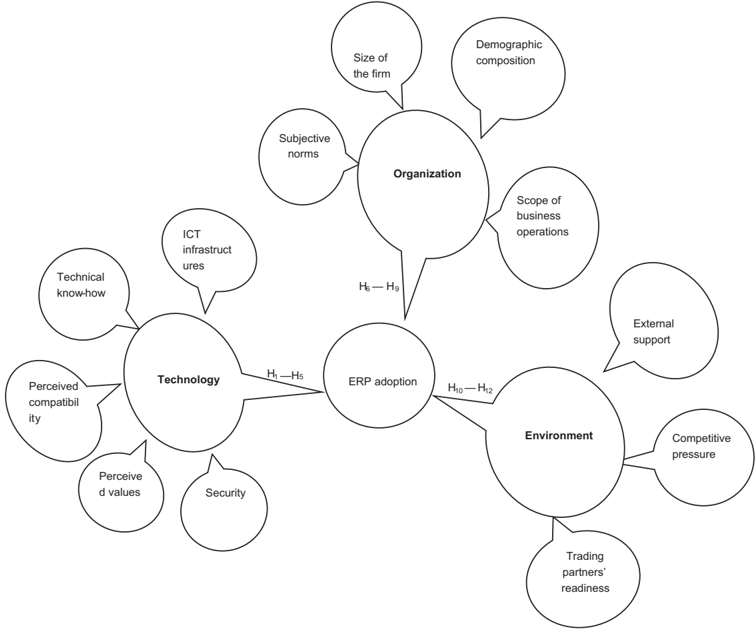
This paper provides further insight into IS adoption by investigating how 12 factors within the technology-organization-environment (T-O-E) framework explain SMEs’ adoption of enterprise resource planning (ERP) software. Survey data were collected from executives of SMEs drawn from six fast service enterprises with strong operations in Port Harcourt, Nigeria. Purposive and snow ball sampling was adopted and the proposed framework was tested using the logistic regression; specifically, the likelihood ratios, Hosmer and Lemeshow’s goodness of fit, and Nagelkerke R2 were used. The hypothesized relationships were supported at either p < 0.01 or 0.05 with each factor differing in its statistical coefficient and some bearing negative values; suggesting that some factors do not pose much threat to adopters but to non-adopters. Thus, adoption of ERP by SMEs is well-explained by T-O-E framework though it is more driven by technological factors than by organizational and environmental factors. Implicit is that the proposed model will be useful to IS vendors in making investment decisions and crafting marketing programs that appeal to non-adopters since they have more adoption challenges than adopters and to cause adopters to progress in the loyalty ladder.
Overview
CoChat Summary
TL;DR
This paper tests a 12-factor technology-organization-environment (T-O-E) model of enterprise resource planning (ERP) adoption among SMEs in Port Harcourt, Nigeria. It finds all 12 hypothesized factors supported at p < 0.01 or 0.05, with adoption more driven by technological factors than organizational or environmental factors.
Key findings
- The logistic model reported −2 log likelihood = 99.400, Hosmer and Lemeshow χ² = 5.670 (p = 0.817), Nagelkerke R² = 0.456, and overall prediction accuracy of 78.70% (178 adopters, 66 non-adopters).
- Positive coefficients were reported for ICT infrastructure (0.653), technical know-how (0.167), perceived compatibility (0.576), perceived values (0.459), security (0.686), and firm size (0.103); firm size was described as the most critical adoption driver at p < 0.05.
- Negative coefficients were reported for scope of business operations (−0.589), subjective norms (−0.634), competitive pressure (−0.495), external support (−0.480), trading partners’ readiness (−0.661), and demographic composition (−0.483); these were interpreted as critical adoption factors that pose less obstacle to adopters than to non-adopters.
- The paper concludes that ERP adoption by SMEs is well explained by the T-O-E framework but is more driven by technological factors than by organizational and environmental factors.
Methods
- Positivist, realist survey design; data collected from owners and executives of SMEs in six fast-growing service enterprises with strong operations in Port Harcourt, Nigeria; sampling frame was 373 owners/executives, with 244 returns.
- Purposive and snowball sampling were used; population criteria included at least 10 employees, huge ICT investment, annual turnover of five million naira or less, use of ERP to integrate operations, and registration with the Corporate Affairs Commission and other approved bodies.
- Analysis used logistic regression and Wald statistics, with likelihood ratios, Hosmer and Lemeshow’s goodness of fit, and Nagelkerke R²; factor analysis assessed validity and reliability, and collinearity diagnostics included tolerance, VIF, and Durbin-Watson (1.645).
Limitations
- The paper states that reliance on data from only the ICT industry and cross-sectional data limits generalizability; measures were subjective perceptions prone to common error biases; the study focuses on pre-adoption only; other factors outside T-O-E may affect ERP adoption; and PCA with varimax rotation was used, with future CFA, maximum likelihood, oblimin rotation, or second-order modeling suggested.
- Evident from the text: the non-probability purposive/snowball sampling and the single-city, six-service-enterprise sample further constrain generalizability.
- Evident from the text: there is an inconsistency in the reported sign for demographic composition—one passage lists it among positive coefficients, while later text and Table 5 report a negative coefficient.
Model-written summary. Check it against the paper before relying on it.
Integrity signals
Registry
Cites
Statistics
Figures






















Verification
Claims the paper makes
6 Valid · 3 Not valid · 45 Not checked · 57 Own results and interpretations
At least one cited source doesn’t support this claim or points to a different paper, and none confirmed it — see the verdicts below.
In the paper
“the extensive focus of TAM on technology to the neglect of social and psychological parameters (Agarwal & Prasad, 1998;Venkatesh & Bala, 2008) limits its explanatory and predictive utilities, and therefore demands its integration with other frameworks”
§ Using T-O-E theoretical framework to study the adoption of ERP solution > 1. Introduction
What the sources say
- Not checked — no full text of the sourcecites Agarwal & Prasad, 1998 matched to “A Conceptual and Operational Definition of Personal Innovativeness in the Domain of Information Technology” (1998) source
- Disputedcites Venkatesh & Bala, 2008 matched to “Technology Acceptance Model 3 and a Research Agenda on Interventions” (2008) sourceExperimental — accuracy not yet measured
The introductory discussion describes TAM as “highly predictive of IT adoption and use,” contrary to the claim that its predictive utility is limited. It identifies TAM’s commonly cited limitation as a lack of actionable guidance, not a neglect of social and psychological factors; the Theoretical Framework discusses social influence and individual differences in extensions of TAM. No page numbers are provided in our copy. (LLM, conf=0.86)
Checked by a reasoning model — may be wrong.
plainstates a cause- Asserted: passes — The authors put it forward as true.
- Checkable: passes — It can be checked against evidence.
- Load-bearing: passes — The paper’s conclusions depend on it.
- Based: passes — The paper gives a reason why it holds.
The cited sources support only part of this claim — read each source’s verdict below.
In the paper
“significant number of vendors principally targets large enterprises (Kumar & van Hillegersberg, 2000;Waarts, van Everdingen, & van Hillegersberg, 2002).”
§ Using T-O-E theoretical framework to study the adoption of ERP solution > 1. Introduction
What the sources say
- Partly supportedcites Kumar & van Hillegersberg, 2000 matched to “Enterprise resource planning: introduction” (2000) sourceExperimental — accuracy not yet measured
Section I I says most Fortune 500 companies had installed ERP systems while the midsize-company market remained relatively untapped. That supports the large-enterprise emphasis, but it does not establish that a significant number of vendors principally targeted large enterprises. (LLM, conf=0.78)
- Not checked — no full text of the sourcecites Waarts, van Everdingen, & van Hillegersberg, 2002 matched to “The dynamics of factors affecting the adoption of innovations” (2002) source
plain- Asserted: passes — The authors put it forward as true.
- Checkable: passes — It can be checked against evidence.
- Load-bearing: unclear — It is unclear whether the paper’s conclusions depend on it.
- Based: passes — The paper gives a reason why it holds.
- Partly supported
The cited sources support only part of this claim — read each source’s verdict below.
In the paper
“by integrating the constructs of environment, T-O-E framework provides a more superior theoretical analysis than IDT in studying technology adoption, use, and value creation (Gangwar et al., 2014;Hossain & Quaddus, 2011;Oliveira & Martins, 2011).”
§ Using T-O-E theoretical framework to study the adoption of ERP solution > 3. The T-O-E framework
What the sources say
- Not checked — no full text of the sourcecites Gangwar et al., 2014 matched to “Review on IT adoption: insights from recent technologies” (2014) source
- Not checked — no full text of the sourcecites Hossain & Quaddus, 2011 matched to “The adoption and continued usage intention of RFID: an integrated framework” (2011) source
- Partly supportedcites Oliveira & Martins, 2011 matched to “Literature Review of Information Technology Adoption Models at Firm Level” (2011)Experimental — accuracy not yet measured
Our copy does support the comparative core: the Conclusions (p. n/a) state that because the TOE framework includes the environment context, absent from DOI/IDT, it 'becomes better able to explain intra-firm innovation adoption; therefore, we consider this model to be more complete,' and the External task environment section repeats that TOE 'makes Rogers' innovation diffusion theory better able to explain intrafirm innovation diffusion.' However, the source frames the advantage as 'more complete' and limited to explaining adoption/assimilation at the firm level; it nowhere claims superiority for 'use, and value creation' (searched: value creation, adoption and assimilation, perceived benefits). The same Conclusions also hedge the comparison by recommending that for more complex technologies more than one model be combined, rather than TOE alone being superior. (LLM, conf=0.72)
plain- Asserted: passes — The authors put it forward as true.
- Checkable: unclear — It is unclear whether it could be checked against evidence.
- Load-bearing: passes — The paper’s conclusions depend on it.
- Based: passes — The paper gives a reason why it holds.
The cited sources support only part of this claim — read each source’s verdict below.
In the paper
“Scholars describe SBO as an adoption predicator; the greater the scope of business, the more likelihood enterprises invest to digitalize operations and to reduce internal co-ordination costs, administrative complexities, and information processing (Bakos, 1998;Chopra & Meindl, 2001;Hitt, 1999;Zhu et al., 2003).”
§ Using T-O-E theoretical framework to study the adoption of ERP solution > 4.2. Organization
What the sources say
- Could not verifycites Bakos, 1998 matched to “The emerging role of electronic marketplaces on the Internet” (1998) sourceExperimental — accuracy not yet measured
The Facilitation section (page unavailable) says electronic marketplaces improve information sharing and lower logistics costs between buyers and sellers. Our copy does not address whether a greater scope of business makes enterprises more likely to digitalize operations to reduce internal coordination costs, administrative complexity, or information processing; searches for business scope and internal coordination found no such passage. (LLM, conf=0.76)
- Not matchedcites Chopra & Meindl, 2001
An author–year citation the paper’s reference list doesn’t settle. We don’t search these by name.
- Supportedcites Hitt, 1999 matched to “Information Technology and Firm Boundaries: Evidence from Panel Data” (1999) source
Hitt (1999) supports the attributed proposition in the direction the claim states it: the Introduction reports that "firms that are less vertically integrated and more diversified have a higher demand for IT after controlling for other determinants of IT demand," and §5.4/§6.1 state that firms using coordination-intensive structures (i.e., broader scope/diversification) use substantially more IT, driven by "the demand for coordination activity" rather than mere size. The cost rationale also matches the paper: §2.1 defines internal coordination costs as "communications, data transfer, and other actual expenditures on managing dependencies between activities" and notes diversification "entails increased internal coordination costs because firms have to manage more complex and diverse activities," while the Introduction/hypotheses state IT lowers those coordination costs. One caveat worth noting is that Hitt finds only weaker/marginal support for the reverse causal path (IT causing greater diversification), but the claim attributes scope of business as a predictor of IT investment, which is the direction the paper does support. (LLM, conf=0.82)
hedgedstates a cause- Asserted: passes — The authors put it forward as true.
- Checkable: passes — It can be checked against evidence.
- Load-bearing: passes — The paper’s conclusions depend on it.
- Based: passes — The paper gives a reason why it holds.
- Could not verify
A result the paper reports from its own data — it cites no other source for it, so there is none to check. The quote shows it is in the paper.
In the paper
“Thus, adoption of ERP by SMEs is well-explained by T-O-E framework though it is more driven by technological factors than by organizational and environmental factors.”
- Also stated in: § 7. Discussion · plain
“The study found that adoption of ERP by SMEs is more driven by technological factors than by organizational and environmental factors.”
§ Using T-O-E theoretical framework to study the adoption of ERP solution > Abstract
plainstates a cause- Asserted: passes — The authors put it forward as true.
- Checkable: passes — It can be checked against evidence.
- Load-bearing: passes — The paper’s conclusions depend on it.
- Based: passes — The paper gives a reason why it holds.
- Also stated in: § 7. Discussion · plain
41 more claims
Create a free account to see all 111 claims and to verify the 13 references still open.
- Probably not a substantial claim. 23
- It may state two separate claims as one. 48
- Borderline: one of the tests for a substantial claim is unclear. 1
- The quote only partly states this claim. 1
Claims other papers make about this one
Each is checked against this paper’s own text: does it say what the citing paper says it does?
In the citing paper
“An organization’s preparedness to adopt AI determines how well an organization is prepared to fully realize the promise of an innovation (Awa et al., 2016).”
From Exploring the antecedents of AI adoption for effective HRM practices in the Indian pharmaceutical sector (2023) · cites this paper as Awa et al., 2016
Self-check
Percentages, sums and reported differences re-computed from the paper’s own numbers.
Each contradiction between two passages listed here was confirmed by an independent check.
Rated major: it would touch a result — a value a result rests on, reported and recomputed p-values on opposite sides of the significance level, two passages that conflict with no sign which is right, or a cited work retracted before this paper was published.
In the paper
§ Using T-O-E theoretical framework to study the adoption of ERP solution > 7. Discussion
“The 12 hypotheses were supported at either p < 0.01 or 0.05 with each factor differing in its statistical coefficient.”
§ Using T-O-E theoretical framework to study the adoption of ERP solution > 6.1. Measures
“ICT infrastructures 0.653 (0.314) 7.450 0.070* Technical know-how 0.167 (0.331) 2.541 0.072* Perceived compatibility 0.576 (0.302) 7.331 0.073*”
Rated major: it would touch a result — a value a result rests on, reported and recomputed p-values on opposite sides of the significance level, two passages that conflict with no sign which is right, or a cited work retracted before this paper was published.
In the paper
§ Using T-O-E theoretical framework to study the adoption of ERP solution > 5. Methods
“Other criteria used to define the population were that the SMEs must use ERP to integrate operations and be duly registered with Corporate Affairs Commission and other relevant government approved bodies.”
§ Using T-O-E theoretical framework to study the adoption of ERP solution > 6.1. Measures
“The table reports 178 adopters and 66 non-adopters;”
Rated major: it would touch a result — a value a result rests on, reported and recomputed p-values on opposite sides of the significance level, two passages that conflict with no sign which is right, or a cited work retracted before this paper was published.
In the paper
§ Using T-O-E theoretical framework to study the adoption of ERP solution > 6.1. Measures
“Discriminant validity is confirmed because the square roots of the AVE in the diagonal exceed the correlation between other constructs;”
§ Using T-O-E theoretical framework to study the adoption of ERP solution > 8. Conclusion and implications
“SN | 0.525 0.564 | 0.367 | 0.524 | 0.713 | 0.467 | 0.640 | 0.540 | 0.510 |”
Rated major: it would touch a result — a value a result rests on, reported and recomputed p-values on opposite sides of the significance level, two passages that conflict with no sign which is right, or a cited work retracted before this paper was published.
In the paper
“Overall 244 199 45 78.70”
§ Using T-O-E theoretical framework to study the adoption of ERP solution > 6.1. Measures
Reported 78.7 · recomputed 81.557377
Rated major: it would touch a result — a value a result rests on, reported and recomputed p-values on opposite sides of the significance level, two passages that conflict with no sign which is right, or a cited work retracted before this paper was published.
In the paper
§ Using T-O-E theoretical framework to study the adoption of ERP solution > 6.1. Measures
“others have significant positive coefficients (firm's size, security, perceived values, perceived compatibility, technical know-how, demographic composition, and ICT infrastructure).”
§ Using T-O-E theoretical framework to study the adoption of ERP solution > 6.1. Measures
“Demographic composition -0.483 (0.279) 2.330 0.070*”
3 more findings
Create a free account to see every finding of this check.
Citations
Cites
The theory of planned behavior
Ajzen, I. (1991) · Organizational Behavior and Human Decision Processes · doi:10.1016/0749-5978(91)90020-t · Cited by 134,657
Evaluating Structural Equation Models with Unobservable Variables and Measurement Error
Fornell, C., & Larcker, D. F. (1981) · Journal of Marketing Research · doi:10.2307/3151312 · Cited by 109,314 · cited 2×
“…which a given construct shares more variance with its measures than other latent variables in the model (Hinkin, 1995; Sanchez & Roldan, 2005); thus, the square root of a construct’s AVE must be larger than the interconstruct correlations to ensure discriminant validity (Fornell & Larcker, 1981).”
BackgroundInfluentialEvaluating structural equation models with unobservable variables and measurement error
Fornell, C., & Larcker, D. F. (1981) · Journal of Marketing Research · doi:10.1177/002224378101800104 · Cited by 109,190
Perceived usefulness, perceived ease of use, and user acceptance of information technology
Davis, F. D. (1989) · MIS Quarterly · doi:10.2307/249008 · Cited by 68,483 · cited 3×
“Among such models are: • technology acceptance model (TAM; Davis, 1989); • theory of reasoned action (TRA; Ajzen & Fishbein, 1980); • theory of planned behavior (TPB; Ajzen, 1991); • innovation diffusion theory (IDT; Rogers, 2003); • stage model (SM; Poon & Swatman, 1999); •…”
BackgroundHerne, H., Cooley, W. W., & Lohnes, P. R. (1973) · Journal of the Royal Statistical Society. Series A (General) · doi:10.2307/2344428 · Cited by 35,697
(1980) · Medical Entomology and Zoology · Cited by 25,810
A Theoretical Extension of the Technology Acceptance Model: Four Longitudinal Field Studies
Venkatesh, V., & Davis, F. D. (2000) · Management Science · doi:10.1287/mnsc.46.2.186.11926 · Cited by 23,066 · cited 2×
“Proposed IS frameworks factored in SBOs, size and size-related issues (Eze et al., 2013; Pang & Jang, 2008); social influences (Rogers, 2003; Venkatesh & Davis, 2000), individual difference factors (Hambrick & Mason, 1984), organizations’ mission (Awa et al., 2010), top management, available…”
Background(1997) · Chemometrics in Environmental Analysis · doi:10.1002/352760216x.ch5 · Cited by 18,653
Armstrong, J. S., & Georgoff, D. M. (1988) · International Journal of Forecasting · doi:10.1016/0169-2070(88)90019-2 · Cited by 17,894
An Index of Factorial Simplicity
Kaiser, H. F. (1974) · Psychometrika · doi:10.1007/bf02291575 · Cited by 14,898 · cited 1×
“Further, the observed components met Kaiser-Meyer-Olkin’s (KMO) benchmark (Kaiser, 1974) and the eigen-values of greater than one.”
Method
Research works printed but not linked: 16
- 21. Bingham, R. (1976). The adoption of innovation by local government. Lexington, MA: Lexington Books.
- 28. Chein, I. (1981). An introduction to sampling. In L. H. Kidder (Ed.), Sellitz, Wrightsman & Cook's research methods in social relations (4th ed., pp. 418-441). New York, NY: Holt, Rinehart and Winston.
- 31. Chopra, S., & Meindl, P. (2001). Supply chain management: Strategy, plannng, and operations. Upper Saddle River, NJ: Prentice Hall.
- 49. Green, M. (1997). Whos zooming who on the web? Black Enterprise, 28, 89-108.
- Nunnally J., 1978, Psychometric theory
- 105. Nunnally, J. (1978). Psychometric theory. New York, NY: McGraw-Hill. OECD. (2000). Local access pricing and e-commerce: An update on the statistics. Paris: Organization for Economic -operation and Development. OECD. (2002). OECD small and medium size enterprises outlook. Paris: Author. Retrieved February 23, 2015, from www. oecd.org
- 110. Pang, M., & Jang, W. (2008). Determinants of the adoption of ERP within the T-O-E framework: Taiwan's Communications industry. Journal of Computer Information Systems, 48, 94-102.
- 124. Rogers, E. (2003). Diffusion of Innovations (4th ed.). New York, NY: The Free Press.
- 128. Samson, C., & Hornby, L. (1988). Spending for tomorrow. Fast Eastern Economic Review, 161, 46-52.
- 131. Shafi, I. (2002). Assessment of the impact of Internet technology use among Saudi business organizations (Ph.D. dissertation). Mississippi State University, United States, Mississippi.
- 134. Sheridan, J. (1994). Lew platt: Creating a culture for innovation. Industry Week, 26-30.
- 138. SMEDAN. (2005). SME success. Digest, 3, 45-61.
- 145. Tornatzky, L., & Fleischer, M. (1990). The process of technology innovation. Lexington: Lexington Books.
- 153. Wen, K., & Chen, Y. (2010). E-business value creation in SMEs: A US study using the TOE framework. International Journal of Electronic Business, 24, 1-10.
- 154. Windrum, P., & de Berranger, P. (2004, May 23-26). Factors affecting the adoption of intranet and extranet by SMEs: A UK study. In Proceedings of the Innovation through Information Technology (pp. 904-911). New Orleans: Idea Group.
- 165. Zhu, K., Kraemer, K., & Xu, S. (2002). A cross-country study of e-business adoption using the technology-organization- environment framework. Proceedings of the International Conference on Information Systems, Barcelona.
Cited by
Items 101–200 of 268
(2023) · Quality - Access to Success · doi:10.47750/qas/25.198.25 · Cited by 10
Alshenaifi, Z. H. S., & Sayad, S. E. (2024) · Journal of Science and Technology Policy Management · doi:10.1108/jstpm-04-2024-0127 · Cited by 14
Zadeh, A. V., Nikbin, D., Danaraj, T., & Hanifah, H. M. (2025) · Journal of Manufacturing Technology Management · doi:10.1108/jmtm-11-2024-0610 · Cited by 14
Data driven predictive maintenance for large-scale asset-heavy process industries in Singapore
Karippur, N. K., Balaramachandran, P. R., & John, E. (2024) · Journal of Manufacturing Technology Management · doi:10.1108/jmtm-05-2023-0173 · Cited by 12
An Empirical Study of E-Marketplace Acceptance by MSMEs in Bali using TOE Model
Subawa, N. S., & Mimaki, C. A. (2019) · International Conference on E-Business, Information Management and Computer Science (EBIMCS) · doi:10.1145/3377817.3377837 · Cited by 9
“TOE framework also has been widely used in various technology adoption researches such as exploring the adoption of ERP solution by SMEs [3], identify effective factors on RFID adoption in supply chain management of manufacturing industries in SMEs [4], explain the critical determinants for the adoption of emarket in…”
MethodA Fuzzy Multicriteria Group Decision Making Approach for Evaluating and Selecting Fintech Projects
Wibowo, S., Grandhi, L. S., Grandhi, S., & Wells, M. (2022) · Mathematics · doi:10.3390/math10020225 · Cited by 14
Chen, Z., Wang, Y., Yue-hua, C., Mardani, A., Pedrycz, W., & Martínez, L. M. (2024) · Knowledge-Based Systems · doi:10.1016/j.knosys.2024.111721 · Cited by 9
Digital transformation in governance: Preconditions for achieving good governance
Maheshwari, N., Mohan, G., & Mishra, D. (2025) · Public Policy and Administration · doi:10.1177/09520767251355715 · Cited by 55
Watts, S., & Munir, T. (2025) · International Journal of Productivity and Performance Management · doi:10.1108/ijppm-01-2025-0001 · Cited by 18
Factors Influencing Attitudes of Students Toward ERP Systems as Computer-Aided Learning Environments
Zabukovšek, S. S., Štrukelj, Т., Tominc, P., & Bobek, S. (2020) · Advances in higher education and professional development book series · doi:10.4018/978-1-7998-2708-5.ch021 · Cited by 10
Adoption and implementation of evidence-based library acquisition of electronic resources
Mustafa, A., & Abdullah, N. (2020) · Malaysian Journal of Library & Information Science · doi:10.22452/mjlis.vol25no1.1 · Cited by 10
Factors influencing biometric technology adoption: Empirical evidence from Nigeria
Bello, O., & Olanrewaju, O. (2020) · African Journal of Science Technology Innovation and Development · doi:10.1080/20421338.2020.1837415 · Cited by 9
“The results are consistent with previous studies (Lip-Sam and Hock-Eam 2011; Awa, Ukoha, and Emecheta 2016; Shi and Yan 2016).”
BackgroundResultInfluentialThe behavioral intention to adopt XBRL in the accounting firms: Tunisian context
Hentati, H., Maktouf, M. B., & Taktak, N. B. (2021) · Accounting and Management Information Systems · doi:10.24818/jamis.2021.01006 · Cited by 10
E-Commerce Adoption Among Micro, Small, and Medium Enterprises in Brunei Darussalam
Almunawar, M. N., Auzzali, A., Oseli, N. H., & Ariff, W. Z. A. M. Z. (2022) · International Journal of E-Business Research · doi:10.4018/ijebr.293297 · Cited by 15
“According to Awa, Ukoha and Emecheta (2016), the TOE framework is comprehensive and industry friendly.”
BackgroundShanmugam, J. K., Ping, T. A., & Thuraisamy, R. (2022) · East Asian Journal of Multidisciplinary Research · doi:10.55927/eajmr.v1i4.76 · Cited by 11
“It turns out that the adoption of information technologies by SMEs will show significant and positive relationships (Setiowati et al., 2012; Awa et al., 2016; 2017).”
BackgroundMokhtar, S. S. M., & Salimon, M. G. (2022) · Palgrave studies of marketing in emerging economies · doi:10.1007/978-3-030-95581-6_2 · Cited by 17
Cho, W. C., Atukeren, E., & Yim, H. (2023) · Systems · doi:10.3390/systems11110532 · Cited by 10
“Important factors include competitive pressure, industry pressure, trading partner pressure, government regulation, business environment, and technical support infrastructure [15,23].”
BackgroundInfluentialExtended Technological Acceptance Model for Evaluating E-Learning: The African Context (ETAM-4EEA)
(2018) · doi:10.17758/eares4.eap1118444 · Cited by 7
“…that can be used to examine perception and expectation of e-learning quality include TAM (1, 2 and 3), Information Systems Success Model ([18]; [19]), Theory of Reasoned Action (Ajzen & Fishein and Ajzen & Fishein as cited by [49]), Cognitive Dissonance Theory (Anon, nd) and the TOE framework [5].”
BackgroundAdoption of Industry 4.0 with Cloud Computing as a Mediator: Evaluation using TOE Framework for SMEs
Bakar, M. R. A., Razali, N. A. M., Ishak, K. K., Ismail, M. N., & Sembok, T. M. T. (2024) · JOIV International Journal on Informatics Visualization · doi:10.62527/joiv.8.2.2205 · Cited by 16
Isiaku, L., & Adalıer, A. (2025) · Management Decision · doi:10.1108/md-08-2024-1848 · Cited by 11
Blockchain Adoption in Indian Manufacturing Supply Chain using T-O-E Framework
Agrawal, A., Sharma, A. J., & Srivastava, P. K. (2022) · International Conference on Computing for Sustainable Global Development · doi:10.23919/indiacom54597.2022.9763168 · Cited by 13
Alessa, A., Shee, H., & de Vass, T. (2025) · Sustainability · doi:10.3390/su17135902 · Cited by 8
Sulemana, I., Adam, I. O., & Salifu, Z. N. (2024) · The Electronic Journal of Information Systems in Developing Countries · doi:10.1002/isd2.12330 · Cited by 15
“Organization, according to the researchers Adam (2020a), Awa et al. (2016), Baker (2018), and Tornatzky and Fleischer (1990), encompasses standardized assessments such as the firm's scope of business, organizational culture, top management support, management structure difficulty as measured by…”
Pu, L., Radics, R. I., Umar, M., & Quan, Z. (2024) · Journal of Organizational and End User Computing · doi:10.4018/joeuc.349934 · Cited by 9
Sastrodiharjo, I., & Khasanah, U. (2023) · Cogent Business & Management · doi:10.1080/23311975.2023.2212499 · Cited by 6
“(Awa et al., 2016) demonstrated the critical role of the technology-organization-environment (T-O-E) framework in ERP adoption, The results show that ERP adoption by SMEs is driven more by technological factors than organisational and environmental factors.”
BackgroundResultInfluentialIsmail, S. N. A., Mohamed, W. N., Omar, K. B., Mat, N. H. N., & SAPUTRA, J. (2023) · Theoretical and Practical Research in Economic Fields · doi:10.14505/tpref.v14.1(27).14 · Cited by 10
Islam, M. F., Rahman, M. M., Sultana, S., Nabi, M. N., Rosid, M. H. O., & Alnour, M. (2024) · Environmental Challenges · doi:10.1016/j.envc.2024.101028 · Cited by 8
ADOPTION OF FREE/OPEN SOURCE SOFTWARE PRODUCTS IN HEALTHCARE INDUSTRY: AN INDONESIAN CASE STUDY
Putratama, S. H., & Ali, S. (2020) · Jurnal Reviu Akuntansi dan Keuangan · doi:10.22219/jrak.v10i1.11232 · Cited by 14
Alabri, S. D., Kamarudin, S., Gilal, A. R., Jaafar, J., & Aziz, I. A. (2020) · IEEE Access · doi:10.1109/access.2020.3010126 · Cited by 10
Mulaji, S. M., & Roodt, S. (2021) · Security and Communication Networks · doi:10.1155/2021/9910078 · Cited by 14
Mensah, I. K., Khan, M. K., & Pratt, C. B. (2024) · Journal of the Knowledge Economy · doi:10.1007/s13132-024-02440-8 · Cited by 7
“However, if government regulations and policy ensure the provision of financial support, infrastructure support, means, and tax breaks, then it will inspire more firms to use available technological innovation for their businesses (Awa et al., 2016; Gui et al., 2020).”
Entsie, E., Hurson, I. B., & Vaz, A. (2025) · Multidisciplinary Science Journal · doi:10.31893/multiscience.2025345 · Cited by 7
Understanding Drivers and Outcomes of AI Adoption: A Theory-Elaboration Approach
Marhraoui, M. A. (2025) · IEEE Transactions on Engineering Management · doi:10.1109/tem.2025.3644129 · Cited by 7
“The axes of analysis about AI adoption factors are organizational, technological, and environmental [59], [134].”
Analyzing digital innovation in SMEs: Methodological frameworks and review of research approaches
Secka, J., & Szopik‐Depczyńska, K. (2024) · Procedia Computer Science · doi:10.1016/j.procs.2024.09.260 · Cited by 5
Analysing the issues surrounding information and communication technology penetration and growth
Ahmed, A. A. (2022) · Managerial and Decision Economics · doi:10.1002/mde.3708 · Cited by 6
A SEM-STELLA approach for predicting decision-makers’ adoption of cloud computing data center
Badie, N., Hussin, A. R. C., Yadegaridehkordi, E., Singh, D., & Lashkari, A. H. (2022) · Education and Information Technologies · doi:10.1007/s10639-022-11484-9 · Cited by 7
“Many studies are available to assess the various innovations at the firm level based on the TOE framework (Awa et al., 2016, 2017; Azarnik & Shayan, 2012; Chembessi et al., 2022; Mitra et al., 2022).”
BackgroundYakubu, A. S., Kassim, A. M., & Husin, M. H. (2024) · Journal of Librarianship and Information Science · doi:10.1177/09610006231222623 · Cited by 7
“Vu et al.’s (2020) TOE framework postered some basic factors- Technology- Environmental-Organizational-that could likely influence the adoption of technology smoothly (Awa et al., 2016).”
InfluentialMwemezi, J., & Mandari, H. E. (2024) · Journal of Electronic Business & Digital Economics · doi:10.1108/jebde-01-2024-0001 · Cited by 11
Why Do Small Firms Implement Web Sales? The Italian Olive Oil Case
Polenzani, B., Riganelli, C., & Marchini, A. (2021) · Journal of International Food & Agribusiness Marketing · doi:10.1080/08974438.2021.2012547 · Cited by 5
“The TOE framework includes the structure of the industry, the availability of technology service providers, the sector, and the competitive pressure (Abed, 2020; Awa et al., 2016; Chen & McQueen, 2008; Ramdani et al., 2009; Scupola, 2003).”
Leveraging big data analytics to improve decision making in South African public universities
Segooa, M. A., & Kalema, B. M. (2018) · IEEE International Conference on Big Data Analysis (ICBDA) · doi:10.1109/icbda.2018.8367462 · Cited by 7
Malaysia, U. K., Salah, O. H., Yusof, Z. M., Malaysia, U. K., Mohamed, H. B., & Malaysia, U. K. (2018) · International Journal of Information Systems and Engineering · doi:10.24924/ijise/2018.11/v6.iss2/52.75 · Cited by 7
“(2016); Techakriengkrai and Tan (2015); Oliveira and Martins (2010); Croteau and Li (2003) cost Ahani et al. (2017); Awa et al. (2016); Awa et al. (2016); Ramayah et al. (2016); Shah Alam et al. (2011); Tornatzky and Klein (1982) Security Frygell et al. (2017); Ramayah et al. (2016); Shah al-Am et…”
BackgroundConsumer Behavior in Social Commerce Adoption: Systematic Literature Review
Wardhani, S. A. K., & Subriadi, A. P. (2020) · International Seminar on Research of Information Technology and Intelligent Systems (ISRITI) · doi:10.1109/isriti51436.2020.9315335 · Cited by 6
“According to Awa [48], the consumer environment combines industry structure, availability of technology service providers, and the organization's dogmatic environment.”
BackgroundGaratsa, C. (2020) · DUT Open Scholar (Durban University of Technology) · doi:10.51415/10321/4341 · Cited by 5
Challenges in big data adoption for Malaysian organizations: a review
Zian, L. Q., Zulkarnain, N. Z., & Kumar, Y. J. (2024) · Indonesian Journal of Electrical Engineering and Computer Science · doi:10.11591/ijeecs.v33.i1.pp507-517 · Cited by 6
“There are several studies [6]–[12] conducted to study the factors and challenges influencing the adoption of big data technologies.”
BackgroundFACTORS AFFECTING ADOPTION OF INTERNET OF THINGS IN SELECTED GREENHOUSE FARMS IN KENYA
Jepkorir, C., Mose, T., & Mwalili, T. (2022) · International Journal of Technology and Systems · doi:10.47604/ijts.1668 · Cited by 8
“They range from technological progress to the dynamic ability of a company, to the aggressiveness of a company (Chatterjee, Grewal & Sambamurthy, 2002) and the state of the industry (Awa, Ukoha & Emecheta, 2016).”
BackgroundDeterminants of Electric Road System Adoption by Road Freight Companies
Lövstål, E., Sällberg, H., & Wrenne, A. (2023) · International Journal of Innovation and Technology Management · doi:10.1142/s0219877023500323 · Cited by 4
Eampoonga, I., & Leelasantitham, A. (2023) · Journal of Mobile Multimedia · doi:10.13052/jmm1550-4646.1953 · Cited by 10
“Technology context were adapted from [25, 59, 60, 74].”
MethodInfluentialMbwambo, E., & Mandari, H. E. (2023) · Journal of international technology and information management · doi:10.58729/1941-6679.1574 · Cited by 10
Marfo, J. S., Asamoah, P., Owusu-Bio, M. K., Marfo, A. F. A., & Kyeremeh, K. (2023) · PLOS Digital Health · doi:10.1371/journal.pdig.0000266 · Cited by 6
Boakye, E. A., Zhao, H., & Adu-Damoah, M. (2024) · African Journal of Science Technology Innovation and Development · doi:10.1080/20421338.2024.2374978 · Cited by 7
“To be more precise, the technological factors list new technologies that are pertinent to implementing the technology and currently used technologies (Awa, Ukoha, and Emecheta 2016; Fernando, Rozuar, and Mergeresa 2021).”
Human Resource Information System Adoption and Implementation Factors: A Theoretical Analysis
Srivastava, S., Bajaj, B., & Dev, S. (2020) · International Journal of Human Capital and Information Technology Professionals · doi:10.4018/ijhcitp.2020100105 · Cited by 7
ICT Usage determinants among Tanzania World Heritage sites
Mugobi, T. I., & Mlozi, S. (2020) · Tourism & Heritage Journal · doi:10.1344/thj.2020.2.4 · Cited by 9
Alajmi, Q., Yassin, A. A., & Alhadhrami, A. S. (2022) · Lecture notes in networks and systems · doi:10.1007/978-3-031-16865-9_31 · Cited by 6
Disruptive innovation in Small and Medium Enterprises: a key factors checklist
Weilbach, L., Boolaky, A. M., Chittoo, H. B., Mauree-Narrainen, D., Padachi, K., Ramphul, N., & Smuts, H. (2023) · EPiC series in computing · doi:10.29007/65dc · Cited by 7
Factors affecting Big Data adoption in a government organisation in the Western Cape
Bruintjies, A. N., & Njenga, J. K. (2024) · South African journal of information management · doi:10.4102/sajim.v26i1.1690 · Cited by 8
“Proficient individuals understand the technology’s usefulness and use their experience to turn the complexities of technology into mental effortlessness (Awa et al. 2016).”
Elucidating the determinants of crowdsourcing adoption for organisation value creation
Mishra, D., & Maheshwari, N. (2024) · International journal of organizational analysis · doi:10.1108/ijoa-01-2024-4175 · Cited by 5
Organizational Factors Influencing Data Analytics Adoption in SMEs: A Systematic Review
Alsulami, A., Hamid, S. B., & Ghani, N. B. A. (2024) · Journal of Cases on Information Technology · doi:10.4018/jcit.356673 · Cited by 13
The Adoption of CRM Initiative among Palestinian Enterprises: A Proposed Framework
Salah, O. H., Yusof, Z. M., & Mohamed, H. B. (2019) · Interdisciplinary Journal of Information Knowledge and Management · doi:10.28945/4447 · Cited by 6
Bach, M. P., Meško, M., Stjepić, A. M., Khawaja, S., & Qureshi, F. H. (2025) · Information · doi:10.3390/info16010045 · Cited by 13
Sharbek, N., & Duţescu, A. (2025) · Springer proceedings in business and economics · doi:10.1007/978-3-031-78179-7_20 · Cited by 6
MSMEs and e-commerce in Mexico
de Hidalgo, U. M. D. S. N., Martínez, A. Z., Gómez, P. O., & de Hidalgo, U. M. D. S. N. (2023) · PAAKAT Revista de Tecnología y Sociedad · doi:10.32870/pk.a13n24.788 · Cited by 9
Νικοπούλου, Μ., Kourouthanassis, P. E., & Pateli, A. G. (2024) · Tourism · doi:10.37741/t.72.1.4 · Cited by 9
Rawat, P., Yashpal, & Purohit, J. K. (2024) · Journal of The Institution of Engineers (India) Series C · doi:10.1007/s40032-024-01042-2 · Cited by 5
“On the other hand, the organizational context includes things that describe the business, like its size, how complicated its governance sys-tem is, how much money it has, and how good its employees are [9, 25].”
Breaking through unravel problems in ERP implementation using agile
Wijaya, S. F., & Egeten, A. E. J. (2019) · Journal of Advanced Computer Science & Technology · doi:10.14419/jacst.v8i2.16236 · Cited by 3
“Technology, Organization, Environment is a classic framework that proposes the likelihood of innovation / technology adoption [1,13].”
BackgroundAwotunde, J. B., Ogundokun, R. O., Adeniyi, A. E., Misra, S., & Ajamu, G. J. (2021) · International Journal of Business Analytics · doi:10.4018/ijban.288518 · Cited by 5
Impact of Digital Transformation on Pharmaceutical Retail in Myanmar
Htut, K. M. (2021) · Advances in electronic commerce (AEC) book series/Advances in electronic commerce series · doi:10.4018/978-1-7998-9035-5.ch020 · Cited by 5
(2023) · doi:10.17758/eares13.eap0523408 · Cited by 4
“The framework suggests that an organization should be consistent with its environment and its needs and that both internal and external elements, including the environment, the organization's size, and its strategy, affect how strong the organization is [34][36][39].”
BackgroundResultInfluentialThe Big potential of Big Data towards universities outcome based funding
Segooa, M. A., & Kalema, B. M. (2019) · IEEE Annual Computing and Communication Workshop and Conference (CCWC) · doi:10.1109/ccwc.2019.8666626 · Cited by 4
Shaharudin, M. S., Zulkifli, W. N., Gui, A., et al. (2021) · International Journal of Industrial Management · doi:10.15282/ijim.12.1.2021.6123 · Cited by 3
“…and strengths and risks to their companies, and form their willingness to evolve and or participate in strategic and or tactical initiatives (Awa et al, 2016) Furthermore, the research established competitive forces and requirements on market participants as strategic conditions and…”
BackgroundSalah, O. H., & Alzaghal, Q. K. (2021) · مجلة جامعة فلسطين التقنية للأبحاث · doi:10.53671/pturj.v9i4.193 · Cited by 3
Garatsa, C. (2020) · DUT Open Scholar (Durban University of Technology) · doi:10.51415/10321/4340 · Cited by 4
Chatbot Design and Implementation: Towards an Operational Model for ChatbotsPreprint
Skuridin, A., & Wynn, M. G. (2024) · Preprints.org · doi:10.20944/preprints202403.1883.v1 · Cited by 3
Thị, P. N., Nguyen, L. H., & Le, D. Q. (2025) · Risk Governance and Control Financial Markets & Institutions · doi:10.22495/rgcv15i2p10 · Cited by 4
“Competitive pressure has impacted the adoption of technological innovation, and modern technologies have changed the ways to compete and reorganize the auditing industry (Awa et al., 2016).”
InfluentialWhy do manufacturing firms struggle with artificial intelligence?
Kunecová, J., Prester, J., Šebo, J., & Palčić, I. (2025) · Journal of Manufacturing Technology Management · doi:10.1108/jmtm-05-2025-0432 · Cited by 8
Vo, D. T. T., Afifa, M. M. A., Nguyen, N. M., Bui, D. V., & Van, H. V. (2025) · VINE Journal of Information and Knowledge Management Systems · doi:10.1108/vjikms-12-2023-0333 · Cited by 7
EVALUATING THE IMPACT OF FINANCIAL LITERACY AND KEY FACTORS ON SMES’ FINTECH ADOPTION INTENTION
Ahsan, A., Yusuf, D. H. M., Abidin, J. Z., Ghani, M. R. A., Kamaruddin, N. S., & Rozali, A. Z. (2026) · International Journal of Entrepreneurship and Management Practices · doi:10.35631/ijemp.933026 · Cited by 2
Institutional drivers of Green AI adoption in banking sector: An integrated TOE–TAM analysis
C., S. C. M., Chandran, R., & Achuthan, K. (2026) · Development and sustainability in economics and finance. · doi:10.1016/j.dsef.2026.100144 · Cited by 6
Instagram as a Marketing Tool for Small and Medium Enterprises
Harun, Z., & Tajudeen, F. P. (2021) · IGI Global eBooks · doi:10.4018/978-1-7998-9155-0.ch038 · Cited by 3
Maguraushe, K., Masimba, F., & Muderedzwa, M. (2022) · Zimbabwe Conference of Information and Communication Technologies (ZCICT) · doi:10.1109/zcict55726.2022.10046024 · Cited by 5
“Infrastructures for supporting technology, like having access to competent ICT specialists are also part of the environmental aspect [25].”
BackgroundMethodEconomic Crisis and its Effects on ERP Adoption in Sri Lanka
Opatha, N., & Withanaarachchi, A. S. (2024) · SLIIT Business Review · doi:10.54389/wlbt5062 · Cited by 2
Ojeme, M., & Odiase, M. (2023) · Information System and Smart City · doi:10.59400/issc.v3i1.227 · Cited by 4
“Despite the solemnity of these differences, investigations of IT Adoption models in Nigeria [2,13] ; still fall short of a robust IT model that integrates the dimensions of cultural values and perceptions [6] In seeking to address the cultural element relevant to the study setting, this research…”
BackgroundAbujraiban, A., Assaf, G. J., & Hmoud, A. Y. R. (2025) · Journal of Management Analytics · doi:10.1080/23270012.2025.2455550 · Cited by 6
Pham, T. L., Dau, T. K. T., & Nguyen, P. B. A. (2025) · Journal of the Knowledge Economy · doi:10.1007/s13132-025-02620-0 · Cited by 4
“…(RFID) (Wang et al., 2010), e-business (Kurnia et al., 2015; Zhu et al., 2006), enterprise applications (AlBar & Hoque, 2019; Awa & Ojiabo, 2016; Awa et al., 2016; Brad-ford et al., 2014; Jia et al., 2017; Ramdani et al., 2013), cloud computing (Borgman et al., 2013), and electronic supply…”
InfluentialAn Indoor Farming Framework for Decision Support Towards Food Security in Society 5.0
van Zyl, A., & Smuts, H. (2021) · Communications in computer and information science · doi:10.1007/978-3-030-86761-4_10 · Cited by 3
A case study of the benefits of the IoT in the Qatari retail industry
Al-Nabet, N. (2021) · Studies in Business and Economics · doi:10.29117/sbe.2021.0128 · Cited by 3
Okoisama, T. C., & Bagshaw, K. B. (2023) · International Journal of Science and Business · doi:10.58970/ijsb.2196 · Cited by 2
Twinomurinzi, H., Cilliers, L., & Murire, O. T. (2024) · Innovations in Education and Teaching International · doi:10.1080/14703297.2024.2306868 · Cited by 2
“The T-U-E framework explains users’ voluntary decision-making regarding technological innovation usage, such as MOOCs, as it considers both human and non-human actors in the network (Awa et al., 2016; Kimiagari & Baei, 2022).”
Human Resource Information System Adoption and Implementation Factors: A Theoretical Analysis
Srivastava, S., Bajaj, B., & Dev, S. (2021) · IGI Global eBooks · doi:10.4018/978-1-6684-3873-2.ch006 · Cited by 5
Holistic Success Strategies Model Utilized for Postmodern ERP and Hybrid Cloud ImplementationPreprint
Eampoonga, I., & Leelasantitham, A. (2021) · SSRN Electronic Journal · doi:10.2139/ssrn.3990735 · Cited by 2
Mohasseb, A. M. A. (2024) · المجلة العلمية للدراسات والبحوث المالية والتجارية · doi:10.21608/cfdj.2024.329290 · Cited by 4
“This framework is consistent with the Diffusion of Innovations Theory (DOI), However, the TOE premise is comparable to Actor Network Theory (ANT) in that it emphasizes dynamic capabilities and the mutual interplay of technological and social systems (Awa et al. , 2016).”
MethodGrandhi, L. S., Wibowo, S., & Wells, M. (2023) · IEEE International Conference on Computing (ICOCO) · doi:10.1109/icoco59262.2023.10398025 · Cited by 2
“Due to numerous benefits, several researchers used the TOE model in their technology adoption studies [10].”
BackgroundMethodInfluentialNavigating the Future: Industry 4.0 Adoption in Accounting Through the TOE Framework.
Oluka, A. (2025) · International Journal of Applied Research in Business and Management · doi:10.51137/wrp.ijarbm.2025.aont.45738 · Cited by 2
Khan, M. N., & Shao, Z. (2025) · Systems · doi:10.3390/systems13070502 · Cited by 1
Managerial and structural drivers of industry 4.0 technology adoption in the agri-food supply chain
ShalekBriski, A., Loy, R., & Malone, T. (2026) · Digital Business · doi:10.1016/j.digbus.2026.100176 · Cited by 3
Karakaş, S., & Acar, A. Z. (2025) · International Journal of Production Research · doi:10.1080/00207543.2025.2551242 · Cited by 1
“In addition, TOE is often cited as being industry and practitioner-friendly (Awa, Ukoha, and Emecheta 2016; Caldarelli, Zardini, and Rossignoli 2021) and is commonly employed to explain technology-specific adoption phenomena (Yin and Ran 2021).”
Kolesnik, Y. (2025) · Journal of Marketing Analytics · doi:10.1057/s41270-025-00444-0 · Cited by 3
Anomah, S., & Mahama, A. (2025) · EDPACS · doi:10.1080/07366981.2025.2586487 · Cited by 3
Incorporation of Artificial Intelligence: Exploring Readiness Factors at School Level
Angadi, G. R., & Karan, B. (2026) · Bulletin of Science Technology & Society · doi:10.1177/02704676251407967 · Cited by 4
“The extensive focus of TAM on technology neglects social and psychological parameters (Venkatesh & Bala, 2008), which limits its predictive values and therefore demands its integration with other frameworks (Awa et al., 2016).”
Imori, M. M., Kasoga, P. S., & Keregero, C. M. (2026) · SEISENSE Journal of Management · doi:10.33215/8c83p674 · Cited by 2
Jalal, M. S., & Rana, M. (2026) · Discover Sustainability · doi:10.1007/s43621-025-02485-y · Cited by 5
Metadata
- Authors
- Awa, H. O., Ukoha, O., & Emecheta, B. C.
- Affiliations
- University of Port Harcourt (NG)
- University of Maryland Eastern Shore (US)
- Corresponding author
- Awa, Hart O.
- ORCID
- Awa, Hart O.
- Venue
- Cogent Business & Management
- Publisher
- Informa UK Limited
- Published
- 2016-07-07
- Volume
- 3
- Issue
- 1
- Pages
- 1196571
- ISSN
- 2331-1975 (ISSN-L)
- OpenAlex
- W2470427883
- Semantic Scholar
- 68cc4d4fac48ca404f729701ed7e7d104b56050c
- Cited by
- 272
- References
- 175
- Citations by year
- 2026: 32 · 2025: 36 · 2024: 42 · 2023: 38 · 2022: 35 · 2021: 43 · 2020: 20 · 2019: 14 · 2018: 10 · 2017: 1 · 2016: 1
- FWCI
- 15.55
- Type
- journal article
- Language
- en
- Open access
- gold
- doi.org
- Licence
- Locations
- Cogent Business & Management (publishedVersion, cc-by)
- RePEc: Research Papers in Economics (submittedVersion)
- DOAJ (DOAJ: Directory of Open Access Journals) (submittedVersion, cc-by-sa)
- Econstor (Econstor) (submittedVersion, cc-by)
- Topics
- Social Sciences › Business, Management and Accounting › Management Information Systems › ERP Systems Implementation and Impact
- Social Sciences › Decision Sciences › Information Systems and Management › Technology Adoption and User Behaviour
- Social Sciences › Business, Management and Accounting › Management Information Systems › Big Data and Business Intelligence
- Keywords
- enterprise resource planning, ERP adoption, technology-organization-environment framework, small and medium-sized enterprises, information systems adoption, technological factors, organizational factors, environmental factors
About these checks
Registry, retraction, Cites and statistics results are computed, not judged, with one exception: a printed reference that no index lists is read once by a model before it counts as a citation error. Claims are extracted by a model and kept only when their quote appears verbatim in the text; each cited source is then checked, with a model’s help, for whether it says what the claim relies on. Those verdicts can be wrong — read the claim’s quote and the cited source before relying on one.
The claim verdicts this report counts are experimental: their accuracy is not yet measured.
A language model drew the claims from the paper on 2026-10-10, under version 3 of the claim definition (model deepseek-v4.1-flash, prompt extract-v3).
A second model labelled each claim on 2026-10-10 (model jev-1.13-20260917, definition revision gold-guideline-v0.2).
Cited sources are checked with a language model’s help (gpt-6-sol and qwen3.8-omni-flash).
Statistics and arithmetic are recomputed, not judged.
Confidence bands are shown only for fields calibrated on our annotated test set. None is calibrated yet, so no band is shown.
What counts as a claim ›How we measure confidence ›How we check this ›
Are you an author, or do you see a problem with this page? Request a review
Data sources
Bibliographic data: Semantic Scholar, OpenAlex, Crossref.
Contains information from the Semantic Scholar Academic Graph Datasets, made available under the ODC Attribution License (ODC-BY 1.0).
Semantic Scholar’s data is described in: Kinney, R., et al. (2023). The Semantic Scholar Open Data Platform. arXiv:2301.10140.
