

Using T-O-E theoretical framework to study the adoption of ERP solution
Open accessThe DOI matches its Crossref record; 166 of the 175 references it cites were found in a registry or an index; 8 of the 103 sources its claims cite were checked for support.
Abstract
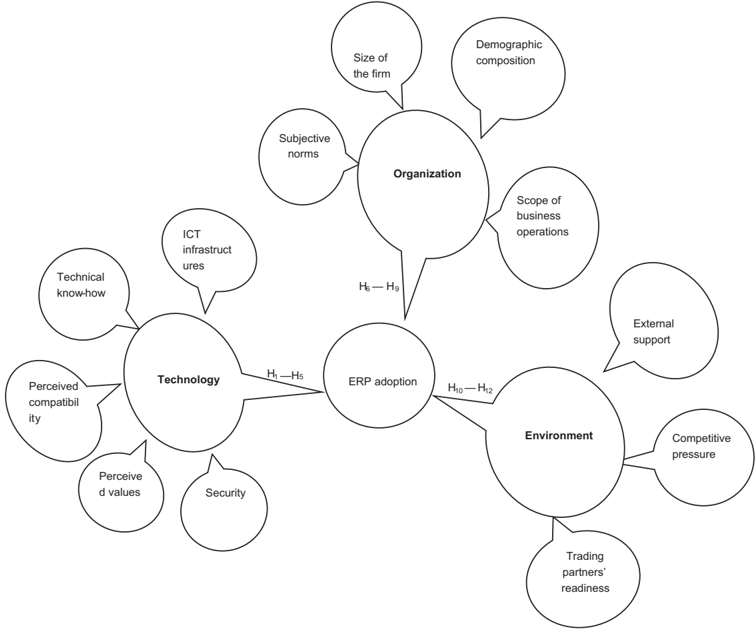
This paper provides further insight into IS adoption by investigating how 12 factors within the technology-organization-environment (T-O-E) framework explain SMEs’ adoption of enterprise resource planning (ERP) software. Survey data were collected from executives of SMEs drawn from six fast service enterprises with strong operations in Port Harcourt, Nigeria. Purposive and snow ball sampling was adopted and the proposed framework was tested using the logistic regression; specifically, the likelihood ratios, Hosmer and Lemeshow’s goodness of fit, and Nagelkerke R2 were used. The hypothesized relationships were supported at either p < 0.01 or 0.05 with each factor differing in its statistical coefficient and some bearing negative values; suggesting that some factors do not pose much threat to adopters but to non-adopters. Thus, adoption of ERP by SMEs is well-explained by T-O-E framework though it is more driven by technological factors than by organizational and environmental factors. Implicit is that the proposed model will be useful to IS vendors in making investment decisions and crafting marketing programs that appeal to non-adopters since they have more adoption challenges than adopters and to cause adopters to progress in the loyalty ladder.
Overview
CoChat Summary
TL;DR
This paper tests a 12-factor technology-organization-environment (T-O-E) model of enterprise resource planning (ERP) adoption among SMEs in Port Harcourt, Nigeria. It finds all 12 hypothesized factors supported at p < 0.01 or 0.05, with adoption more driven by technological factors than organizational or environmental factors.
Key findings
- The logistic model reported −2 log likelihood = 99.400, Hosmer and Lemeshow χ² = 5.670 (p = 0.817), Nagelkerke R² = 0.456, and overall prediction accuracy of 78.70% (178 adopters, 66 non-adopters).
- Positive coefficients were reported for ICT infrastructure (0.653), technical know-how (0.167), perceived compatibility (0.576), perceived values (0.459), security (0.686), and firm size (0.103); firm size was described as the most critical adoption driver at p < 0.05.
- Negative coefficients were reported for scope of business operations (−0.589), subjective norms (−0.634), competitive pressure (−0.495), external support (−0.480), trading partners’ readiness (−0.661), and demographic composition (−0.483); these were interpreted as critical adoption factors that pose less obstacle to adopters than to non-adopters.
- The paper concludes that ERP adoption by SMEs is well explained by the T-O-E framework but is more driven by technological factors than by organizational and environmental factors.
Methods
- Positivist, realist survey design; data collected from owners and executives of SMEs in six fast-growing service enterprises with strong operations in Port Harcourt, Nigeria; sampling frame was 373 owners/executives, with 244 returns.
- Purposive and snowball sampling were used; population criteria included at least 10 employees, huge ICT investment, annual turnover of five million naira or less, use of ERP to integrate operations, and registration with the Corporate Affairs Commission and other approved bodies.
- Analysis used logistic regression and Wald statistics, with likelihood ratios, Hosmer and Lemeshow’s goodness of fit, and Nagelkerke R²; factor analysis assessed validity and reliability, and collinearity diagnostics included tolerance, VIF, and Durbin-Watson (1.645).
Limitations
- The paper states that reliance on data from only the ICT industry and cross-sectional data limits generalizability; measures were subjective perceptions prone to common error biases; the study focuses on pre-adoption only; other factors outside T-O-E may affect ERP adoption; and PCA with varimax rotation was used, with future CFA, maximum likelihood, oblimin rotation, or second-order modeling suggested.
- Evident from the text: the non-probability purposive/snowball sampling and the single-city, six-service-enterprise sample further constrain generalizability.
- Evident from the text: there is an inconsistency in the reported sign for demographic composition—one passage lists it among positive coefficients, while later text and Table 5 report a negative coefficient.
Model-written summary. Check it against the paper before relying on it.
Integrity signals
Registry
Cites
Statistics
Figures






















Verification
Claims the paper makes
6 Valid · 3 Not valid · 45 Not checked · 57 Own results and interpretations
At least one cited source doesn’t support this claim or points to a different paper, and none confirmed it — see the verdicts below.
In the paper
“the extensive focus of TAM on technology to the neglect of social and psychological parameters (Agarwal & Prasad, 1998;Venkatesh & Bala, 2008) limits its explanatory and predictive utilities, and therefore demands its integration with other frameworks”
§ Using T-O-E theoretical framework to study the adoption of ERP solution > 1. Introduction
What the sources say
- Not checked — no full text of the sourcecites Agarwal & Prasad, 1998 matched to “A Conceptual and Operational Definition of Personal Innovativeness in the Domain of Information Technology” (1998) source
- Disputedcites Venkatesh & Bala, 2008 matched to “Technology Acceptance Model 3 and a Research Agenda on Interventions” (2008) sourceExperimental — accuracy not yet measured
The introductory discussion describes TAM as “highly predictive of IT adoption and use,” contrary to the claim that its predictive utility is limited. It identifies TAM’s commonly cited limitation as a lack of actionable guidance, not a neglect of social and psychological factors; the Theoretical Framework discusses social influence and individual differences in extensions of TAM. No page numbers are provided in our copy. (LLM, conf=0.86)
Checked by a reasoning model — may be wrong.
plainstates a cause- Asserted: passes — The authors put it forward as true.
- Checkable: passes — It can be checked against evidence.
- Load-bearing: passes — The paper’s conclusions depend on it.
- Based: passes — The paper gives a reason why it holds.
The cited sources support only part of this claim — read each source’s verdict below.
In the paper
“significant number of vendors principally targets large enterprises (Kumar & van Hillegersberg, 2000;Waarts, van Everdingen, & van Hillegersberg, 2002).”
§ Using T-O-E theoretical framework to study the adoption of ERP solution > 1. Introduction
What the sources say
- Partly supportedcites Kumar & van Hillegersberg, 2000 matched to “Enterprise resource planning: introduction” (2000) sourceExperimental — accuracy not yet measured
Section I I says most Fortune 500 companies had installed ERP systems while the midsize-company market remained relatively untapped. That supports the large-enterprise emphasis, but it does not establish that a significant number of vendors principally targeted large enterprises. (LLM, conf=0.78)
- Not checked — no full text of the sourcecites Waarts, van Everdingen, & van Hillegersberg, 2002 matched to “The dynamics of factors affecting the adoption of innovations” (2002) source
plain- Asserted: passes — The authors put it forward as true.
- Checkable: passes — It can be checked against evidence.
- Load-bearing: unclear — It is unclear whether the paper’s conclusions depend on it.
- Based: passes — The paper gives a reason why it holds.
- Partly supported
The cited sources support only part of this claim — read each source’s verdict below.
In the paper
“by integrating the constructs of environment, T-O-E framework provides a more superior theoretical analysis than IDT in studying technology adoption, use, and value creation (Gangwar et al., 2014;Hossain & Quaddus, 2011;Oliveira & Martins, 2011).”
§ Using T-O-E theoretical framework to study the adoption of ERP solution > 3. The T-O-E framework
What the sources say
- Not checked — no full text of the sourcecites Gangwar et al., 2014 matched to “Review on IT adoption: insights from recent technologies” (2014) source
- Not checked — no full text of the sourcecites Hossain & Quaddus, 2011 matched to “The adoption and continued usage intention of RFID: an integrated framework” (2011) source
- Partly supportedcites Oliveira & Martins, 2011 matched to “Literature Review of Information Technology Adoption Models at Firm Level” (2011)Experimental — accuracy not yet measured
Our copy does support the comparative core: the Conclusions (p. n/a) state that because the TOE framework includes the environment context, absent from DOI/IDT, it 'becomes better able to explain intra-firm innovation adoption; therefore, we consider this model to be more complete,' and the External task environment section repeats that TOE 'makes Rogers' innovation diffusion theory better able to explain intrafirm innovation diffusion.' However, the source frames the advantage as 'more complete' and limited to explaining adoption/assimilation at the firm level; it nowhere claims superiority for 'use, and value creation' (searched: value creation, adoption and assimilation, perceived benefits). The same Conclusions also hedge the comparison by recommending that for more complex technologies more than one model be combined, rather than TOE alone being superior. (LLM, conf=0.72)
plain- Asserted: passes — The authors put it forward as true.
- Checkable: unclear — It is unclear whether it could be checked against evidence.
- Load-bearing: passes — The paper’s conclusions depend on it.
- Based: passes — The paper gives a reason why it holds.
The cited sources support only part of this claim — read each source’s verdict below.
In the paper
“Scholars describe SBO as an adoption predicator; the greater the scope of business, the more likelihood enterprises invest to digitalize operations and to reduce internal co-ordination costs, administrative complexities, and information processing (Bakos, 1998;Chopra & Meindl, 2001;Hitt, 1999;Zhu et al., 2003).”
§ Using T-O-E theoretical framework to study the adoption of ERP solution > 4.2. Organization
What the sources say
- Could not verifycites Bakos, 1998 matched to “The emerging role of electronic marketplaces on the Internet” (1998) sourceExperimental — accuracy not yet measured
The Facilitation section (page unavailable) says electronic marketplaces improve information sharing and lower logistics costs between buyers and sellers. Our copy does not address whether a greater scope of business makes enterprises more likely to digitalize operations to reduce internal coordination costs, administrative complexity, or information processing; searches for business scope and internal coordination found no such passage. (LLM, conf=0.76)
- Not matchedcites Chopra & Meindl, 2001
An author–year citation the paper’s reference list doesn’t settle. We don’t search these by name.
- Supportedcites Hitt, 1999 matched to “Information Technology and Firm Boundaries: Evidence from Panel Data” (1999) source
Hitt (1999) supports the attributed proposition in the direction the claim states it: the Introduction reports that "firms that are less vertically integrated and more diversified have a higher demand for IT after controlling for other determinants of IT demand," and §5.4/§6.1 state that firms using coordination-intensive structures (i.e., broader scope/diversification) use substantially more IT, driven by "the demand for coordination activity" rather than mere size. The cost rationale also matches the paper: §2.1 defines internal coordination costs as "communications, data transfer, and other actual expenditures on managing dependencies between activities" and notes diversification "entails increased internal coordination costs because firms have to manage more complex and diverse activities," while the Introduction/hypotheses state IT lowers those coordination costs. One caveat worth noting is that Hitt finds only weaker/marginal support for the reverse causal path (IT causing greater diversification), but the claim attributes scope of business as a predictor of IT investment, which is the direction the paper does support. (LLM, conf=0.82)
hedgedstates a cause- Asserted: passes — The authors put it forward as true.
- Checkable: passes — It can be checked against evidence.
- Load-bearing: passes — The paper’s conclusions depend on it.
- Based: passes — The paper gives a reason why it holds.
- Could not verify
A result the paper reports from its own data — it cites no other source for it, so there is none to check. The quote shows it is in the paper.
In the paper
“Thus, adoption of ERP by SMEs is well-explained by T-O-E framework though it is more driven by technological factors than by organizational and environmental factors.”
- Also stated in: § 7. Discussion · plain
“The study found that adoption of ERP by SMEs is more driven by technological factors than by organizational and environmental factors.”
§ Using T-O-E theoretical framework to study the adoption of ERP solution > Abstract
plainstates a cause- Asserted: passes — The authors put it forward as true.
- Checkable: passes — It can be checked against evidence.
- Load-bearing: passes — The paper’s conclusions depend on it.
- Based: passes — The paper gives a reason why it holds.
- Also stated in: § 7. Discussion · plain
41 more claims
Create a free account to see all 111 claims and to verify the 8 references still open.
- Probably not a substantial claim. 23
- It may state two separate claims as one. 48
- Borderline: one of the tests for a substantial claim is unclear. 1
- The quote only partly states this claim. 1
Claims other papers make about this one
Each is checked against this paper’s own text: does it say what the citing paper says it does?
In the citing paper
“An organization’s preparedness to adopt AI determines how well an organization is prepared to fully realize the promise of an innovation (Awa et al., 2016).”
From Exploring the antecedents of AI adoption for effective HRM practices in the Indian pharmaceutical sector (2023) · cites this paper as Awa et al., 2016
Self-check
Percentages, sums and reported differences re-computed from the paper’s own numbers.
Each contradiction between two passages listed here was confirmed by an independent check.
Rated major: it would touch a result — a value a result rests on, reported and recomputed p-values on opposite sides of the significance level, two passages that conflict with no sign which is right, or a cited work retracted before this paper was published.
In the paper
§ Using T-O-E theoretical framework to study the adoption of ERP solution > 7. Discussion
“The 12 hypotheses were supported at either p < 0.01 or 0.05 with each factor differing in its statistical coefficient.”
§ Using T-O-E theoretical framework to study the adoption of ERP solution > 6.1. Measures
“ICT infrastructures 0.653 (0.314) 7.450 0.070* Technical know-how 0.167 (0.331) 2.541 0.072* Perceived compatibility 0.576 (0.302) 7.331 0.073*”
Rated major: it would touch a result — a value a result rests on, reported and recomputed p-values on opposite sides of the significance level, two passages that conflict with no sign which is right, or a cited work retracted before this paper was published.
In the paper
§ Using T-O-E theoretical framework to study the adoption of ERP solution > 5. Methods
“Other criteria used to define the population were that the SMEs must use ERP to integrate operations and be duly registered with Corporate Affairs Commission and other relevant government approved bodies.”
§ Using T-O-E theoretical framework to study the adoption of ERP solution > 6.1. Measures
“The table reports 178 adopters and 66 non-adopters;”
Rated major: it would touch a result — a value a result rests on, reported and recomputed p-values on opposite sides of the significance level, two passages that conflict with no sign which is right, or a cited work retracted before this paper was published.
In the paper
§ Using T-O-E theoretical framework to study the adoption of ERP solution > 6.1. Measures
“Discriminant validity is confirmed because the square roots of the AVE in the diagonal exceed the correlation between other constructs;”
§ Using T-O-E theoretical framework to study the adoption of ERP solution > 8. Conclusion and implications
“SN | 0.525 0.564 | 0.367 | 0.524 | 0.713 | 0.467 | 0.640 | 0.540 | 0.510 |”
Rated major: it would touch a result — a value a result rests on, reported and recomputed p-values on opposite sides of the significance level, two passages that conflict with no sign which is right, or a cited work retracted before this paper was published.
In the paper
“Overall 244 199 45 78.70”
§ Using T-O-E theoretical framework to study the adoption of ERP solution > 6.1. Measures
Reported 78.7 · recomputed 81.557377
Rated major: it would touch a result — a value a result rests on, reported and recomputed p-values on opposite sides of the significance level, two passages that conflict with no sign which is right, or a cited work retracted before this paper was published.
In the paper
§ Using T-O-E theoretical framework to study the adoption of ERP solution > 6.1. Measures
“others have significant positive coefficients (firm's size, security, perceived values, perceived compatibility, technical know-how, demographic composition, and ICT infrastructure).”
§ Using T-O-E theoretical framework to study the adoption of ERP solution > 6.1. Measures
“Demographic composition -0.483 (0.279) 2.330 0.070*”
3 more findings
Create a free account to see every finding of this check.
Citations
Cites
Evaluating Structural Equation Models with Unobservable Variables and Measurement Error
Fornell, C., & Larcker, D. F. (1981) · Journal of Marketing Research · doi:10.2307/3151312 · Cited by 109,314 · cited 2×
“…which a given construct shares more variance with its measures than other latent variables in the model (Hinkin, 1995; Sanchez & Roldan, 2005); thus, the square root of a construct’s AVE must be larger than the interconstruct correlations to ensure discriminant validity (Fornell & Larcker, 1981).”
BackgroundInfluentialEvaluating structural equation models with unobservable variables and measurement error
Fornell, C., & Larcker, D. F. (1981) · Journal of Marketing Research · doi:10.1177/002224378101800104 · Cited by 109,190
The theory of planned behavior
Ajzen, I. (1991) · Organizational Behavior and Human Decision Processes · doi:10.1016/0749-5978(91)90020-t · Cited by 90,587
Perceived usefulness, perceived ease of use, and user acceptance of information technology
Davis, F. D. (1989) · MIS Quarterly · doi:10.2307/249008 · Cited by 68,483 · cited 3×
“Among such models are: • technology acceptance model (TAM; Davis, 1989); • theory of reasoned action (TRA; Ajzen & Fishbein, 1980); • theory of planned behavior (TPB; Ajzen, 1991); • innovation diffusion theory (IDT; Rogers, 2003); • stage model (SM; Poon & Swatman, 1999); •…”
BackgroundHerne, H., Cooley, W. W., & Lohnes, P. R. (1973) · Journal of the Royal Statistical Society. Series A (General) · doi:10.2307/2344428 · Cited by 35,697
(1980) · Medical Entomology and Zoology · Cited by 25,810
A Theoretical Extension of the Technology Acceptance Model: Four Longitudinal Field Studies
Venkatesh, V., & Davis, F. D. (2000) · Management Science · doi:10.1287/mnsc.46.2.186.11926 · Cited by 23,066 · cited 2×
“Proposed IS frameworks factored in SBOs, size and size-related issues (Eze et al., 2013; Pang & Jang, 2008); social influences (Rogers, 2003; Venkatesh & Davis, 2000), individual difference factors (Hambrick & Mason, 1984), organizations’ mission (Awa et al., 2010), top management, available…”
Background(1997) · Chemometrics in Environmental Analysis · doi:10.1002/352760216x.ch5 · Cited by 18,653
Armstrong, J. S., & Georgoff, D. M. (1988) · International Journal of Forecasting · doi:10.1016/0169-2070(88)90019-2 · Cited by 17,894
An Index of Factorial Simplicity
Kaiser, H. F. (1974) · Psychometrika · doi:10.1007/bf02291575 · Cited by 14,898 · cited 1×
“Further, the observed components met Kaiser-Meyer-Olkin’s (KMO) benchmark (Kaiser, 1974) and the eigen-values of greater than one.”
MethodUpper Echelons: The Organization as a Reflection of Its Top Managers
Hambrick, D. C., & Mason, P. A. (1984) · The Academy of Management Review · doi:10.5465/amr.1984.4277628 · Cited by 10,220 · cited 4×
“Further, inquiries show that top management’s demographic differences affect technology adoption (Awa, Baridam et al., 2015; Chuang et al., 2009; Hambrick & Mason, 1984; Thong, 1999; Zhu et al., 2003).”
BackgroundMethodInfluentialMoore, G. C., & Benbasat, I. (1991) · Information Systems Research · doi:10.1287/isre.2.3.192 · Cited by 9,150 · cited 1×
“Many grounded adoption theories (e.g. TRA, IDT, and TPB) find practical utility in many disciplines, but they do not specifically target ICT acceptance as much as TAM and T-O-E frameworks (Moore & Benbasat, 1991).”
BackgroundUnderstanding information technology usage: a test of competing models
Taylor, S., & Todd, P. A. (1995) · Information Systems Research · doi:10.1287/isre.6.2.144 · Cited by 8,815 · cited 2×
“…Ritchie, 2007; Rogers, 2003; Samson & Hornby, 1988) on what members want from a group, we conceptualize subjective norms in terms of the functional and/or psychological influences of other peoples’ opinions, including those of superior and peer groups (Taylor & Todd, 1995; Venkatesh & Davis, 2000).”
BackgroundResultApplied Regression Analysis and Other Multivariable Methods
Walker, E. (1989) · Technometrics · doi:10.1080/00401706.1989.10488486 · Cited by 8,538
Technology Acceptance Model 3 and a Research Agenda on Interventions
Venkatesh, V., & Bala, H. (2008) · Decision Sciences · doi:10.1111/j.1540-5915.2008.00192.x · Cited by 8,159 · cited 2×
“…2001; Yoon & George, 2013; Zheng, Yen, & Tarn, 2011; Zhu, Kraemer, & Xu, 2003) and meets the contemporary scholarly demand (Barrett, Grant, & Wailes, 2006; Jacobsson & Linderoth, 2010; Venkatesh & Bala, 2008) for more social interactive systems that address the ordeals of deterministic system.”
BackgroundSPSS survival manual : a step by step guide to data analysis using SPSS
Pallant, J. (2010) · Cited by 6,888
Structural Equation Modeling and Regression: Guidelines for Research Practice
Gefen, D., Straub, D., & Boudreau, M.-C. (2000) · Communications of the Association for Information Systems · doi:10.17705/1cais.00407 · Cited by 6,416
Porter, M. E. (2000) · Cited by 5,814
Putting the enterprise into the enterprise system.
Davenport, T. H. (1998) · PubMed · Cited by 4,888
How information gives you competitive advantage
Porter, M. E., & Millar, V. A. (1985) · Cited by 4,416
Why do people use information technology? A critical review of the technology acceptance model
Legris, P., Ingham, J., & Collerette, P. (2003) · Information & Management · doi:10.1016/s0378-7206(01)00143-4 · Cited by 4,250 · cited 1×
“Legris, Ingham, and Collerette (2003) note that extant inquiries considered external determining factors without a clear pattern as to how they were chosen and/or conceptually measured.”
BackgroundInformation Rules: A Strategic Guide to the Network Economy
Shaw, M. J., Shapiro, C., & Varian, H. R. (2000) · The Academy of Management Review · doi:10.2307/259025 · Cited by 4,124
Agarwal, R., & Prasad, J. (1998) · Information Systems Research · doi:10.1287/isre.9.2.204 · Cited by 3,575 · cited 1×
“However, the extensive focus of TAM on technology to the neglect of social and psychological parameters (Agarwal & Prasad, 1998; Venkatesh & Bala, 2008) limits its explanatory and predictive utilities, and therefore demands its integration with other frameworks (Awa, Baridam et al., 2015; Shiau et…”
BackgroundA Review of Scale Development Practices in the Study of Organizations
Hinkin, T. R. (1995) · Journal of Management · doi:10.1177/014920639502100509 · Cited by 3,193 · cited 2×
“The discriminant validity describes the extent to which a given construct shares more variance with its measures than other latent variables in the model (Hinkin, 1995; Sanchez & Roldan, 2005); thus, the square root of a construct’s AVE must be larger than the interconstruct correlations to ensure discriminant validit…”
BackgroundA meta-analysis of the technology acceptance model
King, W. R., & He, J. (2006) · Information & Management · doi:10.1016/j.im.2006.05.003 · Cited by 2,906 · cited 1×
“Scholars (King & He, 2006; Oliveira & Martins, 2011) proposed individual, group/team, and organizational levels of adoption, and posit that TRA, TPB, and UTAUT predominantly predict individual adoption while TAM and TOE frameworks study technology adoption at organizational level.”
BackgroundInformation Rules: A Strategic Guide to the Network Economy
Becker, W. E., Shapiro, C., & Varian, H. R. (1999) · The Journal of Economic Education · doi:10.2307/1183273 · Cited by 2,557 · cited 1×
“Studies (Bakos, 1998; Chopra & Meindl, 2001; Gurbaxani & Whang, 1991; Shapiro & Varian, 1999) show that larger scope of business demands e-business to reduce costs, to integrate demand and improve inventory management and to benefit from synergy of modern applications and traditional business.”
BackgroundElectronic Data Interchange and Small Organizations: Adoption and Impact of Technology
Iacovou, C. L., Benbasat, I., & Dexter, A. S. (1995) · MIS Quarterly · doi:10.2307/249629 · Cited by 2,497
An Integrated Model of Information Systems Adoption in Small Businesses
Thong, J. Y. L. (1999) · Journal of Management Information Systems · doi:10.1080/07421222.1999.11518227 · Cited by 1,727 · cited 12×
“Whereas Grover (1993) found negative association between complexity and adoption of IS innovations, Thong (1999) found it a critical determinant in the context of small businesses.”
BackgroundResultInfluentialZhu, K., & Kraemer, K. L. (2005) · Information Systems Research · doi:10.1287/isre.1050.0045 · Cited by 1,723 · cited 7×
“Other studies (Hwang, Ku, Yen, & Cheng, 2004; Zhu & Kraemer, 2005; Zhu et al., 2003) emphasize that adoption is slower among smaller enterprises because they rarely possess economy of scale advantage and the facilitating slacks as well as the resilience to bear the associated risks and to encourage…”
BackgroundMethodInfluentialMusings on management. Ten ideas designed to rile everyone who cares about management.
Mintzberg, H. (1996) · PubMed · Cited by 1,720
Enterprise resource planning: Implementation procedures and critical success factors
Umble, E. J., Haft, R. R., & Umble, M. M. (2003) · European Journal of Operational Research · doi:10.1016/s0377-2217(02)00547-7 · Cited by 1,607
Unifying the fragmented models of information systems implementation
Kwon, T.-H., & Zmud, R. W. (1987) · John Wiley & Sons, Inc. eBooks · Cited by 1,463
The emerging role of electronic marketplaces on the Internet
Bakos, Y. (1998) · Communications of the ACM · doi:10.1145/280324.280330 · Cited by 1,386 · cited 6×
“Scholars describe SBO as an adoption predicator; the greater the scope of business, the more likelihood enterprises invest to digitalize operations and to reduce internal co-ordination costs, administrative complexities, and information processing (Bakos, 1998; Chopra & Meindl, 2001; Hitt, 1999; Zhu et al., 2003).”
BackgroundMethodInfluentialUniversity of British Columbia, C., Benbasat, I., Barki, H., & Montréal, H. (2007) · Journal of the Association for Information Systems · doi:10.17705/1jais.00126 · Cited by 1,363 · cited 2×
“…choice models (e.g. TAM, TRA, and TPB) are accused of illusion of accumulated tradition, attitudinal, utilitarianism (Al-Natour & Benbasat, 2009; Benbasat & Barki, 2007; Eze et al., 2013), technological determinism, and techno-centric predictions (Vankatesh, Davis, & Morris, 2007); hence,…”
BackgroundLiterature Review of Information Technology Adoption Models at Firm Level
(2011) · Portuguese National Funding Agency for Science, Research and Technology (RCAAP Project by FCT) · Cited by 1,341
Kuan, K. K. Y., & Chau, P. Y. K. (2001) · Information & Management · doi:10.1016/s0378-7206(01)00073-8 · Cited by 1,335 · cited 5×
“…theoretical perspective specific to IS domain; therefore, its variables have been severally tested on the adoption of several other technologies–EDI, KM, e-business, RFID, e-commerce, enterprise systems, and e-procurement (Kuan & Chau, 2001; Wang et al., 2010; Zhu, Kraemer, Xu, & Dedrick, 2004).”
BackgroundMethodInfluentialA Review of the Predictors, Linkages, and Biases in IT Innovation Adoption Research
Jeyaraj, A., Rottman, J. W., & Lacity, M. C. (2006) · Journal of Information Technology · doi:10.1057/palgrave.jit.2000056 · Cited by 1,136 · cited 7×
“Many studies recognize the strategic necessity of competitive pressure (Iacovou, Benbasat, & Dexter, 1995; Jeyaraj et al., 2006; Zhu et al., 2003; Zhu & Kraemer, 2005) in altering the rules of the games, restructuring the industry make-ups, and unraveling novelty in outperforming rivals (Porter & Millar, 1985).”
BackgroundMethodInfluentialElectronic commerce adoption: an empirical study of small and medium US businesses
Grandon, E. E., & Pearson, J. M. (2004) · Information & Management · doi:10.1016/j.im.2003.12.010 · Cited by 1,113 · cited 3×
“Previous studies (Grandon & Pearson, 2004; Mehrtens et al., 2001) suggest that innovation adoption is largely dependent upon its relative advantage over current practices.”
BackgroundAdoption of new information technologies in rural small businesses
Premkumar, G., & Roberts, M. (1999) · Omega · doi:10.1016/s0305-0483(98)00071-1 · Cited by 1,108 · cited 3×
“Others studies (Delone, 1988; Premkumar & Roberts, 1999) confirm external support as a critical adoption determinant.”
BackgroundFactors Affecting the Adoption of Open Systems: An Exploratory Study1
Chau, P. Y. K., & Tam, K. Y. (1997) · MIS Quarterly · doi:10.2307/249740 · Cited by 1,067 · cited 3×
“Eze et al. (2013) and Chau and Tam (1997) adopted T-O-E framework in their study and identified the innovation’s characteristics, organization’s technology, and external environment as quite useful in explaining and predicting adoption.”
BackgroundMethodZhu, K., Kraemer, K., & Xu, S. (2003) · European Journal of Information Systems · doi:10.1057/palgrave.ejis.3000475 · Cited by 1,043 · cited 21×
“Whereas some previous studies (Khemthong & Roberts, 2006; Al-Qirim, 2006; Zhu & Kraemer, 2002; Zhu et al., 2002, 2003) are consistent with this finding when they emphasize that the adoption of facilities is dependent upon the availability of internal and external technology resources, others…”
BackgroundMethodResultInfluentialTechnology acceptance model for wireless Internet
Lu, J., Yu, C., Liu, C., & Yao, J. E. (2003) · Internet Research · doi:10.1108/10662240310478222 · Cited by 991 · cited 6×
“Studies found security threat the most critical adoption barrier (Belkhamza & Wafa, 2009; Hua, 2009; Limthongchai & Speece, 2003; Miyazaki & Fernandez, 2000; Yang & Jun, 2002) and others (Cho, Kwon, & Lee, 2007; Lu et al., 2003; Luarn & Lin, 2005) suggest positive relationship between security trust in web transaction…”
BackgroundResultInfluentialThe impact of information systems on organizations and markets
Gurbaxani, V., & Whang, S. (1991) · Communications of the ACM · doi:10.1145/99977.99990 · Cited by 960 · cited 1×
“Studies (Bakos, 1998; Chopra & Meindl, 2001; Gurbaxani & Whang, 1991; Shapiro & Varian, 1999) show that larger scope of business demands e-business to reduce costs, to integrate demand and improve inventory management and to benefit from synergy of modern applications and traditional business.”
BackgroundHong, S., Thong, J. Y. L., & Tam, K. Y. (2006) · Decision Support Systems · doi:10.1016/j.dss.2006.03.009 · Cited by 955 · cited 3×
“…2013; Zheng et al., 2011; Zhu & Kraemer, 2005; Zhu et al., 2003) as well as validated inventory of psychometric measurements; and hence, it is more widely used in IS domain at the organizational level than alternative models (Gangwar et al., 2014; Hong et al., 2006; Hossain & Quaddus, 2011).”
BackgroundMethodChatterjee, D., Grewal, R., & Sambamurthy, V. (2002) · MIS Quarterly · doi:10.2307/4132321 · Cited by 945
The Journal of Internet Banking and Commerce
(2016) · The Journal of Internet Banking and Commerce · doi:10.4172/1204-5357 · Cited by 922
Understanding the determinants of RFID adoption in the manufacturing industry
Wang, Y.-M., Wang, Y.-S., & Yang, Y.-F. (2010) · Technological Forecasting and Social Change · doi:10.1016/j.techfore.2010.03.006 · Cited by 912 · cited 5×
“Unlike most other frameworks, scholars (Salwani et al., 2009; Wang et al., 2010; Wen & Chen, 2010) opine that T-O-E provides”
BackgroundMethodResultInfluentialInvestment in Enterprise Resource Planning: Business Impact and Productivity Measures
Hitt, L. M., Wu, D. J., & Zhou, X. (2002) · Journal of Management Information Systems · doi:10.1080/07421222.2002.11045716 · Cited by 877 · cited 2×
“, 2009), empirical evidence confirms that their dream to improve market positioning and to take advantage of governments’ support programs have lately precipitated SMEs to adopt ERP in some economies (Hitt et al., 2002; Lall & Teyarachakul, 2006; Ramdani, Kawalek, & Lorenzo, 2009).”
BackgroundPremkumar, G., & Ramamurthy, K. (1995) · Decision Sciences · doi:10.1111/j.1540-5915.1995.tb01431.x · Cited by 837 · cited 3×
“Previous studies found mixed result on the influence of competitive pressure on adoption (Premkumar & Ramamurthy, 1995; Zhu et al., 2003); some scholars suggest direct (Jeyaraj et al., 2006; Zhu & Kraemer, 2005) and others indirect (Lee, 2004; Thong, 1999) effects on adoption decision with the…”
BackgroundResultA model of Internet adoption by SMEs
Mehrtens, J., Cragg, P. B., & Mills, A. M. (2001) · Information & Management · doi:10.1016/s0378-7206(01)00086-6 · Cited by 826 · cited 1×
“Previous studies (Grandon & Pearson, 2004; Mehrtens et al., 2001) suggest that innovation adoption is largely dependent upon its relative advantage over current practices.”
Hyper-coordination via mobile phones in Norway
Ling, R., & Yttri, B. (2002) · Perpetual Contact · doi:10.1017/cbo9780511489471.013 · Cited by 793 · cited 3×
“Further, younger users of communication interfaces are subjected to social influences because they are at social development and learning stage of life (Ling & Yttri, 2002).”
BackgroundResultDead Or Alive? The Development, Trajectory And Future Of Technology Adoption Research.
University of Arkansas, Venkatesh, V., Davis, F., University of Arkansas, Morris, M., & University of Virginia (2007) · Journal of the Association for Information Systems · doi:10.17705/1jais.00120 · Cited by 789
Zhu, K., & Kraemer, K. L. (2002) · Information Systems Research · doi:10.1287/isre.13.3.275.82 · Cited by 779 · cited 4×
“Conceptually, we measure ICT infrastructure in terms of the number of computers owned, computers connected to the internet, and technical skills (Zhu & Kraemer, 2002; Zhu, Kraemer, & Xu, 2002).”
BackgroundResultInfluentialZHU, K., KRAEMER, K. L., & DEDRICK, J. (2004) · Journal of Management Information Systems · doi:10.1080/07421222.2004.11045797 · Cited by 775 · cited 3×
“Zhu et al. (2004) conclude that the technology-driven nature of IT-based innovations precipitates that enterprises that efficiently exploit the complexities of internet technologies and exhibit technology readiness are more likely to create values with ERP faster than others, who do not have such…”
BackgroundApplied Regression Analysis and Other Multivariate Methods.
Iversen, G. R., Kleinbaum, D. G., Kupper, L. L., & Muller, K. E. (1989) · Journal of the American Statistical Association · doi:10.2307/2289682 · Cited by 769
An Empirically Derived Model for the Adoption of Customer‐based Interorganizational Systems*
Grover, V. (1993) · Decision Sciences · doi:10.1111/j.1540-5915.1993.tb01295.x · Cited by 757 · cited 1×
“Whereas Grover (1993) found negative association between complexity and adoption of IS innovations, Thong (1999) found it a critical determinant in the context of small businesses.”
BackgroundDeterminants of success for computer usage in small business
DeLone, W. H. (1988) · MIS Quarterly · doi:10.2307/248803 · Cited by 703 · cited 2×
“Others studies (Delone, 1988; Premkumar & Roberts, 1999) confirm external support as a critical adoption determinant.”
BackgroundPerceived security and World Wide Web purchase intention
Salisbury, W. D., Pearson, R. A., Pearson, A. W., & Miller, D. W. (2001) · Industrial Management & Data Systems · doi:10.1108/02635570110390071 · Cited by 685
Information System Success: Individual and Organizational Determinants
Sabherwal, R., Jeyaraj, A., & Chowa, C. (2006) · Management Science · doi:10.1287/mnsc.1060.0583 · Cited by 685 · cited 1×
“For organizational factors, size was conceptualized by the number of employees, level of investment in ICT, and use of ERP software and other related applications to build competitive advantage (Jeyaraj et al., 2006; Metaxiotis, 2009; Pang & Jang, 2008; Sabherwal et al., 2006).”
MethodAn exploratory study of small business Internet commerce issues
Poon, S., & Swatman, P. M. C. (1999) · Information & Management · doi:10.1016/s0378-7206(98)00079-2 · Cited by 584 · cited 1×
“…action (TRA; Ajzen & Fishbein, 1980); • theory of planned behavior (TPB; Ajzen, 1991); • innovation diffusion theory (IDT; Rogers, 2003); • stage model (SM; Poon & Swatman, 1999); • technology-environment-organization (T-O-E; Tornatzky & Fleischer, 1990); and • resource-based view (Caldeira &…”
Predicting SMEs' adoption of enterprise systems
Ramdani, B., Kawalek, P., & Lorenzo, O. (2009) · Journal of Enterprise Information Management · doi:10.1108/17410390910922796 · Cited by 582 · cited 5×
“Previous literature (Federici, 2009; Metaxiotis, 2009; Ongori, 2009; Ramdani et al., 2009; Scupola, 2009) confirm that SMEs are the potent drivers of the informal sector as well as important sources of flexibility, local capital formation, innovations, improved living standards, and employment…”
BackgroundInfluentialCritical issues in information systems research
Yerkey, N. (1988) · Information Processing & Management · doi:10.1016/0306-4573(88)90058-1 · Cited by 578
Understanding it adoption decisions in small business: integrating current theories
Riemenschneider, C. K., Harrison, D. A., & Mykytyn, P. P. (2003) · Information & Management · doi:10.1016/s0378-7206(02)00010-1 · Cited by 570
MANAGERIAL AND ORGANIZATIONAL FACTORS ASSOCIATED WITH COMPANY PERFORMANCE PART I
Child, J. (1974) · Journal of Management Studies · doi:10.1111/j.1467-6486.1974.tb00693.x · Cited by 536 · cited 2×
“Other organizational conditions that influence ERP adoption include organizational resistance to change (Child, 1974), adoption without organizational readiness and proper change management (Motwani et al., 2002), poor implementation process (Umble, Haft, & Umble, 2003), and ineffective ERP systems…”
BackgroundA framework of ERP systems implementation success in China: An empirical study
Zhang, Z., Lee, M. K. O., Huang, P., Zhang, L., & Huang, X. (2005) · International Journal of Production Economics · doi:10.1016/j.ijpe.2004.09.004 · Cited by 510 · cited 1×
“Further psychometric assessment of survey instruments and scales confirmed internal consistency (Kim & Cha, 2002; Zhang et al., 2005) through inter-item consistency measure of Cronbach’s coefficient.”
BackgroundConsumer Perception of E-Service Quality: From Internet Purchaser and Non-Purchaser Perspectives
Yang, Z., & Jun, M. (1970) · Journal of Business Strategies · doi:10.54155/jbs.19.1.19-42 · Cited by 506 · cited 1×
“…security threat the most critical adoption barrier (Belkhamza & Wafa, 2009; Hua, 2009; Limthongchai & Speece, 2003; Miyazaki & Fernandez, 2000; Yang & Jun, 2002) and others (Cho, Kwon, & Lee, 2007; Lu et al., 2003; Luarn & Lin, 2005) suggest positive relationship between security trust in web…”
BackgroundCaldeira, M. M., & Ward, J. M. (2003) · European Journal of Information Systems · doi:10.1057/palgrave.ejis.3000454 · Cited by 471 · cited 1×
“…(TRA; Ajzen & Fishbein, 1980); • theory of planned behavior (TPB; Ajzen, 1991); • innovation diffusion theory (IDT; Rogers, 2003); • stage model (SM; Poon & Swatman, 1999); • technology-environment-organization (T-O-E; Tornatzky & Fleischer, 1990); and • resource-based view (Caldeira & Ward, 2003).”
A Meta-Analysis of Research on Information Technology Implementation in Small Business
Premkumar, G. (2003) · Journal of Organizational Computing and Electronic Commerce · doi:10.1207/s15327744joce1302_2 · Cited by 444 · cited 3×
“This confirms previous studies (Khemthong & Roberts, 2006; Lertwongsatien & Wongpinunwatana, 2003; Premkumar, 2003; Tornatzky & Fleischer, 1990) that found perceived compatibility a critical adoption predictor.”
BackgroundResultAwa, H. O., Ojiabo, O. U., & Emecheta, B. C. (2015) · Journal of Science & Technology Policy Management · doi:10.1108/jstpm-04-2014-0012 · Cited by 427
Self-citationFactors influencing corporate web site adoption: a time-based assessment
Beatty, R. C., Shim, J. P., & Jones, M. C. (2001) · Information & Management · doi:10.1016/s0378-7206(00)00064-1 · Cited by 421
Enterprise information systems project implementation:
Yusuf, Y., Gunasekaran, A., & Abthorpe, M. S. (2004) · International Journal of Production Economics · doi:10.1016/j.ijpe.2003.10.004 · Cited by 414
Pan, M.-J., & Jang, W.-Y. (2008) · Journal of Computer Information Systems · doi:10.1080/08874417.2008.11646025 · Cited by 410
Customer Trust in the Salesperson
Swan, J. E., Bowers, M. R., & Richardson, L. D. (1999) · Journal of Business Research · doi:10.1016/s0148-2963(97)00244-0 · Cited by 402
Economics and Electronic Commerce: Survey and Directions for Research
Kauffman, R. J., & Walden, E. A. (2001) · International Journal of Electronic Commerce · doi:10.1080/10864415.2001.11044222 · Cited by 386 · cited 1×
“The contexts are technology development (Kauffman & Walden, 2001); organizational conditions, business and organizational reconfiguration (Chatterjee, Grewal, & Sambamurthy, 2002); and Page 5 of 23 industry environment (Kowath & Choon, 2001).”
BackgroundEnterprise resource planning: introduction
Kumar, K., & van Hillegersberg, J. (2000) · Communications of the ACM · doi:10.1145/332051.332063 · Cited by 372
Successful implementation of ERP projects: Evidence from two case studies
Motwani, J., Mirchandani, D., Madan, M., & Gunasekaran, A. (2002) · International Journal of Production Economics · doi:10.1016/s0925-5273(01)00183-9 · Cited by 371 · cited 2×
“Other organizational conditions that influence ERP adoption include organizational resistance to change (Child, 1974), adoption without organizational readiness and proper change management (Motwani et al., 2002), poor implementation process (Umble, Haft, & Umble, 2003), and ineffective ERP systems (Lall & Teyarachaku…”
BackgroundAntecedents and consequences of relationship quality in hotel industry
Kim, W. G., & Cha, Y. (2002) · International Journal of Hospitality Management · doi:10.1016/s0278-4319(02)00011-7 · Cited by 365 · cited 1×
“Further psychometric assessment of survey instruments and scales confirmed internal consistency (Kim & Cha, 2002; Zhang et al., 2005) through inter-item consistency measure of Cronbach’s coefficient.”
BackgroundInternet privacy concerns confirm the case for intervention
Clarke, R. (1999) · Communications of the ACM · doi:10.1145/293411.293475 · Cited by 357 · cited 1×
“Security is a critical adoption issue and was measured by data security and absence of threat of yahoo-yahoo boys breaking into personal information privacy (Clarke, 1999; Swan, Bowers, & Richardson, 1999).”
BackgroundCritical factors for successful ERP implementation: Exploratory findings from four case studies
Motwani, J., Subramanian, R., & Gopalakrishna, P. (2005) · Computers in Industry · doi:10.1016/j.compind.2005.02.005 · Cited by 354 · cited 1×
“…2004), financial and economic benefits (Matolcsy, Booth, & Weider, 2005; Nicolaou, Stratopoulos, & Dehning, 2003), success measurement (Wu & Wang, 2006), critical success factors (Maguire et al., 2007; Motwani & Subramanian, 2005), to extended ERP modules (Metaxiotis, Psarras, & Ergazakis, 2003).”
Information Technology and Firm Boundaries: Evidence from Panel Data
Hitt, L. M. (1999) · Information Systems Research · doi:10.1287/isre.10.2.134 · Cited by 341 · cited 3×
“…SBO as an adoption predicator; the greater the scope of business, the more likelihood enterprises invest to digitalize operations and to reduce internal co-ordination costs, administrative complexities, and information processing (Bakos, 1998; Chopra & Meindl, 2001; Hitt, 1999; Zhu et al., 2003).”
BackgroundSon, J.-Y., & Benbasat, I. (2007) · Journal of Management Information Systems · doi:10.2753/mis0742-1222240102 · Cited by 338
Internet Privacy and Security: An Examination of Online Retailer Disclosures
Miyazaki, A. D., & Fernandez, A. (2000) · Journal of Public Policy & Marketing · doi:10.1509/jppm.19.1.54.16942 · Cited by 337 · cited 1×
“Studies found security threat the most critical adoption barrier (Belkhamza & Wafa, 2009; Hua, 2009; Limthongchai & Speece, 2003; Miyazaki & Fernandez, 2000; Yang & Jun, 2002) and others (Cho, Kwon, & Lee, 2007; Lu et al., 2003; Luarn & Lin, 2005) suggest positive relationship between security…”
BackgroundMartin, L. M., & Matlay, H. (2001) · Internet Research · doi:10.1108/eum0000000006118 · Cited by 326 · cited 1×
“Often small size explains the inability to commit resources, to assign ERP tools to something different from short-run operating issues, and to understand ERP’s benefits (Martin & Matlay, 2001; Metaxiotis, 2009).”
BackgroundEnterprise resource planning: ERP adoption by European midsize companies
van Everdingen, Y., van Hillegersberg, J., & Waarts, E. (2000) · Communications of the ACM · doi:10.1145/332051.332064 · Cited by 322
Factors Influencing e-commerce Adoption and Use by Small and Medium Businesses
Wymer, S., & Regan, E. (2005) · Electronic Markets · doi:10.1080/10196780500303151 · Cited by 320 · cited 2×
“Most new ICT technologies turn the world flat, remove the competitive disadvantages and geographic isolation of small enterprises (Wymer & Regan, 2005), and offer the adopting enterprises the opportunity to build competitive advantages across the globe.”
BackgroundSMEs' e‐commerce adoption: perspectives from Denmark and Australia
Scupola, A. (2009) · Journal of Enterprise Information Management · doi:10.1108/17410390910932803 · Cited by 306 · cited 17×
“…organizations’ mission (Awa et al., 2010), top management, available expertise, type of products offered, corporate culture and ownership structure (Scupola, 2009; Sheridan, 1994) and facilitating conditions (Tornatzky & Fleischer, 1990); and information sources and communication channels…”
BackgroundMethodInfluentialBenefits and barriers of electronic marketplace participation: an SME perspective
Stockdale, R., & Standing, C. (2004) · Journal of Enterprise Information Management · doi:10.1108/17410390410548715 · Cited by 296 · cited 1×
“SMEs are more adaptable and responsive to changes than large firms and often benefit from the speed and operational agility offered by the electronic environment (Metaxiotis, 2009; Stockdale & Standing, 2004).”
BackgroundIT innovation adoption in the government sector: identifying the critical success factors
Kamal, M. M. (2006) · Journal of Enterprise Information Management · doi:10.1108/17410390610645085 · Cited by 291 · cited 1×
“Size is an environmental and organizational issue (Kamal, 2006) though it measures the size of the community served and the number of services provided (Akbulut, 2002).”
BackgroundReview on IT adoption: insights from recent technologies
Gangwar, H., Date, H., & Raoot, A. D. (2014) · Journal of Enterprise Information Management · doi:10.1108/jeim-08-2012-0047 · Cited by 289 · cited 6×
“, 2003) as well as validated inventory of psychometric measurements; and hence, it is more widely used in IS domain at the organizational level than alternative models (Gangwar et al., 2014; Hong et al., 2006; Hossain & Quaddus, 2011).”
BackgroundMethodInfluentialWeb acceptance and usage model: A comparison between goal‐directed and experiential web users
Sánchez‐Franco, M. J., & Roldán, J. L. (2005) · Internet Research · doi:10.1108/10662240510577059 · Cited by 288 · cited 1×
“…describes the extent to which a given construct shares more variance with its measures than other latent variables in the model (Hinkin, 1995; Sanchez & Roldan, 2005); thus, the square root of a construct’s AVE must be larger than the interconstruct correlations to ensure discriminant…”
BackgroundE-Commerce Adoption in Thailand: An Empirical Study of Small and Medium Enterprises (SMEs)
Lertwongsatien, C., & Wongpinunwatana, N. (2003) · Journal of Global Information Technology Management · doi:10.1080/1097198x.2003.10856356 · Cited by 282 · cited 1×
“This confirms previous studies (Khemthong & Roberts, 2006; Lertwongsatien & Wongpinunwatana, 2003; Premkumar, 2003; Tornatzky & Fleischer, 1990) that found perceived compatibility a critical adoption predictor.”
ResultSupporting the e‐business readiness of small and medium‐sized enterprises: approaches and metrics
Jutla, D., Bodorik, P., & Dhaliwal, J. (2002) · Internet Research · doi:10.1108/10662240210422512 · Cited by 276
TRUSTe: an online privacy seal program
Benassi, P. (1999) · Communications of the ACM · doi:10.1145/293411.293461 · Cited by 267 · cited 2×
“People are less likely to use the internet facilities in more advanced forms due to security concerns and access issues (Shafi, 2002); often they leave websites when their personal information is requested for (Benassi, 1999; Green, 1997).”
BackgroundResultAlam, S. S., Ali, M. Y., & Jani, M. F. M. (2011) · Journal of Business Economics and Management · doi:10.3846/16111699.2011.576749 · Cited by 254
Introduction to the Special Issue: Mobile Commerce Applications
Liang, T.-P., & Wei, C.-P. (2004) · International Journal of Electronic Commerce · doi:10.1080/10864415.2004.11044303 · Cited by 234 · cited 2×
“…2009; Hua, 2009; Limthongchai & Speece, 2003; Miyazaki & Fernandez, 2000; Yang & Jun, 2002) and others (Cho, Kwon, & Lee, 2007; Lu et al., 2003; Luarn & Lin, 2005) suggest positive relationship between security trust in web transactions and customer attitude, intention to buy, and purchase…”
BackgroundResultHwang, H.-G., Ku, C.-Y., Yen, D. C., & Cheng, C.-C. (2004) · Decision Support Systems · doi:10.1016/s0167-9236(02)00191-4 · Cited by 228 · cited 1×
“Other studies (Hwang et al., 2004; Zhu & Kraemer, 2005; Zhu et al., 2003) emphasize that smaller enterprises often lack the requisite resources to be entrepreneurial.”
BackgroundThe dynamics of factors affecting the adoption of innovations
Waarts, E., van Everdingen, Y. M., & van Hillegersberg, J. (2002) · Journal of Product Innovation Management · doi:10.1016/s0737-6782(02)00175-3 · Cited by 225
Determinants of Web site implementation in small businesses
Raymond, L. (2001) · Internet Research · doi:10.1108/10662240110410363 · Cited by 213 · cited 2×
“…anticipate and respond to macro and micro environmental factors (Abell, 1978) as they often pose opportunities and threats as well as strengths and threats (SWOT) to their enterprises and shape their propensity to innovate and/or to engage in strategic and/or tactical programs (Raymond, 2001).”
BackgroundE‐commerce usage and business performance in the Malaysian tourism sector: empirical analysis
Intan Salwani, M., Marthandan, G., Daud Norzaidi, M., & Choy Chong, S. (2009) · Information Management & Computer Security · doi:10.1108/09685220910964027 · Cited by 202 · cited 2×
“Unlike most other frameworks, scholars (Salwani et al., 2009; Wang et al., 2010; Wen & Chen, 2010) opine that T-O-E provides Page 6 of 23 a more holistic insight (without minding size and industry constraints) into adoption challenges and adoption factors, value-chain activities, adoption processes…”
ResultDeterminants of website development: a study of electronic commerce in Singapore
Rao Kowtha, N., & Whai Ip Choon, T. (2001) · Information & Management · doi:10.1016/s0378-7206(01)00092-1 · Cited by 193 · cited 1×
“The contexts are technology development (Kauffman & Walden, 2001); organizational conditions, business and organizational reconfiguration (Chatterjee, Grewal, & Sambamurthy, 2002); and Page 5 of 23 industry environment (Kowath & Choon, 2001).”
BackgroundOECD Small and Medium Enterprise Outlook 2002
OECD (2002) · OECD small and medium enterprise outlook · doi:10.1787/sme_outlook-2002-en · Cited by 192
Lee, J. (2016) · Journal of Computer Information Systems · doi:10.1080/08874417.2004.11647596 · Cited by 191 · cited 3×
“, 2006; Zhu & Kraemer, 2005) and others indirect (Lee, 2004; Thong, 1999) effects on adoption decision with the proposition that organization’s willingness to adopt an innovation is largely dependent upon her internal necessity for it (Premkumar & Ramamurthy, 1995).”
BackgroundStrategic Windows: The time to invest in a product or market is when a ‘strategic window’ is open.
Abell, D. F. (1978) · Journal of Marketing · doi:10.1177/002224297804200307 · Cited by 184 · cited 2×
“Environment Strategists anticipate and respond to macro and micro environmental factors (Abell, 1978) as they often pose opportunities and threats as well as strengths and threats (SWOT) to their enterprises and shape their propensity to innovate and/or to engage in strategic and/or tactical programs (Raymond, 2001).”
BackgroundAligning ERP implementation with competitive priorities of manufacturing firms: An exploratory study
Yen, H. R., & Sheu, C. (2004) · International Journal of Production Economics · doi:10.1016/j.ijpe.2003.08.014 · Cited by 182 · cited 2×
“The contemporary global economy emphasizes proficient use of human intellectual capital and technology to integrate processes, support enterprise strategies, optimize resources and ultimately to build competitive advantage (Metaxiotis, 2009; Pang & Jang, 2008; Yen & Sheu, 2004).”
BackgroundMethodWhy aren’t organizations adopting virtual worlds?
Yoon, T. E., & George, J. F. (2013) · Computers in Human Behavior · doi:10.1016/j.chb.2012.12.003 · Cited by 178 · cited 2×
“…in IS field more than other adoption frameworks (e.g. TAM, IDT, TRA, SM, and TPB) (Henriksen, 2006; Hong, Thong, & Tam, 2006; Kuan & Chau, 2001; Yoon & George, 2013; Zheng, Yen, & Tarn, 2011; Zhu, Kraemer, & Xu, 2003) and meets the contemporary scholarly demand (Barrett, Grant, & Wailes, 2006;…”
BackgroundChuang, T., Nakatani, K., & Zhou, D. (2009) · Journal of Enterprise Information Management · doi:10.1108/17410390910932821 · Cited by 176 · cited 2×
“Further, inquiries show that top management’s demographic differences affect technology adoption (Awa, Baridam et al., 2015; Chuang et al., 2009; Hambrick & Mason, 1984; Thong, 1999; Zhu et al., 2003).”
BackgroundSauder School of Business, U. O. B. C., Al-Natour, S., Benbasat, I., & University of British Columbia (2009) · Journal of the Association for Information Systems · doi:10.17705/1jais.00208 · Cited by 173 · cited 2×
“Often rational choice models (e.g. TAM, TRA, and TPB) are accused of illusion of accumulated tradition, attitudinal, utilitarianism (Al-Natour & Benbasat, 2009; Benbasat & Barki, 2007; Eze et al., 2013), technological determinism, and techno-centric predictions (Vankatesh, Davis, & Morris, 2007);…”
BackgroundMethodMeasuring ERP success: the ultimate users' view
Wu, J., & Wang, Y. (2006) · International Journal of Operations & Production Management · doi:10.1108/01443570610678657 · Cited by 172 · cited 1×
“…2004), financial and economic benefits (Matolcsy, Booth, & Weider, 2005; Nicolaou, Stratopoulos, & Dehning, 2003), success measurement (Wu & Wang, 2006), critical success factors (Maguire et al., 2007; Motwani & Subramanian, 2005), to extended ERP modules (Metaxiotis, Psarras, & Ergazakis,…”
Potential of critical e-applications for engaging SMEs in e-business: a provider perspective
Brown, D. H., & Lockett, N. (2004) · European Journal of Information Systems · doi:10.1057/palgrave.ejis.3000480 · Cited by 170
Jacobsson, M., & Linderoth, H. C. J. (2010) · Construction Management and Economics · doi:10.1080/01446190903406154 · Cited by 159 · cited 1×
“…2001; Yoon & George, 2013; Zheng, Yen, & Tarn, 2011; Zhu, Kraemer, & Xu, 2003) and meets the contemporary scholarly demand (Barrett, Grant, & Wailes, 2006; Jacobsson & Linderoth, 2010; Venkatesh & Bala, 2008) for more social interactive systems that address the ordeals of deterministic system.”
BackgroundInformation Resources Management Journal
Kelley, G. (2026) · Information Resources Management Journal · doi:10.4018/irmj · Cited by 157
A conceptualisation of the opportunities and barriers to e‐business development in the smaller firm
Fillis, I., Johansson, U., & Wagner, B. (2003) · Journal of Small Business and Enterprise Development · doi:10.1108/14626000310489808 · Cited by 146
A benefits realisation road‐map framework for ERP usage in small and medium‐sized enterprises
Esteves, J. (2009) · Journal of Enterprise Information Management · doi:10.1108/17410390910922804 · Cited by 146 · cited 1×
“Scholars (Esteves, 2009; Zhang, Lee, Huang, Zhang, & Huang, 2005) collapsed the efficiency and legitimacy syndromes when they propose that successful implementation of ERP systems improves product quality, operational efficiency and consistency, customer service and customer friendliness, and…”
BackgroundDECISION CRITERIA IN THE ADOPTION OF EDI
Bouchard, L. (1993) · Journal of the Association for Information Systems · Cited by 143
The adoption of e‐business and knowledge management in SMEs
Maguire, S., Koh, S. C. L., & Magrys, A. (2007) · Benchmarking: An International Journal · doi:10.1108/14635770710730928 · Cited by 139 · cited 4×
“Nevertheless, Maguire et al. (2007) confirm the growing use of ERP by SMEs to gain competitive advantage.”
BackgroundInfluentialMultiple Conceptualizations of Small Business Web Use and Benefit*
Pflughoeft, K. A., Ramamurthy, K., Soofi, E. S., Yasai‐Ardekani, M., & Zahedi, F. (. (2003) · Decision Sciences · doi:10.1111/j.1540-5414.2003.02539.x · Cited by 139 · cited 5×
“The finding supports studies that propose that ERP and other related technologies demand integrated and electronically compatible trading systems (Pflughoeft et al., 2003; Sinkkonen, 2001) and disagrees”
BackgroundResultInfluentialKannabiran, G., & Dharmalingam, P. (2012) · Journal of Enterprise Information Management · doi:10.1108/17410391211204419 · Cited by 136 · cited 1×
“…et al., 2010), top management, available expertise, type of products offered, corporate culture and ownership structure (Scupola, 2009; Sheridan, 1994) and facilitating conditions (Tornatzky & Fleischer, 1990); and information sources and communication channels (Kannabiran & Dharmalingam, 2012).”
BackgroundThe adoption and continued usage intention of RFID: an integrated framework
Alamgir Hossain, M., & Quaddus, M. (2011) · Information Technology & People · doi:10.1108/09593841111158365 · Cited by 134 · cited 5×
“…2013; Zheng et al., 2011; Zhu & Kraemer, 2005; Zhu et al., 2003) as well as validated inventory of psychometric measurements; and hence, it is more widely used in IS domain at the organizational level than alternative models (Gangwar et al., 2014; Hong et al., 2006; Hossain & Quaddus, 2011).”
BackgroundMethodInfluentialGengatharen, D. E., & Standing, C. (2005) · European Journal of Information Systems · doi:10.1057/palgrave.ejis.3000551 · Cited by 129 · cited 1×
“Scholars proposed that ERP software levels the playing field; it offers SMEs a considerable opportunity to compete more effectively with their rivals, including large ones (Gengatharen & Standing, 2005; Levy, Powell, & Worrall, 2005).”
BackgroundDevelopment of measures to assess the ERP adoption of small and medium enterprises
Shiau, W., Hsu, P., & Wang, J. (2009) · Journal of Enterprise Information Management · doi:10.1108/17410390910922859 · Cited by 129 · cited 10×
“Prasad, 1998; Venkatesh & Bala, 2008) limits its explanatory and predictive utilities, and therefore demands its integration with other frameworks (Awa, Baridam et al., 2015; Shiau et al., 2009).”
BackgroundInfluential(2008) · Journal of Nursing Management · doi:10.1111/j.1365-2834.1998.00001.x · Cited by 124
Analysis of Trust in Internet and Mobile Commerce Adoption
Cho, D.-Y., Kwon, H. J., & Lee, H.-Y. (2007) · 2007 40th Annual Hawaii International Conference on System Sciences (HICSS'07) · doi:10.1109/hicss.2007.76 · Cited by 120 · cited 2×
“It is a critical adoption factor in central and local governments (Cho et al., 2007; Tornatzky & Fleischer, 1990); firms in larger cities adopt more sophisticated technologies than those in smaller cities (Norris, 1999).”
BackgroundResultFactors influencing ERP outcomes in SMEs: a post‐introduction assessment
Federici, T. (2009) · Journal of Enterprise Information Management · doi:10.1108/17410390910922840 · Cited by 116 · cited 4×
“Scholars (Federici, 2009; Maguire, Koh, & Magrys, 2007; Shiau et al., 2009) posit that such integration and support provide enterprises with opportunities to reduce costs and improve operational efficiencies and customer service through circle time and lead-time compression, data integration, fewer…”
BackgroundInfluentialICT and Organizational Change: Introduction to the Special Issue
Barrett, M., Grant, D., & Wailes, N. (2006) · The Journal of Applied Behavioral Science · doi:10.1177/0021886305285299 · Cited by 115
Assessing Belief Differences in Small Business Adopters and Non-Adopters of Web-Based E-Commerce
Riemenschneider, C. K., & McKinney, V. R. (2002) · Journal of Computer Information Systems · doi:10.1080/08874417.2002.11647494 · Cited by 115 · cited 1×
“…owner’s enthusiasm and growth ambition (Fillis, Johansson, & Wagner, 2003), top management support and managerial productivity (Grandon & Pearson, 2004), managers’ belief differences (Riemenschneider & McKinney, 2002), and CEO’s knowledge and characteristics (Shiau et al., 2009; Thong, 1999).”
BackgroundProcess mapping in successful ERP implementations
Okrent, M. D., & Vokurka, R. J. (2004) · Industrial Management & Data Systems · doi:10.1108/02635570410561618 · Cited by 114 · cited 1×
“ERP studies investigate different aspects of adoption ranging from implementation (Alsène, 2007; Okrent & Vokurka, 2004), financial and economic benefits (Matolcsy, Booth, & Weider, 2005; Nicolaou, Stratopoulos, & Dehning, 2003), success measurement (Wu & Wang, 2006), critical success factors…”
BackgroundStrategic Intent and E-Business in SMEs: Enablers and Inhibitors
Levy, M., Powell, P., & Worrall, L. (2005) · Information Resources Management Journal · doi:10.4018/irmj.2005100101 · Cited by 110
Organizational factors that support the implementation of a nursing Best Practice Guideline
MARCHIONNI, C., & RITCHIE, J. (2008) · Journal of Nursing Management · doi:10.1111/j.1365-2834.2007.00775.x · Cited by 107 · cited 2×
“Social participation, group cohesiveness, and social mobility presuppose moving from functional to psychological motives and of course the adoption of untried technologies (Choudrie & Dwivedi, 2005; Marchionni & Ritchie, 2007; Rogers, 2003).”
BackgroundAkbulut, A. Y. (2003) · Louisiana State University · doi:10.31390/gradschool_dissertations.877 · Cited by 103
Economic benefits of enterprise resource planning systems: some empirical evidence
Matolcsy, Z. P., Booth, P., & Wieder, B. (2005) · Accounting and Finance · doi:10.1111/j.1467-629x.2005.00149.x · Cited by 103
A System Development Methodology for ERP Systems
Ahituv, N., Neumann, S., & Zviran, M. (2002) · Journal of Computer Information Systems · doi:10.1080/08874417.2002.11647504 · Cited by 102 · cited 1×
“Ahituv et al. (2002) and Huang, Hung, Chen, and Ku (2004) assert that many SMEs find it difficult to take full potential benefits of ERP solution because its implementation is technically complex and demands huge investment in internal resources.”
BackgroundBusiness Statistics in Practice
(2001) · Technometrics · doi:10.1198/tech.2001.s638 · Cited by 90
Choudrie, J., & Dwivedi, Y. K. (2005) · Journal of Computer Information Systems · doi:10.1080/08874417.2005.11645860 · Cited by 85 · cited 1×
“Social participation, group cohesiveness, and social mobility presuppose moving from functional to psychological motives and of course the adoption of untried technologies (Choudrie & Dwivedi, 2005; Marchionni & Ritchie, 2007; Rogers, 2003).”
BackgroundEze, S. C., Awa, H. O., Okoye, J. C., Emecheta, B. C., & Anazodo, R. O. (2013) · Journal of Enterprise Information Management · doi:10.1108/jeim-05-2013-0024 · Cited by 81 · cited 10×
“TAM, TRA, and TPB) are accused of illusion of accumulated tradition, attitudinal, utilitarianism (Al-Natour & Benbasat, 2009; Benbasat & Barki, 2007; Eze et al., 2013), technological determinism, and techno-centric predictions (Vankatesh, Davis, & Morris, 2007); hence, technology, rather than individuals, determines a…”
BackgroundMethodInfluentialSelf-citationThe Adoption of Innovation by Local Government, by Richard D. Bingham and Thomas P. McNaught
Mohr, L. B. (1977) · Political Science Quarterly · doi:10.2307/2148878 · Cited by 79 · cited 3×
“Within environmental context, competitive pressure was conceptualized by enterprise’s behavior on Research and Development (R&D), domestic and overseas ICT talent, and developing related applications/services (Pang & Jang, 2008); and external support by the extent of encouragement from governments and non-governmental…”
BackgroundMethodE-Readiness Assessment of Small and Medium Enterprises in Egypt: A Micro Study
Rizk, N. (2004) · Topics in Middle Eastern andNorth African Economies · Cited by 78
(2012) · RePEc: Research Papers in Economics · Cited by 76
(2004) · Journal of Computer Information Systems · doi:10.1080/08874417.2004.11647601 · Cited by 74
The Effect of Perceived Characteristics of Innovation on E-Commerce Adoption by SMEs in ThailandPreprint
Limthongchai, P., & Speece, M. W. (2015) · SSRN Electronic Journal · doi:10.2139/ssrn.2565392 · Cited by 72 · cited 1×
“Studies found security threat the most critical adoption barrier (Belkhamza & Wafa, 2009; Hua, 2009; Limthongchai & Speece, 2003; Miyazaki & Fernandez, 2000; Yang & Jun, 2002) and others (Cho, Kwon, & Lee, 2007; Lu et al., 2003; Luarn & Lin, 2005) suggest positive relationship between security…”
BackgroundExploring the rationales for ERP and knowledge management integration in SMEs
Metaxiotis, K. (2009) · Journal of Enterprise Information Management · doi:10.1108/17410390910922822 · Cited by 72 · cited 9×
“The contemporary global economy emphasizes proficient use of human intellectual capital and technology to integrate processes, support enterprise strategies, optimize resources and ultimately to build competitive advantage (Metaxiotis, 2009; Pang & Jang, 2008; Yen & Sheu, 2004).”
BackgroundMethodInfluentialZheng, S., Yen, D. C., & Tarn, J. M. (2000) · Journal of Computer Information Systems · doi:10.1080/08874417.2000.11646980 · Cited by 71 · cited 1×
“…substantial theoretical and empirical supports (see Eze et al., 2013; Henriksen, 2006; Hong et al., 2006; Kuan & Chau, 2001; Yoon & George, 2013; Zheng et al., 2011; Zhu & Kraemer, 2005; Zhu et al., 2003) as well as validated inventory of psychometric measurements; and hence, it is more widely…”
BackgroundDemographic determinants of electronic commerce (EC) adoption by SMEs: A twist by location factors
Awa, H. O., Baridam, D. M., & Nwibere, B. M. (2015) · Journal of Enterprise Information Management · doi:10.1108/jeim-10-2013-0073 · Cited by 70
Self-citationEvaluating Mid-Level ERP Software
Fisher, D. M., Kiang, M. Y., Fisher, S. A., & Robert, T. H. (2004) · Journal of Computer Information Systems · doi:10.1080/08874417.2004.11645815 · Cited by 69
Journal of Electronic Commerce in Organizations
Isaías, P. (2026) · Journal of Electronic Commerce in Organizations · doi:10.4018/jeco · Cited by 69
Role of Information Communication Technologies Adoption in SMES: Evidence from Botswana
Ongori, H. (2009) · Research Journal of Information Technology · doi:10.3923/rjit.2009.79.85 · Cited by 63 · cited 2×
“Previous literature (Federici, 2009; Metaxiotis, 2009; Ongori, 2009; Ramdani et al., 2009; Scupola, 2009) confirm that SMEs are the potent drivers of the informal sector as well as important sources of flexibility, local capital formation, innovations, improved living standards, and employment creation.”
BackgroundAwa, H. O., Eze, S. C., Urieto, J. E., & Inyang, B. J. (2011) · Journal of Systems and Information Technology · doi:10.1108/13287261111135981 · Cited by 61 · cited 2×
“Awa et al. (2011) observe that a cohort made up of executives with integrated cost-cutting behavior, optimization backgrounds, database management and related areas influences adoption of new technologies.”
BackgroundSelf-citationZafeiropoulos, I., Metaxiotis, K., & Askounis, D. (2005) · Information Management & Computer Security · doi:10.1108/09685220510602031 · Cited by 61
(2009) · Cited by 61
Awa, H. O., Nwibere, B. M., & Inyang, B. J. (2010) · Journal of global business and technology · Cited by 56
Self-citationJOURNAL OF BUSINESS MANAGEMENT AND ECONOMICS
(2017) · doi:10.15520/jbme · Cited by 55
Adopting EDI in a network enterprise: the case of subcontracting SMEs
Raymond, L., & Blili, S. (1997) · European Journal of Purchasing & Supply Management · doi:10.1016/s0969-7012(97)00008-7 · Cited by 54 · cited 1×
“A review of literature (see Al-Qirim, 2004; Awa et al., 2010; Pflughoeft, Ramamurthy, Soofi, Yasai-Ardekani, & Zahedi, 2003; Porter, 1996; Raymond & Blili, 1997; Sinkkonen, 2001; Tornatzky & Fleischer, 1990) reported that environmental factors that shape operational effectiveness, strategic…”
Adoption of Internet and Web Technology for Hotel Marketing: A Study of Hotels in Thailand
Khemthong, S., & Roberts, L. M. (2006) · Journal of Business Systems, Governance and Ethics · doi:10.15209/jbsge.v1i2.74 · Cited by 53 · cited 5×
“Whereas some previous studies (Khemthong & Roberts, 2006; Al-Qirim, 2006; Zhu & Kraemer, 2002; Zhu et al., 2002, 2003) are consistent with this finding when they emphasize that the adoption of facilities is dependent upon the availability of internal and external technology resources, others…”
BackgroundResultInfluentialConcepts and measurements of innovativeness: the case of information and communication technologies
Khasawneh, A. M. (2008) · International Journal of Arab Culture, Management and Sustainable Development · doi:10.1504/ijacmsd.2008.020487 · Cited by 49 · cited 2×
“SMEs and adoption of ERP solution The adoption of ERP or any other technologies defines individual and/or organization levels voluntary decision to first accept and/or use (Khasawneh, 2008; Musawa & Wahab, 2012).”
BackgroundMethodThe role of the government and E-Commerce adoption in small businesses in New Zealand
Qirim, N. A. (2006) · International Journal of Internet and Enterprise Management · doi:10.1504/ijiem.2006.011042 · Cited by 46 · cited 4×
“Whereas some previous studies (Khemthong & Roberts, 2006; Al-Qirim, 2006; Zhu & Kraemer, 2002; Zhu et al., 2002, 2003) are consistent with this finding when they emphasize that the adoption of facilities is dependent upon the availability of internal and external technology resources, others…”
BackgroundResultInfluentialProduction scheduling in ERP systems: An AI‐based approach to face the gap
Metaxiotis, K. S., Psarras, J. E., & Ergazakis, K. A. (2003) · Business Process Management Journal · doi:10.1108/14637150310468416 · Cited by 41
Enterprise Resource Planning (ERP) System Selection: A Data Envelopment Anaysis (DEA) Approach
Lall, V., & Teyarachakul, S. (2006) · Journal of Computer Information Systems · doi:10.1080/08874417.2006.11645946 · Cited by 39
ERP systems and the coordination of the enterprise
Alsène, É. (2007) · Business Process Management Journal · doi:10.1108/14637150710752326 · Cited by 38 · cited 2×
“ERP studies investigate different aspects of adoption ranging from implementation (Alsène, 2007; Okrent & Vokurka, 2004), financial and economic benefits (Matolcsy, Booth, & Weider, 2005; Nicolaou, Stratopoulos, & Dehning, 2003), success measurement (Wu & Wang, 2006), critical success factors…”
BackgroundMotivators for IOS Adoption in Denmark
Henriksen, H. Z. (2006) · Journal of Electronic Commerce in Organizations · doi:10.4018/jeco.2006040102 · Cited by 37 · cited 6×
“In their study of the Danish steel and machinery industry within the context of T-O-E framework, Henriksen (2006) contrasted this finding when he reported that organizational and environmental factors are more critical adoption determinants than do the technological attributes.”
BackgroundInfluentialFinancial Analysis of Potential Benefits from ERP Systems AdoptionPreprint
Nicolaou, A. I., Dehning, B., & Stratopoulos, T. C. (2008) · SSRN Electronic Journal · Cited by 35
Leading Edge Information Technologies and Their Adoption
Norris, D. F. (1999) · IGI Global eBooks · doi:10.4018/978-1-87828-952-0.ch008 · Cited by 27 · cited 2×
“It is a critical adoption factor in central and local governments (Cho et al., 2007; Tornatzky & Fleischer, 1990); firms in larger cities adopt more sophisticated technologies than those in smaller cities (Norris, 1999).”
BackgroundMetaxiotis, K. S., Zafeiropoulos, I., Nikolinakou, K., & Psarras, J. E. (2005) · Information Management & Computer Security · doi:10.1108/09685220510582674 · Cited by 27
Electronic Commerce in Small to Medium-Sized Enterprises
Faverio, P., Moro, J., Ravarini, A., et al. (2004) · IGI Global eBooks · doi:10.4018/978-1-59140-146-9 · Cited by 22
Feature Extraction by Using Non-linear and Unsupervised Neural Networks
Jalil, A., Qureshi, I. M., Naveed, A., & Cheema, T. A. (2002) · Information Technology Journal · doi:10.3923/itj.2003.40.43 · Cited by 15
Repositioning the Non-incremental Changes and Business Strategic Windows Correlates
Awa, H. O., & Kalu, S. E. (2010) · International Journal of Business and Management · doi:10.5539/ijbm.v5n2p184 · Cited by 13
Self-citationIdentifying Business Processes for, and Challenges to, Electronic Supply Chain Management
Sinkkonen, T. (2011) · Cases on information technology series · doi:10.4018/978-1-61520-592-9.ch009 · Cited by 5 · cited 7×
“The finding supports studies that propose that ERP and other related technologies demand integrated and electronically compatible trading systems (Pflughoeft et al., 2003; Sinkkonen, 2001) and disagrees”
BackgroundResultInfluentialAnnals of Cases on Information Technology
Khosrow-Pour, M., & D.B.A. (2001) · Cases on information technology series · doi:10.4018/978-1-61520-592-9 · Cited by 1
Research works printed but not linked: 16
- 21. Bingham, R. (1976). The adoption of innovation by local government. Lexington, MA: Lexington Books.
- 28. Chein, I. (1981). An introduction to sampling. In L. H. Kidder (Ed.), Sellitz, Wrightsman & Cook's research methods in social relations (4th ed., pp. 418-441). New York, NY: Holt, Rinehart and Winston.
- 31. Chopra, S., & Meindl, P. (2001). Supply chain management: Strategy, plannng, and operations. Upper Saddle River, NJ: Prentice Hall.
- 49. Green, M. (1997). Whos zooming who on the web? Black Enterprise, 28, 89-108.
- Nunnally J., 1978, Psychometric theory
- 105. Nunnally, J. (1978). Psychometric theory. New York, NY: McGraw-Hill. OECD. (2000). Local access pricing and e-commerce: An update on the statistics. Paris: Organization for Economic -operation and Development. OECD. (2002). OECD small and medium size enterprises outlook. Paris: Author. Retrieved February 23, 2015, from www. oecd.org
- 110. Pang, M., & Jang, W. (2008). Determinants of the adoption of ERP within the T-O-E framework: Taiwan's Communications industry. Journal of Computer Information Systems, 48, 94-102.
- 124. Rogers, E. (2003). Diffusion of Innovations (4th ed.). New York, NY: The Free Press.
- 128. Samson, C., & Hornby, L. (1988). Spending for tomorrow. Fast Eastern Economic Review, 161, 46-52.
- 131. Shafi, I. (2002). Assessment of the impact of Internet technology use among Saudi business organizations (Ph.D. dissertation). Mississippi State University, United States, Mississippi.
- 134. Sheridan, J. (1994). Lew platt: Creating a culture for innovation. Industry Week, 26-30.
- 138. SMEDAN. (2005). SME success. Digest, 3, 45-61.
- 145. Tornatzky, L., & Fleischer, M. (1990). The process of technology innovation. Lexington: Lexington Books.
- 153. Wen, K., & Chen, Y. (2010). E-business value creation in SMEs: A US study using the TOE framework. International Journal of Electronic Business, 24, 1-10.
- 154. Windrum, P., & de Berranger, P. (2004, May 23-26). Factors affecting the adoption of intranet and extranet by SMEs: A UK study. In Proceedings of the Innovation through Information Technology (pp. 904-911). New Orleans: Idea Group.
- 165. Zhu, K., Kraemer, K., & Xu, S. (2002). A cross-country study of e-business adoption using the technology-organization- environment framework. Proceedings of the International Conference on Information Systems, Barcelona.
Cited by
Wong, L.-W., Leong, L.-Y., Hew, J.-J., Tan, G. W.-H., & Ooi, K.-B. (2020) · International Journal of Information Management · doi:10.1016/j.ijinfomgt.2019.08.005 · Cited by 739
Social commerce adoption using TOE framework: An empirical investigation of Saudi Arabian SMEs
Abed, S. S. (2020) · International Journal of Information Management · doi:10.1016/j.ijinfomgt.2020.102118 · Cited by 453
Adoption of artificial intelligence (AI) for talent acquisition in IT/ITeS organizations
Pillai, R., & Sivathanu, B. (2020) · Benchmarking: An International Journal · doi:10.1108/bij-04-2020-0186 · Cited by 422
Adoption of AI-empowered industrial robots in auto component manufacturing companies
Pillai, R., Sivathanu, B., Mariani, M., Rana, N. P., Yang, B., & Dwivedi, Y. K. (2022) · Production Planning & Control · doi:10.1080/09537287.2021.1882689 · Cited by 195
Prioritizing barriers for the adoption of Industry 4.0 technologies
Senna, P. P., Ferreira, L. M. D. F., Barros, A. C., Roca, J. B., & Magalhães, V. S. M. (2022) · Computers & Industrial Engineering · doi:10.1016/j.cie.2022.108428 · Cited by 198
Metadata
- Authors
- Awa, H. O., Ukoha, O., & Emecheta, B. C.
- Affiliations
- University of Port Harcourt (NG)
- University of Maryland Eastern Shore (US)
- Corresponding author
- Awa, Hart O.
- ORCID
- Awa, Hart O.
- Venue
- Cogent Business & Management
- Publisher
- Informa UK Limited
- Published
- 2016-07-07
- Volume
- 3
- Issue
- 1
- Pages
- 1196571
- ISSN
- 2331-1975 (ISSN-L)
- OpenAlex
- W2470427883
- Semantic Scholar
- 68cc4d4fac48ca404f729701ed7e7d104b56050c
- Cited by
- 272
- References
- 175
- Citations by year
- 2026: 32 · 2025: 36 · 2024: 42 · 2023: 38 · 2022: 35 · 2021: 43 · 2020: 20 · 2019: 14 · 2018: 10 · 2017: 1 · 2016: 1
- FWCI
- 15.55
- Type
- journal article
- Language
- en
- Open access
- gold
- doi.org
- Licence
- Locations
- Cogent Business & Management (publishedVersion, cc-by)
- RePEc: Research Papers in Economics (submittedVersion)
- DOAJ (DOAJ: Directory of Open Access Journals) (submittedVersion, cc-by-sa)
- Econstor (Econstor) (submittedVersion, cc-by)
- Topics
- Social Sciences › Business, Management and Accounting › Management Information Systems › ERP Systems Implementation and Impact
- Social Sciences › Decision Sciences › Information Systems and Management › Technology Adoption and User Behaviour
- Social Sciences › Business, Management and Accounting › Management Information Systems › Big Data and Business Intelligence
- Keywords
- enterprise resource planning, ERP adoption, technology-organization-environment framework, small and medium-sized enterprises, information systems adoption, technological factors, organizational factors, environmental factors
About these checks
Registry, retraction, Cites and statistics results are computed, not judged, with one exception: a printed reference that no index lists is read once by a model before it counts as a citation error. Claims are extracted by a model and kept only when their quote appears verbatim in the text; each cited source is then checked, with a model’s help, for whether it says what the claim relies on. Those verdicts can be wrong — read the claim’s quote and the cited source before relying on one.
The claim verdicts this report counts are experimental: their accuracy is not yet measured.
A language model drew the claims from the paper on 2026-10-10, under version 3 of the claim definition (model deepseek-v4.1-flash, prompt extract-v3).
A second model labelled each claim on 2026-10-10 (model jev-1.13-20260917, definition revision gold-guideline-v0.2).
Cited sources are checked with a language model’s help (gpt-6-sol and qwen3.8-omni-flash).
Statistics and arithmetic are recomputed, not judged.
Confidence bands are shown only for fields calibrated on our annotated test set. None is calibrated yet, so no band is shown.
What counts as a claim ›How we measure confidence ›How we check this ›
Are you an author, or do you see a problem with this page? Request a review
Data sources
Bibliographic data: Semantic Scholar, OpenAlex, Crossref.
Contains information from the Semantic Scholar Academic Graph Datasets, made available under the ODC Attribution License (ODC-BY 1.0).
Semantic Scholar’s data is described in: Kinney, R., et al. (2023). The Semantic Scholar Open Data Platform. arXiv:2301.10140.
