

Using T-O-E theoretical framework to study the adoption of ERP solution
Open accessThe DOI matches its Crossref record; 166 of the 175 references it cites were found in a registry or an index; 8 of the 103 sources its claims cite were checked for support.
Abstract
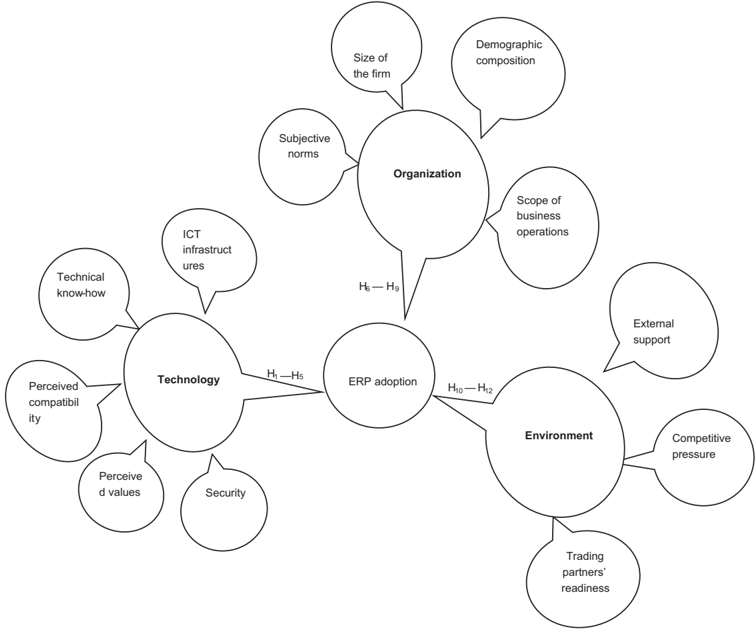
This paper provides further insight into IS adoption by investigating how 12 factors within the technology-organization-environment (T-O-E) framework explain SMEs’ adoption of enterprise resource planning (ERP) software. Survey data were collected from executives of SMEs drawn from six fast service enterprises with strong operations in Port Harcourt, Nigeria. Purposive and snow ball sampling was adopted and the proposed framework was tested using the logistic regression; specifically, the likelihood ratios, Hosmer and Lemeshow’s goodness of fit, and Nagelkerke R2 were used. The hypothesized relationships were supported at either p < 0.01 or 0.05 with each factor differing in its statistical coefficient and some bearing negative values; suggesting that some factors do not pose much threat to adopters but to non-adopters. Thus, adoption of ERP by SMEs is well-explained by T-O-E framework though it is more driven by technological factors than by organizational and environmental factors. Implicit is that the proposed model will be useful to IS vendors in making investment decisions and crafting marketing programs that appeal to non-adopters since they have more adoption challenges than adopters and to cause adopters to progress in the loyalty ladder.
Overview
CoChat Summary
TL;DR
This paper tests a 12-factor technology-organization-environment (T-O-E) model of enterprise resource planning (ERP) adoption among SMEs in Port Harcourt, Nigeria. It finds all 12 hypothesized factors supported at p < 0.01 or 0.05, with adoption more driven by technological factors than organizational or environmental factors.
Key findings
- The logistic model reported −2 log likelihood = 99.400, Hosmer and Lemeshow χ² = 5.670 (p = 0.817), Nagelkerke R² = 0.456, and overall prediction accuracy of 78.70% (178 adopters, 66 non-adopters).
- Positive coefficients were reported for ICT infrastructure (0.653), technical know-how (0.167), perceived compatibility (0.576), perceived values (0.459), security (0.686), and firm size (0.103); firm size was described as the most critical adoption driver at p < 0.05.
- Negative coefficients were reported for scope of business operations (−0.589), subjective norms (−0.634), competitive pressure (−0.495), external support (−0.480), trading partners’ readiness (−0.661), and demographic composition (−0.483); these were interpreted as critical adoption factors that pose less obstacle to adopters than to non-adopters.
- The paper concludes that ERP adoption by SMEs is well explained by the T-O-E framework but is more driven by technological factors than by organizational and environmental factors.
Methods
- Positivist, realist survey design; data collected from owners and executives of SMEs in six fast-growing service enterprises with strong operations in Port Harcourt, Nigeria; sampling frame was 373 owners/executives, with 244 returns.
- Purposive and snowball sampling were used; population criteria included at least 10 employees, huge ICT investment, annual turnover of five million naira or less, use of ERP to integrate operations, and registration with the Corporate Affairs Commission and other approved bodies.
- Analysis used logistic regression and Wald statistics, with likelihood ratios, Hosmer and Lemeshow’s goodness of fit, and Nagelkerke R²; factor analysis assessed validity and reliability, and collinearity diagnostics included tolerance, VIF, and Durbin-Watson (1.645).
Limitations
- The paper states that reliance on data from only the ICT industry and cross-sectional data limits generalizability; measures were subjective perceptions prone to common error biases; the study focuses on pre-adoption only; other factors outside T-O-E may affect ERP adoption; and PCA with varimax rotation was used, with future CFA, maximum likelihood, oblimin rotation, or second-order modeling suggested.
- Evident from the text: the non-probability purposive/snowball sampling and the single-city, six-service-enterprise sample further constrain generalizability.
- Evident from the text: there is an inconsistency in the reported sign for demographic composition—one passage lists it among positive coefficients, while later text and Table 5 report a negative coefficient.
Model-written summary. Check it against the paper before relying on it.
Integrity signals
Registry
Cites
Statistics
Figures






















Verification
Claims the paper makes
6 Valid · 3 Not valid · 45 Not checked · 57 Own results and interpretations
At least one cited source doesn’t support this claim or points to a different paper, and none confirmed it — see the verdicts below.
In the paper
“the extensive focus of TAM on technology to the neglect of social and psychological parameters (Agarwal & Prasad, 1998;Venkatesh & Bala, 2008) limits its explanatory and predictive utilities, and therefore demands its integration with other frameworks”
§ Using T-O-E theoretical framework to study the adoption of ERP solution > 1. Introduction
What the sources say
- Not checked — no full text of the sourcecites Agarwal & Prasad, 1998 matched to “A Conceptual and Operational Definition of Personal Innovativeness in the Domain of Information Technology” (1998) source
- Disputedcites Venkatesh & Bala, 2008 matched to “Technology Acceptance Model 3 and a Research Agenda on Interventions” (2008) sourceExperimental — accuracy not yet measured
The introductory discussion describes TAM as “highly predictive of IT adoption and use,” contrary to the claim that its predictive utility is limited. It identifies TAM’s commonly cited limitation as a lack of actionable guidance, not a neglect of social and psychological factors; the Theoretical Framework discusses social influence and individual differences in extensions of TAM. No page numbers are provided in our copy. (LLM, conf=0.86)
Checked by a reasoning model — may be wrong.
plainstates a cause- Asserted: passes — The authors put it forward as true.
- Checkable: passes — It can be checked against evidence.
- Load-bearing: passes — The paper’s conclusions depend on it.
- Based: passes — The paper gives a reason why it holds.
The cited sources support only part of this claim — read each source’s verdict below.
In the paper
“significant number of vendors principally targets large enterprises (Kumar & van Hillegersberg, 2000;Waarts, van Everdingen, & van Hillegersberg, 2002).”
§ Using T-O-E theoretical framework to study the adoption of ERP solution > 1. Introduction
What the sources say
- Partly supportedcites Kumar & van Hillegersberg, 2000 matched to “Enterprise resource planning: introduction” (2000) sourceExperimental — accuracy not yet measured
Section I I says most Fortune 500 companies had installed ERP systems while the midsize-company market remained relatively untapped. That supports the large-enterprise emphasis, but it does not establish that a significant number of vendors principally targeted large enterprises. (LLM, conf=0.78)
- Not checked — no full text of the sourcecites Waarts, van Everdingen, & van Hillegersberg, 2002 matched to “The dynamics of factors affecting the adoption of innovations” (2002) source
plain- Asserted: passes — The authors put it forward as true.
- Checkable: passes — It can be checked against evidence.
- Load-bearing: unclear — It is unclear whether the paper’s conclusions depend on it.
- Based: passes — The paper gives a reason why it holds.
- Partly supported
The cited sources support only part of this claim — read each source’s verdict below.
In the paper
“by integrating the constructs of environment, T-O-E framework provides a more superior theoretical analysis than IDT in studying technology adoption, use, and value creation (Gangwar et al., 2014;Hossain & Quaddus, 2011;Oliveira & Martins, 2011).”
§ Using T-O-E theoretical framework to study the adoption of ERP solution > 3. The T-O-E framework
What the sources say
- Not checked — no full text of the sourcecites Gangwar et al., 2014 matched to “Review on IT adoption: insights from recent technologies” (2014) source
- Not checked — no full text of the sourcecites Hossain & Quaddus, 2011 matched to “The adoption and continued usage intention of RFID: an integrated framework” (2011) source
- Partly supportedcites Oliveira & Martins, 2011 matched to “Literature Review of Information Technology Adoption Models at Firm Level” (2011)Experimental — accuracy not yet measured
Our copy does support the comparative core: the Conclusions (p. n/a) state that because the TOE framework includes the environment context, absent from DOI/IDT, it 'becomes better able to explain intra-firm innovation adoption; therefore, we consider this model to be more complete,' and the External task environment section repeats that TOE 'makes Rogers' innovation diffusion theory better able to explain intrafirm innovation diffusion.' However, the source frames the advantage as 'more complete' and limited to explaining adoption/assimilation at the firm level; it nowhere claims superiority for 'use, and value creation' (searched: value creation, adoption and assimilation, perceived benefits). The same Conclusions also hedge the comparison by recommending that for more complex technologies more than one model be combined, rather than TOE alone being superior. (LLM, conf=0.72)
plain- Asserted: passes — The authors put it forward as true.
- Checkable: unclear — It is unclear whether it could be checked against evidence.
- Load-bearing: passes — The paper’s conclusions depend on it.
- Based: passes — The paper gives a reason why it holds.
The cited sources support only part of this claim — read each source’s verdict below.
In the paper
“Scholars describe SBO as an adoption predicator; the greater the scope of business, the more likelihood enterprises invest to digitalize operations and to reduce internal co-ordination costs, administrative complexities, and information processing (Bakos, 1998;Chopra & Meindl, 2001;Hitt, 1999;Zhu et al., 2003).”
§ Using T-O-E theoretical framework to study the adoption of ERP solution > 4.2. Organization
What the sources say
- Could not verifycites Bakos, 1998 matched to “The emerging role of electronic marketplaces on the Internet” (1998) sourceExperimental — accuracy not yet measured
The Facilitation section (page unavailable) says electronic marketplaces improve information sharing and lower logistics costs between buyers and sellers. Our copy does not address whether a greater scope of business makes enterprises more likely to digitalize operations to reduce internal coordination costs, administrative complexity, or information processing; searches for business scope and internal coordination found no such passage. (LLM, conf=0.76)
- Not matchedcites Chopra & Meindl, 2001
An author–year citation the paper’s reference list doesn’t settle. We don’t search these by name.
- Supportedcites Hitt, 1999 matched to “Information Technology and Firm Boundaries: Evidence from Panel Data” (1999) source
Hitt (1999) supports the attributed proposition in the direction the claim states it: the Introduction reports that "firms that are less vertically integrated and more diversified have a higher demand for IT after controlling for other determinants of IT demand," and §5.4/§6.1 state that firms using coordination-intensive structures (i.e., broader scope/diversification) use substantially more IT, driven by "the demand for coordination activity" rather than mere size. The cost rationale also matches the paper: §2.1 defines internal coordination costs as "communications, data transfer, and other actual expenditures on managing dependencies between activities" and notes diversification "entails increased internal coordination costs because firms have to manage more complex and diverse activities," while the Introduction/hypotheses state IT lowers those coordination costs. One caveat worth noting is that Hitt finds only weaker/marginal support for the reverse causal path (IT causing greater diversification), but the claim attributes scope of business as a predictor of IT investment, which is the direction the paper does support. (LLM, conf=0.82)
hedgedstates a cause- Asserted: passes — The authors put it forward as true.
- Checkable: passes — It can be checked against evidence.
- Load-bearing: passes — The paper’s conclusions depend on it.
- Based: passes — The paper gives a reason why it holds.
- Could not verify
A result the paper reports from its own data — it cites no other source for it, so there is none to check. The quote shows it is in the paper.
In the paper
“Thus, adoption of ERP by SMEs is well-explained by T-O-E framework though it is more driven by technological factors than by organizational and environmental factors.”
- Also stated in: § 7. Discussion · plain
“The study found that adoption of ERP by SMEs is more driven by technological factors than by organizational and environmental factors.”
§ Using T-O-E theoretical framework to study the adoption of ERP solution > Abstract
plainstates a cause- Asserted: passes — The authors put it forward as true.
- Checkable: passes — It can be checked against evidence.
- Load-bearing: passes — The paper’s conclusions depend on it.
- Based: passes — The paper gives a reason why it holds.
- Also stated in: § 7. Discussion · plain
41 more claims
Create a free account to see all 111 claims and to verify the 13 references still open.
- Probably not a substantial claim. 23
- It may state two separate claims as one. 48
- Borderline: one of the tests for a substantial claim is unclear. 1
- The quote only partly states this claim. 1
Claims other papers make about this one
Each is checked against this paper’s own text: does it say what the citing paper says it does?
In the citing paper
“An organization’s preparedness to adopt AI determines how well an organization is prepared to fully realize the promise of an innovation (Awa et al., 2016).”
From Exploring the antecedents of AI adoption for effective HRM practices in the Indian pharmaceutical sector (2023) · cites this paper as Awa et al., 2016
Self-check
Percentages, sums and reported differences re-computed from the paper’s own numbers.
Each contradiction between two passages listed here was confirmed by an independent check.
Rated major: it would touch a result — a value a result rests on, reported and recomputed p-values on opposite sides of the significance level, two passages that conflict with no sign which is right, or a cited work retracted before this paper was published.
In the paper
§ Using T-O-E theoretical framework to study the adoption of ERP solution > 7. Discussion
“The 12 hypotheses were supported at either p < 0.01 or 0.05 with each factor differing in its statistical coefficient.”
§ Using T-O-E theoretical framework to study the adoption of ERP solution > 6.1. Measures
“ICT infrastructures 0.653 (0.314) 7.450 0.070* Technical know-how 0.167 (0.331) 2.541 0.072* Perceived compatibility 0.576 (0.302) 7.331 0.073*”
Rated major: it would touch a result — a value a result rests on, reported and recomputed p-values on opposite sides of the significance level, two passages that conflict with no sign which is right, or a cited work retracted before this paper was published.
In the paper
§ Using T-O-E theoretical framework to study the adoption of ERP solution > 5. Methods
“Other criteria used to define the population were that the SMEs must use ERP to integrate operations and be duly registered with Corporate Affairs Commission and other relevant government approved bodies.”
§ Using T-O-E theoretical framework to study the adoption of ERP solution > 6.1. Measures
“The table reports 178 adopters and 66 non-adopters;”
Rated major: it would touch a result — a value a result rests on, reported and recomputed p-values on opposite sides of the significance level, two passages that conflict with no sign which is right, or a cited work retracted before this paper was published.
In the paper
§ Using T-O-E theoretical framework to study the adoption of ERP solution > 6.1. Measures
“Discriminant validity is confirmed because the square roots of the AVE in the diagonal exceed the correlation between other constructs;”
§ Using T-O-E theoretical framework to study the adoption of ERP solution > 8. Conclusion and implications
“SN | 0.525 0.564 | 0.367 | 0.524 | 0.713 | 0.467 | 0.640 | 0.540 | 0.510 |”
Rated major: it would touch a result — a value a result rests on, reported and recomputed p-values on opposite sides of the significance level, two passages that conflict with no sign which is right, or a cited work retracted before this paper was published.
In the paper
“Overall 244 199 45 78.70”
§ Using T-O-E theoretical framework to study the adoption of ERP solution > 6.1. Measures
Reported 78.7 · recomputed 81.557377
Rated major: it would touch a result — a value a result rests on, reported and recomputed p-values on opposite sides of the significance level, two passages that conflict with no sign which is right, or a cited work retracted before this paper was published.
In the paper
§ Using T-O-E theoretical framework to study the adoption of ERP solution > 6.1. Measures
“others have significant positive coefficients (firm's size, security, perceived values, perceived compatibility, technical know-how, demographic composition, and ICT infrastructure).”
§ Using T-O-E theoretical framework to study the adoption of ERP solution > 6.1. Measures
“Demographic composition -0.483 (0.279) 2.330 0.070*”
3 more findings
Create a free account to see every finding of this check.
Citations
Cites
The theory of planned behavior
Ajzen, I. (1991) · Organizational Behavior and Human Decision Processes · doi:10.1016/0749-5978(91)90020-t · Cited by 134,657
Evaluating Structural Equation Models with Unobservable Variables and Measurement Error
Fornell, C., & Larcker, D. F. (1981) · Journal of Marketing Research · doi:10.2307/3151312 · Cited by 109,314 · cited 2×
“…which a given construct shares more variance with its measures than other latent variables in the model (Hinkin, 1995; Sanchez & Roldan, 2005); thus, the square root of a construct’s AVE must be larger than the interconstruct correlations to ensure discriminant validity (Fornell & Larcker, 1981).”
BackgroundInfluentialEvaluating structural equation models with unobservable variables and measurement error
Fornell, C., & Larcker, D. F. (1981) · Journal of Marketing Research · doi:10.1177/002224378101800104 · Cited by 109,190
Perceived usefulness, perceived ease of use, and user acceptance of information technology
Davis, F. D. (1989) · MIS Quarterly · doi:10.2307/249008 · Cited by 68,483 · cited 3×
“Among such models are: • technology acceptance model (TAM; Davis, 1989); • theory of reasoned action (TRA; Ajzen & Fishbein, 1980); • theory of planned behavior (TPB; Ajzen, 1991); • innovation diffusion theory (IDT; Rogers, 2003); • stage model (SM; Poon & Swatman, 1999); •…”
BackgroundHerne, H., Cooley, W. W., & Lohnes, P. R. (1973) · Journal of the Royal Statistical Society. Series A (General) · doi:10.2307/2344428 · Cited by 35,697
(1980) · Medical Entomology and Zoology · Cited by 25,810
A Theoretical Extension of the Technology Acceptance Model: Four Longitudinal Field Studies
Venkatesh, V., & Davis, F. D. (2000) · Management Science · doi:10.1287/mnsc.46.2.186.11926 · Cited by 23,066 · cited 2×
“Proposed IS frameworks factored in SBOs, size and size-related issues (Eze et al., 2013; Pang & Jang, 2008); social influences (Rogers, 2003; Venkatesh & Davis, 2000), individual difference factors (Hambrick & Mason, 1984), organizations’ mission (Awa et al., 2010), top management, available…”
Background(1997) · Chemometrics in Environmental Analysis · doi:10.1002/352760216x.ch5 · Cited by 18,653
Armstrong, J. S., & Georgoff, D. M. (1988) · International Journal of Forecasting · doi:10.1016/0169-2070(88)90019-2 · Cited by 17,894
An Index of Factorial Simplicity
Kaiser, H. F. (1974) · Psychometrika · doi:10.1007/bf02291575 · Cited by 14,898 · cited 1×
“Further, the observed components met Kaiser-Meyer-Olkin’s (KMO) benchmark (Kaiser, 1974) and the eigen-values of greater than one.”
Method
Research works printed but not linked: 16
- 21. Bingham, R. (1976). The adoption of innovation by local government. Lexington, MA: Lexington Books.
- 28. Chein, I. (1981). An introduction to sampling. In L. H. Kidder (Ed.), Sellitz, Wrightsman & Cook's research methods in social relations (4th ed., pp. 418-441). New York, NY: Holt, Rinehart and Winston.
- 31. Chopra, S., & Meindl, P. (2001). Supply chain management: Strategy, plannng, and operations. Upper Saddle River, NJ: Prentice Hall.
- 49. Green, M. (1997). Whos zooming who on the web? Black Enterprise, 28, 89-108.
- Nunnally J., 1978, Psychometric theory
- 105. Nunnally, J. (1978). Psychometric theory. New York, NY: McGraw-Hill. OECD. (2000). Local access pricing and e-commerce: An update on the statistics. Paris: Organization for Economic -operation and Development. OECD. (2002). OECD small and medium size enterprises outlook. Paris: Author. Retrieved February 23, 2015, from www. oecd.org
- 110. Pang, M., & Jang, W. (2008). Determinants of the adoption of ERP within the T-O-E framework: Taiwan's Communications industry. Journal of Computer Information Systems, 48, 94-102.
- 124. Rogers, E. (2003). Diffusion of Innovations (4th ed.). New York, NY: The Free Press.
- 128. Samson, C., & Hornby, L. (1988). Spending for tomorrow. Fast Eastern Economic Review, 161, 46-52.
- 131. Shafi, I. (2002). Assessment of the impact of Internet technology use among Saudi business organizations (Ph.D. dissertation). Mississippi State University, United States, Mississippi.
- 134. Sheridan, J. (1994). Lew platt: Creating a culture for innovation. Industry Week, 26-30.
- 138. SMEDAN. (2005). SME success. Digest, 3, 45-61.
- 145. Tornatzky, L., & Fleischer, M. (1990). The process of technology innovation. Lexington: Lexington Books.
- 153. Wen, K., & Chen, Y. (2010). E-business value creation in SMEs: A US study using the TOE framework. International Journal of Electronic Business, 24, 1-10.
- 154. Windrum, P., & de Berranger, P. (2004, May 23-26). Factors affecting the adoption of intranet and extranet by SMEs: A UK study. In Proceedings of the Innovation through Information Technology (pp. 904-911). New Orleans: Idea Group.
- 165. Zhu, K., Kraemer, K., & Xu, S. (2002). A cross-country study of e-business adoption using the technology-organization- environment framework. Proceedings of the International Conference on Information Systems, Barcelona.
Cited by
Wong, L.-W., Leong, L.-Y., Hew, J.-J., Tan, G. W.-H., & Ooi, K.-B. (2020) · International Journal of Information Management · doi:10.1016/j.ijinfomgt.2019.08.005 · Cited by 739
Social commerce adoption using TOE framework: An empirical investigation of Saudi Arabian SMEs
Abed, S. S. (2020) · International Journal of Information Management · doi:10.1016/j.ijinfomgt.2020.102118 · Cited by 453
Adoption of artificial intelligence (AI) for talent acquisition in IT/ITeS organizations
Pillai, R., & Sivathanu, B. (2020) · Benchmarking: An International Journal · doi:10.1108/bij-04-2020-0186 · Cited by 422
Adoption of AI-empowered industrial robots in auto component manufacturing companies
Pillai, R., Sivathanu, B., Mariani, M., Rana, N. P., Yang, B., & Dwivedi, Y. K. (2022) · Production Planning & Control · doi:10.1080/09537287.2021.1882689 · Cited by 195
Prioritizing barriers for the adoption of Industry 4.0 technologies
Senna, P. P., Ferreira, L. M. D. F., Barros, A. C., Roca, J. B., & Magalhães, V. S. M. (2022) · Computers & Industrial Engineering · doi:10.1016/j.cie.2022.108428 · Cited by 198
Why Do SMEs Adopt Artificial Intelligence-Based Chatbots?
Sharma, S., Singh, G., Islam, N., & Dhir, A. (2022) · IEEE Transactions on Engineering Management · doi:10.1109/tem.2022.3203469 · Cited by 215
“Third, the environmental perspective consists of the business’s dogmatic environment, the availability of technology service providers and the overall industry structure [55].”
BackgroundMohammad, A. B., Al‐Okaily, M., Al-Majali, M., & Masa’deh, R. M. T. (2022) · Journal of Open Innovation Technology Market and Complexity · doi:10.3390/joitmc8040189 · Cited by 209
“Although technology adoption is very well structured, very few studies have been conducted to determine the influencing factors associated with the adoption of BI systems [25].”
BackgroundResultInfluentialAdopting Industry 4.0 by leveraging organisational factors
Srivastava, D., Kumar, V., Ekren, B. Y., Upadhyay, A., Tyagi, M., & Kumari, A. (2021) · Technological Forecasting and Social Change · doi:10.1016/j.techfore.2021.121439 · Cited by 127
“Some of the most common existing theoretical models used to examine the technology acceptance and adoption are Innovation Diffusion Theory (IDT) (Van den Berg and Van der Lingen, 2019), Theory of Reasoned Action (TRA) (Ajzen, 2005), Theory of Planned Behaviour (TPB) (Sniehotta, Presseau and Araújo-Soares, 2014), Techn…”
BackgroundKalaitzi, D., & Tsolakis, N. (2022) · International Journal of Production Economics · doi:10.1016/j.ijpe.2022.108466 · Cited by 133
Senna, P. P., Barros, A. C., Roca, J. B., & Azevedo, A. L. (2023) · Computers & Industrial Engineering · doi:10.1016/j.cie.2023.109645 · Cited by 165
Beyond smart systems adoption: Enabling diffusion and assimilation of smartness in hospitality
Stylos, N. D., Fotiadis, A., Shin, D., & Huan, T.-C. T. C. (2021) · International Journal of Hospitality Management · doi:10.1016/j.ijhm.2021.103042 · Cited by 120
Critical determinants for mobile commerce adoption in Vietnamese small and medium-sized enterprises
Chau, N. T., Deng, H., & Tay, R. (2020) · Journal of Marketing Management · doi:10.1080/0267257x.2020.1719187 · Cited by 96
Kimiagari, S., & Baei, F. (2021) · Enterprise Information Systems · doi:10.1080/17517575.2021.1894356 · Cited by 115
“The results of Cronbach’s alpha from the pilot test are as follows: AU = 0.817; BI = 0.807; SI = 0.934; BR = 0.927; ITR = 0.829; UI = 0.883; GS = 0.798; TTF = 0.829; TAC = 0.791; TEC = 0.797; SA = 0.902; TSI = 0.851, CTF: 0.857; PS: 0.858.”
BackgroundInfluentialAgarwal, A. (2023) · foresight · doi:10.1108/fs-10-2021-0199 · Cited by 78
Understanding the Intention to Adopt Cloud-based Accounting Information System in Jordanian SMEs
Lutfi, A. (2022) · The International Journal of Digital Accounting Research · doi:10.4192/1577-8517-v22_2 · Cited by 130
“In the TOE model, the environmental construct encapsulates the structure of the industry, the availability of the technologies provider, and the business dogmatic 54 The International Journal of Digital Accounting Research Vol. 22 environment (Awa et al., 2016; Oliveira et al., 2014).”
MethodShukla, M. P., & Shankar, R. (2021) · Computers & Industrial Engineering · doi:10.1016/j.cie.2021.107865 · Cited by 90
Νικοπούλου, Μ., Kourouthanassis, P. E., Chasapi, G., Pateli, A. G., & Mylonas, N. (2023) · Sustainability · doi:10.3390/su15032736 · Cited by 144
“In recent years, PLS-SEM has been attracting researchers’ interest [64].”
BackgroundSalisu, I., Sappri, M. M., & Omar, M. F. (2021) · Cogent Business & Management · doi:10.1080/23311975.2021.1935663 · Cited by 97
“The environmental characteristics in the TOE framework integrates the availability of technology service providers, the structure of the industry, and the flexible organizational environment (Awa et al., 2016).”
BackgroundArakpogun, E. O., Elsahn, Z., Nyuur, R. B.-B.-I., & Olan, F. (2020) · Technological Forecasting and Social Change · doi:10.1016/j.techfore.2020.120263 · Cited by 78
“Researchers have also investigated the relational properties of firms that induce coopetitive behaviours (Barretta, 2008).”
BackgroundAssessing the Intention to Adopt Cloud Accounting during COVID-19
Saad, M., Lutfi, A., Almaiah, M. A., Alshira’h, A. F., Alshirah, M. H., Alqudah, H. M., Al-Khasawneh, A. L., Alsyouf, A., Alrawad, M., & Fathelbab, O. E. A. (2022) · Electronics · doi:10.3390/electronics11244092 · Cited by 119
Determinants of an Organization's Readiness for Drone Technologies Adoption
Ali, S. S., Kaur, R., Gupta, H., Ahmad, Z., & Elnaggar, G. R. (2021) · IEEE Transactions on Engineering Management · doi:10.1109/tem.2021.3083138 · Cited by 70
“[49] Adoption of ERP solution; Chiu et al.”
BackgroundMethodZabukovšek, S. S., Bobek, S., Zabukovšek, U., Kalinić, Z., & Tominc, P. (2022) · Mathematics · doi:10.3390/math10091379 · Cited by 80
Hao, X., & Demir, E. (2024) · Production Planning & Control · doi:10.1080/09537287.2024.2302482 · Cited by 92
“The combination of both human and nonhuman actors (Awa, Ukoha, and Emecheta 2016) and internal and external factors (Marija, Bach, and Vuk � s � ıc 2021) provides TOE a more holistic view of the technology integration enablers and constraints which is the reason for its dominance over other…”
Fintech Services and the Drivers of Their Implementation in Small and Medium Enterprises
Moreira-Santos, D., Au‐Yong‐Oliveira, M., & Moreira, A. (2022) · Information · doi:10.3390/info13090409 · Cited by 84
Chen, X., Chang-Richards, A. Y., Ling, F. Y. Y., Yiu, T. W., Pelosi, A. W., & Yang, N. (2022) · Building Research & Information · doi:10.1080/09613218.2022.2136130 · Cited by 71
“ational and environmental factors (Awa et al., 2016).”
BackgroundInfluentialIT Strategy in the Hotel Industry in the Digital Era
Wynn, M. G., & Jones, P. (2022) · Sustainability · doi:10.3390/su141710705 · Cited by 77
Social media adoption in smes sustainability: evidence from an emerging economy
Amoah, J. O., Bruce, E., Shurong, Z., Egala, S. B., & Kwarteng, K. (2023) · Cogent Business & Management · doi:10.1080/23311975.2023.2183573 · Cited by 103
Ergado, A. A., Desta, A., & Mehta, H. (2021) · Education and Information Technologies · doi:10.1007/s10639-020-10397-9 · Cited by 76
Factors affecting cloud computing adoption in the Indian school education system
Singh, J., & Mansotra, V. (2019) · Education and Information Technologies · doi:10.1007/s10639-019-09878-3 · Cited by 58
From Public E-Procurement 3.0 to E-Procurement 4.0; A Critical Literature Review
Mavidis, A., & Folinas, D. (2022) · Sustainability · doi:10.3390/su141811252 · Cited by 45
Butarbutar, Z. T., Handayani, P. W., Suryono, R. R., & Wibowo, W. S. (2023) · Cogent Business & Management · doi:10.1080/23311975.2023.2264001 · Cited by 42
“Earlier studies have effectively employed the TOE framework to pinpoint critical success factors (CSFs), albeit primarily within the context of adoption rather than the subsequent post-adoption phase (Awa et al., 2016).”
BackgroundMethodSalah, O. H., Yusof, Z. M., & Mohamed, H. (2021) · PLOS ONE · doi:10.1371/journal.pone.0243355 · Cited by 42
“[90] propose an analytical method known as the TOE framework that has since become the most popular acceptance technology theory that underpins IS studies and end-user adoption at organizations level [71].”
BackgroundMethodResultInfluentialBlockchain technology prospects in transforming Ghana’s economy: a phenomenon-based approach
Boakye, E. A., Zhao, H., & Ahia, B. N. K. (2022) · Information Technology for Development · doi:10.1080/02681102.2022.2073580 · Cited by 58
Bhattacharyya, S. S., & Shah, Y. (2021) · Journal of Science and Technology Policy Management · doi:10.1108/jstpm-03-2021-0048 · Cited by 56
Aremu, A. Y., Shahzad, A., & Hassan, S. (2021) · Global Business Review · doi:10.1177/0972150919849751 · Cited by 39
“However, the adoption of ERP systems in MEs is affected by poor electricity power supply, inadequate computer system literacy, lack of expertise to operate the adopted system, lack of awareness among the users, inadequate infrastructural support and poor Internet services (Awa et al., 2016).”
BackgroundInfluentialDriving Factors of Industry 4.0 Readiness among Manufacturing SMEs in Malaysia
Wong, A. P. H., & Kee, D. M. H. (2022) · Information · doi:10.3390/info13120552 · Cited by 35
Morawiec, P., & Sołtysik-Piorunkiewicz, A. (2023) · Sustainability · doi:10.3390/su15054646 · Cited by 65
“The advantage of using the TOE framework is its more holistic insight in comparison to other models [79].”
MethodHiran, K. K., & Dadhich, M. (2023) · Technological Forecasting and Social Change · doi:10.1016/j.techfore.2023.122979 · Cited by 44
Disengagement toward brand-based online communities: The role of culture
Kumar, A., & Shankar, A. (2023) · Journal of Global Marketing · doi:10.1080/08911762.2023.2175757 · Cited by 38
Sharma, A., & Sharma, S. (2023) · European Journal of Innovation Management · doi:10.1108/ejim-09-2022-0532 · Cited by 50
Goswami, M., Jain, S., Alam, T., Deifalla, A. F., Ragab, A. E., & Khargotra, R. (2023) · Frontiers in Pharmacology · doi:10.3389/fphar.2023.1215706 · Cited by 33
Factors affecting electronic invoice adoption and tax compliance process efficiency
Qi, Y., & Azmi, A. C. (2021) · Transforming Government People Process and Policy · doi:10.1108/tg-04-2020-0070 · Cited by 66
Benchis, M. P., Shahzad, K., & Dan, S. (2025) · Journal of Innovation & Knowledge · doi:10.1016/j.jik.2025.100746 · Cited by 56
Daradkeh, M. K. (2019) · Journal of Organizational and End User Computing · doi:10.4018/joeuc.2019100102 · Cited by 36
Abdulkarem, A., & Hou, W. (2021) · Journal of theoretical and applied electronic commerce research · doi:10.3390/jtaer16070150 · Cited by 35
Exploring challenges and mitigation strategies towards practicing Teledentistry
Fahim, A., Saleem, Z., Malik, K. A., Atta, K., Mahmood, R., Alam, M. K., & Sethi, A. (2022) · BMC Oral Health · doi:10.1186/s12903-022-02685-2 · Cited by 41
“The environmental context refers to governmental encouragement, supporting infrastructures, sociocultural issues, and other operational enablers and inhibitors [35].”
BackgroundUnderstanding Digital Work and its Use in Organizations from a Literature Review
Wibowo, S., Deng, H., & Duan, S. X. (2022) · Pacific Asia journal of the Association for Information Systems · doi:10.17705/1pais.14302 · Cited by 53
Faasolo, M. B., & Sumarliah, E. (2021) · Information Resources Management Journal · doi:10.4018/irmj.287907 · Cited by 37
Factors Influencing Individual Customers Trust in Internet Banking: Case of Baltic States
Skvarciany, V., & Jurevičienė, D. (2018) · Sustainability · doi:10.3390/su10124809 · Cited by 37
Bahari, M., Arpacı, İ., Der, O., Akkoyun, F., & Erçetin, A. (2024) · Sustainability · doi:10.3390/su16052129 · Cited by 46
Rural smartness: Its determinants and impacts on rural economic welfare
Mukti, I. Y., Henseler, J., Aldea, A., Govindaraju, R., & Iacob, M. (2022) · Electronic Markets · doi:10.1007/s12525-022-00526-2 · Cited by 38
Chau, N. T., Deng, H., & Tay, R. (2020) · Journal of Global Information Management · doi:10.4018/jgim.2021010103 · Cited by 38
Factors Affecting Internet of Things (IoT) Adoption in the Yemeni Oil and Gas Sector
Hawash, B., Mokhtar, U. A., Yusof, Z. M., Mukred, M., & Gaid, A. S. A. (2021) · International Conference of Technology, Science and Administration (ICTSA) · doi:10.1109/ictsa52017.2021.9406527 · Cited by 39
“Security Information Security (IS) Corporation Security (CS) [3, 35]”
BackgroundAmornkitvikai, Y., Tham, S. Y., & Tangpoolcharoen, J. (2021) · Global Business Review · doi:10.1177/09721509211036294 · Cited by 40
“…studies using the TOE and/or its extended TOE framework have different findings despite using a common framework (Abed, 2020; Ahmad et al., 2015; Awa et al., 2016; Chaua & Denga, 2018; Dahbi & Benmoussa, 2019; Hameed & Counsell, 2012; Lawrence & Tar, 2010; Saif-Ur-Rehman & Alam, 2016; Scupola &…”
NGUYEN, C. Q., Nguyen, A. M. T., & Tran, P. (2024) · Journal of Open Innovation Technology Market and Complexity · doi:10.1016/j.joitmc.2024.100257 · Cited by 51
Addy, M., Kwofie, T., Agbonani, D. M., & Essegbey, A. (2023) · Journal of Engineering, Design and Technology · doi:10.1108/jedt-02-2022-0096 · Cited by 23
Qatawneh, N. A. (2024) · Journal of Open Innovation Technology Market and Complexity · doi:10.1016/j.joitmc.2024.100401 · Cited by 53
Some antecedent factors that shape actors’ adoption of enterprise systems
Awa, H. O. (2018) · Enterprise Information Systems · doi:10.1080/17517575.2018.1466368 · Cited by 28
“…factors potentially affect innovation adoption; amongst them are relative advantage, cost structure, compatibility, availability of infrastructure, vendor support, existing IS solutions, security, and reliability (see Eze et al. 2013; Awa and Ukoha 2016; Awa, Ojiabo, and Emecheta 2016).”
BackgroundMethodInfluentialSelf-citationDefining Rural Smartness and Its Impact: A Systematic Literature Review
Mukti, I. Y., Iacob, M., Aldea, A., Govindaraju, R., & van Hillegersberg, J. (2021) · Journal of the Knowledge Economy · doi:10.1007/s13132-021-00736-7 · Cited by 39
Tang, G., Wang, L., Zheng, T., & Wei'e, W. (2024) · Managerial and Decision Economics · doi:10.1002/mde.4063 · Cited by 25
Alam, S. S., Masukujjaman, M., Ahmed, S., Kokash, H. A., & Khattak, A. N. (2024) · Circular Economy and Sustainability · doi:10.1007/s43615-023-00341-7 · Cited by 28
Chatbot Design and Implementation: Towards an Operational Model for Chatbots
Skuridin, A., & Wynn, M. G. (2024) · Information · doi:10.3390/info15040226 · Cited by 36
Digital technology adoption in circular startups: An integrated framework
Hajoary, P. K., Jennifer, D. S., & Pathak, M. (2024) · Business Strategy & Development · doi:10.1002/bsd2.425 · Cited by 26
Investigating the Adoption of Social Commerce: A Case Study of SMEs in Jordan
Trawnih, A. A., Al‐Adwan, A. S., Amayreh, A., Majali, T., & Al‐Hattami, H. M. (2023) · Interdisciplinary Journal of Information Knowledge and Management · doi:10.28945/5071 · Cited by 34
Zabukovšek, S. S., Picek, R., Bobek, S., Klančnik, I. Š., & Tominc, P. (2019) · Journal of information and organizational sciences · doi:10.31341/jios.43.1.4 · Cited by 28
“The most frequently used research approaches in these studies are [3]: technology acceptance model (TAM) [4], theory of reasoned action (TRA) [5], theory of planned behaviour (TPB) [6], innovation diffusion theory (IDT) [7], stage model (SM) [8] and technology-environment-organization (T-O-E) [9].”
MethodCustomer satisfaction with complaint responses under the moderation of involvement
Awa, H. O., Ikwor, N. K., & Ademe, D. G. (2021) · Cogent Business & Management · doi:10.1080/23311975.2021.1905217 · Cited by 37
Self-citationFactors affecting the adoption and use of online assessment for learning at Polytechnics in Zimbabwe
Mahlangu, G., & Makwasha, L. (2023) · Cogent Education · doi:10.1080/2331186x.2023.2177475 · Cited by 28
“These theories especially target the acceptance of technology (Awa et al., 2016).”
BackgroundMethodInfluentialFactors Affecting E-Commerce Adoption by Handicraft SMEs of India
Yadav, R., & Mahara, T. (2019) · Journal of Electronic Commerce in Organizations · doi:10.4018/jeco.2019100104 · Cited by 23
Kim, Y., & Kim, B. (2021) · Information · doi:10.3390/info12110446 · Cited by 27
ERP System Adoption Analysis Using TOE Framework in Permata Hijau Group (PHG) Medan
Catherine, C., & Abdurachman, E. (2018) · International Journal of Enterprise Information Systems · doi:10.4018/ijeis.2018070105 · Cited by 19
Investigating digital marketing readiness among tourism firms: an emerging economy perspective
Abate, Y. A., Ukpabi, D. C., & Karjaluoto, H. (2024) · Current Issues in Tourism · doi:10.1080/13683500.2024.2358047 · Cited by 49
“Prior studies used TOE framework to investigate the adoption of different technologies such as cloud computing adoption (e.g. Gangwar et al., 2015), AI (Cho et al., 2022), and enterprise resource planning (Awa et al., 2016) among others.”
FACTORS AFFECTING PERSONAL CUSTOMERS’ TRUST IN TRADITIONAL BANKING: CASE OF THE BALTICS
Skvarciany, V., & Jurevičienė, D. (2017) · Journal of Business Economics and Management · doi:10.3846/16111699.2017.1345784 · Cited by 22
“In order to describe the created logistic model, the following measures of fit were used (Allison 2014; Awa et al. 2016; Chen, Zhang 2016; Chun-Hung 2015; Nagelkerke 1991; Peng et al. 2002): – Contingency table test was used to examine the distribution of each independent variable.”
MethodAdoption of digital marketing in tourism SMEs: a review and research agenda
Sharma, A., & Sharma, S. (2024) · Management Research Review · doi:10.1108/mrr-08-2021-0597 · Cited by 54
Bindeeba, D., Tukamushaba, E. K., & Bakashaba, R. (2025) · Discover Sustainability · doi:10.1007/s43621-025-01916-0 · Cited by 21
“High compatibility reduces resistance and accelerates adoption, thereby reinforcing a firm’s ability to reconfigure digital assets in support of sustainability [27, 53, 54].”
InfluentialMensah, I. K., Wang, R., Gui, L., & Wang, J. (2021) · Information Development · doi:10.1177/02666669211048486 · Cited by 26
“The level of intense competition that characterizes a fi rm ’ s environment can drive and stimulate the extent of innovation adoption (Awa et al., 2016).”
BackgroundFactors stimulating value micro-businesses attribute to digital marketing technology (DMT) adoption
Eze, S. C., Chinedu-Eze, V. C., Awa, H. O., & Alharthi Rami Hashem, E. (2021) · PLoS ONE · doi:10.1371/journal.pone.0260145 · Cited by 45
“This is common through the use of unattainable global resources to converse and carryout business activities with new and incumbent clients in a manner that integrates [3, 25, 26] and grows them in the client loyalty ladder [27, 28].”
BackgroundSelf-citationMujalli, A., & Almgrashi, A. (2020) · IEEE Asia-Pacific Conference on Computer Science and Data Engineering (CSDE) · doi:10.1109/csde50874.2020.9411556 · Cited by 23
“It is possible to measure the perceived advantages economically or socially, such as performance, satisfaction, reputation and convenience [22].”
BackgroundAbdullahi, I. N., Husin, M. H., Baharudin, A. S., & Abdullah, N. A. (2022) · Journal of Systems and Information Technology · doi:10.1108/jsit-11-2020-0249 · Cited by 29
Valdebenito, J., & Quelopana, A. (2019) · Advances in intelligent systems and computing · doi:10.1007/978-3-030-11890-7_15 · Cited by 28
Acceptance of GIS within ERP System: Research Study in Higher Education
Zabukovšek, S. S., Tominc, P., Deželak, Z., Nalbandyan, G. G., & Bobek, S. (2022) · ISPRS International Journal of Geo-Information · doi:10.3390/ijgi11020083 · Cited by 24
Aremu, A. Y., Shahzad, A., & Hassan, S. (2019) · International Journal of Information Systems and Social Change · doi:10.4018/ijissc.2020010103 · Cited by 23
Muhamad, M. Q. B. (2021) · International Journal of ADVANCED AND APPLIED SCIENCES · doi:10.21833/ijaas.2021.07.006 · Cited by 20
“specifically targeted technology acceptance and most popularly underpin by many information systems studies that explain end-user adoption at the organizational level (Awa et al., 2016).”
BackgroundParvand, S., & Rasiah, R. (2021) · Sustainability · doi:10.3390/su14010260 · Cited by 19
“Consequently, several studies indicate that perceived compatibility [36,37], perceived complexity [36–41], and costs [35–42] are critical predictors of adoption.”
BackgroundResultInfluentialAbdalla, S. Z. S. (2025) · Progress in Disaster Science · doi:10.1016/j.pdisas.2025.100451 · Cited by 27
Cheung, S. T., Jayawickrama, U., Olan, F., & Nuwangi, S. M. (2023) · Lecture notes in business information processing · doi:10.1007/978-3-031-32534-2_17 · Cited by 17
Adopting Information Systems in a Small Company : A Longitudinal Study
Imre, Ö. (2016) · Jonkoping University Library (Jönköping University) · Cited by 20
Nurliza, N., & Oktoriana, S. (2021) · Economics & Sociology · doi:10.14254/2071-789x.2021/14-3/8 · Cited by 19
Drivers of mobile commerce adoption intention by Saudi SMEs during the COVID-19 pandemic
Alaskar, T. H., & Alsadi, A. K. (2023) · Future Business Journal · doi:10.1186/s43093-023-00190-8 · Cited by 26
“This finding is consistent with the findings of other studies related to innovation adoption, such as big data [2] and ERP [57].”
An IoT business model for public sector retail oil outlets
Das, S. (2021) · Information Technology and People · doi:10.1108/itp-08-2020-0570 · Cited by 15
Molla, C., Bhuiyan, M. R. I., Islam, M. T., & Amin, A. A. A. (2025) · Digital Finance · doi:10.1007/s42521-025-00168-x · Cited by 19
“The study conducted by Awa et al., (2016) concludes that the T-O-E framework is a commonly used theoretical perspective in the field of Information Systems (Riaj et al., 2025).”
Cyber Insurance Adoption and Digitalisation in Small and Medium-Sized Enterprises
Taşkın, N., Yıldırım, A. Ö., Ercan, H. D., Wynn, M. G., & Metin, B. (2025) · Information · doi:10.3390/info16010066 · Cited by 27
Mulaji, S. M., & Roodt, S. (2022) · Sustainability · doi:10.3390/su141811534 · Cited by 18
Aremu, A. Y., Shahzad, A., & Hassan, S. (2018) · Universiti Utara Malaysia Institutional Repository (Universiti Utara Malaysia) · Cited by 12
Factors Influencing E-Commerce Adoption: Evaluation Using Structural Equation Modelling (SEM)
Sin, K. Y., & Sin, M. C. (2021) · International Journal of Business and Society · doi:10.33736/ijbs.3334.2020 · Cited by 24
“…implementation (see Lertwongsatien & Wongpininwatana, 2003; Grandon & Pearson, 2004; Mac Gregor & Vrazalic, 2008; Gilaninia, Danesh, Amiri, Mousavian, & Eskandarpour, 2011; Elmazi et al., 2011; Shah Alam et al., 2011; Wanyoike, Mukulu, & Waititu, 2012; Saffu, Walker, & Mazurek, 2012, Awa et al .”
BackgroundAssaye, B. T., Endalew, B., Tadele, M. M., Teferie, G. H., Teym, A., Hune, Y., Senishaw, A. F., Wubante, S. M., Ngusie, H. S., & Haimanot, A. B. (2024) · Heliyon · doi:10.1016/j.heliyon.2024.e38570 · Cited by 17
“Early technological adoption at the individual and organizational level helps to customize the system easily after assessing its compatibility and complexity [47].”
BackgroundInstagram as a Marketing Tool for Small and Medium Enterprises
Harun, Z., & Tajudeen, F. P. (2020) · International Journal of Technology Diffusion · doi:10.4018/ijtd.2020070103 · Cited by 23
Martins, A. L., & Picoto, W. N. (2019) · Journal of Systems and Information Technology · doi:10.1108/jsit-06-2019-0112 · Cited by 18
Nanath, K., & Pillai, R. R. (2020) · The Electronic Journal of Information Systems in Developing Countries · doi:10.1002/isd2.12163 · Cited by 15
“They emphasize that enterprise-level innovations largely depend on decision-makers' functional and emotional feelings (Awa et al., 2016).”
BackgroundIslam, M. N., Ozuem, W., Bowen, G. L., Willis, M., & Ng, R. (2021) · Sustainability · doi:10.3390/su13010345 · Cited by 23
“The IT technological characteristics that have been explored are IT infrastructure, relative advantage, compatibility, application and tools, complexity, and trust [57,63].”
BackgroundFostering competitiveness of Indian MSMEs through IT and digitalization
Mittal, R., Sheetal, S., & Soriya, S. K. (2025) · Information Technology for Development · doi:10.1080/02681102.2025.2453211 · Cited by 33
“A broader business scope allows MSMEs to establish a digital presence, reducing search costs for both buyers and sellers (Awa et al., 2016).”
Metadata
- Authors
- Awa, H. O., Ukoha, O., & Emecheta, B. C.
- Affiliations
- University of Port Harcourt (NG)
- University of Maryland Eastern Shore (US)
- Corresponding author
- Awa, Hart O.
- ORCID
- Awa, Hart O.
- Venue
- Cogent Business & Management
- Publisher
- Informa UK Limited
- Published
- 2016-07-07
- Volume
- 3
- Issue
- 1
- Pages
- 1196571
- ISSN
- 2331-1975 (ISSN-L)
- OpenAlex
- W2470427883
- Semantic Scholar
- 68cc4d4fac48ca404f729701ed7e7d104b56050c
- Cited by
- 272
- References
- 175
- Citations by year
- 2026: 32 · 2025: 36 · 2024: 42 · 2023: 38 · 2022: 35 · 2021: 43 · 2020: 20 · 2019: 14 · 2018: 10 · 2017: 1 · 2016: 1
- FWCI
- 15.55
- Type
- journal article
- Language
- en
- Open access
- gold
- doi.org
- Licence
- Locations
- Cogent Business & Management (publishedVersion, cc-by)
- RePEc: Research Papers in Economics (submittedVersion)
- DOAJ (DOAJ: Directory of Open Access Journals) (submittedVersion, cc-by-sa)
- Econstor (Econstor) (submittedVersion, cc-by)
- Topics
- Social Sciences › Business, Management and Accounting › Management Information Systems › ERP Systems Implementation and Impact
- Social Sciences › Decision Sciences › Information Systems and Management › Technology Adoption and User Behaviour
- Social Sciences › Business, Management and Accounting › Management Information Systems › Big Data and Business Intelligence
- Keywords
- enterprise resource planning, ERP adoption, technology-organization-environment framework, small and medium-sized enterprises, information systems adoption, technological factors, organizational factors, environmental factors
About these checks
Registry, retraction, Cites and statistics results are computed, not judged, with one exception: a printed reference that no index lists is read once by a model before it counts as a citation error. Claims are extracted by a model and kept only when their quote appears verbatim in the text; each cited source is then checked, with a model’s help, for whether it says what the claim relies on. Those verdicts can be wrong — read the claim’s quote and the cited source before relying on one.
The claim verdicts this report counts are experimental: their accuracy is not yet measured.
A language model drew the claims from the paper on 2026-10-10, under version 3 of the claim definition (model deepseek-v4.1-flash, prompt extract-v3).
A second model labelled each claim on 2026-10-10 (model jev-1.13-20260917, definition revision gold-guideline-v0.2).
Cited sources are checked with a language model’s help (gpt-6-sol and qwen3.8-omni-flash).
Statistics and arithmetic are recomputed, not judged.
Confidence bands are shown only for fields calibrated on our annotated test set. None is calibrated yet, so no band is shown.
What counts as a claim ›How we measure confidence ›How we check this ›
Are you an author, or do you see a problem with this page? Request a review
Data sources
Bibliographic data: Semantic Scholar, OpenAlex, Crossref.
Contains information from the Semantic Scholar Academic Graph Datasets, made available under the ODC Attribution License (ODC-BY 1.0).
Semantic Scholar’s data is described in: Kinney, R., et al. (2023). The Semantic Scholar Open Data Platform. arXiv:2301.10140.
