

Engagement and flexibility: An empirical discussion about consultative leadership intent for productivity from Pakistan
Open accessThe DOI matches its Crossref record; 93 of the 95 references it cites were found in a registry or an index; 3 of the 15 sources its claims cite were checked for support.
Abstract
Change and development are continuous processes inside organizations. Maintaining a high level of productivity is critical at all times. Flexibility and engagement are the two most essential factors in determining productivity. Leadership is necessary for an organization to manage these characteristics to be produced correctly. Nevertheless, consultative leadership has been determined to be the most theoretically appropriate form of leadership. The model has been tried and tested in Pakistani higher educational settings. The findings of this study provide evidence that the proposed model is booming, and the pertinent parts of this paper clarify the theoretical and practical aspects of the model.
Overview
CoChat Summary
TL;DR
In a survey of 220 higher-education employees in Islamabad, Pakistan, consultative leadership was positively associated with flexibility, engagement, and productivity, with flexibility and engagement also linked in sequence to productivity. The authors conclude that consultative leadership intent can support engagement and flexible work, though the study is limited to one sector and context.
Key findings
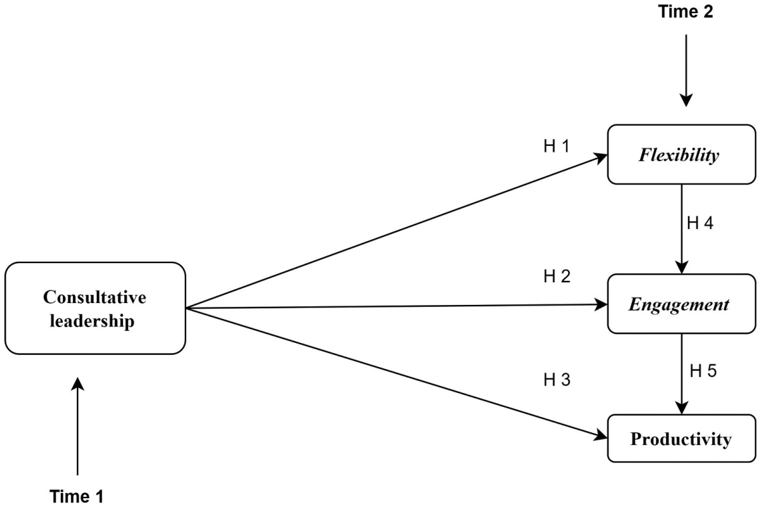
- Consultative leadership had significant positive paths to flexibility (β = 0.493, t = 7.716, p < 0.001), engagement (β = 0.377, t = 5.492, p < 0.001), and productivity (β = 0.523, t = 8.542, p < 0.001).
- Flexibility significantly predicted engagement (β = 0.333, t = 4.650, p < 0.001), and engagement significantly predicted productivity (β = 0.265, t = 3.822, p < 0.001); the paper notes this last association was weaker than the other validated paths.
- Model statistics reported R² = 0.377 for engagement, 0.243 for flexibility, and 0.494 for productivity; Q² values were 0.289, 0.169, and 0.307, respectively. Consultative leadership’s effect size was modest for engagement (f² = 0.173) but larger for flexibility (f² = 0.322) and productivity (f² = 0.382).
Methods
- A self-administered Likert-scale questionnaire was distributed in August 2020 to volunteers in Pakistan’s private and public higher education sectors; the Islamabad higher-education workers were randomly sampled (n = 380) at a reported 5% confidence level, with 250 questionnaires returned and 220 complete responses analyzed (110 public, 110 private).
- Measures included consultative leadership (4 items), engagement (3 items), flexibility (4 items), and productivity (5 items); data were analyzed using SPSS and SmartPLS for structural equation modeling and path analysis.
- The paper reports model fit values of SRMR = 0.068 and NFI = 0.890, with reliability and validity assessed via factor loadings, Cronbach’s alpha, composite reliability, and AVE.
Limitations
- The paper states that the study design contains demographic, sampling, and methodological constraints, and that lower participation occurred due to situational variables, COVID-19 consequences, and apparent convenience in scheduling during the pandemic; it calls for replication in many contexts.
- Evident from the text: the sample is limited to Islamabad higher-education workers in Pakistan, uses self-report Likert measures, and is mostly male (65.5%) and experienced (51.8% with 6–10 years), which restricts generalizability.
- The reported NFI of 0.890 is just below the stated >0.90 threshold, although SRMR = 0.068 is within the stated <0.08 threshold.
Model-written summary. Check it against the paper before relying on it.
Integrity signals
Registry
Cites
Statistics
Figures



















Verification
Claims the paper makes
2 Valid · 5 Not valid · 12 Not checked · 35 Own results and interpretations
The cited sources that could be checked couldn’t confirm or dispute this claim.
In the paper
“Interaction between group members makes it possible for individuals to construct and negotiate their roles within the group (Fraussen et al., 2020).”
What the sources say
- Could not verifycites Fraussen et al., 2020 matched to “Conceptualizing consultation approaches: identifying combinations of consultation tools and analyzing their implications for stakeholder diversity” (2020) sourceExperimental — accuracy not yet measured
Our full (untruncated) copy of Fraussen et al. (2020) is entirely about combinations of consultation tools (open, closed, hybrid) and their implications for stakeholder diversity and business dominance in EU policy consultation; no passage addresses interaction between group members as a mechanism for individuals constructing and negotiating their roles. Searched the indexed text for 'interaction... construct and negotiate roles', 'role construction/identity through interaction', 'interaction among participants/deliberation', and the participation-tool framework (Introduction, 'Consultation approaches: a framework to examine stakeholder engagement', Discussion, Conclusion) — the closest material is the Discussion's endorsement of Baldwin's (2018) broader notion of influence as 'regular participation and the ability to raise issues and participate in deliberation with decision makers', which is a different point and is credited to Baldwin, not a claim about role negotiation. Nothing in our copy supports the attributed statement, and nothing contradicts it, so the claim cannot be checked against this source. (LLM, conf=0.70)
plainstates a cause- Asserted: passes — The authors put it forward as true.
- Checkable: passes — It can be checked against evidence.
- Load-bearing: unclear — It is unclear whether the paper’s conclusions depend on it.
- Based: passes — The paper gives a reason why it holds.
- Could not verify
A result the paper reports from its own data — it cites no other source for it, so there is none to check. The quote shows it is in the paper.
In the paper
“The positive correlation between the two variables is indicated by a path analysis result of 0.493 coefficients, t-values of 7.716, and a significance level of 0.001.”
hedgedstates a cause- Asserted: passes — The authors put it forward as true.
- Checkable: passes — It can be checked against evidence.
- Load-bearing: passes — The paper’s conclusions depend on it.
- Based: passes — The paper gives a reason why it holds.
A result the paper reports from its own data — it cites no other source for it, so there is none to check. The quote shows it is in the paper.
In the paper
“However, this association is weaker than the path beta observed for all validated hypotheses.”
plainstates an association- Asserted: passes — The authors put it forward as true.
- Checkable: passes — It can be checked against evidence.
- Load-bearing: unclear — It is unclear whether the paper’s conclusions depend on it.
- Based: passes — The paper gives a reason why it holds.
A result the paper reports from its own data — it cites no other source for it, so there is none to check. The quote shows it is in the paper.
In the paper
“Coefficients of 0.265, t-values of 3.822, and p-values of 0.001 show that this hypothesis is supported.”
plainstates a cause- Asserted: passes — The authors put it forward as true.
- Checkable: passes — It can be checked against evidence.
- Load-bearing: passes — The paper’s conclusions depend on it.
- Based: passes — The paper gives a reason why it holds.
A result the paper reports from its own data — it cites no other source for it, so there is none to check. The quote shows it is in the paper.
In the paper
“Confirmation of this hypothesis is indicated by coefficients of 0.377, t-values of 5.492, and p-values of 0.001.”
hedgedstates a cause- Asserted: passes — The authors put it forward as true.
- Checkable: passes — It can be checked against evidence.
- Load-bearing: passes — The paper’s conclusions depend on it.
- Based: passes — The paper gives a reason why it holds.
8 more claims
Create a free account to see all 54 claims and to verify the 2 references still open.
- Probably not a substantial claim. 31
- It may state two separate claims as one. 10
- The quote only partly states this claim. 8
Self-check
Percentages, sums and reported differences re-computed from the paper’s own numbers.
Each contradiction between two passages listed here was confirmed by an independent check.
Rated minor: it would not touch a result — a value no result rests on, a p-value that stays on the same side of the significance level, or a conflict that is clerical, resolved elsewhere in the paper, or outside its own findings.
In the paper
§ Results · p. 8
“Table 2 displays statistical indicators with this study model's values achieving the allowable range.”
§ Results · p. 8
“NFI >.90, (0.890)”
Cited works that were retracted
Works this paper cites that were later retracted, from the retraction notices publishers deposit. Major when the notice came out before this paper was published.
Rated major: it would touch a result — a value a result rests on, reported and recomputed p-values on opposite sides of the significance level, two passages that conflict with no sign which is right, or a cited work retracted before this paper was published.
In the paper
“Considering human psychology is not consistent in changing working habits, it is a realistic technique to employ various tactics to maximize performance, e.g., (Suhariadi et al., 2023).”
Cited work 10.1016/j.heliyon.2023.e14082 · retracted 2023-03-01 · notice 10.1016/j.heliyon.2023.e14082 · this paper published 2023-04-09
Citations
Cites
1 retracted
Suhariadi, F., Sugiarti, R., Hardaningtyas, D., Mulyati, R., Kurniasari, E., Saadah, N., Yumni, H., & Abbas, A. (2023) · Heliyon · doi:10.1016/j.heliyon.2023.e14082 · Cited by 36 · cited 4×
“Considering human psychology is not consistent in changing working habits, it is a realistic technique to employ various tactics to maximize performance, e.g., (Suhariadi et al., 2023).”
BackgroundMethodInfluentialSelf-citationRetractedEvaluating structural equation models with unobservable variables and measurement error
Fornell, C., & Larcker, D. F. (1981) · Journal of Marketing Research · doi:10.1177/002224378101800104 · Cited by 109,190 · cited 1×
“Indices presented in Table 3 hold a primary threshold (Fornell & Larcker, 1981) between ≥.85 and ≤.90 (Gold et al., 2001).”
BackgroundPodsakoff, P. M., MacKenzie, S. B., Lee, J.-Y., & Podsakoff, N. P. (2003) · Journal of Applied Psychology · doi:10.1037/0021-9010.88.5.879 · Cited by 82,194 · cited 1×
“…Islamabad were randomly sampled (n = 380) at a 5% confidence level to complete a survey. n ¼ N 1þ n� eð Þ2 since n ¼ 7154 1þ 7154 0:05ð Þ2 ;n ¼ 379 Upon willingness, they were asked to return the questionnaire during office hours, while the time lag approach was employed (Podsakoff et al., 2003).”
MethodStatistical Power Analysis for the Behavioral Sciences
Cohen, J. (2013) · doi:10.4324/9780203771587 · Cited by 25,373
A primer on partial least squares structural equation modeling (PLS-SEM)
Leguina, A. (2015) · International Journal of Research & Method in Education · doi:10.1080/1743727x.2015.1005806 · Cited by 18,921
(2014) · DigitalCommons - Kennesaw State University (Kennesaw State University) · Cited by 12,785
Partial Least Squares Structural Equation Modeling (PLS-SEM) Using R: A Workbook
Hair, J. F., Hult, G. T. M., Ringle, C. M., Sarstedt, M., Danks, N. P., & Ray, S. (2021) · Classroom Companion: Business · doi:10.1007/978-3-030-80519-7 · Cited by 10,343 · cited 2×
“Factor loadings of 0.7 or above indicate sufficient variance is extracted from the variable using the SEM technique (Hair et al., 2021).”
BackgroundMethodInfluentialJob demands, job resources, and their relationship with burnout and engagement: a multi‐sample study
Schaufeli, W. B., & Bakker, A. B. (2004) · Journal of Organizational Behavior · doi:10.1002/job.248 · Cited by 9,297 · cited 1×
“These questions were adopted from the literature recommendations (Schaufeli & Bakker, 2004; Schaufeli et al., 2006).”
MethodThe Measurement of Work Engagement With a Short Questionnaire: A Cross-National Study
Schaufeli, W. B., Bakker, A. B., & Salanova, M. (2006) · Educational and Psychological Measurement · doi:10.1177/0013164405282471 · Cited by 7,403 · cited 1×
“These questions were adopted from the literature recommendations (Schaufeli & Bakker, 2004; Schaufeli et al., 2006).”
MethodKnowledge management: An organizational capabilities perspective
Gold, A. H., Malhotra, A., & Segars, A. H. (2001) · Journal of Management Information Systems · doi:10.1080/07421222.2001.11045669 · Cited by 6,233 · cited 1×
“Indices presented in Table 3 hold a primary threshold (Fornell & Larcker, 1981) between ≥.85 and ≤.90 (Gold et al., 2001).”
BackgroundThe Predictive Sample Reuse Method with Applications
Geisser, S. (1975) · Journal of the American Statistical Association · doi:10.1080/01621459.1975.10479865 · Cited by 2,748 · cited 1×
“Q-Square values greater than zero suggest that the model’s values have been well rebuilt and that the model is predictive (Geisser, 1975).”
BackgroundPsychosocial work environment and mental health—a meta-analytic review
Stansfeld, S., & Candy, B. (2006) · Scandinavian Journal of Work, Environment & Health · doi:10.5271/sjweh.1050 · Cited by 1,875 · cited 1×
“…emotional, and physiological environment are used to classify individual thinking capacity: concentration, consciousness, intuitive understanding, good remembering, possible interpretation, problem-solving, and decision-making, e.g. (Dane, 2011; Giampaoli et al., 2017; Stansfeld & Candy, 2006).”
BackgroundA three-talk model for shared decision making: multistage consultation process
Elwyn, G., Durand, M. A., Song, J., Aarts, J., Barr, P. J., Berger, Z., Cochran, N., Frosch, D., Galasiński, D., Gulbrandsen, P., et al. (2017) · BMJ · doi:10.1136/bmj.j4891 · Cited by 1,018
THE DYNAMICS OF COLLECTIVE LEADERSHIP AND STRATEGIC CHANGE IN PLURALISTIC ORGANIZATIONS.
Denis, J.-L., Lamothe, L., & Langley, A. (2001) · Academy of Management Journal · doi:10.2307/3069417 · Cited by 953
Reed, M. S., Vella, S., Challies, E., de Vente, J., Frewer, L., Hohenwallner‐Ries, D., Huber, T., Neumann, R. K., Oughton, E. A., Sidoli del Ceno, J., et al. (2018) · Restoration Ecology · doi:10.1111/rec.12541 · Cited by 746
Paying Attention to Mindfulness and Its Effects on Task Performance in the Workplace
Dane, E. (2011) · Journal of Management · doi:10.1177/0149206310367948 · Cited by 682
Transformational leadership and shared values: the building blocks of trust
Gillespie, N. A., & Mann, L. (2004) · Journal of Managerial Psychology · doi:10.1108/02683940410551507 · Cited by 511 · cited 1×
“In a consultative leadership questionnaire, respondents must indicate how much leaders should consult, participate, or delegate in their daily operations (Gillespie & Mann, 2004; Oshagbemi & Ocholi, 2006; Oshagbemi, 2004).”
BackgroundHuman beliefs and values a cross-cultural sourcebook based on the 1999 - 2002 values surveys
Inglehart, R. (2004) · Cited by 481
Assessing the evidence for stakeholder engagement in biodiversity conservation
Sterling, E. J., Betley, E., Sigouin, A., Gomez, A., Toomey, A., Cullman, G., Malone, C., Pekor, A., Arengo, F., Blair, M., et al. (2017) · Biological Conservation · doi:10.1016/j.biocon.2017.02.008 · Cited by 476 · cited 1×
“Though participative approaches, especially in sustainable development, do not entirely overcome the expected beneficial or societal effects in some instances, e.g., (Sterling et al., 2017).”
BackgroundBhattacharya, M., Gibson, D. E., & Doty, D. H. (2005) · Journal of Management · doi:10.1177/0149206304272347 · Cited by 378 · cited 2×
“Bhattacharya et al. (2005) produced four ways to measure human resources’ flexibility.”
BackgroundBeltrán-Martín, I., Roca-Puig, V., Escrig-Tena, A., & Bou-Llusar, J. C. (2008) · Journal of Management · doi:10.1177/0149206308318616 · Cited by 337 · cited 1×
“In a high-performance work environment, people’s behavior can be self-regulated rather than controlled by sanctions and coercion (Beltrán-Martín et al., 2008).”
BackgroundUse of exploratory factor analysis in maritime research
Maskey, R., Fei, J., & Nguyen, H.-O. (2018) · The Asian Journal of Shipping and Logistics · doi:10.1016/j.ajsl.2018.06.006 · Cited by 297 · cited 1×
“Cross-loadings should meet minimum>.40 (Maskey et al., 2018), AVE >.50, Alpha and CR e.g., composite reliability >.70 (Hair et al., 2014).”
BackgroundRichman, A. L., Civian, J. T., Shannon, L. L., Jeffrey Hill, E., & Brennan, R. T. (2008) · Community, Work & Family · doi:10.1080/13668800802050350 · Cited by 296 · cited 1×
“That is possible with the perseverance and patience of construction-minded executives who value methodical engagement for workforce flexibility (Richman et al., 2008).”
BackgroundYang, E., Kim, Y., & Hong, S. (2021) · Journal of Corporate Real Estate · doi:10.1108/jcre-04-2021-0015 · Cited by 262 · cited 2×
“Flexible working with in-person collaboration is a future strategic option (Yang et al., 2021).”
BackgroundEnhancing the relevance of organizational behavior by embracing performance management research
Aguinis, H., & Pierce, C. A. (2008) · Journal of Organizational Behavior · doi:10.1002/job.493 · Cited by 231
Alotaibi, S. M., Amin, M., & Winterton, J. (2020) · Leadership & Organization Development Journal · doi:10.1108/lodj-07-2020-0313 · Cited by 222 · cited 1×
“Emotional stability, cognitive capacity, and self-assurance are necessary for effective leadership (Alotaibi et al., 2020).”
BackgroundMubarak, N., Khan, J., Yasmin, R., & Osmadi, A. (2021) · Leadership & Organization Development Journal · doi:10.1108/lodj-11-2020-0518 · Cited by 190 · cited 1×
“Time management is also crucial in determining the participation rate, as a person’s and leaders’ personality traits may play a role in these differences (Mubarak et al., 2021).”
BackgroundKnowledge management, problem solving and performance in top Italian firms
Giampaoli, D., Ciambotti, M., & Bontis, N. (2017) · Journal of Knowledge Management · doi:10.1108/jkm-03-2016-0113 · Cited by 187 · cited 1×
“…emotional, and physiological environment are used to classify individual thinking capacity: concentration, consciousness, intuitive understanding, good remembering, possible interpretation, problem-solving, and decision-making, e.g. (Dane, 2011; Giampaoli et al., 2017; Stansfeld & Candy, 2006).”
BackgroundKeller, T. (2003) · The Leadership Quarterly · doi:10.1016/s1048-9843(03)00007-9 · Cited by 186 · cited 1×
“In conjunction with a varied body of literature on implicit leadership, transformational leadership skills were used to develop a leadership questionnaire, e.g. (Bass & Stogdill, 1990; Keller, 2003).”
MethodZhu, W., He, H., Treviño, L. K., Chao, M. M., & Wang, W. (2015) · The Leadership Quarterly · doi:10.1016/j.leaqua.2015.01.004 · Cited by 184 · cited 1×
“Today’s literature affirms the growing implicitness of productivity and leadership styles (Abbas et al., 2023; Zhu et al., 2015).”
BackgroundKock, N., Mayfield, M., Mayfield, J., Sexton, S., & De La Garza, L. M. (2019) · Journal of Leadership & Organizational Studies · doi:10.1177/1548051818806290 · Cited by 183 · cited 1×
“We used the measurements from a study that had items like “I can deal with issues and challenges at work” and “I can better adapt to changes at work than my colleagues” (Kock et al., 2019).”
MethodThe multi-generational workforce: Workplace flexibility and engagement
Pitt-Catsouphes, M., & Matz-Costa, C. (2008) · Community, Work & Family · doi:10.1080/13668800802021906 · Cited by 181 · cited 1×
“A wide gap exists in employee engagement between those who can execute their jobs as they see fit and those who do not, regardless of age (Pitt-Catsouphes & Matz-Costa, 2008).”
BackgroundPositive leadership psychology: Authentic and servant leadership in higher education in Pakistan
Abbas, A., Saud, M., Suhariadi, F., Usman, I., & Ekowati, D. (2020) · Current Psychology · doi:10.1007/s12144-020-01051-1 · Cited by 173 · cited 1×
“Factor loadings, cross-loadings, model fit indices, correlation, and path coefficients were obtained from literature consideration (Abbas et al., 2020).”
MethodSelf-citationAge influences on the leadership styles and behaviour of managers
Oshagbemi, T. (2004) · Employee Relations · doi:10.1108/01425450410506878 · Cited by 167 · cited 2×
“In a consultative leadership questionnaire, respondents must indicate how much leaders should consult, participate, or delegate in their daily operations (Gillespie & Mann, 2004; Oshagbemi & Ocholi, 2006; Oshagbemi, 2004).”
BackgroundEichenauer, C. J., Ryan, A. M., & Alanis, J. M. (2021) · Journal of Leadership & Organizational Studies · doi:10.1177/15480518211010761 · Cited by 167
Guix, M., Bonilla-Priego, M. J., & Font, X. (2017) · Journal of Sustainable Tourism · doi:10.1080/09669582.2017.1410164 · Cited by 154
Political Leaders and Public Engagement: The Hidden World of Informal Elite–Citizen Interaction
Hendriks, C. M., & Lees-Marshment, J. (2019) · Political Studies · doi:10.1177/0032321718791370 · Cited by 151
Complex Responsive Processes in Organizations
Stacey, R. D. (2003) · doi:10.4324/9780203361481 · Cited by 132
Hatch, M. J. (2018) · Oxford University Press eBooks · doi:10.1093/hebz/9780198723981.001.0001 · Cited by 130
Kampkötter, P., Harbring, C., & Sliwka, D. (2016) · The International Journal of Human Resource Management · doi:10.1080/09585192.2016.1209227 · Cited by 124 · cited 1×
“Nimble individuals may benefit the organization if willing to accomplish their duties in any function (Kampkötter et al., 2018).”
BackgroundMorgan, D. F., Ingle, M. D., & Shinn, C. W. (2018) · New Public Leadership · doi:10.4324/9780429450181-4 · Cited by 123
Adil, A., & Kamal, A. (2019) · International Journal of Leadership in Education · doi:10.1080/13603124.2019.1580772 · Cited by 116 · cited 1×
“Studies revealed that using empirical analysis in Pakistani educational landscape research is helpful (Adil & Kamal, 2019; Asrar-Ul-Haq et al., 2019).”
BackgroundMa, S., & Seidl, D. N. (2017) · Strategic Management Journal · doi:10.1002/smj.2721 · Cited by 113
A Company I Can Trust? Organizational Lay Theories Moderate Stereotype Threat for Women
Emerson, K. T. U., & Murphy, M. C. (2015) · Personality and Social Psychology Bulletin · doi:10.1177/0146167214564969 · Cited by 107
Strategic flexibility analysis of HRD research and practice post COVID-19 pandemic
Yawson, R. (2020) · Human Resource Development International · doi:10.1080/13678868.2020.1779169 · Cited by 107 · cited 1×
“Additionally, it can lead to new and innovative ideas emerging when people freely express their thoughts and ideas (Yawson, 2020).”
BackgroundPersonal and organizational mindsets at work
Murphy, M. C., & Reeves, S. L. (2019) · Research in Organizational Behavior · doi:10.1016/j.riob.2020.100121 · Cited by 107 · cited 1×
“People’s beliefs in the permanence of the first influence their level of motivation, level of involvement, and behavior, all of which affect their performance (Murphy & Reeves, 2019).”
BackgroundGamification and gigification: A multidimensional theoretical approach
Behl, A., Jayawardena, N., Ishizaka, A., Gupta, M., & Shankar, A. (2022) · Journal of Business Research · doi:10.1016/j.jbusres.2021.09.023 · Cited by 104 · cited 1×
“When performance is designed to achieve a goal, it must be viewed in a manner that integrates the numerous motivational orientations that shape the complex psychology of individuals (Behl et al., 2022; Hatch, 2018).”
BackgroundSchuh, A. M. (2016) · Springer eBooks · doi:10.1007/978-3-319-31816-5_106-1 · Cited by 101
Two sides of the same coin? Leadership and organizational culture
Chong, M. P. M., Shang, Y., Richards, M., & Zhu, X. (2018) · Leadership & Organization Development Journal · doi:10.1108/lodj-05-2017-0122 · Cited by 97
Fraussen, B., Albareda, A., & Braun, C. (2020) · Policy Sciences · doi:10.1007/s11077-020-09382-3 · Cited by 93 · cited 2×
“Findings reveal that it significantly impacts the understanding of the relationship between consultation strategies and stakeholder participation, e.g. (Fraussen et al., 2020).”
BackgroundSims, C. M., Carter, A., & de Peralta, A. M. (2020) · Human Resource Development Quarterly · doi:10.1002/hrdq.21408 · Cited by 86
Linking Work Engagement to Job Performance Through Flexible Human Resource Management
Sekhar, C., Patwardhan, M., & Vyas, V. (2018) · Advances in Developing Human Resources · doi:10.1177/1523422317743250 · Cited by 83
Vollero, A., Siano, A., Palazzo, M., & Amabile, S. (2020) · Corporate Social Responsibility and Environmental Management · doi:10.1002/csr.1773 · Cited by 80
Asrar‐ul‐Haq, M., Ali, H. Y., Anwar, S., Iqbal, A., Iqbal, M. B., Suleman, N., Sadiq, I., & Haris‐ul‐Mahasbi, M. (2019) · South Asian Journal of Business Studies · doi:10.1108/sajbs-07-2018-0086 · Cited by 74
Towards a multidimensional competency‐based managerial performance framework
Cheng, M., Dainty, A., & Moore, D. (2005) · Journal of Managerial Psychology · doi:10.1108/02683940510602941 · Cited by 71 · cited 1×
“This culture includes individuals, structural alignment, value alignment, and mission alignment (Cheng et al., 2005; Hirsch, 2015).”
BackgroundFlexible working and engagement: the importance of choice
Anderson, D., & Kelliher, C. (2009) · Strategic HR Review · doi:10.1108/14754390910937530 · Cited by 65 · cited 1×
“Flexibility and engagement can increase productivity over time (Anderson & Kelliher, 2009).”
BackgroundToward a Meta-Theory of Consultation
Gallessich, J. M. (1985) · The Counseling Psychologist · doi:10.1177/0011000085133002 · Cited by 62 · cited 1×
“Intentional consultation requires a plausible hypothesis about who has the more admirable traits, e.g., (Gallessich, 1985).”
BackgroundHimawan, K. K., Helmi, J., & Fanggidae, J. P. (2022) · Knowledge and Process Management · doi:10.1002/kpm.1708 · Cited by 57 · cited 2×
“So, in the Asian context, employment flexibility hindered by management structure is not a frequently recognized practice, e.g. (Himawan et al., 2022).”
BackgroundGovernance and cooperative networks: An adaptive systems perspective
Smith, M. Y., & Stacey, R. D. (1997) · Technological Forecasting and Social Change · doi:10.1016/s0040-1625(96)00100-x · Cited by 51 · cited 1×
“When members of an organization are complete, a positive mind is consciously active for psychologically engaged individuals, communities, and organizations toward productivity (Smith & Stacey, 1997; Stacey, 2003).”
BackgroundLeadership styles and behaviour profiles of managers
Oshagbemi, T., & Ocholi, S. A. (2006) · Journal of Management Development · doi:10.1108/02621710610684231 · Cited by 50 · cited 1×
“In a consultative leadership questionnaire, respondents must indicate how much leaders should consult, participate, or delegate in their daily operations (Gillespie & Mann, 2004; Oshagbemi & Ocholi, 2006; Oshagbemi, 2004).”
BackgroundRuben, B. D., & Gigliotti, R. A. (2021) · Leadership & Organization Development Journal · doi:10.1108/lodj-02-2021-0072 · Cited by 49 · cited 1×
“Inconsistencies may hinder this relationship, whereas consistent leadership behavior helps it to flourish, e.g. (Ruben & Gigliotti, 2021).”
BackgroundThe impact of personal and organisational variables on the leadership styles of managers
Oshagbemi, T. (2008) · The International Journal of Human Resource Management · doi:10.1080/09585190802324130 · Cited by 48 · cited 1×
“Consultative leadership is a type of leadership that focuses on the development of teams and makes use of the knowledge and experience of other people when developing plans and making decisions, e.g. (Oshagbemi, 2008).”
BackgroundAbbas, A., Eliyana, A., Ekowati, D., Saud, M., Raza, A., & Wardani, R. (2020) · Data in Brief · doi:10.1016/j.dib.2020.105583 · Cited by 46 · cited 1×
“Factor loadings, cross-loadings, model fit indices, correlation, and path coefficients were obtained from literature consideration (Abbas et al., 2020).”
MethodSelf-citationAssessing Employee Engagement in a Post-COVID-19 Workplace Ecosystem
Surma, M., Nunes, R., Rook, C., & Loder, A. (2021) · Sustainability · doi:10.3390/su132011443 · Cited by 45 · cited 1×
“Workers who are invested in their work show greater vigor and energy and are healthier and more productive (Surma et al., 2021).”
BackgroundCorrelates of perceived leadership style in a culturally mixed environment
Yousef, D. A. (1998) · Leadership & Organization Development Journal · doi:10.1108/01437739810234341 · Cited by 44 · cited 1×
“Consultative leadership is typical of mixed cultural dimensions where the leader’s approach to business has a noticeable and lasting impact on the bottom line (Yousef, 1998).”
BackgroundAbbas, A., Ekowati, D., Suhariadi, F., Fenitra, R. M., & Fahlevi, M. (2022) · Advances in logistics, operations, and management science book series · doi:10.4018/978-1-7998-8856-7.ch007 · Cited by 40
Self-citationFenitra, R. M., Abbas, A., Ekowati, D., & Suhairidi, F. (2022) · Emerald Group Publishing Limited eBooks · doi:10.1108/978-1-80262-073-320221003 · Cited by 40
Self-citationCreating conditions to nourish sustainable organizational excellence
Dervitsiotis, K. N. (2005) · Total Quality Management & Business Excellence · doi:10.1080/14783360500163078 · Cited by 38 · cited 1×
“Creating a conducive atmosphere is crucial to the growth of any firm because it fosters stability and predictability (Dervitsiotis, 2005).”
BackgroundDaily engagement and productivity: The importance of the speed of engagement.
Vogel, R. M., Rodell, J. B., & Agolli, A. (2021) · Journal of Applied Psychology · doi:10.1037/apl0000958 · Cited by 38
Leadership Theory and Development: The Coming ″New Phase″
Schriesheim, C. A., & Neider, L. L. (1989) · Leadership & Organization Development Journal · doi:10.1108/eum0000000001145 · Cited by 35 · cited 1×
“Depending on the specifics of the scenario, such as the amount of information available, the problem’s structure, and the subordinates’ attitudes may vary (Schriesheim & Neider, 1989).”
BackgroundTeaching multiple approaches to management to facilitate prosocial and environmental well-being
Dyck, B., & Caza, A. (2021) · Management Learning · doi:10.1177/13505076211045498 · Cited by 35 · cited 1×
“It requires more work commitment and not being concerned about saving money but inculcating a growth mindset (Dyck & Caza, 2021; Reif et al., 2022; Sims et al., 2021; Van Dijk et al., 2021).”
BackgroundNegative vs. Positive Psychology: a Review of Science of Well-Being
Abbas, A., Ekowati, D., Suhariadi, F., & Hamid, S. A. R. (2024) · Integrative Psychological and Behavioral Science · doi:10.1007/s12124-022-09708-1 · Cited by 28
Self-citationIndividual psychological distance: a leadership task to assess and cope with invisible change
Abbas, A., Ekowati, D., & Suhariadi, F. (2021) · Journal of Management Development · doi:10.1108/jmd-09-2020-0304 · Cited by 27
Self-citationContemporary Leadership Theories
Winkler, I. (2009) · Contributions to management science · doi:10.1007/978-3-7908-2158-1 · Cited by 27 · cited 2×
“The theory does account for the content or form of role communication, which affects the perception and interpretation of role-sending, e.g., (Winkler, 2009).”
BackgroundMotivational Effect of Performance Management: Does Leadership Matter?
", & Lee, H.-W. (2020) · Transylvanian Review of Administrative Sciences · doi:10.24193/tras.59e.4 · Cited by 25
Abbas, A., Ekowati, D., & Anwar, A. (2023) · International Journal of Public Leadership · doi:10.1108/ijpl-04-2022-0020 · Cited by 22 · cited 1×
“Today’s literature affirms the growing implicitness of productivity and leadership styles (Abbas et al., 2023; Zhu et al., 2015).”
BackgroundSelf-citationSocial Psychology and Fabrication: A Synthesis of Individuals, Society, and Organization
Abbas, A., Saud, M., Ekowati, D., & Suhariadi, F. (2021) · Advances in psychology, mental health, and behavioral studies (APMHBS) book series · doi:10.4018/978-1-7998-6960-3.ch005 · Cited by 21
Self-citationManaging Individuals and Organizations Through Leadership: Diversity Consciousness Roadmap
Abbas, A., Ekowati, D., & Suhariadi, F. (2021) · Advances in psychology, mental health, and behavioral studies (APMHBS) book series · doi:10.4018/978-1-7998-6960-3.ch003 · Cited by 20
Self-citationYu, F., Deuble, R., & Morgan, H. (2017) · Journal of the Australian Library and Information Association · doi:10.1080/24750158.2017.1364835 · Cited by 19 · cited 2×
“It effectively influences followers in strategic planning and problem-solving (Yu et al., 2017).”
BackgroundReif, J. A. M., Kugler, K. G., Stockkamp, M. T., Richter, S. S., Benning, V. M., Muschaweck, L. A., & Brodbeck, F. C. (2022) · Business Process Management Journal · doi:10.1108/bpmj-06-2021-0375 · Cited by 19 · cited 1×
“It requires more work commitment and not being concerned about saving money but inculcating a growth mindset (Dyck & Caza, 2021; Reif et al., 2022; Sims et al., 2021; Van Dijk et al., 2021).”
BackgroundUnderstanding Leadership Theories-A Review for Researchers
Khan, Z. A., Bhat, S. J., & Hussanie, I. (2017) · Asian Journal of Research in Social Sciences and Humanities · doi:10.5958/2249-7315.2017.00313.6 · Cited by 18 · cited 1×
“A company’s ability to create a vision, support a strategy, and act as a catalyst to improve the bench strength of its employees depends on the quality of its leadership (Khan et al., 2017).”
BackgroundDoes Leadership Style Influence Organizational Effectiveness in Non-Governmental Organizations?
Mwai, G. M., Namada, J. M., & Katuse, P. (2018) · International Journal of Business and Management · doi:10.5539/ijbm.v13n8p52 · Cited by 18 · cited 1×
“If the leader is unsure of the best course of action and might use their team members’ input, they should adopt a consultative style (Mwai et al., 2018).”
BackgroundThe Leadership Productivity Model
Desjardins, C. (2012) · RePEc: Research Papers in Economics · Cited by 17
Preferred leadership style, managerial and entrepreneurial inclination among Hungarian students
Perpék, É., Győri, Á., & Lengyel, G. (2021) · Journal of Innovation and Entrepreneurship · doi:10.1186/s13731-021-00174-4 · Cited by 16 · cited 1×
“Education benefits from collaborative and participatory approaches (Perpék et al., 2021).”
BackgroundButt, K., Jabeen, M., & Zareef, M. (2023) · The Journal of Academic Librarianship · doi:10.1016/j.acalib.2023.102677 · Cited by 14 · cited 2×
“Transformational education is a matter of time (Butt et al., 2023).”
BackgroundBusiness Coaching and Consulting – the Systemic Constellation Approach in Business
Burchardt, C. (2015) · Modelling and Management of Engineering Processes · doi:10.1007/978-3-662-44009-4_9 · Cited by 13 · cited 1×
“It may resolve many intricate relationships and complex interactions (Burchardt, 2015).”
BackgroundMURADLI, N., & Ahmadov, F. (2019) · Journal of Entrepreneurship and Sustainability Issues · doi:10.9770/jesi.2019.6.3(14 · Cited by 12
Gallardo, R. M. (2019) · International Journal of Public Leadership · doi:10.1108/ijpl-05-2019-0020 · Cited by 9
Dijk, D. V., Kark, R., Matta, F. K., et al. (2020) · Journal of Business and Psychology · doi:10.1007/s10869-020-09699-z · Cited by 6
Being awkward: creating conscious culture change
Hirsch, P. B. (2015) · Journal of Business Strategy · doi:10.1108/jbs-11-2014-0131 · Cited by 5 · cited 1×
“This culture includes individuals, structural alignment, value alignment, and mission alignment (Cheng et al., 2005; Hirsch, 2015).”
BackgroundSutton, L. B.-M., Roux, T. L., & Fourie, L. (2022) · Communicatio · doi:10.1080/02500167.2022.2163268 · Cited by 4 · cited 1×
“Leaders use communication to engage their teams to acquire their employees’ views and perspectives (Sutton et al., 2023).”
BackgroundNantavisit, N., & Wongsa, S. (2021) · Asia Social Issues · doi:10.48048/asi.2022.251502 · Cited by 2
Winkler, I. (2009) · Contributions to Management Science · doi:10.1007/978-3-7908-2158-1_10
Research works printed but not linked: 8
- Bass, B. M., & Stogdill, R. M. (1990). Bass & stogdill’s Handbook of Leadership: Theory, Research, and Managerial Applications. The Free Press.
- Berger, J. (2016). Invisible influence: The hidden forces that shape behavior. Simon and Schuster.
- De Smet, A., Dowling, B., Mysore, M., & Reich, A. (2021). It’s time for leaders to get real about hybrid. In The McKinsey Quarterly (pp. 1–10). United States. https://www.mckinsey.com/business-functions/people-and-organizational-performance/our-insights/its-time-for-leadersto-get-real-about-hybrid
- Elkaleh, E. S. (2023). What Makes a Balanced Leader?: An Islamic Perspective. In Ahmed Amin & Jonathan A. J. Wilson, & N. El-Bassiouny (Eds.), Management, Spirituality and Religion: Volume 3 of Management, Spirituality and Religion (Vol. 3, pp. 45–62). De Gruyter.
- Johnson, G., Whittington, R., Regnér, P., Angwin, D., & Scholes, K. (2020). Exploring strategy (7th ed.) ed.). Pearson.
- Neffinger, J., & Kohut, M. (2014). Compelling people: The hidden qualities that make us influential. Penguin.
- Savić, D. (2020). COVID-19 and work from home: Digital transformation of the workforce. Grey Journal , 16 (2), 101-104.
- Sokolic, D. (2022). Remote work and hybrid work organizations . Paper presented at the 78th International Scientific Conference on Economic and Social Development, Aveiro, Portugal.
Cited by
Technology acceptance and COVID-19: a perspective for emerging opportunities from crisis
Abbas, A., Ekowati, D., Suhariadi, F., Anwar, A., & Fenitra, R. M. (2023) · Technology Analysis and Strategic Management · doi:10.1080/09537325.2023.2214642 · Cited by 25
“Yet, strategic intent is most important in productivity stimulants that sustainable development agenda (Ekowati et al. 2023).”
Self-citationHelalat, A. S., Sharari, H., Qawasmeh, R., Bani‐Mustafa, A., & Alkhazali, Z. (2023) · Cogent Business & Management · doi:10.1080/23311975.2023.2254023 · Cited by 33
“Leadership is assigned to set a direction for the organisation to succeed (Ekowati et al., 2023).”
BackgroundSetyaningrum, R. P., Ratnasari, S. L., Soelistya, D., Purwati, T., Desembrianita, E., & Fahlevi, M. (2024) · Cogent Business & Management · doi:10.1080/23311975.2024.2348718 · Cited by 79
“…return, employees can reciprocate with increased loyalty, commitment, and desire to remain with the organization, thereby enhancing retention rates (ekowati et al., 2023). this reciprocal exchange is central to understanding why ghRM may positively impact employee retention (Maskuroh et al.,…”
Self-citationKuntadi, C., Widyanty, W., Nurhidajat, R., Cahyandito, M. F., Sariadi, P., & Fahlevi, M. (2023) · Cogent Business & Management · doi:10.1080/23311975.2023.2285265 · Cited by 32
“Ekowati et al. (2023) expanded on this by emphasizing the role of power and interdependence within relationships, suggesting that the balance of reciprocation is central to maintaining engagement and satisfaction in the workplace.”
BackgroundSelf-citationAbbas, A., Suhariadi, F., Ekowati, D., & Fenitra, R. M. (2023) · Advances in human resources management and organizational development book series · doi:10.4018/979-8-3693-1380-0.ch018 · Cited by 7
Self-citation
Metadata
- Authors
- Ekowati, D., Abbas, A., Anwar, A., Suhariadi, F., & Fahlevi, M.
- Affiliations
- Universitas Airlangga (ID)
- Government Viqar-un-Nisa Post Graduate College for Women
- Binus University (ID)
- Corresponding author
- Ekowati, Dian
- Venue
- Cogent Business & Management
- Publisher
- Informa UK Limited
- Published
- 2023-04-09
- Volume
- 10
- Issue
- 1
- ISSN
- 2331-1975 (ISSN-L)
- OpenAlex
- W4362735997
- Cited by
- 19
- References
- 95
- Citations by year
- 2026: 1 · 2024: 8 · 2023: 10
- FWCI
- 4.10
- Type
- journal article
- Language
- en
- Open access
- gold
- doi.org
- Licence
- cc-by
- creativecommons.org/licenses/by/4.0/ (vor)
- doi.org/10.1080/policies-text-data-mining (tdm)
- Locations
- Cogent Business & Management (publishedVersion, cc-by)
- Universitas Airlangga Repository (Universitas Airlangga) (acceptedVersion)
- Econstor (Econstor) (submittedVersion, cc-by)
- RePEc: Research Papers in Economics (submittedVersion)
- DOAJ (DOAJ: Directory of Open Access Journals) (submittedVersion, cc-by-sa)
- Funders
- Research Transfer and Technology Officer
- Bina Nusantara University, Jakarta (research results' publication costs.)
- Topics
- Social Sciences › Business, Management and Accounting › Strategy and Management › Leadership and Management in Organizations
- Social Sciences › Business, Management and Accounting › Organizational Behavior and Human Resource Management › Employee Performance and Leadership
- Social Sciences › Business, Management and Accounting › Organizational Behavior and Human Resource Management › Employee Performance and Management
- Keywords
- consultative leadership, employee engagement, organizational flexibility, productivity, higher education institutions, organizational change, Pakistani universities
About these checks
Registry, retraction, Cites and statistics results are computed, not judged, with one exception: a printed reference that no index lists is read once by a model before it counts as a citation error. Claims are extracted by a model and kept only when their quote appears verbatim in the text; each cited source is then checked, with a model’s help, for whether it says what the claim relies on. Those verdicts can be wrong — read the claim’s quote and the cited source before relying on one.
The claim verdicts this report counts are experimental: their accuracy is not yet measured.
A language model drew the claims from the paper on 2026-10-10, under version 3 of the claim definition (model deepseek-v4.1-flash, prompt extract-v3).
A second model labelled each claim on 2026-10-10 (model jev-1.13-20260917, definition revision gold-guideline-v0.2).
Cited sources are checked with a language model’s help (qwen3.8-omni-flash).
Statistics and arithmetic are recomputed, not judged.
Confidence bands are shown only for fields calibrated on our annotated test set. None is calibrated yet, so no band is shown.
What counts as a claim ›How we measure confidence ›How we check this ›
Are you an author, or do you see a problem with this page? Request a review
Data sources
Bibliographic data: Semantic Scholar, OpenAlex, Crossref.
Contains information from the Semantic Scholar Academic Graph Datasets, made available under the ODC Attribution License (ODC-BY 1.0).
Semantic Scholar’s data is described in: Kinney, R., et al. (2023). The Semantic Scholar Open Data Platform. arXiv:2301.10140.
