

A comparative analysis of mathematical methods for detecting lactate thresholds using muscle oxygenation data during a graded cycling test
Open accessThe DOI matches its Crossref record; 56 of the 61 references it cites were found in a registry or an index; 9 of the 18 sources its claims cite were checked for support.
Abstract
Objective . Threshold determination for improving training and sports performance is important for researchers and trainers, who currently use different methods for determining lactate, ventilatory or muscle oxygenation (SmO 2 ) thresholds. Our study aimed to compare the identification of the intensity at the first and second thresholds using lactate and SmO 2 data by different mathematical methods in different muscles during a graded cycling test. Approach . Twenty-six cyclists (15 males and 11 females; 23 ±6 years, 1.71 ± 0.09 m, 64.3 ± 8.8 Kg and 12 ± 3 training hours per week) performed a graded test on the cycle ergometer. Power output and saturation of muscle oxygen in four muscles (vastus lateralis, biceps femoris, gastrocnemius and tibialis anterior) were measured, along with systemic lactate concentration. Main Results . Our results showed that any method was reliable for determining the first muscle oxygenation threshold (MOT1) when comparing the lactate threshold in any muscle. However, the best method for determining the second muscle oxygenation threshold (MOT2) was the Exp-Dmax ( p < 0.01; ICC = 0.79–0.91) in all muscles. In particular, the vastus lateralis muscle showed the highest intraclass correlation coefficient (ICC = 0.91, CI95% [0.81, 0.96]). However, results varied per sex across all muscles analyzed. Significance . Although the first muscle oxygenation threshold could not be determined using mathematical methods in all the muscles analyzed, the Exp-Dmax method presented excellent results in detecting the second systemic threshold in the vastus lateralis.
Overview
CoChat Summary
TL;DR
This study compared mathematical methods for detecting first and second thresholds from muscle oxygenation (SmO2) versus lactate in 26 cyclists during a graded cycling test. Exp-Dmax was best for the second muscle oxygenation threshold (MOT2), especially in vastus lateralis, but no method reliably detected the first threshold (MOT1).
Key findings
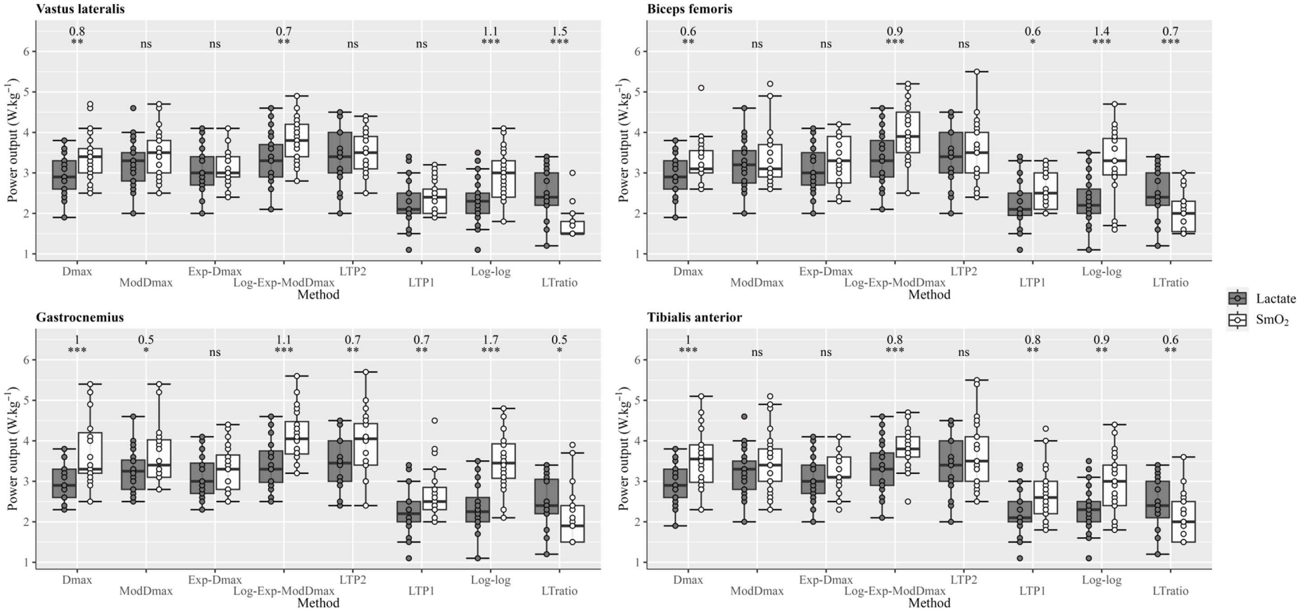
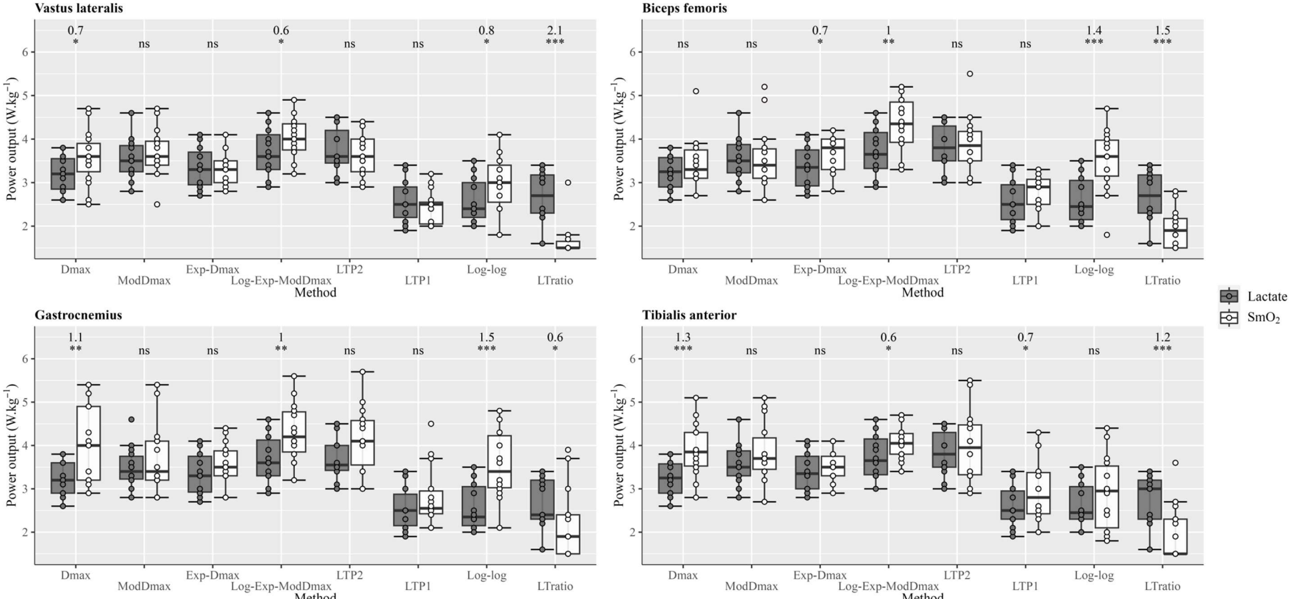
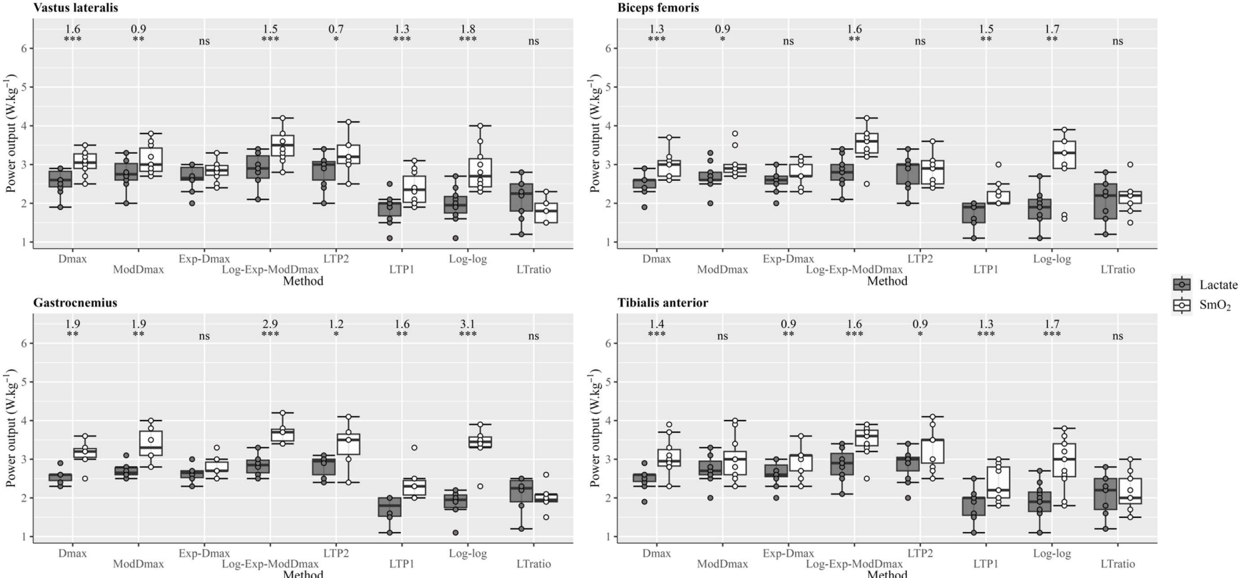
- No method was reliable for determining MOT1 when compared with lactate threshold in any muscle; first-threshold methods LTP1, Log-log, and LTratio showed non-significant ICC values in vastus lateralis and tibialis anterior, while biceps femoris (ICC=0.53, CI95%[0.08, 0.79]) and gastrocnemius (ICC=0.49, CI95%[0.04, 0.77]) had significant but only reasonable results in all participants.
- Exp-Dmax was the best method for MOT2 in all muscles: vastus lateralis ICC=0.91, CI95%[0.81, 0.96]; biceps femoris ICC=0.81, CI95%[0.35, 0.93]; tibialis anterior ICC=0.79, CI95%[0.48, 0.93]; gastrocnemius ICC=0.80, CI95%[0.45, 0.92] (p < 0.01).
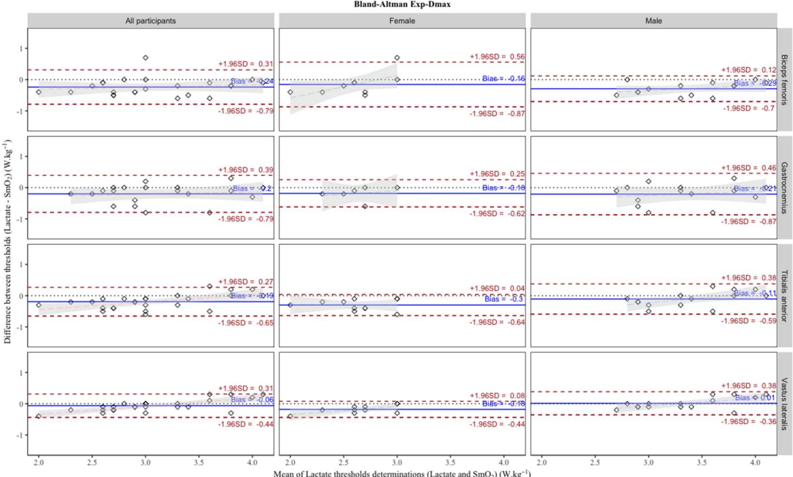
- Bland-Altman bias for Exp-Dmax was -0.06 ± 0.19 W·kg⁻¹ for vastus lateralis, -0.19 ± 0.23 W·kg⁻¹ for tibialis anterior, -0.2 ± 0.3 W·kg⁻¹ for gastrocnemius, and -0.24 ± 0.28 W·kg⁻¹ for biceps femoris.
- Automatic methods failed or gave incoherent values in some cases; vastus lateralis had the fewest failures (4%), while Dmax and LTratio had the most incorrect cases (12–13%), with discrepancies primarily found in females and most often in gastrocnemius (six discrepancies, four in females).
Methods
- Twenty-six competitive cyclists (15 males, 11 females; 23 ± 6 years, 1.71 ± 0.09 m, 64.3 ± 8.8 kg, 12 ± 3 training hours/week) performed a graded cycle ergometer test: 3-min warm-up at 1 W·kg⁻¹, then 3-min steps with 0.5 W·kg⁻¹ increments, maintaining 90 ± 10 rpm.
- SmO2 was measured with four Moxy NIRS devices on vastus lateralis, biceps femoris, gastrocnemius medialis, and tibialis anterior; blood lactate was measured from the earlobe in the last 30 s of each step; power output was normalized to W·kg⁻¹.
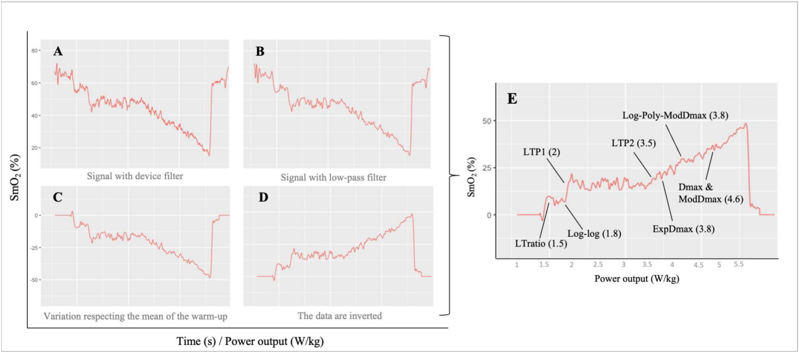
- Thresholds were calculated with the lactater package in RStudio using Log-log, Dmax, ModDmax, Log-Exp-ModDmax, Exp-Dmax, LTP1, LTP2, and LTratio; comparisons used Wilcoxon tests, Cohen’s effect sizes, ICCs, and Bland-Altman plots.
Limitations
- Stated by the authors: blood lactate concentration was measured rather than muscle lactate; results are specific to the Lactate Pro 2 and Moxy devices and their uncertainty; skinfold was not measured at all muscle sites; blood lactate was sampled every 3 min while SmO2 was continuous; protocol type (step vs. ramp) may alter reliability; and caution is needed when extrapolating to other NIRS devices due to different inter-optode spacing, sampling rate, signal noise, or algorithms.
- Evident from the text: females generally showed lower ICC values and wider confidence intervals, possibly due to higher skinfolds; automatic methods failed more often in females; the female subgroup was small (11 participants) and included varied menstrual status (6 eumenorrheic, 2 contraceptive pill users, 3 amenorrheic or irregular).
Model-written summary. Check it against the paper before relying on it.
Integrity signals
Registry
Cites
Statistics
Figures
Verification
Claims the paper makes
7 Valid · 3 Not valid · 3 Not checked · 40 Own results and interpretations
At least one cited source doesn’t support this claim or points to a different paper, and none confirmed it — see the verdicts below.
In the paper
“The determination of the MOT2 using mathematical methods was excellent in vastus lateralis in line with the results of Rodrigo-Carranza et al. (2021) who also performed the intervention in cycling.”
What the sources say
- Disputedcites Rodrigo-Carranza et al., 2021 matched to “Using a Portable Near-infrared Spectroscopy Device to Estimate The Second Ventilatory Threshold” (2021) sourceExperimental — accuracy not yet measured
The Experimental design section states that Rodrigo-Carranza et al. tested runners on a treadmill, directly contradicting the citing sentence’s assertion that they performed the intervention in cycling. The Discussion distinguishes this study from earlier cycle-ergometer studies and describes its NIRS–VT2 agreement as acceptable, not excellent. (LLM, conf=0.90)
Checked by a reasoning model — may be wrong.
plain- Asserted: passes — The authors put it forward as true.
- Checkable: passes — It can be checked against evidence.
- Load-bearing: passes — The paper’s conclusions depend on it.
- Based: passes — The paper gives a reason why it holds.
- Disputed
Every source the paper cites for this claim was checked and supports it.
In the paper
“The oxygen consumption increase during the first lactate threshold remains linear (Binder et al., 2008) which may explain the difficulty for SmO2 data to determine this point.”
What the sources say
- Supportedcites Binder et al., 2008 matched to “Methodological approach to the first and second lactate threshold in incremental cardiopulmonary exercise testing” (2008) source
In Phase I, the paper states that oxygen consumption increases linearly before the first lactate threshold. It also says that above the first threshold, the increase in VO₂ remains linear as workload rises. The citing sentence’s explanation concerning SmO₂ is its own suggestion, not a claim attributed to Binder et al. (LLM, conf=0.93)
plainstates an association- Asserted: passes — The authors put it forward as true.
- Checkable: passes — It can be checked against evidence.
- Load-bearing: unclear — It is unclear whether the paper’s conclusions depend on it.
- Based: passes — The paper gives a reason why it holds.
- Supported
The cited sources support only part of this claim — read each source’s verdict below.
In the paper
“However, previous studies showed good correlations (r = 0.63) between gas exchange and SmO2 data at the first threshold in cycling during step tests (van der Zwaard et al., 2016).”
What the sources say
- Partly supportedcites van der Zwaard et al., 2016 matched to “Oxygenation Threshold Derived from Near-Infrared Spectroscopy: Reliability and Its Relationship with the First Ventilatory Threshold” (2016) sourceExperimental — accuracy not yet measured
The Abstract (Results; page not provided) reports an r = 0.58–0.63 relationship between the NIRS-derived oxygenation breakpoint and the first ventilatory threshold during incremental cycling. The Discussion (Critical exercise threshold; page not provided) calls this relationship moderate, not good. The reported correlation concerns derived thresholds, rather than gas-exchange and SmO2 values directly. (LLM, conf=0.88)
plainstates an association- Asserted: passes — The authors put it forward as true.
- Checkable: passes — It can be checked against evidence.
- Load-bearing: unclear — It is unclear whether the paper’s conclusions depend on it.
- Based: passes — The paper gives a reason why it holds.
- Partly supported
The cited sources support only part of this claim — read each source’s verdict below.
In the paper
“Furthermore, the SmO2 has an exponential increase above the second threshold similar to blood lactate (Binder et al., 2008).”
What the sources say
- Partly supportedcites Binder et al., 2008 matched to “Methodological approach to the first and second lactate threshold in incremental cardiopulmonary exercise testing” (2008) sourceExperimental — accuracy not yet measured
The Phase III passage says blood lactate concentration increases exponentially during incremental exercise above the second lactate threshold. It does not say that SmO2 increases exponentially or follows a similar pattern, so the SmO2 portion of the claim is unsupported. (LLM, conf=0.88)
plainstates an association- Asserted: passes — The authors put it forward as true.
- Checkable: passes — It can be checked against evidence.
- Load-bearing: passes — The paper’s conclusions depend on it.
- Based: passes — The paper gives a reason why it holds.
- Partly supported
A result the paper reports from its own data — it cites no other source for it, so there is none to check. The quote shows it is in the paper.
In the paper
“Our main result is that Exp-Dmax presented the highest ICC values in the vastus lateralis, with no differences between lactate and SmO2 data in determining the threshold value.”
plainstates an association- Asserted: passes — The authors put it forward as true.
- Checkable: passes — It can be checked against evidence.
- Load-bearing: passes — The paper’s conclusions depend on it.
- Based: passes — The paper gives a reason why it holds.
29 more claims
Create a free account to see all 53 claims and every source verdict.
- It may state two separate claims as one. 11
- Probably not a substantial claim. 15
Self-check
Percentages, sums and reported differences re-computed from the paper’s own numbers.
Each contradiction between two passages listed here was confirmed by an independent check.
Rated minor: it would not touch a result — a value no result rests on, a p-value that stays on the same side of the significance level, or a conflict that is clerical, resolved elsewhere in the paper, or outside its own findings.
In the paper
§ Intraclass correlation coefficients
“However, biceps femoris (ICC=0.53, CI95%[0.08, 0.79]) and gastrocnemius (ICC=0.49, CI95%[0.04, 0.77]) presented significant and reasonable results in all participants.”
§ 2.5. Statistical analysis
“0.60-0.41 (good), 0.40-0.21 (reasonable)”
Rated minor: it would not touch a result — a value no result rests on, a p-value that stays on the same side of the significance level, or a conflict that is clerical, resolved elsewhere in the paper, or outside its own findings.
In the paper
“| Calf skinfold (mm) | 14.2 5.1 | 11.3 3.9 | 16.6 5.1 | 0.01 (1.1) |”
Reported 14.2 · recomputed 13.542308
Citations
Cites
QUANTIFYING TEST-RETEST RELIABILITY USING THE INTRACLASS CORRELATION COEFFICIENT AND THE SEM
WEIR, J. P. (2005) · Journal of Strength and Conditioning Research · doi:10.1519/00124278-200502000-00038 · Cited by 4,842
Measurement in Medicine: The Analysis of Method Comparison Studies
Altman, D. G., & Bland, J. M. (1983) · The Statistician · doi:10.2307/2987937 · Cited by 4,300
McNulty, K. L., Elliott-Sale, K. J., Dolan, E., Swinton, P. A., Ansdell, P., Goodall, S., Thomas, K., & Hicks, K. M. (2020) · Sports Medicine · doi:10.1007/s40279-020-01319-3 · Cited by 812
van Melick, N., Meddeler, B. M., Hoogeboom, T. J., Nijhuis-van der Sanden, M. W. G., & van Cingel, R. E. H. (2017) · PLOS ONE · doi:10.1371/journal.pone.0189876 · Cited by 802
Elliott-Sale, K. J., Minahan, C. L., de Jonge, X. A. K. J., Ackerman, K. E., Sipilä, S., Constantini, N. W., Lebrun, C. M., & Hackney, A. C. (2021) · Sports Medicine · doi:10.1007/s40279-021-01435-8 · Cited by 731
European recommendations for surface electromyography results of the SENIAM project
Hermens, H. J. (1999) · Cited by 581
Binder, R. K., Wonisch, M., Corra, U., Cohen-Solal, A., Vanhees, L., Saner, H., & Schmid, J.-P. (2008) · European Journal of Cardiovascular Prevention & Rehabilitation · doi:10.1097/hjr.0b013e328304fed4 · Cited by 487
Understanding near infrared spectroscopy and its application to skeletal muscle research
Barstow, T. J. (2019) · Journal of Applied Physiology · doi:10.1152/japplphysiol.00166.2018 · Cited by 470
Improved detection of lactate threshold during exercise using a log-log transformation
Beaver, W. L., Wasserman, K., & Whipp, B. J. (1985) · Journal of Applied Physiology · doi:10.1152/jappl.1985.59.6.1936 · Cited by 457
An Examination and Critique of Current Methods to Determine Exercise Intensity
Jamnick, N. A., Pettitt, R. W., Granata, C., Pyne, D. B., & Bishop, D. J. (2020) · Sports Medicine · doi:10.1007/s40279-020-01322-8 · Cited by 424
Bentley, D. J., Newell, J., & Bishop, D. (2007) · Sports Medicine · doi:10.2165/00007256-200737070-00002 · Cited by 404
Methods of Prescribing Relative Exercise Intensity: Physiological and Practical Considerations
Mann, T., Lamberts, R. P., & Lambert, M. I. (2013) · Sports Medicine · doi:10.1007/s40279-013-0045-x · Cited by 333
Wearable sensors for monitoring the internal and external workload of the athlete
Seshadri, D. R., Li, R. T., Voos, J. E., Rowbottom, J. R., Alfes, C. M., Zorman, C. A., & Drummond, C. K. (2019) · npj Digital Medicine · doi:10.1038/s41746-019-0149-2 · Cited by 330
The anaerobic threshold: 50+ years of controversy
Poole, D. C., Rossiter, H. B., Brooks, G. A., & Gladden, L. B. (2021) · The Journal of Physiology · doi:10.1113/jp279963 · Cited by 312
Lactate in contemporary biology: a phoenix risen
Brooks, G. A., Arevalo, J. A., Osmond, A. D., Leija, R. G., Curl, C. C., & Tovar, A. P. (2022) · The Journal of Physiology · doi:10.1113/jp280955 · Cited by 269
The relationship between plasma lactate parameters, Wpeak and 1-h cycling performance in women
BISHOP, D., JENKINS, D. G., & MACKINNON, L. T. (1998) · Medicine& Science in Sports & Exercise · doi:10.1097/00005768-199808000-00014 · Cited by 263
Muscle Oximetry in Sports Science: A Systematic Review
Perrey, S., & Ferrari, M. (2018) · Sports Medicine · doi:10.1007/s40279-017-0820-1 · Cited by 220
Sims, S. T., & Heather, A. K. (2018) · Experimental Physiology · doi:10.1113/ep086797 · Cited by 211
Validity and reliability of the Moxy oxygen monitor during incremental cycling exercise
Crum, E. M., O'Connor, W. J., Van Loo, L., Valckx, M., & Stannard, S. R. (2017) · European Journal of Sport Science · doi:10.1080/17461391.2017.1330899 · Cited by 206
McManus, C. J., Collison, J., & Cooper, C. E. (2018) · Journal of Biomedical Optics · doi:10.1117/1.jbo.23.1.015007 · Cited by 205
Feldmann, A., Schmitz, R. W., & Erlacher, D. (2019) · Journal of Biomedical Optics · doi:10.1117/1.jbo.24.11.115001 · Cited by 203
Anaerobic threshold, blood lactate, and muscle metabolites in progressive exercise
Green, H. J., Hughson, R. L., Orr, G. W., & Ranney, D. A. (1983) · Journal of Applied Physiology · doi:10.1152/jappl.1983.54.4.1032 · Cited by 197
Validity and reliability of ventilatory and blood lactate thresholds in well-trained cyclists
Pallarés, J. G., Morán-Navarro, R., Ortega, J. F., Fernández-Elías, V. E., & Mora-Rodriguez, R. (2016) · PLOS ONE · doi:10.1371/journal.pone.0163389 · Cited by 180
Jamnick, N. A., Botella, J., Pyne, D. B., & Bishop, D. J. (2018) · PLOS ONE · doi:10.1371/journal.pone.0199794 · Cited by 178
Dickhuth, H.-H., Yin, L., Niess, A., Röcker, K., Mayer, F., Heitkamp, H.-C., & Horstmann, T. (1999) · International Journal of Sports Medicine · doi:10.1055/s-2007-971105 · Cited by 168
Blood lactate concentration increases as a continuous function in progressive exercise
Hughson, R. L., Weisiger, K. H., & Swanson, G. D. (1987) · Journal of Applied Physiology · doi:10.1152/jappl.1987.62.5.1975 · Cited by 163
Characterizing the profile of muscle deoxygenation during ramp incremental exercise in young men
Spencer, M. D., Murias, J. M., & Paterson, D. H. (2012) · European Journal of Applied Physiology · doi:10.1007/s00421-012-2323-y · Cited by 96
van der Zwaard, S., Jaspers, R. T., Blokland, I. J., Achterberg, C., Visser, J. M., den Uil, A. R., Hofmijster, M. J., Levels, K., Noordhof, D. A., de Haan, A., et al. (2016) · PLOS ONE · doi:10.1371/journal.pone.0162914 · Cited by 95
Intensity- and Duration-Based Options to Regulate Endurance Training
Hofmann, P., & Tschakert, G. (2017) · Frontiers in Physiology · doi:10.3389/fphys.2017.00337 · Cited by 94
Beever, A. T., Tripp, T. R., Zhang, J., & MacInnis, M. J. (2020) · Journal of Applied Physiology · doi:10.1152/japplphysiol.00017.2020 · Cited by 70
Niemeijer, V. M., Jansen, J. P., van Dijk, T., Spee, R. F., Meijer, E. J., Kemps, H. M. C., & Wijn, P. F. F. (2017) · Physiological Measurement · doi:10.1088/1361-6579/aa5dd5 · Cited by 61
Wearable Lactate Threshold Predicting Device is Valid and Reliable in Runners
Borges, N. R., & Driller, M. W. (2016) · Journal of Strength and Conditioning Research · doi:10.1519/jsc.0000000000001307 · Cited by 59
Sendra-Pérez, C., Sanchez-Jimenez, J. L., Marzano-Felisatti, J. M., Encarnación-Martínez, A., Salvador-Palmer, R., & Priego-Quesada, J. I. (2023) · Scientific Reports · doi:10.1038/s41598-023-39651-z · Cited by 52
Self-citationReliability and validity of the lactate Pro 2 analyzer
Crotty, N. M., Boland, M., Mahony, N., Donne, B., & Fleming, N. (2021) · Measurement in Physical Education and Exercise Science · doi:10.1080/1091367x.2020.1865966 · Cited by 50
Quadriceps muscles O2 extraction and emg breakpoints during a ramp incremental test
Iannetta, D., Qahtani, A., Millet, G. Y., & Murias, J. M. (2017) · Frontiers in Physiology · doi:10.3389/fphys.2017.00686 · Cited by 43
Muscle Oxygen Saturation Breakpoints Reflect Ventilatory Thresholds in Both Cycling and Running
Feldmann, A., Ammann, L., Gächter, F., Zibung, M., & Erlacher, D. (2022) · Journal of Human Kinetics · doi:10.2478/hukin-2022-0054 · Cited by 41
Reliability of NIRS portable device for measuring intercostal muscles oxygenation during exercise
Contreras-Briceño, F., Espinosa-Ramirez, M., Hevia, G., Llambias, D., Carrasco, M., Cerda, F., López-Fuenzalida, A., García, P., Gabrielli, L., & Viscor, G. (2019) · Journal of Sports Sciences · doi:10.1080/02640414.2019.1653422 · Cited by 40
Priego Quesada, J. I., Kerr, Z. Y., Bertucci, W. M., & Carpes, F. P. (2018) · Journal of Sports Sciences · doi:10.1080/02640414.2018.1432239 · Cited by 36
Self-citationValidation of a point-of-care capillary lactate measuring device (Lactate Pro 2)
Raa, A., Sunde, G. A., Bolann, B., Kvåle, R., Bjerkvig, C., Eliassen, H. S., Wentzel-Larsen, T., & Heltne, J.-K. (2020) · Scandinavian Journal of Trauma, Resuscitation and Emergency Medicine · doi:10.1186/s13049-020-00776-z · Cited by 36
Yogev, A., Arnold, J., Clarke, D., Guenette, J. A., Sporer, B. C., & Koehle, M. S. (2022) · Frontiers in Physiology · doi:10.3389/fphys.2022.818733 · Cited by 35
Jones, B. L., Hesford, C., & Cooper, C. E. (2013) · Advances in experimental medicine and biology · doi:10.1007/978-1-4614-7411-1_26 · Cited by 31
Ramp vs. step tests: valid alternatives to determine the maximal lactate steady-state intensity?
Caen, K., Pogliaghi, S., Lievens, M., Vermeire, K., Bourgois, J. G., & Boone, J. (2021) · European Journal of Applied Physiology · doi:10.1007/s00421-021-04620-9 · Cited by 31
Determination of Second Lactate Threshold Using Near-infrared Spectroscopy in Elite Cyclists
Salas-Montoro, J.-A., Mateo-March, M., Sánchez-Muñoz, C., & Zabala, M. (2022) · International Journal of Sports Medicine · doi:10.1055/a-1738-0252 · Cited by 27
Using a Portable Near-infrared Spectroscopy Device to Estimate The Second Ventilatory Threshold
Rodrigo-Carranza, V., González-Mohíno, F., Turner, A. P., Rodriguez-Barbero, S., & González-Ravé, J. M. (2021) · International Journal of Sports Medicine · doi:10.1055/a-1343-2127 · Cited by 24
Machado, F. A., Nakamura, F. Y., & Moraes, S. M. F. D. (2012) · Journal of Sports Sciences · doi:10.1080/02640414.2012.702424 · Cited by 20
Raleigh, C. J., Donne, B., & Fleming, N. (2018) · International Journal of Exercise Science · doi:10.70252/buct5185 · Cited by 19
(2021) · International Journal of Exercise Science · doi:10.70252/hbra1900 · Cited by 19
Metabolic and ventilatory thresholds assessment in front crawl swimming.
Ribeiro, J., Figueiredo, P., Sousa, M., et al. (2016) · PubMed · Cited by 18
Gandía-Soriano, A., Salas-Montoro, J.-A., Javaloyes, A., Lorente-Casaus, C., Zabala, M., Priego‐Quesada, J. I., & Mateo‐March, M. (2022) · International Journal of Sports Medicine · doi:10.1055/a-1828-8499 · Cited by 18
Self-citationPossamai, L. T., Campos, F. D. S., Salvador, P. C. D. N., de Aguiar, R. A., Guglielmo, L. G. A., de Lucas, R. D., Caputo, F., & Turnes, T. (2019) · Applied Physiology, Nutrition, and Metabolism · doi:10.1139/apnm-2019-0405 · Cited by 17
Evaluating a new wearable lactate threshold sensor in recreational to highly trained cyclists
Driller, M., Borges, N., & Plews, D. (2016) · Sports Engineering · doi:10.1007/s12283-016-0198-6 · Cited by 15
A Validation Study of a Noninvasive Lactate Threshold Device
McMorries, R. M., Joubert, D. P., Jones, E. J., & Faries, M. D. (2019) · International Journal of Exercise Science · doi:10.70252/loed6863 · Cited by 14
Spectral properties of muscle activation during incremental cycling test
Priego‐Quesada, J. I., Bini, R. R., Diefenthaeler, F., & Carpes, F. P. (2015) · Journal Of Science & Cycling · doi:10.28985/jsc.v4i1.160 · Cited by 12
Self-citationSecond Ventilatory Threshold Assessed by Heart Rate Variability in a Multiple Shuttle Run Test
Stergiopoulos, D. C., Kounalakis, S. N., Miliotis, P. G., & Geladas, N. D. (2020) · International Journal of Sports Medicine · doi:10.1055/a-1214-6309 · Cited by 11
Hovorka, M., Simon, D., Leo, P., Prinz, B., & Nimmerichter, A. (2023) · Journal of Sports Sciences · doi:10.1080/02640414.2023.2200565 · Cited by 3
Walter (1998) · doi:10.1002/(sici)1097-0258(19980115)17:1<101::aid-sim727>3.0.co;2-e
Cited by
Sendra-Pérez, C., Encarnacion-Martinez, A., Salvador-Palmer, R., Murias, J. M., & Priego-Quesada, J. I. (2025) · European Journal of Applied Physiology · doi:10.1007/s00421-024-05593-1 · Cited by 16
Self-citationArnet, J., Knaier, R., Schoch, R., D’Hulst, G., Bruggisser, F., Feldmann, A., Leuenberger, R., Westerhuis, E., Infanger, D., Schmidt‐Trucksäss, A., et al. (2025) · International Journal of Sports Physiology and Performance · doi:10.1123/ijspp.2024-0265 · Cited by 5
Sendra‐Pérez, C., Martínez, A. E., Murias, J. M., la Fuente, C. D., Palmer, R. S., Martin-Rivera, F., & Priego‐Quesada, J. I. (2025) · Journal of Sports Sciences · doi:10.1080/02640414.2025.2518015 · Cited by 3
Self-citationSendra‐Pérez, C., Marzano‐Felisatti, J. M., da Silva, W., Pérez‐Soriano, P., Carpes, F. P., & Priego‐Quesada, J. I. (2025) · Physiological Reports · doi:10.14814/phy2.70680 · Cited by 2
Self-citationMuscle Oxygen Saturation to Determine Lactate Thresholds in Spinal Cord Injury Population
Sánchez‐Jiménez, J. L., Sendra‐Pérez, C., de Anda, R. M. C.-O., Vazquez-Fariñas, M., Priego‐Quesada, J. I., & Aparicio, I. (2025) · International Journal of Sports Medicine · doi:10.1055/a-2637-7212 · Cited by 1
“This may be ex - 8 , 10 differences between SCI and Non-SCI groups at either thresh - old (LT1: p = 0.51, ES = 0.24; LT2: p = 0.36, ES = 0.36), indicating that the systematic error between methods was comparable across populations.”
InfluentialSelf-citation
Metadata
- Authors
- Sendra-Pérez, C., Encarnación-Martínez, A., Oficial-Casado, F., Salvador-Palmer, R., & Priego-Quesada, J. I.
- Affiliations
- Universitat de València
- Red Española de Investigación del Rendimiento Deportivo en Ciclismo y Mujer (REDICYM), Consejo Superior de Deportes (CSD), Ontinyent (Valencia),
- ORCID
- Venue
- Physiological Measurement
- Publisher
- IOP Publishing
- Published
- 2023-12-01
- Volume
- 44
- Issue
- 12
- Pages
- 125013
- ISSN
- 0967-3334 (ISSN-L)
- 1361-6579
- OpenAlex
- W4389540607
- Semantic Scholar
- 8bcb7a02c5848d222cfc49ef2df4fe07cd3f5d83
- Cited by
- 9
- References
- 61
- Citations by year
- 2026: 4 · 2025: 4 · 2024: 1
- FWCI
- 1.37
- Type
- journal article
- Language
- en
- Open access
- green
- hdl.handle.net
- Licence
- cc-by-nc
- publishingsupport.iopscience.iop.org/iop-standard/v1 (vor, 28 d)
- iopscience.iop.org/info/page/text-and-data-mining (tdm, 28 d)
- Locations
- Physiological Measurement (publishedVersion)
- PubMed (publishedVersion)
- Repository of Digital Objects for Teaching Research and Culture (University of Valencia) (submittedVersion, cc-by-nc)
- Topics
- Health Sciences › Medicine › Physiology (medical) › Cardiovascular and exercise physiology
- Health Sciences › Medicine › Orthopedics and Sports Medicine › Sports Performance and Training
- Health Sciences › Medicine › Physiology (medical) › Exercise and Physiological Responses
- Keywords
- lactate threshold, muscle oxygen saturation, vastus lateralis, biceps femoris, gastrocnemius, tibialis anterior, sex differences, cyclists
- MeSH terms
- Bicycling, Female, Humans, Male, Muscle, Skeletal, Lactic Acid, Quadriceps Muscle, Athletic Performance
About these checks
Registry, retraction, Cites and statistics results are computed, not judged, with one exception: a printed reference that no index lists is read once by a model before it counts as a citation error. Claims are extracted by a model and kept only when their quote appears verbatim in the text; each cited source is then checked, with a model’s help, for whether it says what the claim relies on. Those verdicts can be wrong — read the claim’s quote and the cited source before relying on one.
The claim verdicts this report counts are experimental: their accuracy is not yet measured.
A language model drew the claims from the paper on 2026-10-13, under version 3 of the claim definition (model deepseek-v4.1-flash, prompt extract-v3).
A second model labelled each claim on 2026-10-13 (model jev-1.13-20260917, definition revision gold-guideline-v0.2).
Cited sources are checked with a language model’s help (gpt-6-sol).
Statistics and arithmetic are recomputed, not judged.
Confidence bands are shown only for fields calibrated on our annotated test set. None is calibrated yet, so no band is shown.
What counts as a claim ›How we measure confidence ›How we check this ›
Are you an author, or do you see a problem with this page? Request a review
Data sources
Bibliographic data: Semantic Scholar, OpenAlex, Crossref.
Contains information from the Semantic Scholar Academic Graph Datasets, made available under the ODC Attribution License (ODC-BY 1.0).
Semantic Scholar’s data is described in: Kinney, R., et al. (2023). The Semantic Scholar Open Data Platform. arXiv:2301.10140.
